
Report Type CVE Vulnerability Intelligence Report
Threat Category Active Exploitation Vulnerability (EXP)
Assessment Date April 03, 2026
Latest Amendment Date: October 16, 2026
Primary Impact Domain Identity and Cloud Control Plane Compromise
Published by: CyberDax LLC
Author: Edward “Tony” Dolley
Role: Founder / Principal Threat Researcher, CyberDax LLC
Publication Date: April 03, 2026
Amendment Date: July 05, 2026
Publication Type: Cybersecurity Research Report / White Paper
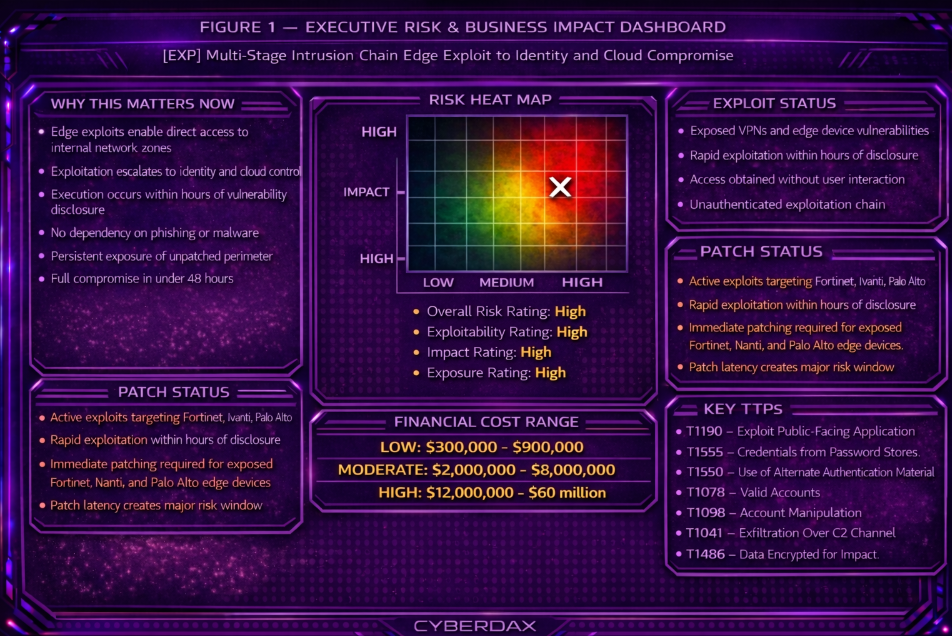
BLUF
Organizations face critical enterprise risk from intrusion chains that originate from exploitation of internet-facing edge devices and rapidly escalate into identity system takeover and cloud control compromise, enabling complete operational disruption, data exfiltration, and ransomware enablement. These attacks are initiated through vulnerabilities in perimeter appliances such as Fortinet VPNs, Ivanti Connect Secure gateways, and Palo Alto firewalls, allowing attackers to bypass traditional perimeter defenses and directly access trusted network zones. Exploitation is highly mature and operationalized, with threat actors consistently weaponizing vulnerabilities within hours and executing repeatable edge-to-identity-to-cloud compromise playbooks across multiple sectors. Organizations must treat exposed edge infrastructure and identity control planes as immediate enterprise risk priorities and reallocate security focus toward rapid patch enforcement, identity session protection, and privileged access restriction to prevent full-chain compromise.
Executive Risk Translation
A single exploited edge device can allow attackers to assume trusted identities and gain administrative control of cloud environments, resulting in full enterprise compromise before traditional security controls can respond.
S3 Why This Matters Now
· Active exploitation campaigns targeting Fortinet, Ivanti, and Palo Alto edge vulnerabilities are occurring within hours to days of public disclosure.
· FortiBleed reporting reinforces this intrusion model by showing how Fortinet edge exposure can shift from appliance compromise into credential harvesting, credential reuse, access resale, and ransomware-affiliate enablement.
· Public exploit code and automated scanning frameworks are rapidly integrated into attacker operations, increasing exploitation scale and speed.
· Observed intrusion timelines show full progression from edge access to cloud control in less than 48 hours.
· Persistent exposure of edge infrastructure combined with delayed patch cycles continues to expand the accessible attack surface.
· Detection visibility remains fragmented across edge, identity, and cloud layers, delaying recognition of multi-stage compromise.
S4 Key Judgments
· Edge device exploitation is the dominant and most reliable initial access vector in modern enterprise intrusion campaigns.
· Identity systems function as the primary control plane for attacker expansion, persistence, and privilege escalation.
· Cloud environments represent the ultimate objective due to centralized access to data, infrastructure, and administrative control.
· Attacker success depends on transitioning from network access to identity control without triggering detection.
· Organizations without integrated identity and cloud security controls remain highly susceptible to full-chain compromise.
S5 Executive Risk Summary
· Exploitation of edge devices enables unauthorized entry into trusted network zones, bypassing perimeter security controls.
· Attackers extract credentials and session artifacts, allowing impersonation of legitimate users and bypass of authentication safeguards.
· Compromised identities are leveraged to escalate privileges and gain administrative access within enterprise environments.
· Administrative access to cloud control planes enables persistent access, infrastructure manipulation, and large-scale data exfiltration.
S6 Executive Cost Summary
This cost analysis was developed by the CyberDax team using expert judgment and assisted analytical tools to support clarity and consistency.
· Low Impact Scenario
Edge exploitation detected and contained prior to identity compromise, resulting in limited investigation scope and minimal operational disruption. Estimated cost: 300,000 to 900,000 USD
· Moderate Impact Scenario
Identity compromise achieved with partial cloud access, resulting in data exposure, extended response operations, and regulatory notification requirements. Estimated cost: 2 million to 8 million USD
· High Impact Scenario
Full intrusion chain execution including identity takeover, cloud administrative control, data exfiltration, and ransomware deployment, resulting in enterprise-wide disruption, regulatory penalties, and prolonged recovery. Estimated cost: 12 million to 60 million USD or higher
S6A Key Cost Drivers
· Speed of detection between edge exploitation and identity compromise
· Degree of privileged identity access obtained by attackers
· Extent of cloud control-plane access and persistence mechanisms
· Volume and sensitivity of accessed or exfiltrated data
· Duration and complexity of incident response across multiple environments
· Regulatory exposure and legal obligations
· Operational downtime and business disruption
S6B Compliance and Risk Context
Compliance Exposure Indicator
Severe exposure for organizations handling regulated data due to unauthorized identity-based access across enterprise and cloud systems.
Risk Register Entry
· Risk Title: Edge-to-Identity-to-Cloud Intrusion Chain
· Risk Description: Exploitation of perimeter infrastructure enabling identity compromise and cloud administrative control
· Likelihood: High
· Impact: Severe
· Risk Rating: Critical
Annualized Risk Exposure
Estimated annualized exposure ranges from 5 million to 25 million USD based on high exploitation frequency, rapid attack execution timelines, and significant impact of full-chain compromise events.
S7 Operational Impact Assessment
· Initial access originating from exploited edge infrastructure is treated as trusted internal activity, allowing attacker operations to inherit legitimate network trust and bypass internal security controls.
· Authentication integrity is degraded as attackers operate using valid credentials and active session tokens, undermining confidence in identity-based access decisions.
· Session persistence mechanisms enable continued access even after credential resets, delaying effective containment.
· Administrative control over cloud environments allows unauthorized creation of privileged roles, persistence artifacts, and modification of critical services.
· Security monitoring effectiveness is reduced as attacker behavior blends with legitimate identity and cloud activity, complicating detection and investigation.
· Incident response requires synchronized containment across edge, identity, and cloud layers, significantly increasing operational complexity and recovery timelines.
S8 Bottom Line for Executives
Organizations must immediately eliminate exposed edge vulnerabilities, enforce strict identity session controls, and restrict privileged access to cloud environments to disrupt this attack chain. Security operations must prioritize detection of abnormal identity activity and cross-layer behavior rather than relying on endpoint-centric alerts. Failure to execute these controls allows attackers to progress from initial access to full enterprise control with minimal resistance.
S9 Board-Level Takeaway
This threat represents a governance-level failure condition where inadequate control over edge exposure, identity privilege, and cloud access enables enterprise-wide compromise. The board must ensure that management enforces accountability for vulnerability remediation at the edge, strict identity governance, and controlled cloud privilege boundaries as core risk controls. Failure to enforce these controls constitutes a material breakdown in enterprise risk management with direct financial and regulatory consequences.

S10 Campaign Overview
This campaign represents a multi-stage intrusion pattern in which attackers exploit internet-facing edge devices such as Fortinet SSL VPN, Ivanti Connect Secure, and Palo Alto GlobalProtect systems to gain trusted internal access. These systems act as authentication gateways, allowing attackers to transition from external access into enterprise identity systems without triggering traditional perimeter defenses.
Across observed incidents, attackers have leveraged device-level access to obtain authentication material, including credentials and active session artifacts, which are then used to establish valid identity sessions. This enables rapid pivot from initial access into identity control and subsequent expansion into cloud environments.
FortiBleed reporting reinforces this campaign model by demonstrating how Fortinet edge exposure can function as a credential-harvesting and access-monetization pathway. In this pattern, compromised FortiGate or Fortinet remote-access infrastructure may expose credentials, session material, or authentication-adjacent data that can be reused by follow-on operators, sold through access-broker channels, or leveraged by ransomware affiliates. The operational risk is not limited to initial appliance compromise; the greater enterprise exposure comes from downstream use of harvested access to authenticate as trusted users, expand into identity systems, and enable extortion-driven objectives
The campaign demonstrates a consistent operational model combining opportunistic exploitation at scale with targeted follow-on activity, including privilege escalation, data access, and ransomware deployment. The defining characteristic is the use of trusted identity pathways to achieve low-noise, high-impact compromise.
S11 Sectors AffectedS11 Sectors Affected
· Financial Services where centralized identity systems provide access to financial data and transactional platforms
· Healthcare where remote access infrastructure supports distributed clinical systems and sensitive patient data
· Technology and SaaS providers where identity systems directly control cloud infrastructure and customer environments
· Government and Public Sector where large identity ecosystems and legacy edge infrastructure increase exposure
· Critical Infrastructure where remote access systems are essential for operational continuity
· Manufacturing where VPN access bridges corporate IT and operational technology environments
S12 Countries Affected
· United States
· United Kingdom
· Canada
· Germany
· Australia
· Japan
These regions are consistently targeted due to high concentrations of enterprise infrastructure, cloud adoption, and reliance on remote access technologies.
S13 — Targets and Exposure Surface
The exposure surface includes internet-facing edge devices, Fortinet and FortiGate remote-access infrastructure, identity providers, cloud platforms, privileged accounts, reusable credential or session material, and out-of-band server-management interfaces that may provide a path from exposed infrastructure to privileged access.
· Organizations with exposed or unpatched edge devices that are directly integrated with identity providers or cloud platforms.
· Fortinet and FortiGate remote-access services where previously harvested VPN credentials, authentication material, session data, packet captures, support bundles, or configuration data may remain valid or reusable.
· Baseboard Management Controllers, IPMI services, iDRAC, iLO, and comparable internet-exposed out-of-band server-management interfaces whose authentication exchange may expose password-hash material for offline cracking and subsequent privileged management access.
· Organizations with weak identity controls, including limited session monitoring, inadequate token or credential protection, weak credential rotation, excessive privilege assignment, or continued trust in credentials associated with previously exposed edge infrastructure.
· Direct trust relationships between VPN systems and identity providers, identity providers configured to accept upstream authentication without additional validation, and cloud IAM roles or administrative accounts with broad privileges.
· Environments with delayed patching of internet-facing edge infrastructure, active remote-access services, vulnerable firmware or software, publicly available exploit material, weak segmentation between edge systems and identity infrastructure, or credential and session storage on exposed devices.
· Environments where Fortinet-derived remote-access credentials are reused across identity, administrative, or cloud-connected systems, or where suspected edge-device exposure is not followed by credential rotation and trust validation.
· Management networks and access controls governing BMC, IPMI, iDRAC, iLO, and comparable interfaces, particularly where inventory is incomplete, management interfaces are directly internet reachable, segmentation is weak, controller logging is insufficient, or BMC authentication cannot be correlated with subsequent privileged management activity.
Attackers receive high operational value from infrastructure that can be exploited without phishing or user interaction, supports repeatable targeting across multiple organizations, exposes reusable authentication material, enables credential resale or ransomware-affiliate handoff, or provides a direct transition into identity, cloud, or privileged management access.
S14 Initial Access Vector
The primary initial access vector is exploitation of vulnerabilities in internet-facing edge devices, including VPN gateways and firewall systems. These vulnerabilities allow attackers to access device file systems, configuration data, or session management components.
Because these systems function as authentication intermediaries, successful exploitation provides access within trusted network boundaries. This eliminates the need for phishing or endpoint compromise and allows attackers to interact directly with authentication infrastructure.
S15 Adversary Capability Profiling
Skill Level
High, with demonstrated ability to rapidly weaponize vulnerabilities and execute multi-stage intrusion chains
Infrastructure Maturity
Mature, leveraging distributed scanning infrastructure and automated exploitation frameworks
Operational Scalability
High during initial access, enabling exploitation of large numbers of exposed edge devices
Tooling Sophistication
Moderate to high, focused on exploit execution, credential extraction, and use of legitimate administrative interfaces
Escalation Likelihood
High, with consistent progression from initial access to identity compromise and privilege escalation
S16 Adversary Operational Objectives
· Establish authenticated access within enterprise identity systems
· Escalate privileges to administrative levels within identity providers
· Extend access into cloud environments through identity-based authorization
· Access and exfiltrate sensitive data from enterprise and cloud systems
· Monetize harvested Fortinet or FortiGate access through credential reuse, access resale, initial-access broker transfer, or ransomware-affiliate handoff
· Establish persistent access through identity and cloud control mechanisms
· Execute monetization objectives including ransomware deployment
S17 Exploit Status
Exploitation of edge device vulnerabilities is actively occurring in the wild, with attackers leveraging publicly available exploit code and automated scanning tools. Observed campaigns demonstrate rapid weaponization following vulnerability disclosure, with exploitation timelines measured in hours.
The widespread exposure of vulnerable edge systems and delays in patch deployment contribute to sustained exploitation opportunities. This indicates a high likelihood of continued exploitation across affected environments.
FortiBleed reporting should be treated as a material exploitation-status update within this same edge-device intrusion family. The significance is not limited to new appliance compromise; the operational risk comes from Fortinet or FortiGate access material that may remain usable after exposure, enabling credential reuse, downstream identity access, access resale, and ransomware-affiliate monetization. This reinforces the need to treat exposed or previously compromised Fortinet infrastructure as an active identity-risk condition until credentials, sessions, and trust relationships have been rotated or invalidated.
S17B Defensive Weakness Profile
· Overreliance on perimeter security controls without sufficient identity-layer monitoring
· Lack of visibility into session-based authentication activity within identity providers
· Insufficient segmentation between edge infrastructure and internal identity systems
· Limited monitoring of cloud control-plane activity and identity-based access
· Delayed patching of critical edge infrastructure due to operational constraints
These weaknesses enable attackers to transition from initial access to identity control with minimal resistance and limited detection.
S18 Attack Chain Overview
This intrusion chain begins with exploitation of internet-facing edge devices that function as authentication gateways, allowing attackers to gain access within trusted network boundaries. Because these systems originate authenticated sessions, attacker activity inherits internal trust and bypasses traditional perimeter detection.
Following initial access, attackers obtain authentication material from compromised devices and use it to establish valid sessions within identity providers. This enables immediate access to enterprise identity systems without triggering authentication challenges.
Attackers then expand access through enumeration of identity structures and privilege relationships, identifying escalation pathways and high-value targets. Privilege escalation is subsequently achieved through modification of identity roles and permissions, transitioning attacker access to administrative control.
With identity-level administrative access established, attackers extend control into cloud environments through identity-based authorization. This enables direct manipulation of infrastructure, access to sensitive data, and establishment of persistence mechanisms.
The attack concludes with execution of objectives such as data exfiltration, persistence, or ransomware deployment, conducted entirely through legitimate identity and cloud control channels.
S19 MITRE ATT&CK Mapping
Initial Access — T1190 Exploit Public-Facing Application
Exploitation of edge devices provides direct access to trusted network and authentication infrastructure
Credential Access — T1555 Credentials from Password Stores
Access to configuration files and memory exposes stored credentials and authentication data
Credential Access — T1550 Use of Alternate Authentication Material
Session tokens and authentication artifacts are reused to establish authenticated sessions without reauthentication
Persistence — T1078 Valid Accounts
Compromised credentials and session tokens are used to maintain persistent identity-based access
Privilege Escalation — T1098 Account Manipulation
Identity roles and permissions are modified to elevate access and gain administrative control
Discovery — T1087 Account Discovery
Attackers enumerate users, roles, and identity structures within enterprise environments
Discovery — T1069 Permission Groups Discovery
Privilege group relationships and role assignments are analyzed to identify escalation pathways
Lateral Movement — T1021 Remote Services
Authenticated access is used to move across enterprise systems and services
Command and Control — T1071 Application Layer Protocol
Communication occurs through standard protocols, blending with legitimate traffic
Exfiltration — T1041 Exfiltration Over C2 Channel
Data is extracted using authenticated communication channels
Impact — T1486 Data Encrypted for Impact
Administrative access enables ransomware deployment or destructive actions

S20 Attack Stage Breakdown
Stage 1 – Credential Harvesting
Attackers exploit edge devices to access configuration storage, memory, and active session data. This allows extraction of stored credentials and authentication artifacts associated with legitimate users. In many cases, attackers obtain session tokens that represent already authenticated user sessions, eliminating the need for credential-based login attempts.
Stage 2 – Valid Account Authentication
Using harvested credentials and session artifacts, attackers establish authenticated sessions within identity providers. Session reuse allows access without triggering authentication workflows, bypassing multi-factor authentication enforcement tied to login events. Activity appears as legitimate user behavior within identity logs.
Stage 3 – Account and Resource Discovery
Once authenticated, attackers query identity providers and cloud environments to enumerate users, roles, service accounts, and privilege relationships. This stage identifies high-value targets, administrative roles, and escalation pathways across both enterprise identity systems and cloud environments.
Stage 4 – Privilege Escalation and Control Transition
Attackers escalate privileges by modifying identity roles, group memberships, or cloud IAM permissions through administrative interfaces and APIs. This transitions attacker access from standard user context to administrative control over identity systems and cloud resources.
Stage 5 – Persistence and Objective Execution
With administrative control established, attackers maintain persistent access through identity-based mechanisms and execute objectives. This includes accessing or exfiltrating data, creating additional access pathways, modifying infrastructure, or deploying ransomware. All activity occurs through legitimate identity and cloud control channels, reducing detection likelihood.
S20A Adversary Tradecraft Summary
This intrusion model reflects a mature operational approach centered on identity control rather than traditional system exploitation. Attackers prioritize acquisition of authenticated access early in the intrusion chain, recognizing that control of identity systems enables access to both enterprise and cloud environments without additional exploitation.
A defining characteristic of this tradecraft is the use of existing authentication material to establish trusted access. By leveraging session-based authentication rather than initiating new login attempts, attackers avoid triggering authentication controls and reduce visibility within security monitoring systems.
The operational model supports separation between initial access and objective execution. Opportunistic exploitation identifies vulnerable edge systems and harvests access at scale, while follow-on actors leverage identity control for monetization or strategic objectives. This division increases efficiency, scalability, and resilience across campaigns.
FortiBleed reporting strengthens this tradecraft assessment by showing how Fortinet-derived access can support a divided intrusion economy. One operator may obtain or harvest credential material from exposed Fortinet or FortiGate infrastructure, while a separate access broker or ransomware affiliate later uses that material for authenticated entry, internal expansion, data access, or extortion preparation. This separation makes the intrusion chain harder to recognize because the exploitation event, credential reuse, and ransomware activity may occur at different times and may involve different actors.
The approach emphasizes low-noise execution, reliance on trusted system behavior, and rapid progression from initial access to full environment control, making detection dependent on correlation across identity, endpoint, and network telemetry.
S21 Indicators of Compromise (IOC Summary)
· Edge device access involving configuration files, session storage, or authentication components outside normal administrative activity
· Fortinet or FortiGate administrative, VPN, diagnostic, configuration-export, packet-capture, support-bundle, or backup activity occurring outside approved maintenance windows or involving unusual source infrastructure.
· Fortinet-derived credential or VPN activity followed by first-seen identity-provider access, new source IP authentication, unusual geographic access, unmanaged-device access, or administrative activity inconsistent with the user’s historical access pattern.
· Presence of unauthorized files or scripts on edge infrastructure indicative of persistent access mechanisms
· Identity session activity exhibiting inconsistencies in origin, continuity, or authentication lineage relative to expected user behavior
· Identity activity originating from infrastructure-associated IP ranges, including VPN gateways or edge systems, rather than user endpoints
· Privilege modification events within identity or cloud environments occurring outside established administrative workflows
· Cloud control-plane activity occurring in temporal proximity to identity session irregularities or privilege escalation
· Ransomware staging, data-access activity, file-encryption preparation, backup interference, or security-control modification occurring after Fortinet-origin VPN access, Fortinet-derived credential reuse, or first-seen identity activity associated with Fortinet exposure.
S22 Malware and Tooling
· Exploitation of internet-facing edge infrastructure including Fortinet, Ivanti, and Palo Alto systems to obtain configuration and session artifacts
· Use of Fortinet or FortiGate administrative functions, VPN services, diagnostic interfaces, packet-capture capabilities, configuration exports, support bundles, or backup artifacts to expose credential-bearing data or authentication-adjacent material.
· Reuse of Fortinet-derived credentials, VPN access material, or authentication artifacts by follow-on operators, access brokers, or ransomware affiliates to establish valid-looking access without requiring new exploitation of the edge device.
· Use of web shells or equivalent mechanisms on edge appliances to maintain access and enable command execution
· Extraction of credential and session-related data from device storage and configuration components
· Reuse of authentication material through session inheritance, replay, or token reuse techniques
· Use of identity provider administrative interfaces and APIs to modify roles, permissions, and access control structures
· Use of cloud control-plane APIs to establish persistence, escalate privileges, and manipulate infrastructure
· Reliance on legitimate system functionality and trusted interfaces rather than traditional malware deployment
· Use of legitimate VPN authentication, administrative tooling, remote-access pathways, data-staging utilities, backup-disruption activity, or encryption preparation after Fortinet-origin access has been converted into downstream identity or ransomware operations.
S23 Behavior and Log Artifacts
Purpose
To define stage-aligned attacker behaviors that represent observable activity and serve as candidate inputs for detection engineering validation.
Stage 1 – Credential Harvesting
· Access to edge device configuration and session storage components
· Interaction with credential-bearing system locations
· FortiGate administrative, diagnostic, packet-capture, support-bundle, configuration-export, or backup access involving credential-bearing or authentication-adjacent data
· Fortinet VPN, session, configuration, or traffic-capture artifacts accessed outside approved maintenance or forensic workflows
· Presence or execution of unauthorized files or scripts on edge systems
Stage 2 – Valid Account Authentication
· Session establishment inconsistent with expected authentication flow
· Identity activity lacking clear authentication lineage
· First-seen identity-provider authentication following known or suspected Fortinet exposure
· Successful authentication from Fortinet VPN ranges, Fortinet-derived source context, or source infrastructure inconsistent with the user’s normal access history
· Session behavior inconsistent with established user access patterns
Stage 3 – Account and Resource Discovery
· Enumeration of identity objects, roles, permissions, and service principals
· Repeated access to directory or IAM metadata
· Unusual query patterns within identity and cloud environments
Stage 4 – Privilege Escalation and Control Transition
· Modification of roles, group memberships, or IAM policies
· Elevation of privileges beyond normal identity usage patterns
· Administrative actions originating from previously non-privileged identities
Stage 5 – Persistence and Objective Execution
· Creation of new identities, credentials, or long-lived access mechanisms
· Data access inconsistent with identity baseline behavior
· Ransomware staging, file-access expansion, backup interference, or encryption preparation following Fortinet-origin VPN access or Fortinet-derived credential reuse
· Data-access or extortion-preparation behavior occurring after access-broker-style handoff from Fortinet-exposed credentials or VPN material
· Infrastructure modification or impact-aligned activity

S24 Detection Strategy
Purpose
To define the detection approach and prioritization model that will be implemented and validated through S25 detection engineering.
Detection Philosophy
· Focus on identity-centric intrusion behavior and post-authentication misuse rather than initial access signatures
· Prioritize session-based anomalies and identity activity patterns over login failure detection
· Detect multi-stage progression through correlation across edge, identity, and cloud activity
Stage-Aligned Detection Model
· Stage 1: Monitor interaction with edge systems and credential-bearing components
· Stage 2: Identify session anomalies and inconsistencies in authentication lineage
· Stage 3: Detect identity and IAM enumeration behavior
· Stage 4: Detect privilege escalation and access control modification
· Stage 5: Detect persistence mechanisms and impact-related activity
Detection Priorities
· Identity session irregularities and inconsistencies
· Fortinet-origin VPN, administrative, diagnostic, packet-capture, configuration-export, support-bundle, and credential-reuse activity that precedes first-seen identity access, privilege escalation, data staging, or ransomware preparation
· Privilege escalation events within identity providers and cloud environments
· Privilege escalation events within identity providers and cloud environments
· Cloud administrative activity following identity anomalies
· Edge system interaction patterns associated with credential access
Detection Constraints
· Limited visibility into edge appliance internals depending on platform and logging configuration
· Fortinet-derived credential exposure may be difficult to prove directly when packet capture, support-bundle access, configuration export, or credential harvesting occurs inside appliance-level workflows or before centralized telemetry collection begins
· Incomplete session lineage visibility within identity providers
· Encrypted traffic limiting inspection of network-level activity
· High baseline of legitimate administrative behavior introducing potential detection noise
S25 Ultra-Tuned Detection Engineering Rules
FortiBleed Tuning Addendum
FortiBleed-specific coverage should be implemented as tuning and localization of the existing edge-to-identity-to-cloud detection model, not as a separate rule family. Detection teams should localize edge-appliance scope to include Fortinet and FortiGate VPN, firewall, management, diagnostic, configuration-export, support-bundle, backup, and packet-capture activity where telemetry is available.
Existing Stage 1 rules should be tuned to include Fortinet-derived configuration, session, credential, support-bundle, backup, and packet-capture artifacts. Existing Stage 2 rules should correlate Fortinet VPN or FortiGate-origin access with first-seen identity-provider authentication, new source IP activity, unmanaged-device access, unusual geography, missing authentication lineage, or user behavior inconsistent with historical remote-access patterns.
Existing Stage 4 and Stage 5 rules should prioritize privilege changes, durable access creation, cloud administrative activity, data staging, backup interference, security-control modification, and ransomware-preparation activity that occurs after Fortinet-origin VPN access or suspected Fortinet-derived credential reuse. Analysts should treat Fortinet-derived credential reuse as an identity-risk condition even when direct appliance-level credential theft is not visible.
A key limitation is that FortiBleed-style credential harvesting may occur inside appliance-level workflows, including packet capture, diagnostic access, support-bundle handling, configuration export, or memory/session exposure, before centralized telemetry records the theft itself. For this reason, S25 detections should prioritize correlation between Fortinet exposure, credential reuse, identity anomalies, and downstream ransomware or cloud-control activity rather than relying on direct proof of appliance-internal sniffing.
Suricata
Engineering Position
These Suricata rules are intentionally limited to realistic network-layer observables. They provide supporting detection signals, not authoritative confirmation of credential theft, valid-account misuse, privilege escalation, or persistence. Incident-level conclusions require correlation with identity, endpoint, and cloud-audit telemetry.
Rule Name
Edge Appliance Sensitive Path Access Burst
Mapped Stage
Stage 1 Credential Harvesting
MITRE ATT&CK
T1190 – Exploit Public-Facing Application
T1555 – Credentials from Password Stores
T1550 – Use of Alternate Authentication Material
Purpose
Detect repeated access to high-risk administrative, export, configuration, and session-related web paths on internet-facing edge appliances consistent with post-access retrieval behavior.
What this rule detects
Repeated HTTP GET requests to sensitive edge appliance paths associated with administrative access, export functions, diagnostics, or session/configuration retrieval.
What this rule does not prove
Does not confirm credential theft, token theft, or successful session compromise.
Tuning Explanation
Restrict to known edge appliance IP ranges only.
Use only where HTTP URI visibility or TLS decryption is available.
Suppress approved vulnerability scanners, monitoring systems, backup collectors, and administrative bastions.
This path set is a generic baseline and should be replaced with product-specific paths where possible.
Treat as a collection-behavior signal, not exploit confirmation.
Suricata Rule
alert http $EXTERNAL_NET any -> $EDGE_APPLIANCES $HTTP_PORTS (
msg:"CYBERDAX EXP edge appliance sensitive path access burst";
flow:to_server,established;
http.method; content:"GET"; nocase;
http.uri;
pcre:"/^\/(?:admin|api|diag|debug|export|backup|session|config)(?:\/|\?|$)/Ui";
dsize:>50;
threshold:type both, track by_src, count 4, seconds 180;
classtype:attempted-admin;
metadata:service http, deployment Perimeter, attack_target edge-appliance, confidence Medium;
sid:410001;
rev:5;
)
Administrator Localization Instructions
Replace $EDGE_APPLIANCES with actual appliance ranges.
Replace URI patterns with vendor-specific paths where possible.
Clone POST variant only if required by the appliance.
Add suppressions for approved sources.
Disable if URI visibility is unavailable.
Logical Notes
Single-rule meaning: sensitive-path access anomaly.
Correlated meaning: possible credential or session artifact retrieval.
Rule Regret Check
Deployment caution
Requires URI visibility.
Confidence caution
May generate noise in managed environments.
Coverage value
Strong early-stage signal.
Rule Execution Validity
Correlation-ready detection. Not sufficient alone to confirm credential harvesting.
Rule Name
Identity Provider TLS Access from Non-User Infrastructure
Mapped Stage
Stage 2 Valid Account Authentication
MITRE ATT&CK
T1078 – Valid Accounts
T1550 – Use of Alternate Authentication Material
Purpose
Detect TLS access to identity-provider endpoints from infrastructure or edge network segments where user-authentication traffic is not expected.
What this rule detects
TLS sessions from non-user infrastructure to a specific identity-provider hostname.
What this rule does not prove
Does not confirm successful authentication or account compromise.
Tuning Explanation
Restrict to non-user infrastructure ranges.
Use exact IdP hostnames only.
Clone per IdP.
Suppress federation and proxy infrastructure.
Treat as contextual identity anomaly.
Suricata Rule
alert tls $INFRASTRUCTURE_NET any -> $EXTERNAL_NET 443 (
msg:"CYBERDAX EXP identity-provider TLS access from non-user infrastructure";
flow:to_server,established;
tls.sni;
content:"login.microsoftonline.com"; nocase; endswith;
threshold:type both, track by_src, count 3, seconds 300;
classtype:policy-violation;
metadata:service tls, deployment Egress, attack_target identity-provider, confidence Medium;
sid:410002;
rev:5;
)
Administrator Localization Instructions
Replace hostname with tenant IdP domains.
Scope infrastructure ranges correctly.
Suppress legitimate identity infrastructure.
Avoid generic matching.
Logical Notes
Single-rule meaning: unexpected IdP access origin.
Correlated meaning: possible session misuse.
Rule Regret Check
Deployment caution
SNI visibility may be reduced or eliminated in some environments.
Confidence caution
Middleware may generate similar traffic.
Coverage value
Strong supporting signal.
Rule Execution Validity
Correlation-ready detection. Requires identity telemetry for confirmation.
Rule Name
Cloud Control Plane TLS Access from Non-Admin Host
Mapped Stage
Late-Chain Activity (Privilege Escalation or Persistence — cannot be distinguished at network layer)
MITRE ATT&CK
T1098 – Account Manipulation
T1078 – Valid Accounts
Purpose
Detect TLS access to cloud control-plane endpoints from hosts that are not approved administrative systems.
What this rule detects
TLS connections to cloud management endpoints from atypical host classes.
What this rule does not prove
Does not confirm escalation, persistence, or objective execution.
Tuning Explanation
Restrict to non-admin hosts.
Use exact control-plane endpoints only.
Suppress automation and admin systems.
Azure is the only concretely implemented provider in this rule set.
Suricata Rule
alert tls $NON_ADMIN_HOSTS any -> $EXTERNAL_NET 443 (
msg:"CYBERDAX EXP cloud control-plane TLS access from non-admin host";
flow:to_server,established;
tls.sni;
content:"management.azure.com"; nocase; endswith;
threshold:type both, track by_src, count 5, seconds 600;
classtype:policy-violation;
metadata:service tls, deployment Egress, attack_target cloud-control-plane, confidence Medium;
sid:410003;
rev:5;
)
Administrator Localization Instructions
Replace host scope appropriately.
Clone per provider as needed.
Exclude admin and automation systems.
Logical Notes
Single-rule meaning: control-plane access from wrong host.
Correlated meaning: late-stage attack activity.
Rule Regret Check
Deployment caution
Depends on host-role accuracy and SNI visibility.
Confidence caution
Automation traffic may resemble malicious activity.
Coverage value
Strong late-chain signal.
Rule Execution Validity
Correlation-ready detection. Requires identity and cloud telemetry.
Engineering Note
Rule effectiveness depends on:
· HTTP visibility or TLS decryption (Rule 1)
· SNI visibility (Rules 2 and 3)
· Accurate asset scoping and suppression
These rules must be correlated with identity, endpoint, and cloud telemetry for full detection confidence.
SentinelOne
Engineering Position
These detections represent host-observable behavioral signals only. They do not independently confirm identity compromise, privilege escalation, or persistence. The modeled intrusion chain is identity-centric and requires correlation across endpoint, identity-provider, and cloud telemetry for confirmation.
These rules are deployment templates requiring enforcement controls. They are not safe for unrestricted standalone deployment.
Event Taxonomy Requirement
SentinelOne event schemas vary by tenant.
Before deployment, the following must be mapped:
· process events (for example: Process Creation, Process)
· network events (for example: Network Connection)
· file events (for example: File Read, File Creation)
Failure to map event taxonomy invalidates rule execution.
Rule Name
Sensitive Configuration or Session Artifact Access on Edge-Adjacent Systems
Mapped Stage
Stage 1 Credential Harvesting
MITRE ATT&CK
T1555 – Credentials from Password Stores
T1550 – Use of Alternate Authentication Material
SOC Usage Mode
Alert-capable supporting detection
Minimum Deployment Requirement
Deployment restricted to systems that store edge configuration exports, support bundles, or backup artifacts.
Enforcement Method
Enforced through deployment scoping only to approved host groups.
Implementation Constraint Notes
Deployment outside scoped edge-adjacent systems is not permitted.
Broad Linux deployment is not permitted.
SentinelOne Deep Visibility Query
EventType IN ("File Creation","File Modification","File Rename","File Read")
AND AgentOs = "linux"
AND FilePath RegExp "(?i)(session|token|config|backup|export)"
AND ProcessName IN ("bash","sh","python","python3","tar","cp","scp","curl","wget","grep","cat")
AND NOT ProcessName IN ("rsync")
AND NOT CommandLine RegExp "(?i)(ansible|puppet|chef|salt|backup|monitor|compliance)"
Logical Notes
Single-rule meaning: sensitive file-access behavior
Correlated meaning: potential credential or session artifact harvesting
Rule 2
Rule Name
Outbound Identity-Provider Access from Non-User Host
Mapped Stage
Stage 2 Valid Account Authentication
MITRE ATT&CK
T1078 – Valid Accounts
T1550 – Use of Alternate Authentication Material
SOC Usage Mode
Correlation-only
Minimum Deployment Requirement
Requires:
· host-role classification
· destination enrichment OR baseline deviation detection
Enforcement Method
Must be enforced through:
· deployment only on non-user host groups
· correlation with identity telemetry
· enrichment identifying identity-provider infrastructure
Implementation Constraint Notes
Standalone alerting is not permitted.
Deployment without host-role scoping is not permitted.
Deployment without enrichment or correlation is not permitted.
SentinelOne Deep Visibility Query
EventType = "Network Connection"
AND DstPort = "443"
AND ProcessName IN ("chrome","msedge","firefox","curl","wget","powershell","pwsh","python","python3")
AND NOT ProcessName IN ("java","node","kubelet")
AND NOT CommandLine RegExp "(?i)(identity-sync|federation|sso|proxy)"
Logical Notes
Single-rule meaning: authentication-capable outbound traffic
Correlated meaning: potential session misuse
Rule Name
Cloud and Identity Enumeration Command Activity
Mapped Stage
Stage 3 Discovery
MITRE ATT&CK
T1087 – Account Discovery
T1069 – Permission Groups Discovery
SOC Usage Mode
Correlation or hunt only
Minimum Deployment Requirement
Requires:
· multi-execution correlation
· OR time-based burst logic external to SentinelOne
Enforcement Method
Enforced through:
· SIEM/XDR correlation logic
· OR hunt-only operational use
Implementation Constraint Notes
Standalone alerting is not permitted.
Single execution must not trigger paging.
Deployment without correlation capability is not permitted.
SentinelOne Deep Visibility Query
EventType = "Process Creation"
AND (
CommandLine RegExp "(?i)\baz ad user list\b"
OR CommandLine RegExp "(?i)\baws iam list-"
OR CommandLine RegExp "(?i)\bgcloud projects get-iam-policy\b"
)
AND NOT CommandLine RegExp "(?i)(terraform|ansible|ci-runner|approved-admin)"
Logical Notes
Single-rule meaning: enumeration command execution
Correlated meaning: privilege discovery
Rule Name
Privilege Modification Command Execution from Non-Standard Host
Mapped Stage
Stage 4 Privilege Escalation
MITRE ATT&CK
T1098 – Account Manipulation
SOC Usage Mode
Enforced through:
· suppression lists
· host-role scoping
· workflow exclusion
Implementation Constraint Notes
Deployment without suppression maturity is not permitted.
Deployment on approved admin systems is not permitted.
SentinelOne Deep Visibility Query
EventType = "Process Creation"
AND CommandLine RegExp "(?i)(\baz role assignment create\b|\baws iam attach-role-policy\b|\bgcloud projects add-iam-policy-binding\b)"
AND NOT CommandLine RegExp "(?i)(terraform|ci-runner|approved-admin|change-window)"
Logical Notes
Single-rule meaning: privilege-changing command execution
Correlated meaning: escalation confirmed via audit logs
Rule Name
Persistence or High-Risk Cloud Operation Tool Execution
Mapped Stage
Stage 5 Persistence / Objective Execution
MITRE ATT&CK
T1078 – Valid Accounts
T1098 – Account Manipulation
SOC Usage Mode
Correlation-first
Minimum Deployment Requirement
Requires:
· host-role scoping
· exclusion of backup, migration, provisioning systems
Enforcement Method
Enforced through:
· deployment only on atypical hosts
· correlation with prior-stage activity
· optional rule splitting
Implementation Constraint Notes
Standalone alerting is not permitted until validated.
If noise persists, rule must be split into:
· persistence creation
· data operation
Weakening detection logic is not permitted.
SentinelOne Deep Visibility Query
EventType = "Process Creation"
AND (
CommandLine RegExp "(?i)(\bcreate-access-key\b|\bclient secret\b|\bservice-principal create\b)"
OR CommandLine RegExp "(?i)(\baws s3 cp\b|\bgsutil cp\b)"
)
AND NOT CommandLine RegExp "(?i)(backup|migration|provisioning|approved-admin|ci-runner)"
Logical Notes
Single-rule meaning: high-risk cloud tooling execution
Correlated meaning: persistence or objective execution
Splunk
Engineering Position
Splunk is the authoritative detection layer for identity and cloud control-plane activity. These rules detect confirmed authentication, privilege modification, persistence creation, and high-risk operational behavior when proper logging and normalization are present.
Detection quality depends on:
· normalized fields
· complete cloud audit log ingestion
· suppression maturity for approved workflows
Event Normalization Requirement
User Identity
user, userPrincipalName, identity, principal
Source IP
src_ip, client_ip, ipAddress
Action
action, operationName, eventName
Failure to normalize invalidates detection consistency.
Rule Name
Sensitive Configuration or Session Artifact Access via File or Storage Logs
Mapped Stage
Stage 1 Credential Harvesting
MITRE ATT&CK
T1555 – Credentials from Password Stores
SOC Usage Mode
Correlation-only (low confidence standalone)
Minimum Deployment Requirement
Requires reliable file-access or storage-access logging.
Enforcement Method
Enforced through correlation with:
· endpoint telemetry
· edge access activity
Implementation Constraint Notes
Standalone alerting is not permitted.
Deployment without verified file or storage telemetry is not permitted.
Splunk Query
index=* (file_access OR storage_access)
| eval file_path=coalesce(file_path, object, uri)
| search file_path="*config*" OR file_path="*session*" OR file_path="*token*" OR file_path="*backup*"
| bin time span=10m
| stats count by user, srcip, file_path, _time
| where count > 3
Variant Analysis
Covered:
· config, session, token, backup artifacts
Not Covered:
· endpoint-local access without logging
· encrypted storage access without visibility
Rule Name
Successful Authentication from Atypical Source or First-Seen IP
Mapped Stage
Stage 2 Valid Account Authentication
MITRE ATT&CK
T1078 – Valid Accounts
SOC Usage Mode
Alert-capable supporting detection
Minimum Deployment Requirement
Requires:
· historical authentication data (baseline)
· source IP tracking
Enforcement Method
Enforced through:
· first-seen source detection OR
· deviation from historical user baseline
Implementation Constraint Notes
Standalone alerting without baseline comparison is not permitted.
Splunk Query
index=auth_logs
| eval user=coalesce(user, userPrincipalName, identity, principal)
| eval src_ip=coalesce(src_ip, client_ip, ipAddress)
| search result="success"
| stats earliest(_time) as first_seen by user, src_ip
| where first_seen > relative_time(now(), "-1d")
Variant Analysis
Covered:
· new source IP authentication events
Not Covered:
· token reuse without new login
· federated authentication without source visibility
Rule Name
Identity and IAM Enumeration Burst
Mapped Stage
Stage 3 Discovery
MITRE ATT&CK
T1087 – Account Discovery
T1069 – Permission Groups Discovery
SOC Usage Mode
Alert-capable with enforced burst logic
Minimum Deployment Requirement
Requires:
· cloud audit logs
· normalized action field
Enforcement Method
Enforced through:
· time-bound burst window
· user-level aggregation
Implementation Constraint Notes
Single-event alerting is not permitted.
Burst window enforcement is mandatory.
Splunk Query
index=cloud_logs
| eval user=coalesce(user, userPrincipalName, identity, principal)
| eval action=coalesce(action, operationName, eventName)
| search action IN ("ListUsers","ListRoles","GetRole","ListGroups","DescribeInstances")
| bin time span=5m
| stats count, dc(action) as distinctactions by user, time
| where count > 5 OR distinctactions > 3
Variant Analysis
Covered:
· multi-action enumeration bursts
Not Covered:
· low-and-slow enumeration
· provider-specific APIs not listed
Rule Name
Privilege Boundary Change or Role Assignment Modification
Mapped Stage
Stage 4 Privilege Escalation
MITRE ATT&CK
T1098 – Account Manipulation
SOC Usage Mode
Alert-capable primary detection
Minimum Deployment Requirement
Requires:
· cloud audit logs with administrative actions
· suppression of approved admin workflows
Enforcement Method
Enforced through:
· direct detection of privilege-changing actions only
Implementation Constraint Notes
Credential creation and data operations are not permitted in this rule.
Splunk Query
index=cloud_logs
| eval user=coalesce(user, userPrincipalName, identity, principal)
| eval action=coalesce(action, operationName, eventName)
| search action IN ("AddRoleAssignment","AttachRolePolicy","PutRolePolicy","AddMemberToPrivilegedGroup","GrantAdminRole")
| stats count by user, action
Variant Analysis
Covered:
· direct role and policy modification actions
Not Covered:
· indirect escalation paths
· inherited privilege escalation
Rule Name
Durable Access Artifact Creation
Mapped Stage
Stage 5 Persistence
MITRE ATT&CK
T1078 – Valid Accounts
T1098 – Account Manipulation
SOC Usage Mode
Alert-capable high-confidence detection
Minimum Deployment Requirement
Requires cloud audit logs capturing identity-object creation.
Enforcement Method
Enforced through:
· direct detection of credential and identity artifact creation
Implementation Constraint Notes
Privilege modification is not permitted in this rule.
Splunk Query
index=cloud_logs
| eval user=coalesce(user, userPrincipalName, identity, principal)
| eval action=coalesce(action, operationName, eventName)
| search action IN ("CreateAccessKey","CreateServicePrincipal","AddClientSecret","CreateApplicationCredential","GrantOAuthConsent")
| stats count by user, action
Variant Analysis
Covered:
· credential and identity artifact creation
Not Covered:
· delegated token creation not logged
· temporary token abuse
Rule Name
High-Risk Cloud Data or Control-Plane Action
Mapped Stage
Stage 5 Objective Execution
MITRE ATT&CK
T1078 – Valid Accounts
T1098 – Account Manipulation
SOC Usage Mode
Correlation-first (alert after tuning maturity)
Minimum Deployment Requirement
Requires:
· cloud audit logs
· suppression of normal data workflows
Enforcement Method
Enforced through:
· correlation with prior-stage activity
· or tuned action-family filtering
Implementation Constraint Notes
If noise is high, must split by:
· data actions
· control-plane actions
Splunk Query
index=cloud_logs
| eval user=coalesce(user, userPrincipalName, identity, principal)
| eval action=coalesce(action, operationName, eventName)
| search action IN ("PutObject","UploadObject","CreateSnapshot","ModifyLogging","DisableSecurityControl")
| stats count by user, action
Variant Analysis
Covered:
· storage, snapshot, and control-plane actions
Not Covered:
· encrypted or delegated operations
· provider-specific APIs not included
Elastic
Engineering Position
Elastic functions as the identity, cloud, and correlation enforcement layer. It is authoritative for:
· Successful authentication validation
· Privilege boundary changes
· Persistence artifact creation
· Multi-stage attack correlation
Elastic is not authoritative for edge appliance internals, and detection must account for:
· incomplete session lineage
· encrypted traffic limitations
· legitimate administrative noise
Detection is therefore identity-centric and correlation-driven, not single-signal dependent.
Data Normalization Requirement (Mandatory)
User Identity
user.name, user.email, user.id
Source Context
source.ip, source.geo.country_name
Action
event.action, event.type, cloud.audit.method_name
Outcome
event.outcome
Constraint
Deployment without validated normalization is not permitted
Rule Name
Edge-Adjacent Sensitive Artifact Access or Suspicious Tooling
Mapped Stage
Stage 1 Credential Harvesting
MITRE ATT&CK
T1555 – Credentials from Password Stores
T1550 – Use of Alternate Authentication Material
Rule Type
Custom query
SOC Usage Mode
Correlation-only
Minimum Deployment Requirement
· Edge-adjacent host scoping
· File and process telemetry availability
Enforcement Method
Enforced through strict host scoping only
Implementation Constraint Notes
· Standalone alerting is not permitted
· Provides partial Stage 1 coverage only
· Broad enterprise deployment is not permitted
Elastic Query
host.os.type:linux and
(
(event.category:file and file.path:(*session* or token or config or backup or export))
or
(event.category:process and process.command_line:(*session* or token or config or backup or tmp))
)
and not process.command_line:(*ansible* or puppet or chef or backup)
Administrator Localization Instructions
· Replace generic paths with real export and backup locations
· Restrict to systems handling edge-derived artifacts
· Add suppression for approved automation
Variant Analysis
Covered
· Artifact access patterns
· Basic suspicious tooling
Not Covered
· Appliance-internal access
· Memory-only harvesting
· Vendor-specific paths
Rule Name
Successful Authentication Deviating from Historical Baseline
Mapped Stage
Stage 2 Valid Account Authentication
MITRE ATT&CK
T1078 – Valid Accounts
T1550 – Use of Alternate Authentication Material
Rule Type
ES|QL
SOC Usage Mode
Alert-capable supporting detection
Minimum Deployment Requirement
· Minimum 14-day historical baseline
· Normalized identity and source fields
Enforcement Method
Baseline comparison (historical vs recent activity)
Implementation Constraint Notes
· Deployment without baseline data is not permitted
· Failed logins must not be included
Elastic Query
FROM auth-*
| WHERE event.outcome == "success"
| EVAL actor = COALESCE(user.name, user.email, user.id)
| EVAL src = COALESCE(source.ip, related.ip)
| WHERE actor IS NOT NULL AND src IS NOT NULL
| EVAL recent = CASE(@timestamp >= NOW() - 1 day, 1, 0)
| STATS
recent_count = SUM(recent),
historical_count = COUNT() - SUM(recent)
BY actor, src
| WHERE recent_count > 0 AND historical_count == 0
Administrator Localization Instructions
· Adjust baseline window if required
· Integrate with device trust or MFA context if available
Variant Analysis
Covered
· First-seen source authentication
Not Covered
· Token reuse
· Federated auth without source attribution
Rule Name
Identity and IAM Enumeration Burst
Mapped Stage
Stage 3 Discovery
MITRE ATT&CK
T1087 – Account Discovery
T1069 – Permission Groups Discovery
Rule Type
Threshold rule
SOC Usage Mode
Alert-capable (burst enforced)
Minimum Deployment Requirement
· Normalized cloud audit logs
· Exception lists for admin tooling
Enforcement Method
Time-bound threshold enforcement
Implementation Constraint Notes
· Single-event alerting is not permitted
· Exception tuning is mandatory
Elastic Query
event.action:(
"ListUsers" or
"ListRoles" or
"GetRole" or
"ListGroups" or
"ListServicePrincipals" or
"GetIamPolicy" or
"ListRoleAssignments" or
"ListApplications"
)
Threshold Configuration
Group by: user.name
Count: ≥ 6
Window: 5 minutes
Administrator Localization Instructions
· Replace with tenant-specific verbs
· Add suppression for governance tools
Variant Analysis
Covered
· Burst enumeration patterns
Not Covered
· Low-and-slow enumeration
· Unmapped provider actions
Rule Name
Privilege Boundary Change or Access-Control Modification
Mapped Stage
Stage 4 Privilege Escalation
MITRE ATT&CK
T1098 – Account Manipulation
Rule Type
Custom query
SOC Usage Mode
Alert-capable primary detection
Minimum Deployment Requirement
· Cloud audit logs
· Admin suppression rules
Enforcement Method
Direct privilege-change action matching
Implementation Constraint Notes
· Credential creation not permitted here
· Action set must be tenant-validated
Elastic Query
event.action:(
"AddRoleAssignment" or
"AttachRolePolicy" or
"PutRolePolicy" or
"AddMemberToPrivilegedGroup" or
"GrantAdminRole" or
"SetIamPolicy"
)
Administrator Localization Instructions
· Map provider-specific privilege actions
· Suppress approved workflows
Variant Analysis
Covered
· Direct privilege escalation actions
Not Covered
· Indirect escalation
· Unlogged permission inheritance
Rule Name
Durable Access Artifact Creation
Mapped Stage
Stage 5 Persistence
MITRE ATT&CK
T1078 – Valid Accounts
T1098 – Account Manipulation
Rule Type
Custom query
SOC Usage Mode
Alert-capable high-confidence detection
Minimum Deployment Requirement
· Credential creation logs
Enforcement Method
Direct artifact creation detection
Implementation Constraint Notes
· Privilege modification not permitted here
· Action set must be tenant-validated
Elastic Query
event.action:(
"CreateAccessKey" or
"CreateServicePrincipal" or
"AddClientSecret" or
"CreateApplicationCredential" or
"AddPasswordCredential" or
"AddKeyCredential"
)
Administrator Localization Instructions
· Map provider-specific credential verbs
· Keep suppression minimal and controlled
Variant Analysis
Covered
· Durable credential creation
Not Covered
· Temporary tokens
· Delegated access
Rule Name
High-Risk Cloud Action Following Privilege Transition
Mapped Stage
Stage 5 Objective Execution
MITRE ATT&CK
T1078 – Valid Accounts
T1098 – Account Manipulation
Rule Type
EQL
SOC Usage Mode
Correlation-first
Minimum Deployment Requirement
· Normalized logs
· Consistent user attribution
Enforcement Method
Sequence-based correlation
Implementation Constraint Notes
· Standalone alerting is not permitted
· Split rule if data noise is high
Elastic Query
sequence by user.name with maxspan=30m
[ any where event.action in (
"AddRoleAssignment",
"AttachRolePolicy",
"PutRolePolicy",
"GrantAdminRole",
"SetIamPolicy"
) ]
[ any where event.action in (
"PutObject",
"UploadObject",
"CreateSnapshot",
"ModifyLogging",
"DisableSecurityControl",
"DeleteTrail"
) ]
Administrator Localization Instructions
· Replace action sets with tenant-specific mappings
· Split into separate rules if needed
Variant Analysis
Covered
· Privilege transition followed by high-risk action
Not Covered
· Slow execution outside correlation window
· Unattributed delegated actions
QRadar
Engineering Position
QRadar is the stateful offense and correlation layer for this chain. Event rules in CRE are the primary detection mechanism, building blocks provide reusable scope and action families, and reference sets hold watchlist/baseline state used by rules.
Mandatory Pre-Deployment Controls
Before enabling any rule below:
1. Validate building blocks
· BB:HostDefinition:Edge_Adjacent_Systems
· BB:HostDefinition:Non_User_Infrastructure
· BB:HostDefinition:Non_Admin_Hosts
· BB:LogSource:Identity_Provider
· BB:Exclude:Approved_Admin_and_Automation
· BB:ActionFamily:Identity_IAM_Enumeration
· BB:ActionFamily:Privilege_Boundary_Change
· BB:ActionFamily:Durable_Access_Artifact_Creation
BB:ActionFamily:High_Risk_Cloud_Post_Control
2. Validate reference sets
· RS:User_Source_Baseline_14d
· RS:Recent_Stage2_Actors_30m
· RS:Recent_Stage4_Actors_30m
3. Validate custom event properties if DSM normalization is incomplete
· CEP_UserName
· CEP_SourceIP
· CEP_ActionName
· CEP_Outcome
· CEP_TargetObject
· CEP_ActorRole
Deployment without validated BB population and reference-set readiness is not permitted. QRadar supports custom event properties and reference-set-backed rule logic directly.
Reference Set Lifecycle Controls
RS:User_Source_Baseline_14d
· populate during a 7-day burn-in period
during burn-in, do not create offenses from first-seen user/source logic
· after burn-in, add CEP_UserName|CEP_SourceIP on successful auth events with 14-day expiry
· review top churn pairs weekly; remove known ephemeral or synthetic sources if needed
RS:Recent_Stage2_Actors_30m
· populated only by Rule 2
· 30-minute expiry
· used only for downstream Stage 5B correlation
RS:Recent_Stage4_Actors_30m
· populated only by Rule 4
· 30-minute expiry
· used only for downstream Stage 5B correlation
Starter Building Block Content
BB:ActionFamily:Privilege_Boundary_Change
Starter provider verbs:
· Azure / Entra: Add member to role, Add directory role member, Add app role assignment
· AWS: AttachRolePolicy, AttachUserPolicy, PutRolePolicy, PutUserPolicy
· GCP: SetIamPolicy, projects.setIamPolicy
BB:ActionFamily:Durable_Access_Artifact_Creation
Starter provider verbs:
· Azure / Entra: Add client secret, Add password credential, Add key credential, Create service principal
· AWS: CreateAccessKey, CreateLoginProfile
· GCP: service-account key creation equivalents as normalized in the tenant
BB:ActionFamily:High_Risk_Cloud_Post_Control
Starter provider verbs:
· Azure: storage upload, diagnostic/logging changes, snapshot or disk export equivalents as normalized
· AWS: PutObject, CloudTrail/logging changes, snapshot creation equivalents
· GCP: storage object upload, logging/config changes, snapshot equivalents as normalized
These are starter populations, not complete coverage. Variant completeness still depends on tenant-normalized event names and QIDs. Building blocks are specifically intended to hold reusable groups of event names, IPs, or privileged identities.
Rule Name
Edge-Adjacent Artifact Access or Suspicious Tooling
Mapped Stage
Stage 1 Credential Harvesting
MITRE ATT&CK
T1555 – Credentials from Password Stores
T1550 – Use of Alternate Authentication Material
Rule Type
Event Rule — Local
SOC Usage Mode
Correlation-only
Minimum Deployment Requirement
· BB:HostDefinition:Edge_Adjacent_Systems validated
· edge-adjacent host telemetry available
· approved maintenance exclusions validated
Enforcement Method
Strict host scoping with BB:HostDefinition:Edge_Adjacent_Systems and BB:Exclude:Approved_Admin_and_Automation
Implementation Constraint Notes
· standalone offense creation is not permitted
· broad deployment is not permitted
· partial Stage 1 coverage only, consistent with the source model’s edge-visibility constraints
CRE Wizard Test Order
when the event matches any of:
o event name/category indicates file access to session, token, config, backup, or export artifacts
o event name/category indicates suspicious process or script touching those artifacts
and when the event matches BB:HostDefinition:Edge_Adjacent_Systems
and when the event does not match BB:Exclude:Approved_Admin_and_Automation
and when at least 3 events are seen with the same source IP or hostname in 10 minutes
Responses
· add to offense only
· magnitude: Low
· rule response note: Stage1_Supporting_Edge_Artifact_Access
AQL Validation
SELECT username, sourceip, destinationip, QIDNAME(qid), COUNT(*) AS event_count
FROM events
WHERE (
UTF8(payload) ILIKE '%session%' OR
UTF8(payload) ILIKE '%token%' OR
UTF8(payload) ILIKE '%config%' OR
UTF8(payload) ILIKE '%backup%' OR
UTF8(payload) ILIKE '%export%'
)
GROUP BY username, sourceip, destinationip, QIDNAME(qid)
LAST 10 MINUTES
Variant Analysis
Covered
copied config, session, token, and backup artifact access; suspicious tooling on edge-adjacent systems.
Not Covered
appliance-internal-only activity, memory-only harvesting, vendor-specific artifact names absent from normalized telemetry.
Rule Name
Successful Identity Activity from First-Seen or Infrastructure Source
Mapped Stage
Stage 2 Valid Account Authentication
MITRE ATT&CK
T1078 – Valid Accounts
T1550 – Use of Alternate Authentication Material
Rule Type
Event Rule — Global
SOC Usage Mode
Alert-capable supporting detection
Minimum Deployment Requirement
· BB:LogSource:Identity_Provider validated
· BB:HostDefinition:Non_User_Infrastructure validated
· RS:User_Source_Baseline_14d active after burn-in
· CEP_Outcome normalized
Enforcement Method
Infrastructure-origin scoping or first-seen user/source baseline test
Implementation Constraint Notes
· failed-auth-only logic is not permitted
· deployment before baseline burn-in is not permitted for first-seen mode
· this remains supporting detection because session lineage can be incomplete in the source model
CRE Wizard Test Order
1. when the event matches BB:LogSource:Identity_Provider
2. and when CEP_Outcome = success
3. and when any of:
o source IP is in BB:HostDefinition:Non_User_Infrastructure
o CEP_UserName|CEP_SourceIP is not in RS:User_Source_Baseline_14d
4. and when the event does not match BB:Exclude:Approved_Admin_and_Automation
Responses
· create offense
· magnitude: Medium
· add CEP_UserName to RS:Recent_Stage2_Actors_30m with 30-minute expiry
· after burn-in, add CEP_UserName|CEP_SourceIP to RS:User_Source_Baseline_14d with 14-day expiry
· rule response note: Stage2_Supporting_Identity_Anomaly
AQL Validation
SELECT username, sourceip, LOGSOURCENAME(logsourceid), QIDNAME(qid), COUNT(*) AS event_count
FROM events
WHERE LOGSOURCENAME(logsourceid) ILIKE '%okta%'
OR LOGSOURCENAME(logsourceid) ILIKE '%azure%'
OR LOGSOURCENAME(logsourceid) ILIKE '%entra%'
GROUP BY username, sourceip, LOGSOURCENAME(logsourceid), QIDNAME(qid)
LAST 1 DAY
Variant Analysis
Covered: infrastructure-origin successful identity activity and first-seen user/source pairs.
Not Covered: token reuse with no IdP event, federated flows with poor attribution, session inheritance without a new success event.
Rule Name
Identity and IAM Enumeration Burst
Mapped Stage
Stage 3 Account and Resource Discovery
MITRE ATT&CK
T1087 – Account Discovery
T1069 – Permission Groups Discovery
Rule Type
Event Rule — Global
SOC Usage Mode
Alert-capable with burst enforcement
Minimum Deployment Requirement
· BB:ActionFamily:Identity_IAM_Enumeration populated
· approved governance and inventory exclusions validated
· actor field normalized
Enforcement Method
Global burst threshold by actor, with distinct-action expectation
Implementation Constraint Notes
· single-event alerting is not permitted
· governance and inventory suppression is mandatory
· if the tenant cannot distinguish event families well, keep this rule supporting-only
CRE Wizard Test Order
1. when the event matches BB:ActionFamily:Identity_IAM_Enumeration
2. and when the event does not match BB:Exclude:Approved_Admin_and_Automation
3. and when at least 6 events are seen with the same CEP_UserName in 5 minutes
4. and when at least 2 different QIDs or normalized actions are observed for that same CEP_UserName in the same interval
Responses
· create offense if none exists
· otherwise add to existing offense for same CEP_UserName
· magnitude: Medium
· rule response note: Stage3_Enumeration_Burst
AQL Validation
SELECT username, QIDNAME(qid), COUNT(*) AS event_count
FROM events
WHERE QIDNAME(qid) ILIKE '%ListUsers%'
OR QIDNAME(qid) ILIKE '%ListRoles%'
OR QIDNAME(qid) ILIKE '%ListGroups%'
OR QIDNAME(qid) ILIKE '%GetIamPolicy%'
GROUP BY username, QIDNAME(qid)
LAST 5 MINUTES
Variant Analysis
Covered: burst enumeration of users, groups, roles, service principals, applications, and IAM metadata.
Not Covered: low-and-slow discovery, provider-specific verbs absent from the BB, and discovery only visible in upstream SaaS logs not ingested into QRadar.
Rule Name
Privilege Boundary Change or Access-Control Modification
Mapped Stage
Stage 4 Privilege Escalation and Control Transition
MITRE ATT&CK
T1098 – Account Manipulation
Rule Type
Event Rule — Local
SOC Usage Mode
Alert-capable primary detection
Minimum Deployment Requirement
· BB:ActionFamily:Privilege_Boundary_Change populated
· approved admin exceptions validated
· CEP_ActionName normalized
Enforcement Method
Direct action-family match only
Implementation Constraint Notes
· credential creation is not permitted in this rule
· data actions are not permitted in this rule
· deployment without approved admin exceptions is not permitted
CRE Wizard Test Order
1. when the event matches BB:ActionFamily:Privilege_Boundary_Change
2. and when the event does not match BB:Exclude:Approved_Admin_and_Automation
Responses
· create offense
· magnitude: High
· add CEP_UserName to RS:Recent_Stage4_Actors_30m with 30-minute expiry
· rule response note: Stage4_Privilege_Boundary_Change
AQL Validation
SELECT username, sourceip, QIDNAME(qid), COUNT(*) AS event_count
FROM events
WHERE QIDNAME(qid) ILIKE '%Role%'
OR QIDNAME(qid) ILIKE '%Policy%'
OR QIDNAME(qid) ILIKE '%PrivilegedGroup%'
GROUP BY username, sourceip, QIDNAME(qid)
LAST 1 DAY
Variant Analysis
Covered: direct role, policy, trust-policy, and privileged membership changes.
Not Covered: indirect escalation via inherited permissions, non-audited control expansion, and poorly normalized provider actions.
Rule Name
Durable Access Artifact Creation
Mapped Stage
Stage 5 Persistence
MITRE ATT&CK
T1078 – Valid Accounts
T1098 – Account Manipulation
Rule Type
Event Rule — Local
SOC Usage Mode
Alert-capable high-confidence detection
Minimum Deployment Requirement
· BB:ActionFamily:Durable_Access_Artifact_Creation populated
· credential/application creation logs ingested
· CEP_ActionName normalized
Enforcement Method
Direct artifact-creation match only
Implementation Constraint Notes
· privilege-boundary changes are not permitted in this rule
· bulk data or storage actions are not permitted in this rule
CRE Wizard Test Order
1. when the event matches BB:ActionFamily:Durable_Access_Artifact_Creation
2. and when the event does not match BB:Exclude:Approved_Admin_and_Automation
Responses
· create offense
· magnitude: High
· rule response note: Stage5_Persistence_Durable_Access
AQL Validation
SELECT username, sourceip, QIDNAME(qid), COUNT(*) AS event_count
FROM events
WHERE QIDNAME(qid) ILIKE '%AccessKey%'
OR QIDNAME(qid) ILIKE '%ServicePrincipal%'
OR QIDNAME(qid) ILIKE '%ClientSecret%'
OR QIDNAME(qid) ILIKE '%Credential%'
GROUP BY username, sourceip, QIDNAME(qid)
LAST 1 DAY
Variant Analysis
Covered: durable credential and identity-artifact creation.
Not Covered: temporary-token abuse, delegated grants without durable object creation, unmanaged trust-path persistence.
Rule Name
High-Risk Cloud Action Following Privilege Transition or Identity Anomaly
Mapped Stage
Stage 5 Objective Execution
MITRE ATT&CK
T1078 – Valid Accounts
T1098 – Account Manipulation
Rule Type
Event Rule — Global
SOC Usage Mode
Correlation-first
Minimum Deployment Requirement
· BB:ActionFamily:High_Risk_Cloud_Post_Control populated
· RS:Recent_Stage2_Actors_30m and RS:Recent_Stage4_Actors_30m active
· shared actor field normalized
· backup and sanctioned automation exceptions validated
Enforcement Method
Reference-set-backed staged correlation
Implementation Constraint Notes
· standalone single-event alerting is not permitted
· if CEP_UserName is unreliable, define and validate one fallback join key before deployment, such as:
o sourceip|targetobject
o service principal ID
o application ID
· do not mix join strategies inside one deployed rule
CRE Wizard Test Order
1. when the event matches BB:ActionFamily:High_Risk_Cloud_Post_Control
2. and when the event does not match BB:Exclude:Approved_Admin_and_Automation
3. and when either:
o CEP_UserName is in RS:Recent_Stage2_Actors_30m
o CEP_UserName is in RS:Recent_Stage4_Actors_30m
Responses
· create offense if none exists for CEP_UserName
· otherwise add to existing offense for CEP_UserName
· magnitude: Critical
· rule response note: Stage5_Objective_Execution_Post_Control
AQL Validation
SELECT username, QIDNAME(qid), COUNT(*) AS event_count
FROM events
WHERE QIDNAME(qid) ILIKE '%PutObject%'
OR QIDNAME(qid) ILIKE '%UploadObject%'
OR QIDNAME(qid) ILIKE '%Snapshot%'
OR QIDNAME(qid) ILIKE '%Logging%'
OR QIDNAME(qid) ILIKE '%SecurityControl%'
GROUP BY username, QIDNAME(qid)
LAST 30 MINUTES
Variant Analysis
Covered: late-stage storage, snapshot, logging, and security-control actions after earlier identity anomaly or privilege transition.
Not Covered: low-and-slow post-control activity outside the window, delegated-service actions without stable attribution, provider verbs missing from the BB.
Sigma
Engineering Position
Sigma is the portable detection-content layer. These rules are designed to be converted into backend-specific implementations, not to replace backend-native state, baseline, threshold, reference-set, or offense logic.
These rules are:
· detection-portable
· implementation-aware
· backend-dependent for enforcement of stateful logic
Global Backend Enforcement Requirement
Before conversion and deployment, validate backend mappings for:
User Identity
user.name, user.id, user.email
Source Context
source.ip, source.geo.country_name
Action / Operation
event.action
Outcome
event.outcome
Process / File Context
process.name, process.command_line, file.path
Constraint
Deployment without validated backend field mapping is not permitted.
Rule Name
Edge-Adjacent Sensitive Artifact Access or Suspicious Tooling
Mapped Stage
Stage 1 Credential Harvesting
MITRE ATT&CK
T1555 – Credentials from Password Stores
T1550 – Use of Alternate Authentication Material
SOC Usage Mode
Correlation-only
Minimum Deployment Requirement
Deploy only to:
· edge-adjacent Linux telemetry
· hosts that store copied edge artifacts
· hosts with process and file visibility
Enforcement Method
Host scoping and exclusion logic must be enforced in the destination backend.
Implementation Constraint Notes
· Standalone alerting is not permitted
· Broad enterprise deployment is not permitted
· Partial Stage 1 coverage only
· Backend host scoping is mandatory
Backend Enforcement Notes
The destination SIEM or EDR must restrict this rule to approved edge-adjacent host groups or equivalent tags.
title: Edge-Adjacent Sensitive Artifact Access or Suspicious Tooling
id: 8a3f1d2e-1c6b-4d15-9b11-110000000001
status: experimental
description: Detects suspicious access to copied edge configuration, session, token, backup, export, or support-bundle artifacts, or suspicious tooling interacting with those artifacts on edge-adjacent Linux systems.
references:
- internal-source
author: OpenAI
date: 2026-04-03
logsource:
product: linux
detection:
selection_file:
file.path|contains:
- session
- token
- config
- backup
- export
- support
selection_proc:
process.name|endswith:
- bash
- sh
- python
- python3
- curl
- wget
- chmod
- chown
selection_cmd:
process.command_line|contains:
- session
- token
- config
- backup
- export
- support
- /tmp/
- /var/tmp/
filter_main_legit:
process.command_line|contains:
- ansible
- puppet
- chef
- salt
- backup
- monitor
- compliance
condition: (selection_file or (selection_proc and selection_cmd)) and not filter_main_legit
falsepositives:
- Approved maintenance or support activity on edge-adjacent systems
level: medium
tags:
- attack.credential_access
- attack.t1555
- attack.t1550
Variant Analysis
Covered
· artifact access patterns
· suspicious tooling touching session, token, config, backup, export, or support artifacts
Not Covered
· appliance-internal-only activity
· memory-only harvesting
· vendor-specific artifact names not present in file or process telemetry
Rule Name
Successful Authentication from Infrastructure-Associated Source Context
Mapped Stage
Stage 2 Valid Account Authentication
MITRE ATT&CK
T1078 – Valid Accounts
T1550 – Use of Alternate Authentication Material
SOC Usage Mode
Alert-capable supporting detection
Minimum Deployment Requirement
Requires:
· successful authentication logs
· source IP visibility
· backend-specific infrastructure source scoping
Enforcement Method
Infrastructure-source context must be enforced in the destination backend.
Implementation Constraint Notes
This Sigma rule does not implement first-seen or baseline logic by itself
· Failed-login-only deployment is not permitted
· This is supporting detection only
Backend Enforcement Notes
If first-seen, baseline deviation, impossible-travel, or device-anomaly logic is required, it must be implemented in the destination backend after Sigma conversion.
title: Successful Authentication from Infrastructure-Associated Source Context
id: 8a3f1d2e-1c6b-4d15-9b11-110000000002
status: experimental
description: Detects successful authentication events from infrastructure-associated source ranges or other non-user source contexts. Historical baseline and first-seen logic must be implemented in the target backend if required.
references:
- internal-source
author: OpenAI
date: 2026-04-03
logsource:
category: authentication
detection:
selection_success:
event.outcome: success
selection_infra_source:
source.ip|cidr:
- 10.0.0.0/8
- 172.16.0.0/12
- 192.168.0.0/16
condition: selection_success and selection_infra_source
falsepositives:
- Approved identity middleware
- Federation services
- Infrastructure-based identity workflows
level: medium
tags:
- attack.persistence
- attack.valid_accounts
- attack.t1078
- attack.t1550
Variant Analysis
Covered
· successful auth from infrastructure-associated source context
Not Covered
· token reuse without new login
· baseline deviation or first-seen logic unless added downstream
· federated auth with poor source attribution
Rule Name
Identity and IAM Enumeration Activity
Mapped Stage
Stage 3 Account and Resource Discovery
MITRE ATT&CK
T1087 – Account Discovery
T1069 – Permission Groups Discovery
SOC Usage Mode
Correlation or threshold-backed alerting
Minimum Deployment Requirement
Requires:
· normalized cloud and identity audit verbs
· backend thresholding or correlation support
· exception lists for governance and inventory activity
Enforcement Method
Burst thresholds and actor grouping must be enforced in the destination backend.
Implementation Constraint Notes
· Single-event alerting is not permitted
· Backend thresholding is mandatory for production use
Backend Enforcement Notes
Destination backend should require:
· actor grouping
· short interval threshold
· approved inventory/admin suppressions
title: Identity and IAM Enumeration Activity
id: 8a3f1d2e-1c6b-4d15-9b11-110000000003
status: experimental
description: Detects identity and IAM enumeration actions associated with discovery of users, roles, groups, service principals, applications, and IAM policy metadata.
references:
- internal-source
author: OpenAI
date: 2026-04-03
logsource:
category: cloud
detection:
selection_actions:
event.action:
- ListUsers
- ListRoles
- GetRole
- ListGroups
- ListServicePrincipals
- GetIamPolicy
- ListRoleAssignments
- GetDirectoryRole
- ListApplications
filter_main_legit:
user.name:
- governance-service
- inventory-service
- approved-admin
condition: selection_actions and not filter_main_legit
falsepositives:
- Governance collectors
- Inventory tooling
- Approved administrative review activity
level: medium
tags:
- attack.discovery
- attack.account_discovery
- attack.permission_groups_discovery
- attack.t1087
- attack.t1069
Variant Analysis
Covered
· identity and IAM read actions for users, roles, groups, service principals, applications, and policy metadata
Not Covered
· low-and-slow discovery
· provider-specific unmapped verbs
· production-safe burst logic unless enforced downstream
Rule Name
Privilege Boundary Change or Access-Control Modification
Mapped Stage
Stage 4 Privilege Escalation
MITRE ATT&CK
T1098 – Account Manipulation
SOC Usage Mode
Alert-capable primary detection
Minimum Deployment Requirement
Requires:
· normalized cloud and identity admin verbs
· approved admin exclusions
· tenant verb validation
Enforcement Method
Direct privilege-change matching in the destination backend.
Implementation Constraint Notes
· Credential creation is not permitted in this rule
· Post-control data actions are not permitted in this rule
· Provider verb validation is mandatory
Backend Enforcement Notes
Destination backend should preserve direct action-family semantics and maintain approved admin exceptions.
title: Privilege Boundary Change or Access-Control Modification
id: 8a3f1d2e-1c6b-4d15-9b11-110000000004
status: experimental
description: Detects direct authority-expanding changes such as role assignment, privileged group membership modification, or IAM policy change.
references:
- internal-source
author: OpenAI
date: 2026-04-03
logsource:
category: cloud
detection:
selection_actions:
event.action:
- AddRoleAssignment
- AttachRolePolicy
- PutRolePolicy
- AddMemberToPrivilegedGroup
- GrantAdminRole
- UpdateAssumeRolePolicy
- SetIamPolicy
- AddDirectoryRoleMember
filter_main_legit:
user.name:
- approved-admin
- pam-service
- breakglass-approved
condition: selection_actions and not filter_main_legit
falsepositives:
- Approved privileged administration
- Emergency access workflows
level: high
tags:
- attack.privilege_escalation
- attack.account_manipulation
- attack.t1098
Variant Analysis
Covered
· direct role, policy, trust-policy, and privileged membership changes
Not Covered
· indirect escalation through inherited permissions
· poorly normalized provider verbs
Rule Name
Durable Access Artifact Creation
Mapped Stage
Stage 5 Persistence
MITRE ATT&CK
T1078 – Valid Accounts
T1098 – Account Manipulation
SOC Usage Mode
Alert-capable high-confidence detection
Minimum Deployment Requirement
Requires:
· cloud and identity audit coverage for credential and identity-object creation
· tenant verb validation
Enforcement Method
Direct durable-artifact creation matching in the destination backend.
Implementation Constraint Notes
· Privilege-boundary change actions are not permitted here
· Bulk data actions are not permitted here
· Provider verb validation is mandatory
Backend Enforcement Notes
Destination backend should keep suppressions narrow and tied only to approved provisioning workflows.
title: Durable Access Artifact Creation
id: 8a3f1d2e-1c6b-4d15-9b11-110000000005
status: experimental
description: Detects creation of long-lived access artifacts such as access keys, service principals, client secrets, and application credentials.
references:
- internal-source
author: OpenAI
date: 2026-04-03
logsource:
category: cloud
detection:
selection_actions:
event.action:
- CreateAccessKey
- CreateServicePrincipal
- AddClientSecret
- CreateApplicationCredential
- GrantOAuthConsent
- AddPasswordCredential
- AddKeyCredential
filter_main_legit:
user.name:
- approved-provisioning
- approved-admin
condition: selection_actions and not filter_main_legit
falsepositives:
- Approved provisioning systems
- Narrowly scoped credential rotation workflows
level: high
tags:
- attack.persistence
- attack.valid_accounts
- attack.account_manipulation
- attack.t1078
- attack.t1098
Variant Analysis
Covered
· durable credential and identity-artifact creation
Not Covered
· temporary-token abuse
· delegated access paths without durable object creation
Rule Name
High-Risk Cloud Action Following Privilege Transition
Mapped Stage
Stage 5 Objective Execution
MITRE ATT&CK
T1078 – Valid Accounts
T1098 – Account Manipulation
SOC Usage Mode
Correlation-first
Minimum Deployment Requirement
Requires a backend that supports:
· Sigma correlation
· or equivalent translated sequence logic
· stable actor attribution
Enforcement Method
Sequence or correlation logic must be implemented in the destination backend.
Implementation Constraint Notes
· Standalone single-event alerting is not permitted
· This rule requires a backend supporting Sigma correlation or an equivalent translated feature
· If storage-heavy activity is common, split storage actions from control-plane impairment actions downstream
Backend Enforcement Notes
Do not deploy this rule as a plain single-event Sigma conversion. It must be converted into backend correlation or sequence logic.
title: High-Risk Cloud Action Following Privilege Transition
id: 8a3f1d2e-1c6b-4d15-9b11-110000000006
status: experimental
description: Detects high-risk cloud data or control-plane actions following a privilege boundary change by the same actor within a constrained interval.
references:
- internal-source
author: OpenAI
date: 2026-04-03
correlation:
type: event_count
rules:
- 8a3f1d2e-1c6b-4d15-9b11-110000000004
- 8a3f1d2e-1c6b-4d15-9b11-110000000006-base
group-by:
- user.name
timespan: 30m
level: high
tags:
- attack.exfiltration
- attack.impact
- attack.valid_accounts
- attack.account_manipulation
- attack.t1078
- attack.t1098
---
title: High-Risk Cloud Action Following Privilege Transition Base
id: 8a3f1d2e-1c6b-4d15-9b11-110000000006-base
status: experimental
description: Base detector for high-risk cloud post-control actions.
references:
- internal-source
author: OpenAI
date: 2026-04-03
logsource:
category: cloud
detection:
selection_actions:
event.action:
- PutObject
- UploadObject
- CreateSnapshot
- ModifyLogging
- DisableSecurityControl
- StopLogging
- DeleteTrail
- UpdateBucketPolicy
filter_main_legit:
user.name:
- approved-backup
- approved-admin
- approved-automation
condition: selection_actions and not filter_main_legit
falsepositives:
- Approved backup workflows
- Sanctioned cloud administration
level: medium
tags:
- attack.exfiltration
- attack.impact
- attack.t1078
- attack.t1098
Variant Analysis
Covered
· ordered progression from privilege transition into storage, snapshot, logging, and security-control-impacting actions
Not Covered
· slow post-control actions outside the correlation window
· delegated service activity without stable actor attribution
· backends that do not support Sigma correlation or equivalent translated logic
YARA
Engineering Position
YARA is the artifact and content-detection layer.
It is appropriate for:
· suspicious web shells
· dropped scripts
· copied session or credential dump artifacts
· shell-history fragments
· recovered admin tooling
· operator notes and staging files
It is not the authoritative layer for:
· successful authentication detection
· identity session anomalies
· privilege changes in IdP or cloud logs
· cloud control-plane sequencing
Those behaviors are identity- and cloud-native in this intrusion model and belong in log and correlation layers rather than static content signatures.
Rule Name
Edge Web Shell or Unauthorized Edge Script Artifact
Mapped Stage
Stage 1 Credential Harvesting
MITRE ATT&CK
T1190 – Exploit Public-Facing Application
T1555 – Credentials from Password Stores
SOC Usage Mode
Alert-capable supporting detection
Minimum Deployment Requirement
Deploy only on:
· edge-adjacent file collections
· suspicious web directories
· extracted appliance file systems
· support bundles
· forensic triage sets from suspected edge compromise
Enforcement Method
Restrict scanning scope to edge-adjacent artifacts only.
Implementation Constraint Notes
Broad enterprise-wide YARA deployment is not permitted.
This rule is intended for unauthorized files or scripts on edge systems, which the intrusion model explicitly identifies as a Stage 1 behavior.
rule CYBERDAX_EXP_Edge_Webshell_Or_Unauthorized_Script
{
meta:
description = "Detects suspicious edge web shells or unauthorized script artifacts associated with edge-to-identity intrusion chains"
author = "OpenAI"
date = "2026-04-03"
stage = "Stage 1 Credential Harvesting"
mitre_1 = "T1190 - Exploit Public-Facing Application"
mitre_2 = "T1555 - Credentials from Password Stores"
usage_mode = "Alert-capable supporting detection"
strings:
$php_1 = "system($_" ascii nocase
$php_2 = "shell_exec($_" ascii nocase
$php_3 = "passthru($_" ascii nocase
$php_4 = "eval(base64_decode(" ascii nocase
$php_5 = "assert($_POST" ascii nocase
$jsp_1 = "Runtime.getRuntime().exec" ascii nocase
$jsp_2 = "ProcessBuilder(" ascii nocase
$py_1 = "subprocess.Popen(" ascii nocase
$py_2 = "os.system(" ascii nocase
$sh_1 = "/bin/sh" ascii nocase
$sh_2 = "/bin/bash" ascii nocase
$net_1 = "curl -k" ascii nocase
$net_2 = "wget --no-check-certificate" ascii nocase
$net_3 = "chmod +x /tmp/" ascii nocase
$edge_1 = "sessionid" ascii nocase
$edge_2 = "auth_token" ascii nocase
$edge_3 = "vpn" ascii nocase
$edge_4 = "support bundle" ascii nocase
$edge_5 = "configuration export" ascii nocase
condition:
(
2 of ($php_*) or
2 of ($jsp_*) or
2 of ($py_*) or
2 of ($sh_*,$net_*)
)
or
(
1 of ($php_*,$jsp_*,$py_*,$sh_*,$net_*) and
2 of ($edge_*)
)
}
Variant Analysis
Covered
· PHP, JSP, Python, and shell-style web-shell or script artifacts
· unauthorized tooling with edge/session-oriented context
Not Covered
· heavily obfuscated shells
· compiled implants with no useful strings
· pure memory-only shell activity
· benign admin scripts that do not contain shell-like or web-shell-like behavior markers
Rule Name
Edge Session or Credential Dump Artifact
Mapped Stage
Stage 1 Credential Harvesting
MITRE ATT&CK
T1555 – Credentials from Password Stores
T1550 – Use of Alternate Authentication Material
SOC Usage Mode
Correlation-first
Minimum Deployment Requirement
Use only on:
· copied config files
· extracted edge storage
· support bundles
· memory string dumps exported to text
· recovered dump artifacts from suspected edge compromise
Enforcement Method
Restrict to artifacts collected from exploited or suspected edge infrastructure.
Implementation Constraint Notes
Standalone alerting is not permitted.
This rule is intended to detect artifact content consistent with session or credential exposure, which the intrusion model places at the core of Stage 1.
rule CYBERDAX_EXP_Edge_Session_Or_Credential_Dump_Artifact
{
meta:
description = "Detects edge-derived dump artifacts containing session, cookie, token, or credential-related content"
author = "OpenAI"
date = "2026-04-03"
stage = "Stage 1 Credential Harvesting"
mitre_1 = "T1555 - Credentials from Password Stores"
mitre_2 = "T1550 - Use of Alternate Authentication Material"
usage_mode = "Correlation-first"
strings:
$h1 = "Set-Cookie:" ascii nocase
$h2 = "Authorization: Bearer " ascii nocase
$h3 = "Cookie:" ascii nocase
$t1 = "sessionid=" ascii nocase
$t2 = "auth_token=" ascii nocase
$t3 = "remember_token=" ascii nocase
$t4 = "refresh_token" ascii nocase
$t5 = "access_token" ascii nocase
$c1 = "password=" ascii nocase
$c2 = "credential" ascii nocase
$c3 = "saml" ascii nocase
$c4 = "oauth" ascii nocase
$c5 = "vpn" ascii nocase
condition:
(
2 of ($h*) and
2 of ($t*,$c*)
)
or
(
4 of ($t*,$c*)
)
}
Variant Analysis
Covered
· dumped cookies, bearer headers, token fields, and credential-bearing text artifacts
· support-bundle or copied-storage text with auth-related residue
Not Covered
· encrypted dumps
· binary-only token containers
· proprietary vendor encodings with no readable auth markers
Rule Name
Recovered Identity and Cloud Administration Script Artifact
Mapped Stage
Stage 3 Account and Resource Discovery
Stage 4 Privilege Escalation and Control Transition
MITRE ATT&CK
T1087 – Account Discovery
T1069 – Permission Groups Discovery
T1098 – Account Manipulation
SOC Usage Mode
Hunt-only
Minimum Deployment Requirement
Use on:
· recovered scripts
· dropped admin tooling
· shell-history exports
· forensic text collections
· operator notes
Enforcement Method
Hunt in recovered files only. Do not use as a standalone production alert.
Implementation Constraint Notes
Standalone alerting is not permitted.
This rule is hunt-only because these stages are primarily expressed through IdP and cloud administrative interfaces and APIs, not static malware artifacts.
rule CYBERDAX_EXP_Recovered_Identity_Cloud_Admin_Script
{
meta:
description = "Detects recovered scripts or textual artifacts containing identity and cloud enumeration or privilege modification tooling"
author = "OpenAI"
date = "2026-04-03"
stage = "Stage 3 and Stage 4"
mitre_1 = "T1087 - Account Discovery"
mitre_2 = "T1069 - Permission Groups Discovery"
mitre_3 = "T1098 - Account Manipulation"
usage_mode = "Hunt-only"
strings:
$az_1 = "az ad user list" ascii nocase
$az_2 = "az role assignment list" ascii nocase
$az_3 = "az role assignment create" ascii nocase
$aws_1 = "aws iam list-" ascii nocase
$aws_2 = "aws iam get-" ascii nocase
$aws_3 = "aws iam attach-role-policy" ascii nocase
$gcp_1 = "gcloud projects get-iam-policy" ascii nocase
$gcp_2 = "gcloud projects add-iam-policy-binding" ascii nocase
$ms_1 = "Add-AzureADDirectoryRoleMember" ascii nocase
$ms_2 = "Add-MgGroupMember" ascii nocase
$ms_3 = "Get-MgUser" ascii nocase
$ms_4 = "Get-MgDirectoryRole" ascii nocase
condition:
2 of them
}
Variant Analysis
Covered
· recovered scripts or notes containing common Azure, AWS, GCP, and Microsoft identity administration verbs
Not Covered
· pure API abuse with no script artifact
· GUI-only admin activity
· renamed or encoded tooling with no readable command residue
Rule Name
Durable Access Creation Artifact
Mapped Stage
Stage 5 Persistence
MITRE ATT&CK
T1078 – Valid Accounts
T1098 – Account Manipulation
SOC Usage Mode
Alert-capable supporting detection
Minimum Deployment Requirement
Use on:
· attacker scripts
· shell-history exports
· automation fragments
· recovered admin tooling files
· textual forensic artifacts
Enforcement Method
Restrict to recovered or suspicious artifacts and pair with cloud-audit confirmation.
Implementation Constraint Notes
This rule does not confirm successful persistence on its own.
Use with identity or cloud logs to confirm long-lived access creation, which the intrusion model identifies as Stage 5 behavior.
rule CYBERDAX_EXP_Durable_Access_Creation_Artifact
{
meta:
description = "Detects scripts or text artifacts used to create durable cloud or identity access artifacts"
author = "OpenAI"
date = "2026-04-03"
stage = "Stage 5 Persistence"
mitre_1 = "T1078 - Valid Accounts"
mitre_2 = "T1098 - Account Manipulation"
usage_mode = "Alert-capable supporting detection"
strings:
$a1 = "CreateAccessKey" ascii nocase
$a2 = "CreateServicePrincipal" ascii nocase
$a3 = "AddClientSecret" ascii nocase
$a4 = "AddPasswordCredential" ascii nocase
$a5 = "AddKeyCredential" ascii nocase
$a6 = "CreateApplicationCredential" ascii nocase
$a7 = "service-principal create" ascii nocase
$a8 = "create-access-key" ascii nocase
$a9 = "grant oauth consent" ascii nocase
condition:
2 of them
}
Variant Analysis
Covered
· scripts or text showing durable credential, secret, key, or service-principal creation
Not Covered
· direct console/API activity without artifact residue
· temporary token abuse
· delegated-consent paths with no local script or text evidence
Rule Name
High-Risk Cloud Objective or Impact Artifact
Mapped Stage
Stage 5 Objective Execution
MITRE ATT&CK
T1041 – Exfiltration Over C2 Channel
T1486 – Data Encrypted for Impact
T1098 – Account Manipulation
SOC Usage Mode
Hunt-only or correlation-first
Minimum Deployment Requirement
Use on:
· recovered scripts
· operator notes
· shell-history files
· dumped command files
· staging artifacts
Enforcement Method
Use as hunt content or supporting artifact detection only.
Implementation Constraint Notes
Standalone alerting is not permitted.
This rule is supporting-only because Stage 5 objective execution in the intrusion model occurs largely through legitimate identity and cloud control channels, not necessarily static malware files.
rule CYBERDAX_EXP_High_Risk_Cloud_Objective_Artifact
{
meta:
description = "Detects scripts or artifacts associated with high-risk cloud data access, logging impairment, snapshot activity, or destructive objective execution"
author = "OpenAI"
date = "2026-04-03"
stage = "Stage 5 Objective Execution"
mitre_1 = "T1041 - Exfiltration Over C2 Channel"
mitre_2 = "T1486 - Data Encrypted for Impact"
mitre_3 = "T1098 - Account Manipulation"
usage_mode = "Hunt-only or correlation-first"
strings:
$d1 = "aws s3 cp" ascii nocase
$d2 = "gsutil cp" ascii nocase
$d3 = "PutObject" ascii nocase
$d4 = "UploadObject" ascii nocase
$d5 = "CreateSnapshot" ascii nocase
$d6 = "DeleteTrail" ascii nocase
$d7 = "DisableSecurityControl" ascii nocase
$d8 = "ModifyLogging" ascii nocase
$d9 = "encrypt" ascii nocase
$d10 = "ransom" ascii nocase
condition:
(
2 of ($d1,$d2,$d3,$d4,$d5,$d6,$d7,$d8)
)
or
(
1 of ($d1,$d2,$d3,$d4,$d5,$d6,$d7,$d8) and
1 of ($d9,$d10)
)
}
Variant Analysis
Covered
· recovered artifacts indicating bulk data movement, snapshot creation, logging impairment, security-control manipulation, or destructive intent
Not Covered
· pure console/API activity with no file or text artifact
· provider-specific verbs not represented in strings
· minimalist operator behavior leaving no script residue
Engineering Note
This hardened YARA set now matches the intrusion model’s real detection boundaries:
· strongest at Stage 1 for web shells, dump artifacts, and unauthorized files/scripts
· supporting or hunt-only for later stages where the attack shifts into identity and cloud control channels
· not a replacement for identity or cloud-native telemetry, which the source model explicitly prioritizes for detection across Stage 2 through Stage 5
AWS
Engineering Position
AWS is the native cloud audit and control-plane detection layer for AWS-visible behavior in this intrusion chain. It is strongest for:
· Stage 3 discovery
· Stage 4 privilege escalation
· Stage 5 persistence
· Stage 5 objective execution
It is weaker for:
· direct Stage 1 edge exploit visibility
· upstream identity-provider session lineage outside AWS-visible telemetry
· appliance-internal artifact access
Mandatory Data Source Requirement
Before deployment, validate:
CloudTrail
· Management events enabled
· Write events enabled
· Read events enabled where required
· Global service events enabled
S3 / Data Events
· Enable S3 data events for relevant buckets if using object-level actions like PutObject
Identity Context
· Principal attribution fields available and consistent enough for downstream joins
Constraint
Deployment without validated CloudTrail coverage is not permitted. Rules using object-level S3 actions are not valid unless S3 data events are enabled for the relevant scope.
Rule Name
AWS Identity and IAM Enumeration Burst
Mapped Stage
Stage 3 Account and Resource Discovery
MITRE ATT&CK
T1087 – Account Discovery
T1069 – Permission Groups Discovery
SOC Usage Mode
Correlation or threshold-backed alerting
Minimum Deployment Requirement
Requires:
· CloudTrail IAM read activity
· downstream thresholding
· downstream exclusions for approved inventory, governance, and admin automation
Enforcement Method
EventBridge matches IAM enumeration APIs.
Burst logic must be enforced in the downstream target.
Implementation Constraint Notes
· Single-event alerting is not permitted
· Production use requires short-window actor grouping
· Approved governance and inventory tooling must be excluded downstream
· Failed API calls should be excluded
EventBridge Event Pattern JSON
{
"source": ["aws.iam"],
"detail-type": ["AWS API Call via CloudTrail"],
"detail": {
"eventSource": ["iam.amazonaws.com"],
"eventName": [
"ListUsers",
"ListRoles",
"ListAttachedUserPolicies",
"ListAttachedRolePolicies",
"GetRole",
"GetPolicy",
"GetPolicyVersion",
"ListAccessKeys",
"GetAccountAuthorizationDetails"
],
"readOnly": [true],
"errorCode": [
{ "exists": false }
]
}
}
Target / Downstream Action Guidance
Downstream logic should:
· group by actor, such as principal ARN or username
· alert only when the same actor performs repeated enumeration in a short window such as 5 minutes
· optionally require 3 or more distinct enumeration APIs
· suppress known inventory, governance, and approved admin tooling
Variant Analysis
Covered
· common AWS IAM enumeration APIs
Not Covered
· low-and-slow discovery
· non-IAM enumeration outside this action family
· service-specific read APIs not listed here
Logical Notes
Single-rule meaning: IAM enumeration activity observed.
Correlated meaning: privilege-path or target discovery in AWS.
Rule Execution Validity
Deployable only with downstream thresholding or correlation.
Rule Name
Privilege Boundary Change via IAM Policy or Role Modification
Mapped Stage
Stage 4 Privilege Escalation
MITRE ATT&CK
T1098 – Account Manipulation
SOC Usage Mode
Alert-capable primary detection
Minimum Deployment Requirement
Requires:
· CloudTrail write activity
· downstream allowlist for approved administration and automation
· principal normalization
Enforcement Method
Direct match on privilege-boundary-changing IAM APIs.
Implementation Constraint Notes
· Durable-access creation is not permitted in this rule
· Storage or data actions are not permitted in this rule
· Approved admin exceptions must be enforced downstream
· Failed API calls should be excluded
EventBridge Event Pattern JSON
{
"source": ["aws.iam"],
"detail-type": ["AWS API Call via CloudTrail"],
"detail": {
"eventSource": ["iam.amazonaws.com"],
"eventName": [
"AttachUserPolicy",
"AttachRolePolicy",
"PutUserPolicy",
"PutRolePolicy",
"PutRolePermissionsBoundary",
"CreatePolicyVersion",
"UpdateAssumeRolePolicy",
"AddUserToGroup"
],
"readOnly": [false],
"errorCode": [
{ "exists": false }
]
}
}
Target / Downstream Action Guidance
Downstream logic should:
· suppress explicitly approved admin and automation identities
· raise severity when the actor is not a normal administrator
· optionally inspect whether CreatePolicyVersion created a new default version
· enrich AddUserToGroup to confirm the group is privileged
Variant Analysis
Covered
· direct IAM role, user, inline policy, permissions-boundary, trust-policy, and group membership changes
Not Covered
· indirect escalation through inherited permissions
· escalation caused by pre-existing over-privileged roles without a new IAM change
· privilege changes hidden behind unmapped APIs
Logical Notes
Single-rule meaning: direct privilege-boundary change in AWS IAM.
Correlated meaning: confirmed escalation into higher authority.
Rule Execution Validity
Deployable as a primary escalation detector.
Rule Name
Durable Access Artifact Creation in AWS
Mapped Stage
Stage 5 Persistence
MITRE ATT&CK
T1078 – Valid Accounts
T1098 – Account Manipulation
SOC Usage Mode
Alert-capable high-confidence detection
Minimum Deployment Requirement
Requires:
· CloudTrail write activity
· downstream exception handling for tightly controlled provisioning workflows
Enforcement Method
Direct match on durable-access artifact creation APIs.
Implementation Constraint Notes
· Privilege-boundary changes are not permitted in this rule
· Storage and data actions are not permitted in this rule
· Suppressions must remain narrow and explicit
· CreateUser is often legitimate in some environments; split or suppress aggressively if onboarding volume is high
· Failed API calls should be excluded
EventBridge Event Pattern JSON
{
"source": ["aws.iam"],
"detail-type": ["AWS API Call via CloudTrail"],
"detail": {
"eventSource": ["iam.amazonaws.com"],
"eventName": [
"CreateAccessKey",
"CreateLoginProfile",
"CreateUser"
],
"readOnly": [false],
"errorCode": [
{ "exists": false }
]
}
}
Target / Downstream Action Guidance
Downstream logic should:
· exclude only tightly controlled provisioning identities
· raise severity on access-key creation by non-admin or non-provisioning actors
· distinguish expected onboarding from suspicious persistence creation
· strongly consider splitting CreateUser into its own rule if it is common in the tenant
Variant Analysis
Covered
· access key creation
· console credential creation
· IAM user creation where relevant to the environment
Not Covered
· STS-only temporary session abuse
· delegated access paths without durable IAM artifact creation
· persistence through unmanaged or external identity trust not reflected in IAM creation events
Logical Notes
Single-rule meaning: durable access artifact creation in AWS.
Correlated meaning: persistence establishment through legitimate AWS control-plane mechanisms.
Rule Execution Validity
Deployable as a primary persistence detector, with careful CreateUser handling.
Rule Name
High-Risk Cloud Action Following Privilege Transition
Mapped Stage
Stage 5 Objective Execution
MITRE ATT&CK
T1078 – Valid Accounts
T1098 – Account Manipulation
SOC Usage Mode
Correlation-first
Minimum Deployment Requirement
Requires:
· CloudTrail write activity
· a stateful downstream target
· actor continuity or an alternate join-key strategy
· mature backup and automation exceptions
· S3 data events enabled for the relevant buckets if PutObject is used
Enforcement Method
EventBridge matches high-risk post-control actions.
Downstream logic must correlate them to a prior Rule 2 privilege-transition event.
Implementation Constraint Notes
· Standalone single-event alerting is not permitted
· Actor continuity must be validated downstream
· If storage-heavy workloads are common, split data actions from logging or security-control impairment actions
· Do not rely on event proximity alone; use the same actor or a validated fallback join key
· PutObject requires S3 data events and should be removed if those data events are not enabled
· Failed API calls should be excluded
EventBridge Event Pattern JSON
{
"source": ["aws.s3", "aws.ec2", "aws.cloudtrail"],
"detail-type": ["AWS API Call via CloudTrail"],
"detail": {
"eventSource": [
"s3.amazonaws.com",
"ec2.amazonaws.com",
"cloudtrail.amazonaws.com"
],
"eventName": [
"PutObject",
"PutBucketPolicy",
"CreateSnapshot",
"StopLogging",
"DeleteTrail",
"UpdateTrail"
],
"readOnly": [false],
"errorCode": [
{ "exists": false }
]
}
}
Target / Downstream Action Guidance
Downstream logic should:
· correlate to a prior privilege-transition event by the same actor within a bounded interval such as 30 minutes
· separate storage-heavy operations from trail or logging impairment if needed
· elevate to critical only when prior privilege-transition context exists
· define fallback join strategy if actor naming is inconsistent, such as:
o principal ARN
o session issuer ARN
o assumed-role principal ID
Variant Analysis
Covered
· storage policy or object actions
· snapshot creation
· CloudTrail trail/logging changes after privilege transition
Not Covered
· low-and-slow post-control activity outside the correlation window
· delegated-service execution with weak actor attribution
· high-risk post-control APIs outside the listed services or event names
Logical Notes
Single-rule meaning: high-risk AWS action observed.
Correlated meaning: objective execution, defense impairment, or late-stage operational action after escalation.
Rule Execution Validity
Deployable only as correlation-first content.
Rule Name
AWS Administrative API Activity Signal Aggregator from Infrastructure-Associated Source Context
Mapped Stage
Stage 2 Valid Account Authentication
Stage 3 Account and Resource Discovery
MITRE ATT&CK
T1078 – Valid Accounts
T1087 – Account Discovery
SOC Usage Mode
Supporting detection or correlation-first
Minimum Deployment Requirement
Requires:
· source IP visibility in CloudTrail-delivered events
· downstream infrastructure-source scoping
· approved automation exclusions
Enforcement Method
EventBridge matches a narrow AWS IAM administrative signal family.
Downstream logic must determine whether source context is infrastructure-associated or otherwise suspicious.
Implementation Constraint Notes
· Standalone paging is not permitted unless infrastructure-source logic is mature
· This remains supporting-only because AWS-native logs do not always prove the upstream identity anomaly by themselves
· Approved automation and CI or CD roles must be excluded
· This is a signal aggregator, not a primary high-confidence rule
· Failed API calls should be excluded
EventBridge Event Pattern JSON
{
"source": ["aws.iam"],
"detail-type": ["AWS API Call via CloudTrail"],
"detail": {
"eventSource": ["iam.amazonaws.com"],
"eventName": [
"ListUsers",
"ListRoles",
"GetRole",
"AttachUserPolicy",
"AttachRolePolicy"
],
"errorCode": [
{ "exists": false }
]
}
}
Target / Downstream Action Guidance
Downstream logic should:
· compare source IP against known infrastructure or non-user ranges
· exclude approved automation, CI or CD, and sanctioned admin roles
· treat as a supporting signal linking infrastructure-origin activity to AWS discovery or control actions
· optionally enrich with VPC, proxy, NAT, or organization egress context
Variant Analysis
Covered
· AWS IAM administrative APIs from potentially suspicious source context
Not Covered
· token reuse without distinguishable source context
· AWS service-to-service paths that mask the initiating actor
· persistence creation or high-risk storage actions, which are intentionally excluded from this aggregator
Logical Notes
Single-rule meaning: AWS administrative API signal observed.
Correlated meaning: suspicious authenticated-session use leading into AWS discovery or control activity.
Rule Execution Validity
Deployable as supporting or correlation-first content only.
Engineering Note
This corrected AWS rule set is now explicitly written in the agreed system-ready format: Amazon EventBridge event pattern JSON.
That means:
· EventBridge handles matching
· downstream targets handle state
· downstream targets handle thresholding
· downstream targets handle correlation
· downstream targets handle exceptions and severity
It is therefore easier to translate for teams using:
· EventBridge directly
· Lambda
· Step Functions
· SIEM forwarding
· Security Hub custom findings
· other cloud-native or third-party pipelines
Azure
Engineering Position
Azure Activity Log Alert JSON is strongest for:
· Stage 4 privilege-boundary and access-control modification
· Stage 5 high-risk post-control Azure management actions
It is weaker for:
· Stage 1 edge artifact visibility
· Stage 2 identity session lineage and sign-in anomaly detection
· Stage 3 burst-based discovery detections
· identity-native persistence actions that live primarily outside Azure Activity Log
Mandatory Data Source Requirement
Before deployment, validate:
· Azure Activity Log coverage for all intended subscriptions or scopes
· reliable use of:
o category
o operationName
o caller
o status
o resourceProvider
o resourceType
· action groups for downstream handling
Constraint
Deployment without validated Activity Log coverage is not permitted.
Rule Name
Azure Privilege Boundary Change or Access-Control Modification
Mapped Stage
Stage 4 Privilege Escalation
MITRE ATT&CK
T1098 – Account Manipulation
SOC Usage Mode
Alert-capable primary detection
Minimum Deployment Requirement
Requires:
· Administrative Activity Log coverage
· approved admin exception process
· scope set to relevant subscription or management scope
Enforcement Method
Direct Activity Log matching on high-risk RBAC, policy, and access-control operations
Implementation Constraint Notes
· Durable-access creation is not permitted in this rule
· Data-plane actions are not permitted in this rule
· Approved admin exceptions must be enforced downstream
Azure Activity Log Alert JSON
{
"type": "Microsoft.Insights/activityLogAlerts",
"apiVersion": "2020-10-01",
"name": "cdx-az-priv-boundary-change",
"location": "Global",
"properties": {
"enabled": true,
"description": "Detect direct Azure privilege-boundary or access-control modification events.",
"scopes": [
"/subscriptions/<SUBSCRIPTION_ID>"
],
"condition": {
"allOf": [
{
"field": "category",
"equals": "Administrative"
},
{
"anyOf": [
{
"field": "operationName",
"containsAny": [
"Microsoft.Authorization/roleAssignments/write",
"Microsoft.Authorization/roleDefinitions/write",
"Microsoft.Authorization/denyAssignments/write",
"Microsoft.Authorization/policyAssignments/write",
"Microsoft.Authorization/policyDefinitions/write",
"Microsoft.Authorization/policySetDefinitions/write",
"Microsoft.Authorization/elevateAccess/Action"
]
}
]
},
{
"field": "status",
"equals": "Succeeded"
}
]
},
"actions": {
"actionGroups": [
{
"actionGroupId": "/subscriptions/<SUBSCRIPTION_ID>/resourceGroups/<RG>/providers/microsoft.insights/actionGroups/<ACTION_GROUP_NAME>"
}
]
}
}
}
Target / Downstream Action Guidance
Downstream handling should:
· suppress approved change windows and sanctioned admin workflows
· enrich with caller, resourceGroup, resourceProvider, and resourceType
· elevate severity when the caller is not part of a known privileged-admin set
Variant Analysis
Covered
· direct RBAC, deny-assignment, policy, and elevate-access control-plane changes
Not Covered
· indirect escalation through pre-existing privilege
· identity-native entitlement changes visible only in Entra-focused audit sources
Logical Notes
Single-rule meaning: direct Azure privilege-boundary or access-control modification observed.
Correlated meaning: confirmed escalation into higher authority in Azure control plane.
Rule Execution Validity
Deployable as a primary escalation detector.
Rule Name
Azure High-Risk Control-Surface Change Signal
Mapped Stage
Stage 4 Privilege Escalation
Stage 5 Objective Execution
MITRE ATT&CK
T1098 – Account Manipulation
SOC Usage Mode
Supporting detection
Minimum Deployment Requirement
Requires:
· Administrative Activity Log coverage
· downstream approved-admin and approved-governance handling
· well-chosen scope
Enforcement Method
Direct Activity Log matching on policy and diagnostics control-surface changes
Implementation Constraint Notes
· This is a supporting signal, not a primary high-confidence detector
· Use this to enrich investigations around policy rollback, diagnostics tampering, or broader control-surface manipulation
· If noisy, split policy changes from diagnostics changes
Azure Activity Log Alert JSON
{
"type": "Microsoft.Insights/activityLogAlerts",
"apiVersion": "2020-10-01",
"name": "cdx-az-control-surface-signal",
"location": "Global",
"properties": {
"enabled": true,
"description": "Detect high-impact Azure policy or diagnostics control-surface changes as supporting signals.",
"scopes": [
"/subscriptions/<SUBSCRIPTION_ID>"
],
"condition": {
"allOf": [
{
"field": "category",
"equals": "Administrative"
},
{
"anyOf": [
{
"field": "operationName",
"containsAny": [
"Microsoft.Authorization/policyAssignments/write",
"Microsoft.Authorization/policyDefinitions/write",
"Microsoft.Authorization/policySetDefinitions/write",
"Microsoft.Insights/diagnosticSettings/write",
"Microsoft.Insights/diagnosticSettings/delete"
]
}
]
},
{
"field": "status",
"equals": "Succeeded"
}
]
},
"actions": {
"actionGroups": [
{
"actionGroupId": "/subscriptions/<SUBSCRIPTION_ID>/resourceGroups/<RG>/providers/microsoft.insights/actionGroups/<ACTION_GROUP_NAME>"
}
]
}
}
}
Target / Downstream Action Guidance
Downstream logic should:
· suppress known approved governance and diagnostics workflows
· annotate this alert as supporting-only unless tied to earlier suspicious identity or privilege events
Variant Analysis
Covered
· policy assignment and definition changes
· diagnostics-setting changes
Not Covered
· identity-only events outside Activity Log
· semantically risky but operationally normal governance changes
Logical Notes
Single-rule meaning: Azure policy or diagnostics control-surface change observed.
Correlated meaning: supporting signal for escalation or post-control activity.
Rule Execution Validity
Deployable as supporting detection only.
Rule Name
High-Risk Azure Control-Plane Action Following Privilege Transition
Mapped Stage
Stage 5 Objective Execution
MITRE ATT&CK
T1078 – Valid Accounts
T1098 – Account Manipulation
SOC Usage Mode
Correlation-first
Minimum Deployment Requirement
Requires:
· Administrative Activity Log coverage
· a stateful downstream target
· actor continuity or a validated fallback join-key strategy
· mature automation and backup exceptions
Enforcement Method
The Activity Log alert matches high-risk post-control management actions.
Downstream logic must correlate them to a prior Rule 1 privilege-transition event.
Implementation Constraint Notes
· Standalone single-event alerting is not permitted
· This rule is intentionally stateless at the Activity Log layer and must be correlated downstream
· If one action family is noisy, split resource-write actions from diagnostics or logging actions
Azure Activity Log Alert JSON
{
"type": "Microsoft.Insights/activityLogAlerts",
"apiVersion": "2020-10-01",
"name": "cdx-az-high-risk-post-control",
"location": "Global",
"properties": {
"enabled": true,
"description": "Detect high-risk Azure control-plane actions intended for downstream correlation after privilege transition.",
"scopes": [
"/subscriptions/<SUBSCRIPTION_ID>"
],
"condition": {
"allOf": [
{
"field": "category",
"equals": "Administrative"
},
{
"anyOf": [
{
"field": "operationName",
"containsAny": [
"Microsoft.Storage/storageAccounts/write",
"Microsoft.Compute/snapshots/write",
"Microsoft.Insights/diagnosticSettings/write",
"Microsoft.Insights/diagnosticSettings/delete",
"Microsoft.Security/securitySolutions/write"
]
}
]
},
{
"field": "status",
"equals": "Succeeded"
}
]
},
"actions": {
"actionGroups": [
{
"actionGroupId": "/subscriptions/<SUBSCRIPTION_ID>/resourceGroups/<RG>/providers/microsoft.insights/actionGroups/<ACTION_GROUP_NAME>"
}
]
}
}
}
Target / Downstream Action Guidance
Downstream logic should:
· correlate this event to a prior Rule 1 privilege-transition event by the same caller within a bounded window such as 30 minutes
· define fallback join strategy if caller is inconsistent, such as service principal ID or application ID
· split storage-heavy actions from diagnostics modifications if they behave differently in the tenant
Variant Analysis
Covered
· storage-account changes
· snapshot creation
· diagnostics changes
· selected security-control-related management actions
Not Covered
· data-plane actions not represented in Activity Log
· low-and-slow post-control activity outside the downstream correlation window
· delegated or unattributed actions without stable actor continuity
Logical Notes
Single-rule meaning: high-risk Azure control-plane action observed.
Correlated meaning: objective execution or late-stage operational action after privilege transition.
Rule Execution Validity
Deployable only as correlation-first content.
Rule Name
Azure Administrative Signal Aggregator for Suspicious Caller Context
Mapped Stage
Stage 2 Valid Account Authentication
Stage 3 Account and Resource Discovery
MITRE ATT&CK
T1078 – Valid Accounts
T1087 – Account Discovery
SOC Usage Mode
Supporting detection or correlation-first
Minimum Deployment Requirement
Requires:
· Activity Log visibility
· downstream caller-context enrichment
· approved automation exclusions
Enforcement Method
The Activity Log alert matches a narrow Azure administrative signal family.
Downstream logic must determine whether the caller or execution context is suspicious.
Implementation Constraint Notes
· Activity Log Alert JSON does not natively implement first-seen caller logic, impossible travel, or identity-risk logic
· Standalone paging is not permitted unless downstream caller-context enrichment is mature
· This is intentionally a signal wrapper, not a primary self-contained detector
Azure Activity Log Alert JSON
{
"type": "Microsoft.Insights/activityLogAlerts",
"apiVersion": "2020-10-01",
"name": "cdx-az-admin-signal-wrapper",
"location": "Global",
"properties": {
"enabled": true,
"description": "Detect Azure administrative signal family intended for downstream correlation with suspicious caller context.",
"scopes": [
"/subscriptions/<SUBSCRIPTION_ID>"
],
"condition": {
"allOf": [
{
"field": "category",
"equals": "Administrative"
},
{
"anyOf": [
{
"field": "operationName",
"containsAny": [
"Microsoft.Authorization/roleAssignments/write",
"Microsoft.Authorization/policyAssignments/write",
"Microsoft.Storage/storageAccounts/write",
"Microsoft.Insights/diagnosticSettings/write"
]
}
]
},
{
"field": "status",
"equals": "Succeeded"
}
]
},
"actions": {
"actionGroups": [
{
"actionGroupId": "/subscriptions/<SUBSCRIPTION_ID>/resourceGroups/<RG>/providers/microsoft.insights/actionGroups/<ACTION_GROUP_NAME>"
}
]
}
}
}
Target / Downstream Action Guidance
Downstream logic should:
· enrich with caller, execution context, and known admin or automation exceptions
· compare caller context against non-user or otherwise suspicious indicators
· treat as a supporting signal linking suspicious caller context to Azure discovery or control activity
Variant Analysis
Covered
· Azure administrative signal family for supporting suspicious-context detections
Not Covered
· true first-seen caller logic
· impossible-travel or device-anomaly logic
· Entra-native session anomalies outside Activity Log visibility
Logical Notes
Single-rule meaning: Azure administrative activity observed.
Correlated meaning: suspicious authenticated use leading into Azure control activity.
Rule Execution Validity
Deployable as supporting or correlation-first content only.
GCP / Eventarc
Rule Name
GCP IAM Discovery Signal
Mapped Stage
Stage 3 Account and Resource Discovery
MITRE ATT&CK
T1087 – Account Discovery
T1069 – Permission Groups Discovery
SOC Usage Mode
Supporting detection
Minimum Deployment Requirement
· Cloud Audit Logs enabled
· downstream processor capable of actor grouping and short-window counting
· allowlisting for governance, inventory, and approved admin tooling
Enforcement Method
Eventarc matches narrow IAM discovery events only. Burst enforcement must happen downstream.
Implementation Constraint Notes
· Standalone alerting is not permitted
· Single events should be treated as signal only
· This rule should not be used as a complete burst detector by itself
Variant Analysis
Covered
· IAM role enumeration
· service account listing
· IAM policy retrieval
Not Covered
· broad service-specific discovery outside these methods
· low-and-slow enumeration
· data-plane discovery
Logical Notes
Single event = benign-capable discovery signal
Correlated pattern = discovery activity
Rule Execution Validity
Supporting only
System-Ready Code
# Primary trigger
eventType: google.cloud.audit.log.v1.written
filters:
- attribute: serviceName
value: iam.googleapis.com
- attribute: methodName
value: google.iam.admin.v1.ListRoles
# Additional variants
---
eventType: google.cloud.audit.log.v1.written
filters:
- attribute: serviceName
value: iam.googleapis.com
- attribute: methodName
value: google.iam.admin.v1.ListServiceAccounts
---
eventType: google.cloud.audit.log.v1.written
filters:
- attribute: serviceName
value: cloudresourcemanager.googleapis.com
- attribute: methodName
value: GetIamPolicy
Log Type Dependency
Admin Activity only.
Rule Name
GCP IAM Policy Modification
Mapped Stage
Stage 4 Privilege Escalation
MITRE ATT&CK
T1098 – Account Manipulation
SOC Usage Mode
Primary detection
Minimum Deployment Requirement
· Cloud Audit Logs enabled
· admin and automation allowlisting defined
· resource hierarchy context available downstream
Enforcement Method
Direct match on privilege-boundary-changing IAM methods.
Implementation Constraint Notes
· Persistence behavior is not permitted in this rule
· Post-control or storage behavior is not permitted in this rule
· Approved admin exceptions must be applied downstream
Variant Analysis
Covered
· IAM policy changes
· custom role creation
· custom role update
Not Covered
· indirect escalation through pre-existing privilege
· adjacent identity-system privilege changes not emitted here
Logical Notes
Single event = privilege-boundary change
Correlated meaning = escalation
Rule Execution Validity
Primary alert-capable detection
System-Ready Code
# Primary trigger
eventType: google.cloud.audit.log.v1.written
filters:
- attribute: serviceName
value: cloudresourcemanager.googleapis.com
- attribute: methodName
value: SetIamPolicy
# Additional variants
---
eventType: google.cloud.audit.log.v1.written
filters:
- attribute: serviceName
value: iam.googleapis.com
- attribute: methodName
value: google.iam.admin.v1.CreateRole
---
eventType: google.cloud.audit.log.v1.written
filters:
- attribute: serviceName
value: iam.googleapis.com
- attribute: methodName
value: google.iam.admin.v1.UpdateRole
Log Type Dependency
Admin Activity only.
Rule Name
GCP Service Account Key Creation
Mapped Stage
Stage 5 Persistence
MITRE ATT&CK
T1078 – Valid Accounts
T1098 – Account Manipulation
SOC Usage Mode
Supporting detection
Minimum Deployment Requirement
· Cloud Audit Logs enabled
· provisioning workflows identified
· tight suppressions for approved service-account lifecycle operations
Enforcement Method
Direct match on durable access artifact creation visible in audit logs.
Implementation Constraint Notes
· Broad provisioning suppressions are not permitted
· This is supporting detection because not every persistence path is equally visible here
· Temporary-token abuse is out of scope for this rule
Variant Analysis
Covered
· service account key creation
· service account creation
Not Covered
· temporary-token abuse
· delegated access without durable artifact creation
· external trust-based persistence
Logical Notes
Single event = credential or identity artifact creation
Correlated meaning = persistence
Rule Execution Validity
Supporting, high-confidence with tuning
System-Ready Code
# Primary trigger
eventType: google.cloud.audit.log.v1.written
filters:
- attribute: serviceName
value: iam.googleapis.com
- attribute: methodName
value: google.iam.admin.v1.CreateServiceAccountKey
# Additional variant
---
eventType: google.cloud.audit.log.v1.written
filters:
- attribute: serviceName
value: iam.googleapis.com
- attribute: methodName
value: google.iam.admin.v1.CreateServiceAccount
Log Type Dependency
Admin Activity only.
Rule Name
GCP High-Risk Post-Control Action
Mapped Stage
Stage 5 Objective Execution
MITRE ATT&CK
T1078 – Valid Accounts
T1098 – Account Manipulation
SOC Usage Mode
Correlation-first
Minimum Deployment Requirement
· Cloud Audit Logs enabled
· stateful downstream processor
· actor continuity or fallback join strategy
· automation and backup exceptions
Enforcement Method
Eventarc matches high-risk post-control management actions. Downstream logic must correlate them to a prior Rule 2 event.
Implementation Constraint Notes
· Standalone alerting is not permitted
· Eventarc itself does not provide the needed state
· If noisy, split storage-permission changes from logging-impact changes
Variant Analysis
Covered
· snapshot creation
· logging sink changes
· storage bucket IAM policy changes
Not Covered
· data-plane object activity
· low-and-slow post-control activity outside correlation window
· unattributed delegated actions
Logical Notes
Single event = high-risk action
Correlated meaning = objective execution
Rule Execution Validity
Correlation-only
System-Ready Code
# Primary trigger
eventType: google.cloud.audit.log.v1.written
filters:
- attribute: serviceName
value: compute.googleapis.com
- attribute: methodName
value: v1.compute.snapshots.insert
# Additional variants
---
eventType: google.cloud.audit.log.v1.written
filters:
- attribute: serviceName
value: logging.googleapis.com
- attribute: methodName
value: google.logging.v2.ConfigServiceV2.UpdateSink
---
eventType: google.cloud.audit.log.v1.written
filters:
- attribute: serviceName
value: storage.googleapis.com
- attribute: methodName
value: storage.buckets.setIamPolicy
Log Type Dependency
Admin Activity only in this canonical set. Data Access is intentionally excluded here.
Rule Name
GCP Administrative Signal Wrapper
Mapped Stage
Stage 2 Valid Account Authentication
Stage 3 Account and Resource Discovery
MITRE ATT&CK
T1078 – Valid Accounts
T1087 – Account Discovery
SOC Usage Mode
Supporting / correlation input
Minimum Deployment Requirement
· Cloud Audit Logs enabled
· downstream caller-context enrichment
· admin and automation exception handling
Enforcement Method
Eventarc matches a narrow admin signal family. Downstream logic determines whether caller context is suspicious.
Implementation Constraint Notes
· Standalone alerting is not permitted
· This rule must not duplicate primary rule families
· First-seen logic, baseline deviation, and identity-risk scoring are downstream-only
Variant Analysis
Covered
· IAM read operations used as supporting admin-context signals
Not Covered
· true identity anomalies
· session risk analytics
· device or impossible-travel context
Logical Notes
Single event = admin activity signal
Correlated meaning = suspicious authenticated usage
Rule Execution Validity
Supporting / correlation-only
System-Ready Code
# Primary trigger
eventType: google.cloud.audit.log.v1.written
filters:
- attribute: serviceName
value: iam.googleapis.com
- attribute: methodName
value: google.iam.admin.v1.ListRoles
# Additional variant
---
eventType: google.cloud.audit.log.v1.written
filters:
- attribute: serviceName
value: iam.googleapis.com
- attribute: methodName
value: google.iam.admin.v1.ListServiceAccounts
Log Type Dependency
Admin Activity only
S26 Threat-to-Rule Traceability Matrix
Behavior
IAM role, service account, and policy discovery through repeated control-plane read activity
MITRE ATT&CK
T1087 – Account Discovery
T1069 – Permission Groups Discovery
Mapped Rule(s)
· Rule 1 — GCP IAM Discovery Signal
· Rule 5 — GCP Administrative Signal Wrapper
Telemetry Source
Cloud Audit Logs — Admin Activity
Coverage Disposition
Hunt Only
Detection Limitation
· Single events are benign-capable
· Detection requires downstream aggregation and thresholding
Behavior
Privilege boundary change through IAM policy modification or custom-role manipulation
MITRE ATT&CK
T1098 – Account Manipulation
Mapped Rule(s)
· Rule 2 — GCP IAM Policy Modification
Telemetry Source
Cloud Audit Logs — Admin Activity
Coverage Disposition
Detected
Detection Limitation
· Abuse of existing privileges does not generate new IAM change events
Behavior
Creation of durable access through service account or service account key creation
MITRE ATT&CK
T1078 – Valid Accounts
T1098 – Account Manipulation
Mapped Rule(s)
· Rule 3 — GCP Service Account Key Creation
Telemetry Source
Cloud Audit Logs — Admin Activity
Coverage Disposition
Detected
Detection Limitation
· Token-based or federated persistence may not generate equivalent artifacts
Behavior
High-risk post-escalation action through snapshot creation, logging modification, or storage permission change
MITRE ATT&CK
T1078 – Valid Accounts
T1098 – Account Manipulation
Mapped Rule(s)
· Rule 4 — GCP High-Risk Post-Control Action
Telemetry Source
Cloud Audit Logs — Admin Activity
Coverage Disposition
Partially Detected
Detection Limitation
· Requires correlation with prior escalation events
Behavior
Suspicious administrative activity from a caller context inconsistent with operational expectations
MITRE ATT&CK
T1078 – Valid Accounts
Mapped Rule(s)
· Rule 5 — GCP Administrative Signal Wrapper
Telemetry Source
Cloud Audit Logs — Admin Activity
Coverage Disposition
Hunt Only
Detection Limitation
· Requires downstream identity enrichment and context analysis
S27 Behavior & Log Artifacts
Behavioral Profile
· Control-plane activity driven through legitimate cloud APIs
· IAM and policy discovery preceding privilege changes
· Transition from read operations to write operations
· Creation of service account credentials for persistence
· Administrative actions following escalation affecting critical resources
Primary Log Artifacts
· iam.googleapis.com — ListRoles
· iam.googleapis.com — ListServiceAccounts
· cloudresourcemanager.googleapis.com — SetIamPolicy
· iam.googleapis.com — CreateServiceAccountKey
· compute.googleapis.com — snapshots.insert
· logging.googleapis.com — UpdateSink
Behavior-to-Artifact Logic
· Discovery manifests as repeated IAM read operations
· Escalation manifests as IAM policy modification
· Persistence manifests as credential creation
· Objective activity manifests as high-risk administrative actions
Telemetry Pillar Mapping
Cloud Control-Plane Telemetry
· Cloud Audit Logs — Admin Activity
Identity Context
· Principal identity
· User versus service account
Operational Context
· Project, folder, or organization scope
S27A Infrastructure Intelligence
Infrastructure Characteristics
· Single principal performing multiple IAM and administrative actions
· Transition from read-heavy to write-heavy API usage
· Execution through service accounts or delegated identities
Operational Pattern
· Discovery followed by escalation
· Escalation followed by persistence or administrative action
· Repeated use of the same identity across multiple resources
· Activity spanning multiple scopes
Infrastructure Insight
· Cloud control-plane APIs function as the attacker’s operational infrastructure
· Identity reuse is a primary indicator of activity chaining
· Traditional external infrastructure indicators are less relevant

S28 Detection Strategy and SOC Implementation Guidance
Detection Strategy
· Use Eventarc as a signal-generation layer
· Apply correlation and aggregation in downstream systems
· Prioritize escalation and persistence signals
SOC Implementation Model
Signal Intake
· Ingest Eventarc-triggered events
· Normalize identity and resource context
Correlation Layer
· Correlate escalation to post-control actions
· Apply thresholds to discovery behavior
Decision Layer
· Suppress approved workflows
· Escalate abnormal or unauthorized activity
Decision Conditions
· Escalate on unauthorized IAM policy modification
· Escalate on unauthorized service account key creation
· Escalate critically when escalation is followed by high-risk action
· Do not alert on isolated discovery events
SOC Usage Mapping
· Rule 2 — Primary detection
· Rule 3 — High-confidence supporting detection
· Rule 4 — Correlation-only
· Rule 1 and Rule 5 — Supporting signals
S29 Detection Coverage Matrix (Strategic Layer)
Coverage Mapping
IAM discovery
· Coverage Disposition: Hunt Only
· Detection Strength: Low
· Strategic Value: Early-stage signal requiring aggregation
Privilege escalation
· Coverage Disposition: Detected
· Detection Strength: High
· Strategic Value: Strong control-plane indicator
Persistence through service account key creation
· Coverage Disposition: Detected
· Detection Strength: High
· Strategic Value: Durable access indicator
High-risk post-control actions
· Coverage Disposition: Partially Detected
· Detection Strength: Medium
· Strategic Value: Correlation-dependent signal
Suspicious administrative context
· Coverage Disposition: Hunt Only
· Detection Strength: Low
· Strategic Value: Contextual enrichment signal
Strategic Assessment
· Strong coverage of escalation and persistence
· Moderate coverage of post-escalation activity
· Limited coverage of early discovery behavior
Coverage Gaps
· Identity-session anomalies
· Low-and-slow discovery patterns
· Cross-project lateral movement
· Non-key persistence mechanisms
S30 Detection Validation
Validation Approach
· Validate against known administrative workflows
· Simulate escalation, persistence, and post-control activity
· Verify suppression and correlation logic
Validation Criteria
· Rules trigger on expected malicious behavior
· Rules do not generate excessive false positives
· Correlation produces actionable alerts
Validation Outcome
· Escalation detection is reliable
· Persistence detection is reliable with tuning
· Post-control detection requires correlation
· Discovery and context signals require enrichment
Validation Limitations
· Eventarc provides no native stateful logic
· Detection depends on downstream correlation
· Identity context requires additional telemetry
Final Validation Statement
· Detection model is effective for control-plane threats
· Full effectiveness depends on a properly implemented correlation layer
S31 — Telemetry Dependencies
Purpose
Define the required telemetry and context necessary to support detection and correlation of control-plane abuse across the attack lifecycle.
Dependencies
Cloud Audit Logs — Admin Activity
· Required for IAM policy changes, service account activity, and high-risk administrative actions
· Must be enabled across project, folder, and organization scope
Eventarc Trigger Layer
· Required for ingestion of audit-log events using serviceName and methodName
· Misconfiguration results in loss of detection signals
Principal Identity Context
· Required to track actor continuity across discovery, escalation, and execution
· Must distinguish user identities, service accounts, and delegated identities
Downstream Correlation Engine
· Required for aggregation of discovery activity
· Required to correlate escalation to post-control actions
· Required for suppression of approved workflows
Allowlisting and Administrative Context
· Required to differentiate approved administrative actions from unauthorized activity
· Includes admin roles, automation identities, and change windows
S32 — Detection Limitations
Purpose
Define detection gaps and adversarial conditions that reduce detection effectiveness.
Identified Gaps
Pre-existing privilege abuse
· Attackers using existing elevated access do not trigger IAM change events
Identity-layer visibility limitations
· No native visibility into login anomalies, token theft, or session hijacking
Low-and-slow discovery
· Distributed or delayed discovery avoids aggregation thresholds
Persistence without key creation
· Workload identity, federation, or delegated access may bypass key-based detection
Distributed execution
· Activity spread across multiple identities reduces correlation effectiveness
Logging manipulation risk
· Early modification of logging configuration may degrade visibility
Impact
· Detection effectiveness depends on centralized and consistent attacker behavior
· Distributed or delayed activity reduces detection reliability
· Identity-layer attacks remain partially unobserved
S33 — Defensive Control & Hardening Improvements
Purpose
Define control improvements directly aligned to detection gaps and attacker bypass paths.
Strategic Improvements
Restrict IAM policy modification permissions
· Limit SetIamPolicy capability to controlled roles
· Enforce approval workflows for privilege changes
Reduce service account key exposure
· Disable unnecessary key creation
· Replace long-lived keys with short-lived identity mechanisms
Enforce identity isolation
· Reduce reuse of service accounts across systems
· Limit identity reuse across attack stages
Protect logging configuration
· Monitor and restrict logging sink modifications
· Preserve telemetry integrity
Strengthen correlation capability
· Implement actor-based aggregation
· Enforce escalation-to-action correlation
Control Impact Mapping
· IAM restriction reduces escalation risk
· Service account hardening reduces persistence risk
· Identity isolation reduces attack chaining capability
· Logging protection preserves detection visibility
· Correlation improves multi-stage detection accuracy
S34 — Defensive Control & Hardening Architecture

Purpose
Define the defensive architecture and its alignment to attack phases.
Defensive Architecture Layers
Signal Layer
· Eventarc ingestion of Cloud Audit Logs
· Supports rule-based signal generation
Correlation Layer
· Aggregates discovery activity
· Correlates escalation to post-control actions
Decision Layer
· Produces alerts based on unauthorized escalation and persistence
· Applies suppression and prioritization
Governance Layer
· Enforces IAM control and identity management
· Maintains allowlisting and policy enforcement
Architecture Alignment to Attack Phases
Discovery
· Detected through aggregated IAM activity
Escalation
· Detected through IAM policy modification
Persistence
· Detected through service account and key creation
Objective Execution
· Detected through correlated administrative actions
Architecture Objectives
· Detect privilege escalation immediately
· Detect persistence through credential creation
· Correlate multi-stage attack behavior
· Maintain low false positives through contextual suppression
S35 — Defensive Control Mapping Matrix
Purpose
Map defensive controls to each attack phase and assess effectiveness.
Control Mapping by Phase
Phase 1A — Credential Lure Delivery
· Not observed in currently available reporting; may occur during post-exploitation depending on attacker objectives and target environment
Phase 1B — Credential and Session Artifact Access
· Limited visibility in control-plane telemetry
· Requires identity-provider integration
Phase 2 — Discovery
· Control: IAM activity monitoring and aggregation
· Effectiveness: Low without correlation
Phase 3 — Privilege Escalation
· Control: IAM policy change detection
· Effectiveness: High
Phase 4 — Persistence
· Control: Service account and key monitoring
· Effectiveness: High with suppression
Phase 5 — Objective Execution
· Control: Correlated administrative action detection
· Effectiveness: Medium
Control Effectiveness
· Strong for escalation and persistence detection
· Moderate for post-escalation activity
· Weak for identity-layer and early discovery behavior
S36 — CyberDax Intelligence Maturity Assessment
Purpose
Assess detection, telemetry, and response maturity for this threat model.
Maturity Assessment
Detection Maturity
· Moderate
· Strong for escalation and persistence events
· Dependent on correlation for full coverage
Telemetry Maturity
· Moderate to High
· Strong control-plane visibility
· Limited identity-layer visibility
Response Maturity
· Moderate
· Requires structured triage and correlation workflows
Control Effectiveness Score
· Moderate
Audit Evidence Statement
· Detection capability validated against control-plane activity
· Known bypass paths identified in detection limitations
· Detection effectiveness depends on correlation implementation
Security Program Integration Note
· Detection must integrate with centralized SOC workflows
· Correlation and enrichment are required for full effectiveness
· IAM governance must align with detection and response
S37 — Strategic Defensive Improvements
Purpose
Define prioritized actions to improve security posture and detection capability.
Recommendations
· Restrict IAM policy modification to approved roles
· Monitor all service account key creation
· Implement correlation for multi-stage detection
· Protect logging configuration from unauthorized changes
· Reduce identity reuse across environments
Implementation Priorities
Immediate
Alert on unauthorized IAM policy changes
Alert on service account key creation
Near-Term
Implement correlation between escalation and post-control actions
Apply aggregation to discovery activity
Long-Term
Adopt identity-centric security model
Replace long-lived credentials with short-lived mechanisms
Strengthen cross-scope governance
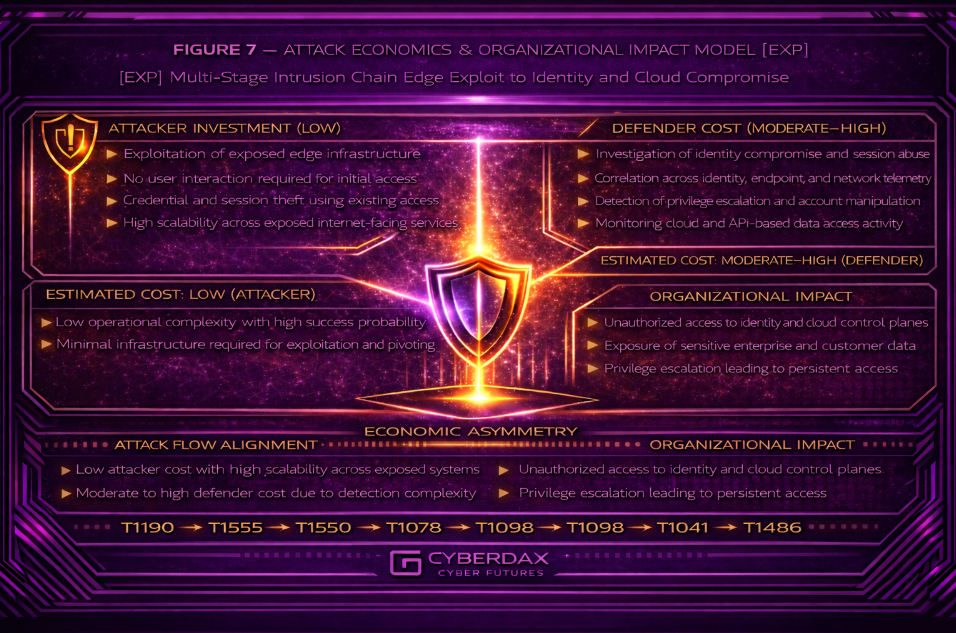
S38 — Attack Economics & Organizational Impact Model
Purpose
Model adversary operational investment, execution efficiency, and return on investment to determine exploitation attractiveness and recurrence likelihood.
Adversary Operational Investment
· Low infrastructure cost due to reliance on native GCP control-plane APIs rather than external command-and-control infrastructure
· Minimal tooling requirements; activity executed through authenticated API calls
· Operational dependency centered on identity access acquisition rather than malware development
· High scalability through reuse of compromised identities
Credential Harvesting Operations
· Acquisition of valid authentication material through phishing, token capture, or credential reuse
· Low operational cost relative to success rate in cloud-enabled environments
· High success probability due to credential reuse and exposure patterns
Credential Store and Session Artifact Access
· Immediate access when valid credentials or session artifacts are obtained
· Eliminates need for initial privilege escalation when sufficient permissions exist
· Reduces time-to-impact and operational complexity
Authentication Material Staging and Reuse Preparation
· Service account key creation enables durable credential staging
· Credentials reusable across sessions, systems, and time periods
· Persistence cost negligible once credentials are established
Credential Reuse Against Enterprise Services
· Reuse of credentials enables access across multiple services and projects
· Supports lateral movement without additional exploitation effort
· Enables repeated operational use without re-compromise
Adversary Return on Investment
· High return due to elimination of infrastructure cost and low execution complexity
· Durable access increases long-term value of compromise
· Minimal reinvestment required after initial compromise
Return on Investment Assessment
· High ROI driven by low operational cost and high scalability
· Attack model economically sustainable and repeatable
· Detection gaps increase probability of successful execution
Economic Alignment to S6
· Low attacker cost combined with moderate-to-high enterprise impact creates asymmetric risk
· Detection limitations increase likelihood of prolonged unauthorized access
· Control gaps increase total impact cost through extended exposure duration.
S39 — Economic Impact & Organizational Exposure
Multi-stage edge-to-identity-to-cloud intrusion chains create organizational exposure by increasing uncertainty around edge-device integrity, remote-access trust, credential safety, identity-session validity, cloud administrative control, privileged access boundaries, data-access scope, ransomware readiness, legal exposure, cyber-insurance review, customer-impact analysis, and business-continuity readiness.
Exposure rises when suspicious activity affects Fortinet or FortiGate VPN and firewall infrastructure, Ivanti Connect Secure gateways, Palo Alto GlobalProtect systems, FortiWeb systems, identity providers, privileged accounts, service accounts, cloud IAM roles, cloud administrative consoles, sensitive data repositories, backup systems, regulated-data environments, customer-facing applications, business-critical operational dependencies, or internet-exposed BMC, IPMI, iDRAC, iLO, or comparable out-of-band server-management interfaces where the IPMI authentication exchange may disclose password-derived authentication material that supports offline password guessing.
Estimated Economic Exposure
Estimated exposure should be treated as scenario-based rather than fixed. The most defensible enterprise estimate is tied to whether activity remains attempted or low-scope edge-device exploitation, becomes confirmed or strongly suspected compromise of an edge appliance with credential or session exposure, or expands into Fortinet-derived credential reuse, identity-provider access, cloud control-plane activity, data access, ransomware staging, backup interference, security-control modification, regulatory review, customer notification assessment, cyber-insurance scrutiny, executive reporting, or board-level recovery-trust restoration.
Low Impact Scenario
Estimated $300K–$900K
This scenario applies when edge exploitation, Fortinet or FortiGate exposure, suspicious VPN activity, GlobalProtect anomaly, Ivanti gateway activity, FortiWeb administrative activity, or edge-adjacent artifact access is detected and contained before identity compromise, privileged access, cloud administrative activity, data exposure, or ransomware preparation occurs.
Activity may involve suspicious administrative access, abnormal VPN activity, diagnostic or configuration-review concerns, blocked access to credential-bearing artifacts, failed session reuse, or early investigation of edge-appliance exposure, but endpoint, identity, VPN, cloud, network, backup, and SIEM telemetry support a failed, contained, or non-impacting event.
Response remains limited to appliance isolation or validation, firmware and patch review, configuration inspection, targeted credential rotation, VPN session review, identity-log validation, short-term monitoring, and executive assurance that identity control and cloud access were not materially affected.
Moderate Impact Scenario
Estimated $2M–$8M
This scenario applies when confirmed or strongly suspected edge compromise affects one or more Fortinet, FortiGate, Ivanti, Palo Alto, FortiWeb, VPN, firewall, identity-adjacent, or cloud-connected systems and the organization cannot immediately determine whether credentials, session artifacts, support bundles, configuration data, packet-capture output, service-account material, cloud keys, or privileged authentication paths were exposed.
Response may require broad credential rotation, VPN session invalidation, identity-provider review, MFA and conditional-access validation, cloud IAM audit, service-account review, privileged-role review, source-host reconstruction, endpoint and network triage, backup validation, legal and compliance review, cyber-insurance coordination, executive reporting, and business-owner validation for affected systems or dependencies.
Where BMC, IPMI, iDRAC, iLO, or comparable out-of-band management interfaces are affected, response may additionally require confirmation of exposed management paths, controller inventory, BMC account review, BMC credential rotation, management-network review, controller-authentication review, and validation that password-derived authentication material was not successfully converted into unauthorized privileged management access.
High Impact Scenario
Estimated $12M–$60M+
This scenario applies when edge-device compromise becomes an enterprise-impact event involving confirmed or strongly suspected credential harvesting, Fortinet-derived credential reuse, identity compromise, privilege escalation, cloud administrative control, data exfiltration, ransomware staging, security-control modification, backup interference, regulated-data exposure, customer-facing service disruption, or uncertainty over whether trusted access paths can be restored.
The organization may need to assume that remote-access infrastructure, identity sessions, privileged accounts, service accounts, cloud roles, administrative consoles, data repositories, backup paths, and recovery workflows were exposed until forensic evidence proves otherwise.
Response may require extended incident response, emergency remote-access containment, broad credential and token invalidation, identity and cloud-control rebuild, privileged-access review, backup and recovery validation, data-access scoping, affected-population analysis, legal and regulatory notification assessment, cyber-insurance engagement, extortion response support, communications planning, executive and board reporting, customer or partner notification, and formal validation that affected business services can safely resume.
Annualized Risk Exposure
Estimated annualized exposure ranges from $5M–$25M for materially exposed enterprise environments with internet-facing edge infrastructure, Fortinet or FortiGate remote-access services, Ivanti Connect Secure gateways, Palo Alto GlobalProtect systems, FortiWeb management interfaces, weak credential rotation, incomplete VPN telemetry, limited edge-appliance logging, fragmented identity-session visibility, excessive cloud IAM privilege, unmanaged service accounts, incomplete cloud audit coverage, weak administrative workflow controls, unvalidated backup recovery, or poor correlation across edge, identity, endpoint, and cloud telemetry.
Exposure may exceed the high-impact scenario range where edge compromise results in confirmed or suspected credential harvesting, durable identity access, cloud administrative control, regulated-data exposure, ransomware deployment, customer impact, extortion communication, cyber-insurance review, or board-level reporting.
Remote-Access and Edge-Platform Dependency
Remote-access and edge-platform dependency is high where Fortinet, FortiGate, Ivanti, Palo Alto, FortiWeb, VPN, firewall, WAF, or secure-access infrastructure provides business-critical access to workforce systems, privileged administration, cloud management, production applications, operational technology, regulated workflows, third-party support, or distributed service delivery.
Dependency increases when affected appliances, VPN sessions, authentication paths, support bundles, configuration exports, packet-capture data, service accounts, privileged identities, cloud access paths, backup workflows, or customer-facing dependencies are required to maintain trusted operations during containment and recovery.
Control-Plane Trust
Control-plane trust is reduced when the organization cannot prove that edge-device state, VPN session history, authentication lineage, identity-provider logs, MFA enforcement, conditional-access decisions, privileged-role changes, cloud IAM activity, service-account ownership, data-access records, backup integrity, and post-containment evidence remained reliable during the event.
Control-plane trust is further reduced when Fortinet-derived or edge-derived credentials may have been reused after appliance exposure, when sessions cannot be tied to approved authentication events, or when cloud administrative activity cannot be tied to approved users, approved devices, expected source infrastructure, and documented change-control records.
Visibility Confidence
Visibility confidence is highest when edge-appliance logs, VPN session logs, administrative access logs, diagnostic activity, support-bundle handling, configuration-export records, packet-capture records, identity-provider logs, MFA and conditional-access logs, endpoint telemetry, network telemetry, DNS logs, proxy logs, firewall logs, cloud audit logs, service-account records, privileged-access records, backup telemetry, vulnerability-management data, change-control records, incident-response notes, asset inventory, and business-owner context can be joined reliably.
Visibility confidence is reduced where appliance-internal telemetry is incomplete, packet-capture or diagnostic activity is not centrally logged, VPN source attribution is weak, identity-session lineage is incomplete, source-host enrichment is inconsistent, cloud audit logging is partial, service-account ownership is unclear, timestamp normalization is poor, or backup validation is manual.
BMC and IPMI visibility requires controller and account inventory, exposed-service identification, controller-authentication records where available, management-network flows, firewall or switch telemetry, administrator-source baselines, credential-rotation records, and correlation between suspicious controller authentication and subsequent privileged management activity. Endpoint, operating-system, workload, or hypervisor telemetry is not sufficient by itself to exclude controller-local authentication or access.
Privileged Object Confidence
Privileged object confidence is high when VPN accounts, privileged users, service accounts, cloud credentials, access keys, client secrets, session tokens, break-glass accounts, administrator roles, cloud IAM policies, identity-provider groups, emergency-access paths, backup accounts, SSH keys, API keys, and remote-administration credentials can be reviewed and tied to approved ownership, expected source hosts, approved use cases, and change-control records.
Confidence is reduced when privileged objects are undocumented, shared across teams, reused across systems, stored on or accessible from exposed edge infrastructure, changed outside approved windows, poorly monitored, or disconnected from incident-response evidence after suspicious Fortinet, VPN, identity, or cloud activity.
Credential and Session Dependency
Credential and session dependency is high where remote-access infrastructure relies on reusable credentials, long-lived sessions, service accounts, cloud credentials, VPN tokens, SAML assertions, authentication cookies, support-bundle artifacts, configuration-stored secrets, or privileged access paths to deliver normal business operations.
These dependencies increase impact when the organization cannot quickly prove whether exposed credentials, Fortinet-derived VPN access material, session artifacts, cloud credentials, service-account credentials, or privileged authentication paths remained trustworthy after suspected edge-device exposure or credential-harvesting activity.
Downstream Service Dependency
Downstream service dependency is high when compromised edge infrastructure can reach identity providers, directory services, privileged-management systems, administrative hosts, cloud control planes, data repositories, backup systems, internal applications, regulated systems, customer portals, operational technology, or business-critical services.
These dependencies increase the impact of even limited edge-appliance activity when internal reachability, authentication lineage, privileged access, cloud administrative activity, data-access scope, or dependent-service state cannot be validated quickly.
Customer, Workforce, and Regulatory Exposure
Customer, workforce, and regulatory exposure increases when suspicious edge-to-identity-to-cloud activity may affect customer-facing applications, regulated data, workforce records, finance systems, legal systems, healthcare data, government systems, partner integrations, cloud-connected workloads, privileged accounts, service accounts, backup environments, or business-critical remote-access dependencies.
Exposure also increases when incomplete telemetry prevents timely confirmation of whether credential exposure, identity access, cloud control-plane activity, data access, ransomware staging, backup interference, security-control modification, customer-facing outage, sensitive-data exposure, or post-containment activity was legitimate, malicious, or caused by approved operational activity.
Residual Economic Risk
Residual economic risk remains after containment if the organization cannot prove that affected edge appliances were isolated, vulnerable firmware was remediated, VPN sessions were invalidated, credentials were rotated, identity-provider activity was reviewed, privileged access was validated, cloud IAM changes were inspected, service-account activity was scoped, cloud administrative actions were reviewed, data-access activity was assessed, backup integrity was validated, legal and regulatory obligations were assessed, cyber-insurance evidence was preserved, and edge-to-identity-to-cloud trust was restored.
Residual risk is highest where edge-appliance logs, VPN session records, packet-capture records, support-bundle handling, identity-provider logs, cloud audit logs, endpoint telemetry, backup records, dependency maps, business-owner mappings, change-control records, or remediation evidence are incomplete.
For BMC or IPMI exposure, residual risk remains where affected controllers and accounts have not been identified, internet or untrusted-network access has not been restricted, exposed credentials have not been rotated, management-network activity has not been reviewed, or suspicious controller authentication cannot be reconciled with approved privileged-management activity.
Proof-of-Concept / KEV Behavioral Coverage Assessment
This report’s behavioral detection model directly covers edge-to-identity-to-cloud intrusion activity that aligns with exploitation or abuse of internet-facing edge infrastructure, credential or session artifact access, valid-account authentication, identity-provider access, identity and IAM enumeration, privilege-boundary modification, durable access creation, cloud administrative activity, data access, exfiltration preparation, security-control modification, backup interference, and ransomware staging.
The model directly covers CVE-2026-24858 because the vulnerability represents FortiGate zero-day access behavior that can enable unauthorized appliance login, credential exposure, persistence, lateral movement, and downstream enterprise access. This aligns with the report’s Fortinet edge-access, credential/session artifact, valid-account, identity-pivot, and downstream control-plane model. CVE-2026-24858 is CISA KEV-confirmed for this review.
The model directly covers CVE-2026-0257 because the vulnerability affects Palo Alto PAN-OS GlobalProtect portal and gateway authentication and can allow unauthorized VPN access. This aligns with the report’s GlobalProtect session-irregularity, missing authentication-lineage, first-seen source, valid-account, and VPN-origin identity-access model. CVE-2026-0257 is CISA KEV-confirmed for this review.
The model directly covers CVE-2025-59718 because the vulnerability affects FortiOS, FortiProxy, and FortiSwitchManager FortiCloud SSO authentication and can enable unauthenticated administrative access through crafted SAML activity. This aligns with the report’s Fortinet edge-authentication, configuration access, credential exposure, session misuse, and identity-pivot model. CVE-2025-59718 is CISA KEV-confirmed for this review.
The model directly covers CVE-2025-24472 because the vulnerability affects FortiOS and FortiProxy and may allow a remote unauthenticated attacker with prior knowledge of upstream and downstream device serial numbers to gain super-admin privileges on a downstream device through crafted CSF proxy requests when Security Fabric is enabled. This aligns with the report’s Fortinet edge-authentication, unauthorized privileged access, credential or session exposure, identity pivot, durable access, and downstream enterprise-compromise model. CVE-2025-24472 was added to the CISA KEV Catalog on 18 March 2025 and is identified in the August 2026 joint Gunra advisory as an initial-access vulnerability observed by the FBI in Gunra activity.
The model directly covers CVE-2025-22457 because the vulnerability affects Ivanti Connect Secure VPN appliances and has been associated with remote code execution against edge infrastructure. This aligns with the report’s Ivanti gateway exploitation, edge-device compromise, post-exploitation access, malware/backdoor deployment, and identity-adjacent intrusion model. CVE-2025-22457 is CISA KEV-confirmed for this review.
The model directly covers CVE-2025-0282 because the vulnerability affects Ivanti Connect Secure and aligns with the same internet-facing VPN appliance compromise, unauthorized access, post-exploitation, and follow-on identity-risk behavior modeled in S21 through S25. CVE-2025-0282 is CISA KEV-confirmed for this review.
The model directly covers CVE-2024-55591 because the vulnerability affects FortiOS and FortiProxy and allows a remote attacker to gain super-admin privileges through crafted requests to the Node.js WebSocket module. This aligns directly with the report’s Fortinet edge-compromise, unauthorized administrative access, credential or session exposure, valid-account reuse, identity pivot, durable access, and downstream control-plane model. CVE-2024-55591 is CISA KEV-confirmed and is identified in the August 2026 joint Gunra advisory as an initial-access vulnerability observed by the FBI in Gunra activity.
The model directly covers CVE-2024-47575 because the FortiManager missing-authentication vulnerability permits unauthenticated remote command execution through crafted FMG-Access management requests over TCP 541. Documented exploitation includes unauthorized FortiGate registration, creation and exfiltration of configuration archives, and exposure of administrative databases, network topology, credentials, certificates, private keys, and configuration material associated with managed FortiGate infrastructure. These behaviors align directly with the report's edge-management compromise, configuration and credential theft, unauthorized administration, identity and VPN access, and downstream managed-device trust model. Fortinet PSIRT advisory FG-IR-24-423 governs affected FortiManager and FortiManager Cloud releases, fixed-version boundaries, and remediation requirements. CISA added CVE-2024-47575 to the Known Exploited Vulnerabilities Catalog on 23 October 2024 with a remediation deadline of 13 November 2024. Direct Coverage applies to the observable intrusion and consequential behaviors, not automatic identification of the vulnerability-specific initiating request or attribution of every downstream event to this CVE.
The model directly covers CVE-2024-3400 because the vulnerability affects Palo Alto PAN-OS GlobalProtect and has been exploited as an edge-device initial-access path. This aligns with the report’s GlobalProtect VPN anomaly, authentication-lineage gap, edge-to-identity transition, and follow-on control-plane activity model. CVE-2024-3400 is CISA KEV-confirmed for this review.
The model directly covers CVE-2024-21893 because the vulnerability affects Ivanti Connect Secure and Policy Secure SAML functionality and has been exploited in edge-device compromise activity. This aligns with the report’s SAML-adjacent authentication risk, edge-gateway exploitation, trusted access, and post-authentication misuse model. CVE-2024-21893 is CISA KEV-confirmed for this review.
The model directly covers CVE-2024-21887 because the vulnerability affects Ivanti Connect Secure and Policy Secure command-execution behavior and aligns with the report’s edge-device exploitation, post-exploitation access, credential access, and follow-on identity or cloud-control risk model. CVE-2024-21887 is CISA KEV-confirmed for this review.
The model directly covers CVE-2023-46805 because the vulnerability affects Ivanti Connect Secure and Policy Secure authentication bypass and aligns with the report’s exposed remote-access gateway compromise, authentication bypass, trusted network access, and downstream identity-risk model. CVE-2023-46805 is CISA KEV-confirmed for this review.
The model directly covers CVE-2022-40684 because the vulnerability affects Fortinet administrative authentication behavior and has historical relevance to FortiGate configuration and credential exposure. This aligns with the report’s Fortinet edge-compromise, configuration access, VPN credential exposure, and downstream credential-reuse model. CVE-2022-40684 is CISA KEV-confirmed for this review.
The model directly covers CVE-2018-13379 because the vulnerability affects Fortinet VPN credential exposure and represents a historical but still operationally relevant credential-reuse pattern. This aligns with the report’s VPN credential exposure, valid-account authentication, session misuse, and downstream identity-compromise model. CVE-2018-13379 is CISA KEV-confirmed for this review.
The model provides coverage with adaptation for CVE-2026-0310 because the vulnerability affects PAN-OS XML processing and may allow an unauthenticated network attacker to cause denial of service on VM-Series firewalls or arbitrary code execution with root privileges on PA-Series hardware firewalls. The behavior aligns with the report’s broader Palo Alto and exposed edge-appliance compromise model, but reliable initiating-behavior identification requires Palo Alto Networks-specific affected-product and version state, relevant management-web or dataplane exposure, appliance-service and network telemetry, appliance-health or execution evidence where available, and correlation with resulting administrative, credential, session, identity, cloud, or other post-exploitation activity. Palo Alto Networks states that it is not aware of malicious exploitation. CVE-2026-0310 is not CISA KEV-confirmed for this review.
The model provides coverage with adaptation for CVE-2025-68686 because the vulnerability affects FortiOS SSL-VPN and may allow continued read-only filesystem access through crafted HTTP requests on a FortiGate previously compromised at the filesystem level, where a symbolic-link persistence mechanism had been implemented. The vulnerability is a post-compromise access-preservation condition rather than a standalone initial-access path. The behavior aligns with the report’s Fortinet edge-appliance compromise, appliance-internal artifact access, persistence, credential or session exposure, and downstream identity-risk model, but local tuning is required for affected FortiOS versions, prior filesystem-compromise evidence, historical SSL-VPN enablement, symbolic-link artifacts, crafted HTTP activity, appliance-forensic evidence, and subsequent credential, session, identity, VPN, or cloud activity. Products that never had SSL-VPN enabled are not affected. CVE-2025-68686 is CISA KEV-confirmed.
The model provides coverage with adaptation for CVE-2025-64446 because the vulnerability affects FortiWeb path traversal and administrative command execution. The behavior fits the broader exposed security-appliance compromise model, but local tuning is required for FortiWeb management paths, command-execution evidence, WAF telemetry, and affected administrative interfaces. CVE-2025-64446 is CISA KEV-confirmed.
The model provides Coverage With Adaptation for CVE-2025-61624 because the authenticated FortiOS system.auto-script path-traversal vulnerability permits unauthorized root-level file access and modification through affected administrative functionality. Unit 42 documents exploitation of this condition during the CL-STA-0954 / UNC5820 intrusion following FortiManager CVE-2024-47575 exploitation, configuration and credential theft, and subsequent access to managed FortiGate appliances. The observed exploitation supported PEERSTITCH staging and execution. The behavior aligns with the report's Fortinet edge-compromise, appliance-local execution, administrative abuse, credential exposure, persistence, VPN access, and downstream identity and network-control model. Reliable vulnerability-specific identification requires affected FortiOS version and product context, authenticated administrative-session evidence, system.auto-script history, traversal-related file operations, privileged execution, configuration revisions, process activity, and appliance-forensic evidence. Fortinet PSIRT advisory FG-IR-26-122 governs affected-product and fixed-release requirements. Unit 42 establishes documented in-the-wild exploitation, and CISA added CVE-2025-61624 to its Known Exploited Vulnerabilities Catalog on 16 October 2026. The KEV designation increases remediation and retrospective-investigation priority but does not change the Coverage With Adaptation classification or independently establish compromise of a particular deployment.
The model provides coverage with adaptation for CVE-2025-59719 because the vulnerability affects FortiWeb FortiCloud SSO authentication rather than the FortiGate/FortiOS remote-access path that is most central to this report. The detection model can support adapted coverage where observable behavior includes unauthenticated administrative access, configuration exposure, credential exposure, FortiWeb management activity, or downstream identity and access reuse. CVE-2025-59719 is CISA KEV-confirmed.
The model provides coverage with adaptation for CVE-2025-58034 because the vulnerability affects FortiWeb OS command-injection behavior rather than the Fortinet VPN credential-reuse path most directly modeled in this report. Adapted coverage is strongest where observable behavior includes FortiWeb command execution, appliance persistence, credential access, lateral movement, or downstream identity and cloud-control activity. CVE-2025-58034 is CISA KEV-confirmed.
The model provides coverage with adaptation for CVE-2025-25249 because the vulnerability affects Fortinet edge infrastructure through a network-reachable heap-based buffer-overflow condition capable of unauthorized code or command execution through specially crafted packets. The behavior aligns with the report’s broader Fortinet edge-appliance compromise and downstream trust model, but reliable initiating-behavior identification requires Fortinet-specific affected-product and version state, relevant appliance-service and network telemetry, evidence of abnormal appliance behavior or execution where available, appliance-forensic evidence, and correlation with resulting administrative, credential, session, network-control, identity, cloud, or other post-exploitation activity. CVE-2025-25249 therefore remains covered with adaptation rather than direct coverage because its packet-triggered memory-corruption initiating condition requires Fortinet-specific telemetry and qualification beyond the generic S25 model. CISA added CVE-2025-25249 to the Known Exploited Vulnerabilities Catalog on 9 September 2026 based on evidence of active exploitation.
The model provides coverage with adaptation for CVE-2025-4428 because the vulnerability affects Ivanti Endpoint Manager Mobile remote-code-execution behavior rather than Ivanti Connect Secure remote-access gateway compromise. The report’s detection model can support adapted coverage where observable behavior includes internet-facing appliance exploitation, payload execution, Tomcat or Java execution artifacts, credential access, persistence, identity access, or downstream administrative activity. CVE-2025-4428 is CISA KEV-confirmed.
The model provides coverage with adaptation for CVE-2025-4427 because the vulnerability affects Ivanti Endpoint Manager Mobile authentication bypass rather than Ivanti Connect Secure VPN access. Adapted coverage is appropriate where observable behavior aligns with unauthorized access to protected resources, appliance compromise, credential exposure, or downstream identity-control behavior. CVE-2025-4427 is CISA KEV-confirmed.
The model provides coverage with adaptation for CVE-2024-21762 because the vulnerability affects FortiOS/FortiProxy code-execution behavior and aligns with the exposed Fortinet edge-device exploitation class, but the specific exploit path may require Fortinet version, SSL-VPN, management-plane, and appliance-specific telemetry tuning before it can be represented as direct coverage. CVE-2024-21762 is CISA KEV-confirmed.
The model provides coverage with adaptation for CVE-2013-4786 because IPMI 2.0 RAKP authentication may return password-derived authentication material that supports offline password guessing. Successful use requires a valid BMC account name, whether previously known or identified through separate username-enumeration behavior. The vulnerability aligns with the report’s credential-material exposure, valid-account access, credential reuse, privileged-management, and downstream-compromise model, but adaptation is required for the distinct management-controller surface, authentication exchange, telemetry sources, and post-authentication activity.
Local adaptation should include BMC, IPMI, iDRAC, iLO, or comparable controller and account inventory; exposed IPMI service identification; management-network and firewall telemetry; controller-authentication records where available; administrator-source baselines; credential-strength and credential-reuse review; credential rotation; and correlation between suspicious BMC authentication and subsequent privileged-management activity.
Disclosure of password-derived authentication material that supports offline password guessing does not establish successful password guessing. Successful password guessing does not establish successful BMC authentication, and successful BMC authentication does not independently establish server takeover, persistence, lateral movement, or downstream enterprise compromise. CVE-2013-4786 is not CISA KEV-confirmed.
The report is behavior-led and should not be interpreted as limited to one appliance name, one Fortinet product label, one Ivanti advisory, one Palo Alto advisory, one exploit nickname, one CVE, one KEV entry, one symbolic-link mechanism, one packet-capture method, one VPN log field, one source IP, one actor name, one ransomware name, one access-broker report, one scanner fingerprint, one proof-of-concept, one user agent, one request path, one payload structure, or one static IOC.
Detection Engineering Coverage Interpretation
The S25 detection content provides direct behavioral coverage for edge-to-identity-to-cloud compromise where observable behavior falls directly inside the report’s detection model: edge-appliance sensitive path access, configuration or session artifact access, identity-provider access from non-user infrastructure, successful authentication from atypical or first-seen sources, identity and IAM enumeration, privilege-boundary changes, durable access artifact creation, high-risk cloud data or control-plane actions, and multi-stage correlation across edge, endpoint, identity, and cloud telemetry.
The S25 detection content provides coverage with adaptation for FortiBleed, Fortinet, FortiGate, FortiOS SSL-VPN symbolic-link persistence, FortiWeb, Ivanti, Palo Alto, GlobalProtect, packet-capture, support-bundle, diagnostic-access, configuration-export, VPN credential-reuse, access-broker, ransomware-affiliate, VDI session or authentication manipulation, MFA or OTP bypass, cloud-data collection, recovery-infrastructure interference, PivotC2-style FortiGate post-exploitation activity, and downstream cloud-control behaviors when those behaviors can be correlated through edge-appliance logs, VPN logs, endpoint telemetry, identity-provider logs, VDI or authentication-platform telemetry, cloud audit logs, NDR telemetry, DNS logs, proxy logs, firewall logs, backup telemetry, SIEM enrichment, incident-response evidence, approved administrator context, appliance-forensic evidence, and post-access telemetry.
PivotC2-style coverage is strongest where exploitation or compromise of Fortinet edge infrastructure can be correlated with unexpected Node.js or script execution on the appliance, persistent outbound encrypted command-and-control, interactive command execution, file transfer, proxy or tunnel establishment, local or remote port forwarding, internal network scanning, configuration collection, credential-material access or decryption, and subsequent identity, network, cloud, data-access, or lateral-movement activity.
PEERSTITCH / CL-STA-0954 / UNC5820 requires Coverage With Adaptation because the intrusion combines FortiManager management-plane exploitation, managed-FortiGate configuration and cryptographic-material theft, authenticated FortiOS auto-script exploitation, and memory-resident ARM64 implant execution. Existing S25 detection logic supports the observable management, configuration, credential, process, VPN, identity, network, logging, cloud, and downstream-trust behaviors. Reliable identification of the PEERSTITCH implant requires FortiOS-specific volatile-memory analysis, miglogd and iked daemon-integrity validation, anonymous executable-memory mapping inspection, available ptrace and /proc/<pid>/mem activity, suspicious auto-script history, configuration-revision review, crash-log and segmentation-fault evidence, and correlated appliance-management telemetry. The implant's use of legitimate daemon traffic, absence of a persistent on-disk malware binary, and lack of an independent listening port or outbound command-and-control connection limit conventional file-based and network-indicator detection. Existing behavioral coverage does not independently establish PEERSTITCH attribution without the additional appliance-specific evidence. No new generic S25 detection family is required.
The Gunra advisory specifically documents VDI credential and session collection, stolen-cookie session hijacking, modification of VDI authentication processing to accept an attacker-designated OTP and continuously bypass MFA, and credential recovery from a Hiware access-control system.
The S25 detection content provides CVE, proof-of-concept, KEV, exploit-tooling, actor, ransomware, access-broker, malware, and campaign coverage only as behavior-led coverage. Product names, CVE IDs, KEV status, proof-of-concept availability, vendor advisory labels, scanner names, actor names, ransomware names, exploit nicknames, malware names, access-broker labels, source IPs, or tool names should not be used as detection inputs unless they are locally approved enrichment fields supporting triage.
Detection coverage remains based on observable edge access, command execution, credential or session artifact exposure, authentication-lineage anomalies, identity misuse, privilege modification, durable access creation, proxy or tunnel behavior, internal discovery, cloud control-plane activity, data staging, recovery interference, and ransomware preparation.
Direct Coverage
Direct behavioral coverage applies to edge-to-identity-to-cloud compromise behavior that can be detected by the report’s S21 through S25 logic without requiring a separate detection model.
Directly Covered CVEs
· CVE-2026-24858
· CVE-2026-0257
· CVE-2025-59718
· CVE-2025-24472
· CVE-2025-22457
· CVE-2025-0282
· CVE-2024-55591
· CVE-2024-47575
· CVE-2024-3400.
· CVE-2024-21893
· CVE-2024-21887
· CVE-2023-46805
· CVE-2022-40684
· CVE-2018-13379
Future Fortinet, FortiGate, FortiOS, FortiProxy, FortiSwitchManager, Ivanti Connect Secure, Ivanti Policy Secure, Palo Alto GlobalProtect, PAN-OS, VPN, firewall, or edge-appliance compromise where observable behavior includes configuration or session artifact access, credential exposure, valid-account use, identity-provider access, identity and IAM enumeration, privilege escalation, durable access creation, cloud control-plane activity, data access, or impact preparation.
Coverage With Adaptation
Coverage with adaptation applies to related edge-appliance, VPN, WAF, identity-provider, cloud-control, access-broker, ransomware-affiliate, malware, out-of-band management, VDI, and authentication-control activity that shares parts of the report’s credential-exposure, session-reuse, identity-control, cloud-administration, post-exploitation, or extortion-preparation model but requires local tuning for affected appliance, affected version, authentication model, exploit path, prior-compromise condition, telemetry source, VPN log field, IdP integration, VDI authentication stack, packet-capture visibility, session-token handling, support-bundle handling, filesystem visibility, management-controller visibility, appliance-local execution, proxy or tunnel behavior, or downstream access path.
CVEs Covered With Adaptation
· CVE-2026-0310
· CVE-2025-68686
· CVE-2025-64446
· CVE-2025-61624
· CVE-2025-59719
· CVE-2025-58034
· CVE-2025-25249
· CVE-2025-4428
· CVE-2025-4427
· CVE-2024-21762
· CVE-2013-4786
Future FortiWeb, Ivanti EPMM, non-VPN Fortinet, non-VPN Ivanti, Fortinet WAF, edge-management, appliance-command-execution, appliance-authentication-bypass, or post-compromise SSL-VPN persistence-bypass activity where observable behavior aligns with credential theft, session reuse, authentication-lineage gaps, valid-account access, identity enumeration, privilege escalation, cloud administrative control, or ransomware enablement.
Initial-access-broker activity involving exposed edge devices, VPN credentials, session artifacts, Fortinet-derived access material, identity-provider access, cloud-console access, or privileged remote-access paths where the observable telemetry aligns with this report’s S21 through S25 model.
Ransomware affiliate activity that uses edge-device compromise, stolen VPN credentials, Fortinet-derived access, session reuse, identity compromise, cloud administrative access, data staging, backup interference, security-control modification, or encryption preparation as an initial-access or impact path.
Future proof-of-concept, KEV, scanner, exploit-attempt, malware, access-broker, ransomware, or campaign activity involving exposed edge infrastructure, Fortinet or FortiGate remote access, identity-provider compromise, credential reuse, cloud-control-plane activity, data theft, or ransomware preparation where observable telemetry aligns with the report’s detection strategy.
Named Malware / Tooling / Exploit-Framework Coverage
Named malware, tooling, scanner, proof-of-concept, exploit-framework, access-broker, ransomware, or tradecraft coverage should be interpreted as behavior-led coverage only. A tool name, exploit name, scanner label, GitHub repository, payload artifact, source IP, user agent, public reporting label, ransomware name, malware family, access-broker label, or actor name should not be used as a detection input unless it is locally approved enrichment supporting triage.
Coverage applies when the observable behavior aligns with this report’s edge-appliance exposure, appliance-local execution, credential or session artifact access, valid-account use, identity-provider access, privilege modification, durable access creation, tunneling or proxying, internal discovery, cloud administrative activity, data access, backup interference, security-control modification, or ransomware-preparation model.
Core Tooling and Exploit Behavior
· Multi-stage edge exploit to identity and cloud compromise.
· FortiBleed-style Fortinet or FortiGate credential-harvesting and access-monetization behavior where observable activity includes exposed Fortinet infrastructure, credential or session artifact exposure, suspicious VPN access, first-seen identity access, credential reuse, access resale, ransomware-affiliate handoff, cloud administrative activity, or extortion preparation.
· Generic Fortinet, VPN, firewall, and edge-appliance exploit-follow-on behavior producing suspicious administrative access, configuration or session artifact access, authentication-lineage gaps, valid-account access, identity-provider activity, cloud-control activity, data access, or ransomware staging.
· Ivanti Connect Secure exploitation behavior producing appliance compromise, web shell or backdoor deployment, credential access, authentication bypass, command execution, identity-adjacent access, internal movement, or downstream control-plane exposure.
· Palo Alto GlobalProtect exploitation behavior producing unauthorized VPN access, authentication-lineage gaps, first-seen source activity, suspicious portal or gateway activity, valid-account access, or downstream identity and cloud-control activity.
Adapted Tooling and Exploit Context
· FortiOS SSL-VPN symbolic-link persistence patch-bypass behavior where the affected device was previously compromised at the filesystem level, a symbolic-link persistence mechanism had been implemented, and local FortiOS, web-request, filesystem, or forensic telemetry is required to establish continued read-only filesystem access or preservation of post-compromise access.
· Fortinet packet-triggered appliance memory-corruption or code-execution behavior requiring affected-product and version identification, relevant network and appliance-service telemetry, appliance-health or execution evidence where available, appliance-forensic evidence, and correlation with resulting administrative, credential, session, network-control, identity, cloud, or other post-exploitation activity.
· PEERSTITCH-style FortiManager-to-managed-FortiGate post-exploitation behavior where attackers exploit centralized management infrastructure, obtain configuration archives and credential or cryptographic material, reuse administrative or VPN credentials against managed appliances, exploit authenticated FortiOS system.auto-script path traversal, and deploy a memory-resident ARM64 implant that modifies miglogd and iked execution behavior. Related procedures include process-memory injection, anonymous executable-memory allocation, management-platform impersonation, malicious auto-scripts, VPN and identity abuse, logging disruption, crash-log manipulation, configuration rollback, and concealment of command activity within legitimate appliance traffic. Reliable coverage requires FortiManager and FortiGate configuration history, administrative-session telemetry, appliance-memory inspection, daemon-integrity evidence, process and filesystem artifacts where available, logging-health evidence, and downstream credential, session, network, and identity correlation. PEERSTITCH naming or isolated static indicators do not establish local compromise or campaign attribution.
· PivotC2-style FortiGate post-exploitation activity where an exploited or otherwise compromised appliance is used to execute a Node.js-based remote-access payload, maintain persistent encrypted command-and-control, provide interactive shell or file-transfer capability, establish SOCKS5 or HTTP proxying, perform local or remote port forwarding, scan internal address ranges, collect appliance configuration data, access or decrypt credential material, or automate post-compromise discovery and collection. Reliable coverage requires FortiGate-specific appliance, process, network, configuration, credential, and downstream activity correlation rather than the PivotC2 name alone.
· Packet-capture or appliance-internal credential-harvesting activity where local Fortinet or FortiGate telemetry is incomplete but downstream VPN, identity, cloud, or ransomware-preparation telemetry supports behavior alignment.
· FortiWeb exploitation where the affected product is a WAF or management surface rather than the FortiGate/FortiOS remote-access path, but observable behavior includes administrative access, command execution, configuration exposure, credential access, persistence, or downstream identity activity.
· Ivanti Endpoint Manager Mobile exploitation where the affected platform differs from Ivanti Connect Secure but observable behavior includes authentication bypass, remote code execution, web middleware manipulation, credential exposure, persistence, or downstream identity and control-plane activity.
· BMC or IPMI authentication-material exposure where a remotely reachable controller discloses password-derived authentication material that supports offline password guessing. Adapted coverage requires controller and account inventory, exposed-service identification, management-network visibility, controller-authentication records where available, administrator-source baselines, credential review, and correlation with subsequent privileged-management activity.
· Access-broker or credential-market activity where exposed VPN credentials, Fortinet-derived access material, session artifacts, or identity credentials are reused by a different operator after the original exposure event.
· Ransomware affiliate activity where the intrusion path begins with or depends on edge-derived credentials, VPN access, identity compromise, cloud administrative control, backup interference, security-control modification, data staging, or encryption preparation.
· Gunra ransomware activity where Fortinet or FortiProxy exploitation, unauthorized privileged access, malicious persistent account creation, credential or session capture, stolen-session reuse, VDI access, authentication-control manipulation, MFA or OTP bypass, enterprise credential recovery, OneDrive or SharePoint collection, data staging, backup or recovery-store deletion, exfiltration, and encryption activity align with the report’s edge-to-identity-to-cloud model. Complete Gunra procedure-set coverage remains adaptive because incident-specific VDI authentication manipulation, authentication-platform modification, enterprise credential-store access, Microsoft cloud collection, and recovery-infrastructure activity require environment-specific telemetry and correlation.
· Future exploit kits, scanner modules, proof-of-concept tools, credential-harvesting methods, packet-capture abuse, support-bundle abuse, diagnostic-access abuse, configuration-export abuse, appliance-resident RATs, proxy or tunneling frameworks, post-compromise persistence-bypass methods, ransomware playbooks, access-broker workflows, or campaign-specific tooling that produce aligned edge, identity, cloud, data-access, or impact telemetry.
Named APT / Actor / Campaign Activity Coverage
Actor, APT, ransomware, access-broker, and campaign coverage should be treated as enrichment and coverage context only. The report does not detect actor names directly. It detects the behavior those actors, affiliates, brokers, ransomware operators, or intrusion sets may produce when abusing Fortinet, FortiGate, FortiWeb, Ivanti, Palo Alto, VPN, firewall, edge-authentication, identity-provider, cloud-control, data-access, or ransomware-preparation paths.
Direct Actor and Campaign Behavior Context
· UNC5221 where observable behavior includes Ivanti Connect Secure exploitation, authentication bypass, command execution, appliance compromise, SPAWN ecosystem malware, TRAILBLAZE, BUSHFIRE, persistence, credential access, internal movement, or downstream identity and control-plane activity.
· UTA0218 / Operation MidnightEclipse where observable behavior includes Palo Alto GlobalProtect exploitation, PAN-OS compromise, appliance access, command execution, persistence, exfiltration preparation, valid-account misuse, or downstream identity and control-plane activity.
· UNC3886 where observable behavior includes Fortinet, FortiGate, VMware, network appliance, virtualization infrastructure, credential theft, rootkit, backdoor, persistence, lateral movement, or long-term covert access behavior aligned to this report’s edge-to-identity model.
· FortiBleed-style credential-harvesting and credential-reuse operators where observable behavior includes Fortinet or FortiGate exposure, credential or session material exposure, VPN credential reuse, first-seen identity access, cloud administrative activity, access resale, ransomware-affiliate handoff, or extortion preparation.
Adapted Actor and Campaign Context
· APT5 or suspected Chinese state-linked Pulse Secure / Ivanti exploitation activity where observable behavior includes VPN appliance compromise, authentication bypass, web shell deployment, credential exposure, persistence, identity access, or downstream enterprise compromise.
· Volt Typhoon-style edge and network-device compromise where observable behavior includes edge infrastructure abuse, living-off-the-land administration, valid-account access, persistence, credential exposure, or stealthy control-plane access aligned to this report’s model.
· Salt Typhoon-style network-control and telecom infrastructure compromise where observable behavior includes edge or network-device access, valid-account use, administrative control, credential exposure, persistence, and downstream infrastructure visibility aligned to this report’s model.
· Russian-speaking FortiBleed credential-harvesting or access-market activity where observable behavior includes Fortinet credential collection, brute-force activity, hash cracking, VPN credential reuse, access resale, or ransomware-affiliate enablement. This should not be labeled as a classic APT group unless public reporting or local evidence supports that attribution.
· Gunra ransomware activity where observable behavior includes exploitation of FortiOS or FortiProxy through CVE-2024-55591 or CVE-2025-24472, unauthorized super-admin access, persistent account creation, credential or session capture, stolen-session reuse, VDI and authentication-control abuse, MFA or OTP bypass, cloud-data collection, backup or disaster-recovery interference, exfiltration, or ransomware deployment aligned to this report’s detection model. Gunra remains adaptive named-context coverage because the complete procedure set depends on incident-specific appliance, VDI, identity, SaaS, backup, and forensic telemetry.
· CL-STA-0954 / UNC5820 PEERSTITCH activity where observable behavior includes exploitation of FortiManager CVE-2024-47575, unauthorized managed-device registration, configuration archive exfiltration, credential and cryptographic-material exposure, subsequent access to managed FortiGate infrastructure, exploitation of FortiOS CVE-2025-61624, malicious auto-script activity, memory-resident ARM64 implant deployment, miglogd and iked process modification, VPN and management impersonation, logging disruption, and downstream network or identity compromise. Unit 42's 14 October 2026 investigation provides the controlling campaign evidence. The procedure set remains Coverage With Adaptation because reliable identification requires FortiOS-specific volatile-memory, process-integrity, auto-script, configuration, administrative-session, network, logging, and forensic evidence. The CL-STA-0954 and UNC5820 designations are retained as reported campaign identifiers and do not independently establish attribution of an observed local intrusion.
· PivotC2 activity where observable behavior includes exploitation or compromise of FortiGate infrastructure followed by appliance-local Node.js execution, persistent encrypted command-and-control, remote shell activity, file transfer, proxy or tunnel creation, port forwarding, network scanning, FortiGate configuration collection, credential-material access or decryption, and downstream network or identity activity. PivotC2 remains adaptive named-context coverage because reliable attribution requires appliance-specific, process, network, configuration, credential, and post-access telemetry.
· Ransomware affiliate activity using Fortinet-derived, VPN-derived, or edge-derived access where observable behavior includes valid-account entry, lateral movement, identity compromise, cloud access, data staging, backup interference, security-control modification, or encryption preparation.
· Future actor clusters, ransomware groups, intrusion sets, access brokers, cloud-extortion groups, or campaign labels using Fortinet-style credential exposure, edge-appliance exploitation, VPN credential reuse, session artifact abuse, identity compromise, cloud administrative control, data access, or ransomware preparation where behavior-to-telemetry alignment is validated.
Named classic APT groups should not be listed as direct coverage unless public reporting or local evidence ties the named group to edge-appliance exploitation, Fortinet-derived credential use, Ivanti gateway compromise, Palo Alto GlobalProtect compromise, identity compromise, cloud-control abuse, ransomware enablement, or aligned post-compromise behavior. The correct standard is to avoid invented classic APT attribution while including sourced actor, campaign, access-broker, ransomware, and exploitation operations tied to the same behavior class.
Active Exploitation and KEV Coverage Interpretation
Active exploitation, weaponization, proof-of-concept availability, and KEV status should be treated as urgency and remediation-prioritization signals, not as the basis for detection coverage by themselves. The report should count actively exploited, CISA KEV-confirmed, or in-the-wild items only when the observable exploitation behavior aligns with S21 through S25.
The current coverage model directly covers edge-to-identity-to-cloud intrusion behavior where exploitation or abuse of exposed edge infrastructure leads to credential exposure, session reuse, identity compromise, privilege escalation, cloud administrative control, data access, or ransomware enablement.
The current coverage model directly covers FortiBleed-style reporting when the observable behavior aligns with Fortinet or FortiGate credential exposure, credential reuse, access resale, ransomware-affiliate handoff, identity access, or cloud-control activity.
The current coverage model adaptively covers CVE-2025-25249 where exploitation of affected Fortinet edge infrastructure through specially crafted packets may result in unauthorized code or command execution. Fortinet-specific affected-product and version identification, relevant network and appliance-service telemetry, appliance-health or execution evidence where available, appliance-forensic evidence, and post-exploitation correlation are required to establish reliable coverage. CISA added CVE-2025-25249 to the Known Exploited Vulnerabilities Catalog on 9 September 2026 based on evidence of active exploitation. Its KEV designation increases remediation and retrospective-investigation priority but does not change its adapted classification or require a new generic S25 detection object.
Public reporting on PivotC2 demonstrates how exploitation associated with CVE-2025-25249 may transition from edge-appliance code execution into a persistent appliance-resident post-exploitation channel. Reported behavior includes Node.js-based remote access, encrypted command-and-control, interactive shell activity, file transfer, proxying and tunneling, port forwarding, internal scanning, configuration harvesting, credential-material access or decryption, and automated follow-on activity. These behaviors strengthen the report’s edge-compromise-to-downstream-trust model but remain Coverage With Adaptation because reliable identification depends on FortiGate-specific appliance, execution, network, configuration, credential, and post-access evidence.
The current coverage model directly covers the observable FortiManager CVE-2024-47575 exploitation and downstream trust consequences documented in the PEERSTITCH intrusion, including unauthorized management-plane command execution, configuration archive exfiltration, credential and cryptographic-material exposure, and subsequent managed-FortiGate access. CVE-2024-47575 is CISA KEV-confirmed, with an addition date of 23 October 2024 and a remediation deadline of 13 November 2024. The model provides Coverage With Adaptation for CVE-2025-61624 because documented exploitation of authenticated FortiOS auto-script path traversal requires appliance-specific administrative-session, file-operation, process, configuration-revision, and forensic evidence. Unit 42's October 2026 investigation validates in-the-wild use of CVE-2025-61624 during the documented intrusion, and CISA added the vulnerability to its Known Exploited Vulnerabilities Catalog on 16 October 2026. PEERSTITCH deployment and associated CL-STA-0954 / UNC5820 procedures strengthen the report's edge-management-to-managed-firewall compromise lineage without creating a new generic detection family. Exploitation evidence, CISA KEV designation, and successful compromise of a particular deployment remain distinct determinations.
The current coverage model directly covers CVE-2025-24472 where exploitation of affected FortiOS or FortiProxy Security Fabric functionality produces unauthorized super-admin access and observable downstream administrative, credential, session, identity, cloud, data-access, or ransomware-enablement behavior. CVE-2025-24472 was added to the CISA KEV Catalog on 18 March 2025, and the August 2026 joint Gunra advisory identifies it as an initial-access vulnerability observed by the FBI in Gunra operations.
The current coverage model directly covers CVE-2024-55591 where crafted Node.js WebSocket requests against affected FortiOS or FortiProxy systems produce unauthorized super-admin access and observable downstream administrative, credential, session, identity, cloud, data-access, or ransomware-enablement behavior. CVE-2024-55591 is CISA KEV-confirmed, and the August 2026 joint Gunra advisory identifies it as an initial-access vulnerability observed by the FBI in Gunra operations.
The August 2026 Gunra activity strengthens exploitation-to-impact lineage for the report by documenting an intrusion model that progresses from Fortinet exploitation into credential and session compromise, VDI authentication abuse, MFA bypass, enterprise credential recovery, Microsoft cloud-data collection, exfiltration, recovery inhibition, and ransomware impact.
This activity does not require a separate S21 through S25 detection model because the governing edge-to-identity-to-cloud and ransomware-enablement behaviors are already represented; incident-specific VDI, authentication-platform, credential-store, SaaS, and backup telemetry remain adaptation requirements.
The current coverage model adaptively covers CVE-2025-68686 where a previously compromised FortiOS SSL-VPN device remains susceptible to a symbolic-link persistence patch bypass that may preserve read-only filesystem access. This vulnerability does not independently provide initial access. Coverage depends on confirmation of prior filesystem-level compromise, historical SSL-VPN enablement, crafted HTTP activity, symbolic-link or filesystem artifacts, appliance-forensic evidence, or downstream credential, session, identity, VPN, or cloud activity. Products that never had SSL-VPN enabled are outside the affected-product condition for this vulnerability. CVE-2025-68686 is CISA KEV-confirmed.
The current coverage model adaptively covers FortiWeb exploitation where the vulnerability affects WAF administration, command execution, path traversal, or FortiCloud SSO behavior rather than FortiGate or FortiOS VPN access. These items should remain adaptively covered when downstream authentication, identity, cloud, data-access, or ransomware-preparation telemetry aligns with the report’s detection model.
The current coverage model adaptively covers appliance-internal Fortinet packet-capture, diagnostic, support-bundle, configuration-export, filesystem, or memory/session exposure where direct proof of credential theft or unauthorized access depends on local appliance telemetry or forensic collection. These items should remain adaptively covered when downstream authentication, identity, VPN, cloud, or ransomware-preparation telemetry aligns with the report’s detection model.
The current coverage model adaptively covers CVE-2013-4786 and related BMC or IPMI authentication-material exposure. Current reporting identifies internet-exposed controllers and confirms that the IPMI authentication exchange may return password-derived authentication material that supports offline password guessing. The available reporting does not, by itself, establish confirmed in-the-wild exploitation of CVE-2013-4786 or successful compromise of the exposed controllers. The vulnerability is not CISA KEV-confirmed for this review. Coverage depends on exposed-controller identification, valid-account or username-enumeration context, management-network and controller-authentication visibility, credential-strength review, and evidence distinguishing authentication-material disclosure from successful password guessing, successful BMC authentication, and subsequent server or enterprise compromise.
Non-Coverage Conditions
Non-coverage applies where related activity does not produce observable suspicious edge-appliance activity, appliance-local execution, credential or session artifact access, VPN anomaly, authentication-lineage gap, first-seen identity access, identity-provider misuse, IAM enumeration, privilege modification, durable access creation, tunneling or proxy behavior, cloud administrative activity, data access, backup interference, security-control modification, ransomware staging, extortion preparation, or recovery-trust uncertainty.
Activity limited to unrelated endpoint malware, unrelated SaaS platforms, generic phishing, unrelated web application exploitation, denial-of-service without edge-to-identity relevance, network-only scanning, isolated vulnerability reporting, unrelated CVE exploitation, or actor attribution without aligned telemetry should not be represented as covered by this report.
For CVE-2025-25249, affected-version status, scanner identification, generic network traffic, service exposure, or the CVE identifier alone should not be represented as successful exploitation or enterprise compromise. Reliable coverage requires sufficient Fortinet-specific product, affected-version, network, appliance-service, execution, forensic, or post-exploitation evidence to connect the vulnerability path to observable malicious activity.
PivotC2 naming, a Node.js artifact, a command-and-control address, a proxy configuration, an isolated scan, a configuration file, or another campaign-specific indicator should not independently be represented as confirmed PivotC2 compromise. Reliable attribution requires sufficient evidence linking FortiGate compromise or exploitation with the observed appliance-local execution, command-and-control, tunneling, collection, credential, discovery, or downstream post-access behavior.
For CVE-2024-47575, CVE-2025-61624, and PEERSTITCH / CL-STA-0954 / UNC5820 activity, vulnerable-version identification, exposed FortiManager or FortiGate management services, historical CISA KEV designation, administrative-session presence, isolated auto-script artifacts, daemon anomalies, generic process-memory access, isolated configuration exports, campaign indicators, or missing conventional malware files do not independently establish successful exploitation or PEERSTITCH compromise. Reliable vulnerability-specific attribution requires evidence linking the affected product and exploitation prerequisites to unauthorized management requests, configuration or credential exfiltration, authenticated auto-script abuse, privileged file operations, implant-related memory or daemon modification, logging interference, or correlated post-access behavior. Detection gaps remain where FortiOS volatile memory, miglogd and iked integrity, process maps, /proc activity, crash logs, auto-script history, configuration revisions, or management-plane telemetry are unavailable. Theft of configuration material associated with managed firewalls does not independently establish successful compromise of every downstream customer network.
For BMC or IPMI activity, internet exposure, username enumeration, disclosure of password-derived authentication material that supports offline password guessing, or offline password-guessing capability alone should not be represented as successful privileged access, server takeover, persistence, lateral movement, or downstream compromise without corroborating authentication or post-access evidence.
Gunra branding, ransomware artifacts, the forticloud-sync account name, a VDI artifact, an OTP value, tool name, ransom note, leak-site entry, or other static indicator should not independently be represented as confirmed Gunra compromise or complete Gunra procedure-set coverage without aligned edge, identity, session, endpoint, cloud, backup, network, or incident-response evidence.
A CVE, exploit report, proof-of-concept, scanner, actor, campaign, ransomware label, access-broker label, or malware family should not be counted when it depends on unrelated exploitation mechanics, lacks sufficient technical detail, produces no aligned edge, identity, cloud, credential, session, data-access, ransomware, or recovery-trust telemetry, cannot be correlated through the report’s S21 through S25 strategy, or would require a separate detection model.
Coverage should not depend only on branding, infrastructure indicators, static IOCs, exploit nickname, source IPs, user agents, request strings, public reporting labels, vendor naming, ransomware naming, malware naming, or actor attribution rather than observable behavior aligned with the report’s detection model.
Current Coverage Count
Directly Covered CVEs
14
· CVE-2026-24858
· CVE-2026-0257
· CVE-2025-59718
· CVE-2025-24472
· CVE-2025-22457
· CVE-2025-0282
· CVE-2024-55591
· CVE-2024-47575
· CVE-2024-3400
· CVE-2024-21893
· CVE-2024-21887
· CVE-2023-46805
· CVE-2022-40684
· CVE-2018-13379
CVEs Covered With Adaptation
11
· CVE-2026-0310
· CVE-2025-68686
· CVE-2025-64446
· CVE-2025-61624
· CVE-2025-59719
· CVE-2025-58034
· CVE-2025-25249
· CVE-2025-4428
· CVE-2025-4427
· CVE-2024-21762
· CVE-2013-4786
Total CVEs Directly or Adaptively Covered by This Report’s Behavioral Detection Model
25
CISA KEV-Confirmed CVEs Directly Covered
14
· CVE-2026-24858
· CVE-2026-0257
· CVE-2025-59718
· CVE-2025-24472
· CVE-2025-22457
· CVE-2025-0282
· CVE-2024-55591
· CVE-2024-47575
· CVE-2024-3400
· CVE-2024-21893
· CVE-2024-21887
· CVE-2023-46805
· CVE-2022-40684
· CVE-2018-13379
CISA KEV-Confirmed CVEs Covered With Adaptation
9
· CVE-2025-68686
· CVE-2025-64446
· CVE-2025-61624
· CVE-2025-59719
· CVE-2025-58034
· CVE-2025-25249
· CVE-2025-4428
· CVE-2025-4427
· CVE-2024-21762
Total CISA KEV-Confirmed CVEs Represented in This Coverage Set
23
Known Exploited, Actively Exploited, or Exploitation-Reported CVE Items Represented in This Coverage Set
23
The 23 known-exploited, actively exploited, or exploitation-reported CVEs consist of 23 CISA KEV-confirmed CVEs, including CVE-2025-61624, for which Unit 42 documents in-the-wild exploitation and CISA established KEV-confirmed status on 16 October 2026. CVE-2024-47575 is included in the directly covered KEV-confirmed population and was added to the CISA KEV Catalog on 23 October 2024, with a remediation deadline of 13 November 2024. CVE-2026-0310 and CVE-2013-4786 are the two remaining CVEs in the 25-CVE coverage population that are not CISA KEV-confirmed and are not counted as known-exploited or exploitation-reported items. Exploitation reporting and CISA KEV designation remain separate evidentiary states.
Directly Covered Proof-of-Concept / Exploit Behavior Classes
1
· Exposed edge-appliance compromise leading to credential or session exposure and downstream identity or cloud-control activity.
Proof-of-Concept / KEV / Exploit Behavior Classes Covered With Adaptation
9
· Appliance-internal credential harvesting or persistent filesystem access.
· Packet-capture or diagnostic abuse.
· Support-bundle or configuration-export exposure.
· WAF administrative compromise.
· Mobile-management appliance compromise.
· Fortinet packet-triggered memory-corruption or code-execution behavior.
· FortiManager-to-managed-FortiGate exploitation and PEERSTITCH memory-resident post-exploitation behavior requiring centralized management-plane, administrative-session, configuration-export, credential and cryptographic-material, FortiOS auto-script, process-memory, daemon-integrity, logging, appliance-forensic, and downstream-trust correlation.
· BMC or IPMI authentication-material exposure and offline password guessing.
· Access-broker or ransomware-affiliate reuse of edge-derived credentials.
PivotC2 is retained as campaign and tooling context within the existing Fortinet packet-triggered code-execution and edge-post-exploitation behavior class. It does not create an additional CVE or exploit-behavior-class count.
Directly Covered Named APT / Actor / Campaign Behavior Patterns
4
· UNC5221 Ivanti Connect Secure exploitation behavior.
· UTA0218 / Operation MidnightEclipse Palo Alto GlobalProtect exploitation behavior.
· UNC3886 Fortinet, network appliance, and virtualization infrastructure compromise behavior.
· FortiBleed-style Fortinet credential-harvesting and access-monetization behavior.
Actor / Campaign Behavior Patterns Covered With Adaptation
9
· APT5 or suspected Chinese state-linked Pulse Secure / Ivanti exploitation behavior.
· Volt Typhoon-style edge and network-device compromise behavior.
· Salt Typhoon-style network-control and telecom infrastructure compromise behavior.
· Russian-speaking FortiBleed credential-harvesting or access-market activity.
· Gunra ransomware Fortinet-to-identity-to-ransomware activity.
· CL-STA-0954 / UNC5820 PEERSTITCH FortiManager-to-managed-FortiGate compromise, memory-resident FortiOS implant deployment, credential and cryptographic-material exposure, VPN and management impersonation, logging disruption, and downstream trust compromise requiring appliance-specific forensic and post-access correlation
· PivotC2 FortiGate post-exploitation RAT and tunneling activity.
· Ransomware affiliate use of edge-derived credentials, VPN access, or identity compromise.
· Future actor clusters, ransomware groups, intrusion sets, access brokers, cloud-extortion groups, or campaign labels using aligned edge-to-identity-to-cloud behavior.
Coverage Qualification
This count is a living analytical note, not a universal Fortinet, FortiGate, FortiWeb, Ivanti, Palo Alto, VPN, firewall, edge-appliance, identity-provider, cloud, ransomware, access-broker, vulnerability, proof-of-concept, exploit-tooling, actor, campaign, APT, malware, or credential-market coverage claim. A related CVE, proof-of-concept, exploit report, KEV entry, scanner pattern, tooling report, actor report, ransomware report, access-broker report, malware report, or advisory should only be added when it shares enough observable behavior with the report’s detection model to support credible detection or detection-readiness coverage.
Direct coverage should remain limited to edge-to-identity-to-cloud behavior, including suspicious edge-appliance access, configuration or session artifact access, credential exposure, VPN anomaly, first-seen identity access, authentication-lineage gaps, identity-provider misuse, IAM enumeration, privilege modification, durable access creation, cloud administrative activity, data access, and ransomware preparation.
Covered-with-adaptation items should remain counted only when the activity can be correlated through edge-appliance logs, VPN logs, endpoint telemetry, identity-provider logs, cloud audit logs, WAF logs, reverse-proxy logs, VDI or authentication-platform logs where applicable, DNS logs, proxy logs, firewall logs, NDR telemetry, backup telemetry, SIEM enrichment, appliance-forensic evidence, incident-response evidence, approved administrator context, approved remote-access context, and post-access telemetry where applicable.
CVE-2025-25249 coverage additionally requires sufficient Fortinet-specific product, affected-version, network, appliance-service, execution, forensic, or post-exploitation evidence to distinguish vulnerable exposure or generic traffic from credible exploitation and consequential compromise.
PivotC2 coverage additionally requires sufficient evidence to distinguish generic FortiGate exploitation or ordinary Node.js activity from appliance-resident post-exploitation behavior involving persistent command-and-control, interactive execution, proxying or tunneling, port forwarding, internal scanning, configuration collection, credential-material access, or downstream network and identity activity.
PEERSTITCH / CL-STA-0954 / UNC5820 coverage additionally requires sufficient FortiManager and FortiGate evidence to distinguish exposed or vulnerable management infrastructure from confirmed exploitation, configuration and cryptographic-material theft, authenticated FortiOS auto-script abuse, and memory-resident implant execution. Reliable identification requires FortiOS-specific volatile-memory, process-map, miglogd and iked integrity, available ptrace and /proc/<pid>/mem activity, administrative-session, auto-script, configuration-revision, crash-log, logging-health, and downstream behavioral correlation. The absence of conventional on-disk malware indicators, a separate listening port, or independently initiated outbound command-and-control activity does not exclude PEERSTITCH compromise. Campaign naming, affected-version identification, historical KEV designation, or isolated artifacts do not independently establish local compromise, attribution, or successful intrusion into every managed downstream environment.
BMC or IPMI coverage additionally requires sufficient evidence to distinguish disclosure of password-derived authentication material that supports offline password guessing, successful password guessing, successful controller authentication, and subsequent privileged-management or downstream activity.
KEV status, active exploitation status, proof-of-concept availability, exploit nicknames, public exploitation reports, scanner fingerprints, actor names, ransomware names, access-broker labels, campaign labels, malware names, vendor names, and tool names should be treated as urgency, enrichment, and prioritization context only when their behavior aligns to the report’s S21 through S25 detection strategy.
A related CVE, proof-of-concept, scanner pattern, exploit report, actor cluster, ransomware report, access-broker report, campaign report, malware report, tool report, or advisory should not be counted when it depends on unrelated exploitation mechanics, lacks aligned telemetry, affects only unrelated application functionality, produces no edge, identity, cloud, credential, session, data-access, ransomware, or recovery-trust behavior, or requires a separate detection model.
Executive Exposure Statement
The organization’s economic exposure is highest when edge-device activity creates uncertainty around whether remote-access infrastructure, VPN sessions, credentials, identity-provider trust, privileged accounts, cloud administrative control, data repositories, backup systems, and customer-facing services remain trustworthy.
The strategic risk is not only one Fortinet appliance, one FortiGate VPN, one FortiWeb instance, one Ivanti gateway, one Palo Alto firewall, one CVE, one patch, one symbolic-link mechanism, one packet-capture method, one credential list, one access-broker report, one ransomware affiliate, one malware family, one source IP, one scanner, one exploit nickname, one APT label, or one public advisory; it is the possibility that adversaries can convert exposed or previously compromised edge infrastructure into persistent appliance control, reusable credentials, trusted identity access, internal network reach, cloud control, data exposure, ransomware enablement, legal and customer-impact review, and executive uncertainty about whether enterprise operations can safely return to a trusted state.
Internet-exposed BMC or IPMI services add a related out-of-band management risk where the authentication exchange may disclose password-derived authentication material that supports offline password guessing, but confirmed privileged access or server compromise requires separate authentication and post-access evidence.
The August 2026 Gunra activity reinforces this exposure model by demonstrating how exploited remote-access infrastructure can progress into privileged edge access, identity and session compromise, authentication-control manipulation, cloud-data collection, recovery-infrastructure interference, exfiltration, and ransomware impact. In one investigated environment, actors captured credentials and session information from a VDI authentication flow, hijacked stolen sessions, altered authentication processing to continuously bypass MFA using an attacker-designated OTP, and recovered enterprise-server credentials from a system-access-control server. In another documented impact sequence, Gunra actors deleted backup and archived data at both primary and disaster-recovery facilities.
PivotC2 reporting reinforces a related post-exploitation path in which compromised FortiGate infrastructure can become an active remote-access and tunneling platform rather than remaining only an initial-access point. Appliance-resident command execution, persistent encrypted command-and-control, proxying, port forwarding, configuration harvesting, credential-material access, and internal scanning can materially expand uncertainty over network reachability, credential trust, administrative authority, and downstream compromise scope.
The strategic significance is the validated conversion of edge-access conditions into loss of trust across network access, authentication, identity, cloud data, recovery infrastructure, and enterprise restoration rather than any individual campaign or malware name.
S40 — References
The following references support the public behavior descriptions, coverage classifications, KEV assessment, and detection-engineering interpretation in this report.
Vulnerability Records
· CVE.org — CVE-2026-0310 — hxxps://www[.]cve[.]org/CVERecord?id=CVE-2026-0310.
· CVE.org — CVE-2026-24858 — hxxps://www[.]cve[.]org/CVERecord?id=CVE-2026-24858.
· CVE.org — CVE-2026-0257 — hxxps://www[.]cve[.]org/CVERecord?id=CVE-2026-0257.
· CVE.org — CVE-2025-68686 — hxxps://www[.]cve[.]org/CVERecord?id=CVE-2025-68686.
· CVE.org — CVE-2025-64446 — hxxps://www[.]cve[.]org/CVERecord?id=CVE-2025-64446.
· CVE.org — CVE-2025-61624 — Fortinet FortiOS, FortiProxy, FortiPAM, and FortiSwitchManager authenticated path-traversal vulnerability permitting unauthorized file modification through affected administrative CLI functionality — hxxps://www[.]cve[.]org/CVERecord?id=CVE-2025-61624.
· CVE.org — CVE-2025-59719 — hxxps://www[.]cve[.]org/CVERecord?id=CVE-2025-59719.
· CVE.org — CVE-2025-59718 — hxxps://www[.]cve[.]org/CVERecord?id=CVE-2025-59718.
· CVE.org — CVE-2025-58034 — hxxps://www[.]cve[.]org/CVERecord?id=CVE-2025-58034.
· CVE.org — CVE-2025-25249 — hxxps://www[.]cve[.]org/CVERecord?id=CVE-2025-25249.
· NVD — CVE-2025-25249 — hxxps://nvd[.]nist[.]gov/vuln/detail/CVE-2025-25249.
· CVE.org — CVE-2025-24472 — hxxps://www[.]cve[.]org/CVERecord?id=CVE-2025-24472.
· NVD — CVE-2025-24472 — hxxps://nvd[.]nist[.]gov/vuln/detail/CVE-2025-24472.
· CVE.org — CVE-2025-22457 — hxxps://www[.]cve[.]org/CVERecord?id=CVE-2025-22457.
· CVE.org — CVE-2025-4428 — hxxps://www[.]cve[.]org/CVERecord?id=CVE-2025-4428.
· CVE.org — CVE-2025-4427 — hxxps://www[.]cve[.]org/CVERecord?id=CVE-2025-4427.
· CVE.org — CVE-2025-0282 — hxxps://www[.]cve[.]org/CVERecord?id=CVE-2025-0282.
· CVE.org — CVE-2024-55591 — hxxps://www[.]cve[.]org/CVERecord?id=CVE-2024-55591.
· NVD — CVE-2024-55591 — hxxps://nvd[.]nist[.]gov/vuln/detail/CVE-2024-55591.
· CVE.org — CVE-2024-47575 — Fortinet FortiManager missing-authentication vulnerability permitting unauthenticated command execution through crafted FortiGate-to-FortiManager management requests, with documented exploitation, configuration theft, credential exposure, and downstream managed-firewall trust implications — hxxps://www[.]cve[.]org/CVERecord?id=CVE-2024-47575.
· CVE.org — CVE-2024-3400 — hxxps://www[.]cve[.]org/CVERecord?id=CVE-2024-3400.
· CVE.org — CVE-2024-21893 — hxxps://www[.]cve[.]org/CVERecord?id=CVE-2024-21893.
· CVE.org — CVE-2024-21887 — hxxps://www[.]cve[.]org/CVERecord?id=CVE-2024-21887.
· CVE.org — CVE-2024-21762 — hxxps://www[.]cve[.]org/CVERecord?id=CVE-2024-21762.
· NVD — CVE-2024-21762 — hxxps://nvd[.]nist[.]gov/vuln/detail/CVE-2024-21762.
· CVE.org — CVE-2023-46805 — hxxps://www[.]cve[.]org/CVERecord?id=CVE-2023-46805.
· CVE.org — CVE-2022-40684 — hxxps://www[.]cve[.]org/CVERecord?id=CVE-2022-40684.
· CVE.org — CVE-2018-13379 — hxxps://www[.]cve[.]org/CVERecord?id=CVE-2018-13379.
· CVE.org — CVE-2013-4786 — hxxps://www[.]cve[.]org/CVERecord?id=CVE-2013-4786.
· NVD — CVE-2013-4786 — hxxps://nvd[.]nist[.]gov/vuln/detail/CVE-2013-4786.
Known Exploited Vulnerabilities
· CISA — CISA Adds Two Known Exploited Vulnerabilities to Catalog — 16 October 2026 — CVE-2025-61624 Fortinet Multiple Products Path Traversal Vulnerability; CVE-2026-102764 BeyondTrust Remote Support Authentication Bypass by Spoofing Vulnerability — hxxps://www[.]cisa[.]gov/news-events/alerts/2026/10/16/cisa-adds-two-known-exploited-vulnerabilities-catalog
· CISA — CISA Adds Four Known Exploited Vulnerabilities to Catalog — 9 September 2026 — CVE-2025-25249 Fortinet Multiple Products Heap-Based Buffer Overflow Vulnerability; CVE-2026-19490 Citrix NetScaler Authentication Bypass Using an Alternate Path or Channel Vulnerability; CVE-2026-87491 Google Chromium V8 Out-of-Bounds Write Vulnerability; CVE-2026-20079 Cisco Firewall Management Center Authentication Bypass Using an Alternate Path or Channel Vulnerability — hxxps://www[.]cisa[.]gov/news-events/alerts/.
· CISA — Known Exploited Vulnerabilities Catalog — governing KEV status source for the 23 KEV-confirmed CVEs represented in the current coverage register, including FortiManager CVE-2024-47575, added October 23, 2024, and Fortinet CVE-2025-61624, added October 16, 2026 — hxxps://www[.]cisa[.]gov/known-exploited-vulnerabilities-catalog.
Security Vendor Analysis
· Palo Alto Networks Security Advisory — CVE-2026-0310 — PAN-OS Buffer Overflow Vulnerability via XML Processing — 9 September 2026 — hxxps://security[.]paloaltonetworks[.]com/CVE-2026-0310.
· Fortinet PSIRT — FG-IR-26-122 — Path Traversal in CLI — CVE-2025-61624 — authenticated FortiOS system.auto-script path-traversal vulnerability permitting unauthorized file modification, with affected-product and affected-version boundaries, required administrative privileges, fixed-release guidance, and related FortiProxy, FortiPAM, and FortiSwitchManager exposure — hxxps://fortiguard[.]fortinet[.]com/psirt/FG-IR-26-122.
· Fortinet PSIRT — FG-IR-25-084 — Heap-Based Buffer Overflow in cw_acd Daemon — CVE-2025-25249 — FortiOS and FortiSwitchManager affected-version, remediation, and mitigation guidance — hxxps://fortiguard[.]fortinet[.]com/psirt/FG-IR-25-084.
· Fortinet PSIRT — FG-IR-24-423 — Missing Authentication in fgfmsd — CVE-2024-47575 — unauthenticated FortiManager command execution through crafted management requests, confirmed exploitation, affected FortiManager and FortiManager Cloud release boundaries, mitigation guidance, observed configuration and credential exfiltration, indicators of compromise, and managed-device credential and cryptographic-material recovery requirements — hxxps://fortiguard[.]fortinet[.]com/psirt/FG-IR-24-423.
· Fortinet PSIRT — Fortinet product-security advisories supporting the Fortinet authentication-bypass, SSL-VPN, FortiCloud SSO, FortiWeb, command-execution, persistence, and appliance-compromise vulnerability population represented in this report — hxxps://fortiguard[.]fortinet[.]com/psirt/.
· SOCRadar Threat Research Unit — CVE-2025-25249 Exploitation Delivers PivotC2, a FortiGate Post-Exploitation RAT — 8 September 2026 — FortiGate exploitation and post-exploitation activity involving a Node.js remote-access payload, persistent encrypted command-and-control, interactive shell and file-transfer capability, proxying, port forwarding, network scanning, configuration collection, credential decryption, and automated follow-on activity — hxxps://socradar[.]io/.
· Palo Alto Networks Unit 42 — Unit 42 Uncovers PEERSTITCH, a Stealthy FortiGate Implant — 14 October 2026 — investigation of CL-STA-0954 / UNC5820 exploitation of FortiManager CVE-2024-47575, theft of configuration and cryptographic material associated with more than 500 managed FortiGate firewalls, subsequent FortiOS CVE-2025-61624 exploitation, memory-resident ARM64 PEERSTITCH deployment, miglogd and iked process injection, management-platform impersonation, VPN and credential abuse, logging interference, and FortiManager-to-managed-FortiGate trust-chain compromise — hxxps://unit42[.]paloaltonetworks[.]com/fortimanager-cve-2024-47575-peerstitch-malware/.
· Palo Alto Networks Unit 42 — Operation MidnightEclipse: Post-Exploitation Activity Related to CVE-2024-3400 — GlobalProtect exploitation and post-exploitation behavior — hxxps://unit42[.]paloaltonetworks[.]com/cve-2024-3400/.
· Palo Alto Networks Security Advisories — PAN-OS and GlobalProtect vulnerability and remediation guidance — hxxps://security[.]paloaltonetworks[.]com/.
· Ivanti — Security Advisory Portal — Connect Secure, Policy Secure, and Endpoint Manager Mobile vulnerability and remediation guidance — hxxps://forums[.]ivanti[.]com/s/article/Security-Advisory.
· Mandiant / Google Cloud — Ivanti Connect Secure exploitation research and UNC5221-related intrusion analysis — hxxps://cloud[.]google[.]com/blog/topics/threat-intelligence/.
· FBI, CISA, DC3, NSA, USSS, and Republic of Korea National Police Agency — #StopRansomware: Gunra Ransomware — 10 August 2026 — Joint Cybersecurity Advisory AA26-222A documenting Fortinet exploitation, persistent privileged-account creation, credential and session capture, VDI authentication manipulation, MFA bypass, Microsoft cloud-data collection, exfiltration, recovery inhibition, and ransomware impact — hxxps://media[.]defense[.]gov/2026/Aug/10/2003976697/-1/-1/0/CSA_STOPRANSOMWARE_GUNRA_RANSOMWARE[.]PDF.
· NVIDIA Offensive Security Research — Analyzing Baseboard Management Controllers to Secure Data Center Infrastructure — 5 June 2025 — IPMI authentication analysis, username-enumeration behavior, CVE-2013-4786 validation, and offline password guessing — hxxps://developer[.]nvidia[.]com/blog/analyzing-baseboard-management-controllers-to-secure-data-center-infrastructure/.
· Dark Reading — Thousands of Data Center Controllers Open to Takeover — 28 July 2026 — internet-exposed BMC and IPMI interfaces, exposed authentication behavior, and potential offline password guessing and unauthorized management access — hxxps://www[.]darkreading[.]com/cyber-risk/flaw-exposes-data-centers-server-takeover.
Threat Tradecraft and Intrusion Patterns
· MITRE ATT&CK Framework — Enterprise Matrix — hxxps://attack[.]mitre[.]org/.
· CISA — Known Exploited Vulnerabilities Catalog — exploitation-priority context for edge-appliance vulnerabilities represented by the report — hxxps://www[.]cisa[.]gov/known-exploited-vulnerabilities-catalog.
· Google Threat Intelligence / Mandiant — public threat-intelligence research supporting edge-appliance exploitation, credential access, persistence, identity pivoting, and downstream enterprise-compromise behavior — hxxps://cloud[.]google[.]com/blog/topics/threat-intelligence/.
· CISA — StopRansomware resources — ransomware initial-access, credential abuse, lateral movement, data theft, recovery inhibition, and impact context — hxxps://www[.]cisa[.]gov/stopransomware.
Reference Usage Note
Palo Alto Networks Security Advisory CVE-2026-0310 and the authoritative CVE record establish a PAN-OS XML-processing buffer-overflow condition published on 9 September 2026. Palo Alto Networks states that an unauthenticated attacker with network access to the management web or dataplane interface can cause denial of service on VM-Series firewalls or execute arbitrary code with root privileges on PA-Series hardware firewalls. Palo Alto Networks states that it is not aware of malicious exploitation. CVE-2026-0310 is therefore represented as Coverage With Adaptation and is not counted as CISA KEV-confirmed for this review.
CVE.org, NVD, Fortinet PSIRT advisory FG-IR-25-084, CISA’s 9 September 2026 KEV alert, and the CISA Known Exploited Vulnerabilities Catalog establish the vulnerability identity, affected-product context, remediation state, and known-exploitation status for CVE-2025-25249.
Fortinet PSIRT advisory FG-IR-25-084 identifies CVE-2025-25249 as a heap-based buffer-overflow condition in the cw_acd daemon affecting FortiOS and FortiSwitchManager. The vulnerability may permit a remote unauthenticated attacker to execute unauthorized code or commands through specially crafted packets. Fortinet’s affected-product and affected-version boundaries, fixed releases, and documented mitigations should govern remediation decisions.
Product and branch-specific remediation state should be established from current Fortinet and authoritative vulnerability records rather than inferred from generic edge-appliance behavior.
CISA’s 9 September 2026 alert establishes that CVE-2025-25249 was added to the Known Exploited Vulnerabilities Catalog. The KEV designation establishes ecosystem-level evidence of active exploitation and materially increases remediation and retrospective-investigation urgency. It does not establish successful exploitation of a specific local Fortinet deployment.
SOCRadar Threat Research Unit’s 8 September 2026 PivotC2 analysis describes FortiGate post-exploitation activity associated with CVE-2025-25249. Reported behavior includes a Node.js-based remote-access payload capable of persistent encrypted command-and-control, interactive shell access, file transfer, SOCKS5 and HTTP proxying, local and remote port forwarding, internal network scanning, configuration harvesting, credential-material access or decryption, and automated follow-on activity.
PivotC2 demonstrates how compromised FortiGate infrastructure may be converted into a persistent remote-access, tunneling, discovery, and credential-access platform. PivotC2 naming, infrastructure, or isolated artifacts do not independently establish local compromise. Reliable attribution requires correlation with FortiGate exploitation or compromise, appliance-local execution, network behavior, configuration or credential access, and downstream post-access activity.
CVE-2025-25249 does not require a separate generic S25 detection family. Existing S21 through S25 logic governs the consequential edge-to-identity-to-cloud behaviors represented by the report, including suspicious edge-appliance activity, administrative activity, credential or session exposure, authentication-lineage anomalies, valid-account use, identity-provider activity, privilege modification, durable access creation, cloud administrative activity, data access, security-control modification, backup interference, internal discovery, tunneling or proxy activity, and ransomware preparation.
Reliable vulnerability-specific identification requires Fortinet product and affected-version state, relevant network and appliance-service telemetry, evidence of abnormal appliance behavior or execution where available, appliance-forensic evidence, and correlation with resulting administrative, credential, session, network-control, identity, cloud, or other post-exploitation activity. Vulnerable-version presence, scanner identification, generic network traffic, service exposure, the CVE identifier, or KEV status alone does not establish successful exploitation.
Palo Alto Networks Unit 42's 14 October 2026 PEERSTITCH investigation, Fortinet PSIRT advisories FG-IR-24-423 and FG-IR-26-122, and the authoritative CVE records establish the FortiManager-to-managed-FortiGate intrusion sequence associated with CL-STA-0954 / UNC5820. The documented intrusion began with exploitation of CVE-2024-47575 against a centralized FortiManager appliance, followed by registration of a rogue FortiGate, generation and exfiltration of a configuration archive, and exposure of administrative databases, network topology, credentials, certificates, private keys, and configuration material associated with more than 500 managed FortiGate firewalls. The attackers subsequently reused recovered management and authentication material to access managed appliances, exploit CVE-2025-61624 through authenticated FortiOS auto-script functionality, and facilitate root-level file modification and PEERSTITCH deployment. Exposure of client-network configuration material does not independently establish successful intrusion into every downstream managed network.
PEERSTITCH is a memory-resident ARM64 implant that modifies FortiOS daemon execution rather than relying on a persistent on-disk malware binary. Unit 42 documents process inspection, ptrace-based manipulation, anonymous executable memory allocation, cross-process memory modification through /proc/<pid>/mem, and injection into the miglogd and iked processes. The implant conceals command activity within traffic handled by legitimate appliance processes and does not require a dedicated listening port or independently initiated outbound command-and-control connection. Related intrusion activity includes malicious auto-scripts, staged execution, management-platform impersonation, VPN access, credential and cryptographic-material reuse, logging disruption, crash-log manipulation, configuration rollback, and interference with security visibility. Reliable PEERSTITCH identification requires FortiOS-specific volatile-memory analysis, daemon-integrity validation, process-memory mapping inspection, available ptrace and /proc telemetry, auto-script history, configuration revisions, crash and segmentation-fault evidence, and correlated appliance-management and downstream activity. Absence of conventional on-disk malware artifacts or independent outbound connections does not establish that an appliance is uncompromised.
CVE-2024-47575 is represented as Direct Coverage and is CISA KEV-confirmed, having been added to the catalog on 23 October 2024 with a remediation deadline of 13 November 2024. CVE-2025-61624 is represented as Coverage With Adaptation because exploitation identification requires affected-version, authenticated administrative-session, auto-script, file-operation, process, configuration-revision, and appliance-forensic context. Unit 42 documents in-the-wild exploitation of CVE-2025-61624, and CISA added the vulnerability to its Known Exploited Vulnerabilities Catalog on 16 October 2026, establishing its KEV-confirmed status. PEERSTITCH / CL-STA-0954 / UNC5820 is represented once as a Coverage With Adaptation malware and campaign procedure set, rather than as a separate report or generic detection family. Existing S21 through S25 logic covers the consequential management-plane compromise, configuration and credential theft, appliance execution, persistence, VPN and identity misuse, logging interference, cloud access, and downstream trust effects. Campaign attribution and reliable implant identification nevertheless depend on the additional FortiOS-specific evidence described above. Vulnerability exposure, historical KEV designation, campaign naming, isolated indicators, or missing endpoint artifacts alone do not establish successful exploitation or compromise of a specific deployment.
The current coverage register contains 14 Direct Coverage CVEs and 11 CVEs covered with adaptation, for 25 total CVEs. FortiManager CVE-2024-47575 is represented as Direct Coverage because its observed unauthenticated management-plane command execution, configuration and credential exfiltration, and downstream managed-firewall trust effects fall within the existing intrusion-chain behavior model. FortiOS CVE-2025-61624 is represented as Coverage With Adaptation because reliable identification of the authenticated system.auto-script path-traversal condition and resulting root-level file access or execution requires affected-version, administrative-session, auto-script, file, process, configuration-revision, and appliance-forensic context.
CISA KEV-confirmed coverage consists of 14 directly covered CVEs and 9 CVEs covered with adaptation, for 23 total KEV-confirmed CVEs. CVE-2024-47575 is CISA KEV-confirmed, with an October 23, 2024 catalog addition and a November 13, 2024 remediation deadline. CVE-2025-61624 is CISA KEV-confirmed following its October 16, 2026 catalog addition, consistent with previously documented in-the-wild exploitation reported by Unit 42. CVE-2026-0310 and CVE-2013-4786 remain outside the CISA KEV-confirmed population. These two CVEs account for the difference between the 25 represented CVEs and 23 KEV-confirmed CVEs.
The current proof-of-concept / KEV / exploit coverage includes one directly covered core behavior class and nine related behavior classes covered with adaptation. PivotC2 remains represented as campaign and tooling context within the existing Fortinet packet-triggered memory-corruption or code-execution and post-exploitation behavior model rather than as a separate CVE or exploit-behavior class. The additional adapted behavior class represents the FortiManager-to-managed-FortiGate intrusion sequence documented by Unit 42, including exploitation of CVE-2024-47575, configuration and cryptographic-material theft, subsequent exploitation of CVE-2025-61624 through authenticated FortiOS auto-script functionality, root-level file access and execution, and deployment of PEERSTITCH. Reliable identification of the PEERSTITCH execution mechanism requires FortiOS-specific memory, process-integrity, cross-process injection, auto-script, crash-log, configuration-revision, and appliance-forensic evidence. These qualifications extend existing behavioral coverage without creating a new generic S25 detection family.
The current named actor and campaign coverage includes four directly covered behavior patterns and nine patterns covered with adaptation. PivotC2 remains represented within the adapted campaign set because reliable identification depends on FortiGate-specific appliance, execution, network, configuration, credential, and downstream telemetry. PEERSTITCH / CL-STA-0954 / UNC5820 is represented as one additional Coverage With Adaptation campaign procedure set encompassing centralized FortiManager compromise, managed-FortiGate configuration and credential theft, subsequent FortiOS exploitation, memory-resident ARM64 process injection, modification of miglogd and iked execution behavior, concealment of command activity within legitimate appliance traffic, management-platform impersonation, VPN and identity abuse, logging disruption, and downstream trust compromise. The campaign name, malware name, or isolated static indicators do not independently establish local compromise or attribution. Reliable identification requires correlation of appliance-memory and process-integrity evidence with management, configuration, credential, session, network, logging, and downstream activity.
The August 2026 joint Gunra advisory remains the governing source for the represented Fortinet-to-identity-to-ransomware behavior. It supports the coverage of CVE-2024-55591 and CVE-2025-24472 and documents progression from Fortinet exploitation into persistent privileged access, credential and session compromise, VDI authentication abuse, MFA bypass, cloud-data collection, exfiltration, recovery inhibition, and ransomware impact. The Gunra name itself is not a detection object and does not establish local compromise without aligned telemetry.
The NVIDIA Offensive Security Research material and the CVE-2013-4786 vulnerability records remain the governing sources for the BMC/IPMI authentication-material exposure entry. That entry remains adaptively covered and is not CISA KEV-confirmed. Disclosure of password-derived authentication material that supports offline password guessing does not independently establish successful password guessing, successful BMC authentication, privileged access, server takeover, persistence, lateral movement, or downstream compromise.
MITRE ATT&CK is retained as the general enterprise threat-tradecraft reference for exploitation of public-facing infrastructure, command execution, credential access, valid-account use, privilege escalation, persistence, discovery, collection, proxying, cloud activity, exfiltration, recovery inhibition, impact, and related post-compromise behavior. ATT&CK does not replace the product-specific or vulnerability-specific sources used to establish affected products, affected versions, exploitation prerequisites, remediation boundaries, or KEV status.
