[EXP] PTC Windchill Webshell Exploitation and Java Enterprise Application Data Exposure

Report Type: Exploit Path / Webshell Exploitation Report
Threat Category: Java Enterprise Application Exploitation / PLM Webshell Activity
Assessment Date: June 26, 2026
Primary Impact Domain: Product Lifecycle Trust and Sensitive Engineering Data Exposure
Secondary Impact Domains: Application-Server Integrity; Supplier and Manufacturing Workflow Risk; Intellectual Property Exposure; Legal, Contractual, and Executive Reporting Exposure
Affected Asset Class: PTC Windchill, PTC FlexPLM, Java Application Servers, PLM Repositories, CAD and Engineering Data Stores, Supplier and Manufacturing Workflow Systems
Threat Objective Classification: Application-Server Compromise, JSP Webshell Access, Product-Lifecycle Data Access, Sensitive Engineering Data Exposure, and Post-Exploitation Containment Uncertainty
Published by: CyberDax LLC
Author: Edward “Tony” Dolley
Role: Founder / Principal Threat Researcher, CyberDax LLC
Publication Date: June 26, 2026
Publication Type: Cybersecurity Research Report / White Paper
BLUF
PTC Windchill and FlexPLM webshell exploitation creates material business risk because adversaries may move from critical Java enterprise application exploitation into JSP webshell activity, application-server command execution, file discovery, outbound communication, PLM repository access, engineering document exposure, CAD file access, bill-of-materials visibility, supplier data exposure, manufacturing workflow disruption, and loss of confidence in product lifecycle system integrity. The core risk is whether suspicious Windchill or FlexPLM request activity can be contained before it becomes application-server compromise, sensitive product-data access, supplier or manufacturing exposure, or continued access through trusted PLM infrastructure. Immediate executive action is required to validate Windchill and FlexPLM exposure, emergency remediation, application-server integrity, webshell hunting, PLM audit visibility, sensitive data scoping, supplier and manufacturing impact, and the organization’s ability to distinguish vulnerable or exposed PLM systems from confirmed compromise.
Executive Risk Translation
PTC Windchill and FlexPLM exploitation shifts the business risk from a software vulnerability response to uncertainty over whether the organization can still trust the systems that manage product design, engineering workflows, supplier collaboration, bills of materials, manufacturing records, configuration data, and product lifecycle decisions. If Windchill, FlexPLM, Java application logs, web-tier telemetry, endpoint process data, file telemetry, PLM audit records, and outbound network evidence cannot be tied into a reliable sequence, leadership may need to assume that sensitive product-lifecycle data or application-server trust paths were exposed until proven otherwise. That response can expand into emergency patching, application isolation, webshell eradication, Java server forensics, PLM data-access review, CAD and engineering repository scoping, supplier notification analysis, manufacturing workflow validation, legal and contractual review, cyber-insurance coordination, executive reporting, and board-level assurance that product-development operations remain trustworthy.
S3 — Why This Matters Now
· PTC Windchill and FlexPLM support high-value product lifecycle management functions, including engineering workflows, CAD data, product designs, bills of materials, supplier records, manufacturing context, document management, and configuration data.
· Active exploitation of critical Windchill and FlexPLM remote code execution changes the response posture from routine patch management to urgent compromise validation.
· The highest-risk condition occurs when suspicious web-tier access is followed by JSP access, JSP creation, application-server child-process execution, file discovery, outbound communication, PLM data access, export activity, archive creation, or sensitive document access.
· Windchill and FlexPLM compromise may expose intellectual property, engineering designs, supplier relationships, product-release data, manufacturing dependencies, regulated product information, contractual data, and sensitive workflow records that are difficult to replace or re-create.
· Java enterprise application exploitation may not look like traditional malware activity because early evidence may appear as unusual request paths, rare JSP activity, abnormal response sizes, application errors, file writes, or child processes spawned by trusted service contexts.
· Internet-exposed PLM systems may receive scanning and probing, making it important to separate exposure and attempted exploitation from suspected webshell activity, command execution, sensitive data access, and confirmed post-exploitation behavior.
· Response becomes more expensive when web logs, request headers, application logs, file telemetry, endpoint telemetry, PLM audit logs, data-access logs, outbound proxy logs, or change-management records are incomplete.
· Executive coordination is required because confirmed or suspected compromise may affect application owners, engineering teams, manufacturing operations, supplier-management teams, infrastructure, identity, legal, compliance, cyber insurance, data governance, incident response, and executive leadership.
S4 — Key Judgments
· PTC Windchill and FlexPLM webshell exploitation should be treated as a product-lifecycle trust, engineering-data exposure, and application-server compromise risk, not only as a vulnerability, patching, or web-server alert.
· The primary enterprise risk is reduced ability to prove whether suspicious Windchill or FlexPLM activity led to JSP webshell access, application-server command execution, file discovery, product-data access, supplier-data access, data staging, or outbound transfer.
· Suspicious request paths, abnormal request headers, rare JSP POST activity, newly observed JSP files, application-server child processes, file discovery, abnormal response volume, and PLM data access form the strongest risk sequence when observed together.
· Exposed Windchill or FlexPLM systems, vulnerable versions, scanner output, KEV status, isolated denied requests, isolated WSDL access, single JSP requests, or ordinary administrative actions should not be treated as confirmed compromise without supporting behavior.
· Business exposure increases sharply when affected systems manage product designs, CAD repositories, bills of materials, supplier records, manufacturing workflows, regulated product records, configuration files, backups, or sensitive engineering documents.
· Incomplete telemetry increases cost because the organization may need to reconstruct web-tier access, JSP activity, application-server execution, file changes, PLM object access, administrator actions, outbound communication, and change history across multiple systems.
· The most damaging outcome occurs when confirmed or suspected Windchill or FlexPLM compromise results in sensitive product-data theft, engineering design exposure, supplier data exposure, manufacturing disruption, application trust loss, regulatory or contractual review, customer or partner notification analysis, cyber-insurance scrutiny, or board-level concern over product lifecycle integrity.
S5 — Executive Risk Summary
Business Risk
PTC Windchill and FlexPLM exploitation can weaken the organization’s ability to trust product lifecycle management systems, engineering workflows, supplier collaboration, manufacturing context, document repositories, configuration data, and application-server integrity. Risk increases when affected systems support product design, CAD repositories, bill-of-materials management, supplier file exchange, manufacturing operations, regulated product records, or business-critical engineering workflows. The business impact is not limited to a vulnerable application; it can expand into uncertainty over whether adversaries accessed product designs, viewed engineering documents, enumerated repositories, staged output, exported files, modified application components, created JSP webshells, used application servers for command execution, or retained access after remediation.
Technical Cause
The risk is driven by remote code execution and Java enterprise application compromise conditions affecting Windchill and FlexPLM environments, where unauthenticated or pre-authentication application abuse may lead to JSP webshell activity, servlet abuse, application-server command execution, file creation, file discovery, outbound communication, sensitive PLM data access, and downstream identity or infrastructure impact. Technical exposure becomes material when suspicious request paths, abnormal headers, rare JSP access, newly observed JSP files, FlexPLM WSDL probing, application errors, Java child-process execution, webroot or codebase file writes, sensitive document access, export behavior, or unusual outbound communication occur near the same investigation window. The risk is amplified when organizations lack reliable request logging, application logs, file telemetry, endpoint telemetry, PLM audit records, outbound network visibility, data-object sensitivity mapping, or change-management correlation.
Threat Posture
The threat posture is high because Windchill and FlexPLM concentrate sensitive engineering, supplier, manufacturing, and product lifecycle data inside Java enterprise application environments that may be exposed to internet, partner, supplier, VPN, or administrative access paths. Active exploitation elevates the issue from theoretical exposure to a current incident-readiness problem, especially for organizations with externally reachable PLM interfaces, incomplete patch status, weak web-tier visibility, limited application-server telemetry, poor PLM audit retention, or broad supplier and engineering access. The posture becomes critical when suspicious web-tier behavior is followed by JSP webshell activity, command execution, file staging, data repository access, outbound transfer, administrator-state changes, or evidence that sensitive product-lifecycle data may have been accessed.
Executive Decision Requirement
Executives must require measurable assurance that Windchill and FlexPLM exposure is inventoried, affected versions are remediated, internet-facing interfaces are controlled, webshell hunting is performed, application-server integrity is validated, PLM audit logs are reviewed, sensitive data access is scoped, outbound communication is investigated, and change-management records can separate approved maintenance from exploitation. Leadership should also require evidence that engineering, manufacturing, supplier-management, infrastructure, identity, legal, compliance, incident response, cyber insurance, and data-governance teams can support rapid decisions if PLM data exposure, application-server compromise, supplier impact, contractual exposure, or product-development disruption is suspected.
S6 — Executive Cost Summary
PTC Windchill and FlexPLM webshell exploitation creates financial exposure because the organization must determine whether trusted PLM systems and Java application servers were used to access, modify, stage, export, or transfer sensitive engineering and product lifecycle data. The cost profile is higher than a routine web application compromise because Windchill and FlexPLM may hold product designs, CAD files, bills of materials, supplier records, manufacturing records, workflow artifacts, document repositories, configuration data, backup references, service-account context, and product-release information. Response cost is driven by emergency remediation, exposure validation, application isolation, webshell hunting, Java server forensics, endpoint and file review, PLM audit reconstruction, sensitive data scoping, supplier and partner impact review, manufacturing workflow validation, outbound transfer analysis, legal and contractual review, cyber-insurance coordination, and executive assurance that product-development systems remain trustworthy.
Cost increases materially when Windchill or FlexPLM is internet-facing, supplier-facing, partner-accessible, cloud-hosted, third-party managed, integrated with identity services, tied to manufacturing workflows, or used as the authoritative system for engineering documents and product data. Cost also increases when request headers are not retained, raw request paths are unavailable, servlet logs are limited, PLM audit logs are incomplete, endpoint telemetry is missing from application servers, file telemetry does not cover webroot or codebase paths, or data-object sensitivity is not mapped. In those conditions, leadership may need to fund broader assurance work across incident response, infrastructure, application ownership, engineering operations, manufacturing operations, supplier management, legal, compliance, data governance, cyber insurance, communications, and business continuity.
Low Impact Scenario
Rapid investigation confirms suspicious Windchill or FlexPLM activity, exploit probing, isolated suspicious requests, failed exploitation, or exposure without evidence of JSP webshell placement, application-server command execution, sensitive PLM data access, outbound transfer, administrator-state changes, or persistence. Activity may involve internet scanning, suspicious request paths, abnormal headers, FlexPLM WSDL probing, denied requests, HTTP errors, or rare JSP access, but web logs, reverse-proxy records, WAF events, application logs, endpoint telemetry where available, file telemetry where available, PLM audit records, outbound network logs, and change-management evidence support a contained or non-impacting event. Response is limited to emergency validation, patch confirmation, targeted log review, webshell checks, application-owner coordination, limited PLM access review, short-term monitoring, and executive assurance that sensitive product-lifecycle data was not materially accessed. Estimated impact $450K - $3.2M.
Moderate Impact Scenario
Confirmed or strongly suspected Windchill or FlexPLM compromise affects one or more application servers, webroot paths, JSP artifacts, application-managed directories, or PLM workflows, but available evidence does not confirm broad data exfiltration or enterprise-wide manufacturing disruption. The organization cannot immediately determine whether suspicious web-tier activity led to command execution, JSP webshell access, file discovery, PLM document access, CAD repository enumeration, bill-of-materials access, supplier data exposure, archive creation, outbound communication, or continued access after remediation. Response requires application-server forensics, webshell eradication, patch validation, endpoint and file telemetry review, PLM audit reconstruction, sensitive data-object scoping, supplier and manufacturing workflow review, outbound network analysis, identity and service-account review, legal and compliance assessment, cyber-insurance coordination, executive reporting, and strengthened monitoring for post-remediation activity. Estimated impact $5.5M - $32M.
High Impact Scenario
Windchill or FlexPLM exploitation becomes an enterprise-impact event when confirmed or suspected compromise results in sensitive product-design exposure, CAD file access, bill-of-materials extraction, supplier data exposure, manufacturing record access, configuration or backup exposure, outbound transfer, cloud-storage access, credential or service-account abuse, application trust loss, or uncertainty over multiple product-development and manufacturing workflows. The organization may need to assume that sensitive product-lifecycle data was accessed or transferred until telemetry and incident-response evidence prove otherwise. Response may require extended PLM and application-server forensics, emergency platform isolation, supplier and partner impact analysis, manufacturing continuity planning, engineering repository review, legal and contractual notification analysis, intellectual-property review, cyber-insurance engagement, communications planning, executive and board reporting, and formal validation that Windchill, FlexPLM, PLM data stores, identity integrations, and downstream manufacturing workflows can safely resume. Estimated impact $38M - $145M+.
S6A — Key Cost Drivers
· Number, exposure level, and business criticality of affected Windchill, FlexPLM, Java application, servlet-container, Tomcat, middleware, reverse-proxy, WAF, and PLM integration systems.
· Whether affected systems are internet-facing, supplier-facing, partner-facing, VPN-accessible, cloud-hosted, third-party managed, or tied to remote engineering and manufacturing workflows.
· Scope of sensitive product-lifecycle data requiring review, including engineering documents, CAD files, product designs, bills of materials, supplier records, manufacturing records, workflow exports, configuration files, backups, product-release packages, and sensitive document repositories.
· Whether suspicious web-tier access can be tied to or separated from JSP webshell activity, JSP creation, application-server child-process execution, file discovery, archive creation, outbound communication, PLM data access, administrator-state changes, or persistence.
· Availability and retention of Windchill logs, FlexPLM logs, web access logs, reverse-proxy logs, WAF logs, load-balancer records, servlet logs, application-server logs, endpoint telemetry, file telemetry, EDR telemetry, DNS logs, proxy logs, network-flow telemetry, PLM audit logs, data-access logs, identity logs, and change-management records.
· Maturity of asset inventory, including the ability to identify Windchill servers, FlexPLM systems, Java application servers, Tomcat hosts, servlet containers, middleware systems, reverse proxies, WAF paths, PLM repositories, supplier interfaces, integration hosts, and approved administrator sources.
· Ability to validate application-server integrity, webroot and codebase file changes, JSP file creation, temporary file use, staged output, archive creation, service modification, scheduled jobs, startup behavior, and remote-management pathway changes.
· Ability to distinguish approved application updates, Java updates, servlet-container maintenance, Windchill maintenance, FlexPLM maintenance, vendor support, supplier exchange, product-release activity, backup workflows, security testing, incident response, and administrative troubleshooting from unauthorized compromise.
· Whether PLM audit records can identify document access, CAD access, bill-of-materials access, supplier data access, engineering workflow access, export activity, administrative changes, service-account behavior, and sensitive object access.
· Whether outbound communication can be scoped across DNS, proxy, firewall, NDR, network-flow, cloud storage, file transfer, tunnel-like traffic, rare destinations, newly observed infrastructure, unusual ASNs, unexpected geographies, and role-inconsistent destinations.
· Need to review service accounts, administrator accounts, API tokens, database credentials, integration secrets, SSH keys, backup credentials, supplier-access paths, and cloud-connected identity or storage workflows.
· Business disruption caused by emergency patching, application isolation, internet exposure reduction, WAF policy changes, supplier access restrictions, PLM downtime, manufacturing workflow delay, engineering access interruption, data export suspension, and extended application-owner validation.
· Legal, contractual, regulatory, cyber-insurance, supplier, partner, customer, executive, or board-level obligations triggered by suspected product-design exposure, supplier-record exposure, manufacturing-data exposure, regulated product data access, contractual confidentiality impact, or inability to prove non-exposure.
S6B — Compliance and Risk Context

Figure 1
PTC Windchill and FlexPLM executive risk model showing the progression from critical Java enterprise application exploitation to JSP webshell activity, application-server command execution, PLM data access, product lifecycle exposure, supplier or manufacturing impact, and organizational trust loss.
Compliance Exposure Indicator
High
Risk Register Entry
Risk Title
PTC Windchill and FlexPLM Webshell Exploitation and Product Lifecycle Data Exposure
Risk Description
Adversaries may exploit PTC Windchill or FlexPLM to move from suspicious web-tier access into JSP webshell activity, Java application-server command execution, file discovery, PLM repository access, CAD or engineering document access, bill-of-materials exposure, supplier data access, manufacturing workflow visibility, configuration access, backup access, outbound transfer, or persistence. This may increase business interruption, intellectual-property exposure, supplier and partner risk, manufacturing disruption, contractual exposure, regulatory review, cyber-insurance scrutiny, customer trust impact, and board-level concern over the integrity of product lifecycle systems. Compliance exposure should be driven by local evidence of sensitive product-lifecycle data access, regulated product record exposure, supplier or customer data exposure, outbound transfer, contractual confidentiality impact, or inability to prove non-exposure, not by vulnerable version status or internet exposure alone.
Likelihood
High
Impact
Severe
Risk Rating
Critical
Annualized Risk Exposure
Estimated $5.5M - $35M+ for materially exposed enterprise environments with internet-facing or supplier-facing Windchill and FlexPLM systems, sensitive PLM repositories, engineering data, CAD files, bills of materials, supplier records, manufacturing workflows, weak request logging, incomplete PLM audit telemetry, limited endpoint visibility, incomplete file telemetry, unclear service-account ownership, or weak change-management correlation. Exposure may exceed $38M - $145M+ where exploitation results in confirmed or suspected product-design theft, CAD data exposure, supplier data compromise, manufacturing disruption, regulated product record exposure, outbound transfer, persistence, cloud storage exposure, contractual confidentiality impact, customer or partner notification analysis, legal escalation, cyber-insurance review, communications response, or board-level reporting.
S7 — Risk Drivers
· Windchill and FlexPLM environments concentrate product lifecycle management, engineering documents, CAD data, bills of materials, supplier collaboration, manufacturing records, document workflows, configuration data, and product-release context.
· Critical remote code execution against PLM infrastructure creates risk beyond application availability because successful compromise can expose intellectual property and product-development workflows.
· JSP webshell activity and Java application-server command execution may allow adversaries to perform file discovery, directory enumeration, archive creation, data staging, outbound communication, and persistence from trusted application infrastructure.
· Exposed Windchill and FlexPLM systems can attract scanning and exploitation attempts, requiring reliable separation between exposure, attempted exploitation, suspected compromise, and confirmed post-exploitation behavior.
· Missing request-header capture, incomplete raw request paths, limited servlet logs, absent endpoint telemetry, weak file monitoring, missing PLM audit logs, and incomplete outbound proxy visibility can extend investigation time and increase cost.
· Business exposure increases when affected systems support regulated product data, defense or aerospace programs, manufacturing workflows, supplier exchanges, proprietary design files, executive product decisions, or high-value intellectual property.
· Legitimate activity such as vendor support, Java updates, application releases, supplier data exchange, product release workflows, backup jobs, CAD access, document exports, migration activity, security testing, and incident response can resemble suspicious behavior when not baselined.
· Weak asset inventory can make it difficult to identify which Windchill servers, FlexPLM systems, Java application servers, reverse proxies, WAF destinations, PLM repositories, supplier interfaces, and integration systems are affected.
· Limited data-object sensitivity mapping can force broader review because the organization cannot quickly determine whether accessed PLM objects were routine workflow items or sensitive product, supplier, engineering, regulated, or contractual data.
· Outbound communication, cloud storage access, tunnel-like traffic, archive transfer, large egress volume, or destination anomalies following suspicious web-tier activity can transform an application incident into suspected data theft or supplier-impact review.
· Application trust loss can disrupt engineering, manufacturing, product release, supplier coordination, quality assurance, and operational planning even when final data-theft confirmation remains unresolved.
· Legal, contractual, cyber-insurance, customer, supplier, partner, regulatory, executive, and board obligations increase when the organization cannot prove whether sensitive product-lifecycle data was accessed, staged, exported, or transferred.
S8 — Bottom Line for Executives
PTC Windchill and FlexPLM webshell exploitation should be treated as a high-priority product-lifecycle trust, intellectual-property exposure, and application-server compromise risk because it can move from critical application exploitation into sensitive engineering, supplier, manufacturing, and product data exposure. The executive question is not only whether the affected software has been patched or whether a suspicious request was observed; it is whether the organization can prove that exploitation did not lead to JSP webshell activity, command execution, file discovery, PLM data access, archive creation, outbound transfer, administrator-state changes, or continued access after remediation. Response must focus on exposure reduction, emergency remediation, webshell hunting, application-server integrity validation, PLM audit review, sensitive data scoping, supplier and manufacturing impact analysis, and defensible executive assurance that product lifecycle operations remain trustworthy.
S9 — Board-Level Takeaway
PTC Windchill and FlexPLM exploitation turns PLM security into a board-level intellectual-property, operational-resilience, supplier-risk, and governance issue. The risk is not simply that a critical vulnerability exists or that a PLM application was exposed; it is the possibility that adversaries used trusted product lifecycle infrastructure to access engineering designs, CAD files, bills of materials, supplier records, manufacturing workflows, configuration data, backups, or sensitive product documents while appearing to operate through normal application paths. Leadership should require evidence that Windchill and FlexPLM exposure management, emergency patching, webshell detection, application-server forensics, PLM audit logging, sensitive data mapping, supplier and manufacturing impact review, legal readiness, cyber-insurance coordination, and business-continuity planning can support rapid, defensible decisions when PLM compromise is suspected.
S10 — Threat Overview
PTC Windchill and FlexPLM webshell exploitation describes adversary behavior in which critical Java enterprise application exposure is used to move from suspicious web-tier access into remote code execution, JSP webshell activity, application-server command execution, file discovery, outbound communication, and potential product-lifecycle data exposure. The behavior is most relevant when suspicious Windchill or FlexPLM request activity aligns with rare JSP access, newly observed JSP files, abnormal request headers, FlexPLM WSDL probing, application-server errors, Java or Tomcat child-process execution, webroot or codebase file changes, sensitive PLM object access, archive creation, unusual response volume, or outbound communication from application infrastructure.
· This is not only a vulnerable-version, internet-exposure, scanner-output, patch-state, KEV-status, single-request, single-header, single-JSP-file, single-IP-address, proof-of-concept, webshell-name, or actor-specific model.
· The core threat behavior is movement from critical Windchill or FlexPLM application exploitation into application-server control, JSP webshell access, command execution, file discovery, product-lifecycle data access, data staging, outbound communication, or persistence.
· The primary risk is reduced ability to determine whether Windchill or FlexPLM activity remained limited to exposure and attempted exploitation or crossed into confirmed application-server compromise, webshell activity, sensitive data access, supplier exposure, manufacturing impact, or outbound transfer.
· Windchill logs, FlexPLM logs, reverse-proxy logs, WAF logs, servlet logs, application logs, endpoint telemetry, file telemetry, PLM audit logs, network-flow telemetry, DNS logs, proxy logs, identity records, administrator records, change-management records, and incident-response evidence may be incomplete or difficult to reconcile during active investigation.
· The behavior can create uncertainty around product lifecycle trust, engineering-data confidentiality, CAD repository integrity, bill-of-materials exposure, supplier collaboration, manufacturing workflows, configuration data, application-server integrity, and downstream business operations.
· Public reporting on Windchill and FlexPLM exploitation, remote code execution, proof-of-concept activity, detection analytics, and vulnerability response should support the relevance and urgency of the behavior class but should not narrow the report into a CVE-only, IOC-only, actor-only, scanner-only, proof-of-concept-only, or patch-status-only report.
S11 — Threat Classification and Type
Threat Type
PTC Windchill and FlexPLM Java enterprise application exploitation and product-lifecycle data exposure.
Threat Sub-Type
Remote code execution, suspicious web-tier access, JSP webshell activity, application-server command execution, webroot or codebase file modification, file discovery, archive creation, outbound communication, PLM repository access, CAD and engineering document access, supplier data exposure, bill-of-materials exposure, manufacturing workflow visibility, configuration access, and post-exploitation application-server trust loss.
Operational Classification
Enterprise Java application compromise, PLM application-server intrusion, JSP webshell-enabled post-exploitation, and sensitive product-lifecycle data-access pathway.
Primary Function
Exploit Windchill, FlexPLM, or related Java enterprise application infrastructure to move from public or externally reachable application access into application-server execution, JSP webshell control, file and repository discovery, product-lifecycle data access, sensitive engineering-data exposure, outbound communication, or persistence, creating uncertainty around PLM system integrity, intellectual-property confidentiality, supplier trust, manufacturing continuity, and post-remediation containment.
S12 — Campaign or Activity Overview
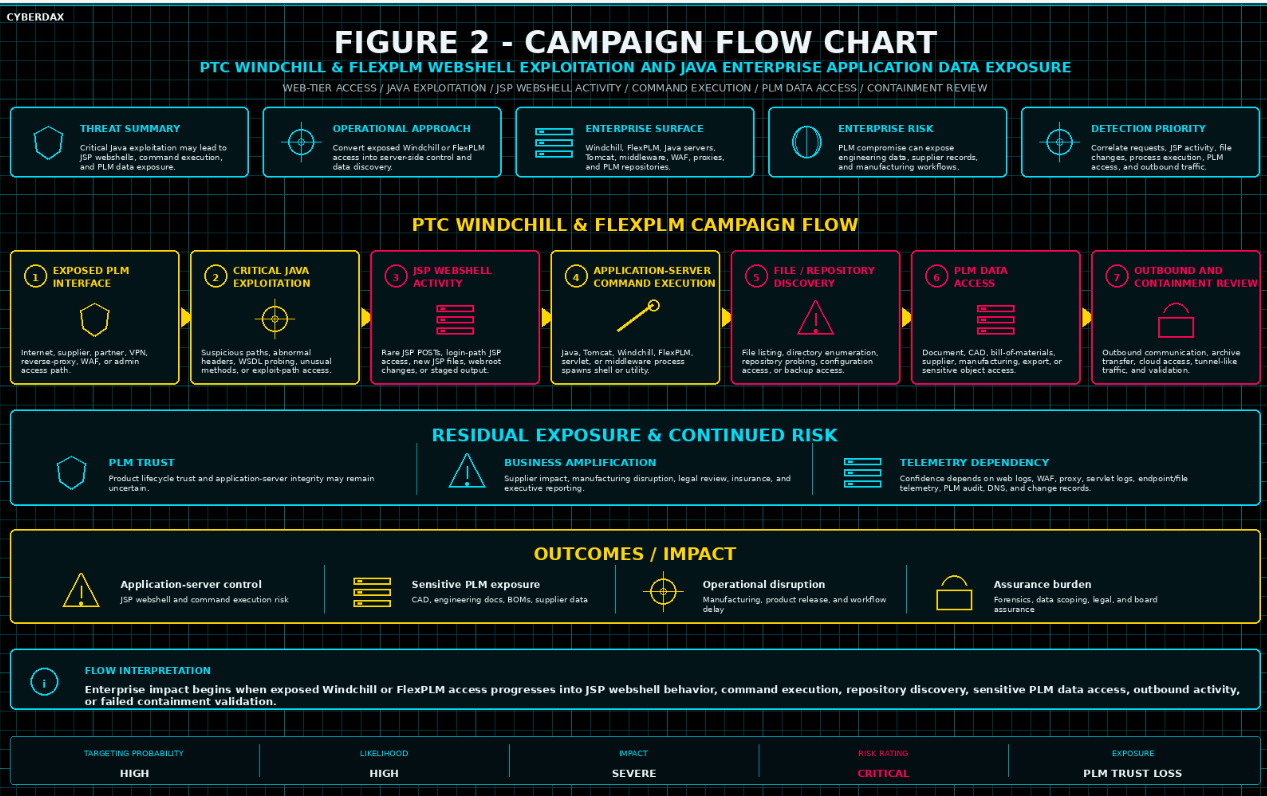
Figure 2
PTC Windchill, FlexPLM, and Adobe ColdFusion exploitation activity model showing suspicious web-tier access, exploit-path activity, server-side application execution, webshell or script artifact risk, application-server command execution, file discovery, sensitive application data access, outbound communication, and containment validation.
This report assesses PTC Windchill and FlexPLM exploitation as a durable Java enterprise application compromise and PLM data-exposure behavior class rather than a single CVE-only, actor-only, proof-of-concept-only, or IOC-only activity cluster. Current Adobe ColdFusion exploitation should be treated as coverage with amendment because it reinforces the same enterprise application compromise model when observable activity involves public-facing application access, path traversal or exploit-path behavior, arbitrary code execution risk, server-side artifact abuse, application-server command execution, file discovery, configuration access, outbound communication, or sensitive application data exposure.
· The activity remains best understood as enterprise application-server compromise risk rather than a routine patch-management event.
· Adobe ColdFusion does not replace Windchill and FlexPLM as the primary report scope; it extends the coverage register where ColdFusion behavior aligns with the existing Java enterprise application, webshell, command-execution, and application-data exposure model.
· Current ColdFusion activity increases urgency for organizations with internet-facing ColdFusion 2023 or ColdFusion 2025 deployments, incomplete patch validation, weak request logging, limited application-server telemetry, or insufficient outbound visibility.
· The strongest investigation path is suspicious ColdFusion request activity followed by traversal indicators, abnormal request paths, unexpected file access, application errors, newly created web-accessible artifacts, server-side execution evidence, command execution, archive creation, outbound communication, or sensitive data access.
· The activity may remain limited to scanning, proof-of-concept reuse, file-read probing, failed exploitation, or denied requests, or it may progress into command execution, webshell placement, file discovery, data staging, credential or configuration access, and outbound transfer.
· The activity becomes highest risk when ColdFusion servers support public applications, authentication workflows, document repositories, internal application bridges, database connectivity, administrative interfaces, file upload paths, or business-critical application workflows.
· CVE identifiers, CVSS severity, patch release timing, public exploit reporting, proof-of-concept availability, scanner signatures, or KEV-style urgency should enrich the activity model but should not replace local behavior-led evidence of exploit-path activity, command execution, data access, outbound communication, or containment failure.
S13 — Targets and Exposure Surface
The exposure surface includes PTC Windchill, PTC FlexPLM, Windchill PDMLink, FlexPLM application components, Java application servers, servlet containers, Tomcat hosts, middleware where applicable, reverse proxies, WAF paths, load balancers, web-accessible directories, codebase paths, login directories, application-managed directories, PLM repositories, CAD repositories, engineering document repositories, supplier data stores, manufacturing workflow records, backup paths, configuration files, integration hosts, and administrator workflows.
The confirmed Clop data-theft extortion campaign expands this exposure surface to internet-exposed Windchill and FlexPLM systems targeted through CVE-2026-12569. Observed activity includes unauthenticated exploitation, JSP webshell deployment, application-server command execution, access to sensitive product-lifecycle information, data staging, outbound transfer, and data theft for extortion. Exposure is highest where affected systems contain proprietary engineering designs, CAD files, bills of materials, supplier records, manufacturing information, product-development documentation, configuration data, regulated product records, or other high-value intellectual property.
CVE-2026-66066 expands this exposure surface to Ruby on Rails applications that accept untrusted image uploads, use libvips for Active Storage image processing, and generate image variants. Successful exploitation can allow unauthenticated reading of files accessible to the Rails application process, potentially exposing process-environment data, application configuration, secrets, credentials, tokens, or other sensitive application material. The confirmed behavior is arbitrary file read. Remote code execution or lateral movement is conditional and requires separate evidence that exposed secrets or credentials were successfully used for execution or access to connected systems.
· Internet-facing, supplier-facing, partner-facing, VPN-accessible, or externally reachable Windchill and FlexPLM web interfaces.
· Windchill login paths, FlexPLM application paths, WSDL paths, JSP paths, servlet paths, webroot paths, codebase paths, temporary paths, application-writable directories, and application-managed directories.
· Java runtime environments, Tomcat services, servlet containers, web-server processes, middleware services, Windchill service contexts, FlexPLM service contexts, and PLM integration hosts.
· Engineering repositories, CAD repositories, product-design repositories, bill-of-materials data, supplier records, manufacturing records, product-release workflows, document repositories, configuration files, backup files, and export packages.
· Reverse-proxy, WAF, firewall, secure-access, load-balancer, DNS, proxy, NDR, network-flow, endpoint, EDR, file telemetry, application logs, servlet logs, PLM audit logs, identity logs, administrator records, and change-management systems used to reconstruct activity.
· Administrator accounts, application service accounts, middleware users, integration accounts, API tokens, database credentials, backup credentials, SSH keys, and supplier or partner access paths associated with Windchill, FlexPLM, or PLM infrastructure.
· Environments with incomplete request logging, missing request-header capture, weak webroot monitoring, limited endpoint telemetry, missing file telemetry, incomplete PLM audit records, weak source baselines, undocumented vendor-support workflows, broad supplier access, or unclear product-data ownership.
· Hosted, managed, appliance-backed, third-party-supported, or telemetry-limited deployments where the customer may not have full process, file, memory, servlet, or application-server visibility.
Adjacent engineering, manufacturing, identity, database, backup, monitoring, supplier, partner, and business systems reachable from Windchill, FlexPLM, Java application, or PLM integration infrastructure.
S14 — Sectors / Countries Affected
Sectors Affected
· Manufacturing and industrial organizations.
· Aerospace, defense, and advanced engineering organizations.
· Automotive, transportation, and mobility organizations.
· Life sciences, medical device, and regulated product manufacturers.
· Energy, utilities, and critical infrastructure suppliers.
· Technology, hardware, electronics, semiconductor, and product-development organizations.
· Retail, apparel, consumer-goods, and supply-chain organizations using FlexPLM for product lifecycle and supplier workflows.
· Engineering, design, research, product-development, and supplier-dependent enterprises.
· Organizations using Windchill or FlexPLM to manage CAD data, product designs, bills of materials, supplier records, manufacturing workflows, engineering documentation, configuration data, regulated product records, or product-release decisions.
Countries Affected
· Global.
· Exposure is not limited to a single country or region because Windchill and FlexPLM are deployed across multinational manufacturing, engineering, supplier, product-development, aerospace, defense, life sciences, retail, industrial, and critical infrastructure environments.
· Countries with large manufacturing bases, aerospace and defense programs, automotive supply chains, regulated product-development environments, supplier-dependent production models, or major engineering operations may face elevated operational exposure.
· Country-specific impact should be assessed by Windchill and FlexPLM deployment footprint, internet exposure, supplier access, engineering-data sensitivity, manufacturing dependency, regulatory obligations, local telemetry maturity, and evidence of exploit-path or post-exploitation activity rather than geography alone.
S15 — Adversary Capability Profiling
Capability Level
Moderate to High
Technical Sophistication
Adversaries require enough technical capability to identify exposed Windchill or FlexPLM infrastructure, exploit Java enterprise application weaknesses, interact with unusual request paths or headers, establish or access JSP webshell capability, execute commands through application-server contexts, enumerate local or application-managed files, and translate application access into meaningful product-lifecycle impact. Lower-complexity activity may involve scanning, probing, public exploit reuse, opportunistic JSP access, simple command execution, file listing, or limited outbound communication. Higher-capability activity may involve targeted selection of PLM environments, careful source-infrastructure rotation, modified exploit chains, delayed execution, webshell naming variation, stealthy file discovery, PLM repository access, archive staging, credential or configuration access, supplier-impact scoping, and post-remediation persistence.
Infrastructure Maturity
Moderate
Infrastructure maturity varies by activity pattern. Lower-maturity activity may rely on commodity scanners, hosting-provider infrastructure, public proof-of-concept logic, basic webshell interaction, simple callbacks, or direct file retrieval. Higher-maturity activity may use rotating cloud infrastructure, compromised hosts, residential proxies, VPN paths, supplier or partner networks, internal pivot sources, role-consistent access timing, low-noise request patterns, delayed outbound communication, encrypted transfer paths, cloud storage, and operational timing designed to blend with administrator maintenance, vendor support, supplier workflows, engineering activity, or incident-response noise.
Operational Scale
Single exposed application to multi-system PLM and engineering-data exposure
Operational scale ranges from suspicious activity against one exposed Windchill or FlexPLM interface to broader enterprise exposure when adversaries reach application-server execution, webroot paths, PLM repositories, supplier data stores, engineering document repositories, CAD libraries, backup locations, identity infrastructure, database systems, or adjacent manufacturing and business systems. Within one organization, scale can expand from one application host to multiple PLM systems, reverse-proxy destinations, integration hosts, sensitive repositories, supplier workflows, and downstream systems that depend on product lifecycle data.
Escalation Likelihood
Moderate to High
Escalation likelihood is moderate to high when suspicious Windchill or FlexPLM activity is followed by rare JSP POST activity, newly observed JSP files, application-server child-process execution, file discovery, archive creation, outbound communication, administrator-state changes, PLM document access, CAD repository access, bill-of-materials access, supplier file access, manufacturing record access, backup access, or configuration review. Escalation likelihood increases when affected systems are internet-facing, supplier-facing, partner-accessible, heavily integrated, poorly monitored, managed by broad administrator groups, or used as authoritative repositories for high-value product lifecycle data.
S16 — Targeting Probability Assessment
Overall Targeting Probability
High
Targeting Drivers
· Windchill and FlexPLM environments commonly support high-value product lifecycle management, engineering design, CAD data, supplier collaboration, manufacturing records, bills of materials, configuration data, and product-release workflows.
· Critical remote code execution against PLM applications can provide adversaries with a path into sensitive application infrastructure without requiring initial endpoint compromise.
· Public-facing, supplier-facing, partner-facing, VPN-accessible, or reverse-proxy-exposed PLM interfaces increase attacker reach.
· Product lifecycle data has high pressure value because engineering designs, CAD files, supplier records, manufacturing records, product-release data, regulated product records, and bills of materials may create intellectual-property, contractual, operational, or regulatory consequences.
· JSP webshell activity, application-server command execution, file discovery, and outbound communication can allow adversaries to move beyond exploitation attempts into application-server control and sensitive data-access pathways.
· Adversaries benefit from environments where request headers, raw paths, servlet logs, endpoint telemetry, file telemetry, PLM audit records, sensitive data-object mapping, outbound telemetry, administrator baselines, and change records are incomplete.
· Normal workflows, including application updates, Java updates, servlet-container maintenance, vendor support, supplier exchange, engineering document access, CAD activity, product releases, backup jobs, migrations, security testing, and incident response can make attacker-driven activity harder to classify quickly.
· Targeting probability should be assessed through Windchill and FlexPLM exposure, affected version posture, external accessibility, PLM data sensitivity, supplier and manufacturing dependency, telemetry maturity, and local evidence of exploit-path-to-impact behavior rather than CVE status or actor reporting alone.
Most Likely Targets
· Internet-facing, supplier-facing, partner-facing, VPN-accessible, or externally reachable Windchill and FlexPLM instances.
· Windchill PDMLink environments, FlexPLM environments, Java application servers, Tomcat hosts, servlet containers, middleware systems, reverse-proxy paths, WAF-protected application routes, and PLM integration hosts.
· Engineering document repositories, CAD libraries, product-design repositories, bill-of-materials data, supplier records, manufacturing records, quality records, workflow exports, configuration files, backups, and sensitive document repositories.
· Application service accounts, administrator accounts, integration accounts, API tokens, database credentials, backup credentials, SSH keys, supplier access paths, and vendor-support workflows associated with Windchill or FlexPLM infrastructure.
· Adjacent databases, file shares, engineering repositories, identity infrastructure, backup systems, monitoring systems, supplier systems, partner systems, and high-value internal systems reachable from PLM application infrastructure.
· Organizations with broad PLM dependency, sensitive intellectual property, regulated product-development workflows, supplier-facing access, incomplete patch visibility, weak request logging, limited endpoint telemetry, missing PLM audit logs, unclear change records, or incomplete data-object sensitivity mapping.
S17 — MITRE ATT&CK Chain Flow Mapping
Stage 1: Public-Facing Windchill or FlexPLM Exploitation
The adversary targets an exposed Windchill, FlexPLM, or related Java enterprise application interface and attempts to exploit a critical application weakness to obtain server-side execution or application control. This stage should be mapped only when activity involves suspicious exploit-path requests, abnormal application access, or exploitation behavior against public, supplier-facing, partner-facing, VPN-accessible, or externally reachable PLM interfaces.
· T1190 Exploit Public-Facing Application.
Stage 2: JSP Webshell or Server-Side Application Persistence
The adversary establishes, accesses, or attempts to use a JSP webshell, web-accessible server-side artifact, or application-managed file path to support continued control of the compromised application environment. This stage should be tied to rare JSP access, newly observed JSP files, webroot or codebase file creation, suspicious JSP POST behavior, or webshell-like interaction.
· T1505.003 Server Software Component: Web Shell.
Stage 3: Application-Server Command Execution
The adversary executes commands through Windchill, FlexPLM, Java, Tomcat, servlet-container, web-server, application-server, or middleware service contexts. This stage should be mapped when process telemetry, application logs, EDR evidence, or incident-response findings show shells, interpreters, command processors, file-retrieval utilities, archive tools, discovery utilities, or network utilities spawned from application-server contexts.
· T1059 Command and Scripting Interpreter.
Stage 4: File and Repository Discovery
The adversary enumerates files, directories, application paths, configuration locations, PLM repositories, document stores, backup paths, or adjacent application resources after suspected compromise. This stage should be tied to file listing, directory enumeration, repository probing, staged output, application-server file access, or suspicious access to configuration and document paths.
· T1083 File and Directory Discovery.
Stage 5: Product-Lifecycle Data Collection
The adversary accesses or collects data from Windchill, FlexPLM, PLM repositories, CAD repositories, engineering document stores, supplier data locations, bills of materials, manufacturing records, configuration files, backups, or other product-lifecycle information repositories. This stage should be mapped when telemetry shows sensitive data-object access, document enumeration, export behavior, backup access, archive creation, or file collection near exploit-path or webshell activity.
· T1213 Data from Information Repositories.
S18 — Attack Path Narrative (Signal-Aligned Execution Flow)
PTC Windchill and FlexPLM webshell exploitation begins when an adversary targets an exposed Windchill, FlexPLM, or related Java enterprise application interface and attempts to move from suspicious web-tier access into server-side execution, JSP webshell activity, application-server command execution, file discovery, PLM data access, outbound communication, or persistence. The attacker’s objective is to convert critical application exposure into control over trusted PLM infrastructure that may contain engineering documents, CAD files, product designs, bills of materials, supplier records, manufacturing records, workflow artifacts, configuration data, backups, or sensitive product-lifecycle repositories. The attack path is defined by public-facing application exploitation, JSP webshell or server-side artifact use, application-server command execution, file and repository discovery, product-lifecycle data access, and conditional outbound activity. Lateral movement, credential theft, broader identity compromise, supplier-system expansion, or confirmed data exfiltration should be treated as conditional amplification unless supporting telemetry confirms those behaviors.
Stage 1: Public-Facing Windchill or FlexPLM Exploitation
The adversary targets an exposed Windchill, FlexPLM, or related Java enterprise application interface through internet-facing, supplier-facing, partner-facing, VPN-accessible, reverse-proxy, WAF-protected, or administrative access paths. Observable evidence may include suspicious request paths, abnormal request headers, FlexPLM WSDL probing, unusual HTTP methods, repeated path variation, access from unfamiliar source infrastructure, requests from hosting providers or residential proxies, abnormal status-code sequences, or request activity inconsistent with approved application use. This stage is not sufficient by itself to establish compromise because exposed PLM applications may receive scanning, probing, denied requests, vulnerability assessment traffic, or security testing. It becomes materially significant when suspicious request activity aligns with rare JSP access, newly observed JSP files, application errors, abnormal response sizes, file writes, application-server child-process execution, outbound communication, or PLM data access.
Stage 2: JSP Webshell or Server-Side Artifact Use
The adversary establishes, accesses, or attempts to use a JSP webshell, web-accessible server-side artifact, or application-managed file path to support continued control of the compromised environment. Observable evidence may include rare JSP POST activity, login-path JSP access, newly observed JSP filenames, webroot or codebase file creation, suspicious JSP file modification, unusual response-size behavior, staged output, or access to files inconsistent with the approved deployment baseline. This stage changes the event from suspected exploitation into suspected application compromise when JSP behavior aligns with suspicious source context, abnormal request activity, file telemetry, process telemetry, application errors, or incident-response evidence. JSP activity should not be treated as confirmed webshell execution by itself because some environments may include legitimate JSP components, application updates, vendor support, or deployment workflows.
Stage 3: Application-Server Command Execution
The adversary executes or attempts to execute commands through Windchill, FlexPLM, Java, Tomcat, servlet-container, web-server, application-server, or middleware service contexts. Observable evidence may include Java or Tomcat spawning shells, command processors, interpreters, scripting engines, file-retrieval utilities, archive tools, discovery utilities, network utilities, service-control commands, scheduled-task utilities, or persistence-oriented commands. This stage is operationally significant because it indicates that activity may have moved beyond web-tier probing into application-server control. The strongest signal is suspicious child-process execution from a trusted application service context near exploit-path requests, rare JSP access, newly observed JSP files, application errors, file creation, outbound communication, administrator-state changes, or sensitive PLM data access.
Stage 4: File and Repository Discovery
The adversary enumerates local files, directories, application paths, configuration locations, codebase paths, webroot paths, temporary directories, backup locations, document repositories, PLM repositories, CAD repositories, or adjacent application resources after suspected compromise. Observable evidence may include file listing, directory enumeration, repository probing, staged command output, archive preparation, configuration-file access, backup access, or unusual access to paths not normally used by the application role. This stage increases business risk because it may reveal where product designs, engineering documents, supplier files, bills of materials, manufacturing records, credentials, configuration data, or sensitive document repositories are stored. The strongest signal is file or repository discovery that occurs near suspicious web-tier access, JSP activity, application-server command execution, abnormal response volume, outbound communication, or unusual administrator activity.
Stage 5: Product-Lifecycle Data Access
The adversary accesses or attempts to access sensitive product-lifecycle data through Windchill, FlexPLM, PLM repositories, CAD repositories, engineering document stores, supplier data locations, bill-of-materials records, manufacturing workflows, configuration files, backups, export packages, or sensitive document repositories. Relevant evidence may include document enumeration, CAD file access, bill-of-materials access, supplier file access, manufacturing record access, bulk export activity, archive creation, backup access, configuration access, unusual service-account activity, or sensitive object access outside expected workflow context. This stage is the primary business-impact pivot because it moves the incident from application compromise concern into potential intellectual-property exposure, supplier-risk review, manufacturing impact assessment, contractual review, regulatory analysis, executive reporting, and board-level product lifecycle trust concerns. The strongest signal is sensitive PLM data access that exceeds expected source, role, workflow, timing, volume, identity, or business-cycle baselines and occurs near exploit-path activity, JSP access, command execution, file discovery, or outbound communication.
Stage 6: Conditional Outbound Activity and Containment Validation
The adversary may attempt outbound communication, tool retrieval, archive transfer, cloud storage access, tunnel-like traffic, unusual file transfer, or data movement after exploit-path activity, webshell access, command execution, file discovery, or sensitive product-lifecycle data access. This stage provides important scoping value but should not be treated as confirmed exfiltration without staging evidence, transfer evidence, unusual byte volume, data-loss evidence, incident-response validation, or destination context inconsistent with approved business workflows. Outbound behavior becomes materially significant when it follows suspicious application access, JSP activity, application-server command execution, archive creation, sensitive data access, administrator-state changes, or access to rare, newly observed, low-reputation, geographically unusual, or role-inconsistent destinations. Containment validation should determine whether webshell artifacts were removed, application-server integrity was restored, vulnerable paths were remediated, PLM data access was scoped, service accounts were reviewed, outbound activity stopped, and post-remediation activity did not continue.
S19 — Attack Chain Risk Amplification Summary
PTC Windchill and FlexPLM webshell exploitation amplifies risk because it targets PLM infrastructure that may concentrate engineering designs, CAD files, bills of materials, supplier records, manufacturing workflows, configuration data, backups, product-release artifacts, and sensitive document repositories. The chain becomes materially more dangerous when suspicious web-tier activity is followed by JSP webshell behavior, application-server command execution, file discovery, archive creation, PLM repository access, CAD or engineering document access, supplier data access, manufacturing record access, outbound communication, or post-remediation activity.
· Broad PLM dependency increases exposure because Windchill and FlexPLM may support engineering, product design, supplier collaboration, manufacturing planning, bill-of-materials management, document workflows, configuration control, quality processes, and product-release decisions.
· Public-facing, supplier-facing, partner-facing, VPN-accessible, or reverse-proxy-exposed PLM interfaces increase attacker reach and make exploit-path visibility critical.
· Suspicious request paths, abnormal request headers, FlexPLM WSDL probing, rare JSP access, unusual HTTP methods, repeated path variation, abnormal response sizes, and unfamiliar source infrastructure increase concern when they align with downstream activity.
· JSP webshell behavior amplifies risk because it may provide repeatable access through trusted application infrastructure while blending with web-tier and application-server activity.
· Application-server child-process execution becomes materially significant when Java, Tomcat, Windchill, FlexPLM, servlet-container, web-server, or middleware service contexts spawn shells, interpreters, command processors, file-retrieval utilities, archive tools, discovery utilities, or network utilities.
· File and repository discovery increases business risk because it may reveal PLM repositories, CAD libraries, supplier data stores, manufacturing records, configuration files, backup paths, credential material, or sensitive document repositories.
· Product-lifecycle data access amplifies impact when it involves engineering designs, CAD files, bills of materials, product-release data, regulated product records, supplier files, manufacturing workflows, configuration data, backups, or export packages.
· Outbound communication increases concern when it involves rare destinations, newly observed infrastructure, low-reputation destinations, unusual geographies, tunnel-like traffic, file-transfer behavior, cloud storage access, abnormal byte volume, or destinations inconsistent with the deployed application role.
· Supplier, partner, or manufacturing exposure increases response scope because PLM compromise may affect external collaboration, production planning, contractual confidentiality, product quality, regulated product workflows, or downstream business operations.
· Administrator-state changes, service-account activity, API token activity, permission changes, service modification, or configuration changes increase risk when they occur near exploit-path behavior or suspected webshell activity.
· Incomplete web logs, request-header capture, raw request paths, servlet logs, endpoint telemetry, file telemetry, PLM audit records, data-object sensitivity mapping, outbound telemetry, asset inventory, or change-management records can force broader investigation because the organization cannot quickly prove whether sensitive product-lifecycle data was accessed or transferred.
· Response burden increases because teams must validate exposure, patch status, webshell presence, application-server integrity, file changes, PLM data access, outbound communication, supplier impact, manufacturing impact, legal obligations, contractual exposure, and executive assurance.
S20 — Tactics, Techniques, and Procedures

Figure 3
PTC Windchill and FlexPLM attack-chain model showing public-facing application exploitation, JSP webshell or server-side artifact use, application-server command execution, file and repository discovery, product-lifecycle data access, conditional outbound activity, and containment validation.
Public-Facing PLM Application Exploitation
Adversaries may target exposed Windchill, FlexPLM, or related Java enterprise application interfaces through internet-facing, supplier-facing, partner-facing, VPN-accessible, reverse-proxy, WAF-protected, or administrative access paths. The behavior may involve suspicious request paths, abnormal request headers, FlexPLM WSDL probing, unexpected HTTP methods, path variation, encoded path elements, unusual source infrastructure, abnormal response patterns, or activity inconsistent with approved application use. This activity becomes risk-relevant when exploit-path behavior aligns with JSP access, JSP creation, application errors, file writes, command execution, outbound communication, or PLM data access.
JSP Webshell or Server-Side Artifact Activity
Adversaries may establish, access, or attempt to use JSP webshells, web-accessible server-side artifacts, or application-managed file paths to support continued control of Windchill, FlexPLM, or related Java application infrastructure. The behavior may involve rare JSP POST activity, newly observed JSP filenames, login-path JSP access, suspicious webroot file creation, codebase file modification, application-writable path activity, abnormal response sizes, or staged command output. This activity becomes high risk when it occurs near suspicious web-tier access, abnormal request headers, application errors, application-server child-process execution, file discovery, outbound communication, or sensitive PLM data access.
Application-Server Command Execution
Adversaries may execute commands from Java, Tomcat, Windchill, FlexPLM, servlet-container, web-server, application-server, or middleware service contexts. The behavior may involve shells, command processors, interpreters, scripting engines, file-retrieval utilities, archive tools, discovery utilities, network utilities, service-control utilities, scheduled-task utilities, or persistence-oriented commands. This activity becomes materially significant when process execution occurs under application service accounts, web service accounts, middleware users, integration accounts, root context, administrator context, or unusual service-account context near exploit-path activity or JSP behavior.
File Discovery and Staged Output
Adversaries may enumerate files, directories, application paths, configuration locations, temporary directories, backup paths, document repositories, PLM repositories, CAD repositories, or adjacent application resources. The behavior may involve directory listing, file discovery, repository probing, staged output files, archive preparation, configuration review, backup access, or access to paths inconsistent with normal application behavior. This activity becomes high risk when it follows suspicious web-tier access, JSP webshell activity, command execution, abnormal response volume, outbound communication, or PLM data access.
Product-Lifecycle Repository Access
Adversaries may access Windchill, FlexPLM, PLM repositories, CAD repositories, engineering document stores, supplier data locations, bill-of-materials records, manufacturing records, product-release workflows, configuration files, backups, export packages, or sensitive document repositories. This behavior is operationally significant because PLM repositories may contain intellectual property, regulated product records, supplier data, product designs, manufacturing context, and business-critical engineering workflows. It becomes high risk when access deviates from expected role, workflow, source, time window, identity, data-sensitivity, volume, or approved business-cycle baselines.
Archive Creation and Data Staging
Adversaries may create archives, stage output files, collect files into temporary directories, prepare export packages, access backups, or organize product-lifecycle data for later transfer. This behavior should be evaluated against approved engineering exports, supplier exchanges, product-release workflows, backup activity, migration activity, legal discovery, compliance workflows, security testing, and incident response before being treated as malicious. It becomes data-exposure-relevant when it follows exploit-path activity, JSP access, command execution, file discovery, sensitive PLM object access, unusual service-account use, or outbound communication.
Outbound Communication and Tool Retrieval
Adversaries may use outbound HTTP, HTTPS, DNS, SSH, SMB, file-transfer behavior, cloud storage access, tunnel-like traffic, or rare external destinations after application compromise. The behavior may support callback activity, tool retrieval, command staging, archive transfer, or data movement. This activity should not be treated as confirmed exfiltration by itself because application servers may communicate with vendor services, update services, monitoring tools, backup destinations, supplier integrations, partner integrations, security-testing infrastructure, or incident-response destinations. It becomes high risk when it follows JSP activity, application-server command execution, archive creation, sensitive PLM data access, administrator-state changes, or communication to rare, newly observed, low-reputation, geographically unusual, or role-inconsistent destinations.
Administrator, Service Account, and Integration Abuse
Adversaries may attempt to use administrator accounts, application service accounts, middleware users, integration accounts, API tokens, database credentials, backup credentials, SSH keys, supplier access paths, or vendor-support workflows after application compromise. This behavior becomes high risk when account or service activity occurs near suspicious web-tier access, JSP webshell activity, command execution, file discovery, PLM data access, configuration access, or outbound communication. Local investigation should validate whether account activity aligns with approved maintenance, vendor support, supplier exchange, backup jobs, product-release workflows, security testing, incident response, or documented administrative action.
Operational Blending With PLM Workflows
Adversaries may blend malicious behavior into normal Windchill, FlexPLM, Java application, engineering, supplier, manufacturing, backup, and administrator workflows. Normal activity may include application updates, Java updates, servlet-container maintenance, vendor support, supplier file exchange, CAD access, engineering document review, product release activity, backup jobs, migrations, monitoring, vulnerability scanning, security testing, and incident response. This blending is effective because PLM environments routinely involve sensitive file access, engineering workflows, supplier collaboration, application maintenance, privileged administration, and scheduled data movement.
Conditional Expansion Into Adjacent Systems
Adversaries may attempt to use compromised PLM infrastructure to reach adjacent databases, file shares, engineering repositories, identity infrastructure, backup systems, monitoring systems, supplier systems, partner systems, or high-value internal systems. This behavior should remain conditional unless it follows suspicious Windchill or FlexPLM access, JSP activity, application-server command execution, credential or configuration access, PLM data access, outbound communication, or other validated post-exploitation behavior within a bounded investigation window.
S20A — Adversary Tradecraft Summary
PTC Windchill and FlexPLM webshell exploitation targets the trust relationship between public-facing PLM applications, Java enterprise application infrastructure, JSP execution paths, application-server service contexts, engineering repositories, supplier workflows, manufacturing data, and incident-response containment. The adversary objective is to convert critical application exposure into application-server control, product-lifecycle data access, sensitive engineering-data exposure, supplier or manufacturing impact, outbound communication, or persistent uncertainty over PLM system integrity.
· The core tradecraft pattern is suspicious Windchill or FlexPLM web-tier activity followed by rare JSP access, newly observed JSP files, application-server command execution, file discovery, PLM repository access, sensitive product-lifecycle data access, outbound communication, or post-remediation concern.
· The behavior is not dependent on a single CVE identifier, actor name, proof-of-concept string, request header, file name, webshell name, source IP address, user agent, tool name, scanner label, or static IOC.
· Adversaries may use exposed PLM interfaces, suspicious request paths, abnormal request headers, FlexPLM WSDL probing, JSP webshell interaction, application-server child processes, file discovery, archive creation, configuration access, PLM repository access, outbound communication, and operational timing designed to blend with approved workflows.
· The strongest operational risk occurs when suspected exploitation affects internet-facing, supplier-facing, partner-facing, or heavily integrated Windchill and FlexPLM environments that hold engineering designs, CAD files, bills of materials, supplier records, manufacturing records, regulated product data, backups, configuration files, or sensitive product-release information.
· Detection requires visibility into web-tier access, request paths, request headers, response sizes, application errors, JSP activity, file telemetry, process telemetry, outbound network activity, PLM audit records, administrator actions, asset inventory, and change-management context.
· Response requires treating suspected Windchill or FlexPLM exploitation as a PLM trust, application-server integrity, intellectual-property exposure, supplier-risk, and containment-validation incident, not a routine vulnerable-version finding, scanner alert, patch ticket, or isolated web request.
· The behavior remains durable because the adversary objective is to convert trusted product lifecycle infrastructure into application control and data-access uncertainty regardless of the specific exploit variant, webshell filename, request path, source infrastructure, or public reporting label used.
S21 — Detection Strategy Overview
Detection Philosophy
Detection for PTC Windchill, FlexPLM, Adobe ColdFusion, and related Java enterprise application exploitation must prioritize exploit-path behavior, suspicious web-tier request activity, path traversal indicators, server-side artifact creation, application-server command execution, file discovery, data staging, outbound communication, and sensitive application data access over vulnerability-state identification alone. The amended detection model should treat ColdFusion exploitation as coverage with adaptation inside the existing enterprise application compromise pattern. Coverage should preserve Windchill and FlexPLM specificity while adding ColdFusion-specific hunting focus where telemetry and behavior align.
Primary Detection Anchors
· Suspicious Windchill, FlexPLM, or ColdFusion web requests involving unauthenticated access paths, path traversal patterns, encoded traversal sequences, unusual template or endpoint access, abnormal request headers, unexpected HTTP methods, abnormal response sizes, rare status-code sequences, or paths inconsistent with approved application use.
· ColdFusion request activity involving attempts to access system files, configuration files, application files, administrator paths, template files, upload paths, or web-accessible directories outside expected application workflow.
· JSP, CFM, CFC, Java, servlet, webroot, login-directory, temporary-directory, application-writable, upload-path, or codebase file creation, modification, execution, or permission change on Windchill, FlexPLM, ColdFusion, or adjacent enterprise application servers.
· Unexpected child-process execution from Java, Tomcat, ColdFusion, Windchill, FlexPLM, servlet-container, application-server, web-server, or middleware service contexts, including shells, interpreters, command processors, file-retrieval utilities, archive utilities, scripting engines, and network utilities.
· File discovery, directory listing, configuration access, staged output, attacker-created text files, archive creation, or suspicious artifact creation consistent with exploit-enabled reconnaissance.
· Large responses, abnormal response-body sizes, repeated file-read-like responses, unusual byte volume, or command-output-like responses from ColdFusion, JSP, servlet, or application paths that normally do not return large dynamic output.
· Outbound communication from ColdFusion, Windchill, FlexPLM, application-server, servlet-container, middleware, or integration hosts to newly observed, rare, low-reputation, geographically unusual, role-inconsistent, or unexpected destinations.
· Access to application data, PLM data, engineering data, product-design data, supplier data, manufacturing data, configuration data, database connection material, backup data, or document repositories occurring near suspected exploit-path activity.
Detection Prioritization Model
· Highest priority should be assigned to suspicious ColdFusion, Windchill, or FlexPLM exploit-path request activity followed by file access, server-side artifact creation, application-server child-process execution, file discovery, abnormal response volume, outbound communication, or sensitive data access.
· High priority should be assigned to path traversal behavior against ColdFusion servers when paired with suspicious source context, system-file access attempts, application errors, unusual response sizes, or follow-on host activity.
· High priority should be assigned to newly observed CFM, CFC, JSP, or other server-side artifacts in web-accessible, application-writable, upload, temporary, codebase, or administrative paths.
· High priority should be assigned to application-server service contexts spawning shells, interpreters, command processors, file-retrieval utilities, archive utilities, network utilities, scripting engines, or persistence-oriented commands without an approved maintenance workflow.
· Medium priority should be assigned to suspicious web-tier access, unusual application errors, abnormal request headers, traversal-like paths, rare template access, file writes, response-size anomalies, or unusual application-data access when supporting process, file, network, or application telemetry is incomplete.
· Lower priority should be assigned to vulnerability scan results, exposed systems, patch-state findings, isolated denied requests, isolated web errors, single anomalous request paths, or ordinary administrator activity that aligns with approved maintenance and validated change records.
Correlation Strategy
· Correlate ColdFusion, Windchill, FlexPLM, web-server, reverse-proxy, load-balancer, WAF, firewall, application, servlet-container, access, application-server, endpoint, process, file, EDR, DNS, proxy, network-flow, audit, identity, and change-management records where available.
· Require temporal linkage between suspicious request behavior and downstream file access, server-side artifact activity, command execution, file discovery, abnormal response volume, outbound communication, sensitive data access, administrator change, or application-server host behavior before escalating to suspected compromise.
· Treat exposed systems, vulnerable versions, scanner output, patch-state findings, CVSS severity, public proof-of-concept availability, and general internet exposure as exposure indicators, not compromise indicators.
· Do not attribute ordinary ColdFusion, Windchill, FlexPLM, Java application, Tomcat, WebLogic, Confluence, SAP NetWeaver, Spring, or middleware maintenance to exploitation unless suspicious source context, exploit-path behavior, file anomalies, command execution, outbound communication, or sensitive data-access evidence is also present.
· Preserve separate analytic outcomes for exposure, attempted exploitation, suspected file-read activity, suspected server-side artifact activity, suspected command execution, suspected data access, suspected staging, suspected exfiltration, and confirmed post-exploitation activity.
Telemetry Prioritization
· ColdFusion web, access, application, administrator, servlet, and audit logs where available.
· Windchill and FlexPLM web, access, application, servlet, and audit logs where available.
· Reverse-proxy, WAF, load-balancer, firewall, and secure access logs for public ingress and management-path visibility.
· Request-path, normalized-path, raw-path, HTTP method, response status, response size, request-header, source-IP, destination-host, user-agent, session, identity, and timestamp telemetry.
· Endpoint and EDR telemetry from ColdFusion, Windchill, FlexPLM, Tomcat, Java application, application-server, middleware, and supporting Linux or Windows hosts.
· Process telemetry capturing parent-child lineage, command line, process user, effective user, working directory, service context, shell execution, interpreter execution, file-retrieval activity, archive activity, and process-network connections.
· File telemetry covering CFM, CFC, JSP, Java, servlet, webroot, login-directory, codebase, application-writable, upload, temporary, staging, backup, configuration, and document-repository paths.
· DNS, proxy, firewall, NDR, and network-flow telemetry covering outbound communication, file transfer, callback behavior, unusual byte volume, and connections to rare or newly observed destinations.
· Asset inventory and exposure-management data identifying ColdFusion servers, Windchill systems, FlexPLM systems, Java application servers, Tomcat hosts, WebLogic hosts, Confluence servers, SAP NetWeaver systems, Spring applications, reverse proxies, WAF paths, exposed interfaces, approved administrators, and sensitive repositories.
· Change-management records for ColdFusion updates, application updates, Java updates, servlet-container changes, reverse-proxy changes, WAF policy changes, application deployments, administrative maintenance, vendor support, security testing, and incident response.
Detection Design Constraints
· Detection must distinguish exposed or vulnerable ColdFusion, Windchill, and FlexPLM assets from active exploitation or post-exploitation behavior.
· Detection must not rely primarily on CVE identifiers, CVSS score, public exploit strings, proof-of-concept names, static filenames, fixed hashes, known IP addresses, single request fragments, scanner labels, or vendor advisory text.
· Detection must account for environments where request bodies, raw request paths, full request headers, endpoint process telemetry, file telemetry, application audit logs, or outbound proxy logs are unavailable.
· Detection must not assume that path traversal, suspicious web-tier access, or file-read probing alone represents successful command execution, durable webshell persistence, data exfiltration, or actor attribution.
· Detection must preserve operational separation between approved application updates, administrative troubleshooting, file exports, bulk data access, vendor support, security testing, patch validation, and unauthorized compromise.
· Detection must avoid claiming direct Windchill or FlexPLM coverage for ColdFusion unless the target platform, telemetry, and observed behavior align with the Java, server-side application, webshell, or application-server compromise model.
· Detection must use behavior-led correlation wherever possible instead of single-event alerting.
Operational Detection Model
· Treat suspicious ColdFusion, Windchill, or FlexPLM exploit-path activity as an enterprise application compromise incident candidate.
· Escalate when traversal-like request paths, abnormal headers, rare server-side template access, newly observed web-accessible files, unusual response-size behavior, or application errors are followed by process execution, file creation, outbound communication, data access, administrator changes, or application-server instability.
· Use source reputation, administrator baseline, request path, request header, HTTP method, response size, session context, application role, asset criticality, process lineage, file path, data-object sensitivity, outbound destination, and change-window context to separate approved activity from exploitation behavior.
· Require incident triage to determine whether activity represents exposure, attempted exploitation, suspected file-read activity, suspected server-side artifact access, suspected command execution, suspected persistence, suspected data discovery, suspected data staging, suspected exfiltration, or confirmed post-exploitation activity.
· Preserve escalation language that reflects confidence level and observed behavior rather than assuming full application compromise from a single weak signal.
Explicit Non-Deployment Guardrails
· Do not deploy high-confidence alerting from exposed ColdFusion, Windchill, or FlexPLM internet-facing services alone.
· Do not deploy high-confidence alerting from patch state, vulnerability scanner output, CVSS score, KEV-style urgency, or CVE presence alone.
· Do not deploy high-confidence alerting from isolated HTTP errors, isolated denied requests, isolated traversal-like paths, isolated WSDL access, isolated JSP or CFM requests, or single anomalous request headers without supporting context.
· Do not deploy a rule that assumes all CFM, CFC, or JSP files are malicious in environments where those files are expected application components.
· Do not deploy endpoint rules as direct coverage for hosted, managed, appliance, or platform environments where endpoint process and file telemetry are unavailable.
· Do not deploy network-only rules as confirmed compromise detections without supporting application, file, process, data-access, or incident-response evidence.
Do not use these detections for actor attribution without incident-specific intelligence, validated behavioral correlation, and confirmed victim-environment evidence.
S22 — Primary Detection Signals
Primary Detection Signals
· Abnormal ColdFusion, Windchill, or FlexPLM web requests involving unauthenticated exploit-path behavior, path traversal indicators, encoded traversal sequences, unusual request headers, unexpected HTTP methods, request-path variation, or access patterns inconsistent with approved application use.
· ColdFusion requests attempting to access system files, configuration files, administrator paths, application files, template files, upload paths, temporary paths, backup paths, or web-accessible directories outside expected workflow.
· POST or GET requests to newly observed, randomly named, rare, or suspicious CFM, CFC, JSP, or other server-side files under webroot, application-managed, upload, temporary, codebase, login, or administrative paths.
· CFM, CFC, JSP, Java, servlet, webroot, upload-path, temporary-path, application-writable, or codebase file creation, modification, execution, permission change, or access where the file is not part of an approved deployment.
· Java, Tomcat, ColdFusion, Windchill, FlexPLM, servlet-container, web-server, application-server, or middleware service processes spawning shells, interpreters, command processors, file-retrieval utilities, archive tools, scripting engines, network utilities, or service-management commands.
· File discovery, directory listing, staged output, attacker-created text files, configuration access, backup access, or application-server file enumeration occurring near suspicious web-tier access.
· Abnormal response-size patterns from ColdFusion, JSP, servlet, application, login-adjacent, or administrative paths that normally do not return large output.
· Outbound DNS, HTTP, HTTPS, SSH, tunnel-like traffic, or unusual external communication from ColdFusion, Windchill, FlexPLM, application-server, middleware, or integration hosts after suspicious web-tier activity.
· Application-data, PLM-data, engineering, product-design, CAD, bill-of-materials, supplier, manufacturing, workflow, document-repository, backup, configuration, database connection, or credential-material access occurring near suspected exploit-path behavior.
Supporting Detection Signals
· Repeated requests to ColdFusion, Windchill, or FlexPLM from unfamiliar source IPs, unusual geographies, suspicious ASNs, hosting providers, residential proxies, VPN ingress paths, supplier networks, partner paths, newly observed internal hosts, unmanaged systems, or sources outside approved administration baselines.
· HTTP response anomalies, repeated denied requests, redirect anomalies, HTTP 5xx patterns, application errors, unusual response-size sequences, or abnormal status-code combinations near suspicious application activity.
· Access to rarely used ColdFusion, Windchill, FlexPLM, CFM, CFC, JSP, servlet, WSDL, webroot, codebase, login-directory, administrator, or application-management paths by sources outside approved administrative or integration baselines.
· User-agent anomalies, automation-like request timing, repeated requests with small path changes, unusual URL encoding, suspicious method use, path canonicalization differences, or request-normalization mismatches.
· New or unusual administrative sessions, API activity, service-account use, workflow changes, export activity, or data-object access following suspicious source access, failed authentication patterns, abnormal path behavior, or rare server-side template access.
· Application-server errors, servlet-container errors, ColdFusion errors, Java exceptions, web-service instability, repeated failed requests, service restarts, process crashes, or abnormal system instability near exploit-path request activity.
· File creation, file modification, archive extraction, temporary file use, script placement, executable permission changes, or suspicious download activity from application-writable, web-accessible, upload, temporary, backup, or staging paths.
· DNS, firewall, proxy, NDR, or network-flow events showing outbound communication from application servers to newly observed, rare, low-reputation, geographically unusual, or role-inconsistent destinations.
· Change-management mismatch where CFM, CFC, JSP, application updates, reverse-proxy changes, WAF exceptions, administrative actions, export activity, or service restarts occur without a corresponding approved maintenance record.
Exploit Attempt and Instability Signals
· Bursts of ColdFusion, Windchill, or FlexPLM requests involving traversal-like paths, encoded path elements, administrator paths, login paths, WSDL paths, JSP paths, CFM paths, CFC paths, unexpected file paths, repeated path variations, unusual request ordering, uncommon headers, or abnormal HTTP methods.
· Repeated attempts against exposed ColdFusion, Windchill, or FlexPLM interfaces from the same source, source network, ASN, hosting provider, residential proxy range, VPN path, supplier path, partner network, or newly observed internal source.
· Web-tier request activity followed by HTTP 5xx errors, ColdFusion exceptions, Java exceptions, servlet errors, application-server instability, service restarts, process crashes, or abnormal system faults.
· Suspicious CFM, CFC, or JSP access followed by shell execution, interpreter execution, command-processor execution, network utility execution, file retrieval, archive extraction, command chaining, or service modification.
· Suspicious application request activity followed by file-listing artifacts, directory enumeration, application repository probing, document enumeration, backup access, configuration-file access, database connection material access, or credential-material access.
· Similar exploit-path request patterns observed across multiple ColdFusion, Windchill, FlexPLM, Java application, middleware, or reverse-proxy destinations.
· Internal scanning, application enumeration, service discovery, management-interface discovery, API probing, or repository enumeration preceding suspicious access or following suspected compromise.
· Logging gaps, application telemetry reduction, service interruption, unexpected restart behavior, administrative-console errors, monitoring visibility reduction, or unexplained telemetry loss near suspected exploit-path activity.
Outbound Communication Signals
· Outbound communication from ColdFusion, Windchill, FlexPLM, Java application, application-server, servlet-container, middleware, or integration hosts to unfamiliar external infrastructure before or after exploit-path request behavior or command-execution evidence.
· Newly observed DNS queries, rare domains, rare IP destinations, unusual ASNs, low-reputation destinations, unexpected geographic destinations, or traffic patterns inconsistent with the deployed application role.
· HTTP, HTTPS, DNS, SSH, SMB, tunnel-like traffic, unexpected file retrieval, unusual package-repository access, abnormal byte volume, or repeated outbound sessions after suspected exploit-path activity.
· External communication from application servers that does not align with approved update services, vendor services, integrations, monitoring tools, backup destinations, remote-management platforms, or administrator workflows.
· Outbound communication from an internal source host that recently generated abnormal ColdFusion, Windchill, FlexPLM, or Java application access.
· Data staging, archive creation, bulk document access, configuration export, sensitive application object access, backup export, credential material access, or unusual outbound transfer behavior after suspected compromise.
· Communication to newly observed external destinations followed by data-access anomalies, administrative changes, service-account use, workflow changes, export activity, or additional application-server access.
Persistence and Post-Exploitation Signals
· Creation, modification, or unexpected use of CFM files, CFC files, JSP files, Java artifacts, servlet components, webroot files, application-writable files, scheduled jobs, startup scripts, service entries, local users, SSH keys, or remote-access mechanisms.
· Unexpected enabling, disabling, or modification of application services, web services, ColdFusion services, Tomcat services, Java processes, servlet containers, middleware services, startup behavior, package components, reverse-proxy rules, WAF exceptions, or application routing.
· Placement or execution of scripts, binaries, archives, webshells, temporary files, downloaded tools, suspicious packages, or staged output on ColdFusion, Windchill, FlexPLM, application-server, middleware, or supporting hosts.
· Credential access behavior, sensitive configuration access, database connection-string access, service-account credential access, application secret access, backup access, API token exposure, or administrative credential changes.
· Security-control weakening, log clearing, logging interruption, WAF rule change, reverse-proxy change, monitoring disruption, endpoint protection interference, backup tampering, or defensive visibility reduction after suspected exploitation.
· Administrative activity from newly created, rarely used, unfamiliar, geographically unusual, or role-inconsistent identities following exploit-path activity or command-execution behavior.
· Application data access, document access, export activity, backup access, configuration access, database access, supplier file access, CAD data access, bill-of-materials extraction, or sensitive repository enumeration following suspected webshell or command-execution activity.
Lateral Movement and Expansion Signals
· Access from a suspected ColdFusion, Windchill, FlexPLM, Java application, application-server, or middleware host to internal file shares, database servers, identity infrastructure, engineering systems, CAD repositories, build systems, supplier portals, backup systems, monitoring systems, or high-value business systems.
· Internal scanning, service enumeration, directory enumeration, SMB access, SSH access, RDP access, database access, web-admin access, API probing, SNMP activity, or management-plane discovery after suspected application compromise.
· Access from application servers into adjacent engineering, manufacturing, product, supplier, or operational systems that does not align with expected integration workflows.
· Administrative sessions, API activity, credential use, or service-account activity expanding from ColdFusion, Windchill, FlexPLM, or Java application infrastructure into adjacent business, identity, security, backup, or monitoring platforms.
· Reuse of service-account credentials, administrator credentials, API tokens, SSH keys, database credentials, session material, or integration secrets across application servers, databases, or related infrastructure after suspected compromise.
· Cross-segment, cross-site, supplier-facing, partner-facing, or cross-business-unit activity that does not align with normal application topology, approved integration paths, administrator baselines, or change records.
Signal Usage Constraints
· Do not treat patch state, vulnerability scan output, exposed ColdFusion, Windchill, or FlexPLM interfaces, internet exposure, CVSS score, or KEV-style urgency as evidence of exploitation by itself.
· Do not treat isolated web errors, denied requests, ordinary WSDL access, single CFM requests, single CFC requests, single JSP requests, single login failures, or single administrative actions as compromise indicators unless they correlate with suspicious source context, exploit-path behavior, or downstream application-server behavior.
· Do not escalate approved application updates, vendor support activity, exports, workflow changes, maintenance scripts, backup jobs, integrations, administrative troubleshooting, security testing, or incident response when activity aligns with known administrators, approved systems, expected windows, and validated change records.
· Do not infer command execution, webshell persistence, or data exfiltration from web-tier request activity alone without supporting file, process, application, network, data-access, or incident-response evidence.
· Do not rely on proof-of-concept names, public exploit strings, single request fragments, tool names, scanner labels, user-agent strings, static filenames, or known infrastructure as primary detection signals.
· Do not assume endpoint, file, process, memory, servlet, request-body, or full request-header telemetry exists for all ColdFusion, Windchill, FlexPLM, hosted, managed, appliance, or middleware deployments.
· Do not infer actor attribution from exploit-path behavior, webshell access, command execution, outbound communication, data access, or tooling without incident-specific intelligence and validated evidence.
· Preserve separate analytic outcomes for exposure, attempted exploitation, suspected file-read activity, suspected webshell activity, suspected application-server command execution, suspected persistence, suspected data access, suspected staging, suspected exfiltration, and confirmed post-exploitation activity.
S23 — Telemetry Requirements
Endpoint and Process Execution Telemetry
· Endpoint and process telemetry should be collected from Windchill, FlexPLM, Tomcat, Java application, application-server, middleware, reverse-proxy, and supporting Linux or Windows hosts where customer-managed telemetry is available.
· Process telemetry should capture process creation, parent-child process lineage, command-line execution, working directory, process user, effective user, process path, process hash, service context, interpreter execution, shell execution, command-processor execution, file retrieval, archive extraction, network utility execution, and service restart behavior.
· Application-server service-context execution should be monitored for unexpected child processes spawned by Java, Tomcat, Windchill, FlexPLM, servlet-container, web-server, WebLogic, Confluence, SAP NetWeaver, ColdFusion, Spring, middleware, or locally mapped application service processes.
· Process telemetry should identify execution from application service accounts, web service accounts, middleware users, integration accounts, privileged users, root-context processes, or administrator-context processes when those fields are exposed.
· Sudo telemetry, privileged command telemetry, Windows administrative execution telemetry, and root or administrator context execution telemetry should be collected from deployments that expose operating-system logs or equivalent endpoint diagnostics.
· Endpoint telemetry should capture service modification, startup changes, scheduled jobs, registry persistence where applicable, package installation, package removal, local user changes, SSH configuration changes, webroot writes, JSP writes, and remote-management pathway changes where those signals are visible.
· Endpoint telemetry should support differentiation between approved maintenance, vendor-guided update activity, application-owner troubleshooting, vulnerability management, security testing, incident response, and unauthorized command execution.
· Detection logic must not require endpoint or process telemetry as a universal prerequisite because hosted, managed, appliance-backed, or telemetry-limited deployments may not expose full host-level process visibility.
Memory and Execution Telemetry
· Memory and execution telemetry is useful where EDR, host security agents, operating-system telemetry, Java runtime monitoring, application diagnostics, or appliance diagnostics provide runtime visibility.
· Memory telemetry should capture suspicious process injection, unauthorized code execution, unusual module loading, credential-access behavior, suspicious Java process behavior, sensitive process access, and security-control interference when technically available.
· Execution telemetry should identify unusual interpreter use, shell activity, command-processor activity, downloaded tooling execution, script execution, package script execution, privilege-escalation behavior, and process ancestry tied to application-server service contexts.
· Runtime telemetry should increase confidence when suspicious web-tier access or JSP activity is followed by command execution, privileged activity, credential access, file discovery, sensitive data access, or suspicious outbound communication.
· Memory and execution telemetry should not be required to identify initial exploit-path activity because compromise may first appear through web logs, reverse-proxy logs, WAF logs, file writes, application logs, response-size anomalies, or PLM audit records.
· Environments without memory telemetry should preserve detection coverage through web telemetry, network telemetry, application logs, file telemetry, PLM audit logs, administrator activity logs, and change-management correlation.
Crash and Fault Telemetry
· Crash and fault telemetry should capture Windchill errors, FlexPLM errors, Java exceptions, servlet errors, Tomcat errors, WebLogic errors, application-server faults, web-service errors, reverse-proxy errors, HTTP 5xx patterns, process crashes, daemon restarts, service interruptions, abnormal reboot behavior, and administrative-console instability.
· HTTP 5xx response patterns, repeated application errors, request-handling failures, servlet exceptions, application-server restarts, Java process crashes, and web-service instability should be correlated with web-tier request activity rather than treated as compromise indicators by themselves.
· Fault telemetry should support triage of attempted exploitation, failed exploitation, exploit-adjacent instability, operational maintenance issues, and post-compromise disruption.
· System logs should be retained for service restarts, daemon failures, package events, authentication anomalies, privilege events, local user changes, SSH changes, scheduled job activity, and other operating-system events when exposed to the customer.
· Application diagnostics, servlet-container logs, reverse-proxy logs, web logs, infrastructure monitoring, EDR telemetry, and incident-response records should be combined when direct host fault telemetry is incomplete.
· Service instability should receive higher priority when preceded by suspicious web-tier requests or followed by JSP access, JSP creation, command execution, file discovery, outbound communication, administrative changes, data-access anomalies, or telemetry loss.
· Isolated faults, restarts, update failures, Java errors, application exceptions, or administrative-console errors should remain low-confidence signals unless supported by suspicious source context, exploit-path behavior, or post-exploitation evidence.
File and Persistence Telemetry
· File telemetry should capture creation, modification, deletion, download, extraction, execution, permission changes, ownership changes, and timestamp anomalies involving JSP files, Java files, servlet artifacts, scripts, binaries, archives, temporary files, staged output, backup files, configuration files, application logs, and administrative tooling where visible.
· Persistence telemetry should capture service creation, service modification, scheduled job creation, startup modification, webroot file creation, JSP placement, local user creation, SSH key changes, remote-access changes, registry persistence where applicable, and unauthorized management pathway changes when those signals are exposed.
· Windchill, FlexPLM, Java application, and middleware deployments should collect file and persistence telemetry from application directories, webroot paths, login directories, codebase paths, servlet directories, temporary directories, user-writable paths, backup locations, configuration locations, log locations, document repositories, and administrative staging paths.
· Hosted, managed, or telemetry-limited environments should rely on application logs, reverse-proxy logs, WAF logs, vendor-provided audit logs, system diagnostics, configuration records, backup records, and management-plane activity logs when direct file telemetry is unavailable.
· Sensitive configuration access, database connection file access, PLM repository access, backup export, document export, credential material access, API token exposure, or unusual access to stored product-lifecycle data should be treated as higher risk when correlated with exploit-path activity.
· File and persistence telemetry should not be required for initial exploit detection because application compromise may produce command execution, data access, outbound behavior, or administrator-state change without durable file artifacts.
· File and persistence events should be correlated with web access, request headers, process execution, administrator actions, outbound communication, PLM data access, and change-management records before being escalated as post-exploitation evidence.
Network and Outbound Communication Telemetry
· Network telemetry must capture source IP, destination IP, destination host, destination interface, destination port, protocol, application classification, request timing, connection frequency, directionality, byte volume, user agent when visible, request header when visible, and source network context for Windchill, FlexPLM, and Java enterprise application access.
· Web, reverse-proxy, load-balancer, firewall, WAF, and secure access telemetry should capture request path, normalized path, raw path when available, HTTP method, response status, response size, user agent, request headers where available, source IP, destination interface, TLS termination context when available, session identifiers when available, and application exposure path.
· Network telemetry should identify access from unfamiliar internet sources, unusual geographies, suspicious ASNs, hosting providers, residential proxy ranges, VPN ingress paths, supplier networks, partner paths, newly observed internal hosts, unmanaged systems, and sources outside approved application baselines.
· Outbound telemetry should capture DNS, HTTP, HTTPS, SSH, SMB, tunnel-like protocols, file retrieval, package-repository access, cloud storage access, unusual external destinations, abnormal byte volume, and traffic inconsistent with the deployed application role.
· Internal network telemetry should capture service discovery, database access, management-plane discovery, SMB access, SSH access, RDP access, web-admin access, API probing, engineering-system access, supplier-system access, and access to adjacent identity, backup, monitoring, or product-data infrastructure after suspected application compromise.
· Network telemetry should support differentiation between internet scanning, failed exploitation, suspicious web-tier activity, approved administration, vendor support, application integrations, and downstream data exposure.
· Network telemetry alone should not be treated as proof of command execution, webshell persistence, credential theft, data exfiltration, or actor attribution without supporting host, application, file, data-access, administrator, or incident-response evidence.
Web and Application Telemetry (Conditional Availability)
· Windchill and FlexPLM web and application telemetry should capture web requests, login activity, WSDL access, JSP access, administrative sessions, API activity, export activity, document access, workflow changes, product-data access, application errors, and audit events when exposed by the deployment.
· Web telemetry should preserve request path, normalized path, raw path when available, HTTP method, response status, response size, user agent, referrer when available, request headers where available, session context, authenticated identity where available, and destination interface.
· Application telemetry should capture administrator login activity, session creation, session reuse, API token use, permission changes, workflow actions, document access, CAD data access, bill-of-materials access, supplier data access, export activity, product-data repository access, and role-specific configuration events.
· Servlet-container and application-server telemetry should capture JSP compilation, servlet activity, deployment changes, webroot writes, application errors, Java exceptions, service restarts, and unusual execution or access behavior where available.
· Authentication telemetry should capture successful and failed administrative access, unusual source context, unfamiliar device context, anomalous session timing, unusual API use, service-account activity, and authentication-state transitions where exposed.
· Web and application telemetry should enrich exploitation and post-exploitation triage, but it should not be used alone to confirm command execution, durable persistence, data exfiltration, or actor attribution unless correlated with process, file, outbound, data-access, or incident-response evidence.
· Where Windchill or FlexPLM application logs are limited, reverse-proxy logs, WAF logs, firewall logs, load-balancer logs, administrative audit logs, system diagnostics, PLM audit logs, and change-management records should be used to preserve web-tier visibility.
Telemetry Availability Requirements
· Asset inventory must identify Windchill, FlexPLM, Java application servers, servlet containers, Tomcat hosts, WebLogic hosts, Confluence servers, SAP NetWeaver systems, ColdFusion servers, Spring application hosts, middleware systems, exposed interfaces, reverse proxies, WAF paths, load balancers, sensitive PLM repositories, and approved administration paths as applicable.
· Web-tier access telemetry must be available from application logs, reverse proxies, WAFs, firewalls, secure access services, load balancers, or other ingress-control points.
· Web or application telemetry should be available for request paths, request headers, response status, response size, login activity, administrative access, API activity, WSDL access, JSP access, export activity, and PLM data access when the platform exposes those logs.
· Network telemetry should cover internet ingress, VPN ingress, supplier or partner ingress, administrator access paths, application networks, middleware networks, database connections, PLM integration traffic, east-west traffic, and outbound communication from application servers.
· System, process, file, persistence, privilege, package-management, and endpoint telemetry should be collected from deployments that expose those signals.
· Administrator activity telemetry should capture administrative session creation, account changes, API token activity, permission changes, export activity, configuration changes, workflow changes, and role-specific management actions.
· Data-access telemetry should capture access to sensitive PLM objects, CAD data, engineering documents, supplier files, bill-of-materials data, manufacturing records, workflow exports, and bulk-download or export actions where available.
· Change-management records must be available to validate approved application updates, patching, Java updates, servlet-container changes, webroot changes, reverse-proxy changes, WAF policy changes, product-data workflows, vendor support, security testing, and incident-response actions.
· Incident-response records, vulnerability management records, asset exposure records, and patch records should be available to separate exposure, attempted exploitation, suspected compromise, remediation, and post-remediation validation.
Telemetry Limitations and Gaps
· Hosted, managed, appliance-backed, or third-party-supported Windchill, FlexPLM, or Java application environments may not expose full endpoint, file, process, memory, privilege, or persistence telemetry to the customer.
· Reverse-proxy, firewall, WAF, secure access, or load-balancer telemetry may preserve request metadata but not full request bodies, full request headers, normalized paths, application context, session state, or internal servlet behavior.
· Web and application logs may not consistently expose raw request paths, normalized paths, request headers, administrator session context, API token context, export context, internal service behavior, or data-object sensitivity needed for high-confidence reconstruction.
· Network telemetry may identify suspicious ingress, outbound communication, or downstream access but may not prove exploitation, command execution, webshell persistence, credential access, or exfiltration by itself.
· Missing PLM audit logs may reduce confidence when assessing product-data access, supplier data access, CAD file access, bill-of-materials access, workflow export activity, or sensitive document enumeration.
· Missing administrator audit logs may reduce confidence when assessing account creation, permission changes, API activity, export actions, service-account use, or configuration changes.
· Missing file telemetry may reduce confidence when assessing JSP creation, webshell persistence, staged output, temporary file use, archive creation, or application-writable path modification.
· Missing change-management context may increase false positives around application updates, Java updates, PLM workflows, document exports, vendor support, integrations, security testing, and incident-response activity.
· Incomplete asset inventory may make it difficult to distinguish Windchill, FlexPLM, Java application servers, middleware hosts, reverse proxies, WAFs, databases, integration systems, engineering repositories, and approved administrative sources.
· Telemetry gaps should reduce confidence ratings, shift detections toward hunt mode, or increase investigation requirements rather than force unsupported compromise conclusions.
S24 — Detection Opportunities and Gaps
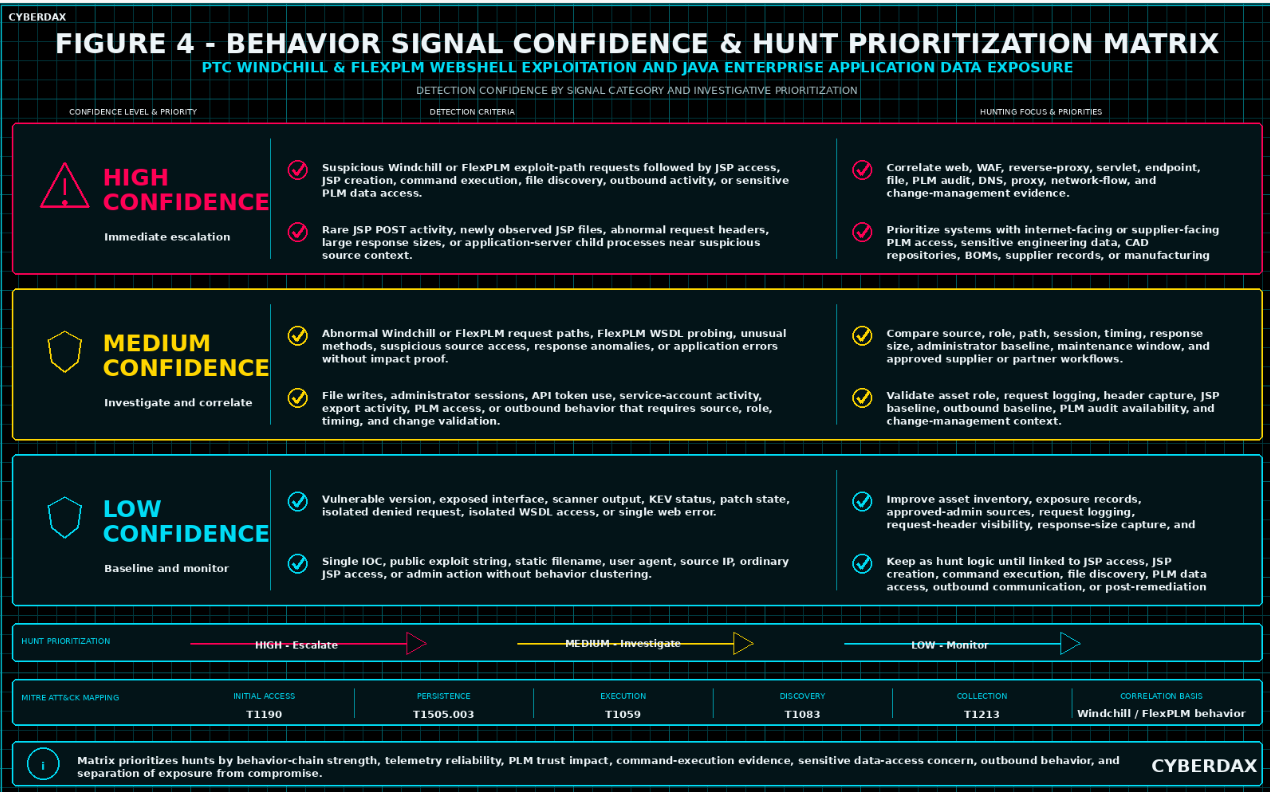
Figure 4
Behavior signal confidence and hunt prioritization matrix for ColdFusion, Windchill, FlexPLM, and Java enterprise application exploitation, prioritizing exploit-path activity, path traversal indicators, server-side artifact behavior, application-server command execution, file discovery, outbound communication, sensitive data access, and containment validation.
Detection Opportunities
· Abnormal ColdFusion, Windchill, and FlexPLM web-tier request behavior provides an early opportunity to identify suspected exploit-path activity before confirmed command execution, webshell persistence, or data exfiltration.
· Path traversal indicators, encoded traversal patterns, abnormal request-header use, unusual response-size behavior, rare server-side template access, and newly observed CFM, CFC, or JSP paths provide high-value signals when correlated with suspicious source context.
· ColdFusion file-read behavior, system-file access attempts, configuration access, administrator-path probing, and application-file access outside expected workflow provide useful exploit-attempt and scoping opportunities.
· CFM, CFC, JSP, script, temporary file, application-writable path, upload-path, webroot, and codebase changes provide strong detection opportunities where file telemetry exists.
· Unexpected child-process execution from ColdFusion, Java, Tomcat, Windchill, FlexPLM, servlet-container, application-server, web-server, or middleware service contexts provides a high-value host-side detection opportunity where process telemetry exists.
· File discovery, directory listing, attacker-created output files, staged command output, archive creation, configuration access, backup access, and repository enumeration provide durable post-exploitation signals when observed near exploit-path activity.
· Outbound communication from application servers to rare, newly observed, low-reputation, geographically unusual, or role-inconsistent destinations provides useful post-exploitation scoping.
· Application data, PLM data, engineering data, product-design data, supplier data, manufacturing data, CAD data, bill-of-materials data, workflow data, document-management data, backup data, configuration data, database connection material, or credential-material access near suspicious exploit-path behavior provides high-value business-impact visibility.
· Cross-telemetry correlation between web requests, file writes, process execution, outbound network activity, application data access, administrator actions, and change-management records provides the strongest path for hunt-to-alert promotion.
· The behavior model provides reusable coverage with adaptation for enterprise application RCE, path traversal, server-side artifact abuse, and webshell activity across ColdFusion, Windchill, FlexPLM, Tomcat, WebLogic, Confluence, SAP NetWeaver, Spring, and other middleware environments when telemetry and behavior align.
High-Value Correlation Opportunities
· Correlate abnormal ColdFusion, Windchill, or FlexPLM request activity with path traversal indicators, encoded traversal sequences, rare server-side template access, abnormal request headers, unusual HTTP methods, response-size anomalies, or repeated path variations within the same investigation window.
· Correlate suspicious source access with later CFM, CFC, JSP, script, upload-path, temporary-path, or webroot file creation, file modification, file discovery, staged output, application-server child-process execution, shell execution, interpreter use, or network utility execution.
· Correlate traversal-like requests with file-read behavior, configuration access, system-file access, application errors, abnormal response size, or follow-on command-execution evidence.
· Correlate application-server child-process behavior with outbound DNS, proxy, firewall, and network-flow activity from the same host.
· Correlate suspicious web-tier activity with administrator-session creation, API token use, service-account activity, permission changes, workflow changes, application configuration changes, or export activity.
· Correlate newly observed CFM, CFC, or JSP files with file modification events, process creation events, command-line activity, web access logs, and EDR file reputation where available.
· Correlate abnormal application-data access with preceding exploit-path activity, webshell access, application-server process execution, data staging, archive creation, or outbound transfer behavior.
· Correlate activity from internal hosts that accessed ColdFusion, Windchill, FlexPLM, or Java application servers abnormally with later lateral movement, credential access, tool staging, rare outbound communication, or access to additional high-value systems.
· Correlate missing logs, telemetry interruptions, application restarts, monitoring gaps, or security-control changes with suspected exploit-path activity and post-exploitation behavior.
Detection Gaps
· ColdFusion, Windchill, FlexPLM, hosted, managed, or appliance-backed deployments may not expose full process, file, persistence, privilege, memory, or endpoint telemetry to the customer, limiting direct confirmation of command execution or webshell persistence.
· Web, reverse-proxy, WAF, firewall, secure access, or load-balancer telemetry may preserve request metadata but not request bodies, full headers, normalized paths, internal servlet routing, ColdFusion runtime behavior, session context, or application-state transitions.
· Limited ColdFusion, Windchill, or FlexPLM application logging may reduce visibility into traversal behavior, request-header behavior, server-side template execution, session state, API token use, administrator activity, data access, and export workflows.
· Network telemetry may identify suspicious ingress, outbound communication, or downstream access but cannot independently prove exploitation, command execution, credential access, webshell persistence, or exfiltration.
· Missing file telemetry may reduce visibility into CFM, CFC, JSP, script placement, staged output, temporary file creation, archive creation, permission changes, and persistence-oriented file activity.
· Missing administrator audit logs may reduce confidence when assessing administrator account changes, API token use, service-account activity, permission changes, export actions, or configuration changes.
· Missing application audit logs may reduce visibility into business-impact scoping, including document access, database-backed application data access, export activity, configuration access, workflow changes, and sensitive object access.
· Incomplete asset inventory may prevent reliable separation of ColdFusion servers, Windchill servers, FlexPLM systems, Java application servers, middleware hosts, reverse proxies, WAF destinations, integration systems, databases, repositories, and approved administrator sources.
· Missing change-management records may increase false positives around patching, ColdFusion updates, application updates, Java updates, vendor support, data workflows, bulk exports, integrations, security testing, and incident response.
· Reusable coverage for non-Windchill enterprise applications requires local adaptation because request paths, template locations, webshell locations, service names, data repositories, administrator workflows, and application telemetry differ by platform.
Operational Blind Spots
· Internet-exposed ColdFusion, Windchill, FlexPLM, and Java application interfaces may receive frequent scanning and probing, making it difficult to separate opportunistic exposure noise from exploit-path activity without request, source, timing, and follow-on context.
· Environments without ingress logging may lose early exploit-path visibility before activity reaches file, process, application, data-access, or outbound logs.
· Environments without full request-header or raw-path logging may miss traversal details and be forced to rely on request path, response size, source context, file activity, and follow-on behavior.
· Environments without file telemetry may fail to identify server-side artifact placement, staged output, archive creation, or persistence artifacts.
· Environments without application audit telemetry may fail to identify sensitive data exposure even when exploitation and command-execution behavior are detected.
· Environments without downstream data-access monitoring may detect webshell or command-execution behavior but miss database, document, engineering, supplier, manufacturing, CAD, bill-of-materials, or repository impact.
· Short log-retention windows may prevent reconstruction of the sequence between exploit-path access, file-read activity, command execution, file discovery, data access, outbound communication, and remediation.
· Undocumented maintenance workflows may generate high false-positive volume around ColdFusion updates, application updates, Java upgrades, vendor support, troubleshooting, integrations, exports, and data-migration activity.
False Positive Control Requirements
· Validate whether the source IP, administrator identity, device, VPN path, jump host, privileged access workstation, vendor-support path, supplier path, partner path, or management network is approved for ColdFusion, Windchill, FlexPLM, or Java application access.
· Validate whether activity aligns with approved ColdFusion updates, application updates, Java updates, servlet-container changes, Windchill maintenance, FlexPLM maintenance, application workflows, document exports, backup activity, vendor support, security testing, or incident-response actions.
· Validate whether web-tier request anomalies occurred near expected vulnerability scanning, exposure assessment, penetration testing, monitoring, integration testing, application troubleshooting, or patch validation.
· Validate whether CFM, CFC, JSP, script creation, file writes, archive extraction, service restarts, or package operations align with approved deployment workflows, known maintenance windows, documented application releases, or vendor-guided updates.
· Validate whether child-process execution, privilege activity, service modification, or file retrieval is expected for the application role, maintenance window, and deployment type.
· Validate whether administrator-account changes, API token activity, session anomalies, workflow changes, export actions, or data access match approved change records and known administrators.
· Validate whether outbound communication aligns with approved update services, vendor services, application integrations, monitoring tools, backup destinations, cloud services, remote-management platforms, or incident-response workflows.
· Validate whether application-data access aligns with known business workflows, product release activity, supplier exchange, manufacturing operations, data migration, backups, discovery, or approved legal and compliance activity.
Hunt-to-Alert Promotion Criteria
· Promote to alert logic when suspicious ColdFusion, Windchill, or FlexPLM request behavior repeatedly correlates with path traversal indicators, rare server-side template access, newly observed CFM, CFC, or JSP files, abnormal request headers, abnormal response-size patterns, or suspicious source context.
· Promote to alert logic when CFM, CFC, JSP, or script access or creation is followed by shell execution, interpreter execution, command-processor execution, file retrieval, archive extraction, file discovery, privilege activity, service modification, or outbound communication.
· Promote to alert logic when suspicious web-tier activity is followed by sensitive application-data access, bulk document access, database-backed record access, configuration access, backup access, export activity, archive creation, or unusual outbound transfer behavior.
· Promote to alert logic when application-server child-process activity occurs from ColdFusion, Java, Tomcat, Windchill, FlexPLM, servlet-container, web-server, WebLogic, Confluence, SAP NetWeaver, Spring, or middleware service contexts without approved maintenance justification.
· Promote to alert logic when outbound communication from application servers to rare, newly observed, low-reputation, geographically unusual, or role-inconsistent destinations follows exploit-path activity, webshell access, or command-execution evidence.
· Promote to alert logic when newly created, modified, or accessed CFM, CFC, JSP, script, or server-side artifacts appear in webroot, application-writable, upload, temporary, login, codebase, or servlet paths and correlate with suspicious web access or process execution.
· Promote to alert logic when administrator-state changes, API token activity, service-account use, permission changes, workflow changes, or export activity occurs near exploit-path request behavior or suspicious source access.
· Keep as hunt logic when signals are limited to patch state, scanner output, exposed interfaces, isolated denied requests, isolated web errors, isolated traversal-like paths, expected server-side template access, or uncorrelated administrative actions.
· Keep as hunt logic when required field mappings, asset inventory, request-path visibility, request-header capture, file telemetry, process telemetry, application audit logs, telemetry joins, or change-management validation are insufficient for reliable alerting.
· Keep as hunt logic where telemetry limitations prevent confirmation of command execution, webshell placement, sensitive data access, or outbound transfer and no compensating application, file, process, data-access, or incident-response evidence exists.
Detection Engineering Gaps to Resolve Before S25 Deployment
· Confirm ColdFusion, Windchill, FlexPLM, Java application, servlet-container, Tomcat, WebLogic, Confluence, SAP NetWeaver, Spring, middleware, reverse-proxy, WAF, and load-balancer asset inventory.
· Confirm which deployments expose web logs, reverse-proxy logs, WAF logs, load-balancer logs, full request paths, request headers, response sizes, application logs, servlet logs, administrator logs, audit logs, endpoint telemetry, process telemetry, file telemetry, EDR telemetry, and outbound telemetry.
· Confirm field mappings for source IP, destination host, destination interface, request path, normalized path, raw path, HTTP method, request header, response status, response size, user agent, session context, identity context, process lineage, command line, file path, file action, data object, export action, byte count, destination domain, and change-window context.
· Confirm reverse-proxy, WAF, firewall, secure access, load-balancer, web, application, EDR, DNS, proxy, network-flow, audit, change-management, and incident-response telemetry can be correlated within reliable time windows.
· Confirm approved administrator sources, VPN ranges, jump hosts, privileged access workstations, vendor-support paths, supplier paths, partner paths, application-owner systems, monitoring systems, update systems, backup destinations, and application integration systems.
· Confirm false-positive baselines for ColdFusion updates, application updates, Java updates, servlet-container changes, Windchill maintenance, FlexPLM maintenance, vendor support, security testing, vulnerability scanning, application workflows, data exports, product release activity, supplier exchange, backups, and incident response.
· Confirm sensitive data-object mapping for application repositories, engineering documents, CAD files, product designs, bills of materials, supplier records, manufacturing records, workflow exports, configuration files, backups, database connection material, and application data stores.
· Confirm downstream telemetry for database access, file-share access, engineering repository access, identity access, backup access, monitoring access, and adjacent business-system access where those systems are relevant to application impact.
· Confirm SOC triage procedures for separating exposure, attempted exploitation, suspected file-read activity, suspected webshell access, suspected command execution, suspected persistence, suspected data discovery, suspected data staging, suspected exfiltration, and confirmed post-exploitation activity.
Confirm query-performance limits, lookup quality, enrichment reliability, exception handling, suppression logic, and hunt-to-alert thresholds before enabling production alerting.
S25 — Ultra-Tuned Detection Engineering Rules
NDR / Network Behavioral Analytics
Detection Viability Assessment
· NDR / Network Behavioral Analytics is viable for detecting suspicious network behavior associated with PTC Windchill, FlexPLM, and Java enterprise application webshell exploitation, including abnormal web-tier access, suspicious request-path behavior, rare JSP POST activity, abnormal request-header behavior, FlexPLM WSDL probing, unusual response-size patterns, outbound communication, and downstream application or data-access activity.
· NDR / Network Behavioral Analytics is strongest where network-flow telemetry, web telemetry, reverse-proxy telemetry, WAF telemetry, firewall telemetry, secure access telemetry, DNS telemetry, response-size visibility, request-header visibility, asset inventory, approved-source baselines, and SIEM correlation can be combined.
· NDR / Network Behavioral Analytics can identify suspicious sequencing between abnormal source access, Windchill or FlexPLM exploit-path request behavior, rare JSP access, large JSP responses, outbound communication, internal scanning, application enumeration, and access to engineering, PLM, identity, database, backup, or monitoring infrastructure.
· NDR / Network Behavioral Analytics is not a standalone source for confirming successful command execution, JSP webshell persistence, credential theft, product-lifecycle data theft, or actor attribution because network telemetry may not observe process lineage, file creation, servlet behavior, local command execution, application audit state, or attacker intent.
· NDR / Network Behavioral Analytics detections must be correlated with Windchill logs, FlexPLM logs, reverse-proxy logs, WAF logs, application logs, endpoint telemetry where available, file telemetry where available, PLM audit logs, administrator activity records, change-management records, and incident-response evidence before activity is classified as probable compromise.
· NDR / Network Behavioral Analytics detection content should be treated as high-value behavioral coverage for suspicious web-tier access, exploit-attempt scoping, webshell access triage, outbound follow-on detection, and sensitive application impact scoping, not direct CVE confirmation or standalone compromise confirmation.
· NDR / Network Behavioral Analytics rules should not generate high-confidence alerting from exposed Windchill or FlexPLM interfaces alone, patch state alone, KEV status alone, vulnerability scan output alone, isolated denied requests alone, isolated WSDL access alone, isolated JSP access alone, or normal administrator access alone.
Rule
Suspicious Windchill or FlexPLM Web-Tier Access With JSP Exploit-Path Behavior
Rule Format
Vendor-neutral NDR behavioral analytics rule template suitable for network-flow telemetry, web telemetry, reverse-proxy telemetry, WAF telemetry, firewall telemetry, secure access telemetry, load-balancer telemetry, DNS enrichment, source-reputation enrichment, Windchill and FlexPLM asset inventory, approved-source baselines, request-path validation, request-header validation, response-size validation, and SIEM correlation after local schema mapping, timing-window tuning, and environment-specific allowlisting.
Detection Purpose
· Detect abnormal access to Windchill or FlexPLM web interfaces involving login-path JSP access, newly observed JSP filenames, suspicious POST activity, abnormal request headers, FlexPLM WSDL probing, unexpected HTTP methods, unusual response-size behavior, or request patterns inconsistent with approved application use.
· Identify sources that interact with Windchill or FlexPLM from unfamiliar internet locations, suspicious ASNs, hosting providers, residential proxy ranges, VPN ingress paths, supplier networks, partner paths, newly observed internal hosts, unmanaged systems, or sources outside approved administration and integration paths.
· Prioritize activity where suspicious request behavior and suspicious source context occur together rather than treating internet exposure or routine scanning as compromise evidence.
· Support early escalation when abnormal web-tier access is followed by JSP access, large JSP responses, file discovery, application errors, outbound communication, PLM data access, administrator-state changes, or application-server host activity.
· Preserve separation between suspicious exploit-path activity and confirmed compromise by requiring supporting application, file, process, data-access, configuration, or incident-response evidence before classifying activity as probable compromise.
· This rule does not prove successful command execution, durable webshell persistence, credential theft, data exfiltration, downstream compromise, or actor attribution without supporting telemetry and investigation evidence.
Detection Logic
· Identify network, web, reverse-proxy, WAF, firewall, secure access, or load-balancer events targeting verified Windchill or FlexPLM web interfaces.
· Prioritize request paths, normalized paths, raw paths, URI categories, or locally classified web events associated with login-path JSP access, newly observed JSP filenames, rare JSP POST activity, FlexPLM WSDL probing, abnormal request-header use, unexpected file access, or request-path variation.
· Prioritize sources that are unfamiliar, newly observed, internet-facing, hosting-provider-based, residential-proxy-based, VPN-ingress-based, supplier-path-based, partner-path-based, unmanaged, or outside approved administrator and integration baselines.
· Increase confidence when repeated requests, path variations, abnormal HTTP methods, unusual request ordering, abnormal response-code patterns, large response sizes, or unusual response-size sequences occur within a locally defined investigation window.
· Increase confidence when abnormal web-tier access is followed by JSP access, additional JSP POST activity, application errors, file-listing behavior, outbound communication, administrator-session anomalies, API token activity, data-access anomalies, export activity, or access to adjacent internal systems.
· Reduce severity when activity aligns with approved administration, application monitoring, vulnerability scanning, exposure assessment, vendor support, supplier integration, partner integration, penetration testing, security testing, incident response, or documented maintenance.
· Do not classify exposed Windchill or FlexPLM services, patch state, scanner labels, KEV status, isolated denied requests, ordinary login failures, isolated WSDL access, or single web errors as exploitation evidence by themselves.
· Do not treat network-visible exploit-path behavior as proof of command execution, webshell persistence, product-data theft, or actor attribution without supporting application, file, process, data-access, or incident-response evidence.
Required Telemetry
· Network-flow telemetry.
· Web telemetry.
· Reverse-proxy telemetry where available.
· WAF telemetry where available.
· Firewall telemetry.
· Secure access telemetry where available.
· Load-balancer telemetry where available.
· DNS telemetry where available.
· Source IP.
· Destination IP.
· Destination host.
· Destination interface.
· Destination port.
· Protocol.
· Application or service classification.
· Request path where available.
· Normalized request path where available.
· Raw request path where available.
· HTTP method where available.
· Request headers where available.
· Response status where available.
· Response size where available.
· User agent where available.
· Session identifier where available.
· Request timestamp.
· Connection count.
· Connection frequency.
· Byte volume.
· Directionality.
· Windchill asset inventory.
· FlexPLM asset inventory.
· Java application asset inventory where applicable.
· Web-interface inventory.
· Approved administrator source inventory.
· Approved supplier and partner path inventory.
· Approved integration source inventory.
· VPN address pool inventory.
· Management network inventory.
· Jump-host inventory.
· Privileged access workstation inventory.
· Source-reputation enrichment.
· ASN enrichment.
· Geolocation enrichment.
· Newly observed source context.
· Change-management records.
· Approved vulnerability scanning records.
· Approved security testing records.
· Approved incident-response records.
Engineering Implementation Instructions
· Build Windchill and FlexPLM asset groups covering internet-facing interfaces, internal application interfaces, reverse-proxy destinations, WAF-protected paths, load-balancer destinations, administrative paths, integration paths, and PLM application hosts.
· Build Java enterprise application asset groups where reusable coverage is intended, including Tomcat, WebLogic, Confluence, SAP NetWeaver, ColdFusion, Spring, servlet-container, and middleware systems that expose comparable JSP or Java application behavior.
· Build approved source groups covering known administrator IPs, VPN ranges, jump hosts, privileged access workstations, management networks, monitoring systems, vendor-support paths, supplier integration paths, partner integration paths, vulnerability management systems, security-testing systems, and incident-response systems.
· Build suspicious source groups covering unfamiliar internet sources, hosting providers, residential proxy ranges, unusual geographies, suspicious ASNs, newly observed internal hosts, unmanaged systems, non-administrative networks, and sources outside approved administration or integration baselines.
· Build request-path groups for Windchill login-path JSP access, rare JSP POST activity, newly observed JSP filenames, FlexPLM WSDL probing, unexpected file-access paths, request-path variation, encoded path elements, and locally observed application anomalies.
· Build request-header groups for locally validated abnormal Windchill or FlexPLM request headers, headers with no legitimate application use, rare header names, and header patterns observed only during suspicious exploit-path activity.
· Build response-anomaly groups for large JSP responses, unusual response-size sequences, repeated denied requests, redirect anomalies, HTTP 5xx patterns, abnormal status-code sequences, and request bursts near exploit-path activity.
· Build follow-on groups for additional JSP access, application errors, file-listing behavior, outbound communication, administrator-session anomalies, API token activity, PLM export activity, sensitive object access, and downstream internal access.
· Validate whether NDR, firewall, WAF, reverse-proxy, secure access, load-balancer, DNS, Windchill, FlexPLM, change-management, and SIEM telemetry can reliably join on source IP, destination host, destination interface, request path, request timestamp, session context, asset role, and application exposure path.
· Use short correlation windows for suspicious request activity, JSP POST behavior, abnormal request headers, response-size anomalies, path variation, and WSDL probing.
· Use moderate correlation windows for outbound communication, administrator-state changes, sensitive PLM data access, export activity, or downstream internal access.
· Use longer correlation windows only when repeated source behavior, incident-response evidence, administrator evidence, data-access evidence, or configuration evidence supports delayed linkage.
· Add severity weighting for rare JSP POST activity, newly observed JSP filenames, abnormal request-header use, large JSP responses, suspicious source context, FlexPLM WSDL probing, file-listing behavior, outbound follow-on behavior, sensitive data access, and lack of approved change context.
· Treat suspicious request-path behavior as a confidence amplifier, not standalone proof of successful command execution, webshell persistence, or data theft.
· Use approved administrator records, integration records, update records, vulnerability scanning records, security-testing records, vendor-support records, incident-response records, and change-management records as triage evidence.
· Validate all environment variables, asset groups, web-interface groups, approved source groups, suspicious source groups, request-path groups, request-header groups, response-anomaly groups, timing windows, enrichment fields, exception logic, parser behavior, join logic, and local schema mappings before production deployment.
· Do not enable alert mode until field availability, request-field quality, header visibility, response-size visibility, asset inventory, source-baseline quality, false-positive rate, query performance, SOC triage workflow, enrichment availability, exception handling, and incident-response evidence requirements are validated.
DRI Assessment
· The rule is behaviorally anchored to abnormal Windchill or FlexPLM web-tier access, JSP exploit-path behavior, suspicious source context, request-header anomalies, and response-size anomalies rather than static CVE identifiers, proof-of-concept names, scanner labels, hashes, fixed IP addresses, or known actor infrastructure.
· The rule remains useful if an adversary changes request pacing, user agent, source infrastructure, JSP filename, path encoding, request ordering, command syntax, or post-access timing.
· The score is supported by the durability of rare JSP POST activity, newly observed JSP paths, abnormal request-header behavior, response-size anomalies, FlexPLM WSDL probing, and follow-on network correlation.
· The score is constrained by missing request paths, missing request headers, reverse-proxy normalization, incomplete response-size visibility, weak source baselines, high internet scanning volume, and incomplete asset inventories.
· The rule is durable as an early exploit-path detector but should not be treated as standalone proof of command execution, webshell persistence, exfiltration, or actor attribution.
DRI
8.6 / 10
TCR Assessment
· Operational confidence depends on reliable web-interface inventory, request-path visibility, request-header visibility, response-size visibility, reverse-proxy or WAF logging, source-reputation enrichment, approved-source baselines, and SIEM correlation quality.
· Operational confidence is reduced where exposed applications receive heavy scanning, request paths are not logged, headers are not retained, response-size fields are absent, source baselines are weak, or approved supplier and partner paths are broad.
· Operational confidence is reduced where vulnerability scanning, exposure assessment, security testing, vendor support, application monitoring, supplier integrations, partner integrations, or incident-response workflows generate similar request patterns.
· Full-telemetry confidence improves when suspicious access is enriched with Windchill logs, FlexPLM logs, servlet logs, endpoint telemetry where available, file telemetry where available, PLM audit logs, configuration records, change-management records, and incident-response evidence.
· Even under full telemetry conditions, this rule should support early escalation and scoping rather than standalone confirmation of exploit success or data exfiltration.
Operational TCR
7.6 / 10
Full-Telemetry TCR
8.7 / 10
Limitations
· This rule detects suspicious Windchill or FlexPLM web-tier access and JSP exploit-path behavior, not confirmed exploitation by itself.
· NDR may not observe local command execution, JSP file creation, servlet behavior, application-server file writes, PLM object access, administrator intent, or local application state without enrichment.
· Internet scanning, vulnerability assessment, penetration testing, monitoring, vendor support, supplier integrations, partner integrations, administrator troubleshooting, and incident-response activity may produce similar request patterns.
· Missing request paths, normalized paths, raw paths, headers, response-size fields, source enrichment, asset inventory, or reverse-proxy logging can reduce confidence.
· The rule may miss exploitation that originates from approved sources, uses expected application paths, blends into normal integration traffic, avoids visible JSP paths, or occurs outside configured timing windows.
· The rule should not be used for actor attribution without incident-specific intelligence, validated behavioral correlation, or confirmed victim-environment evidence.
Detection Query Pattern
Vendor-neutral NDR correlation rule pattern for Windchill and FlexPLM web-tier exploit-path access. This pattern requires target-platform syntax conversion, asset validation, request-field validation, request-header validation, response-size validation, timing-window tuning, and environment-specific allowlisting before production deployment.
NetworkEvent AS WindchillWebAccess
WHERE WindchillWebAccess.DestinationAsset IN ASSET_GROUP (
"Windchill Servers",
"FlexPLM Servers",
"Windchill Web Interfaces",
"FlexPLM Web Interfaces",
"Windchill Reverse Proxy Destinations",
"FlexPLM Reverse Proxy Destinations",
"Windchill WAF Protected Paths",
"FlexPLM WAF Protected Paths",
"Java Enterprise Application Servers"
)
AND WindchillWebAccess.DestinationService IN ANY (
"WINDCHILL_WEB",
"FLEXPLM_WEB",
"JAVA_APPLICATION_WEB",
"SERVLET_CONTAINER",
"REVERSE_PROXY_APPLICATION_PATH",
"WAF_PROTECTED_APPLICATION_PATH"
)
AND (
WindchillWebAccess.RequestPathCategory IN ANY (
"windchill_login_jsp_path",
"rare_jsp_post_path",
"newly_observed_jsp_path",
"flexplm_wsdl_path",
"unexpected_file_access_path",
"encoded_path_variation",
"application_path_not_in_baseline"
)
OR WindchillWebAccess.RequestPattern IN ANY (
"repeated_path_variation",
"abnormal_request_ordering",
"request_burst_to_application_interface",
"rare_application_path_access",
"jsp_access_from_non_admin_source"
)
OR WindchillWebAccess.RequestHeaderPattern IN ANY (
"abnormal_windchill_header",
"rare_application_header",
"header_not_in_application_baseline",
"header_seen_only_during_suspicious_access"
)
OR WindchillWebAccess.ResponsePattern IN ANY (
"large_jsp_response",
"unusual_response_size",
"http_5xx_near_application_path_activity",
"abnormal_status_code_sequence",
"redirect_anomaly"
)
)
AND WindchillWebAccess.SourceAsset NOT IN ASSET_GROUP (
"Approved Windchill Administrators",
"Approved FlexPLM Administrators",
"Approved Administrative Jump Hosts",
"Approved Privileged Access Workstations",
"Approved Management Networks",
"Approved VPN Administration Ranges",
"Approved Supplier Integration Sources",
"Approved Partner Integration Sources",
"Approved Monitoring Systems",
"Approved Vulnerability Management Systems",
"Approved Vendor Support Paths",
"Approved Security Testing Systems",
"Approved Incident Response Systems"
)
AND (
WindchillWebAccess.SourceContext IN ANY (
"unfamiliar_internet_source",
"newly_observed_source",
"hosting_provider_source",
"residential_proxy_source",
"suspicious_asn",
"unusual_geography",
"vpn_ingress_source",
"unmanaged_internal_host",
"source_not_in_application_admin_baseline"
)
OR WindchillWebAccess.ConnectionPattern IN ANY (
"repeated_application_interface_access",
"new_source_to_windchill_or_flexplm",
"high_frequency_application_requests",
"multiple_application_assets_targeted",
"outside_normal_administration_window"
)
)
AND OPTIONAL_CONFIDENCE_INCREASE WITHIN ENV_WEB_FOLLOWON_WINDOW (
ApplicationOrNetworkEvent AS ApplicationFollowOn
WHERE ApplicationFollowOn.Asset IN SAME_DESTINATION (
WindchillWebAccess.DestinationAsset
)
AND ApplicationFollowOn.EventPattern IN ANY (
"additional_jsp_access",
"application_error_near_suspicious_request",
"file_listing_behavior",
"administrator_session_anomaly",
"api_token_activity",
"plm_export_activity",
"sensitive_object_access",
"configuration_change",
"service_instability"
)
)
AND OPTIONAL_CONFIDENCE_INCREASE WITHIN ENV_OUTBOUND_FOLLOWON_WINDOW (
NetworkEvent AS OutboundFollowOn
WHERE OutboundFollowOn.SourceAsset IN SAME_DESTINATION (
WindchillWebAccess.DestinationAsset
)
AND OutboundFollowOn.EventPattern IN ANY (
"rare_outbound_destination",
"new_external_destination",
"low_reputation_destination",
"unusual_asn_destination",
"unexpected_geography",
"tunnel_like_traffic",
"abnormal_byte_volume",
"file_transfer_behavior"
)
)
AND NOT ChangeContext IN ANY (
"approved_application_update",
"approved_windchill_maintenance",
"approved_flexplm_maintenance",
"approved_supplier_integration",
"approved_partner_integration",
"approved_vendor_support",
"approved_vulnerability_scan",
"approved_security_testing",
"approved_incident_response"
)
Rule
Windchill or FlexPLM JSP Activity Followed by Suspicious Outbound or Internal Access
Rule Format
Vendor-neutral NDR behavioral analytics rule template suitable for network-flow telemetry, DNS telemetry, firewall telemetry, proxy telemetry, web telemetry, reverse-proxy telemetry, WAF telemetry, application telemetry where available, asset inventory, outbound baseline enrichment, internal destination inventory, approved integration baselines, and SIEM correlation after request-path validation, outbound-destination validation, internal-access validation, timing-window tuning, and environment-specific allowlisting.
Detection Purpose
· Detect Windchill, FlexPLM, or Java application JSP activity followed by suspicious outbound communication, internal scanning, application enumeration, database access, file-share access, engineering-system access, backup-system access, or additional management-interface access.
· Identify cases where JSP access becomes higher risk because it is followed by behavior consistent with webshell operator activity, external callback, tool retrieval, file discovery, data staging, lateral movement, or access to sensitive PLM-adjacent infrastructure.
· Prioritize outbound communication to newly observed, rare, low-reputation, geographically unusual, role-inconsistent, or unexpected destinations after suspicious JSP access.
· Prioritize internal access to databases, file shares, engineering repositories, identity infrastructure, backup systems, monitoring systems, supplier systems, or additional application servers after suspected web-tier compromise.
· Preserve separation between suspicious follow-on behavior and confirmed compromise by requiring supporting application logs, endpoint telemetry where available, file telemetry where available, PLM audit records, change-management records, or incident-response evidence.
· This rule does not prove successful command execution, data exfiltration, downstream compromise, or actor attribution without supporting evidence.
Detection Logic
· Identify Windchill, FlexPLM, or Java enterprise application events involving JSP access, rare JSP POST activity, newly observed JSP paths, login-path JSP access, or webshell-like JSP request behavior.
· Correlate JSP activity with outbound communication from the application server to newly observed, rare, low-reputation, unusual, role-inconsistent, or unexpected external destinations.
· Correlate JSP activity with internal scanning, application enumeration, database access, file-share access, engineering repository access, identity infrastructure access, backup-system access, monitoring-system access, or access to adjacent application servers.
· Increase confidence when outbound or internal follow-on behavior occurs after abnormal source access, abnormal request-header behavior, suspicious response-size patterns, FlexPLM WSDL probing, request-path variation, or access from a non-standard source.
· Increase confidence when outbound or internal follow-on behavior is accompanied by PLM data access, document export, backup access, archive transfer, administrator-state changes, service-account use, API token activity, or configuration changes.
· Increase confidence when the same source that accessed Windchill or FlexPLM abnormally later interacts with additional application interfaces, management interfaces, databases, file shares, engineering systems, or high-value internal systems.
· Reduce severity when outbound communication aligns with approved vendor services, monitoring tools, backup destinations, PLM integrations, supplier exchanges, partner integrations, remote-management services, vulnerability management, security testing, incident response, or documented maintenance.
· Do not classify outbound communication or internal access as Windchill or FlexPLM compromise without upstream JSP or exploit-path context and supporting application, data-access, host, or incident-response evidence.
· Do not treat ordinary application integrations, expected outbound traffic, scheduled exports, backup jobs, monitoring activity, or normal internal application traffic as malicious by themselves.
Required Telemetry
· Network-flow telemetry.
· DNS telemetry.
· Firewall telemetry.
· Proxy telemetry where available.
· Web telemetry where available.
· Reverse-proxy telemetry where available.
· WAF telemetry where available.
· Secure access telemetry where available.
· Application telemetry where available.
· Source host.
· Destination host.
· Source IP.
· Destination IP.
· Destination port.
· Protocol.
· Application or service classification.
· Request path where available.
· HTTP method where available.
· Response status where available.
· Response size where available.
· Request timestamp.
· Session timing.
· Connection frequency.
· Byte volume.
· Directionality.
· External destination reputation where available.
· External destination first-seen context where available.
· ASN enrichment.
· Geolocation enrichment.
· Windchill asset inventory.
· FlexPLM asset inventory.
· Java application asset inventory.
· Database inventory.
· File-share inventory.
· Engineering repository inventory.
· PLM repository inventory.
· Identity infrastructure inventory.
· Backup system inventory.
· Monitoring system inventory.
· Supplier integration inventory.
· Partner integration inventory.
· Approved outbound destination records.
· Approved vendor service records.
· Approved backup destination records.
· Approved monitoring destination records.
· Approved integration records.
· Change-management records.
· Incident-response records.
Engineering Implementation Instructions
· Build application asset groups covering Windchill systems, FlexPLM systems, exposed web interfaces, reverse-proxy destinations, WAF-protected paths, Java enterprise application systems, servlet-container hosts, middleware hosts, and PLM integration systems.
· Build JSP activity groups for login-path JSP access, rare JSP POST activity, newly observed JSP paths, suspicious JSP response-size patterns, webshell-like JSP access, and locally observed JSP behavior inconsistent with normal application use.
· Build outbound-risk groups for newly observed external destinations, rare domains, rare IPs, low-reputation destinations, unusual ASNs, unexpected geographic destinations, tunnel-like traffic, abnormal byte volume, unusual file-transfer behavior, and destinations inconsistent with the deployed application role.
· Build internal-access groups covering databases, file shares, engineering repositories, CAD repositories, product-data repositories, identity infrastructure, backup systems, monitoring systems, supplier systems, partner systems, and additional application or management interfaces.
· Build internal discovery groups for application enumeration, service discovery, database probing, file-share enumeration, SMB access, SSH access, RDP access, web-admin access, API probing, and access to additional management interfaces.
· Build data-impact groups for PLM document access, CAD file access, bill-of-materials access, supplier file access, backup access, archive transfer, bulk export, sensitive object access, configuration access, and unusual data-volume patterns.
· Validate whether NDR, DNS, firewall, proxy, WAF, reverse-proxy, secure access, application, PLM audit, change-management, and SIEM telemetry can reliably join on source host, destination host, source IP, destination IP, timestamp, request path, asset role, session context, and change-window context.
· Use short correlation windows for JSP activity followed by immediate outbound communication, file-transfer behavior, internal scanning, or application enumeration.
· Use moderate correlation windows for delayed internal access, database activity, file-share access, PLM data access, backup access, export activity, or repeated outbound communication.
· Use longer correlation windows only when repeated source behavior, incident-response evidence, administrator evidence, application evidence, or data-access evidence supports delayed linkage.
· Add severity weighting for rare JSP activity, newly observed JSP paths, abnormal response size, abnormal source context, rare outbound destinations, low-reputation destinations, internal discovery, database access, PLM repository access, backup access, archive transfer, and lack of approved change context.
· Treat outbound communication and internal access as confidence amplifiers, not standalone proof of command execution, exfiltration, or downstream compromise.
· Use approved integration records, vendor service records, backup records, monitoring records, administrator records, vulnerability management records, security-testing records, incident-response records, and change-management records as triage evidence.
· Validate all environment variables, asset groups, JSP activity groups, outbound-risk groups, internal-access groups, discovery groups, data-impact groups, timing windows, enrichment fields, exception logic, parser behavior, join logic, and local schema mappings before production deployment.
· Do not enable alert mode until request-path validation, outbound baseline quality, internal destination inventory, PLM data-object mapping, false-positive rate, query performance, SOC triage workflow, enrichment availability, exception handling, and incident-response evidence requirements are validated.
DRI Assessment
· The rule is behaviorally anchored to JSP activity followed by outbound communication, internal access, discovery, and data-impact behavior rather than static CVE identifiers, exploit strings, proof-of-concept names, filenames, IP addresses, or known infrastructure.
· The rule remains useful if an adversary changes source infrastructure, outbound destination, JSP filename, command syntax, staging method, timing, or downstream target order.
· The score is supported by the durability of webshell-like JSP access followed by rare outbound communication, internal discovery, database access, file-share access, engineering repository access, backup access, or sensitive PLM data access.
· The score is constrained by legitimate application integrations, backup workflows, supplier exchanges, partner integrations, monitoring traffic, weak outbound baselines, incomplete destination reputation enrichment, and incomplete internal destination inventories.
· The rule is durable as a follow-on scoping detector but should not be treated as standalone proof of command execution, data exfiltration, or actor attribution.
DRI
8.3 / 10
TCR Assessment
· Operational confidence depends on reliable JSP activity visibility, outbound network telemetry, DNS or proxy coverage, destination reputation enrichment, internal destination inventory, source baselines, and SIEM correlation quality.
· Operational confidence is reduced where JSP access is poorly baselined, approved outbound destinations are not documented, supplier or partner integrations are broad, or monitoring and backup tools commonly generate similar traffic.
· Operational confidence is reduced where internal application traffic is broad, database and file-share inventories are incomplete, or PLM data-access context is not available.
· Full-telemetry confidence improves when outbound and internal behavior is enriched with Windchill logs, FlexPLM logs, application logs, PLM audit records, endpoint telemetry where available, file telemetry where available, change-control records, and incident-response evidence.
· Even under full telemetry conditions, this rule should support escalation and scoping rather than standalone confirmation of exploit success, command execution, or data exfiltration.
Operational TCR
7.2 / 10
Full-Telemetry TCR
8.6 / 10
Limitations
· This rule detects suspicious follow-on network behavior after JSP activity, not confirmed exploitation by itself.
· NDR may not observe local command execution, JSP file creation, servlet execution, application-server file access, PLM object access, administrator intent, or internal application state without enrichment.
· Approved integrations, vendor services, monitoring tools, backup workflows, supplier exchanges, partner integrations, vulnerability management, security testing, incident response, and remote-management activity can produce similar outbound or internal patterns.
· Missing DNS telemetry, proxy telemetry, destination reputation, internal asset inventory, source baselines, PLM audit records, or change records can reduce confidence.
· The rule may miss activity that uses approved destinations, blends into normal integration traffic, avoids visible outbound communication, remains within expected application paths, or delays follow-on behavior outside configured windows.
· The rule should not be used for actor attribution without incident-specific intelligence, validated behavioral correlation, or confirmed victim-environment evidence.
Detection Query Pattern
Vendor-neutral NDR correlation rule pattern for Windchill, FlexPLM, and Java application JSP activity followed by suspicious outbound or internal access. This pattern requires target-platform syntax conversion, JSP activity validation, outbound baseline validation, internal destination inventory validation, timing-window tuning, and environment-specific allowlisting before production deployment.
NetworkEvent AS ApplicationJspActivity
WHERE ApplicationJspActivity.DestinationAsset IN ASSET_GROUP (
"Windchill Servers",
"FlexPLM Servers",
"Windchill Web Interfaces",
"FlexPLM Web Interfaces",
"Java Enterprise Application Servers",
"Servlet Container Hosts",
"Application Reverse Proxy Destinations",
"WAF Protected Application Paths"
)
AND (
ApplicationJspActivity.RequestPathCategory IN ANY (
"windchill_login_jsp_path",
"rare_jsp_post_path",
"newly_observed_jsp_path",
"application_jsp_path_not_in_baseline",
"webshell_like_jsp_access"
)
OR ApplicationJspActivity.EventPattern IN ANY (
"jsp_post_activity",
"large_jsp_response",
"repeated_jsp_access",
"jsp_access_from_non_admin_source",
"jsp_activity_near_abnormal_request_header"
)
)
AND EVENT_NEAR WITHIN ENV_JSP_OUTBOUND_FOLLOWON_WINDOW (
NetworkEvent AS JspOutboundFollowOn
WHERE JspOutboundFollowOn.SourceAsset IN SAME_DESTINATION (
ApplicationJspActivity.DestinationAsset
)
AND (
JspOutboundFollowOn.ExternalDestinationContext IN ANY (
"newly_observed_external_destination",
"rare_external_destination",
"low_reputation_destination",
"unusual_asn",
"unexpected_geography",
"destination_not_in_application_role_baseline",
"tunnel_like_protocol",
"abnormal_byte_volume"
)
OR JspOutboundFollowOn.ProtocolOrService IN ANY (
"HTTP",
"HTTPS",
"DNS",
"SSH",
"SMB_EGRESS",
"TUNNEL_LIKE_TRAFFIC",
"FILE_TRANSFER"
)
)
)
AND OPTIONAL_CONFIDENCE_INCREASE WITHIN ENV_JSP_INTERNAL_FOLLOWON_WINDOW (
NetworkEvent AS InternalAccessFollowOn
WHERE InternalAccessFollowOn.SourceAsset IN SAME_DESTINATION (
ApplicationJspActivity.DestinationAsset
)
AND (
InternalAccessFollowOn.DestinationAsset IN ASSET_GROUP (
"Databases",
"File Shares",
"Engineering Repositories",
"CAD Repositories",
"PLM Repositories",
"Identity Infrastructure",
"Backup Systems",
"Monitoring Systems",
"Supplier Systems",
"Partner Systems",
"High Value Internal Systems"
)
OR InternalAccessFollowOn.EventPattern IN ANY (
"application_enumeration",
"service_discovery",
"database_access",
"file_share_access",
"api_probing",
"additional_management_interface_access",
"internal_scanning",
"engineering_repository_access"
)
)
)
AND OPTIONAL_CONFIDENCE_INCREASE WITHIN ENV_DATA_IMPACT_WINDOW (
ApplicationOrDataEvent AS DataImpactContext
WHERE DataImpactContext.RelatedAsset IN SAME_DESTINATION (
ApplicationJspActivity.DestinationAsset
)
AND DataImpactContext.EventPattern IN ANY (
"plm_document_access",
"cad_file_access",
"bill_of_materials_access",
"supplier_file_access",
"backup_access",
"archive_transfer",
"bulk_export",
"sensitive_object_access",
"configuration_access",
"unusual_data_volume"
)
)
AND NOT ChangeContext IN ANY (
"approved_application_update",
"approved_windchill_maintenance",
"approved_flexplm_maintenance",
"approved_vendor_support",
"approved_supplier_integration",
"approved_partner_integration",
"approved_backup_activity",
"approved_monitoring_activity",
"approved_security_testing",
"approved_incident_response"
)
Rule
Suspicious Application-Server Access Followed by Product-Lifecycle Data Exposure Indicators
Rule Format
Vendor-neutral NDR behavioral analytics rule template suitable for web telemetry, reverse-proxy telemetry, WAF telemetry, firewall telemetry, network-flow telemetry, DNS telemetry, proxy telemetry, PLM audit enrichment where available, data-access enrichment where available, asset inventory, sensitive data-object mapping, approved workflow baselines, and SIEM correlation after sensitive object validation, network-path validation, workflow validation, timing-window tuning, and environment-specific allowlisting.
Detection Purpose
· Detect suspicious Windchill, FlexPLM, or Java application-server access followed by product-lifecycle data exposure indicators involving PLM document access, CAD data access, bill-of-materials access, supplier files, manufacturing records, backup access, configuration access, archive transfer, bulk export, or abnormal data-volume behavior.
· Identify cases where web-tier exploit-path activity becomes higher risk because it is followed by access to engineering, design, manufacturing, supplier, workflow, or product data that may create business, operational, contractual, or regulatory exposure.
· Prioritize sensitive data access occurring after suspicious source access, abnormal request headers, rare JSP access, large JSP responses, FlexPLM WSDL probing, outbound communication, or internal discovery behavior.
· Support escalation when sensitive product-lifecycle data access is not explained by approved engineering workflows, product release activity, supplier exchange, manufacturing operations, backup activity, legal discovery, security testing, or incident response.
· Preserve separation between suspected data exposure and confirmed exfiltration by requiring outbound transfer, staging, archive movement, unusual byte volume, data-loss evidence, or incident-response validation before classifying activity as exfiltration.
· This rule does not prove data theft, extortion, downstream compromise, or actor attribution without supporting evidence.
Detection Logic
· Identify suspicious Windchill, FlexPLM, or Java application-server access involving abnormal source context, rare JSP activity, abnormal request-header behavior, FlexPLM WSDL probing, unusual response-size behavior, path variation, or exploit-path request behavior.
· Correlate suspicious application access with sensitive PLM data access, engineering document access, CAD repository access, bill-of-materials access, supplier data access, manufacturing record access, backup access, configuration access, archive creation, bulk export, or unusual data-volume behavior.
· Prioritize sensitive data access that occurs outside approved workflows, outside expected source paths, outside expected time windows, or from unusual identities, sessions, service accounts, or application contexts.
· Increase confidence when sensitive data access follows JSP access, application-server error patterns, outbound communication, internal scanning, database access, file-share access, backup access, or archive transfer.
· Increase confidence when sensitive data access is followed by outbound communication to rare destinations, large egress volume, cloud storage access, file-transfer protocols, tunnel-like traffic, or external transfer paths inconsistent with approved business workflows.
· Reduce severity when data access aligns with approved engineering workflows, product release activity, supplier exchange, manufacturing operations, backup activity, migration activity, legal discovery, compliance workflows, security testing, incident response, or documented maintenance.
· Do not classify sensitive PLM data access as exfiltration without staging, transfer, egress, data-loss evidence, or incident-response confirmation.
· Do not treat normal engineering access, supplier exchange, product release workflows, backup jobs, or administrative exports as malicious solely because Windchill or FlexPLM is vulnerable or exposed.
Required Telemetry
· Web telemetry.
· Reverse-proxy telemetry where available.
· WAF telemetry where available.
· Firewall telemetry.
· Network-flow telemetry.
· DNS telemetry.
· Proxy telemetry where available.
· PLM audit telemetry where available.
· Data-access telemetry where available.
· Source host.
· Destination host.
· Source IP.
· Destination IP.
· Destination port.
· Protocol.
· Application or service classification.
· Request path where available.
· HTTP method where available.
· Response status where available.
· Response size where available.
· User identity where available.
· Session identifier where available.
· Service-account context where available.
· Data object where available.
· Data object sensitivity where available.
· Export action where available.
· File type where available.
· Byte volume.
· Event timestamp.
· Windchill asset inventory.
· FlexPLM asset inventory.
· Java application asset inventory.
· PLM repository inventory.
· Engineering repository inventory.
· CAD repository inventory.
· Supplier data inventory.
· Backup system inventory.
· Approved workflow records.
· Approved export records.
· Approved integration records.
· Approved administrator records.
· Approved supplier exchange records.
· Change-management records.
· Incident-response records.
Engineering Implementation Instructions
· Build application asset groups covering Windchill systems, FlexPLM systems, Java enterprise application servers, reverse-proxy destinations, WAF-protected paths, servlet-container hosts, middleware systems, and PLM integration hosts.
· Build suspicious application-access groups covering abnormal source context, rare JSP activity, newly observed JSP paths, abnormal request-header behavior, FlexPLM WSDL probing, large JSP response patterns, path variation, and exploit-path request behavior.
· Build sensitive data-object groups covering PLM documents, CAD files, product designs, bill-of-materials data, supplier files, manufacturing records, engineering workflows, configuration files, backup files, export packages, and sensitive document repositories.
· Build data-impact groups covering bulk export, archive creation, backup access, configuration access, unusual data volume, unusual file-type access, access outside workflow, access outside role baseline, and access by unusual identity or service account.
· Build egress follow-on groups covering rare outbound destinations, large egress volume, cloud storage access, file-transfer protocols, tunnel-like traffic, unexpected geography, low-reputation destinations, and destinations outside approved data-exchange baselines.
· Build approved workflow groups covering engineering workflows, product release activity, supplier exchange, manufacturing operations, backup jobs, data migration, legal discovery, compliance workflows, security testing, vendor support, and incident response.
· Validate whether NDR, web, WAF, firewall, proxy, DNS, PLM audit, data-access, change-management, and SIEM telemetry can reliably join on source host, destination host, user identity, session identifier, application role, data object, timestamp, and change-window context.
· Use short correlation windows for suspicious application access followed by immediate sensitive object access, export activity, archive creation, or abnormal data volume.
· Use moderate correlation windows for delayed backup access, supplier data access, manufacturing record access, PLM workflow access, or outbound transfer behavior.
· Use longer correlation windows only when repeated source behavior, data-access evidence, incident-response evidence, or workflow evidence supports delayed linkage.
· Add severity weighting for rare JSP access, abnormal request headers, large response sizes, sensitive data-object access, access outside workflow, unusual service-account use, bulk export, archive transfer, backup access, unusual byte volume, and rare outbound destinations.
· Treat product-lifecycle data access as an exposure indicator until staging, outbound transfer, data-loss evidence, or incident-response validation supports exfiltration.
· Use approved workflow records, export records, supplier exchange records, backup records, administrator records, vendor-support records, security-testing records, incident-response records, and change-management records as triage evidence.
· Validate all environment variables, application asset groups, suspicious access groups, sensitive data-object groups, data-impact groups, egress follow-on groups, approved workflow groups, timing windows, enrichment fields, exception logic, parser behavior, join logic, and local schema mappings before production deployment.
· Do not enable alert mode until sensitive data-object mapping, workflow baseline quality, export-context quality, egress telemetry quality, false-positive rate, query performance, SOC triage workflow, enrichment availability, exception handling, and incident-response evidence requirements are validated.
DRI Assessment
· The rule is behaviorally anchored to suspicious application-server access followed by sensitive product-lifecycle data exposure indicators rather than static CVE identifiers, exploit strings, known filenames, hashes, IP addresses, or actor infrastructure.
· The rule remains useful if an adversary changes JSP filenames, request paths, source infrastructure, timing, command syntax, staging method, or outbound destination.
· The score is supported by the durability of exploit-path access followed by sensitive PLM object access, bulk export, archive transfer, backup access, unusual data volume, and outbound egress behavior.
· The score is constrained by legitimate engineering workflows, supplier exchanges, manufacturing operations, backup jobs, legal discovery, data migrations, weak data-object tagging, incomplete PLM audit logs, and incomplete export context.
· The rule is durable as a data-exposure detector but should not be treated as standalone proof of exfiltration or actor attribution.
DRI
8.1 / 10
TCR Assessment
· Operational confidence depends on reliable suspicious application-access visibility, PLM audit telemetry, data-object sensitivity mapping, export context, workflow baselines, outbound telemetry, and SIEM correlation quality.
· Operational confidence is reduced where PLM workflows are poorly documented, sensitive data-object mapping is incomplete, engineering exports are common, supplier exchanges are broad, or backup and migration activity produce similar patterns.
· Operational confidence is reduced where data-access logs do not include object sensitivity, user identity, session context, export action, byte volume, or workflow context.
· Full-telemetry confidence improves when sensitive data access is enriched with web logs, Windchill logs, FlexPLM logs, endpoint telemetry where available, file telemetry where available, outbound proxy logs, DNS logs, change-control records, and incident-response evidence.
· Even under full telemetry conditions, this rule should support data-exposure scoping and escalation rather than standalone confirmation of data theft.
Operational TCR
7.0 / 10
Full-Telemetry TCR
8.4 / 10
Limitations
· This rule detects suspected product-lifecycle data exposure indicators after suspicious application-server access, not confirmed exfiltration by itself.
· NDR may not observe PLM object sensitivity, export intent, user authorization, local file staging, or application-level object access without PLM audit enrichment.
· Approved engineering workflows, product release activity, supplier exchange, manufacturing operations, backups, migrations, legal discovery, compliance workflows, security testing, vendor support, and incident response can produce similar data-access or export patterns.
· Missing PLM audit logs, incomplete data-object mapping, missing user identity, missing session context, weak workflow baselines, or incomplete egress telemetry can reduce confidence.
· The rule may miss data exposure that remains within approved workflows, uses expected destinations, blends into normal supplier exchanges, avoids visible outbound transfer, or occurs outside configured correlation windows.
· The rule should not be used for actor attribution without incident-specific intelligence, validated behavioral correlation, or confirmed victim-environment evidence.
Detection Query Pattern
Vendor-neutral NDR correlation rule pattern for suspicious application-server access followed by product-lifecycle data exposure indicators. This pattern requires target-platform syntax conversion, sensitive data-object mapping, workflow baseline validation, egress validation, timing-window tuning, and environment-specific allowlisting before production deployment.
NetworkOrApplicationEvent AS SuspiciousApplicationAccess
WHERE SuspiciousApplicationAccess.DestinationAsset IN ASSET_GROUP (
"Windchill Servers",
"FlexPLM Servers",
"Java Enterprise Application Servers",
"Application Reverse Proxy Destinations",
"WAF Protected Application Paths",
"PLM Integration Hosts"
)
AND (
SuspiciousApplicationAccess.EventPattern IN ANY (
"abnormal_source_to_application",
"rare_jsp_activity",
"newly_observed_jsp_path",
"abnormal_request_header",
"large_jsp_response",
"flexplm_wsdl_probe",
"path_variation",
"exploit_path_request_behavior"
)
OR SuspiciousApplicationAccess.SourceContext IN ANY (
"unfamiliar_internet_source",
"hosting_provider_source",
"residential_proxy_source",
"suspicious_asn",
"unusual_geography",
"vpn_ingress_source",
"source_not_in_application_baseline"
)
)
AND EVENT_NEAR WITHIN ENV_DATA_ACCESS_WINDOW (
ApplicationOrDataEvent AS SensitiveDataAccess
WHERE SensitiveDataAccess.RelatedApplicationAsset IN SAME_DESTINATION (
SuspiciousApplicationAccess.DestinationAsset
)
AND SensitiveDataAccess.DataObject IN DATA_GROUP (
"PLM Documents",
"CAD Files",
"Product Designs",
"Bill of Materials Data",
"Supplier Files",
"Manufacturing Records",
"Engineering Workflows",
"Configuration Files",
"Backup Files",
"Export Packages",
"Sensitive Document Repositories"
)
AND (
SensitiveDataAccess.EventPattern IN ANY (
"bulk_export",
"archive_creation",
"backup_access",
"configuration_access",
"unusual_data_volume",
"unusual_file_type_access",
"access_outside_workflow",
"access_outside_role_baseline",
"unusual_service_account_access"
)
OR SensitiveDataAccess.DataObjectSensitivity IN ANY (
"high",
"restricted",
"regulated",
"product_sensitive",
"supplier_sensitive",
"engineering_sensitive"
)
)
)
AND OPTIONAL_CONFIDENCE_INCREASE WITHIN ENV_EGRESS_FOLLOWON_WINDOW (
NetworkEvent AS EgressFollowOn
WHERE EgressFollowOn.SourceAsset IN SAME_DESTINATION (
SuspiciousApplicationAccess.DestinationAsset
)
AND EgressFollowOn.EventPattern IN ANY (
"rare_outbound_destination",
"large_egress_volume",
"cloud_storage_access",
"file_transfer_protocol",
"tunnel_like_traffic",
"unexpected_geography",
"low_reputation_destination",
"destination_not_in_data_exchange_baseline"
)
)
AND NOT WorkflowContext IN ANY (
"approved_engineering_workflow",
"approved_product_release",
"approved_supplier_exchange",
"approved_manufacturing_operation",
"approved_backup_activity",
"approved_data_migration",
"approved_legal_discovery",
"approved_compliance_workflow",
"approved_security_testing",
"approved_incident_response"
)
SentinelOne
Detection Viability Assessment
· SentinelOne is viable for detecting endpoint-side behavior associated with PTC Windchill, FlexPLM, and Java enterprise application webshell exploitation where the organization has endpoint telemetry on the application server, middleware host, servlet-container host, or supporting Windows or Linux system.
· SentinelOne is strongest for identifying suspicious child-process execution from Java, Tomcat, Windchill, FlexPLM, servlet-container, web-server, application-server, or middleware service contexts.
· SentinelOne can identify process creation, process lineage, command-line activity, script execution, shell execution, file modification, JSP placement, webroot writes, network connections from suspicious processes, and endpoint-side post-exploitation activity.
· SentinelOne is not viable as direct coverage for hosted, managed, appliance-backed, or third-party-operated Windchill, FlexPLM, or Java application environments where customer-managed endpoint telemetry is unavailable.
· SentinelOne detections should be correlated with Windchill logs, FlexPLM logs, reverse-proxy logs, WAF logs, application logs, file telemetry, DNS logs, proxy logs, network-flow telemetry, PLM audit logs, administrator activity records, change-management records, and incident-response evidence before activity is classified as confirmed compromise.
· SentinelOne detection content should be treated as endpoint-side compromise and post-exploitation coverage, not standalone CVE confirmation, KEV confirmation, data-theft confirmation, or actor attribution.
· SentinelOne rules should not generate high-confidence alerting from Java process execution alone, Tomcat process execution alone, Windchill service activity alone, FlexPLM service activity alone, ordinary application maintenance, approved patching, approved Java updates, approved servlet-container updates, approved vendor support, approved security testing, or approved incident-response activity.
Rule
Java Application Server Child-Process Execution From Windchill or FlexPLM Service Context
Rule Format
SentinelOne Deep Visibility / STAR rule pattern suitable for process creation telemetry, parent-child process lineage, command-line telemetry, process-user context, file-path context, application-server asset inventory, service-account baselines, approved maintenance windows, approved administrator activity, and local schema validation before production deployment.
Detection Purpose
· Detect suspicious child-process execution from Java, Tomcat, Windchill, FlexPLM, servlet-container, web-server, application-server, or middleware service contexts.
· Identify command execution behavior that may follow JSP webshell access, unauthenticated application compromise, servlet abuse, or application-server exploitation.
· Prioritize process chains where application service processes spawn shells, command processors, interpreters, file-retrieval utilities, archive utilities, network utilities, discovery commands, credential-access utilities, service-control utilities, scheduled-task utilities, or persistence-oriented commands.
· Support escalation when suspicious process execution occurs near abnormal Windchill or FlexPLM request activity, rare JSP POST activity, newly observed JSP files, application errors, outbound communication, PLM data access, or administrator-state changes.
· Preserve separation between suspicious application-server command execution and confirmed data theft, lateral movement, or actor attribution.
· This rule does not prove successful exploitation, durable persistence, data exfiltration, downstream compromise, or actor attribution without supporting telemetry and investigation evidence.
Detection Logic
· Identify process creation events on verified Windchill, FlexPLM, Java application, Tomcat, servlet-container, web-server, application-server, or middleware hosts.
· Prioritize parent processes associated with Java runtime, Tomcat, Windchill, FlexPLM, servlet containers, web servers, WebLogic, Confluence, SAP NetWeaver, ColdFusion, Spring applications, or locally mapped middleware services.
· Prioritize child processes associated with shells, command processors, interpreters, scripting engines, file-retrieval utilities, archive utilities, network utilities, discovery commands, credential-access utilities, service-control utilities, scheduled-task utilities, or persistence-oriented commands.
· Increase confidence when command-line content includes webshell-like command execution, file discovery, directory enumeration, archive creation, download behavior, outbound connection setup, credential-material access, service modification, scheduled-task creation, startup modification, or staged output behavior.
· Increase confidence when process execution occurs under application service accounts, web service accounts, middleware users, integration accounts, root context, administrator context, or unusual service-account context.
· Increase confidence when process execution occurs near suspicious web-tier activity, rare JSP access, newly observed JSP files, abnormal request-header behavior, FlexPLM WSDL probing, unusual response-size behavior, application errors, file writes, or outbound communication.
· Reduce severity when process execution aligns with approved patching, application updates, Java updates, servlet-container maintenance, vendor support, backup jobs, monitoring scripts, vulnerability scanning, security testing, incident response, or documented administrative maintenance.
· Do not classify Java, Tomcat, Windchill, FlexPLM, or middleware execution as malicious without suspicious child-process behavior or supporting context.
· Do not treat endpoint process behavior as direct evidence of data exfiltration or actor attribution without supporting data-access, network, or incident-response evidence.
Required Telemetry
· SentinelOne process creation telemetry.
· Parent process name.
· Parent process path.
· Parent process command line.
· Child process name.
· Child process path.
· Child process command line.
· Process user.
· Effective user where available.
· Hostname.
· Endpoint group.
· Asset role.
· Operating system.
· Process start time.
· Process hash where available.
· Process reputation where available.
· Network connection telemetry where available.
· File modification telemetry where available.
· Script execution telemetry where available.
· Application-server asset inventory.
· Windchill asset inventory.
· FlexPLM asset inventory.
· Java application asset inventory.
· Approved application service-account inventory.
· Approved administrator inventory.
· Approved maintenance-window records.
· Approved vendor-support records.
· Approved security-testing records.
· Approved incident-response records.
· Change-management records.
Engineering Implementation Instructions
· Build endpoint groups covering Windchill servers, FlexPLM servers, Java application servers, Tomcat hosts, servlet-container hosts, web-server hosts, WebLogic hosts, Confluence servers, SAP NetWeaver systems, ColdFusion servers, Spring application hosts, middleware systems, and PLM integration hosts where SentinelOne telemetry exists.
· Build parent-process groups covering Java runtime processes, Tomcat processes, Windchill service processes, FlexPLM service processes, servlet-container processes, web-server processes, WebLogic processes, Confluence processes, SAP NetWeaver processes, ColdFusion processes, Spring application processes, and locally mapped middleware service processes.
· Build suspicious child-process groups covering shells, command processors, interpreters, scripting engines, file-retrieval utilities, archive utilities, network utilities, discovery utilities, credential-access utilities, service-control utilities, scheduled-task utilities, and persistence-oriented utilities.
· Build suspicious command-line groups covering file discovery, directory enumeration, command chaining, archive creation, download behavior, outbound connection setup, credential-material access, service modification, scheduled-task creation, startup modification, and staged output behavior.
· Build approved execution groups for patching, application updates, Java updates, servlet-container maintenance, vendor support, backup jobs, monitoring scripts, vulnerability scanning, security testing, incident response, and approved administrator maintenance.
· Validate SentinelOne field mappings for endpoint name, endpoint group, process name, process path, parent process name, parent process path, command line, process user, hash, process reputation, file path, network destination, timestamp, and asset role.
· Use short correlation windows for suspicious child-process execution occurring near application errors, rare JSP access, newly observed JSP files, abnormal request headers, suspicious web-tier activity, file writes, or unusual response-size behavior.
· Use moderate correlation windows for outbound communication, file staging, PLM data access, administrator-state changes, service modification, scheduled-task creation, startup modification, or persistence activity.
· Add severity weighting for Java service parentage, web-service account execution, shell execution, interpreter execution, command-processor execution, file retrieval, archive creation, credential-material access, outbound process connections, and absence of approved maintenance context.
· Use change-management records, administrator records, maintenance records, vendor-support records, security-testing records, and incident-response records as triage evidence.
· Validate all endpoint groups, parent-process groups, child-process groups, command-line groups, user baselines, timing windows, exception logic, and local schema mappings before production deployment.
· Do not enable alert mode until process lineage quality, command-line capture quality, endpoint asset inventory, service-account baselines, false-positive rate, query performance, SOC triage workflow, and exception handling are validated.
DRI Assessment
· The rule is behaviorally anchored to suspicious child-process execution from Java, Tomcat, Windchill, FlexPLM, servlet-container, web-server, application-server, and middleware service contexts.
· The rule remains useful if an adversary changes JSP filename, request path, source infrastructure, webshell content, command syntax, or outbound destination.
· The score is supported by the durability of application-server service processes spawning shells, interpreters, command processors, file-retrieval utilities, archive tools, network tools, or persistence utilities.
· The score is constrained by legitimate maintenance scripts, vendor-support activity, backup jobs, monitoring scripts, weak service-account baselines, and missing endpoint telemetry in hosted or managed environments.
· The rule is durable as endpoint-side compromise coverage but should not be treated as standalone proof of initial exploit success, data exfiltration, or actor attribution.
DRI
8.8 / 10
TCR Assessment
· Operational confidence depends on reliable SentinelOne process telemetry, parent-child lineage, command-line capture, endpoint asset grouping, service-account baselines, approved maintenance context, and change-management enrichment.
· Operational confidence is reduced where application servers run frequent administrative scripts, backup tasks, monitoring scripts, vendor-support tooling, or update operations that produce similar process behavior.
· Operational confidence is reduced where Java application assets are not clearly grouped, service accounts are not baselined, or command-line telemetry is incomplete.
· Full-telemetry confidence improves when process execution is enriched with Windchill logs, FlexPLM logs, reverse-proxy logs, WAF logs, application logs, file telemetry, outbound network telemetry, PLM audit logs, and incident-response evidence.
· Even under full telemetry conditions, this rule should support suspected command-execution escalation rather than standalone confirmation of data theft or actor attribution.
Operational TCR
8.0 / 10
Full-Telemetry TCR
9.0 / 10
Limitations
· This rule detects suspicious endpoint-side child-process execution from application-server service contexts, not confirmed exploitation by itself.
· SentinelOne may not be deployed on hosted, managed, appliance-backed, or third-party-operated Windchill, FlexPLM, or Java application environments.
· Approved patching, application updates, Java updates, servlet-container maintenance, vendor support, backup jobs, monitoring scripts, vulnerability scanning, security testing, and incident response can produce similar process behavior.
· Missing command-line telemetry, incomplete parent-child lineage, weak asset grouping, weak service-account baselines, or missing change context can reduce confidence.
· The rule may miss activity that executes inside the application process without spawning visible child processes, uses approved scripts, blends into maintenance activity, or occurs on unmanaged systems.
· The rule should not be used for actor attribution without incident-specific intelligence, validated behavioral correlation, or confirmed victim-environment evidence.
Detection Query Pattern
SentinelOne Deep Visibility / STAR query pattern for suspicious child-process execution from Windchill, FlexPLM, or Java application-server service contexts. This pattern requires local field validation, endpoint-group validation, process-name validation, service-account validation, timing-window tuning, and environment-specific allowlisting before production deployment.
EventType = "Process Creation"
AND EndpointGroup IN (
"Windchill Servers",
"FlexPLM Servers",
"Java Application Servers",
"Tomcat Hosts",
"Servlet Container Hosts",
"Web Server Hosts",
"Middleware Servers",
"PLM Integration Hosts"
)
AND (
SrcProcName IN (
"java",
"java.exe",
"tomcat",
"tomcat.exe",
"catalina",
"catalina.bat",
"w3wp.exe",
"httpd",
"httpd.exe",
"nginx",
"nginx.exe"
)
OR SrcProcCmdLine Contains Any (
"Windchill",
"FlexPLM",
"Tomcat",
"WebLogic",
"Confluence",
"NetWeaver",
"ColdFusion",
"Spring",
"Servlet"
)
)
AND (
TgtProcName IN (
"cmd.exe",
"powershell.exe",
"pwsh.exe",
"wscript.exe",
"cscript.exe",
"bash",
"sh",
"dash",
"zsh",
"python",
"python.exe",
"perl",
"perl.exe",
"curl",
"curl.exe",
"wget",
"wget.exe",
"certutil.exe",
"bitsadmin.exe",
"tar",
"tar.exe",
"zip",
"zip.exe",
"7z.exe",
"nc",
"ncat",
"netcat",
"socat",
"ssh",
"scp",
"whoami",
"ipconfig.exe",
"ifconfig",
"net.exe",
"netstat",
"ss",
"tasklist.exe",
"ps",
"systemctl",
"schtasks.exe",
"at.exe",
"crontab"
)
OR TgtProcCmdLine Contains Any (
"whoami",
"hostname",
"ipconfig",
"ifconfig",
"netstat",
"ss ",
"curl ",
"wget ",
"certutil",
"bitsadmin",
"tar ",
"zip ",
"7z",
"/bin/sh",
"/bin/bash",
"cmd /c",
"powershell",
"Invoke-WebRequest",
"Invoke-Expression",
"download",
"chmod",
"chown",
"crontab",
"schtasks",
"systemctl"
)
)
AND NOT ChangeContext IN (
"approved_application_update",
"approved_java_update",
"approved_servlet_container_maintenance",
"approved_windchill_maintenance",
"approved_flexplm_maintenance",
"approved_vendor_support",
"approved_backup_activity",
"approved_monitoring_activity",
"approved_vulnerability_scan",
"approved_security_testing",
"approved_incident_response"
)
Rule
JSP or Webroot File Creation on Windchill, FlexPLM, or Java Application Hosts
Rule Format
SentinelOne Deep Visibility / STAR rule pattern suitable for file telemetry, process telemetry, endpoint grouping, file-path baselines, application deployment baselines, approved release windows, approved administrator activity, and local schema validation before production deployment.
Detection Purpose
· Detect creation or modification of suspicious JSP, Java, servlet, script, archive, or staged-output files in Windchill, FlexPLM, webroot, codebase, servlet-container, application-writable, temporary, or application-managed paths.
· Identify file activity consistent with JSP webshell placement, staged command output, archive creation, unauthorized application modification, or attacker-controlled file staging.
· Prioritize file writes from unusual process contexts, service accounts, web-service users, middleware users, unexpected administrator sessions, or processes not associated with approved deployment workflows.
· Support escalation when file creation occurs near suspicious web-tier access, rare JSP POST activity, abnormal request-header behavior, FlexPLM WSDL probing, application-server command execution, outbound communication, or PLM data access.
· Preserve separation between suspicious file activity and confirmed exploitation, command execution, data exfiltration, or actor attribution.
· This rule does not prove successful exploitation, webshell execution, data theft, or actor attribution without supporting telemetry and investigation evidence.
Detection Logic
· Identify file creation or modification events on verified Windchill, FlexPLM, Java application, Tomcat, servlet-container, web-server, application-server, or middleware hosts.
· Prioritize file paths associated with Windchill login directories, FlexPLM application directories, webroot paths, codebase paths, servlet directories, application-managed paths, application-writable paths, temporary paths, staging paths, backup paths, and document-adjacent paths.
· Prioritize file extensions and filenames associated with JSP files, Java artifacts, servlet files, scripts, archives, staged command output, suspicious text output, or files inconsistent with approved application deployment baselines.
· Increase confidence when file creation is performed by Java, Tomcat, Windchill, FlexPLM, web-server, servlet-container, middleware, shell, interpreter, command-processor, file-retrieval, archive, or unknown process contexts.
· Increase confidence when file creation occurs near abnormal web-tier access, rare JSP access, newly observed JSP paths, suspicious response-size behavior, application-server child-process execution, outbound communication, administrator-state changes, or sensitive data access.
· Reduce severity when file creation aligns with approved application deployment, patching, Java updates, servlet-container maintenance, backup activity, vendor support, security testing, incident response, or documented administrative maintenance.
· Do not classify every JSP file write as malicious in environments where JSP files are expected application components.
· Do not treat file creation as webshell execution, command execution, data exfiltration, or actor attribution without supporting process, web, application, network, data-access, or incident-response evidence.
Required Telemetry
· SentinelOne file creation telemetry.
· SentinelOne file modification telemetry.
· SentinelOne process creation telemetry.
· Endpoint name.
· Endpoint group.
· Asset role.
· Operating system.
· File path.
· File name.
· File extension.
· File action.
· File timestamp.
· File hash where available.
· File reputation where available.
· Creating process name.
· Creating process path.
· Creating process command line.
· Parent process name where available.
· Parent process command line where available.
· Process user.
· Windchill asset inventory.
· FlexPLM asset inventory.
· Java application asset inventory.
· Webroot baseline.
· Application deployment baseline.
· Approved release-window records.
· Approved administrator records.
· Approved vendor-support records.
· Approved backup records.
· Approved security-testing records.
· Approved incident-response records.
· Change-management records.
Engineering Implementation Instructions
· Build endpoint groups covering Windchill servers, FlexPLM servers, Java application servers, Tomcat hosts, servlet-container hosts, web-server hosts, middleware systems, and PLM integration hosts where SentinelOne telemetry exists.
· Build sensitive path groups covering Windchill login directories, FlexPLM application directories, webroot paths, codebase paths, servlet paths, application-managed paths, application-writable paths, temporary paths, staging paths, backup paths, configuration paths, and document-adjacent paths.
· Build suspicious extension groups covering JSP, Java, servlet, script, archive, executable, staged-output, and uncommon file types within application-managed or web-accessible directories.
· Build suspicious creation-process groups covering Java, Tomcat, Windchill, FlexPLM, web-server, servlet-container, middleware, shell, interpreter, command-processor, file-retrieval, archive, unknown, and unsigned process contexts.
· Build approved deployment groups for application releases, patching, Java updates, servlet-container updates, vendor support, backup activity, monitoring activity, security testing, incident response, and approved administrator maintenance.
· Validate SentinelOne field mappings for endpoint name, endpoint group, file path, file name, file extension, file action, file hash, file reputation, process name, process path, command line, parent process, process user, timestamp, and asset role.
· Use short correlation windows for suspicious file writes occurring near rare JSP access, abnormal web-tier activity, abnormal request headers, application errors, child-process execution, or suspicious response-size behavior.
· Use moderate correlation windows for suspicious file writes followed by outbound communication, sensitive PLM data access, administrator-state changes, service modification, or repeated file modification.
· Add severity weighting for JSP creation, newly observed JSP filenames, webroot writes, login-directory writes, application-writable path writes, suspicious creating process, suspicious service account, missing release context, and nearby web-tier anomalies.
· Use change-management records, release records, administrator records, vendor-support records, backup records, security-testing records, and incident-response records as triage evidence.
· Validate all endpoint groups, path groups, extension groups, process groups, deployment baselines, timing windows, exception logic, and local schema mappings before production deployment.
· Do not enable alert mode until file telemetry quality, application path baselines, release-window quality, false-positive rate, query performance, SOC triage workflow, and exception handling are validated.
DRI Assessment
· The rule is behaviorally anchored to suspicious JSP, Java, servlet, script, archive, or staged-output file creation in application-server paths.
· The rule remains useful if an adversary changes webshell name, file hash, source infrastructure, request path, command syntax, or follow-on timing.
· The score is supported by the durability of unexpected JSP or webroot file creation on application servers and by correlation with suspicious process, web, and network behavior.
· The score is constrained by legitimate application deployments, patching, Java updates, servlet-container updates, vendor support, backup activity, and missing application path baselines.
· The rule is durable as endpoint-side persistence and webshell-placement coverage but should not be treated as standalone proof of webshell execution or data theft.
DRI
8.5 / 10
TCR Assessment
· Operational confidence depends on reliable SentinelOne file telemetry, endpoint asset grouping, application path baselines, file-action visibility, creating-process context, release-window records, and change-management enrichment.
· Operational confidence is reduced where application deployments frequently modify JSP, Java, servlet, webroot, or codebase paths without reliable release records.
· Operational confidence is reduced where file telemetry is incomplete, webroot paths are not baselined, or application owners frequently perform manual maintenance.
· Full-telemetry confidence improves when file activity is enriched with Windchill logs, FlexPLM logs, reverse-proxy logs, WAF logs, process telemetry, outbound network telemetry, PLM audit logs, and incident-response evidence.
· Even under full telemetry conditions, this rule should support suspected webshell-placement escalation rather than standalone confirmation of webshell execution or data exfiltration.
Operational TCR
7.7 / 10
Full-Telemetry TCR
8.8 / 10
Limitations
· This rule detects suspicious file creation or modification in application-server paths, not confirmed exploitation by itself.
· SentinelOne may not be deployed on hosted, managed, appliance-backed, or third-party-operated Windchill, FlexPLM, or Java application environments.
· Approved deployments, patching, Java updates, servlet-container updates, vendor support, backup jobs, monitoring scripts, vulnerability scanning, security testing, and incident response can produce similar file activity.
· Missing file telemetry, weak path baselines, incomplete release records, missing creating-process context, or weak change-management context can reduce confidence.
· The rule may miss in-memory webshell behavior, fileless execution, webshell placement outside monitored paths, activity on unmanaged hosts, or modifications hidden within approved deployment workflows.
· The rule should not be used for actor attribution without incident-specific intelligence, validated behavioral correlation, or confirmed victim-environment evidence.
Detection Query Pattern
SentinelOne Deep Visibility / STAR query pattern for suspicious JSP or webroot file creation on Windchill, FlexPLM, or Java application hosts. This pattern requires local field validation, endpoint-group validation, file-path validation, deployment-baseline validation, timing-window tuning, and environment-specific allowlisting before production deployment.
EventType IN (
"File Creation",
"File Modification"
)
AND EndpointGroup IN (
"Windchill Servers",
"FlexPLM Servers",
"Java Application Servers",
"Tomcat Hosts",
"Servlet Container Hosts",
"Web Server Hosts",
"Middleware Servers",
"PLM Integration Hosts"
)
AND (
FilePath Contains Any (
"/Windchill/",
"/FlexPLM/",
"/webapps/",
"/ROOT/",
"/codebase/",
"/login/",
"/WEB-INF/",
"/temp/",
"/tmp/"
)
OR FilePathCategory IN (
"windchill_login_directory",
"flexplm_application_directory",
"application_webroot",
"servlet_directory",
"application_writable_directory",
"application_temporary_directory",
"application_staging_directory",
"windows_windchill_path",
"windows_flexplm_path",
"windows_webapps_path",
"windows_root_webroot_path",
"windows_codebase_path",
"windows_login_path",
"windows_web_inf_path",
"windows_temp_path",
"windows_tmp_path"
)
)
AND (
FileExtension IN (
"jsp",
"jspx",
"java",
"class",
"jar",
"war",
"txt",
"log",
"zip",
"7z",
"tar",
"gz",
"sh",
"bat",
"ps1"
)
OR FileName Matches Regex "^[0-9a-fA-F]{8,32}[.][A-Za-z0-9]{2,5}$"
OR FileName IN (
"flst.txt",
"cmd.jsp",
"shell.jsp",
"upload.jsp",
"test.jsp"
)
)
AND CreatingProcName NOT IN (
"Approved Application Deployment Tool",
"Approved Patch Management Tool",
"Approved Backup Tool",
"Approved Monitoring Tool"
)
AND NOT ChangeContext IN (
"approved_application_release",
"approved_application_update",
"approved_java_update",
"approved_servlet_container_maintenance",
"approved_windchill_maintenance",
"approved_flexplm_maintenance",
"approved_vendor_support",
"approved_backup_activity",
"approved_security_testing",
"approved_incident_response"
)
Rule
Application-Server Service Process With Suspicious Network Connection
Rule Format
SentinelOne Deep Visibility / STAR rule pattern suitable for process-network telemetry, process creation telemetry, parent-process lineage, destination reputation enrichment, outbound baseline validation, application-server asset inventory, service-account baselines, approved integration records, and local schema validation before production deployment.
Detection Purpose
· Detect suspicious outbound network connections from Java, Tomcat, Windchill, FlexPLM, servlet-container, web-server, application-server, or middleware service processes.
· Identify endpoint-side follow-on behavior consistent with callback activity, tool retrieval, command-and-control staging, file transfer, data staging, or unauthorized external communication after web-tier compromise.
· Prioritize outbound connections to newly observed, rare, low-reputation, geographically unusual, role-inconsistent, or unexpected destinations.
· Support escalation when suspicious outbound communication occurs near rare JSP access, abnormal web-tier activity, application-server child-process execution, file creation, archive activity, PLM data access, or administrator-state changes.
· Preserve separation between suspicious outbound process behavior and confirmed command-and-control, exfiltration, or actor attribution.
· This rule does not prove data theft, command-and-control, downstream compromise, or actor attribution without supporting telemetry and investigation evidence.
Detection Logic
· Identify process-network events from verified Windchill, FlexPLM, Java application, Tomcat, servlet-container, web-server, application-server, or middleware hosts.
· Prioritize outbound connections where the source process is Java, Tomcat, Windchill, FlexPLM, servlet-container, web-server, application-server, middleware, shell, interpreter, command processor, file-retrieval utility, archive utility, or suspicious child process spawned from an application service context.
· Prioritize destinations that are newly observed, rare, low reputation, unusual ASN, unexpected geography, external, role-inconsistent, tunnel-like, file-transfer-oriented, or outside approved integration baselines.
· Increase confidence when outbound communication follows rare JSP access, newly observed JSP file creation, abnormal request-header behavior, application-server command execution, archive creation, sensitive PLM data access, or internal discovery.
· Increase confidence when outbound communication uses unusual ports, abnormal byte volume, repeated connections, file-transfer behavior, suspicious process ancestry, or destinations not associated with approved vendor services or integrations.
· Reduce severity when outbound communication aligns with approved update services, vendor services, monitoring destinations, backup destinations, PLM integrations, supplier exchanges, partner integrations, vulnerability management, security testing, incident response, or documented maintenance.
· Do not classify outbound communication as command-and-control or exfiltration without supporting process, file, web, data-access, destination, or incident-response evidence.
· Do not treat ordinary application integrations, expected outbound traffic, monitoring, backup, or vendor communication as malicious by itself.
Required Telemetry
· SentinelOne process-network telemetry.
· SentinelOne process creation telemetry.
· Endpoint name.
· Endpoint group.
· Asset role.
· Source process name.
· Source process path.
· Source process command line.
· Parent process name.
· Parent process command line.
· Process user.
· Destination IP.
· Destination domain where available.
· Destination port.
· Protocol.
· Connection direction.
· Connection timestamp.
· Byte volume where available.
· Destination reputation where available.
· Destination first-seen context where available.
· ASN enrichment where available.
· Geolocation enrichment where available.
· Windchill asset inventory.
· FlexPLM asset inventory.
· Java application asset inventory.
· Approved outbound destination records.
· Approved vendor service records.
· Approved integration records.
· Approved monitoring records.
· Approved backup records.
· Change-management records.
· Incident-response records.
Engineering Implementation Instructions
· Build endpoint groups covering Windchill servers, FlexPLM servers, Java application servers, Tomcat hosts, servlet-container hosts, web-server hosts, middleware systems, and PLM integration hosts where SentinelOne telemetry exists.
· Build source-process groups covering Java, Tomcat, Windchill, FlexPLM, servlet-container, web-server, application-server, middleware, shell, interpreter, command-processor, file-retrieval, archive, and suspicious child-process contexts.
· Build destination-risk groups covering newly observed destinations, rare destinations, low-reputation destinations, unusual ASNs, unexpected geographies, external destinations, role-inconsistent destinations, tunnel-like traffic, file-transfer destinations, and destinations outside approved integration baselines.
· Build approved destination groups covering update services, vendor services, monitoring destinations, backup destinations, PLM integrations, supplier exchanges, partner integrations, vulnerability management, security testing, incident response, and approved remote-management destinations.
· Validate SentinelOne field mappings for endpoint name, endpoint group, process name, process path, command line, parent process, process user, destination IP, destination domain, destination port, protocol, connection direction, byte volume, destination reputation, timestamp, and asset role.
· Use short correlation windows for outbound connections occurring near suspicious child-process execution, rare JSP access, newly observed JSP files, abnormal request headers, application errors, or archive creation.
· Use moderate correlation windows for outbound communication following PLM data access, backup access, sensitive object access, administrator-state changes, internal discovery, or repeated file staging.
· Add severity weighting for application-service process parentage, shell or interpreter source processes, newly observed destinations, low-reputation destinations, unusual ASN, unexpected geography, abnormal byte volume, file-transfer behavior, and lack of approved integration context.
· Treat suspicious outbound process behavior as a confidence amplifier, not standalone proof of command-and-control, exfiltration, or actor attribution.
· Use approved destination records, integration records, vendor service records, monitoring records, backup records, security-testing records, incident-response records, and change-management records as triage evidence.
· Validate all endpoint groups, source-process groups, destination-risk groups, approved destination groups, timing windows, enrichment fields, exception logic, and local schema mappings before production deployment.
· Do not enable alert mode until process-network telemetry quality, outbound baseline quality, destination enrichment quality, false-positive rate, query performance, SOC triage workflow, and exception handling are validated.
DRI Assessment
· The rule is behaviorally anchored to suspicious outbound network connections from application-server service processes and related child processes.
· The rule remains useful if an adversary changes source infrastructure, webshell filename, command syntax, outbound destination, tool name, user agent, or connection timing.
· The score is supported by the durability of unexpected outbound communication from Java, Tomcat, Windchill, FlexPLM, servlet-container, web-server, application-server, middleware, shell, interpreter, or file-retrieval process contexts.
· The score is constrained by legitimate vendor services, application integrations, supplier exchanges, monitoring destinations, backup destinations, weak outbound baselines, and incomplete destination reputation enrichment.
· The rule is durable as endpoint-side outbound follow-on coverage but should not be treated as standalone proof of command-and-control or exfiltration.
DRI
8.2 / 10
TCR Assessment
· Operational confidence depends on reliable SentinelOne process-network telemetry, process lineage, endpoint grouping, destination reputation enrichment, approved outbound baselines, service-account baselines, and change-management enrichment.
· Operational confidence is reduced where application servers communicate with many vendors, suppliers, partners, update services, monitoring tools, backup platforms, or cloud destinations.
· Operational confidence is reduced where destination reputation, destination first-seen context, process-network linkage, or approved integration records are incomplete.
· Full-telemetry confidence improves when outbound process behavior is enriched with Windchill logs, FlexPLM logs, reverse-proxy logs, WAF logs, file telemetry, process telemetry, PLM audit records, proxy logs, DNS logs, and incident-response evidence.
· Even under full telemetry conditions, this rule should support outbound follow-on escalation and scoping rather than standalone confirmation of command-and-control or data exfiltration.
Operational TCR
7.4 / 10
Full-Telemetry TCR
8.6 / 10
Limitations
· This rule detects suspicious outbound process-network behavior from application servers, not confirmed command-and-control or exfiltration by itself.
· SentinelOne may not be deployed on hosted, managed, appliance-backed, or third-party-operated Windchill, FlexPLM, or Java application environments.
· Approved update services, vendor services, monitoring destinations, backup destinations, PLM integrations, supplier exchanges, partner integrations, vulnerability management, security testing, incident response, and remote-management activity can produce similar outbound behavior.
· Missing process-network telemetry, weak outbound baselines, incomplete destination enrichment, incomplete process lineage, missing DNS context, or weak integration records can reduce confidence.
· The rule may miss outbound behavior that uses approved destinations, blends into normal integration traffic, uses internal relays, avoids monitored processes, or occurs outside configured timing windows.
· The rule should not be used for actor attribution without incident-specific intelligence, validated behavioral correlation, or confirmed victim-environment evidence.
Detection Query Pattern
SentinelOne Deep Visibility / STAR query pattern for suspicious outbound network connections from Windchill, FlexPLM, or Java application-server service processes. This pattern requires local field validation, endpoint-group validation, process-network telemetry validation, destination-baseline validation, timing-window tuning, and environment-specific allowlisting before production deployment.
EventType = "IP Connect"
AND EndpointGroup IN (
"Windchill Servers",
"FlexPLM Servers",
"Java Application Servers",
"Tomcat Hosts",
"Servlet Container Hosts",
"Web Server Hosts",
"Middleware Servers",
"PLM Integration Hosts"
)
AND (
SrcProcName IN (
"java",
"java.exe",
"tomcat",
"tomcat.exe",
"catalina",
"catalina.bat",
"httpd",
"httpd.exe",
"nginx",
"nginx.exe",
"cmd.exe",
"powershell.exe",
"pwsh.exe",
"bash",
"sh",
"python",
"python.exe",
"curl",
"curl.exe",
"wget",
"wget.exe"
)
OR SrcProcCmdLine Contains Any (
"Windchill",
"FlexPLM",
"Tomcat",
"WebLogic",
"Confluence",
"NetWeaver",
"ColdFusion",
"Spring",
"Servlet",
"curl",
"wget",
"Invoke-WebRequest",
"certutil",
"bitsadmin"
)
)
AND ConnectionDirection = "OUTBOUND"
AND (
DstReputation IN (
"malicious",
"suspicious",
"unknown"
)
OR DstFirstSeenWithinDays <= 7
OR DstGeo NOT IN (
"Approved Business Geographies"
)
OR DstASN NOT IN (
"Approved Vendor ASNs",
"Approved Cloud Provider ASNs",
"Approved Monitoring ASNs",
"Approved Backup Provider ASNs"
)
OR DstPort IN (
22,
53,
80,
443,
445,
8080,
8443,
9001,
4444,
5555,
6667
)
)
AND Destination NOT IN (
"Approved Vendor Services",
"Approved Update Services",
"Approved Monitoring Destinations",
"Approved Backup Destinations",
"Approved PLM Integrations",
"Approved Supplier Exchanges",
"Approved Partner Integrations",
"Approved Security Testing Destinations",
"Approved Incident Response Destinations"
)
AND NOT ChangeContext IN (
"approved_application_update",
"approved_java_update",
"approved_windchill_maintenance",
"approved_flexplm_maintenance",
"approved_vendor_support",
"approved_backup_activity",
"approved_monitoring_activity",
"approved_security_testing",
"approved_incident_response"
)
Splunk
Detection Viability Assessment
· Splunk is viable for detecting PTC Windchill, FlexPLM, and Java enterprise application webshell exploitation when web logs, reverse-proxy logs, WAF logs, application logs, authentication logs, file-integrity telemetry, endpoint telemetry, network telemetry, DNS logs, proxy logs, and PLM audit logs are ingested with reliable asset and user normalization.
· Splunk is strongest for correlating suspicious web-tier access, rare JSP activity, abnormal request behavior, application-server child-process execution, suspicious webroot file creation, outbound network activity, and sensitive PLM object access.
· Splunk is viable as a correlation layer even when no single telemetry source proves compromise by itself.
· Splunk should not treat ordinary Windchill, FlexPLM, Java, Tomcat, servlet-container, or application maintenance activity as malicious without exploit-path indicators, anomalous file activity, suspicious process behavior, or sensitive data-access context.
· Splunk detections should use asset inventories, approved administrator lookups, approved maintenance windows, approved vendor-support records, release records, known application paths, known integration accounts, source reputation, and destination baselines to reduce false positives.
· Splunk detection content should be treated as exploit-path and post-exploitation correlation, not standalone CVE confirmation, KEV confirmation, confirmed data theft, or actor attribution.
· Splunk detections are less viable where Windchill or FlexPLM is externally hosted, managed by a third party, or not covered by web, application, endpoint, file, and network telemetry.
Rule
Windchill or FlexPLM Suspicious Web-Tier Activity Followed by Application-Server Execution
Rule Format
Splunk SPL summary-correlation pattern suitable for web logs, reverse-proxy logs, WAF logs, application logs, endpoint process telemetry, asset inventory lookups, source reputation lookups, administrator allowlists, maintenance-window records, and local field-name validation before production deployment.
Detection Purpose
· Detect suspicious Windchill, FlexPLM, or Java application web-tier activity followed by application-server child-process execution.
· Identify exploit-path behavior where abnormal JSP access, suspicious servlet activity, unusual request paths, rare POST requests, FlexPLM probing, or abnormal response behavior is followed by shell, interpreter, command processor, file-retrieval utility, archive utility, discovery command, or persistence-oriented execution.
· Prioritize cases where external or unapproved sources reach Windchill or FlexPLM paths before process execution occurs on the related application host.
· Support escalation for suspected webshell execution, servlet abuse, application compromise, or command execution on Java enterprise application infrastructure.
· Preserve separation between suspected exploit-path execution and confirmed data theft, lateral movement, durable persistence, or actor attribution.
· This rule does not prove successful exploitation, webshell execution, data exfiltration, or actor attribution without supporting telemetry and investigation evidence.
Detection Logic
· Search summarized suspicious web-tier activity from Windchill, FlexPLM, Java application, Tomcat, servlet-container, reverse-proxy, WAF, or web-server telemetry.
· Normalize destination host, application asset, source IP, request path, HTTP method, status, response size, user agent, administrator identity, and exploit-path category.
· Use asset inventory to confirm the destination is a Windchill, FlexPLM, Java application, Tomcat, servlet-container, or middleware asset.
· Use source-reputation and approved-administrator lookups to identify unapproved, rare, hosted, residential proxy, suspicious ASN, suspicious geography, or low-reputation sources.
· Search summarized endpoint process activity from application-server hosts.
· Normalize host, parent process, child process, command line, process user, process time, and suspicious process category.
· Correlate suspicious upstream web-tier activity with downstream application-server child-process execution on the same asset or mapped application host within a defined timing window.
· Suppress activity tied to approved application maintenance, approved release windows, approved Java updates, approved servlet-container maintenance, approved vendor support, approved backup activity, approved monitoring activity, approved vulnerability scanning, approved security testing, or approved incident response.
· Increase confidence when suspicious web activity includes JSP access, rare JSP POST, FlexPLM WSDL probing, abnormal request headers, suspicious request paths, unusual response size, application errors, or unapproved source reputation.
· Increase confidence when child-process execution includes shells, command processors, interpreters, retrieval tools, archive utilities, discovery utilities, service-control utilities, scheduled-task utilities, or persistence-oriented commands.
Required Telemetry
· Splunk web logs.
· Reverse-proxy logs.
· WAF logs.
· Windchill application logs.
· FlexPLM application logs.
· Java application logs.
· Tomcat or servlet-container logs.
· Endpoint process telemetry.
· Parent process name.
· Child process name.
· Command line.
· Process user.
· Hostname.
· Destination host.
· Source IP.
· Request path.
· HTTP method.
· HTTP status.
· Response size.
· User agent.
· Application asset inventory.
· Windchill asset inventory.
· FlexPLM asset inventory.
· Java application asset inventory.
· Approved administrator lookup.
· Approved source lookup.
· Source reputation lookup.
· Approved maintenance-window records.
· Approved release records.
· Approved vendor-support records.
· Approved security-testing records.
· Change-management records.
· Incident-response records.
Engineering Implementation Instructions
· Build scheduled candidate searches that summarize suspicious Windchill, FlexPLM, Java application, reverse-proxy, WAF, and servlet-container request activity into a summary source such as windchill_flexplm_webtier_suspicious_activity_summary.
· Build scheduled candidate searches that summarize suspicious endpoint process execution from Java, Tomcat, Windchill, FlexPLM, web-server, servlet-container, application-server, and middleware service contexts into a summary source such as windchill_flexplm_appserver_process_execution_summary.
· Build or validate lookups for windchill_flexplm_assets, approved_administrator_sources, source_reputation, approved_maintenance_windows, approved_vendor_support, approved_security_testing, approved_release_windows, and application_host_mapping.
· Normalize asset fields across web, application, endpoint, and network telemetry using coalesce logic for dest_host, host, dvc, device_name, app_host, application_host, and related_application_host.
· Normalize request fields across web and WAF telemetry using coalesce logic for uri_path, request_path, url_path, cs_uri_stem, http_uri, and url.
· Normalize process fields across endpoint telemetry using coalesce logic for parent_process_name, parent_process, process_parent_name, src_process_name, process_name, child_process_name, process, command_line, process_command_line, and cmdline.
· Validate environment-specific timing windows for exploit-path web activity followed by application-server execution.
· Validate lookup quality before alert deployment.
· Do not enable alert mode until summary search freshness, asset mapping, process lineage, field normalization, false-positive rate, SOC triage workflow, and exception handling are validated.
DRI Assessment
· The rule is behaviorally anchored to suspicious web-tier activity followed by application-server child-process execution.
· The rule remains useful if an adversary changes JSP filename, source IP, user agent, command syntax, request path, or outbound destination.
· The score is supported by durable attacker behavior: web-facing exploit-path activity followed by command execution from Java, Tomcat, Windchill, FlexPLM, servlet-container, or middleware service contexts.
· The score is constrained by legitimate administrative activity, vendor support, patching, application deployment, security testing, weak source baselines, incomplete process telemetry, and missing asset mapping.
· The rule is durable as exploit-path correlation but should not be treated as standalone proof of confirmed exploitation, data exfiltration, or actor attribution.
DRI
8.8 / 10
TCR Assessment
· Operational confidence depends on reliable web logs, reverse-proxy logs, WAF logs, application logs, endpoint process telemetry, asset mapping, source reputation enrichment, and change-management context.
· Operational confidence is reduced where web and endpoint telemetry cannot be tied to the same Windchill, FlexPLM, or Java application asset.
· Operational confidence is reduced where application teams perform frequent maintenance, release activity, vendor support, security testing, or administrative troubleshooting through web-accessible application paths.
· Full-telemetry confidence improves when web activity, process execution, file creation, outbound network behavior, PLM audit activity, and administrator-state changes can be correlated in one timeline.
· Even under full telemetry conditions, this rule should support suspected exploit-path escalation rather than standalone confirmation of theft or attribution.
Operational TCR
8.1 / 10
Full-Telemetry TCR
9.1 / 10
Limitations
· This rule requires reliable summary search generation and consistent field normalization across web, WAF, application, endpoint, and asset telemetry.
· Hosted, managed, or third-party-operated Windchill or FlexPLM environments may not provide sufficient endpoint or application telemetry.
· Approved maintenance, vendor support, application releases, security testing, incident response, monitoring scripts, and backup activity can create similar sequences.
· Missing process telemetry, incomplete web logs, weak source reputation enrichment, missing asset mapping, or stale lookups can reduce confidence.
· This rule does not confirm data exfiltration, durable persistence, lateral movement, or actor attribution without supporting evidence.
Detection Query Pattern
Splunk SPL summary-correlation pattern for suspicious Windchill, FlexPLM, or Java application web-tier activity followed by downstream application-server child-process execution. This pattern assumes scheduled candidate searches populate windchill_flexplm_webtier_suspicious_activity_summary and windchill_flexplm_appserver_process_execution_summary. Local index, sourcetype, macro, lookup, field-name, timing-window, summary-index, and data-model validation are required before production deployment.
index=summary source=windchill_flexplm_webtier_suspicious_activity_summary earliest=-ENV_WINDCHILL_PROCESS_LOOKBACK latest=now
| eval candidate_type="upstream_webtier_activity", app_asset=coalesce(app_asset, dest_host, host, dvc, device_name, application_host), upstream_time=_time
| lookup windchill_flexplm_assets app_asset AS app_asset OUTPUT is_windchill_flexplm_asset, app_asset_role, mapped_endpoint_host
| lookup approved_administrator_sources src_ip AS src_ip OUTPUT is_approved_admin_source, approved_source_type
| lookup source_reputation src_ip AS src_ip OUTPUT source_reputation, source_asn, source_geo, is_hosting_provider, is_residential_proxy, is_suspicious_asn
| eval is_approved_admin_source=coalesce(is_approved_admin_source,"false"), is_hosting_provider=coalesce(is_hosting_provider,"false"), is_residential_proxy=coalesce(is_residential_proxy,"false"), is_suspicious_asn=coalesce(is_suspicious_asn,"false"), is_exploit_path_category=coalesce(is_exploit_path_category,"false")
| where is_windchill_flexplm_asset="true"
| eval upstream_suspicious=if(is_exploit_path_category="true" OR upstream_event_type IN ("rare_jsp_access","rare_jsp_post","suspicious_servlet_request","flexplm_wsdl_probe","abnormal_request_header","abnormal_response_size","application_error_after_request","unapproved_source_to_application") OR is_approved_admin_source!="true" OR is_hosting_provider="true" OR is_residential_proxy="true" OR is_suspicious_asn="true", 1, 0)
| where upstream_suspicious=1
| fields upstream_time, app_asset, mapped_endpoint_host, app_asset_role, src_ip, request_path, http_method, status, response_size, user_agent, exploit_path_category, upstream_event_type, administrator, source_reputation, source_asn, source_geo
| append [
search index=summary source=windchill_flexplm_appserver_process_execution_summary earliest=-ENV_WINDCHILL_PROCESS_LOOKBACK latest=now
| eval candidate_type="downstream_process_execution", process_host=coalesce(process_host, host, dest_host, dvc, device_name), app_asset=coalesce(app_asset, related_app_asset, application_host, dest_host, host, dvc, device_name), process_time=_time
| lookup application_host_mapping process_host AS process_host OUTPUT mapped_app_asset
| eval app_asset=coalesce(app_asset, mapped_app_asset)
| lookup windchill_flexplm_assets app_asset AS app_asset OUTPUT is_windchill_flexplm_asset, app_asset_role
| lookup windchill_flexplm_suspicious_processes child_process_name AS child_process_name OUTPUT is_suspicious_child_process, suspicious_process_category
| lookup approved_application_execution process_user AS process_user OUTPUT is_approved_service_activity, approved_execution_type
| eval is_suspicious_child_process=coalesce(is_suspicious_child_process,"false"), is_approved_service_activity=coalesce(is_approved_service_activity,"false")
| where is_windchill_flexplm_asset="true" AND is_suspicious_child_process="true"
| fields process_time, app_asset, process_host, app_asset_role, parent_process_name, child_process_name, command_line, process_user, suspicious_process_category, is_approved_service_activity, approved_execution_type
]
| eventstats min(upstream_time) AS first_upstream_time values(request_path) AS upstream_paths values(http_method) AS upstream_methods values(status) AS upstream_statuses values(response_size) AS upstream_response_sizes values(user_agent) AS upstream_user_agents values(exploit_path_category) AS exploit_path_categories values(upstream_event_type) AS upstream_event_types values(src_ip) AS upstream_sources values(source_asn) AS upstream_asns values(source_geo) AS upstream_geos by app_asset
| where isnotnull(first_upstream_time) AND isnotnull(process_time)
| eval time_from_upstream=process_time-first_upstream_time
| where time_from_upstream>=0 AND time_from_upstream<=ENV_WINDCHILL_PROCESS_EXECUTION_WINDOW
| eval is_approved_service_activity=coalesce(is_approved_service_activity,"false")
| where is_approved_service_activity!="true"
| stats values(upstream_event_types) AS upstream_event_types values(upstream_paths) AS upstream_paths values(upstream_methods) AS upstream_methods values(upstream_statuses) AS upstream_statuses values(upstream_response_sizes) AS upstream_response_sizes values(upstream_user_agents) AS upstream_user_agents values(exploit_path_categories) AS exploit_path_categories values(upstream_sources) AS upstream_sources values(upstream_asns) AS upstream_asns values(upstream_geos) AS upstream_geos values(process_host) AS process_hosts values(parent_process_name) AS parent_processes values(child_process_name) AS child_processes values(command_line) AS command_lines values(process_user) AS process_users values(suspicious_process_category) AS suspicious_process_categories min(first_upstream_time) AS first_upstream_time min(process_time) AS first_process_time by app_asset
| eval detection_outcome="Suspected Windchill or FlexPLM exploit-path web activity followed by application-server child-process execution"
| eval confidence="Medium to High"
| table first_upstream_time, first_process_time, app_asset, upstream_event_types, upstream_paths, upstream_methods, upstream_statuses, upstream_response_sizes, upstream_user_agents, exploit_path_categories, upstream_sources, upstream_asns, upstream_geos, process_hosts, parent_processes, child_processes, command_lines, process_users, suspicious_process_categories, detection_outcome, confidence
Rule
Suspicious JSP or Webroot File Creation Followed by Web Access or Process Execution
Rule Format
Splunk SPL summary-correlation pattern suitable for file-integrity telemetry, EDR file telemetry, application deployment records, web logs, WAF logs, endpoint process telemetry, application asset inventory, release-window lookups, and local field-name validation before production deployment.
Detection Purpose
· Detect suspicious JSP, Java, servlet, script, archive, or staged-output file creation in Windchill, FlexPLM, webroot, codebase, servlet-container, application-writable, temporary, or application-managed paths.
· Identify cases where suspicious file creation is followed by web access, rare JSP activity, process execution, outbound activity, or sensitive PLM object access.
· Prioritize file creation outside approved release windows, deployment workflows, vendor support, backup activity, security testing, or incident response.
· Support escalation for suspected JSP webshell placement, staged command output, unauthorized application modification, or attacker-controlled file staging.
· Preserve separation between suspicious file creation and confirmed webshell execution, data theft, or actor attribution.
· This rule does not prove successful exploitation, webshell execution, data exfiltration, or actor attribution without supporting telemetry and investigation evidence.
Detection Logic
· Search summarized suspicious file creation or modification on Windchill, FlexPLM, Java application, Tomcat, servlet-container, web-server, application-server, or middleware hosts.
· Normalize host, application asset, file path, file name, file extension, file action, creating process, process user, and file time.
· Use application asset inventory and file-path category lookups to identify webroot, codebase, servlet, application-managed, application-writable, temporary, staging, backup, Windchill, FlexPLM, and Windows application paths.
· Search summarized web access and process execution after the file event.
· Correlate suspicious file creation with later web access to the same path, rare JSP access, application-server child-process execution, or sensitive PLM object access within a defined timing window.
· Suppress activity tied to approved releases, approved application updates, approved Java updates, approved servlet-container maintenance, approved vendor support, approved backups, approved monitoring, approved security testing, or approved incident response.
· Increase confidence when the created file is a newly observed JSP, JSPX, Java artifact, script, archive, or staged-output file.
· Increase confidence when web access or process execution follows file creation on the same application asset.
Required Telemetry
· File-integrity monitoring logs.
· EDR file telemetry.
· SentinelOne or equivalent endpoint file telemetry where available.
· Web logs.
· Reverse-proxy logs.
· WAF logs.
· Windchill application logs.
· FlexPLM application logs.
· Java application logs.
· Endpoint process telemetry.
· File path.
· File name.
· File extension.
· File action.
· File hash where available.
· Creating process.
· Process user.
· Hostname.
· Application asset.
· Request path.
· HTTP method.
· HTTP status.
· Response size.
· Parent process.
· Child process.
· Command line.
· Application asset inventory.
· File-path category lookup.
· Approved release-window records.
· Approved deployment records.
· Approved vendor-support records.
· Approved backup records.
· Approved security-testing records.
· Change-management records.
Engineering Implementation Instructions
· Build scheduled candidate searches that summarize suspicious file creation or modification into a summary source such as windchill_flexplm_suspicious_file_activity_summary.
· Build scheduled candidate searches that summarize web access, rare JSP activity, suspicious process execution, and sensitive PLM object access into supporting summary sources.
· Build or validate lookups for windchill_flexplm_assets, windchill_flexplm_path_categories, approved_application_releases, approved_vendor_support, approved_backup_activity, approved_security_testing, approved_incident_response, and application_host_mapping.
· Normalize file path fields across file-integrity and endpoint telemetry using coalesce logic for file_path, filepath, object_path, target_file_path, file_name, and object_name.
· Normalize application asset fields across file, web, process, and PLM telemetry using coalesce logic for app_asset, host, dest_host, dvc, device_name, application_host, and related_application_host.
· Validate expected deployment paths before alert mode.
· Validate release-window and deployment lookup quality before alert mode.
· Use short timing windows for suspicious file creation followed by web access or process execution.
· Use moderate timing windows for suspicious file creation followed by sensitive PLM object access, archive creation, or outbound communication.
· Do not enable alert mode until file telemetry quality, path-category mapping, release baselines, web correlation, process correlation, false-positive rate, SOC triage workflow, and exception handling are validated.
DRI Assessment
· The rule is behaviorally anchored to suspicious file creation in application-server paths followed by web access or process execution.
· The rule remains useful if an adversary changes webshell filename, hash, request path, command syntax, source infrastructure, or follow-on timing.
· The score is supported by durable behavior: unauthorized application-path file creation followed by interaction or execution.
· The score is constrained by legitimate application releases, patching, Java updates, servlet-container updates, vendor support, backup activity, monitoring scripts, and missing file-path baselines.
· The rule is durable as webshell-placement and staged-file coverage but should not be treated as standalone proof of execution or data theft.
DRI
8.6 / 10
TCR Assessment
· Operational confidence depends on reliable file telemetry, web logs, process telemetry, application path mapping, release records, asset mapping, and change-management context.
· Operational confidence is reduced where application deployments frequently modify JSP, Java, servlet, webroot, codebase, temporary, or application-managed paths without reliable release records.
· Operational confidence is reduced where file-path categories are not maintained or where application owners perform manual changes outside documented deployment workflows.
· Full-telemetry confidence improves when suspicious file creation is enriched with web access, process execution, outbound network behavior, PLM audit activity, and administrator-state changes.
· Even under full telemetry conditions, this rule should support suspected webshell-placement escalation rather than standalone confirmation of data exfiltration.
Operational TCR
7.9 / 10
Full-Telemetry TCR
9.0 / 10
Limitations
· This rule requires reliable file telemetry and path normalization.
· Hosted, managed, or third-party-operated Windchill or FlexPLM environments may not expose file telemetry or application path details.
· Approved deployments, patching, vendor support, backup jobs, monitoring activity, security testing, and incident response can create similar file activity.
· Missing file telemetry, weak file-path baselines, incomplete release records, missing web access correlation, or incomplete process telemetry can reduce confidence.
· This rule does not confirm webshell execution, data exfiltration, durable persistence, or actor attribution without supporting evidence.
Detection Query Pattern
Splunk SPL summary-correlation pattern for suspicious Windchill, FlexPLM, or Java application file creation followed by web access or application-server process execution. This pattern assumes scheduled candidate searches populate windchill_flexplm_suspicious_file_activity_summary, windchill_flexplm_webtier_followon_activity_summary, and windchill_flexplm_appserver_process_execution_summary. Local index, sourcetype, macro, lookup, field-name, timing-window, summary-index, file-path category, and data-model validation are required before production deployment.
index=summary source=windchill_flexplm_suspicious_file_activity_summary earliest=-ENV_WINDCHILL_FILE_LOOKBACK latest=now
| eval candidate_type="suspicious_file_activity", app_asset=coalesce(app_asset, related_app_asset, application_host, dest_host, host, dvc, device_name), file_time=_time
| lookup windchill_flexplm_assets app_asset AS app_asset OUTPUT is_windchill_flexplm_asset, app_asset_role
| lookup windchill_flexplm_path_categories file_path AS file_path OUTPUT file_path_category, is_application_path, is_web_accessible_path, is_application_writable_path, is_windows_application_path
| lookup approved_application_releases app_asset AS app_asset OUTPUT is_approved_release, release_type, release_window
| eval is_web_accessible_path=coalesce(is_web_accessible_path,"false"), is_application_writable_path=coalesce(is_application_writable_path,"false"), is_windows_application_path=coalesce(is_windows_application_path,"false"), is_approved_release=coalesce(is_approved_release,"false")
| where is_windchill_flexplm_asset="true"
| eval suspicious_file=if(file_extension IN ("jsp","jspx","java","class","jar","war","txt","log","zip","7z","tar","gz","sh","bat","ps1") OR is_web_accessible_path="true" OR is_application_writable_path="true" OR is_windows_application_path="true" OR file_path_category IN ("windchill_login_directory","flexplm_application_directory","application_webroot","servlet_directory","application_writable_directory","application_temporary_directory","application_staging_directory","windows_windchill_path","windows_flexplm_path","windows_webapps_path","windows_root_webroot_path","windows_codebase_path","windows_login_path","windows_web_inf_path","windows_temp_path","windows_tmp_path"), 1, 0)
| where suspicious_file=1 AND is_approved_release!="true"
| fields file_time, app_asset, app_asset_role, file_path, file_name, file_extension, file_action, file_hash, creating_process_name, creating_process_command_line, process_user, file_path_category
| append [
search index=summary source=windchill_flexplm_webtier_followon_activity_summary earliest=-ENV_WINDCHILL_FILE_LOOKBACK latest=now
| eval candidate_type="followon_web_activity", app_asset=coalesce(app_asset, dest_host, host, dvc, device_name, application_host), web_time=_time
| lookup windchill_flexplm_assets app_asset AS app_asset OUTPUT is_windchill_flexplm_asset
| where is_windchill_flexplm_asset="true"
| fields web_time, app_asset, request_path, http_method, status, response_size, user_agent, web_followon_event_type
]
| append [
search index=summary source=windchill_flexplm_appserver_process_execution_summary earliest=-ENV_WINDCHILL_FILE_LOOKBACK latest=now
| eval candidate_type="followon_process_execution", app_asset=coalesce(app_asset, related_app_asset, application_host, dest_host, host, dvc, device_name), process_time=_time
| lookup windchill_flexplm_assets app_asset AS app_asset OUTPUT is_windchill_flexplm_asset
| lookup windchill_flexplm_suspicious_processes child_process_name AS child_process_name OUTPUT is_suspicious_child_process, suspicious_process_category
| eval is_suspicious_child_process=coalesce(is_suspicious_child_process,"false")
| where is_windchill_flexplm_asset="true" AND is_suspicious_child_process="true"
| fields process_time, app_asset, parent_process_name, child_process_name, command_line, process_user, suspicious_process_category
]
| eventstats min(file_time) AS first_file_time values(file_path) AS suspicious_file_paths values(file_name) AS suspicious_file_names values(file_extension) AS suspicious_file_extensions values(file_action) AS suspicious_file_actions values(file_hash) AS suspicious_file_hashes values(creating_process_name) AS creating_processes values(creating_process_command_line) AS creating_process_command_lines values(process_user) AS file_process_users values(file_path_category) AS file_path_categories by app_asset
| where isnotnull(first_file_time) AND (isnotnull(web_time) OR isnotnull(process_time))
| eval time_from_file_to_web=web_time-first_file_time
| eval time_from_file_to_process=process_time-first_file_time
| where (time_from_file_to_web>=0 AND time_from_file_to_web<=ENV_WINDCHILL_FILE_WEB_WINDOW) OR (time_from_file_to_process>=0 AND time_from_file_to_process<=ENV_WINDCHILL_FILE_PROCESS_WINDOW)
| stats values(suspicious_file_paths) AS suspicious_file_paths values(suspicious_file_names) AS suspicious_file_names values(suspicious_file_extensions) AS suspicious_file_extensions values(suspicious_file_actions) AS suspicious_file_actions values(suspicious_file_hashes) AS suspicious_file_hashes values(creating_processes) AS creating_processes values(creating_process_command_lines) AS creating_process_command_lines values(file_process_users) AS file_process_users values(file_path_categories) AS file_path_categories values(request_path) AS followon_request_paths values(http_method) AS followon_methods values(status) AS followon_statuses values(response_size) AS followon_response_sizes values(user_agent) AS followon_user_agents values(web_followon_event_type) AS web_followon_event_types values(parent_process_name) AS followon_parent_processes values(child_process_name) AS followon_child_processes values(command_line) AS followon_command_lines values(suspicious_process_category) AS followon_process_categories min(first_file_time) AS first_file_time min(web_time) AS first_web_time min(process_time) AS first_process_time by app_asset
| eval detection_outcome="Suspicious Windchill or FlexPLM application-path file creation followed by web access or application-server process execution"
| eval confidence="Medium to High"
| table first_file_time, first_web_time, first_process_time, app_asset, suspicious_file_paths, suspicious_file_names, suspicious_file_extensions, suspicious_file_actions, suspicious_file_hashes, creating_processes, creating_process_command_lines, file_process_users, file_path_categories, followon_request_paths, followon_methods, followon_statuses, followon_response_sizes, followon_user_agents, web_followon_event_types, followon_parent_processes, followon_child_processes, followon_command_lines, followon_process_categories, detection_outcome, confidence
Rule
Application-Server Outbound Communication After Suspicious Web or File Activity
Rule Format
Splunk SPL summary-correlation pattern suitable for web logs, WAF logs, application logs, endpoint process telemetry, network telemetry, DNS logs, proxy logs, destination reputation enrichment, approved integration lookups, outbound baseline records, and local field-name validation before production deployment.
Detection Purpose
· Detect suspicious outbound communication from Windchill, FlexPLM, Java application, Tomcat, servlet-container, web-server, application-server, or middleware hosts after suspicious web-tier activity, suspicious file creation, or application-server process execution.
· Identify follow-on behavior consistent with callback activity, tool retrieval, command-and-control staging, file transfer, data staging, or unauthorized external communication.
· Prioritize outbound communication from application service processes, suspicious child processes, newly observed destinations, low-reputation destinations, unexpected ASNs, unexpected geographies, or destinations outside approved integration baselines.
· Support escalation when outbound activity occurs after rare JSP activity, FlexPLM probing, suspicious file creation, child-process execution, archive creation, or sensitive PLM access.
· Preserve separation between suspicious outbound process behavior and confirmed command-and-control, data exfiltration, downstream compromise, or actor attribution.
· This rule does not prove data theft, command-and-control, downstream compromise, or actor attribution without supporting telemetry and investigation evidence.
Detection Logic
· Search summarized suspicious upstream web, file, and process activity associated with Windchill, FlexPLM, Java application, Tomcat, servlet-container, web-server, application-server, or middleware assets.
· Search summarized outbound network, DNS, proxy, firewall, or endpoint process-network telemetry from the same asset or mapped application host.
· Normalize application asset, process host, destination IP, destination domain, destination port, protocol, process name, command line, source process, user, destination reputation, ASN, geography, byte count, and destination baseline context.
· Use destination reputation and approved integration lookups to identify rare, newly observed, low-reputation, unapproved, role-inconsistent, suspicious ASN, suspicious geography, or file-transfer-oriented destinations.
· Correlate suspicious upstream activity with outbound communication within a defined timing window.
· Suppress activity associated with approved update services, approved vendor services, approved monitoring destinations, approved backup destinations, approved PLM integrations, approved supplier exchanges, approved partner integrations, approved security testing, approved incident response, or approved maintenance windows.
· Increase confidence when outbound behavior follows rare JSP access, suspicious file creation, application-server child-process execution, archive creation, sensitive PLM object access, or administrator-state change.
· Increase confidence when outbound activity involves shell, interpreter, command processor, file-retrieval utility, archive utility, Java service process, Tomcat process, Windchill process, FlexPLM process, or middleware service process.
Required Telemetry
· Web logs.
· Reverse-proxy logs.
· WAF logs.
· Windchill application logs.
· FlexPLM application logs.
· Java application logs.
· File-integrity telemetry.
· Endpoint process telemetry.
· Endpoint network telemetry.
· Firewall logs.
· DNS logs.
· Proxy logs.
· Network-flow telemetry.
· Destination IP.
· Destination domain.
· Destination port.
· Protocol.
· Source host.
· Process host.
· Source process.
· Process command line.
· Process user.
· Byte count.
· Destination reputation.
· Destination first-seen context.
· ASN enrichment.
· Geolocation enrichment.
· Application asset inventory.
· Approved outbound destination records.
· Approved vendor service records.
· Approved integration records.
· Approved monitoring records.
· Approved backup records.
· Approved security-testing records.
· Incident-response records.
· Change-management records.
Engineering Implementation Instructions
· Build scheduled candidate searches that summarize suspicious upstream web, file, and process activity into a summary source such as windchill_flexplm_upstream_suspicious_activity_summary.
· Build scheduled candidate searches that summarize outbound network, DNS, proxy, firewall, or endpoint process-network activity into a summary source such as windchill_flexplm_outbound_network_activity_summary.
· Build or validate lookups for windchill_flexplm_assets, application_host_mapping, destination_reputation, approved_outbound_destinations, approved_vendor_services, approved_plm_integrations, approved_supplier_exchanges, approved_partner_integrations, approved_security_testing, approved_incident_response, and approved_maintenance_windows.
· Normalize destination fields across firewall, DNS, proxy, endpoint, and network telemetry using coalesce logic for dest_ip, destination_ip, dst_ip, dest, dest_host, dest_domain, url_domain, query, and domain.
· Normalize source and process fields across network and endpoint telemetry using coalesce logic for src_host, host, dvc, device_name, process_host, process_name, src_process_name, process_command_line, command_line, and cmdline.
· Validate outbound baselines before alert mode.
· Validate approved destination and integration lookup quality before alert mode.
· Use short timing windows for outbound communication following suspicious process execution or suspicious file creation.
· Use moderate timing windows for outbound communication following suspicious web-tier activity, sensitive PLM object access, archive creation, or staged file activity.
· Do not enable alert mode until outbound telemetry quality, destination enrichment, application-host mapping, approved destination baselines, false-positive rate, SOC triage workflow, and exception handling are validated.
DRI Assessment
· The rule is behaviorally anchored to suspicious outbound communication after exploit-path web, file, or process activity.
· The rule remains useful if an adversary changes destination IP, domain, user agent, JSP filename, request path, command syntax, or tool name.
· The score is supported by durable attacker behavior: external communication after suspicious application compromise indicators.
· The score is constrained by legitimate vendor services, PLM integrations, supplier exchanges, monitoring platforms, backup destinations, update services, cloud services, weak destination baselines, and incomplete destination enrichment.
· The rule is durable as outbound follow-on correlation but should not be treated as standalone proof of command-and-control or exfiltration.
DRI
8.3 / 10
TCR Assessment
· Operational confidence depends on reliable upstream activity summaries, outbound network telemetry, DNS logs, proxy logs, endpoint process-network telemetry, destination enrichment, approved destination baselines, and application-host mapping.
· Operational confidence is reduced where application servers communicate with many vendors, suppliers, partners, update services, monitoring tools, backup platforms, or cloud destinations.
· Operational confidence is reduced where destination reputation, first-seen context, process-network linkage, DNS context, or approved integration records are incomplete.
· Full-telemetry confidence improves when outbound behavior is enriched with web-tier activity, file activity, process execution, PLM audit activity, administrator-state changes, and incident-response findings.
· Even under full telemetry conditions, this rule should support outbound follow-on escalation and scoping rather than standalone confirmation of command-and-control or data exfiltration.
Operational TCR
7.6 / 10
Full-Telemetry TCR
8.8 / 10
Limitations
· This rule requires reliable upstream summaries and outbound telemetry.
· Hosted, managed, or third-party-operated Windchill or FlexPLM environments may not provide sufficient outbound, process-network, or application-host telemetry.
· Approved update services, vendor services, monitoring destinations, backup destinations, PLM integrations, supplier exchanges, partner integrations, security testing, incident response, and remote-management activity can produce similar outbound behavior.
· Missing DNS context, missing process-network linkage, weak destination reputation, incomplete outbound baselines, stale approved-destination lookups, or incomplete application-host mapping can reduce confidence.
· This rule does not confirm command-and-control, exfiltration, durable persistence, downstream compromise, or actor attribution without supporting evidence.
Detection Query Pattern
Splunk SPL summary-correlation pattern for outbound communication from Windchill, FlexPLM, or Java application infrastructure after suspicious upstream web, file, or process activity. This pattern assumes scheduled candidate searches populate windchill_flexplm_upstream_suspicious_activity_summary and windchill_flexplm_outbound_network_activity_summary. Local index, sourcetype, macro, lookup, field-name, timing-window, summary-index, outbound-baseline, destination-enrichment, and data-model validation are required before production deployment.
index=summary source=windchill_flexplm_upstream_suspicious_activity_summary earliest=-ENV_WINDCHILL_OUTBOUND_LOOKBACK latest=now
| eval candidate_type="upstream_suspicious_activity", app_asset=coalesce(app_asset, related_app_asset, application_host, dest_host, host, dvc, device_name), upstream_time=_time
| lookup windchill_flexplm_assets app_asset AS app_asset OUTPUT is_windchill_flexplm_asset, app_asset_role, mapped_endpoint_host
| where is_windchill_flexplm_asset="true"
| eval is_exploit_path_category=coalesce(is_exploit_path_category,"false")
| eval upstream_suspicious=if(upstream_event_type IN ("rare_jsp_access","rare_jsp_post","suspicious_servlet_request","flexplm_wsdl_probe","abnormal_request_header","suspicious_file_creation","application_server_child_process","archive_creation","sensitive_plm_access","administrator_state_change") OR is_exploit_path_category="true", 1, 0)
| where upstream_suspicious=1
| fields upstream_time, app_asset, mapped_endpoint_host, app_asset_role, upstream_event_type, exploit_path_category, request_path, file_path, child_process_name, command_line, administrator, src_ip
| append [
search index=summary source=windchill_flexplm_outbound_network_activity_summary earliest=-ENV_WINDCHILL_OUTBOUND_LOOKBACK latest=now
| eval candidate_type="outbound_network_activity", app_asset=coalesce(app_asset, related_app_asset, application_host, src_host, host, dvc, device_name), outbound_time=_time
| lookup windchill_flexplm_assets app_asset AS app_asset OUTPUT is_windchill_flexplm_asset, app_asset_role
| lookup destination_reputation destination AS destination OUTPUT destination_reputation, destination_asn, destination_geo, is_new_destination, is_rare_destination, is_suspicious_destination, is_file_transfer_destination
| lookup approved_outbound_destinations destination AS destination OUTPUT is_approved_destination, approved_destination_type
| lookup approved_plm_integrations destination AS destination OUTPUT is_approved_plm_integration, integration_type
| eval is_new_destination=coalesce(is_new_destination,"false"), is_rare_destination=coalesce(is_rare_destination,"false"), is_suspicious_destination=coalesce(is_suspicious_destination,"false"), is_file_transfer_destination=coalesce(is_file_transfer_destination,"false"), is_approved_destination=coalesce(is_approved_destination,"false"), is_approved_plm_integration=coalesce(is_approved_plm_integration,"false"), destination_reputation=coalesce(destination_reputation,"unknown")
| where is_windchill_flexplm_asset="true"
| eval outbound_suspicious=if(is_new_destination="true" OR is_rare_destination="true" OR is_suspicious_destination="true" OR is_file_transfer_destination="true" OR destination_reputation IN ("malicious","suspicious","unknown") OR (is_approved_destination!="true" AND is_approved_plm_integration!="true"), 1, 0)
| where outbound_suspicious=1
| fields outbound_time, app_asset, src_host, process_name, parent_process_name, command_line, process_user, destination, dest_ip, dest_port, protocol, bytes_out, destination_reputation, destination_asn, destination_geo, is_new_destination, is_rare_destination, is_suspicious_destination, is_file_transfer_destination, is_approved_destination, approved_destination_type, is_approved_plm_integration, integration_type
]
| eventstats min(upstream_time) AS first_upstream_time values(upstream_event_type) AS upstream_event_types values(exploit_path_category) AS exploit_path_categories values(request_path) AS upstream_request_paths values(file_path) AS upstream_file_paths values(child_process_name) AS upstream_child_processes values(command_line) AS upstream_command_lines values(src_ip) AS upstream_sources by app_asset
| where isnotnull(first_upstream_time) AND isnotnull(outbound_time)
| eval time_from_upstream=outbound_time-first_upstream_time
| where time_from_upstream>=0 AND time_from_upstream<=ENV_WINDCHILL_OUTBOUND_WINDOW
| eval is_approved_destination=coalesce(is_approved_destination,"false"), is_approved_plm_integration=coalesce(is_approved_plm_integration,"false")
| where is_approved_destination!="true" AND is_approved_plm_integration!="true"
| stats values(upstream_event_types) AS upstream_event_types values(exploit_path_categories) AS exploit_path_categories values(upstream_request_paths) AS upstream_request_paths values(upstream_file_paths) AS upstream_file_paths values(upstream_child_processes) AS upstream_child_processes values(upstream_command_lines) AS upstream_command_lines values(upstream_sources) AS upstream_sources values(src_host) AS outbound_hosts values(process_name) AS outbound_processes values(parent_process_name) AS outbound_parent_processes values(command_line) AS outbound_command_lines values(process_user) AS outbound_process_users values(destination) AS destinations values(dest_ip) AS destination_ips values(dest_port) AS destination_ports values(protocol) AS protocols values(bytes_out) AS outbound_bytes values(destination_reputation) AS destination_reputations values(destination_asn) AS destination_asns values(destination_geo) AS destination_geos values(is_new_destination) AS new_destination_flags values(is_rare_destination) AS rare_destination_flags values(is_suspicious_destination) AS suspicious_destination_flags values(is_file_transfer_destination) AS file_transfer_destination_flags min(first_upstream_time) AS first_upstream_time min(outbound_time) AS first_outbound_time by app_asset
| eval detection_outcome="Suspicious Windchill or FlexPLM upstream exploit-path activity followed by suspicious outbound communication"
| eval confidence="Medium to High"
| table first_upstream_time, first_outbound_time, app_asset, upstream_event_types, exploit_path_categories, upstream_request_paths, upstream_file_paths, upstream_child_processes, upstream_command_lines, upstream_sources, outbound_hosts, outbound_processes, outbound_parent_processes, outbound_command_lines, outbound_process_users, destinations, destination_ips, destination_ports, protocols, outbound_bytes, destination_reputations, destination_asns, destination_geos, new_destination_flags, rare_destination_flags, suspicious_destination_flags, file_transfer_destination_flags, detection_outcome, confidence
Elastic
Detection Viability Assessment
· Elastic is viable for detecting PTC Windchill, FlexPLM, and Java enterprise application webshell exploitation when web logs, reverse-proxy logs, WAF logs, application logs, endpoint events, file events, network events, DNS events, proxy events, and PLM audit events are normalized into Elastic data views with consistent ECS-aligned fields.
· Elastic is strongest when transform-backed candidate data streams summarize suspicious web-tier activity, suspicious file creation, application-server process execution, outbound network activity, and sensitive PLM access before correlation.
· Elastic can support KQL-based candidate detection and EQL-based sequence correlation for exploit-path activity followed by process execution, file creation, web access, or outbound communication.
· Elastic should not treat ordinary Windchill, FlexPLM, Java, Tomcat, servlet-container, application maintenance, release activity, or vendor support as malicious without exploit-path context, suspicious file activity, suspicious process behavior, unusual outbound communication, or sensitive data-access context.
· Elastic detections should use asset labels, enrichment policies, value lists, exception lists, approved administrator lists, approved source lists, approved release windows, approved maintenance windows, approved vendor-support records, approved outbound destinations, and destination reputation enrichment to reduce false positives.
· Elastic detection content should be treated as exploit-path and post-exploitation correlation, not standalone CVE confirmation, KEV confirmation, confirmed data theft, or actor attribution.
· Elastic detections are less viable where Windchill or FlexPLM is externally hosted, third-party managed, or missing application, endpoint, file, and network telemetry.
Rule
Windchill or FlexPLM Suspicious Web-Tier Activity Followed by Application-Server Execution
Rule Format
Elastic transform-backed KQL and EQL pattern suitable for web logs, reverse-proxy logs, WAF logs, application logs, endpoint process events, asset enrichment labels, source reputation labels, approved administrator value lists, approved source value lists, exception lists, and local ECS field validation before production deployment.
Detection Purpose
· Detect suspicious Windchill, FlexPLM, or Java application web-tier activity followed by application-server child-process execution.
· Identify exploit-path behavior where rare JSP access, rare JSP POST activity, suspicious servlet requests, FlexPLM probing, abnormal request headers, abnormal response behavior, or application errors are followed by shell, interpreter, command processor, file-retrieval utility, archive utility, discovery command, or persistence-oriented process execution.
· Prioritize sequences where suspicious web activity reaches a Windchill, FlexPLM, Java application, Tomcat, servlet-container, web-server, or middleware asset before suspicious process execution occurs on the same normalized application asset identifier.
· Support escalation for suspected webshell execution, servlet abuse, application compromise, or command execution on Java enterprise application infrastructure.
· Preserve separation between suspected exploit-path execution and confirmed data theft, lateral movement, durable persistence, or actor attribution.
· This rule does not prove successful exploitation, webshell execution, data exfiltration, or actor attribution without supporting telemetry and investigation evidence.
Detection Logic
· Use transform-backed candidate streams for suspicious Windchill, FlexPLM, Java application, reverse-proxy, WAF, and servlet-container activity.
· Use KQL to identify upstream web-tier candidate events associated with known Windchill, FlexPLM, Java application, Tomcat, servlet-container, web-server, or middleware assets.
· Use KQL to identify downstream process-execution candidate events where application-server service contexts spawn suspicious child processes.
· Use EQL sequence logic to correlate upstream suspicious web-tier activity followed by downstream process execution by normalized application asset identifier.
· Increase confidence when upstream activity includes rare JSP access, rare JSP POST, suspicious servlet request, FlexPLM WSDL probing, abnormal request headers, abnormal response size, application errors after request, suspicious source reputation, hosted-provider source, residential-proxy source, suspicious ASN, or unapproved source.
· Increase confidence when downstream process execution includes shells, command processors, interpreters, retrieval tools, archive utilities, discovery tools, service-control utilities, scheduled-task utilities, or persistence-oriented commands.
· Suppress activity associated with approved administrator sources, approved release windows, approved Java updates, approved servlet-container maintenance, approved vendor support, approved backup activity, approved monitoring activity, approved vulnerability scanning, approved security testing, or approved incident response.
· Do not classify the sequence as confirmed exploitation, exfiltration, or attribution without supporting web, endpoint, file, network, PLM, and incident-response evidence.
Required Telemetry
· Elastic web logs.
· Reverse-proxy logs.
· WAF logs.
· Windchill application logs.
· FlexPLM application logs.
· Java application logs.
· Tomcat or servlet-container logs.
· Elastic Defend or equivalent endpoint process events.
· Process parent name.
· Process name.
· Process command line.
· Process user.
· Host name.
· Destination host.
· Source IP.
· HTTP request path.
· HTTP request method.
· HTTP response status.
· HTTP response body bytes.
· User agent.
· Application asset identifier.
· Asset enrichment labels.
· Source reputation enrichment.
· Approved administrator value lists.
· Approved source value lists.
· Approved maintenance-window records.
· Approved release records.
· Approved vendor-support records.
· Approved security-testing records.
· Change-management records.
· Incident-response records.
Engineering Implementation Instructions
· Configure Elastic data views to include transform-backed upstream suspicious activity and downstream application-server process-execution candidate data streams.
· Build transforms that summarize suspicious Windchill, FlexPLM, Java application, reverse-proxy, WAF, and servlet-container request activity into an upstream candidate stream.
· Build transforms that summarize suspicious endpoint process execution from Java, Tomcat, Windchill, FlexPLM, web-server, servlet-container, application-server, and middleware service contexts into a downstream candidate stream.
· Ensure transforms populate a stable labels.application_asset_id value across upstream web activity and downstream endpoint process activity.
· Populate labels for asset role, application asset identifier, upstream event type, exploit-path category, source reputation, suspicious source classification, approved administrator source, suspicious child-process category, and approved service activity.
· Validate ECS mappings for host.name, source.ip, destination.ip, url.path, http.request.method, http.response.status_code, http.response.body.bytes, user_agent.original, process.name, process.parent.name, process.command_line, user.name, event.action, event.category, and event.dataset.
· Validate value lists for Windchill assets, FlexPLM assets, Java application assets, approved administrator sources, approved vendor sources, approved maintenance sources, approved release windows, and approved service accounts.
· Validate EQL sequence grouping by labels.application_asset_id before alert deployment.
· Validate transform freshness, enrichment-policy quality, exception-list behavior, timing windows, false-positive rate, SOC triage workflow, and exception handling before production deployment.
DRI Assessment
· The rule is behaviorally anchored to suspicious web-tier activity followed by application-server child-process execution.
· The rule remains useful if an adversary changes JSP filename, source IP, user agent, request path, command syntax, webshell content, or outbound destination.
· The score is supported by durable attacker behavior: web-facing exploit-path activity followed by command execution from Java, Tomcat, Windchill, FlexPLM, servlet-container, or middleware service contexts.
· The score is constrained by legitimate administrative activity, vendor support, application releases, patching, security testing, weak source baselines, incomplete process telemetry, and missing asset mapping.
· The rule is durable as Elastic exploit-path correlation but should not be treated as standalone proof of confirmed exploitation, data exfiltration, or actor attribution.
DRI
8.7 / 10
TCR Assessment
· Operational confidence depends on reliable web logs, WAF logs, reverse-proxy logs, application logs, endpoint process telemetry, transform freshness, asset labels, source reputation enrichment, exception lists, and change-management context.
· Operational confidence is reduced where web and endpoint telemetry cannot be tied to the same Windchill, FlexPLM, or Java application asset.
· Operational confidence is reduced where application teams perform frequent maintenance, release activity, vendor support, security testing, or administrative troubleshooting through web-accessible application paths.
· Full-telemetry confidence improves when web activity, process execution, file creation, outbound communication, PLM audit activity, and administrator-state changes are correlated in one timeline.
· Even under full telemetry conditions, this rule should support suspected exploit-path escalation rather than standalone confirmation of theft or attribution.
Operational TCR
8.0 / 10
Full-Telemetry TCR
9.0 / 10
Limitations
· This rule requires reliable transform-backed candidate streams and consistent ECS-aligned field normalization.
· Hosted, managed, or third-party-operated Windchill or FlexPLM environments may not provide sufficient endpoint or application telemetry.
· Approved maintenance, vendor support, application releases, security testing, incident response, monitoring scripts, and backup activity can create similar sequences.
· Missing endpoint process telemetry, incomplete web logs, weak source reputation enrichment, missing asset labels, stale transforms, or poorly tuned exception lists can reduce confidence.
· This rule does not confirm data exfiltration, durable persistence, lateral movement, or actor attribution without supporting evidence.
Detection Query Pattern
Elastic transform-backed KQL and EQL pattern for suspicious Windchill, FlexPLM, or Java application web-tier activity followed by downstream application-server child-process execution. Configure Elastic rule data views to include transform-backed upstream suspicious activity and downstream process-execution candidate data streams. Local ECS field, value-list, enrichment-policy, exception-list, transform, threshold, and timing-window validation are required before production deployment.
labels.is_windchill_flexplm_asset : true
and (
labels.is_exploit_path_category : true or
labels.upstream_event_type : (
"rare_jsp_access" or
"rare_jsp_post" or
"suspicious_servlet_request" or
"flexplm_wsdl_probe" or
"abnormal_request_header" or
"abnormal_response_size" or
"application_error_after_request" or
"unapproved_source_to_application"
) or
labels.upstream_suspicious : true
)
and not labels.is_approved_admin_source : true
labels.is_windchill_flexplm_asset : true
and labels.is_suspicious_child_process : true
and not labels.is_approved_service_activity : true
sequence by labels.application_asset_id with maxspan=ENV_WINDCHILL_PROCESS_EXECUTION_WINDOW
[any where labels.is_windchill_flexplm_asset == true and (
labels.is_exploit_path_category == true or
labels.upstream_event_type in ("rare_jsp_access", "rare_jsp_post", "suspicious_servlet_request", "flexplm_wsdl_probe", "abnormal_request_header", "abnormal_response_size", "application_error_after_request", "unapproved_source_to_application") or
labels.upstream_suspicious == true
) and labels.is_approved_admin_source != true]
[process where labels.is_windchill_flexplm_asset == true and labels.is_suspicious_child_process == true and labels.is_approved_service_activity != true]
Rule
Suspicious JSP or Webroot File Creation Followed by Web Access or Process Execution
Rule Format
Elastic transform-backed KQL and EQL pattern suitable for file telemetry, Elastic Defend events, file-integrity events, web logs, WAF logs, application logs, endpoint process events, path-category labels, asset enrichment labels, release-window exception lists, and local ECS field validation before production deployment.
Detection Purpose
· Detect suspicious JSP, Java, servlet, script, archive, or staged-output file creation in Windchill, FlexPLM, webroot, codebase, servlet-container, application-writable, temporary, or application-managed paths.
· Identify cases where suspicious file creation is followed by web access, rare JSP activity, process execution, outbound activity, or sensitive PLM object access.
· Prioritize file creation outside approved release windows, deployment workflows, vendor support, backup activity, security testing, or incident response.
· Support escalation for suspected JSP webshell placement, staged command output, unauthorized application modification, or attacker-controlled file staging.
· Preserve separation between suspicious file creation and confirmed webshell execution, data theft, or actor attribution.
· This rule does not prove successful exploitation, webshell execution, data exfiltration, or actor attribution without supporting telemetry and investigation evidence.
Detection Logic
· Use transform-backed candidate streams for suspicious file creation or modification on Windchill, FlexPLM, Java application, Tomcat, servlet-container, web-server, application-server, or middleware hosts.
· Use KQL to identify suspicious files based on file extension, file path category, web-accessible location, application-writable location, Windows application path, or newly observed application-path file creation.
· Use KQL to identify follow-on web access, rare JSP activity, suspicious process execution, or sensitive PLM activity after the suspicious file event.
· Use EQL sequence logic to correlate suspicious file creation followed by web activity or process execution on the same normalized application asset identifier within a defined timing window.
· Increase confidence when file creation involves JSP, JSPX, Java artifacts, scripts, archives, staged-output files, application-writable directories, webroot paths, login paths, codebase paths, temporary paths, or Windows application path categories.
· Increase confidence when web access or process execution follows file creation on the same Windchill, FlexPLM, Java application, Tomcat, servlet-container, web-server, or middleware asset.
· Suppress activity associated with approved application releases, approved Java updates, approved servlet-container maintenance, approved vendor support, approved backup activity, approved monitoring activity, approved security testing, approved incident response, or approved administrator maintenance.
· Do not classify suspicious file creation as webshell execution, data theft, or attribution without supporting web, process, network, PLM, and incident-response evidence.
Required Telemetry
· Elastic Defend file events.
· File-integrity monitoring logs.
· EDR file telemetry.
· Web logs.
· Reverse-proxy logs.
· WAF logs.
· Windchill application logs.
· FlexPLM application logs.
· Java application logs.
· Endpoint process events.
· File path.
· File name.
· File extension.
· File action.
· File hash where available.
· Creating process.
· Process user.
· Host name.
· Application asset identifier.
· HTTP request path.
· HTTP request method.
· HTTP response status.
· HTTP response body bytes.
· User agent.
· Process parent name.
· Process name.
· Process command line.
· Asset enrichment labels.
· File-path category labels.
· Approved release-window records.
· Approved deployment records.
· Approved vendor-support records.
· Approved backup records.
· Approved security-testing records.
· Change-management records.
Engineering Implementation Instructions
· Configure Elastic data views to include transform-backed suspicious file activity, follow-on web activity, and application-server process-execution candidate data streams.
· Build transforms that summarize suspicious file creation or modification into a suspicious file activity candidate stream.
· Build transforms that summarize follow-on web activity, rare JSP activity, suspicious process execution, and sensitive PLM object access into supporting candidate streams.
· Ensure transforms populate a stable labels.application_asset_id value across file, web, process, and PLM activity associated with the same application environment.
· Populate labels for asset role, application asset identifier, file path category, web-accessible path, application-writable path, Windows application path, suspicious extension, newly observed application file, approved release, approved deployment, suspicious child process, and follow-on web event type.
· Validate ECS mappings for host.name, file.path, file.name, file.extension, file.hash.sha256, event.action, process.name, process.parent.name, process.command_line, user.name, url.path, http.request.method, http.response.status_code, http.response.body.bytes, user_agent.original, event.category, and event.dataset.
· Validate value lists and exception lists for application assets, known deployment paths, approved release windows, approved deployment tools, approved vendor activity, approved backup activity, approved security testing, and approved incident response.
· Validate transform freshness, file-path category enrichment, application asset mapping, EQL sequence grouping, false-positive rate, SOC triage workflow, and exception handling before production deployment.
DRI Assessment
· The rule is behaviorally anchored to suspicious file creation in application-server paths followed by web access or process execution.
· The rule remains useful if an adversary changes webshell filename, hash, request path, command syntax, source infrastructure, or follow-on timing.
· The score is supported by durable behavior: unauthorized application-path file creation followed by interaction or execution.
· The score is constrained by legitimate application releases, patching, Java updates, servlet-container updates, vendor support, backup activity, monitoring scripts, and missing file-path baselines.
· The rule is durable as Elastic webshell-placement and staged-file coverage but should not be treated as standalone proof of execution or data theft.
DRI
8.5 / 10
TCR Assessment
· Operational confidence depends on reliable file telemetry, web logs, process telemetry, transform freshness, application path mapping, release records, asset labels, and change-management context.
· Operational confidence is reduced where application deployments frequently modify JSP, Java, servlet, webroot, codebase, temporary, or application-managed paths without reliable release records.
· Operational confidence is reduced where file-path categories are not maintained, file events are incomplete, or application owners perform manual changes outside documented deployment workflows.
· Full-telemetry confidence improves when suspicious file creation is enriched with web access, process execution, outbound network behavior, PLM audit activity, and administrator-state changes.
· Even under full telemetry conditions, this rule should support suspected webshell-placement escalation rather than standalone confirmation of data exfiltration.
Operational TCR
7.8 / 10
Full-Telemetry TCR
8.9 / 10
Limitations
· This rule requires reliable file telemetry, transform-backed candidate streams, and path-category normalization.
· Hosted, managed, or third-party-operated Windchill or FlexPLM environments may not expose file telemetry or application path details.
· Approved deployments, patching, vendor support, backup jobs, monitoring activity, security testing, and incident response can create similar file activity.
· Missing file telemetry, weak file-path baselines, incomplete release records, stale transforms, missing web access correlation, or incomplete process telemetry can reduce confidence.
· This rule does not confirm webshell execution, data exfiltration, durable persistence, or actor attribution without supporting evidence.
Detection Query Pattern
Elastic transform-backed KQL and EQL pattern for suspicious Windchill, FlexPLM, or Java application file creation followed by web access or application-server process execution. Configure Elastic rule data views to include transform-backed suspicious file activity, follow-on web activity, and downstream process-execution candidate data streams. Local ECS field, value-list, enrichment-policy, exception-list, transform, path-category, threshold, and timing-window validation are required before production deployment.
labels.is_windchill_flexplm_asset : true
and (
file.extension : (
"jsp" or
"jspx" or
"java" or
"class" or
"jar" or
"war" or
"txt" or
"log" or
"zip" or
"7z" or
"tar" or
"gz" or
"sh" or
"bat" or
"ps1"
) or
labels.is_web_accessible_path : true or
labels.is_application_writable_path : true or
labels.is_windows_application_path : true or
labels.file_path_category : (
"windchill_login_directory" or
"flexplm_application_directory" or
"application_webroot" or
"servlet_directory" or
"application_writable_directory" or
"application_temporary_directory" or
"application_staging_directory" or
"windows_windchill_path" or
"windows_flexplm_path" or
"windows_webapps_path" or
"windows_root_webroot_path" or
"windows_codebase_path" or
"windows_login_path" or
"windows_web_inf_path" or
"windows_temp_path" or
"windows_tmp_path"
)
)
and not labels.is_approved_release : true
labels.is_windchill_flexplm_asset : true
and (
labels.web_followon_event_type : (
"rare_jsp_access" or
"rare_jsp_post" or
"newly_observed_jsp_access" or
"suspicious_request_to_new_file"
) or
labels.is_suspicious_child_process : true
)
and not labels.is_approved_service_activity : true
sequence by labels.application_asset_id with maxspan=ENV_WINDCHILL_FILE_FOLLOWON_WINDOW
[file where labels.is_windchill_flexplm_asset == true and (
file.extension in ("jsp", "jspx", "java", "class", "jar", "war", "txt", "log", "zip", "7z", "tar", "gz", "sh", "bat", "ps1") or
labels.is_web_accessible_path == true or
labels.is_application_writable_path == true or
labels.is_windows_application_path == true or
labels.file_path_category in ("windchill_login_directory", "flexplm_application_directory", "application_webroot", "servlet_directory", "application_writable_directory", "application_temporary_directory", "application_staging_directory", "windows_windchill_path", "windows_flexplm_path", "windows_webapps_path", "windows_root_webroot_path", "windows_codebase_path", "windows_login_path", "windows_web_inf_path", "windows_temp_path", "windows_tmp_path")
) and labels.is_approved_release != true]
[any where labels.is_windchill_flexplm_asset == true and (
labels.web_followon_event_type in ("rare_jsp_access", "rare_jsp_post", "newly_observed_jsp_access", "suspicious_request_to_new_file") or
labels.is_suspicious_child_process == true
) and labels.is_approved_service_activity != true]
Rule
Application-Server Outbound Communication After Suspicious Web or File Activity
Rule Format
Elastic transform-backed KQL and EQL pattern suitable for web logs, WAF logs, application logs, file telemetry, endpoint process events, endpoint network events, firewall logs, DNS logs, proxy logs, network-flow events, destination reputation enrichment, approved integration value lists, approved destination exception lists, and local ECS field validation before production deployment.
Detection Purpose
· Detect suspicious outbound communication from Windchill, FlexPLM, Java application, Tomcat, servlet-container, web-server, application-server, or middleware hosts after suspicious web-tier activity, suspicious file creation, or application-server process execution.
· Identify follow-on behavior consistent with callback activity, tool retrieval, command-and-control staging, file transfer, data staging, or unauthorized external communication.
· Prioritize outbound communication from application service processes, suspicious child processes, newly observed destinations, low-reputation destinations, unexpected ASNs, unexpected geographies, or destinations outside approved integration baselines.
· Support escalation when outbound activity occurs after rare JSP activity, FlexPLM probing, suspicious file creation, child-process execution, archive creation, or sensitive PLM access.
· Preserve separation between suspicious outbound process behavior and confirmed command-and-control, data exfiltration, downstream compromise, or actor attribution.
· This rule does not prove data theft, command-and-control, downstream compromise, or actor attribution without supporting telemetry and investigation evidence.
Detection Logic
· Use transform-backed candidate streams for suspicious upstream web, file, process, and PLM activity associated with Windchill, FlexPLM, Java application, Tomcat, servlet-container, web-server, application-server, or middleware assets.
· Use transform-backed outbound candidate streams for endpoint network events, firewall logs, DNS logs, proxy logs, network-flow events, or process-network events.
· Use KQL to identify upstream exploit-path, suspicious file, suspicious process, archive creation, sensitive PLM access, or administrator-state-change activity.
· Use KQL to identify outbound activity involving newly observed destinations, rare destinations, suspicious destinations, file-transfer destinations, malicious reputation, suspicious reputation, unknown reputation, or destinations outside approved application integration baselines.
· Use EQL sequence logic to correlate suspicious upstream activity followed by outbound communication from the same normalized application asset identifier.
· Suppress activity associated with approved update services, approved vendor services, approved monitoring destinations, approved backup destinations, approved PLM integrations, approved supplier exchanges, approved partner integrations, approved security testing, approved incident response, approved remote management, or approved maintenance windows.
· Increase confidence when outbound behavior follows rare JSP access, suspicious file creation, application-server child-process execution, archive creation, sensitive PLM object access, administrator-state change, or suspicious source-to-application activity.
· Do not classify outbound communication as command-and-control, exfiltration, downstream compromise, or attribution without supporting process, file, web, data-access, destination, and incident-response evidence.
Required Telemetry
· Web logs.
· Reverse-proxy logs.
· WAF logs.
· Windchill application logs.
· FlexPLM application logs.
· Java application logs.
· File telemetry.
· Endpoint process events.
· Endpoint network events.
· Firewall logs.
· DNS logs.
· Proxy logs.
· Network-flow telemetry.
· Destination IP.
· Destination domain.
· Destination port.
· Network protocol.
· Source host.
· Process host.
· Source process.
· Process command line.
· Process user.
· Bytes outbound.
· Destination reputation.
· Destination first-seen context.
· ASN enrichment.
· Geolocation enrichment.
· Application asset identifier.
· Asset enrichment labels.
· Approved outbound destination value lists.
· Approved vendor service value lists.
· Approved integration value lists.
· Approved monitoring records.
· Approved backup records.
· Approved security-testing records.
· Incident-response records.
· Change-management records.
Engineering Implementation Instructions
· Configure Elastic data views to include transform-backed upstream suspicious activity and outbound network activity candidate data streams.
· Build transforms that summarize suspicious upstream web, file, process, PLM, and administrator-state-change activity into an upstream suspicious activity candidate stream.
· Build transforms that summarize outbound network, DNS, proxy, firewall, network-flow, or endpoint process-network activity into an outbound candidate stream.
· Ensure transforms populate a stable labels.application_asset_id value across upstream suspicious activity and outbound network activity associated with the same application environment.
· Populate labels for asset role, application asset identifier, upstream event type, exploit-path category, destination reputation, destination ASN, destination geography, newly observed destination, rare destination, suspicious destination, file-transfer destination, approved outbound destination, approved PLM integration, approved vendor service, and approved incident-response destination.
· Validate ECS mappings for host.name, source.ip, source.domain, destination.ip, destination.domain, destination.port, network.protocol, network.direction, network.bytes, dns.question.name, url.domain, process.name, process.parent.name, process.command_line, user.name, event.category, event.action, and event.dataset.
· Validate value lists and exception lists for approved outbound destinations, approved vendor services, approved PLM integrations, approved supplier exchanges, approved partner integrations, approved monitoring platforms, approved backup destinations, approved security testing, approved incident response, and approved maintenance windows.
· Validate transform freshness, outbound destination enrichment, EQL sequence grouping, timing windows, exception-list behavior, false-positive rate, SOC triage workflow, and exception handling before production deployment.
DRI Assessment
· The rule is behaviorally anchored to suspicious outbound communication after exploit-path web, file, process, or PLM activity.
· The rule remains useful if an adversary changes destination IP, domain, user agent, JSP filename, request path, command syntax, or tool name.
· The score is supported by durable attacker behavior: external communication after suspicious application compromise indicators.
· The score is constrained by legitimate vendor services, PLM integrations, supplier exchanges, monitoring platforms, backup destinations, update services, cloud services, weak destination baselines, and incomplete destination enrichment.
· The rule is durable as Elastic outbound follow-on correlation but should not be treated as standalone proof of command-and-control or exfiltration.
DRI
8.3 / 10
TCR Assessment
· Operational confidence depends on reliable upstream activity transforms, outbound network telemetry, DNS logs, proxy logs, endpoint process-network telemetry, destination enrichment, approved destination baselines, exception lists, and application-host mapping.
· Operational confidence is reduced where application servers communicate with many vendors, suppliers, partners, update services, monitoring tools, backup platforms, or cloud destinations.
· Operational confidence is reduced where destination reputation, first-seen context, process-network linkage, DNS context, or approved integration records are incomplete.
· Full-telemetry confidence improves when outbound behavior is enriched with web-tier activity, file activity, process execution, PLM audit activity, administrator-state changes, and incident-response findings.
· Even under full telemetry conditions, this rule should support outbound follow-on escalation and scoping rather than standalone confirmation of command-and-control or data exfiltration.
Operational TCR
7.6 / 10
Full-Telemetry TCR
8.8 / 10
Limitations
· This rule requires reliable upstream transforms and outbound telemetry.
· Hosted, managed, or third-party-operated Windchill or FlexPLM environments may not provide sufficient outbound, process-network, or application-host telemetry.
· Approved update services, vendor services, monitoring destinations, backup destinations, PLM integrations, supplier exchanges, partner integrations, security testing, incident response, and remote-management activity can produce similar outbound behavior.
· Missing DNS context, missing process-network linkage, weak destination reputation, incomplete outbound baselines, stale transforms, stale value lists, stale exception lists, or incomplete application-host mapping can reduce confidence.
· This rule does not confirm command-and-control, exfiltration, durable persistence, downstream compromise, or actor attribution without supporting evidence.
Detection Query Pattern
Elastic transform-backed KQL and EQL pattern for outbound communication from Windchill, FlexPLM, or Java application infrastructure after suspicious upstream web, file, process, or PLM activity. Configure Elastic rule data views to include transform-backed upstream suspicious activity and outbound network activity candidate data streams. Local ECS field, value-list, enrichment-policy, exception-list, transform, outbound-baseline, destination-enrichment, threshold, and timing-window validation are required before production deployment.
labels.is_windchill_flexplm_asset : true
and (
labels.is_exploit_path_category : true or
labels.upstream_event_type : (
"rare_jsp_access" or
"rare_jsp_post" or
"suspicious_servlet_request" or
"flexplm_wsdl_probe" or
"abnormal_request_header" or
"suspicious_file_creation" or
"application_server_child_process" or
"archive_creation" or
"sensitive_plm_access" or
"administrator_state_change"
) or
labels.upstream_suspicious : true
)
labels.is_windchill_flexplm_asset : true
and (
labels.is_new_destination : true or
labels.is_rare_destination : true or
labels.is_suspicious_destination : true or
labels.is_file_transfer_destination : true or
labels.destination_reputation : (
"malicious" or
"suspicious" or
"unknown"
)
)
and not labels.is_approved_destination : true
and not labels.is_approved_plm_integration : true
sequence by labels.application_asset_id with maxspan=ENV_WINDCHILL_OUTBOUND_WINDOW
[any where labels.is_windchill_flexplm_asset == true and (
labels.is_exploit_path_category == true or
labels.upstream_event_type in ("rare_jsp_access", "rare_jsp_post", "suspicious_servlet_request", "flexplm_wsdl_probe", "abnormal_request_header", "suspicious_file_creation", "application_server_child_process", "archive_creation", "sensitive_plm_access", "administrator_state_change") or
labels.upstream_suspicious == true
)]
[network where labels.is_windchill_flexplm_asset == true and (
labels.is_new_destination == true or
labels.is_rare_destination == true or
labels.is_suspicious_destination == true or
labels.is_file_transfer_destination == true or
labels.destination_reputation in ("malicious", "suspicious", "unknown")
) and labels.is_approved_destination != true and labels.is_approved_plm_integration != true]
QRadar
Detection Viability Assessment
· QRadar is viable for detecting PTC Windchill, FlexPLM, and Java enterprise application webshell exploitation when web logs, reverse-proxy logs, WAF logs, application logs, endpoint telemetry, file-integrity telemetry, network telemetry, DNS logs, proxy logs, firewall logs, and PLM audit events are ingested through normalized DSMs and supported by reliable custom properties.
· QRadar is strongest when CRE rules correlate suspicious web-tier activity, suspicious application-server process execution, suspicious webroot or JSP file creation, outbound network activity, and sensitive PLM object access within bounded timing windows.
· QRadar should use building blocks, reference sets, reference maps, custom properties, asset profiles, offense rules, and AQL hunt logic to separate suspicious exploit-path behavior from approved maintenance and normal enterprise application activity.
· QRadar detections should not treat ordinary Windchill, FlexPLM, Java, Tomcat, servlet-container, vendor support, patching, release activity, backup activity, monitoring activity, or security testing as malicious without exploit-path context or suspicious post-exploitation behavior.
· QRadar detection content should be treated as exploit-path and post-exploitation correlation, not standalone CVE confirmation, KEV confirmation, confirmed data theft, or actor attribution.
· QRadar detections are less viable where Windchill or FlexPLM is hosted, third-party managed, appliance-backed, or missing web, application, endpoint, file, and network telemetry.
· QRadar AQL logic in this section is supporting hunt and validation logic only. Production alerting authority should remain with CRE rules and validated building blocks.
Rule
Windchill or FlexPLM Suspicious Web-Tier Activity Followed by Application-Server Execution
Rule Format
QRadar production CRE correlation logic supported by bounded AQL hunt and validation logic. The CRE logic is the production detection authority. The AQL block is supporting hunt and validation logic only and requires local log-source, DSM, custom-property, reference-set, reference-map, asset-profile, and timing-window validation before operational use.
Detection Purpose
· Detect suspicious Windchill, FlexPLM, or Java application web-tier activity followed by application-server child-process execution.
· Identify exploit-path behavior where rare JSP access, rare JSP POST activity, suspicious servlet requests, FlexPLM probing, abnormal request headers, abnormal response behavior, or application errors are followed by shell, interpreter, command processor, file-retrieval utility, archive utility, discovery command, or persistence-oriented process execution.
· Prioritize sequences where suspicious external or unapproved web activity reaches a Windchill, FlexPLM, Java application, Tomcat, servlet-container, web-server, or middleware asset before suspicious process execution occurs on the same normalized application asset.
· Support escalation for suspected webshell execution, servlet abuse, application compromise, or command execution on Java enterprise application infrastructure.
· Preserve separation between suspected exploit-path execution and confirmed data theft, lateral movement, durable persistence, or actor attribution.
· This rule does not prove successful exploitation, webshell execution, data exfiltration, or actor attribution without supporting telemetry and investigation evidence.
Detection Logic
· Use QRadar building blocks to identify suspicious upstream Windchill, FlexPLM, Java application, reverse-proxy, WAF, servlet-container, or web-server activity.
· Use QRadar building blocks to identify downstream suspicious process execution from Java, Tomcat, Windchill, FlexPLM, web-server, servlet-container, application-server, or middleware service contexts.
· Correlate upstream suspicious web-tier activity with downstream application-server child-process execution within a defined timing window.
· Match on the same Windchill, FlexPLM, Java application, application asset ID, destination host, related application host, related endpoint host, or mapped application asset where local QRadar normalization supports those properties.
· Increase confidence when upstream activity includes rare JSP access, rare JSP POST, suspicious servlet request, FlexPLM WSDL probing, abnormal request headers, abnormal response size, application errors after request, suspicious source reputation, hosting-provider source, residential-proxy source, suspicious ASN, or unapproved source.
· Increase confidence when downstream execution includes shells, command processors, interpreters, retrieval tools, archive utilities, discovery tools, service-control utilities, scheduled-task utilities, or persistence-oriented commands.
· Suppress activity associated with approved administrator sources, approved release windows, approved Java updates, approved servlet-container maintenance, approved vendor support, approved backup activity, approved monitoring activity, approved vulnerability scanning, approved security testing, or approved incident response.
· Do not classify the sequence as confirmed exploitation, exfiltration, or attribution without supporting web, endpoint, file, network, PLM, and incident-response evidence.
Required Telemetry
· QRadar web logs.
· Reverse-proxy logs.
· WAF logs.
· Windchill application logs.
· FlexPLM application logs.
· Java application logs.
· Tomcat or servlet-container logs.
· Endpoint process telemetry.
· Parent process name.
· Child process name.
· Process command line.
· Process user.
· Hostname.
· Destination host.
· Source IP.
· HTTP request path.
· HTTP request method.
· HTTP status.
· Response size.
· User agent.
· Application asset identifier.
· QRadar custom properties for application asset, upstream event type, exploit-path category, suspicious process category, and approval context.
· QRadar reference sets for application assets, approved sources, approved administrators, approved service accounts, approved maintenance, approved vendor support, approved security testing, and incident response.
· QRadar reference maps for host-to-application-asset mapping where available.
· Change-management records.
Engineering Implementation Instructions
· Build or validate QRadar building blocks for suspicious Windchill, FlexPLM, Java application, reverse-proxy, WAF, servlet-container, and web-server activity.
· Build or validate QRadar building blocks for suspicious application-server child-process execution.
· Build custom properties for application asset ID, related application host, related endpoint host, request path, request method, response size, user agent, upstream event type, exploit-path category, parent process, child process, command line, process user, suspicious process category, and approval context.
· Build reference sets for Windchill assets, FlexPLM assets, Java application assets, approved administrator sources, approved vendor sources, approved maintenance sources, approved release windows, approved service accounts, and approved security-testing sources.
· Build reference maps to normalize related web, application, and endpoint hosts to the same application asset where QRadar log sources do not share a common host identifier.
· Validate offense creation logic, contribution logic, timing windows, reference-set freshness, custom-property extraction quality, DSM mapping, log-source coverage, false-positive rate, SOC triage workflow, and exception handling before production deployment.
· Keep AQL as supporting hunt and validation logic. Do not treat the AQL block as the production detection authority.
DRI Assessment
· The rule is behaviorally anchored to suspicious web-tier activity followed by application-server child-process execution.
· The rule remains useful if an adversary changes JSP filename, source IP, user agent, request path, command syntax, webshell content, or outbound destination.
· The score is supported by durable attacker behavior: web-facing exploit-path activity followed by command execution from Java, Tomcat, Windchill, FlexPLM, servlet-container, or middleware service contexts.
· The score is constrained by legitimate administrative activity, vendor support, application releases, patching, security testing, weak source baselines, incomplete process telemetry, and missing custom-property mapping.
· The rule is durable as QRadar exploit-path correlation but should not be treated as standalone proof of confirmed exploitation, data exfiltration, or actor attribution.
DRI
8.6 / 10
TCR Assessment
· Operational confidence depends on reliable QRadar log-source coverage, DSM parsing, custom-property extraction, building-block quality, reference-set freshness, asset mapping, source reputation context, and change-management enrichment.
· Operational confidence is reduced where web and endpoint telemetry cannot be tied to the same Windchill, FlexPLM, or Java application asset.
· Operational confidence is reduced where application teams perform frequent maintenance, release activity, vendor support, security testing, or administrative troubleshooting through web-accessible application paths.
· Full-telemetry confidence improves when web activity, process execution, file creation, outbound communication, PLM audit activity, and administrator-state changes can be correlated in one offense timeline.
· Even under full telemetry conditions, this rule should support suspected exploit-path escalation rather than standalone confirmation of theft or attribution.
Operational TCR
7.9 / 10
Full-Telemetry TCR
8.9 / 10
Limitations
· This rule requires reliable QRadar log-source coverage, DSM mapping, custom-property extraction, and host-to-application-asset normalization.
· Hosted, managed, or third-party-operated Windchill or FlexPLM environments may not provide sufficient endpoint or application telemetry.
· Approved maintenance, vendor support, application releases, security testing, incident response, monitoring scripts, and backup activity can create similar sequences.
· Missing endpoint process telemetry, incomplete web logs, weak source reputation enrichment, stale reference sets, weak custom properties, or missing asset mapping can reduce confidence.
· This rule does not confirm data exfiltration, durable persistence, lateral movement, or actor attribution without supporting evidence.
Detection Query Pattern
QRadar production CRE logic for suspicious Windchill, FlexPLM, or Java application web-tier activity followed by application-server child-process execution, followed by bounded supporting AQL hunt logic. The CRE logic is the production detection authority. The AQL block is supporting hunt and validation logic only and requires local log-source, DSM, custom-property, reference-set, reference-map, asset-profile, and timing-window validation before operational use.
WHEN event matches BB:Upstream Windchill FlexPLM Suspicious Web-Tier Activity
AND within ENV_WINDCHILL_PROCESS_EXECUTION_WINDOW the same application asset, related application host, related endpoint host, destination host, or mapped application asset matches BB:Downstream Application-Server Suspicious Child-Process Execution
AND downstream process execution does NOT match BB:Approved Application Maintenance Or Vendor Support
AND event matches BB:Suspicious Windchill FlexPLM Exploit-Path Context
THEN create or contribute to offense Windchill FlexPLM Exploit-Path Activity Followed By Application-Server Execution.
SELECT
DATEFORMAT(starttime, 'YYYY-MM-dd HH:mm:ss') AS event_time,
sourceip,
destinationip,
"Application Asset ID" AS application_asset_id,
"Related Application Host" AS related_application_host,
"Related Endpoint Host" AS related_endpoint_host,
"Request Path" AS request_path,
"HTTP Method" AS http_method,
"HTTP Status" AS http_status,
"Response Size" AS response_size,
"User Agent" AS user_agent,
"Upstream Event Type" AS upstream_event_type,
"Exploit Path Category" AS exploit_path_category,
"Parent Process" AS parent_process,
"Child Process" AS child_process,
"Process Command Line" AS process_command_line,
"Process User" AS process_user,
"Suspicious Process Category" AS suspicious_process_category,
QIDNAME(qid) AS event_name,
LOGSOURCENAME(logsourceid) AS log_source
FROM events
WHERE
"Application Asset ID" IS NOT NULL
AND (
"Upstream Windchill FlexPLM Suspicious Activity" = 'true'
OR "Application Server Suspicious Child Process" = 'true'
)
AND NOT (
"Change Context" ILIKE '%approved%'
OR REFERENCESETCONTAINS('REF:Approved Application Maintenance Sources', sourceip)
OR REFERENCESETCONTAINS('REF:Approved Vendor Support Sources', sourceip)
OR REFERENCESETCONTAINS('REF:Approved Security Testing Sources', sourceip)
)
LAST ENV_WINDCHILL_PROCESS_EXECUTION_WINDOW
Rule
Suspicious JSP or Webroot File Creation Followed by Web Access or Process Execution
Rule Format
QRadar production CRE correlation logic supported by bounded AQL hunt and validation logic. The CRE logic is the production detection authority. The AQL block is supporting hunt and validation logic only and requires local log-source, DSM, custom-property, reference-set, reference-map, file-path-category, asset-profile, and timing-window validation before operational use.
Detection Purpose
· Detect suspicious JSP, Java, servlet, script, archive, or staged-output file creation in Windchill, FlexPLM, webroot, codebase, servlet-container, application-writable, temporary, or application-managed paths.
· Identify cases where suspicious file creation is followed by web access, rare JSP activity, process execution, outbound activity, or sensitive PLM object access.
· Prioritize file creation outside approved release windows, deployment workflows, vendor support, backup activity, security testing, or incident response.
· Support escalation for suspected JSP webshell placement, staged command output, unauthorized application modification, or attacker-controlled file staging.
· Preserve separation between suspicious file creation and confirmed webshell execution, data theft, or actor attribution.
· This rule does not prove successful exploitation, webshell execution, data exfiltration, or actor attribution without supporting telemetry and investigation evidence.
Detection Logic
· Use QRadar building blocks to identify suspicious file creation or modification in Windchill, FlexPLM, Java application, webroot, codebase, servlet-container, application-writable, temporary, staging, backup, Windows application, or application-managed paths.
· Use QRadar building blocks to identify follow-on web access, rare JSP access, suspicious servlet activity, suspicious process execution, sensitive PLM access, or outbound communication.
· Correlate suspicious file creation with follow-on web access or process execution within a defined timing window.
· Match on the same Windchill, FlexPLM, Java application, application asset ID, destination host, related application host, related endpoint host, or mapped application asset where local QRadar normalization supports those properties.
· Increase confidence when file creation involves JSP, JSPX, Java artifacts, scripts, archives, staged-output files, application-writable directories, webroot paths, login paths, codebase paths, temporary paths, or Windows application path categories.
· Increase confidence when web access or process execution follows file creation on the same application asset.
· Suppress activity associated with approved application releases, approved Java updates, approved servlet-container maintenance, approved vendor support, approved backup activity, approved monitoring activity, approved security testing, approved incident response, or approved administrator maintenance.
· Do not classify suspicious file creation as webshell execution, data theft, or attribution without supporting web, process, network, PLM, and incident-response evidence.
Required Telemetry
· QRadar file-integrity telemetry.
· EDR file telemetry.
· Web logs.
· Reverse-proxy logs.
· WAF logs.
· Windchill application logs.
· FlexPLM application logs.
· Java application logs.
· Endpoint process telemetry.
· File path.
· File name.
· File extension.
· File action.
· File hash where available.
· Creating process.
· Process user.
· Hostname.
· Application asset identifier.
· HTTP request path.
· HTTP request method.
· HTTP status.
· Response size.
· User agent.
· Parent process.
· Child process.
· Command line.
· QRadar custom properties for file path category, application asset, follow-on event type, suspicious child process, release context, and approval context.
· QRadar reference sets for approved releases, approved deployment tools, approved vendor activity, approved backup activity, approved security testing, and approved incident response.
· Change-management records.
Engineering Implementation Instructions
· Build or validate QRadar building blocks for suspicious file creation and modification in application-managed, web-accessible, application-writable, temporary, staging, codebase, login, and Windows application paths.
· Build or validate QRadar building blocks for follow-on web access, rare JSP activity, suspicious process execution, outbound communication, and sensitive PLM object access.
· Build custom properties for application asset ID, related application host, related endpoint host, file path, file name, file extension, file action, file hash, creating process, process user, file path category, follow-on event type, parent process, child process, command line, suspicious process category, and approval context.
· Build reference sets for Windchill assets, FlexPLM assets, Java application assets, approved release windows, approved deployment tools, approved vendor activity, approved backup activity, approved monitoring activity, approved security testing, approved incident response, and approved administrator maintenance.
· Build reference maps to normalize file, web, process, and PLM activity to the same application asset where QRadar log sources do not share a common host identifier.
· Validate offense creation logic, contribution logic, timing windows, reference-set freshness, file-path-category mapping, custom-property extraction quality, DSM mapping, log-source coverage, false-positive rate, SOC triage workflow, and exception handling before production deployment.
· Keep AQL as supporting hunt and validation logic. Do not treat the AQL block as the production detection authority.
DRI Assessment
· The rule is behaviorally anchored to suspicious file creation in application-server paths followed by web access or process execution.
· The rule remains useful if an adversary changes webshell filename, hash, request path, command syntax, source infrastructure, or follow-on timing.
· The score is supported by durable behavior: unauthorized application-path file creation followed by interaction or execution.
· The score is constrained by legitimate application releases, patching, Java updates, servlet-container updates, vendor support, backup activity, monitoring scripts, and missing file-path baselines.
· The rule is durable as QRadar webshell-placement and staged-file coverage but should not be treated as standalone proof of execution or data theft.
DRI
8.5 / 10
TCR Assessment
· Operational confidence depends on reliable file telemetry, web logs, process telemetry, DSM mapping, custom-property extraction, file-path category mapping, release records, asset mapping, reference-set freshness, and change-management context.
· Operational confidence is reduced where application deployments frequently modify JSP, Java, servlet, webroot, codebase, temporary, or application-managed paths without reliable release records.
· Operational confidence is reduced where file-path categories are not maintained, file events are incomplete, or application owners perform manual changes outside documented deployment workflows.
· Full-telemetry confidence improves when suspicious file creation is enriched with web access, process execution, outbound network behavior, PLM audit activity, and administrator-state changes.
· Even under full telemetry conditions, this rule should support suspected webshell-placement escalation rather than standalone confirmation of data exfiltration.
Operational TCR
7.7 / 10
Full-Telemetry TCR
8.8 / 10
Limitations
· This rule requires reliable file telemetry, DSM mapping, custom-property extraction, and path-category normalization.
· Hosted, managed, or third-party-operated Windchill or FlexPLM environments may not expose file telemetry or application path details.
· Approved deployments, patching, vendor support, backup jobs, monitoring activity, security testing, and incident response can create similar file activity.
· Missing file telemetry, weak file-path baselines, incomplete release records, stale reference sets, missing web access correlation, or incomplete process telemetry can reduce confidence.
· This rule does not confirm webshell execution, data exfiltration, durable persistence, or actor attribution without supporting evidence.
Detection Query Pattern
QRadar production CRE logic for suspicious Windchill, FlexPLM, or Java application file creation followed by web access or application-server process execution, followed by bounded supporting AQL hunt logic. The CRE logic is the production detection authority. The AQL block is supporting hunt and validation logic only and requires local log-source, DSM, custom-property, reference-set, reference-map, file-path-category, asset-profile, and timing-window validation before operational use.
WHEN event matches BB:Suspicious Windchill FlexPLM Application-Path File Creation
AND within ENV_WINDCHILL_FILE_FOLLOWON_WINDOW the same application asset, related application host, related endpoint host, destination host, or mapped application asset matches BB:Follow-On Web Access Or Application-Server Process Execution
AND file activity does NOT match BB:Approved Application Release Or Vendor Maintenance
AND event matches BB:Suspicious Windchill FlexPLM File-Placement Context
THEN create or contribute to offense Windchill FlexPLM Suspicious Application File Creation Followed By Web Or Process Activity.
SELECT
DATEFORMAT(starttime, 'YYYY-MM-dd HH:mm:ss') AS event_time,
sourceip,
destinationip,
"Application Asset ID" AS application_asset_id,
"Related Application Host" AS related_application_host,
"Related Endpoint Host" AS related_endpoint_host,
"File Path" AS file_path,
"File Name" AS file_name,
"File Extension" AS file_extension,
"File Action" AS file_action,
"File Hash" AS file_hash,
"Creating Process" AS creating_process,
"Process User" AS process_user,
"File Path Category" AS file_path_category,
"Follow-On Event Type" AS followon_event_type,
"Request Path" AS request_path,
"Parent Process" AS parent_process,
"Child Process" AS child_process,
"Process Command Line" AS process_command_line,
QIDNAME(qid) AS event_name,
LOGSOURCENAME(logsourceid) AS log_source
FROM events
WHERE
"Application Asset ID" IS NOT NULL
AND (
"Suspicious Windchill FlexPLM File Activity" = 'true'
OR "Follow-On Web Or Process Activity" = 'true'
)
AND NOT (
"Change Context" ILIKE '%approved%'
OR REFERENCESETCONTAINS('REF:Approved Application Release Sources', sourceip)
OR REFERENCESETCONTAINS('REF:Approved Deployment Tools', "Creating Process")
OR REFERENCESETCONTAINS('REF:Approved Vendor Support Sources', sourceip)
OR REFERENCESETCONTAINS('REF:Approved Security Testing Sources', sourceip)
)
LAST ENV_WINDCHILL_FILE_FOLLOWON_WINDOW
Rule
Application-Server Outbound Communication After Suspicious Web or File Activity
Rule Format
QRadar production CRE correlation logic supported by bounded AQL hunt and validation logic. The CRE logic is the production detection authority. The AQL block is supporting hunt and validation logic only and requires local log-source, DSM, custom-property, reference-set, reference-map, destination-enrichment, outbound-baseline, asset-profile, and timing-window validation before operational use.
Detection Purpose
· Detect suspicious outbound communication from Windchill, FlexPLM, Java application, Tomcat, servlet-container, web-server, application-server, or middleware hosts after suspicious web-tier activity, suspicious file creation, or application-server process execution.
· Identify follow-on behavior consistent with callback activity, tool retrieval, command-and-control staging, file transfer, data staging, or unauthorized external communication.
· Prioritize outbound communication from application service processes, suspicious child processes, newly observed destinations, low-reputation destinations, unexpected ASNs, unexpected geographies, or destinations outside approved integration baselines.
· Support escalation when outbound activity occurs after rare JSP activity, FlexPLM probing, suspicious file creation, child-process execution, archive creation, or sensitive PLM access.
· Preserve separation between suspicious outbound process behavior and confirmed command-and-control, data exfiltration, downstream compromise, or actor attribution.
· This rule does not prove data theft, command-and-control, downstream compromise, or actor attribution without supporting telemetry and investigation evidence.
Detection Logic
· Use QRadar building blocks to identify suspicious upstream web, file, process, PLM, and administrator-state-change activity associated with Windchill, FlexPLM, Java application, Tomcat, servlet-container, web-server, application-server, or middleware assets.
· Use QRadar building blocks to identify suspicious outbound network, DNS, proxy, firewall, network-flow, or endpoint process-network activity from the same application asset or mapped host.
· Correlate suspicious upstream activity with suspicious outbound communication within a defined timing window.
· Match on the same Windchill, FlexPLM, Java application, application asset ID, destination host, source host, related application host, related endpoint host, or mapped application asset where local QRadar normalization supports those properties.
· Increase confidence when outbound behavior follows rare JSP access, suspicious file creation, application-server child-process execution, archive creation, sensitive PLM object access, administrator-state change, or suspicious source-to-application activity.
· Increase confidence when outbound activity involves newly observed destinations, rare destinations, suspicious destinations, file-transfer destinations, malicious reputation, suspicious reputation, unknown reputation, unusual ASN, unexpected geography, or destinations outside approved integration baselines.
· Suppress activity associated with approved update services, approved vendor services, approved monitoring destinations, approved backup destinations, approved PLM integrations, approved supplier exchanges, approved partner integrations, approved security testing, approved incident response, approved remote management, or approved maintenance windows.
· Do not classify outbound communication as command-and-control, exfiltration, downstream compromise, or attribution without supporting process, file, web, data-access, destination, and incident-response evidence.
Required Telemetry
· Web logs.
· Reverse-proxy logs.
· WAF logs.
· Windchill application logs.
· FlexPLM application logs.
· Java application logs.
· File telemetry.
· Endpoint process telemetry.
· Endpoint network telemetry.
· Firewall logs.
· DNS logs.
· Proxy logs.
· Network-flow telemetry.
· Destination IP.
· Destination domain.
· Destination port.
· Protocol.
· Source host.
· Process host.
· Source process.
· Process command line.
· Process user.
· Bytes outbound.
· Destination reputation.
· Destination first-seen context.
· ASN enrichment.
· Geolocation enrichment.
· Application asset identifier.
· QRadar custom properties for upstream event type, exploit-path category, destination reputation, destination ASN, destination geography, destination approval context, outbound context, and application asset mapping.
· QRadar reference sets for approved outbound destinations, approved vendor services, approved PLM integrations, approved supplier exchanges, approved partner integrations, approved monitoring platforms, approved backup destinations, approved security testing, approved incident response, and approved maintenance windows.
Engineering Implementation Instructions
· Build or validate QRadar building blocks for suspicious upstream web, file, process, PLM, archive, and administrator-state-change activity.
· Build or validate QRadar building blocks for suspicious outbound network, DNS, proxy, firewall, network-flow, or endpoint process-network activity.
· Build custom properties for application asset ID, related application host, related endpoint host, upstream event type, exploit-path category, source host, destination IP, destination domain, destination port, protocol, destination reputation, destination ASN, destination geography, new destination, rare destination, suspicious destination, file-transfer destination, source process, parent process, command line, process user, bytes outbound, approved destination, and approved integration context.
· Build reference sets for Windchill assets, FlexPLM assets, Java application assets, approved outbound destinations, approved vendor services, approved PLM integrations, approved supplier exchanges, approved partner integrations, approved monitoring platforms, approved backup destinations, approved security testing, approved incident response, approved remote management, and approved maintenance windows.
· Build reference maps to normalize upstream web, file, process, PLM, and outbound activity to the same application asset where QRadar log sources do not share a common host identifier.
· Validate offense creation logic, contribution logic, timing windows, reference-set freshness, destination-enrichment quality, custom-property extraction quality, DSM mapping, log-source coverage, false-positive rate, SOC triage workflow, and exception handling before production deployment.
· Keep AQL as supporting hunt and validation logic. Do not treat the AQL block as the production detection authority.
DRI Assessment
· The rule is behaviorally anchored to suspicious outbound communication after exploit-path web, file, process, or PLM activity.
· The rule remains useful if an adversary changes destination IP, domain, user agent, JSP filename, request path, command syntax, or tool name.
· The score is supported by durable attacker behavior: external communication after suspicious application compromise indicators.
· The score is constrained by legitimate vendor services, PLM integrations, supplier exchanges, monitoring platforms, backup destinations, update services, cloud services, weak destination baselines, and incomplete destination enrichment.
· The rule is durable as QRadar outbound follow-on correlation but should not be treated as standalone proof of command-and-control or exfiltration.
DRI
8.2 / 10
TCR Assessment
· Operational confidence depends on reliable upstream activity detection, outbound telemetry, DNS logs, proxy logs, endpoint process-network telemetry, DSM mapping, custom-property extraction, destination enrichment, approved destination baselines, reference-set freshness, and application-host mapping.
· Operational confidence is reduced where application servers communicate with many vendors, suppliers, partners, update services, monitoring tools, backup platforms, or cloud destinations.
· Operational confidence is reduced where destination reputation, first-seen context, process-network linkage, DNS context, or approved integration records are incomplete.
· Full-telemetry confidence improves when outbound behavior is enriched with web-tier activity, file activity, process execution, PLM audit activity, administrator-state changes, and incident-response findings.
· Even under full telemetry conditions, this rule should support outbound follow-on escalation and scoping rather than standalone confirmation of command-and-control or data exfiltration.
Operational TCR
7.5 / 10
Full-Telemetry TCR
8.7 / 10
Limitations
· This rule requires reliable upstream building blocks and outbound telemetry.
· Hosted, managed, or third-party-operated Windchill or FlexPLM environments may not provide sufficient outbound, process-network, or application-host telemetry.
· Approved update services, vendor services, monitoring destinations, backup destinations, PLM integrations, supplier exchanges, partner integrations, security testing, incident response, and remote-management activity can produce similar outbound behavior.
· Missing DNS context, missing process-network linkage, weak destination reputation, incomplete outbound baselines, stale reference sets, weak custom properties, or incomplete application-host mapping can reduce confidence.
· This rule does not confirm command-and-control, exfiltration, durable persistence, downstream compromise, or actor attribution without supporting evidence.
Detection Query Pattern
QRadar production CRE logic for outbound communication from Windchill, FlexPLM, or Java application infrastructure after suspicious upstream web, file, process, or PLM activity, followed by bounded supporting AQL hunt logic. The CRE logic is the production detection authority. The AQL block is supporting hunt and validation logic only and requires local log-source, DSM, custom-property, reference-set, reference-map, destination-enrichment, outbound-baseline, asset-profile, and timing-window validation before operational use.
WHEN event matches BB:Upstream Windchill FlexPLM Suspicious Web File Process Or PLM Activity
AND within ENV_WINDCHILL_OUTBOUND_WINDOW the same application asset, related application host, related endpoint host, source host, destination host, or mapped application asset matches BB:Suspicious Application-Server Outbound Communication
AND outbound destination does NOT match BB:Approved Application Integration Or Vendor Destination
AND event matches BB:Suspicious Windchill FlexPLM Outbound Follow-On Context
THEN create or contribute to offense Windchill FlexPLM Suspicious Upstream Activity Followed By Outbound Communication.
SELECT
DATEFORMAT(starttime, 'YYYY-MM-dd HH:mm:ss') AS event_time,
sourceip,
destinationip,
"Application Asset ID" AS application_asset_id,
"Related Application Host" AS related_application_host,
"Related Endpoint Host" AS related_endpoint_host,
"Source Host" AS source_host,
"Destination Domain" AS destination_domain,
"Destination Port" AS destination_port,
"Protocol" AS protocol,
"Upstream Event Type" AS upstream_event_type,
"Exploit Path Category" AS exploit_path_category,
"Source Process" AS source_process,
"Parent Process" AS parent_process,
"Process Command Line" AS process_command_line,
"Process User" AS process_user,
"Bytes Out" AS bytes_out,
"Destination Reputation" AS destination_reputation,
"Destination ASN" AS destination_asn,
"Destination Geography" AS destination_geography,
"Outbound Context" AS outbound_context,
QIDNAME(qid) AS event_name,
LOGSOURCENAME(logsourceid) AS log_source
FROM events
WHERE
"Application Asset ID" IS NOT NULL
AND (
"Upstream Windchill FlexPLM Suspicious Activity" = 'true'
OR "Suspicious Application Server Outbound Communication" = 'true'
)
AND NOT (
"Destination Approval Context" ILIKE '%approved%'
OR REFERENCESETCONTAINS('REF:Approved Outbound Destinations', destinationip)
OR REFERENCESETCONTAINS('REF:Approved Vendor Services', destinationip)
OR REFERENCESETCONTAINS('REF:Approved PLM Integrations', destinationip)
OR REFERENCESETCONTAINS('REF:Approved Security Testing Sources', sourceip)
)
LAST ENV_WINDCHILL_OUTBOUND_WINDOW
SIGMA
Detection Viability Assessment
· SIGMA is viable for portable event-rule templates that identify suspicious event-level behavior associated with PTC Windchill, FlexPLM, and Java enterprise application webshell exploitation.
· SIGMA is strongest for expressing backend-convertible detection templates for suspicious web-tier activity, suspicious application-path file creation, and suspicious outbound follow-on behavior.
· SIGMA should not be treated as a complete production correlation engine by itself. These templates require backend conversion, local field mapping, SIEM-native correlation, exception handling, enrichment, and timing-window logic before production deployment.
· SIGMA event templates should be correlated with Windchill logs, FlexPLM logs, reverse-proxy logs, WAF logs, application logs, endpoint process telemetry, file telemetry, DNS logs, proxy logs, network-flow telemetry, PLM audit records, administrator activity, and change-management evidence.
· SIGMA detection content should be treated as event-level exploit-path and post-exploitation coverage, not standalone CVE confirmation, KEV confirmation, confirmed data theft, or actor attribution.
· SIGMA detections are less viable where the target SIEM cannot reliably normalize application logs, endpoint telemetry, file activity, network activity, local custom fields, enrichment fields, or exception-list logic.
· SIGMA templates in this section are not standalone proof of compromise. They are portable detection starting points that require SIEM-native implementation and correlation.
Rule
Windchill or FlexPLM Suspicious Web-Tier Activity Event
Rule Format
SIGMA event-rule template for suspicious Windchill, FlexPLM, or Java application web-tier events that may precede webshell execution, servlet abuse, or application-server compromise. This template requires backend conversion, local field mapping, application asset enrichment, source reputation enrichment, exception handling, and SIEM-native correlation with downstream application-server process execution before production deployment.
Detection Purpose
· Detect suspicious Windchill, FlexPLM, or Java application web-tier activity that may indicate exploit-path activity before application-server execution.
· Identify event-level indicators such as rare JSP access, rare JSP POST activity, suspicious servlet requests, FlexPLM probing, abnormal request headers, abnormal response size, application errors, suspicious source reputation, hosting-provider source, residential-proxy source, suspicious ASN, or unapproved source activity.
· Support SIEM-native correlation with downstream application-server child-process execution, suspicious file creation, outbound communication, sensitive PLM access, or administrator-state change.
· Preserve separation between suspicious web-tier activity and confirmed exploitation, webshell execution, data theft, or actor attribution.
· This rule does not prove successful exploitation, durable persistence, data exfiltration, or actor attribution without supporting telemetry and investigation evidence.
Detection Logic
· Match web, reverse-proxy, WAF, servlet-container, or application events associated with Windchill, FlexPLM, Java application, Tomcat, web-server, servlet-container, application-server, or middleware assets.
· Match request paths, event classifications, or local enrichment fields associated with rare JSP access, rare JSP POST, suspicious servlet access, FlexPLM WSDL probing, abnormal request headers, abnormal response size, application errors, or unapproved source-to-application activity.
· Increase confidence when the source is not an approved administrator source, approved vendor source, approved maintenance source, approved security-testing source, or approved incident-response source.
· Require SIEM-native correlation with process, file, network, PLM, or incident-response evidence before classification as confirmed compromise.
· Suppress approved maintenance, approved vendor support, approved vulnerability scanning, approved security testing, approved incident response, approved application testing, and documented administrative troubleshooting.
Required Telemetry
· Web logs.
· Reverse-proxy logs.
· WAF logs.
· Windchill application logs.
· FlexPLM application logs.
· Java application logs.
· Tomcat or servlet-container logs.
· Source IP.
· Destination IP.
· Host name.
· Observer name.
· HTTP request path.
· HTTP request method.
· HTTP response status.
· HTTP response size.
· User agent.
· Application asset identifier.
· Local exploit-path category enrichment.
· Local upstream event type enrichment.
· Local source reputation enrichment.
· Local approval context.
· Approved administrator source list.
· Approved vendor source list.
· Approved maintenance source list.
· Approved security-testing source list.
· Approved incident-response source list.
Engineering Implementation Instructions
· Convert the SIGMA template into the target SIEM backend before use.
· Map local web, WAF, reverse-proxy, servlet-container, and application fields to event.category, event.action, url.path, http.request.method, http.response.status_code, http.response.body.bytes, user_agent.original, source.ip, destination.ip, host.name, and observer.name.
· Populate local fields for local.application.asset_type, local.application.asset_id, local.windchill_flexplm.exploit_path_category, local.windchill_flexplm.upstream_event_type, local.source.reputation, and local.change.context.
· Use SIEM-native correlation to join this event-level template with downstream application-server process execution, suspicious file creation, outbound communication, sensitive PLM access, or administrator-state change.
· Validate backend conversion, field mapping, enrichment fields, exception handling, source allowlists, timing windows, false-positive rate, and SOC triage workflow before production deployment.
· Do not deploy this as a standalone high-confidence compromise rule without downstream correlation.
DRI Assessment
· The rule is behaviorally anchored to suspicious Windchill, FlexPLM, or Java application web-tier activity.
· The rule remains useful if an adversary changes source IP, user agent, exact JSP name, request path, or command syntax.
· The score is supported by durable exploit-path behaviors such as rare JSP access, rare JSP POST activity, suspicious servlet requests, abnormal web-tier signals, and unapproved source access.
· The score is constrained because web-tier activity alone can overlap with scanning, maintenance, vulnerability testing, troubleshooting, and benign application errors.
· The rule is durable as an upstream event template but should not be treated as standalone confirmation of exploitation or data theft.
DRI
8.0 / 10
TCR Assessment
· Operational confidence depends on reliable web, WAF, reverse-proxy, servlet-container, and application logs with accurate local enrichment.
· Operational confidence is reduced where application logs are incomplete, source reputation is weak, approved-source lists are stale, or web-tier events cannot be tied to application assets.
· Operational confidence improves when this event template is correlated with application-server child-process execution, suspicious file creation, outbound communication, PLM audit anomalies, or incident-response evidence.
· Full-telemetry confidence depends on SIEM-native correlation across web, process, file, network, and PLM telemetry.
· This rule should support upstream triage and correlation rather than standalone compromise confirmation.
Operational TCR
7.4 / 10
Full-Telemetry TCR
8.5 / 10
Limitations
· This template is an event-level detection rule and requires backend conversion before use.
· The rule may produce false positives from vulnerability scanning, security testing, vendor support, monitoring, administrative troubleshooting, application errors, or legitimate rare application paths.
· The rule may miss exploit-path activity if web logs, WAF logs, application logs, source reputation enrichment, or local application labels are incomplete.
· The rule does not prove webshell execution, application-server command execution, data theft, persistence, or actor attribution without supporting telemetry.
· Production use requires SIEM-native correlation with downstream process, file, network, PLM, and incident-response evidence.
Detection Query Pattern
SIGMA event rule for suspicious Windchill, FlexPLM, or Java application web-tier activity that may indicate exploit-path behavior before application-server execution. This rule requires backend conversion, local field mapping, application asset enrichment, source reputation enrichment, exception handling, and SIEM-native correlation with downstream process, file, network, PLM, or incident-response evidence before production deployment.
title: Windchill FlexPLM Suspicious Web-Tier Activity Event
id: windchill-flexplm-suspicious-web-tier-activity-event
status: test
description: Detects suspicious Windchill, FlexPLM, or Java application web-tier activity that may indicate exploit-path behavior before application-server execution.
references:
- Local Windchill and FlexPLM asset inventory
- Local web, reverse-proxy, WAF, and application telemetry
author: CyberDax
date: 2026/06/26
logsource:
category: webserver
detection:
selection_asset:
local.application.asset_type:
- windchill
- flexplm
- java_application
- tomcat
- servlet_container
- middleware
selection_request_activity:
event.category|contains:
- web
- application
event.action|contains:
- request
- access
- post
- error
- servlet
- jsp
selection_exploit_event_type:
local.windchill_flexplm.upstream_event_type:
- rare_jsp_access
- rare_jsp_post
- suspicious_servlet_request
- flexplm_wsdl_probe
- abnormal_request_header
- abnormal_response_size
- application_error_after_request
- unapproved_source_to_application
selection_suspicious_path:
url.path|contains:
- .jsp
- .jspx
- /Windchill/
- /FlexPLM/
- /servlet/
- /webapps/
- /ROOT/
- /codebase/
- /login/
selection_suspicious_source:
local.source.reputation:
- malicious
- suspicious
- unknown
- hosting_provider
- residential_proxy
- suspicious_asn
filter_approved_context:
local.change.context:
- approved_application_testing
- approved_application_release
- approved_windchill_maintenance
- approved_flexplm_maintenance
- approved_vendor_support
- approved_vulnerability_scan
- approved_security_testing
- approved_incident_response
condition: selection_asset and selection_request_activity and (selection_exploit_event_type or selection_suspicious_path or selection_suspicious_source) and not filter_approved_context
fields:
- event.action
- event.category
- source.ip
- destination.ip
- url.path
- http.request.method
- http.response.status_code
- http.response.body.bytes
- user_agent.original
- local.application.asset_id
- local.application.asset_type
- local.windchill_flexplm.upstream_event_type
- local.windchill_flexplm.exploit_path_category
- local.source.reputation
- local.change.context
falsepositives:
- Approved application maintenance
- Approved vendor support
- Vulnerability scanning
- Security testing
- Incident response
- Application troubleshooting
- Monitoring activity
level: medium
tags:
- attack.initial_access
- attack.execution
- attack.t1190
- attack.t1059
Rule
Suspicious JSP or Webroot File Creation on Windchill or FlexPLM Hosts
Rule Format
SIGMA event-rule template for suspicious JSP, Java, servlet, script, archive, or staged-output file creation on Windchill, FlexPLM, or Java application hosts. This template requires backend conversion, local field mapping, file-path category enrichment, application asset enrichment, release-window exception handling, and SIEM-native correlation with web access or application-server process execution before production deployment.
Detection Purpose
· Detect suspicious JSP, Java, servlet, script, archive, or staged-output file creation in Windchill, FlexPLM, webroot, codebase, servlet-container, application-writable, temporary, Windows application, or application-managed paths.
· Identify event-level file activity consistent with JSP webshell placement, staged command output, unauthorized application modification, or attacker-controlled file staging.
· Support SIEM-native correlation with follow-on web access, rare JSP activity, application-server process execution, outbound communication, sensitive PLM access, or administrator-state change.
· Preserve separation between suspicious file creation and confirmed webshell execution, data theft, or actor attribution.
· This rule does not prove successful exploitation, webshell execution, data exfiltration, or actor attribution without supporting telemetry and investigation evidence.
Detection Logic
· Match file creation or modification events on Windchill, FlexPLM, Java application, Tomcat, servlet-container, web-server, application-server, or middleware hosts.
· Match suspicious file extensions, file-path categories, web-accessible paths, application-writable paths, Windows application paths, temporary paths, staging paths, or newly observed application files.
· Increase confidence when file activity occurs outside approved application release, deployment, maintenance, vendor support, backup, monitoring, security-testing, or incident-response context.
· Require SIEM-native correlation with web access, process execution, network activity, PLM access, or incident-response evidence before classification as confirmed compromise.
· Suppress approved release activity, approved deployment activity, approved backup jobs, approved monitoring activity, approved vendor support, approved security testing, approved incident response, and approved administrator maintenance.
Required Telemetry
· File-integrity telemetry.
· Endpoint file telemetry.
· EDR file events.
· File path.
· File name.
· File extension.
· File action.
· File hash where available.
· Creating process.
· Process user.
· Host name.
· Application asset identifier.
· Local file-path category enrichment.
· Local application asset enrichment.
· Local release context.
· Approved release-window records.
· Approved deployment tool list.
· Approved vendor-support list.
· Approved backup list.
· Approved security-testing list.
· Approved incident-response list.
Engineering Implementation Instructions
· Convert the SIGMA template into the target SIEM backend before use.
· Map local file telemetry fields to event.category, event.action, file.path, file.name, file.extension, file.hash.sha256, process.name, process.command_line, user.name, and host.name.
· Populate local fields for local.application.asset_type, local.application.asset_id, local.file.path_category, local.file.is_web_accessible_path, local.file.is_application_writable_path, local.file.is_windows_application_path, and local.change.context.
· Use SIEM-native correlation to join this event-level template with follow-on web access, suspicious process execution, outbound communication, sensitive PLM access, or incident-response evidence.
· Validate backend conversion, field mapping, path-category enrichment, release-window exceptions, deployment exceptions, false-positive rate, and SOC triage workflow before production deployment.
· Do not deploy this as a standalone high-confidence compromise rule without downstream correlation.
DRI Assessment
· The rule is behaviorally anchored to suspicious file creation in application-server paths.
· The rule remains useful if an adversary changes webshell filename, hash, request path, command syntax, or source infrastructure.
· The score is supported by durable behavior: unexpected JSP, JSPX, script, archive, staged-output, or application-path file creation on enterprise application hosts.
· The score is constrained by legitimate application releases, patching, vendor support, backup jobs, monitoring activity, manual administrator activity, and weak path baselines.
· The rule is durable as an event-level webshell-placement template but should not be treated as standalone proof of execution or data theft.
DRI
8.4 / 10
TCR Assessment
· Operational confidence depends on reliable file telemetry, application asset labels, file-path category enrichment, release-window records, deployment baselines, and exception handling.
· Operational confidence is reduced where application deployments frequently modify JSP, Java, servlet, webroot, codebase, temporary, or application-managed paths without reliable release records.
· Operational confidence improves when suspicious file creation is correlated with web access, process execution, outbound network behavior, PLM audit anomalies, or incident-response evidence.
· Full-telemetry confidence depends on SIEM-native correlation across file, web, process, network, and PLM telemetry.
· This rule should support file-placement triage and correlation rather than standalone compromise confirmation.
Operational TCR
7.7 / 10
Full-Telemetry TCR
8.8 / 10
Limitations
· This template is an event-level detection rule and requires backend conversion before use.
· The rule may produce false positives from application releases, patching, vendor support, backup jobs, monitoring, security testing, incident response, and approved administrator maintenance.
· The rule may miss fileless webshell behavior, in-memory execution, unmonitored file paths, activity hidden inside approved release workflows, or activity on unmanaged hosts.
· The rule does not prove webshell execution, command execution, data theft, persistence, or actor attribution without supporting telemetry.
· Production use requires SIEM-native correlation with downstream web, process, network, PLM, and incident-response evidence.
Detection Query Pattern
SIGMA event rule for suspicious JSP, Java, servlet, script, archive, or staged-output file creation on Windchill, FlexPLM, or Java application hosts. This rule requires backend conversion, local field mapping, file-path category enrichment, application asset enrichment, release-window exception handling, and SIEM-native correlation with web access or application-server process execution before production deployment.
title: Suspicious JSP or Webroot File Creation on Windchill or FlexPLM Hosts
id: suspicious-jsp-or-webroot-file-creation-on-windchill-or-flexplm-hosts
status: test
description: Detects suspicious file creation or modification in Windchill, FlexPLM, or Java application paths that may indicate JSP webshell placement, staged command output, or unauthorized application modification.
references:
- Local Windchill and FlexPLM asset inventory
- Local file-integrity and endpoint file telemetry
author: CyberDax
date: 2026/06/26
logsource:
category: file_event
detection:
selection_asset:
local.application.asset_type:
- windchill
- flexplm
- java_application
- tomcat
- servlet_container
- middleware
selection_file_write:
event.category|contains:
- file
event.action|contains:
- creation
- created
- modification
- modified
- write
selection_suspicious_extension:
file.extension:
- jsp
- jspx
- java
- class
- jar
- war
- txt
- log
- zip
- 7z
- tar
- gz
- sh
- bat
- ps1
selection_sensitive_path_category:
local.file.path_category:
- windchill_login_directory
- flexplm_application_directory
- application_webroot
- servlet_directory
- application_writable_directory
- application_temporary_directory
- application_staging_directory
- windows_windchill_path
- windows_flexplm_path
- windows_webapps_path
- windows_root_webroot_path
- windows_codebase_path
- windows_login_path
- windows_web_inf_path
- windows_temp_path
- windows_tmp_path
selection_web_accessible_path:
local.file.is_web_accessible_path: true
selection_application_writable_path:
local.file.is_application_writable_path: true
filter_approved_change:
local.change.context:
- approved_application_release
- approved_application_update
- approved_java_update
- approved_servlet_container_maintenance
- approved_windchill_maintenance
- approved_flexplm_maintenance
- approved_vendor_support
- approved_backup_activity
- approved_monitoring_activity
- approved_security_testing
- approved_incident_response
condition: selection_asset and selection_file_write and (selection_suspicious_extension or selection_sensitive_path_category or selection_web_accessible_path or selection_application_writable_path) and not filter_approved_change
fields:
- event.action
- event.category
- process.command_line
- file.path
- file.extension
- file.hash.sha256
- local.application.asset_id
- local.application.asset_type
- local.file.path_category
- local.change.context
falsepositives:
- Approved application releases
- Approved patching
- Approved Java updates
- Approved servlet-container maintenance
- Vendor support
- Backup jobs
- Monitoring activity
- Security testing
- Incident response
level: medium
tags:
- attack.persistence
- attack.execution
- attack.t1505.003
- attack.t1059
Rule
Application-Server Outbound Communication After Suspicious Upstream Activity
Rule Format
SIGMA event-rule template for suspicious outbound communication from Windchill, FlexPLM, or Java application infrastructure after upstream web, file, process, or PLM suspicious activity. This template requires backend conversion, local field mapping, destination enrichment, approved-destination exceptions, and SIEM-native correlation with upstream suspicious activity before production deployment.
Detection Purpose
· Detect suspicious outbound communication from Windchill, FlexPLM, Java application, Tomcat, servlet-container, web-server, application-server, or middleware hosts.
· Identify event-level outbound activity that may support callback activity, tool retrieval, command-and-control staging, file transfer, data staging, or unauthorized external communication after suspicious upstream activity.
· Prioritize newly observed destinations, rare destinations, suspicious destinations, file-transfer destinations, low-reputation destinations, suspicious ASNs, unexpected geographies, or destinations outside approved integration baselines.
· Support SIEM-native correlation with upstream web-tier activity, suspicious file creation, application-server process execution, sensitive PLM access, administrator-state change, or incident-response evidence.
· Preserve separation between suspicious outbound process behavior and confirmed command-and-control, exfiltration, downstream compromise, or actor attribution.
· This rule does not prove data theft, command-and-control, downstream compromise, or actor attribution without supporting telemetry and investigation evidence.
Detection Logic
· Match outbound network, firewall, DNS, proxy, network-flow, or endpoint process-network events from Windchill, FlexPLM, Java application, Tomcat, servlet-container, web-server, application-server, or middleware assets.
· Match outbound destinations with suspicious, malicious, unknown, rare, newly observed, file-transfer, suspicious ASN, suspicious geography, or unapproved destination context.
· Treat source process context as a confidence amplifier, not a standalone trigger, because normal Java, Tomcat, Windchill, FlexPLM, monitoring, update, vendor, or integration traffic may be expected in enterprise environments.
· Require SIEM-native correlation with upstream web, file, process, PLM, administrator-state, or incident-response evidence before classification as command-and-control or exfiltration.
· Suppress approved update services, approved vendor services, approved monitoring destinations, approved backup destinations, approved PLM integrations, approved supplier exchanges, approved partner integrations, approved security testing, approved incident response, approved remote management, and approved maintenance activity.
Required Telemetry
· Firewall logs.
· DNS logs.
· Proxy logs.
· Network-flow telemetry.
· Endpoint process-network telemetry.
· Source IP.
· Destination IP.
· Destination domain.
· Destination port.
· Network protocol.
· Network direction.
· Bytes outbound.
· Host name.
· Process name.
· Parent process name.
· Process command line.
· Process user.
· Application asset identifier.
· Destination reputation enrichment.
· Destination ASN enrichment.
· Destination geography enrichment.
· Destination context enrichment.
· Approved outbound destination list.
· Approved vendor service list.
· Approved PLM integration list.
· Approved security-testing list.
· Approved incident-response list.
· Approved remote-management list.
Engineering Implementation Instructions
· Convert the SIGMA template into the target SIEM backend before use.
· Map local network, proxy, DNS, firewall, and endpoint process-network fields to event.category, event.action, source.ip, destination.ip, destination.domain, destination.port, network.direction, network.protocol, network.bytes, host.name, process.name, process.parent.name, process.command_line, and user.name.
· Populate local fields for local.application.asset_type, local.application.asset_id, local.destination.reputation, local.destination.context, local.destination.approval_context, local.destination.asn, and local.destination.geography.
· Use SIEM-native correlation to join this event-level template with upstream web-tier activity, suspicious file creation, application-server process execution, sensitive PLM access, administrator-state change, or incident-response evidence.
· Validate backend conversion, field mapping, destination enrichment, approved-destination exceptions, false-positive rate, and SOC triage workflow before production deployment.
· Do not deploy this as a standalone high-confidence command-and-control or exfiltration rule without upstream correlation.
DRI Assessment
· The rule is behaviorally anchored to suspicious outbound communication from application-server infrastructure.
· The rule remains useful if an adversary changes destination IP, domain, user agent, JSP filename, request path, command syntax, or tool name.
· The score is supported by durable attacker behavior: suspicious external communication after potential application compromise.
· The score is constrained by legitimate vendor services, PLM integrations, supplier exchanges, monitoring platforms, backup destinations, update services, cloud services, weak destination baselines, and incomplete destination enrichment.
· The rule is durable as an outbound event template but should not be treated as standalone proof of command-and-control or exfiltration.
DRI
8.0 / 10
TCR Assessment
· Operational confidence depends on reliable network, DNS, proxy, firewall, endpoint process-network telemetry, destination enrichment, approved destination baselines, and application asset labeling.
· Operational confidence is reduced where application servers communicate with many vendors, suppliers, partners, update services, monitoring tools, backup platforms, cloud destinations, or remote-management platforms.
· Operational confidence improves when suspicious outbound behavior is correlated with web-tier activity, file activity, process execution, PLM audit activity, administrator-state changes, and incident-response findings.
· Full-telemetry confidence depends on SIEM-native correlation across web, file, process, network, PLM, and incident-response evidence.
· This rule should support outbound follow-on triage and correlation rather than standalone command-and-control or exfiltration confirmation.
Operational TCR
7.3 / 10
Full-Telemetry TCR
8.5 / 10
Limitations
· This template is an event-level detection rule and requires backend conversion before use.
· The rule may produce false positives from approved update services, vendor services, monitoring destinations, backup destinations, PLM integrations, supplier exchanges, partner integrations, remote management, security testing, incident response, and normal application integrations.
· The rule may miss outbound behavior that uses approved destinations, blends into normal integration traffic, uses internal relays, avoids monitored processes, or occurs outside configured SIEM-native timing windows.
· The rule does not prove command-and-control, data exfiltration, durable persistence, downstream compromise, or actor attribution without supporting telemetry.
· Production use requires SIEM-native correlation with upstream web, file, process, PLM, and incident-response evidence.
Detection Query Pattern
SIGMA event rule for suspicious outbound communication from Windchill, FlexPLM, or Java application infrastructure after upstream web, file, process, or PLM suspicious activity. This rule requires backend conversion, local field mapping, destination enrichment, approved-destination exceptions, and SIEM-native correlation with upstream suspicious activity before production deployment.
title: Application-Server Outbound Communication After Suspicious Upstream Activity
id: application-server-outbound-communication-after-suspicious-upstream-activity
status: test
description: Detects suspicious outbound communication from Windchill, FlexPLM, or Java application infrastructure that may indicate callback activity, tool retrieval, command-and-control staging, file transfer, or unauthorized external communication after upstream suspicious activity.
references:
- Local Windchill and FlexPLM asset inventory
- Local outbound network, DNS, proxy, firewall, and endpoint process-network telemetry
author: CyberDax
date: 2026/06/26
logsource:
category: network_connection
detection:
selection_asset:
local.application.asset_type:
- windchill
- flexplm
- java_application
- tomcat
- servlet_container
- middleware
selection_outbound_network:
event.category|contains:
- network
- dns
- proxy
- firewall
network.direction:
- outbound
- egress
selection_suspicious_destination_context:
local.destination.context:
- new_destination
- rare_destination
- suspicious_destination
- file_transfer_destination
- suspicious_asn
- unexpected_geography
selection_bad_destination_reputation:
local.destination.reputation:
- malicious
- suspicious
- unknown
filter_approved_destination:
local.destination.approval_context:
- approved_update_service
- approved_vendor_service
- approved_monitoring_destination
- approved_backup_destination
- approved_plm_integration
- approved_supplier_exchange
- approved_partner_integration
- approved_security_testing
- approved_incident_response
- approved_remote_management
- approved_maintenance
condition: selection_asset and selection_outbound_network and (selection_suspicious_destination_context or selection_bad_destination_reputation) and not filter_approved_destination
fields:
- event.action
- event.category
- source.ip
- destination.ip
- destination.domain
- destination.port
- network.direction
- network.protocol
- network.bytes
- process.command_line
- local.application.asset_id
- local.application.asset_type
- local.destination.context
- local.destination.reputation
- local.destination.approval_context
falsepositives:
- Approved update services
- Vendor services
- Monitoring destinations
- Backup destinations
- PLM integrations
- Supplier exchanges
- Partner integrations
- Remote management
- Security testing
- Incident response
level: medium
tags:
- attack.command_and_control
- attack.exfiltration
- attack.t1105
- attack.t1041
YARA
Detection Viability Assessment
· YARA is viable for detecting suspicious JSP, Java, servlet, script, and webshell-like artifacts associated with PTC Windchill, FlexPLM, and Java enterprise application compromise.
· YARA is strongest when used for file-content scanning of webroot directories, application-managed directories, servlet-container paths, backup collections, forensic images, EDR-collected files, quarantined files, and incident-response evidence.
· YARA should not be treated as behavioral telemetry, network detection, runtime process detection, confirmed exploitation evidence, confirmed data theft evidence, or actor attribution.
· YARA rules should focus on durable artifact traits such as JSP request-handler patterns, command-execution constructs, process-builder usage, runtime execution calls, encoded payload handling, staged output markers, suspicious import combinations, and webshell-style parameter handling.
· YARA detections are less viable where files are unavailable for scanning, application content is compressed or packaged, webshell content is encrypted, attackers use memory-only execution, or hosted/managed environments restrict file-level access.
· YARA rules should be used as triage and forensic enrichment, not standalone proof of compromise.
· Positive YARA matches require analyst validation, file-path context, deployment context, hash reputation, timestamp review, web-access correlation, process correlation, and incident-response evidence before escalation as confirmed webshell activity.
Rule
Suspicious JSP Webshell Command Execution Artifact
Rule Format
YARA artifact rule for suspicious JSP or Java server-side file content that contains webshell-like request handling and command-execution constructs. This rule is intended for file scanning, forensic triage, EDR collection review, and incident-response artifact analysis. It requires local path scoping, false-positive review, known-good application baselining, and analyst validation before operational use.
Detection Purpose
· Detect suspicious JSP or Java server-side artifacts that may support command execution through request parameters.
· Identify webshell-like constructs involving request parameter handling, runtime execution, process builder usage, shell invocation, command output capture, or response writing.
· Support triage of suspicious files discovered in Windchill, FlexPLM, Java application, Tomcat, servlet-container, webroot, codebase, application-writable, temporary, or staging paths.
· Preserve separation between suspicious artifact content and confirmed exploitation, active webshell use, data theft, or actor attribution.
· This rule does not prove successful exploitation or active use without supporting web, file, process, network, and incident-response evidence.
Detection Logic
· Match JSP or Java-like artifacts containing server-side request object handling and command-execution constructs.
· Increase confidence when request parameter handling appears with runtime execution, process-builder usage, shell execution, output-stream handling, or response writing.
· Increase confidence when matched files are found in web-accessible, application-writable, temporary, staging, backup, login, codebase, servlet, or Windchill/FlexPLM application paths.
· Suppress or downgrade findings in approved test files, development samples, known administrative tooling, documented vendor support artifacts, or validated application components.
· Require analyst validation before classifying a match as malicious.
Required Telemetry
· File content.
· File path.
· File name.
· File extension.
· File hash.
· File creation time.
· File modification time.
· File owner.
· Host name.
· Application asset identifier.
· Application path context.
· Known-good application baseline.
· Approved release records.
· EDR or forensic file collection.
· Web access logs.
· Endpoint process telemetry.
· Incident-response evidence.
Engineering Implementation Instructions
· Scope scanning to Windchill, FlexPLM, Java application, Tomcat, servlet-container, webroot, codebase, temporary, staging, backup, and application-managed paths where possible.
· Validate findings against known-good application versions, approved releases, vendor support artifacts, development samples, and deployment records.
· Prioritize matches where file paths are web-accessible, application-writable, newly created, recently modified, externally accessed, or followed by application-server process execution.
· Use the rule for triage and forensic enrichment. Do not use a single match as standalone confirmation of compromise.
· Maintain local allowlists for approved JSP utilities, vendor diagnostic files, administrative scripts, test harnesses, and known application components.
· Retain matched samples, hashes, timestamps, host context, web access evidence, and process evidence for incident-response review.
DRI Assessment
· The rule is behaviorally anchored at the artifact level to command-execution logic commonly used in JSP webshells.
· The rule remains useful if an adversary changes file name, request parameter name, whitespace, comments, or surrounding JSP structure.
· The score is supported by durable artifact traits: request parameter handling paired with runtime execution, process creation, shell invocation, output capture, or response writing.
· The score is constrained by legitimate administrative tools, development samples, diagnostic JSPs, vendor support files, and obfuscated or memory-only webshells.
· The rule is durable for artifact triage but should not be treated as standalone proof of exploitation.
DRI
8.5 / 10
TCR Assessment
· Operational confidence depends on file availability, path context, known-good baselines, release records, hash review, and analyst validation.
· Operational confidence is reduced where developers or administrators maintain JSP-based diagnostic utilities or where application files are frequently changed outside formal release workflows.
· Operational confidence improves when a matched artifact is newly created, externally accessed, located in a web-accessible path, associated with suspicious web requests, or followed by suspicious process execution.
· Full-telemetry confidence improves when YARA matches are correlated with web logs, file telemetry, process execution, outbound communication, PLM audit activity, and incident-response findings.
· This rule should support suspected webshell artifact escalation rather than standalone compromise confirmation.
Operational TCR
7.8 / 10
Full-Telemetry TCR
8.8 / 10
Limitations
· This rule requires file access and does not detect memory-only execution.
· Obfuscated, encrypted, packed, staged, or highly minimal webshells may evade static matching.
· Legitimate diagnostic JSPs, administrative utilities, development samples, vendor support files, or test harnesses can produce false positives.
· Hosted or third-party-managed Windchill or FlexPLM environments may not provide file-level access.
· This rule does not confirm active use, data theft, persistence, lateral movement, or actor attribution without supporting evidence.
Detection Query Pattern
YARA artifact rule for suspicious JSP or Java server-side file content that combines request handling with command-execution behavior. This rule is intended for file scanning and forensic triage and requires local allowlisting, path scoping, and analyst validation before operational use.
rule Windchill_FlexPLM_Suspicious_JSP_Command_Execution_Artifact
{
meta:
author = "CyberDax"
date = "2026-06-26"
description = "Detects suspicious JSP or Java server-side artifact content with request handling and command execution traits that may indicate webshell activity."
scope = "File-content scanning for Windchill, FlexPLM, Java application, Tomcat, servlet-container, webroot, codebase, temporary, staging, backup, and application-managed paths."
confidence = "Medium"
severity = "Medium"
attack = "T1505.003, T1059"
limitations = "Requires file access and analyst validation. Does not confirm exploitation, active webshell use, data theft, or attribution."
strings:
$jsp_page_directive = /<%@\s*page\b/i
$jsp_scriptlet = /<%[^@=]/i
$request_param_1 = "request.getParameter" ascii wide
$request_param_2 = "getParameterValues" ascii wide
$request_param_3 = "getParameterMap" ascii wide
$runtime_exec = "Runtime.getRuntime().exec" ascii wide
$process_builder = "new ProcessBuilder" ascii wide
$process_start = ".start()" ascii wide
$cmd_windows = "cmd.exe" ascii wide nocase
$cmd_unix_1 = "/bin/sh" ascii wide
$cmd_unix_2 = "/bin/bash" ascii wide
$output_stream_1 = "getInputStream" ascii wide
$output_stream_2 = "getErrorStream" ascii wide
$response_writer_1 = "response.getWriter" ascii wide
$response_writer_2 = "out.print" ascii wide
$response_writer_3 = "out.println" ascii wide
condition:
filesize < 2MB and
(
$jsp_page_directive or $jsp_scriptlet
)
and
1 of ($request_param_*)
and
(
$runtime_exec
or
($process_builder and $process_start)
or
1 of ($cmd_*)
)
and
(
1 of ($output_stream_*)
or
1 of ($response_writer_*)
)
}
Rule
Suspicious JSP Encoded Payload or Dynamic Evaluation Artifact
Rule Format
YARA artifact rule for suspicious JSP, Java, or servlet content containing encoded payload handling, dynamic class loading, reflection, byte-array execution patterns, or suspicious decoding constructs. This rule is intended for file scanning, forensic triage, EDR collection review, and incident-response artifact analysis. It requires local allowlisting, application baseline comparison, and analyst validation before operational use.
Detection Purpose
· Detect suspicious JSP or Java artifacts that may use encoding, reflection, class loading, or byte-array handling to hide webshell logic.
· Identify artifact traits associated with obfuscated command handlers, staged payload loaders, in-memory class execution, or encoded payload processing.
· Support forensic review of suspicious files discovered in Windchill, FlexPLM, Java application, Tomcat, servlet-container, webroot, codebase, temporary, backup, staging, or application-managed paths.
· Preserve separation between suspicious encoded artifact content and confirmed exploitation, active webshell use, data theft, or actor attribution.
· This rule does not prove malicious use without supporting web, file, process, network, and incident-response evidence.
Detection Logic
· Match Java or JSP artifacts containing Base64 decoding, URL decoding, byte-array handling, reflection, dynamic class loading, class loader references, or invocation patterns.
· Increase confidence when encoded payload handling appears with request parameter handling, response writing, class loading, reflection, process execution, or suspicious byte-array construction.
· Increase confidence when matched files are newly created, recently modified, web-accessible, application-writable, or located outside approved release workflows.
· Suppress or downgrade findings in approved libraries, vendor code, application framework components, documented integrations, development samples, or known-good deployment packages.
· Require analyst validation and context correlation before escalation.
Required Telemetry
· File content.
· File path.
· File name.
· File extension.
· File hash.
· File creation time.
· File modification time.
· File owner.
· Host name.
· Application asset identifier.
· Known-good application baseline.
· Approved release records.
· EDR or forensic file collection.
· Web access logs.
· Endpoint process telemetry.
· Incident-response evidence.
Engineering Implementation Instructions
· Scope scanning to suspicious or changed JSP, Java, servlet, webroot, codebase, temporary, staging, backup, and application-managed paths.
· Compare matches against known-good application versions, third-party libraries, approved vendor packages, application framework components, and release artifacts.
· Prioritize matches where encoded payload handling appears in a JSP, servlet, application-writable path, web-accessible path, or file created outside an approved deployment window.
· Use this rule as artifact triage and forensic enrichment. Do not classify a match as malicious without contextual evidence.
· Maintain local allowlists for approved frameworks, libraries, integrations, vendor diagnostic code, security tools, and development samples.
· Preserve matched samples, hashes, timestamps, path context, web access evidence, and related process/network evidence for incident-response review.
DRI Assessment
· The rule is anchored to suspicious encoded payload handling and dynamic execution traits associated with webshell loaders and obfuscated server-side artifacts.
· The rule remains useful if an adversary changes file name, parameter name, whitespace, comments, or superficial JSP structure.
· The score is supported by durable artifact traits such as Base64 decoding, byte-array handling, class loading, reflection, and dynamic invocation in server-side application files.
· The score is constrained by legitimate libraries, application frameworks, vendor code, integrations, and benign encoded data handling.
· The rule is durable as an artifact-triage control but requires analyst validation.
DRI
8.1 / 10
TCR Assessment
· Operational confidence depends on file availability, known-good application baselines, library allowlisting, path context, release records, and analyst validation.
· Operational confidence is reduced where Java applications legitimately use encoding, reflection, class loading, or dynamic invocation in normal application code.
· Operational confidence improves when matched content is located in JSP, webroot, application-writable, temporary, staging, backup, or recently modified paths.
· Full-telemetry confidence improves when YARA matches are correlated with suspicious web access, process execution, outbound communication, PLM audit activity, and incident-response findings.
· This rule should support suspicious artifact review rather than standalone compromise confirmation.
Operational TCR
7.3 / 10
Full-Telemetry TCR
8.4 / 10
Limitations
· Legitimate Java frameworks, vendor code, application libraries, diagnostic utilities, or integrations may use encoding, reflection, class loading, or byte-array handling.
· Highly obfuscated, encrypted, staged, or memory-only payloads may evade the rule.
· Hosted or third-party-managed environments may not provide file access.
· This rule does not confirm exploitation, active webshell use, data theft, persistence, or attribution without supporting evidence.
· Analyst validation and known-good baseline comparison are required.
Detection Query Pattern
YARA artifact rule for suspicious JSP, Java, or servlet content containing encoded payload handling, dynamic class loading, reflection, byte-array execution patterns, or suspicious decoding constructs. This rule is intended for file scanning and forensic triage and requires local allowlisting, path scoping, and analyst validation before operational use.
rule Windchill_FlexPLM_Suspicious_JSP_Encoded_Payload_Or_Dynamic_Evaluation_Artifact
{
meta:
author = "CyberDax"
date = "2026-06-26"
description = "Detects suspicious JSP or Java artifact content with encoded payload handling, reflection, dynamic class loading, or byte-array execution traits."
scope = "File-content scanning for Windchill, FlexPLM, Java application, Tomcat, servlet-container, webroot, codebase, temporary, staging, backup, and application-managed paths."
confidence = "Medium"
severity = "Medium"
attack = "T1505.003, T1027, T1059"
limitations = "Requires file access, known-good baseline comparison, and analyst validation. Does not confirm exploitation, active webshell use, data theft, or attribution."
strings:
$jsp_page_directive = /<%@\s*page\b/i
$jsp_scriptlet = /<%[^@=]/i
$request_param_1 = "request.getParameter" ascii wide
$request_param_2 = "getParameterMap" ascii wide
$base64_decode_1 = "Base64.getDecoder().decode" ascii wide
$base64_decode_2 = "sun.misc.BASE64Decoder" ascii wide
$base64_decode_3 = "org.apache.commons.codec.binary.Base64" ascii wide
$url_decode = "URLDecoder.decode" ascii wide
$byte_array_1 = "byte[]" ascii wide
$byte_array_2 = "ByteArrayOutputStream" ascii wide
$class_loader_1 = "ClassLoader" ascii wide
$class_loader_2 = "defineClass" ascii wide
$reflection_1 = "java.lang.reflect" ascii wide
$reflection_2 = ".getMethod" ascii wide
$reflection_3 = ".invoke" ascii wide
$runtime_exec = "Runtime.getRuntime().exec" ascii wide
$process_builder = "new ProcessBuilder" ascii wide
$response_writer_1 = "response.getWriter" ascii wide
$response_writer_2 = "out.print" ascii wide
condition:
filesize < 2MB and
(
$jsp_page_directive or $jsp_scriptlet
)
and
(
1 of ($request_param_*)
or
1 of ($response_writer_*)
)
and
(
1 of ($base64_decode_*)
or
$url_decode
or
1 of ($byte_array_*)
)
and
(
1 of ($class_loader_*)
or
2 of ($reflection_*)
or
$runtime_exec
or
$process_builder
)
}
Rule
Suspicious JSP Credential, PLM Data, or File Access Helper Artifact
Rule Format
YARA artifact rule for suspicious JSP or Java server-side content that may support credential access, PLM data staging, file browsing, archive handling, or unauthorized file transfer from application infrastructure. This rule is intended for file scanning, forensic triage, EDR collection review, and incident-response artifact analysis. It requires local allowlisting, path scoping, known-good application baselining, and analyst validation before operational use.
Detection Purpose
· Detect suspicious JSP or Java artifacts that may support file browsing, file reading, archive creation, credential exposure, PLM data staging, or unauthorized download helpers.
· Identify artifact traits associated with attacker utility webshells, file managers, data staging helpers, or sensitive object access support.
· Support forensic review of suspicious files discovered in Windchill, FlexPLM, Java application, Tomcat, servlet-container, webroot, codebase, temporary, staging, backup, or application-managed paths.
· Preserve separation between suspicious helper artifact content and confirmed data theft, credential theft, or actor attribution.
· This rule does not prove data exfiltration, credential theft, or unauthorized PLM object access without supporting evidence.
Detection Logic
· Match JSP or Java artifacts containing request handling and file-system access helpers.
· Increase confidence when file browsing, file reading, archive handling, download response headers, credential strings, PLM object references, or sensitive export terms appear together.
· Increase confidence when matched files are found in web-accessible, application-writable, temporary, staging, backup, login, codebase, servlet, or Windchill/FlexPLM application paths.
· Suppress or downgrade findings in approved administrative tools, vendor diagnostics, documented export utilities, release artifacts, backup utilities, and known-good application components.
· Require analyst validation and correlation with access logs, PLM audit records, file activity, and incident-response evidence.
Required Telemetry
· File content.
· File path.
· File name.
· File extension.
· File hash.
· File creation time.
· File modification time.
· File owner.
· Host name.
· Application asset identifier.
· Known-good application baseline.
· Approved release records.
· EDR or forensic file collection.
· Web access logs.
· PLM audit records.
· File access telemetry.
· Incident-response evidence.
Engineering Implementation Instructions
· Scope scanning to Windchill, FlexPLM, Java application, Tomcat, servlet-container, webroot, codebase, temporary, staging, backup, and application-managed paths.
· Validate matches against approved application components, export utilities, administrative tools, vendor diagnostics, backup tools, and release artifacts.
· Prioritize matches where file access helper content appears in unexpected JSP files, web-accessible paths, temporary paths, backup paths, recently modified files, or files accessed by suspicious external sources.
· Use this rule as artifact triage and forensic enrichment. Do not classify a match as confirmed data theft without PLM audit, web access, file access, process, or network evidence.
· Maintain local allowlists for approved export utilities, vendor support tooling, diagnostic JSPs, backup workflows, and known application components.
· Preserve matched samples, hashes, timestamps, path context, web access evidence, PLM audit evidence, and related process/network evidence for incident-response review.
DRI Assessment
· The rule is anchored to suspicious helper-artifact traits that may support file access, data staging, credential exposure, or unauthorized download behavior.
· The rule remains useful if an adversary changes file names, request parameter names, or superficial JSP structure.
· The score is supported by durable artifact traits such as request handling combined with file I/O, archive handling, download response headers, credential terms, or PLM data terms.
· The score is constrained by legitimate export utilities, administrative tools, backup workflows, vendor diagnostics, and application components.
· The rule is durable for artifact review but should not be treated as standalone evidence of data theft.
DRI
7.9 / 10
TCR Assessment
· Operational confidence depends on file availability, path context, known-good application baselines, approved export tooling records, PLM audit correlation, web access evidence, and analyst validation.
· Operational confidence is reduced where applications legitimately include export utilities, file handlers, backup helpers, reporting modules, or vendor diagnostic functionality.
· Operational confidence improves when matched files are newly created, externally accessed, located in web-accessible paths, or followed by suspicious file access, archive creation, PLM object access, or outbound communication.
· Full-telemetry confidence improves when YARA matches are correlated with web access logs, PLM audit records, file telemetry, process execution, outbound communication, and incident-response findings.
· This rule should support suspected staging-helper escalation rather than standalone data-theft confirmation.
Operational TCR
7.1 / 10
Full-Telemetry TCR
8.2 / 10
Limitations
· Legitimate export utilities, backup helpers, reporting modules, vendor diagnostics, and administrative tools may contain similar file-access or data-export logic.
· The rule may miss minimal webshells, memory-only tooling, encrypted payloads, or tools that avoid obvious file-access and staging terms.
· Hosted or third-party-managed environments may not provide file access.
· This rule does not confirm credential theft, PLM data theft, exfiltration, persistence, or attribution without supporting evidence.
· Analyst validation and known-good baseline comparison are required.
Detection Query Pattern
YARA artifact rule for suspicious JSP or Java server-side content that may support file browsing, file reading, archive creation, credential exposure, PLM data staging, or unauthorized download helpers. This rule is intended for file scanning and forensic triage and requires local allowlisting, path scoping, and analyst validation before operational use.
rule Windchill_FlexPLM_Suspicious_JSP_File_Or_Data_Access_Helper_Artifact
{
meta:
author = "CyberDax"
date = "2026-06-26"
description = "Detects suspicious JSP or Java artifact content that may support file browsing, file reading, archive handling, credential exposure, PLM data staging, or unauthorized download helpers."
scope = "File-content scanning for Windchill, FlexPLM, Java application, Tomcat, servlet-container, webroot, codebase, temporary, staging, backup, and application-managed paths."
confidence = "Medium"
severity = "Medium"
attack = "T1505.003, T1005, T1552"
limitations = "Requires file access, path context, known-good baseline comparison, and analyst validation. Does not confirm credential theft, data theft, exfiltration, or attribution."
strings:
$jsp_page_directive = /<%@\s*page\b/i
$jsp_scriptlet = /<%[^@=]/i
$request_param_1 = "request.getParameter" ascii wide
$request_param_2 = "getParameterMap" ascii wide
$file_io_1 = "new File(" ascii wide
$file_io_2 = "FileInputStream" ascii wide
$file_io_3 = "FileOutputStream" ascii wide
$file_io_4 = "RandomAccessFile" ascii wide
$file_io_5 = "Files.readAllBytes" ascii wide
$archive_1 = "ZipOutputStream" ascii wide
$archive_2 = "ZipEntry" ascii wide
$archive_3 = "GZIPOutputStream" ascii wide
$download_1 = "Content-Disposition" ascii wide
$download_2 = "attachment; filename" ascii wide
$download_3 = "application/octet-stream" ascii wide
$credential_1 = "password" ascii wide nocase
$credential_2 = "passwd" ascii wide nocase
$credential_3 = "credential" ascii wide nocase
$credential_4 = "secret" ascii wide nocase
$plm_1 = "Windchill" ascii wide nocase
$plm_2 = "FlexPLM" ascii wide nocase
$plm_3 = "wt.doc" ascii wide nocase
$plm_4 = "wt.part" ascii wide nocase
$plm_5 = "com.ptc" ascii wide nocase
$response_writer_1 = "response.getOutputStream" ascii wide
$response_writer_2 = "response.getWriter" ascii wide
$response_writer_3 = "out.print" ascii wide
condition:
filesize < 2MB and
(
$jsp_page_directive or $jsp_scriptlet
)
and
1 of ($request_param_*)
and
(
2 of ($file_io_*)
or
1 of ($archive_*)
or
2 of ($download_*)
or
2 of ($credential_*)
or
2 of ($plm_*)
)
and
1 of ($response_writer_*)
}
AWS
Detection Viability Assessment
· AWS detection is conditionally viable for PTC Windchill, FlexPLM, and Java enterprise application compromise when the application stack is hosted in AWS or when AWS-native telemetry captures relevant web-tier, compute, identity, network, storage, secrets, backup, DNS, or management-plane activity.
· AWS is strongest when CloudTrail, CloudWatch Logs, AWS WAF, ALB access logs, VPC Flow Logs, GuardDuty, Systems Manager, Secrets Manager, IAM, STS, S3, AWS Backup, Route 53, Security Hub, and forwarded application logs can be normalized into a common investigation schema.
· AWS rules should focus on suspicious control-plane or cloud-adjacent behavior near suspected Windchill or FlexPLM compromise, including WAF changes, network exposure changes, Systems Manager command execution, session activity, IAM changes, secrets access, backup activity, storage access, DNS changes, and suspicious outbound network patterns.
· AWS rules should not be treated as standalone proof of Windchill exploitation, webshell execution, data theft, persistence, or actor attribution.
· AWS detection content is less viable where Windchill or FlexPLM is not hosted in AWS, where AWS telemetry does not observe the application infrastructure, or where logs are not normalized with application asset context.
· AWS rules require local AWS account, region, VPC, subnet, load balancer, instance, resource-tag, identity, enrichment, exception, normalized-log, and timing-window validation before operational deployment.
· Where AWS does not host or observe the Windchill/FlexPLM deployment path, this section should be treated as conditional guidance rather than active deployable detection coverage.
Rule
AWS Web-Tier or Compute Activity Near Suspected Windchill or FlexPLM Compromise
Rule Format
AWS conditional correlation pattern using EventBridge candidate events and CloudWatch Logs Insights supporting hunt logic for suspicious WAF, ALB, compute, network-control, Systems Manager, IAM, or STS activity near suspected Windchill or FlexPLM compromise. The EventBridge pattern identifies high-risk AWS control-plane candidate events only. Final correlation requires local AWS account, region, VPC, subnet, load balancer, instance, resource-tag, identity, enrichment, exception, normalized-log, and timing-window validation.
Detection Purpose
· Detect AWS-hosted or AWS-observed activity that may indicate suspicious web-tier or compute follow-on behavior near suspected Windchill, FlexPLM, or Java enterprise application compromise.
· Identify cloud-adjacent activity involving WAF changes, security group exposure, route changes, Systems Manager sessions, Systems Manager commands, unusual compute administration, or suspicious control-plane changes affecting application infrastructure.
· Support correlation between suspicious Windchill/FlexPLM web-tier activity and downstream AWS compute, network, WAF, load-balancer, or management-plane behavior.
· Preserve separation between suspicious AWS activity and confirmed exploitation, webshell execution, data theft, persistence, or actor attribution.
· This rule does not prove successful exploitation without supporting web, endpoint, application, network, cloud, and incident-response evidence.
Detection Logic
· Monitor CloudTrail and EventBridge for high-risk AWS API activity affecting application-adjacent WAF, EC2, VPC, Systems Manager, IAM, STS, load balancer, or network-control resources.
· Correlate candidate AWS control-plane events with normalized local fields identifying Windchill, FlexPLM, Java application, Tomcat, servlet-container, ALB, WAF, EC2, subnet, security group, or VPC resources associated with the application stack.
· Increase confidence when AWS activity occurs near suspicious web-tier activity, rare JSP access, suspicious servlet requests, suspicious file creation, application-server process execution, or outbound communication.
· Increase confidence when AWS activity is performed by unusual principals, new sessions, unexpected source IPs, unusual user agents, unapproved automation, or identities not normally associated with application administration.
· Suppress approved infrastructure maintenance, approved release windows, approved WAF tuning, approved vulnerability scanning, approved Systems Manager activity, approved incident response, approved deployment automation, and documented cloud operations.
Required Telemetry
· AWS CloudTrail.
· Amazon EventBridge.
· CloudWatch Logs.
· AWS WAF logs.
· ALB access logs.
· VPC Flow Logs.
· GuardDuty findings.
· Systems Manager session and command telemetry.
· EC2 API activity.
· IAM and STS activity.
· Security group changes.
· Route table changes.
· Load balancer changes.
· Resource tags.
· AWS account ID.
· AWS region.
· VPC ID.
· Subnet ID.
· Load balancer ID.
· Instance ID.
· Application asset identifier.
· Normalized Windchill/FlexPLM suspect asset field.
· Approved change context.
· Approved administrator and automation identities.
· Change-management records.
Engineering Implementation Instructions
· Scope the rule to AWS accounts, regions, VPCs, load balancers, WAFs, EC2 instances, security groups, subnets, resource tags, and identity contexts associated with Windchill, FlexPLM, Java application, Tomcat, servlet-container, or middleware infrastructure.
· Normalize AWS control-plane events, WAF logs, ALB logs, VPC Flow Logs, GuardDuty findings, and forwarded application events into a common schema.
· Build local enrichment fields for local_windchill_flexplm_suspect_asset, local_application_asset_id, local_application_stack, local_approved_change, local_approved_identity, local_resource_criticality, and local_exploit_path_context.
· Correlate AWS candidate activity with suspicious upstream web, file, process, network, or application events within a bounded timing window.
· Validate account, region, resource-tag, identity, source IP, user agent, exception, enrichment, and timing-window behavior before production deployment.
· Do not treat the EventBridge pattern as final detection authority without normalized-log correlation and local exception handling.
DRI Assessment
· The rule is behaviorally anchored to AWS web-tier, compute, and management-plane activity near suspected application compromise.
· The rule remains useful if an adversary changes source IP, user agent, webshell filename, request path, or command syntax.
· The score is supported by durable cloud-adjacent behavior: WAF changes, security group changes, route changes, Systems Manager activity, load-balancer changes, and suspicious compute administration near application compromise.
· The score is constrained by legitimate cloud operations, automated deployments, WAF tuning, incident response, infrastructure maintenance, and incomplete application-to-cloud asset mapping.
· The rule is durable as conditional AWS correlation but should not be treated as standalone confirmation of compromise.
DRI
8.0 / 10
TCR Assessment
· Operational confidence depends on CloudTrail coverage, EventBridge rules, CloudWatch normalization, WAF and ALB logging, VPC Flow Logs, resource tagging, identity baselines, exception handling, and application asset mapping.
· Operational confidence is reduced where AWS telemetry is not tied to Windchill/FlexPLM application assets or where cloud operations frequently modify WAF, network, load-balancer, or compute resources.
· Operational confidence improves when AWS candidate activity is correlated with suspicious web-tier activity, file creation, process execution, outbound traffic, PLM audit activity, or incident-response findings.
· Full-telemetry confidence improves when AWS events, application logs, endpoint telemetry, WAF logs, ALB logs, network telemetry, and PLM audit events are correlated in a single timeline.
· This rule should support cloud-side escalation and scoping rather than standalone compromise confirmation.
Operational TCR
7.4 / 10
Full-Telemetry TCR
8.5 / 10
Limitations
· This rule is only viable when AWS hosts or observes the Windchill/FlexPLM deployment path.
· Legitimate WAF tuning, EC2 maintenance, Systems Manager administration, route changes, security group changes, load-balancer changes, deployment automation, and incident-response activity can produce similar events.
· Missing resource tags, incomplete application asset mapping, weak identity baselines, incomplete CloudWatch normalization, or absent WAF/ALB logs can reduce confidence.
· This rule does not confirm exploitation, webshell execution, data theft, persistence, or attribution without supporting evidence.
Detection Query Pattern
AWS conditional correlation pattern for WAF, compute, Systems Manager, EC2 network-control, IAM, STS, load-balancer, or application-adjacent activity near suspected Windchill or FlexPLM compromise. The EventBridge pattern identifies high-risk AWS control-plane candidate events only. Final correlation requires local AWS account, region, VPC, subnet, load balancer, instance, resource-tag, identity, enrichment, exception, normalized-log, and timing-window validation.
{
"source": [
"aws.ec2",
"aws.elasticloadbalancing",
"aws.wafv2",
"aws.iam",
"aws.sts",
"aws.ssm"
],
"detail-type": [
"AWS API Call via CloudTrail"
],
"detail": {
"eventSource": [
"elasticloadbalancing.amazonaws.com",
],
"eventName": [
"AuthorizeSecurityGroupIngress",
"AuthorizeSecurityGroupEgress",
"RevokeSecurityGroupIngress",
"RevokeSecurityGroupEgress",
"CreateRoute",
"ReplaceRoute",
"DeleteRoute",
"ModifyInstanceAttribute",
"UpdateWebACL",
"AssociateWebACL",
"DisassociateWebACL",
"ModifyLoadBalancerAttributes",
"ModifyTargetGroup",
"RegisterTargets",
"DeregisterTargets",
"AssumeRole",
"StartSession",
"SendCommand"
]
}
}
CloudWatch Logs Insights supporting hunt pattern for normalized AWS web-tier, compute, WAF, ALB, Systems Manager, EC2 network-control, IAM, STS, or forwarded Windchill/FlexPLM activity near suspected application compromise. This pattern assumes CloudTrail, WAF, ALB, VPC Flow Log, GuardDuty, CloudWatch, endpoint, reverse-proxy, and forwarded application events have been normalized into a common schema with local enrichment fields.
fields @timestamp, eventName, eventSource, user_arn, source_ip, user_agent, awsRegion, account_id, resource_id, vpc_id, subnet_id, load_balancer_id, instance_id, local_windchill_flexplm_suspect_asset, local_application_asset_id, local_exploit_path_context, local_approved_change
| filter local_windchill_flexplm_suspect_asset = "true"
| filter local_approved_change != "true"
| filter eventName in [
"AuthorizeSecurityGroupIngress",
"AuthorizeSecurityGroupEgress",
"RevokeSecurityGroupIngress",
"RevokeSecurityGroupEgress",
"CreateRoute",
"ReplaceRoute",
"DeleteRoute",
"ModifyInstanceAttribute",
"UpdateWebACL",
"AssociateWebACL",
"DisassociateWebACL",
"ModifyLoadBalancerAttributes",
"ModifyTargetGroup",
"RegisterTargets",
"DeregisterTargets",
"AssumeRole",
"StartSession",
"SendCommand"
]
| stats count(*) as aws_action_count, count_distinct(eventName) as distinct_aws_actions, count_distinct(user_arn) as distinct_principals by bin(10m), source_ip, user_arn, user_agent, awsRegion, account_id, resource_id, local_application_asset_id, local_exploit_path_context
| filter aws_action_count >= ENV_WINDCHILL_AWS_ACTION_THRESHOLD or distinct_aws_actions >= ENV_WINDCHILL_AWS_DISTINCT_ACTION_THRESHOLD
| sort aws_action_count desc
Rule
AWS Identity, Secrets, or Systems Manager Activity Near Suspected Application Compromise
Rule Format
AWS conditional correlation pattern using EventBridge candidate events and CloudWatch Logs Insights supporting hunt logic for suspicious IAM, STS, Secrets Manager, Systems Manager, Parameter Store, or credential-adjacent activity near suspected Windchill or FlexPLM compromise. The EventBridge pattern identifies high-risk AWS control-plane candidate events only. Final correlation requires local AWS account, region, identity, role, session, secret, parameter, resource-tag, enrichment, exception, normalized-log, and timing-window validation.
Detection Purpose
· Detect suspicious AWS identity, secrets, and management activity near suspected compromise of AWS-hosted or AWS-observed Windchill/FlexPLM infrastructure.
· Identify activity involving role assumption, access key creation, inline policy changes, policy attachment, policy version changes, secrets retrieval, parameter retrieval, Systems Manager sessions, or Systems Manager command execution.
· Support escalation where application compromise may lead to credential access, cloud management activity, secrets access, or post-compromise administrative action.
· Preserve separation between suspicious AWS identity activity and confirmed credential theft, cloud persistence, data theft, or actor attribution.
· This rule does not prove successful exploitation or credential theft without supporting web, application, identity, endpoint, cloud, and incident-response evidence.
Detection Logic
· Monitor CloudTrail and EventBridge for IAM, STS, Secrets Manager, SSM, and Systems Manager Parameter Store activity near suspected Windchill/FlexPLM application compromise.
· Correlate activity with application-associated roles, service accounts, EC2 instance profiles, automation identities, deployment roles, secrets, parameters, and cloud resources tagged to Windchill, FlexPLM, Java application, Tomcat, servlet-container, or middleware infrastructure.
· Increase confidence when events involve unusual principals, new source IPs, unexpected user agents, rare role assumptions, high-risk policy changes, access key creation, secrets retrieval, parameter retrieval, interactive sessions, or remote command execution.
· Increase confidence when identity or secrets activity follows suspicious web-tier activity, suspicious file creation, application-server process execution, outbound communication, or PLM audit anomalies.
· Suppress approved deployments, approved automation, approved incident response, approved break-glass activity, approved secrets rotation, approved administrative maintenance, and documented cloud operations.
Required Telemetry
· AWS CloudTrail.
· Amazon EventBridge.
· CloudWatch Logs.
· IAM activity.
· STS activity.
· Secrets Manager activity.
· Systems Manager Parameter Store activity.
· Systems Manager Session Manager telemetry.
· Systems Manager Run Command telemetry.
· EC2 instance profile context.
· IAM role context.
· Access key events.
· Secret and parameter metadata.
· Resource tags.
· AWS account ID.
· AWS region.
· Source IP.
· User agent.
· User ARN.
· Application asset identifier.
· Approved identity list.
· Approved automation list.
· Approved secrets rotation records.
· Change-management records.
Engineering Implementation Instructions
· Scope the rule to AWS accounts, regions, IAM roles, instance profiles, secrets, parameters, EC2 instances, and resource tags associated with Windchill, FlexPLM, Java application, Tomcat, servlet-container, or middleware infrastructure.
· Normalize IAM, STS, SSM, Secrets Manager, Parameter Store, application, and endpoint events into a common investigation schema.
· Build local enrichment fields for local_windchill_flexplm_suspect_asset, local_application_asset_id, local_application_role, local_secret_application_scope, local_identity_expected_for_asset, local_approved_change, and local_exploit_path_context.
· Correlate identity, secrets, and Systems Manager candidate activity with suspicious upstream web, file, process, network, or PLM events within a bounded timing window.
· Validate identity baselines, session context, role ownership, secret ownership, parameter ownership, resource tags, source IPs, user agents, exceptions, and timing windows before production deployment.
· Do not treat secrets retrieval, role assumption, or Systems Manager activity as malicious without local context and correlation.
DRI Assessment
· The rule is behaviorally anchored to identity, secrets, and Systems Manager activity near suspected application compromise.
· The rule remains useful if an adversary changes webshell file name, source IP, user agent, command syntax, or staging method.
· The score is supported by durable post-compromise behavior: role assumption, access key creation, policy modification, secrets access, parameter access, interactive sessions, and remote command execution.
· The score is constrained by legitimate automation, deployment activity, secrets rotation, break-glass access, incident response, and cloud administration.
· The rule is durable as conditional AWS identity and secrets correlation but should not be treated as standalone proof of credential theft or cloud persistence.
DRI
8.1 / 10
TCR Assessment
· Operational confidence depends on CloudTrail coverage, identity baselines, role ownership mapping, resource tags, secrets ownership mapping, approved automation context, source IP enrichment, user agent baselines, and timing-window validation.
· Operational confidence is reduced where application roles, deployment roles, automation roles, and administrator roles are not clearly separated.
· Operational confidence improves when suspicious identity, secrets, or Systems Manager activity follows suspicious application-layer events or occurs from unexpected principals, sources, sessions, or user agents.
· Full-telemetry confidence improves when AWS identity and secrets events are correlated with web logs, endpoint telemetry, file activity, network telemetry, PLM audit records, and incident-response findings.
· This rule should support cloud-side investigation and credential-access scoping rather than standalone confirmation.
Operational TCR
7.5 / 10
Full-Telemetry TCR
8.6 / 10
Limitations
· This rule is only viable when AWS hosts or observes application-associated identity, secrets, or management activity.
· Legitimate deployments, automation, secrets rotation, incident response, administrative maintenance, and break-glass workflows can produce similar events.
· Missing identity baselines, weak role ownership mapping, incomplete resource tags, shared administrator roles, or incomplete CloudTrail coverage can reduce confidence.
· This rule does not confirm credential theft, persistence, exfiltration, or attribution without supporting evidence.
Detection Query Pattern
AWS conditional correlation pattern for IAM, STS, Secrets Manager, Parameter Store, or Systems Manager activity near suspected Windchill or FlexPLM compromise. The EventBridge pattern identifies high-risk AWS control-plane candidate events only. Final correlation requires local AWS account, region, identity, role, session, secret, parameter, resource-tag, enrichment, exception, normalized-log, and timing-window validation.
{
"source": [
"aws.iam",
"aws.sts",
"aws.secretsmanager",
"aws.ssm"
],
"detail-type": [
"AWS API Call via CloudTrail"
],
"detail": {
"eventSource": [
"secretsmanager.amazonaws.com",
],
"eventName": [
"PutRolePolicy",
"AttachRolePolicy",
"DetachRolePolicy",
"CreatePolicyVersion",
"SetDefaultPolicyVersion",
"CreateAccessKey",
"UpdateAccessKey",
"AssumeRole",
"GetSecretValue",
"DescribeSecret",
"GetParameter",
"GetParameters",
"GetParametersByPath",
"StartSession",
"SendCommand"
]
}
}
CloudWatch Logs Insights supporting hunt pattern for normalized AWS IAM, STS, Secrets Manager, Parameter Store, Systems Manager, or application-adjacent identity activity near suspected Windchill/FlexPLM compromise. This pattern assumes CloudTrail, GuardDuty, CloudWatch, endpoint, application, and forwarded Windchill/FlexPLM events have been normalized into a common schema with local enrichment fields.
fields @timestamp, eventName, eventSource, user_arn, source_ip, user_agent, awsRegion, account_id, resource_id, request_parameter_name, secret_id, role_arn, local_windchill_flexplm_suspect_asset, local_application_asset_id, local_application_role, local_secret_application_scope, local_approved_change
| filter local_windchill_flexplm_suspect_asset = "true"
| filter local_approved_change != "true"
| filter eventName in [
"PutRolePolicy",
"AttachRolePolicy",
"DetachRolePolicy",
"CreatePolicyVersion",
"SetDefaultPolicyVersion",
"CreateAccessKey",
"UpdateAccessKey",
"AssumeRole",
"GetSecretValue",
"DescribeSecret",
"GetParameter",
"GetParameters",
"GetParametersByPath",
"StartSession",
"SendCommand"
]
| stats count(*) as aws_identity_action_count, count_distinct(eventName) as distinct_identity_actions, count_distinct(user_arn) as distinct_principals, count_distinct(source_ip) as distinct_sources by bin(10m), user_arn, source_ip, user_agent, awsRegion, account_id, resource_id, local_application_asset_id, local_application_role, local_secret_application_scope
| filter aws_identity_action_count >= ENV_WINDCHILL_AWS_IDENTITY_ACTION_THRESHOLD or distinct_identity_actions >= ENV_WINDCHILL_AWS_IDENTITY_DISTINCT_ACTION_THRESHOLD or distinct_sources >= ENV_WINDCHILL_AWS_IDENTITY_SOURCE_THRESHOLD
| sort aws_identity_action_count desc
Rule
AWS Storage, Backup, DNS, or Data Access Activity Near Suspected Application Compromise
Rule Format
AWS conditional correlation pattern using EventBridge candidate events and CloudWatch Logs Insights supporting hunt logic for suspicious S3, AWS Backup, Route 53, DNS, storage, or data-access activity near suspected Windchill or FlexPLM compromise. The EventBridge pattern identifies high-risk AWS control-plane or CloudTrail data-event candidate events only. Final correlation requires local AWS account, region, bucket, object, backup vault, restore job, DNS zone, resource-tag, identity, enrichment, exception, normalized-log, and timing-window validation.
Detection Purpose
· Detect suspicious AWS storage, backup, DNS, or data-access activity near suspected Windchill, FlexPLM, or Java enterprise application compromise.
· Identify activity involving S3 object access, S3 object writes, bucket policy changes, backup job activity, restore job activity, DNS record changes, or unusual data movement involving application-associated resources.
· Support escalation where suspected application compromise may lead to PLM data staging, backup access, unauthorized object retrieval, DNS manipulation, storage modification, or data access from cloud resources.
· Preserve separation between suspicious AWS storage activity and confirmed data theft, exfiltration, persistence, or actor attribution.
· This rule does not prove data theft or exfiltration without supporting storage, PLM, web, endpoint, network, and incident-response evidence.
Detection Logic
· Monitor CloudTrail, CloudTrail data events, and EventBridge for S3, AWS Backup, Route 53, and storage-adjacent activity involving application-associated buckets, objects, backup vaults, restore jobs, hosted zones, and resource tags.
· Correlate candidate events with local fields identifying Windchill, FlexPLM, PLM export, document storage, backup, integration, supplier exchange, or application-associated cloud resources.
· Increase confidence when events involve unusual principals, unexpected sources, high object counts, unusual GetObject activity, PutObject staging, bucket policy changes, backup restore activity, DNS changes, or activity outside approved workflows.
· Increase confidence when storage, backup, or DNS activity follows suspicious web-tier events, suspicious file creation, application-server process execution, outbound communication, PLM object access, or administrator-state changes.
· Suppress approved integrations, approved supplier exchanges, approved backup operations, approved restore tests, approved data exports, approved DNS changes, approved incident response, and documented maintenance activity.
Required Telemetry
· AWS CloudTrail.
· CloudTrail S3 data events.
· Amazon EventBridge.
· CloudWatch Logs.
· S3 data events.
· S3 management events.
· AWS Backup events.
· Route 53 events.
· GuardDuty findings.
· CloudTrail Lake or normalized CloudWatch logs.
· Bucket name.
· Object key.
· Backup vault.
· Restore job ID.
· Hosted zone ID.
· DNS record set.
· User ARN.
· Source IP.
· User agent.
· AWS account ID.
· AWS region.
· Resource tags.
· Application asset identifier.
· PLM data classification.
· Approved integration records.
· Approved backup records.
· Approved export records.
· Change-management records.
Engineering Implementation Instructions
· Scope the rule to S3 buckets, object prefixes, backup vaults, restore jobs, hosted zones, resource tags, accounts, and regions associated with Windchill, FlexPLM, PLM exports, product data, supplier exchanges, document storage, backups, or integrations.
· Enable and validate S3 data events where required; management events alone may not provide sufficient object-level access visibility.
· Normalize S3, AWS Backup, Route 53, CloudTrail, GuardDuty, application, PLM audit, and endpoint events into a common investigation schema.
· Build local enrichment fields for local_windchill_flexplm_suspect_asset, local_application_asset_id, local_plm_data_resource, local_plm_data_classification, local_storage_action_context, local_approved_change, and local_exploit_path_context.
· Correlate storage, backup, or DNS candidate activity with suspicious upstream web, file, process, network, or PLM events within a bounded timing window.
· Validate bucket ownership, object prefix ownership, backup job ownership, DNS zone ownership, identity baselines, source IPs, user agents, exceptions, and timing windows before production deployment.
DRI Assessment
· The rule is behaviorally anchored to AWS storage, backup, DNS, and data-access activity near suspected application compromise.
· The rule remains useful if an adversary changes file names, object names, source IPs, user agents, staging paths, or command syntax.
· The score is supported by durable post-compromise behavior: object access, object staging, backup interaction, restore activity, DNS changes, and storage-policy changes near suspected application compromise.
· The score is constrained by legitimate integrations, supplier exchanges, backups, restore tests, reporting workflows, exports, DNS maintenance, and incident response.
· The rule is durable as conditional AWS storage and data-access correlation but should not be treated as standalone proof of data theft.
DRI
7.9 / 10
TCR Assessment
· Operational confidence depends on S3 data event coverage, CloudTrail coverage, bucket and prefix ownership mapping, backup vault mapping, Route 53 logging, resource tags, identity baselines, approved integration context, and timing-window validation.
· Operational confidence is reduced where object-level logging is disabled, PLM storage resources are not clearly tagged, or integrations frequently access S3 and backup resources.
· Operational confidence improves when suspicious storage, backup, or DNS events follow suspicious web-tier activity, suspicious file creation, process execution, PLM audit anomalies, or outbound communication.
· Full-telemetry confidence improves when AWS storage, backup, and DNS activity is correlated with web logs, endpoint telemetry, PLM audit records, network telemetry, and incident-response findings.
· This rule should support cloud-side data-access scoping rather than standalone exfiltration confirmation.
Operational TCR
7.2 / 10
Full-Telemetry TCR
8.4 / 10
Limitations
· This rule is only viable when AWS hosts or observes application-associated storage, backup, DNS, or data-access activity.
· S3 object-level detection requires data event logging or equivalent normalized telemetry.
· Legitimate integrations, supplier exchanges, backups, restore tests, exports, reporting workflows, DNS maintenance, and incident response can produce similar activity.
· Missing resource tags, incomplete object-level logging, weak identity baselines, incomplete PLM data classification, or absent application-to-storage mapping can reduce confidence.
· This rule does not confirm data theft, exfiltration, persistence, or attribution without supporting evidence.
Detection Query Pattern
AWS conditional correlation pattern for S3, AWS Backup, Route 53, DNS, storage, or data-access activity near suspected Windchill or FlexPLM compromise. The EventBridge pattern identifies high-risk AWS control-plane or CloudTrail data-event candidate events only. Final correlation requires local AWS account, region, bucket, object, backup vault, restore job, DNS zone, resource-tag, identity, enrichment, exception, normalized-log, and timing-window validation.
{
"source": [
"aws.s3",
"aws.backup",
"aws.route53",
"aws.iam",
"aws.sts"
],
"detail-type": [
"AWS API Call via CloudTrail"
],
"detail": {
"eventSource": [
],
"eventName": [
"GetObject",
"PutObject",
"CopyObject",
"DeleteObject",
"PutBucketPolicy",
"PutBucketAcl",
"PutBucketPublicAccessBlock",
"StartBackupJob",
"StartRestoreJob",
"ChangeResourceRecordSets",
"AssumeRole",
"CreateAccessKey"
]
}
}
CloudWatch Logs Insights supporting hunt pattern for normalized AWS S3, Backup, Route 53, DNS, storage, or data-access activity near suspected Windchill/FlexPLM compromise. This pattern assumes CloudTrail, S3 data events, AWS Backup, Route 53, GuardDuty, CloudWatch, endpoint, application, PLM audit, and forwarded Windchill/FlexPLM events have been normalized into a common schema with local enrichment fields.
fields @timestamp, eventName, eventSource, user_arn, source_ip, user_agent, awsRegion, account_id, bucket_name, object_key, backup_vault_name, restore_job_id, hosted_zone_id, resource_id, local_windchill_flexplm_suspect_asset, local_application_asset_id, local_plm_data_resource, local_plm_data_classification, local_storage_action_context, local_approved_change
| filter local_windchill_flexplm_suspect_asset = "true"
| filter local_approved_change != "true"
| filter eventName in [
"GetObject",
"PutObject",
"CopyObject",
"DeleteObject",
"PutBucketPolicy",
"PutBucketAcl",
"PutBucketPublicAccessBlock",
"StartBackupJob",
"StartRestoreJob",
"ChangeResourceRecordSets",
"AssumeRole",
"CreateAccessKey"
]
| stats count(*) as aws_storage_action_count, count_distinct(eventName) as distinct_storage_actions, count_distinct(user_arn) as distinct_principals, count_distinct(source_ip) as distinct_sources, count_distinct(object_key) as distinct_objects by bin(10m), user_arn, source_ip, user_agent, awsRegion, account_id, bucket_name, backup_vault_name, hosted_zone_id, local_application_asset_id, local_plm_data_resource, local_plm_data_classification
| filter aws_storage_action_count >= ENV_WINDCHILL_AWS_STORAGE_ACTION_THRESHOLD or distinct_storage_actions >= ENV_WINDCHILL_AWS_STORAGE_DISTINCT_ACTION_THRESHOLD or distinct_objects >= ENV_WINDCHILL_AWS_OBJECT_THRESHOLD
| sort aws_storage_action_count desc
Azure
Detection Viability Assessment
· Azure detection is conditionally viable for PTC Windchill, FlexPLM, and Java enterprise application compromise when the application stack is hosted in Azure or when Azure-native telemetry captures relevant web-tier, compute, identity, network, storage, secrets, backup, DNS, WAF, or management-plane activity.
· Azure is strongest when AzureActivity, Microsoft Entra ID logs, Microsoft Defender for Cloud alerts, Azure Monitor logs, Log Analytics, Application Gateway WAF logs, Front Door WAF logs, NSG flow logs, Key Vault logs, Storage logs, VM run-command logs, Backup logs, DNS activity, and forwarded application logs can be normalized into a common investigation schema.
· Azure rules should focus on suspicious control-plane or cloud-adjacent behavior near suspected Windchill or FlexPLM compromise, including WAF changes, network exposure changes, VM command execution, role assignment changes, Key Vault access, storage access, backup activity, DNS changes, and suspicious application-adjacent activity.
· Azure rules should not be treated as standalone proof of Windchill exploitation, webshell execution, data theft, persistence, or actor attribution.
· Azure detection content is less viable where Windchill or FlexPLM is not hosted in Azure, where Azure telemetry does not observe the application infrastructure, or where logs are not normalized with application asset context.
· Azure rules require local tenant, subscription, workspace, resource group, resource tag, identity, enrichment, exception, normalized-log, and timing-window validation before operational deployment.
· Where Azure does not host or observe the Windchill/FlexPLM deployment path, this section should be treated as conditional guidance rather than active deployable detection coverage.
Rule
Azure Web-Tier, Compute, or Network-Control Activity Near Suspected Windchill or FlexPLM Compromise
Rule Format
Azure conditional correlation pattern using Log Analytics and AzureActivity candidate events for suspicious WAF, Application Gateway, Front Door, VM command, NSG, route table, public IP, load-balancer, or network-control activity near suspected Windchill or FlexPLM compromise. The Log Analytics pattern identifies high-risk Azure control-plane candidate events only. Final correlation requires local tenant, subscription, workspace, resource group, resource tag, identity, enrichment, exception, normalized-log, and timing-window validation.
Detection Purpose
· Detect Azure-hosted or Azure-observed activity that may indicate suspicious web-tier, compute, or network follow-on behavior near suspected Windchill, FlexPLM, or Java enterprise application compromise.
· Identify cloud-adjacent activity involving WAF changes, network security group rule changes, route changes, VM run-command execution, load-balancer changes, Application Gateway changes, Front Door changes, or suspicious control-plane changes affecting application infrastructure.
· Support correlation between suspicious Windchill/FlexPLM web-tier activity and downstream Azure compute, network, WAF, application delivery, or management-plane behavior.
· Preserve separation between suspicious Azure activity and confirmed exploitation, webshell execution, data theft, persistence, or actor attribution.
· This rule does not prove successful exploitation without supporting web, endpoint, application, network, cloud, and incident-response evidence.
Detection Logic
· Monitor AzureActivity and normalized Log Analytics data for high-risk Azure API activity affecting application-adjacent WAF, Application Gateway, Front Door, VM, NSG, route table, load balancer, public IP, or network-control resources.
· Correlate candidate Azure control-plane events with normalized local fields identifying Windchill, FlexPLM, Java application, Tomcat, servlet-container, Application Gateway, Front Door, VM, subnet, NSG, resource group, or virtual network resources associated with the application stack.
· Increase confidence when Azure activity occurs near suspicious web-tier activity, rare JSP access, suspicious servlet requests, suspicious file creation, application-server process execution, or outbound communication.
· Increase confidence when Azure activity is performed by unusual principals, new sessions, unexpected source IPs, unusual user agents, unapproved automation, or identities not normally associated with application administration.
· Suppress approved infrastructure maintenance, approved release windows, approved WAF tuning, approved vulnerability scanning, approved VM administration, approved incident response, approved deployment automation, and documented cloud operations.
Required Telemetry
· AzureActivity.
· Log Analytics workspace data.
· Azure Monitor logs.
· Application Gateway WAF logs.
· Front Door WAF logs.
· NSG flow logs.
· Microsoft Defender for Cloud alerts.
· VM run-command activity.
· Load-balancer activity.
· Network security group changes.
· Route table changes.
· Public IP changes.
· Resource tags.
· Tenant ID.
· Subscription ID.
· Resource group.
· Resource ID.
· Caller identity.
· Caller IP address.
· Application asset identifier.
· Normalized Windchill/FlexPLM suspect asset field.
· Approved change context.
· Approved administrator and automation identities.
· Change-management records.
Engineering Implementation Instructions
· Scope the rule to Azure tenants, subscriptions, resource groups, virtual networks, subnets, NSGs, Application Gateways, Front Doors, WAF policies, VMs, load balancers, public IPs, resource tags, and identity contexts associated with Windchill, FlexPLM, Java application, Tomcat, servlet-container, or middleware infrastructure.
· Normalize AzureActivity, WAF logs, NSG flow logs, Defender for Cloud alerts, Azure Monitor logs, VM activity, and forwarded application events into a common schema.
· Build local enrichment fields for local_windchill_flexplm_suspect_asset, local_application_asset_id, local_application_stack, local_approved_change, local_approved_identity, local_resource_criticality, and local_exploit_path_context.
· Correlate Azure candidate activity with suspicious upstream web, file, process, network, or application events within a bounded timing window.
· Validate tenant, subscription, resource group, resource tag, identity, source IP, user agent, exception, enrichment, and timing-window behavior before production deployment.
· Do not treat the Log Analytics pattern as final detection authority without normalized-log correlation and local exception handling.
DRI Assessment
· The rule is behaviorally anchored to Azure web-tier, compute, and network-control activity near suspected application compromise.
· The rule remains useful if an adversary changes source IP, user agent, webshell filename, request path, or command syntax.
· The score is supported by durable cloud-adjacent behavior: WAF changes, NSG changes, route changes, VM command execution, application delivery changes, and suspicious compute administration near application compromise.
· The score is constrained by legitimate cloud operations, automated deployments, WAF tuning, incident response, infrastructure maintenance, and incomplete application-to-cloud asset mapping.
· The rule is durable as conditional Azure correlation but should not be treated as standalone confirmation of compromise.
DRI
8.0 / 10
TCR Assessment
· Operational confidence depends on AzureActivity coverage, Log Analytics normalization, WAF logging, NSG flow logging, resource tagging, identity baselines, exception handling, and application asset mapping.
· Operational confidence is reduced where Azure telemetry is not tied to Windchill/FlexPLM application assets or where cloud operations frequently modify WAF, network, application delivery, or compute resources.
· Operational confidence improves when Azure candidate activity is correlated with suspicious web-tier activity, file creation, process execution, outbound traffic, PLM audit activity, or incident-response findings.
· Full-telemetry confidence improves when Azure events, application logs, endpoint telemetry, WAF logs, NSG flow logs, network telemetry, and PLM audit events are correlated in a single timeline.
· This rule should support cloud-side escalation and scoping rather than standalone compromise confirmation.
Operational TCR
7.4 / 10
Full-Telemetry TCR
8.5 / 10
Limitations
· This rule is only viable when Azure hosts or observes the Windchill/FlexPLM deployment path.
· Legitimate WAF tuning, VM maintenance, NSG changes, route changes, load-balancer changes, Application Gateway changes, Front Door changes, deployment automation, and incident-response activity can produce similar events.
· Missing resource tags, incomplete application asset mapping, weak identity baselines, incomplete Log Analytics normalization, or absent WAF/NSG logs can reduce confidence.
· This rule does not confirm exploitation, webshell execution, data theft, persistence, or attribution without supporting evidence.
Detection Query Pattern
Azure conditional correlation pattern for WAF, Application Gateway, Front Door, VM command, NSG, route table, load-balancer, public IP, or application-adjacent network-control activity near suspected Windchill or FlexPLM compromise. The Log Analytics pattern identifies high-risk Azure control-plane candidate events only. Final correlation requires local tenant, subscription, workspace, resource group, resource-tag, identity, enrichment, exception, normalized-log, and timing-window validation.
let timeframe = 24h;
let AzureHighRiskActions = dynamic([
"Microsoft.Network/networkSecurityGroups/securityRules/write",
"Microsoft.Network/networkSecurityGroups/securityRules/delete",
"Microsoft.Network/routeTables/routes/write",
"Microsoft.Network/routeTables/routes/delete",
"Microsoft.Network/applicationGateways/write",
"Microsoft.Network/frontDoors/write",
"Microsoft.Network/frontdoorWebApplicationFirewallPolicies/write",
"Microsoft.Network/ApplicationGatewayWebApplicationFirewallPolicies/write",
"Microsoft.Network/loadBalancers/write",
"Microsoft.Network/publicIPAddresses/write",
"Microsoft.Compute/virtualMachines/runCommand/action",
"Microsoft.Compute/virtualMachines/write"
]);
AzureActivity
| where TimeGenerated > ago(timeframe)
| extend local_windchill_flexplm_suspect_asset = tostring(column_ifexists("local_windchill_flexplm_suspect_asset", "false"))
| extend local_approved_change = tostring(column_ifexists("local_approved_change", "false"))
| extend local_application_asset_id = tostring(column_ifexists("local_application_asset_id", "unknown"))
| extend local_exploit_path_context = tostring(column_ifexists("local_exploit_path_context", "unknown"))
| where OperationNameValue in~ (AzureHighRiskActions)
| where local_windchill_flexplm_suspect_asset =~ "true"
| where local_approved_change !~ "true"
| summarize azure_action_count=count(), distinct_azure_actions=dcount(OperationNameValue), distinct_callers=dcount(Caller), distinct_sources=dcount(CallerIpAddress) by bin(TimeGenerated, 10m), Caller, CallerIpAddress, SubscriptionId, ResourceGroup, ResourceId, local_application_asset_id, local_exploit_path_context
| where azure_action_count >= ENV_WINDCHILL_AZURE_ACTION_THRESHOLD or distinct_azure_actions >= ENV_WINDCHILL_AZURE_DISTINCT_ACTION_THRESHOLD or distinct_sources >= ENV_WINDCHILL_AZURE_SOURCE_THRESHOLD
| sort by azure_action_count desc
Rule
Azure Identity, Key Vault, or VM Command Activity Near Suspected Application Compromise
Rule Format
Azure conditional correlation pattern using Log Analytics and AzureActivity candidate events for suspicious Microsoft Entra ID-adjacent, Azure RBAC, Key Vault, managed identity, VM command, or credential-adjacent activity near suspected Windchill or FlexPLM compromise. The Log Analytics pattern identifies high-risk Azure control-plane candidate events only. Final correlation requires local tenant, subscription, workspace, identity, role, key vault, secret, VM, resource-tag, enrichment, exception, normalized-log, and timing-window validation.
Detection Purpose
· Detect suspicious Azure identity, Key Vault, RBAC, managed identity, and VM command activity near suspected compromise of Azure-hosted or Azure-observed Windchill/FlexPLM infrastructure.
· Identify activity involving role assignment changes, role definition changes, Key Vault secret reads, Key Vault access policy changes, managed identity changes, VM run-command execution, or credential-adjacent administrative activity.
· Support escalation where application compromise may lead to credential access, cloud management activity, secrets access, remote command execution, or post-compromise administrative action.
· Preserve separation between suspicious Azure identity activity and confirmed credential theft, cloud persistence, data theft, or actor attribution.
· This rule does not prove successful exploitation or credential theft without supporting web, application, identity, endpoint, cloud, and incident-response evidence.
Detection Logic
· Monitor AzureActivity and normalized Log Analytics data for RBAC, Key Vault, managed identity, VM command, and credential-adjacent activity near suspected Windchill/FlexPLM application compromise.
· Correlate activity with application-associated users, service principals, managed identities, role assignments, VMs, Key Vaults, secrets, certificates, and cloud resources tagged to Windchill, FlexPLM, Java application, Tomcat, servlet-container, or middleware infrastructure.
· Increase confidence when events involve unusual principals, new source IPs, unexpected user agents, rare role assignment changes, high-risk role changes, secret reads, access policy changes, managed identity changes, or VM command execution.
· Increase confidence when identity, Key Vault, or VM command activity follows suspicious web-tier activity, suspicious file creation, application-server process execution, outbound communication, or PLM audit anomalies.
· Suppress approved deployments, approved automation, approved incident response, approved break-glass activity, approved secrets rotation, approved administrative maintenance, and documented cloud operations.
Required Telemetry
· AzureActivity.
· Log Analytics workspace data.
· Microsoft Entra ID sign-in logs.
· Microsoft Entra ID audit logs.
· Azure RBAC activity.
· Key Vault diagnostic logs.
· VM run-command activity.
· Managed identity activity.
· Microsoft Defender for Cloud alerts.
· Azure Monitor logs.
· Resource tags.
· Tenant ID.
· Subscription ID.
· Resource group.
· Resource ID.
· Caller identity.
· Caller IP address.
· Service principal ID.
· Managed identity ID.
· Key Vault name.
· Secret name or secret identifier.
· VM name.
· Application asset identifier.
· Approved identity list.
· Approved automation list.
· Approved secrets rotation records.
· Change-management records.
Engineering Implementation Instructions
· Scope the rule to Azure tenants, subscriptions, resource groups, managed identities, service principals, role assignments, Key Vaults, secrets, VMs, resource tags, and identity contexts associated with Windchill, FlexPLM, Java application, Tomcat, servlet-container, or middleware infrastructure.
· Normalize AzureActivity, Entra ID logs, Key Vault logs, VM command events, Defender for Cloud alerts, application events, and endpoint events into a common investigation schema.
· Build local enrichment fields for local_windchill_flexplm_suspect_asset, local_application_asset_id, local_application_role, local_secret_application_scope, local_identity_expected_for_asset, local_approved_change, and local_exploit_path_context.
· Correlate identity, Key Vault, and VM command candidate activity with suspicious upstream web, file, process, network, or PLM events within a bounded timing window.
· Validate identity baselines, role ownership, Key Vault ownership, secret ownership, VM ownership, resource tags, source IPs, user agents, exceptions, and timing windows before production deployment.
· Do not treat secret access, role assignment, managed identity activity, or VM command execution as malicious without local context and correlation.
DRI Assessment
· The rule is behaviorally anchored to identity, Key Vault, RBAC, managed identity, and VM command activity near suspected application compromise.
· The rule remains useful if an adversary changes webshell file name, source IP, user agent, command syntax, or staging method.
· The score is supported by durable post-compromise behavior: role assignment changes, role definition changes, secret reads, access policy changes, managed identity changes, and VM command execution.
· The score is constrained by legitimate automation, deployment activity, secrets rotation, break-glass access, incident response, and cloud administration.
· The rule is durable as conditional Azure identity and secrets correlation but should not be treated as standalone proof of credential theft or cloud persistence.
DRI
8.1 / 10
TCR Assessment
· Operational confidence depends on AzureActivity coverage, Entra ID logs, Key Vault diagnostic logging, identity baselines, role ownership mapping, resource tags, secrets ownership mapping, approved automation context, source IP enrichment, user agent baselines, and timing-window validation.
· Operational confidence is reduced where application identities, deployment identities, automation identities, service principals, and administrator roles are not clearly separated.
· Operational confidence improves when suspicious identity, Key Vault, or VM command activity follows suspicious application-layer events or occurs from unexpected principals, sources, sessions, or user agents.
· Full-telemetry confidence improves when Azure identity and secrets events are correlated with web logs, endpoint telemetry, file activity, network telemetry, PLM audit records, and incident-response findings.
· This rule should support cloud-side investigation and credential-access scoping rather than standalone confirmation.
Operational TCR
7.5 / 10
Full-Telemetry TCR
8.6 / 10
Limitations
· This rule is only viable when Azure hosts or observes application-associated identity, secrets, or management activity.
· Legitimate deployments, automation, secrets rotation, incident response, administrative maintenance, and break-glass workflows can produce similar events.
· Missing identity baselines, weak role ownership mapping, incomplete resource tags, shared administrator roles, or incomplete AzureActivity and Key Vault logging can reduce confidence.
· This rule does not confirm credential theft, persistence, exfiltration, or attribution without supporting evidence.
Detection Query Pattern
Azure conditional correlation pattern for RBAC, Key Vault, managed identity, VM command, or credential-adjacent activity near suspected Windchill or FlexPLM compromise. The Log Analytics pattern identifies high-risk Azure control-plane candidate events only. Final correlation requires local tenant, subscription, workspace, identity, role, key vault, secret, VM, resource-tag, enrichment, exception, normalized-log, and timing-window validation.
let timeframe = 24h;
let AzureIdentityHighRiskActions = dynamic([
"Microsoft.Authorization/roleAssignments/write",
"Microsoft.Authorization/roleAssignments/delete",
"Microsoft.Authorization/roleDefinitions/write",
"Microsoft.ManagedIdentity/userAssignedIdentities/write",
"Microsoft.ManagedIdentity/userAssignedIdentities/assign/action",
"Microsoft.KeyVault/vaults/secrets/read",
"Microsoft.KeyVault/vaults/accessPolicies/write",
"Microsoft.KeyVault/vaults/accessPolicies/delete",
"Microsoft.Compute/virtualMachines/runCommand/action"
]);
AzureActivity
| where TimeGenerated > ago(timeframe)
| extend local_windchill_flexplm_suspect_asset = tostring(column_ifexists("local_windchill_flexplm_suspect_asset", "false"))
| extend local_approved_change = tostring(column_ifexists("local_approved_change", "false"))
| extend local_application_asset_id = tostring(column_ifexists("local_application_asset_id", "unknown"))
| extend local_application_role = tostring(column_ifexists("local_application_role", "unknown"))
| extend local_secret_application_scope = tostring(column_ifexists("local_secret_application_scope", "unknown"))
| where OperationNameValue in~ (AzureIdentityHighRiskActions)
| where local_windchill_flexplm_suspect_asset =~ "true"
| where local_approved_change !~ "true"
| summarize azure_identity_action_count=count(), distinct_identity_actions=dcount(OperationNameValue), distinct_callers=dcount(Caller), distinct_sources=dcount(CallerIpAddress) by bin(TimeGenerated, 10m), Caller, CallerIpAddress, SubscriptionId, ResourceGroup, ResourceId, local_application_asset_id, local_application_role, local_secret_application_scope
| where azure_identity_action_count >= ENV_WINDCHILL_AZURE_IDENTITY_ACTION_THRESHOLD or distinct_identity_actions >= ENV_WINDCHILL_AZURE_IDENTITY_DISTINCT_ACTION_THRESHOLD or distinct_sources >= ENV_WINDCHILL_AZURE_IDENTITY_SOURCE_THRESHOLD
| sort by azure_identity_action_count desc
Rule
Azure Storage, Backup, DNS, or Data Access Activity Near Suspected Application Compromise
Rule Format
Azure conditional correlation pattern using Log Analytics and AzureActivity candidate events for suspicious Storage, Recovery Services, DNS, backup, restore, key listing, blob, file share, or data-access activity near suspected Windchill or FlexPLM compromise. The Log Analytics pattern identifies high-risk Azure control-plane candidate events only. Final correlation requires local tenant, subscription, workspace, storage account, container, file share, backup vault, DNS zone, resource-tag, identity, enrichment, exception, normalized-log, and timing-window validation.
Detection Purpose
· Detect suspicious Azure storage, backup, DNS, or data-access activity near suspected Windchill, FlexPLM, or Java enterprise application compromise.
· Identify activity involving storage key listing, blob access, file share access, storage account modification, backup job activity, restore job activity, DNS changes, or unusual data movement involving application-associated resources.
· Support escalation where suspected application compromise may lead to PLM data staging, backup access, unauthorized object retrieval, DNS manipulation, storage modification, or data access from cloud resources.
· Preserve separation between suspicious Azure storage activity and confirmed data theft, exfiltration, persistence, or actor attribution.
· This rule does not prove data theft or exfiltration without supporting storage, PLM, web, endpoint, network, and incident-response evidence.
Detection Logic
· Monitor AzureActivity and normalized Log Analytics data for Storage, Recovery Services, Backup, DNS, and data-access activity involving application-associated storage accounts, containers, file shares, backup vaults, restore jobs, DNS zones, and resource tags.
· Correlate candidate events with local fields identifying Windchill, FlexPLM, PLM export, document storage, backup, integration, supplier exchange, or application-associated cloud resources.
· Increase confidence when events involve unusual principals, unexpected sources, high object counts, storage key listing, blob activity, file share activity, storage account policy changes, backup restore activity, DNS changes, or activity outside approved workflows.
· Increase confidence when storage, backup, or DNS activity follows suspicious web-tier events, suspicious file creation, application-server process execution, outbound communication, PLM object access, or administrator-state changes.
· Suppress approved integrations, approved supplier exchanges, approved backup operations, approved restore tests, approved data exports, approved DNS changes, approved incident response, and documented maintenance activity.
Required Telemetry
· AzureActivity.
· Log Analytics workspace data.
· Azure Monitor logs.
· Azure Storage logs.
· Blob Storage logs.
· Azure Files logs.
· Storage account management events.
· Recovery Services vault events.
· Azure Backup events.
· Azure DNS events.
· Microsoft Defender for Cloud alerts.
· Storage account name.
· Container name.
· Blob name.
· File share name.
· Backup vault name.
· Restore job ID.
· DNS zone.
· User identity.
· Caller IP address.
· Tenant ID.
· Subscription ID.
· Resource group.
· Resource tags.
· Application asset identifier.
· PLM data classification.
· Approved integration records.
· Approved backup records.
· Approved export records.
· Change-management records.
Engineering Implementation Instructions
· Scope the rule to Azure storage accounts, blob containers, file shares, backup vaults, restore jobs, DNS zones, resource tags, tenants, subscriptions, and resource groups associated with Windchill, FlexPLM, PLM exports, product data, supplier exchanges, document storage, backups, or integrations.
· Enable and validate Azure Storage diagnostic logs where required; management-plane events alone may not provide sufficient object-level access visibility.
· Normalize Storage, Recovery Services, Azure Backup, Azure DNS, AzureActivity, Defender for Cloud, application, PLM audit, and endpoint events into a common investigation schema.
· Build local enrichment fields for local_windchill_flexplm_suspect_asset, local_application_asset_id, local_plm_data_resource, local_plm_data_classification, local_storage_action_context, local_approved_change, and local_exploit_path_context.
· Correlate storage, backup, or DNS candidate activity with suspicious upstream web, file, process, network, or PLM events within a bounded timing window.
· Validate storage account ownership, container ownership, file share ownership, backup job ownership, DNS zone ownership, identity baselines, source IPs, user agents, exceptions, and timing windows before production deployment.
DRI Assessment
· The rule is behaviorally anchored to Azure storage, backup, DNS, and data-access activity near suspected application compromise.
· The rule remains useful if an adversary changes file names, blob names, source IPs, user agents, staging paths, or command syntax.
· The score is supported by durable post-compromise behavior: storage access, storage key listing, data staging, backup interaction, restore activity, DNS changes, and storage-policy changes near suspected application compromise.
· The score is constrained by legitimate integrations, supplier exchanges, backups, restore tests, reporting workflows, exports, DNS maintenance, and incident response.
· The rule is durable as conditional Azure storage and data-access correlation but should not be treated as standalone proof of data theft.
DRI
7.9 / 10
TCR Assessment
· Operational confidence depends on Azure Storage diagnostic logging, AzureActivity coverage, container and file-share ownership mapping, backup vault mapping, DNS logging, resource tags, identity baselines, approved integration context, and timing-window validation.
· Operational confidence is reduced where object-level logging is disabled, PLM storage resources are not clearly tagged, or integrations frequently access storage and backup resources.
· Operational confidence improves when suspicious storage, backup, or DNS events follow suspicious web-tier activity, suspicious file creation, process execution, PLM audit anomalies, or outbound communication.
· Full-telemetry confidence improves when Azure storage, backup, and DNS activity is correlated with web logs, endpoint telemetry, PLM audit records, network telemetry, and incident-response findings.
· This rule should support cloud-side data-access scoping rather than standalone exfiltration confirmation.
Operational TCR
7.2 / 10
Full-Telemetry TCR
8.4 / 10
Limitations
· This rule is only viable when Azure hosts or observes application-associated storage, backup, DNS, or data-access activity.
· Azure object-level storage detection requires diagnostic logging or equivalent normalized telemetry.
· Legitimate integrations, supplier exchanges, backups, restore tests, exports, reporting workflows, DNS maintenance, and incident response can produce similar activity.
· Missing resource tags, incomplete object-level logging, weak identity baselines, incomplete PLM data classification, or absent application-to-storage mapping can reduce confidence.
· This rule does not confirm data theft, exfiltration, persistence, or attribution without supporting evidence.
Detection Query Pattern
Azure conditional correlation pattern for Storage, Recovery Services, Backup, DNS, storage-key, blob, file share, or data-access activity near suspected Windchill or FlexPLM compromise. The Log Analytics pattern identifies high-risk Azure control-plane candidate events only. Final correlation requires local tenant, subscription, workspace, storage account, container, file share, backup vault, DNS zone, resource-tag, identity, enrichment, exception, normalized-log, and timing-window validation.
let timeframe = 24h;
let AzureStorageHighRiskActions = dynamic([
"Microsoft.Storage/storageAccounts/listKeys/action",
"Microsoft.Storage/storageAccounts/write",
"Microsoft.Storage/storageAccounts/blobServices/containers/write",
"Microsoft.Storage/storageAccounts/blobServices/containers/delete",
"Microsoft.Storage/storageAccounts/fileServices/shares/write",
"Microsoft.Storage/storageAccounts/fileServices/shares/delete",
"Microsoft.RecoveryServices/vaults/backupJobs/write",
"Microsoft.RecoveryServices/vaults/backupProtectedItems/write",
"Microsoft.RecoveryServices/vaults/restore/action",
"Microsoft.Network/dnsZones/write",
"Microsoft.Network/dnsZones/delete"
]);
AzureActivity
| where TimeGenerated > ago(timeframe)
| extend local_windchill_flexplm_suspect_asset = tostring(column_ifexists("local_windchill_flexplm_suspect_asset", "false"))
| extend local_approved_change = tostring(column_ifexists("local_approved_change", "false"))
| extend local_application_asset_id = tostring(column_ifexists("local_application_asset_id", "unknown"))
| extend local_plm_data_resource = tostring(column_ifexists("local_plm_data_resource", "unknown"))
| extend local_plm_data_classification = tostring(column_ifexists("local_plm_data_classification", "unknown"))
| where OperationNameValue in~ (AzureStorageHighRiskActions)
| where local_windchill_flexplm_suspect_asset =~ "true"
| where local_approved_change !~ "true"
| summarize azure_storage_action_count=count(), distinct_storage_actions=dcount(OperationNameValue), distinct_callers=dcount(Caller), distinct_sources=dcount(CallerIpAddress) by bin(TimeGenerated, 10m), Caller, CallerIpAddress, SubscriptionId, ResourceGroup, ResourceId, local_application_asset_id, local_plm_data_resource, local_plm_data_classification
| where azure_storage_action_count >= ENV_WINDCHILL_AZURE_STORAGE_ACTION_THRESHOLD or distinct_storage_actions >= ENV_WINDCHILL_AZURE_STORAGE_DISTINCT_ACTION_THRESHOLD or distinct_sources >= ENV_WINDCHILL_AZURE_STORAGE_SOURCE_THRESHOLD
| sort by azure_storage_action_count desc
GCP
Detection Viability Assessment
· GCP detection is conditionally viable for PTC Windchill, FlexPLM, and Java enterprise application compromise when the application stack is hosted in GCP or when GCP-native telemetry captures relevant web-tier, compute, identity, network, storage, secrets, backup, DNS, Cloud Armor, or management-plane activity.
· GCP is strongest when Cloud Audit Logs, BigQuery-exported control-plane logs, Cloud Data Access audit logs, Cloud Logging, Cloud Armor logs, Load Balancer logs, VPC Flow Logs, Security Command Center findings, Compute Engine activity, IAM activity, service account activity, Secret Manager activity, Cloud Storage activity, Cloud DNS activity, Backup and DR activity, and forwarded application logs can be normalized into a common investigation schema.
· GCP rules should focus on suspicious control-plane or cloud-adjacent behavior near suspected Windchill or FlexPLM compromise, including firewall rule changes, route changes, Cloud Armor changes, load-balancer changes, IAM changes, service account changes, service account key activity, Secret Manager access, storage access, backup activity, DNS changes, and suspicious application-adjacent activity.
· GCP rules should not be treated as standalone proof of Windchill exploitation, webshell execution, data theft, persistence, or actor attribution.
· GCP detection content is less viable where Windchill or FlexPLM is not hosted in GCP, where GCP telemetry does not observe the application infrastructure, or where logs are not normalized with application asset context.
· GCP rules require local organization, folder, project, dataset, log-source, resource-label, identity, enrichment, exception, normalized-log, method-name, and timing-window validation before operational deployment.
· Where GCP does not host or observe the Windchill/FlexPLM deployment path, this section should be treated as conditional guidance rather than active deployable detection coverage.
Rule
GCP Web-Tier, Compute, Cloud Armor, or Network-Control Activity Near Suspected Windchill or FlexPLM Compromise
Rule Format
GCP conditional correlation pattern using BigQuery-normalized control-plane events for suspicious Cloud Armor, load balancer, Compute Engine, firewall, route, instance metadata, service account attachment, or network-control activity near suspected Windchill or FlexPLM compromise. The BigQuery pattern identifies high-risk GCP control-plane candidate events only. Final correlation requires local organization, folder, project, dataset, log-source, resource-label, identity, enrichment, exception, normalized-log, method-name, and timing-window validation.
Detection Purpose
· Detect GCP-hosted or GCP-observed activity that may indicate suspicious web-tier, compute, or network follow-on behavior near suspected Windchill, FlexPLM, or Java enterprise application compromise.
· Identify cloud-adjacent activity involving Cloud Armor changes, firewall rule changes, route changes, instance metadata changes, load-balancer changes, service account attachment, or suspicious control-plane changes affecting application infrastructure.
· Support correlation between suspicious Windchill/FlexPLM web-tier activity and downstream GCP compute, network, Cloud Armor, application delivery, or management-plane behavior.
· Preserve separation between suspicious GCP activity and confirmed exploitation, webshell execution, data theft, persistence, or actor attribution.
· This rule does not prove successful exploitation without supporting web, endpoint, application, network, cloud, and incident-response evidence.
Detection Logic
· Monitor BigQuery-normalized GCP control-plane events for high-risk GCP API activity affecting application-adjacent Cloud Armor, Compute Engine, firewall, route, load balancer, instance metadata, service account, or network-control resources.
· Correlate candidate GCP control-plane events with normalized local fields identifying Windchill, FlexPLM, Java application, Tomcat, servlet-container, Cloud Armor, load balancer, Compute Engine instance, subnet, firewall, route, project, or VPC resources associated with the application stack.
· Increase confidence when GCP activity occurs near suspicious web-tier activity, rare JSP access, suspicious servlet requests, suspicious file creation, application-server process execution, or outbound communication.
· Increase confidence when GCP activity is performed by unusual principals, new sessions, unexpected caller IPs, unusual user agents, unapproved automation, or identities not normally associated with application administration.
· Suppress approved infrastructure maintenance, approved release windows, approved Cloud Armor tuning, approved vulnerability scanning, approved compute administration, approved incident response, approved deployment automation, and documented cloud operations.
Required Telemetry
· Cloud Audit Logs.
· BigQuery-exported control-plane logs.
· Cloud Logging.
· Cloud Armor logs.
· Load Balancer logs.
· VPC Flow Logs.
· Security Command Center findings.
· Compute Engine activity.
· Firewall rule changes.
· Route changes.
· Instance metadata changes.
· IAM and service account activity.
· Resource labels.
· Organization ID.
· Folder ID.
· Project ID.
· Dataset name.
· Resource name.
· Principal email.
· Caller IP address.
· User agent.
· Application asset identifier.
· Normalized Windchill/FlexPLM suspect asset field.
· Approved change context.
· Approved administrator and automation identities.
· Change-management records.
Engineering Implementation Instructions
· Scope the rule to GCP organizations, folders, projects, datasets, VPCs, subnets, firewall rules, Cloud Armor policies, load balancers, Compute Engine instances, service accounts, resource labels, and identity contexts associated with Windchill, FlexPLM, Java application, Tomcat, servlet-container, or middleware infrastructure.
· Normalize Cloud Audit Logs, Cloud Armor logs, Load Balancer logs, VPC Flow Logs, Security Command Center findings, compute events, and forwarded application events into a common schema.
· Build local enrichment fields for local_windchill_flexplm_suspect_asset, local_application_asset_id, local_application_stack, local_approved_change, local_approved_identity, local_resource_criticality, and local_exploit_path_context.
· Correlate GCP candidate activity with suspicious upstream web, file, process, network, or application events within a bounded timing window.
· Validate organization, folder, project, dataset, log source, resource label, identity, caller IP, user agent, exception, enrichment, method-name, and timing-window behavior before production deployment.
· Do not treat the BigQuery pattern as final detection authority without normalized-log correlation and local exception handling.
DRI Assessment
· The rule is behaviorally anchored to GCP web-tier, compute, Cloud Armor, and network-control activity near suspected application compromise.
· The rule remains useful if an adversary changes source IP, user agent, webshell filename, request path, or command syntax.
· The score is supported by durable cloud-adjacent behavior: Cloud Armor changes, firewall changes, route changes, load-balancer changes, instance metadata changes, service account attachment, and suspicious compute administration near application compromise.
· The score is constrained by legitimate cloud operations, automated deployments, Cloud Armor tuning, incident response, infrastructure maintenance, and incomplete application-to-cloud asset mapping.
· The rule is durable as conditional GCP correlation but should not be treated as standalone confirmation of compromise.
DRI
8.0 / 10
TCR Assessment
· Operational confidence depends on Cloud Audit Logs coverage, BigQuery normalization, Cloud Armor logging, Load Balancer logging, VPC Flow Logs, resource labels, identity baselines, exception handling, method-name validation, and application asset mapping.
· Operational confidence is reduced where GCP telemetry is not tied to Windchill/FlexPLM application assets or where cloud operations frequently modify Cloud Armor, network, application delivery, or compute resources.
· Operational confidence improves when GCP candidate activity is correlated with suspicious web-tier activity, file creation, process execution, outbound traffic, PLM audit activity, or incident-response findings.
· Full-telemetry confidence improves when GCP events, application logs, endpoint telemetry, Cloud Armor logs, Load Balancer logs, network telemetry, and PLM audit events are correlated in a single timeline.
· This rule should support cloud-side escalation and scoping rather than standalone compromise confirmation.
Operational TCR
7.4 / 10
Full-Telemetry TCR
8.5 / 10
Limitations
· This rule is only viable when GCP hosts or observes the Windchill/FlexPLM deployment path.
· Legitimate Cloud Armor tuning, Compute Engine maintenance, firewall changes, route changes, load-balancer changes, deployment automation, and incident-response activity can produce similar events.
· Missing resource labels, incomplete application asset mapping, weak identity baselines, incomplete BigQuery normalization, or absent Cloud Armor and load-balancer logs can reduce confidence.
· This rule does not confirm exploitation, webshell execution, data theft, persistence, or attribution without supporting evidence.
Detection Query Pattern
GCP conditional correlation pattern for Cloud Armor, Compute Engine, firewall, route, load-balancer, instance metadata, service account attachment, or application-adjacent network-control activity near suspected Windchill or FlexPLM compromise. The BigQuery pattern identifies high-risk GCP control-plane candidate events only. Final correlation requires local organization, folder, project, dataset, log-source, resource-label, identity, enrichment, exception, normalized-log, method-name, and timing-window validation.
DECLARE timeframe_hours INT64 DEFAULT 24;
WITH gcp_high_risk_actions AS (
SELECT action FROM UNNEST([
"compute.firewalls.insert",
"compute.firewalls.patch",
"compute.firewalls.update",
"compute.firewalls.delete",
"compute.routes.insert",
"compute.routes.patch",
"compute.routes.delete",
"compute.securityPolicies.insert",
"compute.securityPolicies.patch",
"compute.securityPolicies.update",
"compute.securityPolicies.delete",
"compute.backendServices.update",
"compute.urlMaps.patch",
"compute.instances.setMetadata",
"compute.instances.setServiceAccount",
"compute.instances.update"
]) AS action
)
SELECT
TIMESTAMP_SECONDS(600 * DIV(UNIX_SECONDS(event_timestamp), 600)) AS detection_window,
project_id,
resource_name,
local_application_asset_id,
local_exploit_path_context,
ARRAY_AGG(DISTINCT principal_email IGNORE NULLS LIMIT 5) AS sample_principals,
ARRAY_AGG(DISTINCT caller_ip IGNORE NULLS LIMIT 5) AS sample_caller_ips,
COUNT(*) AS gcp_action_count,
COUNT(DISTINCT method_name) AS distinct_gcp_actions,
COUNT(DISTINCT principal_email) AS distinct_principals,
COUNT(DISTINCT caller_ip) AS distinct_sources
FROM `ENV_PROJECT.ENV_DATASET.normalized_gcp_control_plane_events`
WHERE event_timestamp >= TIMESTAMP_SUB(CURRENT_TIMESTAMP(), INTERVAL timeframe_hours HOUR)
AND method_name IN (SELECT action FROM gcp_high_risk_actions)
AND local_windchill_flexplm_suspect_asset = TRUE
AND local_approved_change != TRUE
GROUP BY detection_window, project_id, resource_name, local_application_asset_id, local_exploit_path_context
HAVING gcp_action_count >= ENV_WINDCHILL_GCP_ACTION_THRESHOLD
OR distinct_gcp_actions >= ENV_WINDCHILL_GCP_DISTINCT_ACTION_THRESHOLD
OR distinct_sources >= ENV_WINDCHILL_GCP_SOURCE_THRESHOLD
ORDER BY gcp_action_count DESC;
Rule
GCP Identity, Service Account, or Secret Manager Activity Near Suspected Application Compromise
Rule Format
GCP conditional correlation pattern using BigQuery-normalized control-plane events for suspicious IAM, service account, service account key, Secret Manager, workload identity, or credential-adjacent activity near suspected Windchill or FlexPLM compromise. The BigQuery pattern identifies high-risk GCP control-plane candidate events only. Final correlation requires local organization, folder, project, dataset, identity, service account, secret, resource-label, enrichment, exception, normalized-log, method-name, and timing-window validation.
Detection Purpose
· Detect suspicious GCP identity, service account, Secret Manager, IAM, workload identity, and credential-adjacent activity near suspected compromise of GCP-hosted or GCP-observed Windchill/FlexPLM infrastructure.
· Identify activity involving IAM policy changes, service account impersonation, service account key creation, service account key deletion, Secret Manager access, secret policy changes, workload identity changes, or credential-adjacent administrative activity.
· Support escalation where application compromise may lead to credential access, cloud management activity, secrets access, service account abuse, or post-compromise administrative action.
· Preserve separation between suspicious GCP identity activity and confirmed credential theft, cloud persistence, data theft, or actor attribution.
· This rule does not prove successful exploitation or credential theft without supporting web, application, identity, endpoint, cloud, and incident-response evidence.
Detection Logic
· Monitor BigQuery-normalized GCP control-plane events for IAM, service account, service account key, Secret Manager, workload identity, and credential-adjacent activity near suspected Windchill/FlexPLM application compromise.
· Correlate activity with application-associated users, service accounts, workload identities, IAM policies, secrets, projects, and cloud resources labeled to Windchill, FlexPLM, Java application, Tomcat, servlet-container, or middleware infrastructure.
· Increase confidence when events involve unusual principals, new caller IPs, unexpected user agents, rare IAM changes, service account impersonation, service account key creation, Secret Manager access, or workload identity changes.
· Increase confidence when identity, service account, or Secret Manager activity follows suspicious web-tier activity, suspicious file creation, application-server process execution, outbound communication, or PLM audit anomalies.
· Suppress approved deployments, approved automation, approved incident response, approved break-glass activity, approved secrets rotation, approved administrative maintenance, and documented cloud operations.
Required Telemetry
· Cloud Audit Logs.
· BigQuery-exported control-plane logs.
· Cloud Logging.
· IAM activity.
· Service account activity.
· Service account key activity.
· Secret Manager activity.
· Workload Identity activity.
· Security Command Center findings.
· Resource labels.
· Organization ID.
· Folder ID.
· Project ID.
· Dataset name.
· Principal email.
· Caller IP address.
· User agent.
· Service account email.
· Secret name or secret identifier.
· Application asset identifier.
· Approved identity list.
· Approved automation list.
· Approved secrets rotation records.
· Change-management records.
Engineering Implementation Instructions
· Scope the rule to GCP organizations, folders, projects, datasets, service accounts, IAM policies, service account keys, workload identities, secrets, resource labels, and identity contexts associated with Windchill, FlexPLM, Java application, Tomcat, servlet-container, or middleware infrastructure.
· Normalize Cloud Audit Logs, IAM events, Secret Manager events, service account events, Security Command Center findings, application events, and endpoint events into a common investigation schema.
· Build local enrichment fields for local_windchill_flexplm_suspect_asset, local_application_asset_id, local_application_role, local_secret_application_scope, local_identity_expected_for_asset, local_approved_change, and local_exploit_path_context.
· Correlate identity, service account, and Secret Manager candidate activity with suspicious upstream web, file, process, network, or PLM events within a bounded timing window.
· Validate identity baselines, service account ownership, secret ownership, project ownership, resource labels, caller IPs, user agents, exceptions, method names, and timing windows before production deployment.
· Do not treat secret access, IAM policy changes, service account impersonation, or service account key activity as malicious without local context and correlation.
DRI Assessment
· The rule is behaviorally anchored to identity, service account, Secret Manager, and credential-adjacent activity near suspected application compromise.
· The rule remains useful if an adversary changes webshell file name, source IP, user agent, command syntax, or staging method.
· The score is supported by durable post-compromise behavior: IAM policy changes, service account impersonation, service account key creation, service account key deletion, Secret Manager access, and workload identity changes.
· The score is constrained by legitimate automation, deployment activity, secrets rotation, break-glass access, incident response, and cloud administration.
· The rule is durable as conditional GCP identity and secrets correlation but should not be treated as standalone proof of credential theft or cloud persistence.
DRI
8.1 / 10
TCR Assessment
· Operational confidence depends on Cloud Audit Logs coverage, IAM baselines, service account ownership mapping, resource labels, secrets ownership mapping, approved automation context, caller IP enrichment, user agent baselines, method-name validation, and timing-window validation.
· Operational confidence is reduced where application identities, deployment identities, automation identities, service accounts, and administrator roles are not clearly separated.
· Operational confidence improves when suspicious identity, service account, or Secret Manager activity follows suspicious application-layer events or occurs from unexpected principals, sources, sessions, or user agents.
· Full-telemetry confidence improves when GCP identity and secrets events are correlated with web logs, endpoint telemetry, file activity, network telemetry, PLM audit records, and incident-response findings.
· This rule should support cloud-side investigation and credential-access scoping rather than standalone confirmation.
Operational TCR
7.5 / 10
Full-Telemetry TCR
8.6 / 10
Limitations
· This rule is only viable when GCP hosts or observes application-associated identity, secrets, or management activity.
· Legitimate deployments, automation, secrets rotation, incident response, administrative maintenance, and break-glass workflows can produce similar events.
· Missing identity baselines, weak service account ownership mapping, incomplete resource labels, shared administrator roles, or incomplete Cloud Audit Logs coverage can reduce confidence.
· This rule does not confirm credential theft, persistence, exfiltration, or attribution without supporting evidence.
Detection Query Pattern
GCP conditional correlation pattern for IAM, service account, service account key, Secret Manager, workload identity, or credential-adjacent activity near suspected Windchill or FlexPLM compromise. The BigQuery pattern identifies high-risk GCP control-plane candidate events only. Final correlation requires local organization, folder, project, dataset, identity, service account, secret, resource-label, enrichment, exception, normalized-log, method-name, and timing-window validation.
DECLARE timeframe_hours INT64 DEFAULT 24;
WITH gcp_identity_high_risk_actions AS (
SELECT action FROM UNNEST([
"setIamPolicy",
"iam.serviceAccounts.actAs",
"iam.serviceAccounts.getAccessToken",
"iam.serviceAccounts.signBlob",
"iam.serviceAccounts.signJwt",
"iam.serviceAccountKeys.create",
"iam.serviceAccountKeys.delete",
"secretmanager.versions.access",
"secretmanager.secrets.setIamPolicy"
]) AS action
)
SELECT
TIMESTAMP_SECONDS(600 * DIV(UNIX_SECONDS(event_timestamp), 600)) AS detection_window,
project_id,
resource_name,
service_account_email,
secret_name,
local_application_asset_id,
local_application_role,
local_secret_application_scope,
ARRAY_AGG(DISTINCT principal_email IGNORE NULLS LIMIT 5) AS sample_principals,
ARRAY_AGG(DISTINCT caller_ip IGNORE NULLS LIMIT 5) AS sample_caller_ips,
COUNT(*) AS gcp_identity_action_count,
COUNT(DISTINCT method_name) AS distinct_identity_actions,
COUNT(DISTINCT principal_email) AS distinct_principals,
COUNT(DISTINCT caller_ip) AS distinct_sources
FROM `ENV_PROJECT.ENV_DATASET.normalized_gcp_control_plane_events`
WHERE event_timestamp >= TIMESTAMP_SUB(CURRENT_TIMESTAMP(), INTERVAL timeframe_hours HOUR)
AND method_name IN (SELECT action FROM gcp_identity_high_risk_actions)
AND local_windchill_flexplm_suspect_asset = TRUE
AND local_approved_change != TRUE
GROUP BY detection_window, project_id, resource_name, service_account_email, secret_name, local_application_asset_id, local_application_role, local_secret_application_scope
HAVING gcp_identity_action_count >= ENV_WINDCHILL_GCP_IDENTITY_ACTION_THRESHOLD
OR distinct_identity_actions >= ENV_WINDCHILL_GCP_IDENTITY_DISTINCT_ACTION_THRESHOLD
OR distinct_sources >= ENV_WINDCHILL_GCP_IDENTITY_SOURCE_THRESHOLD
ORDER BY gcp_identity_action_count DESC;
Rule
GCP Storage, Backup, DNS, or Data Access Activity Near Suspected Application Compromise
Rule Format
GCP conditional correlation pattern using BigQuery-normalized control-plane and data-access events for suspicious Cloud Storage, Backup and DR, Cloud DNS, storage object, bucket policy, or data-access activity near suspected Windchill or FlexPLM compromise. The BigQuery pattern identifies high-risk GCP control-plane or data-access candidate events only. Final correlation requires local organization, folder, project, dataset, bucket, object, backup resource, DNS zone, resource-label, identity, enrichment, exception, normalized-log, method-name, and timing-window validation.
Detection Purpose
· Detect suspicious GCP storage, backup, DNS, or data-access activity near suspected Windchill, FlexPLM, or Java enterprise application compromise.
· Identify activity involving Cloud Storage object access, object creation, object deletion, bucket policy changes, backup or restore activity, DNS changes, or unusual data movement involving application-associated resources.
· Support escalation where suspected application compromise may lead to PLM data staging, backup access, unauthorized object retrieval, DNS manipulation, storage modification, or data access from cloud resources.
· Preserve separation between suspicious GCP storage activity and confirmed data theft, exfiltration, persistence, or actor attribution.
· This rule does not prove data theft or exfiltration without supporting storage, PLM, web, endpoint, network, and incident-response evidence.
Detection Logic
· Monitor BigQuery-normalized GCP control-plane and data-access events for Cloud Storage, Backup and DR, Cloud DNS, bucket policy, storage object, and data-access activity involving application-associated buckets, objects, backup resources, restore resources, DNS zones, and resource labels.
· Correlate candidate events with local fields identifying Windchill, FlexPLM, PLM export, document storage, backup, integration, supplier exchange, or application-associated cloud resources.
· Increase confidence when events involve unusual principals, unexpected sources, high object counts, storage object access, object creation, bucket policy changes, backup restore activity, DNS changes, or activity outside approved workflows.
· Increase confidence when storage, backup, or DNS activity follows suspicious web-tier events, suspicious file creation, application-server process execution, outbound communication, PLM object access, or administrator-state changes.
· Suppress approved integrations, approved supplier exchanges, approved backup operations, approved restore tests, approved data exports, approved DNS changes, approved incident response, and documented maintenance activity.
Required Telemetry
· Cloud Audit Logs.
· Cloud Data Access audit logs.
· BigQuery-exported control-plane logs.
· BigQuery-exported data-access logs.
· Cloud Logging.
· Cloud Storage data-access events.
· Cloud Storage management events.
· Backup and DR events.
· Cloud DNS events.
· Security Command Center findings.
· Bucket name.
· Object name.
· Backup resource name.
· Restore resource name.
· DNS managed zone.
· Principal email.
· Caller IP address.
· User agent.
· Organization ID.
· Folder ID.
· Project ID.
· Dataset name.
· Resource labels.
· Application asset identifier.
· PLM data classification.
· Approved integration records.
· Approved backup records.
· Approved export records.
· Change-management records.
Engineering Implementation Instructions
· Scope the rule to GCP buckets, object prefixes, backup resources, restore resources, DNS zones, resource labels, organizations, folders, projects, and datasets associated with Windchill, FlexPLM, PLM exports, product data, supplier exchanges, document storage, backups, or integrations.
· Enable and validate data-access audit logs where required; admin activity logs alone may not provide sufficient object-level access visibility.
· Normalize Cloud Storage, Backup and DR, Cloud DNS, Cloud Audit Logs, Cloud Data Access audit logs, Security Command Center, application, PLM audit, and endpoint events into a common investigation schema.
· Build local enrichment fields for local_windchill_flexplm_suspect_asset, local_application_asset_id, local_plm_data_resource, local_plm_data_classification, local_storage_action_context, local_approved_change, and local_exploit_path_context.
· Correlate storage, backup, or DNS candidate activity with suspicious upstream web, file, process, network, or PLM events within a bounded timing window.
· Validate bucket ownership, object prefix ownership, backup resource ownership, DNS zone ownership, identity baselines, caller IPs, user agents, exceptions, method names, and timing windows before production deployment.
DRI Assessment
· The rule is behaviorally anchored to GCP storage, backup, DNS, and data-access activity near suspected application compromise.
· The rule remains useful if an adversary changes file names, object names, source IPs, user agents, staging paths, or command syntax.
· The score is supported by durable post-compromise behavior: storage access, object staging, backup interaction, restore activity, DNS changes, and storage-policy changes near suspected application compromise.
· The score is constrained by legitimate integrations, supplier exchanges, backups, restore tests, reporting workflows, exports, DNS maintenance, and incident response.
· The rule is durable as conditional GCP storage and data-access correlation but should not be treated as standalone proof of data theft.
DRI
7.9 / 10
TCR Assessment
· Operational confidence depends on Cloud Storage data-access logging, Cloud Audit Logs coverage, bucket and object-prefix ownership mapping, backup resource mapping, DNS logging, resource labels, identity baselines, approved integration context, method-name validation, and timing-window validation.
· Operational confidence is reduced where object-level logging is disabled, PLM storage resources are not clearly labeled, or integrations frequently access storage and backup resources.
· Operational confidence improves when suspicious storage, backup, or DNS events follow suspicious web-tier activity, suspicious file creation, process execution, PLM audit anomalies, or outbound communication.
· Full-telemetry confidence improves when GCP storage, backup, and DNS activity is correlated with web logs, endpoint telemetry, PLM audit records, network telemetry, and incident-response findings.
· This rule should support cloud-side data-access scoping rather than standalone exfiltration confirmation.
Operational TCR
7.2 / 10
Full-Telemetry TCR
8.4 / 10
Limitations
· This rule is only viable when GCP hosts or observes application-associated storage, backup, DNS, or data-access activity.
· GCP object-level storage detection requires data-access audit logging or equivalent normalized telemetry.
· Legitimate integrations, supplier exchanges, backups, restore tests, exports, reporting workflows, DNS maintenance, and incident response can produce similar activity.
· Missing resource labels, incomplete object-level logging, weak identity baselines, incomplete PLM data classification, or absent application-to-storage mapping can reduce confidence.
· This rule does not confirm data theft, exfiltration, persistence, or attribution without supporting evidence.
Detection Query Pattern
GCP conditional correlation pattern for Cloud Storage, Backup and DR, Cloud DNS, storage object, bucket policy, or data-access activity near suspected Windchill or FlexPLM compromise. The BigQuery pattern identifies high-risk GCP control-plane or data-access candidate events only. Final correlation requires local organization, folder, project, dataset, bucket, object, backup resource, DNS zone, resource-label, identity, enrichment, exception, normalized-log, method-name, and timing-window validation.
DECLARE timeframe_hours INT64 DEFAULT 24;
WITH gcp_storage_high_risk_actions AS (
SELECT action FROM UNNEST([
"storage.objects.get",
"storage.objects.create",
"storage.objects.delete",
"storage.buckets.setIamPolicy",
"storage.buckets.update",
"dns.changes.create",
"backupdr.backupPlanAssociations.create",
"backupdr.backupPlanAssociations.delete",
"backupdr.backupVaults.create",
"backupdr.backupVaults.delete",
"backupdr.dataSources.setInternalStatus"
]) AS action
)
SELECT
TIMESTAMP_SECONDS(600 * DIV(UNIX_SECONDS(event_timestamp), 600)) AS detection_window,
project_id,
resource_name,
bucket_name,
object_name,
dns_zone,
local_application_asset_id,
local_plm_data_resource,
local_plm_data_classification,
ARRAY_AGG(DISTINCT principal_email IGNORE NULLS LIMIT 5) AS sample_principals,
ARRAY_AGG(DISTINCT caller_ip IGNORE NULLS LIMIT 5) AS sample_caller_ips,
COUNT(*) AS gcp_storage_action_count,
COUNT(DISTINCT method_name) AS distinct_storage_actions,
COUNT(DISTINCT principal_email) AS distinct_principals,
COUNT(DISTINCT caller_ip) AS distinct_sources,
COUNT(DISTINCT object_name) AS distinct_objects
FROM `ENV_PROJECT.ENV_DATASET.normalized_gcp_control_plane_events`
WHERE event_timestamp >= TIMESTAMP_SUB(CURRENT_TIMESTAMP(), INTERVAL timeframe_hours HOUR)
AND method_name IN (SELECT action FROM gcp_storage_high_risk_actions)
AND local_windchill_flexplm_suspect_asset = TRUE
AND local_approved_change != TRUE
GROUP BY detection_window, project_id, resource_name, bucket_name, object_name, dns_zone, local_application_asset_id, local_plm_data_resource, local_plm_data_classification
HAVING gcp_storage_action_count >= ENV_WINDCHILL_GCP_STORAGE_ACTION_THRESHOLD
OR distinct_storage_actions >= ENV_WINDCHILL_GCP_STORAGE_DISTINCT_ACTION_THRESHOLD
OR distinct_sources >= ENV_WINDCHILL_GCP_STORAGE_SOURCE_THRESHOLD
OR distinct_objects >= ENV_WINDCHILL_GCP_OBJECT_THRESHOLD
ORDER BY gcp_storage_action_count DESC;
S26 Threat-to-Rule Traceability Matrix
Traceability Purpose
This section maps the PTC Windchill and FlexPLM webshell exploitation behavior model to the finalized S25 detection-rule inventory. The traceability model is behavior-led and separates suspicious web-tier access, suspected exploitation, webshell or helper-artifact behavior, application-server follow-on activity, PLM data-access risk, conditional cloud impact, and confirmed compromise. CVE identifiers, proof-of-concept labels, scanner output, internet exposure, isolated WAF events, isolated cloud-control events, suspicious JSP files, and actor naming are not treated as standalone confirmation of compromise.
Primary Threat Behaviors Covered
· Suspicious access to Windchill, FlexPLM, Java application, servlet, JSP, webroot, authentication, file-access, upload, export, or administrative paths from unfamiliar, newly observed, non-baselined, or suspicious source context.
· Web-tier request behavior associated with suspected exploitation, webshell access, servlet abuse, unexpected JSP access, encoded request patterns, suspicious parameters, unusual methods, or application-path anomalies where telemetry exposes those fields.
· Suspicious JSP, Java, servlet, webroot, temporary, staging, backup, or application-managed file creation or modification near Windchill or FlexPLM application paths.
· Webshell-like artifact behavior involving request handling, command execution, process builder usage, encoded payload handling, dynamic evaluation, file access helpers, credential terms, archive handling, PLM object references, or data-staging logic.
· Application-server child process execution, suspicious command invocation, shell behavior, script execution, file staging, or outbound communication following suspected web-tier compromise.
· PLM data-access, export, file-access, archive, credential, object, document, supplier-exchange, or product-data behavior requiring correlation with suspicious upstream application activity.
· Suspicious outbound communication or external callback behavior following suspicious web, file, process, artifact, or PLM activity.
· Conditional cloud-control-plane activity near suspected Windchill or FlexPLM compromise when the application stack is cloud-hosted, cloud-fronted, cloud-logged, or meaningfully integrated with cloud identity, logging, backup, storage, DNS, WAF, or network-control workflows.
· Identity, secret, storage, backup, firewall, route, DNS, WAF, load-balancer, service-account, VM command, Systems Manager, Key Vault, Secret Manager, or network-control activity that requires upstream Windchill or FlexPLM linkage before being treated as related downstream impact.
NDR / Network Behavioral Analytics Traceability
Rule
Suspicious Windchill or FlexPLM Web-Tier Access With Exploit-Path Request Behavior
Mapped Threat Behavior
· Suspicious access to Windchill, FlexPLM, Java application, servlet, JSP, webroot, authentication, file-access, upload, export, or administrative paths.
· Web-tier request behavior involving suspicious methods, suspicious parameters, encoded request construction, unexpected JSP access, webshell-like access patterns, or request-normalization mismatch where visible to network, proxy, WAF, reverse-proxy, or NDR telemetry.
· Newly observed, unfamiliar, non-baselined, or suspicious source context accessing Windchill or FlexPLM application infrastructure.
· Suspicious source behavior requiring correlation against local application-path inventories and administrator baselines.
Coverage Role
This rule provides direct network-side behavioral coverage for suspicious Windchill or FlexPLM web-tier access attempts when application ingress telemetry is available.
Coverage Boundary
This rule does not prove successful exploitation, webshell execution, command execution, data theft, persistence, lateral movement, credential theft, or actor attribution by itself. Confirmation requires correlation with endpoint, application, file, PLM audit, cloud, administrative, or incident-response evidence.
Rule
Suspicious Windchill or FlexPLM Web-Tier Activity Followed by Outbound or Downstream Behavior
Mapped Threat Behavior
· Suspicious web-tier activity followed by outbound communication.
· Potential callback, staging, command-and-control, external transfer, or downstream management behavior after suspected application compromise.
· Application-server network behavior occurring after suspicious servlet, JSP, webroot, file-access, or administrative-path activity.
· Post-access behavior that may indicate expansion from a compromised Java enterprise application server.
Coverage Role
This rule provides network-side follow-on behavior coverage after suspected Windchill or FlexPLM web-tier activity.
Coverage Boundary
This rule depends on visibility into application ingress telemetry, outbound communication, reverse-proxy logs, WAF logs, network flow records, and destination enrichment. It should not infer payload execution, webshell success, exfiltration, or compromise confirmation without supporting endpoint, application, PLM audit, cloud, or incident-response evidence.
Rule
Suspicious Windchill or FlexPLM Web-Tier Activity Followed by PLM Data or Control-Plane Impact
Mapped Threat Behavior
· Suspicious Windchill or FlexPLM web activity followed by PLM object, document, export, file-access, supplier-exchange, or product-data activity.
· Potential transition from application access to sensitive PLM data exposure.
· Application trust exposure affecting engineering data, product lifecycle records, documents, credentials, or supplier workflows.
· Downstream impact requiring linkage between suspicious upstream web activity and later PLM or application behavior.
Coverage Role
This rule provides network-behavior traceability between suspicious Windchill/FlexPLM access and downstream PLM data or application-impact consequences.
Coverage Boundary
This rule requires reliable linkage between suspicious web-tier activity and downstream PLM or application activity. It does not treat ordinary user activity, approved exports, scheduled integrations, supplier exchanges, backup workflows, or isolated data-access events as compromise evidence by itself.
SentinelOne Traceability
Rule
Windchill or FlexPLM Application-Server Child Process and Command Execution Behavior
Mapped Threat Behavior
· Application-server child process execution from Java, Tomcat, servlet-container, Windchill, FlexPLM, or middleware service context.
· Unexpected shell, script, command-line, process-builder, interpreter, or utility execution from application processes.
· Endpoint-visible behavior consistent with command execution or post-exploitation activity on Windchill or FlexPLM application servers.
· Suspicious execution activity occurring near suspected web-tier, JSP, servlet, upload, file-access, or administrative-path activity.
Coverage Role
This rule provides endpoint-side behavioral coverage where Windchill or FlexPLM infrastructure is hosted on systems monitored by SentinelOne.
Coverage Boundary
This rule does not apply to hosted, appliance-like, or third-party-managed deployments without endpoint telemetry. It requires local process, service, user, command-line, parent-child, host-role, application-path, and maintenance-window mapping before alert promotion.
Rule
Windchill or FlexPLM Suspicious JSP, Webroot, or Application-Managed File Creation
Mapped Threat Behavior
· Suspicious JSP, Java, servlet, webroot, codebase, temporary, staging, backup, or application-managed file creation.
· File staging, suspicious modification, webshell-like artifact placement, or helper-file creation near Windchill or FlexPLM application paths.
· Endpoint-visible file activity that may follow web-tier exploitation, upload abuse, application misconfiguration, or unauthorized maintenance.
· Suspicious file creation requiring investigation for webshell placement, staging helper creation, or unauthorized application modification.
Coverage Role
This rule provides endpoint-side follow-on behavior coverage for suspicious webroot, JSP, application-managed, temporary, staging, and codebase file activity around Windchill or FlexPLM infrastructure.
Coverage Boundary
This rule requires local baseline validation for approved releases, patches, integrations, vendor support, developer activity, backup workflows, administrative tools, and incident-response activity. It should not infer compromise without supporting web, endpoint, application, PLM audit, network, or incident-response evidence.
Rule
Windchill or FlexPLM Application-Server Outbound Communication After Suspicious Upstream Activity
Mapped Threat Behavior
· Outbound communication from application-server, Java, Tomcat, Windchill, FlexPLM, servlet-container, or middleware processes after suspicious upstream activity.
· Potential callback, staging, data transfer, command-and-control, or external communication from application infrastructure.
· Network behavior requiring correlation with suspicious web, file, process, PLM, or application activity.
· Endpoint-visible outbound activity that may indicate post-compromise communication from the application tier.
Coverage Role
This rule provides endpoint-side network follow-on behavior coverage for suspicious outbound activity from application-server context.
Coverage Boundary
This rule requires destination reputation, process context, host role, approved integration baseline, proxy behavior, change context, and application workflow validation. It does not prove exfiltration, command-and-control, or compromise without supporting evidence.
Splunk Traceability
Rule
Windchill or FlexPLM Web-Tier Exploit-Path Access With Suspicious Source Context
Mapped Threat Behavior
· Suspicious access to Windchill, FlexPLM, Java application, servlet, JSP, webroot, authentication, file-access, upload, export, or administrative paths.
· Suspicious source context based on administrator baselines, source reputation, new-source behavior, geolocation, ASN, VPN, hosting-provider, unmanaged-source, or reverse-proxy enrichment.
· Web-tier exploit-path behavior requiring correlation against local application-path and asset inventories.
· Ingress activity visible through web, proxy, WAF, firewall, NDR, reverse-proxy, forwarded application, or SIEM telemetry.
Coverage Role
This rule provides SIEM-side correlation coverage for suspicious Windchill/FlexPLM web-tier access using normalized web, proxy, WAF, firewall, forwarded application, network, and enrichment telemetry.
Coverage Boundary
This rule is a correlation-search pattern pending local Splunk index, sourcetype, field mapping, macro, lookup, threshold, summary-index, schedule, and exception validation.
Rule
Windchill or FlexPLM Web-Tier Activity Followed by Endpoint or Network Follow-On Behavior
Mapped Threat Behavior
· Suspicious web-tier activity followed by endpoint process, file, service, or network behavior.
· Correlation between suspicious application access and potential post-exploitation activity across network and host telemetry.
· Webshell-like execution, file staging, suspicious outbound behavior, or application-server process activity after suspicious access.
· Cross-domain sequencing between application, endpoint, network, and enrichment data.
Coverage Role
This rule provides Splunk correlation coverage between suspicious Windchill/FlexPLM web-tier activity and endpoint or network follow-on behavior.
Coverage Boundary
This rule depends on local summary indexes, normalized fields, host-role mapping, endpoint telemetry, network telemetry, application telemetry, and approved-maintenance exceptions.
Rule
Windchill or FlexPLM Suspicious Activity Followed by PLM Data or Administrative Impact
Mapped Threat Behavior
· Suspicious Windchill or FlexPLM web activity followed by PLM object access, document access, export behavior, file access, administrative change, identity activity, or application-control impact.
· Potential transition from web-tier access to sensitive PLM data exposure or application-control consequences.
· Product lifecycle, document, supplier, engineering, credential, or administrative data activity requiring SOC escalation when linked to suspicious upstream behavior.
· Downstream impact affecting sensitive PLM workflows or enterprise application trust.
Coverage Role
This rule provides Splunk correlation coverage for linking suspected Windchill/FlexPLM exploit-path activity to downstream PLM data or administrative behavior.
Coverage Boundary
This rule requires PLM audit logging, application audit events, identity enrichment, asset-role mapping, change-management integration, and local suppression for approved exports, integrations, automation, vendor support, maintenance, backup, monitoring, security testing, and incident-response activity.
Elastic Traceability
Rule
Windchill or FlexPLM Web-Tier Exploit-Path Access With Suspicious Source Context
Mapped Threat Behavior
· Suspicious Windchill or FlexPLM web-tier access.
· Request-path behavior involving authentication, servlet, JSP, upload, export, file-access, administrative, encoded, or webshell-like indicators.
· Suspicious source context based on local enrichments, value lists, transforms, exception lists, and source baselines.
· Application-ingress activity requiring correlation against application asset and path inventories.
Coverage Role
This rule provides Elastic KQL or EQL detection-template coverage for Windchill/FlexPLM exploit-path access when relevant logs are mapped into ECS or a local schema.
Coverage Boundary
This rule depends on local Elastic data views, ECS mapping, transforms, enrich policies, value lists, exception lists, and rule-type validation.
Rule
Windchill or FlexPLM Web-Tier Activity Followed by Endpoint or Network Follow-On Behavior
Mapped Threat Behavior
· Suspicious web-tier access followed by endpoint process, file, service, or outbound network behavior.
· Cross-source sequencing between application, endpoint, network, and enrichment data.
· Application-server child process execution, suspicious file creation, or outbound communication after suspicious upstream access.
· Potential post-exploitation behavior requiring telemetry correlation.
Coverage Role
This rule provides Elastic sequence or transform-backed correlation coverage for suspected Windchill/FlexPLM web-tier abuse followed by suspicious host or network activity.
Coverage Boundary
This rule should not be treated as direct compromise proof without endpoint, application, network, administrative, PLM audit, or incident-response evidence. It requires tuning for approved maintenance, vendor support, integrations, and automation.
Rule
Windchill or FlexPLM Suspicious Activity Followed by PLM Data or Administrative Impact
Mapped Threat Behavior
· Suspicious Windchill or FlexPLM access followed by PLM object access, document access, export behavior, file access, administrative change, identity activity, or application-control behavior.
· Potential transition from suspicious application access to sensitive-data exposure, product-data access, supplier-data access, or administrative impact.
· Application or PLM control-plane activity that may indicate downstream impact after suspected web-tier compromise.
Coverage Role
This rule provides Elastic correlation coverage for linking suspected Windchill/FlexPLM exploit-path activity to downstream PLM data or administrative-impact behavior.
Coverage Boundary
This rule requires reliable local correlation identifiers, asset enrichment, PLM audit telemetry, application audit events, identity context, change-management context, and validated exception handling.
QRadar Traceability
Rule
Windchill or FlexPLM Web-Tier Exploit-Path Access With Suspicious Source Context
Mapped Threat Behavior
· Suspicious access to Windchill or FlexPLM application paths.
· Exploit-path request indicators visible in web, proxy, WAF, firewall, forwarded application, reverse-proxy, or normalized events.
· Non-baselined source behavior, unusual source context, or suspicious administrative access patterns.
· Web-tier events requiring correlation against local application path inventories, host roles, and source baselines.
Coverage Role
This rule provides QRadar CRE and building-block coverage for suspicious Windchill/FlexPLM web-tier access.
Coverage Boundary
This rule requires DSM parsing, custom property validation, reference sets or maps, building blocks, offense tuning, and approved-source exceptions before production use.
Rule
Windchill or FlexPLM Web-Tier Activity Followed by Endpoint or Network Follow-On Behavior
Mapped Threat Behavior
· Suspicious web-tier activity followed by endpoint process, file, service, or network behavior.
· Follow-on behavior from Windchill/FlexPLM application servers or Java middleware infrastructure.
· Correlation between suspicious application-path activity and suspected post-access behavior.
· Possible webshell execution, file staging, or outbound communication requiring investigation.
Coverage Role
This rule provides QRadar CRE correlation coverage for Windchill/FlexPLM web-tier behavior followed by endpoint or network follow-on activity.
Coverage Boundary
This rule depends on parsed custom properties, relevant log sources, endpoint or network telemetry, reference data, host-role mapping, and local baseline validation.
Rule
Windchill or FlexPLM Suspicious Activity Followed by PLM Data or Administrative Impact
Mapped Threat Behavior
· Windchill or FlexPLM exploit-path activity followed by PLM object access, export behavior, document access, administrative change, or application-control activity.
· Suspicious changes or data-access behavior affecting product lifecycle systems, engineering records, supplier data, documents, credentials, or administrative workflows.
· Potential application trust or PLM data-impact behavior following suspicious web-tier activity.
Coverage Role
This rule provides QRadar offense-correlation coverage for potential downstream PLM data or administrative impact.
Coverage Boundary
This rule should be tuned against approved exports, supplier integrations, scheduled jobs, automation accounts, administrative workflows, security testing, monitoring, vendor support, maintenance windows, and incident-response actions.
SIGMA Traceability
Rule
Suspicious Windchill or FlexPLM Web-Tier Request Event
Mapped Threat Behavior
· Suspicious Windchill or FlexPLM web-tier request behavior.
· Servlet, JSP, authentication, upload, export, file-access, encoded, administrative, or webshell-like request indicators.
· Event-level detection of potentially suspicious application access.
· Suspicious source or path behavior requiring backend SIEM enrichment and correlation.
Coverage Role
This rule provides portable event-rule template coverage for backend conversion into supported SIEMs.
Coverage Boundary
This rule does not perform full multi-stage correlation in SIGMA alone. Backend SIEM conversion, local field mapping, enrichment creation, exception handling, and SIEM-native correlation are required.
Rule
Suspicious Windchill or FlexPLM JSP or Webroot File Creation Event
Mapped Threat Behavior
· Suspicious JSP, Java, servlet, webroot, codebase, temporary, staging, backup, or application-managed file creation.
· Webshell-like artifact placement or helper-file creation near application paths.
· Endpoint-visible file activity associated with suspected application compromise.
· File events requiring backend correlation with web, process, endpoint, and application telemetry.
Coverage Role
This rule provides portable SIGMA event-template coverage for host-side suspicious file creation and artifact-placement behavior.
Coverage Boundary
This rule requires backend-specific conversion, local field mapping, enrichment creation, exceptions, and SIEM-native correlation to avoid overclaiming compromise based on isolated file events.
Rule
Suspicious Outbound Communication After Upstream Windchill or FlexPLM Activity Event
Mapped Threat Behavior
· Outbound communication after suspicious Windchill or FlexPLM web, file, process, or application activity.
· Potential callback, staging, transfer, or external communication from application infrastructure.
· Event-level network or host communication requiring backend correlation with upstream suspicious activity.
· Post-access behavior that may indicate expansion from the application tier.
Coverage Role
This rule provides portable SIGMA event-template coverage for suspicious outbound communication requiring backend correlation.
Coverage Boundary
This rule requires SIEM-native correlation with upstream suspicious Windchill/FlexPLM activity and local approved-destination, integration, proxy, maintenance, and administrator exceptions.
YARA Traceability
Rule
Suspicious JSP Webshell Command Execution Artifact
Mapped Threat Behavior
· JSP or Java server-side artifact content containing request handling and command-execution constructs.
· Webshell-like logic involving request parameters, runtime execution, process builder usage, shell invocation, output capture, or response writing.
· Suspicious application artifact behavior requiring file-content scanning and forensic validation.
· Potential artifact-level evidence of webshell capability, not proof of active use.
Coverage Role
This rule provides artifact-behavior coverage for suspicious JSP or Java webshell-like command-execution content in Windchill, FlexPLM, Java application, servlet-container, webroot, temporary, staging, backup, or application-managed paths.
Coverage Boundary
This rule requires file access, path context, known-good baseline comparison, hash review, web-access correlation, process evidence, and analyst validation. It does not confirm exploitation, active webshell use, data theft, persistence, or attribution by itself.
Rule
Suspicious JSP Encoded Payload or Dynamic Evaluation Artifact
Mapped Threat Behavior
· JSP or Java artifact content containing encoded payload handling, dynamic class loading, reflection, byte-array construction, or suspicious decoding logic.
· Obfuscated or staged webshell-like loader behavior.
· Artifact-level behavior associated with hiding command handlers, staged payloads, or dynamic execution.
· Suspicious server-side application content requiring forensic triage.
Coverage Role
This rule provides YARA file-content coverage for suspicious encoded payload, dynamic evaluation, and loader-like traits in Windchill/FlexPLM application artifacts.
Coverage Boundary
This rule requires known-good baseline comparison and analyst validation. Legitimate frameworks, libraries, integrations, vendor diagnostics, and development samples may use encoding, reflection, or class loading. It does not confirm exploitation or active use without supporting telemetry.
Rule
Suspicious JSP Credential, PLM Data, or File Access Helper Artifact
Mapped Threat Behavior
· JSP or Java artifact content that may support file browsing, file reading, archive creation, credential exposure, PLM data staging, or unauthorized download helpers.
· File-access, credential-term, PLM-object, archive, or response-output helper logic in server-side application artifacts.
· Artifact-level behavior that may support staging or unauthorized access to sensitive application data.
· Suspicious helper-file behavior requiring correlation with PLM audit, web access, file access, process, and network evidence.
Coverage Role
This rule provides YARA artifact-behavior coverage for suspicious file, credential, PLM data, archive, and download-helper constructs.
Coverage Boundary
This rule does not confirm credential theft, PLM data theft, exfiltration, or unauthorized access by itself. Legitimate export utilities, reporting workflows, backup helpers, vendor diagnostics, integrations, and administrative tools may contain similar logic.
AWS Traceability
Rule
AWS Web-Tier or Compute Activity Near Suspected Windchill or FlexPLM Compromise
Mapped Threat Behavior
· AWS-hosted or AWS-observed Windchill/FlexPLM web-tier, compute, WAF, ALB, EC2, Systems Manager, IAM, STS, or network-control activity near suspected application compromise.
· Suspicious WAF changes, security group changes, route changes, load-balancer changes, Systems Manager sessions, Systems Manager commands, or compute-adjacent behavior.
· Conditional downstream cloud-impact behavior requiring upstream Windchill or FlexPLM linkage.
Coverage Role
This rule provides AWS conditional correlation coverage when Windchill or FlexPLM infrastructure is AWS-hosted, AWS-fronted, AWS-logged, or integrated with AWS identity, networking, logging, backup, storage, WAF, or management workflows.
Coverage Boundary
This rule does not provide direct Windchill/FlexPLM exploitation visibility. AWS-only events must not be attributed to Windchill or FlexPLM compromise without upstream application, endpoint, administrator, configuration, change-management, or incident-response evidence.
Rule
AWS Identity, Secrets, or Systems Manager Activity Near Suspected Application Compromise
Mapped Threat Behavior
· AWS IAM, STS, Secrets Manager, Parameter Store, Systems Manager, or credential-adjacent activity near suspected Windchill/FlexPLM compromise.
· Role assumption, access key creation, policy modification, secrets access, parameter access, interactive session, or remote command behavior.
· Cloud-control activity that may represent downstream impact from compromised application paths, exposed application hosts, service context, or administrator credential misuse.
Coverage Role
This rule provides conditional AWS cloud-impact triage for high-risk identity, secrets, and Systems Manager activity near suspected Windchill/FlexPLM compromise.
Coverage Boundary
This rule requires reliable linkage to suspected Windchill/FlexPLM activity, AWS-hosted application asset context, shared administrator context, change-management context, or incident-response validation. It should not treat cloud-only anomalies as application compromise.
Rule
AWS Storage, Backup, DNS, or Data Access Activity Near Suspected Application Compromise
Mapped Threat Behavior
· AWS S3, AWS Backup, Route 53, DNS, storage, object, bucket policy, backup, restore, or data-access activity near suspected Windchill/FlexPLM compromise.
· Potential PLM data staging, backup access, unauthorized object retrieval, DNS manipulation, storage modification, or data-access behavior from cloud resources.
· Conditional downstream data-impact behavior requiring upstream Windchill or FlexPLM linkage.
Coverage Role
This rule provides conditional AWS cloud-side data-access and storage-impact traceability near suspected Windchill/FlexPLM compromise.
Coverage Boundary
This rule requires upstream application suspicious activity, AWS-hosted asset context, PLM data-resource mapping, object-level logging, administrator context, approved integration context, change-management context, or incident-response validation before attributing activity to application compromise.
Azure Traceability
Rule
Azure Web-Tier, Compute, or Network-Control Activity Near Suspected Windchill or FlexPLM Compromise
Mapped Threat Behavior
· Azure-hosted or Azure-observed Windchill/FlexPLM web-tier, compute, WAF, Application Gateway, Front Door, VM, NSG, route, load-balancer, public IP, or network-control activity near suspected application compromise.
· Suspicious WAF changes, network security group changes, route changes, VM run-command execution, load-balancer changes, Application Gateway changes, Front Door changes, or application-adjacent control-plane behavior.
· Conditional downstream cloud-impact behavior requiring upstream Windchill or FlexPLM linkage.
Coverage Role
This rule provides Azure conditional correlation coverage when Windchill or FlexPLM infrastructure is Azure-hosted, Azure-fronted, Azure-logged, or integrated with Azure identity, networking, logging, backup, storage, WAF, or management workflows.
Coverage Boundary
This rule does not provide direct Windchill/FlexPLM exploitation visibility. Azure-only events must not be attributed to Windchill or FlexPLM compromise without upstream application, endpoint, administrator, configuration, change-management, or incident-response evidence.
Rule
Azure Identity, Key Vault, or VM Command Activity Near Suspected Application Compromise
Mapped Threat Behavior
· Azure RBAC, Microsoft Entra ID-adjacent, managed identity, Key Vault, VM command, or credential-adjacent activity near suspected Windchill/FlexPLM compromise.
· Role assignment changes, role definition changes, Key Vault secret reads, Key Vault access policy changes, managed identity changes, or VM run-command execution.
· Cloud-control activity that may represent downstream impact from compromised application paths, exposed application hosts, service context, or administrator credential misuse.
Coverage Role
This rule provides conditional Azure cloud-impact triage for high-risk identity, Key Vault, and VM command activity near suspected Windchill/FlexPLM compromise.
Coverage Boundary
This rule requires reliable linkage to suspected Windchill/FlexPLM activity, Azure-hosted application asset context, shared administrator context, change-management context, identity baseline, or incident-response validation before attributing activity to application compromise.
Rule
Azure Storage, Backup, DNS, or Data Access Activity Near Suspected Application Compromise
Mapped Threat Behavior
· Azure Storage, Recovery Services, Backup, DNS, storage-key, blob, file share, backup, restore, or data-access activity near suspected Windchill/FlexPLM compromise.
· Potential PLM data staging, backup access, unauthorized object retrieval, DNS manipulation, storage modification, or data-access behavior from cloud resources.
· Conditional downstream data-impact behavior requiring upstream Windchill or FlexPLM linkage.
Coverage Role
This rule provides conditional Azure cloud-side data-access and storage-impact traceability near suspected Windchill/FlexPLM compromise.
Coverage Boundary
This rule requires upstream application suspicious activity, Azure-hosted asset context, PLM data-resource mapping, storage diagnostic logging, administrator context, approved integration context, change-management context, or incident-response validation before attributing activity to application compromise.
GCP Traceability
Rule
GCP Web-Tier, Compute, Cloud Armor, or Network-Control Activity Near Suspected Windchill or FlexPLM Compromise
Mapped Threat Behavior
· GCP-hosted or GCP-observed Windchill/FlexPLM web-tier, compute, Cloud Armor, load balancer, firewall, route, instance metadata, service account attachment, or network-control activity near suspected application compromise.
· Suspicious Cloud Armor changes, firewall changes, route changes, load-balancer changes, instance metadata changes, service account attachment, or compute-adjacent behavior.
· Conditional downstream cloud-impact behavior requiring upstream Windchill or FlexPLM linkage.
Coverage Role
This rule provides GCP conditional correlation coverage when Windchill or FlexPLM infrastructure is GCP-hosted, GCP-fronted, GCP-logged, or integrated with GCP identity, networking, logging, backup, storage, Cloud Armor, or management workflows.
Coverage Boundary
This rule does not provide direct Windchill/FlexPLM exploitation visibility. GCP-only events must not be attributed to Windchill or FlexPLM compromise without upstream application, endpoint, administrator, configuration, change-management, or incident-response evidence.
Rule
GCP Identity, Service Account, or Secret Manager Activity Near Suspected Application Compromise
Mapped Threat Behavior
· GCP IAM, service account, service account key, Secret Manager, workload identity, or credential-adjacent activity near suspected Windchill/FlexPLM compromise.
· IAM policy changes, service account impersonation, service account key creation, service account key deletion, Secret Manager access, secret policy changes, or workload identity changes.
· Cloud-control activity that may represent downstream impact from compromised application paths, exposed application hosts, service context, or administrator credential misuse.
Coverage Role
This rule provides conditional GCP cloud-impact triage for high-risk identity, service account, and Secret Manager activity near suspected Windchill/FlexPLM compromise.
Coverage Boundary
This rule requires reliable linkage to suspected Windchill/FlexPLM activity, GCP-hosted application asset context, shared administrator context, change-management context, identity baseline, or incident-response validation before attributing activity to application compromise.
Rule
GCP Storage, Backup, DNS, or Data Access Activity Near Suspected Application Compromise
Mapped Threat Behavior
· GCP Cloud Storage, Backup and DR, Cloud DNS, storage object, bucket policy, backup, restore, or data-access activity near suspected Windchill/FlexPLM compromise.
· Potential PLM data staging, backup access, unauthorized object retrieval, DNS manipulation, storage modification, or data-access behavior from cloud resources.
· Conditional downstream data-impact behavior requiring upstream Windchill or FlexPLM linkage.
Coverage Role
This rule provides conditional GCP cloud-side data-access and storage-impact traceability near suspected Windchill/FlexPLM compromise.
Coverage Boundary
This rule requires upstream application suspicious activity, GCP-hosted asset context, PLM data-resource mapping, data-access audit logging, administrator context, approved integration context, change-management context, or incident-response validation before attributing activity to application compromise.
Coverage Consolidation
The S25 rule inventory provides direct or conditional traceability across network, endpoint, SIEM, event-template, artifact-scanning, and cloud-control-plane telemetry. The strongest direct coverage appears in NDR, SentinelOne, Splunk, Elastic, QRadar, SIGMA, and YARA where Windchill/FlexPLM web, proxy, WAF, reverse-proxy, endpoint, file, process, network, forwarded application, PLM audit, or artifact telemetry is available. AWS, Azure, and GCP provide conditional downstream cloud-impact coverage only when Windchill or FlexPLM infrastructure is cloud-hosted, cloud-fronted, cloud-logged, or otherwise integrated with cloud identity, logging, backup, storage, DNS, WAF, or network-control workflows.
Non-Coverage Conditions
· Hosted, appliance-like, or third-party-managed Windchill/FlexPLM deployments without forwarded web, application, reverse-proxy, WAF, endpoint, file, artifact, PLM audit, network, or cloud telemetry may have limited detection coverage.
· Cloud-only identity, storage, network, backup, DNS, WAF, route, firewall, secret-access, VM-command, service-account, or management-plane events are not treated as Windchill/FlexPLM compromise without upstream application linkage.
· Scanner output, internet exposure, benign WAF events, isolated failed requests, isolated suspicious JSP files, isolated cloud-control events, or isolated administrative changes are not treated as compromise confirmation.
· YARA artifact matches are not treated as active exploitation or webshell use without file-path context, web-access evidence, process evidence, PLM audit correlation, and analyst validation.
· The rule set does not attribute activity to a specific actor, campaign, tool, exploit kit, or malware family without external evidence.
· The rule set does not prove command execution, webshell success, credential theft, PLM data theft, exfiltration, durable persistence, lateral movement, downstream compromise, or successful exploitation without supporting telemetry and investigation evidence.
Traceability Conclusion
The finalized S25 rule inventory provides broad, behavior-led coverage for the Windchill and FlexPLM webshell exploitation and Java enterprise application data-exposure model. The rules trace suspicious web-tier access, suspected exploitation, webshell-like artifact behavior, application-server child process execution, suspicious file creation, outbound communication, PLM data-access risk, downstream administrative impact, and conditional cloud-control-plane activity to the appropriate telemetry sources. The traceability model preserves a strict distinction between suspicious access, suspected exploitation, artifact-level behavior, post-access activity, PLM data-impact risk, conditional cloud exposure, and confirmed compromise.
S27 Behavior & Log Artifacts
Purpose
This section identifies the primary behavior and log artifacts that support detection, investigation, triage, and validation for PTC Windchill and FlexPLM webshell exploitation, suspicious web-tier access, Java enterprise application abuse, JSP or webroot artifact placement, application-server follow-on behavior, PLM data-access risk, outbound communication, and conditional downstream cloud-impact activity.
The artifacts below are behavior-led. They should not be treated as proof of Windchill exploitation, FlexPLM compromise, webshell execution, command execution, credential theft, PLM data theft, persistence, data exfiltration, AWS compromise, Azure compromise, GCP compromise, or actor attribution unless they are correlated into a coherent sequence.
Primary Artifact Categories
· Windchill and FlexPLM web-tier access artifacts.
· Servlet, JSP, upload, export, file-access, authentication, administrative, encoded, and webshell-like request artifacts.
· Reverse proxy, ingress, WAF, web, firewall, DNS, VPN, proxy, load balancer, and NDR artifacts.
· Application-server endpoint, Java process, Tomcat, servlet-container, command execution, file, outbound communication, and persistence artifacts.
· JSP, Java, webroot, temporary, staging, backup, application-managed, and YARA-scannable artifact content.
· PLM audit, product-data, document, object, supplier-exchange, export, credential, archive, and file-access artifacts.
· Cloud-hosted or cloud-fronted Windchill/FlexPLM artifacts across AWS, Azure, and GCP.
· Conditional cloud-control-plane artifacts involving identity, secrets, storage, backup, network controls, WAF, DNS, routing, load balancing, VM command, service account, Systems Manager, Key Vault, Secret Manager, and administrative configuration.
· Asset, source, session, administrator, resource, change-management, SOAR, incident-response, and enrichment artifacts used for correlation.
Windchill and FlexPLM Web-Tier Access Artifacts
Relevant Artifacts
Application access event, source IP, destination IP, destination hostname, virtual host, request path, request method, response status, response size, user agent, session identifier where available, authenticated user where available, administrator identity where available, application path, reverse-proxy route, load-balancer route, WAF policy, source ASN, geography, VPN context, administrator source baseline, newly observed source status, approved administrator source status, asset role, Windchill asset tag, FlexPLM asset tag, Java application asset tag, servlet-container asset tag, and event timestamp.
Useful Log Sources
· Windchill application logs.
· FlexPLM application logs.
· Web access logs.
· Tomcat or servlet-container logs.
· Reverse proxy logs.
· WAF logs.
· Load-balancer logs.
· Firewall logs.
· NDR telemetry.
· DNS logs.
· VPN logs.
· Proxy logs.
· SIEM-normalized network telemetry.
· Asset inventory or CMDB records.
· Change-management systems.
· SOAR systems.
· Incident-response case-management systems.
Detection Use
These artifacts support detection when Windchill or FlexPLM access is joined with suspicious source context, unusual application-path access, suspicious servlet or JSP access, encoded request behavior, unexpected upload or export activity, suspicious file-access paths, non-baselined administrator context, endpoint follow-on behavior, PLM data activity, outbound communication, or cloud-control-plane activity.
Investigation Use
Investigators should determine whether the application access is expected for the source, administrator, asset, route, VPN path, maintenance window, change ticket, source geography, ASN, user agent, and business context. They should also review whether access is followed by JSP or webroot file creation, Java process execution, suspicious command invocation, outbound communication, PLM object access, export behavior, credential activity, archive creation, storage access, or cloud-control-plane activity.
Non-Coverage Conditions
Web-tier access alone does not prove exploitation. Internet exposure alone does not prove compromise. Scanner traffic alone does not prove compromise. WAF events alone do not prove compromise. Suspicious JSP access alone does not prove active webshell use. These artifacts require correlation with suspicious request behavior, source anomalies, file evidence, endpoint evidence, PLM audit evidence, cloud activity, administrator context, or incident-response validation before they become compromise-oriented detection evidence.
Servlet, JSP, Upload, Export, and Request-Path Artifacts
Relevant Artifacts
Servlet path, JSP path, administrative path, upload path, export path, file-access path, authentication path, application route, raw path, decoded path, normalized path, request-normalization mismatch, encoded parameter, suspicious parameter name, request body indicator where available, HTTP method, response code, response size, request count, request burst, source IP, destination host, user agent, authenticated user where available, session identifier where available, reverse-proxy header, forwarded-for header, and timestamp.
Useful Log Sources
· Windchill application logs.
· FlexPLM application logs.
· Tomcat or servlet-container logs.
· Reverse proxy logs.
· Web server logs.
· WAF logs.
· Load-balancer logs.
· Application Gateway, Front Door, CloudFront, ALB, NLB, Cloud Armor, or equivalent ingress logs where applicable.
· Firewall logs.
· NDR telemetry.
· SIEM-normalized web and application telemetry.
Detection Use
These artifacts support detection when suspicious servlet, JSP, upload, export, file-access, administrative, encoded, or webshell-like request behavior occurs from suspicious sources or is followed by endpoint, outbound, PLM data-access, file-creation, artifact, or cloud-control-plane behavior.
Investigation Use
Investigators should determine whether the request path is expected for legitimate Windchill or FlexPLM administration, user workflow, export activity, supplier exchange, integration, monitoring, vendor support, vulnerability scanning, or security testing. They should compare raw and normalized request paths where available and determine whether follow-on behavior occurred on the application server, PLM audit layer, storage layer, endpoint, network, or cloud environment.
Non-Coverage Conditions
Suspicious path strings alone are not sufficient. JSP access alone is not sufficient. Upload-path access alone is not sufficient. Export-path access alone is not sufficient. Authentication-path access alone is not sufficient. These artifacts must be correlated with suspicious source context, abnormal request sequence, endpoint behavior, suspicious file creation, PLM data activity, outbound communication, cloud-control activity, or incident-response evidence.
Endpoint, Process, Service, and File Artifacts
Relevant Artifacts
Application-server host role, process name, parent process, child process, command line, executable path, Java process, Tomcat process, servlet-container process, Windchill service context, FlexPLM service context, service account, privilege context, file creation, file modification, file rename, file permission change, webroot path, JSP path, Java file path, temporary file path, staging path, backup path, application-managed path, archive path, script interpreter, shell process, outbound connection, DNS query, destination IP, destination port, binary reputation where available, endpoint detection event, and timestamp.
Useful Log Sources
· EDR telemetry.
· SentinelOne Deep Visibility or STAR telemetry where deployed.
· Defender for Endpoint where deployed.
· Linux audit logs where available.
· Windows event logs where applicable.
· Sysmon where deployed.
· System logs.
· Service manager logs.
· File integrity monitoring.
· Process telemetry.
· Network connection telemetry.
· DNS telemetry.
· SIEM-normalized endpoint telemetry.
Detection Use
These artifacts support detection when application-server service context spawns unexpected child processes, executes suspicious commands, creates suspicious JSP or webroot files, stages files, modifies service or persistence locations, initiates abnormal outbound communication, or coincides with suspicious web-tier access.
Investigation Use
Investigators should determine whether the process, service, command line, file path, file content, and outbound behavior align with normal Windchill or FlexPLM operation, approved deployment workflows, vendor support, administrator maintenance, integrations, backup activity, monitoring, vulnerability management, or incident-response work. They should also review whether host activity occurred after suspicious request-path, web-tier, PLM audit, or cloud-control activity.
Non-Coverage Conditions
Endpoint process activity alone is not sufficient. Java child process activity alone is not sufficient. File creation alone is not sufficient. JSP file presence alone is not sufficient. Service modification alone is not sufficient. These artifacts require correlation with application asset role, web-tier activity, file content, administrator context, baseline deviation, PLM audit activity, network activity, or incident-response findings.
YARA and Artifact-Content Artifacts
Relevant Artifacts
JSP content, Java source content, compiled artifact metadata where available, script content, webshell-like request handling, runtime execution strings, process builder constructs, shell invocation strings, output capture logic, response-writing logic, encoded payload handling, Base64 decoding, byte-array construction, reflection, dynamic class loading, file browsing logic, file reading logic, archive creation logic, credential terms, PLM object terms, product-data terms, document-access terms, and download-helper behavior.
Useful Log Sources
· File-system scans.
· EDR file telemetry.
· File integrity monitoring.
· Forensic collection.
· Webroot inventory.
· Application deployment inventory.
· Known-good application baselines.
· Hash inventories.
· YARA scan results.
· Web access logs.
· Endpoint process logs.
· PLM audit logs.
· Incident-response evidence.
Detection Use
These artifacts support artifact-level detection when JSP or Java files contain suspicious webshell-like command-execution logic, encoded payload handling, dynamic evaluation, file-access helper behavior, credential-related terms, archive logic, PLM data references, or response-output helper constructs.
Investigation Use
Investigators should determine whether the file is part of a known-good Windchill/FlexPLM deployment, approved customization, vendor diagnostic package, developer workflow, integration component, reporting utility, export workflow, or unauthorized artifact. Analysts should compare hashes, file paths, timestamps, web access, process execution, PLM audit activity, and outbound communication.
Non-Coverage Conditions
YARA matches alone do not prove exploitation, active webshell use, command execution, credential theft, PLM data theft, exfiltration, persistence, or attribution. Legitimate frameworks, vendor tools, customizations, export utilities, reporting workflows, backup helpers, integrations, and administrative tools may contain similar logic.
PLM Data, Export, Credential, and Application Audit Artifacts
Relevant Artifacts
PLM object access, document access, product-data access, supplier-exchange activity, export event, archive creation, bulk download, file-access event, credential reference, administrator action, user identity, session identifier, source IP, source hostname, request path, object identifier, document identifier, project or product identifier, data classification where available, export destination, storage target, integration account, service account, and timestamp.
Useful Log Sources
· Windchill audit logs.
· FlexPLM audit logs.
· Application audit logs.
· Database audit logs where available.
· Object access logs.
· Export logs.
· Document-management logs.
· Identity provider logs.
· Reverse proxy logs.
· Web logs.
· Endpoint file telemetry.
· Storage logs.
· SIEM-normalized application telemetry.
· Change-management systems.
· SOAR systems.
· Incident-response case records.
Detection Use
These artifacts support detection when PLM object access, document access, export behavior, archive creation, credential-related access, or administrative activity follows suspicious web-tier, file, endpoint, artifact, outbound, or cloud-control-plane behavior.
Investigation Use
Investigators should determine whether the PLM activity matches expected user workflows, integration patterns, supplier exchange, approved export activity, reporting workflows, backup jobs, vendor support, administrator actions, or incident-response activity. Analysts should determine whether PLM access occurred from suspicious sessions, sources, users, service accounts, or compromised application paths.
Non-Coverage Conditions
PLM data access alone is not sufficient. Export activity alone is not sufficient. Bulk document access alone is not sufficient. Archive creation alone is not sufficient. These artifacts require correlation with suspicious upstream web-tier activity, endpoint evidence, file evidence, abnormal identity context, cloud storage access, or incident-response validation.
Outbound Communication and Network Follow-On Artifacts
Relevant Artifacts
Outbound destination IP, destination domain, destination port, protocol, connection count, connection duration, byte count, DNS query, DNS response, first-seen destination, rare destination status, newly observed egress path, source host, source process where available, source interface, NAT context, proxy context, firewall decision, NDR risk score where available, and timestamp.
Useful Log Sources
· NDR telemetry.
· Firewall logs.
· Proxy logs.
· DNS logs.
· EDR network telemetry.
· VPC Flow Logs where applicable.
· NSG flow logs where applicable.
· GCP VPC Flow Logs where applicable.
· SIEM-normalized network telemetry.
Detection Use
These artifacts support detection when outbound communication from Windchill/FlexPLM infrastructure follows suspicious web-tier access, servlet or JSP activity, suspicious file creation, endpoint process execution, webshell-like artifact discovery, PLM data access, or cloud-control-plane behavior.
Investigation Use
Investigators should determine whether outbound destinations, protocols, timing, and volume align with expected Windchill/FlexPLM operations, integrations, supplier exchange, updates, telemetry, backup, monitoring, vendor support, or administrative workflows. Analysts should verify whether outbound activity is tied to application-server service context or another local process.
Non-Coverage Conditions
Outbound communication alone is not sufficient. Rare destination access alone is not sufficient. DNS anomaly alone is not sufficient. These artifacts require correlation with application asset context, web-tier activity, endpoint behavior, PLM audit activity, cloud activity, or incident-response evidence.
AWS Downstream Cloud Artifacts
Relevant Artifacts
AWS-hosted Windchill/FlexPLM asset context, AWS-fronted application path, ALB or CloudFront request context, WAF event, security group change, route table change, Route 53 change, IAM activity, role assumption, access key creation, Systems Manager session, Systems Manager command, Secrets Manager access, Parameter Store access, S3 access, object access, bucket policy change, backup activity, restore activity, CloudTrail event, GuardDuty finding, Security Hub finding, VPC Flow Log entry, principal ARN, account ID, source IP, user agent, resource ARN, and timestamp.
Useful Log Sources
· AWS CloudTrail management events.
· AWS CloudTrail data events where enabled.
· AWS WAF logs.
· ALB or CloudFront logs where applicable.
· VPC Flow Logs.
· Route 53 logs.
· GuardDuty.
· Security Hub.
· AWS Config.
· Systems Manager logs.
· Secrets Manager logs.
· Parameter Store logs.
· S3 data events where applicable.
· AWS Backup logs where applicable.
· SIEM-normalized AWS telemetry.
· Forwarded Windchill, FlexPLM, web, or reverse-proxy telemetry.
Detection Use
These artifacts support downstream AWS cloud-impact detection only when Windchill/FlexPLM infrastructure is AWS-hosted, AWS-fronted, AWS-logged, or correlated with upstream Windchill/FlexPLM suspicious activity.
Investigation Use
Investigators should determine whether AWS activity aligns to the same application asset, source IP, administrator identity, cloud principal, route, security group, WAF path, load balancer, storage resource, PLM data resource, incident-response case, or change-management record.
Non-Coverage Conditions
AWS activity alone is not sufficient. AWS console access alone is not sufficient. IAM activity alone is not sufficient. S3 access alone is not sufficient. Cloud-only anomalies must not be attributed to Windchill/FlexPLM compromise unless reliable upstream application context and resource linkage exist.
Azure Downstream Cloud Artifacts
Relevant Artifacts
Azure-hosted Windchill/FlexPLM asset context, Azure-fronted application path, Application Gateway event, Front Door event, WAF event, NSG change, route change, Azure DNS change, Entra ID activity, managed identity activity, Key Vault access, VM Run Command use, Storage access, blob access, file share access, backup activity, Recovery Services event, Azure Activity event, Defender for Cloud alert, NSG flow event, resource ID, tenant ID, subscription ID, caller identity, source IP, user agent, and timestamp.
Useful Log Sources
· Azure Activity logs.
· Entra ID sign-in logs.
· Entra ID audit logs.
· Application Gateway logs.
· Front Door logs.
· WAF logs.
· NSG flow logs.
· Azure Firewall logs.
· Key Vault diagnostic logs.
· Storage logs.
· Backup or Recovery Services Vault logs.
· Defender for Cloud.
· Defender for Endpoint where applicable.
· Microsoft Sentinel.
· SIEM-normalized Azure telemetry.
· Forwarded Windchill, FlexPLM, web, or reverse-proxy telemetry.
Detection Use
These artifacts support downstream Azure cloud-impact detection only when Windchill/FlexPLM infrastructure is Azure-hosted, Azure-fronted, Azure-logged, or correlated with upstream Windchill/FlexPLM suspicious activity.
Investigation Use
Investigators should determine whether Azure activity aligns to the same application asset, source IP, administrator identity, managed identity, resource ID, subscription, network path, storage resource, PLM data resource, incident-response case, or change-management record.
Non-Coverage Conditions
Azure activity alone is not sufficient. Azure portal access alone is not sufficient. Key Vault access alone is not sufficient. Role assignment alone is not sufficient. Storage access alone is not sufficient. Cloud-only anomalies must not be attributed to Windchill/FlexPLM compromise unless reliable upstream application context and resource linkage exist.
GCP Downstream Cloud Artifacts
Relevant Artifacts
GCP-hosted Windchill/FlexPLM asset context, GCP-fronted application path, load balancer event, Cloud Armor event, firewall rule change, route change, Cloud DNS change, IAM policy change, service account activity, service account key activity, Secret Manager access, Cloud Storage access, object access, bucket policy change, backup activity, Compute Engine metadata change, Cloud Audit Logs event, Cloud Data Access event, Security Command Center finding, VPC Flow Log entry, principal email, caller IP, project ID, resource name, organization ID, and timestamp.
Useful Log Sources
· Google Cloud Admin Activity audit logs.
· Google Cloud Data Access audit logs where enabled.
· Cloud IAM logs.
· Service account logs.
· Cloud Armor logs.
· Cloud Load Balancing logs.
· VPC Flow Logs.
· Cloud DNS logs where available.
· Secret Manager logs.
· Cloud Storage logs.
· Backup and DR logs where available.
· Security Command Center.
· Cloud Logging.
· Chronicle or SIEM-normalized Google Cloud telemetry.
· Forwarded Windchill, FlexPLM, web, or reverse-proxy telemetry.
Detection Use
These artifacts support downstream GCP cloud-impact detection only when Windchill/FlexPLM infrastructure is GCP-hosted, GCP-fronted, GCP-logged, or correlated with upstream Windchill/FlexPLM suspicious activity.
Investigation Use
Investigators should determine whether GCP activity aligns to the same application asset, source IP, administrator identity, service account, resource name, project, network path, storage resource, PLM data resource, incident-response case, or change-management record.
Non-Coverage Conditions
GCP activity alone is not sufficient. GCP console access alone is not sufficient. Service-account activity alone is not sufficient. Cloud Storage access alone is not sufficient. Cloud-only anomalies must not be attributed to Windchill/FlexPLM compromise unless reliable upstream application context and resource linkage exist.
S28 Detection Strategy and SOC Implementation Guidance
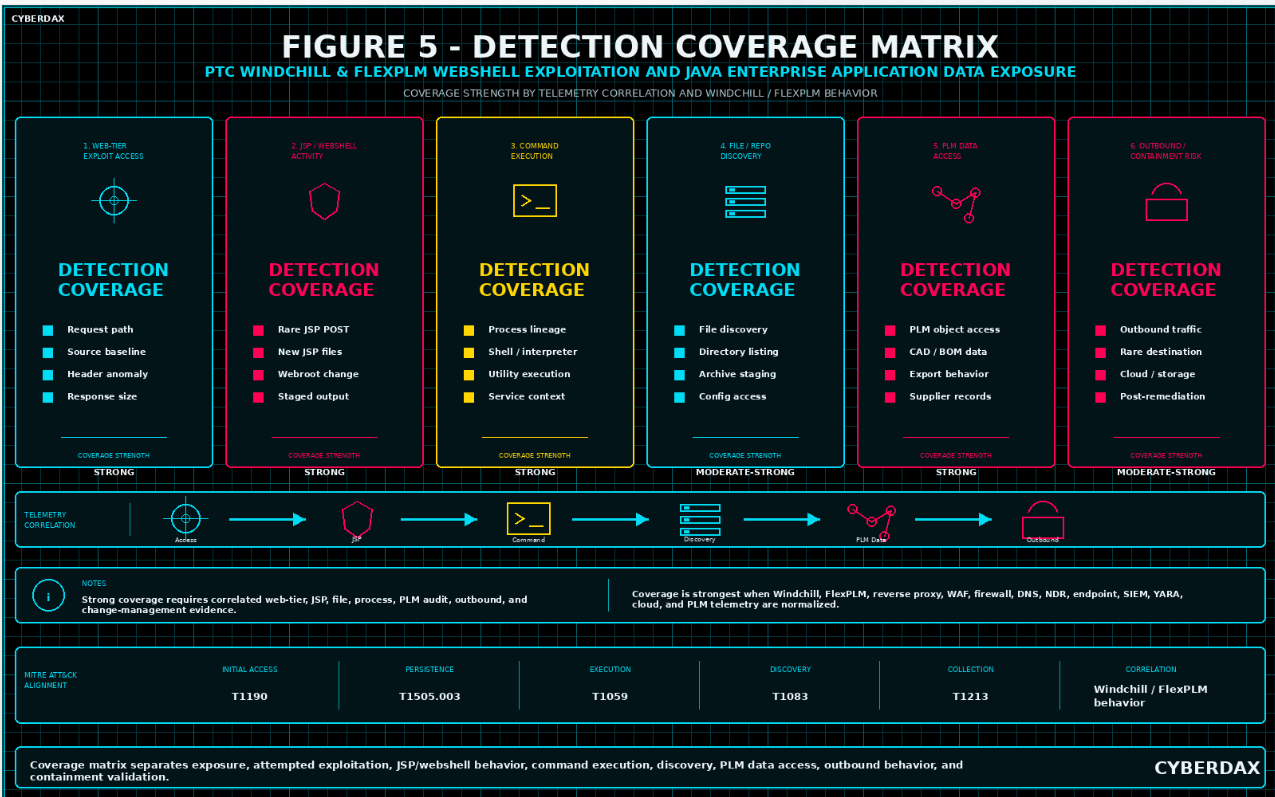
Figure 5
Purpose
This section provides implementation guidance for operationalizing the S25 rule set and S26 traceability model across Windchill/FlexPLM web-tier telemetry, reverse proxy, WAF, firewall, DNS, VPN, proxy, NDR, endpoint, YARA file-scanning workflows, SIEM, QRadar, Elastic, Splunk, SIGMA-converted backends, AWS, Azure, GCP, change-management, SOAR, and incident-response environments.
The detection strategy is sequence-based. It prioritizes correlated behavior over single-event alerting and avoids treating internet exposure, scanner output, isolated WAF events, suspicious path strings, JSP access, file creation, endpoint process activity, outbound traffic, PLM object access, export activity, cloud-control activity, source IP, user agent, YARA match, or static indicator as proof of compromise.
Implementation Strategy
Deploy the detection model in layered stages:
· Windchill/FlexPLM asset, application-path, webroot, PLM data-resource, and administrative-path inventory first.
· Reverse proxy, WAF, web, firewall, DNS, VPN, proxy, load balancer, and NDR telemetry second.
· Web-tier request-path, suspicious source-context, suspicious servlet, JSP, upload, export, file-access, and administrative-path detection third.
· Endpoint service-context, Java process, Tomcat, servlet-container, command execution, file, outbound communication, and persistence telemetry fourth.
· YARA artifact-scanning workflows for suspicious JSP, Java, webroot, staging, temporary, backup, and application-managed files fifth.
· PLM audit, object-access, export, document-access, supplier-exchange, and administrative-impact correlation sixth.
· Conditional AWS, Azure, and GCP cloud-impact correlation seventh.
· Alert promotion only after local telemetry validation, false-positive baselining, suppression governance, and triage playbook alignment.
Telemetry Normalization Requirements
Implementation requires normalized entity and time correlation across Windchill, FlexPLM, reverse proxy, WAF, firewall, load balancer, DNS, VPN, proxy, NDR, EDR, endpoint, YARA scanning, PLM audit, Splunk, Elastic, QRadar, SIGMA-converted backends, AWS, Azure, GCP, change-management, SOAR, incident-response, and SIEM telemetry.
Minimum Normalization Requirements
· Windchill asset identifier.
· FlexPLM asset identifier.
· Java application asset identifier.
· Application asset role.
· Application hostname.
· Webroot path.
· Servlet path.
· JSP path.
· Upload path.
· Export path.
· File-access path.
· Administrative path.
· Source IP.
· Destination IP.
· Destination hostname.
· Request path.
· Request method.
· Response status.
· Response size.
· User agent.
· Session identifier where available.
· Authenticated user where available.
· Administrator identity.
· Administrator source baseline.
· Source ASN.
· Geography.
· VPN context.
· Proxy context.
· Reverse-proxy route.
· WAF policy or rule.
· Firewall decision.
· DNS query and response where available.
· Endpoint hostname.
· Endpoint process name.
· Parent process.
· Child process.
· Command line.
· Service account.
· Java process context.
· Tomcat or servlet-container process context.
· File path.
· File hash.
· YARA rule name where applicable.
· YARA match path where applicable.
· PLM object identifier.
· Document identifier.
· Export identifier.
· Supplier-exchange context.
· PLM data classification where available.
· Outbound destination.
· Cloud principal, account, resource, and region where applicable.
· AWS principal, account, resource, and region where applicable.
· Azure tenant, subscription, resource, caller, and region where applicable.
· GCP principal, project, resource, and region where applicable.
· Change ticket ID.
· Change window.
· Automation identity.
· SOAR case ID.
· Incident-response case ID.
· Event timestamp.
· Event source.
· Approved workflow context.
Correlation Requirements
Rules should use bounded correlation windows that reflect the relationship between Windchill/FlexPLM web-tier risk and follow-on behavior.
Recommended Starting Windows
· Suspicious Windchill/FlexPLM web-tier access to suspicious servlet, JSP, upload, export, file-access, authentication, or administrative-path behavior within 30 minutes.
· Suspicious web-tier access to endpoint process, service-context, Java, Tomcat, or command execution behavior within 60 minutes.
· Suspicious web-tier access to suspicious JSP, webroot, temporary, staging, backup, or application-managed file creation within 60 minutes.
· Suspicious file creation or YARA artifact match to web access, endpoint process activity, or outbound communication within 2 hours.
· Suspicious web-tier or endpoint activity to PLM object access, document access, export behavior, archive creation, or administrative-impact behavior within 4 hours.
· Suspicious Windchill/FlexPLM activity to unusual outbound communication from application infrastructure within 4 hours.
· Suspicious Windchill/FlexPLM activity to AWS, Azure, or GCP cloud-control-plane activity within 24 hours when the application deployment is cloud-hosted, cloud-fronted, cloud-logged, or otherwise integrated with cloud identity, logging, backup, storage, DNS, WAF, or network-control workflows.
These windows should be tightened in high-volume environments and extended only when session continuity, administrator activity, source-device context, VPN logs, reverse-proxy logs, endpoint evidence, PLM audit evidence, change-management evidence, SOAR evidence, or incident-response evidence supports continuity.
Alert Promotion Guidance
Do not promote a hunt or correlation search into alert mode until the following conditions are met:
· Required telemetry is present and normalized.
· Required field mappings are validated.
· Entity resolution is reliable.
· Event timing and ordering are reliable.
· Windchill/FlexPLM asset roles and application paths are mapped.
· Webroot, servlet, JSP, upload, export, and file-access paths are mapped.
· Reverse proxy, WAF, firewall, DNS, NDR, endpoint, YARA, SIEM, PLM audit, and cloud context are mapped.
· Approved administrator source baselines are defined.
· Approved development, deployment, integration, backup, export, supplier-exchange, monitoring, vulnerability-scanning, security-testing, vendor-support, and incident-response workflows are defined.
· False-positive sources are reviewed.
· High-volume expected workflows are suppressed or downgraded.
· Query performance is tested.
· YARA scanning scope and known-good baselines are documented.
· PLM audit triage criteria are documented.
· Analyst review criteria are established.
· Local severity logic is calibrated.
· Alert-routing ownership is assigned.
False-Positive Control
False-positive control should use allowlists, reference sets, approved workflow baselines, known administrator source ranges, expected VPN paths, approved jump hosts, expected application routes, approved maintenance windows, approved deployment workflows, approved customization workflows, approved export workflows, approved supplier exchanges, approved integrations, approved backup workflows, approved vulnerability scanning, approved security testing, approved monitoring, approved vendor-support activity, approved cloud automation identities, approved infrastructure-as-code identities, and incident-response exceptions.
Common False-Positive Sources
· Approved administrator access.
· Approved maintenance windows.
· Approved Windchill or FlexPLM deployments.
· Approved application patches.
· Approved vendor support.
· Approved customizations.
· Approved integrations.
· Approved supplier exchanges.
· Approved PLM exports.
· Approved reporting workflows.
· Approved backup workflows.
· Approved monitoring.
· Approved vulnerability scanning.
· Approved penetration testing.
· Approved incident-response collection.
· Approved file integrity monitoring.
· Approved YARA scanning.
· Approved Java or JSP deployment activity.
· Approved application-server troubleshooting.
· Approved storage activity.
· Approved DNS, WAF, route, firewall, or load-balancer changes.
· Approved automation identities.
· Infrastructure-as-code workflows.
· CI/CD workflows.
· Cloud load-balancer or WAF testing.
· WAF false positives.
· Scanner traffic.
· VPN egress changes.
· Managed-service provider activity.
· Break-glass administration.
· AWS automation.
· Azure automation.
· GCP automation.
Triage Guidance
Initial triage should determine whether suspicious activity forms a coherent sequence rather than a single-event anomaly.
Triage Questions
· Was suspicious Windchill/FlexPLM web-tier access observed?
· Was access from a newly observed, unfamiliar, suspicious, unmanaged, or non-baselined source?
· Was suspicious servlet, JSP, upload, export, file-access, administrative, encoded, or webshell-like request behavior observed?
· Was the activity visible in application logs, reverse proxy logs, WAF logs, web logs, firewall logs, NDR telemetry, or SIEM-normalized telemetry?
· Did endpoint process, Java, Tomcat, service-context, file, persistence, or outbound behavior occur after the web-tier activity?
· Was a suspicious JSP, Java, webroot, temporary, staging, backup, or application-managed file created or modified?
· Did YARA identify suspicious artifact behavior, and does the file path align with application-server exposure?
· Did PLM object access, document access, export behavior, archive creation, supplier-exchange activity, or administrative-impact behavior occur after suspicious upstream activity?
· Did AWS, Azure, or GCP administrative, secret, storage, backup, identity, WAF, DNS, firewall, route, VM command, service account, or network-control activity follow?
· Can the activity be linked by application asset, source IP, administrator identity, session, endpoint host, file path, YARA match path, PLM object, cloud principal, resource, change ticket, SOAR case, incident-response case, or equivalent normalized identity and asset lineage?
· Is the activity explained by approved administration, customization, deployment, integration, supplier exchange, export workflow, automation, vendor support, monitoring, vulnerability scanning, security testing, maintenance, backup, cloud automation, or incident response?
Escalation Guidance
Escalate when multiple behavior classes align in sequence, especially when suspicious Windchill/FlexPLM web-tier access is followed by suspicious servlet or JSP activity, suspicious file creation, YARA artifact matches, application-server process execution, abnormal outbound communication, PLM data access, export activity, or cloud-control-plane activity.
Higher-Priority Escalation Conditions
· The affected Windchill or FlexPLM system supports business-critical engineering, product lifecycle, supplier, manufacturing, or regulated-data workflows.
· The affected application is internet-exposed or accessible from untrusted sources.
· The activity used a newly observed, suspicious, unmanaged, non-baselined, or high-risk source.
· Suspicious servlet, JSP, upload, export, file-access, encoded, or administrative-path behavior occurred.
· Application-server child process or command execution occurred.
· Suspicious JSP, Java, webroot, temporary, staging, backup, or application-managed file creation occurred.
· YARA matched webshell-like command execution, encoded payload handling, dynamic evaluation, credential, PLM data, file-access, or archive-helper behavior.
· Abnormal outbound communication occurred from Windchill/FlexPLM infrastructure.
· PLM object access, document access, export behavior, archive creation, or supplier-data activity occurred after suspicious upstream behavior.
· AWS, Azure, or GCP activity involved privileged roles, secrets, keys, storage, logging changes, security-control suppression, WAF changes, DNS changes, firewall changes, route changes, VM command activity, service account activity, or administrative configuration.
· Multiple systems independently show aligned behavior.
· Activity is not explained by approved change records, deployments, customizations, maintenance, automation, vendor support, monitoring, vulnerability scanning, security testing, supplier exchange, export workflows, or incident response.
Deployment Guardrails
Do not deploy these detections as fully automated blocking or containment logic without local validation.
Do not treat a single web-tier event, suspicious path, JSP access, file creation event, YARA match, endpoint process event, outbound connection, PLM object access, export event, WAF event, firewall event, DNS event, AWS event, Azure event, GCP event, source IP, user agent, or static indicator as proof of compromise.
Do not attribute cloud-only, endpoint-only, artifact-only, network-only, WAF-only, proxy-only, PLM-only, configuration-only, or SIEM-only anomalies to Windchill/FlexPLM compromise without prior application risk context and reliable asset, administrator, source, host, file, PLM object, resource, change-management, or incident-response correlation.
Do not enable high-confidence alerting until platform-specific schemas, index names, sourcetypes, DSM fields, custom properties, ECS mappings, CloudTrail fields, Azure Activity fields, GCP audit fields, WAF fields, proxy fields, firewall fields, application fields, endpoint fields, network fields, PLM audit fields, YARA scan fields, identity mappings, cloud identity mappings, enrichment sources, exception lists, false-positive baselines, query performance, triage readiness, and escalation criteria have been validated.
S29 Detection Coverage Summary
Coverage Summary
The S25 detection set provides broad behavior-led coverage for Windchill/FlexPLM webshell exploitation, suspicious Java enterprise application access, servlet and JSP activity, suspicious file creation, application-server command execution, outbound communication, PLM data-access risk, and conditional cloud-impact activity.
Coverage is strongest when Windchill, FlexPLM, reverse proxy, WAF, firewall, DNS, NDR, endpoint, YARA artifact scanning, PLM audit, SIEM, Splunk, Elastic, QRadar, SIGMA-converted backend, AWS, Azure, GCP, change-management, SOAR, and incident-response telemetry are normalized and correlated into bounded sequences.
The report’s detection model intentionally avoids exploit names, proof-of-concept labels, static indicators, source IPs, user-agent values, actor branding, campaign names, and single-event conclusions. It focuses on durable activity patterns that remain useful across web-tier exploitation attempts, suspicious servlet or JSP behavior, webshell-like artifact behavior, application-server execution, file staging, PLM data access, outbound communication, and conditional cloud activity.
Strong Coverage Areas
· Suspicious Windchill/FlexPLM web-tier access from unusual, non-baselined, or suspicious source context.
· Servlet, JSP, upload, export, file-access, administrative, encoded, and webshell-like request behavior when visible through application logs, reverse proxy logs, WAF logs, web logs, firewall logs, NDR telemetry, or SIEM-normalized telemetry.
· Web-tier activity followed by endpoint process, file, service, or outbound network behavior.
· Application-server child process and command execution behavior on monitored Windchill/FlexPLM hosts.
· Suspicious JSP, Java, webroot, temporary, staging, backup, or application-managed file creation around application infrastructure.
· YARA artifact-behavior detection for suspicious JSP command execution, encoded payload handling, dynamic evaluation, credential, file-access, archive-helper, or PLM-data helper constructs.
· PLM object access, document access, export behavior, archive creation, supplier-exchange behavior, or administrative-impact activity when correlated with suspicious upstream activity.
· AWS, Azure, and GCP activity when correlated with Windchill/FlexPLM cloud-hosted, cloud-fronted, cloud-logged, or cloud-integrated risk context.
Moderate Coverage Areas
· Hosted or third-party-managed deployments that forward partial web, WAF, reverse-proxy, application, PLM audit, or network telemetry into SIEM or NDR.
· Reverse-proxy or WAF-only visibility where backend application logs are unavailable.
· Endpoint detection where Windchill/FlexPLM deployment architecture varies.
· YARA coverage where known-good application baselines are incomplete.
· SIGMA portability across SIEM backends.
· QRadar coverage where DSM parsing and custom properties differ.
· Elastic coverage where ECS mapping, transforms, and enrich policies differ.
· Splunk coverage where CIM mapping, macros, lookups, summary indexes, and sourcetypes differ.
· Cloud detection where application-to-cloud asset linkage is partial.
· PLM audit detection where object, document, export, and identity context are incomplete.
· Downstream administrative-impact detection where change-management context is incomplete.
Limited Coverage Areas
· Windchill/FlexPLM deployments with no forwarded web logs, no reverse-proxy visibility, no WAF telemetry, no NDR coverage, no endpoint visibility, no PLM audit telemetry, and no cloud telemetry.
· Exploitation that succeeds without visible request-path, endpoint, file, artifact, network, PLM audit, or cloud artifacts.
· Command execution on systems without endpoint visibility.
· Suspicious JSP or webroot file placement where file integrity monitoring, EDR, forensic collection, or YARA scanning is unavailable.
· Webshell activity that blends into approved application customization or vendor-support workflows.
· PLM data access that mirrors legitimate user, supplier, integration, export, or reporting workflows.
· Cloud-hosted or cloud-fronted deployments without reliable resource labels, identity mapping, or normalized correlation fields.
· Environments without AWS CloudTrail data events, Azure Key Vault logs, Azure Storage logs, GCP Data Access logs, Secret Manager logs, Cloud Storage logs, or equivalent sensitive-service visibility.
· Environments without reliable change-management, SOAR, or incident-response integration.
Non-Covered Areas
The S25 rule set does not directly prove:
· Successful Windchill exploitation.
· Successful FlexPLM compromise.
· Active webshell use.
· Command execution.
· Credential theft.
· PLM data theft.
· Data exfiltration.
· Persistent access.
· Lateral movement.
· Downstream system compromise.
· AWS compromise.
· Azure compromise.
· GCP compromise.
· Actor attribution.
· Campaign attribution.
· Malware-family attribution.
These outcomes require investigation, corroborating telemetry, and incident-specific validation.
System Coverage Summary
NDR / Network Behavioral Analytics
NDR provides strong supporting coverage for suspicious web-tier access, request-path anomalies, suspicious servlet or JSP behavior where visible, unusual source context, outbound communication, and downstream application or PLM behavior.
NDR does not independently prove successful Windchill/FlexPLM exploitation, webshell execution, command execution, PLM data theft, cloud compromise, or actor attribution without endpoint, application, file, PLM audit, SIEM, cloud, or incident-response context.
SentinelOne
SentinelOne provides endpoint coverage where Windchill/FlexPLM infrastructure is monitored and where application-server process behavior, command execution, suspicious file creation, webroot or JSP modification, outbound communication, and persistence-oriented host changes are visible.
SentinelOne does not cover hosted, appliance-like, or third-party-managed deployments without endpoint telemetry.
Splunk
Splunk provides strong correlation coverage when Windchill, FlexPLM, reverse proxy, WAF, firewall, DNS, NDR, endpoint, PLM audit, YARA scan results, change-management, AWS, Azure, and GCP telemetry are normalized into searchable indexes with reliable field mappings, sourcetypes, macros, lookups, summary datasets, and sequence logic.
Elastic
Elastic provides strong endpoint and SIEM correlation coverage when Windchill, FlexPLM, web, proxy, WAF, endpoint, network, PLM audit, YARA scan results, AWS, Azure, and GCP data are normalized into ECS-compatible or locally mapped fields with reliable sequencing, enrichment, transforms, value lists, and exception handling.
QRadar
QRadar provides strong correlation coverage when DSM parsing, custom properties, reference sets, reference maps, building blocks, event ordering, and offense grouping are validated across Windchill, FlexPLM, reverse proxy, WAF, firewall, endpoint, network, PLM audit, YARA scan results, AWS, Azure, and GCP telemetry.
SIGMA
SIGMA provides portable event-rule template logic for suspicious Windchill/FlexPLM web-tier requests, suspicious JSP or webroot file creation, and suspicious outbound communication after upstream activity.
SIGMA production value depends on SIEM translation quality, field mappings, enrichment-field creation, sequence support, wildcard behavior, case handling, backend-native correlation, and local event-source coverage.
YARA
YARA provides artifact-behavior coverage for suspicious JSP or Java webshell-like content, encoded payload handling, dynamic evaluation, credential, file-access, archive-helper, and PLM-data helper constructs.
YARA does not independently prove exploitation, active webshell use, command execution, credential theft, PLM data theft, persistence, exfiltration, or attribution without supporting file-path context, web-access evidence, endpoint telemetry, PLM audit records, network telemetry, and analyst validation.
AWS
AWS provides conditional downstream cloud-impact coverage when suspicious AWS activity is correlated with Windchill/FlexPLM infrastructure that is AWS-hosted, AWS-fronted, AWS-logged, or integrated with AWS identity, networking, logging, backup, storage, WAF, DNS, or management workflows.
AWS does not independently prove Windchill/FlexPLM compromise without upstream application context and reliable asset, identity, resource, PLM data, or incident-response linkage.
Azure
Azure provides conditional downstream cloud-impact coverage when suspicious Azure activity is correlated with Windchill/FlexPLM infrastructure that is Azure-hosted, Azure-fronted, Azure-logged, or integrated with Azure identity, networking, logging, backup, storage, WAF, DNS, or management workflows.
Azure does not independently prove Windchill/FlexPLM compromise without upstream application context and reliable asset, identity, resource, PLM data, or incident-response linkage.
GCP
GCP provides conditional downstream cloud-impact coverage when suspicious GCP activity is correlated with Windchill/FlexPLM infrastructure that is GCP-hosted, GCP-fronted, GCP-logged, or integrated with GCP identity, networking, logging, backup, storage, WAF, DNS, or management workflows.
GCP does not independently prove Windchill/FlexPLM compromise without upstream application context and reliable asset, identity, resource, PLM data, or incident-response linkage.
Coverage Conclusion
The detection set provides strong practical coverage for observable enterprise behavior associated with Windchill/FlexPLM webshell exploitation, suspicious web-tier access, servlet and JSP activity, webshell-like artifact behavior, application-server execution, suspicious file creation, outbound communication, PLM data-access risk, and conditional cloud-control-plane activity.
It is strongest when multiple telemetry classes align in sequence and weakest where application telemetry is not forwarded, endpoint visibility is unavailable, request-path visibility is missing, artifact collection is unavailable, PLM audit context is incomplete, or downstream cloud activity cannot be correlated to Windchill/FlexPLM asset and incident context.
S30 Intelligence Maturity Assessment
Maturity Assessment Summary
The intelligence maturity level for this report is high for behavior-led detection strategy and moderate for direct exploitation confirmation.
The detection model is mature because it focuses on durable behavioral relationships: suspicious Windchill/FlexPLM web-tier access, suspicious servlet and JSP behavior, webshell-like artifact behavior, application-server process execution, suspicious file creation, outbound communication, PLM data-access risk, export behavior, and conditional cloud-control-plane activity.
Direct exploit-success attribution remains limited because many environments do not expose the full web-tier, application, endpoint, file-content, PLM audit, cloud, and incident-response telemetry needed to prove exploitation or active webshell use from detection telemetry alone. Most environments infer suspected compromise through suspicious web activity, endpoint behavior, artifact evidence, network behavior, PLM audit activity, cloud-control-plane activity, and incident-response validation.
Behavioral Intelligence Maturity
Behavioral maturity is high.
The report identifies repeatable post-access and downstream-impact behaviors that can be detected across Windchill logs, FlexPLM logs, reverse proxy logs, WAF telemetry, firewall logs, NDR telemetry, endpoint telemetry, YARA artifact scans, PLM audit telemetry, SIEM platforms, Splunk, Elastic, QRadar, SIGMA-converted backends, AWS, Azure, and GCP platforms.
The behaviors are durable across exploit naming, proof-of-concept labels, scanner infrastructure, source IPs, user-agent values, actor branding, campaign names, cloud-provider variation, and deployment architecture differences.
Strong Behavioral Anchors
· Suspicious Windchill/FlexPLM web-tier access.
· Suspicious servlet, JSP, upload, export, file-access, administrative, encoded, or webshell-like request behavior.
· Suspicious source context, including newly observed, unfamiliar, unmanaged, high-risk, non-baselined, or suspicious administrator sources.
· Application-server Java, Tomcat, servlet-container, command-line, shell, or child-process behavior.
· Suspicious JSP, Java, webroot, temporary, staging, backup, or application-managed file creation.
· YARA artifact matches for webshell-like command execution, encoded payload handling, dynamic evaluation, credential, PLM data, file-access, archive-helper, or download-helper behavior.
· Outbound communication from application infrastructure after suspicious upstream activity.
· PLM object access, document access, export behavior, archive creation, supplier-exchange activity, or administrative impact following suspicious upstream behavior.
· AWS, Azure, or GCP control-plane activity following Windchill/FlexPLM risk context.
Telemetry Maturity
Telemetry maturity is moderate to high.
Windchill logs, FlexPLM logs, reverse proxy logs, WAF telemetry, firewall logs, NDR telemetry, endpoint telemetry, YARA artifact scans, PLM audit data, SIEM telemetry, change-management data, SOAR data, incident-response data, and cloud-control-plane telemetry provide strong coverage where asset, source, request, administrator, endpoint, file, object, resource, case, and timestamp fields are available and normalized.
Telemetry maturity decreases when application logs are unavailable, request paths are not logged, WAF telemetry is incomplete, reverse-proxy data is unavailable, endpoint telemetry is missing, file-content collection is unavailable, YARA baselines are incomplete, PLM audit logging is limited, cloud-resource labeling is weak, or change-management context is not integrated.
Cloud and Infrastructure Maturity
Cloud and infrastructure maturity is moderate.
AWS, Azure, and GCP provide useful downstream cloud-impact visibility when Windchill/FlexPLM infrastructure is cloud-hosted, cloud-fronted, cloud-logged, or meaningfully integrated with cloud identity, logging, backup, storage, WAF, DNS, or network-control workflows.
Cloud telemetry does not independently prove Windchill/FlexPLM exploitation. Its strongest value comes from correlation with prior application risk context, asset lineage, administrator identity, network path, endpoint evidence, PLM audit evidence, change-management records, SOAR context, or incident-response validation.
Maturity increases when cloud asset labels, resource identifiers, administrator identities, service accounts, source IPs, VPC or VNet context, WAF events, load balancer logs, CloudTrail, Azure Activity Logs, GCP Cloud Audit Logs, sensitive data-event logs, and SIEM-forwarded Windchill/FlexPLM context are normalized and validated.
Adversary-Resilience Maturity
Adversary-resilience maturity is high for behavior-led detection and moderate for high-confidence exploitation attribution.
The detection model is resilient because it avoids brittle indicators and focuses on behavior an adversary must often produce when converting web-tier access into webshell activity, application-server execution, suspicious file creation, outbound communication, PLM data access, export activity, or cloud-control-plane impact.
The model is less resilient when adversaries use expected administrator sources, expected maintenance windows, expected application paths, approved customization workflows, approved deployment workflows, approved cloud automation, normal outbound destinations, legitimate integrations, or subtle PLM access patterns that blend into business workflows. It is also less resilient when exploitation occurs in hosted or third-party-managed deployments with limited telemetry forwarding.
Operationalization Maturity
Operationalization maturity is moderate.
The S25 rules are implementation-ready detection patterns, but production deployment requires local validation of schemas, index names, sourcetypes, DSM fields, custom properties, ECS mappings, application fields, web fields, reverse-proxy fields, WAF fields, firewall fields, endpoint fields, PLM audit fields, YARA scan fields, CloudTrail fields, Azure Activity fields, GCP audit fields, identity mappings, administrator mappings, cloud identity mappings, asset mappings, enrichment, exception lists, false-positive baselines, query performance, triage logic, and alert-routing decisions.
Operational maturity increases when detection owners validate each platform’s field mappings, confirm telemetry quality, baseline approved Windchill/FlexPLM administrative workflows, baseline approved deployment and customization workflows, baseline approved PLM access and export workflows, baseline approved cloud administrative workflows, and test sequence logic using realistic benign and suspicious event data.
Attribution Maturity
Attribution maturity is low to moderate.
The rule set supports detection of behavior consistent with Windchill/FlexPLM webshell exploitation, suspicious Java enterprise application abuse, webshell-like artifact behavior, application-server follow-on behavior, PLM data-access risk, and conditional cloud-control-plane activity. It should not be used by itself to attribute activity to a specific adversary, campaign, exploit developer, infrastructure provider, tool, malware family, or named threat group without external evidence and incident-specific validation.
Attribution requires corroborating evidence such as exploit timeline, source infrastructure, request sequence, host evidence, artifact evidence, payload evidence, credential or session evidence, PLM data activity, configuration changes, cloud activity, victimology, actor tradecraft, and threat-intelligence reporting.
Maturity Limitations
Primary Maturity Limitations
· Limited direct visibility into exploit success.
· Limited direct visibility into active webshell use.
· Variable Windchill and FlexPLM log availability.
· Variable reverse-proxy and WAF visibility.
· Variable request-path capture.
· Variable endpoint coverage for application-server deployments.
· Variable file-content collection and YARA scanning coverage.
· Variable known-good application artifact baselines.
· Variable PLM audit logging.
· Variable export, object-access, and document-access telemetry.
· Variable administrator identity mapping.
· Variable change-management integration.
· Variable SOAR and incident-response integration.
· Variable source IP stability.
· Variable cloud-hosted or cloud-fronted deployment context.
· Variable AWS, Azure, and GCP data-event logging.
· Variable approved workflow baselines.
· High false-positive potential when detections are deployed without local tuning.
Maturity Improvement Priorities
Priority Improvements
· Improve Windchill and FlexPLM web-tier log collection.
· Improve reverse-proxy, WAF, and load-balancer logging.
· Improve request-path normalization and retention.
· Improve servlet, JSP, upload, export, file-access, and administrative-path visibility.
· Improve firewall, DNS, proxy, VPN, and NDR coverage for application paths.
· Improve endpoint telemetry for application-server deployments.
· Improve Java, Tomcat, servlet-container, service-context process, file, and outbound communication monitoring.
· Improve file integrity monitoring for webroot, JSP, Java, temporary, staging, backup, and application-managed paths.
· Improve YARA scanning coverage and known-good application baselines.
· Improve PLM audit logging for object access, document access, export behavior, archive creation, supplier exchanges, and administrative activity.
· Improve asset inventory and Windchill/FlexPLM role tagging.
· Improve administrator identity mapping and privileged access workflow baselining.
· Improve change-management, SOAR, and incident-response integration.
· Improve cloud resource labeling and asset-to-cloud linkage for AWS, Azure, and GCP.
· Enable relevant cloud data-event logging for sensitive AWS, Azure, and GCP services.
· Build approved workflow baselines for Windchill/FlexPLM administration, deployments, customizations, integrations, backups, exports, supplier exchanges, reporting workflows, monitoring, vulnerability scanning, vendor support, cloud administration, infrastructure-as-code, managed-service access, break-glass use, security tooling, and incident-response activity.
· Test detection logic against realistic benign and suspicious sequences before alert promotion.
Final Intelligence Maturity Assessment
The report’s intelligence maturity is strong for behavior-led detection engineering, strong for executive risk framing, moderate to strong for telemetry-driven operational detection, moderate to strong for SIEM and artifact correlation, moderate for AWS, Azure, and GCP downstream cloud correlation, and low to moderate for direct exploit-success attribution.
The S25 through S30 detection model is best used as an implementation-ready threat-to-detection framework that identifies suspicious Windchill/FlexPLM web-tier, servlet, JSP, endpoint, artifact, PLM data-access, outbound communication, and cloud-impact patterns. It should not be used as a standalone proof model for successful exploitation, active webshell use, command execution, credential theft, PLM data theft, data exfiltration, persistence, cloud compromise, or actor attribution without corroborating telemetry and incident-specific validation.
S31 — Telemetry Dependencies
PTC Windchill and FlexPLM webshell exploitation requires telemetry that can prove whether suspicious web-tier activity, JSP access, application-server command execution, file discovery, PLM data access, outbound communication, administrator activity, or post-remediation behavior remained within approved operations or created material application-server compromise and product-lifecycle data-exposure risk. The central dependency is the ability to correlate Windchill logs, FlexPLM logs, reverse-proxy logs, WAF logs, load-balancer logs, servlet logs, Java application logs, endpoint telemetry, file telemetry, EDR telemetry, PLM audit records, DNS logs, proxy logs, firewall logs, NDR telemetry, identity records, administrator records, asset inventory, change-management records, incident-response records, data-sensitivity mappings, approved workflow baselines, and remediation evidence into one PLM application exploitation-to-impact investigation model.
Windchill, FlexPLM, Web-Tier, and Application Telemetry
Windchill and FlexPLM telemetry must capture web requests, login-path access, JSP access, WSDL access, servlet activity, administrative sessions, API activity, document access, workflow actions, export activity, application errors, Java exceptions, response status, response size, request paths, request headers where available, source IP, user agent, authenticated identity where available, destination interface, session context where available, and timestamp.
Reverse-proxy, WAF, load-balancer, firewall, and secure-access telemetry must capture exposed application paths, normalized paths, raw paths where available, HTTP method, response status, response size, request-header context where available, TLS termination context where available, source IP, destination host, destination interface, session identifiers where available, user agent, request frequency, and application exposure path.
Required fields include source IP, source ASN where available, source geography, destination host, destination interface, HTTP method, request path, normalized path, raw path where available, request headers where available, response status, response size, user agent, session identifier where available, authenticated identity where available, application path category, event time, and change-window context.
This telemetry is required to determine whether suspicious request activity, FlexPLM WSDL probing, rare JSP access, abnormal request headers, unusual HTTP methods, response-size anomalies, or source-context deviations align with JSP file creation, command execution, file discovery, PLM data access, outbound communication, administrator-state changes, or post-remediation activity.
These sources must be interpreted conservatively because legitimate application updates, Java updates, servlet-container maintenance, vendor support, supplier workflows, product-release activity, vulnerability scanning, security testing, monitoring, troubleshooting, and incident response can produce overlapping web-tier and application activity.
Endpoint, Process, File, and Persistence Telemetry
Endpoint and process telemetry must capture process creation, parent-child process lineage, command line, working directory, process user, effective user, service context, process path, interpreter execution, shell execution, command-processor execution, file-retrieval utility execution, archive utility execution, scripting activity, network utility execution, service restart behavior, and privileged execution where available.
File telemetry must capture creation, modification, deletion, execution, permission changes, ownership changes, timestamp changes, archive creation, extraction activity, staged output, JSP placement, webroot writes, codebase changes, temporary file use, backup access, configuration access, script placement, binary placement, and application-writable path activity.
Required fields include host name, asset role, process name, parent process, command line, process user, effective user, working directory, process path, file path, file name, file action, file extension, hash where available, file owner, permission state, service context, timestamp, and associated application or change window.
This telemetry is required to determine whether suspicious Windchill or FlexPLM activity progressed into JSP webshell placement, application-server command execution, file discovery, archive creation, persistence, configuration access, service modification, staged output, or suspicious activity from trusted Java, Tomcat, servlet-container, web-server, or middleware service contexts.
Endpoint and file telemetry must be interpreted against approved maintenance because application upgrades, Java updates, vendor-guided fixes, servlet-container changes, product-release workflows, backup activity, migrations, security testing, and incident-response collection can create file writes, process activity, restarts, archive activity, or temporary artifacts that resemble attacker behavior.
PLM Audit, Data-Access, Engineering, and Product-Repository Telemetry
PLM audit telemetry must capture document access, CAD file access, product-design access, bill-of-materials access, supplier record access, manufacturing workflow access, engineering document access, configuration access, workflow export activity, bulk export activity, administrative changes, service-account behavior, API activity, permission changes, and sensitive object access where available.
Data-access telemetry must capture repository name, object name, object ID, file path, file type, sensitivity category, business owner, user identity, service account, source host, action, access volume, export action, download action, workflow action, timestamp, and relationship to Windchill, FlexPLM, engineering, supplier, or manufacturing workflows.
Required fields include user, service account, role, source IP, source host, PLM object, object category, repository, file name, file path, CAD file type where available, bill-of-materials object where available, supplier data category, manufacturing workflow, export action, byte count where available, access count, sensitivity label or local sensitivity category, business owner, and timestamp.
This telemetry is required to determine whether suspected exploitation affected intellectual property, engineering files, CAD repositories, bills of materials, supplier records, manufacturing records, regulated product records, configuration files, backups, export packages, or sensitive product-release information.
PLM and data-access telemetry must be interpreted against business workflows because engineering review, supplier exchange, product release, manufacturing planning, quality review, migration activity, backups, legal discovery, compliance review, and approved data exports can create legitimate high-volume or sensitive repository access.
Network, DNS, Proxy, NDR, and Outbound Communication Telemetry
Network telemetry must capture internet ingress, VPN ingress, supplier access, partner access, administrator access, reverse-proxy paths, WAF-protected paths, internal application traffic, middleware traffic, database connections, PLM integration traffic, east-west traffic, and outbound communication from Windchill, FlexPLM, Java application, middleware, and PLM integration hosts.
Outbound telemetry must capture DNS queries, HTTP traffic, HTTPS traffic, SSH activity, SMB activity, file-transfer behavior, cloud storage access, package-repository access, tunnel-like traffic, rare external destinations, newly observed destinations, low-reputation destinations, unusual ASNs, unexpected geographic destinations, abnormal byte volume, and traffic inconsistent with the deployed application role.
Required fields include source host, source IP, destination IP, destination host, destination domain, destination port, protocol, directionality, connection count, byte count, DNS query, proxy action, firewall action, NDR classification, TLS metadata where available, external destination reputation where available, first-seen destination context where available, ASN, geography, timestamp, and application role.
This telemetry is required to determine whether suspected webshell activity, command execution, archive creation, PLM data access, file discovery, or administrator-state changes were followed by external communication, tool retrieval, staging, callback behavior, archive transfer, data movement, or access to adjacent internal systems.
Network telemetry must not be used as the primary basis for confirming exploitation, command execution, webshell persistence, data theft, or actor attribution by itself. It is strongest when tied to suspicious web-tier activity, JSP access, application-server process execution, file telemetry, PLM audit records, data-access events, administrator activity, or incident-response evidence.
Identity, Administrator, Service Account, and Integration Telemetry
Identity and administrator telemetry must capture administrator logins, privileged access, service-account activity, integration-account use, API token activity, database credential use where available, SSH key use where available, group membership changes, role changes, permission changes, local user changes, authentication source, session creation, and administrative workflow context.
Service-account and integration telemetry must capture Windchill service accounts, FlexPLM service accounts, middleware accounts, database accounts, backup accounts, supplier integration accounts, partner integration accounts, API tokens, automation accounts, vendor-support accounts, and approved administrative paths.
Required fields include user, service account, account type, role, group membership, privileged status, source IP, source host, authentication method, session context, API token identifier where available, target asset, target application, action, result, change ticket where available, approval context, and timestamp.
This telemetry is required to determine whether suspected exploitation led to administrator-state changes, service-account misuse, API token use, permission changes, integration abuse, database access, backup access, supplier-path access, or adjacent infrastructure access.
Identity and administrator telemetry must be interpreted against approved maintenance because vendor support, emergency patching, application-owner troubleshooting, backup operations, supplier integrations, migrations, security testing, incident response, and recovery actions may create legitimate privileged activity near the same investigation window.
Asset Inventory, Configuration, Change-Control, and Sensitive-Data Context
Asset inventory must identify Windchill systems, FlexPLM systems, Windchill PDMLink environments, Java application servers, Tomcat hosts, servlet containers, middleware systems, reverse proxies, WAF paths, load balancers, exposed interfaces, supplier-facing paths, partner-facing paths, VPN-accessible paths, PLM repositories, CAD repositories, engineering repositories, supplier data stores, manufacturing workflow systems, databases, backup systems, monitoring systems, and approved administrative sources.
Configuration and change-control telemetry must capture patching, emergency remediation, Java updates, application updates, servlet-container changes, reverse-proxy changes, WAF rule changes, firewall changes, supplier-access changes, product-data workflow changes, export jobs, administrator activity, service changes, vendor-support activity, vulnerability scanning, security testing, and incident-response actions.
Sensitive-data context must identify engineering documents, CAD files, product designs, bills of materials, supplier records, manufacturing records, regulated product records, configuration files, backup files, workflow exports, product-release packages, contractual data, intellectual property, and business owners.
Required fields include asset owner, application owner, data owner, repository owner, asset role, exposure path, software version, patch status, business criticality, data category, sensitivity label or local sensitivity category, workflow owner, integration owner, change owner, approving authority, maintenance window, ticket identifier, event time, rollback status, and validation outcome where available.
Asset, configuration, change-control, and sensitive-data context is required to separate approved PLM operations from suspicious exploitation, webshell activity, command execution, file discovery, product-data access, outbound communication, or containment failure.
Help Desk, Incident Response, Remediation, and Business-Workflow Context
Help desk and incident-response telemetry must capture user reports, application-owner reports, suspicious access reports, vendor advisories, emergency patching actions, application isolation, webshell hunting, JSP artifact review, application-server integrity validation, PLM audit review, outbound communication review, sensitive data scoping, service-account review, supplier impact review, manufacturing workflow review, and post-remediation monitoring.
Business workflow context must capture approved Windchill maintenance, FlexPLM maintenance, Java updates, servlet-container maintenance, vendor support, supplier exchanges, partner integrations, engineering document access, CAD access, product-release workflows, manufacturing planning, workflow exports, backups, migrations, vulnerability scanning, security testing, legal review, compliance review, and incident-response collection.
Required fields include ticket ID, case ID, affected application, affected asset, affected repository, affected account, remediation action, action owner, action timestamp, webshell review status, patch status, application-server integrity status, file-review status, PLM audit-review status, outbound-review status, service-account-review status, supplier-review status, manufacturing-review status, data-access-review status, and closure evidence.
This telemetry is required to determine whether containment was complete, whether Windchill or FlexPLM access continued after remediation, whether application-server trust was restored, whether sensitive product-lifecycle data was accessed, and whether observed activity aligned with approved business workflows.
Remediation telemetry should not be assumed complete unless patch validation, webshell artifact removal, application-server integrity review, service-account review, PLM audit review, outbound activity review, sensitive data scoping, change-control reconciliation, and post-remediation monitoring are explicitly validated.
S32 — Detection Limitations
Detection of PTC Windchill and FlexPLM webshell exploitation is limited by whether the organization can reconstruct the relationship between suspicious web-tier access, critical Java application exposure, JSP access, JSP file creation, application-server command execution, file discovery, archive creation, PLM data access, outbound communication, administrator activity, remediation actions, and approved PLM workflows. Environments that rely only on vulnerable-version status, scanner output, KEV status, isolated denied requests, single WSDL access, single JSP requests, internet exposure, public proof-of-concept references, or actor reporting will not have enough evidence for high-confidence compromise or impact determination.
Primary Limitations
Missing asset inventory may prevent identification of Windchill systems, FlexPLM systems, Java application servers, servlet containers, Tomcat hosts, middleware systems, reverse proxies, WAF paths, load balancers, exposed interfaces, supplier-facing paths, partner-facing paths, PLM repositories, CAD repositories, engineering repositories, databases, backup systems, and approved administrator sources.
Missing web-tier fields such as raw request path, normalized request path, request headers, HTTP method, response status, response size, source IP, user agent, session context, destination interface, or timestamp may prevent reliable exploit-path reconstruction.
Missing Windchill or FlexPLM application logs may prevent review of login-path JSP access, FlexPLM WSDL probing, JSP execution, servlet activity, administrative sessions, API activity, export activity, document access, workflow changes, product-data access, application errors, and audit events.
Missing endpoint or process telemetry may prevent assessment of Java, Tomcat, Windchill, FlexPLM, servlet-container, web-server, application-server, or middleware service contexts spawning shells, interpreters, command processors, file-retrieval utilities, archive tools, discovery utilities, network utilities, or persistence-oriented commands.
Missing file telemetry may prevent assessment of JSP placement, webroot writes, codebase changes, staged output, temporary file use, archive creation, configuration access, backup access, permission changes, service modification, or persistence-oriented file activity.
Missing PLM audit logs may prevent reliable assessment of engineering document access, CAD file access, bill-of-materials access, supplier data access, manufacturing workflow access, document enumeration, export activity, backup access, and sensitive repository exposure.
Missing outbound network telemetry may prevent assessment of callback behavior, tool retrieval, cloud storage access, archive transfer, unusual byte volume, rare destinations, newly observed infrastructure, low-reputation destinations, tunnel-like traffic, or data movement.
Missing administrator, identity, service-account, API token, integration-account, or change-management records may prevent reliable separation between approved maintenance, vendor support, supplier workflows, security testing, incident response, and unauthorized activity.
Short log retention may prevent reconstruction of the period between initial exploit-path activity, JSP access, application-server command execution, file discovery, PLM data access, outbound communication, remediation, and post-remediation validation.
Poor timestamp normalization can break sequence logic between web access logs, WAF logs, reverse-proxy logs, application logs, endpoint telemetry, file telemetry, PLM audit records, outbound network events, administrator actions, and incident-response records.
Incomplete asset, identity, application, repository, data-object, source, destination, business-owner, and exception normalization can prevent reliable correlation across web, host, file, PLM, network, identity, and change-management telemetry.
Detection Boundary
A vulnerable version, exposed Windchill or FlexPLM interface, scanner finding, KEV listing, proof-of-concept reference, suspicious request, denied request, WSDL access, rare JSP request, HTTP error, response-size anomaly, or unfamiliar source IP is not proof of compromise by itself.
Suspicious web-tier activity should not be treated as successful exploitation without downstream JSP activity, file creation, application errors, application-server command execution, file discovery, outbound communication, PLM data access, administrator-state changes, or incident-response evidence.
JSP access should not be treated as webshell execution without supporting source context, newly observed file behavior, suspicious POST activity, response-size anomalies, file telemetry, process telemetry, application evidence, or incident-response validation.
Application-server command execution should not be inferred from request activity alone without process telemetry, endpoint telemetry, application logs, file telemetry, network evidence, or incident-response findings.
File discovery, archive creation, PLM data access, or export behavior should not be treated as data theft without evidence of suspicious context, abnormal scope, unusual role or account context, staging, outbound transfer, unusual byte volume, rare destination activity, or data-loss validation.
Outbound communication should not be treated as confirmed exfiltration without staging evidence, transfer evidence, unusual byte volume, destination context, incident-response validation, or relationship to exploit-path activity, webshell behavior, command execution, or sensitive data access.
Network-only, WAF-only, vulnerability-only, endpoint-only, PLM-audit-only, or actor-reporting-only evidence should not be used as the primary basis for confirming Windchill or FlexPLM compromise, product-data theft, supplier exposure, manufacturing disruption, or actor attribution.
Detection logic must not rely on prior alert state, another rule’s output, analyst judgment after alert generation, DRI, or TCR as an input.
High-confidence alerting should require validated multi-signal correlation across web-tier activity, application logs, JSP behavior, process telemetry, file telemetry, PLM audit records, outbound communication, administrator context, change-management records, incident-response evidence, and approved workflow context where applicable.
Operational Impact of Limitations
Detection coverage should be reduced, scoped down, converted to hunt-only logic, or withheld when required telemetry is unavailable, incomplete, delayed, sampled, inconsistently normalized, or unable to support bounded sequence correlation. Suspicious Windchill or FlexPLM activity may be analytically important but unsuitable for high-confidence alerting if the organization cannot validate source context, request path, request headers, application behavior, JSP behavior, file activity, process lineage, PLM data access, outbound communication, administrator actions, remediation status, and approved business workflow evidence within locally validated correlation windows.
S33 — Defensive Control & Hardening Improvements
Defensive improvement should focus on making Windchill, FlexPLM, Java application infrastructure, JSP execution paths, application-server behavior, PLM repository access, supplier workflows, manufacturing data, outbound communication, administrator activity, and remediation evidence measurable, governed, and resilient under active exploitation pressure. The objective is not only to patch one application, block one request, remove one JSP file, or investigate one alert, but to prove that PLM activity can be scoped, correlated, contained, and separated from legitimate engineering, supplier, manufacturing, vendor-support, and administrative workflows when Windchill or FlexPLM exploitation is suspected.
PLM Asset, Exposure, and Application Governance
Maintain a complete inventory of Windchill systems, FlexPLM systems, Windchill PDMLink environments, Java application servers, Tomcat hosts, servlet containers, middleware systems, reverse proxies, WAF paths, load balancers, exposed interfaces, supplier-facing interfaces, partner-facing interfaces, VPN-accessible paths, PLM repositories, CAD repositories, engineering repositories, databases, backup systems, monitoring systems, approved administrator sources, and PLM integration hosts.
Govern internet exposure, supplier access, partner access, VPN access, reverse-proxy routes, WAF policies, administrative paths, service accounts, integration accounts, vendor-support paths, emergency maintenance paths, and product-data workflow access.
Require auditable change control for emergency patching, application updates, Java updates, servlet-container changes, reverse-proxy changes, WAF rule changes, firewall changes, supplier-access changes, partner-access changes, service-account changes, PLM workflow changes, and product-data export jobs.
Treat unexplained Windchill or FlexPLM exploit-path activity, rare JSP access, newly observed JSP files, application-server command execution, suspicious PLM data access, or post-remediation activity as application-server compromise risk requiring validation.
Prioritize exposure governance for systems that support product design, engineering workflows, CAD repositories, bill-of-materials management, supplier collaboration, manufacturing records, regulated product records, configuration data, backups, or product-release decisions.
Web-Tier, WAF, Reverse-Proxy, and Application Logging Hardening
Enable and retain Windchill, FlexPLM, web-server, reverse-proxy, WAF, load-balancer, firewall, secure-access, servlet-container, and application logs that preserve request path, normalized path, raw path where available, HTTP method, response status, response size, request headers where available, user agent, source IP, destination interface, session context where available, authenticated identity where available, and timestamp.
Monitor suspicious request paths, abnormal request headers, FlexPLM WSDL probing, rare JSP access, newly observed JSP filenames, suspicious JSP POST activity, unexpected HTTP methods, path variation, encoded path elements, abnormal status-code sequences, application errors, and unusual response-size behavior.
Preserve raw request-path and request-header visibility where feasible because reverse-proxy normalization, WAF normalization, or partial logging can remove exploit-path evidence needed for investigation.
Tune WAF, reverse-proxy, and load-balancer controls to distinguish approved administrator activity, vendor support, supplier workflows, application monitoring, vulnerability scanning, security testing, and incident response from suspicious source context and exploit-path behavior.
Require multi-signal escalation when suspicious web-tier behavior is followed by JSP access, file creation, command execution, file discovery, abnormal response volume, outbound communication, PLM data access, administrator-state changes, or application instability.
Endpoint, File, Process, and Application-Server Hardening
Enable endpoint, EDR, process, and file telemetry on Windchill, FlexPLM, Java application, Tomcat, servlet-container, web-server, middleware, reverse-proxy, and supporting Linux or Windows hosts where customer-managed telemetry is available.
Monitor Java, Tomcat, Windchill, FlexPLM, servlet-container, web-server, application-server, and middleware service contexts for unexpected child processes, shells, interpreters, command processors, scripting engines, file-retrieval utilities, archive tools, discovery utilities, network utilities, service-control utilities, and persistence-oriented commands.
Monitor JSP, Java, servlet, webroot, login-directory, codebase, temporary, backup, configuration, document-repository, staging, and application-writable paths for file creation, modification, deletion, permission changes, ownership changes, timestamp anomalies, archive activity, staged output, and unexpected executable content.
Restrict write access to webroot, login, codebase, application-writable, temporary, and servlet paths where feasible, and validate that deployment workflows do not allow unmanaged JSP placement.
Require application-server integrity validation after suspected exploitation, including webshell checks, file-diff review, process review, service review, scheduled job review, configuration review, account review, startup behavior review, and post-remediation monitoring.
Treat hosted, managed, appliance-backed, or telemetry-limited deployments as requiring compensating controls through vendor logs, reverse-proxy logs, WAF logs, application audit records, configuration snapshots, vendor-provided diagnostics, and incident-response evidence.
PLM Data, Engineering Repository, and Sensitive Object Hardening
Enable and retain PLM audit telemetry for document access, CAD access, product-design access, bill-of-materials access, supplier data access, manufacturing workflow access, configuration access, export activity, backup access, workflow changes, administrative activity, and sensitive object access.
Maintain sensitivity mapping for engineering documents, CAD files, product designs, bills of materials, supplier records, manufacturing records, regulated product records, configuration files, backups, workflow exports, product-release packages, contractual data, and intellectual property.
Monitor sensitive PLM object access, document enumeration, CAD repository access, bulk export activity, archive creation, backup access, supplier file access, manufacturing workflow access, and configuration access after suspicious web-tier activity or suspected webshell behavior.
Restrict broad repository access, unmanaged export paths, uncontrolled backup access, excessive service-account permissions, and informal supplier data exchange where feasible.
Require data-access scoping when suspected exploitation occurs near sensitive object access, archive creation, export behavior, unusual service-account activity, outbound communication, or administrator-state changes.
Outbound, Egress, and Internal Movement Hardening
Enrich DNS, proxy, firewall, NDR, secure web gateway, network-flow, and egress telemetry with application role, asset owner, source host, destination host, destination domain, destination category, ASN, geography, reputation, first-seen context, byte count, protocol, and approved workflow context.
Monitor outbound communication from Windchill, FlexPLM, Java application, middleware, application-server, and PLM integration hosts to rare destinations, newly observed destinations, low-reputation destinations, unusual ASNs, unexpected geographies, tunnel-like traffic, cloud storage, file-transfer paths, package repositories, or destinations inconsistent with the deployed application role.
Restrict outbound communication from PLM application servers to approved vendor services, update services, monitoring systems, backup destinations, supplier integrations, partner integrations, remote-management platforms, and incident-response destinations where feasible.
Monitor internal access from suspected Windchill, FlexPLM, Java application, middleware, or PLM integration hosts to databases, file shares, engineering repositories, CAD repositories, identity infrastructure, backup systems, monitoring systems, supplier systems, partner systems, and high-value internal systems.
Treat outbound, egress, and internal movement telemetry as supporting context rather than standalone confirmation of exploitation, webshell persistence, credential theft, data theft, or actor attribution.
Service Account, Administrator, Integration, and Credential Hardening
Maintain ownership and approved-use mapping for Windchill administrators, FlexPLM administrators, Java application administrators, middleware administrators, service accounts, integration accounts, API tokens, database credentials, backup credentials, SSH keys, supplier access paths, partner integrations, and vendor-support workflows.
Restrict service-account privileges to required application, database, integration, and repository functions, and remove unused or overly broad permissions.
Monitor administrator sessions, service-account use, API token activity, database access, backup access, permission changes, workflow changes, configuration changes, local user changes, SSH key changes, and privileged access near suspicious web-tier or webshell activity.
Require rapid procedures for service-account review, API token review, database credential review, backup credential review, SSH key review, vendor-support review, integration-account review, and administrator-source validation after suspected exploitation.
Validate that approved maintenance, vendor support, supplier workflows, product releases, backup jobs, migrations, security testing, and incident response can be distinguished from unauthorized administrator or service-account behavior.
Incident Response and Containment Hardening
Create response procedures for suspicious Windchill or FlexPLM request activity, rare JSP access, newly observed JSP files, application-server command execution, file discovery, archive creation, PLM data access, outbound communication, administrator-state changes, service-account activity, supplier impact, manufacturing impact, and post-remediation activity.
Require rapid validation of affected application, affected asset, exposure path, source context, request path, request headers where available, JSP activity, file activity, process activity, PLM repository access, sensitive data scope, outbound communication, administrator actions, service-account activity, and remediation status.
Prepare decision paths for emergency patching, application isolation, internet exposure reduction, WAF rule changes, reverse-proxy changes, webshell eradication, application-server forensics, file-diff review, PLM audit review, outbound communication review, service-account rotation, supplier impact analysis, manufacturing workflow validation, legal escalation, cyber-insurance coordination, communications planning, and executive reporting.
Treat suspected Windchill or FlexPLM exploitation as a PLM trust, application-server integrity, intellectual-property exposure, supplier-risk, manufacturing-risk, and containment-validation incident, not a routine vulnerable-version finding, scanner alert, patch ticket, or isolated web request.
Require post-event validation to distinguish approved application updates, Java updates, vendor support, supplier exchanges, product-release workflows, CAD access, document exports, backup jobs, migrations, vulnerability scanning, security testing, and incident-response collection from attacker-driven behavior.
S34 — Defensive Control & Hardening Architecture

Figure 6
PTC Windchill and FlexPLM defensive architecture showing PLM asset governance, exposed application control, web-tier visibility, application-server integrity, JSP/webshell monitoring, PLM data-access validation, outbound communication control, SOC correlation, and executive product-lifecycle trust restoration.
The defensive architecture should treat Windchill and FlexPLM as governed product lifecycle trust infrastructure rather than isolated web applications or routine patch-management targets. The architecture must connect PLM asset inventory, exposure governance, WAF and reverse-proxy visibility, Java application-server telemetry, JSP and file monitoring, endpoint and process telemetry, PLM audit records, engineering repository visibility, supplier and manufacturing workflow context, outbound communication monitoring, administrator and service-account governance, SOC correlation, incident-response containment, and executive product-lifecycle trust decisioning into one PLM exploitation-to-business-impact assurance model.
Architecture Layer One — PLM Asset and Exposure Governance
PLM asset and exposure governance establishes which Windchill systems, FlexPLM systems, Java application servers, servlet containers, Tomcat hosts, middleware systems, reverse proxies, WAF paths, load balancers, supplier-facing paths, partner-facing paths, VPN-accessible paths, administrative interfaces, integration hosts, and sensitive repositories exist. This layer captures asset owner, application owner, exposure path, version posture, patch status, business criticality, approved administrators, approved suppliers, approved partners, approved vendor-support paths, sensitive repositories, and operational dependency.
Architecture Layer Two — Web-Tier, WAF, Reverse-Proxy, and Application Visibility
Web-tier, WAF, reverse-proxy, and application visibility determines whether suspicious activity remained scanning or became exploit-path-relevant behavior. This layer captures request paths, normalized paths, raw paths where available, HTTP methods, request headers where available, response status, response size, user agent, source IP, destination interface, session context where available, FlexPLM WSDL probing, rare JSP access, newly observed JSP filenames, abnormal request-header behavior, path variation, application errors, and servlet activity.
Architecture Layer Three — JSP, File, and Application-Server Integrity
JSP, file, and application-server integrity determines whether the application environment was modified or used for server-side control. This layer captures JSP creation, JSP modification, webroot writes, codebase changes, application-writable path activity, temporary file use, staged output, archive creation, permission changes, file ownership changes, service changes, scheduled jobs, startup changes, configuration changes, and post-remediation file validation.
Architecture Layer Four — Endpoint, Process, and Runtime Behavior
Endpoint, process, and runtime behavior determines whether suspicious application activity progressed into command execution or host-level compromise. This layer captures Java, Tomcat, Windchill, FlexPLM, servlet-container, web-server, application-server, and middleware service contexts spawning shells, interpreters, command processors, scripting engines, file-retrieval utilities, archive tools, discovery utilities, network utilities, service-control utilities, or persistence-oriented commands.
Architecture Layer Five — PLM Data, Engineering Repository, and Business Object Visibility
PLM data, engineering repository, and business object visibility determines whether compromise created product-lifecycle data exposure. This layer captures document access, CAD access, product-design access, bill-of-materials access, supplier record access, manufacturing workflow access, configuration access, workflow exports, bulk exports, backup access, sensitive object access, repository owner, data owner, sensitivity category, business process, and affected product context.
Architecture Layer Six — Outbound Communication and Internal Access Control
Outbound communication and internal access control determines whether suspected compromise created callback, tool retrieval, archive transfer, data movement, or adjacent-system exposure. This layer captures DNS, proxy, firewall, NDR, network-flow, outbound HTTP, outbound HTTPS, SSH, SMB, file-transfer behavior, cloud storage access, rare destinations, newly observed destinations, low-reputation destinations, unusual ASNs, unexpected geographies, tunnel-like traffic, abnormal byte volume, and internal access to databases, file shares, identity infrastructure, backup systems, monitoring systems, supplier systems, partner systems, and engineering repositories.
Architecture Layer Seven — Administrator, Service Account, Integration, and Vendor Workflow Governance
Administrator, service account, integration, and vendor workflow governance determines whether privileged activity was approved operational activity or attacker-relevant follow-on behavior. This layer captures administrator sessions, service-account use, API token activity, database credential use, backup credential use, SSH key activity, supplier integrations, partner integrations, vendor-support access, permission changes, account changes, configuration changes, workflow changes, and approval context.
Architecture Layer Eight — SOC Correlation and False-Positive Control
SOC correlation joins web-tier activity, application logs, WAF events, reverse-proxy events, JSP activity, file telemetry, process telemetry, endpoint telemetry, PLM audit records, data-access events, outbound communication, administrator actions, asset inventory, change-control records, business workflow baselines, and incident-response evidence. This layer validates whether activity is attacker-driven, scanner-driven, administrator-driven, vendor-driven, supplier-driven, engineering-driven, manufacturing-driven, backup-driven, migration-driven, security-testing-driven, or incident-response-driven.
Architecture Layer Nine — Incident Response and Executive PLM Trust Workflow
Incident response and executive PLM trust workflow connects technical validation to business decisions. This layer captures incident severity, affected applications, affected assets, affected repositories, affected product lines, affected suppliers, affected manufacturing workflows, affected data categories, affected accounts, webshell status, patch status, application-server integrity, service-account status, outbound activity, data-access scope, supplier review, manufacturing review, legal review, contractual review, cyber-insurance coordination, communications planning, executive reporting, board-level assurance, and validation that product lifecycle operations can safely resume.
Architecture Outcome
The architecture should enable the organization to answer seven questions during a Windchill or FlexPLM exploitation incident:
· Which application, asset, exposure path, request path, JSP file, service account, administrator, repository, CAD library, bill-of-materials object, supplier record, manufacturing workflow, outbound destination, internal system, data category, or business workflow was affected?
· Did the activity align with approved application maintenance, Java updates, vendor support, supplier exchange, partner integration, product-release workflow, backup activity, migration activity, vulnerability scanning, security testing, incident response, or documented administrator action?
· Did suspicious web-tier activity transition into JSP webshell behavior, application-server command execution, file discovery, archive creation, PLM data access, outbound communication, administrator-state changes, or post-remediation activity?
· Did the activity affect engineering documents, CAD files, product designs, bills of materials, supplier records, manufacturing records, regulated product data, configuration files, backups, product-release packages, contractual data, or intellectual property?
· Can the organization contain affected applications, reduce exposure, validate patching, remove webshell artifacts, restore application-server integrity, review service accounts, inspect PLM audit logs, scope sensitive data access, review outbound communication, and preserve business continuity without over-attributing unrelated application or administrator activity to exploitation?
· Can the organization prove that Windchill, FlexPLM, Java application, PLM repository, supplier, manufacturing, administrator, and outbound activity was approved operational behavior rather than suspicious follow-on behavior?
· Can leadership make defensible decisions about product-data exposure, supplier impact, manufacturing continuity, contractual obligations, regulatory review, cyber-insurance coordination, customer or partner notification analysis, and product-lifecycle trust restoration?
S35 — Defensive Control Mapping Matrix
Preventive Controls
Maintain complete Windchill, FlexPLM, Java application, servlet-container, Tomcat, middleware, reverse-proxy, WAF, load-balancer, supplier-facing path, partner-facing path, VPN-accessible path, PLM repository, CAD repository, engineering repository, database, backup system, monitoring system, administrator-source, and integration-host inventory.
Enforce emergency patching, exposure reduction, WAF policy validation, reverse-proxy route governance, firewall policy review, secure-access control, supplier-access control, partner-access control, VPN access governance, administrative-path restriction, and vendor-support approval for Windchill and FlexPLM environments.
Restrict write access to webroot, login-directory, codebase, servlet, temporary, application-writable, backup, configuration, and staging paths where feasible.
Restrict broad service-account permissions, unused integration accounts, unmanaged API tokens, excessive database access, unnecessary backup access, informal supplier access, and uncontrolled vendor-support paths.
Prioritize preventive controls for systems that support engineering designs, CAD files, bills of materials, supplier records, manufacturing workflows, regulated product records, configuration data, backups, product-release workflows, contractual data, and intellectual property.
Detective Controls
Monitor suspicious Windchill and FlexPLM request paths, abnormal request headers, FlexPLM WSDL probing, rare JSP access, newly observed JSP filenames, suspicious JSP POST activity, unexpected HTTP methods, path variation, application errors, abnormal response-size behavior, and unfamiliar source context.
Monitor JSP creation, JSP modification, webroot writes, codebase changes, application-writable path changes, temporary file activity, staged output, archive creation, permission changes, service modification, scheduled job creation, startup changes, and configuration changes.
Monitor Java, Tomcat, Windchill, FlexPLM, servlet-container, web-server, application-server, and middleware service contexts spawning shells, interpreters, command processors, scripting engines, file-retrieval utilities, archive tools, discovery utilities, network utilities, service-control utilities, or persistence-oriented commands.
Monitor PLM document access, CAD access, product-design access, bill-of-materials access, supplier data access, manufacturing workflow access, configuration access, backup access, bulk export activity, archive creation, and sensitive object access after suspicious web-tier activity or webshell behavior.
Monitor outbound communication from Windchill, FlexPLM, Java application, middleware, application-server, and PLM integration hosts to rare destinations, newly observed destinations, low-reputation destinations, unusual ASNs, unexpected geographies, cloud storage, file-transfer paths, tunnel-like traffic, abnormal byte volume, or role-inconsistent destinations.
Monitor administrator sessions, service-account use, API token activity, database access, backup access, SSH key use, permission changes, configuration changes, workflow changes, supplier access, partner access, and vendor-support activity near suspected exploitation.
Require multi-signal application exploitation-to-impact correlation before high-confidence alerting or compromise determination.
Responsive Controls
Validate exposure, affected versions, patch status, reverse-proxy paths, WAF policy, firewall policy, external access, supplier access, partner access, VPN access, and administrative access for affected Windchill and FlexPLM environments.
Isolate affected application paths or systems where appropriate, apply emergency remediation, remove webshell artifacts, preserve evidence, review file changes, validate application-server integrity, inspect services, review scheduled jobs, and confirm startup behavior.
Review PLM audit records, engineering document access, CAD access, bill-of-materials access, supplier data access, manufacturing workflow access, configuration access, backup access, export activity, and sensitive object access near suspected exploitation.
Review outbound DNS, proxy, firewall, NDR, network-flow, cloud storage, file-transfer, tunnel-like traffic, rare destination, and unusual byte-volume activity after suspicious web-tier activity, JSP behavior, command execution, or data access.
Review administrator accounts, service accounts, integration accounts, API tokens, database credentials, backup credentials, SSH keys, supplier access paths, partner integrations, and vendor-support workflows.
Perform legal and compliance review, contractual review, cyber-insurance coordination, supplier impact analysis, manufacturing workflow validation, communications planning, executive reporting, and board-level PLM trust assurance where sensitive product-lifecycle data access or transfer is suspected.
Confirm that Windchill, FlexPLM, application-server, file, PLM audit, outbound, administrator, supplier, and manufacturing activity was approved operational activity before closing the incident.
Governance Controls
Maintain approved inventories for Windchill systems, FlexPLM systems, Java application servers, middleware hosts, reverse proxies, WAF paths, supplier-facing interfaces, partner-facing interfaces, PLM repositories, CAD repositories, engineering repositories, manufacturing workflows, service accounts, integration accounts, administrators, vendor-support paths, and sensitive data owners.
Maintain approved workflows for Windchill maintenance, FlexPLM maintenance, Java updates, servlet-container changes, vendor support, supplier exchange, partner integration, engineering document access, CAD access, product release, manufacturing planning, backup activity, migration activity, vulnerability scanning, security testing, legal review, compliance review, and incident response.
Require change-control records for patching, application updates, Java updates, servlet-container changes, reverse-proxy changes, WAF exceptions, firewall changes, supplier-access changes, partner-access changes, PLM workflow changes, product-data exports, service-account changes, and emergency control changes.
Maintain escalation criteria for suspicious request paths, abnormal request headers, rare JSP access, newly observed JSP files, application-server command execution, file discovery, archive creation, PLM data access, outbound communication, administrator-state changes, service-account activity, supplier impact, manufacturing impact, and post-remediation activity.
Track Windchill and FlexPLM exploitation exposure in the risk register when telemetry, exposure management, asset inventory, application-server visibility, PLM audit visibility, data-sensitivity mapping, supplier workflows, manufacturing workflows, or response gaps create unresolved enterprise risk.
Control Mapping Summary
The strongest control posture combines prevention of unnecessary Windchill and FlexPLM exposure, detection of suspicious application exploitation-to-impact behavior, and response workflows that restore PLM application trust, application-server integrity, product-data confidentiality, supplier confidence, manufacturing continuity, and executive assurance. Controls should be prioritized for Windchill and FlexPLM environments supporting engineering designs, CAD repositories, bills of materials, supplier records, manufacturing workflows, regulated product records, product-release decisions, configuration data, backups, contractual data, and intellectual property.
S36 — CyberDax Intelligence Maturity Assessment
Current Intelligence Maturity
Moderate
Maturity Rationale
PTC Windchill and FlexPLM webshell exploitation is a well-defined behavior class, but organization-specific maturity depends on whether suspicious web-tier activity, JSP access, JSP file creation, application-server command execution, file discovery, archive creation, PLM data access, outbound communication, administrator activity, service-account behavior, remediation actions, and approved PLM workflows can be correlated. Many environments can identify vulnerable versions, exposed interfaces, scanner findings, WAF events, or application errors, but fewer can prove whether suspicious Windchill or FlexPLM activity resulted in webshell activity, command execution, product-lifecycle data access, supplier exposure, manufacturing impact, outbound transfer, or persistence after remediation.
Strengths
The behavior pattern is durable because it focuses on PLM application exploitation-to-impact tradecraft rather than one CVE identifier, actor name, proof-of-concept string, request header, filename, webshell name, source IP address, user agent, tool name, scanner label, or static IOC.
The core sequence is analytically clear: public-facing application exploitation, JSP webshell or server-side artifact use, application-server command execution, file and repository discovery, product-lifecycle data access, and conditional outbound activity.
Detection opportunities are strong where Windchill logs, FlexPLM logs, reverse-proxy logs, WAF logs, application logs, servlet logs, endpoint telemetry, file telemetry, process telemetry, EDR telemetry, PLM audit records, DNS logs, proxy logs, firewall logs, NDR telemetry, administrator records, change-management records, sensitive data mapping, and business context can be correlated.
Defensive controls can be mapped directly to exposure governance, emergency patching, WAF and reverse-proxy control, web-tier logging, JSP monitoring, application-server integrity validation, endpoint telemetry, file telemetry, PLM audit coverage, outbound communication control, service-account governance, SOC triage, and incident-response containment.
Blocks 2, 3, 4, and 5 remain aligned while preserving a behavior-led model and avoiding CVE-only, actor-only, IOC-only, scanner-only, proof-of-concept-only, or patch-status-only overreach.
Maturity Gaps
Windchill and FlexPLM asset inventory may not reliably identify internet-facing interfaces, supplier-facing paths, partner-facing paths, VPN-accessible paths, reverse-proxy routes, WAF destinations, application servers, servlet containers, Tomcat hosts, middleware systems, PLM repositories, CAD repositories, engineering repositories, supplier data stores, manufacturing workflows, databases, backup systems, and approved administrator sources.
Web-tier telemetry may not preserve enough raw request path, normalized request path, request-header, response-size, HTTP method, source-context, destination-interface, session, or timestamp detail for complete exploit-path reconstruction.
Application telemetry may not preserve sufficient Windchill, FlexPLM, servlet, JSP, WSDL, administrative, export, workflow, product-data access, application-error, or Java exception detail.
Endpoint and process telemetry may be unavailable, especially in hosted, managed, appliance-backed, third-party-supported, or telemetry-limited deployments, limiting confirmation of command execution and application-server behavior.
File telemetry may not reliably capture JSP placement, webroot changes, codebase modifications, staged output, temporary files, archive creation, permission changes, service changes, startup changes, or persistence artifacts.
PLM audit telemetry may not preserve enough engineering document access, CAD access, bill-of-materials access, supplier data access, manufacturing workflow access, export activity, backup access, configuration access, or sensitive object detail for reliable impact scoping.
Outbound telemetry may not reliably connect rare destinations, cloud storage access, file-transfer behavior, tunnel-like traffic, unusual byte volume, or external communication to exploit-path activity, JSP behavior, command execution, or PLM data access.
Help desk, incident-response, SOAR, and remediation records may not consistently document patch validation, webshell review, file review, application-server integrity review, PLM audit review, outbound review, service-account review, supplier review, manufacturing review, sensitive data scoping, or post-remediation monitoring.
Business workflow baselines for application updates, Java updates, servlet-container maintenance, vendor support, supplier exchange, partner integration, engineering access, CAD access, product release, manufacturing planning, backup jobs, migrations, vulnerability scanning, security testing, and incident response may be insufficient for false-positive control.
Organizations may over-rely on vulnerable-version status, patch state, scanner findings, KEV status, public exploit references, isolated web requests, WAF alerts, or actor reporting rather than validating the full application exploitation-to-impact sequence.
Maturity Improvement Priorities
Normalize Windchill, FlexPLM, Java application, servlet-container, Tomcat, middleware, reverse-proxy, WAF, load-balancer, supplier-interface, partner-interface, PLM repository, CAD repository, engineering repository, database, backup, service-account, administrator, vendor-support, and integration inventory.
Improve web-tier logging, request-path retention, request-header capture, response-size visibility, WAF logging, reverse-proxy logging, load-balancer logging, servlet logging, application logging, and timestamp normalization.
Improve endpoint, EDR, process, file, persistence, privilege, package-management, service, scheduled-job, startup, and configuration telemetry for customer-managed Windchill, FlexPLM, Java application, middleware, and supporting hosts.
Improve PLM audit coverage, engineering document access visibility, CAD file access visibility, bill-of-materials access visibility, supplier record visibility, manufacturing workflow visibility, export logging, backup access logging, configuration access logging, and sensitive object mapping.
Improve DNS, proxy, firewall, NDR, network-flow, secure web gateway, and egress telemetry correlation for rare destinations, newly observed infrastructure, cloud storage access, file transfer, tunnel-like traffic, abnormal byte volume, tool retrieval, and post-exploitation outbound behavior.
Improve remediation evidence capture for patch validation, webshell artifact removal, application-server integrity review, file-diff review, service-account review, API token review, PLM audit review, outbound communication review, supplier impact review, manufacturing impact review, sensitive data scoping, and post-remediation activity validation.
Improve baselines for approved application updates, Java updates, servlet-container changes, vendor support, supplier exchange, partner integration, product release, CAD access, engineering document access, backup activity, migrations, vulnerability scanning, security testing, incident response, administrator behavior, outbound destinations, and PLM data access.
Add Windchill and FlexPLM exploitation validation steps to SOC, application owner, PLM owner, engineering systems, manufacturing operations, supplier management, infrastructure, identity, legal, compliance, privacy, cyber-insurance, communications, business-continuity, data-owner, and executive reporting workflows.
Maturity Outlook
Maturity can improve quickly if the organization prioritizes Windchill and FlexPLM asset inventory completeness, exposure governance, emergency patch validation, web-tier logging, request-header retention, application logging, endpoint and file telemetry, PLM audit visibility, sensitive repository mapping, service-account governance, outbound communication baselining, supplier workflow validation, manufacturing workflow validation, and SOC workflows that connect application exploitation to data-access and containment evidence. The highest-value improvements are exposed PLM interface mapping, webshell hunting, application-server integrity validation, PLM audit retention, sensitive product-data mapping, service-account review, outbound communication review, supplier impact workflow integration, and post-remediation monitoring.
S37 — Strategic Defensive Improvements
Strategic improvement should reduce the likelihood that attackers can use exposed Windchill, FlexPLM, Java application infrastructure, JSP execution paths, application-server service contexts, PLM repositories, supplier workflows, or manufacturing dependencies to create product-lifecycle trust, application-server integrity, intellectual-property exposure, supplier-risk, manufacturing-continuity, or business-governance uncertainty without detection. The objective is measurable PLM exploitation-to-data-exposure resilience and product-lifecycle trust governance, not patch response alone.
Priority One — Establish PLM Trust as a Security Metric
Define measurable assurance metrics for Windchill and FlexPLM asset inventory completeness, exposure reduction, patch validation, WAF and reverse-proxy visibility, request logging, JSP monitoring, application-server integrity, endpoint telemetry, file telemetry, PLM audit retention, sensitive product-data mapping, service-account governance, outbound communication baselining, incident-response evidence, and post-remediation validation.
Track resilience completeness for PLM environments supporting engineering designs, CAD repositories, bills of materials, supplier records, manufacturing workflows, regulated product records, configuration data, backups, contractual data, product-release decisions, and intellectual property.
Report unresolved Windchill or FlexPLM exposure, weak request logging, missing request-header capture, incomplete PLM audit visibility, endpoint telemetry gaps, file telemetry gaps, service-account ownership gaps, outbound visibility gaps, sensitive data mapping gaps, and post-remediation uncertainty as enterprise risk.
Treat unexplained exploit-path activity, JSP access, JSP creation, application-server command execution, PLM data access, archive creation, outbound communication, administrator-state changes, or post-remediation activity affecting high-value PLM systems as executive-relevant product-lifecycle trust issues.
Priority Two — Harden Exposure, Patch, WAF, and Reverse-Proxy Governance
Maintain live inventory of Windchill systems, FlexPLM systems, Java application servers, servlet containers, Tomcat hosts, middleware systems, reverse proxies, WAF paths, load balancers, exposed interfaces, supplier-facing paths, partner-facing paths, VPN-accessible paths, administrative interfaces, and integration hosts.
Enforce emergency patching, exposure reduction, WAF policy validation, reverse-proxy route review, firewall policy review, secure-access restrictions, supplier-access review, partner-access review, VPN path governance, and administrator-source validation by business criticality and data sensitivity.
Validate that web-tier controls preserve request path, normalized path, raw path where available, request-header context where available, response status, response size, source IP, destination interface, user agent, session context where available, and timestamp evidence.
Reduce broad or informal exceptions that allow high-value PLM systems or supplier-facing interfaces to remain exposed through unmanaged routes, undocumented WAF exceptions, weak reverse-proxy controls, unapproved administrator paths, or incomplete change records.
Require exposure and patch validation to include compromise checks, not just software version confirmation.
Priority Three — Improve Application-Server, JSP, File, and Process Visibility
Centralize Windchill logs, FlexPLM logs, servlet logs, Java application logs, web-server logs, reverse-proxy logs, WAF logs, load-balancer logs, endpoint telemetry, EDR telemetry, process telemetry, file telemetry, service logs, scheduled job records, startup records, and configuration-change records.
Improve telemetry that links suspicious web-tier activity to JSP access, JSP creation, application errors, Java or Tomcat child-process execution, file discovery, archive creation, staged output, service modification, startup changes, and persistence-oriented behavior.
Prioritize detection for suspicious Windchill or FlexPLM request activity followed by rare JSP access, newly observed JSP files, abnormal response-size behavior, application-server child-process execution, file discovery, archive creation, outbound communication, or PLM data access.
Validate timestamp normalization, field mapping, schema mapping, lookup quality, enrichment reliability, exception handling, asset tagging, application-owner mapping, and SIEM correlation before promoting hunt logic into high-severity alerting.
Require staged containment review for assets with unresolved JSP behavior, suspicious file changes, process execution, service modification, outbound communication, PLM data access, or post-remediation activity.
Priority Four — Strengthen Product-Data, Supplier, and Manufacturing Visibility
Improve PLM audit visibility into engineering document access, CAD file access, product-design access, bill-of-materials access, supplier record access, manufacturing workflow access, configuration access, backup access, product-release activity, export activity, workflow changes, and sensitive object access.
Define rapid response paths for sensitive product-data access review, CAD repository review, bill-of-materials review, supplier data review, manufacturing workflow validation, configuration review, backup review, archive review, PLM export review, legal review, contractual review, cyber-insurance engagement, communications planning, and executive reporting.
Require correlation between sensitive PLM data access and upstream suspicious web-tier activity, JSP behavior, command execution, file discovery, archive creation, outbound communication, service-account activity, administrator-state changes, or post-remediation activity before determining data-theft confidence.
Prioritize repositories and workflows involving engineering designs, CAD files, bills of materials, regulated product records, supplier records, manufacturing workflows, configuration files, backups, product-release packages, contractual data, and intellectual property.
Ensure supplier-management and manufacturing teams are included in incident decision paths when suspected exploitation affects shared repositories, supplier exchanges, manufacturing records, product-release workflows, or regulated product data.
Priority Five — Improve Outbound, Egress, Service Account, and Integration Correlation
Enrich DNS, proxy, firewall, NDR, secure web gateway, network-flow, endpoint, and egress telemetry with application role, source context, asset owner, service account, destination host, destination domain, destination category, reputation, first-seen context, ASN, geography, byte count, protocol, data sensitivity, business owner, and approved workflow context.
Monitor suspicious outbound activity after exploit-path requests, JSP access, command execution, file discovery, archive creation, sensitive PLM object access, administrator-state changes, or service-account use.
Restrict outbound communication from Windchill, FlexPLM, Java application, middleware, and PLM integration hosts to approved vendor services, update services, monitoring tools, backup destinations, supplier integrations, partner integrations, remote-management platforms, and incident-response destinations where feasible.
Prevent DNS, proxy, firewall, NDR, egress, endpoint, or network-only detections from asserting Windchill or FlexPLM compromise, webshell persistence, credential theft, data theft, or actor attribution without application, file, process, PLM audit, administrator, service-account, or incident-response correlation.
Improve service-account and integration governance for Windchill, FlexPLM, Java middleware, databases, backups, supplier integrations, partner integrations, API tokens, SSH keys, vendor-support paths, and remote-management workflows.
Priority Six — Strengthen SOC, PLM Owner, Engineering, Manufacturing, Legal, and Executive Response
Create or update playbooks for suspicious Windchill or FlexPLM request activity, FlexPLM WSDL probing, rare JSP access, newly observed JSP files, abnormal request headers, application-server command execution, file discovery, archive creation, PLM data access, outbound communication, administrator-state changes, service-account activity, supplier exposure, manufacturing workflow impact, and post-remediation activity.
Require responders to validate affected application, asset role, exposure path, source IP, ASN, geography, request path, request headers where available, JSP behavior, file activity, process activity, service context, PLM repository access, sensitive data category, business owner, outbound destination, administrator activity, service-account activity, change record, and remediation status.
Require rapid decision paths for application isolation, emergency patching, WAF updates, reverse-proxy changes, firewall changes, exposure reduction, webshell removal, application-server integrity review, file-diff review, service-account rotation, API token review, outbound communication block, PLM audit review, supplier impact analysis, manufacturing workflow validation, legal escalation, cyber-insurance coordination, communications planning, affected-population analysis, executive reporting, and board-level assurance.
Require Windchill and FlexPLM compromise validation before affected systems resume unrestricted engineering workflows, supplier collaboration, manufacturing planning, regulated product workflows, product-release decisions, broad repository access, or sensitive export activity.
Strategic Outcome
The organization should be able to prove whether suspicious Windchill or FlexPLM activity affected JSP execution paths, application-server behavior, file systems, PLM repositories, CAD files, bills of materials, supplier records, manufacturing workflows, configuration files, backups, outbound communication, administrator activity, service accounts, integrations, or post-remediation trust. It should also be able to scope exposure across application, asset, source, request path, JSP artifact, process, file, repository, PLM object, data category, supplier workflow, manufacturing workflow, service account, administrator, outbound destination, change record, remediation action, and business-owner context, then restore PLM trust, application-server integrity, product-data confidentiality, supplier confidence, manufacturing continuity, and executive assurance before Windchill or FlexPLM exploitation becomes broad operational disruption.
S38 — Attack Economics & Organizational Impact Model

Figure 7
PTC Windchill and FlexPLM attack economics model showing how critical Java enterprise application exploitation can create PLM trust uncertainty, application-server integrity loss, product-lifecycle data exposure, supplier and manufacturing impact, post-remediation containment cost, and executive product-trust restoration burden.
PTC Windchill and FlexPLM webshell exploitation changes the economics of intrusion response by allowing adversaries to pressure trusted product lifecycle infrastructure that supports engineering design, CAD repositories, bills of materials, supplier collaboration, manufacturing workflows, configuration data, document repositories, product-release decisions, regulated product records, backup references, service-account workflows, and downstream business operations. When suspicious web-tier activity, JSP access, newly observed JSP files, application-server command execution, file discovery, PLM data access, archive creation, outbound communication, administrator-state changes, or post-remediation activity aligns inside one investigation window, the attacker can create disproportionate business uncertainty without compromising every engineering endpoint, supplier system, manufacturing platform, or downstream repository individually.
The organization’s cost expands when responders must prove whether Windchill or FlexPLM activity remained scanning, probing, failed exploitation, approved maintenance, vendor support, supplier workflow, or legitimate PLM use, or whether it crossed into application-server compromise, JSP webshell activity, command execution, file discovery, sensitive product-lifecycle data access, supplier exposure, manufacturing impact, outbound transfer, persistence, or continued access after remediation.
Adversary Economic Advantage
· Windchill and FlexPLM exploitation can reduce attacker friction because PLM environments often concentrate engineering documents, CAD files, product designs, bills of materials, supplier records, manufacturing workflows, configuration data, backups, and product-release context in one trusted application environment.
· Critical Java enterprise application exploitation can give adversaries a path into trusted application infrastructure without requiring initial endpoint compromise, broad phishing success, or immediate lateral movement.
· JSP webshell access can create durable operator leverage when defenders treat the event as patch-only exposure rather than potential application-server compromise.
· Application-server command execution can allow adversaries to perform discovery, staging, tool retrieval, archive creation, configuration review, and outbound communication from trusted service contexts.
· PLM application activity can blend with legitimate engineering workflows, supplier exchange, product-release activity, vendor support, application updates, Java maintenance, servlet-container changes, backup jobs, migration work, security testing, and incident response.
· A single affected Windchill or FlexPLM environment can create disproportionate business impact when it supports high-value product designs, CAD repositories, regulated product records, supplier files, manufacturing records, contractual data, or executive product-release decisions.
· The attacker benefits when defenders cannot quickly determine whether web-tier activity, JSP access, file changes, process execution, PLM data access, outbound communication, administrator activity, or post-remediation behavior was approved operational activity or adversary-driven compromise.
· Downstream impact can extend into emergency patching, application isolation, webshell eradication, application-server forensics, file-diff review, service-account review, PLM audit reconstruction, sensitive data scoping, supplier impact analysis, manufacturing workflow validation, legal review, contractual review, cyber-insurance coordination, communications planning, executive reporting, and product-lifecycle trust restoration.
Defender Cost Expansion
· The organization must investigate both suspicious Windchill or FlexPLM activity and the reliability of the web, application, endpoint, file, PLM audit, outbound network, administrator, service-account, change-management, incident-response, and business-workflow evidence needed to confirm or disprove impact.
· Response teams may need to reconstruct request paths, request headers where available, source context, FlexPLM WSDL probing, rare JSP access, newly observed JSP files, application errors, Java or Tomcat child-process execution, file discovery, archive creation, PLM data access, outbound communication, administrator-state changes, service-account activity, and post-remediation behavior.
· Mitigation may require emergency patching, exposure reduction, WAF policy changes, reverse-proxy changes, application isolation, webshell removal, file review, application-server integrity validation, service review, scheduled-job review, configuration review, service-account rotation, API token review, and post-remediation monitoring.
· Internal exposure scoping may be required across affected applications, application servers, PLM repositories, CAD repositories, engineering document stores, supplier data stores, bill-of-materials records, manufacturing workflows, backup locations, configuration files, export packages, administrator accounts, service accounts, and integration paths.
· Response cost increases when request headers, raw request paths, servlet logs, application logs, endpoint telemetry, file telemetry, PLM audit records, outbound proxy logs, network-flow telemetry, service-account records, change-management records, or data-sensitivity mappings are incomplete.
· Business impact increases when defenders must prove whether sensitive product-lifecycle data was accessed, whether archives were created, whether outbound transfer occurred, whether supplier or manufacturing workflows were affected, whether service accounts remained trustworthy, and whether Windchill and FlexPLM systems can safely resume normal business operations.
Organizational Impact Model
Application Exposure Impact
The organization must determine whether Windchill and FlexPLM exposure, vulnerable versions, internet-facing paths, supplier-facing paths, partner-facing paths, VPN-accessible paths, reverse-proxy routes, WAF-protected interfaces, and administrative paths were remediated, controlled, or abused during the event window.
Application-Server Integrity Impact
The organization must determine whether suspicious web-tier activity led to JSP webshell access, newly observed JSP files, webroot or codebase modification, Java or Tomcat child-process execution, command execution, file discovery, archive creation, service modification, scheduled jobs, startup changes, configuration changes, or persistence-oriented behavior.
Product-Lifecycle Data Impact
The organization must determine whether PLM repositories, CAD files, engineering documents, product designs, bills of materials, supplier records, manufacturing records, workflow exports, regulated product records, configuration files, backups, product-release packages, contractual data, or intellectual property were accessed, enumerated, staged, exported, or transferred.
Supplier and Manufacturing Impact
The organization must determine whether supplier collaboration, partner workflows, manufacturing planning, product-release decisions, regulated product workflows, quality processes, bill-of-materials integrity, supplier records, shared repositories, or external collaboration channels were affected by suspected Windchill or FlexPLM compromise.
Outbound Communication and Data Movement Impact
The organization must determine whether outbound DNS, HTTP, HTTPS, SSH, SMB, cloud storage access, file-transfer behavior, tunnel-like traffic, rare destinations, newly observed infrastructure, low-reputation destinations, unusual ASNs, unexpected geographies, abnormal byte volume, or role-inconsistent destinations support a tool retrieval, callback, staging, archive transfer, or data-movement hypothesis without over-attributing normal application, vendor, monitoring, backup, supplier, partner, or incident-response traffic.
Containment and PLM Trust Restoration Impact
The organization must restore PLM application trust, application-server integrity, service-account integrity, sensitive-data confidence, supplier workflow confidence, manufacturing continuity, and business workflow continuity through patch validation, exposure reduction, webshell removal, file-diff review, application-server forensics, service-account review, PLM audit review, outbound communication review, sensitive data scoping, supplier impact review, manufacturing workflow validation, legal review, contractual review, cyber-insurance coordination, communications planning, and executive reporting.
Governance Impact
Leadership may need to treat confirmed or strongly suspected Windchill or FlexPLM exploitation as an executive-level product-lifecycle trust incident because affected systems can support engineering designs, CAD repositories, bills of materials, supplier records, manufacturing workflows, regulated product records, configuration files, backups, contractual data, product-release decisions, intellectual property, and downstream business operations.
Economic Impact Summary
PTC Windchill and FlexPLM webshell exploitation is economically powerful for adversaries because it can convert trusted product lifecycle infrastructure into application-server integrity, product-data exposure, supplier-risk, manufacturing-continuity, and containment uncertainty. The organization’s financial exposure grows when it cannot quickly prove whether Windchill or FlexPLM activity remained contained, whether sensitive product-lifecycle data was accessed or transferred, whether service accounts and application servers remained trustworthy, whether supplier or manufacturing workflows were affected, and whether affected PLM systems can safely resume normal business operations.
S39 — Economic Impact & Organizational Exposure
Adobe ColdFusion current exploited activity expands the organizational exposure model for this report by increasing uncertainty around whether internet-facing enterprise application infrastructure was used for path traversal, arbitrary code execution, arbitrary file-system read activity, dangerous file upload, server-side artifact placement, CFM or CFC access, application-server command execution, configuration access, credential-material exposure, database connection exposure, file discovery, outbound communication, sensitive application-data access, persistence, or downstream business-system access. The exposure aligns with the existing PTC Windchill and FlexPLM model because the core business risk is not limited to one platform name; it is whether trusted Java, servlet, or server-side enterprise application infrastructure can be exploited and then used to execute commands, modify application components, read files, access sensitive data, stage output, communicate externally, or create uncertainty over application-server integrity. The amended report already incorporates ColdFusion because it reinforces the same enterprise application compromise model when observable activity involves public-facing application access, path traversal or exploit-path behavior, arbitrary code execution risk, server-side artifact abuse, application-server command execution, file discovery, configuration access, outbound communication, or sensitive application-data exposure.
The confirmed Clop data-theft extortion campaign further expands the organizational exposure model by demonstrating that CVE-2026-12569 exploitation is being operationalized against internet-exposed PTC Windchill and FlexPLM systems by a mature mass-data-theft actor. Observed campaign activity includes unauthenticated exploitation, JSP webshell deployment, application-server command execution, access to sensitive product-lifecycle information, data staging, outbound transfer, and data theft for extortion. This development does not create a new behavior family or require a new detection model. It confirms that the report’s existing exploit-to-impact chain is being used against the exact product family, application infrastructure, repositories, and product-data types represented by this report.
CVE-2026-66066 expands the organizational exposure model to Ruby on Rails applications that accept untrusted image uploads, use libvips for Active Storage image processing, and generate image variants. Successful exploitation can allow unauthenticated reading of files accessible to the Rails application process, potentially exposing process-environment data, application configuration, secrets, credentials, tokens, or other sensitive application material. The confirmed behavior is arbitrary file read. Remote code execution or lateral movement is conditional and requires separate evidence that exposed secrets or credentials were successfully used for execution or access to connected systems.
Economic exposure rises when suspicious Windchill, FlexPLM, or ColdFusion activity involves exposed enterprise application services, unpatched systems, administrator paths, login paths, upload paths, application-managed directories, webroot paths, JSP files, CFM files, CFC files, template files, configuration files, database connection material, application secrets, public applications, authentication workflows, document repositories, file upload functions, internal application bridges, supplier or partner workflows, PLM repositories, or business-critical web applications. Exposure is highest when suspicious request activity cannot be separated from server-side artifact placement, command execution, abnormal response volume, sensitive file access, archive creation, outbound communication, administrator-state changes, service-account activity, data staging, data exfiltration, extortion activity, or post-remediation activity.
Estimated Economic Exposure
Estimated exposure should be treated as scenario-based rather than fixed. The most defensible enterprise estimate is tied to whether activity remains limited to exposed application versions, scanning, probing, denied traversal attempts, isolated suspicious requests, file-read attempts, or patch validation; becomes suspected or confirmed enterprise application compromise; or expands into command execution, server-side artifact placement, sensitive file access, configuration exposure, credential-material access, database connection exposure, document repository access, PLM repository access, outbound communication, data staging, data theft, extortion, persistence, downstream access, or loss of confidence in business-critical application integrity.
Economic exposure increases when the organization cannot quickly prove whether Windchill, FlexPLM, or ColdFusion exploit-path activity remained limited to attempted exploitation, whether path traversal or arbitrary file-system read occurred, whether arbitrary code execution occurred, whether JSP, CFM, CFC, or other server-side artifacts were created or accessed, whether application service contexts spawned shells or utilities, whether sensitive configuration files were read, whether credentials or database connection material were exposed, whether application data or PLM data was accessed, whether data was staged or transferred externally, whether Clop-associated extortion activity occurred, and whether web, WAF, reverse-proxy, application, file, process, endpoint, DNS, proxy, firewall, data-access, PLM audit, identity, administrator, and change-management telemetry can be joined into a reliable sequence.
Low Impact Scenario
Estimated $450K - $3.2M.
This scenario applies when suspicious Windchill, FlexPLM, or ColdFusion activity, path traversal attempts, file-read probing, scanner activity, exposed-version findings, denied requests, abnormal request paths, or isolated application errors are detected quickly, but available telemetry confirms no successful command execution, no server-side artifact placement, no suspicious JSP, CFM, or CFC file creation, no sensitive configuration access, no credential-material access, no database connection exposure, no sensitive application-data access, no PLM data access, no outbound transfer, no data theft, no extortion activity, no persistence, no administrator-state change, and no downstream business-system impact. Response remains limited to emergency patch validation, exposure reduction, administrator-path review, targeted log review, WAF or reverse-proxy validation, webshell and artifact checks, short-term hunting, and executive tracking.
Moderate Impact Scenario
Estimated $5.5M - $32M.
This scenario applies when confirmed or strongly suspected Windchill, FlexPLM, or ColdFusion exploitation affects one or more application servers, web-accessible directories, upload paths, application-managed directories, JSP files, CFM files, CFC files, configuration files, administrator paths, PLM workflows, or business application workflows, but available evidence does not confirm broad data theft, extortion, downstream infrastructure compromise, or business-critical service disruption. The organization cannot immediately determine whether suspicious requests led to arbitrary code execution, server-side artifact use, command execution, file discovery, configuration access, credential-material exposure, database connection exposure, archive creation, outbound communication, administrator activity, PLM data access, sensitive application-data access, data staging, or Clop-associated follow-on activity. Response may require application-server forensics, ColdFusion and Java host review, Windchill and FlexPLM audit review, patch validation, endpoint and file telemetry review, webroot and upload-path review, application-owner coordination, data-access scoping, credential and connection-string review, outbound network analysis, WAF and reverse-proxy review, legal and compliance assessment, cyber-insurance coordination, executive reporting, and strengthened monitoring for post-remediation activity.
High Impact Scenario
Estimated $38M - $145M+.
This scenario applies when Windchill, FlexPLM, or ColdFusion exploitation becomes an enterprise-impact event involving confirmed or strongly suspected arbitrary code execution, JSP, CFM, CFC, or server-side artifact placement, command execution, sensitive file access, configuration exposure, credential or connection-string access, application-data exposure, PLM-data exposure, database-backed data access, archive creation, data staging, outbound transfer, data theft, extortion, persistence, administrator-state changes, service-account abuse, downstream system access, or loss of confidence in business-critical application integrity. The upper end of this range applies when the organization must assume sensitive application data, PLM data, customer data, regulated records, proprietary business data, engineering records, CAD files, bills of materials, supplier records, manufacturing information, document repositories, configuration files, authentication material, database credentials, service-account secrets, or downstream connected systems were exposed until proven otherwise. Response may require emergency application isolation, extended application-server forensics, credential rotation, database and application-data scoping, PLM audit reconstruction, application rebuild or redeployment, customer or partner notification analysis, supplier-impact review, legal and contractual review, cyber-insurance engagement, communications planning, executive reporting, board-level assurance, extortion-response coordination, and validation that affected enterprise applications can safely return to service.
Confirmed Clop involvement increases the credibility of the high-impact scenario because the observed campaign objective is product-lifecycle data theft and extortion rather than opportunistic application access alone.
Annualized Risk Exposure
Estimated $5.5M - $35M+ for materially exposed enterprise environments with internet-facing Windchill, FlexPLM, or ColdFusion servers, externally reachable Java or servlet application infrastructure, public application workflows, administrator interfaces, weak request logging, limited application telemetry, incomplete file telemetry, incomplete endpoint visibility, weak outbound network visibility, insufficient configuration-file monitoring, unclear application ownership, limited change-management correlation, sensitive PLM repositories, or sensitive application-data repositories behind affected services.
Exposure may exceed $38M - $145M+ where exploitation results in confirmed or suspected arbitrary code execution, JSP, CFM, CFC, or server-side artifact placement, command execution, credential-material exposure, database connection exposure, sensitive application-data access, PLM-data access, document repository exposure, archive creation, outbound transfer, data theft, extortion, persistence, downstream infrastructure access, business application disruption, contractual exposure, regulated data review, supplier or customer notification analysis, cyber-insurance review, communications response, or board-level reporting.
Operational Dependency
Operational dependency is high where Windchill, FlexPLM, ColdFusion, Java application servers, servlet containers, Tomcat hosts, middleware systems, reverse proxies, WAF paths, document repositories, PLM repositories, file upload paths, authentication workflows, customer portals, supplier workflows, partner integrations, reporting systems, or internal business applications support business-critical services. Dependency increases when affected applications connect to databases, identity services, file stores, document-management systems, supplier systems, product-lifecycle repositories, manufacturing workflows, regulated data stores, cloud storage, backup systems, or internal systems that cannot be easily isolated without business disruption.
The Clop campaign increases dependency-related exposure because emergency isolation, forensic preservation, application rebuilding, or extended validation of affected Windchill and FlexPLM systems may interrupt engineering, product-development, supplier, manufacturing, quality-control, product-release, or regulatory workflows.
Control Trust
Control trust is reduced when the organization cannot prove that application patch state, administrator-path exposure, WAF behavior, reverse-proxy routing, upload-path controls, template integrity, JSP, CFM, and CFC file integrity, application configuration, database connection handling, service-account use, outbound communication, application logs, endpoint telemetry, PLM audit records, and change records remained reliable during the activity window.
Control trust is further reduced when suspicious request paths, traversal indicators, unusual response sizes, JSP, CFM, or CFC access, application errors, file writes, process execution, administrator activity, data access, archive creation, outbound communication, service restarts, or telemetry gaps cannot be tied to approved maintenance, approved application updates, approved security testing, approved vendor support, approved incident response, or validated administrator activity.
For Clop-associated activity, control trust should remain reduced until the organization can determine whether CVE-2026-12569 exploitation resulted in persistent JSP webshell access, remote command execution, product-lifecycle repository access, data staging, outbound transfer, or continued access after remediation.
Visibility Confidence
Visibility confidence is highest when Windchill logs, FlexPLM logs, ColdFusion access logs, application logs, administrator logs, servlet logs, web-server logs, reverse-proxy logs, WAF logs, load-balancer logs, firewall logs, endpoint telemetry, process lineage, file telemetry, EDR telemetry, DNS logs, proxy logs, network-flow telemetry, application audit records, PLM audit records, data-access logs, identity logs, administrator records, asset inventory, and change-management records can be joined reliably.
Visibility confidence is reduced when web logs do not preserve raw paths, normalized paths, request headers, response sizes, source context, session context, or administrator context; when application logs do not preserve template execution, servlet behavior, file-read behavior, administrator activity, or application-state transitions; when endpoint telemetry does not cover the application host; when file telemetry does not cover webroot, upload, temporary, codebase, CFIDE, JSP, CFM, CFC, or application-managed paths; when outbound telemetry cannot distinguish approved integrations from suspicious communication; when PLM audit records do not preserve sensitive object access; or when timestamps and change records are insufficient to reconstruct the exploit-to-impact sequence.
Visibility confidence is further reduced when the organization cannot determine whether Clop-associated exploitation resulted in JSP webshell deployment, application-server command execution, access to product-lifecycle information, archive creation, data staging, outbound transfer, or data exfiltration.
Change-Control Confidence
Change-control confidence is high when application updates, ColdFusion updates, Windchill updates, FlexPLM updates, Java updates, webroot changes, JSP, CFM, or CFC file changes, configuration changes, administrator actions, service restarts, WAF rule changes, reverse-proxy changes, upload-path changes, application deployments, data exports, supplier workflows, vendor support, security testing, and incident-response actions can be tied to approved tickets, approved windows, expected administrators, expected source systems, and validated business workflows.
Confidence is reduced when suspicious activity occurs outside approved windows, lacks an owning ticket, affects administrator paths, modifies application files, changes upload paths, touches configuration files, reads sensitive files, creates new server-side artifacts, spawns unexpected child processes, initiates outbound communication, accesses sensitive data, accesses PLM objects, creates archives, performs unusual exports, or creates uncertainty around whether the action was performed by the expected administrator, service account, application owner, integration path, supplier workflow, or deployment process.
Downstream Dependency
Downstream dependency is high when Windchill, FlexPLM, or ColdFusion application activity can influence databases, file repositories, identity services, document repositories, PLM repositories, customer-facing applications, regulated workflows, internal business systems, reporting systems, partner integrations, supplier workflows, cloud storage, backup systems, monitoring systems, manufacturing workflows, or recovery-critical systems. These dependencies increase the impact of even limited enterprise application compromise because responders may need to prove that application data, PLM data, configuration files, database connections, service accounts, file uploads, exports, downstream sessions, and trusted application behavior remained intact.
The Clop campaign increases downstream concern because access to Windchill or FlexPLM may expose connected engineering repositories, CAD libraries, supplier systems, manufacturing records, product-release workflows, databases, file shares, backup systems, and integrated business applications beyond the initially exploited application host.
Customer and Regulatory Exposure
Customer and regulatory exposure increases when suspicious Windchill, FlexPLM, or ColdFusion exploit-path activity, path traversal, arbitrary code execution, file-read behavior, server-side artifact use, command execution, configuration access, credential-material exposure, database connection exposure, application-data access, PLM-data access, outbound transfer, data theft, extortion, or persistence affects customer-facing applications, regulated records, confidential business data, product-lifecycle data, supplier records, authentication workflows, contractual services, partner workflows, or systems subject to privacy, financial, operational, intellectual-property, defense, manufacturing, export-control, or sector-specific obligations.
Exposure also increases when telemetry gaps prevent timely confirmation of whether sensitive files, application data, PLM objects, customer records, regulated data, credentials, connection strings, document repositories, engineering designs, CAD files, bills of materials, manufacturing records, exports, administrator actions, outbound communication, supplier workflows, or downstream systems were impacted.
Residual Economic Risk
Residual economic risk remains after patching, exposure reduction, WAF tuning, administrator-path restriction, credential rotation, artifact removal, service restart, application redeployment, or platform remediation when the pre-remediation activity window cannot be reconstructed. Updating affected applications reduces future exposure, but it does not prove that pre-remediation path traversal, arbitrary code execution, file-read activity, JSP, CFM, or CFC artifact placement, command execution, configuration access, credential access, database connection exposure, sensitive data access, PLM data access, archive creation, outbound communication, data exfiltration, extortion-related collection, or persistence did not occur.
Residual risk should remain elevated until historical web logs, Windchill logs, FlexPLM logs, ColdFusion logs, administrator logs, reverse-proxy logs, WAF logs, application logs, endpoint telemetry, file telemetry, process telemetry, EDR records, DNS logs, proxy logs, firewall logs, network-flow records, PLM audit records, data-access logs, identity records, administrator records, change-management records, incident-response notes, patch records, application-owner evidence, and available Clop campaign indicators have been reviewed.
Proof-of-Concept / Behavioral Coverage Assessment
This amended report’s behavioral detection model directly covers the original Windchill and FlexPLM exploitation CVEs already represented by the report because observable activity aligns with the primary PLM compromise chain: public-facing application exploitation, JSP webshell or server-side artifact behavior, application-server command execution, file discovery, PLM repository access, sensitive product-lifecycle data access, outbound communication, and containment validation.
The model directly covers CVE-2026-12569 and the behaviors observed in the Clop campaign because the activity aligns with the report’s existing Windchill and FlexPLM compromise chain: unauthenticated exploitation, remote code execution, JSP webshell deployment, application-server command execution, file and repository discovery, sensitive product-lifecycle data access, archive or staging activity, outbound transfer, data exfiltration, persistence, and containment validation.
The Clop campaign does not require a new behavioral detection model. It confirms that the existing model is applicable to a mature data-theft extortion campaign targeting the exact product family represented by the report.
This amended report’s behavioral detection model directly covers the Adobe ColdFusion CVEs because the observable activity aligns with the same enterprise application compromise chain now explicitly included in the amended report: public-facing application access, exploit-path behavior, path traversal indicators, arbitrary code execution risk, dangerous file upload, arbitrary file-system read, server-side artifact behavior, application-server command execution, file discovery, configuration access, sensitive application-data access, outbound communication, and containment validation. Adobe’s APSB26-68 lists the ColdFusion vulnerabilities that could lead to arbitrary code execution, privilege escalation, arbitrary file-system read, and security feature bypass, and identifies the affected ColdFusion 2025 and 2023 update levels.
The model directly covers CVE-2026-48276 where dangerous file upload behavior results in server-side artifact placement, CFM or CFC file creation, web-accessible file creation, command execution, file discovery, outbound communication, sensitive application-data access, or post-remediation integrity concern.
The model directly covers CVE-2026-48277 where input-validation abuse results in arbitrary code execution, application-server command execution, file discovery, configuration access, outbound communication, sensitive application-data access, or downstream application trust loss.
The model directly covers CVE-2026-48281 where input-validation abuse results in arbitrary code execution, application-server command execution, file discovery, configuration access, outbound communication, sensitive application-data access, or downstream application trust loss.
The model directly covers CVE-2026-48282 where path traversal results in arbitrary code execution, exploit-path behavior, file access, application-server command execution, server-side artifact behavior, configuration access, credential-material exposure, sensitive application-data access, outbound communication, or persistence. CVE-2026-48282 should be treated as the primary exploited ColdFusion item because Adobe acknowledges limited exploitation in the wild, and NVD’s CISA-ADP change record changed exploitation status from none to active.
The model directly covers CVE-2026-48283 where dangerous file upload behavior results in server-side artifact placement, CFM or CFC file creation, web-accessible file creation, command execution, file discovery, outbound communication, sensitive application-data access, or post-remediation integrity concern.
The model directly covers CVE-2026-48313 where path traversal or arbitrary file-system read behavior results in sensitive file access, configuration access, credential-material exposure, database connection exposure, application secrets exposure, sensitive application-data access, or follow-on command execution or outbound communication.
The model directly covers CVE-2026-48316 where input-validation abuse results in arbitrary code execution, application-server command execution, file discovery, configuration access, outbound communication, sensitive application-data access, or downstream application trust loss.
CVE-2026-66066 is represented as Coverage With Adaptation because it affects Ruby on Rails Active Storage variant processing through libvips rather than Windchill, FlexPLM, ColdFusion, or the Java enterprise application stack directly. Coverage applies when untrusted image-upload or variant-processing activity can be correlated with unauthorized reading of files accessible to the Rails application process, process-environment disclosure, application-configuration access, secret exposure, credential exposure, token exposure, or other sensitive application-material exposure. The confirmed behavior is arbitrary file read. Remote code execution or lateral movement is conditional and requires separate evidence that exposed secrets or credentials were successfully used for execution or access to connected systems. Rails and Active Storage inventory, affected-version identification, libvips configuration, application-specific upload and variant routes, application-process file permissions, and relevant processing telemetry require local adaptation.
CVE-2026-16723 is represented as Coverage With Adaptation because it affects Fastjson 1.x JSON-processing behavior within Spring Boot and other Java enterprise applications rather than Windchill, FlexPLM, or ColdFusion directly. Coverage applies when attacker-controlled JSON or unsafe type resolution can be correlated with Java-service-context code execution, unexpected child-process activity, file creation or modification, payload or server-side artifact staging, configuration or credential access, outbound communication, persistence, or downstream compromise. Fastjson dependency discovery, Spring Boot fat-JAR identification, application-specific JSON endpoint mapping, parser or exception telemetry, SafeMode status, noneautotype build status, WAF controls, and migration status require local adaptation.
Detection Engineering Coverage Interpretation
The S25 detection content provides direct behavioral coverage when suspicious Windchill, FlexPLM, Adobe ColdFusion, Java application, servlet-container, web-tier, server-side artifact, application-server, file, process, outbound, data-access, administrator, PLM audit, or downstream activity falls inside the amended report’s enterprise application compromise model. Direct coverage applies because this amended report includes the original Windchill and FlexPLM exploitation behavior, the Clop campaign’s observable procedures, and the added ColdFusion activity where observable telemetry shows exploit-path access, path traversal, JSP, CFM, CFC, or other server-side artifact activity, application-server command execution, file discovery, configuration access, sensitive application-data access, PLM-data access, archive creation, outbound communication, data staging, persistence, or containment failure.
S21 explicitly prioritizes exploit-path behavior, suspicious web-tier activity, path traversal indicators, server-side artifact creation, command execution, file discovery, data staging, outbound communication, and sensitive application-data access across PTC Windchill, FlexPLM, Adobe ColdFusion, and related Java enterprise application exploitation. CVE-2026-16723 does not require an S21–S25 rewrite because its behaviorally visible post-exploitation activity falls within the existing Java enterprise application compromise model.
Detection coverage should be interpreted as behavior-led coverage, not CVE-string or actor-name coverage. CVE identifiers, product names, actor names, campaign labels, template names, request fragments, source IPs, user agents, scanner labels, proof-of-concept names, payload strings, filenames, infrastructure, domains, or exploit labels should not be used as primary detection inputs unless they are locally approved enrichment supporting triage. Detection confidence remains based on observable request behavior, file behavior, process behavior, application behavior, data-access behavior, PLM audit behavior, outbound communication, administrator activity, and change-control context.
Direct Coverage
Direct coverage applies where observable activity aligns with the amended report’s enterprise application compromise chain: public-facing application exploitation, exploit-path request behavior, path traversal, JSP, CFM, CFC, or server-side artifact activity, application-server command execution, file discovery, configuration access, sensitive application-data or PLM-data access, archive creation, data staging, outbound communication, data exfiltration, administrator-state change, persistence, downstream impact, or containment failure.
Directly Covered CVEs
· Original Windchill and FlexPLM CVEs carried forward by the report’s direct behavior-led coverage, including CVE-2026-12569
· CVE-2026-48276
· CVE-2026-48277
· CVE-2026-48281
· CVE-2026-48282
· CVE-2026-48283
· CVE-2026-48313
· CVE-2026-48316
CVE-2026-12569 remains Direct Coverage because it was already explicitly represented by the report and the confirmed Clop campaign uses the same observable Windchill and FlexPLM behaviors already modeled by S21 through S25.
The ColdFusion CVEs listed above remain Direct Coverage because they fall inside the report’s explicit Windchill, FlexPLM, ColdFusion, and Java enterprise application compromise detection model.
Coverage With Adaptation
Coverage With Adaptation applies to related enterprise application, Java application server, servlet-container, middleware, server-side template, dependency-level, JSON-processing, upload-path, image-processing, webroot, WAF-bypass, SSRF, configuration-read, file-read, webshell-adjacent, application-data exposure, actor, or campaign activity that is not directly detected by name but produces behavior that can be mapped to the report’s detection model.
CVE-2026-66066 is represented as Coverage With Adaptation.
The report does not detect the CVE identifier, Rails framework name, Active Storage component, libvips library, or crafted upload format directly. It detects observable behavior where untrusted image-upload or variant-processing activity results in unauthorized reading of files accessible to the Rails application process, process-environment disclosure, application-configuration access, secret exposure, credential exposure, token exposure, or other sensitive application-material exposure.
The confirmed behavior is arbitrary file read. Remote code execution or lateral movement is conditional and requires separate evidence that exposed secrets or credentials were successfully used for execution or access to connected systems.
Adaptation is required for Rails and Active Storage inventory, affected-version identification, confirmation that libvips is used for image processing, identification of applications accepting untrusted image uploads and generating variants, application-specific upload and variant routes, Rails application-process file permissions, relevant processing telemetry, secret-storage practices, and connected-service context.
CVE-2026-16723 is represented as Coverage With Adaptation.
The report does not detect the CVE identifier or Fastjson library name directly. It detects the observable behavior produced when attacker-controlled JSON reaches an affected Fastjson 1.x implementation and results in unsafe type resolution, Java-service-context code execution, unexpected child-process activity, file creation or modification, payload or server-side artifact staging, configuration or credential access, outbound communication, persistence, or downstream compromise.
Adaptation is required for Fastjson dependency discovery, Spring Boot fat-JAR identification, application-specific JSON endpoints, request-body visibility where available, parser or exception telemetry, SafeMode status, noneautotype build status, application-specific Java parent processes, WAF enrichment, and migration-state validation.
Clop is represented as Coverage With Adaptation.
The report does not detect the Clop name directly. It detects the observable procedures associated with the campaign when operators exploit internet-exposed Windchill or FlexPLM systems through CVE-2026-12569, deploy JSP webshells, execute commands through application-server contexts, discover files or repositories, access sensitive product-lifecycle information, stage or archive data, transfer information externally, or retain access after remediation.
Adaptation is limited to actor and campaign enrichment, observed infrastructure, request characteristics, JSP filenames, source addresses, campaign timing, victimology, extortion context, and locally validated indicators. The underlying exploit, webshell, process, file, repository-access, outbound-communication, and data-exposure behaviors remain directly covered.
This category does not include CVE-2026-12569, the original Windchill and FlexPLM CVEs, or the ColdFusion CVEs explicitly represented in Direct Coverage.
Limited / Non-Direct Platform CVE Examples
Limited or non-direct coverage applies where a related ColdFusion or enterprise application issue affects privilege escalation, reflected XSS, security feature bypass, SSRF, application hardening, administrative exposure, or platform stability without observable exploit-to-impact behavior that maps to this report’s application compromise chain.
Limited / Non-Direct CVE Examples
· CVE-2026-48314
· CVE-2026-48315
· CVE-2026-48307
· CVE-2026-48285
These items may support urgency, enrichment, or scoping, but they should not be counted as Direct Coverage unless local telemetry shows exploit-path activity, server-side execution, command execution, file discovery, configuration access, sensitive application-data access, outbound communication, administrator-state change, downstream access, or other behavior aligned with S21 through S25.
Explicit Exclusions From Coverage Counts
Adobe Campaign Classic vulnerabilities remain excluded because the applicable scope is ColdFusion activity mapped to the existing Windchill and FlexPLM Java enterprise application compromise and server-side artifact model. Adobe Campaign Classic may share arbitrary code execution risk, but it is a different platform and should not be included without a separate Campaign Classic assessment or broader enterprise application compromise decision.
ColdFusion vulnerable-version status alone remains excluded from compromise coverage. Exposure, patch state, CVSS score, scanner output, priority rating, proof-of-concept availability, or KEV-style urgency should drive remediation priority, not confirmed compromise language.
Rails or Active Storage version findings, libvips presence, image-upload capability, variant-generation capability, scanner output, dependency inventory, or affected configuration alone remain excluded from confirmed compromise coverage. These conditions establish exposure and remediation urgency but do not prove that unauthorized file read occurred.
Isolated image uploads, ordinary variant generation, failed image processing, libvips errors, application exceptions, or denied requests remain excluded unless correlated with unauthorized file access, process-environment disclosure, configuration or secret exposure, abnormal response content, credential exposure, or supporting forensic evidence.
Remote code execution or lateral movement should not be counted solely because CVE-2026-66066 arbitrary file read occurred. Those outcomes require separate evidence that exposed secrets or credentials were successfully used for execution or access to connected systems.
Fastjson dependency presence, affected-version identification, scanner output, software-composition findings, Spring Boot fat-JAR identification, or absence of SafeMode alone remain excluded from confirmed compromise coverage. These conditions establish exposure and remediation urgency but do not prove that attacker-controlled JSON produced unsafe type resolution or code execution.
Isolated malformed JSON, parser exceptions, application errors, blocked requests, WAF detections, or unusual JSON fields remain excluded unless correlated with suspicious source context, Java-service-context execution, unexpected child processes, file changes, outbound communication, credential access, persistence, or downstream behavior.
Isolated ColdFusion errors, denied requests, single traversal-like requests, single CFM or CFC requests, isolated administrator-path access, ordinary application updates, expected ColdFusion maintenance, approved vendor support, expected application deployments, approved security testing, or incident-response activity remain excluded unless correlated with suspicious source context, exploit-path activity, file behavior, process behavior, outbound communication, data access, administrator changes, or incident-response evidence.
Clop attribution remains excluded when the only evidence is an actor name, extortion-site reference, infrastructure match, source-address match, request-header value, JSP filename, campaign label, or unverified claim without supporting behavioral, forensic, intelligence, or incident-response evidence.
Named Malware / Tooling / Exploit-Framework Coverage
Named malware, tooling, scanner, proof-of-concept, exploit-framework, source infrastructure, request payload, file name, user agent, exploit label, actor name, campaign label, dependency name, or library name coverage should be interpreted as behavior-led enrichment only. A tool name, exploit label, scanner label, payload artifact, JSP filename, CFM filename, CFC filename, source IP, user agent, domain, CVE label, dependency name, library name, or actor attribution should not be used as a primary detection input unless it is locally approved enrichment supporting triage.
Coverage applies when observable behavior aligns with exploit-path activity, path traversal, unauthorized file read, unsafe type resolution associated with execution, server-side artifact creation, application-server command execution, file discovery, configuration access, sensitive application-data access, PLM-data access, archive creation, data staging, outbound communication, data exfiltration, persistence, or containment failure.
Named Actor / Campaign Activity Coverage
Actor, campaign, cybercrime, ransomware, initial-access, espionage, or webshell-operator coverage should be treated as enrichment and context only. The report does not detect actor names directly. It detects the behavior those actors, affiliates, operators, or toolchains may produce when abusing public-facing enterprise application infrastructure, Windchill services, FlexPLM services, ColdFusion services, Java application servers, web-accessible directories, administrator paths, upload paths, configuration files, application data, PLM data, outbound communication, and downstream access paths.
Clop is represented as Coverage With Adaptation because current reporting identifies Clop as the operator of a data-theft extortion campaign targeting internet-exposed Windchill and FlexPLM systems through CVE-2026-12569. Coverage applies when locally observed activity includes suspicious exploitation requests, JSP webshell deployment, application-server command execution, file or repository discovery, sensitive product-lifecycle data access, archive creation, outbound transfer, data exfiltration, or persistence.
Clop attribution requires corroborating campaign intelligence, infrastructure analysis, forensic evidence, victim communications, extortion activity, incident-response findings, or other validated attribution evidence. Behavioral detection alone should not be represented as definitive actor attribution.
Active Exploitation and KEV Coverage Interpretation
Active exploitation, public reporting, proof-of-concept availability, vendor priority rating, campaign attribution, extortion reporting, and KEV status should be treated as urgency and remediation-prioritization signals, not as detection coverage by themselves.
CVE-2026-66066 is represented as Coverage With Adaptation under this report because it introduces relevant arbitrary-file-read behavior affecting Rails Active Storage variant processing through libvips. Local compromise assessment must distinguish vulnerable application state, attempted image-processing abuse, confirmed arbitrary file read, and separately evidenced use of exposed secrets or credentials for execution or access to connected systems.
No confirmed in-the-wild exploitation of CVE-2026-66066 has been identified as of July 29, 2026. The vulnerability is remotely reachable in affected applications that accept untrusted image uploads and generate Active Storage variants with libvips, may not require authentication, and can expose sensitive files or process-environment material. Public research or proof-of-concept material creates heightened near-term exploitation risk, but those conditions do not establish observed attacks.
CVE-2026-66066 is not represented as a CISA Known Exploited Vulnerability. Its inclusion in this report is based on behavioral relevance and public exploitability, not confirmed active exploitation.
CVE-2026-16723 is represented as Coverage With Adaptation under this report. The absence of a patched Fastjson 1.x release increases remediation urgency for affected Spring Boot and Java enterprise application deployments. Local compromise assessment must remain behavior-led and should be based on malicious-JSON delivery, application or parser behavior, Java-service-context execution, process behavior, file behavior, configuration or credential access, outbound communication, persistence, downstream activity, and incident-response evidence. CVE-2026-16723 is not represented as a CISA KEV vulnerability.
CVE-2026-12569 remains represented as an actively exploited CISA KEV vulnerability. Confirmed Clop campaign linkage increases urgency by demonstrating that exploitation is being operationalized against internet-exposed Windchill and FlexPLM systems for product-lifecycle data theft and extortion. Local compromise assessment must still be based on observable request activity, JSP file behavior, process behavior, application behavior, file and repository discovery, archive creation, outbound communication, data-access activity, administrator activity, PLM audit activity, and incident-response evidence.
Adobe’s acknowledgement of limited exploitation and NVD’s CISA-ADP active-exploitation change for CVE-2026-48282 continue to increase urgency for the ColdFusion portion of the report, but local compromise assessment must remain behavior-led.
Non-Coverage Conditions
Non-Coverage applies where related activity does not produce observable exploit-path activity, path traversal, unauthorized file read, unsafe type resolution associated with execution, arbitrary code execution, file-read behavior, server-side artifact placement, command execution, file discovery, configuration access, credential-material exposure, sensitive application-data access, PLM-data access, archive creation, outbound communication, data exfiltration, administrator-state change, persistence, or downstream application impact.
Non-Coverage applies when activity remains limited to vulnerable-version exposure, dependency presence, internet exposure, Rails or Active Storage inventory, libvips presence, image-upload or variant-generation capability, patch-state or mitigation-state findings, scanner output, denied requests, isolated image-processing errors, isolated web errors, isolated malformed-JSON requests, isolated parser exceptions, isolated traversal-like requests, isolated CFM or CFC requests, isolated JSP requests, isolated administrator-path access, or maintenance activity without supporting suspicious source context or downstream behavior.
For CVE-2026-66066, remote code execution and lateral movement remain outside the confirmed local coverage determination when the evidence establishes only arbitrary file read or possible secret exposure. Those outcomes require separate evidence that exposed secrets or credentials were successfully used for execution or access to connected systems.
Non-Coverage also applies when required web logs, application logs, reverse-proxy logs, WAF logs, endpoint telemetry, process telemetry, file telemetry, PLM audit records, administrator logs, data-access records, outbound telemetry, identity logs, dependency inventories, change-control records, incident-response evidence, or SIEM telemetry are unavailable or cannot be joined reliably enough to support a coverage determination.
Activity should not be counted when it is better explained by approved application maintenance, ColdFusion updates, Windchill maintenance, FlexPLM maintenance, Java updates, Rails or Active Storage updates, libvips maintenance, Fastjson mitigation or migration, servlet-container maintenance, vendor support, application deployment, product-release workflow, supplier exchange, backup activity, security testing, vulnerability management, or incident response.
Clop campaign coverage should not be claimed where the only available evidence is public attribution, a campaign label, a source-address match, an infrastructure match, or a reported JSP filename without locally observable behavior or corroborating forensic evidence.
Current Coverage Count
Directly Covered CVEs
Original Windchill and FlexPLM CVEs carried forward by the report’s direct behavior-led coverage, including CVE-2026-12569, plus 7 Adobe ColdFusion CVEs.
CVEs Covered With Adaptation
2
· CVE-2026-66066 — Rails Active Storage/libvips unauthenticated arbitrary file read; follow-on execution or lateral movement requires separate evidence
· CVE-2026-16723 — Fastjson 1.x default-configuration remote code execution
Named Activity Groups / Campaign Procedure Sets Covered With Adaptation
1
· Clop Windchill and FlexPLM data-theft extortion campaign
Limited / Non-Direct ColdFusion CVE Examples
4
Known Exploited / Actively Exploited / In-the-Wild Vulnerabilities Represented in This Report
2
· CVE-2026-12569 — actively exploited PTC Windchill and FlexPLM vulnerability represented by the confirmed Clop data-theft extortion campaign
· CVE-2026-48282 — Adobe-acknowledged exploited ColdFusion vulnerability
CISA KEV / CISA-ADP Validation Status
CVE-2026-66066 is not included in the active-exploitation count. No confirmed in-the-wild exploitation has been identified as of July 29, 2026, and it is not represented as a CISA KEV vulnerability. Public technical analysis or proof-of-concept availability increases near-term exploitation risk but does not establish observed attacks.
CVE-2026-16723 is not represented as a CISA KEV vulnerability.
CVE-2026-12569 is represented as an actively exploited CISA KEV vulnerability. The confirmed Clop campaign provides additional evidence that the vulnerability is being used against internet-exposed Windchill and FlexPLM systems for JSP webshell deployment, remote command execution, product-lifecycle data theft, and extortion.
CVE-2026-48282 has an NVD CISA-ADP update showing active exploitation and a CISA KEV catalog reference.
Total ColdFusion CVEs Directly Covered
7
Total CVEs Covered With Adaptation
2
Total Named Activity Groups / Campaign Procedure Sets Covered With Adaptation
1
Total CVEs Directly Covered by This Report’s Behavioral Detection Model
Original Windchill and FlexPLM CVEs carried forward by the report’s direct behavior-led coverage, including CVE-2026-12569, plus 7 Adobe ColdFusion CVEs. CVE-2026-66066 and CVE-2026-16723 are not included in the Direct Coverage total because they are represented as Coverage With Adaptation.
Coverage Qualification
Coverage is strong for behaviorally visible Windchill, FlexPLM, and ColdFusion exploitation where suspicious request activity can be joined with path traversal, file-read activity, JSP, CFM, CFC, or server-side artifact activity, file creation, command execution, file discovery, configuration access, abnormal response volume, archive creation, outbound communication, sensitive application-data access, PLM-data access, data staging, data exfiltration, administrator-state change, or containment failure.
Coverage is strong for the observable procedures associated with the Clop campaign when Windchill or FlexPLM exploitation can be correlated with CVE-2026-12569 activity, JSP webshell deployment, application-server command execution, sensitive product-lifecycle repository access, archive creation, outbound transfer, or post-remediation persistence.
Coverage With Adaptation is appropriate for CVE-2026-66066 when affected Rails Active Storage and libvips context can be established and untrusted image-upload or variant-processing activity can be correlated with unauthorized file access, process-environment disclosure, application-configuration access, secret exposure, credential exposure, or token exposure.
Coverage is weaker for CVE-2026-66066 where evidence is limited to vulnerable Rails versions, Active Storage or libvips presence, ordinary image processing, failed uploads, processing errors, or possible secret exposure without evidence identifying which files were read. Confirmed arbitrary file read should not be elevated to remote code execution or lateral movement without separate supporting evidence.
Coverage With Adaptation is appropriate for CVE-2026-16723 when affected Fastjson 1.x or Spring Boot application context can be established and attacker-controlled JSON or related application behavior can be correlated with unsafe type resolution, Java-service-context execution, unexpected child processes, file changes, payload or server-side artifact staging, configuration or credential access, outbound communication, persistence, or downstream compromise.
Coverage is weaker for Fastjson dependency presence without runtime confirmation, isolated malformed JSON, parser exceptions without follow-on activity, blocked WAF requests, unknown transitive dependencies, incomplete application logging, or environments where Java execution, file, network, application, identity, and change-management evidence cannot be joined.
Coverage is weaker for exposure-only vulnerable-version state, isolated denied requests, isolated traversal-like paths, ordinary ColdFusion administrator activity, ordinary Windchill or FlexPLM administrative activity, approved application deployment, approved vendor support, approved security testing, patch validation, uncorroborated Clop attribution, or environments where request, file, process, application, outbound, administrator, data-access, PLM audit, and change-management telemetry cannot be joined.
The report should not claim universal ColdFusion detection, universal Windchill detection, universal FlexPLM detection, universal Rails or Active Storage detection, universal Fastjson detection, universal exploit detection, universal webshell detection, universal path traversal detection, universal arbitrary file-read detection, universal arbitrary code-execution detection, universal lateral-movement detection, universal data-exfiltration detection, universal KEV coverage, universal Clop detection, or standalone actor attribution. Detection confidence depends on telemetry completeness, field mapping, local baselines, application inventory, dependency inventory, exposed-interface inventory, request logging, ColdFusion logging, Windchill logging, FlexPLM logging, Rails application logging, Java application logging, file telemetry, endpoint visibility, outbound telemetry, data-access logging, PLM audit logging, change-control records, false-positive testing, query performance testing, and SOC triage readiness.
Zero-Day Coverage Interpretation
The purpose of this S39 coverage model is to show that the detection strategy is not limited to the known exploit mechanics of the original Windchill and FlexPLM CVEs, the Clop campaign, the Adobe ColdFusion CVEs, CVE-2026-66066, or CVE-2026-16723. Future zero-day or proof-of-concept activity affecting Windchill, FlexPLM, ColdFusion, Rails applications, Active Storage, libvips-backed image processing, Fastjson, Java application servers, servlet containers, Tomcat, WebLogic, Confluence, SAP NetWeaver, Spring applications, middleware systems, server-side template engines, upload paths, administrator paths, application-managed directories, configuration files, or web-accessible directories should still be detectable when it produces the same operational behaviors: suspicious exploit-path access, path traversal, unauthorized file read, unsafe type resolution associated with execution, server-side artifact activity, application-server command execution, file discovery, configuration access, sensitive application-data access, PLM-data access, archive creation, outbound communication, data exfiltration, persistence, or containment failure.
The model should not be presented as universal zero-day prevention. It is behavior-led coverage for zero-day activity that becomes visible through the enterprise application compromise chain.
Executive Exposure Statement
The organization’s economic exposure is highest when Windchill, FlexPLM, ColdFusion, or related enterprise application exploitation creates uncertainty around whether public-facing enterprise application infrastructure remained trustworthy. The confirmed Clop campaign demonstrates that CVE-2026-12569 exploitation can progress from public-facing application compromise into JSP webshell deployment, application-server command execution, sensitive product-lifecycle data access, outbound transfer, and data-theft extortion. CVE-2026-66066 demonstrates that Rails Active Storage variant processing through libvips can expose files accessible to the Rails application process. The confirmed behavior is arbitrary file read; remote code execution or lateral movement remains conditional on separate use of exposed secrets or credentials. No confirmed in-the-wild exploitation was identified as of July 29, 2026, although public exploitability creates heightened near-term risk. CVE-2026-16723 further demonstrates that dependency-level JSON-processing flaws can create unauthenticated code-execution risk inside Spring Boot and other Java enterprise applications. The strategic risk is not only that a vulnerability exists, that an exploit request was observed, or that an update or mitigation was released; it is the possibility that attackers used trusted application infrastructure to execute commands, access configuration files, expose credentials, access sensitive application or PLM data, stage output, remove proprietary product information, communicate externally, or undermine confidence in business-critical applications.
S40 — References
Vendor / Platform Documentation
Customer & Partner Updates: Remote Code Execution Vulnerability in PTC’s Windchill and FlexPLM Solutions
hxxps://www[.]ptc[.]com/en/about/trust-center/advisory-center/active-advisories/windchill-flexplm-rce-vulnerability
PTC eSupport Article CS473270 — Critical Windchill and FlexPLM Remote Code Execution Vulnerability
hxxps://www[.]ptc[.]com/en/support/article/CS473270
Ruby on Rails Security Advisory — Possible Arbitrary File Read and Remote Code Execution in Active Storage Variant Processing
hxxps://github[.]com/rails/rails/security/advisories/GHSA-xr9x-r78c-5hrm
Fastjson Project Documentation — SafeMode
hxxps://github[.]com/alibaba/fastjson/wiki/fastjson_safemode_en
Fastjson 2 Project Repository
hxxps://github[.]com/alibaba/fastjson2
Vulnerability Records
CVE Record — CVE-2026-66066 vulnerability details
hxxps://www[.]cve[.]org/CVERecord?id=CVE-2026-66066
NVD Record — CVE-2026-66066 vulnerability details
hxxps://nvd[.]nist[.]gov/vuln/detail/CVE-2026-66066
CVE Record — CVE-2026-16723 vulnerability details
hxxps://www[.]cve[.]org/CVERecord?id=CVE-2026-16723
NVD Record — CVE-2026-16723 vulnerability details
hxxps://nvd[.]nist[.]gov/vuln/detail/CVE-2026-16723
CVE Record — CVE-2026-12569 vulnerability details
hxxps://www[.]cve[.]org/CVERecord?id=CVE-2026-12569
NVD Record — CVE-2026-12569 vulnerability details
hxxps://nvd[.]nist[.]gov/vuln/detail/CVE-2026-12569
Known Exploited Vulnerabilities
CISA Known Exploited Vulnerabilities Catalog — CVE-2026-12569 status
hxxps://www[.]cisa[.]gov/known-exploited-vulnerabilities-catalog
Security Vendor Analysis
Clop Ransomware Targets Windchill, FlexPLM in Data Theft Attacks
hxxps://www[.]bleepingcomputer[.]com/news/security/clop-ransomware-targets-windchill-flexplm-in-data-theft-attacks/
Threat Tradecraft and Intrusion Patterns
MITRE ATT&CK Framework — Enterprise Matrix
hxxps://attack[.]mitre[.]org
