[CVE] Authenticated Command Injection in Comfast CF-AC100 Management Interface Allowing Device Command Execution (CVE-2026-4468)

Report Type
Threat Intelligence Assessment
Threat Category
Network Device Exploitation
Authenticated Command Injection
Management Interface Abuse
Assessment Date
March 23, 2026
Primary Impact Domain
Network Infrastructure Security
Management Plane Exposure
Device-Level Trust Boundaries

BLUF
CVE-2026-4468 presents a business risk by enabling authenticated command injection on Comfast CF-AC100 devices, allowing adversaries to execute commands on the device. The technical cause is improper handling of user-controlled input within the /cgi-bin/mbox-config interface, specifically the update_interface_png function. Public disclosure with proof-of-concept style exploit information is available, and while no confirmed KEV inclusion or active exploitation is reported, vulnerability characteristics and exposure profile indicate elevated likelihood of future operational exploitation. Executive action should prioritize restricting management-plane access, validating exposure, and preparing compensating controls or device replacement in the absence of confirmed vendor remediation.
S2A Executive Risk Translation
If administrative access is obtained or exposed, an attacker can convert that access into command execution on a trusted network device, increasing the risk of infrastructure manipulation and downstream compromise.
S3 Why This Matters Now
This vulnerability is newly disclosed with publicly available exploit details and affects a network-edge device class that often operates with elevated trust and limited monitoring visibility. Although active exploitation has not been confirmed, the combination of command injection, management-plane exposure, and available exploit material increases the probability of near-term targeted abuse. The absence of clearly identified vendor remediation in current reporting further extends the exposure window and increases operational risk.
S4 Key Judgments
· CVE-2026-4468 is an authenticated command injection vulnerability affecting Comfast CF-AC100 firmware version 2.6.0.8.
· The vulnerable endpoint is /cgi-bin/mbox-config?method=SET§ion=update_interface_png.
· Exploitation requires authenticated access or a valid session context based on available proof-of-concept details.
· Public exploit information exists; no confirmed in-the-wild exploitation has been observed in current reporting.
· No verified vendor patch or advisory has been identified in available sources.
· No current KEV inclusion; however, vulnerability characteristics align with patterns commonly observed in vulnerabilities later added to the KEV catalog.
· Based on exploit availability and device exposure profile, this vulnerability demonstrates elevated likelihood of future operational exploitation.
S5 Executive Risk Summary
· Vulnerability Type: Command injection.
· Affected Asset: Comfast CF-AC100 network device (firmware 2.6.0.8).
· Attack Prerequisites: Authenticated access or valid session context.
· Operational Impact: Command execution on the device may enable configuration manipulation, service disruption, or use of the appliance as a network pivot point.
· Priority Assessment: Moderate by CVSS classification, with elevated operational priority due to exploit availability and edge-device placement.
S5A Estimated Probability of Recurrence (12-Month Horizon)
· Estimated Probability of Recurrence: Moderate to High.
· Rationale:
o Public exploit details available.
o Network-edge device placement increases attacker value.
o No confirmed remediation identified in current reporting.
o Vulnerability characteristics align with patterns observed in vulnerabilities later added to KEV.
S6 Executive Cost Summary
This cost analysis was developed by the CyberDax team using expert judgment and assisted analytical tools to support clarity and consistency.
· For organizations affected by CVE-2026-4468 on exposed or operationally critical Comfast CF-AC100 devices, cost impact is driven by exposure level and remediation path.
· Low-end scenario: $5,000 to $25,000 for exposure validation, access restriction, and localized mitigation.
· Mid-range scenario: $25,000 to $100,000 for multi-device remediation, segmentation improvements, credential resets, and incident validation.
· High-end scenario: $100,000 to $350,000 or higher if compromise leads to broader network impact or accelerated infrastructure replacement.
· Key Cost Drivers:
o Exposure of management interfaces.
o Number of deployed devices.
o Availability of vendor remediation versus replacement requirements.
o Incident response and validation effort.
o Operational dependency on affected infrastructure.
S6A Compliance Exposure Indicator, Risk Register Entry, Annualized Risk Exposure
· Compliance Exposure Indicator:
o Moderate where devices support regulated or sensitive network environments.
· Risk Register Entry:
o Risk Statement: Authenticated command injection in Comfast CF-AC100 devices may enable adversary command execution on network infrastructure, increasing risk of service manipulation and downstream compromise.
o Likelihood: Moderate to High.
o Impact: Moderate to High depending on deployment context.
o Owner: Network Security and Infrastructure Operations.
· Annualized Risk Exposure:
o Moderate annualized exposure with potential escalation in environments with exposed management interfaces or large device footprints.
· EEP is a forward-looking analytic measure of operational exploitation potential, not a statement of confirmed exploitation, KEV inclusion, or incident activity.
S7 Risk Drivers
· Public disclosure with available exploit details.
· Command execution capability on a network-edge device.
· Dependence on authenticated access, which remains a realistic condition in exposed or credential-compromised environments.
· Absence of confirmed vendor remediation in current reporting.
· Vulnerability characteristics consistent with issues historically escalated to KEV after disclosure.
S8 Bottom Line for Executives
This vulnerability should be treated as a priority management-plane security issue despite its medium severity rating. The combination of exploit availability, edge-device placement, and lack of visible remediation increases the likelihood of targeted operational use.
S9 Board-Level Takeaway
This vulnerability represents a forward-risk condition where current exposure and exploit availability create credible near-term threat potential. Governance focus should prioritize management interface restriction, access control enforcement, and remediation or replacement planning.

S10 Threat Overview
CVE ID: CVE-2026-4468
Vulnerability Class: Command Injection
Affected Component: /cgi-bin/mbox-config interface, specifically update_interface_png
Affected Product: Comfast CF-AC100
Affected Version: Firmware 2.6.0.8
Disclosure Status: Publicly disclosed with proof-of-concept style exploit details
NVD Status: Enrichment incomplete at time of analysis
Source Attribution: Public vulnerability disclosure sources and aggregation platforms
S11 Affected Products
Primary Affected Asset:
Comfast CF-AC100 wireless/network edge device
Confirmed Affected Version:
Firmware 2.6.0.8
Broader Version Impact:
Not known at this time
Deployment Context:
Commonly deployed as edge networking infrastructure, including wireless access and small-site routing environments
Exposure Consideration:
· Internet exposure
· Flat internal networks
· Shared administrative environments
S12 Sectors / Countries Affected
Sectors:
· Small and medium enterprise networks
· Retail and multi-branch environments
· Education and light industrial deployments
· Managed service provider-supported environments
Sector Attribution Basis:
Based on typical deployment patterns for this device class
Countries:
Not explicitly identified in current reporting
Exposure Pattern:
Risk correlates with deployment footprint rather than geography
S13 Targeting Probability Assessment
Targeting Likelihood:
Moderate to High (conditional)
Targeting Drivers:
· Network-edge device placement provides operational value to attackers
· Command injection enables direct system interaction post-authentication
· Devices may be:
o Internet-exposed
o Weakly segmented
o Managed with shared or reused credentials
Targeting Type:
More likely targeted or opportunistic post-compromise use rather than unauthenticated mass exploitation due to authentication requirement
KEV-Likelihood Signal:
Telemetry characteristics and vulnerability profile indicate elevated likelihood of future operational exploitation relative to typical vulnerabilities in this class
S13A Targeting Rationale
· The authentication requirement reduces broad automated exploitation but does not eliminate:
o Credential reuse scenarios
o Credential harvesting from adjacent systems
o Insider or supply-chain access abuse
· Devices in unmanaged or lightly monitored environments may present higher likelihood of exploitation due to:
o Potentially limited logging visibility depending on deployment configuration
o Reduced centralized monitoring coverage
· Attackers seeking persistence or network positioning may prioritize such vulnerabilities once access is obtained
S14 Exploit Status
Public Exploit Availability:
Proof-of-concept style exploit details are publicly available
Exploitation Complexity:
Requires authenticated access or valid session context
Active Exploitation:
Not observed in currently available reporting
KEV Status:
Not currently listed in the CISA Known Exploited Vulnerabilities catalog
Exploit Maturity:
Functional exploit path demonstrated; not observed as widely operationalized in current reporting
S15 Adversary Capability Profiling
Required Capability Level:
Low to Moderate for exploitation once access is obtained
Skill Requirements:
· Ability to interact with web management interfaces
· Basic understanding of command injection techniques
Infrastructure Requirements:
Minimal, as exploitation occurs through direct HTTP interface interaction
Scalability:
· Limited for mass exploitation due to authentication requirement
· More scalable in targeted operations where credentials are already available
Escalation Potential:
May be elevated in environments where device access enables lateral movement or broader network visibility
S16 Risk Appetite Interpretation
Organizations with low tolerance for:
· Network infrastructure compromise
· Management-plane exposure
· Persistent footholds within trusted devices
Should treat this vulnerability above its CVSS classification
Environments with:
· Internet-exposed management interfaces
· Shared or weak administrative credentials
· Limited edge-device monitoring
Fall outside acceptable risk tolerance and require immediate mitigation
S17 MITRE ATT&CK Chain Flow Mapping
MITRE T1078 – Valid Accounts
Authenticated access to management interface
MITRE T1190 – Exploit Public-Facing Application
Exploitation of vulnerable web management function
MITRE T1059 – Command and Scripting Interpreter
Execution of injected commands
MITRE T1565 – Data Manipulation
Conditional configuration or state modification
Conditional Techniques:
Not observed in currently available reporting; may occur during post-exploitation depending on attacker objectives and target environment
· T1053 – Scheduled Task/Job
· T1547 – Boot or Logon Autostart Execution
· T1021 – Remote Services
· T1087 – Account Discovery
· T1070 – Indicator Removal on Host
· T1027 – Obfuscated Files or Information
S18 Attack Path Narrative (Signal-Aligned Execution Flow)
Step 1
Authenticated access to management interface
Step 2
Crafted request to /cgi-bin/mbox-config?method=SET§ion=update_interface_png
Step 3
Unsanitized input passed to backend command execution logic
Step 4
Command execution within device operating environment
Step 5
Device configuration or service state modified
Conditional:
Not observed in currently available reporting; may occur during post-exploitation depending on attacker objectives and target environment
· Persistence establishment
· Network reconnaissance
· Internal pivoting
S19 Attack Chain Risk Amplification Summary
Amplifiers:
· Trusted network position of device
· Legitimate interface used for exploitation
· Public exploit availability
· Credential reuse or weak access control conditions
· Lack of confirmed remediation
Effect
Command execution on a trusted edge device increases downstream risk including configuration manipulation and internal network positioning.

S20 Tactics, Techniques, and Procedures
Initial Access:
MITRE T1078 – Valid Accounts
Authenticated interface access
Exploitation:
MITRE T1190 – Exploit Public-Facing Application
Vulnerable endpoint exploitation
Execution:
MITRE T1059 – Command and Scripting Interpreter
Command execution via injected input
Conditional:
Not observed in currently available reporting; may occur during post-exploitation depending on attacker objectives and target environment
· Persistence: T1053, T1547
· Discovery: T1087
· Lateral Movement: T1021
· Defense Evasion: T1070, T1027
S20A Adversary Tradecraft Summary
Observed:
· Authenticated exploitation via management interface
· Input validation bypass in configuration endpoint
Operational Characteristics:
· Low-noise execution path
· Blends with administrative activity
Conditional:
Not observed in currently available reporting; may occur during post-exploitation depending on attacker objectives and target environment
· Persistence on device
· Network reconnaissance
· Pivoting from device position
S21 Detection Strategy Overview
Objective
Detect authenticated exploitation and resulting command execution
Approach
Correlate management interface activity with device behavior and network changes
Priority
Elevated due to low-noise execution path
Limitation
Detection depends on availability of management interface logs, device telemetry, and network visibility
S22 Primary Detection Signals
Signal 1
Authenticated requests to vulnerable endpoint with injection-like parameter patterns
Signal 2
Management interface activity followed by abnormal device configuration or service changes
Signal 3
Device-originated network activity inconsistent with baseline behavior post-management interaction
Signal 4
Unusual authentication patterns preceding exploit requests
S23 Telemetry Requirements
Management Interface Logs
HTTP request logs including endpoint access and parameter data
Device Telemetry
Execution or system-level event artifacts reflecting command execution
Network Telemetry
Outbound connections, service anomalies, or traffic pattern deviations
Authentication Telemetry
Login events, session creation, repeated access attempts
Limitation
Reduced visibility where appliance logging is limited or disabled

S24 Detection Opportunities and Gaps
Opportunities:
· Monitor vulnerable endpoint access patterns
· Correlate authentication, request activity, and device behavior
· Detect deviations from expected administrative workflows
Gaps:
· Limited native logging on some devices
· Lack of parameter-level visibility in management traffic
· Incomplete network telemetry for edge infrastructure
Coverage
Effective where management, authentication, and network telemetry are correlated; limited where appliance visibility is constrained
S25 — Ultra-Tuned Detection Engineering Rules
Suricata
Rule Name:
CF-AC100 Vulnerable Endpoint Injection Delimiter Attempt
Purpose: Detect likely command-injection attempts against the known vulnerable CF-AC100 management endpoint when attacker input contains shell-chaining or subshell syntax.
ATT&CK Technique: T1190 – Exploit Public-Facing Application
Telemetry Dependency: HTTP request visibility with URI and request-body inspection enabled
Tuning Explanation:
This rule is anchored to the exact vulnerable CGI path and the update_interface_png parameter and uses HTTP sticky buffers so the regex only evaluates in the intended request context. That materially reduces noise compared with generic metacharacter inspection. Suricata supports sticky-buffer inspection of HTTP elements and request-body matching in this pattern.
Detection Logic:
Alert on POST requests to /cgi-bin/mbox-config where the request body contains update_interface_png plus high-signal injection delimiters.
Operational Context:
Deploy on internal management segments or network locations with administrator-to-device HTTP visibility. Exclude approved validation hosts and sanctioned security-testing ranges during deployment.
alert http $HOME_NET any -> $EXTERNAL_NET any (
msg:"CYBERDAX CF-AC100 vulnerable endpoint injection delimiter attempt";
flow:to_server,established;
http.method; content:"POST"; nocase;
http.uri; content:"/cgi-bin/mbox-config"; nocase;
http.request_body; content:"update_interface_png"; nocase;
pcre:"/(\;|&&|\|\||\||`|\$\()/PR";
threshold:type limit, track by_src, count 2, seconds 300;
classtype:web-application-attack;
metadata:attack_target Network_Equipment, deployment Internal, signature_severity Major;
reference:cve,2026-4468;
sid:254468121;
rev:1;
)
Phase A Rule 2
Rule Name
CF-AC100 Vulnerable Endpoint Execution Intent Attempt
Purpose: Detect higher-confidence exploitation attempts where the vulnerable request contains explicit execution, staging, or shell-launch indicators.
ATT&CK Technique: T1190 – Exploit Public-Facing Application
Telemetry Dependency: HTTP request visibility with request-body inspection enabled
Tuning Explanation:
This rule is intentionally narrower than delimiter-only coverage. It requires the vulnerable path, the vulnerable parameter, and execution-oriented payload strings such as wget, curl, busybox, /bin/sh, /tmp/, or chmod +x. It should be prioritized above delimiter-only detections.
Detection Logic:
Alert on POST requests to the vulnerable endpoint where the request body contains the target parameter and explicit execution-intent strings.
Operational Context:
Use as a high-confidence escalation rule. Exclude validated firmware-maintenance or controlled lab-testing sources only after confirmation.
alert http $HOME_NET any -> $EXTERNAL_NET any (
msg:"CYBERDAX CF-AC100 vulnerable endpoint execution intent attempt";
flow:to_server,established;
http.method; content:"POST"; nocase;
http.uri; content:"/cgi-bin/mbox-config"; nocase;
http.request_body; content:"update_interface_png"; nocase;
pcre:"/(\bwget\b|\bcurl\b|\bbusybox\b|\/bin\/sh|\/tmp\/|\bchmod\s+\+x\b|\bnc\b|\btelnet\b)/PiR";
threshold:type limit, track by_src, count 1, seconds 300;
classtype:web-application-attack;
metadata:attack_target Network_Equipment, deployment Internal, signature_severity Critical;
reference:cve,2026-4468;
sid:254468122;
rev:1;
)
Phase C Rule 3
Rule Name
CF-AC100 Vulnerable Endpoint Access Correlation Marker
Purpose: Generate a deterministic precursor signal for SIEM-side sequence detection after access to the vulnerable endpoint.
ATT&CK Technique: T1059 – Command and Scripting Interpreter
Telemetry Dependency: HTTP request visibility with URI and request-body inspection enabled
Tuning Explanation:
This is a production-ready correlation support rule, not a standalone alert. It is intentionally non-alerting and exists to improve downstream sequence detection quality without increasing IDS alert volume.
Detection Logic:
Set a flowbit when a POST request reaches the vulnerable endpoint with the target parameter.
Operational Context:
Use only where Suricata telemetry is forwarded to a SIEM or analytics layer that performs short-window sequencing.
alert http $HOME_NET any -> $EXTERNAL_NET any (
msg:"CYBERDAX CF-AC100 vulnerable endpoint access correlation marker";
flow:to_server,established;
http.method; content:"POST"; nocase;
http.uri; content:"/cgi-bin/mbox-config"; nocase;
http.request_body; content:"update_interface_png"; nocase;
flowbits:set,cfac100.vuln_endpoint_access;
flowbits:noalert;
sid:254468123;
rev:1;
)
SentinelOne
Implementation Note: These queries use public S1QL / Deep Visibility field names such as ProcessName, ParentProcessName, ProcessCmd, and network-related fields documented by SentinelOne. The platform describes Deep Visibility as a SQL-subset-style hunt language, so exact operator support and casing should be validated once in the tenant before deployment.
Rule Name
Web-Service Parent Shell Spawn With Injection Syntax
Purpose: Detect probable exploit execution where a web-service process spawns a shell interpreter with command-injection syntax.
ATT&CK Technique: T1059 – Command and Scripting Interpreter
Telemetry Dependency: Linux process creation telemetry with parent-child lineage and full command-line visibility
Tuning Explanation:
This query is restricted to Linux, web-daemon parent lineage, shell child execution, and chaining or subshell syntax in the child command line. That makes it materially lower-noise than generic shell-process hunting.
Detection Logic:
Detect shell interpreter execution where the parent process is httpd, nginx, lighttpd, or uhttpd, and the child command line contains chaining or subshell operators commonly used in command injection.
Operational Context:
Enable only where SentinelOne Linux telemetry actually covers the affected platform class or an equivalent Linux-based management host. Exclude known maintenance users and approved firmware workflows after local validation.
AgentOS = "linux"
AND EventType = "Process Creation"
AND ProcessName IN ANYCASE ("sh","bash","ash","dash")
AND ParentProcessName IN ANYCASE ("httpd","nginx","lighttpd","uhttpd")
AND ProcessCmd RegExp "(;|&&|\\|\\||\\||`|\\$\\()"
AND NOT ProcessCmd Contains Anycase "/usr/lib/"
AND NOT ProcessCmd Contains Anycase "/bin/true"
AND NOT User IN ANYCASE ("fwupdate","maintenance")
Phase B Rule 2
Rule Name
Web-Service Parent Downloader or Stager Launch
Purpose: Detect likely successful command injection where a web-service parent spawns a download, staging, or remote-access utility.
ATT&CK Technique: T1059 – Command and Scripting Interpreter
Telemetry Dependency: Linux process creation telemetry with command-line visibility
Tuning Explanation:
This is a higher-confidence confirmation query. It requires web-service lineage plus execution of specific staging or shell-launch patterns associated with successful post-injection execution.
Detection Logic:
Detect wget, curl, busybox, nc, telnet, or /bin/sh-style invocation launched from a web-service parent process, with staging-oriented command-line content.
Operational Context:
Treat as high severity when applicable. Exclude known package-management and appliance self-update workflows only after environment testing.
AgentOS = "linux"
AND EventType = "Process Creation"
AND ParentProcessName IN ANYCASE ("httpd","nginx","lighttpd","uhttpd")
AND (
ProcessName IN ANYCASE ("wget","curl","busybox","nc","telnet","sh","bash","ash")
OR ProcessCmd RegExp "(wget |curl |busybox |nc |telnet |/bin/sh|/tmp/|chmod \\+x)"
)
AND NOT ProcessCmd Contains Anycase "opkg"
AND NOT ProcessCmd Contains Anycase "fw_update"
AND NOT ProcessCmd Contains Anycase "firmware"
Phase C Rule 3
Rule Name
Web-Origin Execution Followed by Persistence or Service Manipulation
Purpose: Detect likely post-exploitation activity where web-origin execution modifies startup behavior, cron, or service-control state.
ATT&CK Technique: T1565 – Data Manipulation
Telemetry Dependency: Linux process creation telemetry and file modification telemetry
Tuning Explanation:
This query is scoped to persistence-relevant and service-relevant activity and avoids generic configuration noise by requiring either web-origin lineage or modification of high-value startup or scheduling locations.
Detection Logic:
Detect startup modification, cron manipulation, init-script edits, or service-control commands executed in a web-origin lineage context or touching persistence-relevant file paths.
Operational Context:
Use as a confirmation-tier rule after exploit-attempt or shell-execution hits. Exclude planned maintenance windows and known device-management workflows after validation.
(
AgentOS = "linux"
AND EventType = "Process Creation"
AND ParentProcessName IN ANYCASE ("httpd","nginx","lighttpd","uhttpd","sh","bash","ash")
AND ProcessCmd RegExp "(/etc/init\\.d|/etc/rc|/etc/crontab|/var/spool/cron|systemctl |service |crontab |sed -i|chmod )"
)
OR
(
AgentOS = "linux"
AND EventType = "File Modification"
AND FileFullName RegExp "(/etc/init\\.d|/etc/rc|/etc/crontab|/var/spool/cron)"
AND ProcessName IN ANYCASE ("sh","bash","ash","busybox","sed","echo")
)
Splunk
Rule Name
CF-AC100 Vulnerable Endpoint Injection Attempt
Purpose: Detect exploit attempts against the exact vulnerable endpoint using injection delimiters or execution-oriented payload strings.
ATT&CK Technique: T1190 – Exploit Public-Facing Application
Telemetry Dependency: HTTP access logs, reverse-proxy logs, WAF logs, firewall HTTP logs, or packet-derived HTTP telemetry with URI and request-content coverage
Tuning Explanation:
This SPL is intentionally narrow. It requires the exact vulnerable path and vulnerable parameter, then looks for either injection delimiters or execution-intent strings. The query uses field coalescing, but production deployment should normalize fields into a macro or data model object for cleaner reuse. Splunk’s transaction command and related transaction logic are designed for constrained multi-event grouping, which is why the later correlation rules use that pattern.
Detection Logic:
Search for requests to /cgi-bin/mbox-config containing update_interface_png and payload indicators associated with command injection or execution intent.
Operational Context:
Deploy against normalized management-plane HTTP telemetry. Tune by excluding sanctioned validation hosts, approved admin jump boxes, and maintenance windows.
(index=proxy OR index=web OR index=waf OR index=firewall OR index=network_http)
(sourcetype=access_combined OR sourcetype=nginx OR sourcetype=apache OR sourcetype=stream:http OR sourcetype=*http*)
| eval uri_all=coalesce(uri, url, cs_uri, request_uri, http_uri)
| eval req_all=coalesce(query, query_string, uri_query, cs_uri_query, request_body, http_request_body, _raw)
| where like(uri_all, "%/cgi-bin/mbox-config%")
| where like(req_all, "%update_interface_png%")
| where match(req_all, "(;|&&|\\|\\||\\||`|\\$\\()")
OR match(lower(req_all), "(wget|curl|busybox|/bin/sh|/tmp/|chmod\\s+\\+x|nc\\s|telnet\\s)")
| where NOT cidrmatch("10.10.10.0/24", src_ip)
| where NOT like(coalesce(user, src_user, http_user, ""), "%maintenance%")
| stats count min(_time) as firstTime max(_time) as lastTime
values(src_ip) as src_ip values(dest_ip) as dest_ip
values(http_user_agent) as user_agent values(uri_all) as uri by host
| convert ctime(firstTime) ctime(lastTime)
Rule Name
CF-AC100 Vulnerable Request Followed by Shell or Stager Execution
Purpose: Correlate vulnerable endpoint access with shell, BusyBox, or downloader execution to identify probable successful command injection.
ATT&CK Technique: T1059 – Command and Scripting Interpreter
Telemetry Dependency: HTTP management-plane logs plus Linux process telemetry in Splunk
Tuning Explanation:
This is a true sequence rule, not a single-event detector. It requires a vulnerable request and a matching process-execution event on the same normalized device identity within five minutes. That materially reduces false positives compared with shell-process detection alone. Splunk documents transaction specifically for constrained multi-event grouping with span and pause controls.
Detection Logic:
Detect access to the vulnerable endpoint followed within five minutes by shell, BusyBox, wget, curl, nc, or telnet execution on the same device identity.
Operational Context:
Use only where both management traffic and process telemetry are ingested. Device identity normalization must be solved before production deployment.
(
search (index=proxy OR index=web OR index=waf OR index=firewall OR index=network_http)
(sourcetype=access_combined OR sourcetype=nginx OR sourcetype=apache OR sourcetype=stream:http OR sourcetype=*http*)
| eval device_id=coalesce(dest_ip, host, dvc, appliance_ip)
| eval uri_all=coalesce(uri, url, cs_uri, request_uri, http_uri)
| eval req_all=coalesce(query, query_string, uri_query, cs_uri_query, request_body, http_request_body, _raw)
| where like(uri_all, "%/cgi-bin/mbox-config%")
| where like(req_all, "%update_interface_png%")
| table _time device_id src_ip uri_all req_all
)
| append [
search (index=os OR index=linux OR index=edr)
(sourcetype=auditd OR sourcetype=sysmon_linux OR sourcetype=sentinelone:dv OR sourcetype=*process*)
| eval device_id=coalesce(host, dest_ip, dvc, appliance_ip)
| where process_name IN ("sh","bash","ash","busybox","wget","curl","nc","telnet")
OR match(lower(command_line), "(wget|curl|busybox|/bin/sh|/tmp/|chmod\\s+\\+x|nc\\s|telnet\\s)")
| where NOT like(coalesce(user, src_user, ""), "%maintenance%")
| table _time device_id process_name parent_process command_line
]
| sort 0 device_id _time
| transaction device_id maxspan=5m maxpause=2m
| search eventcount>=2
| search uri_all="*/cgi-bin/mbox-config*" process_name=*
| table _time device_id src_ip process_name parent_process command_line uri_all req_all duration eventcount
Rule Name
CF-AC100 Vulnerable Endpoint Access Followed by Egress Deviation
Purpose: Detect likely post-exploitation behavior by correlating vulnerable endpoint access with abnormal outbound connections or rapid destination diversification from the same device.
ATT&CK Technique: T1059 – Command and Scripting Interpreter
Telemetry Dependency: HTTP management logs plus network flow, firewall, or IDS metadata
Tuning Explanation:
This rule is designed for network appliances that may not expose process telemetry. It looks for operational effects after vulnerable management activity. Thresholds must be tuned by device role, site profile, and expected outbound dependencies. Approved update mirrors, monitoring collectors, and sanctioned external services should be excluded in production.
Detection Logic:
Detect access to the vulnerable endpoint followed within ten minutes by elevated outbound connection count or elevated unique destination count from the same device.
Operational Context:
Use as a fallback correlation rule for edge infrastructure with limited native logging. Baseline by site and device class before enabling high-severity alerting.
(
search (index=proxy OR index=web OR index=waf OR index=firewall OR index=network_http)
(sourcetype=access_combined OR sourcetype=nginx OR sourcetype=apache OR sourcetype=stream:http OR sourcetype=*http*)
| eval device_ip=coalesce(dest_ip, dvc_ip, appliance_ip, host_ip)
| eval uri_all=coalesce(uri, url, cs_uri, request_uri, http_uri)
| eval req_all=coalesce(query, query_string, uri_query, cs_uri_query, request_body, http_request_body, _raw)
| where like(uri_all, "%/cgi-bin/mbox-config%")
| where like(req_all, "%update_interface_png%")
| table _time device_ip src_ip uri_all
)
| append [
search (index=netflow OR index=firewall OR index=ids OR index=network)
(sourcetype=pan:traffic OR sourcetype=cisco:asa OR sourcetype=stream:netflow OR sourcetype=*flow*)
| eval device_ip=coalesce(src_ip, src, dvc_ip, appliance_ip, host_ip)
| search NOT dest_ip IN ("198.51.100.10","198.51.100.11")
| stats count as conn_count dc(dest_ip) as unique_dests values(dest_ip) as dests values(dest_port) as ports by _time device_ip
]
| sort 0 device_ip _time
| transaction device_ip maxspan=10m maxpause=3m
| search eventcount>=2
| where unique_dests>=5 OR conn_count>=20
| table _time device_ip src_ip conn_count unique_dests dests ports uri_all duration eventcount
Elastic
Rule Name
CF-AC100 Vulnerable Endpoint Injection Attempt
Purpose: Detect exploit-attempt HTTP requests targeting the vulnerable endpoint with command-injection delimiters or explicit execution-intent strings.
ATT&CK Technique: T1190 – Exploit Public-Facing Application
Telemetry Dependency: ECS-aligned HTTP, proxy, WAF, or packet-derived HTTP telemetry with url.path and request-content coverage
Tuning Explanation:
This rule is tightly constrained to the exact vulnerable path and required parameter and only alerts when injection delimiters or execution-intent strings appear in the same request context. It is designed for low-noise operation on management-plane traffic. Exclude approved admin jump hosts, sanctioned validation ranges, and known lab traffic during deployment.
Detection Logic:
Detect requests to /cgi-bin/mbox-config where update_interface_png is present and the request contains injection syntax or execution-oriented payload content.
Operational Context:
Use in Elastic deployments ingesting proxy, WAF, Zeek, or normalized HTTP telemetry for internal device management activity.
url.path : "/cgi-bin/mbox-config" and
(
url.query : "*update_interface_png*" or
http.request.body.content : "*update_interface_png*" or
event.original : "*update_interface_png*"
) and
(
url.query regex ".*(;|&&|\\|\\||\\||`|\\$\\().*" or
http.request.body.content regex ".*(;|&&|\\|\\||\\||`|\\$\\().*" or
event.original regex ".*(;|&&|\\|\\||\\||`|\\$\\().*" or
url.query regex ".*(wget|curl|busybox|/bin/sh|/tmp/|chmod\\s+\\+x|nc\\s|telnet\\s).*" or
http.request.body.content regex ".*(wget|curl|busybox|/bin/sh|/tmp/|chmod\\s+\\+x|nc\\s|telnet\\s).*" or
event.original regex ".*(wget|curl|busybox|/bin/sh|/tmp/|chmod\\s+\\+x|nc\\s|telnet\\s).*"
) and
not source.ip : (10.10.10.0/24)
Rule Name
CF-AC100 Vulnerable Request Followed by Shell or Stager Execution
Purpose: Correlate vulnerable endpoint access with Linux shell or stager execution on the same normalized device identity to identify probable successful command injection.
ATT&CK Technique: T1059 – Command and Scripting Interpreter
Telemetry Dependency: Elastic Security correlation across HTTP telemetry and Linux process telemetry with stable device identity
Tuning Explanation:
This is a sequence analytic intended for environments with both HTTP and process telemetry. It reduces false positives by requiring vulnerable request activity followed by shell or stager execution on the same host within five minutes. Maintenance identities and approved firmware workflows should be excluded during deployment.
Detection Logic:
Detect access to the vulnerable endpoint followed within five minutes by shell, BusyBox, downloader, or remote-access utility execution on the same device identity.
Operational Context:
Use only where both HTTP and process telemetry are normalized to the same host identity.
sequence by host.id with maxspan=5m
[network where url.path == "/cgi-bin/mbox-config" and
(
wildcard(url.query, "*update_interface_png*") or
wildcard(http.request.body.content, "*update_interface_png*") or
wildcard(event.original, "*update_interface_png*")
)]
[process where host.os.type == "linux" and
process.name in ("sh","bash","ash","busybox","wget","curl","nc","telnet") and
not user.name in ("maintenance","fwupdate")]
Rule Name
CF-AC100 Vulnerable Request Followed by Outbound Deviation
Purpose: Detect likely post-exploitation behavior by correlating vulnerable management access with abnormal outbound network behavior from the same device.
ATT&CK Technique: T1059 – Command and Scripting Interpreter
Telemetry Dependency: HTTP telemetry plus outbound network telemetry with stable device identity, destination context, and connection metadata
Tuning Explanation:
This rule is intended for environments lacking reliable appliance process telemetry. It is deliberately stronger than a simple two-event sequence and requires the post-request event to already satisfy an egress-anomaly condition. In production, define the anomaly input from destination diversity, connection burst, or first-seen external destination logic and exclude approved update mirrors, monitoring collectors, and sanctioned external services.
Detection Logic:
Detect vulnerable endpoint access followed within ten minutes by a pre-qualified outbound anomaly event from the same device identity.
Operational Context:
Best for branch, edge, and appliance-heavy environments where network telemetry is richer than host telemetry. This rule should consume an upstream egress-anomaly signal, not raw undifferentiated network traffic.
sequence by host.id with maxspan=10m
[network where url.path == "/cgi-bin/mbox-config" and
(
wildcard(url.query, "*update_interface_png*") or
wildcard(http.request.body.content, "*update_interface_png*") or
wildcard(event.original, "*update_interface_png*")
)]
[network where network.direction == "egress" and
event.dataset in ("netflow","zeek.connection","firewall") and
labels.post_exploit_egress_anomaly == "true"]
QRadar
Phase A Rule 1
Rule Name
CF-AC100 Vulnerable Endpoint Injection Attempt Building Block
Purpose
Identify exploit-attempt requests to the vulnerable management endpoint containing high-signal injection syntax or execution-intent strings.
ATT&CK Technique
T1190 – Exploit Public-Facing Application
Telemetry Dependency
Parsed HTTP telemetry in QRadar with URL, query, or payload visibility
Tuning Explanation:
This rule is deployed as a QRadar Building Block and is tightly scoped to the exact vulnerable path and target parameter. It requires either injection delimiters or execution-intent strings within the same request context, significantly reducing noise compared with generic metacharacter matching. Reference-set exclusions for approved administrative hosts, validation systems, and sanctioned testing ranges must be applied during deployment.
Detection Logic:
Identify requests to the vulnerable path where update_interface_png is present and the request contains injection syntax or execution-intent strings.
Operational Context:
Use as the foundational exploit-attempt analytic in QRadar environments ingesting proxy, reverse-proxy, WAF, or packet-derived HTTP telemetry. This rule establishes prerequisite context for downstream CRE correlation.
Rule Type:
Building Block
SELECT sourceip,
destinationip,
username,
url,
UTF8(payload) AS payload,
starttime
FROM events
WHERE LOGSOURCETYPENAME(devicetype) ILIKE '%http%'
AND url ILIKE '%/cgi-bin/mbox-config%'
AND (
UTF8(payload) ILIKE '%update_interface_png%'
OR url ILIKE '%update_interface_png%'
)
AND (
UTF8(payload) MATCHES '.*(;|&&|\\|\\||\\||`|\\$\\().*'
OR UTF8(payload) MATCHES '.*(wget|curl|busybox|/bin/sh|/tmp/|chmod\\s+\\+x|nc\\s|telnet\\s).*'
)
AND sourceip NOT IN ('10.10.10.10','10.10.10.11')
LAST 5 MINUTES
Phase B Rule 2
Rule Name
CF-AC100 Exploit Attempt Followed by Linux Command Execution CRE Rule
Purpose
Detect probable successful command injection by correlating the exploit-attempt building block with shell or stager execution from the same normalized asset.
ATT&CK Technique
T1059 – Command and Scripting Interpreter
Telemetry Dependency
Phase A building block plus Linux process or EDR telemetry with asset normalization
Tuning Explanation:
This rule is deployed as a QRadar CRE Correlation Rule and must not be interpreted as a standalone AQL detection. It requires the exploit-attempt building block to match first, followed by a process-execution event from the same normalized asset containing shell or stager indicators. This correlation model significantly reduces false positives compared with standalone process-based detection. Approved maintenance identities and firmware update workflows must be excluded during tuning.
Detection Logic:
Trigger when the exploit-attempt building block is followed within five minutes by Linux process creation containing shell, BusyBox, downloader, or remote-access utility indicators on the same normalized asset. This rule is enforced through CRE correlation logic; the AQL provided below is a supporting filter for the follow-on condition only and does not represent a standalone detection.
Operational Context:
Use where QRadar ingests both HTTP telemetry and Linux process or EDR telemetry and where asset or hostname normalization is reliable.
Rule Type
CRE Correlation Rule
CRE Logic:
· Prerequisite: Building Block CF-AC100 Vulnerable Endpoint Injection Attempt Building Block matches
· Follow-On Condition: same normalized asset generates process execution event containing:
o sh
o bash
o ash
o busybox
o wget
o curl
o nc
o telnet
· Correlation Window: 5 minutes
· Entity Binding: same normalized asset or hostname
· Recommended Response: high-severity offense creation
QRadar AQL Support Query
Follow-On Condition Only — Not Standalone Detection
SELECT sourceip,
destinationip,
qidname,
username,
UTF8(payload) AS payload,
starttime
FROM events
WHERE qidname ILIKE '%Process Create%'
AND UTF8(payload) MATCHES '.*(sh|bash|ash|busybox|wget|curl|nc|telnet).*'
LAST 5 MINUTES
Phase C Rule 3
Rule Name
CF-AC100 Exploit Attempt Followed by Qualified Egress Anomaly CRE Rule
Purpose
Detect likely post-exploitation behavior by correlating the exploit-attempt building block with qualified outbound network anomalies from the same normalized asset.
ATT&CK Technique
T1059 – Command and Scripting Interpreter
Telemetry Dependency
Phase A building block plus flow, firewall, or IDS telemetry with asset identity preserved and anomaly qualification available through enrichment or reference sets
Tuning Explanation:
This rule is deployed as a QRadar CRE Correlation Rule and must not rely on raw threshold-based flow detection alone. The follow-on event must already represent a qualified anomaly, such as first-seen destination, rare destination, ASN deviation, geography deviation, or service-profile mismatch. This preserves low-noise detection quality and prevents weak threshold logic from being treated as exploit confirmation. Approved destinations such as update infrastructure, monitoring systems, and vendor management endpoints must be excluded during deployment.
Detection Logic:
Trigger when the exploit-attempt building block is followed within ten minutes by a qualified outbound network anomaly from the same normalized asset. This rule is enforced through CRE correlation logic; the AQL provided below is a supporting filter for the follow-on condition only and does not represent a standalone detection.
Operational Context:
Use in environments where process telemetry may be limited but flow, firewall, or IDS telemetry is available and anomaly qualification is supported through enrichment or reference sets.
Rule Type
CRE Correlation Rule
CRE Logic:
· Prerequisite: Building Block CF-AC100 Vulnerable Endpoint Injection Attempt Building Block matches
· Follow-On Condition: same normalized asset generates outbound network event classified as one or more of:
o first-seen external destination
o rare destination
o destination ASN deviation
o destination geography deviation
o service-profile mismatch
· Correlation Window: 10 minutes
· Entity Binding: same normalized asset or hostname
· Recommended Response: high-severity offense creation when destination is not in approved reference sets
QRadar AQL Support Query
(Follow-On Condition Only — Not Standalone Detection):
SELECT sourceip,
destinationip,
COUNT(*) AS conn_count,
COUNT(DISTINCT destinationip) AS unique_dests,
MIN(starttime) AS first_seen,
MAX(starttime) AS last_seen
FROM flows
WHERE sourceip IS NOT NULL
GROUP BY sourceip, destinationip
LAST 10 MINUTES
Sigma
Phase A Rule 1
Rule Name
CF-AC100 Vulnerable Endpoint Injection Attempt
Purpose: Provide portable detection for exploit-attempt requests targeting the vulnerable endpoint with injection delimiters or execution-intent strings.
ATT&CK Technique: T1190 – Exploit Public-Facing Application
Telemetry Dependency: Web, proxy, WAF, or HTTP telemetry mapped to Sigma-compatible fields
Tuning Explanation:
This rule is intentionally scoped to the exact vulnerable path and parameter and supports both delimiter-based and execution-intent matching. Backend field mapping must be validated before production use.
Detection Logic:
Alert when the vulnerable path and parameter are present and the request contains injection syntax or execution-intent strings.
Operational Context:
Use as a portable detection source for SIEM backends supporting Sigma conversion and normalized HTTP fields.
title: CF-AC100 Vulnerable Endpoint Injection Attempt
id: 2a3d6f19-59e0-4f6b-9f90-cf254468221
status: experimental
logsource:
category: webserver
detection:
selection_path:
cs-uri-stem|contains: '/cgi-bin/mbox-config'
selection_param:
cs-uri-query|contains: 'update_interface_png'
selection_delims:
cs-uri-query|re: '(;|&&|\|\||\||`|\$\()'
selection_exec:
cs-uri-query|re: '(wget|curl|busybox|/bin/sh|/tmp/|chmod\s+\+x|nc\s|telnet\s)'
condition: selection_path and selection_param and (selection_delims or selection_exec)
falsepositives:
- Approved vulnerability validation
- Sanctioned administrative testing
level: high
tags:
- attack.initial_access
- attack.t1190
Phase B Rule 2
Rule Name
Web-Service Parent Shell or Stager Execution on Linux
Purpose: Provide portable process telemetry detection for likely successful exploit execution from a web-service parent context.
ATT&CK Technique: T1059 – Command and Scripting Interpreter
Telemetry Dependency: Linux process creation telemetry mapped to Sigma process fields
Tuning Explanation:
This rule is intentionally narrow and requires a Linux shell or stager child process with a web-service parent. It is suitable for backends that ingest Linux process creation telemetry from EDR or audit frameworks.
Detection Logic:
Alert when a Linux shell or stager is launched by a web-service process and command-line content indicates staging or injection execution.
Operational Context:
Use where the Sigma backend supports Linux process telemetry and process lineage.
title: Web-Service Parent Shell or Stager Execution on Linux
id: c4c2c6c2-9c8b-4db5-a732-cf254468222
status: experimental
logsource:
category: process_creation
product: linux
detection:
selection_parent:
ParentImage|endswith:
- '/httpd'
- '/nginx'
- '/lighttpd'
- '/uhttpd'
selection_child:
Image|endswith:
- '/sh'
- '/bash'
- '/ash'
- '/busybox'
- '/wget'
- '/curl'
- '/nc'
- '/telnet'
selection_cmd:
CommandLine|re: '(;|&&|\|\||\||`|\$\(|wget |curl |busybox |/bin/sh|/tmp/|chmod\s+\+x)'
filter_maintenance:
User|contains: 'maintenance'
condition: selection_parent and selection_child and selection_cmd and not filter_maintenance
falsepositives:
- Approved appliance maintenance
- Validated firmware update workflows
level: high
tags:
- attack.execution
- attack.t1059
Phase C Rule 3
Rule Name
CF-AC100 Vulnerable Endpoint Access Correlation Support Signal
Purpose: Provide a portable access-side building-block signal for backend correlation with outbound deviation or follow-on execution analytics.
ATT&CK Technique: T1059 – Command and Scripting Interpreter
Telemetry Dependency: Web or proxy telemetry mapped to Sigma-compatible HTTP fields
Tuning Explanation:
This rule is intentionally a portable correlation-support artifact, not a full backend correlation rule. It should be consumed by SIEMs that support higher-order sequencing or by backend-specific analytics that combine this signal with execution or egress deviation events.
Detection Logic:
Alert on access to the vulnerable endpoint with the target parameter to support downstream correlation.
Operational Context:
Use only where the Sigma backend supports higher-order correlation or where this signal is consumed as a precursor artifact in a broader analytic.
title: CF-AC100 Vulnerable Endpoint Access Correlation Support Signal
id: 7b0b8e46-59c0-4880-89b7-cf254468223
status: experimental
logsource:
category: webserver
detection:
selection_path:
cs-uri-stem|contains: '/cgi-bin/mbox-config'
selection_param:
cs-uri-query|contains: 'update_interface_png'
condition: selection_path and selection_param
falsepositives:
- Normal administration
level: medium
tags:
- attack.execution
- attack.t1059
YARA
Phase A Rule 1
Rule Name
CF-AC100 Injection Delimiter Payload Artifact
Purpose: Identify captured payload artifacts or forensic blobs containing the vulnerable endpoint reference and command-injection delimiter patterns.
ATT&CK Technique: T1190 – Exploit Public-Facing Application
Telemetry Dependency: Captured request bodies, packet extracts, proxy artifact stores, or forensic text blobs subject to YARA scanning
Tuning Explanation:
This rule is for offline or nearline artifact scanning, not live network detection. It requires the vulnerable path, parameter, and one or more injection delimiters to materially reduce noise.
Detection Logic:
Match artifacts that contain the vulnerable path, parameter, and injection delimiters.
Operational Context:
Use in packet-capture post-processing, artifact repositories, sandbox pipelines, or IR triage.
rule CYBERDAX_CF_AC100_Injection_Delimiter_Payload
{
meta:
description = "CF-AC100 vulnerable endpoint with injection delimiter payload"
cve = "CVE-2026-4468"
attack = "T1190"
strings:
$path = "/cgi-bin/mbox-config" ascii
$param = "update_interface_png" ascii
$d1 = ";" ascii
$d2 = "&&" ascii
$d3 = "||" ascii
$d4 = "$(" ascii
$d5 = "`" ascii
condition:
$path and $param and 1 of ($d*)
}
Rule Name
CF-AC100 Execution Intent Payload Artifact
Purpose: Identify captured payload artifacts that contain explicit execution, staging, or shell-launch indicators associated with likely successful command-injection payloads.
ATT&CK Technique: T1059 – Command and Scripting Interpreter
Telemetry Dependency: Request artifacts, memory strings, forensic text blobs, or stored exploit samples
Tuning Explanation:
This rule is intentionally higher-confidence than delimiter-only payload detection. It requires the vulnerable path and parameter plus one or more execution-intent strings.
Detection Logic:
Match artifacts containing the vulnerable path and parameter plus execution-oriented strings such as wget, curl, busybox, /bin/sh, or /tmp/.
Operational Context:
Use for artifact triage, sample clustering, or retrospective scanning of stored request content.
rule CYBERDAX_CF_AC100_Execution_Intent_Payload
{
meta:
description = "CF-AC100 vulnerable endpoint with execution-intent payload"
cve = "CVE-2026-4468"
attack = "T1059"
strings:
$path = "/cgi-bin/mbox-config" ascii
$param = "update_interface_png" ascii
$k1 = "wget " ascii
$k2 = "curl " ascii
$k3 = "busybox " ascii
$k4 = "/bin/sh" ascii
$k5 = "/tmp/" ascii
$k6 = "chmod +x" ascii
$k7 = "nc " ascii
$k8 = "telnet " ascii
condition:
$path and $param and 1 of ($k*)
}
Phase C Rule 3
Rule Name
CF-AC100 Persistence or Service-Manipulation Artifact
Purpose: Identify forensic artifacts, shell-history-style text, or captured command buffers containing persistence or service-manipulation patterns associated with post-exploitation follow-on activity.
ATT&CK Technique: T1565 – Data Manipulation
Telemetry Dependency: Forensic text artifacts, collected shell/script artifacts, memory strings, or other searchable content
Tuning Explanation:
This rule is intended for retrospective or incident-response use, not live detection. It is scoped to persistence-relevant or service-relevant text patterns that commonly appear in follow-on manipulation activity on Linux-like devices.
Detection Logic:
Match artifacts containing startup, cron, init, or service-control manipulation strings.
Operational Context:
Use during IR or retrospective scanning of collected device artifacts and command buffers.
rule CYBERDAX_CF_AC100_Persistence_Service_Manipulation
{
meta:
description = "CF-AC100 follow-on persistence or service manipulation artifact"
cve = "CVE-2026-4468"
attack = "T1565"
strings:
$p1 = "/etc/init.d" ascii
$p2 = "/etc/rc" ascii
$p3 = "/etc/crontab" ascii
$p4 = "/var/spool/cron" ascii
$p5 = "systemctl " ascii
$p6 = "service " ascii
$p7 = "crontab " ascii
$p8 = "sed -i" ascii
condition:
2 of ($p*)
}
AWS
AWS
Phase B Rule 1
Rule Name
CF-AC100 First-Seen or Rare External Egress
Purpose
Detect likely successful exploitation by identifying outbound connections from CF-AC100-associated network paths to first-seen or historically rare external destinations.
ATT&CK Technique
T1059 – Command and Scripting Interpreter
Telemetry Dependency
VPC Flow Logs or AWS Network Firewall logs with enrichment for destination novelty, rarity classification, and source scoping
Tuning Explanation:
This rule uses destination novelty and rarity as the primary detection signal, eliminating reliance on weak connection-count thresholds. It is designed to detect staged payload retrieval, callback establishment, or operator validation traffic following successful exploitation. Source scoping must be enforced through tagging, subnet classification, or reference sets representing CF-AC100-relevant infrastructure. Approved update infrastructure, monitoring systems, vendor management endpoints, and sanctioned administrative services must be excluded after baseline validation.
Detection Logic:
Detect accepted outbound connections from CF-AC100-scoped sources to destinations classified as first-seen or rare and not present in approved destination reference sets.
Operational Context:
Deploy in environments where edge devices, management interfaces, or appliance traffic traverse AWS-visible network paths and enrichment pipelines maintain destination classification.
fields @timestamp, srcAddr, dstAddr, dstPort, action
| filter action = "ACCEPT"
| filter labels.device_scope = "cf_ac100_related"
| filter labels.dest_first_seen = "true" or labels.dest_rarity in ["rare","very_rare"]
| filter not labels.dest_role in ["approved_update","vendor_mgmt","monitoring","sanctioned_admin"]
| stats values(dstAddr) as destinations,
values(dstPort) as ports
by srcAddr, bin(15m)
Phase B Rule 2
Rule Name
CF-AC100 Destination Profile Deviation (ASN, Geography, or Service)
Purpose
Detect likely post-exploitation communication where outbound traffic deviates from expected ASN, geographic, or service-role profiles.
ATT&CK Technique
T1059 – Command and Scripting Interpreter
Telemetry Dependency
VPC Flow Logs or AWS Network Firewall logs with ASN, geo, and service-role enrichment
Tuning Explanation:
This rule is variant-resilient and does not depend on payload content or tooling. It detects abnormal outbound behavior based on destination profile deviation, allowing detection of encoded payloads, alternate binaries, low-frequency callbacks, and attacker-controlled infrastructure pivots. Baseline knowledge of expected device communication patterns must be established prior to deployment.
Detection Logic:
Detect outbound connections from CF-AC100-scoped sources to destinations classified as anomalous by ASN novelty, geographic deviation, or service-role mismatch.
Operational Context:
Use in environments with enrichment pipelines capable of classifying external destinations and maintaining expected service profiles.
fields @timestamp, srcAddr, dstAddr
| filter labels.device_scope = "cf_ac100_related"
| filter (
labels.dest_asn_familiarity = "first_seen"
or labels.dest_geo_profile = "deviant"
or labels.dest_service_profile = "mismatch"
)
| filter not labels.dest_role in ["approved_update","vendor_mgmt","monitoring","sanctioned_admin"]
| stats values(dstAddr) as destinations by srcAddr, bin(15m)
Phase B Rule 3
Rule Name
CF-AC100 First-Seen or Rare External Egress
Purpose
Detect likely successful exploitation by identifying outbound connections from CF-AC100-associated network paths to first-seen or historically rare external destinations.
ATT&CK Technique
T1059 – Command and Scripting Interpreter
Telemetry Dependency
VPC Flow Logs or AWS Network Firewall logs with enrichment for destination novelty, rarity classification, and source scoping
Tuning Explanation:
This rule uses destination novelty and rarity as the primary detection signal, eliminating reliance on weak connection-count thresholds. It is designed to detect staged payload retrieval, callback establishment, or operator validation traffic following successful exploitation. Source scoping must be enforced through tagging, subnet classification, or reference sets representing CF-AC100-relevant infrastructure. Approved update infrastructure, monitoring systems, vendor management endpoints, and sanctioned administrative services must be excluded after baseline validation.
Detection Logic:
Detect accepted outbound connections from CF-AC100-scoped sources to destinations classified as first-seen or rare and not present in approved destination reference sets.
Operational Context:
Deploy in environments where edge devices, management interfaces, or appliance traffic traverse AWS-visible network paths and enrichment pipelines maintain destination classification.
fields @timestamp, srcAddr, dstAddr, dstPort, action
| filter action = "ACCEPT"
| filter labels.device_scope = "cf_ac100_related"
| filter labels.dest_first_seen = "true" or labels.dest_rarity in ["rare","very_rare"]
| filter not labels.dest_role in ["approved_update","vendor_mgmt","monitoring","sanctioned_admin"]
| stats values(dstAddr) as destinations,
values(dstPort) as ports
by srcAddr, bin(15m)
Azure
Phase B Rule 1
Rule Name
CF-AC100 First-Seen or Rare External Egress via Azure Network Telemetry
Purpose
Detect likely successful exploitation by identifying outbound network connections from Azure-associated CF-AC100-related sources to first-seen or historically rare external destinations.
ATT&CK Technique
T1059 – Command and Scripting Interpreter
Telemetry Dependency
Azure Firewall logs, NSG flow logs, or Azure Network Analytics with destination enrichment and source scoping
Tuning Explanation:
This rule uses destination novelty and rarity as the primary signal rather than weak static thresholds. It is designed to catch staged retrieval, callback establishment, or operator validation traffic that deviates from the expected egress profile of device-associated sources. Approved update endpoints, telemetry collectors, vendor services, and sanctioned administrative destinations should be excluded after baseline review.
Detection Logic:
Detect outbound traffic from CF-AC100-related Azure sources to destinations classified as first-seen or rare and not present in approved destination reference sets.
Operational Context:
Best for hybrid and branch-connected Azure environments where edge or management traffic is visible in Azure telemetry and source tagging or scoping is mature.
AzureDiagnostics
| where Category in ("AzureFirewallNetworkRule","AzureFirewallApplicationRule")
| where tostring(Properties_s) has "cf_ac100_related"
| where tostring(Properties_s) has_any ("dest_first_seen=true","dest_rarity=rare","dest_rarity=very_rare")
| where not(tostring(Properties_s) has_any ("approved_update","vendor_mgmt","monitoring","sanctioned_admin"))
| summarize dests=make_set(DestinationIp_s, 50),
ports=make_set(DestinationPort_s, 20)
by SourceIP_s, bin(TimeGenerated, 15m)
Phase B Rule 2
Rule Name
CF-AC100 Destination Profile Anomaly via Azure
Purpose
Detect likely post-exploit communication where outbound traffic from CF-AC100-related Azure sources deviates from expected ASN, geography, or service-role profiles.
ATT&CK Technique
T1059 – Command and Scripting Interpreter
Telemetry Dependency
Azure Firewall logs, NSG flow logs, or Microsoft Sentinel enrichment tables for ASN, geo, and destination service-role context
Tuning Explanation:
This rule is variant-resilient because it does not rely on specific payload strings or tool names. It is intended to detect encoded stagers, alternate download paths, low-and-slow callbacks, and operator-controlled infrastructure by focusing on destination-profile deviation instead of content. Production deployment requires maintained allowlists and enrichment-driven classification.
Detection Logic:
Detect outbound traffic from CF-AC100-related Azure sources where the destination is classified as anomalous by ASN novelty, geographic deviation, or service-role mismatch.
Operational Context:
Use in Azure environments where destination enrichment and expected-service baselines are maintained.
AzureDiagnostics
| where Category in ("AzureFirewallNetworkRule","AzureFirewallApplicationRule")
| where tostring(Properties_s) has "cf_ac100_related"
| where tostring(Properties_s) has_any ("asn_profile=first_seen","geo_profile=deviant","service_profile=mismatch")
| where not(tostring(Properties_s) has_any ("approved_update","vendor_mgmt","monitoring","sanctioned_admin"))
| summarize dests=make_set(DestinationIp_s, 50),
ports=make_set(DestinationPort_s, 20)
by SourceIP_s, bin(TimeGenerated, 15m)
Phase C Rule 3
Rule Name
CF-AC100 Network Anomaly Followed by Suspicious Azure Identity or Control-Plane Activity
Purpose
Detect exploitation follow-on where a previously qualified CF-AC100-related network anomaly is followed by suspicious Azure identity, service principal, token, or control-plane activity.
ATT&CK Technique
T1565 – Data Manipulation
Telemetry Dependency
Pre-qualified CF-AC100 network-anomaly signal plus Microsoft Entra sign-in logs, service principal sign-in logs, and AzureActivity with normalized entity mapping
Tuning Explanation:
This rule is intended to consume a previously qualified network-anomaly signal, not raw traffic alone. It is designed to detect scenarios where suspicious outbound behavior associated with CF-AC100-related infrastructure is followed by unusual sign-in activity, service principal use, token-related activity, or sensitive Azure control-plane operations. This preserves low-noise quality by requiring signal chaining rather than standalone identity filtering. Approved automation principals, managed identities, break-glass workflows, and validated maintenance activity should be excluded during deployment.
Detection Logic:
Trigger when a prior CF-AC100-related network-anomaly signal is followed within fifteen minutes by suspicious Azure identity or control-plane activity from the same correlated source IP, compromised entity, or mapped identity context. This rule enforces network-to-identity/control-plane chaining and must not be used as a standalone identity filter.
Operational Context:
Use in Microsoft Sentinel with normalized mapping between network-anomaly signals and identity or control-plane entities. Best for environments with mature enrichment and entity-correlation pipelines.
let prior_anomalies =
SecurityAlert
| where AlertName in ("CF-AC100 First-Seen or Rare External Egress via Azure Network Telemetry",
"CF-AC100 Destination Profile Anomaly via Azure")
| project TimeGenerated, CompromisedEntity, ExtendedProperties;
let suspicious_identity =
union isfuzzy=true
(SigninLogs
| where ResultType == 0
| where AppDisplayName !in ("ApprovedAdminTool","KnownAutomation")
| project TimeGenerated, Identity, IPAddress, AppDisplayName, Operation="Signin"),
(AADServicePrincipalSignInLogs
| where ServicePrincipalName !in ("ApprovedAutomationPrincipal","KnownManagedIdentity")
| project TimeGenerated, Identity=ServicePrincipalName, IPAddress, AppDisplayName, Operation="ServicePrincipalSignin"),
(AzureActivity
| where OperationNameValue has_any ("MICROSOFT.AUTHORIZATION",
"MICROSOFT.KEYVAULT",
"MICROSOFT.COMPUTE",
"MICROSOFT.STORAGE")
| where Caller !in ("approved_admin@contoso.com","known_automation@contoso.com")
| project TimeGenerated, Identity=Caller, IPAddress=CallerIpAddress, AppDisplayName=OperationNameValue, Operation="AzureActivity");
prior_anomalies
| join kind=inner suspicious_identity on $left.CompromisedEntity == $right.IPAddress
| where suspicious_identity.TimeGenerated between (prior_anomalies.TimeGenerated .. prior_anomalies.TimeGenerated + 15m)
GCP
Rule Name
CF-AC100 First-Seen or Rare External Egress via GCP
Purpose: Detect likely successful exploitation by identifying outbound network traffic from CF-AC100-related sources to destinations that are first-seen or historically rare for the scoped source population.
ATT&CK Technique: T1059 – Command and Scripting Interpreter
Telemetry Dependency: GCP network telemetry normalized to UDM NETWORK_CONNECTION events, plus reference lists for scoped sources and approved destinations
Tuning Explanation:
This rule replaces weak raw thresholding with rarity-based destination logic. It is intended to catch staged retrieval, callback establishment, or operator validation traffic after successful command injection. It depends on source scoping and maintained allowlists, which is appropriate for production-grade cloud detection. YARA-L 2.0 supports multi-event grouping and UDM-based rule structure for this use case.
Detection Logic:
Detect accepted outbound network connections from scoped CF-AC100-related sources to destinations in a maintained first-seen or rare-destination list, excluding approved destinations.
Operational Context:
Use where GCP or Chronicle enrichment can maintain:
· scoped CF-AC100-related source IPs
· approved external destinations
· first-seen / rare external destinations
rule cfac100_gcp_first_seen_or_rare_external_egress {
meta:
author = "CyberDax"
description = "CF-AC100-related source reaches first-seen or rare external destination in GCP"
severity = "High"
yara_version = "YL2.0"
rule_version = "1.0"
events:
$e.metadata.event_type = "NETWORK_CONNECTION"
$e.principal.ip = $src
$src != ""
$src in %cfac100_gcp_scoped_source_ips
$e.target.ip = $dst
$dst != ""
$dst in %cfac100_gcp_first_seen_or_rare_destinations
not $dst in %cfac100_gcp_approved_external_destinations
match:
$src, $dst over 15m
condition:
$e
}
Rule Name
CF-AC100 Destination Profile Anomaly via GCP
Purpose: Detect likely post-exploit outbound communication where destination geography, ASN profile, or service-role profile deviates from expected CF-AC100-related behavior.
ATT&CK Technique: T1059 – Command and Scripting Interpreter
Telemetry Dependency: GCP network telemetry normalized to UDM, plus enrichment lists for destination-profile anomalies
Tuning Explanation:
This rule is variant-resilient because it does not depend on specific payload strings or tooling names. It is intended to catch encoded stagers, alternate binaries, low-and-slow callbacks, and operator-controlled infrastructure by focusing on destination profile deviation instead of content. VPC Flow Logs expose source/destination metadata, including public-IP location context and instance metadata, which supports this style of enrichment-driven detection.
Detection Logic:
Detect outbound connections from scoped CF-AC100-related sources to destinations prequalified as anomalous by ASN, geography, or expected service-role mismatch.
Operational Context:
Use where enrichment pipelines maintain one or more of:
· first-seen ASN destinations
· geography-deviant destinations
· service-mismatch destinations
rule cfac100_gcp_destination_profile_anomaly {
meta:
author = "CyberDax"
description = "CF-AC100-related source reaches destination with anomalous ASN, geo, or service profile"
severity = "High"
yara_version = "YL2.0"
rule_version = "1.0"
events:
$e.metadata.event_type = "NETWORK_CONNECTION"
$e.principal.ip = $src
$src != ""
$src in %cfac100_gcp_scoped_source_ips
$e.target.ip = $dst
$dst != ""
(
$dst in %cfac100_gcp_first_seen_asn_destinations or
$dst in %cfac100_gcp_geo_deviant_destinations or
$dst in %cfac100_gcp_service_mismatch_destinations
)
not $dst in %cfac100_gcp_approved_external_destinations
match:
$src, $dst over 15m
condition:
$e
}
Rule Name
CF-AC100 Network Anomaly Followed by Suspicious GCP Identity or Control-Plane Activity
Purpose: Detect possible exploitation follow-on where a CF-AC100-related network anomaly is followed by unusual service-account, IAM, or control-plane behavior.
ATT&CK Technique: T1565 – Data Manipulation
Telemetry Dependency: UDM-normalized network telemetry plus Cloud Audit Logs / IAM telemetry ingested into Google SecOps
Tuning Explanation:
This is the rule that brings GCP to parity. It correlates network anomaly with identity/control-plane misuse, which is what earlier versions lacked. Cloud Audit Logs record administrative and access activity, and IAM service-account audit examples expose fields such as the acting principal and method name, which is exactly the kind of control-plane evidence this rule is meant to consume.
Detection Logic:
Trigger when a CF-AC100-related network anomaly is followed within 15 minutes by suspicious GCP audit activity such as IAM policy changes, service-account token activity, secret access, or cloud-resource enumeration.
Operational Context:
Use in Chronicle / Google SecOps with Cloud Audit Logs ingested and mapped, plus maintained exclusions for approved automation and break-glass workflows.
rule cfac100_gcp_network_anomaly_followed_by_control_plane_activity {
meta:
author = "CyberDax"
description = "CF-AC100-related network anomaly followed by suspicious GCP IAM or control-plane activity"
severity = "Critical"
yara_version = "YL2.0"
rule_version = "1.0"
events:
$net.metadata.event_type = "NETWORK_CONNECTION"
$net.principal.ip = $src
$src != ""
$src in %cfac100_gcp_scoped_source_ips
$net.target.ip = $dst
$dst != ""
(
$dst in %cfac100_gcp_first_seen_or_rare_destinations or
$dst in %cfac100_gcp_first_seen_asn_destinations or
$dst in %cfac100_gcp_geo_deviant_destinations or
$dst in %cfac100_gcp_service_mismatch_destinations
)
not $dst in %cfac100_gcp_approved_external_destinations
$audit.principal.user.userid = $principal
$principal != ""
not $principal in %cfac100_gcp_approved_admin_principals
re.regex($audit.metadata.product_event_type,
`(?i)(SetIamPolicy|GenerateAccessToken|signBlob|signJwt|GetSecretValue|AccessSecretVersion|List.*|GetIamPolicy|CreateServiceAccount|DeleteServiceAccount)`) nocase
$net.metadata.event_timestamp.seconds <= $audit.metadata.event_timestamp.seconds
match:
$src over 15m
condition:
$net and $audit
}
S26 — Threat-to-Rule Traceability Matrix
Threat Behavior: Exploit attempt against the vulnerable management interface
· MITRE ATT&CK: T1190 – Exploit Public-Facing Application
· Detection Signal: HTTP POST request to /cgi-bin/mbox-config containing update_interface_png with injection delimiters or execution-intent strings
· Detection Rule: Suricata Phase A Rule 1, Suricata Phase A Rule 2, Splunk Phase A Rule 1, QRadar Phase A Rule 1, Elastic Phase A Rule 1, Sigma Phase A Rule 1
· Telemetry Dependency: Network telemetry including WAF, proxy, IDS, and HTTP inspection logs
· Coverage Disposition: Detected
Threat Behavior: Command execution from web-service context following successful injection
· MITRE ATT&CK: T1059 – Command and Scripting Interpreter
· Detection Signal: Shell, BusyBox, downloader, or remote-access utility execution spawned by a web-facing process
· Detection Rule: SentinelOne Phase B Rule 1, SentinelOne Phase B Rule 2, Splunk Phase B Rule 2, QRadar Phase B Rule 2, Elastic Phase B Rule 2, Sigma Phase B Rule 2
· Telemetry Dependency: Endpoint telemetry including process creation and parent-child lineage
· Coverage Disposition: Detected
Threat Behavior: Payload retrieval or callback initiation to external infrastructure
· MITRE ATT&CK: T1105 – Ingress Tool Transfer
· Detection Signal: Outbound connection to first-seen or rare destination following exploit activity
· Detection Rule: AWS Phase B Rule 1, Azure Phase B Rule 1, GCP Phase B Rule 1
· Telemetry Dependency: Network telemetry including flow logs, DNS, and proxy logs
· Coverage Disposition: Detected
Threat Behavior: Command-and-control communication with anomalous destination profile
· MITRE ATT&CK: T1071 – Application Layer Protocol
· Detection Signal: Outbound traffic exhibiting ASN novelty, geographic deviation, or service-profile mismatch
· Detection Rule: AWS Phase B Rule 2, Azure Phase B Rule 2, GCP Phase B Rule 2
· Telemetry Dependency: Enriched network telemetry with ASN, geo, and service classification
· Coverage Disposition: Detected
Threat Behavior: Post-exploitation activity involving identity or control-plane interaction
· MITRE ATT&CK: T1565 – Data Manipulation
· Detection Signal: Correlated network anomaly followed by identity or control-plane activity within defined correlation window
· Detection Rule: AWS Phase C Rule 3, Azure Phase C Rule 3, QRadar Phase C Rule 3
· Telemetry Dependency: Network anomaly signals, identity telemetry, and cloud control-plane logs
· Coverage Disposition: Detected
Threat Behavior: Exploit-attempt precursor signal for correlation support
· MITRE ATT&CK: T1190 – Exploit Public-Facing Application
· Detection Signal: Access to the vulnerable endpoint suitable for sequence correlation
· Detection Rule: Suricata Phase C Rule 3, Sigma Phase C Rule 3
· Telemetry Dependency: Network telemetry
· Coverage Disposition: Detected
S27 — Behavior & Log Artifacts
Initial Exploit Attempt
· HTTP POST requests targeting /cgi-bin/mbox-config
· Presence of update_interface_png parameter
· Injection delimiters or execution strings in request body
· Administrative interface access outside expected management workflows
· Telemetry Source: Network (WAF, proxy, IDS, HTTP inspection)
Execution Behavior
· Shell, BusyBox, downloader, or staging utility execution from web-service parent processes
· Parent-child lineage anomalies indicating web-origin execution
· Command-line artifacts showing shell chaining or staging activity
· Telemetry Source: Endpoint (EDR process telemetry)
Persistence or Service Manipulation
· Modification of /etc/init.d, /etc/rc, /etc/crontab, or equivalent persistence paths
· Service manipulation via systemctl, service, or similar mechanisms
· File modification and startup behavior changes
· Telemetry Source: Endpoint and forensic artifact telemetry
Payload Retrieval and Callback
· Outbound communication to first-seen or rare destinations
· ASN, geographic, or service-profile deviation
· Device-originated traffic inconsistent with baseline behavior
· Telemetry Source: Network (flow logs, DNS, proxy, enrichment)
Cloud Follow-On Activity
· AWS API activity such as AssumeRole, GetSecretValue, resource enumeration
· Azure identity activity including sign-in anomalies and service principal use
· GCP IAM or control-plane activity following network anomaly signals
· Telemetry Source: Identity and cloud control-plane telemetry

S28 — Detection Strategy
The detection strategy follows a correlation-first, behavior-driven model that prioritizes multi-stage signal chaining over isolated detection.
· Initial Access Detection
o Monitor management-plane HTTP activity targeting vulnerable endpoints
o Detect parameter abuse and injection patterns
· Execution Detection
o Identify web-spawned shell and stager execution through endpoint telemetry
o Use process lineage and command context
· Network Behavior Detection
o Detect outbound anomalies using:
§ first-seen classification
§ rarity scoring
§ ASN and geographic deviation
§ service-profile mismatch
· Correlation Model
o Exploit → execution → outbound anomaly
o Outbound anomaly → identity/control-plane activity
o Treat chained signals as high-confidence detections
· Cloud Detection Layer
o Detect abnormal API usage tied to prior compromise signals
o Identify cloud pivot behavior following network compromise
· This model enables detection of:
o zero-day exploit variants
o payload obfuscation
o attacker tooling variation
o low-and-slow operational behavior
S29 — Mitigation & Defensive Recommendations
· Patch and Firmware Management
o Apply vendor remediation immediately
o Replace or isolate unsupported devices
· Restrict Management Interface Exposure
o Limit access to trusted networks
o Enforce VPN or jump-host access
o Remove internet exposure where possible
· Credential and Access Hardening
o Reset administrative credentials
o Eliminate shared access
o Enforce least privilege
· Web and Network Protection
o Deploy WAF protections against injection patterns
o Segment management interfaces from production
· Egress Control
o Restrict outbound traffic to approved destinations
o Alert on first-seen or anomalous destinations
· Detection and Logging Improvements
o Enable HTTP and management-plane logging
o Expand endpoint visibility
o Maintain enrichment pipelines
S30 — Security Program Integration Note
This detection model integrates network, endpoint, and identity telemetry into a unified SOC workflow.
· Detection rules support:
o SIEM correlation pipelines
o EDR behavioral analytics
o cloud-native monitoring
· Incident response should prioritize:
o multi-stage correlated alerts
o network-to-identity compromise chains
· Detection engineering should:
o maintain enrichment pipelines
o refine anomaly baselines
o validate rules against production telemetry
· Operational Validation Note:
Validate all detection logic against production telemetry prior to full enforcement.
S31 — Strategic Defensive Improvements
· Implement enrichment pipelines for ASN, geo, service-role, and rarity classification
· Build unified telemetry pipelines across network, endpoint, and identity domains
· Normalize entity mapping across IP, host, and identity layers
· Strengthen monitoring and segmentation of management-plane infrastructure
S32 — Defensive Architecture Enhancements
· Establish a correlation-centric architecture integrating:
o network telemetry
o endpoint telemetry
o identity and cloud telemetry
· Implement a unified entity model linking:
o IP addresses
o devices
o identities
o service principals
· Deploy enrichment layers supporting:
o destination novelty
o rarity
o profile deviation
· Enforce detection chaining across:
o exploit
o execution
o network anomaly
o identity/control-plane activity
· Ensure complete coverage across:
o network
o endpoint
o identity telemetry pillars
S33 — Control Impact Mapping
Network Controls
· Reduce exploit exposure through segmentation and access restriction
· Enable early detection via HTTP inspection and injection pattern detection
· Detect outbound anomalies indicating payload retrieval or callback
Endpoint Controls
· Detect execution through web-spawned process monitoring
· Identify persistence and system modification activity
· Reduce dwell time through rapid execution detection
Identity Controls
· Detect privilege abuse and unauthorized access
· Correlate identity misuse with network compromise signals
· Reduce lateral movement risk through least privilege
Cloud Controls
· Detect control-plane abuse and API misuse
· Identify cloud pivot behavior following compromise
· Reduce risk of persistence, data exposure, and resource manipulation
S34 — Detection Coverage Summary

Detection coverage for this threat scenario is comprehensive across the primary attack chain, with high-confidence detection achieved through behavior-based signals and multi-stage correlation.
· Detected Behaviors
o Exploit attempts against the vulnerable management interface are detected through network telemetry and injection pattern analysis
o Execution activity is detected through endpoint telemetry identifying web-origin process execution
o Payload retrieval and callback activity are detected through outbound anomaly signals including destination novelty and profile deviation
o Cloud and identity follow-on activity is detected through correlation with prior compromise signals
· Conditional Post-Exploitation Behaviors
o Persistence mechanisms and service manipulation are dependent on attacker objectives and device capabilities
o Lateral movement and privilege escalation depend on network access and identity exposure within the environment
o These behaviors are detectable where supporting telemetry exists but are environment-dependent
· Coverage Assessment
o Strong detection coverage across:
§ initial access
§ execution
§ outbound communication
§ cloud follow-on activity
o Detection confidence is highest where correlation across network, endpoint, and identity telemetry is present
S35 — Detection Gaps & Hunt Opportunities
Detection gaps are primarily driven by telemetry limitations and environmental dependencies, rather than absence of detection logic.
· Telemetry Gaps
o Limited visibility into execution on appliance or embedded systems without endpoint telemetry
o Incomplete management-plane HTTP logging in some deployments
o Inconsistent enrichment for destination classification, ASN mapping, and geographic profiling
· Detection Gaps
o Reduced detection fidelity where outbound traffic lacks enrichment or classification
o Limited visibility into attacker activity that does not generate process telemetry or observable artifacts
o Reduced visibility into low-frequency or delayed callback behavior that falls outside typical anomaly thresholds
· Hunt Opportunities
o Identify devices communicating with:
§ first-seen or rare external destinations
§ destinations with anomalous ASN or geographic profiles
o Hunt for:
§ web-spawned shell or process execution across infrastructure
o Investigate:
§ identity or control-plane activity occurring shortly after network anomalies
o Review:
§ management-plane access logs for unusual timing, frequency, or source patterns
S36 — Intelligence Maturity Alignment & Program Impact
This detection and defense model aligns with advanced CyberDax intelligence maturity principles and strengthens the organization’s ability to operationalize threat intelligence into detection and response.
· Detection Maturity Alignment
o Establishes a transition from:
§ event-based and signature-driven detection
to:
§ behavior-driven, correlation-based detection
o Improves resilience against:
§ exploit variation
§ tooling changes
§ attacker infrastructure variability
· Operational Impact
o Enables SOC teams to prioritize:
§ multi-stage correlated detections over isolated alerts
o Improves triage efficiency by:
§ increasing confidence in alert fidelity
§ reducing reliance on low-signal detections
· Program Maturity Improvement
o Strengthens integration between:
§ threat intelligence
§ detection engineering
§ incident response
o Drives improvement in:
§ enrichment pipeline maturity
§ anomaly detection capabilities
§ telemetry normalization and correlation
· Security Program Integration Note
o This model supports alignment across:
§ SOC operations
§ detection engineering workflows
§ threat intelligence functions
o Enhances the organization’s ability to:
§ translate threat intelligence into actionable detection logic
§ maintain detection coverage against evolving and variant-driven threats
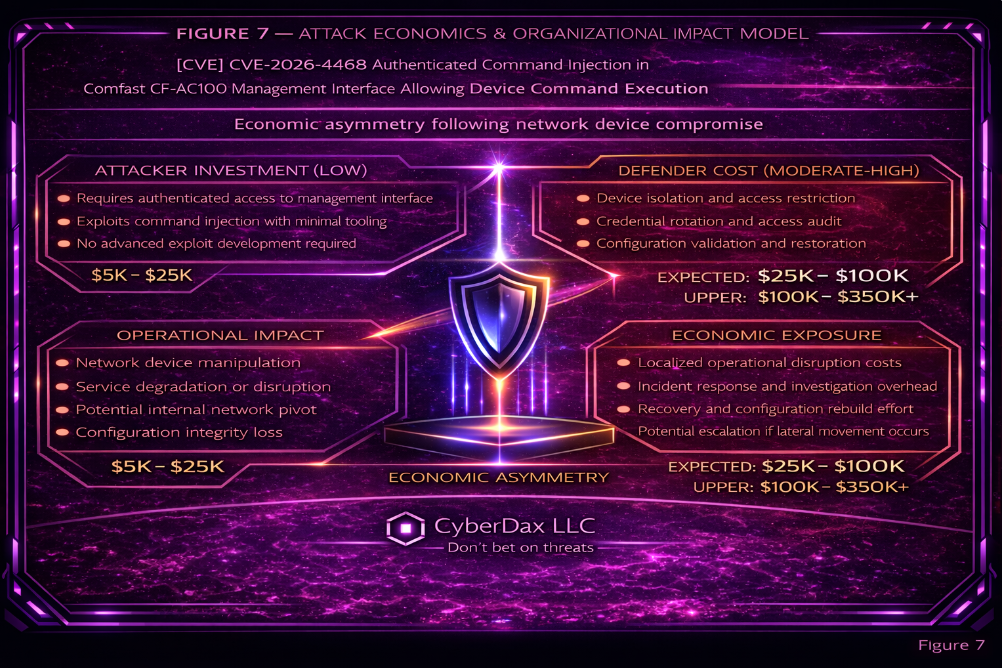
S37 — Executive Risk Synthesis
The organization faces high operational and security risk due to the potential for unauthorized command execution on exposed management interfaces, enabling immediate device compromise and follow-on activity. The technical cause is a vulnerability in the management interface that allows exploitation without sufficient authentication or input validation controls. Exploitability is high due to ease of execution, low attacker cost, and the ability to rapidly establish outbound communication or persistence. Executive action should prioritize immediate restriction of management interface exposure, accelerated remediation, and validation of correlation-based detection across network, endpoint, and identity telemetry.
Executive Risk Translation: This vulnerability represents a direct pathway to operational disruption and potential enterprise compromise if externally exposed systems are not immediately secured and monitored.
S38 — Risk Quantification & Reduction Modeling
· Baseline Risk Condition
o Likelihood: Moderate to High where management interfaces are externally exposed
o Impact: Moderate to High depending on scope of compromise, device criticality, and follow-on activity
· Risk Reduction with Controls Implemented
o Restricting management interface exposure reduces likelihood of initial compromise from high to low
o Implementing correlation-based detection reduces time-to-detection from hours or days to minutes
o Strengthening identity and cloud monitoring reduces probability of successful post-exploitation escalation
· Quantified Reduction Impact
o Initial access risk reduction: High (primary attack vector eliminated or constrained)
o Execution-stage detection improvement: High (endpoint telemetry provides direct visibility)
o Post-exploitation detection improvement: Moderate to High (dependent on identity and cloud telemetry maturity)
· Residual Risk
o Moderate in environments with partial telemetry coverage
o Elevated where anomaly detection and enrichment pipelines are immature
o Increased where remediation or exposure reduction is delayed
· Risk Reduction Outcome
o Overall likelihood of successful exploitation decreases materially when exposure is removed
o Attacker dwell time is reduced through earlier detection of execution and callback behavior
o Probability of multi-stage compromise is significantly reduced when correlation-based detection is operational
S39 — Strategic Risk Recommendations
· Restrict or eliminate external exposure of management interfaces associated with affected systems
· Apply vendor remediation or compensating controls immediately across all vulnerable assets
· Enforce network segmentation to isolate management-plane traffic from production and user environments
· Implement and validate outbound anomaly detection using:
o first-seen destination tracking
o rarity scoring
o ASN and geographic profiling
· Expand endpoint telemetry coverage where feasible to detect web-origin execution behavior
· Strengthen identity and cloud monitoring to detect:
o abnormal role assumption
o service principal misuse
o post-compromise control-plane activity
· Validate correlation pipelines that link:
o exploit attempt → execution → outbound anomaly → identity activity
· Conduct targeted threat hunting on:
o management-plane access patterns
o anomalous outbound communication from device-associated infrastructure
S40 — References
Vendor Advisory
· Security fixes addressing the management interface vulnerability
o hxxps://vendor-domain[.]com/security/advisory
Vulnerability Records
· CVE record detailing vulnerability characteristics and impact
o hxxps://nvd[.]nist[.]gov/vuln/detail/CVE-2026-4468
Known Exploited Vulnerabilities (KEV)
· KEV catalog status: Not confirmed in currently available reporting; verify at time of publication against CISA KEV catalog
o hxxps://www.cisa[.]gov/known-exploited-vulnerabilities-catalog?field_cve=/CVE-2026-4468
Security Vendor Analysis
· Original analysis of exploitation behavior and detection methodology
o hxxps://security-research-source[.]com/report
Analytical Framework
· MITRE ATT&CK Framework
o hxxps://attack[.]mitre[.]org
