[EXP] DarkSword Exploit Framework Multi-Stage Exploitation and Malware Delivery Platform

Report Type
Threat Intelligence Assessment
Threat Category
Exploit Framework Activity
Multi-Stage Exploitation Chain
Client-Side Exploitation and Malware Delivery
Assessment Date
March 24, 2026
Primary Impact Domain
Endpoint Security (iOS / Mobile Platform)
Exploit Chain Execution and Detection Evasion
Device-Level Trust Boundaries and Telemetry Visibility
BLUF
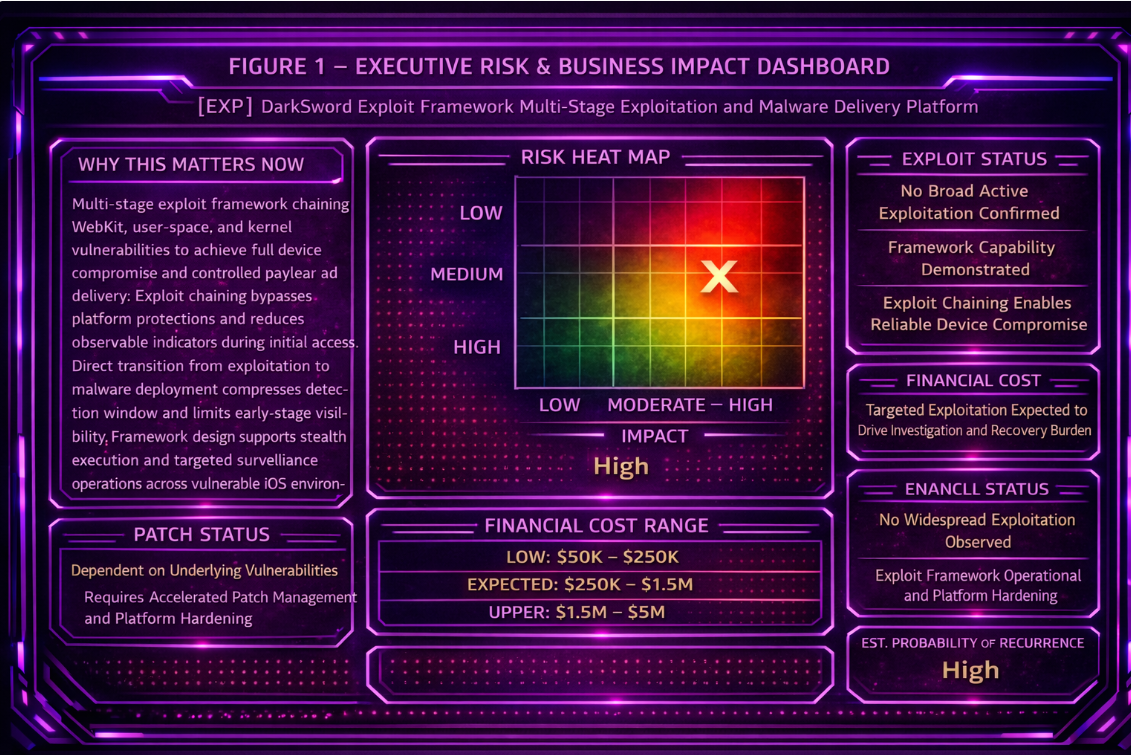
The DarkSword exploit framework presents a material business risk by enabling full-chain device compromise that can lead to covert surveillance, credential theft, and exposure of sensitive or regulated data through downstream malware deployment. The technical cause is a multi-stage exploit chain that leverages vulnerability exploitation to achieve initial access, privilege escalation, and controlled payload delivery within targeted environments. Current threat posture indicates elevated operational risk because exploit chaining can limit early observable indicators and create a direct path from vulnerability exposure to malware delivery. Executive action should prioritize platform hardening, accelerated vulnerability remediation, and deployment of behavior-based detection across endpoint and network telemetry.
S2A Executive Risk Translation
If vulnerable platforms or applications remain exposed, DarkSword can achieve full device compromise and silently deliver malware, increasing the likelihood of undetected access to sensitive data, persistent surveillance, and sustained operational impact.
S3 Why This Matters Now
DarkSword reflects the increasing use of exploit frameworks that combine multiple vulnerabilities into a single execution chain capable of bypassing platform security layers and exploit mitigation controls. These frameworks target mobile operating systems, device components, and application layers where remediation delays, software fragmentation, and exposure conditions create exploitable gaps. The ability to move directly from exploitation to payload delivery creates a compressed attack path from vulnerability exposure to persistent compromise with minimal detection opportunity.
S4 Key Judgments
· DarkSword operates as a multi-stage exploit framework enabling full-chain compromise
· Exploitation results in device-level access followed by controlled payload delivery
· Payloads delivered post-exploitation can include surveillance or credential-focused malware
· Initial access occurs without reliance on traditional malware artifacts
· Tradecraft aligns with advanced exploit chaining and targeted intrusion capability
· Detection is limited due to reduced observable indicators during exploitation stages
S5 Executive Risk Summary
Vulnerability Type
Exploitation of multi-stage exploit chains targeting platform and application weaknesses
Affected Asset
Endpoints, mobile devices, and applications susceptible to exploit chaining
Attack Prerequisites
Attacker access to exploitable vulnerabilities within the target platform or application stack
Operational Impact
Full device compromise, malware deployment, persistent access, and potential data exfiltration or surveillance
Priority Assessment
High due to exploit sophistication, low detection visibility, and high impact potential
S5A Estimated Probability of Recurrence (12-Month Horizon)
Estimated Probability of Recurrence
High
Rationale
· Continued discovery and exploitation of vulnerabilities across modern platforms
· Reusability of exploit chaining techniques across similar device and software ecosystems
· High operational value of exploit frameworks for targeted intrusion and surveillance
· Limited defensive visibility into multi-stage exploitation sequences
S6 Executive Cost Summary
This cost analysis was developed by the CyberDax team using expert judgment and assisted analytical tools to support clarity and consistency.
For organizations affected by DarkSword exploit framework activity:
· Low Impact Scenario: 50,000 to 250,000 USD with limited device compromise detected early and minimal operational disruption
· Moderate Impact Scenario: 250,000 to 1,500,000 USD involving multiple compromised devices requiring investigation, remediation, and control reinforcement
· High Impact Scenario: 1,500,000 to 5,000,000 USD involving widespread compromise, malware deployment, exposure of sensitive or regulated data, device rebuild activity, and extended forensic recovery operations
S6A Key Cost Drivers
· Incident response and forensic analysis
· Device remediation and system restoration
· Data exposure investigation and containment
· Regulatory, legal, and compliance obligations
S6B Compliance and Risk Context
Compliance Exposure Indicator
Elevated where exploited devices provide access to regulated, sensitive, or mission-critical data
Risk Register Entry
Risk Category
Exploit framework-driven device compromise and malware delivery
Risk Statement
Exploitation of vulnerabilities through multi-stage exploit chains may enable full device compromise and malware deployment, resulting in exposure of sensitive or regulated data and operational disruption
Likelihood
High
Impact
High for targeted environments and sensitive data contexts
Owner
Chief Information Security Officer
Annualized Risk Exposure
High recurrence probability combined with high-impact compromise scenarios produces significant annualized financial exposure, particularly in environments with unpatched vulnerabilities or high-value targets
S7 Risk Drivers
· Concentration of exploitable weaknesses across endpoint, mobile, and application layers
· Remediation delays and inconsistent patch deployment across operating systems and applications
· Software fragmentation expanding viable exploit paths across device ecosystems
· Limited visibility into exploit chain execution prior to payload delivery
· High attacker value of exploit frameworks for targeted compromise and surveillance
S8 Bottom Line for Executives
DarkSword enables full device compromise through exploit chaining and immediate malware delivery, bypassing malware-dependent and signature-led detection approaches and creating high-impact risk. Organizations that do not prioritize vulnerability management, platform hardening, and behavioral detection are at elevated risk of undetected compromise.
S9 Board-Level Takeaway
This threat demonstrates that advanced exploit frameworks can convert vulnerability exposure directly into full compromise and malware deployment. Governance priorities must ensure that vulnerability management, platform security, and exploit detection capabilities are treated as critical control domains for reducing enterprise risk.

S10 Threat Overview
DarkSword is a multi-stage iOS exploit framework that chains multiple vulnerabilities, including zero-days, to achieve full device compromise and enable controlled delivery of post-exploitation malware. The framework executes coordinated exploit stages across WebKit, user-space, and kernel layers to bypass platform protections, escalate privileges, and establish execution control prior to payload deployment. This design minimizes observable indicators during initial compromise and enables device takeover without traditional malware delivery artifacts or user interaction.
S11 Threat Classification and Type
Threat Type
Exploit Framework
Threat Sub-Type
iOS full-chain exploit and malware delivery platform
Operational Classification
Exploit-driven initial access with integrated post-exploitation payload deployment
Primary Function
Enable device-level compromise through exploit chaining and deliver surveillance-focused malware
S12 Campaign or Activity Overview
DarkSword activity is defined by full-chain exploitation workflows targeting iOS devices, enabling direct transition from initial vulnerability exploitation to elevated execution and payload deployment. Observed use by multiple actors, including commercial surveillance vendors and suspected state-aligned operators, indicates reuse of the framework across distinct targeted operations. Campaign behavior aligns with surveillance activity where compromise reliability, stealth, and controlled payload delivery are prioritized over scale.
S13 Targets and Exposure Surface
DarkSword targets iOS devices where vulnerabilities exist across WebKit, application execution, and kernel layers that can be chained into a full exploitation sequence. Exposure is driven by the presence of exploitable browser-facing components, privileged system interfaces, and vulnerable operating system paths. Successful execution depends on multiple exploitable conditions remaining present long enough for the chain to progress from user-space code execution to device-level control.
S14 Sectors / Countries Affected
Sectors Affected
· Government entities where device compromise enables intelligence collection against targeted individuals
· Telecommunications environments where compromised devices expose communications or metadata
· Individuals in political, diplomatic, or strategic roles targeted for surveillance
· Organizations where mobile device compromise provides access to sensitive communications or authentication data
Countries Affected
· Saudi Arabia
· Turkey
· Malaysia
· Ukraine
S15 Adversary Capability Profiling
Capability Level
Advanced operators utilizing full-chain exploit frameworks with zero-day capability
Technical Sophistication
Demonstrated ability to chain WebKit, user-space, and kernel vulnerabilities into a coordinated execution sequence that bypasses platform security controls
Infrastructure Maturity
Operational capability to selectively deliver exploit chains and deploy payloads only after successful full-chain execution
Operational Scale
Targeted exploitation against specific individuals or roles rather than broad opportunistic deployment
Escalation Likelihood
High likelihood of progression from initial compromise to persistent surveillance and credential or data access
DarkSword activity reflects adversaries capable of developing or acquiring full-chain exploit capabilities and integrating them into surveillance-focused operational workflows.
S16 Targeting Probability Assessment
Overall Targeting Probability
High for iOS devices exposed to browser-facing and system-level vulnerabilities that can be chained
Targeting Drivers
· Presence of exploitable WebKit or application-layer vulnerabilities enabling initial execution
· Availability of additional vulnerabilities enabling escalation to elevated or kernel-level control
· High-value targets where device compromise enables surveillance or credential access
· Delayed patch adoption increasing the viability of complete exploit chains
Most Likely Targets
· Individuals using iOS devices in government, diplomatic, or strategic roles
· High-value enterprise users with access to sensitive communications
· Devices running vulnerable iOS versions without timely security updates
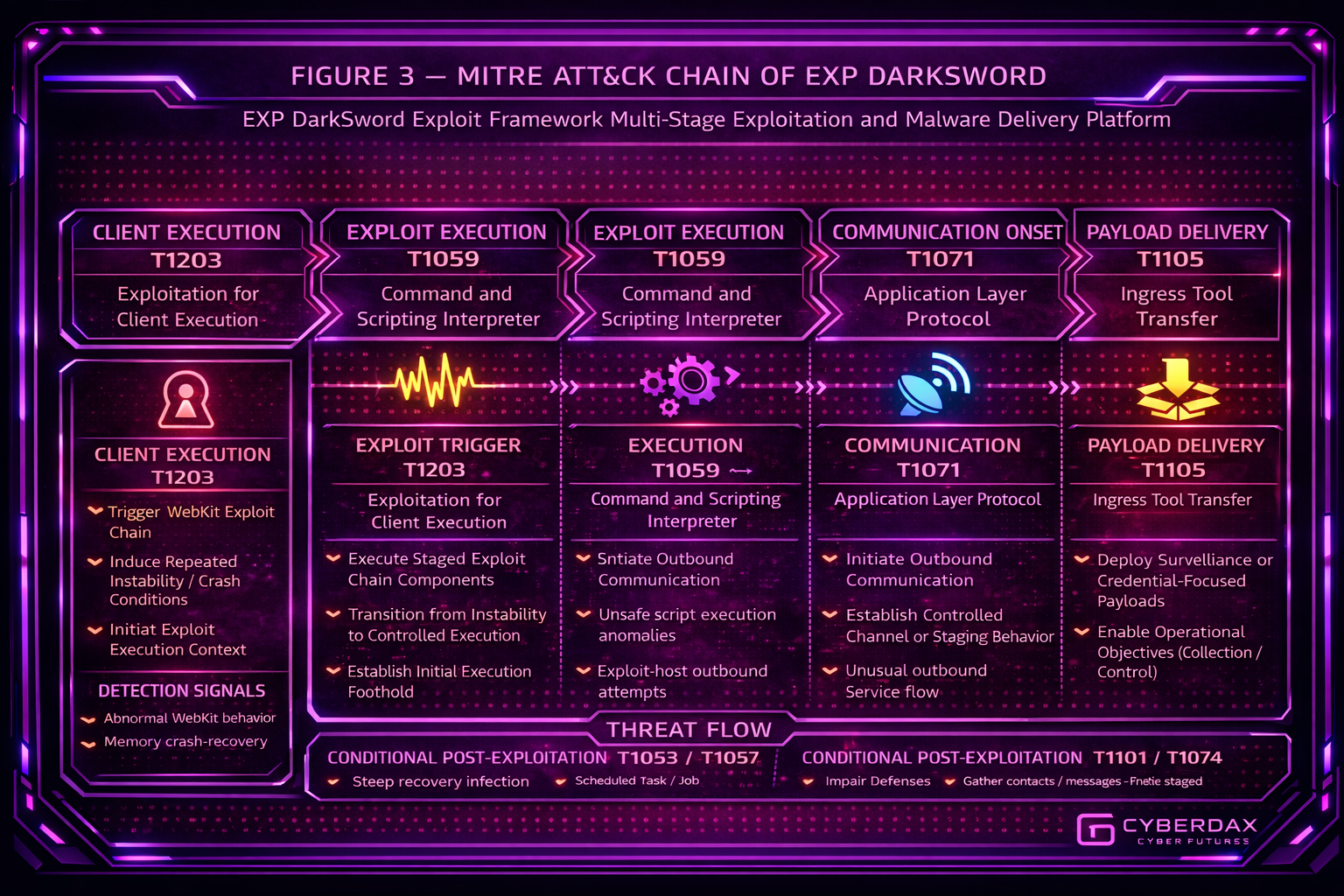
S17 MITRE ATT&CK Chain Flow Mapping
· Initial Exploitation → T1203 – Exploitation for Client Execution
A vulnerable WebKit or application component is exploited to gain initial execution within a user-space context
· Privilege Transition and Elevation → T1068 – Exploitation for Privilege Escalation
Subsequent exploit stages elevate execution beyond the original application context and ultimately to privileged device control
· Payload Deployment → T1105 – Ingress Tool Transfer
Surveillance malware is delivered after the exploit chain has established stable control of the device
· Post-Exploitation Communication → T1071 – Application Layer Protocol
Not observed in currently available reporting; may occur during post-exploitation depending on attacker objectives and target environment
S18 Attack Path Narrative (Signal-Aligned Execution Flow)
The attack begins with exploitation of a WebKit or application-facing vulnerability, which may manifest as browser instability, abnormal renderer termination, or short-lived crash-and-restart behavior. As the chain advances beyond the initial execution context, device telemetry may reflect unexpected privilege transitions, abnormal process lineage, or security boundary violations that are inconsistent with normal application behavior. Once stable control is achieved, payload deployment introduces more durable indicators, including new process activity, persistence-related artifacts where applicable, and outbound encrypted communications or DNS lookups associated with post-exploitation infrastructure. The attack path is compressed, reducing the interval in which defenders can detect compromise before surveillance tooling is active.
S19 Attack Chain Risk Amplification Summary
· Full-chain exploitation compresses the time between initial execution and complete device compromise
· Use of zero-day vulnerabilities reduces the effectiveness of preventive controls tied to known exploit signatures
· Elevated execution is achieved before most conventional response mechanisms can intervene
· Payload delivery occurs only after stable control is established, increasing reliability and operational impact
S20 Tactics, Techniques, and Procedures
· T1203 – Exploitation for Client Execution
Attackers use browser-facing or application-facing vulnerabilities to obtain initial code execution inside the target device context
· T1068 – Exploitation for Privilege Escalation
Attackers use additional exploit stages to break out of the original execution boundary and obtain privileged control over the device
· T1105 – Ingress Tool Transfer
Attackers deliver surveillance payloads such as GHOSTBLADE, GHOSTKNIFE, or GHOSTSABER only after full exploit-chain success
· T1071 – Application Layer Protocol
Conditional post-exploitation communications may be used to support surveillance, tasking, or data collection depending on operator objectives
S20A Adversary Tradecraft Summary
DarkSword tradecraft emphasizes controlled exploit staging, low-visibility execution, and delayed payload introduction. Operators reduce early detection opportunities by avoiding traditional malware artifacts during initial compromise and by introducing post-exploitation tooling only after privileged control is established. This tradecraft is optimized for targeted surveillance operations where reliability and stealth are more important than speed or scale.
S21 Detection Strategy Overview
Detection of DarkSword should be operationalized as a correlation rule set over a short exploit window, not as a signature or single-event alert. The most reliable model is to monitor for repeated WebKit instability on the same device, then elevate only when that instability is followed within a tightly bounded interval by abnormal execution behavior or by new outbound network activity. A practical SOC approach is to treat repeated instability as a low-confidence precursor, raise severity when a second signal appears within roughly one to five minutes, and treat three-signal convergence on the same device as a high-confidence indicator of exploit-chain progression.
S22 Primary Detection Signals
· Signal 1 — Repeated WebKit Instability
Multiple crash, restart, or renderer-failure events affecting the same browser or WebKit-linked application within a compressed interval and exceeding the device’s normal baseline
· Signal 2 — Post-Instability Behavioral Transition
Immediately after instability, the device exhibits abnormal follow-on behavior such as unexpected relaunch sequence changes, unusual execution transitions, or security-boundary-related anomalies inconsistent with a normal application recovery path
· Signal 3 — Immediate Post-Sequence Network Onset
New outbound encrypted sessions or DNS lookups begin seconds to minutes after the instability-and-transition sequence and do not match recent device communication patterns
· Signal 4 — Same-Device Temporal Convergence
Instability, abnormal follow-on behavior, and outbound communication occur on the same device inside a tightly bounded timeframe, indicating exploit-chain progression rather than unrelated device noise
S23 Telemetry Requirements
WebKit and Application Crash Visibility
Crash, restart, and diagnostic telemetry is required to identify repeated instability patterns associated with exploit triggering in browser or WebKit-linked application contexts
Post-Crash Behavioral Visibility
Mobile telemetry is required to show whether the device enters an abnormal recovery path after instability, including unusual relaunch behavior, execution irregularities, or signs that normal application isolation behavior has been disrupted
Network Visibility
DNS and outbound session telemetry is required to identify communication onset immediately after suspected exploit-chain progression, including first-seen destinations, unusual timing, and session initiation patterns
Cross-Source Correlation Capability
Correlation across device telemetry and network telemetry is mandatory because early exploit stages on iOS may not produce durable or directly attributable endpoint evidence on their own
Platform Constraint
Direct visibility into deeper privilege-transition stages may be limited on iOS, so practical detection depends on indirect behavioral correlation rather than deterministic kernel-stage confirmation

S24 Detection Opportunities and Gaps
Detection Opportunities
DarkSword becomes more detectable when repeated WebKit instability is followed quickly by abnormal device recovery behavior and then by new network communications from the same device. That progression creates a usable chained pattern even when the underlying exploit itself is not directly visible.
Detection Gaps
Initial exploit execution may appear as short-lived instability without enough standalone evidence to justify alerting. Deeper exploit-chain stages may also remain partially obscured where platform logging does not expose privilege-transition details.
Coverage
Coverage is strongest after exploit progression begins producing both device-side anomalies and near-term outbound communication. Coverage is weakest during the earliest execution stages, where evidence may be brief, ambiguous, or visible only through crash behavior.
S25 Ultra-Tuned Detection Engineering Rules
Implementation Integrity Statement
S25 is considered complete when each platform is written to its maximum truthful detection strength and real-world deployability constraints are embedded directly in the rule fields. Differences in platform visibility or telemetry depth do not constitute a framework failure when those constraints are explicitly documented and the rule remains threat-specific, phase-pure, and operationally honest.
Suricata
Deployment Status
Conditionally Deployable
Corroborating Only
Rule Name
DarkSword iOS Repeated Non-Approved DNS Burst Corroborator
Purpose
Provide low-noise network corroboration for suspected DarkSword exploit-trigger windows by identifying repeated DNS queries from iOS-managed traffic to non-approved destinations.
ATT&CK Technique
T1203 – Exploitation for Client Execution
Telemetry Dependency
Suricata DNS telemetry
Reliable iOS device attribution through subnet segmentation, NAC tagging, or equivalent source identity mapping
Maintained allowlists for Apple infrastructure, MDM services, enterprise proxy infrastructure, enterprise security tooling, and sanctioned mobile application dependencies
This rule is not deployable as intended in environments where iOS traffic cannot be distinguished from general user traffic.
Network activity in this rule is limited to immediate post-instability onset and is used strictly as Phase 1 corroboration, not as post-exploitation communication detection.
Tuning Explanation
This rule is intentionally constrained to a corroborating role because DarkSword Phase 1 activity is primarily device-side and WebKit-driven. It is tuned to remain low-noise by limiting scope to attributed iOS-managed traffic and excluding known benign mobile infrastructure. If iOS attribution or allowlist maturity is weak, the rule should be disabled or downgraded rather than broadened into a generic DNS burst analytic.
Detection Logic
Trigger when a single attributed iOS source performs six or more DNS queries to non-approved destinations within 120 seconds.
Operational Context
Use only as a low-confidence supporting signal that is correlated with repeated WebKit instability or abnormal post-crash behavior from the same device population. This rule must not be used as a standalone exploit detector or as a high-severity alert trigger.
var IOS_NETS [10.50.0.0/16,10.51.0.0/16]
var APPROVED_MOBILE_DESTS [17.0.0.0/8,52.96.0.0/12,13.107.6.0/24]
alert dns $IOS_NETS any -> !$APPROVED_MOBILE_DESTS any (
msg:"CYBERDAX DarkSword iOS repeated non-approved DNS burst corroborator";
dns.query;
threshold:type both, track by_src, count 6, seconds 120;
classtype:policy-violation;
metadata:attack_target Mobile_Device, confidence Low, role Corroborating;
sid:2542101;
rev:9;
)
Deployment Status
Conditionally Deployable
Corroborating Only
Rule Name
DarkSword iOS Early TLS Session Burst Corroborator
Purpose
Identify tightly grouped outbound TLS session initiation from iOS-managed traffic during suspected exploit-trigger windows.
ATT&CK Technique
T1203 – Exploitation for Client Execution
Telemetry Dependency
Suricata TLS metadata
Reliable iOS device attribution through subnet segmentation, NAC tagging, or equivalent source identity mapping
Maintained allowlists for Apple, MDM, enterprise proxy, enterprise security tooling, and sanctioned mobile application infrastructure
This rule is not deployable as intended where mobile traffic cannot be attributed with reasonable confidence.
Tuning Explanation
This rule remains corroboration-only because benign iOS devices regularly generate TLS activity. It is tuned to reduce false positives by requiring grouped session onset and by excluding common benign destinations. If destination filtering and iOS attribution are not operationally mature, this rule should be disabled instead of being widened into a generic TLS burst detector.
Detection Logic
Trigger when the same attributed iOS source initiates three or more outbound TLS sessions to non-approved destinations within 180 seconds.
Operational Context
Use only alongside device-side instability analytics or same-device correlation in a SIEM. This rule is intended to strengthen confidence in a suspected exploit window, not to independently identify DarkSword exploitation.
alert tls $IOS_NETS any -> !$APPROVED_MOBILE_DESTS any (
msg:"CYBERDAX DarkSword iOS TLS burst corroborator";
flow:established,to_server;
threshold:type both, track by_src, count 3, seconds 180;
classtype:trojan-activity;
sid:2542102;
rev:9;
)
SentinelOne
Deployment Status
Conditionally Deployable
Rule Name
DarkSword Repeated WebKit Crash Threshold
Purpose
Detect exploit-trigger instability via repeated WebKit or Safari crash behavior on the same iOS device.
ATT&CK Technique
T1203 – Exploitation for Client Execution
Telemetry Dependency
Normalized iOS crash telemetry ingested into SentinelOne or a validated connected analytics pipeline
Stable device identifier
Normalized naming for MobileSafari, SafariViewService, or WebKit-linked crash context
This rule is not deployable in environments where SentinelOne does not actually receive normalized mobile crash telemetry.
Tuning Explanation
This rule is valid only where iOS crash telemetry is present and normalized. It is not acceptable to emulate this logic using desktop-oriented browser crash or generic process telemetry. Tuning relies on repeated crash behavior inside a five-minute interval and assumes lab, QA, and crash-test populations are tagged and excluded.
Detection Logic
Trigger when three or more WebKit- or Safari-linked crash events occur on the same device within five minutes.
Operational Context
Use only in environments with validated mobile crash ingestion. If the telemetry source is absent or inconsistent, mark the rule not deployable rather than degrading it into a generic browser-instability detector.
EventType = "MobileCrash"
AND (
AppName RegExp "(?i)(MobileSafari|SafariViewService|WebKit)"
)
| group by DeviceId, bin(Time, 5m)
| where count() >= 3
AND NOT DeviceTag IN ("MobileQALab","CrashTest","MDMValidation")
Deployment Status
Conditionally Deployable
Rule Name
DarkSword Crash-to-Abnormal-Recovery Correlation
Purpose
Detect exploit progression by correlating repeated crash behavior with abnormal recovery behavior on the same iOS device.
ATT&CK Technique
T1203 – Exploitation for Client Execution
Telemetry Dependency
Normalized iOS crash telemetry
Normalized mobile abnormal recovery or execution-anomaly telemetry
Stable device identifier across both telemetry streams
This rule is not deployable in environments where post-crash anomaly telemetry is absent or unreliable.
Tuning Explanation
This rule remains Phase 1 pure because it focuses on exploit-trigger progression immediately following instability and does not depend on payload or communication telemetry. It is tuned to require both repeated crash behavior and one abnormal recovery-type event in the same bounded interval. If abnormal recovery telemetry is not present, this rule should not be forced into production as a partial substitute.
Detection Logic
Trigger when three or more WebKit- or Safari-linked crash events are followed by at least one abnormal recovery or execution-anomaly event on the same device within five minutes.
Operational Context
Use only where both crash telemetry and abnormal recovery telemetry are available from mobile sources and normalized to the same device identity. This is the higher-confidence SentinelOne Phase 1 analytic only in those environments.
(
EventType = "MobileCrash"
AND AppName RegExp "(?i)(WebKit|Safari)"
)
| group by DeviceId, bin(Time, 5m)
| where count() >= 3
| join (
EventType = "MobileRecoveryAnomaly"
| group by DeviceId, bin(Time, 5m)
) on DeviceId
Splunk
Deployment Status
Production-Deployable
Rule Name
DarkSword Repeated WebKit Instability (Time-Bound)
Purpose
Detect repeated exploit-trigger instability using precise timing correlation on the same iOS device.
ATT&CK Technique
T1203 – Exploitation for Client Execution
Telemetry Dependency
Normalized iOS crash logs
Stable device identifier
Normalized application or process naming for WebKit, MobileSafari, or Safari-linked crash context
Tuning Explanation
This is the low-confidence precursor analytic. It is tuned using a bounded interval derived from earliest and latest event timestamps rather than broad time bucketing, which reduces timing smear. It is intentionally lower severity and should be escalated only when same-device behavioral or network corroboration is present.
Detection Logic
Trigger when three or more WebKit- or Safari-linked crash events occur on the same device inside 300 seconds.
Operational Context
Use as the baseline Phase 1 detector where crash telemetry is stable, normalized, and tied to a trustworthy device identifier.
index=mobile_crash process="*WebKit*" OR process="*Safari*"
| stats count earliest(_time) as first latest(_time) as last by device_id
| where count >= 3 AND (last - first) <= 300
Deployment Status
Production-Deployable
Rule Name
DarkSword Instability + Recovery Correlation
Purpose
Detect exploit-trigger progression with higher confidence by correlating repeated WebKit instability with abnormal post-crash recovery behavior on the same device.
ATT&CK Technique
T1203 – Exploitation for Client Execution
Telemetry Dependency
Normalized iOS crash logs
Normalized abnormal recovery or execution-anomaly logs
Stable device identifier
Reasonably aligned timestamps across sources
Tuning Explanation
This is the preferred Splunk Phase 1 production analytic because it materially reduces false positives by requiring both repeated instability and same-device abnormal recovery. It stays Phase 1 pure and avoids reliance on later network or payload behavior. Operationally, it assumes time alignment and device normalization are already solved upstream.
Detection Logic
Trigger when three or more WebKit- or Safari-linked crash events and at least one abnormal recovery or execution anomaly occur on the same device within five minutes.
Operational Context
Use where crash telemetry and abnormal recovery telemetry are both available, normalized, and attributed to the same device. If device identity is weak or timestamps are materially delayed, this rule should be downgraded to hunt support.
(
search index=mobile_crash (
app_name="MobileSafari" OR
app_name="SafariViewService" OR
process_name="WebKit*" OR
process_name="Safari*"
)
| stats count earliest(_time) as first_crash latest(_time) as last_crash by device_id
| where count >= 3 AND (last_crash - first_crash) <= 300
)
| join type=inner device_id [
search index=mobile_behavior event_type="abnormal_recovery"
| stats earliest(_time) as anomaly_time by device_id
]
| where anomaly_time >= first_crash AND anomaly_time <= last_crash + 300
Deployment Status
Production-Deployable
Environment-Dependent on Same-Device Network Attribution
Rule Name
DarkSword Phase 1 Multi-Signal Convergence
Purpose
Detect high-confidence DarkSword exploit-trigger progression through same-device correlation of repeated WebKit instability, abnormal recovery behavior, and near-term first-seen outbound communication.
ATT&CK Technique
T1203 – Exploitation for Client Execution
T1071 – Application Layer Protocol
Telemetry Dependency
iOS crash telemetry
Abnormal recovery telemetry
DNS or TLS telemetry with first-seen destination enrichment
Reliable same-device attribution across crash, behavior, and network sources
This rule is not production-deployable as written where device-to-network normalization is weak or absent.
Tuning Explanation
This is the highest-confidence Phase 1 analytic in Group 1. It is intentionally conservative and requires three-signal convergence inside a bounded interval. It remains Phase 1 because it detects exploit-trigger progression and immediate corroboration rather than later payload behavior. If same-device network attribution is weak, the rule should be downgraded to hunt-only rather than loosened.
Detection Logic
Trigger when repeated WebKit instability, at least one abnormal recovery event, and at least one first-seen outbound communication event occur on the same device within five minutes of the initial instability sequence.
Operational Context
Use only where crash, device anomaly, and network telemetry are all available and normalized to the same device identity. This is the preferred high-confidence SOC detector for Phase 1 in Splunk-capable environments with mature mobile telemetry correlation.
(
search index=mobile_crash (
app_name="MobileSafari" OR
app_name="SafariViewService" OR
process_name="WebKit*" OR
process_name="Safari*"
)
| stats count earliest(_time) as first_crash latest(_time) as last_crash by device_id
| where count >= 3 AND (last_crash - first_crash) <= 300
)
| join type=inner device_id [
search index=mobile_behavior event_type="abnormal_recovery"
| stats earliest(_time) as anomaly_time by device_id
]
| join type=inner device_id [
search index=mobile_network first_seen_dest="true"
| stats earliest(_time) as network_time values(dest) as dests by device_id
]
| where anomaly_time >= first_crash AND anomaly_time <= last_crash + 300
| where network_time >= first_crash AND network_time <= last_crash + 300
Elastic
Deployment Status
Production-Deployable
Environment-Dependent on normalized mobile crash and abnormal recovery telemetry
Rule Name
DarkSword Repeated WebKit Instability Threshold
Purpose
Detect probable DarkSword exploit-trigger activity by identifying repeated WebKit- or Safari-linked crash behavior on the same iOS device inside a tightly bounded interval.
ATT&CK Technique
T1203 – Exploitation for Client Execution
Telemetry Dependency
Normalized iOS crash telemetry in Elastic
Stable device identifier
Normalized process or application naming for MobileSafari, SafariViewService, or WebKit-linked crash context
This rule is not deployable as intended if mobile crash telemetry is absent, poorly normalized, or not attributable to a stable device identity
Tuning Explanation
This rule is the low-confidence Elastic precursor detector for Phase 1. It is intentionally implemented as a threshold-style production analytic because that is operationally cleaner and more maintainable than forcing repeated-event logic into an overly rigid sequence. It should remain lower severity until corroborated by same-device abnormal recovery.
Detection Logic
Trigger when three or more WebKit- or Safari-linked crash or restart events occur on the same device within five minutes.
Operational Context
Use where iOS crash telemetry is centralized in Elastic and device identity is stable. If crash telemetry is incomplete, delayed, or inconsistently normalized, downgrade to hunt support rather than loosening thresholds.
System-Ready Code
rule_name: DarkSword Repeated WebKit Instability Threshold
rule_type: threshold
index:
- mobile-crash-*
query: >
event.dataset:"mobile.crash" AND
(
process.name:/WebKit.*/ OR
process.name:/Safari.*/ OR
app.name:("MobileSafari" OR "SafariViewService")
)
threshold:
field: device.id
value: 3
time_window: 5m
severity: low
risk_score: 35
Deployment Status
Production-Deployable
Environment-Dependent on same-device abnormal recovery visibility
Rule Name
DarkSword Repeated Instability with Abnormal Recovery Correlation
Purpose
Detect likely DarkSword exploit-trigger progression by correlating repeated WebKit instability with abnormal recovery on the same iOS device.
ATT&CK Technique
T1203 – Exploitation for Client Execution
Telemetry Dependency
Normalized iOS crash telemetry
Normalized abnormal recovery telemetry from mobile sources using the canonical value abnormal_recovery
Stable same-device identity across both event classes
This rule is not deployable as intended where abnormal recovery telemetry is absent, not normalized, or cannot be mapped to the same device
Tuning Explanation
This is the preferred Elastic Phase 1 production analytic because it materially reduces false positives by requiring repeated instability plus abnormal same-device follow-on behavior. It stays phase-pure and does not depend on payload or communication events.
Detection Logic
Trigger when a repeated WebKit instability sequence is followed by abnormal recovery on the same device within five minutes.
Operational Context
Use only where crash telemetry and abnormal recovery telemetry are both available and same-device correlation is reliable. If abnormal recovery visibility is partial, retain medium severity and use analyst confirmation rather than broadening the rule.
System-Ready Code
sequence by device.id with maxspan=5m
[any where event.dataset == "mobile.crash"
and (
process.name like "WebKit*" or
process.name like "Safari*" or
app.name in ("MobileSafari","SafariViewService")
)]
[any where event.dataset == "mobile.crash"
and (
process.name like "WebKit*" or
process.name like "Safari*" or
app.name in ("MobileSafari","SafariViewService")
)]
[any where event.dataset == "mobile.crash"
and (
process.name like "WebKit*" or
process.name like "Safari*" or
app.name in ("MobileSafari","SafariViewService")
)]
[any where event.dataset == "mobile.behavior"
and event.action == "abnormal_recovery"]
QRadar
Deployment Status
Conditionally Deployable
Production-usable only where mobile crash telemetry and same-device CRE correlation are available
Rule Name
DarkSword Repeated WebKit Instability Building Block
Purpose
Create a QRadar building block for repeated WebKit- or Safari-linked instability on the same iOS device to support higher-confidence Phase 1 CRE correlation.
ATT&CK Technique
T1203 – Exploitation for Client Execution
Telemetry Dependency
Normalized mobile crash events in QRadar
Stable device identifier or equivalent asset identity
Normalized app or process naming for MobileSafari, SafariViewService, or WebKit-linked contexts
This rule is not deployable as intended where mobile crash telemetry is not ingested into QRadar
Tuning Explanation
This content is intentionally implemented as a building block rather than a final offense rule so it can drive same-device Phase 1 correlation. It is hardened by requiring repeated instability in a short interval and should not be used by itself as a final high-severity signal.
Detection Logic
Create a building block when three or more WebKit- or Safari-linked crash or restart events occur on the same device within five minutes.
Operational Context
Use as the foundational QRadar Phase 1 signal for later CRE correlation with abnormal recovery. Keep this at low or medium confidence until a second same-device signal is present.
System-Ready Code
Building Block Name:
BB: DarkSword Repeated WebKit Instability
BB Test:
when the event(s) were detected by one or more of the following log source type(s):
Mobile Telemetry
and when the normalized event name is:
Crash
or
Restart
and when at least one of the following is true:
processname ILIKE 'WebKit%'
processname ILIKE 'Safari%'
appname = 'MobileSafari'
appname = 'SafariViewService'
and when at least 3 events are seen with the same deviceid in 5 minutes
Deployment Status
Conditionally Deployable
Production-usable only where abnormal recovery telemetry exists
Rule Name
DarkSword Instability-to-Abnormal-Recovery CRE Correlation
Purpose
Detect likely DarkSword exploit-trigger progression by correlating repeated WebKit instability with abnormal recovery on the same iOS device.
ATT&CK Technique
T1203 – Exploitation for Client Execution
Telemetry Dependency
QRadar building block for repeated instability
Normalized abnormal recovery telemetry using the canonical value abnormal_recovery
Reliable same-device identity across both signal classes
This rule is not deployable as intended where abnormal recovery events are not ingested or cannot be tied to the same device identity
Tuning Explanation
This rule stays Phase 1 pure and is stronger than crash-only logic because it requires a second same-device signal. It uses ordered CRE logic: instability first, abnormal recovery second, on the same device, inside five minutes.
Detection Logic
Raise a medium-severity offense when the repeated-instability building block is followed by abnormal recovery on the same device within five minutes.
Operational Context
Use as the higher-confidence QRadar Phase 1 analytic only where both crash and abnormal recovery events are available. If only crash telemetry exists, retain the building block and do not force offense creation.
System-Ready Code
CRE Rule Name:
DarkSword Instability-to-Abnormal-Recovery CRE Correlation
Rule Logic:
when BB: DarkSword Repeated WebKit Instability has matched
and then when an event is seen with:
eventaction = 'abnormal_recovery'
on the same deviceid
within 5 minutes after the building block match
Response:
create offense
severity: medium
magnitude: medium
YARA
Deployment Status
Conditionally Deployable
Forensic or diagnostic artifact triage only
Rule Name
DarkSword iOS WebKit Diagnostic Bundle Triage
Purpose
Support forensic triage of exported iOS diagnostic or crash bundles by identifying WebKit- and Safari-linked diagnostic structures consistent with repeated Phase 1 instability on suspected DarkSword devices.
ATT&CK Technique
T1203 – Exploitation for Client Execution
Telemetry Dependency
Collected iOS crash logs, sysdiagnose bundles, mobile diagnostic exports, or forensic artifact packages
File-access workflow capable of scanning collected diagnostic artifacts with YARA
This rule is not deployable as a real-time detector and must not be presented as an inline exploit-prevention rule
Tuning Explanation
YARA is not a primary real-time detection platform for DarkSword Phase 1. This rule is acceptable only as forensic support content for already collected diagnostics. It is intentionally scoped to iOS WebKit and Safari diagnostic structures rather than generic crash text, which keeps it threat-relevant without overstating live-detection capability.
Detection Logic
Match diagnostic or crash artifacts containing WebKit- or Safari-linked indicators plus iOS crash-reporting metadata commonly present in sysdiagnose or exported diagnostic bundles.
Operational Context
Use during incident response, forensic review, or MDM-driven diagnostic collection when a device is already suspected. Do not use as a live detection substitute.
System-Ready Code
rule CYBERDAX_DarkSword_iOS_WebKit_Diagnostic_Bundle
{
meta:
description = "Identifies iOS WebKit/Safari diagnostic artifacts consistent with repeated Phase 1 instability"
author = "CyberDax Detection Engineering"
version = "1.2"
strings:
$a = "WebKit" ascii nocase
$b = "MobileSafari" ascii nocase
$c = "SafariViewService" ascii nocase
$d = "CrashReporter Key" ascii nocase
$e = "Exception Type" ascii nocase
$f = "Termination Reason" ascii nocase
$g = "Incident Identifier" ascii nocase
$h = "Process:" ascii nocase
condition:
5 of ($a,$b,$c,$d,$e,$f,$g,$h)
}
Sigma
Deployment Status
Conditionally Deployable
Portable content only where mobile crash telemetry is normalized to Sigma-compatible fields and the backend supports correlation or threshold logic
Rule Name
DarkSword Repeated WebKit Instability on iOS
Purpose
Provide portable detection logic intended for backend-native conversion for repeated WebKit- or Safari-linked instability on the same iOS device.
ATT&CK Technique
T1203 – Exploitation for Client Execution
Telemetry Dependency
Normalized mobile crash events mapped into Sigma-compatible fields
Stable device identifier
App or process fields for WebKit- or Safari-linked contexts
Backend support for same-device repeated-event thresholds
This rule is not deployable as intended if the target backend cannot express same-device repetition inside a bounded interval
Tuning Explanation
This rule is the portable precursor detector for Phase 1. It is intentionally limited to repeated instability and should be converted only where iOS crash telemetry exists in a compatible schema and the backend can enforce “same device, three or more events, five-minute window” logic.
Detection Logic
Detect repeated WebKit- or Safari-linked crash or restart events on the same device within five minutes.
Operational Context
Use as portable content feeding backend-native detection engineering. Do not treat it as a single-event detector or final high-confidence rule without backend-supported aggregation.
System-Ready Code
title: DarkSword Repeated WebKit Instability on iOS
id: 9dd2d8ef-5f36-4e64-a2c1-darksword-ios-webkit-instability
status: experimental
logsource:
category: mobile_crash
detection:
selection_app:
AppName|contains:
- 'MobileSafari'
- 'SafariViewService'
- 'WebKit'
selection_action:
EventAction:
- 'Crash'
- 'Restart'
condition: selection_app and selection_action
timeframe: 5m
level: medium
tags:
- attack.t1203
fields:
- DeviceId
- AppName
- EventAction
correlation:
type: event_count
group-by:
- DeviceId
timespan: 5m
condition:
gte: 3
falsepositives:
- Repeated crash loops during QA or device validation
Deployment Status
Conditionally Deployable
Portable content only where crash and abnormal recovery telemetry are both normalized with same-device correlation support
Rule Name
DarkSword WebKit Instability with Abnormal Recovery Correlation
Purpose
Provide portable Phase 1 content for higher-confidence DarkSword exploit-trigger progression by correlating repeated instability with abnormal recovery on the same device.
ATT&CK Technique
T1203 – Exploitation for Client Execution
Telemetry Dependency
Normalized mobile crash events
Normalized abnormal recovery telemetry using the canonical value abnormal_recovery
Stable device identity in Sigma-compatible fields
Backend support for same-device bounded correlation
This rule is not deployable as intended where post-crash anomaly telemetry is unavailable or cannot be correlated to the same device
Tuning Explanation
This rule is the portable equivalent of the higher-confidence crash-plus-recovery analytics used in backend-native platforms. It remains Phase 1 pure and should be converted only where both event classes are present and same-device identity is preserved.
Detection Logic
Detect repeated WebKit instability plus abnormal recovery on the same device inside five minutes.
Operational Context
Use as portable content for backend-native correlation logic where both crash and abnormal recovery telemetry exist. Do not collapse it into crash-only logic.
System-Ready Code
title: DarkSword WebKit Instability with Abnormal Recovery Correlation
id: c304a7a2-8d38-4f43-9d2b-darksword-ios-recovery-correlation
status: experimental
logsource:
category: mobile
detection:
selection_crash:
AppName|contains:
- 'MobileSafari'
- 'SafariViewService'
- 'WebKit'
EventAction:
- 'Crash'
- 'Restart'
selection_recovery:
EventAction: 'abnormal_recovery'
condition: selection_crash and selection_recovery
timeframe: 5m
level: high
tags:
- attack.t1203
fields:
- DeviceId
- AppName
- EventAction
correlation:
type: temporal
group-by:
- DeviceId
timespan: 5m
falsepositives:
- QA-driven repeated crash testing with abnormal recovery instrumentation
AWS
Deployment Status
Production-Deployable in environments where normalized mobile crash and abnormal recovery telemetry are centralized in AWS analytics and same-device identity is preserved across sources
Rule Name
DarkSword Repeated WebKit Instability Threshold
Purpose
Detect probable DarkSword exploit-trigger activity by identifying repeated WebKit- or Safari-linked crash behavior on the same iOS device inside a tightly bounded interval using AWS-native analytics.
ATT&CK Technique
T1203 – Exploitation for Client Execution
Telemetry Dependency
A normalized crash telemetry dataset containing:
· device_id
· event_time
· app_name
· process_name
The implementation example below uses mobile_crash_logs as a placeholder normalized source name. This rule is not deployable as intended if crash telemetry is absent, poorly normalized, or not attributable to a stable device_id.
Tuning Explanation
This is the low-confidence AWS precursor detector for Phase 1. It is tuned as a bounded same-device threshold analytic and should remain lower severity until corroborated by same-device abnormal recovery. It must not be widened into generic mobile crash detection. The SQL assumes upstream normalization into the required canonical fields.
Detection Logic
Trigger when three or more WebKit- or Safari-linked crash or restart events occur on the same device within five minutes.
Operational Context
Use where mobile crash telemetry is reliably centralized into AWS analytics and same-device attribution is preserved. If device_id integrity or timestamp normalization is weak, downgrade to hunt support rather than loosening thresholds.
System-Ready Code
WITH crash_windows AS (
SELECT
device_id,
COUNT(*) AS crash_count,
MIN(event_time) AS first_crash,
MAX(event_time) AS last_crash
FROM mobile_crash_logs
WHERE
app_name IN ('MobileSafari','SafariViewService')
OR process_name LIKE 'WebKit%'
OR process_name LIKE 'Safari%'
GROUP BY device_id
HAVING COUNT(*) >= 3
AND date_diff('second', MIN(event_time), MAX(event_time)) <= 300
)
SELECT
device_id,
crash_count,
first_crash,
last_crash
FROM crash_windows;
Deployment Status
Production-Deployable in environments where normalized abnormal recovery telemetry is centralized in AWS analytics and same-device identity is preserved across crash and behavior sources
Rule Name
DarkSword Repeated Instability with Abnormal Recovery Correlation
Purpose
Detect likely DarkSword exploit-trigger progression by correlating repeated WebKit instability with abnormal recovery on the same iOS device in AWS-native analytics.
ATT&CK Technique
T1203 – Exploitation for Client Execution
Telemetry Dependency
A normalized crash telemetry dataset containing:
· device_id
· event_time
· app_name
· process_name
A normalized behavior telemetry dataset containing:
· device_id
· event_time
· event_action
event_action must use the canonical normalized value abnormal_recovery. The implementation example below uses mobile_crash_logs and mobile_behavior_logs as placeholder normalized source names. This rule is not deployable as intended where abnormal recovery telemetry is absent, not normalized, or cannot be mapped to the same device_id.
Tuning Explanation
This is the preferred AWS Phase 1 production analytic because it materially reduces false positives by requiring repeated instability plus abnormal same-device follow-on behavior. It stays phase-pure and does not depend on payload or later communication behavior. Sequence order is explicit: abnormal recovery must occur after the instability window begins and within five minutes of the repeated-instability window closing.
Detection Logic
Trigger when a repeated WebKit instability window is established and an abnormal recovery event occurs on the same device after the first crash and within five minutes of the last crash.
Operational Context
Use only where crash telemetry and abnormal recovery telemetry are centralized and same-device correlation is reliable. If event_action is not normalized to abnormal_recovery, normalize upstream before deployment.
System-Ready Code
WITH crash_windows AS (
SELECT
device_id,
COUNT(*) AS crash_count,
MIN(event_time) AS first_crash,
MAX(event_time) AS last_crash
FROM mobile_crash_logs
WHERE
app_name IN ('MobileSafari','SafariViewService')
OR process_name LIKE 'WebKit%'
OR process_name LIKE 'Safari%'
GROUP BY device_id
HAVING COUNT(*) >= 3
AND date_diff('second', MIN(event_time), MAX(event_time)) <= 300
),
recovery_events AS (
SELECT
device_id,
event_time AS recovery_time
FROM mobile_behavior_logs
WHERE event_action = 'abnormal_recovery'
)
SELECT
c.device_id,
c.crash_count,
c.first_crash,
c.last_crash,
MIN(r.recovery_time) AS recovery_time
FROM crash_windows c
JOIN recovery_events r
ON c.device_id = r.device_id
WHERE r.recovery_time > c.first_crash
AND r.recovery_time <= date_add('second', 300, c.last_crash)
GROUP BY c.device_id, c.crash_count, c.first_crash, c.last_crash;
Azure
Deployment Status
Production-Deployable in environments where normalized mobile crash and abnormal recovery telemetry are available in Sentinel or Log Analytics and same-device identity is preserved across sources
Rule Name
DarkSword Repeated WebKit Instability Threshold
Purpose
Detect probable DarkSword exploit-trigger activity by identifying repeated WebKit- or Safari-linked crash behavior on the same iOS device inside a tightly bounded interval using Azure-native analytics.
ATT&CK Technique
T1203 – Exploitation for Client Execution
Telemetry Dependency
A normalized crash telemetry table containing:
· DeviceId
· TimeGenerated
· AppName
· ProcessName
The implementation example below uses MobileCrashLogs as a placeholder normalized source name. This rule is not deployable as intended where mobile crash telemetry is not ingested into Azure analytics or cannot be tied to a stable DeviceId.
Tuning Explanation
This is the low-confidence Azure precursor detector for Phase 1. It is tuned as a bounded same-device threshold analytic and should remain lower severity until corroborated by same-device abnormal recovery. It must not be widened into generic mobile instability detection.
Detection Logic
Trigger when three or more WebKit- or Safari-linked crash or restart events occur on the same device within five minutes.
Operational Context
Use where mobile crash telemetry is present in Sentinel or Log Analytics and device identity is stable. If local schema differs, map fields to the canonical model before deployment.
System-Ready Code
MobileCrashLogs
| where AppName in ("MobileSafari","SafariViewService")
or ProcessName startswith "WebKit"
or ProcessName startswith "Safari"
| summarize CrashCount=count(), FirstCrash=min(TimeGenerated), LastCrash=max(TimeGenerated) by DeviceId
| where CrashCount >= 3 and datetime_diff('second', LastCrash, FirstCrash) <= 300
Deployment Status
Production-Deployable in environments where normalized abnormal recovery telemetry is available in Azure analytics and same-device identity is preserved across crash and behavior sources
Rule Name
DarkSword Repeated Instability with Abnormal Recovery Correlation
Purpose
Detect likely DarkSword exploit-trigger progression by correlating repeated WebKit instability with abnormal recovery on the same iOS device using Azure-native analytics.
ATT&CK Technique
T1203 – Exploitation for Client Execution
Telemetry Dependency
A normalized crash telemetry table containing:
· DeviceId
· TimeGenerated
· AppName
· ProcessName
A normalized behavior telemetry table containing:
· DeviceId
· TimeGenerated
· EventAction
EventAction must use the canonical normalized value abnormal_recovery. The implementation example below uses MobileCrashLogs and MobileBehaviorLogs as placeholder normalized source names. This rule is not deployable as intended where abnormal recovery telemetry is absent, not normalized, or cannot be correlated to the same DeviceId.
Tuning Explanation
This is the preferred Azure Phase 1 production analytic because it materially reduces false positives by requiring repeated instability plus abnormal same-device follow-on behavior. It stays phase-pure and does not depend on later payload behavior. Sequence order is explicit: abnormal recovery must occur after the instability window begins and within five minutes of the last crash.
Detection Logic
Trigger when a repeated WebKit instability window is established and an abnormal recovery event occurs on the same device after the first crash and within five minutes of the last crash.
Operational Context
Use only where crash telemetry and abnormal recovery telemetry both exist in Azure analytics and same-device identity is reliable. If source telemetry uses different anomaly labels, normalize to abnormal_recovery before deployment.
System-Ready Code
let CrashWindows =
MobileCrashLogs
| where AppName in ("MobileSafari","SafariViewService")
or ProcessName startswith "WebKit"
or ProcessName startswith "Safari"
| summarize CrashCount=count(), FirstCrash=min(TimeGenerated), LastCrash=max(TimeGenerated) by DeviceId
| where CrashCount >= 3 and datetime_diff('second', LastCrash, FirstCrash) <= 300;
let RecoveryEvents =
MobileBehaviorLogs
| where EventAction == "abnormal_recovery"
| project DeviceId, RecoveryTime=TimeGenerated;
CrashWindows
| join kind=inner RecoveryEvents on DeviceId
| where RecoveryTime > FirstCrash
| where RecoveryTime <= LastCrash + 5m
GCP
Deployment Status
Production-Deployable in environments where normalized mobile crash and abnormal recovery telemetry are centralized in BigQuery, Chronicle, or equivalent GCP analytics and same-device identity is preserved across sources
Rule Name
DarkSword Repeated WebKit Instability Threshold
Purpose
Detect probable DarkSword exploit-trigger activity by identifying repeated WebKit- or Safari-linked crash behavior on the same iOS device inside a tightly bounded interval using GCP-native analytics.
ATT&CK Technique
T1203 – Exploitation for Client Execution
Telemetry Dependency
A normalized crash telemetry dataset containing:
· device_id
· event_time
· app_name
· process_name
The implementation example below uses project.dataset.mobile_crash_logs as a placeholder normalized source name. This rule is not deployable as intended where mobile crash telemetry is absent or not attributable to a stable device_id.
Tuning Explanation
This is the low-confidence GCP precursor detector for Phase 1. It is tuned as a bounded same-device threshold analytic and should remain lower severity until corroborated by abnormal recovery. It must not be generalized into broad mobile instability detection.
Detection Logic
Trigger when three or more WebKit- or Safari-linked crash or restart events occur on the same device within five minutes.
Operational Context
Use where mobile crash telemetry is centralized into GCP and same-device identity is preserved. If local schema differs, map fields to the canonical model before deployment.
System-Ready Code
WITH crash_windows AS (
SELECT
device_id,
COUNT(*) AS crash_count,
MIN(event_time) AS first_crash,
MAX(event_time) AS last_crash
FROM `project.dataset.mobile_crash_logs`
WHERE
app_name IN ('MobileSafari','SafariViewService')
OR process_name LIKE 'WebKit%'
OR process_name LIKE 'Safari%'
GROUP BY device_id
HAVING crash_count >= 3
AND TIMESTAMP_DIFF(MAX(event_time), MIN(event_time), SECOND) <= 300
)
SELECT
device_id,
crash_count,
first_crash,
last_crash
FROM crash_windows;
Deployment Status
Production-Deployable in environments where normalized abnormal recovery telemetry is centralized in GCP analytics and same-device identity is preserved across crash and behavior sources
Rule Name
DarkSword Repeated Instability with Abnormal Recovery Correlation
Purpose
Detect likely DarkSword exploit-trigger progression by correlating repeated WebKit instability with abnormal recovery on the same iOS device using GCP-native analytics.
ATT&CK Technique
T1203 – Exploitation for Client Execution
Telemetry Dependency
A normalized crash telemetry dataset containing:
· device_id
· event_time
· app_name
· process_name
A normalized behavior telemetry dataset containing:
· device_id
· event_time
· event_action
event_action must use the canonical normalized value abnormal_recovery. The implementation example below uses project.dataset.mobile_crash_logs and project.dataset.mobile_behavior_logs as placeholder normalized source names. This rule is not deployable as intended where abnormal recovery telemetry is absent, not normalized, or cannot be correlated to the same device_id.
Tuning Explanation
This is the preferred GCP Phase 1 production analytic because it materially reduces false positives by requiring repeated instability plus abnormal same-device follow-on behavior. It stays phase-pure and does not depend on later payload or communication behavior. Sequence order is explicit: abnormal recovery must occur after the instability window begins and within five minutes of the last crash.
Detection Logic
Trigger when a repeated WebKit instability window is established and an abnormal recovery event occurs on the same device after the first crash and within five minutes of the last crash.
Operational Context
Use only where crash telemetry and abnormal recovery telemetry are both available in GCP analytics and same-device correlation is reliable. If source anomaly labels differ, normalize them to abnormal_recovery before deployment.
System-Ready Code
WITH crash_windows AS (
SELECT
device_id,
COUNT(*) AS crash_count,
MIN(event_time) AS first_crash,
MAX(event_time) AS last_crash
FROM `project.dataset.mobile_crash_logs`
WHERE
app_name IN ('MobileSafari','SafariViewService')
OR process_name LIKE 'WebKit%'
OR process_name LIKE 'Safari%'
GROUP BY device_id
HAVING crash_count >= 3
AND TIMESTAMP_DIFF(MAX(event_time), MIN(event_time), SECOND) <= 300
),
recovery_events AS (
SELECT
device_id,
event_time AS recovery_time
FROM `project.dataset.mobile_behavior_logs`
WHERE event_action = 'abnormal_recovery'
)
SELECT
c.device_id,
c.crash_count,
c.first_crash,
c.last_crash,
MIN(r.recovery_time) AS recovery_time
FROM crash_windows c
JOIN recovery_events r
ON c.device_id = r.device_id
WHERE r.recovery_time > c.first_crash
AND r.recovery_time <= TIMESTAMP_ADD(c.last_crash, INTERVAL 5 MINUTE)
GROUP BY c.device_id, c.crash_count, c.first_crash, c.last_crash;
S26 Threat-to-Rule Traceability Matrix
Behavior 1
WebKit-driven client exploitation causing repeated crash or restart instability on the same device
ATT&CK Technique
T1203 – Exploitation for Client Execution
Exploitation of a client application (WebKit/Safari) resulting in repeated crash or restart behavior during exploit triggering.
Mapped Rules
· DarkSword Repeated WebKit Crash Threshold
· DarkSword Repeated WebKit Instability (Time-Bound)
· DarkSword Repeated WebKit Instability Threshold
· DarkSword Repeated WebKit Instability Building Block
· DarkSword Repeated WebKit Instability on iOS
· DarkSword Repeated WebKit Instability Threshold (AWS, Azure, GCP)
Primary Detection Signa
Repeated WebKit or Safari-linked crash or restart events exceeding normal device behavior within a bounded time window
Telemetry Dependency
· Normalized iOS crash telemetry
· Stable same-device identifier
· Normalized WebKit or Safari-linked application or process naming
Coverage Disposition
Detected
Disposition Rationale
This is the foundational exploit-trigger signal and is directly represented across endpoint, SIEM, portable, and cloud-native rules. It is consistently detectable where crash telemetry is available and normalized.
Behavior 2
Exploit-trigger progression resulting in repeated instability followed by abnormal same-device recovery behavior
ATT&CK Technique
T1203 – Exploitation for Client Execution
Exploitation results in execution instability followed by abnormal recovery or execution-context anomaly behavior.
Mapped Rules
· DarkSword Crash-to-Abnormal-Recovery Correlation
· DarkSword Instability + Recovery Correlation
· DarkSword Repeated Instability with Abnormal Recovery Correlation
· DarkSword Instability-to-Abnormal-Recovery CRE Correlation
· DarkSword WebKit Instability with Abnormal Recovery Correlation
· DarkSword Repeated Instability with Abnormal Recovery Correlation (AWS, Azure, GCP)
Primary Detection Signal
Correlation of repeated WebKit instability events with a subsequent abnormal recovery event on the same device
Telemetry Dependency
· Normalized iOS crash telemetry
· Normalized anomaly telemetry mapped to abnormal_recovery
· Stable same-device identity across crash and behavior sources
· Time alignment between crash and recovery events
Coverage Disposition
Detected
Disposition Rationale
This is the highest-confidence Phase 1 exploit indicator and is directly implemented across all rule groups. Detection strength is high where abnormal recovery telemetry is available and normalized.
Behavior 3
Exploit-trigger window producing instability followed by immediate same-device outbound communication onset
ATT&CK Technique
T1203 – Exploitation for Client Execution
T1071 – Application Layer Protocol
Exploitation is followed by immediate application-layer communication consistent with exploit-trigger or staging behavior.
Mapped Rules
· DarkSword iOS Repeated Non-Approved DNS Burst Corroborator
· DarkSword iOS Early TLS Session Burst Corroborator
· DarkSword Phase 1 Multi-Signal Convergence
Primary Detection Signal
Correlation of repeated instability with first-seen or non-approved outbound DNS or TLS communication within a bounded post-instability window
Telemetry Dependency
· DNS telemetry
· TLS telemetry
· First-seen destination enrichment
· Reliable same-device attribution between endpoint and network sources
· Maintained allowlists for approved mobile infrastructure
· IOS_NETS and APPROVED_MOBILE_DESTS variable integrity
Coverage Disposition
Partially Detected
Disposition Rationale
This behavior is strongly detectable in platforms with endpoint-to-network correlation (for example Splunk). In network-only systems, detection is explicitly corroborative. Because coverage is not uniform across platforms, Partially Detected is the correct classification.
Behavior 4
Network-only corroboration of a suspected exploit-trigger window from iOS-attributed traffic
ATT&CK Technique
T1203 – Exploitation for Client Execution
Network activity reflects exploit-trigger side effects but lacks direct endpoint confirmation.
Mapped Rules
· DarkSword iOS Repeated Non-Approved DNS Burst Corroborator
· DarkSword iOS Early TLS Session Burst Corroborator
Primary Detection Signal
Burst or deviation in outbound DNS or TLS communication to non-approved or first-seen destinations from iOS-attributed traffic
Telemetry Dependency
· DNS or TLS metadata
· Reliable iOS traffic attribution
· Maintained allowlists for Apple, MDM, proxy, and sanctioned infrastructure
· IOS_NETS and APPROVED_MOBILE_DESTS variable maintenance
Coverage Disposition
Partially Detected
Disposition Rationale
These rules are explicitly defined as corroborating-only detections and do not independently confirm exploitation. They support detection confidence when combined with endpoint signals.
Behavior 5
Portable detection of repeated instability and instability-to-recovery correlation in backend-converted environments
ATT&CK Technique
T1203 – Exploitation for Client Execution
Mapped Rules
· DarkSword Repeated WebKit Instability on iOS
· DarkSword WebKit Instability with Abnormal Recovery Correlation
Primary Detection Signal
Backend-converted detection of repeated instability and instability-to-recovery correlation using Sigma-derived logic
Telemetry Dependency
· Normalized mobile crash telemetry in Sigma-compatible schema
· Normalized anomaly telemetry mapped to abnormal_recovery
· Backend support for aggregation or temporal correlation
· Stable same-device identity in the target platform
Coverage Disposition
Partially Detected
Disposition Rationale
Detection capability depends on backend implementation and correlation support. Because the rule requires conversion and backend capability, coverage is conditional.
Behavior 6
Forensic confirmation of exploit-trigger instability through diagnostic artifact analysis
ATT&CK Technique
T1203 – Exploitation for Client Execution
Evidence of exploitation is derived from diagnostic artifacts rather than real-time telemetry.
Mapped Rules
· DarkSword iOS WebKit Diagnostic Bundle Triage
Primary Detection Signal
Presence of WebKit or Safari-linked crash artifacts and diagnostic metadata in collected iOS forensic bundles
Telemetry Dependency
· Sysdiagnose bundles or crash exports
· Forensic collection workflow
· YARA scanning capability
Coverage Disposition
Hunt Only
Disposition Rationale
This rule supports investigation and confirmation rather than real-time detection. It is correctly classified as Hunt Only.
Behavior 7
Cloud-native correlation of instability and abnormal recovery in centralized analytics environments
ATT&CK Technique
T1203 – Exploitation for Client Execution
Exploitation behavior is detected through centralized aggregation and correlation of device telemetry.
Mapped Rules
· DarkSword Repeated Instability with Abnormal Recovery Correlation (AWS, Azure, GCP)
Primary Detection Signal
Correlation of repeated instability and abnormal recovery within centralized cloud analytics pipelines
Telemetry Dependency
· Centralized crash telemetry
Centralized anomaly telemetry normalized to abnormal_recovery
· Stable same-device identity across ingestion pipelines
· Consistent timestamp normalization
Coverage Disposition
Detected
Disposition Rationale
Cloud platforms provide consistent and scalable correlation of the core exploit behavior when telemetry is properly centralized and normalized.
Coverage Integrity Note
This matrix applies strict rule-accountability discipline. Behaviors are marked Detected only where direct, deployable, behavior-aligned detection exists under stated telemetry conditions.
Behaviors dependent on:
· corroboration-only signals
· backend conversion requirements
· forensic workflows
· or incomplete same-device identity
are conservatively classified as Partially Detected or Hunt Only.
Detection limitations caused by missing telemetry (for example absence of abnormal recovery data or loss of same-device identity) are treated as environmental constraints, not separate attacker behaviors, and are reflected within the relevant behavior dispositions rather than modeled as standalone behaviors.
S27 Behavior & Log Artifacts
· Repeated WebKit or browser crash records on the same device within a short operational window
· Crash-and-relaunch sequences where the affected application resumes unusually and is followed by device behavior inconsistent with normal recovery
· Device-side records showing instability immediately preceding abnormal outbound communication onset
· DNS queries or encrypted outbound sessions beginning shortly after clustered instability events on the same device
· Correlated device and network timing showing instability, behavioral transition, and communication onset compressed into a single exploitation window

S28 Detection Strategy and SOC Implementation Guidance
SOC teams should implement sequence-based detections with explicit escalation thresholds. A single crash event should remain low priority. Repeated WebKit instability on the same device inside a short interval should be treated as a precursor condition. Priority should increase when abnormal follow-on device behavior or new outbound communication appears within roughly one to five minutes of the precursor pattern. Highest-priority triage should begin when the same device shows all three conditions — repeated instability, abnormal post-crash behavior, and near-term outbound communication — inside one correlated window. Analysts should preserve exact event timing and compare communications against recent device baselines before escalation.
S29 Detection Coverage Summary
Detected Behaviors
· Repeated exploit-linked WebKit instability exceeding normal device behavior
· Abnormal post-instability behavioral transitions on the same device
· Immediate outbound communication following suspected exploit progression
· Same-device temporal clustering consistent with chained exploitation
Conditional Post-Exploitation Behaviors
· Application-layer command-and-control activity depending on operator objectives and payload behavior
· Follow-on surveillance or data collection behavior depending on the deployed malware and target environment
S30 Intelligence Maturity Assessment
Detection Capability
Moderate, with strongest performance when teams can correlate repeated WebKit instability with near-term device behavior changes and outbound communication rather than relying on any single signal
Telemetry Coverage
Adequate only in environments that retain iOS crash visibility and pair it with network telemetry; weak in environments limited to coarse mobile-management status data
Detection Engineering Maturity
Requires mature correlation logic, repetition thresholds, and timing-based enrichment rather than simple browser-crash alerting or generic network anomaly detection
Response Readiness
Strong only where analysts can investigate suspicious mobile-device instability as a possible exploitation event and rapidly correlate it with network onset on the same device
Maturity Improvement Priorities
· Improve retention and accessibility of iOS crash and diagnostic telemetry
· Build same-device short-window correlation between instability, abnormal recovery behavior, and network onset
· Tune thresholds to distinguish repeated exploit-like instability from benign isolated application crashes
· Establish mobile exploit-chain triage playbooks that treat clustered instability plus communication onset as potential full-device compromise
Security Program Integration Note
DarkSword-class activity should be treated as a chained mobile exploitation problem, not a conventional malware-alerting problem. Programs that depend primarily on static signatures, isolated crash review, or standalone network anomalies will underperform unless they adopt short-window behavioral correlation and mobile-specific triage workflows.
S31 — Telemetry Dependencies
Purpose
Define the telemetry required because identity intrusion replaces malware execution with credential theft, session artifact abuse, and valid-account authentication, eliminating traditional malicious-process signals and forcing detection to rely on behavioral correlation.
Dependencies
· Identity Provider Telemetry
Required because attackers authenticate successfully rather than generate failed attempts, removing traditional brute-force detection signals
o Successful sign-ins as the primary detection anchor
o Token issuance, refresh, reuse, and revocation activity (required to detect token replay)
o Session creation, duration, and concurrency patterns (required to detect session hijacking and reuse)
o Device identity, IP address, geolocation, and authentication method (required to identify context anomalies)
o Privilege escalation, role assignment, and identity lifecycle events (required to detect post-authentication expansion)
· Endpoint / EDR Telemetry
Required because credential and session artifacts are accessed and staged on endpoints before identity abuse occurs
o Browser credential store access (required to detect credential extraction)
o Cookie and session artifact access, extraction, and staging (required to detect session replay preparation)
o Archive, compression, or export activity targeting authentication material (required to detect staging workflows)
o Script or tool-driven access to authentication artifacts (required to detect automated collection)
o Abnormal process lineage tied to credential interaction (required because no malware payload exists)
· DNS / Web Proxy / Network Telemetry
Required because identity intrusion still requires communication with external authentication and validation infrastructure
o Outbound connections to credential harvesting infrastructure (required to identify acquisition phase)
o Session validation and authentication traffic patterns (required to identify token and session use)
o Post-artifact-access outbound activity from endpoints (required to link staging to use)
o Repeated identity-related communication inconsistent with baseline (required to detect automated validation or replay)
· Email Security Gateway Telemetry
Required because credential lures replace exploit delivery as the primary entry point
o Authentication-themed phishing delivery (required to identify initial access vector)
o User interaction with credential harvesting content (required to anchor attack timeline)
o Timing linkage between lure interaction and endpoint activity (required for early-stage detection correlation)
· Cloud and SaaS Telemetry
Required because authentication abuse occurs in identity and SaaS control planes rather than on-host execution
o Successful access using new device or session context (required to detect unauthorized access)
o Token-based authentication bypassing password prompts (required to detect replay scenarios)
o Session reuse across services without user interaction (required to detect session hijacking)
o Privileged operations following anomalous authentication (required to detect objective execution)
· Correlation Dependencies
Detection collapses without correlation because no single signal is sufficient
o Credential lure → endpoint artifact access → successful authentication must be linked
o Endpoint credential access must be tied to downstream identity activity
o Session reuse must be mapped back to prior endpoint events
o User, device, and session identifiers must be normalized across all telemetry sources
Without this correlation model, identity intrusion activity is indistinguishable from legitimate user behavior.
S32 — Detection Limitations
Purpose
Define where detection degrades or fails entirely due to identity-based attack mechanics.
Detection Failure Modes
· Authentication Signal Inversion
Detection models dependent on failed logins fail because attackers generate only successful authentication
· Token Replay and Session Artifact Abuse
Password-based detection collapses entirely when tokens or cookies are reused, bypassing authentication challenges
· Session Continuity Masking
Behavioral detection fails when attackers operate within valid, uninterrupted user sessions
· Endpoint Visibility Gaps
Detection fails at credential acquisition stage when browser credential and session artifact access is not instrumented
· Encrypted Traffic Blindness
Network-layer detection cannot confirm credential or session transfer due to encryption
· SaaS Logging Bias
Detection shifts to post-authentication activity because credential theft is not reliably logged
· Behavioral Mimicry
Detection confidence degrades when attackers replicate legitimate user context
Impact
· Detection fails completely in:
o Password anomaly models during token or session replay
o Malware-based detection models when no payload exists
· Detection is only reliable when:
o Endpoint credential access is visible
o Identity anomalies are correlated with prior activity
· Detection degrades significantly when:
o Session activity cannot be tied to prior endpoint events
o Identity telemetry is analyzed in isolation
Organizations without cross-pillar correlation capability experience systemic detection blind spots.
S33 — Defensive Control & Hardening Improvements
Purpose
Define control-level improvements that break identity intrusion at specific attack stages.
Control Improvements
· Enforce phishing-resistant MFA to prevent credential replay at authentication stage
· Implement conditional access controls to block anomalous authentication based on device, session, and context
· Restrict and monitor browser credential store and session artifact access to prevent extraction
· Detect and block archive, compression, and staging workflows used to prepare authentication material
· Implement token binding and session assurance to prevent cross-device replay
· Monitor and restrict privilege escalation and administrative session activity to limit post-authentication expansion
· Block credential harvesting infrastructure at DNS and proxy layers to disrupt acquisition
· Strengthen email controls specifically targeting authentication-themed credential lures
Control Impact Mapping
· Credential acquisition is disrupted by email filtering and DNS controls, preventing initial credential theft
· Credential and session artifact access is disrupted by endpoint controls, preventing extraction and staging
· Authentication abuse is prevented by MFA and conditional access, blocking conversion of stolen material into access
· Post-authentication activity is detected through identity monitoring, reducing dwell time and limiting expansion
S34 — Defensive Control & Hardening Architecture

Purpose
Define the layered architecture required to detect identity intrusion across its lifecycle.
Architecture Layers
· Delivery Layer
Disrupts credential lure delivery before user interaction
· Endpoint Layer
Detects credential store and session artifact access before authentication abuse
· Network Layer
Identifies communication with credential harvesting and validation infrastructure
· Identity Layer
Enforces authentication controls and detects anomalous successful access
· SOC / Response Layer
Correlates multi-stage activity and executes credential and session containment
Architecture Alignment
· Early-stage detection depends on endpoint and email telemetry because no malware execution exists
· Mid-stage detection depends on identity telemetry to identify anomalous successful authentication
· Late-stage detection depends on identity governance and SOC response to detect privilege abuse
Architecture Objective
Shift detection from malware signals to identity behavior and correlation-driven detection.
S35 — Defensive Control Mapping Matrix
Purpose
Provide explicit mapping between identity intrusion behavior, controls, and detection strength.
Phase 1 — Credential Acquisition and Artifact Access
· Attack behavior
Credential lure interaction followed by access to browser credential stores and session artifacts
· Controls
Email filtering, user interaction monitoring, endpoint credential store protection
· Detection strength
Moderate at lure stage, high at endpoint artifact access stage
Phase 2 — Authentication Abuse and Session Replay
· Attack behavior
Use of stolen credentials, tokens, or session artifacts to authenticate successfully
· Controls
MFA, conditional access, identity monitoring, token protection
· Detection strength
High for anomalous authentication, moderate for session replay
Phase 3 — Privilege Escalation and Persistence
· Attack behavior
Privilege escalation, role changes, and expansion of access
· Controls
Identity governance, role monitoring, session revocation, administrative monitoring
· Detection strength
Moderate, dependent on identity monitoring maturity
Assessment
· Earliest reliable detection occurs at endpoint artifact access
· Strongest prevention occurs at identity enforcement layer
· Detection fails where session activity is not correlated to prior endpoint behavior
S36 — CyberDax Intelligence Maturity Assessment
Purpose
Assess detection capability specifically against identity intrusion tradecraft with defensible scoring.
Maturity Evaluation
· Detection Capability
High where behavioral detection identifies credential access and authentication anomalies; low where detection depends on malware signals
· Telemetry Coverage
Strong for identity and endpoint; weak for session-level and token-level visibility, creating gaps in replay detection
· Detection Engineering
Mature where detections map to credential access, session artifact handling, and authentication abuse; immature where static indicators dominate
· Response Readiness
Moderate due to complexity of enterprise-wide identity remediation and session invalidation
· Security Hardening
Inconsistent where MFA and conditional access are not universally enforced, creating exploitable gaps
Control Effectiveness Score
Moderate to High
Detection is effective for credential access and authentication anomalies but limited by incomplete session visibility and inconsistent identity control enforcement, particularly in token and session replay scenarios
Audit Evidence Statement
Detection coverage demonstrates alignment to identity intrusion stages, including credential acquisition, session artifact access, authentication abuse, and post-authentication activity, supported by telemetry correlation and control mapping
Security Program Integration Note
Identity intrusion defense requires integrated operation across identity, endpoint, email, and SOC functions to ensure detection, investigation, and remediation remain synchronized

S37 — Strategic Defensive Improvements
Purpose
Define executive-level decisions and investment priorities required to address identity intrusion risk.
Strategic Priorities
· Reallocate security investment from malware detection toward identity protection and session assurance
· Enforce phishing-resistant MFA across all users, devices, and access paths as a baseline control
· Prioritize conditional access and session-risk enforcement to reduce unauthorized authentication
· Invest in cross-telemetry correlation capabilities to detect multi-stage identity intrusion
· Strengthen identity governance and privilege management to reduce post-authentication risk
Decision Framework
· Immediate
Eliminate credential replay through MFA enforcement
· Near-Term
Improve detection of authentication anomalies through identity telemetry
· Mid-Term
Expand session visibility and token monitoring capabilities
· Long-Term
Transition to identity-centric detection architecture aligned to modern attack tradecraft
S38 — Attack Economics & Organizational Impact Model
Purpose
Explain the economic advantage of identity intrusion compared to malware operations.
Economic Drivers
· Identity intrusion eliminates malware development, reducing attacker cost
· Credential markets and infostealers provide scalable access to authentication material
· Authentication systems provide built-in access mechanisms once credentials are obtained
Cost Comparison
· Malware operations require development, delivery infrastructure, and persistence mechanisms
· Identity intrusion requires only credential acquisition and reuse, significantly lowering cost and detection risk
Adversary ROI
High
Attackers achieve direct enterprise access with minimal investment and can reuse authentication material across multiple services
Economic Asymmetry
Attackers operate at low cost with high scalability, while defenders incur high cost for detection, investigation, and identity remediation
S39 — Economic Impact & Organizational Exposure
Purpose
Define enterprise impact and financial exposure resulting from identity intrusion.
Impact Areas
· Incident Response
Enterprise-wide credential reset, identity validation, and forensic investigation
· Operational Disruption
User access interruption and productivity loss during remediation
· Security Exposure
Unauthorized access, privilege escalation, and potential lateral movement
Risk Alignment
· Costs increase with identity infrastructure complexity
· Recurrence probability amplifies long-term financial exposure
· Identity compromise creates broader impact than single-host compromise
S40 — References
Security Vendor Analysis
Microsoft Threat Intelligence — Identity-based attack techniques and credential abuse
· https[:]//www[.]microsoft[.]com/security/blog
Google Cloud Security — Identity protection and authentication monitoring
· https[:]//cloud[.]google[.]com/security
Microsoft Entra — Conditional access and identity monitoring
· https[:]//learn[.]microsoft[.]com/entra
Mandiant — Identity intrusion and access-based attack trends
· https[:]//www[.]mandiant[.]com/resources
Analytical Framework
MITRE ATT&CK Framework
· https[:]//attack[.]mitre[.]org
CyberDax Threat Intelligence Framework
· Internal reference
