[CVE] Pre-Authentication Injection Against Internet-Exposed AI Gateway Infrastructure

Report Type: CVE-Triggered Behavior Assessment
Threat Category: Pre-Authentication Injection Against Internet-Exposed AI Gateway Infrastructure
Assessment Date: April 28, 2026
Primary Impact Domain: AI Gateway Trust Boundary and Access Control
Secondary Impact Domains: Credential and Secret Exposure; Provider-Key Misuse; Backend Database Integrity; SaaS and Cloud-Connected AI Operations
Affected Asset Class: AI Gateways; LLM Proxies; OpenAI-Compatible Proxy Services; API Key Verification Systems; Provider Credential Stores; Gateway Backend Databases; Cloud-Connected AI Workloads
Threat Objective Classification: Unauthorized Access, Credential Exposure, Provider Abuse, and Downstream AI Infrastructure Access
BLUF
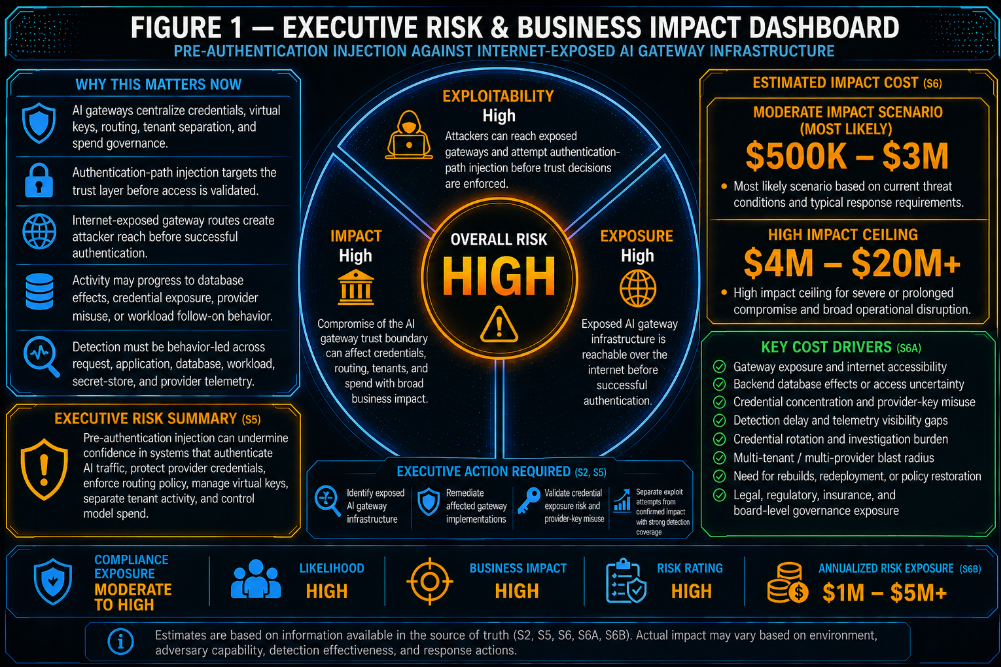
Pre-authentication injection against internet-exposed AI gateway infrastructure creates material enterprise risk by targeting the trust layer that validates API access, routes model traffic, manages virtual keys, and protects provider credentials. The risk is driven by malformed authentication input reaching backend validation or database logic before normal authentication controls complete. CVE-2026-42208 is used as the confirmed exploitation anchor, but this report assesses the broader behavior of authentication-path injection against LiteLLM Proxy, LLM proxy, OpenAI-compatible proxy, and AI gateway deployments. Executive action is required to identify exposed AI gateway infrastructure, remediate affected implementations, validate credential exposure risk, and ensure detection coverage separates exploit attempts from database impact, credential exposure, provider misuse, and conditional workload follow-on activity.
Executive Risk Translation
Authentication-path injection shifts business risk from a single vulnerable service to the integrity of the AI gateway control plane. The primary concern is that attackers may manipulate the authentication path before trust is established, then attempt to access proxy-managed keys, provider credentials, routing configuration, tenant records, configuration data, or spend controls. If database access or credential exposure cannot be ruled out, response may expand into credential rotation, provider usage review, workload validation, customer assurance, legal evaluation, and compliance review. This creates financial, operational, and governance exposure beyond the initial exploit attempt.
S3 Why This Matters Now
· AI gateways increasingly centralize model access, provider credentials, virtual keys, routing policy, tenant separation, and spend governance.
· Authentication-path injection is more consequential than generic web injection because it targets the logic that determines whether an API request should be trusted.
· CVE-2026-42208 provides a confirmed example of this behavior, but the defensive requirement is broader than one CVE, product version, or signature.
· Internet-exposed AI gateway routes create attacker reach before successful authentication.
· Successful activity may progress from request-layer probing into database effects, credential exposure, provider-key misuse, configuration manipulation, or conditional workload follow-on behavior.
· Detection must be behavior-led because CVE-name matching alone will not identify variants, adjacent implementations, or similar authentication-path failure modes.
S4 Key Judgments
· Pre-authentication injection against AI gateway authentication paths is the governing behavior assessed in this report.
· CVE-2026-42208 is the confirmed exploitation anchor, not the full scope of the report.
· The primary business risk is compromise of the AI gateway trust boundary.
· Request-layer SQL injection indicators represent exploit attempt behavior, not confirmed business impact by themselves.
· Database metadata access, schema enumeration, proxy-managed record access, or database modification provides stronger evidence that the vulnerable path was reached.
· Provider-key misuse requires provider-side usage, spend, source, route, tenant, key, or model telemetry.
· Workload compromise and remote code execution should be treated as conditional follow-on behavior unless independently supported by workload, cloud, endpoint, or chained-exploit evidence.
· Detection confidence depends on correlation across request-layer, application, database, workload, secret-store, and provider telemetry.
S5 Executive Risk Summary
Business Risk
Pre-authentication injection against AI gateway infrastructure can undermine confidence in the systems used to authenticate AI application traffic, protect provider credentials, enforce routing policy, manage virtual keys, separate tenant activity, and control model spend. Risk increases when affected gateways support multiple applications, teams, tenants, business units, or providers.
Technical Cause
The risk is driven by malformed authentication material reaching backend validation or database logic before normal trust decisions complete. In the confirmed anchor case, attacker-controlled bearer-token input can affect proxy API key verification behavior, creating a database-impact pathway from unauthenticated request activity.
Threat Posture
The threat posture is elevated because attackers can begin at the exposed API edge and attempt to move from authentication-path manipulation into database enumeration, proxy-managed record access, credential exposure, key-management probing, provider misuse, or conditional workload activity.
Executive Decision Requirement
Executives must require rapid exposure identification, remediation of affected gateway implementations, credential-risk validation, database and provider-usage review where exposure exists, and detection coverage that separates exploit attempts from confirmed impact.
S6 Executive Cost Summary
Pre-authentication injection against internet-exposed AI gateway infrastructure creates financial exposure based on gateway exposure, backend database impact, credential concentration, provider-key misuse potential, detection delay, credential rotation burden, and confidence in request-layer, application, database, workload, secret-store, and provider telemetry.
Low Impact Scenario
Suspicious authentication-path activity is identified against an exposed or potentially exposed AI gateway, but available telemetry confirms the activity did not produce backend database effects, proxy-managed record access, credential exposure, provider misuse, configuration modification, or workload follow-on behavior; estimated impact $75K to $350K.
Moderate Impact Scenario
Suspicious authentication-path activity occurs against an exposed AI gateway, and telemetry cannot fully rule out backend database effects, proxy-managed record exposure, key-management probing, credential exposure, or provider-risk impact, requiring expanded investigation, targeted credential rotation, database review, provider-usage validation, detection tuning, and executive incident coordination; estimated impact $500K to $3M.
High Impact Scenario
Database effects, proxy-managed credential exposure, provider-key misuse, configuration tampering, unauthorized model usage, tenant-impacting activity, or conditional workload follow-on behavior is confirmed, requiring full incident response, broad credential rotation, provider account review, forensic investigation, environment rebuild or redeployment, customer or regulator communications where required, and durable AI gateway control uplift; estimated impact $4M to $20M or higher.
S6A Key Cost Drivers
· Internet exposure of LiteLLM Proxy, LLM proxy, OpenAI-compatible proxy, or AI gateway routes.
· Number and criticality of applications, teams, tenants, providers, or business units dependent on the gateway.
· Concentration of provider keys, virtual keys, master keys, database credentials, routing controls, configuration data, and spend-management records.
· Ability to determine whether malformed authentication input reached backend validation or database logic.
· Evidence of database errors, metadata access, schema enumeration, proxy-managed record access, database modification, or key-management probing.
· Scope of credential rotation required across providers, tenants, services, environments, and automation workflows.
· Provider-side visibility into key usage, model invocation, token volume, source infrastructure, tenant context, route behavior, and spend.
· Availability and reliability of request-layer, application, database, workload, secret-store, and provider telemetry during the investigation window.
· Potential for conditional follow-on activity involving cloud secrets, workload execution, container activity, Kubernetes interaction, outbound staging, or broader service compromise.
· Sensitivity of supported workloads, customer commitments, contractual obligations, regulatory requirements, and audit expectations.
Most Likely Scenario Justification
Moderate scenario is most likely for exposed affected AI gateway infrastructure because the behavior targets authentication-path trust and may affect high-value backend records even when confirmed provider misuse or workload compromise is not established. The estimate moves toward the lower end when telemetry confirms no backend database effects, no credential-bearing record access, no provider misuse, rapid remediation, and narrow credential rotation. The estimate moves toward the upper end when database visibility is incomplete, credential exposure cannot be ruled out, provider telemetry is delayed or insufficient, the gateway supports multiple tenants or providers, or broad key rotation is required.
S6B Compliance and Risk Context
Compliance Exposure Indicator
Moderate to High depending on whether database access, credential exposure, provider misuse, tenant impact, regulated data exposure, or workload follow-on activity is confirmed or cannot be ruled out.
Risk Register Entry
Risk Title
Pre-Authentication Injection Against Internet-Exposed AI Gateway Infrastructure
Risk Description
Attackers may manipulate malformed authentication input against internet-exposed AI gateway or LLM proxy routes before normal authentication controls complete, potentially reaching backend validation or database logic and exposing proxy-managed keys, provider credentials, routing configuration, tenant records, configuration data, or spend controls.
Likelihood
High for exposed vulnerable or weakly controlled AI gateway deployments.
Impact
High.
Risk Rating
High.
Annualized Risk Exposure
Estimated $1M to $5M or higher based on most likely scenario conditions, gateway exposure, credential concentration, telemetry gaps, provider usage visibility, and response scope.
S7 Risk Drivers
· Internet-exposed AI gateway or LLM proxy routes.
· Authentication-path injection before valid API key acceptance.
· Backend database logic reachable from malformed authentication material.
· Gateway-managed provider credentials, virtual keys, tenant routing, model access policy, configuration data, and spend controls.
· Key-management, admin, configuration, team, model-routing, or spend-management endpoints exposed through the same gateway environment.
· Weak visibility into Authorization-header anomalies or WAF matched-field context.
· Generic authentication logging that does not distinguish malformed token input from ordinary invalid credentials.
· Missing database audit logging, query fingerprints, metadata access visibility, or service-account attribution.
· Provider logs that lack key, tenant, model, route, source, token-volume, or spend context.
· Missing workload telemetry for shell execution, secret access, credential-file access, or abnormal outbound communication.
· Delayed credential rotation when database access or credential exposure cannot be ruled out.
· Fragmented ownership across security, platform engineering, application engineering, cloud operations, and AI governance.
S8 Bottom Line for Executives
Pre-authentication injection against internet-exposed AI gateway infrastructure should be treated as a high-priority trust-boundary risk. CVE-2026-42208 is the confirmed example in this report, but the defensive requirement is broader behavior coverage for authentication-path injection that may affect gateway database records, credentials, provider access, and downstream AI operations. Risk reduction depends on exposure management, remediation, credential-risk validation, database auditability, provider-usage review, and detection coverage that separates exploit attempts from confirmed impact. Organizations with exposed AI gateways should prioritize this as an AI infrastructure governance issue, not only as a software patching issue.
S9 Board-Level Takeaway
The board-level risk is not a single CVE. The board-level risk is that enterprise AI access may be concentrated behind internet-exposed gateway infrastructure that can be attacked before authentication and may control provider credentials, virtual keys, routing policy, tenant context, and spend governance. Leadership should require evidence that exposed AI gateways are identified, affected implementations are remediated, credential exposure can be assessed, provider misuse can be detected, and database or workload impact can be proven or ruled out. This report supports governance decisions around AI gateway exposure, credential concentration, telemetry maturity, and behavior-based detection readiness.

Figure 2
S10 Vulnerability Overview
Pre-authentication injection against internet-exposed AI gateway infrastructure is a trust-boundary weakness where malformed authentication material reaches backend validation or database logic before normal authentication controls complete. This report uses CVE-2026-42208 as the confirmed exploitation anchor because it demonstrates the behavior in an AI gateway proxy API key verification path, but the report is not scoped to one CVE, product release, or payload pattern.
The governing risk is the broader behavior class: authentication-path injection against LLM proxy, OpenAI-compatible proxy, and AI gateway deployments. The business concern is that AI gateways may centralize API trust decisions, provider credentials, virtual keys, tenant routing, configuration data, model access, and spend controls behind externally reachable API routes.
Behavior Class
· Pre-authentication injection against API authentication or token-verification logic.
· Malformed bearer-token, API-key, or equivalent token-bearing input reaching backend validation logic.
· Backend database effects tied to authentication-path processing.
· Potential access to proxy-managed keys, provider credentials, tenant records, configuration data, routing controls, or spend-management records.
· Follow-on probing of key-management, administrative, configuration, team, model-routing, or spend-management endpoints.
· Conditional downstream activity involving provider-key misuse, secret access, workload execution, or abnormal outbound communication where additional exposure or misconfiguration exists.
Confirmed Anchor
· CVE-2026-42208 is the report’s confirmed exploitation anchor.
· The anchor case demonstrates SQL injection in an AI gateway proxy API key verification path.
· The affected behavior is reachable through crafted authentication material before successful authentication.
· The anchor supports detection and risk analysis, but the defensive objective is broader behavior coverage across similar AI gateway authentication-path weaknesses.
Scope Boundary
· This report does not assess CVE-2026-42208 as the only risk.
· This report does not assume provider-key misuse, credential theft, workload compromise, or remote code execution from request-layer activity alone.
· This report separates exploit attempt, backend database effect, credential exposure, provider misuse, and conditional workload follow-on behavior.
S11 Technical Vulnerability Details
The governing technical issue is unsafe handling of authentication material in the AI gateway trust path. In the confirmed anchor case, attacker-controlled bearer-token input can influence database query behavior during proxy API key verification. This creates a pre-authentication database-impact pathway because a valid API key is not required to reach the vulnerable verification path.
Technical Cause
· Caller-controlled authentication material is processed during API key verification or equivalent trust validation.
· The request reaches authentication or proxy key-verification logic before trust is established.
· Backend validation or database query logic may process attacker-controlled input unsafely.
· Successful exploitation may allow database reads or modifications depending on implementation, privileges, query path, and datastore behavior.
· The highest-value records are those tied to proxy-managed keys, provider credentials, users, teams, routing policy, configuration, and spend controls.
Affected Technical Surface
· LLM proxy and AI gateway deployments.
· OpenAI-compatible API routes exposed through the gateway.
· Authorization headers or equivalent API-token-bearing request fields.
· Proxy API key verification or equivalent authentication-path validation logic.
· Gateway backend databases or datastores.
· Key-management, administrative, configuration, team, model-routing, and spend-management functions where exposed.
· Workload, cloud-secret, and provider environments reachable through exposed credentials or misconfiguration.
Primary Input Path
· An external client reaches an exposed AI gateway or LLM proxy route.
· The client submits malformed authentication material.
· The gateway attempts to verify the supplied authentication material.
· Unsafe backend validation or query behavior may occur.
· Database effects, key-management probing, credential exposure, provider misuse, or workload activity may follow depending on exploitation success and environment conditions.
Primary Defensive Interpretation
· Authentication-path input must be treated as untrusted data even when it appears in a security control field.
· Detection should focus on suspicious authentication material, authentication-path errors, database effects, proxy-managed record access, key-management probing, provider usage anomalies, and workload follow-on behavior.
· Database activity by the AI gateway service account is central to impact determination.
· Provider misuse and workload compromise require separate supporting evidence.
S12 Exploitability Assessment
Exploitability Rating
High for internet-exposed vulnerable or weakly controlled AI gateway deployments.
Exploitability Basis
· The behavior can be reached before successful authentication.
· The attacker only needs network access to the exposed gateway route.
· The targeted input path is normal API authentication material, not an obscure administrative feature.
· AI gateway deployments often expose OpenAI-compatible routes designed to receive external API traffic.
· Successful exploitation may affect backend records that carry high operational value.
· Active exploitation of the confirmed anchor demonstrates real-world attacker interest in this behavior class.
Exploitation Requirements
· Network reachability to the AI gateway, LLM proxy, or OpenAI-compatible proxy route.
· A vulnerable or similarly unsafe authentication-path implementation.
· Ability to submit malformed bearer-token, API-key, or equivalent token-bearing input.
· Backend validation or database logic that processes the input unsafely.
· Sufficient database privileges or record exposure for meaningful impact.
Exploitation Constraints
· Exploitation may fail or remain limited if the implementation is patched, input is parameterized, or the vulnerable route is not reachable.
· WAF or API gateway controls may block recognizable payloads but may not cover all blind, encoded, or transformed variants.
· Successful request-layer exploitation does not automatically prove database record access.
· Successful database access does not automatically prove provider-key misuse.
· Workload compromise requires separate conditions, chained vulnerabilities, exposed secrets, or misconfiguration.
Likely Attacker Objectives
· Validate exposed gateway reachability.
· Trigger authentication-path SQL injection or equivalent backend manipulation.
· Enumerate database schema or high-value table structures.
· Access proxy-managed keys, provider credentials, tenant records, routing policy, configuration, or spend-management data.
· Probe key-management, admin, configuration, team, model-routing, or spend-management endpoints.
· Use exposed credentials or configuration to access providers, alter routing, consume paid resources, or pivot into related infrastructure.
Exploitability Judgment
The exploitability posture is high when internet-exposed AI gateway routes are vulnerable or weakly controlled because the attacker can begin at the unauthenticated API edge and target a trust-decision path. Impact likelihood depends on whether the activity reaches backend database logic and whether database records, credentials, provider access, or workload controls are exposed.
S13 KEV Status and Patch Availability
KEV Status
This behavior is assessed as an actively exploited AI infrastructure threat for CyberDax prioritization based on the triggering CyberDax critical update and public exploitation reporting tied to the confirmed anchor. KEV listing is not the governing urgency factor for this report. If the confirmed anchor is not listed in CISA KEV at publication time, that absence should not reduce priority because active exploitation, internet-facing AI gateway exposure, and potential database or credential impact already meet criteria for same-day action.
Patch Availability
A fixed version is available for the confirmed LiteLLM anchor case. The advisory identifies affected LiteLLM versions as greater than or equal to 1.81.16 and less than 1.83.7, with 1.83.7 identified as the patched version.
Patch and Response Priorities
· Identify exposed LLM proxy, OpenAI-compatible proxy, and AI gateway instances.
· Confirm product, version, deployment path, ingress exposure, and administrative endpoint exposure.
· Upgrade affected LiteLLM deployments to the fixed release or later.
· Review similar AI gateway and proxy implementations for authentication-path input handling weaknesses.
· Treat exposed affected instances as potential database and credential exposure events until telemetry proves otherwise.
· Review database telemetry for authentication-path errors, metadata access, schema enumeration, proxy-managed record access, or modification attempts.
· Review access to API keys, model credentials, provider keys, database tokens, virtual keys, configuration records, and secret material.
· Rotate provider keys, virtual keys, master keys, database credentials, or cloud secrets where exposure cannot be ruled out.
· Review provider usage and spend telemetry for unexpected model access, token consumption, source infrastructure, route behavior, tenant activity, or spend anomalies.
· Validate that workload, secret-store, and network telemetry show no conditional follow-on behavior.
Residual Risk After Patch
· Patch deployment reduces the confirmed vulnerability path but does not automatically resolve credential exposure if exploitation occurred before remediation.
· Rotation may still be required when database access, proxy-managed record access, or credential exposure cannot be ruled out.
· Provider monitoring should continue after patching because exposed credentials may be misused after the vulnerable service is fixed.
· Detection coverage should remain behavior-led to cover adjacent AI gateway implementations and future authentication-path variants.
S14 Sectors / Countries Affected
Sectors Affected
· Technology and SaaS platforms.
· AI application backends and LLM orchestration environments.
· Financial services and transaction processing environments.
· Healthcare and regulated industries.
· Government and public sector.
· Large enterprises with integration-heavy, API-centric, or middleware-centric architectures.
Countries Affected
· Global exposure due to worldwide deployment of LLM proxy, OpenAI-compatible proxy, and AI gateway infrastructure.
· Elevated risk in regions with large cloud, SaaS, AI platform, and enterprise developer infrastructure presence.
· No geographic limitation observed in exploitation patterns.
S15 Adversary Capability Profiling
Assessed Capability Level
Moderate to High.
Capability Basis
· Basic exploitation may require only the ability to discover exposed AI gateway routes and submit crafted authentication material.
· Reliable exploitation and impact expansion require stronger capability in SQL injection, API route enumeration, backend record discovery, credential targeting, and cloud or provider operational understanding.
· High-impact outcomes require the attacker to understand how AI gateways store, route, and use virtual keys, provider credentials, tenant context, model access, and spend controls.
· Chained outcomes involving workload execution, cloud secret access, or broader compromise require additional vulnerabilities, exposed secrets, misconfiguration, or post-exploitation capability.
Likely Adversary Types
· Opportunistic scanners targeting exposed AI gateway infrastructure.
· Financially motivated actors seeking provider keys, paid model access, cloud credentials, or reusable secrets.
· Initial access brokers interested in credential-bearing AI infrastructure.
· Cloud-focused threat actors targeting API keys, secret stores, and workload identities.
· AI platform abuse actors seeking unauthorized model access or spend abuse.
· More capable intrusion operators using AI gateway compromise as a path into application, cloud, or tenant environments.
Likely Capability Indicators
· Route discovery against OpenAI-compatible proxy paths.
· SQL injection patterns in Authorization headers or equivalent token-bearing fields.
· Schema enumeration and metadata access attempts.
· Queries or payloads targeting key, credential, provider, user, team, configuration, or spend-management records.
· Follow-on probing of key-management, admin, configuration, team, model-routing, or spend-management endpoints.
· Provider usage from unexpected infrastructure.
· Secret access, shell execution, cloud CLI use, Kubernetes interaction, or abnormal outbound activity from the gateway workload.
Capability Judgment
The behavior is accessible to lower-capability actors for scanning and exploit attempts but becomes higher-consequence when performed by actors who understand AI gateway data models, provider key value, virtual-key workflows, and cloud workload environments. The most serious risk comes from operators who can move from authentication-path injection into database impact, credential exposure, provider misuse, and conditional follow-on compromise.
S16 Targeting Probability Assessment
Overall Targeting Probability
High for internet-exposed vulnerable AI gateway deployments.
Targeting Basis
· AI gateways are high-value control points for provider credentials, model access, routing, tenant context, and spend governance.
· Internet-exposed OpenAI-compatible routes are discoverable and attractive to automated scanning.
· The confirmed anchor demonstrates that authentication-path logic can become a pre-authentication attack surface.
· Confirmed active exploitation increases the likelihood of follow-on scanning, payload reuse, opportunistic targeting, and broader attacker adoption.
· Credential-bearing AI infrastructure is economically attractive because provider keys can enable unauthorized model use, token consumption, and downstream access.
Most Likely Targets
· Internet-facing LLM proxy or AI gateway services.
· OpenAI-compatible proxy routes.
· Gateways managing multiple providers, tenants, teams, or business units.
· Gateways with exposed or weakly protected key-management and administrative endpoints.
· Gateways storing provider credentials, virtual keys, model-routing configuration, or spend-management records.
· Cloud-hosted or Kubernetes-hosted gateways with incomplete workload identity and secret-management visibility.
Targeting Drivers
· Publicly reachable API route.
· Known or inferred LLM proxy or AI gateway deployment.
· Authentication path reachable before valid API key acceptance.
· Stored provider keys or virtual keys.
· Multi-provider gateway configuration.
· Administrative endpoint exposure.
· Weak WAF matched-field visibility.
· Limited database audit logging.
· Delayed patching or incomplete asset inventory.
· Provider-side monitoring gaps.
Targeting Constraints
· Non-exposed gateways are less likely to receive direct internet exploitation.
· Strong ingress controls, route restrictions, WAF matched-field blocking, and patched authentication logic reduce targeting success.
· Database least privilege can reduce impact even if request-layer exploitation occurs.
· Provider-key segmentation and short-lived credentials can reduce downstream misuse.
· Mature telemetry increases the chance of rapid detection and containment.
Targeting Judgment
Targeting probability is high for exposed vulnerable AI gateway infrastructure and moderate for internal-only deployments unless attacker access already exists through another route. The most likely near-term activity is scanning, malformed authentication requests, schema enumeration attempts, and key-management probing. The highest-impact but less automatic outcome is successful credential exposure followed by provider misuse or conditional workload follow-on activity.
S17 MITRE ATT&CK Chain Flow Mapping
Stage 1 External Discovery and Target Selection
· The attacker identifies an internet-exposed LLM proxy, OpenAI-compatible proxy, or AI gateway endpoint.
· The attacker may scan for exposed routes, API behavior, service fingerprints, or gateway-specific response patterns.
· This stage establishes target reachability and exposure.
Mapped ATT&CK Techniques
· T1595 Active Scanning.
· T1592 Gather Victim Host Information.
Stage 2 Initial Access Through Authentication-Path Injection
· The attacker sends requests to exposed AI gateway or model API routes.
· The attacker submits malformed bearer-token, API-key, or equivalent token-bearing input.
· The attacker attempts to manipulate backend validation or database query behavior through the authentication path.
· Observable evidence may include SQL injection indicators in authentication material, WAF matched-field events, authentication-path application errors, backend query errors, or abnormal response behavior.
Mapped ATT&CK Techniques
· T1190 Exploit Public-Facing Application.
Stage 3 Backend Database Access or Enumeration
· The attacker attempts to cause backend database errors, metadata access, schema enumeration, or proxy-managed record access.
· This stage is the key transition from exploit attempt to stronger evidence of impact.
· T1213 applies when backend records or repository-like datastore contents are accessed, not when only blocked requests or generic database errors are observed.
· Relevant records may include keys, credentials, provider records, users, teams, configuration, routing, and spend-management data.
Mapped ATT&CK Techniques
· T1213 Data from Information Repositories.
Stage 4 Credential or Key Exposure
· The attacker may access proxy-managed keys, provider credentials, virtual keys, configuration records, environment-derived secrets, or application tokens.
· This stage requires database, application, cloud-secret, workload, or provider evidence.
· Credential exposure should not be assumed from request-layer injection alone.
Mapped ATT&CK Techniques
· T1552 Unsecured Credentials.
· T1528 Steal Application Access Token, only where API keys, application tokens, or provider tokens are exposed.
Stage 5 Conditional Provider Misuse
· The attacker may use exposed provider keys, virtual keys, or routing data to access provider services, invoke models, consume tokens, or generate unauthorized spend.
· This stage must be validated through provider-side usage, spend, route, tenant, source, key, or model telemetry.
· Provider misuse is an impact-confirmation layer, not a default result of the initial exploit.
Mapped ATT&CK Techniques
· T1078 Valid Accounts, only where exposed keys or tokens enable authenticated provider access.
· T1496 Resource Hijacking, only where unauthorized model usage, token consumption, or spend abuse is confirmed.
Stage 6 Conditional Workload Follow-On Activity
· The attacker may attempt workload execution, secret access, package retrieval, Kubernetes interaction, cloud CLI usage, or abnormal outbound communication if additional vulnerabilities, exposed credentials, or misconfigurations are present.
· This stage is conditional and requires independent workload, container, host, cloud, or network evidence.
· Remote code execution should not be inferred from the confirmed anchor alone.
Mapped ATT&CK Techniques
· T1059 Command and Scripting Interpreter, only where command execution is observed.
· T1105 Ingress Tool Transfer, only where payload retrieval or tool staging is observed.
· T1613 Container and Resource Discovery, only where Kubernetes or container discovery occurs.
· T1021 Remote Services, only where lateral access or remote service interaction is observed.
Chain Flow Integrity Statement
The ATT&CK chain is a staged behavior model, not a claim that every stage occurred. The confirmed behavior begins with exposed AI gateway access and authentication-path injection. Database access, credential exposure, provider misuse, and workload follow-on behavior require progressively stronger evidence and must remain separated during investigation, detection engineering, and executive reporting.
S18 Attack Path Narrative (Signal-Aligned Execution Flow)
Pre-authentication injection against internet-exposed AI gateway infrastructure begins when an attacker reaches an exposed LLM proxy, OpenAI-compatible proxy, or AI gateway route and submits malformed authentication material before trust is established. CVE-2026-42208 remains the confirmed exploitation anchor, but the attack path assessed here is the broader behavior: authentication-path injection that may progress from request-layer activity into backend database effects, credential exposure, provider misuse, or workload follow-on behavior.
Stage 1 External Exposure and Gateway Discovery
· The attacker identifies an exposed AI gateway, LLM proxy, or OpenAI-compatible API route.
· Discovery may involve route probing, response fingerprinting, authentication-error review, or repeated requests against model API paths.
· The key defensive question is whether the exposed route can process authentication material before trust is established.
Primary Signals
· Repeated requests to model API, chat completion, embedding, routing, provider, or gateway paths.
· Route discovery against OpenAI-compatible API paths.
· Increased invalid authentication attempts against AI gateway routes.
· Requests with malformed or unusual Authorization header structure.
Interpretation Boundary
· Discovery confirms exposure and targetability, not exploitation or compromise.
Stage 2 Authentication-Path Injection Attempt
· The attacker submits malformed bearer-token, API-key, or equivalent token-bearing input to a gateway route.
· The input is designed to influence backend validation or database query behavior before the request is trusted.
· This stage is the core exploit-attempt behavior assessed in this report.
Primary Signals
· SQL injection patterns or malformed structures in Authorization headers or equivalent token-bearing fields.
· WAF or API gateway matched-field events tied to authentication material.
· Authentication-path application errors after malformed token input.
· Abnormal response codes or latency changes after malformed authentication attempts.
· Repeated invalid-token requests with payload-like structure rather than ordinary invalid API keys.
Interpretation Boundary
· Request-layer injection indicators represent exploit attempt behavior, not confirmed database access, credential exposure, provider misuse, or workload compromise.
Stage 3 Backend Validation or Database Effect
· If the authentication-path weakness is reachable, malformed authentication input may affect backend validation or database query behavior.
· This is the key transition from attempted exploitation to stronger technical impact.
· Impact confidence increases when request-layer evidence and database telemetry align by gateway instance, timestamp, service account, route, and query behavior.
Primary Signals
· Database errors or query anomalies following malformed authentication requests.
· Metadata or schema access by the AI gateway service account.
· Access to proxy-managed key, credential, provider, user, team, routing, configuration, or spend-management records.
· Query patterns inconsistent with normal API key validation.
· Modification attempts against records used for authentication, routing, provider access, configuration, or spend controls.
Interpretation Boundary
· Generic database errors are not sufficient by themselves.
· Backend record access or abnormal query behavior must be tied to the exposed gateway path or service account.
Stage 4 Credential, Key, and Configuration Exposure
· The attacker may attempt to access virtual keys, provider credentials, API keys, database tokens, configuration records, environment-derived secrets, or application tokens.
· Credential exposure materially changes business risk because exposed keys may enable provider access, unauthorized model use, broader secret exposure, or continued misuse after patching.
Primary Signals
· Database reads involving key, token, provider, credential, configuration, user, team, or routing records.
· Application logs showing access to key-management, provider, or configuration functions after suspicious authentication-path activity.
· Secret-store access from gateway workload identities after suspicious request or database behavior.
· File, environment, or mounted-secret access from the gateway workload.
· Administrative activity involving key creation, key export, key update, provider configuration, routing changes, or tenant mapping.
Interpretation Boundary
· Credential exposure requires database, application, secret-store, workload, or provider evidence.
· Provider misuse should not be assumed until provider-side telemetry supports it.
Stage 5 Control-Plane Follow-On Activity
· The attacker may probe or manipulate key-management, administrative, configuration, team, provider-routing, model-routing, or spend-management functions.
· This behavior may represent validation of access, control-plane abuse, or preparation for provider misuse.
· Risk increases where gateways support multiple tenants, providers, teams, or application integrations.
Primary Signals
· Access to key-management endpoints after suspicious authentication-path activity.
· Creation, update, export, deletion, or unusual use of virtual keys or provider records.
· Changes to routing rules, model mappings, team records, rate limits, provider configuration, or spend controls.
· Administrative actions from unusual users, service accounts, source infrastructure, or automation paths.
· Gateway control-plane activity inconsistent with known deployment, operations, or maintenance behavior.
Interpretation Boundary
· Control-plane activity is strongest when temporally linked to exploit attempts or backend database effects.
· Approved operational activity should not be treated as malicious without suspicious context.
Stage 6 Provider Misuse or Unauthorized AI Service Consumption
· If provider keys, virtual keys, or routing data are exposed or modified, the attacker may invoke upstream providers, consume tokens, alter usage patterns, or generate unauthorized spend.
· This stage confirms downstream business impact only when provider-side evidence is present.
Primary Signals
· Unexpected model invocation tied to exposed or suspicious keys.
· Token-volume spikes, unusual model selection, new source infrastructure, or abnormal tenant or route usage.
· Provider activity inconsistent with normal application patterns.
· Usage from locations, workloads, accounts, or infrastructure not associated with approved gateway operations.
· Spend anomalies or quota exhaustion following suspicious gateway activity.
Interpretation Boundary
· Provider misuse is not a default outcome.
· Provider-side usage, key, route, source, tenant, model, token, or spend telemetry is required.
Stage 7 Workload Follow-On Behavior
· Workload follow-on may occur if the attacker gains access to secrets, reaches a chained vulnerability, abuses cloud identity, or interacts with gateway runtime infrastructure.
· This stage is separate from the authentication-path injection finding and must be proven independently.
Primary Signals
· Shell execution, scripting, package retrieval, cloud CLI use, Kubernetes interaction, or abnormal process activity from the gateway workload.
· Access to mounted secrets, credential files, environment variables, metadata services, or secret-store APIs.
· Abnormal outbound communication from gateway containers, hosts, or workloads.
· New or unusual cloud API calls from gateway workload identities.
· Lateral access attempts from the gateway environment to databases, internal services, storage, or administrative systems.
Interpretation Boundary
· Workload compromise requires workload, container, host, cloud, secret-store, or network evidence.
· Remote code execution should not be inferred from the confirmed anchor alone.
Stage 8 Incident Determination and Business Impact
· Business impact depends on how far the activity progressed through the signal chain.
· Attempted exploitation creates urgent remediation and monitoring requirements.
· Backend database effect increases incident scope and forensic requirements.
· Credential exposure triggers rotation, provider review, and broader investigation.
· Provider misuse creates financial, operational, and customer assurance risk.
· Workload follow-on behavior may expand the incident into cloud, application, identity, or infrastructure response.
Primary Signals
· Confirmed vulnerable exposure and suspicious authentication-path requests.
· Database effect tied to gateway service account or authentication-path behavior.
· Credential-bearing record access or secret access.
· Provider usage anomaly or spend impact.
· Workload or cloud follow-on behavior.
· Inability to disprove database or credential access due to telemetry gaps.
Interpretation Boundary
· Impact level must be evidence-based.
· Response scope should expand when telemetry confirms backend effect, credential exposure, provider misuse, workload follow-on activity, or unresolved telemetry gaps.
S19 Attack Chain Risk Amplification Summary
Pre-authentication injection against internet-exposed AI gateway infrastructure amplifies risk because the attacker begins at the unauthenticated edge but may reach systems that control provider credentials, virtual keys, tenant routing, model access, configuration data, and spend governance. Compared with ordinary injection against a low-value application path, this behavior targets the trust layer that decides whether AI traffic is authenticated, routed, authorized, and billed.
Primary Risk Amplifiers
· Internet exposure allows attacker access before trust is established.
· Authentication-path targeting places the attack directly against the gateway trust decision.
· Backend database effects can expose records that support authentication, routing, provider access, tenant context, and spend controls.
· Credential-bearing records can retain attacker value after patching.
· Provider keys and virtual keys can enable unauthorized model use, token consumption, or spend abuse.
· Multi-provider and multi-tenant gateways increase blast radius.
· Weak database audit coverage makes it difficult to determine whether activity remained an attempt or reached sensitive records.
· Incomplete provider telemetry may delay confirmation of unauthorized usage.
· Missing workload telemetry may prevent timely separation of SQL injection impact from runtime compromise.
· Fragmented ownership across security, platform engineering, application engineering, cloud operations, and AI governance can delay containment and credential rotation.
Impact Escalation Path
· Request-layer attempt creates exposure-management and detection requirements.
· Backend database effect creates incident-determination and forensic requirements.
· Proxy-managed record access creates credential-risk and configuration-integrity requirements.
· Provider-key exposure creates provider-usage, spend, and downstream-access requirements.
· Workload follow-on behavior creates cloud, container, host, identity, and network investigation requirements.
· Telemetry gaps increase response scope because the organization may be unable to disprove higher-impact outcomes.
Containment Complexity
· Containment is more complex when the gateway supports multiple applications, tenants, teams, providers, or business workflows.
· Patching the vulnerable path does not prove that credentials were not accessed before remediation.
· Credential rotation may require coordination across applications, providers, tenants, automation workflows, and business units.
· Provider-usage validation may depend on logs outside the gateway environment.
· Workload validation may require endpoint, container, cloud, secret-store, and network telemetry.
· Incident scope may expand when service-account privileges, database access, or provider keys are broad.
Detection Confidence Drivers
· Request-layer visibility into authentication material and matched fields.
· Application logs that distinguish malformed authentication input from ordinary invalid credentials.
· Database audit telemetry tied to gateway service accounts and query behavior.
· Visibility into proxy-managed key, credential, provider, user, team, configuration, routing, and spend-management records.
· Secret-store and workload telemetry for follow-on activity.
· Provider-side usage, route, key, model, token, source, tenant, and spend telemetry.
· Correlation across gateway instance, route, source, account, service account, timestamp, workload identity, and provider account.
Risk Amplification Judgment
Risk amplification is High when exposed AI gateway infrastructure stores or manages provider credentials, virtual keys, tenant routing, configuration data, or spend controls. The most important escalation point is the transition from request-layer exploit attempt to backend database effect. The most important business-impact boundary is whether credential-bearing records or provider keys were accessed or misused. Workload compromise and remote code execution remain separate findings that require independent evidence.
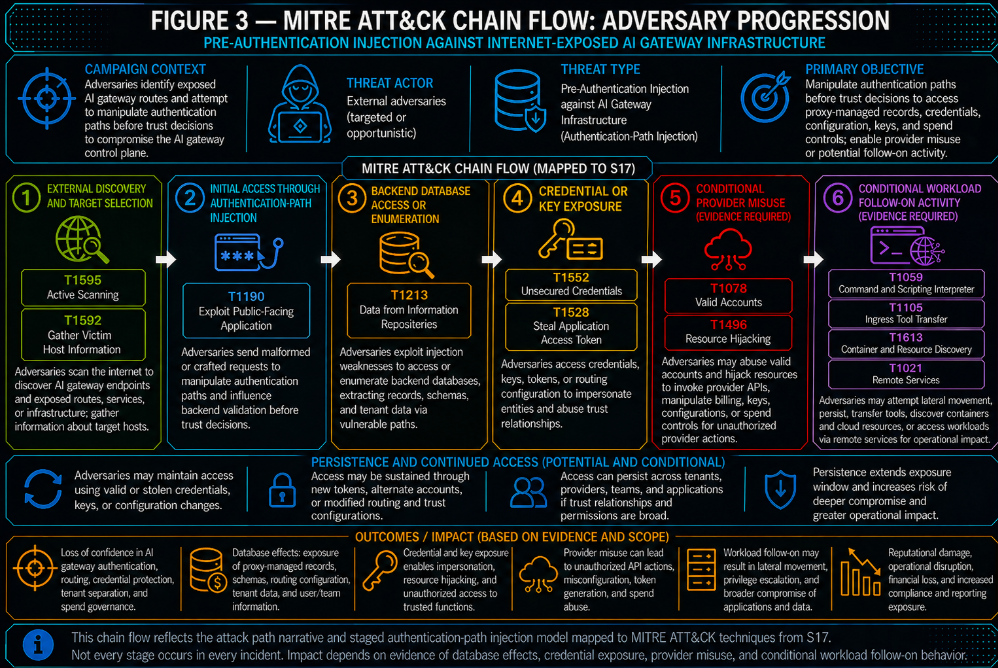
Figure 3
S20 Tactics, Techniques, and Procedures
Initial Access and Discovery
· Identify exposed AI gateway, LLM proxy, or OpenAI-compatible proxy routes.
· Probe model API paths, gateway routes, authentication behavior, and response patterns.
· Prioritize routes that process authentication material, provider routing, model traffic, or key-management functions.
Authentication-Path Manipulation
· Submit malformed bearer-token, API-key, or equivalent token-bearing input.
· Place SQL injection or backend manipulation patterns in authentication-path fields.
· Vary payload encoding, spacing, comments, casing, or request formatting to bypass simple matching.
· Use repeated invalid authentication requests that differ from ordinary mistyped keys or expired tokens.
Backend Database Interaction
· Trigger authentication-path database errors or abnormal query behavior.
· Attempt metadata access, schema enumeration, or proxy-managed record access.
· Target records related to keys, credentials, providers, users, teams, configuration, routing, or spend controls.
· Attempt database modification where backend query path and privileges allow it.
Credential and Configuration Targeting
· Seek provider keys, virtual keys, database credentials, environment-derived secrets, application tokens, model credentials, routing configuration, tenant records, or spend-management data.
· Identify whether secrets are stored in database records, local configuration, mounted secrets, environment variables, or secret-store integrations.
· Use exposed keys or configuration to support provider misuse, key manipulation, or additional infrastructure access.
Control-Plane Probing
· Probe key-management, admin, configuration, team, model-routing, provider, or spend-management endpoints.
· Attempt to create, modify, export, delete, or test virtual keys or provider records.
· Attempt to alter routing, model mappings, provider configuration, rate limits, tenant associations, or spend controls.
· Use normal gateway functions to validate whether database or credential access produced usable control.
Provider and Usage Abuse
· Use exposed provider keys, virtual keys, or routing data to invoke models or consume tokens.
· Test multiple models, providers, routes, tenants, or source infrastructure to determine available access.
· Generate unauthorized usage, quota pressure, or spend anomalies.
· Rely on provider-side visibility gaps to delay detection.
Workload Follow-On
· Attempt workload execution, package retrieval, cloud CLI use, Kubernetes interaction, secret access, or abnormal outbound communication where additional access paths exist.
· Use exposed credentials, misconfigured workload identities, mounted secrets, or chained vulnerabilities to expand access.
· Attempt to reach databases, internal services, secret stores, metadata services, storage, or administrative systems from the gateway environment.
Evasion and Noise Reduction
· Encode payloads or vary request structure to bypass WAF signatures.
· Use normal API routes and standard authentication fields to blend into expected gateway traffic.
· Throttle attempts to avoid volume-based detection.
· Test for blind database effects where response content does not directly reveal query results.
· Operate from cloud infrastructure, proxies, or rotating sources to complicate attribution and blocking.
· Delay provider misuse or credential reuse after patching to evade immediate response review.
Defensive Interpretation
· Suspicious authentication material indicates exploit-attempt behavior.
· Backend database effects indicate stronger evidence of technical impact.
· Credential-bearing record access should trigger credential-risk review.
· Provider misuse requires provider-side evidence.
· Workload follow-on requires workload, cloud, secret-store, endpoint, container, or network evidence.
· Conditional behaviors should not be treated as confirmed attack stages without supporting telemetry.
S20A Adversary Tradecraft Summary
Pre-authentication injection against internet-exposed AI gateway infrastructure is adversary tradecraft focused on abusing trust-establishment logic. The attacker targets the authentication path because it is reachable before trust is established and may connect directly to backend validation or database logic. This makes the behavior high value even when the first visible signal appears as malformed authentication input.
Tradecraft Characteristics
· The attacker uses normal AI gateway routes as the entry point.
· The attacker places malicious structure inside authentication material rather than a conventional content field.
· The attacker attempts to convert unauthenticated request access into backend database effect.
· The attacker prioritizes provider keys, virtual keys, tenant records, configuration data, routing controls, and spend-management records.
· The attacker may use key-management or administrative functions to validate access or alter gateway control state.
· The attacker may convert exposed keys into provider usage, unauthorized token consumption, or downstream access.
· The attacker may pursue workload follow-on only when additional credentials, misconfigurations, or chained weaknesses are present.
Operational Strengths for the Attacker
· The attack begins before successful authentication.
· The malicious input may be embedded in fields defenders may not log in full.
· The initial route may look like normal API traffic.
· The highest-value records may be reachable through backend systems used for normal gateway operations.
· Credential exposure may retain value after the vulnerable code path is patched.
· Provider misuse may occur outside the gateway logging boundary.
· Telemetry gaps can force defenders to expand response scope even without confirmed downstream misuse.
Operational Constraints for the Attacker
· Patch deployment or safe parameterization can remove the vulnerable path.
· Restricted ingress can prevent direct exploitation.
· WAF matched-field visibility may detect obvious payloads.
· Database least privilege can limit record access or modification.
· Strong database audit logging can confirm or disprove backend effects.
· Segmented provider keys and short-lived credentials reduce downstream value.
· Mature provider-usage monitoring can detect unauthorized model access or spend anomalies.
· Workload telemetry can separate database impact from runtime compromise.
Defender Priority
The defender priority is to validate transition points in the attack path. The first transition is malformed authentication input to backend database effect. The second transition is database effect to credential-bearing record access. The third transition is credential exposure to provider misuse. The fourth transition is credential or configuration access to workload follow-on behavior. Each transition requires separate telemetry evidence.
Final Tradecraft Judgment
This behavior is high risk because it targets AI gateway trust infrastructure at the point where external requests become authenticated, routed, and authorized for provider access. The confirmed exploitation anchor demonstrates attacker interest in this class of AI infrastructure weakness, but the broader risk is not limited to one CVE or product. Organizations should treat authentication-path injection against exposed AI gateways as a durable behavior requiring behavior-based detection, database-impact validation, credential-risk review, provider-usage monitoring, and workload follow-on verification.
S21 Detection Strategy Overview
Detection Strategy Overview
This report uses CVE-2026-42208 as the confirmed exploitation anchor, but the detection strategy is centered on the broader behavior class of pre-authentication injection against internet-exposed AI gateway and LLM proxy infrastructure. The vulnerable behavior is authentication-path request manipulation, where attacker-controlled bearer-token input reaches backend database logic during proxy API key verification. Detection must therefore focus on authentication-path abuse, backend database effects, key-management probing, credential exposure risk, and conditional workload follow-on behavior rather than on the CVE identifier alone.
Detection Anchoring Model
· External actor reaches an internet-exposed LiteLLM Proxy, LLM proxy, or AI gateway endpoint.
· Attacker submits malformed API authentication material through an Authorization: Bearer header or equivalent API-token-bearing request field.
· The AI gateway processes the request through authentication or API key verification logic.
· Backend database behavior may expose SQL injection effects, including query errors, metadata access, schema enumeration, proxy-managed record access, credential exposure, or database modification attempts.
· Follow-on activity may include key-management endpoint probing, credential discovery, unauthorized LLM provider access, spend abuse, configuration manipulation, or workload-level compromise where additional chained vulnerabilities, exposed credentials, or misconfigurations exist.
Reliable Detection Begins At
· Request-layer anomalies targeting AI gateway API routes.
· SQL injection payloads embedded in authentication headers or token-bearing fields.
· Application-layer authentication errors, database exceptions, or abnormal API responses associated with malformed bearer-token input.
· Database telemetry showing authentication-path query errors, abnormal metadata access, schema enumeration, suspicious UNION-style query behavior, proxy-managed key or credential record access, or unusual database activity by the AI gateway service account.
· Key-management, admin, configuration, team, model-routing, or spend-management endpoint probing after suspicious authentication-path requests, including /key/generate and /key/info where those endpoints are exposed and logged.
· Workload-level behavior from the AI gateway container or host that indicates secret access, shell execution, outbound staging, or credential misuse.
Core Detection Strategy
Detection must focus on behavior that is abnormal for legitimate AI gateway traffic and materially tied to the exploitation path. The primary detection objective is not simply to identify generic SQL injection, but to detect SQL injection behavior occurring in authentication-path inputs against LLM proxy or AI gateway routes.
Primary Detection Anchors
· SQL injection syntax in Authorization headers or API-token-bearing request fields.
· Requests to LiteLLM or OpenAI-compatible proxy routes containing malformed bearer tokens.
· Repeated authentication-path probes from the same source, user agent, API client, or infrastructure cluster across multiple AI gateway routes.
· SQL errors, database exceptions, or anomalous response behavior following malformed authentication headers.
· Database metadata access, schema enumeration, or high-risk proxy-managed record access by the AI gateway service account outside expected application, maintenance, migration, or administrative workflows.
· Probing of key-management, admin, configuration, team, model-routing, or spend-management endpoints after suspicious request activity.
· Secret access, environment-variable access, credential-file access, or shell execution from the AI gateway workload after request-layer or database exploitation indicators.
Detection Signal Classes
Deterministic High-Confidence Signals
· SQL injection payloads inside authentication headers targeting known AI gateway, LiteLLM, or OpenAI-compatible proxy routes.
· WAF or API gateway SQL injection matches where the matched field is the Authorization header or equivalent token-bearing field.
· LiteLLM or AI gateway application logs showing authentication-path SQL exceptions after malformed bearer-token input.
· Database audit logs showing abnormal metadata access, schema enumeration, or proxy-managed record access by the AI gateway service account after suspicious API requests.
· Access to proxy-managed key, credential, provider, user, team, configuration, or spend-management records by the AI gateway service account outside expected application behavior, maintenance windows, migrations, or approved administrative workflows.
Correlation-Dependent Signals
· Suspicious authentication header followed by database query errors from the same AI gateway instance.
· Suspicious API request followed by key-management, admin, configuration, team, model-routing, or spend-management endpoint probing from the same source.
· WAF SQL injection alert followed by database metadata access, schema enumeration, or proxy-managed credential record access.
· Suspicious AI gateway request followed by abnormal outbound network activity from the LiteLLM or AI gateway container or host.
· Suspicious AI gateway request followed by cloud secret access, environment-variable access, credential-file reads, or shell execution by the workload.
Conditional Post-Exploitation Signals
· Shell execution from the LiteLLM or AI gateway container.
· Use of curl, wget, python, bash, sh, package managers, cloud CLIs, Kubernetes tooling, or network utilities by the AI gateway workload outside expected maintenance activity.
· Access to environment files, Kubernetes service-account tokens, cloud credential files, provider API keys, local configuration files, or secret-mounted paths outside expected startup, reload, deployment, or administrative activity.
· Unexpected outbound communication from the AI gateway workload to infrastructure not associated with configured LLM providers, observability platforms, update services, or approved dependencies.
· Unusual LLM provider API usage, abnormal token consumption, model access pattern changes, new provider-key usage patterns, or spend spikes after suspected gateway exploitation.
Telemetry Dependency Model
Minimum Viable Detection
· Reverse proxy, API gateway, load balancer, or WAF logs with request path, method, source IP, status code, user agent, and matched attack category.
· Visibility into authentication header anomalies or WAF-normalized matched-field data.
· LiteLLM or AI gateway application logs with authentication failures, API route context, and database exception visibility.
· Database logs or audit telemetry showing query behavior, service account activity, metadata access, schema access, and proxy-managed record access patterns.
· Asset inventory identifying exposed LiteLLM Proxy, LLM proxy, or AI gateway instances.
Enhanced Detection Capability
· Full request-header logging in controlled security telemetry pipelines with masking, access control, and retention controls appropriate for sensitive authentication material.
· WAF matched-field visibility showing whether SQL injection was detected in the Authorization header or equivalent token-bearing field.
· Database query text telemetry or normalized database audit events.
· Container runtime telemetry for process execution, file access, secret access, and outbound network behavior.
· Cloud secret-manager logs for AWS Secrets Manager, Azure Key Vault, GCP Secret Manager, Kubernetes secrets, or equivalent secret stores.
· LLM provider usage logs showing anomalous token consumption, model invocation, account access, provider-key usage, or spend behavior.
Adversary Evasion Considerations
· Attackers may vary SQL injection syntax to avoid simple string matching.
· Attackers may use blind SQL injection techniques that produce minimal application errors.
· Attackers may target routes that appear normal for LLM API traffic, reducing route-based detection value.
· Attackers may avoid noisy key-management probing if database extraction succeeds directly.
· Attackers may use trusted cloud infrastructure, anonymization services, or distributed sources to reduce source-IP reputation value.
· Attackers may chain the SQL injection with other vulnerabilities or misconfigurations, shifting observable behavior from request-layer exploitation to workload-level execution.
· Attackers may access or modify stored keys without immediate outbound malware behavior, making database and provider-usage telemetry critical.
Operational Detection Priorities
· Prioritize internet-facing AI gateway, LLM proxy, and LiteLLM Proxy instances for request-layer monitoring.
· Alert on SQL injection patterns in authentication headers or token-bearing fields targeting AI gateway routes.
· Correlate WAF, proxy, application, and database telemetry around the same gateway instance.
· Monitor AI gateway database accounts for abnormal metadata access, schema enumeration, and proxy-managed credential record access.
· Monitor key-management, admin, configuration, team, model-routing, and spend-management endpoint activity after suspicious authentication requests.
· Monitor LLM provider usage for unexpected token spikes, unusual model access, new source infrastructure, or unauthorized provider-key use.
· Monitor the AI gateway workload for shell execution, credential access, cloud secret access, secret-mounted path access, and abnormal outbound communication.
Detection Strategy Constraints
· Generic SQL injection detections are insufficient unless scoped to AI gateway routes, authentication headers, token-bearing fields, or gateway-specific database behavior.
· Header-level detection depends on WAF, reverse proxy, or API gateway visibility and may be reduced by encrypted traffic without termination.
· Application logs may not capture raw Authorization header content due to security redaction.
· Database visibility may be limited where query text logging is disabled or where managed database audit logs are incomplete.
· Cloud control-plane logs do not directly observe the initial authentication-path injection unless application, WAF, or workload telemetry is forwarded.
· Workload and container telemetry detect post-exploitation consequences, not the initial SQL injection itself.
· LLM provider usage and spend anomalies are impact-adjacent correlation signals and should not be treated as standalone proof of exploitation.
· RCE should be treated as conditional chain behavior unless directly supported by workload telemetry or source reporting.
Coverage Integrity Statement
Detection for this threat is strongest when request-layer telemetry is correlated with database audit activity and workload behavior from the same AI gateway instance. The highest-confidence detections are authentication-header SQL injection against AI gateway routes, database metadata access or proxy-managed credential record access by the gateway service account, and key-management endpoint probing after suspicious request activity. Detection confidence degrades when header visibility, database audit logging, workload telemetry, or provider-usage visibility is absent.
S22 Primary Detection Signals
Primary Detection Signals
Primary detection signals for this report are derived from observable behavior associated with pre-authentication injection against internet-exposed AI gateway and LLM proxy infrastructure. CVE-2026-42208 remains the confirmed exploitation anchor, but the signal model is behavior-led so it can support detection of authentication-path injection, database abuse, key-management probing, credential exposure, and conditional workload compromise across LiteLLM-like AI gateway deployments.
Request-Layer Detection Signals
Deterministic High-Confidence Signals
· SQL injection syntax appears inside an Authorization header or equivalent API-token-bearing field on a request to an AI gateway, LLM proxy, or LiteLLM Proxy route.
· WAF, API gateway, or reverse proxy telemetry identifies SQL injection where the matched field is the Authorization header or equivalent token-bearing field.
· Malformed bearer-token input contains SQL operators, quote-delimited logic, SQL comment markers, UNION query structure, database function patterns, or encoded SQL syntax.
· Request traffic to LiteLLM or OpenAI-compatible proxy routes contains authentication material that materially deviates from expected bearer-token format.
· Multiple SQL injection-patterned authentication requests originate from the same source, user agent, API client, or infrastructure cluster against AI gateway routes.
Correlation-Dependent Signals
· Suspicious authentication header followed by HTTP 500-series responses, authentication errors, backend query errors, or database exception indicators from the same AI gateway instance.
· Multiple malformed bearer-token requests followed by abnormal response changes from routes that normally require valid API authentication.
· SQL injection-patterned request followed by probing of key-management, admin, configuration, team, model-routing, or spend-management endpoints.
· Same source IP, user agent, API client, or session-like pattern targets both LLM API routes and management-adjacent routes within a short time window.
· WAF SQL injection match followed by application log evidence of API key verification failure, authentication-path exception, or backend query error.
Application-Layer Detection Signals
Deterministic High-Confidence Signals
· LiteLLM or AI gateway logs show authentication-path SQL exceptions after malformed bearer-token input.
· API key verification errors are paired with database exception traces, query parsing failures, or abnormal backend response behavior.
· Authentication failures include token-field anomalies such as SQL metacharacters, database keywords, encoded SQL syntax, abnormal token length, or malformed token structure.
· Repeated application errors originate from the same source and target LLM API routes without evidence of valid API authentication.
· Application logs indicate the request reached API key verification logic before failing authentication.
Correlation-Dependent Signals
· Authentication-path error followed by a change in API response behavior for the same source.
· Authentication-path error followed by access attempts against key-management or administrative routes.
· Authentication-path exception followed by database metadata access, schema enumeration, or proxy-managed record access by the gateway service account.
· Application error spikes concentrate around externally exposed AI gateway routes.
· Multiple sources use similar malformed bearer-token structures against the same gateway, suggesting automated replay, scanning, or coordinated exploitation.
Database Detection Signals
Deterministic High-Confidence Signals
· Database logs show authentication-path query failures, parsing failures, or SQL errors tied to the AI gateway service account during suspicious request activity.
· Database audit telemetry shows unexpected metadata catalog access by the AI gateway service account outside maintenance, migration, or deployment windows.
· Query behavior associated with the gateway service account shows suspicious UNION-style structure, schema introspection, or table and column discovery activity.
· Database modification attempts target proxy-managed key, credential, provider, user, team, configuration, or spend-management records outside expected administrative workflows.
· Database activity shows abnormal access patterns to high-risk proxy-managed records after request-layer injection indicators.
Correlation-Dependent Signals
· WAF, reverse proxy, or API gateway SQL injection alert followed by database schema enumeration from the AI gateway service account.
· Malformed authentication request followed by unusual database reads against proxy-managed credential, key, provider, user, team, configuration, or spend-management records.
· Database error spike associated with the AI gateway service account after request-layer anomalies.
· New or unusual database query shapes appear from the AI gateway service account after suspicious external requests.
· Database record access is followed by abnormal LLM provider usage, unexpected virtual-key activity, provider configuration changes, or spend-management anomalies.
Key-Management and Administrative Endpoint Signals
Deterministic High-Confidence Signals
· Unauthenticated or malformed-authentication requests target key-management, admin, configuration, team, model-routing, or spend-management endpoints.
· Repeated management-adjacent endpoint discovery attempts originate from a source that previously submitted malformed authentication material.
· Unexpected key creation, key lookup, key modification, provider configuration access, user or team modification, or spend-management access occurs outside expected administrative workflows.
· Management endpoint access originates from source IPs, user agents, API clients, infrastructure, or service identities not associated with normal administration.
Key-management endpoints, including /key/generate and /key/info where exposed and logged, are probed after suspicious authentication-path activity.
Correlation-Dependent Signals
· SQL injection-patterned LLM API request followed by key-management, admin, configuration, team, model-routing, or spend-management endpoint probing from the same source.
· Database access to proxy-managed key or credential records followed by key-management endpoint access.
· New virtual key, provider configuration change, user modification, or team modification occurs after authentication-path anomalies.
· Management endpoint access is followed by abnormal LLM provider usage, unexpected model invocation, or spend spike.
· Key-management activity occurs outside normal administrative windows after suspicious request-layer activity.
Credential and Secret Exposure Signals
Deterministic High-Confidence Signals
· AI gateway workload accesses local .env files, provider key stores, application configuration files, Kubernetes service-account tokens, cloud credential files, or secret-mounted paths outside expected startup, reload, or deployment activity.
· Cloud secret-manager access occurs for records associated with LLM provider keys, AI gateway database credentials, API gateway credentials, or proxy-managed authentication material after suspicious AI gateway request activity.
· The LiteLLM or AI gateway process reads environment material outside known startup, reload, or deployment windows.
· Newly observed provider-key usage appears after suspected gateway exploitation.
· Provider API calls use keys, accounts, routes, tenants, or source infrastructure inconsistent with established gateway baselines.
Correlation-Dependent Signals
· Suspicious authentication-path request followed by secret access from the AI gateway workload.
· Database access to proxy-managed credential records followed by provider API usage anomalies.
· WAF SQL injection event followed by cloud secret access from the same workload identity.
· Secret access followed by new outbound connections, unusual model usage, abnormal token consumption, or spend anomalies.
· Credential access followed by configuration changes, new keys, changed routing behavior, or unexpected provider usage.
Workload and Container Runtime Signals
Deterministic High-Confidence Signals
· Shell execution occurs from the LiteLLM or AI gateway container or host.
· The AI gateway workload executes bash, sh, curl, wget, python, python3, package managers, cloud CLIs, Kubernetes tooling, nc, socat, or similar utilities outside expected maintenance activity.
· The AI gateway process performs unexpected file writes, process spawning, or command execution.
· Container runtime telemetry identifies suspicious process activity, credential-file access, privilege-sensitive file access, or secret-mounted path access from the AI gateway workload.
· The AI gateway workload initiates new outbound network connections to infrastructure not associated with configured LLM providers, observability platforms, update services, or approved dependencies.
Correlation-Dependent Signals
· Request-layer SQL injection indicator followed by shell execution in the AI gateway workload.
· Database enumeration followed by container process execution or suspicious outbound communication.
· Secret access followed by shell execution, cloud CLI usage, Kubernetes API interaction, or package retrieval.
· Suspicious workload process execution followed by provider-key usage or abnormal LLM spend.
· AI gateway workload network activity to new external destinations after authentication-path anomalies.
LLM Provider Usage and Spend Signals
Deterministic High-Confidence Signals
· Sudden token usage spike occurs from provider keys associated with the AI gateway.
· Model access originates from unexpected source infrastructure, region, user, tenant, or service identity.
· Provider keys or virtual keys are used outside expected routing, tenant, workload, or business-function boundaries.
· Unexpected high-cost model invocation occurs after suspected gateway exploitation.
· API consumption patterns materially deviate from normal application workload baselines.
Correlation-Dependent Signals
· SQL injection-patterned gateway request followed by provider usage spike.
· Database access to proxy-managed key or credential records followed by new provider-key usage.
· Key-management endpoint access followed by spend-management anomalies.
· Abnormal provider usage follows secret access from the AI gateway workload.
· Provider usage appears from unexpected infrastructure after suspicious gateway, database, or key-management activity.
Network and Infrastructure Signals
Deterministic High-Confidence Signals
· Internet-originated requests target AI gateway routes with SQL injection patterns in authentication material.
· External sources repeatedly probe LLM API and management-adjacent routes.
· Source infrastructure sends malformed bearer-token requests across multiple exposed AI gateway endpoints.
· High-volume or patterned route enumeration targets LiteLLM, OpenAI-compatible, or AI gateway endpoints.
· External request patterns combine LLM route access, authentication anomalies, and management endpoint probing.
Correlation-Dependent Signals
· New external source contacts the AI gateway immediately before database exception spikes.
· WAF SQL injection event followed by outbound communication from the AI gateway workload.
· External scanning behavior followed by access attempts against management-adjacent routes.
· Request-layer anomaly followed by cloud workload, database, secret-access, or provider-usage anomaly.
· Multiple gateways receive similar malformed Authorization-header payloads within a short time window.
Cross-Telemetry Correlation Signals
High-Confidence Chains
· Malformed Authorization header with SQL injection syntax to an AI gateway route followed by authentication-path SQL exception.
· WAF SQL injection match on the Authorization header followed by database schema enumeration by the AI gateway service account.
· SQL injection-patterned request followed by /key/generate, /key/info, or equivalent key-management endpoint probing where exposed and logged.
· Suspicious authentication request followed by access to proxy-managed key, credential, provider, user, team, configuration, or spend-management records.
· Suspicious gateway request followed by secret access, shell execution, abnormal outbound connection, or anomalous LLM provider usage.
Medium-Confidence Chains
· Repeated malformed bearer-token requests followed by database error spikes.
· LLM API route probing followed by management-adjacent endpoint probing.
· Gateway database account accessing metadata catalogs outside maintenance windows.
· Provider token usage spike after unexplained key-management activity.
· New external source activity followed by abnormal response-code distribution from the AI gateway.
Low-Confidence Hunt Signals
· Generic SQL injection attempts against AI gateway routes without matched-header visibility.
· Failed authentication spikes without SQL injection indicators.
· Management endpoint probing without preceding request-layer anomalies.
· Provider usage anomalies without gateway, database, key-management, or secret-access context.
· Outbound connections from the AI gateway workload without suspicious request, database, or credential-access context.
Signal Classification Model
Deterministic Signals
· SQL injection syntax in authentication headers or token-bearing fields.
· WAF or API gateway SQL injection match on the Authorization header or equivalent token-bearing field.
· Authentication-path SQL exceptions after malformed bearer-token input.
· Database metadata access, schema enumeration, or high-risk proxy-managed record access by the AI gateway service account after suspicious gateway traffic.
· Shell execution, suspicious utility execution, secret-file access, or abnormal outbound activity by the AI gateway workload.
Correlation-Dependent Signals
· Request anomaly followed by database anomaly.
· Request anomaly followed by key-management or administrative probing.
· Database anomaly followed by provider usage or spend anomaly.
· Request-layer anomaly followed by workload process execution or secret access.
· WAF, proxy, application, database, workload, cloud-secret, and LLM-provider events aligned to the same gateway instance within a short time window.
Hunt-Only Signals
· Generic SQL injection events without AI gateway route or header context.
· Failed authentication spikes without SQL injection indicators.
· Outbound network activity without request-layer, database, workload, or credential-access context.
· Provider usage anomalies without linkage to gateway exploitation.
· Management endpoint discovery without authentication-path or database evidence.
S23 Telemetry Requirements
Telemetry Requirements
Telemetry requirements for this report are defined around the observable behaviors needed to detect pre-authentication injection against internet-exposed AI gateway and LLM proxy infrastructure. CVE-2026-42208 remains the confirmed exploitation anchor, but telemetry collection must support the broader behavior class: malformed authentication input, authentication-path database abuse, key-management probing, credential exposure, workload follow-on behavior, and abnormal LLM provider usage.
Minimum Required Telemetry
Reverse Proxy, API Gateway, Load Balancer, and WAF Telemetry
· Request timestamp.
· Source IP address.
· Destination host, service, or gateway instance.
· HTTP method.
· Request path.
· Response status code.
· User agent.
· Request size and response size where available.
· WAF rule match category.
· WAF matched field.
· WAF match confidence, severity, rule identifier, and action taken.
· Route classification for LiteLLM, OpenAI-compatible proxy, LLM proxy, or AI gateway endpoints.
· Header anomaly indicators where raw header logging is unavailable or inappropriate.
Security Handling Requirement
· Raw authentication headers must not be broadly logged into general-purpose telemetry stores.
· Header visibility should rely on WAF matched-field telemetry, redacted header indicators, token-shape anomaly indicators, hashed token fingerprints, or short-retention security-only pipelines.
· Any collection of raw bearer-token material must use strict access control, masking, retention limits, and security review.
· Telemetry design must avoid turning detection logging into a secondary credential-exposure risk.
AI Gateway and Application Telemetry
· Application request timestamp.
· API route or handler name.
· Authentication outcome.
· API key verification outcome.
· API key verification error type.
· Database exception visibility from authentication-path logic.
· Request source context, including source IP, user agent, API client, and trusted forwarded-header data.
· Tenant, team, user, virtual key, provider, route, or model context where available.
· Application error type and stack trace category, with sensitive content redacted.
· Management endpoint access events, including key-management, admin, configuration, team, model-routing, and spend-management routes.
· Application version, deployment identifier, and build revision.
· Host, container, pod, namespace, cluster, or service identity.
Database Telemetry
· Database service account identity used by the AI gateway.
· Query timestamp.
· Database name or logical datastore identifier.
· Query outcome.
· Query error type.
· Query duration.
· Rows returned or affected where available.
· Query-shape telemetry or normalized query fingerprints.
· Metadata catalog access events.
· Schema introspection activity.
· Access to proxy-managed key, credential, provider, user, team, configuration, or spend-management records.
· Modification attempts against proxy-managed records.
· Authentication-path query errors or parsing failures.
· Maintenance, migration, and deployment window markers for suppression and validation.
Container, Host, and Workload Telemetry
· Process creation events from the AI gateway host or container.
· Parent-child process relationships.
· Container image name, image hash, container ID, pod, namespace, service, and workload identity.
· Command line where available.
· File access events for sensitive paths.
· Access to .env files, application configuration files, provider key stores, Kubernetes service-account tokens, cloud credential files, and secret-mounted paths.
· Outbound network connection events from the AI gateway workload.
· DNS queries from the AI gateway workload.
· Execution of shells, package managers, cloud CLIs, Kubernetes tooling, network utilities, and script interpreters.
· Runtime security alerts from EDR, CWPP, container runtime security, Kubernetes security tooling, or equivalent workload protection controls.
Cloud Secret and Identity Telemetry
· Secret access events from AWS Secrets Manager, Azure Key Vault, GCP Secret Manager, Kubernetes Secrets, HashiCorp Vault, or equivalent stores.
· Secret name or identifier, with secret values excluded.
· Calling principal, workload identity, pod identity, service account, managed identity, or IAM role.
· Access timestamp.
· Source workload, host, pod, namespace, cluster, or cloud resource.
· Secret read, list, update, create, or delete action.
· IAM or identity-token usage from the AI gateway workload.
· Access to cloud metadata service or workload identity endpoints where observable.
· Administrative changes to secret permissions, service accounts, workload identities, or role bindings.
LLM Provider Usage and Spend Telemetry
· Provider key, virtual key, or redacted key fingerprint.
· Model invoked.
· Request timestamp.
· Token volume.
· Cost or spend estimate.
· Tenant, team, user, route, or application context where available.
· Source infrastructure or workload identity.
· Response outcome.
· Provider account, organization, project, or workspace context.
· Rate-limit events, quota exhaustion, burst activity, or abnormal error patterns.
· High-cost model use, unusual model selection, or usage inconsistent with established workload baselines.
Network and DNS Telemetry
· Outbound connection timestamp.
· Source workload, host, pod, container, or service identity.
· Destination IP.
· Destination domain.
· Destination port.
· Protocol.
· TLS SNI where available.
· HTTP host and URL path where available through approved proxy telemetry.
· DNS query name.
· DNS response.
· Destination reputation, rarity, first-seen status, and approved-destination classification.
· Baselines for configured LLM providers, observability platforms, update services, package repositories, and approved dependencies.
Enhanced Telemetry Requirements
Request and Header Visibility Enhancement
· WAF matched-field telemetry identifying the Authorization header or equivalent token-bearing field as the SQL injection location.
· Token-shape anomaly indicators without storing raw token values.
· Length, character-class, encoding, and structural-deviation indicators for bearer-token inputs.
· Route-aware correlation between LLM API routes and management-adjacent routes.
· Source clustering across source IP, user agent, API client, ASN, cloud provider, scanner infrastructure, and request pattern.
Application and API Key Verification Enhancement
· Structured authentication-path logging.
· API key verification result codes.
· Authentication handler identifiers.
· Database query path identifiers or query fingerprints tied to authentication logic.
· Redacted exception classes for SQL parsing, query execution, and database errors.
· Management endpoint access audit trails.
· Administrative action audit trails for key creation, key lookup, key modification, provider configuration, user changes, team changes, route changes, and spend-management access.
Database Audit Enhancement
· Query fingerprint logging.
· Metadata catalog access logging.
· Schema introspection logging.
· High-risk proxy-managed record access logging.
· Query error classification.
· Baseline query-shape modeling for the AI gateway service account.
· Differentiation between normal application queries, migrations, administrative operations, and anomalous query patterns.
· Database account privilege inventory for the AI gateway service account.
Workload Runtime Enhancement
· Container process execution telemetry.
· File access monitoring for credential and secret paths.
· Runtime anomaly detection for shell execution, package retrieval, cloud CLI use, Kubernetes API interaction, and unexpected outbound connections.
· Image provenance, image hash, and deployment revision tracking.
· Kubernetes audit events for pod exec, secret access, service-account token usage, role binding changes, and workload identity changes.
· Runtime network policy events where available.
Cloud and Secret Store Enhancement
· Secret read baselines by workload identity.
· Secret access anomaly detection.
· Secret permission change logging.
· Cloud IAM policy change logging.
· Workload identity token usage monitoring.
· Metadata-service access monitoring.
· Alerts for secret access outside expected startup, reload, deployment, or approved administrative workflows.
LLM Provider and Cost Monitoring Enhancement
· Provider-key usage baselines.
· Per-key, per-tenant, per-team, per-route, and per-model usage profiles.
· Token consumption anomaly detection.
· High-cost model invocation detection.
· Unexpected provider route or model mapping changes.
· Quota, rate-limit, and spend spike alerting.
· Correlation between gateway events and provider-side usage events.
Correlation Telemetry Requirements
Minimum Correlation Set
· External request to AI gateway route.
· WAF, proxy, or API gateway SQL injection indicator.
· Application authentication outcome.
· Application database exception or authentication-path error.
· Database service account activity.
· AI gateway instance, host, container, pod, namespace, or service identity.
· Time-normalized event fields across proxy, application, database, workload, cloud-secret, and provider telemetry.
Enhanced Correlation Set
· WAF matched-field evidence showing authentication-header involvement.
· Application-level API key verification failure.
· Database metadata access, schema enumeration, or proxy-managed record access.
· Key-management or administrative endpoint access.
· Secret access from the AI gateway workload.
· Workload shell execution, suspicious utility execution, or abnormal outbound connection.
· LLM provider token usage or spend anomaly.
· Cloud secret-store or identity telemetry tied to the same workload identity.
Correlation Keys
· Source IP address.
· User agent.
· API client identifier where available.
· Request ID.
· Trace ID.
· Gateway instance ID.
· Hostname.
· Container ID.
· Pod name.
· Kubernetes namespace.
· Cloud resource ID.
· Service account or workload identity.
· Database service account.
· Virtual key identifier.
· Tenant, team, or user identifier.
· Provider key identifier or redacted key fingerprint.
· Time window.
Telemetry Normalization Requirements
· Normalize AI gateway route names across reverse proxy, WAF, API gateway, and application logs.
· Normalize source identity across direct client IP, forwarded headers, CDN headers, and load balancer context.
· Preserve trusted proxy-chain logic to avoid false attribution from spoofed forwarding headers.
· Normalize database service account names across database audit logs and workload identity data.
· Normalize container and Kubernetes workload identity across runtime, application, and cloud logs.
· Normalize provider key, virtual key, tenant, team, and user identifiers without exposing secret values.
· Normalize timestamps to a common time source with sufficient precision for short-window correlation.
· Preserve request IDs or trace IDs across gateway, application, and database layers where feasible.
Telemetry Gaps and Limitations
Request-Layer Gaps
· Raw Authorization headers may be redacted or unavailable by design.
· TLS termination location may prevent WAF or proxy inspection.
· CDN or proxy chains may obscure original source attribution.
· Generic WAF SQL injection alerts may lack matched-field context.
· Header inspection may not identify blind SQL injection without error or behavioral correlation.
Application-Layer Gaps
· Application logs may not expose authentication-path internals.
· API key verification errors may be logged generically.
· Exception logging may be disabled or redacted.
· Route-level telemetry may not distinguish LLM API routes from management-adjacent routes.
· Application logs may lack tenant, team, virtual key, provider, or route context.
Database Gaps
· Query text logging may be disabled for privacy or performance reasons.
· Managed database audit logs may lack sufficient query-shape visibility.
· Service account activity may not distinguish normal application queries from exploitation-driven queries without baselining.
· Schema enumeration may blend with legitimate metadata access unless query fingerprinting and maintenance-window context are available.
· Database telemetry may not capture attempted injection if the vulnerable query fails before database execution.
Workload and Container Gaps
· Container runtime telemetry may not be deployed.
· Process execution telemetry may be unavailable in serverless or managed runtime environments.
· File access telemetry may not capture reads of environment variables.
· Secret-mounted path access may not be logged by default.
· Short-lived containers or ephemeral workloads may lose forensic detail if logs are not centralized.
Cloud and Provider Gaps
· Cloud control-plane logs do not directly observe authentication-header SQL injection.
· Secret-manager logs may show secret access without explaining why access occurred.
· Provider usage logs may be delayed, aggregated, or missing source infrastructure context.
· Spend anomalies may occur after compromise but are not proof of exploitation without gateway, database, or credential-access context.
· Cross-cloud or multi-provider AI gateway deployments may fragment telemetry.
Telemetry Dependency Model
Standalone Detection Capability
Requires:
· WAF, API gateway, or reverse proxy telemetry with SQL injection indicators.
· Route visibility for AI gateway, LLM proxy, or LiteLLM endpoints.
· Matched-field or header-anomaly context showing authentication-header involvement.
Enables:
· Detection of high-confidence authentication-header SQL injection attempts.
· Triage of external exploit attempts against exposed AI gateway routes.
· Initial containment decisions based on request-layer evidence.
Correlation Detection Capability
Requires:
· Request-layer telemetry.
· Application authentication-path telemetry.
· Database audit telemetry.
· Gateway workload identity.
· Time-normalized correlation fields.
Enables:
· Detection of request-layer exploitation followed by database effects.
· Detection of schema enumeration or proxy-managed record access after suspicious requests.
· Higher-confidence confirmation of exploitation impact.
Enhanced Impact Detection Capability
Requires:
· Workload runtime telemetry.
· Secret-store telemetry.
· LLM provider usage and spend telemetry.
· Cloud identity and workload identity telemetry.
· Network and DNS telemetry from the AI gateway workload.
Enables:
· Detection of credential exposure consequences.
· Detection of provider-key misuse.
· Detection of suspicious workload follow-on behavior.
· Detection of abnormal spend, model access, or unauthorized AI service usage.
Minimum Deployment Baseline
· Internet-facing AI gateway asset inventory.
· Reverse proxy, API gateway, load balancer, or WAF logs.
· Application logs for the AI gateway or LLM proxy.
· Database audit logs for the gateway datastore.
· Workload identity mapping between gateway service, database service account, and cloud identity.
· Security-controlled telemetry for authentication-header anomaly detection.
· Centralized SIEM or analytics capability for short-window correlation.
Recommended Mature Deployment Baseline
· WAF matched-field logging.
· Structured API key verification logs.
· Database query fingerprints and metadata-access audit events.
· Container runtime security telemetry.
· Kubernetes audit telemetry where applicable.
· Cloud secret-store telemetry.
· Provider usage and spend telemetry.
· Request IDs or trace IDs across gateway, application, and database layers.
· Baselines for administrative workflows, deployment windows, migration windows, provider usage, token consumption, and AI gateway route behavior.
S24 Detection Opportunities and Gaps
Detection Opportunities and Gaps
Detection opportunities and gaps for this report are assessed across the behavior chain for pre-authentication injection against internet-exposed AI gateway and LLM proxy infrastructure. CVE-2026-42208 remains the confirmed exploitation anchor, but the detection model is intentionally behavior-led to support coverage for authentication-path injection, backend database effects, key-management probing, credential exposure, provider-key misuse, and conditional workload follow-on behavior.
High-Confidence Detection Opportunities
Authentication-Header Injection Detection
· Detection of SQL injection syntax in the Authorization header or equivalent API-token-bearing field targeting AI gateway, LLM proxy, LiteLLM Proxy, or OpenAI-compatible proxy routes.
· Detection of WAF, API gateway, or reverse proxy SQL injection matches where the matched field is the authentication header or token-bearing request field.
· Detection of malformed bearer-token input containing quote-delimited logic, SQL comment markers, UNION-style structures, encoded SQL syntax, abnormal length, or token-shape deviations.
· Detection of repeated malformed authentication requests against exposed AI gateway routes from the same source, user agent, API client, ASN, cloud provider, or scanner infrastructure.
These opportunities provide the strongest direct detection path because they align with the exploitation input surface and can be detected before confirmed downstream impact occurs.
Authentication-Path Application Error Detection
· Detection of API key verification errors associated with malformed authentication input.
· Detection of authentication-path SQL exceptions, database parsing failures, backend query errors, or abnormal 500-series response patterns from the same AI gateway instance.
· Detection of repeated request failures against LLM API routes where the request reaches API key verification logic before failing.
· Detection of similar malformed bearer-token structures across multiple sources, indicating replay, scanning, or coordinated exploitation.
These opportunities strengthen request-layer detection when raw header visibility is limited or when WAF telemetry does not expose the matched field.
Database Effect Detection
· Detection of metadata catalog access, schema introspection, table or column discovery, or suspicious UNION-style query behavior by the AI gateway database service account.
· Detection of proxy-managed key, credential, provider, user, team, configuration, or spend-management record access outside expected application, administrative, deployment, migration, or maintenance workflows.
· Detection of database modification attempts affecting proxy-managed records after suspicious request-layer activity.
· Detection of new or unusual query shapes by the AI gateway service account following external request anomalies.
These opportunities provide higher confidence because they indicate the exploit path produced backend database effects rather than remaining a blocked or unsuccessful request-layer probe.
Key-Management and Administrative Endpoint Detection
· Detection of key-management, admin, configuration, team, model-routing, or spend-management endpoint probing after suspicious authentication-path requests.
· Detection of /key/generate, /key/info, or equivalent key-management endpoint activity where those endpoints are exposed and logged.
· Detection of unexpected key creation, key lookup, key modification, provider configuration access, user or team modification, or spend-management activity outside expected administrative workflows.
· Detection of management endpoint access from unfamiliar source infrastructure, API clients, service identities, or non-administrative usage patterns.
These opportunities identify likely follow-on behavior after authentication-path exploitation, especially when an attacker attempts to validate access, enumerate keys, alter routing, or abuse proxy-managed credentials.
Credential and Secret Exposure Detection
· Detection of AI gateway workload access to .env files, application configuration files, provider key stores, cloud credential files, Kubernetes service-account tokens, or secret-mounted paths outside expected startup, reload, deployment, or administrative activity.
· Detection of cloud secret-store access by the AI gateway workload after suspicious gateway, application, or database activity.
· Detection of newly observed provider-key usage or virtual-key usage after suspected gateway exploitation.
· Detection of provider API calls using keys, accounts, tenants, routes, or source infrastructure inconsistent with established baselines.
These opportunities support impact detection and help identify whether exploitation progressed from request-layer or database activity into credential exposure or provider-key misuse.
Workload and Container Runtime Detection
· Detection of shell execution from the LiteLLM or AI gateway container or host.
· Detection of AI gateway workload execution of shells, script interpreters, cloud CLIs, Kubernetes tooling, package managers, or network utilities outside expected maintenance activity.
· Detection of unexpected file writes, process spawning, credential-file access, secret-mounted path access, or abnormal outbound network connections from the AI gateway workload.
· Detection of container runtime or workload protection alerts tied to the AI gateway process, pod, namespace, service account, or host after suspicious gateway activity.
These opportunities are strongest as conditional post-exploitation detections. They should not be treated as proof of CVE-2026-42208 exploitation by themselves but become high-value when correlated with request-layer or database indicators.
Provider Usage and Spend Detection
· Detection of sudden token consumption spikes associated with provider keys or virtual keys managed by the AI gateway.
· Detection of high-cost model invocation inconsistent with normal tenant, team, route, or workload behavior.
· Detection of provider usage from unexpected infrastructure, regions, service identities, tenants, or applications.
· Detection of provider-key or virtual-key usage outside expected routing or business-function boundaries.
These opportunities help detect business impact after credential exposure or key misuse. They are correlation and impact signals rather than standalone exploit confirmation.
Correlation-Driven Detection Opportunities
Request-to-Application Correlation
· Correlate malformed authentication headers with application authentication failures, API key verification errors, backend query errors, or abnormal response patterns.
· Correlate WAF SQL injection matches with AI gateway application logs from the same gateway instance and short time window.
· Correlate repeated malformed bearer-token requests with route-specific application error spikes.
This correlation helps validate whether request-layer exploitation attempts reached the vulnerable authentication path.
Request-to-Database Correlation
· Correlate SQL injection-patterned authentication requests with database metadata access, schema enumeration, query errors, or proxy-managed record access by the AI gateway service account.
· Correlate WAF matched-field SQL injection evidence with unusual database query shapes or abnormal query outcomes.
· Correlate external source activity with database error spikes from the gateway datastore.
This correlation provides one of the strongest confirmation paths because it links external attack input to backend database effects.
Request-to-Key-Management Correlation
· Correlate authentication-path anomalies with probing of key-management, admin, configuration, team, model-routing, or spend-management routes.
· Correlate SQL injection-patterned requests with /key/generate, /key/info, or equivalent endpoint activity where exposed and logged.
· Correlate management endpoint access with suspicious source infrastructure, unfamiliar API clients, or abnormal administrative timing.
This correlation identifies likely attacker validation, key discovery, or administrative abuse after initial injection attempts.
Database-to-Provider Correlation
· Correlate proxy-managed key or credential record access with new provider-key usage.
· Correlate abnormal database reads or modifications with provider usage spikes, high-cost model invocation, quota exhaustion, or new route usage.
· Correlate proxy-managed record access with unexpected tenant, team, model, or provider changes.
This correlation helps convert database impact into business-impact visibility.
Request-to-Workload Correlation
· Correlate gateway SQL injection indicators with shell execution, cloud CLI use, Kubernetes API interaction, package retrieval, or suspicious outbound traffic from the AI gateway workload.
· Correlate database enumeration with secret access, credential-file access, or unexpected workload process execution.
· Correlate secret access with new outbound destinations or provider usage anomalies.
This correlation supports conditional chain and post-exploitation detection without overclaiming direct RCE from the CVE itself.
High-Value Hunt Opportunities
Exposed AI Gateway Discovery
· Hunt for internet-facing LiteLLM Proxy, LLM proxy, AI gateway, OpenAI-compatible proxy, or model-routing infrastructure.
· Identify instances exposing LLM API routes, key-management endpoints, admin endpoints, configuration endpoints, or spend-management interfaces.
· Compare exposed assets against version inventory, deployment records, and patch status.
· Prioritize assets that front multiple LLM providers, store provider credentials, manage virtual keys, or serve multiple tenants or teams.
Authentication-Path Anomaly Hunting
· Hunt for malformed bearer-token inputs, abnormal token length, SQL syntax markers, encoded SQL patterns, quote-delimited logic, and repeated authentication failures against LLM routes.
· Hunt for source clusters using similar token structures across multiple endpoints.
· Hunt for route combinations that pair LLM API access with management-adjacent probing.
Database Behavior Hunting
· Hunt for schema introspection, metadata catalog access, unusual query fingerprints, proxy-managed record access, or database error spikes by the AI gateway service account.
· Hunt for database activity outside maintenance, migration, deployment, or approved administrative windows.
· Hunt for query-shape changes following external request anomalies.
Provider and Spend Abuse Hunting
· Hunt for token usage spikes, high-cost model invocation, unusual route selection, unexpected provider-key usage, or provider activity from unfamiliar infrastructure.
· Hunt for quota exhaustion, rate-limit anomalies, new provider mapping behavior, and unexpected tenant or team usage patterns.
· Correlate provider anomalies with gateway request, database, key-management, or secret-access activity.
Workload Follow-On Hunting
· Hunt for shell execution, cloud CLI use, Kubernetes tooling, script interpreter execution, package retrieval, credential-file reads, secret-mounted path access, or unexpected outbound communication from AI gateway workloads.
· Hunt for pod exec events, service-account token usage, role-binding changes, and workload identity changes associated with the gateway environment.
· Hunt for cloud secret-store access outside expected startup, reload, deployment, or administrative workflows.
Detection Gaps — Request-Layer Visibility
· Raw Authorization headers may be unavailable or intentionally redacted, limiting direct payload inspection.
· WAF or API gateway telemetry may show generic SQL injection without identifying the matched field.
· TLS termination placement may prevent WAF, reverse proxy, or load balancer inspection.
· CDN or proxy chains may obscure original source attribution.
· Blind SQL injection may produce minimal errors or no obvious response anomalies.
· Header anomaly indicators may detect token-shape deviations but not fully reconstruct attacker payloads.
These gaps reduce confidence in direct request-layer detection and increase reliance on application, database, and correlation telemetry.
Detection Gaps — Application Visibility
· AI gateway application logs may not expose API key verification internals.
· Authentication failures may be logged generically without distinguishing malformed token input from ordinary invalid credentials.
· Application exceptions may be redacted, suppressed, or aggregated.
· Route-level telemetry may not distinguish LLM API routes from management-adjacent endpoints.
· Tenant, team, virtual key, provider, model, or route context may be missing.
· Application logs may not preserve request IDs or trace IDs needed for cross-layer correlation.
These gaps reduce the ability to prove that suspicious traffic reached the vulnerable authentication path.
Detection Gaps — Database Visibility
· Query text logging may be disabled for privacy, performance, or operational reasons.
· Managed database audit logs may not expose query fingerprints or metadata access with sufficient detail.
· Normal gateway operation may include legitimate metadata access, administrative queries, migrations, or deployment activity that can resemble suspicious behavior without baselining.
· Schema enumeration may blend into maintenance or migration workflows.
· Failed injection attempts may not produce database telemetry if the request fails before query execution.
· Database service account attribution may be too broad if multiple services share credentials.
These gaps reduce confidence in determining whether request-layer exploitation produced database effects.
Detection Gaps — Key, Credential, and Provider Visibility
· Proxy-managed key or credential record access may not be logged at sufficient granularity.
· Key-management activity may not distinguish automated administrative workflows from suspicious access.
· Secret-manager logs may show access but not the reason for access.
· Provider usage logs may be delayed, aggregated, or missing source infrastructure context.
· Token usage or spend spikes may reflect legitimate business activity unless correlated with gateway or database indicators.
· Provider-key identifiers may not be consistently normalized across gateway, database, and provider logs.
These gaps weaken impact validation and credential exposure assessment.
Detection Gaps — Workload and Runtime Visibility
· Container runtime telemetry may not be deployed.
· Serverless or managed runtime environments may not expose process creation telemetry.
· File access telemetry may miss environment variable reads or secret-mounted path reads.
· Short-lived containers may terminate before forensic artifacts are collected.
· Workload network telemetry may not identify process-level origin for outbound connections.
· Shell execution, cloud CLI usage, or package retrieval may be absent if the attacker limits activity to database or key abuse.
These gaps reduce visibility into conditional chained compromise and post-exploitation activity.
Detection Gaps — Cloud and Multi-Provider Environments
· Cloud control-plane logs do not directly observe authentication-header SQL injection.
· Multi-cloud deployments may fragment gateway, secret-store, database, and provider telemetry.
· Workload identity mappings may be incomplete across Kubernetes, cloud IAM, database accounts, and provider accounts.
· Cross-provider AI gateway deployments may have inconsistent provider usage logging and cost visibility.
· CDN, WAF, API gateway, database, runtime, and provider logs may have inconsistent timestamps or retention periods.
These gaps reduce end-to-end correlation reliability and may delay incident confirmation.
Detection Gaps — Adversary Evasion and Variants
· Attackers may alter SQL injection syntax, encoding, casing, comment style, or whitespace to avoid simple string matching.
· Attackers may use blind SQL injection techniques that avoid obvious application errors.
· Attackers may distribute probes across multiple source IPs, regions, user agents, or cloud providers.
· Attackers may avoid key-management endpoint probing if direct database extraction succeeds.
· Attackers may use legitimate-looking API clients and route patterns to blend with normal LLM traffic.
· Attackers may modify stored keys, routing behavior, or configuration without triggering immediate provider usage anomalies.
· Attackers may chain into workload behavior only when a second vulnerability, exposed secret, or permissive runtime configuration is present.
These gaps require detection logic to rely on behavioral combinations and correlation rather than single-string signatures.
Coverage Summary
Strong Coverage Exists For
· SQL injection patterns in authentication headers where matched-field WAF, API gateway, or reverse proxy visibility exists.
· Authentication-path errors and backend query exceptions where application telemetry is structured and retained.
· Database metadata access, schema enumeration, query-shape changes, or proxy-managed record access where database audit telemetry is available.
· Key-management or administrative endpoint probing where route-level application or proxy telemetry is available.
· Workload follow-on behavior where container runtime, host, cloud-secret, and network telemetry are deployed.
Moderate Coverage Exists For
· Blind SQL injection attempts when request-layer telemetry lacks raw payload context but application or database anomalies are present.
· Credential exposure consequences when secret-store, database, and provider usage telemetry can be correlated.
· Provider-key misuse when provider usage logs include key, tenant, route, model, cost, and source context.
· Distributed scanning or replay activity when source clustering and route correlation are available.
· Management endpoint abuse when administrative baselines are mature.
Limited Coverage Exists For
· Request-layer exploitation where Authorization headers are fully redacted and no matched-field telemetry exists.
· Database impact where query text, query fingerprints, and metadata access logs are unavailable.
· Credential exposure where proxy-managed record access and secret-store access are not logged.
· Provider misuse where provider logs are delayed, aggregated, or missing source context.
· Workload follow-on behavior in serverless, managed, or telemetry-light environments.
Explicit Detection Gaps
· Successful injection with no observable request payload, application error, database anomaly, management endpoint activity, credential access, provider misuse, or workload behavior.
· Database extraction that blends completely with normal application query behavior and lacks query-shape or record-access telemetry.
· Provider-key theft where key usage occurs outside monitored provider accounts or before provider telemetry is available.
· Chained exploitation that occurs in telemetry-light workloads without runtime, file access, or network visibility.
· Attack paths where logs are unavailable, redacted beyond utility, misattributed by proxy chains, or not correlated within retention windows.
Coverage Integrity Statement
Detection coverage is strongest when request-layer evidence, authentication-path application telemetry, database audit logs, and workload identity are correlated around the same AI gateway instance. Coverage weakens materially when header matched-field visibility, database query-shape telemetry, proxy-managed record access logging, workload runtime telemetry, or provider usage telemetry is absent. The report’s detection approach must therefore prioritize high-confidence authentication-path injection signals while preserving explicit gaps for blind injection, telemetry-light database impact, credential exposure without logs, and conditional post-exploitation behavior.
S25 Ultra-Tuned Detection Engineering Rules
Suricata
Detection Viability Assessment
Suricata provides request-layer visibility for pre-authentication injection attempts against internet-exposed AI gateway and LLM proxy infrastructure when HTTP header inspection is available. Its strongest use in this report is detecting SQL injection syntax embedded in authentication material sent to AI gateway routes. Suricata cannot validate backend database impact, credential exposure, key-management activity, provider-key misuse, cloud secret access, or workload execution. Those outcomes require application, database, workload, cloud, provider, or SIEM correlation.
Rule Name
LiteLLM or AI Gateway Authorization Header SQL Injection Attempt
Native Rule Format
Suricata IDS rule.
Purpose
Detect SQL injection patterns in Authorization: Bearer headers targeting LiteLLM, LLM proxy, OpenAI-compatible proxy, or AI gateway routes.
Reason for Inclusion
This rule is included because the exploitation path is centered on crafted authentication-header input reaching API key verification logic. SQL injection syntax inside bearer-token material is abnormal for legitimate AI gateway traffic and provides a strong request-layer detection opportunity where HTTP header visibility exists.
SOC Usage Mode
Correlation-first with high-priority triage.
Standalone alerting is appropriate only when the rule is tightly scoped to confirmed AI gateway ingress assets and benign traffic has been validated. In most environments, this alert should be correlated with application errors, database anomalies, key-management probing, credential access, provider misuse, or workload follow-on behavior before confirming incident impact.
Minimum Deployment Requirement
· Suricata must inspect traffic after TLS termination or through an approved inspection point.
· HTTP header visibility must be available.
· AI gateway, LiteLLM Proxy, LLM proxy, or OpenAI-compatible proxy ingress assets must be identified.
· Rule deployment must be scoped to known gateway hosts, reverse proxy destinations, virtual hosts, or network segments.
· SOC workflow must support correlation with application, database, WAF, reverse proxy, workload, or SIEM telemetry.
Implementation Requirements
· Configure network variables to reflect the protected environment.
· Scope deployment to known AI gateway ingress paths, reverse proxy tiers, or exposed LiteLLM service destinations.
· Confirm that Suricata can inspect decrypted HTTP headers.
· Confirm expected API routes, including LiteLLM routes, OpenAI-compatible proxy routes, and tenant-specific route prefixes.
· Validate normal bearer-token shape for legitimate clients.
· Suppress approved vulnerability scanners only after confirming they are known, authorized, and scheduled.
· Do not deploy this rule broadly across all web traffic without AI gateway scoping.
· Do not treat this alert as confirmed compromise without downstream evidence such as application authentication errors, database metadata access, key-management probing, credential access, provider misuse, or workload follow-on behavior.
Detection Logic
· Match HTTP requests to LLM API or AI gateway routes.
· Require an Authorization header.
· Require bearer-token material.
· Match SQL injection syntax or SQL-oriented payload structure inside the authentication header.
· Prioritize indicators such as UNION SELECT, metadata catalog references, SQL comments, quote-delimited boolean logic, sleep or time-delay functions, and encoded SQL syntax.
· Alert only on authentication-header injection behavior, not generic SQL injection across unrelated request fields.
Tuning Requirements
· Scope to known AI gateway assets and exposed proxy paths.
· Suppress approved scanners after validation.
· Review false positives from security testing tools, QA harnesses, synthetic monitoring, and red-team activity.
· Tune route patterns to match the actual LiteLLM, LLM proxy, or AI gateway deployment.
· Add environment-specific API path prefixes where required.
· Exclude trusted internal testing environments if they intentionally send SQL injection payloads.
· Validate that CDN, reverse proxy, or load balancer behavior does not rewrite route paths in a way that breaks rule matching.
Deployment Scaling Note
· In smaller environments, deploy this rule only on confirmed AI gateway ingress points where the security owner can directly triage the alert.
· In mid-sized and larger environments, route this alert through SIEM correlation with WAF, reverse proxy, application, database, workload, cloud-secret, and LLM provider telemetry where available.
· In large or globally distributed environments, scope the rule by gateway service, region, business unit, and ingress tier to prevent unrelated web-application SQL injection noise.
· Scaling changes deployment scope, routing, baselining, and correlation depth; it must not weaken the detection evidence requirement.
False Positive Considerations
· Approved vulnerability scanners.
· Internal application security testing.
· Red-team or purple-team activity.
· Synthetic traffic replay using malicious payload corpora.
· QA environments that intentionally test malformed authentication headers.
· Misrouted generic web attack traffic if the rule is not scoped to AI gateway assets.
Variant Coverage
· Detects SQL injection attempts delivered through bearer-token material.
· Detects common SQL injection structures such as UNION SELECT, SQL comments, quote-delimited logic, metadata catalog references, and time-delay functions.
· Provides coverage when attackers vary route selection but still target OpenAI-compatible or AI gateway API paths.
· Does not reliably detect blind SQL injection payloads that avoid recognizable syntax.
· Does not detect payloads hidden from Suricata by encryption or unavailable header visibility.
· Does not confirm database impact or credential exposure.
· Does not detect exploitation paths that do not contain observable SQL injection syntax in HTTP headers.
Detection Robustness Index
8.1 out of 10.
DRI Justification
· Strong behavioral anchor because the rule targets SQL injection syntax in authentication material sent to AI gateway routes.
· Good resilience against basic payload variation through multiple SQL injection pattern families.
· Moderate evasion exposure because attackers can alter syntax, encode payloads, use blind SQL injection, or avoid obvious SQL keywords.
· Strong deployability when HTTP header visibility and gateway scoping are available.
· Limited standalone completeness because Suricata cannot validate backend database effects or credential exposure.
Telemetry Confidence Rating
Operational TCR
6.4 out of 10.
Operational TCR Justification
· Operational confidence depends heavily on whether Suricata sees decrypted HTTP headers.
· Confidence is reduced in TLS-only paths without termination before inspection.
· Confidence is reduced if AI gateway assets are not cleanly scoped.
· Confidence improves when Suricata alerts are correlated with WAF, proxy, application, and database telemetry.
Full-Telemetry TCR
8.2 out of 10.
Full-Telemetry TCR Justification
· Full confidence is higher when Suricata has header visibility, route visibility, destination scoping, and correlation support from application and database telemetry.
· The rule becomes a strong request-layer detection source when paired with authentication-path errors or database metadata access.
· Full telemetry still does not make Suricata a backend-impact detector because database and workload effects remain outside its native visibility.
Production Readiness
Production-ready with strict scoping.
Deployment Caution
Deploy only on known AI gateway ingress traffic with confirmed HTTP header visibility.
Confidence Caution
High for request-layer exploitation attempts when scoped correctly; moderate for incident confirmation without downstream telemetry.
Coverage Value
High relative to Suricata’s visibility constraints.
Validation Guidance
· Test against benign AI gateway traffic to confirm normal bearer tokens do not trigger.
· Test against authorized SQL injection simulation payloads in the Authorization header.
· Confirm the rule does not alert on unrelated web applications.
· Confirm the route pattern matches the organization’s LiteLLM or AI gateway route structure.
· Confirm alerts include enough source, destination, URI, and header-match context for SIEM correlation.
· Validate that approved scanners are identified and labeled before suppression.
· Validate downstream correlation with application authentication errors, database exceptions, key-management probing, or database metadata access.
Alert Triage Guidance
· Confirm the destination is an AI gateway, LiteLLM Proxy, LLM proxy, or OpenAI-compatible proxy service.
· Confirm the matched payload is in the Authorization header or equivalent token-bearing field.
· Identify the source IP, user agent, ASN, cloud provider, and request path.
· Search for repeated malformed bearer-token requests from the same source or infrastructure cluster.
· Review AI gateway application logs for API key verification failures, authentication-path exceptions, or backend query errors.
· Review database logs for metadata access, schema enumeration, query errors, or proxy-managed record access by the gateway service account.
· Review route logs for key-management, admin, configuration, team, model-routing, or spend-management endpoint probing.
· Review workload telemetry for shell execution, credential-file access, secret-mounted path access, cloud CLI use, or abnormal outbound communication.
· Review provider usage for unexpected token consumption, high-cost model invocation, new provider-key usage, or spend anomalies.
Compensating Detection Guidance
Suricata should not be treated as the primary system for full attack-chain confirmation. It should feed SIEM or SOC workflows that correlate request-layer indicators with:
· WAF matched-field telemetry.
· AI gateway application logs.
· Database audit logs.
· Key-management endpoint access.
· Workload runtime telemetry.
· Cloud secret-store telemetry.
· LLM provider usage and spend telemetry.
Suricata Limitation Statement
Suricata cannot reliably detect:
· Authentication-path SQL execution inside the backend application.
· Database schema enumeration unless reflected in observable HTTP behavior.
· Proxy-managed credential or key record access.
· Key creation, key modification, or provider configuration changes inside the application.
· Cloud secret access.
· Provider-key misuse.
· Workload shell execution.
· Chained RCE or post-exploitation behavior unless it produces separately observable network indicators.
These limitations are caused by Suricata’s network inspection position and lack of application, database, workload, cloud, and provider context.
Suricata Final Disposition
Suricata receives one selected rule for S25. The selected rule provides request-layer detection for authorization-header SQL injection attempts against AI gateway infrastructure. No additional Suricata rules are recommended because broader SQL injection, route enumeration, rare outbound destination, or generic network behavior would introduce weak signal quality.
System-Ready Code
alert http $EXTERNAL_NET any -> $HOME_NET any (
msg:"AI Gateway Authorization Header SQL Injection Attempt";
flow:established,to_server;
http.uri;
pcre:"/\/(v1\/)?(chat\/completions|completions|embeddings|responses|models|key\/generate|key\/info)(\?|\/|\s|$)/Ui";
http.header;
content:"Authorization|3a|"; nocase;
content:"Bearer"; nocase; distance:0; within:32;
pcre:"/Authorization\s*:\s*Bearer[^\r\n]*(?:union(?:\s|%20|\+)+select|information_schema|sqlite_master|pg_catalog|(?:--|%2d%2d)|(?:\/\*|%2f%2a)|(?:'\s*(?:or|and)\s*'?1'?='?1)|(?:%27\s*(?:or|and)\s*%27?1%27?=%27?1)|sleep\s*\(|benchmark\s*\(|load_file\s*\()/Hi";
classtype:web-application-attack;
sid:2026422081;
rev:1;
metadata:attack_target AI_Gateway, deployment Perimeter, signature_severity Major, cve CVE_2026_42208, created_at 2026_04_28;
)
SentinelOne
Detection Viability Assessment
SentinelOne is not the primary detection layer for the initial authentication-header SQL injection unless request-layer telemetry is forwarded into SentinelOne or correlated externally. Its strongest value for this report is conditional workload and post-exploitation detection when LiteLLM, an LLM proxy, or an AI gateway workload is monitored at the host, container, or cloud workload level.
SentinelOne should be used to detect suspicious process execution, shell activity, utility execution, credential-path access, and secret-access behavior from the AI gateway workload. These detections do not prove CVE-2026-42208 exploitation by themselves. They become high-value when correlated with request-layer injection indicators, authentication-path application errors, database metadata access, key-management probing, provider-key misuse, or other gateway compromise evidence.
Rule Name
AI Gateway Workload Shell or Utility Execution
Native Rule Format
SentinelOne Deep Visibility query for STAR custom detection.
Purpose
Detect suspicious shell, scripting, network utility, cloud CLI, package manager, or Kubernetes tooling execution from a LiteLLM, LLM proxy, or AI gateway workload.
Reason for Inclusion
This rule is included because shell or utility execution from an AI gateway workload is abnormal in most production deployments and may indicate chained exploitation, exposed-secret abuse, attacker validation, workload compromise, or post-exploitation activity. The rule is conditional because SentinelOne observes workload consequences, not the initial authentication-header SQL injection itself.
SOC Usage Mode
Conditional post-exploitation detection.
Standalone alerting may be appropriate for tightly scoped production AI gateway workloads where shell or utility execution is not expected. In most environments, this alert should be correlated with request-layer anomalies, application authentication-path errors, database metadata access, key-management probing, secret access, or provider usage anomalies before confirming exploitation impact.
Minimum Deployment Requirement
· SentinelOne agent, cloud workload telemetry, or equivalent SentinelOne visibility must cover the AI gateway host, node, container, or workload.
· The organization must identify LiteLLM, LLM proxy, OpenAI-compatible proxy, or AI gateway process names, container names, pod names, namespaces, service names, and host groups.
· Process creation telemetry must include parent process, child process, command line, user context, host, and workload identity where available.
· SentinelOne Deep Visibility fields must be validated for the specific tenant before production deployment.
· Known maintenance, deployment, health-check, and administrative workflows must be documented.
· SOC workflow must support correlation with WAF, reverse proxy, application, database, cloud-secret, and provider telemetry where available.
Implementation Requirements
· Scope the rule to known LiteLLM, LLM proxy, or AI gateway workloads.
· Validate SentinelOne Deep Visibility field names for process name, command line, parent process, source process, target process, file path, container name, Kubernetes pod, Kubernetes namespace, service name, workload identity, and user context.
· Translate placeholder or tenant-variable field names to the customer’s SentinelOne schema before deployment.
· Confirm whether container, Kubernetes, and workload identity fields are populated in the customer environment.
· Validate normal process behavior for the AI gateway application, including startup, reload, deployment, and health-check activity.
· Identify approved maintenance workflows that may legitimately invoke shells, package managers, Kubernetes tooling, or cloud CLIs.
· Suppress approved administrative workflows only after validating process lineage, user, service account, timing, and workload identity.
· Do not deploy this rule globally across all Linux or container workloads without AI gateway scoping.
· Do not treat shell execution as direct proof of CVE-2026-42208 exploitation without request-layer, database, key-management, secret-access, provider-usage, or other compromise context.
Detection Logic
· Identify process execution where the source process, parent process, container, pod, namespace, service, or host is associated with LiteLLM, an LLM proxy, or an AI gateway workload.
· Detect execution of shells, scripting runtimes, package managers, network utilities, cloud CLIs, Kubernetes tooling, or remote-access utilities.
· Prioritize unexpected use of bash, sh, python, python3, curl, wget, nc, ncat, socat, package managers, kubectl, cloud CLIs, or similar tooling.
· Increase severity when execution occurs outside expected startup, deployment, maintenance, or administrative windows.
· Increase severity when paired with recent request-layer SQL injection indicators, database metadata access, credential-path access, or provider usage anomalies.
Tuning Requirements
· Scope to production AI gateway hosts, containers, pods, namespaces, or service groups.
· Suppress known deployment automation, image build processes, health checks, backup workflows, and approved troubleshooting sessions.
· Tune for expected runtime behavior of the deployment model, including bare-metal host, VM, container, Kubernetes, or managed workload.
· Maintain allowlists for approved administrative users, service accounts, automation identities, and maintenance windows.
· Review shell or utility execution separately for production, staging, QA, and developer environments.
· Correlate with request-layer and database telemetry before escalating to confirmed exploitation.
Deployment Scaling Note
· In smaller environments, deploy this rule only on confirmed AI gateway workloads where shell or utility execution is clearly abnormal and directly triageable.
· In mid-sized and larger environments, route this alert through SIEM correlation with WAF, application, database, cloud-secret, workload, and provider telemetry.
· In large or globally distributed environments, scope the rule by gateway service, region, namespace, workload owner, and business unit to reduce cross-service noise.
· Scaling changes deployment scope, routing, baselining, and correlation depth; it must not weaken the requirement for AI gateway workload attribution.
False Positive Considerations
· Approved deployment automation.
· Container entrypoint or initialization scripts.
· Health-check and diagnostics workflows.
· Break-glass troubleshooting.
· Platform engineering maintenance.
· Image build or patch activity.
· Approved package installation or dependency repair.
· Kubernetes administration from trusted platform operators.
· Cloud CLI usage from approved automation identities.
Variant Coverage
· Detects workload-level shell and utility execution following or independent of gateway exploitation indicators.
· Detects activity consistent with attacker validation, payload retrieval, cloud interaction, Kubernetes interaction, or manual post-exploitation.
· Provides value when exploitation chains beyond database impact into workload behavior.
· Does not detect the initial Authorization-header SQL injection.
· Does not detect database-only exploitation with no process execution.
· Does not detect credential exposure that occurs only through database reads.
· Does not detect provider-key misuse unless provider telemetry is correlated externally.
Detection Robustness Index
7.8 out of 10.
DRI Justification
· Strong behavioral anchor because production AI gateway workloads rarely need interactive shells, network utilities, package managers, cloud CLIs, or Kubernetes tooling during normal request handling.
· Good variant coverage for multiple post-exploitation execution paths.
· Moderate evasion exposure remains because attackers may avoid shell execution, rely on database-only access, or use built-in application behavior.
· Detection is conditional because it identifies workload consequence behavior rather than the initial SQL injection trigger.
Telemetry Confidence Rating
Operational TCR
6.7 out of 10.
Operational TCR Justification
· Operational confidence depends on SentinelOne visibility into the AI gateway host, container, or workload.
· Confidence is reduced where container process telemetry, command-line visibility, workload identity, or namespace mapping is incomplete.
· Confidence is reduced if SentinelOne tenant-specific field names are not validated before deployment.
· Confidence improves when workload telemetry is correlated with WAF, application, database, and cloud-secret events.
Full-Telemetry TCR
8.1 out of 10.
Full-Telemetry TCR Justification
· Full confidence is higher when SentinelOne has complete process, command-line, parent-child, container, pod, namespace, service, host, and user context.
· Full confidence improves when SIEM correlation links the SentinelOne alert to request-layer injection, database metadata access, or secret-access activity.
· Full telemetry still does not make SentinelOne a direct request-layer SQL injection detector unless those logs are ingested separately.
Production Readiness
Production-ready as conditional post-exploitation detection with strict workload scoping and tenant-specific SentinelOne field validation.
Deployment Caution
Deploy only on known AI gateway workloads with validated normal runtime behavior and validated SentinelOne field mappings.
Confidence Caution
High for suspicious workload behavior when scoped correctly; moderate for CVE-specific attribution without request-layer or database correlation.
Coverage Value
High for conditional chained exploitation and workload compromise detection.
Validation Guidance
· Validate the AI gateway workload inventory before deployment.
· Validate SentinelOne Deep Visibility field names and operator support in the customer tenant.
· Confirm whether container name, pod name, namespace, service name, workload identity, and command-line fields are populated.
· Test against normal startup, deployment, health-check, and maintenance activity.
· Confirm expected process lineage for LiteLLM, LLM proxy, or AI gateway services.
· Confirm whether legitimate workflows invoke shells, package managers, cloud CLIs, or Kubernetes tooling.
· Test authorized simulation activity from an AI gateway workload.
· Validate that alerts include workload, host, user, command-line, parent process, container, pod, namespace, and service context where available.
· Validate downstream correlation with request-layer, application, database, cloud-secret, and provider telemetry.
Alert Triage Guidance
· Confirm whether the source workload is a LiteLLM, LLM proxy, OpenAI-compatible proxy, or AI gateway service.
· Confirm the process lineage and command line.
· Identify whether execution occurred during startup, reload, deployment, maintenance, or approved troubleshooting.
· Review recent WAF, reverse proxy, and API gateway logs for authentication-header SQL injection indicators.
· Review application logs for API key verification failures, authentication-path exceptions, or backend query errors.
· Review database logs for metadata access, schema enumeration, query errors, or proxy-managed record access.
· Review key-management and administrative route logs for probing or unexpected access.
· Review cloud secret-store logs for secret access by the same workload identity.
· Review provider usage for new key usage, token spikes, high-cost model invocation, or spend anomalies.
· Escalate if suspicious workload execution follows request-layer, database, key-management, or secret-access indicators.
Compensating Detection Guidance
This rule should be correlated with:
· WAF or API gateway SQL injection indicators.
· Reverse proxy request logs.
· AI gateway application logs.
· Database audit logs.
· Key-management endpoint access.
· Cloud secret-store telemetry.
· LLM provider usage and spend telemetry.
· Network and DNS telemetry from the AI gateway workload.
SentinelOne Limitation Statement
SentinelOne cannot reliably detect:
· Authorization-header SQL injection unless request-layer logs are forwarded into SentinelOne or correlated externally.
· Backend SQL execution inside the application.
· Database metadata access without database telemetry.
· Proxy-managed key or credential record access without application or database visibility.
· Provider-key misuse without provider telemetry.
· Blind SQL injection that produces no workload behavior.
· Database-only exploitation that does not lead to process execution, secret access, or abnormal workload activity.
· Workload behavior if the SentinelOne tenant lacks required process, command-line, container, Kubernetes, or workload identity fields.
System-Ready Code
EventType = "Process Creation"
AND (
SrcProcName CONTAINS "litellm"
OR SrcProcCmdLine CONTAINS "litellm"
OR SrcProcCmdLine CONTAINS "uvicorn"
OR SrcProcCmdLine CONTAINS "gunicorn"
OR SrcProcCmdLine CONTAINS "openai"
OR SrcProcCmdLine CONTAINS "llm"
OR ContainerName CONTAINS "litellm"
OR ContainerName CONTAINS "llm"
OR KubernetesPodName CONTAINS "litellm"
OR KubernetesPodName CONTAINS "llm"
OR KubernetesNamespace CONTAINS "ai"
)
AND (
TgtProcName IN ("bash","sh","dash","zsh","python","python3","curl","wget","nc","ncat","socat","kubectl","aws","az","gcloud","pip","pip3","apt","apt-get","yum","dnf","apk")
OR TgtProcCmdLine CONTAINS "curl "
OR TgtProcCmdLine CONTAINS "wget "
OR TgtProcCmdLine CONTAINS "kubectl "
OR TgtProcCmdLine CONTAINS "aws "
OR TgtProcCmdLine CONTAINS "az "
OR TgtProcCmdLine CONTAINS "gcloud "
OR TgtProcCmdLine CONTAINS "pip install"
OR TgtProcCmdLine CONTAINS "apt install"
OR TgtProcCmdLine CONTAINS "apk add"
)
Rule Name
AI Gateway Workload Secret or Credential Path Access
Native Rule Format
SentinelOne Deep Visibility query for STAR custom detection.
Purpose
Detect access to sensitive credential, secret, configuration, cloud identity, or provider-key paths by a LiteLLM, LLM proxy, or AI gateway workload outside expected startup, reload, deployment, or administrative activity.
Reason for Inclusion
This rule is included because credential exposure is a primary business-impact concern for AI gateway compromise. Access to environment files, provider key stores, Kubernetes service-account tokens, cloud credential files, secret-mounted paths, or application configuration files from an AI gateway workload is high-risk when abnormal. The rule is conditional because SentinelOne detects potential credential-access consequences, not the initial SQL injection itself.
SOC Usage Mode
Conditional credential-exposure detection.
Standalone alerting may be appropriate for production AI gateway workloads where secret-path access is tightly controlled and rare outside startup or deployment activity. In most environments, this alert should be correlated with request-layer anomalies, application errors, database access, key-management activity, workload execution, or provider usage anomalies.
Minimum Deployment Requirement
· SentinelOne must observe file access, file modification, file read, or equivalent sensitive file activity for the AI gateway workload.
· The organization must identify sensitive credential paths, secret-mounted paths, application configuration paths, cloud credential paths, and provider key locations.
· SentinelOne Deep Visibility fields must be validated for the specific tenant before production deployment.
· The organization must document expected startup, reload, deployment, maintenance, and administrative access patterns.
· Workload identity, host, container, pod, namespace, service, and user context should be available where possible.
· SOC workflow must support correlation with request-layer, application, database, cloud-secret, and provider telemetry.
Implementation Requirements
· Scope the rule to known LiteLLM, LLM proxy, or AI gateway workloads.
· Validate SentinelOne Deep Visibility field names for file event type, source process, command line, file path, container name, Kubernetes pod, Kubernetes namespace, service name, workload identity, and user context.
· Translate placeholder or tenant-variable field names to the customer’s SentinelOne schema before deployment.
· Confirm whether file-read visibility is available in the customer tenant.
· If only file creation or file modification telemetry is available, treat this rule as lower-confidence or convert it to a hunt query.
· Define sensitive path patterns for the environment.
· Validate normal secret access during startup, reload, deployment, and configuration refresh.
· Suppress approved platform operations only after validating user, service account, process lineage, workload identity, and timing.
· Avoid broad deployment across all workloads without AI gateway scoping.
· Do not treat file access alone as confirmed exploitation without supporting gateway, database, key-management, provider, or workload evidence.
Detection Logic
· Identify sensitive file, credential, cloud identity, or secret-mounted path access by a LiteLLM, LLM proxy, or AI gateway workload.
· Prioritize access to .env, application configuration, provider key stores, cloud credential files, Kubernetes service-account tokens, mounted secrets, and runtime secret directories.
· Increase severity when access occurs outside expected startup, reload, deployment, maintenance, or approved administrative windows.
· Increase severity when paired with request-layer SQL injection indicators, database metadata access, key-management probing, suspicious workload execution, or abnormal provider usage.
Tuning Requirements
· Build path patterns specific to the deployment model.
· Suppress expected access during startup, reload, deployment, and approved configuration refresh.
· Maintain baselines for normal secret access by process, user, service account, workload, pod, namespace, and host.
· Treat staging, development, and production environments separately.
· Validate whether SentinelOne captures reads, opens, modifications, or only specific file events in the deployed environment.
· Correlate with cloud secret-store telemetry where secrets are retrieved from external stores rather than local files.
Deployment Scaling Note
· In smaller environments, deploy this rule on confirmed production AI gateway workloads and manually validate expected startup or deployment secret access.
· In mid-sized and larger environments, route this alert through SIEM correlation with cloud secret-store logs, database logs, application logs, and provider usage telemetry.
· In large or globally distributed environments, scope sensitive path patterns by platform, namespace, workload owner, region, and secret-management model.
· Scaling changes deployment scope, baselining, routing, and correlation depth; it must not weaken the requirement for sensitive-path evidence and AI gateway workload attribution.
False Positive Considerations
· Normal application startup.
· Configuration reload.
· Deployment rollout.
· Secret rotation.
· Platform engineering maintenance.
· Approved troubleshooting.
· Backup or inspection tools.
· Container image scanning.
· Secret synchronization agents.
· Service mesh, sidecar, or runtime-initialization activity.
Variant Coverage
· Detects credential-path and secret-path access from AI gateway workloads.
· Detects behavior consistent with provider-key discovery, cloud credential discovery, local configuration access, and Kubernetes service-account token access.
· Provides value for impact detection after request-layer or database compromise.
· Does not detect the initial Authorization-header SQL injection.
· Does not detect database-only key extraction unless reflected in file or secret access behavior.
· Does not detect provider-key misuse unless provider telemetry is correlated externally.
· Does not detect secret access occurring entirely inside a cloud secret manager without endpoint-visible file activity unless cloud telemetry is correlated.
Detection Robustness Index
7.7 out of 10.
DRI Justification
· Strong behavioral anchor because abnormal credential and secret-path access by an AI gateway workload is directly relevant to compromise impact.
· Good resilience against payload variation because the rule detects impact behavior rather than exploit syntax.
· Moderate evasion exposure remains because attackers may extract credentials through database access, application responses, memory, or provider interfaces without touching local files.
· Detection depends on sensitive file or secret-path visibility.
Telemetry Confidence Rating
Operational TCR
6.1 out of 10.
Operational TCR Justification
· Operational confidence depends on whether SentinelOne captures the relevant file access events and workload context.
· Confidence is reduced where reads are not logged, secrets are mounted in ways that do not generate useful telemetry, workloads run in managed environments with limited visibility, or tenant-specific field names are not validated.
· Confidence improves when cloud secret-store, application, database, and provider telemetry are available for correlation.
Full-Telemetry TCR
7.9 out of 10.
Full-Telemetry TCR Justification
· Full confidence is higher when SentinelOne has complete file access, process, command-line, container, pod, namespace, host, and user context.
· Full confidence improves when correlated with cloud secret-store logs, request-layer anomalies, database access, and provider usage.
· Full telemetry still does not make this rule a direct SQL injection detector because it observes credential-access consequences.
Production Readiness
Production-ready where file access or sensitive path telemetry is available, AI gateway workload scoping is mature, and SentinelOne field mappings are validated.
Deployment Caution
Deploy only after validating normal secret access behavior and SentinelOne file-event visibility for the AI gateway workload.
Confidence Caution
High for abnormal credential-path access when scoped correctly; moderate for CVE-specific attribution without request-layer, database, or provider correlation.
Coverage Value
High for credential exposure and post-compromise impact detection.
Validation Guidance
· Validate sensitive path inventory for the AI gateway deployment.
· Validate SentinelOne Deep Visibility field names and operator support in the customer tenant.
· Confirm whether SentinelOne logs reads, opens, modifications, or only specific file events.
· Confirm whether file path, source process, command line, container, pod, namespace, workload identity, and user fields are populated.
· Test normal startup, reload, deployment, secret rotation, and maintenance activity.
· Confirm that the rule identifies the correct AI gateway process, container, pod, namespace, host, and service identity.
· Test authorized access to known secret paths from the AI gateway workload.
· Validate correlation with cloud secret-store access logs where available.
· Validate downstream correlation with provider usage and spend telemetry.
Alert Triage Guidance
· Confirm the source process or workload is associated with LiteLLM, an LLM proxy, or an AI gateway service.
· Confirm the accessed path is sensitive and not part of normal startup, reload, deployment, or secret rotation.
· Identify the user, service account, workload identity, container, pod, namespace, and host.
· Review recent WAF, reverse proxy, and API gateway logs for authentication-header SQL injection indicators.
· Review application logs for API key verification failures or authentication-path exceptions.
· Review database logs for metadata access, proxy-managed record access, or query anomalies.
· Review cloud secret-store logs for related secret reads, list operations, or permission changes.
· Review provider usage for new key usage, unusual model access, token spikes, or spend anomalies.
· Escalate if sensitive path access follows request-layer, database, key-management, or workload execution indicators.
Compensating Detection Guidance
This rule should be correlated with:
· WAF or API gateway SQL injection indicators.
· AI gateway application logs.
· Database audit logs.
· Key-management endpoint access.
· Cloud secret-store telemetry.
· Provider usage and spend telemetry.
· Workload shell or utility execution.
· Network and DNS telemetry from the AI gateway workload.
SentinelOne Limitation Statement
SentinelOne cannot reliably detect:
· Authorization-header SQL injection unless request-layer telemetry is ingested or externally correlated.
· Database-only credential extraction.
· Provider-key misuse without provider telemetry.
· Secret access through cloud APIs unless cloud logs are available.
· Memory-only credential access without observable file or process behavior.
· Blind SQL injection that produces no workload, file, or secret-access effects.
· Sensitive file access if the tenant lacks required file-read, source process, file path, container, Kubernetes, or workload identity fields.
System-Ready Code
EventType IN ("File Creation","File Modification","File Access")
AND (
SrcProcName CONTAINS "litellm"
OR SrcProcCmdLine CONTAINS "litellm"
OR SrcProcCmdLine CONTAINS "uvicorn"
OR SrcProcCmdLine CONTAINS "gunicorn"
OR SrcProcCmdLine CONTAINS "openai"
OR SrcProcCmdLine CONTAINS "llm"
OR ContainerName CONTAINS "litellm"
OR ContainerName CONTAINS "llm"
OR KubernetesPodName CONTAINS "litellm"
OR KubernetesPodName CONTAINS "llm"
OR KubernetesNamespace CONTAINS "ai"
)
AND (
TgtFilePath ENDSWITH "/.env"
OR TgtFilePath CONTAINS "/.env"
OR TgtFilePath CONTAINS "/run/secrets/"
OR TgtFilePath CONTAINS "/var/run/secrets/"
OR TgtFilePath CONTAINS "/var/run/secrets/kubernetes.io/serviceaccount/token"
OR TgtFilePath CONTAINS "/mnt/secrets/"
OR TgtFilePath CONTAINS "/etc/secrets/"
OR TgtFilePath CONTAINS "/var/secrets/"
OR TgtFilePath CONTAINS "/root/.aws/credentials"
OR TgtFilePath CONTAINS "/home/"
AND TgtFilePath CONTAINS "/.aws/credentials"
OR TgtFilePath CONTAINS "/root/.config/gcloud/"
OR TgtFilePath CONTAINS "/home/"
AND TgtFilePath CONTAINS "/.config/gcloud/"
OR TgtFilePath CONTAINS "/azure/"
OR TgtFilePath CONTAINS "application.yml"
OR TgtFilePath CONTAINS "application.yaml"
OR TgtFilePath CONTAINS "config.yaml"
OR TgtFilePath CONTAINS "config.yml"
OR TgtFilePath CONTAINS "secrets.json"
OR TgtFilePath CONTAINS "credentials"
OR TgtFilePath CONTAINS "provider"
AND TgtFilePath CONTAINS "key"
)
Splunk
Detection Viability Assessment
Splunk is a primary-fit detection platform for this report because it can correlate request-layer, application, database, workload, cloud-secret, and provider telemetry around the same AI gateway instance. Splunk’s strongest value is not isolated string matching; it is correlation between malformed authentication input, authentication-path application errors, backend database effects, key-management probing, and downstream impact signals.
Splunk receives three selected rules for S25. These rules are behavior-driven, scoped to LiteLLM, LLM proxy, OpenAI-compatible proxy, or AI gateway infrastructure, and do not depend on another detection rule’s output. Each rule operates on observable telemetry and can be deployed independently where the required data sources are available.
Rule Name
Authorization Header SQL Injection Against AI Gateway Routes
Native Rule Format
Splunk SPL correlation search.
Purpose
Detect SQL injection patterns in Authorization headers or equivalent token-bearing fields targeting LiteLLM, LLM proxy, OpenAI-compatible proxy, or AI gateway routes.
Reason for Inclusion
This rule is included because the confirmed exploitation behavior is centered on crafted authentication-header input reaching API key verification logic. SQL injection syntax inside bearer-token material is abnormal for legitimate AI gateway traffic and provides Splunk with a high-value request-layer detection opportunity when WAF, reverse proxy, API gateway, or load balancer telemetry exposes matched-field or header-anomaly context.
SOC Usage Mode
Primary request-layer detection.
Standalone high-priority alerting is appropriate when matched-field telemetry confirms the Authorization header or equivalent token-bearing field is involved. If only generic SQL injection telemetry exists without matched-field visibility, the alert should be downgraded or correlated with application, database, or key-management evidence before incident confirmation.
Minimum Deployment Requirement
· WAF, reverse proxy, API gateway, load balancer, or application access logs must be ingested into Splunk.
· Logs must include timestamp, source IP, destination host, request path, HTTP method, status code, user agent, and gateway identity.
· Telemetry must identify either the matched field, token-bearing field, redacted Authorization-header anomaly, or WAF SQL injection category.
· AI gateway routes, hosts, services, or ingress assets must be identified.
· Splunk field mappings must be validated before production deployment.
Implementation Requirements
· Validate Splunk index names, sourcetypes, field names, and CIM mappings before deployment.
· Map request path, method, source IP, destination host, user agent, status code, matched field, WAF category, and Authorization-header anomaly fields.
· Use controlled telemetry for authentication-header inspection; do not broadly ingest raw bearer tokens into general-purpose logs.
· Scope to known AI gateway, LiteLLM, LLM proxy, or OpenAI-compatible proxy routes.
· Validate route patterns for customer-specific prefixes and gateway deployments.
· Suppress approved vulnerability scanners only after confirming they are authorized, known, and scheduled.
· Do not deploy as a generic enterprise-wide SQL injection rule without AI gateway and authentication-field scoping.
Detection Logic
· Search request-layer telemetry for AI gateway or OpenAI-compatible proxy routes.
· Require SQL injection indicators in the Authorization header, equivalent token-bearing field, WAF matched field, or redacted header-anomaly field.
· Prioritize UNION SELECT, metadata catalog references, SQL comments, quote-delimited boolean logic, encoded SQL syntax, time-delay functions, and abnormal bearer-token structure.
· Alert when the request targets a known AI gateway route and the authentication material contains SQL injection indicators.
· Treat generic SQL injection events without authentication-field context as lower confidence.
Tuning Requirements
· Scope detection to known gateway assets, route prefixes, virtual hosts, or service names.
· Validate whether WAF or proxy logs expose matched-field data.
· Suppress approved scanners, security testing tools, QA harnesses, and red-team activity after validation.
· Tune route lists for the actual LiteLLM, OpenAI-compatible, or AI gateway deployment.
· Exclude non-production environments only if they are separately monitored or intentionally used for testing.
· Use lookup tables for gateway assets, approved scanners, internal testing sources, and trusted administrative networks.
Deployment Scaling Note
· In smaller environments, deploy this rule against confirmed AI gateway ingress logs with direct SOC or security-owner triage.
· In mid-sized and larger environments, correlate this alert with application authentication errors, database telemetry, key-management endpoint access, workload activity, and provider usage telemetry.
· In large or globally distributed environments, scope by gateway service, region, business unit, ingress tier, and WAF policy to reduce unrelated web-application SQL injection noise.
· Scaling changes deployment scope, routing, baselining, and correlation depth; it must not weaken the requirement for authentication-field evidence.
False Positive Considerations
· Approved vulnerability scanners.
· Internal application security testing.
· Red-team or purple-team activity.
· Synthetic malicious payload replay.
· QA tests that intentionally send malformed Authorization headers.
· Generic internet SQL injection traffic misrouted to AI gateway infrastructure.
· WAF events that identify SQL injection but do not expose matched-field context.
Variant Coverage
· Detects SQL injection syntax in authentication material targeting AI gateway routes.
· Detects multiple common SQL injection pattern families.
· Detects encoded or partially normalized SQL injection strings where logs preserve normalized payload or WAF match details.
· Does not reliably detect blind SQL injection without recognizable payload structure or downstream behavioral evidence.
· Does not confirm database impact by itself.
· Does not detect backend database-only activity without request-layer telemetry.
Detection Robustness Index
8.7 out of 10.
DRI Justification
· Strong behavioral anchor because the rule targets SQL injection syntax in authentication material sent to AI gateway routes.
· Strong deployability where WAF, reverse proxy, or API gateway logs expose matched-field or header-anomaly context.
· Good variant coverage across common SQL injection structures and encoded forms.
· Moderate evasion exposure remains for blind SQL injection, heavily transformed payloads, or environments without header visibility.
· Standalone completeness is limited because backend database effects require additional telemetry.
Telemetry Confidence Rating
Operational TCR
7.2 out of 10.
Operational TCR Justification
· Operational confidence is strong where WAF or API gateway telemetry includes matched-field context.
· Confidence is reduced when Authorization headers are fully redacted or when SQL injection events lack field-level detail.
· Confidence is reduced if AI gateway route and asset scoping are incomplete.
· Confidence improves when correlated with application authentication-path errors or database telemetry.
Full-Telemetry TCR
8.8 out of 10.
Full-Telemetry TCR Justification
· Full confidence is high when request-layer logs include route, source, destination, status, user agent, WAF category, matched field, and header-anomaly context.
· Full confidence improves further with application and database correlation.
· Full telemetry still does not make this rule a backend-impact detector by itself.
Production Readiness
Production-ready where request-layer telemetry includes AI gateway route visibility and authentication-field SQL injection context.
Deployment Caution
Deploy only after validating Splunk field mappings and confirming authentication-header visibility is safe, redacted, or represented through matched-field telemetry.
Confidence Caution
High for exploit attempts when authentication-field involvement is confirmed; moderate when only generic SQL injection category exists.
Coverage Value
High for request-layer exploit-attempt detection.
Validation Guidance
· Validate index, sourcetype, and field names in the customer Splunk environment.
· Confirm whether WAF or proxy telemetry includes matched-field data.
· Confirm route patterns for LiteLLM, OpenAI-compatible proxy, LLM proxy, and AI gateway services.
· Test benign AI gateway traffic to confirm normal bearer tokens do not trigger.
· Test authorized SQL injection simulation payloads in authentication headers.
· Confirm approved scanners and testing sources can be labeled or suppressed.
· Validate that alerts include source IP, destination host, route, user agent, WAF rule, matched field, and response status.
Alert Triage Guidance
· Confirm the destination is an AI gateway, LiteLLM Proxy, LLM proxy, or OpenAI-compatible proxy service.
· Confirm whether the matched field is the Authorization header or equivalent token-bearing field.
· Review the source IP, user agent, ASN, cloud provider, request path, and response status.
· Search for repeated malformed authentication requests from the same source or infrastructure cluster.
· Review application logs for API key verification failures or authentication-path exceptions.
· Review database logs for query errors, metadata access, schema enumeration, or proxy-managed record access.
· Review key-management and administrative routes for follow-on probing.
· Review workload, secret-store, and provider telemetry if downstream impact is suspected.
Compensating Detection Guidance
This rule should be correlated with:
· AI gateway application logs.
· Database audit logs.
· Key-management endpoint access.
· Workload runtime telemetry.
· Cloud secret-store telemetry.
· LLM provider usage and spend telemetry.
Splunk Limitation Statement
This rule cannot reliably detect:
· Authorization-header SQL injection where headers and matched-field data are unavailable.
· Blind SQL injection without recognizable request-layer indicators.
· Database impact without database telemetry.
· Credential exposure without database, secret-store, or workload evidence.
· Provider-key misuse without provider telemetry.
· Workload execution without endpoint, container, or cloud workload telemetry.
System-Ready Code
index=<waf_or_proxy_index> sourcetype IN (<waf_sourcetype>,<proxy_sourcetype>,<api_gateway_sourcetype>,<load_balancer_sourcetype>)
(
url_path="*/chat/completions*" OR url_path="*/completions*" OR url_path="*/embeddings*" OR url_path="*/responses*" OR url_path="*/models*"
OR uri_path="*/chat/completions*" OR uri_path="*/completions*" OR uri_path="*/embeddings*" OR uri_path="*/responses*" OR uri_path="*/models*"
OR request_path="*/chat/completions*" OR request_path="*/completions*" OR request_path="*/embeddings*" OR request_path="*/responses*" OR request_path="*/models*"
)
(
matched_field="Authorization"
OR matched_field="authorization"
OR http_header_name="Authorization"
OR header_anomaly="authorization"
OR auth_header_anomaly=1
OR waf_matched_field="Authorization"
)
(
signature_category="SQL Injection"
OR attack_type="SQL Injection"
OR waf_category="sqli"
OR request_header_authorization="*union*select*"
OR request_header_authorization="*information_schema*"
OR request_header_authorization="*sqlite_master*"
OR request_header_authorization="*pg_catalog*"
OR request_header_authorization="*--*"
OR request_header_authorization="*/*"
OR request_header_authorization="*sleep(*"
OR request_header_authorization="*benchmark(*"
OR request_header_authorization="*load_file(*"
OR authorization_token_shape="sql_injection_like"
)
| eval gateway_host=coalesce(dest_host,dest,host,server_name,virtual_host)
| eval request_path=coalesce(url_path,uri_path,request_path,cs_uri_stem)
| eval src_ip=coalesce(src_ip,src,client_ip,c_ip)
| eval user_agent=coalesce(user_agent,http_user_agent,cs_user_agent)
| lookup ai_gateway_assets gateway_host OUTPUT gateway_role environment owner business_unit
| where isnotnull(gateway_role)
| lookup approved_security_scanners src_ip OUTPUT scanner_name as approved_scanner
| where isnull(approved_scanner)
| eval rule_name="Authorization Header SQL Injection Against AI Gateway Routes"
| eval severity="high"
| eval description="SQL injection indicators were observed in authentication material targeting an AI gateway route."
| table time rulename severity src_ip user_agent gateway_host gateway_role request_path status matched_field signature_category attack_type waf_category description
Rule Name
SQL Injection Attempt Followed by Database Metadata or Proxy-Managed Record Access
Native Rule Format
Splunk SPL correlation search.
Purpose
Detect a suspicious AI gateway authentication-path SQL injection attempt followed by database metadata access, schema enumeration, database query errors, or proxy-managed record access by the AI gateway database service account.
Reason for Inclusion
This rule is included because it links external exploit input to backend database effects. It provides stronger confidence than request-layer detection alone by correlating authentication-field SQL injection indicators with database behavior from the AI gateway service account. This rule is especially valuable when SQL injection attempts reach the backend and produce metadata access, query-shape changes, or access to high-risk proxy-managed records.
SOC Usage Mode
Primary correlation detection.
This rule should be treated as higher confidence than isolated request-layer detection because it links attack input to backend database activity. It should still be reviewed for maintenance, migration, deployment, and approved administrative workflows before confirming exploitation impact.
Minimum Deployment Requirement
· Request-layer telemetry must identify SQL injection attempts against AI gateway routes.
· Database audit logs, query fingerprints, query errors, metadata-access events, or service-account activity must be ingested into Splunk.
· AI gateway database service accounts must be identified.
· Gateway service identity, host, workload, or time-window correlation must be possible.
· Splunk field mappings must be validated before production deployment.
Implementation Requirements
· Validate request-layer and database index names, sourcetypes, and field mappings.
· Identify AI gateway database service accounts.
· Define database metadata access indicators, query error fields, query fingerprints, and high-risk proxy-managed record categories.
· Maintain maintenance, migration, deployment, and administrative workflow windows.
· Avoid exact schema assumptions; use record categories, metadata access, query-shape anomalies, and environment-specific mapping.
· Do not rely on a prior Splunk detection rule output; search raw request-layer and database telemetry directly.
Detection Logic
· Identify SQL injection-patterned request activity against AI gateway routes.
· Identify database metadata access, schema enumeration, query errors, suspicious UNION-style query fingerprints, or access to proxy-managed record categories by the AI gateway database service account.
· Correlate request-layer anomaly and database behavior by gateway host, service identity, database service account, workload identity, or short time window.
· Alert when database behavior occurs after the request-layer anomaly and outside expected administrative, migration, or deployment activity.
Tuning Requirements
· Define AI gateway service accounts and database accounts.
· Suppress known migrations, maintenance windows, deployment jobs, and approved administrative workflows.
· Tune metadata access indicators to the customer database platform.
· Use query fingerprints where raw query text is unavailable.
· Scope to AI gateway databases or logical datastores.
· Require time-window sequencing from request-layer anomaly to database behavior.
Deployment Scaling Note
· In smaller environments, deploy only when request-layer and database telemetry are both available and can be reviewed by the same security owner.
· In mid-sized and larger environments, enrich with gateway identity, service account, workload identity, owner, environment, and business unit.
· In large or globally distributed environments, segment by gateway service, database platform, region, business unit, and environment to avoid noise from legitimate migrations or administrative workflows.
· Scaling changes correlation depth, baseline granularity, and routing; it must not weaken the requirement to observe both request-layer anomaly and database effect.
False Positive Considerations
· Approved database migrations.
· Schema inspection by deployment tools.
· Application upgrades.
· Administrative troubleshooting.
· Database monitoring tools.
· Security testing.
· QA or staging simulations.
· Legitimate application behavior that performs metadata queries during startup or migration.
Variant Coverage
· Detects exploitation attempts that produce backend database effects.
· Detects schema enumeration or metadata access even when request payload is partially redacted.
· Detects high-risk database effects tied to AI gateway service accounts.
· Does not detect blocked request-layer attempts that never reach the database.
· Does not detect database extraction that perfectly mimics normal query fingerprints without record-access visibility.
· Does not detect provider-key misuse unless provider telemetry is correlated externally.
Detection Robustness Index
9.0 out of 10.
DRI Justification
· Strong behavioral anchor because the rule correlates external authentication-path attack input with backend database effects.
· High resilience because it does not depend only on a single payload string.
· Strong confirmation value when database metadata access or proxy-managed record access follows suspicious request activity.
· Evasion remains possible if attackers avoid obvious metadata access, blend with normal query shapes, or exploit environments without database telemetry.
Telemetry Confidence Rating
Operational TCR
6.8 out of 10.
Operational TCR Justification
· Operational confidence depends on the availability and quality of database audit telemetry.
· Confidence is reduced where query text, query fingerprints, metadata access, or service-account attribution are missing.
· Confidence is reduced if request-layer and database identity correlation is weak.
· Confidence improves when request IDs, gateway identities, service accounts, and workload identities are normalized.
Full-Telemetry TCR
9.1 out of 10.
Full-Telemetry TCR Justification
· Full confidence is high when request-layer telemetry, application identity, database audit logs, query fingerprints, and service-account attribution are available.
· Full confidence improves when maintenance windows and approved administrative workflows are mapped.
· Full telemetry provides strong exploit-impact confirmation, but still requires triage for authorized migrations or testing.
Production Readiness
Production-ready where request-layer and database audit telemetry can be correlated.
Deployment Caution
Deploy only after validating AI gateway database accounts, database audit coverage, and maintenance-window suppression logic.
Confidence Caution
High when request-layer anomaly is followed by database metadata or proxy-managed record access; moderate when database fields are incomplete.
Coverage Value
Very high for exploitation impact confirmation.
Validation Guidance
· Validate AI gateway request-layer logs and database audit logs in Splunk.
· Validate database service account identification.
· Confirm query fingerprint, query error, metadata access, and proxy-managed record fields.
· Test against approved database migration and deployment windows.
· Test authorized SQL injection simulation where safe and permitted.
· Confirm alert sequencing places request-layer anomaly before database effect.
· Validate suppression logic for maintenance and migration workflows.
Alert Triage Guidance
· Confirm the request-layer anomaly targeted an AI gateway route.
· Confirm the database activity came from the AI gateway service account or associated workload identity.
· Identify whether metadata access, schema enumeration, query errors, or proxy-managed record access occurred.
· Review whether activity occurred during migration, deployment, maintenance, or approved administration.
· Review key-management routes for follow-on probing.
· Review cloud secret-store logs and provider usage telemetry for possible credential exposure or misuse.
· Escalate when database activity cannot be explained by approved workflows.
Compensating Detection Guidance
This rule should be correlated with:
· AI gateway application authentication-path errors.
· Key-management endpoint access.
· Cloud secret-store telemetry.
· Workload shell or credential-path access.
· Provider usage and spend telemetry.
Splunk Limitation Statement
This rule cannot reliably detect:
· Request-layer attempts that are blocked before database interaction.
· Database effects where audit logging is unavailable.
· Query behavior that blends fully into normal application activity without metadata or record-access visibility.
· Credential exposure that occurs outside logged database or secret-store activity.
· Provider misuse without provider telemetry.
System-Ready Code
| multisearch
[
search index=<waf_or_proxy_index> sourcetype IN (<waf_sourcetype>,<proxy_sourcetype>,<api_gateway_sourcetype>)
(
url_path="*/chat/completions*" OR url_path="*/completions*" OR url_path="*/embeddings*" OR url_path="*/responses*" OR url_path="*/models*"
OR uri_path="*/chat/completions*" OR uri_path="*/completions*" OR uri_path="*/embeddings*" OR uri_path="*/responses*" OR uri_path="*/models*"
OR request_path="*/chat/completions*" OR request_path="*/completions*" OR request_path="*/embeddings*" OR request_path="*/responses*" OR request_path="*/models*"
)
(
matched_field="Authorization"
OR matched_field="authorization"
OR waf_matched_field="Authorization"
OR auth_header_anomaly=1
OR request_header_authorization="*union*select*"
OR request_header_authorization="*information_schema*"
OR request_header_authorization="*sqlite_master*"
OR request_header_authorization="*pg_catalog*"
OR request_header_authorization="*sleep(*"
OR signature_category="SQL Injection"
OR attack_type="SQL Injection"
OR waf_category="sqli"
)
| eval event_role="gateway_auth_sqli_attempt"
| eval entity_gateway=coalesce(dest_host,dest,host,server_name,virtual_host)
| eval entity_src=coalesce(src_ip,src,client_ip,c_ip)
| eval event_time=_time
| eval request_path=coalesce(url_path,uri_path,request_path,cs_uri_stem)
| table event_time event_role entity_gateway entity_src request_path user_agent matched_field signature_category attack_type waf_category status
]
[
search index=<database_audit_index> sourcetype IN (<db_audit_sourcetype>,<postgres_audit_sourcetype>,<mysql_audit_sourcetype>,<sqlite_audit_sourcetype>,<mssql_audit_sourcetype>)
(
db_user IN (<ai_gateway_db_service_accounts>)
OR service_account IN (<ai_gateway_db_service_accounts>)
OR application_name IN ("litellm","llm-proxy","ai-gateway")
)
(
query_error=*
OR db_error=*
OR query_fingerprint="*union*"
OR query_text="*information_schema*"
OR query_text="*sqlite_master*"
OR query_text="*pg_catalog*"
OR query_text="*sys.objects*"
OR query_text="*sys.columns*"
OR object_category IN ("metadata_catalog","schema","credential_record","key_record","provider_record","configuration_record","spend_management_record")
OR access_category IN ("metadata_access","schema_introspection","proxy_managed_record_access")
)
| eval event_role="gateway_database_effect"
| eval entity_gateway=coalesce(app_host,host,db_client_host,client_host,workload_host)
| eval db_account=coalesce(db_user,service_account,user)
| eval event_time=_time
| table event_time event_role entity_gateway db_account database query_error db_error query_fingerprint query_text object_category access_category rows_returned rows_affected
]
| stats
min(eval(if(event_role="gateway_auth_sqli_attempt", event_time, null()))) as first_sqli_time
min(eval(if(event_role="gateway_database_effect", event_time, null()))) as first_db_effect_time
values(event_role) as event_roles
values(entity_src) as source_ips
values(request_path) as request_paths
values(user_agent) as user_agents
values(matched_field) as matched_fields
values(db_account) as db_accounts
values(database) as databases
values(query_error) as query_errors
values(db_error) as db_errors
values(query_fingerprint) as query_fingerprints
values(object_category) as object_categories
values(access_category) as access_categories
values(rows_returned) as rows_returned
values(rows_affected) as rows_affected
by entity_gateway
| where mvfind(event_roles,"gateway_auth_sqli_attempt")>=0
AND mvfind(event_roles,"gateway_database_effect")>=0
AND first_sqli_time <= first_db_effect_time
AND first_db_effect_time - first_sqli_time <= 1800
| lookup ai_gateway_assets gateway_host as entity_gateway OUTPUT gateway_role environment owner business_unit
| where isnotnull(gateway_role)
| lookup approved_database_maintenance entity_gateway OUTPUT maintenance_window_active
| lookup approved_database_migrations entity_gateway OUTPUT migration_active
| where coalesce(maintenance_window_active,"false")!="true"
AND coalesce(migration_active,"false")!="true"
| eval rule_name="SQL Injection Attempt Followed by Database Metadata or Proxy-Managed Record Access"
| eval severity="critical"
| eval description="AI gateway authentication-path SQL injection indicators were followed by database metadata access, query errors, or proxy-managed record access."
| table rule_name severity entity_gateway gateway_role environment owner business_unit source_ips request_paths user_agents first_sqli_time first_db_effect_time db_accounts databases query_errors db_errors query_fingerprints object_categories access_categories rows_returned rows_affected description
Rule Name
SQL Injection Attempt Followed by Key-Management or Administrative Endpoint Probing
Native Rule Format
Splunk SPL correlation search.
Purpose
Detect SQL injection-patterned authentication requests against AI gateway routes followed by probing or access attempts against key-management, admin, configuration, team, model-routing, or spend-management endpoints.
Reason for Inclusion
This rule is included because key-management and administrative probing after authentication-path injection is a high-value follow-on behavior. It may indicate attacker validation, key discovery, key creation attempts, configuration review, or administrative abuse. The rule is behavior-led and uses endpoint examples only where those routes are exposed and logged.
SOC Usage Mode
Primary correlation detection.
This rule is suitable for high-priority alerting when the same source or infrastructure cluster performs both authentication-path SQL injection attempts and management-adjacent probing. It should be reviewed for authorized testing, administrative automation, or known management workflows.
Minimum Deployment Requirement
· Request-layer telemetry must include route, source IP, user agent, destination host, and status code.
· SQL injection indicators must be visible through WAF, proxy, API gateway, load balancer, or application logs.
· Management-adjacent route telemetry must be available.
· AI gateway assets and route prefixes must be identified.
· Splunk field mappings must be validated before production deployment.
Implementation Requirements
· Validate route fields across WAF, proxy, API gateway, load balancer, and application logs.
· Define environment-specific key-management and administrative routes.
· Include /key/generate and /key/info only where those endpoints are exposed and logged.
· Map equivalent routes for key lookup, key creation, provider configuration, team management, model routing, admin functions, and spend management.
· Use same-source, same-user-agent, same-client, request-ID, or time-window correlation.
· Do not rely on a prior rule output; search raw request telemetry directly.
Detection Logic
· Identify SQL injection-patterned authentication requests against AI gateway or OpenAI-compatible proxy routes.
· Identify follow-on access to key-management, admin, configuration, team, model-routing, or spend-management endpoints.
· Correlate by source IP, user agent, API client, gateway host, request ID, or short time window.
· Alert when management-adjacent probing occurs after the authentication-path SQL injection indicator.
Tuning Requirements
· Scope to known AI gateway route prefixes and gateway hosts.
· Tune management endpoint patterns to the customer deployment.
· Suppress approved administrative automation, security testing, QA, and red-team activity after validation.
· Enrich with source reputation, ASN, cloud provider, and scanner labels where available.
· Maintain approved administrative source and service account lookups.
· Separate production, staging, and QA environments.
Deployment Scaling Note
· In smaller environments, deploy when key-management endpoints are known and monitored.
· In mid-sized and larger environments, route this alert through SIEM correlation with application, database, key-management, identity, and provider telemetry.
· In large or globally distributed environments, scope by gateway service, region, business unit, route group, and administrative workflow ownership.
· Scaling changes route scoping, baselining, routing, and correlation depth; it must not weaken the requirement to observe both suspicious authentication input and management-adjacent probing.
False Positive Considerations
· Approved security testing.
· Authorized scanner validation.
· Internal QA testing.
· Administrative automation.
· API client integration testing.
· Platform engineering troubleshooting.
· Misclassified management routes.
· Shared NAT or proxy sources where multiple actors appear as one source IP.
Variant Coverage
· Detects attackers who probe key-management or administrative routes after authentication-path SQL injection.
· Detects route discovery behavior even when exact endpoint names vary.
· Detects management-adjacent probing without requiring database telemetry.
· Does not detect attackers who extract data directly and avoid management endpoints.
· Does not confirm credential exposure by itself.
· Does not detect backend-only database activity without request telemetry.
Detection Robustness Index
8.5 out of 10.
DRI Justification
· Strong behavioral anchor because the rule links authentication-path injection attempts with management-adjacent probing.
· Good resilience because it does not depend on a single exact management endpoint.
· Strong operational value for identifying attacker validation and key-discovery behavior.
· Evasion remains possible if attackers avoid management endpoints or use distributed sources that weaken source correlation.
Telemetry Confidence Rating
Operational TCR
7.0 out of 10.
Operational TCR Justification
· Operational confidence is strong where route-level telemetry and source attribution are available.
· Confidence is reduced when management routes are not logged or route names are normalized inconsistently.
· Confidence is reduced by shared proxies, NAT, CDN layers, or missing user-agent/API-client context.
· Confidence improves when request IDs, trace IDs, gateway host, or application logs support correlation.
Full-Telemetry TCR
8.7 out of 10.
Full-Telemetry TCR Justification
· Full confidence is high when route, source, user agent, request ID, gateway host, status code, and application context are available.
· Full confidence improves when key-management access can be tied to database or provider activity.
· Full telemetry still does not prove credential exposure unless key access, database, secret-store, or provider telemetry supports impact.
Production Readiness
Production-ready where AI gateway route telemetry and management-adjacent endpoint telemetry are available.
Deployment Caution
Deploy only after validating environment-specific management routes and approved administrative automation.
Confidence Caution
High for attacker probing behavior when correlated from the same source or client context; moderate for impact confirmation without database, key, or provider evidence.
Coverage Value
High for follow-on attacker validation and key-management probing detection.
Validation Guidance
· Validate AI gateway route inventory.
· Validate management-adjacent endpoint route patterns.
· Confirm whether /key/generate, /key/info, or equivalent routes are exposed and logged.
· Validate source IP, user agent, API client, request ID, and gateway host fields.
· Test with authorized simulations.
· Confirm approved administrative automation is labeled.
· Review whether CDN, proxy, or load balancer layers affect source attribution.
Alert Triage Guidance
· Confirm the initial request was SQL injection-patterned authentication input.
· Confirm follow-on access to key-management or administrative routes.
· Determine whether the same source, user agent, API client, request ID, or infrastructure cluster is involved.
· Review whether the source is approved for administration or testing.
· Review application logs for authentication-path errors.
· Review database logs for metadata access or proxy-managed record access.
· Review key-management logs for key lookup, key generation, key modification, provider configuration, team changes, or spend-management activity.
· Review provider usage and spend telemetry for possible key misuse.
Compensating Detection Guidance
This rule should be correlated with:
· Application authentication-path logs.
· Database audit logs.
· Key-management audit logs.
· Cloud secret-store telemetry.
· Workload runtime telemetry.
· Provider usage and spend telemetry.
Splunk Limitation Statement
This rule cannot reliably detect:
· Attackers who do not probe key-management or administrative routes.
· Probing hidden by incomplete route logging.
· Activity where source attribution is lost due to proxies, NAT, or CDN layers.
· Credential exposure without database, key-management, secret-store, or provider telemetry.
· Backend-only exploitation with no follow-on route activity.
System-Ready Code
| multisearch
[
search index=<waf_or_proxy_index> sourcetype IN (<waf_sourcetype>,<proxy_sourcetype>,<api_gateway_sourcetype>,<app_access_sourcetype>)
(
url_path="*/chat/completions*" OR url_path="*/completions*" OR url_path="*/embeddings*" OR url_path="*/responses*" OR url_path="*/models*"
OR uri_path="*/chat/completions*" OR uri_path="*/completions*" OR uri_path="*/embeddings*" OR uri_path="*/responses*" OR uri_path="*/models*"
OR request_path="*/chat/completions*" OR request_path="*/completions*" OR request_path="*/embeddings*" OR request_path="*/responses*" OR request_path="*/models*"
)
(
matched_field="Authorization"
OR waf_matched_field="Authorization"
OR auth_header_anomaly=1
OR request_header_authorization="*union*select*"
OR request_header_authorization="*information_schema*"
OR request_header_authorization="*sqlite_master*"
OR request_header_authorization="*pg_catalog*"
OR request_header_authorization="*sleep(*"
OR signature_category="SQL Injection"
OR attack_type="SQL Injection"
OR waf_category="sqli"
)
| eval event_role="gateway_auth_sqli_attempt"
| eval entity_gateway=coalesce(dest_host,dest,host,server_name,virtual_host)
| eval entity_src=coalesce(src_ip,src,client_ip,c_ip)
| eval event_time=_time
| eval request_path=coalesce(url_path,uri_path,request_path,cs_uri_stem)
| eval entity_user_agent=coalesce(user_agent,http_user_agent,cs_user_agent)
| table event_time event_role entity_gateway entity_src entity_user_agent request_path status matched_field signature_category attack_type waf_category
]
[
search index=<waf_or_proxy_index> sourcetype IN (<waf_sourcetype>,<proxy_sourcetype>,<api_gateway_sourcetype>,<app_access_sourcetype>)
(
url_path="*/key/generate*" OR url_path="*/key/info*" OR url_path="*/key/*" OR url_path="*/admin*" OR url_path="*/config*" OR url_path="*/team*" OR url_path="*/model*" OR url_path="*/spend*"
OR uri_path="*/key/generate*" OR uri_path="*/key/info*" OR uri_path="*/key/*" OR uri_path="*/admin*" OR uri_path="*/config*" OR uri_path="*/team*" OR uri_path="*/model*" OR uri_path="*/spend*"
OR request_path="*/key/generate*" OR request_path="*/key/info*" OR request_path="*/key/*" OR request_path="*/admin*" OR request_path="*/config*" OR request_path="*/team*" OR request_path="*/model*" OR request_path="*/spend*"
)
| eval event_role="gateway_management_endpoint_probe"
| eval entity_gateway=coalesce(dest_host,dest,host,server_name,virtual_host)
| eval entity_src=coalesce(src_ip,src,client_ip,c_ip)
| eval event_time=_time
| eval request_path=coalesce(url_path,uri_path,request_path,cs_uri_stem)
| eval entity_user_agent=coalesce(user_agent,http_user_agent,cs_user_agent)
| table event_time event_role entity_gateway entity_src entity_user_agent request_path status http_method
]
| stats
min(eval(if(event_role="gateway_auth_sqli_attempt", event_time, null()))) as first_sqli_time
min(eval(if(event_role="gateway_management_endpoint_probe", event_time, null()))) as first_management_probe_time
values(event_role) as event_roles
values(request_path) as request_paths
values(status) as statuses
values(http_method) as methods
values(matched_field) as matched_fields
values(signature_category) as signature_categories
values(attack_type) as attack_types
values(waf_category) as waf_categories
by entity_gateway entity_src entity_user_agent
| where mvfind(event_roles,"gateway_auth_sqli_attempt")>=0
AND mvfind(event_roles,"gateway_management_endpoint_probe")>=0
AND first_sqli_time <= first_management_probe_time
AND first_management_probe_time - first_sqli_time <= 1800
| lookup ai_gateway_assets gateway_host as entity_gateway OUTPUT gateway_role environment owner business_unit
| where isnotnull(gateway_role)
| lookup approved_admin_sources src_ip as entity_src OUTPUT admin_source_name
| lookup approved_security_scanners src_ip as entity_src OUTPUT scanner_name
| where isnull(admin_source_name)
AND isnull(scanner_name)
| eval rule_name="SQL Injection Attempt Followed by Key-Management or Administrative Endpoint Probing"
| eval severity="high"
| eval description="Authentication-path SQL injection indicators were followed by key-management or administrative endpoint probing against the same AI gateway."
| table rule_name severity entity_gateway gateway_role environment owner business_unit entity_src entity_user_agent first_sqli_time first_management_probe_time request_paths statuses methods matched_fields signature_categories attack_types waf_categories description
Elastic
Detection Viability Assessment
Elastic is a strong detection platform for this report when it ingests normalized WAF, reverse proxy, API gateway, application, database, and workload telemetry. Its primary value is detecting authentication-header SQL injection attempts against AI gateway routes and correlating those attempts with database metadata access or proxy-managed record activity.
Elastic receives two selected rules for S25. Both rules are behavior-driven, scoped to LiteLLM, LLM proxy, OpenAI-compatible proxy, or AI gateway infrastructure, and do not depend on another detection rule’s output. Elastic should not be used here for generic SQL injection or generic failed-authentication alerting because those detections lack the authentication-path and AI gateway specificity required for this report.
Rule Name
Authorization Header SQL Injection Against AI Gateway Routes
Native Rule Format
Elastic detection rule using KQL.
Purpose
Detect SQL injection indicators in WAF matched-field telemetry, equivalent token-bearing field telemetry, or redacted authentication-header anomaly fields targeting LiteLLM, LLM proxy, OpenAI-compatible proxy, or AI gateway routes.
Reason for Inclusion
This rule is included because the exploitation behavior is centered on crafted authentication-header input reaching API key verification logic. SQL injection indicators associated with bearer-token material are abnormal for legitimate AI gateway traffic and provide a high-value request-layer detection opportunity where Elastic receives WAF, reverse proxy, API gateway, or application access telemetry.
SOC Usage Mode
Primary request-layer detection.
Standalone high-priority alerting is appropriate when matched-field telemetry confirms the Authorization header or equivalent token-bearing field is involved. If Elastic only receives generic SQL injection events without matched-field or authentication-field context, the alert should be downgraded or correlated with application, database, or key-management telemetry before confirming exploitation impact.
Minimum Deployment Requirement
· Elastic must ingest WAF, reverse proxy, API gateway, load balancer, or application access logs.
· Logs must include timestamp, source IP, destination host, request path, HTTP method, status code, user agent, and gateway identity.
· Telemetry must identify matched field, token-bearing field, redacted Authorization-header anomaly, token-shape anomaly, or WAF SQL injection category.
· AI gateway routes, hosts, services, or ingress assets must be identified.
· Elastic field mappings, ECS normalization, and index patterns must be validated before production deployment.
Implementation Requirements
· Validate Elastic index patterns, data streams, ECS mappings, and field names before deployment.
· Map route fields such as url.path, url.original, http.request.method, source.ip, destination.domain, host.name, user_agent.original, http.response.status_code, rule.category, event.category, event.action, and WAF matched-field fields.
· Use controlled telemetry for authentication-header inspection; do not broadly ingest raw bearer tokens into general-purpose logs.
· Prefer WAF matched-field telemetry, redacted header indicators, token-shape anomaly indicators, or security-only short-retention fields over raw Authorization-header content.
· Scope detection to known AI gateway, LiteLLM, LLM proxy, or OpenAI-compatible proxy routes.
· Validate customer-specific route prefixes and gateway deployment paths.
· Suppress approved vulnerability scanners only after confirming they are authorized, known, and scheduled.
· Do not deploy as a generic SQL injection rule across unrelated web applications.
Detection Logic
· Search request-layer telemetry for AI gateway or OpenAI-compatible proxy routes.
· Require SQL injection indicators tied to an Authorization header, equivalent token-bearing field, WAF matched field, or redacted header-anomaly field.
· Prioritize WAF or proxy telemetry showing SQL injection category with the matched field identified as Authorization or an equivalent token-bearing field.
· Alert when authentication-field SQL injection indicators target known AI gateway routes.
· Treat generic SQL injection events without authentication-field context as lower confidence.
Tuning Requirements
· Scope detection to known AI gateway hosts, service names, route prefixes, ingress tiers, or WAF policies.
· Validate whether WAF or proxy logs expose matched-field data.
· Suppress approved scanners, security testing tools, QA harnesses, and red-team activity after validation.
· Tune route lists for actual LiteLLM, LLM proxy, OpenAI-compatible proxy, or AI gateway deployment paths.
· Use Elastic exception lists for approved scanner infrastructure, test sources, and controlled security validation.
· Separate production, staging, QA, and development environments where possible.
Deployment Scaling Note
· In smaller environments, deploy this rule against confirmed AI gateway ingress telemetry with direct security-owner triage.
· In mid-sized and larger environments, correlate this alert with application authentication errors, database telemetry, key-management endpoint access, workload activity, cloud-secret logs, and provider usage telemetry.
· In large or globally distributed environments, scope by gateway service, region, business unit, environment, and WAF policy to reduce unrelated web-application SQL injection noise.
· Scaling changes deployment scope, routing, baselining, and correlation depth; it must not weaken the requirement for authentication-field evidence.
False Positive Considerations
· Approved vulnerability scanners.
· Internal application security testing.
· Red-team or purple-team activity.
· Synthetic malicious payload replay.
· QA tests that intentionally send malformed Authorization headers.
· Generic SQL injection traffic routed to AI gateway infrastructure.
· WAF SQL injection events without matched-field detail.
Variant Coverage
· Detects SQL injection indicators associated with authentication material targeting AI gateway routes.
· Detects multiple SQL injection pattern families through WAF, proxy, or API gateway matched-field telemetry.
· Detects encoded or normalized SQL injection strings where WAF or proxy telemetry preserves match context.
· Does not reliably detect blind SQL injection without recognizable request-layer indicators or downstream behavioral evidence.
· Does not confirm backend database impact by itself.
· Does not detect backend-only database behavior without database telemetry.
Detection Robustness Index
8.6 out of 10.
DRI Justification
· Strong behavioral anchor because the rule targets SQL injection indicators in authentication material sent to AI gateway routes.
· Strong deployability where WAF, reverse proxy, or API gateway logs are ECS-normalized and include matched-field or header-anomaly context.
· Good variant coverage across common SQL injection structures and encoded forms when WAF or proxy match context is available.
· Moderate evasion exposure remains for blind SQL injection, heavily transformed payloads, or environments without matched-field visibility.
· Standalone completeness is limited because backend database effects require separate telemetry.
Telemetry Confidence Rating
Operational TCR
7.0 out of 10.
Operational TCR Justification
· Operational confidence is strong where Elastic receives WAF or API gateway telemetry with matched-field context.
· Confidence is reduced when Authorization headers are fully redacted or SQL injection events lack field-level detail.
· Confidence is reduced if AI gateway route, host, and asset scoping are incomplete.
· Confidence improves when request-layer telemetry is correlated with application and database events.
Full-Telemetry TCR
8.7 out of 10.
Full-Telemetry TCR Justification
· Full confidence is high when Elastic has route, source, destination, status, user agent, WAF category, matched field, and header-anomaly context.
· Full confidence improves further with application authentication-path and database audit correlation.
· Full telemetry still does not make this rule a backend-impact detector by itself.
Production Readiness
Production-ready where request-layer telemetry includes AI gateway route visibility and authentication-field SQL injection context.
Deployment Caution
Deploy only after validating Elastic index patterns, ECS mappings, route fields, matched-field fields, and authentication-header handling.
Confidence Caution
High for exploit attempts when authentication-field involvement is confirmed; moderate when only generic SQL injection category exists.
Coverage Value
High for request-layer exploit-attempt detection.
Validation Guidance
· Validate Elastic index patterns, data streams, and field names.
· Confirm whether WAF or proxy telemetry includes matched-field data.
· Confirm route patterns for LiteLLM, LLM proxy, OpenAI-compatible proxy, and AI gateway services.
· Confirm that raw bearer tokens are not broadly ingested into general-purpose telemetry.
· Test benign AI gateway traffic to confirm normal bearer tokens do not trigger.
· Test authorized SQL injection simulation payloads through WAF or matched-field telemetry.
· Confirm approved scanners and testing sources can be labeled or suppressed through Elastic exception lists.
· Validate that alerts include source IP, destination host, route, user agent, WAF rule, matched field, response status, and environment context.
Alert Triage Guidance
· Confirm the destination is an AI gateway, LiteLLM Proxy, LLM proxy, or OpenAI-compatible proxy service.
· Confirm whether the matched field is the Authorization header or equivalent token-bearing field.
· Review source IP, user agent, ASN, cloud provider, request path, response status, and WAF rule details.
· Search for repeated malformed authentication requests from the same source or infrastructure cluster.
· Review application logs for API key verification failures or authentication-path exceptions.
· Review database logs for query errors, metadata access, schema enumeration, or proxy-managed record access.
· Review key-management and administrative routes for follow-on probing.
· Review workload, cloud-secret, and provider telemetry if downstream impact is suspected.
Compensating Detection Guidance
This rule should be correlated with:
· AI gateway application logs.
· Database audit logs.
· Key-management endpoint access.
· Workload runtime telemetry.
· Cloud secret-store telemetry.
· LLM provider usage and spend telemetry.
Elastic Limitation Statement
This rule cannot reliably detect:
· Authorization-header SQL injection where matched-field data, token-shape indicators, and header-anomaly telemetry are unavailable.
· Blind SQL injection without recognizable request-layer indicators.
· Database impact without database telemetry.
· Credential exposure without database, secret-store, or workload evidence.
· Provider-key misuse without provider telemetry.
· Workload execution without endpoint, container, or cloud workload telemetry.
System-Ready Code
(
url.path : (
"*/chat/completions*" or
"*/completions*" or
"*/embeddings*" or
"*/responses*" or
"*/models*"
)
or url.original : (
"*/chat/completions*" or
"*/completions*" or
"*/embeddings*" or
"*/responses*" or
"*/models*"
)
)
and
(
labels.matched_field : ("Authorization" or "authorization")
or labels.waf_matched_field : ("Authorization" or "authorization")
or labels.token_bearing_field : ("Authorization" or "authorization" or "api-key" or "x-api-key")
or labels.auth_header_anomaly : "true"
or labels.authorization_token_shape : "sql_injection_like"
)
and
(
rule.category : ("SQL Injection" or "sqli")
or event.action : ("sql_injection" or "waf_sql_injection")
or labels.waf_attack_type : ("SQL Injection" or "sqli")
or labels.waf_signature_category : ("SQL Injection" or "sqli")
)
and not source.ip : $approved_security_scanners
and destination.domain : $ai_gateway_hosts
Rule Name
AI Gateway SQL Injection Followed by Database Metadata Access
Native Rule Format
Elastic EQL sequence rule.
Purpose
Detect an authentication-path SQL injection attempt against an AI gateway followed by database metadata access, schema introspection, query errors, suspicious query fingerprints, or proxy-managed record access by the AI gateway database service account.
Reason for Inclusion
This rule is included because it links external exploit input to backend database effects. It provides stronger confidence than request-layer detection alone by correlating suspicious authentication-field input with database behavior from the AI gateway service account. This is valuable when SQL injection attempts reach the backend and produce metadata access, query errors, or access to high-risk proxy-managed records.
SOC Usage Mode
Primary correlation detection.
This rule should be treated as higher confidence than isolated request-layer detection because it links attack input to backend database activity. It should still be reviewed for maintenance, migration, deployment, and approved administrative workflows before confirming exploitation impact.
Minimum Deployment Requirement
· Request-layer telemetry must identify SQL injection attempts against AI gateway routes.
· Database audit logs, query fingerprints, query errors, metadata-access events, or service-account activity must be ingested into Elastic.
· AI gateway database service accounts must be identified.
· Request-layer and database events must share a normalized gateway correlation key such as labels.gateway_id, labels.gateway_service, labels.workload_id, service.name, or another validated environment-specific field.
· Elastic field mappings, ECS normalization, and index patterns must be validated before production deployment.
Implementation Requirements
· Validate Elastic request-layer and database index patterns before deployment.
· Validate ECS mapping or custom field mapping for request route, gateway host, source IP, database account, query fingerprint, query text, database error, metadata access, and object category.
· Enrich both request-layer and database events with a shared gateway correlation key before enabling the EQL sequence rule.
· Identify AI gateway database service accounts and database client identities.
· Define database metadata access indicators, query error fields, query fingerprints, and proxy-managed record categories.
· Maintain maintenance, migration, deployment, and approved administrative workflow windows.
· Avoid exact schema assumptions; use metadata access, query-shape anomalies, and proxy-managed record categories.
· Do not rely on a prior detection rule output; query raw request-layer and database telemetry directly.
Detection Logic
· Identify SQL injection-patterned request activity against AI gateway routes.
· Identify database metadata access, schema enumeration, query errors, suspicious UNION-style query fingerprints, or proxy-managed record access by the AI gateway database service account.
· Correlate the request-layer anomaly and database behavior by a validated shared gateway correlation key.
· Alert when database behavior follows the request-layer anomaly and occurs outside expected administrative, migration, or deployment activity.
Tuning Requirements
· Define AI gateway service accounts and database accounts.
· Define the shared gateway correlation key used across request-layer and database telemetry.
· Suppress known migrations, maintenance windows, deployment jobs, and approved administrative workflows.
· Tune metadata access indicators to the database platform.
· Use query fingerprints where raw query text is unavailable.
· Scope to AI gateway databases or logical datastores.
· Require sequencing from request-layer anomaly to database behavior.
· Tune event sequence windows based on log latency and ingestion timing.
Deployment Scaling Note
· In smaller environments, deploy only when request-layer and database telemetry are both available and reviewable by the same security owner.
· In mid-sized and larger environments, enrich with gateway identity, service account, workload identity, owner, environment, and business unit.
· In large or globally distributed environments, segment by gateway service, database platform, region, business unit, and environment to avoid noise from legitimate migrations or administrative workflows.
· Scaling changes correlation depth, baseline granularity, and routing; it must not weaken the requirement to observe both request-layer anomaly and database effect.
False Positive Considerations
· Approved database migrations.
· Schema inspection by deployment tools.
· Application upgrades.
· Administrative troubleshooting.
· Database monitoring tools.
· Security testing.
· QA or staging simulations.
· Legitimate application behavior that performs metadata queries during startup or migration.
Variant Coverage
· Detects exploitation attempts that produce backend database effects.
· Detects schema enumeration or metadata access even when request payload is partially redacted.
· Detects high-risk database effects tied to AI gateway service accounts.
· Does not detect blocked request-layer attempts that never reach the database.
· Does not detect database extraction that mimics normal query fingerprints without record-access visibility.
· Does not detect provider-key misuse unless provider telemetry is correlated externally.
Detection Robustness Index
8.9 out of 10.
DRI Justification
· Strong behavioral anchor because the rule correlates external authentication-path attack input with backend database effects.
· High resilience because it does not depend only on a single payload string.
· Strong confirmation value when database metadata access or proxy-managed record access follows suspicious request activity.
· Evasion remains possible if attackers avoid obvious metadata access, blend with normal query shapes, or exploit environments without database telemetry.
Telemetry Confidence Rating
Operational TCR
6.7 out of 10.
Operational TCR Justification
· Operational confidence depends on the availability and quality of database audit telemetry.
· Confidence is reduced where query text, query fingerprints, metadata access, or service-account attribution are missing.
· Confidence is reduced if request-layer and database events do not share a validated gateway correlation key.
· Confidence improves when gateway identities, service accounts, workload identities, and timestamps are normalized.
Full-Telemetry TCR
9.0 out of 10.
Full-Telemetry TCR Justification
· Full confidence is high when request-layer telemetry, database audit logs, query fingerprints, metadata access fields, service-account attribution, and a shared gateway correlation key are available.
· Full confidence improves when maintenance windows and approved administrative workflows are mapped.
· Full telemetry provides strong exploit-impact confirmation, but still requires triage for authorized migrations or testing.
Production Readiness
Production-ready where request-layer and database audit telemetry can be correlated in Elastic using a validated shared gateway correlation key.
Deployment Caution
Deploy only after validating AI gateway database accounts, database audit coverage, sequence timing, shared correlation key, and maintenance-window suppression logic.
Confidence Caution
High when request-layer anomaly is followed by database metadata or proxy-managed record access; moderate when database fields or correlation keys are incomplete.
Coverage Value
Very high for exploitation impact confirmation.
Validation Guidance
· Validate AI gateway request-layer logs and database audit logs in Elastic.
· Validate database service account identification.
· Confirm query fingerprint, query error, metadata access, and proxy-managed record fields.
· Confirm both request-layer and database events include the selected shared gateway correlation key.
· Test against approved database migration and deployment windows.
· Test authorized SQL injection simulation where safe and permitted.
· Confirm alert sequencing places request-layer anomaly before database effect.
· Validate exception logic for maintenance, migration, and administrative workflows.
Alert Triage Guidance
· Confirm the request-layer anomaly targeted an AI gateway route.
· Confirm the database activity came from the AI gateway service account or associated workload identity.
· Confirm the shared gateway correlation key correctly links the request-layer and database events.
· Identify whether metadata access, schema enumeration, query errors, or proxy-managed record access occurred.
· Review whether activity occurred during migration, deployment, maintenance, or approved administration.
· Review key-management routes for follow-on probing.
· Review cloud secret-store logs and provider usage telemetry for possible credential exposure or misuse.
· Escalate when database activity cannot be explained by approved workflows.
Compensating Detection Guidance
This rule should be correlated with:
· AI gateway application authentication-path errors.
· Key-management endpoint access.
· Cloud secret-store telemetry.
· Workload shell or credential-path access.
· Provider usage and spend telemetry.
Elastic Limitation Statement
This rule cannot reliably detect:
· Request-layer attempts that are blocked before database interaction.
· Database effects where audit logging is unavailable.
· Query behavior that blends fully into normal application activity without metadata or record-access visibility.
· Credential exposure that occurs outside logged database or secret-store activity.
· Provider misuse without provider telemetry.
· Request-layer and database events that cannot be joined by a validated gateway correlation key.
System-Ready Code
sequence by labels.gateway_id with maxspan=30m
[any where
(
url.path like "*/chat/completions*" or
url.path like "*/completions*" or
url.path like "*/embeddings*" or
url.path like "*/responses*" or
url.path like "*/models*" or
url.original like "*/chat/completions*" or
url.original like "*/completions*" or
url.original like "*/embeddings*" or
url.original like "*/responses*" or
url.original like "*/models*"
)
and
(
labels.matched_field in ("Authorization", "authorization") or
labels.waf_matched_field in ("Authorization", "authorization") or
labels.token_bearing_field in ("Authorization", "authorization", "api-key", "x-api-key") or
labels.auth_header_anomaly == "true" or
labels.authorization_token_shape == "sql_injection_like"
)
and
(
rule.category in ("SQL Injection", "sqli") or
event.action in ("sql_injection", "waf_sql_injection") or
labels.waf_attack_type in ("SQL Injection", "sqli") or
labels.waf_signature_category in ("SQL Injection", "sqli")
)
and labels.gateway_id != null
and destination.domain in ($ai_gateway_hosts)
and not source.ip in ($approved_security_scanners)
]
[any where
(
event.dataset in ("postgresql.audit", "mysql.audit", "mssql.audit", "database.audit") or
event.category == "database"
)
and
(
user.name in ($ai_gateway_db_service_accounts) or
service.name in ("litellm", "llm-proxy", "ai-gateway") or
labels.application_name in ("litellm", "llm-proxy", "ai-gateway")
)
and
(
labels.query_error != null or
labels.db_error != null or
labels.query_fingerprint like "*union*" or
labels.query_text like "*information_schema*" or
labels.query_text like "*sqlite_master*" or
labels.query_text like "*pg_catalog*" or
labels.query_text like "*sys.objects*" or
labels.query_text like "*sys.columns*" or
labels.object_category in ("metadata_catalog", "schema", "credential_record", "key_record", "provider_record", "configuration_record", "spend_management_record") or
labels.access_category in ("metadata_access", "schema_introspection", "proxy_managed_record_access")
)
and labels.gateway_id != null
and not labels.maintenance_window_active == "true"
and not labels.migration_active == "true"
]
Elastic Final Disposition
Elastic receives two selected rules for S25. These rules provide strong request-layer detection and database-effect correlation when Elastic receives normalized WAF, proxy, application, and database telemetry. No additional Elastic rules are recommended for generic failed authentication, provider spend spikes, cloud secret access, generic outbound activity, or workload shell execution as standalone detections because those signals are better used as enrichment, escalation, or downstream correlation context.
QRadar
Detection Viability Assessment
QRadar is a viable detection platform for this report when it receives normalized WAF, reverse proxy, API gateway, application, and database telemetry with usable custom properties. Its strongest value is offense generation through scoped correlation rules that connect authentication-path SQL injection indicators against AI gateway routes with either matched-field request evidence, key-management probing, or backend database effects.
QRadar receives two selected rules for S25. Both rules are behavior-driven, scoped to LiteLLM, LLM proxy, OpenAI-compatible proxy, or AI gateway infrastructure, and do not depend on another rule’s output. QRadar should not be used here for generic SQL injection, generic failed authentication, or generic cloud-control-plane detection because those approaches lack the AI gateway and authentication-path specificity required for this report.
Rule Name
Authorization Header SQL Injection Event Against AI Gateway Asset
Native Rule Format
QRadar Custom Rule Engine rule with supporting AQL validation query.
Purpose
Detect SQL injection events against AI gateway assets where the matched field, parsed field, or normalized event context indicates involvement of the Authorization header or an equivalent token-bearing field.
Reason for Inclusion
This rule is included because the exploitation behavior is centered on crafted authentication-header input reaching API key verification logic. QRadar can generate high-value offenses when WAF, proxy, API gateway, or application telemetry identifies SQL injection activity scoped to AI gateway assets and authentication material.
SOC Usage Mode
Primary request-layer detection.
Standalone high-priority alerting is appropriate when QRadar telemetry confirms both AI gateway asset scope and authentication-field involvement. If QRadar only receives generic SQL injection events without matched-field or token-field context, the offense should be downgraded or correlated with application, database, or key-management telemetry before confirming incident impact.
Minimum Deployment Requirement
· QRadar must ingest WAF, reverse proxy, API gateway, load balancer, or application access events.
· AI gateway assets must be grouped in a QRadar asset group, reference set, or custom property mapping.
· Events must include source IP, destination IP or host, request path, HTTP method, status code, user agent, event category, and WAF or proxy rule context where available.
· Custom properties must identify request path, matched field, WAF attack type, token-bearing field, or redacted authentication-header anomaly.
· QRadar DSM parsing and custom property extraction must be validated before production deployment.
Implementation Requirements
· Create or validate an AI gateway asset reference set or asset group.
· Validate DSM parsing for WAF, reverse proxy, API gateway, load balancer, or application events.
· Validate custom properties for request path, matched field, WAF category, WAF signature, HTTP method, source IP, destination host, user agent, and response status.
· Prefer WAF matched-field telemetry, token-bearing field indicators, redacted header anomaly fields, or WAF SQL injection categories over raw bearer-token values.
· Scope rule logic to known LiteLLM, LLM proxy, OpenAI-compatible proxy, or AI gateway routes and assets.
· Suppress approved scanners only after confirming they are known, authorized, and scheduled.
· Do not deploy this rule as a generic enterprise SQL injection offense across unrelated web applications.
Detection Logic
· Identify WAF, proxy, API gateway, or application events categorized as SQL injection.
· Require destination asset membership in an AI gateway reference set or equivalent asset group.
· Require request path consistent with LLM proxy or AI gateway API routes.
· Require matched-field evidence, token-bearing field evidence, or redacted authentication-header anomaly evidence.
· Alert when SQL injection behavior targets authentication material on an AI gateway route.
· Treat generic SQL injection events without authentication-field context as lower confidence.
Tuning Requirements
· Scope to AI gateway destination assets, virtual hosts, or service names.
· Tune route patterns to the organization’s LiteLLM, LLM proxy, OpenAI-compatible proxy, or AI gateway deployment.
· Validate matched-field parsing from the WAF or proxy source.
· Maintain reference sets for AI gateway assets, approved scanners, approved testing sources, and trusted administrative networks.
· Exclude approved scanner traffic only after confirming authorization and timing.
· Separate production, staging, QA, and security-testing environments where possible.
Deployment Scaling Note
· In smaller environments, deploy this rule only against confirmed AI gateway assets with direct security-owner triage.
· In mid-sized and larger environments, route offenses through correlation with application, database, key-management, workload, cloud-secret, and provider telemetry where available.
· In large or globally distributed environments, scope offenses by gateway service, region, business unit, asset group, ingress tier, and WAF policy to reduce unrelated SQL injection noise.
· Scaling changes asset grouping, routing, baselining, and correlation depth; it must not weaken the requirement for authentication-field evidence.
False Positive Considerations
· Approved vulnerability scanners.
· Internal application security testing.
· Red-team or purple-team activity.
· QA tests that intentionally send malformed authentication headers.
· Synthetic malicious payload replay.
· Generic internet SQL injection activity routed to AI gateway infrastructure.
· WAF events that identify SQL injection but do not expose matched-field context.
Variant Coverage
· Detects SQL injection events against AI gateway routes when QRadar receives WAF or proxy match context.
· Detects authentication-field SQL injection attempts where matched-field or token-field custom properties are populated.
· Detects multiple SQL injection payload families through WAF or proxy classification.
· Does not reliably detect blind SQL injection without WAF, proxy, application, or database behavioral indicators.
· Does not confirm database impact by itself.
· Does not detect backend-only exploitation without database telemetry.
Detection Robustness Index
8.4 out of 10.
DRI Justification
· Strong behavioral anchor because the rule targets SQL injection events involving authentication material against AI gateway assets.
· Good deployability where QRadar receives normalized WAF, proxy, or API gateway events with matched-field context.
· Moderate evasion exposure remains for blind SQL injection, weak matched-field parsing, heavily transformed payloads, or environments without route visibility.
· Standalone completeness is limited because QRadar request-layer offenses cannot confirm backend database impact without additional telemetry.
Telemetry Confidence Rating
Operational TCR
6.8 out of 10.
Operational TCR Justification
· Operational confidence depends on DSM parsing quality, custom property extraction, matched-field availability, and AI gateway asset grouping.
· Confidence is reduced when WAF events are generic or do not identify the affected field.
· Confidence is reduced if route and virtual-host context are incomplete.
· Confidence improves when QRadar offenses are correlated with application and database telemetry.
Full-Telemetry TCR
8.5 out of 10.
Full-Telemetry TCR Justification
· Full confidence is high when QRadar has WAF category, matched field, request path, destination asset, source IP, user agent, and response status.
· Full confidence improves further when application authentication-path errors or database events are ingested and normalized.
· Full telemetry still does not make this rule a backend-impact detector by itself.
Production Readiness
Production-ready where QRadar receives normalized WAF, proxy, API gateway, or application telemetry with AI gateway asset scoping and authentication-field context.
Deployment Caution
Deploy only after validating QRadar DSM parsing, custom properties, AI gateway asset groups, and scanner reference sets.
Confidence Caution
High for exploit attempts when authentication-field involvement and AI gateway asset scope are confirmed; moderate when only generic SQL injection category exists.
Coverage Value
High for request-layer exploit-attempt detection.
Validation Guidance
· Validate QRadar log source ingestion and DSM parsing.
· Validate custom properties for route, matched field, WAF category, token-bearing field, and response status.
· Validate the AI gateway asset reference set or asset group.
· Confirm route patterns for LiteLLM, LLM proxy, OpenAI-compatible proxy, and AI gateway services.
· Confirm raw bearer tokens are not broadly ingested into QRadar.
· Test benign AI gateway traffic.
· Test authorized SQL injection simulation payloads through WAF or matched-field telemetry.
· Validate approved scanner and security-testing reference sets.
· Confirm offenses include source IP, destination asset, route, user agent, WAF rule, matched field, status, and log source context.
Alert Triage Guidance
· Confirm the destination asset is an AI gateway, LiteLLM Proxy, LLM proxy, or OpenAI-compatible proxy service.
· Confirm whether the matched field is the Authorization header or equivalent token-bearing field.
· Review source IP, user agent, ASN, request path, response status, WAF rule, and log source.
· Search QRadar for repeated malformed authentication requests from the same source or infrastructure cluster.
· Review application logs for API key verification failures or authentication-path exceptions.
· Review database logs for query errors, metadata access, schema enumeration, or proxy-managed record access.
· Review key-management and administrative routes for follow-on probing.
· Review workload, cloud-secret, and provider telemetry if downstream impact is suspected.
Compensating Detection Guidance
This rule should be correlated with:
· AI gateway application logs.
· Database audit logs.
· Key-management endpoint access.
· Workload runtime telemetry.
· Cloud secret-store telemetry.
· LLM provider usage and spend telemetry.
QRadar Limitation Statement
This rule cannot reliably detect:
· Authorization-header SQL injection where matched-field or token-field telemetry is unavailable.
· Blind SQL injection without recognizable request-layer indicators.
· Database impact without database telemetry.
· Credential exposure without database, secret-store, or workload evidence.
· Provider-key misuse without provider telemetry.
· Workload execution without endpoint, container, or cloud workload telemetry.
System-Ready Logic
QRadar CRE Rule Logic
WHEN an event is detected by one or more of these log source types:
WAF
Reverse Proxy
API Gateway
Load Balancer
Application Access Log
AND when the destination IP, destination host, virtual host, or asset belongs to:
Reference Set: AI_Gateway_Assets
AND when the request path matches one or more AI gateway route patterns:
/chat/completions
/v1/chat/completions
/completions
/v1/completions
/embeddings
/v1/embeddings
/responses
/v1/responses
/models
/v1/models
AND when the event category, WAF category, rule name, signature name, or custom property indicates:
SQL Injection
sqli
waf_sql_injection
AND when one or more custom properties indicate authentication-field involvement:
matched_field = Authorization
waf_matched_field = Authorization
token_bearing_field = Authorization
token_bearing_field = api-key
token_bearing_field = x-api-key
auth_header_anomaly = true
authorization_token_shape = sql_injection_like
AND when the source IP is NOT contained in:
Reference Set: Approved_Security_Scanners
Reference Set: Approved_AI_Gateway_Testing_Sources
THEN create an offense named:
Authorization Header SQL Injection Event Against AI Gateway Asset
AND set severity to:
High
Supporting AQL Validation Query
SELECT
STARTTIME AS event_time,
sourceip AS source_ip,
destinationip AS destination_ip,
UTF8(payload) AS payload,
"request_path" AS request_path,
"matched_field" AS matched_field,
"waf_category" AS waf_category,
"event_name" AS event_name,
"user_agent" AS user_agent,
LOGSOURCENAME(logsourceid) AS log_source
FROM events
WHERE
REFERENCESETCONTAINS('AI_Gateway_Assets', destinationip)
AND (
LOWER("request_path") LIKE '%/chat/completions%'
OR LOWER("request_path") LIKE '%/completions%'
OR LOWER("request_path") LIKE '%/embeddings%'
OR LOWER("request_path") LIKE '%/responses%'
OR LOWER("request_path") LIKE '%/models%'
)
AND (
LOWER("waf_category") LIKE '%sql injection%'
OR LOWER("waf_category") LIKE '%sqli%'
OR LOWER("event_name") LIKE '%sql injection%'
OR LOWER("event_name") LIKE '%sqli%'
)
AND (
LOWER("matched_field") = 'authorization'
OR LOWER("matched_field") = 'api-key'
OR LOWER("matched_field") = 'x-api-key'
OR "auth_header_anomaly" = 'true'
OR LOWER("authorization_token_shape") = 'sql_injection_like'
)
AND NOT REFERENCESETCONTAINS('Approved_Security_Scanners', sourceip)
LAST 1 HOURS
QRadar Selected Detection Rule
Rule 2
Rule Name
SQL Injection Event Followed by Key-Management or Database Effect
Native Rule Format
QRadar Custom Rule Engine correlation rule with supporting AQL validation query.
Purpose
Detect SQL injection events against AI gateway assets followed by key-management endpoint probing, administrative route access, database errors, metadata access, schema introspection, or proxy-managed record access.
Reason for Inclusion
This rule is included because it connects request-layer SQL injection evidence with follow-on behavior that may indicate attacker validation or backend database effect. QRadar’s Custom Rule Engine is well suited to generating higher-confidence offenses when SQL injection against an AI gateway is followed by key-management probing or database-relevant activity within a short time window.
SOC Usage Mode
Primary correlation detection.
This rule should be treated as higher confidence than isolated SQL injection detection because it links request-layer attack behavior to follow-on management or database activity. It should still be reviewed for authorized testing, administrative automation, database migration, deployment, and approved maintenance activity before confirming exploitation impact.
Minimum Deployment Requirement
· QRadar must ingest WAF, reverse proxy, API gateway, load balancer, or application events identifying SQL injection against AI gateway routes.
· QRadar must ingest route-level key-management or administrative endpoint events, or database audit events with service-account and database-effect context.
· AI gateway assets and database service accounts must be identified through asset groups, reference sets, or custom properties.
· Custom properties must identify request path, event role, matched field, key-management route, database account, database error, metadata access, query fingerprint, or proxy-managed record category.
· QRadar DSM parsing, custom property extraction, and time correlation must be validated before production deployment.
Implementation Requirements
· Validate log source ingestion for WAF, proxy, API gateway, application, and database audit sources.
· Validate custom properties for request path, matched field, WAF category, management route, database account, query error, metadata access, query fingerprint, and object category.
· Define AI gateway asset reference sets.
· Define AI gateway database service-account reference sets.
· Define management-adjacent route patterns, including key-management, admin, configuration, team, model-routing, and spend-management routes.
· Include /key/generate and /key/info only where those endpoints are exposed and logged.
· Define maintenance, migration, deployment, scanner, testing, and approved administrative reference sets.
· Do not rely on another detection rule’s offense output; correlate raw events and normalized custom properties.
Detection Logic
· Identify SQL injection events against AI gateway assets or routes.
· Identify follow-on key-management endpoint probing, administrative route access, database errors, metadata access, schema introspection, or proxy-managed record access.
· Correlate using destination asset, gateway host, source IP, user agent, database service account, application name, or validated custom property.
· Alert when the follow-on behavior occurs after the SQL injection event within a short time window and is not explained by approved testing, administration, migration, or maintenance activity.
Tuning Requirements
· Scope to AI gateway assets, route groups, and database service accounts.
· Tune management endpoint patterns to the customer deployment.
· Validate database effect indicators for the database platform.
· Suppress approved scanners, QA, red-team activity, database migrations, and administrative workflows after validation.
· Maintain reference sets for approved administrative sources, approved scanners, database maintenance, and migration windows.
· Tune correlation windows based on log latency and operational baselines.
Deployment Scaling Note
· In smaller environments, deploy this rule only when both request-layer and follow-on route or database telemetry are available and directly triageable.
· In mid-sized and larger environments, enrich offenses with gateway owner, business unit, environment, service account, database platform, and workload identity.
· In large or globally distributed environments, scope by gateway service, region, business unit, database platform, route group, and administrative workflow ownership.
· Scaling changes enrichment depth, routing, baselining, and correlation scope; it must not weaken the requirement to observe both SQL injection evidence and follow-on management or database activity.
False Positive Considerations
· Approved security testing.
· Authorized vulnerability scanning.
· Red-team or purple-team validation.
· QA or staging simulation.
· Administrative automation.
· Database migrations.
· Application upgrades.
· Database monitoring or schema inspection tools.
· Platform engineering troubleshooting.
· Shared NAT, CDN, or proxy layers that weaken source attribution.
Variant Coverage
· Detects attackers who probe key-management or administrative endpoints after SQL injection attempts.
· Detects backend database effects following request-layer injection indicators.
· Detects metadata access or proxy-managed record access even when payload details are unavailable.
· Does not detect attackers who avoid management routes and produce no visible database effect.
· Does not confirm credential exposure without database, key-management, secret-store, or provider telemetry.
· Does not detect provider misuse without provider telemetry.
Detection Robustness Index
8.7 out of 10.
DRI Justification
· Strong behavioral anchor because the rule correlates AI gateway SQL injection events with follow-on key-management or database-effect behavior.
· High confirmation value when database metadata access, query errors, or proxy-managed record access follows suspicious request activity.
· Good resilience because it does not rely on a single exact endpoint or payload string.
· Evasion remains possible if attackers avoid management endpoints, blend database activity into normal application queries, or operate in environments without database audit telemetry.
Telemetry Confidence Rating
Operational TCR
6.6 out of 10.
Operational TCR Justification
· Operational confidence depends on QRadar custom property quality, database log availability, route-level visibility, and source or asset correlation.
· Confidence is reduced where database service-account attribution, metadata access fields, query fingerprints, or management-route custom properties are unavailable.
· Confidence is reduced by NAT, CDN, or proxy layers that weaken source attribution.
· Confidence improves when QRadar receives normalized application, database, and key-management logs.
Full-Telemetry TCR
8.8 out of 10.
Full-Telemetry TCR Justification
· Full confidence is high when QRadar has request-layer SQL injection context, gateway asset identity, management route telemetry, database audit events, database account attribution, and approved workflow reference sets.
· Full confidence improves when events share request IDs, gateway IDs, application names, service accounts, or normalized asset identity.
· Full telemetry provides strong exploit-impact confirmation but still requires triage for approved testing, migrations, or administrative activity.
Production Readiness
Production-ready where QRadar can correlate AI gateway SQL injection events with key-management route telemetry or database audit telemetry.
Deployment Caution
Deploy only after validating custom properties, AI gateway asset groups, database service accounts, management-route patterns, and approved workflow reference sets.
Confidence Caution
High when request-layer SQL injection is followed by key-management probing or database effect; moderate when follow-on custom properties are incomplete.
Coverage Value
High for attacker validation behavior and backend impact confirmation.
Validation Guidance
· Validate WAF, proxy, API gateway, application, and database log source ingestion.
· Validate custom properties for route, matched field, SQL injection category, key-management route, database account, database error, metadata access, query fingerprint, and object category.
· Validate AI gateway asset reference sets.
· Validate AI gateway database service-account reference sets.
· Confirm whether /key/generate, /key/info, or equivalent routes are exposed and logged.
· Test against approved database migration and deployment windows.
· Test authorized SQL injection simulation where safe and permitted.
· Validate suppression logic for scanners, administrative automation, QA, red-team activity, maintenance, and migrations.
Alert Triage Guidance
· Confirm the first event was SQL injection against an AI gateway route or asset.
· Confirm the follow-on event was key-management probing, administrative route access, database error, metadata access, schema introspection, or proxy-managed record access.
· Determine whether the same source IP, user agent, gateway asset, service account, application name, or time window links the events.
· Review whether the source is approved for administration or security testing.
· Review whether database activity occurred during migration, deployment, or maintenance.
· Review key-management logs for key lookup, key generation, key modification, provider configuration, team modification, or spend-management activity.
· Review cloud secret-store and provider usage telemetry for possible credential exposure or provider-key misuse.
· Escalate when follow-on activity cannot be explained by approved workflows.
Compensating Detection Guidance
This rule should be correlated with:
· AI gateway application authentication-path logs.
· Database audit logs.
· Key-management audit logs.
· Cloud secret-store telemetry.
· Workload runtime telemetry.
· Provider usage and spend telemetry.
QRadar Limitation Statement
This rule cannot reliably detect:
· SQL injection attempts blocked before application or database interaction.
· Attackers who avoid key-management or administrative route probing.
· Database effects where audit logging is unavailable.
· Query behavior that blends fully into normal application activity without metadata or record-access visibility.
· Credential exposure that occurs outside logged database, key-management, or secret-store activity.
· Provider misuse without provider telemetry.
· Correlation where NAT, CDN, proxy layers, or missing custom properties prevent event linkage.
System-Ready Logic
QRadar CRE Rule Logic
WHEN Event A is detected by one or more request-layer log sources:
WAF
Reverse Proxy
API Gateway
Load Balancer
Application Access Log
AND Event A destination belongs to:
Reference Set: AI_Gateway_Assets
AND Event A request path matches one or more AI gateway route patterns:
/chat/completions
/v1/chat/completions
/completions
/v1/completions
/embeddings
/v1/embeddings
/responses
/v1/responses
/models
/v1/models
AND Event A indicates SQL injection through event category, WAF category, rule name, signature, or custom property:
SQL Injection
sqli
waf_sql_injection
AND Event A indicates authentication-field involvement where available:
matched_field = Authorization
waf_matched_field = Authorization
token_bearing_field = Authorization
token_bearing_field = api-key
token_bearing_field = x-api-key
auth_header_anomaly = true
authorization_token_shape = sql_injection_like
AND Event B occurs within 30 minutes after Event A
AND Event B matches one or more follow-on behavior categories:
Key-management route access
Administrative route access
Configuration route access
Team-management route access
Model-routing route access
Spend-management route access
Database query error
Database metadata access
Schema introspection
Proxy-managed record access
AND Event B is associated with one or more of:
Same destination asset
Same gateway host
Same source IP
Same user agent
Same AI gateway database service account
Same application name
Same validated gateway correlation custom property
AND the source IP is NOT contained in:
Reference Set: Approved_Security_Scanners
Reference Set: Approved_AI_Gateway_Testing_Sources
AND the activity is NOT within:
Reference Set or schedule: Approved_Database_Maintenance
Reference Set or schedule: Approved_Database_Migrations
Reference Set or schedule: Approved_AI_Gateway_Admin_Automation
THEN create an offense named:
SQL Injection Event Followed by Key-Management or Database Effect
AND set severity to:
Critical when database effect is present
High when key-management or administrative probing is present without database effect
Supporting AQL Validation Query
SELECT
STARTTIME AS event_time,
sourceip AS source_ip,
destinationip AS destination_ip,
"event_role" AS event_role,
"request_path" AS request_path,
"matched_field" AS matched_field,
"waf_category" AS waf_category,
"database_account" AS database_account,
"database_error" AS database_error,
"query_fingerprint" AS query_fingerprint,
"object_category" AS object_category,
"access_category" AS access_category,
"user_agent" AS user_agent,
LOGSOURCENAME(logsourceid) AS log_source
FROM events
WHERE
(
REFERENCESETCONTAINS('AI_Gateway_Assets', destinationip)
AND (
LOWER("request_path") LIKE '%/chat/completions%'
OR LOWER("request_path") LIKE '%/completions%'
OR LOWER("request_path") LIKE '%/embeddings%'
OR LOWER("request_path") LIKE '%/responses%'
OR LOWER("request_path") LIKE '%/models%'
)
AND (
LOWER("waf_category") LIKE '%sql injection%'
OR LOWER("waf_category") LIKE '%sqli%'
OR LOWER("event_name") LIKE '%sql injection%'
OR LOWER("event_name") LIKE '%sqli%'
)
)
OR
(
REFERENCESETCONTAINS('AI_Gateway_Assets', destinationip)
AND (
LOWER("request_path") LIKE '%/key/generate%'
OR LOWER("request_path") LIKE '%/key/info%'
OR LOWER("request_path") LIKE '%/key/%'
OR LOWER("request_path") LIKE '%/admin%'
OR LOWER("request_path") LIKE '%/config%'
OR LOWER("request_path") LIKE '%/team%'
OR LOWER("request_path") LIKE '%/model%'
OR LOWER("request_path") LIKE '%/spend%'
OR "database_error" IS NOT NULL
OR LOWER("access_category") = 'metadata_access'
OR LOWER("access_category") = 'schema_introspection'
OR LOWER("access_category") = 'proxy_managed_record_access'
OR LOWER("object_category") = 'metadata_catalog'
OR LOWER("object_category") = 'schema'
OR LOWER("object_category") = 'credential_record'
OR LOWER("object_category") = 'key_record'
OR LOWER("object_category") = 'provider_record'
OR LOWER("object_category") = 'configuration_record'
OR LOWER("object_category") = 'spend_management_record'
)
)
LAST 1 HOURS
QRadar Final Disposition
QRadar receives two selected rules for S25. These rules provide request-layer detection and higher-confidence correlation when QRadar receives normalized WAF, proxy, application, route, and database telemetry with validated custom properties. No additional QRadar rules are recommended for generic failed authentication, provider spend spikes, cloud secret access, generic outbound activity, or unscoped workload behavior as standalone detections because those signals are better used as enrichment, escalation, or downstream correlation context.
Sigma
Detection Viability Assessment
Sigma is a strong portability layer for this report when used as a backend-agnostic rule format for WAF, reverse proxy, API gateway, load balancer, or application access telemetry. Its value is not in replacing platform-native SIEM correlation, but in providing a portable detection pattern for authentication-field SQL injection against AI gateway routes.
Sigma receives one selected rule for S25. The rule is behavior-driven, scoped to LiteLLM, LLM proxy, OpenAI-compatible proxy, or AI gateway infrastructure, and avoids generic SQL injection matching across unrelated web applications. Sigma should not be used here for complex multi-source database or workload correlation unless the target backend translates Sigma into a SIEM with reliable correlation support.
Rule Name
Authorization Header SQL Injection Attempt Against AI Gateway Route
Native Rule Format
Sigma YAML rule.
Purpose
Detect SQL injection indicators in WAF matched-field telemetry, equivalent token-bearing field telemetry, or redacted authentication-header anomaly fields targeting LiteLLM, LLM proxy, OpenAI-compatible proxy, or AI gateway routes.
Reason for Inclusion
This rule is included because the exploitation behavior is centered on crafted authentication-header input reaching API key verification logic. Sigma is appropriate because the request-layer detection concept can be translated into multiple SIEM backends as long as the customer maps route fields, WAF category fields, matched-field fields, token-bearing fields, and gateway asset fields correctly.
SOC Usage Mode
Portable request-layer detection.
Standalone alerting is appropriate only when the translated backend confirms both AI gateway route scope and authentication-field involvement. If the backend only provides generic SQL injection events without matched-field, token-field, or authentication-header anomaly context, the alert should be downgraded or correlated with application, database, or key-management telemetry before confirming exploitation impact.
Minimum Deployment Requirement
· The target backend must ingest WAF, reverse proxy, API gateway, load balancer, or application access logs.
· Logs must include timestamp, source IP, destination host or service, request path, HTTP method, status code, user agent, and gateway identity where available.
· Telemetry must identify matched field, token-bearing field, redacted Authorization-header anomaly, token-shape anomaly, or WAF SQL injection category.
· AI gateway routes, hosts, services, or ingress assets must be identified.
· Sigma field mappings must be translated and validated for the target SIEM before production deployment.
Implementation Requirements
· Validate the target backend’s Sigma translation before deployment.
· Map route fields such as URL path, URI path, original URL, or request path.
· Map matched-field fields such as WAF matched field, token-bearing field, authentication-header anomaly, or authorization-token-shape indicator.
· Map WAF or proxy classification fields such as SQL injection category, attack type, rule category, signature name, or event action.
· Use controlled telemetry for authentication-header inspection; do not broadly ingest raw bearer tokens into general-purpose logs.
· Prefer WAF matched-field telemetry, redacted header indicators, token-shape anomaly indicators, or security-only short-retention fields over raw Authorization-header content.
· Scope detection to known AI gateway, LiteLLM, LLM proxy, or OpenAI-compatible proxy routes.
· Suppress approved vulnerability scanners only after confirming they are authorized, known, and scheduled.
· Do not deploy as a generic SQL injection rule across unrelated web applications.
Detection Logic
· Identify request-layer telemetry for AI gateway or OpenAI-compatible proxy routes.
· Require at least one authentication-field indicator such as matched field, WAF matched field, token-bearing field, redacted authentication-header anomaly, or SQL-injection-like token-shape indicator.
· Require at least one SQL injection classification indicator such as WAF SQL injection category, SQL injection event action, WAF attack type, or WAF signature category.
· Alert when authentication-field SQL injection indicators target known AI gateway routes.
· Treat generic SQL injection events without authentication-field context as lower confidence.
Tuning Requirements
· Tune route patterns for the customer’s LiteLLM, LLM proxy, OpenAI-compatible proxy, or AI gateway deployment.
· Validate whether the target backend preserves WAF matched-field context.
· Scope the rule to AI gateway hosts, service names, route prefixes, ingress tiers, or WAF policies.
· Suppress approved scanners, security testing tools, QA harnesses, and red-team activity after validation.
· Separate production, staging, QA, and development environments where possible.
· Validate that Sigma-to-backend translation does not broaden the rule into generic SQL injection detection.
· Validate that the translated backend preserves OR logic across authentication-field indicators and SQL injection category indicators.
Deployment Scaling Note
· In smaller environments, deploy this rule only against confirmed AI gateway ingress telemetry with direct security-owner triage.
· In mid-sized and larger environments, translate the Sigma rule into the SIEM backend and correlate alerts with application authentication errors, database telemetry, key-management endpoint access, workload activity, cloud-secret logs, and provider usage telemetry.
· In large or globally distributed environments, scope by gateway service, region, business unit, environment, WAF policy, and backend index to reduce unrelated SQL injection noise.
· Scaling changes deployment scope, routing, baselining, and correlation depth; it must not weaken the requirement for authentication-field evidence.
False Positive Considerations
· Approved vulnerability scanners.
· Internal application security testing.
· Red-team or purple-team activity.
· Synthetic malicious payload replay.
· QA tests that intentionally send malformed Authorization headers.
· Generic SQL injection traffic routed to AI gateway infrastructure.
· WAF SQL injection events without matched-field detail.
· Backend Sigma translation that maps the rule too broadly.
Variant Coverage
· Detects SQL injection indicators associated with authentication material targeting AI gateway routes.
· Detects common SQL injection payload families through WAF, proxy, or API gateway matched-field telemetry.
· Detects encoded or normalized SQL injection strings where WAF or proxy telemetry preserves match context.
· Provides portable detection logic for multiple SIEM backends.
· Does not reliably detect blind SQL injection without recognizable request-layer indicators or downstream behavioral evidence.
· Does not confirm backend database impact by itself.
· Does not detect database-only behavior, provider-key misuse, or workload execution without additional telemetry.
Detection Robustness Index
8.2 out of 10.
DRI Justification
· Strong behavioral anchor because the rule targets SQL injection indicators in authentication material sent to AI gateway routes.
· Good portability across SIEM backends when WAF, proxy, or API gateway matched-field telemetry is available.
· Good coverage of common request-layer exploit-attempt behavior.
· Moderate evasion exposure remains for blind SQL injection, heavily transformed payloads, missing matched-field telemetry, or weak backend translation.
· Standalone completeness is limited because Sigma does not natively provide backend database or workload impact confirmation.
Telemetry Confidence Rating
Operational TCR
6.6 out of 10.
Operational TCR Justification
· Operational confidence depends on the target backend’s field mapping, Sigma translation quality, and matched-field telemetry availability.
· Confidence is reduced where Authorization headers are redacted without matched-field replacement.
· Confidence is reduced if the backend does not preserve AI gateway route, destination host, WAF category, token-bearing field, or authentication-field context.
· Confidence improves when the translated rule is correlated with application, database, and key-management telemetry.
Full-Telemetry TCR
8.3 out of 10.
Full-Telemetry TCR Justification
· Full confidence is high when the backend has route, source, destination, status, user agent, WAF category, matched field, token-shape anomaly, and gateway asset context.
· Full confidence improves when the backend correlates the Sigma alert with application authentication-path errors or database audit events.
· Full telemetry still does not make the Sigma rule a backend-impact detector by itself.
Production Readiness
Production-ready as a portable request-layer rule where backend field mapping, matched-field telemetry, authentication-field OR logic, SQL injection category OR logic, and AI gateway scoping are validated.
Deployment Caution
Deploy only after validating Sigma translation, backend field mappings, AI gateway route scope, matched-field fields, token-bearing field indicators, WAF category fields, and authentication-header handling.
Confidence Caution
High for exploit attempts when authentication-field involvement is confirmed; moderate when only generic SQL injection category exists.
Coverage Value
High for portable request-layer exploit-attempt detection.
Validation Guidance
· Validate Sigma rule translation in the target SIEM backend.
· Validate backend field mappings for route, destination host, source IP, user agent, WAF category, matched field, token-bearing field, and authentication-header anomaly.
· Confirm the translated backend preserves the 1 of selection_auth_* and 1 of selection_sqli_* OR logic.
· Confirm whether WAF or proxy telemetry includes matched-field data.
· Confirm route patterns for LiteLLM, LLM proxy, OpenAI-compatible proxy, and AI gateway services.
· Confirm raw bearer tokens are not broadly ingested into general-purpose telemetry.
· Test benign AI gateway traffic to confirm normal bearer-token activity does not trigger.
· Test authorized SQL injection simulation payloads through WAF or matched-field telemetry.
· Confirm approved scanners and testing sources can be suppressed through backend exceptions.
· Validate that translated alerts include source IP, destination host, route, user agent, WAF rule, matched field, response status, and environment context.
Alert Triage Guidance
· Confirm the destination is an AI gateway, LiteLLM Proxy, LLM proxy, or OpenAI-compatible proxy service.
· Confirm whether the matched field is the Authorization header or equivalent token-bearing field.
· Review source IP, user agent, ASN, cloud provider, request path, response status, WAF rule, and backend log source.
· Search for repeated malformed authentication requests from the same source or infrastructure cluster.
· Review application logs for API key verification failures or authentication-path exceptions.
· Review database logs for query errors, metadata access, schema enumeration, or proxy-managed record access.
· Review key-management and administrative routes for follow-on probing.
· Review workload, cloud-secret, and provider telemetry if downstream impact is suspected.
Compensating Detection Guidance
This rule should be correlated with:
· AI gateway application logs.
· Database audit logs.
· Key-management endpoint access.
· Workload runtime telemetry.
· Cloud secret-store telemetry.
· LLM provider usage and spend telemetry.
Sigma Limitation Statement
This rule cannot reliably detect:
· Authorization-header SQL injection where matched-field data, token-shape indicators, and header-anomaly telemetry are unavailable.
· Blind SQL injection without recognizable request-layer indicators.
· Database impact without database telemetry.
· Credential exposure without database, secret-store, or workload evidence.
· Provider-key misuse without provider telemetry.
· Workload execution without endpoint, container, or cloud workload telemetry.
· Accurate detections in backends where Sigma translation broadens the rule, collapses OR logic incorrectly, or loses field specificity.
System-Ready Code
title: Authorization Header SQL Injection Attempt Against AI Gateway Route
id: 2d60f0d4-1f44-4f5f-9c8d-9d0798ef4d9c
status: experimental
description: Detects SQL injection indicators associated with Authorization or equivalent token-bearing fields targeting LiteLLM, LLM proxy, OpenAI-compatible proxy, or AI gateway routes.
author: CyberDax
date: 2026/04/28
references:
- CVE-2026-42208
tags:
- attack.initial_access
- attack.t1190
- attack.credential_access
- cve.2026.42208
logsource:
category: webserver
product: generic
detection:
selection_route_path:
url.path|contains:
- "/chat/completions"
- "/v1/chat/completions"
- "/completions"
- "/v1/completions"
- "/embeddings"
- "/v1/embeddings"
- "/responses"
- "/v1/responses"
- "/models"
- "/v1/models"
selection_route_original:
url.original|contains:
- "/chat/completions"
- "/v1/chat/completions"
- "/completions"
- "/v1/completions"
- "/embeddings"
- "/v1/embeddings"
- "/responses"
- "/v1/responses"
- "/models"
- "/v1/models"
selection_auth_matched_field:
matched_field:
- "Authorization"
- "authorization"
selection_auth_waf_matched_field:
waf_matched_field:
- "Authorization"
- "authorization"
selection_auth_token_bearing_field:
token_bearing_field:
- "Authorization"
- "authorization"
- "api-key"
- "x-api-key"
selection_auth_header_anomaly:
auth_header_anomaly: "true"
selection_auth_token_shape:
authorization_token_shape: "sql_injection_like"
selection_sqli_rule_category:
rule.category:
- "SQL Injection"
- "sqli"
selection_sqli_event_action:
event.action:
- "sql_injection"
- "waf_sql_injection"
selection_sqli_waf_attack_type:
waf_attack_type:
- "SQL Injection"
- "sqli"
selection_sqli_waf_signature_category:
waf_signature_category:
- "SQL Injection"
- "sqli"
filter_approved_scanners:
source.ip:
- "<approved_security_scanner_ip_or_cidr>"
condition: (1 of selection_route_*) and (1 of selection_auth_*) and (1 of selection_sqli_*) and not filter_approved_scanners
fields:
- "@timestamp"
- source.ip
- destination.ip
- destination.domain
- host.name
- url.path
- url.original
- http.request.method
- http.response.status_code
- user_agent.original
- matched_field
- waf_matched_field
- token_bearing_field
- auth_header_anomaly
- authorization_token_shape
- rule.category
- event.action
falsepositives:
- Approved vulnerability scanning
- Authorized application security testing
- Red-team or purple-team activity
- QA testing using malformed authentication headers
- Synthetic malicious payload replay
- Generic SQL injection traffic routed to AI gateway infrastructure
level: high
Sigma Final Disposition
Sigma receives one selected rule for S25. The selected rule provides portable request-layer detection for authentication-field SQL injection attempts against AI gateway infrastructure. No additional Sigma rules are recommended because generic SQL injection, failed authentication spikes, provider spend anomalies, cloud secret access, or workload execution would either be too noisy as portable rules or better handled through backend-specific SIEM correlation.
YARA
Detection Viability Assessment
YARA is not a primary detection system for this report because the core behavior is runtime authentication-header injection against internet-exposed AI gateway and LLM proxy infrastructure, not a stable file-based artifact. CVE-2026-42208 and the broader behavior class are better detected through request-layer telemetry, application authentication-path logs, database audit logs, key-management route activity, workload runtime telemetry, cloud secret-store telemetry, and LLM provider usage logs.
YARA may support incident response if recovered files, scripts, payloads, container artifacts, temporary files, or post-exploitation tooling are identified during an investigation. However, no stable malware family, webshell, script artifact, file payload, or post-exploitation tool is confirmed as required for this behavior. A production YARA rule is therefore not recommended for this report.
YARA Rule Selection Outcome
Selected Rule Count
· 0 selected YARA rules.
Final Disposition
YARA receives no selected S25 rules for this report.
Why No YARA Rule Was Selected
· The primary exploit behavior is delivered through HTTP authentication material, not a file.
· Runtime Authorization-header SQL injection is not a YARA-native detection surface.
· No stable public file artifact is confirmed as required for exploitation.
· No confirmed malware family, webshell, implant, script body, or tool artifact is required to represent this behavior.
· Generic file-pattern logic for SQL injection strings, AI gateway keywords, credential keywords, or script fragments would be brittle, noisy, and easy to evade.
· File-based detection would not confirm targeting of LiteLLM, an LLM proxy, OpenAI-compatible proxy, or AI gateway infrastructure.
· Production detection should prioritize request-layer, application, database, workload, cloud-secret, and provider telemetry rather than file-pattern matching.
Supporting Use Cases
YARA remains useful as a supporting incident-response and forensic capability when separate telemetry indicates possible workload compromise or artifact creation.
Incident Response Artifact Scanning
· Scan recovered files from affected AI gateway hosts, containers, persistent volumes, or mounted storage.
· Scan suspected staging directories if workload compromise is confirmed.
· Scan recovered scripts, payloads, archives, temporary files, or tool caches.
· Scan container images and filesystem snapshots after confirmed compromise.
· Use YARA to classify recovered artifacts only after collection is justified by request-layer, database, workload, secret-access, or provider-usage indicators.
Forensic Triage
· Use YARA to classify recovered attacker tools if file artifacts are found.
· Develop case-specific YARA rules from confirmed malicious files.
· Compare recovered artifacts across affected hosts or environments.
· Support containment scoping after workload compromise is validated by process, file, secret-access, or network telemetry.
Threat Hunting Support
· Hunt for known webshells, droppers, cryptominers, credential stealers, or attacker tools only when separate telemetry indicates workload compromise.
· Use YARA as a follow-on capability, not as the primary detection mechanism for authentication-header SQL injection.
· Pair YARA scanning with EDR telemetry, container image analysis, filesystem timeline review, and network egress analysis.
Deployment Scaling Note
· In smaller environments, YARA should remain an incident-response support tool and should not be deployed as a primary detection layer for this behavior.
· In mid-sized and larger environments, YARA may support post-incident artifact scanning, container image review, and recovered-file classification after request-layer, database, workload, or secret-access indicators justify forensic collection.
· In large or globally distributed environments, YARA can be integrated into malware analysis, container image scanning, and incident-response pipelines, but it should not replace request-layer, database, workload, cloud-secret, or provider telemetry.
· Scaling changes forensic workflow scope and artifact-review capacity; it must not convert weak file-string logic into a production detection rule.
YARA Limitation Statement
YARA cannot reliably detect:
· Authorization-header SQL injection in live HTTP traffic.
· API key verification abuse inside the application.
· Backend SQL execution.
· Database metadata access or schema enumeration.
· Proxy-managed key, credential, provider, user, team, configuration, or spend-management record access.
· Key-management endpoint probing.
· Cloud secret-store access.
· Provider-key misuse.
· Workload behavior where no file artifact is written.
· Database-only exploitation.
· Blind SQL injection.
· Chained exploitation without recovered file artifacts.
These limitations are caused by YARA’s file-pattern matching model and the runtime nature of the exploitation behavior.
YARA Final Disposition
YARA receives zero selected rules for S25. This is the correct engineering outcome because a file-signature rule does not align with the primary detection surface for this behavior. YARA should be documented as an incident-response and forensic support capability only, not as a production detection rule for this behavior.
AWS
Detection Viability Assessment
AWS-native control-plane telemetry is not a primary detection surface for the initial authentication-header SQL injection behavior in this report. CVE-2026-42208 and the broader behavior class involve runtime request handling by an internet-exposed AI gateway or LLM proxy, where crafted authentication material reaches application API key verification logic. AWS CloudTrail, IAM, Secrets Manager, GuardDuty, VPC Flow Logs, and related cloud telemetry do not directly observe the initial Authorization header injection unless the application, WAF, load balancer, or gateway logs are explicitly collected and correlated.
AWS can still provide important supporting telemetry when the AI gateway is deployed on AWS infrastructure. AWS-native data sources may help detect request-layer WAF events, load balancer access patterns, ECS or EKS workload behavior, Secrets Manager access, CloudTrail identity activity, RDS or Aurora database activity, GuardDuty Runtime Monitoring findings, VPC egress, and provider-key misuse context. These are valuable correlation and impact signals, but they should not be forced into standalone AWS primary rules unless they observe the behavior chain with sufficient specificity.
AWS Rule Selection Outcome
Selected Rule Count
· 0 selected AWS primary rules.
Final Disposition
AWS receives no selected primary S25 rules for this report.
Why No AWS Primary Rule Was Selected
· AWS CloudTrail does not directly observe HTTP Authorization header SQL injection against an application route.
· AWS control-plane logs do not directly capture LiteLLM or AI gateway API key verification behavior.
· AWS Secrets Manager access, IAM activity, VPC egress, or GuardDuty findings may indicate impact or follow-on behavior, but they do not prove the initial authentication-path injection by themselves.
· AWS WAF and ALB telemetry are valid data sources, but detection logic using those logs is better represented in WAF, SIEM, QRadar, Elastic, Splunk, or Sigma rule families.
· A standalone AWS rule based only on secret access, outbound traffic, IAM activity, or workload behavior would overclaim the CVE-specific relationship.
· Production detection should prioritize request-layer telemetry, application authentication-path logs, database audit logs, workload runtime telemetry, cloud-secret telemetry, and provider usage logs in correlation.
AWS Supporting Detection Opportunities
AWS should be documented as a supporting telemetry and correlation layer rather than a primary standalone detection system for this behavior.
AWS WAF and Load Balancer Telemetry
· AWS WAF logs can identify SQL injection classifications against AI gateway routes when WAF inspection is enabled and matched-field context is available.
· Application Load Balancer access logs can provide source IP, destination host, request path, status code, user agent, and timing context for AI gateway traffic.
· CloudFront logs may provide edge request context when AI gateway traffic is fronted by CloudFront.
· These events should feed SIEM correlation rules that evaluate AI gateway route scope and authentication-field involvement.
ECS, EKS, EC2, and Workload Telemetry
· ECS, EKS, or EC2 telemetry may support workload attribution for LiteLLM, LLM proxy, or AI gateway services.
· GuardDuty Runtime Monitoring, EDR telemetry, container security tools, or CloudWatch workload logs may identify shell execution, package retrieval, cloud CLI usage, Kubernetes interaction, or suspicious process behavior.
· Kubernetes audit logs may identify pod exec, service-account token use, role binding changes, or secret access where EKS audit logging is enabled.
· These signals should be treated as conditional workload or post-exploitation indicators, not direct evidence of the initial SQL injection.
Secrets Manager, Parameter Store, and IAM Telemetry
· AWS Secrets Manager and Systems Manager Parameter Store logs may identify reads, list operations, updates, permission changes, or unusual access to secrets associated with the AI gateway.
· CloudTrail may identify IAM role usage, policy changes, access-key creation, role assumption, or permission changes related to the AI gateway workload.
· These signals are useful for credential-exposure and impact analysis when correlated with request-layer, application, database, or workload indicators.
· Secret access alone should not be treated as proof of exploitation because normal startup, reload, deployment, rotation, and administrative workflows may read secrets legitimately.
Database and Storage Telemetry
· RDS, Aurora, or database audit logs can support detection of query errors, metadata access, schema introspection, and proxy-managed record access when database auditing is enabled.
· CloudWatch database logs may provide query error context or database account attribution where configured.
· S3, EFS, or EBS access telemetry may support forensic review if the AI gateway stores configuration, logs, or artifacts in AWS-managed storage.
· Database activity should be correlated with request-layer anomalies before assigning exploit confidence.
Network and Egress Telemetry
· VPC Flow Logs can help identify unusual outbound connections from AI gateway subnets, ENIs, tasks, nodes, or instances.
· Route 53 Resolver logs can identify DNS queries from AI gateway workloads.
· NAT Gateway, Network Firewall, or egress proxy logs can help assess outbound activity after suspected compromise.
· Network egress alone is not specific enough for standalone detection because AI gateways may legitimately contact LLM providers, observability platforms, package repositories, update services, and approved dependencies.
AWS Conditional Detection Guidance
AWS telemetry should support investigation and correlation in the following situations:
· AWS WAF identifies SQL injection against an AI gateway route and matched-field telemetry indicates authentication-field involvement.
· ALB, CloudFront, or application logs show repeated malformed authentication requests against AI gateway routes.
· AI gateway application logs in CloudWatch show API key verification failures, authentication-path exceptions, or backend query errors.
· RDS, Aurora, or database audit logs show metadata access, schema introspection, query errors, or proxy-managed record access after request-layer anomalies.
· Secrets Manager or Parameter Store logs show unusual secret access by the AI gateway workload identity after suspicious gateway activity.
· GuardDuty Runtime Monitoring, EDR, or container security telemetry shows suspicious shell execution, cloud CLI use, package retrieval, or credential-path access from the AI gateway workload.
· Provider usage or spend anomalies occur after gateway, database, key-management, secret-access, or workload indicators.
AWS Deployment Scaling Note
· In smaller environments, AWS telemetry should focus on confirming whether AI gateway traffic is visible through AWS WAF, ALB, CloudFront, CloudWatch application logs, and database audit logs.
· In mid-sized and larger environments, AWS telemetry should be routed into SIEM correlation with gateway identity, workload identity, database account, secret name, region, environment, and owner context.
· In large or globally distributed environments, AWS telemetry should be segmented by account, region, VPC, workload, cluster, service, business unit, and AI gateway owner to avoid conflating unrelated cloud activity.
· Scaling changes telemetry routing, enrichment, baselining, and correlation depth; it must not convert generic cloud activity into proof of authentication-path exploitation.
AWS Limitation Statement
AWS-native telemetry cannot reliably detect:
· Raw Authorization-header SQL injection unless WAF, ALB, CloudFront, API gateway, or application logs expose safe matched-field or anomaly context.
· API key verification abuse inside the application without application logging.
· Backend SQL execution without database audit telemetry.
· Database metadata access or schema enumeration without configured database logs.
· Proxy-managed key, credential, provider, user, team, configuration, or spend-management record access without application or database visibility.
· Provider-key misuse without provider-side usage telemetry.
· Workload compromise without runtime, EDR, container, or host telemetry.
· Credential exposure without secret-store, database, workload, or provider correlation.
· CVE-specific exploitation from CloudTrail alone.
AWS Final Disposition
AWS receives zero selected primary rules for S25. This is the correct engineering outcome because AWS-native control-plane telemetry does not directly observe the initial authentication-header SQL injection behavior. AWS should be documented as a supporting telemetry and correlation layer for WAF events, load balancer traffic, application logs, database audit logs, workload runtime behavior, secret access, identity activity, network egress, and impact analysis.
Azure
Detection Viability Assessment
Azure-native control-plane telemetry is not a primary detection surface for the initial authentication-header SQL injection behavior in this report. CVE-2026-42208 and the broader behavior class involve runtime request handling by an internet-exposed AI gateway or LLM proxy, where crafted authentication material reaches application API key verification logic. Azure Activity Logs, Microsoft Entra ID logs, Key Vault logs, Defender alerts, NSG Flow Logs, and related cloud telemetry do not directly observe the initial Authorization header injection unless application, WAF, load balancer, gateway, or container logs are explicitly collected and correlated.
Azure can still provide important supporting telemetry when the AI gateway is deployed on Azure infrastructure. Azure-native data sources may help detect request-layer WAF events, Application Gateway or Front Door access patterns, AKS or Container Apps workload behavior, Key Vault access, Entra ID identity activity, Azure SQL or database audit activity, Defender for Cloud findings, network egress, and provider-key misuse context. These are valuable correlation and impact signals, but they should not be forced into standalone Azure primary rules unless they observe the behavior chain with sufficient specificity.
Azure Rule Selection Outcome
Selected Rule Count
· 0 selected Azure primary rules.
Final Disposition
Azure receives no selected primary S25 rules for this report.
Why No Azure Primary Rule Was Selected
· Azure Activity Logs do not directly observe HTTP Authorization header SQL injection against an application route.
· Azure control-plane logs do not directly capture LiteLLM or AI gateway API key verification behavior.
· Azure Key Vault access, Entra ID activity, NSG Flow Logs, or Defender findings may indicate impact or follow-on behavior, but they do not prove the initial authentication-path injection by themselves.
· Azure WAF, Application Gateway, and Front Door telemetry are valid data sources, but detection logic using those logs is better represented in WAF, SIEM, QRadar, Elastic, Splunk, or Sigma rule families.
· A standalone Azure rule based only on secret access, identity activity, network egress, or workload behavior would overclaim the CVE-specific relationship.
· Production detection should prioritize request-layer telemetry, application authentication-path logs, database audit logs, workload runtime telemetry, cloud-secret telemetry, and provider usage logs in correlation.
Azure Supporting Detection Opportunities
Azure should be documented as a supporting telemetry and correlation layer rather than a primary standalone detection system for this behavior.
Azure WAF, Front Door, and Application Gateway Telemetry
· Azure WAF logs can identify SQL injection classifications against AI gateway routes when WAF inspection is enabled and matched-field context is available.
· Azure Application Gateway access logs can provide source IP, destination host, request path, status code, user agent, and timing context for AI gateway traffic.
· Azure Front Door logs may provide edge request context when AI gateway traffic is fronted by Front Door.
· These events should feed SIEM correlation rules that evaluate AI gateway route scope and authentication-field involvement.
AKS, Container Apps, App Service, VM, and Workload Telemetry
· AKS, Azure Container Apps, App Service, VM, or VM Scale Set telemetry may support workload attribution for LiteLLM, LLM proxy, or AI gateway services.
· Microsoft Defender for Containers, Defender for Servers, EDR telemetry, container security tools, or Azure Monitor workload logs may identify shell execution, package retrieval, cloud CLI usage, Kubernetes interaction, suspicious process behavior, or abnormal workload activity.
· AKS audit logs may identify pod exec, service-account token use, role binding changes, secret access, or Kubernetes API activity where audit logging is enabled.
· These signals should be treated as conditional workload or post-exploitation indicators, not direct evidence of the initial SQL injection.
Key Vault, Managed Identity, and Entra ID Telemetry
· Azure Key Vault logs may identify secret reads, list operations, updates, deletes, permission changes, or unusual access to secrets associated with the AI gateway.
· Managed identity, workload identity, and Entra ID logs may identify token issuance, role assignment changes, service principal activity, anomalous sign-ins, or permission changes related to the AI gateway workload.
· These signals are useful for credential-exposure and impact analysis when correlated with request-layer, application, database, or workload indicators.
· Secret access alone should not be treated as proof of exploitation because normal startup, reload, deployment, rotation, and administrative workflows may read secrets legitimately.
Database and Storage Telemetry
· Azure SQL, PostgreSQL, MySQL, Cosmos DB, or other database audit logs can support detection of query errors, metadata access, schema introspection, and proxy-managed record access when database auditing is enabled.
· Azure Monitor database logs may provide query error context or database account attribution where configured.
· Storage account, Azure Files, Disk, or Blob access telemetry may support forensic review if the AI gateway stores configuration, logs, or artifacts in Azure-managed storage.
· Database activity should be correlated with request-layer anomalies before assigning exploit confidence.
Network and Egress Telemetry
· NSG Flow Logs, Azure Firewall logs, NAT Gateway logs, and egress proxy logs can help identify unusual outbound connections from AI gateway subnets, nodes, pods, or services.
· Azure DNS logs or resolver telemetry may support DNS visibility where configured.
· Network egress alone is not specific enough for standalone detection because AI gateways may legitimately contact LLM providers, observability platforms, package repositories, update services, and approved dependencies.
Azure Conditional Detection Guidance
Azure telemetry should support investigation and correlation in the following situations:
· Azure WAF identifies SQL injection against an AI gateway route and matched-field telemetry indicates authentication-field involvement.
· Application Gateway, Front Door, or application logs show repeated malformed authentication requests against AI gateway routes.
· AI gateway application logs in Azure Monitor or Log Analytics show API key verification failures, authentication-path exceptions, or backend query errors.
· Azure SQL, PostgreSQL, MySQL, Cosmos DB, or database audit logs show metadata access, schema introspection, query errors, or proxy-managed record access after request-layer anomalies.
· Key Vault logs show unusual secret access by the AI gateway workload identity after suspicious gateway activity.
· Defender for Containers, Defender for Servers, EDR, or container security telemetry shows suspicious shell execution, cloud CLI use, package retrieval, or credential-path access from the AI gateway workload.
· Provider usage or spend anomalies occur after gateway, database, key-management, secret-access, or workload indicators.
Azure Deployment Scaling Note
· In smaller environments, Azure telemetry should focus on confirming whether AI gateway traffic is visible through Azure WAF, Application Gateway, Front Door, Azure Monitor application logs, and database audit logs.
· In mid-sized and larger environments, Azure telemetry should be routed into SIEM correlation with gateway identity, workload identity, database account, secret name, subscription, resource group, region, environment, and owner context.
· In large or globally distributed environments, Azure telemetry should be segmented by subscription, tenant, region, virtual network, workload, cluster, service, business unit, and AI gateway owner to avoid conflating unrelated cloud activity.
· Scaling changes telemetry routing, enrichment, baselining, and correlation depth; it must not convert generic cloud activity into proof of authentication-path exploitation.
Azure Limitation Statement
Azure-native telemetry cannot reliably detect:
· Raw Authorization-header SQL injection unless WAF, Application Gateway, Front Door, API gateway, or application logs expose safe matched-field or anomaly context.
· API key verification abuse inside the application without application logging.
· Backend SQL execution without database audit telemetry.
· Database metadata access or schema enumeration without configured database logs.
· Proxy-managed key, credential, provider, user, team, configuration, or spend-management record access without application or database visibility.
· Provider-key misuse without provider-side usage telemetry.
· Workload compromise without runtime, EDR, container, or host telemetry.
· Credential exposure without secret-store, database, workload, or provider correlation.
· CVE-specific exploitation from Azure Activity Logs or Entra ID logs alone.
Azure Final Disposition
Azure receives zero selected primary rules for S25. This is the correct engineering outcome because Azure-native control-plane telemetry does not directly observe the initial authentication-header SQL injection behavior. Azure should be documented as a supporting telemetry and correlation layer for WAF events, gateway traffic, application logs, database audit logs, workload runtime behavior, secret access, identity activity, network egress, and impact analysis.
GCP
Detection Viability Assessment
GCP-native control-plane telemetry is not a primary detection surface for the initial authentication-header SQL injection behavior in this report. CVE-2026-42208 and the broader behavior class involve runtime request handling by an internet-exposed AI gateway or LLM proxy, where crafted authentication material reaches application API key verification logic. GCP Cloud Audit Logs, IAM logs, Secret Manager logs, VPC Flow Logs, Security Command Center findings, and related cloud telemetry do not directly observe the initial Authorization header injection unless application, WAF, load balancer, gateway, or container logs are explicitly collected and correlated.
GCP can still provide important supporting telemetry when the AI gateway is deployed on GCP infrastructure. GCP-native data sources may help detect request-layer Cloud Armor events, external HTTP(S) load balancer access patterns, GKE or Cloud Run workload behavior, Secret Manager access, IAM activity, Cloud SQL or database audit activity, Security Command Center findings, VPC egress, and provider-key misuse context. These are valuable correlation and impact signals, but they should not be forced into standalone GCP primary rules unless they observe the behavior chain with sufficient specificity.
GCP Rule Selection Outcome
Selected Rule Count
· 0 selected GCP primary rules.
Final Disposition
GCP receives no selected primary S25 rules for this report.
Why No GCP Primary Rule Was Selected
· GCP Cloud Audit Logs do not directly observe HTTP Authorization header SQL injection against an application route.
· GCP control-plane logs do not directly capture LiteLLM or AI gateway API key verification behavior.
· GCP Secret Manager access, IAM activity, VPC Flow Logs, or Security Command Center findings may indicate impact or follow-on behavior, but they do not prove the initial authentication-path injection by themselves.
· Cloud Armor, external HTTP(S) load balancer, and application telemetry are valid data sources, but detection logic using those logs is better represented in WAF, SIEM, QRadar, Elastic, Splunk, or Sigma rule families.
· A standalone GCP rule based only on secret access, identity activity, network egress, or workload behavior would overclaim the CVE-specific relationship.
· Production detection should prioritize request-layer telemetry, application authentication-path logs, database audit logs, workload runtime telemetry, cloud-secret telemetry, and provider usage logs in correlation.
GCP Supporting Detection Opportunities
GCP should be documented as a supporting telemetry and correlation layer rather than a primary standalone detection system for this behavior.
Cloud Armor and Load Balancer Telemetry
· Cloud Armor logs can identify SQL injection classifications against AI gateway routes when inspection is enabled and matched-field context is available.
· External HTTP(S) load balancer logs can provide source IP, destination host, request path, status code, user agent, and timing context for AI gateway traffic.
· Cloud CDN logs may provide edge request context when AI gateway traffic is fronted by Cloud CDN.
· These events should feed SIEM correlation rules that evaluate AI gateway route scope and authentication-field involvement.
GKE, Cloud Run, Compute Engine, and Workload Telemetry
· GKE, Cloud Run, Compute Engine, or managed instance telemetry may support workload attribution for LiteLLM, LLM proxy, or AI gateway services.
· Security Command Center findings, EDR telemetry, container security tools, or Cloud Logging workload logs may identify shell execution, package retrieval, cloud CLI usage, Kubernetes interaction, suspicious process behavior, or abnormal workload activity.
· GKE audit logs may identify pod exec, service-account token use, role binding changes, secret access, or Kubernetes API activity where audit logging is enabled.
· These signals should be treated as conditional workload or post-exploitation indicators, not direct evidence of the initial SQL injection.
Secret Manager, Workload Identity, and IAM Telemetry
· GCP Secret Manager logs may identify secret reads, list operations, updates, deletes, permission changes, or unusual access to secrets associated with the AI gateway.
· Workload Identity, service account, and IAM logs may identify token usage, role binding changes, service-account impersonation, anomalous service account activity, or permission changes related to the AI gateway workload.
· These signals are useful for credential-exposure and impact analysis when correlated with request-layer, application, database, or workload indicators.
· Secret access alone should not be treated as proof of exploitation because normal startup, reload, deployment, rotation, and administrative workflows may read secrets legitimately.
Database and Storage Telemetry
· Cloud SQL, AlloyDB, Firestore, BigQuery, or other database audit logs can support detection of query errors, metadata access, schema introspection, and proxy-managed record access when database auditing is enabled.
· Cloud Logging database logs may provide query error context or database account attribution where configured.
· Cloud Storage, Filestore, Persistent Disk, or artifact storage telemetry may support forensic review if the AI gateway stores configuration, logs, or artifacts in GCP-managed storage.
· Database activity should be correlated with request-layer anomalies before assigning exploit confidence.
Network and Egress Telemetry
· VPC Flow Logs can help identify unusual outbound connections from AI gateway subnets, nodes, services, or workloads.
· Cloud DNS logs or DNS policy logs may support DNS visibility where configured.
· Cloud NAT logs, firewall logs, or egress proxy logs can help assess outbound activity after suspected compromise.
· Network egress alone is not specific enough for standalone detection because AI gateways may legitimately contact LLM providers, observability platforms, package repositories, update services, and approved dependencies.
GCP Conditional Detection Guidance
GCP telemetry should support investigation and correlation in the following situations:
· Cloud Armor identifies SQL injection against an AI gateway route and matched-field telemetry indicates authentication-field involvement.
· External HTTP(S) load balancer, Cloud CDN, or application logs show repeated malformed authentication requests against AI gateway routes.
· AI gateway application logs in Cloud Logging show API key verification failures, authentication-path exceptions, or backend query errors.
· Cloud SQL, AlloyDB, Firestore, BigQuery, or database audit logs show metadata access, schema introspection, query errors, or proxy-managed record access after request-layer anomalies.
· Secret Manager logs show unusual secret access by the AI gateway workload identity after suspicious gateway activity.
· Security Command Center, EDR, or container security telemetry shows suspicious shell execution, cloud CLI use, package retrieval, or credential-path access from the AI gateway workload.
· Provider usage or spend anomalies occur after gateway, database, key-management, secret-access, or workload indicators.
GCP Deployment Scaling Note
· In smaller environments, GCP telemetry should focus on confirming whether AI gateway traffic is visible through Cloud Armor, external HTTP(S) load balancer logs, Cloud Logging application logs, and database audit logs.
· In mid-sized and larger environments, GCP telemetry should be routed into SIEM correlation with gateway identity, workload identity, database account, secret name, project, folder, region, environment, and owner context.
· In large or globally distributed environments, GCP telemetry should be segmented by organization, folder, project, region, VPC, workload, cluster, service, business unit, and AI gateway owner to avoid conflating unrelated cloud activity.
· Scaling changes telemetry routing, enrichment, baselining, and correlation depth; it must not convert generic cloud activity into proof of authentication-path exploitation.
GCP Limitation Statement
GCP-native telemetry cannot reliably detect:
· Raw Authorization-header SQL injection unless Cloud Armor, external HTTP(S) load balancer, API gateway, or application logs expose safe matched-field or anomaly context.
· API key verification abuse inside the application without application logging.
· Backend SQL execution without database audit telemetry.
· Database metadata access or schema enumeration without configured database logs.
· Proxy-managed key, credential, provider, user, team, configuration, or spend-management record access without application or database visibility.
· Provider-key misuse without provider-side usage telemetry.
· Workload compromise without runtime, EDR, container, or host telemetry.
· Credential exposure without secret-store, database, workload, or provider correlation.
· CVE-specific exploitation from Cloud Audit Logs or IAM logs alone.
GCP Final Disposition
GCP receives zero selected primary rules for S25. This is the correct engineering outcome because GCP-native control-plane telemetry does not directly observe the initial authentication-header SQL injection behavior. GCP should be documented as a supporting telemetry and correlation layer for Cloud Armor events, load balancer traffic, application logs, database audit logs, workload runtime behavior, secret access, identity activity, network egress, and impact analysis.
S26 Threat-to-Rule Traceability Matrix
This section maps the behavior chain for pre-authentication injection against internet-exposed AI gateway infrastructure to the selected S25 detection rules. The traceability model is behavior-led: CVE-2026-42208 remains the confirmed exploitation anchor, but detection coverage is mapped to observable attacker behavior rather than to the CVE name alone.
Traceability Scope
Covered Behavior Chain
· Internet-originated request activity against AI gateway, LLM proxy, LiteLLM Proxy, or OpenAI-compatible proxy routes.
· SQL injection indicators associated with authentication material, bearer-token fields, matched-field telemetry, or redacted authentication-header anomaly indicators.
· Authentication-path application failures, backend query errors, or abnormal response behavior.
· Database metadata access, schema introspection, query errors, query-shape anomalies, or proxy-managed record access by the AI gateway database service account.
· Key-management, administrative, configuration, team, model-routing, or spend-management endpoint probing after suspicious request activity.
· Conditional workload behavior, including shell execution, utility execution, package retrieval, cloud CLI use, Kubernetes tooling, credential-path access, or secret-path access.
· Supporting cloud telemetry for WAF events, load balancer traffic, application logs, database logs, secret access, identity activity, workload behavior, and network egress.
· Incident-response artifact review where file artifacts are recovered after separate telemetry indicates workload compromise.
Traceability Guardrails
· Request-layer SQL injection detection must remain scoped to AI gateway routes and authentication-field involvement.
· Database-effect detection must rely on database telemetry, query fingerprints, metadata access, query errors, proxy-managed record categories, or service-account activity.
· Key-management detection must remain scoped to exposed and logged management-adjacent endpoints.
· SentinelOne workload detections are conditional impact detections and do not prove the initial SQL injection by themselves.
· YARA, AWS, Azure, and GCP are not assigned primary S25 rules because their native detection surfaces do not directly observe the initial authentication-header injection behavior.
· Cloud telemetry may support correlation and impact analysis, but generic cloud activity must not be treated as proof of CVE-specific exploitation.
Selected S25 Rule Inventory
Suricata
· LiteLLM or AI Gateway Authorization Header SQL Injection Attempt.
SentinelOne
· AI Gateway Workload Shell or Utility Execution.
· AI Gateway Workload Secret or Credential Path Access.
Splunk
· Authorization Header SQL Injection Against AI Gateway Routes.
· SQL Injection Attempt Followed by Database Metadata or Proxy-Managed Record Access.
· SQL Injection Attempt Followed by Key-Management or Administrative Endpoint Probing.
Elastic
· Authorization Header SQL Injection Against AI Gateway Routes.
· AI Gateway SQL Injection Followed by Database Metadata Access.
QRadar
· Authorization Header SQL Injection Event Against AI Gateway Asset.
· SQL Injection Event Followed by Key-Management or Database Effect.
Sigma
· Authorization Header SQL Injection Attempt Against AI Gateway Route.
YARA
· No selected S25 rules.
AWS
· No selected primary S25 rules.
Azure
· No selected primary S25 rules.
GCP
· No selected primary S25 rules.
Traceability by Threat Behavior
Behavior 1: Authentication-Header SQL Injection Attempt
Threat Behavior
· An external actor sends SQL injection-patterned authentication material to an internet-exposed AI gateway, LLM proxy, LiteLLM Proxy, or OpenAI-compatible proxy route.
Mapped Detection Rules
· Suricata: LiteLLM or AI Gateway Authorization Header SQL Injection Attempt.
· Splunk: Authorization Header SQL Injection Against AI Gateway Routes.
· Elastic: Authorization Header SQL Injection Against AI Gateway Routes.
· QRadar: Authorization Header SQL Injection Event Against AI Gateway Asset.
· Sigma: Authorization Header SQL Injection Attempt Against AI Gateway Route.
Traceability Result
· Strong direct request-layer coverage exists when route visibility and authentication-field telemetry are available.
Coverage Notes
· Coverage is strongest where WAF, reverse proxy, API gateway, Suricata, or SIEM telemetry confirms matched-field or token-bearing field involvement.
· Coverage weakens when Authorization headers are fully redacted and no matched-field, token-shape, or header-anomaly telemetry exists.
· Generic SQL injection alerts without AI gateway route scope or authentication-field context are not sufficient for high-confidence traceability.
Behavior 2: Authentication-Path Error or Backend Query Failure
Threat Behavior
· Malformed authentication material reaches API key verification or authentication-path logic and produces application errors, backend query errors, or abnormal response behavior.
Mapped Detection Rules
· Splunk: Authorization Header SQL Injection Against AI Gateway Routes.
· Splunk: SQL Injection Attempt Followed by Database Metadata or Proxy-Managed Record Access.
· Elastic: Authorization Header SQL Injection Against AI Gateway Routes.
· Elastic: AI Gateway SQL Injection Followed by Database Metadata Access.
· QRadar: SQL Injection Event Followed by Key-Management or Database Effect.
Traceability Result
· Moderate to strong coverage exists when application or database telemetry is available and can be correlated with request-layer activity.
Coverage Notes
· Request-layer rules can identify exploit attempts, but backend confirmation requires application or database telemetry.
· Detection confidence improves when API key verification errors, database query errors, or authentication-path exceptions occur after suspicious request activity.
· Coverage weakens when application errors are generic, redacted, aggregated, or not linked to route and request context.
Behavior 3: Database Metadata Access or Schema Introspection
Threat Behavior
· The AI gateway database service account performs metadata access, schema introspection, query-shape anomalies, or query errors after suspicious request-layer activity.
Mapped Detection Rules
· Splunk: SQL Injection Attempt Followed by Database Metadata or Proxy-Managed Record Access.
· Elastic: AI Gateway SQL Injection Followed by Database Metadata Access.
· QRadar: SQL Injection Event Followed by Key-Management or Database Effect.
Traceability Result
· Strong correlation coverage exists where database audit logs, query fingerprints, metadata access fields, service-account attribution, and gateway correlation keys are available.
Coverage Notes
· This is one of the strongest confirmation paths because it links external request activity to backend database behavior.
· Coverage should avoid exact schema assumptions and rely on metadata access, query-shape anomalies, query errors, and proxy-managed record categories.
· Coverage weakens where query text, query fingerprints, database service-account attribution, or metadata access logging is unavailable.
Behavior 4: Proxy-Managed Record Access or Modification Attempt
Threat Behavior
· The AI gateway database service account accesses or attempts to modify proxy-managed key, credential, provider, user, team, configuration, or spend-management records after suspicious request activity.
Mapped Detection Rules
· Splunk: SQL Injection Attempt Followed by Database Metadata or Proxy-Managed Record Access.
· Elastic: AI Gateway SQL Injection Followed by Database Metadata Access.
· QRadar: SQL Injection Event Followed by Key-Management or Database Effect.
Traceability Result
· Strong impact-oriented coverage exists when database record-access telemetry is available and correlated with request-layer indicators.
Coverage Notes
· This behavior increases concern for credential exposure, provider-key misuse, unauthorized configuration changes, or spend abuse.
· Detection should use proxy-managed record categories rather than hardcoded table names.
· Coverage weakens where database audit logs do not expose object category, query fingerprint, access category, rows returned, rows affected, or service-account identity.
Behavior 5: Key-Management or Administrative Endpoint Probing
Threat Behavior
· The same source, infrastructure cluster, user agent, API client, or session-like pattern probes key-management, admin, configuration, team, model-routing, or spend-management endpoints after suspicious authentication-path activity.
Mapped Detection Rules
· Splunk: SQL Injection Attempt Followed by Key-Management or Administrative Endpoint Probing.
· QRadar: SQL Injection Event Followed by Key-Management or Database Effect.
Traceability Result
· Strong follow-on behavior coverage exists where management-adjacent routes are exposed, logged, and normalized.
Coverage Notes
· Endpoint examples such as /key/generate and /key/info apply only where exposed and logged.
· The rule should include environment-specific equivalents for key lookup, key generation, provider configuration, team management, route management, and spend-management workflows.
· Coverage weakens when management routes are not logged, source attribution is lost through NAT or CDN layers, or administrative automation is not baselined.
Behavior 6: Suspicious Workload Shell, Utility, or Tool Execution
Threat Behavior
· The AI gateway workload executes shells, scripting runtimes, network utilities, package managers, cloud CLIs, Kubernetes tooling, or similar utilities outside expected startup, deployment, maintenance, or administrative activity.
Mapped Detection Rules
· SentinelOne: AI Gateway Workload Shell or Utility Execution.
Traceability Result
· Conditional post-exploitation coverage exists where SentinelOne has process, command-line, container, Kubernetes, host, user, and workload identity visibility.
Coverage Notes
· This behavior does not prove the initial SQL injection by itself.
· It becomes high-value when correlated with request-layer injection indicators, database effects, key-management probing, secret access, or provider usage anomalies.
· Coverage weakens when workload telemetry lacks command-line, parent process, container, namespace, pod, service, or workload identity fields.
Behavior 7: Sensitive Credential or Secret-Path Access by AI Gateway Workload
Threat Behavior
· The AI gateway workload accesses .env files, application configuration, provider key stores, cloud credential files, Kubernetes service-account tokens, mounted secrets, or other sensitive credential paths outside expected operational windows.
Mapped Detection Rules
· SentinelOne: AI Gateway Workload Secret or Credential Path Access.
Traceability Result
· Conditional credential-exposure coverage exists where SentinelOne captures sensitive file or path access and the workload can be scoped to the AI gateway service.
Coverage Notes
· This behavior supports impact assessment but does not prove the initial SQL injection by itself.
· If file-read telemetry is unavailable, this detection should be downgraded or treated as a hunt query.
· Coverage weakens when secrets are accessed through cloud secret managers without endpoint-visible file activity or when file events lack workload identity.
Behavior 8: Provider-Key Misuse, Abnormal Model Usage, or Spend Spike
Threat Behavior
· Provider keys, virtual keys, tenants, teams, routes, or model access patterns show abnormal usage after suspected gateway, database, key-management, secret-access, or workload activity.
Mapped Detection Rules
· No standalone S25 rule selected.
· Supports enrichment and escalation for Splunk, Elastic, QRadar, SentinelOne, AWS, Azure, and GCP workflows.
Traceability Result
· Correlation and impact coverage exists only when provider telemetry is available and can be linked to gateway, database, key-management, secret-access, or workload events.
Coverage Notes
· Provider usage and spend anomalies are impact-adjacent signals, not standalone proof of exploitation.
· Detection is strongest when provider activity follows database record access, secret access, or key-management activity.
· Coverage weakens when provider logs are delayed, aggregated, or missing key, tenant, route, source, or model context.
Behavior 9: Cloud Secret-Store or Cloud Identity Activity
Threat Behavior
· AWS Secrets Manager, Azure Key Vault, GCP Secret Manager, cloud identity, workload identity, IAM, managed identity, or service-account activity appears abnormal after suspicious gateway activity.
Mapped Detection Rules
· No selected primary AWS rule.
· No selected primary Azure rule.
· No selected primary GCP rule.
· Supports correlation for Splunk, Elastic, QRadar, and SentinelOne workflows.
Traceability Result
· Supporting correlation coverage exists when cloud secret-store and identity telemetry are enabled and linked to the AI gateway workload identity.
Coverage Notes
· Secret access or identity activity alone does not prove exploitation.
· Cloud telemetry should support impact analysis, credential-exposure assessment, and downstream triage.
· Coverage weakens when cloud logs are incomplete, workload identity mapping is missing, or normal startup, reload, deployment, and secret rotation activity is not baselined.
Behavior 10: File Artifact Recovery After Workload Compromise
Threat Behavior
· Incident response identifies recovered scripts, payloads, temporary files, container artifacts, tool caches, webshells, droppers, or other file artifacts after separate telemetry indicates workload compromise.
Mapped Detection Rules
· No selected production YARA rule.
· YARA supports incident-response and forensic follow-on only.
Traceability Result
· No production S25 coverage is assigned because file artifacts are not required for the primary behavior chain.
Coverage Notes
· YARA may be used for case-specific artifact classification after compromise is suspected or confirmed.
· No stable file artifact is required for authentication-header SQL injection.
· A production YARA rule would create weak file-pattern dependency and is not appropriate for this behavior.
System Coverage Summary
Strong Primary Coverage
· Suricata provides request-layer detection where decrypted HTTP header inspection and AI gateway route scoping exist.
· Splunk provides the strongest multi-source request, database, and key-management correlation coverage.
· Elastic provides strong request-layer and database-effect correlation coverage when normalized telemetry and shared gateway correlation keys exist.
· QRadar provides strong offense-generation coverage when DSM parsing, custom properties, reference sets, and database or management-route telemetry are available.
· Sigma provides portable request-layer detection when backend translation preserves route, authentication-field, and SQL injection category logic.
Conditional Impact Coverage
· SentinelOne provides conditional workload and credential-path coverage when the AI gateway host, container, pod, namespace, service, and workload identity are visible.
· AWS, Azure, and GCP provide supporting cloud telemetry for WAF events, application logs, database logs, workload behavior, secret access, identity activity, network egress, and impact analysis.
· Provider telemetry supports escalation and impact assessment when correlated with request, database, key-management, secret-access, or workload indicators.
No Primary Rule Coverage
· YARA receives no production rule because the behavior is runtime request and database activity, not a stable file artifact.
· AWS receives no selected primary S25 rule because cloud control-plane telemetry does not directly observe authentication-header injection.
· Azure receives no selected primary S25 rule because cloud control-plane telemetry does not directly observe authentication-header injection.
· GCP receives no selected primary S25 rule because cloud control-plane telemetry does not directly observe authentication-header injection.
Traceability Gaps
Request-Layer Gaps
· Authorization headers may be redacted.
· Matched-field telemetry may be unavailable.
· TLS termination may prevent inspection.
· Generic SQL injection alerts may lack authentication-field context.
· Blind SQL injection may produce limited request-layer indicators.
Application and Database Gaps
· Application logs may not expose API key verification internals.
· Database query text or query fingerprints may be unavailable.
· Metadata access may blend with legitimate migrations or maintenance.
· Database service-account attribution may be incomplete.
· Proxy-managed record access may not be logged at useful granularity.
Workload and Cloud Gaps
· Container or host runtime telemetry may be unavailable.
· File-read events may not be captured.
· Secret-manager logs may show access without explaining cause.
· Cloud control-plane logs do not directly observe application-layer injection.
· Provider usage logs may be delayed, aggregated, or missing source context.
Correlation Gaps
· NAT, CDN, and proxy layers may weaken source attribution.
· Request-layer and database events may lack shared gateway correlation keys.
· Time synchronization and ingestion latency may affect sequence detection.
· Multi-cloud or multi-provider deployments may fragment telemetry.
· Approved scanner, maintenance, migration, and administrative baselines may be incomplete.
Traceability Integrity Statement
The S25 rule set provides strong coverage for request-layer authentication-field SQL injection attempts, backend database effects, and key-management probing when relevant telemetry exists. It provides conditional coverage for workload execution, credential-path access, cloud secret access, identity activity, provider-key misuse, and forensic artifact review. The rule set intentionally does not force weak rules into YARA, AWS, Azure, or GCP because those systems do not directly observe the initial authentication-header injection behavior without supporting application, WAF, database, workload, or SIEM telemetry.

Figure 4
S27 Behavior and Log Artifacts
Behavior and Log Artifacts
This section defines the observable behaviors and log artifacts associated with pre-authentication injection against internet-exposed AI gateway infrastructure. CVE-2026-42208 remains the exploitation anchor, but artifacts are organized by telemetry surface so defenders can validate request-layer exploitation attempts, backend database effects, key-management probing, conditional workload behavior, credential exposure, cloud-supporting activity, and provider usage impact.
Request-Layer Artifacts
Observed Behavior
· External source sends malformed authentication material to LiteLLM, LLM proxy, OpenAI-compatible proxy, or AI gateway routes.
· SQL injection indicators appear in authentication-field telemetry, WAF matched-field telemetry, token-bearing field telemetry, redacted authentication-header anomaly fields, or token-shape indicators.
· Repeated requests target LLM API routes such as completions, chat completions, embeddings, responses, or models.
· Same source, user agent, API client, infrastructure cluster, or scanner pattern sends repeated malformed authentication requests.
· Request activity may be followed by key-management, administrative, configuration, team, model-routing, or spend-management endpoint probing.
Primary Log Sources
· WAF logs.
· Reverse proxy logs.
· API gateway logs.
· Load balancer logs.
· CDN or edge logs.
· Application access logs.
· Suricata or network IDS logs where decrypted HTTP header inspection is available.
Relevant Log Artifacts
· Timestamp.
· Source IP address.
· Destination host, service, or gateway instance.
· HTTP method.
· Request path.
· Response status code.
· User agent.
· WAF category or signature.
· Matched field.
· Token-bearing field indicator.
· Authentication-header anomaly indicator.
· Authorization-token-shape indicator.
· Request size and response size.
· Gateway host, route, virtual host, or service name.
· Request ID or trace ID where available.
Artifact Interpretation
· SQL injection indicators tied to an authentication field and an AI gateway route are high-value request-layer artifacts.
· Generic SQL injection events without AI gateway route scope or authentication-field context should be treated as lower-confidence signals.
· Raw bearer-token values should not be broadly retained; matched-field telemetry, token-shape indicators, and redacted anomaly fields are preferred.
Application-Layer Artifacts
Observed Behavior
· AI gateway application receives malformed authentication material.
· API key verification logic produces errors, exceptions, or abnormal behavior.
· Authentication failures occur with token-shape anomalies or malformed bearer-token patterns.
· Application response behavior changes after suspicious request activity.
· Key-management, admin, configuration, team, model-routing, or spend-management routes are accessed after suspicious authentication-path activity.
Primary Log Sources
· LiteLLM or AI gateway application logs.
· API service logs.
· Container stdout and stderr.
· Cloud application logs.
· Application performance monitoring logs.
· Structured service telemetry.
· Request tracing telemetry.
Relevant Log Artifacts
· API route or handler.
· Authentication outcome.
· API key verification result.
· API key verification error type.
· Authentication-path exception category.
· Database exception category.
· Response status.
· Request ID.
· Trace ID.
· Tenant, team, user, route, model, provider, or virtual-key context where available.
· Application version.
· Deployment identifier.
· Container, pod, namespace, host, or service identity.
Artifact Interpretation
· Authentication-path errors following malformed token-bearing requests increase confidence that traffic reached vulnerable logic.
· Application exceptions are strongest when linked to request-layer indicators and database telemetry.
· Generic authentication failures without SQL injection, route, or database context should remain hunt or enrichment artifacts.
Database Artifacts
Observed Behavior
· AI gateway database service account generates query errors, metadata access, schema introspection, or abnormal query fingerprints.
· Database activity follows suspicious request-layer authentication input.
· Proxy-managed records are accessed or modified outside expected application, deployment, migration, or administrative workflows.
· Database activity may indicate credential, key, provider, user, team, configuration, or spend-management exposure.
Primary Log Sources
· Database audit logs.
· Query logs.
· Query fingerprint telemetry.
· Managed database logs.
· Database error logs.
· Database activity monitoring telemetry.
· Cloud database logs.
Relevant Log Artifacts
· Database service account.
· Query timestamp.
· Query outcome.
· Query error.
· Database error.
· Query fingerprint.
· Query category.
· Metadata access event.
· Schema introspection event.
· Object category.
· Access category.
· Rows returned.
· Rows affected.
· Database client host.
· Application name.
· Gateway service identity.
· Maintenance, migration, deployment, or administrative workflow marker.
Artifact Interpretation
· Database metadata access or proxy-managed record access after request-layer SQL injection indicators is one of the strongest exploitation-impact artifacts.
· Query fingerprints and object categories are preferred over exact schema assumptions.
· Database activity should be reviewed against maintenance, migration, deployment, and approved administrative windows before confirming exploitation impact.
Key-Management and Administrative Route Artifacts
Observed Behavior
· Source probes key-management, admin, configuration, team, model-routing, or spend-management endpoints after suspicious authentication-path activity.
· Key lookup, key creation, key modification, provider configuration access, team modification, user modification, route change, or spend-management activity occurs outside approved workflows.
· Endpoint activity may indicate attacker validation, key discovery, configuration review, or attempted abuse.
Primary Log Sources
· Application access logs.
· API gateway logs.
· Reverse proxy logs.
· WAF logs.
· Application audit logs.
· Key-management audit logs.
· Administrative action logs.
Relevant Log Artifacts
· Request path.
· HTTP method.
· Source IP address.
· User agent.
· API client identifier.
· Status code.
· Authentication outcome.
· Administrative action type.
· Key action type.
· Provider configuration action.
· Team or user action.
· Spend-management action.
· Tenant or team context.
· Request ID or trace ID.
Artifact Interpretation
· Key-management and administrative route access is most meaningful when it follows authentication-field SQL injection indicators from the same source, user agent, API client, request ID, or short time window.
· Endpoint examples such as /key/generate and /key/info should be used only where exposed and logged.
· Administrative automation, QA testing, and approved security validation must be accounted for before escalation.
Workload Runtime Artifacts
Observed Behavior
· AI gateway workload executes shells, script interpreters, package managers, cloud CLIs, Kubernetes tooling, network utilities, or unexpected child processes.
· Workload accesses sensitive files, configuration files, provider key stores, cloud credential files, Kubernetes service-account tokens, or secret-mounted paths.
· Workload initiates unusual outbound connections or DNS requests after suspicious gateway activity.
· These artifacts represent conditional follow-on or chained behavior, not direct proof of the initial SQL injection.
Primary Log Sources
· EDR telemetry.
· SentinelOne Deep Visibility.
· Container runtime telemetry.
· Kubernetes audit logs.
· Host process logs.
· Cloud workload telemetry.
· Runtime security tools.
· Network and DNS logs.
Relevant Log Artifacts
· Process name.
· Parent process.
· Command line.
· User.
· Host.
· Container name.
· Container ID.
· Pod.
· Namespace.
· Service.
· Workload identity.
· File path.
· File access type.
· Destination IP.
· Destination domain.
· Destination port.
· DNS query.
· Runtime alert type.
· Kubernetes verb, resource, and subject where available.
Artifact Interpretation
· Shell or utility execution from a production AI gateway workload is high-value when abnormal and scoped correctly.
· Sensitive path access is strongest when outside startup, reload, deployment, secret rotation, or approved administrative activity.
· Workload artifacts require request-layer, database, key-management, secret-store, or provider telemetry correlation before assigning CVE-specific attribution.
Cloud and Secret-Store Artifacts
Observed Behavior
· AI gateway workload identity reads, lists, updates, or modifies secrets after suspicious gateway activity.
· Cloud identity activity, service-account usage, role assumption, managed identity use, or permission changes occur around the same timeframe.
· Cloud control-plane activity supports impact analysis but does not directly observe initial authentication-header injection.
Primary Log Sources
· AWS Secrets Manager, Systems Manager Parameter Store, CloudTrail, GuardDuty Runtime Monitoring, VPC Flow Logs, Route 53 Resolver logs.
· Azure Key Vault, Entra ID logs, Azure Activity Logs, Defender for Cloud, NSG Flow Logs, Azure Firewall logs.
· GCP Secret Manager, Cloud Audit Logs, IAM logs, Security Command Center, VPC Flow Logs, Cloud DNS logs.
· Kubernetes audit logs.
· Cloud workload logs.
Relevant Log Artifacts
· Secret name or identifier.
· Secret action.
· Calling principal.
· Workload identity.
· Service account.
· IAM role or managed identity.
· Source workload.
· Resource group, project, account, subscription, region, or cluster.
· Permission change.
· Role binding change.
· Secret read, list, update, create, or delete event.
· Network egress metadata.
Artifact Interpretation
· Secret access alone is not proof of exploitation because startup, reload, deployment, rotation, and approved administration may legitimately read secrets.
· Secret-store activity becomes higher value when correlated with request-layer, database, workload, or provider usage indicators.
· Cloud logs should support impact scoping and credential-exposure assessment rather than function as standalone proof.
LLM Provider Usage and Spend Artifacts
Observed Behavior
· Provider keys or virtual keys show abnormal usage after suspected gateway, database, key-management, secret-access, or workload activity.
· Token usage, high-cost model invocation, provider route changes, tenant activity, team activity, or source infrastructure deviates from baseline.
· Provider usage may indicate business impact, credential misuse, or unauthorized model access.
Primary Log Sources
· LLM provider usage logs.
· AI gateway usage logs.
· Spend-management logs.
· Provider account audit logs.
· Key-management logs.
· Billing or cost telemetry.
· Rate-limit and quota telemetry.
Relevant Log Artifacts
· Provider key identifier or redacted fingerprint.
· Virtual key identifier.
· Tenant.
· Team.
· User.
· Route.
· Model.
· Token volume.
· Cost or spend estimate.
· Provider account, organization, project, or workspace.
· Source workload or infrastructure.
· Response outcome.
· Rate-limit event.
· Quota exhaustion.
· Usage spike.
Artifact Interpretation
· Provider usage and spend anomalies are impact-adjacent artifacts, not standalone proof of exploitation.
· They become high-value when tied to database record access, key-management activity, secret access, or suspicious workload behavior.
· Delayed, aggregated, or incomplete provider logs may limit impact assessment.
Artifact Retention and Collection Priorities
Immediate Collection Priorities
· WAF, reverse proxy, API gateway, load balancer, and application access logs for the suspected exposure window.
· AI gateway application logs with authentication-path and API key verification context.
· Database audit logs for the AI gateway datastore.
· Key-management and administrative route logs.
· Workload process, file, network, and DNS telemetry.
· Cloud secret-store and identity logs.
· Provider usage and spend telemetry.
Preservation Priorities
· Request IDs and trace IDs.
· Gateway instance identifiers.
· Workload identities.
· Database service-account activity.
· Matched-field or redacted header-anomaly indicators.
· Query fingerprints and metadata-access indicators.
· Key-management action logs.
· Secret access logs.
· Provider usage records.
· Runtime telemetry from affected hosts, containers, pods, or workloads.
S27 Integrity Statement
Behavior and log artifacts should be interpreted as a chain, not as isolated proof points. The strongest artifact combinations link authentication-field SQL injection against AI gateway routes with application authentication-path errors, database metadata access, proxy-managed record access, key-management probing, credential-path access, cloud secret-store activity, or abnormal provider usage. Single-surface artifacts such as generic SQL injection alerts, generic failed authentication, secret reads, egress anomalies, or spend spikes require correlation before they support exploitation assessment.

Figure 5
S28 Detection Strategy and SOC Implementation Guidance
Detection Strategy and SOC Implementation Guidance
SOC implementation for this report should prioritize high-confidence, behavior-led detection across the AI gateway exposure path. The objective is to detect authentication-field SQL injection attempts, validate whether they reached application or database logic, determine whether key-management or administrative access followed, and assess whether credential exposure, workload activity, cloud secret access, or provider misuse occurred.
SOC Detection Priorities
Priority 1: Confirm Exposed AI Gateway Assets
· Identify internet-exposed LiteLLM, LLM proxy, OpenAI-compatible proxy, or AI gateway services.
· Confirm gateway hostnames, virtual hosts, ingress paths, route prefixes, and service owners.
· Confirm whether WAF, reverse proxy, API gateway, load balancer, or CDN telemetry captures route and matched-field context.
· Confirm whether application logs expose authentication-path and API key verification errors.
· Confirm database audit coverage for gateway datastores.
Priority 2: Detect Authentication-Field SQL Injection Attempts
· Deploy request-layer detection across Suricata, Splunk, Elastic, QRadar, or Sigma where telemetry permits.
· Require AI gateway route scope and authentication-field involvement.
· Prefer WAF matched-field telemetry, token-bearing field indicators, redacted header anomalies, and token-shape indicators over raw Authorization-header values.
· Suppress approved scanners only after validation.
· Treat generic SQL injection events without route and authentication-field context as lower confidence.
Priority 3: Validate Backend Impact
· Correlate request-layer indicators with application authentication-path errors and database telemetry.
· Review database metadata access, schema introspection, query errors, query fingerprints, proxy-managed record access, rows returned, rows affected, and database service-account activity.
· Suppress maintenance, migration, deployment, and approved administrative workflows only after validation.
· Escalate where suspicious request activity is followed by unexplained database effects.
Priority 4: Identify Key-Management and Administrative Follow-On Activity
· Monitor key-management, admin, configuration, team, model-routing, and spend-management routes.
· Include /key/generate and /key/info only where exposed and logged.
· Correlate management-adjacent route activity with suspicious request-layer sources, user agents, API clients, request IDs, trace IDs, or short time windows.
· Review key lookup, key generation, key modification, provider configuration, team changes, user changes, and spend-management activity.
Priority 5: Assess Credential Exposure and Workload Activity
· Use SentinelOne, EDR, container runtime telemetry, cloud workload logs, and Kubernetes audit logs to identify suspicious shell execution, utility execution, package retrieval, cloud CLI use, Kubernetes tooling, credential-path access, and secret-path access.
· Treat workload signals as conditional impact indicators unless correlated with request-layer, application, database, key-management, secret-store, or provider evidence.
· Review secret access outside expected startup, reload, deployment, rotation, or approved administrative windows.
Priority 6: Assess Provider Usage and Business Impact
· Review provider usage, virtual-key activity, token volume, model access, spend, quota exhaustion, and rate-limit events.
· Correlate provider anomalies with database record access, key-management activity, secret access, or suspicious workload behavior.
· Treat provider anomalies as impact indicators, not standalone proof of exploitation.
SOC Workflow
Initial Triage
· Confirm the alert is scoped to an AI gateway, LiteLLM Proxy, LLM proxy, or OpenAI-compatible proxy service.
· Confirm whether authentication-field involvement is present.
· Identify source IP, user agent, route, destination host, response status, WAF rule, matched field, and event time.
· Search for repeated authentication anomalies from the same source, user agent, ASN, cloud provider, or infrastructure cluster.
· Determine whether the source is an approved scanner, QA tool, administrative automation, red-team platform, or known testing source.
Impact Validation
· Review application logs for API key verification failures, authentication-path exceptions, and backend query errors.
· Review database logs for metadata access, schema introspection, query errors, query fingerprints, and proxy-managed record access.
· Review key-management and administrative logs for follow-on probing or action.
· Review workload telemetry for shell execution, utility execution, credential-path access, secret-path access, or abnormal outbound communication.
· Review cloud secret-store logs for unusual secret reads, list operations, permission changes, or role activity.
· Review provider logs for token spikes, high-cost model usage, new key usage, abnormal tenant activity, or spend anomalies.
Escalation Criteria
· Authentication-field SQL injection indicator targets an AI gateway route and is followed by application authentication-path errors.
· Authentication-field SQL injection indicator is followed by database metadata access, schema introspection, query errors, or proxy-managed record access.
· Suspicious request activity is followed by key-management, admin, configuration, team, model-routing, or spend-management endpoint activity.
· Suspicious request or database activity is followed by credential-path access, secret-store access, shell execution, or abnormal workload behavior.
· Provider usage anomalies follow request-layer, database, key-management, secret-access, or workload indicators.
· Activity cannot be explained by approved scanning, testing, migration, deployment, maintenance, or administrative workflows.
Containment Guidance
· Preserve request-layer, application, database, workload, cloud, and provider telemetry before making disruptive changes.
· Isolate exposed AI gateway instances if active exploitation or backend impact is suspected.
· Restrict external access to AI gateway routes and management-adjacent endpoints where feasible.
· Disable or restrict exposed key-management and administrative endpoints until reviewed.
· Rotate potentially exposed AI gateway API keys, virtual keys, provider keys, database credentials, and cloud secrets if credential exposure is suspected.
· Review database service-account privileges and reduce excessive permissions where feasible.
· Review provider usage and revoke or rotate keys showing suspicious use.
· Preserve affected container images, filesystem snapshots, runtime telemetry, and relevant logs for investigation.
Recovery and Hardening Guidance
· Patch or upgrade affected AI gateway or LiteLLM deployments.
· Confirm version inventory across all exposed AI gateway instances.
· Restrict management endpoints to trusted networks, authenticated users, and approved administrative paths.
· Enforce WAF rules for authentication-field SQL injection where safe matched-field telemetry is available.
· Improve structured application logging for API key verification and authentication-path errors.
· Enable database audit logging for query errors, metadata access, query fingerprints, and service-account attribution.
· Reduce AI gateway database service-account privileges to required operations.
· Move secrets into managed secret stores where possible and monitor secret access.
· Apply least privilege to cloud identities, managed identities, service accounts, and workload identities.
· Monitor provider usage and configure spend, quota, and rate-limit alerts.
Deployment Maturity Guidance
Tier 1: Small Environment
· Focus on known AI gateway ingress points.
· Deploy request-layer detections only where direct triage ownership exists.
· Prioritize WAF or proxy matched-field visibility, application logs, and database audit logs.
· Use manual validation for scanner suppression, maintenance windows, and administrative workflows.
· Route high-confidence alerts directly to the security owner or responsible platform team.
Tier 2: Mid-Sized Environment
· Centralize WAF, proxy, application, database, workload, cloud-secret, and provider telemetry into a SIEM.
· Use gateway asset inventories, scanner reference sets, and maintenance-window markers.
· Correlate request-layer alerts with application and database events.
· Establish owner, environment, business unit, and service metadata for AI gateway assets.
· Begin provider usage and spend anomaly monitoring.
Tier 3: Enterprise Environment
· Normalize telemetry across gateways, workloads, databases, cloud accounts, and provider logs.
· Use shared gateway correlation keys, request IDs, trace IDs, and workload identity mapping.
· Route alerts by service owner, business unit, region, and environment.
· Implement structured suppression for approved scanners, migrations, deployments, and administrative automation.
· Correlate workload runtime, secret-store, and provider usage telemetry with request and database detections.
Tier 4: Large Enterprise or Global Environment
· Segment monitoring by region, cloud account, subscription, project, business unit, gateway service, and data sensitivity.
· Maintain mature AI gateway asset inventory, route inventory, database service-account inventory, and provider-key inventory.
· Use centralized detection governance with environment-specific enrichment and routing.
· Validate rule behavior through controlled testing and regression review after major gateway, WAF, database, or cloud changes.
· Preserve the detection evidence requirement across all deployment scales; scale should change routing and correlation depth, not weaken rule logic.
Integrity Statement
SOC implementation should preserve a strict distinction between exploit-attempt detection, backend impact validation, conditional post-exploitation behavior, and business-impact assessment. Request-layer alerts become materially stronger when linked to application and database artifacts. Workload, cloud, and provider signals should support escalation and impact analysis but should not be treated as standalone proof of exploitation without gateway or database context.
S29 Detection Coverage Summary
Detection Coverage Summary
Detection coverage for this report is strongest at the request layer, database-effect layer, and key-management follow-on layer. Conditional coverage exists for workload execution, credential-path access, cloud secret-store activity, provider usage, and forensic artifact review. Coverage is intentionally not forced into systems that do not observe the relevant behavior with sufficient specificity.
Coverage by Detection Layer
Request-Layer Coverage
Coverage Level
Strong where matched-field or authentication-field telemetry exists.
Covered By
· Suricata.
· Splunk.
· Elastic.
· QRadar.
· Sigma.
Covered Behaviors
· SQL injection indicators associated with authentication material.
· AI gateway route targeting.
· WAF, proxy, API gateway, or IDS request-layer detection.
· Repeated malformed authentication requests.
· Authentication-field anomaly indicators.
Coverage Limitations
· Requires route visibility and authentication-field context.
· TLS termination or missing inspection may reduce visibility.
· Raw Authorization headers may be redacted by design.
· Generic SQL injection alerts are not sufficient without AI gateway route and authentication-field context.
· Blind SQL injection may not generate strong request-layer artifacts.
Application-Layer Coverage
Coverage Level
Moderate to strong where structured application logs are available.
Covered By
· Splunk.
· Elastic.
· QRadar.
· Supporting AWS, Azure, and GCP telemetry when application logs are forwarded.
· SOC correlation workflows.
Covered Behaviors
· API key verification failures.
· Authentication-path exceptions.
· Backend query errors.
· Abnormal response behavior.
· Management-adjacent route activity.
Coverage Limitations
· Application logs may be generic, redacted, or incomplete.
· API key verification internals may not be logged.
· Request IDs and trace IDs may be missing.
· Application logs alone may not confirm database impact.
Database-Effect Coverage
Coverage Level
Strong where audit logs, query fingerprints, metadata access fields, and service-account attribution exist.
Covered By
· Splunk.
· Elastic.
· QRadar.
· Supporting cloud database telemetry from AWS, Azure, and GCP.
Covered Behaviors
· Database query errors.
· Metadata access.
· Schema introspection.
· Suspicious query fingerprints.
· Proxy-managed record access.
· Proxy-managed record modification attempts.
· Gateway database service-account anomalies.
Coverage Limitations
· Query text may be unavailable.
· Query fingerprints may not be enabled.
· Metadata access may blend with migrations or maintenance.
· Database service-account attribution may be incomplete.
· Exact schema assumptions should be avoided.
Key-Management and Administrative Coverage
Coverage Level
Strong where management-adjacent routes are exposed, logged, and normalized.
Covered By
· Splunk.
· QRadar.
· Supporting application logs.
· Supporting SIEM correlation.
Covered Behaviors
· Key-management endpoint probing.
· Administrative endpoint probing.
· Configuration, team, model-routing, and spend-management access.
· Follow-on activity after suspicious authentication-path requests.
Coverage Limitations
· Endpoint examples apply only where exposed and logged.
· Route names vary by deployment.
· NAT, CDN, and proxy layers may weaken source attribution.
· Approved administrative automation must be baselined.
Workload and Credential-Path Coverage
Coverage Level
Conditional where endpoint, container, or workload telemetry is available.
Covered By
· SentinelOne.
· Supporting EDR, container runtime, Kubernetes audit, and cloud workload telemetry.
· Supporting SIEM correlation.
Covered Behaviors
· Shell execution.
· Utility execution.
· Script interpreter execution.
· Package retrieval.
· Cloud CLI use.
· Kubernetes tooling.
· Sensitive file access.
· Secret-mounted path access.
· Credential-path access.
Coverage Limitations
· Does not prove initial SQL injection by itself.
· File-read visibility may be unavailable.
· Container, pod, namespace, service, and workload identity fields may be incomplete.
· Database-only exploitation may not produce workload artifacts.
· Workload telemetry must be correlated before CVE-specific attribution.
Cloud-Supporting Coverage
Coverage Level
Supporting only; not primary for the initial injection.
Covered By
· AWS.
· Azure.
· GCP.
· Cloud logs ingested into SIEM workflows.
Covered Behaviors
· WAF events.
· Load balancer access patterns.
· Application logs.
· Database logs.
· Secret-store activity.
· Identity activity.
· Workload runtime findings.
· Network egress.
· DNS activity.
Coverage Limitations
· Cloud control-plane logs do not directly observe authentication-header SQL injection.
· Secret access, IAM activity, managed identity activity, and network egress are not standalone proof.
· Cloud telemetry depends on logging configuration and correlation workflows.
· Multi-cloud deployments may fragment visibility.
Provider Usage and Spend Coverage
Coverage Level
Conditional impact coverage where provider telemetry is available.
Covered By
· Provider usage logs.
· AI gateway usage logs.
· Spend-management logs.
· SIEM enrichment and correlation workflows.
Covered Behaviors
· Token usage spikes.
· High-cost model invocation.
· Provider-key misuse.
· Virtual-key misuse.
· Tenant, team, route, or model anomalies.
· Quota or rate-limit events.
Coverage Limitations
· Provider anomalies are not standalone proof of exploitation.
· Logs may be delayed or aggregated.
· Source context may be missing.
· Key, tenant, route, and model mappings may be incomplete.
Forensic Artifact Coverage
Coverage Level
Incident-response support only.
Covered By
· YARA.
· Malware analysis tooling.
· Container image scanning.
· Filesystem snapshots.
· EDR file telemetry.
Covered Behaviors
· Recovered scripts.
· Recovered payloads.
· Temporary files.
· Tool caches.
· Webshells or droppers where separately confirmed.
· Case-specific artifacts.
Coverage Limitations
· No stable file artifact is required for the primary behavior.
· YARA does not detect live HTTP authentication-header injection.
· File artifacts may not exist.
· Case-specific YARA should be created only after artifacts are recovered.
Coverage by System
Suricata
Coverage Level
Strong request-layer coverage with strict visibility constraints.
Selected Rules
· LiteLLM or AI Gateway Authorization Header SQL Injection Attempt.
Primary Strength
· Detects authentication-field SQL injection attempts where decrypted HTTP header inspection and AI gateway route scoping are available.
Primary Gap
· Cannot validate backend database impact, key-management activity, credential exposure, provider misuse, or workload execution.
SentinelOne
Coverage Level
Conditional workload and impact coverage.
Selected Rules
· AI Gateway Workload Shell or Utility Execution.
· AI Gateway Workload Secret or Credential Path Access.
Primary Strength
· Detects suspicious workload execution and credential-path access from AI gateway workloads.
Primary Gap
· Does not detect the initial authentication-header SQL injection directly.
Splunk
Coverage Level
Strongest overall correlation coverage.
Selected Rules
· Authorization Header SQL Injection Against AI Gateway Routes.
· SQL Injection Attempt Followed by Database Metadata or Proxy-Managed Record Access.
· SQL Injection Attempt Followed by Key-Management or Administrative Endpoint Probing.
Primary Strength
· Correlates request-layer, database-effect, and key-management behavior across multiple telemetry sources.
Primary Gap
· Depends on normalized WAF, proxy, application, database, and route telemetry.
Elastic
Coverage Level
Strong request-layer and database-effect coverage where normalized telemetry exists.
Selected Rules
· Authorization Header SQL Injection Against AI Gateway Routes.
· AI Gateway SQL Injection Followed by Database Metadata Access.
Primary Strength
· Provides request-layer and EQL sequence coverage when ECS mappings and shared gateway correlation keys are validated.
Primary Gap
· Depends on matched-field telemetry, database audit logs, and a reliable shared gateway correlation key.
QRadar
Coverage Level
Strong offense-generation coverage where DSM parsing and custom properties are mature.
Selected Rules
· Authorization Header SQL Injection Event Against AI Gateway Asset.
· SQL Injection Event Followed by Key-Management or Database Effect.
Primary Strength
· Uses reference sets, asset groups, custom properties, and CRE correlation for AI gateway scoped offenses.
Primary Gap
· Depends on DSM parsing, custom property extraction, route visibility, and database telemetry.
Sigma
Coverage Level
Strong portable request-layer coverage when backend translation is validated.
Selected Rules
· Authorization Header SQL Injection Attempt Against AI Gateway Route.
Primary Strength
· Provides backend-agnostic detection pattern for authentication-field SQL injection against AI gateway routes.
Primary Gap
· Depends on backend translation quality and preservation of OR logic, matched-field context, and route fields.
YARA
Coverage Level
No primary production coverage; incident-response support only.
Selected Rules
· No selected S25 rules.
Primary Strength
· Supports artifact classification if files are recovered after separate compromise evidence.
Primary Gap
· Cannot detect live authentication-header SQL injection or backend database effects.
AWS
Coverage Level
Supporting cloud telemetry only.
Selected Rules
· No selected primary S25 rules.
Primary Strength
· Supports WAF, load balancer, application, database, secret-store, identity, workload, and network correlation when enabled.
Primary Gap
· AWS-native control-plane telemetry does not directly observe the initial injection behavior.
Azure
Coverage Level
Supporting cloud telemetry only.
Selected Rules
· No selected primary S25 rules.
Primary Strength
· Supports WAF, gateway, application, database, Key Vault, identity, workload, and network correlation when enabled.
Primary Gap
· Azure-native control-plane telemetry does not directly observe the initial injection behavior.
GCP
Coverage Level
Supporting cloud telemetry only.
Selected Rules
· No selected primary S25 rules.
Primary Strength
· Supports Cloud Armor, load balancer, application, database, Secret Manager, IAM, workload, and network correlation when enabled.
Primary Gap
· GCP-native control-plane telemetry does not directly observe the initial injection behavior.
Overall Coverage Disposition
Strong Coverage Exists For
· Authentication-field SQL injection attempts against AI gateway routes.
· Request-layer events with matched-field or token-bearing field context.
· Request-to-database correlation where database audit telemetry exists.
· Request-to-key-management correlation where management-adjacent routes are logged.
· Workload shell or credential-path activity where SentinelOne or equivalent telemetry is deployed.
Moderate Coverage Exists For
· Authentication-path application errors where logging is structured.
· Blind SQL injection where downstream application or database artifacts exist.
· Credential exposure where database, secret-store, workload, or provider telemetry can be correlated.
· Provider misuse where usage logs include key, tenant, route, model, and source context.
· Cloud impact analysis where cloud telemetry is complete and mapped to the AI gateway workload.
Limited Coverage Exists For
· Fully redacted request-layer telemetry without matched-field indicators.
· Database-only exploitation without query fingerprints, metadata access logs, or service-account attribution.
· Provider misuse without provider-side context.
· Workload behavior in managed or telemetry-light environments.
· Forensic artifact discovery when no file artifacts are created.
S29 Integrity Statement
The S25 rule set provides strong practical coverage for the most observable and defensible portions of the behavior chain: authentication-field SQL injection, backend database effects, and key-management follow-on behavior. Conditional and supporting telemetry expands impact assessment but does not replace request-layer, application, and database evidence. The coverage model intentionally avoids weak filler rules and preserves zero-rule outcomes where a system does not directly observe the behavior with sufficient fidelity.
S30 Intelligence Maturity Assessment
Intelligence Maturity Assessment
The intelligence maturity for this report is assessed as moderate-to-high for exploitation behavior and detection strategy, with maturity varying by telemetry surface. The core exploitation concept is sufficiently defined to support behavior-led detection engineering, but real-world confirmation and incident impact assessment depend heavily on customer telemetry maturity, application logging, database audit depth, workload visibility, cloud secret-store telemetry, and provider usage records.
Intelligence Maturity Rating
Overall Intelligence Maturity
Moderate-to-high.
Rationale
· The behavior class is technically coherent and detection-relevant.
· The request-layer exploitation surface is defined well enough to support high-confidence detection where matched-field telemetry exists.
· Backend database effects and key-management probing provide strong correlation opportunities.
· Workload, cloud, provider, and forensic signals are valuable but conditional.
· Some impact pathways require customer-specific telemetry to validate.
Maturity by Intelligence Dimension
Vulnerability and Exploit Understanding
Maturity Level
High.
Assessment
· The exploitation path is sufficiently understood as authentication-path injection against AI gateway infrastructure.
· Detection can be anchored to malformed authentication material targeting AI gateway routes.
· The report avoids treating the CVE as direct RCE and preserves SQL injection as the governing behavior.
· Remaining uncertainty is primarily around customer-specific exposure, deployment patterns, and telemetry availability.
Request-Layer Detection Intelligence
Maturity Level
High.
Assessment
· Authentication-field SQL injection against AI gateway routes is a strong detection anchor.
· Matched-field WAF, proxy, API gateway, Suricata, Splunk, Elastic, QRadar, and Sigma telemetry can support detection.
· Confidence depends on safe visibility into authentication-field involvement.
· The preferred telemetry model avoids broad raw bearer-token logging.
Application and Database Impact Intelligence
Maturity Level
Moderate-to-high.
Assessment
· Database metadata access, schema introspection, query errors, query fingerprints, and proxy-managed record access provide strong impact indicators.
· Detection maturity depends on database audit configuration, service-account attribution, and gateway correlation keys.
· Impact assessment is weaker where database logs lack query-shape, metadata-access, or object-category detail.
· Exact database schema assumptions are avoided to preserve deployment realism.
Key-Management Follow-On Intelligence
Maturity Level
Moderate-to-high.
Assessment
· Key-management and administrative endpoint probing is a meaningful follow-on behavior where exposed and logged.
· Endpoint names and route structures vary by deployment.
· Detection maturity depends on route normalization, source attribution, and administrative workflow baselining.
· Key-management activity should be correlated with request-layer or database indicators before confirming exploitation impact.
Workload and Credential-Access Intelligence
Maturity Level
Moderate.
Assessment
· Shell execution, utility execution, cloud CLI use, Kubernetes tooling, credential-path access, and secret-path access are important conditional impact indicators.
· These behaviors are not direct proof of CVE-specific exploitation.
· Maturity depends on endpoint, container, Kubernetes, file-access, and workload identity telemetry.
· Detection is weaker in serverless, managed, or telemetry-light environments.
Cloud Telemetry Intelligence
Maturity Level
Moderate.
Assessment
· AWS, Azure, and GCP provide valuable supporting telemetry for WAF events, application logs, database logs, secret access, identity activity, workload findings, and network egress.
· Cloud control-plane logs do not directly observe the initial authentication-header injection.
· Cloud telemetry maturity depends on logging configuration, workload identity mapping, region and account coverage, and SIEM routing.
· Cloud signals should support correlation and impact assessment, not standalone exploitation claims.
Provider Usage and Business Impact Intelligence
Maturity Level
Moderate.
Assessment
· Provider usage, model access, token volume, spend, virtual-key activity, and quota events are useful impact indicators.
· Provider anomalies are not standalone proof of exploitation.
· Maturity depends on provider-side logging granularity, key-to-tenant mapping, source context, and timing.
· Provider telemetry is most valuable when correlated with database record access, key-management activity, secret access, or workload behavior.
Forensic Artifact Intelligence
Maturity Level
Low-to-moderate.
Assessment
· YARA and artifact scanning can support incident response after file artifacts are recovered.
· No stable file artifact is required for the primary behavior.
· Artifact intelligence should not drive production detection for this report.
· Case-specific YARA may be appropriate only after investigation identifies confirmed malicious files.
Maturity Strengths
· Detection strategy is behavior-led and not dependent on CVE naming alone.
· Request-layer detection logic is strong where authentication-field telemetry exists.
· Database-effect and key-management correlation paths provide high-value validation.
· S25 rule selection avoids weak filler rules and preserves zero-rule outcomes where appropriate.
· Scoring and coverage statements remain tied to telemetry realities and detection surfaces.
· Cloud and provider telemetry are positioned as supporting correlation and impact analysis rather than overclaimed proof.
Maturity Constraints
· Header visibility may be limited by redaction, TLS placement, or logging policy.
· Application logs may not expose API key verification internals.
· Database audit logs may lack query fingerprints, metadata access, object categories, or service-account attribution.
· Workload telemetry may lack command-line, file-read, container, pod, namespace, or workload identity fields.
· Cloud telemetry may be fragmented across accounts, projects, subscriptions, regions, or providers.
· Provider logs may be delayed, aggregated, or missing key, tenant, route, model, or source context.
· Approved scanner, administrative, migration, deployment, and maintenance baselines may be incomplete.
Confidence in Detection Engineering
Request-Layer Rules
High confidence where matched-field telemetry exists.
Database Correlation Rules
High confidence where database audit logging and shared gateway correlation keys exist.
Key-Management Correlation Rules
Moderate-to-high confidence where management routes are exposed, logged, and normalized.
SentinelOne Conditional Rules
Moderate confidence as workload and credential-access impact detections.
Cloud Zero-Primary-Rule Outcomes
High confidence because cloud control-plane telemetry does not directly observe the initial application-layer injection.
YARA Zero-Rule Outcome
High confidence because no stable file artifact is required for the primary behavior.
Intelligence Gaps
· Confirmed exploitation scale across industries and regions may evolve.
· Publicly available attacker infrastructure, payload variants, and operational patterns may change.
· Customer-specific LiteLLM or AI gateway route structures may differ materially.
· Some environments may expose management-adjacent endpoints differently.
· Database schema, service-account privileges, and logging depth vary by deployment.
· Provider usage visibility and cost telemetry vary by platform and customer configuration.
Recommended Intelligence Improvements
· Track updated advisories, exploit reporting, patch guidance, and known active exploitation indicators.
· Collect environment-specific route inventories for AI gateway and management-adjacent endpoints.
· Validate whether WAF or proxy telemetry includes matched-field context.
· Enable structured application logging for API key verification and authentication-path exceptions.
· Enable database audit logging with query fingerprints, metadata access, and service-account attribution.
· Map gateway workloads to cloud identities, database accounts, provider keys, and secret-store records.
· Establish baselines for provider usage, token volume, model access, spend, and route behavior.
· Document approved scanners, testing workflows, migrations, deployments, secret rotations, and administrative automation.
S30 Final Assessment
The intelligence base is mature enough to support S25 rule deployment, S26 traceability, and SOC implementation guidance, provided customer telemetry prerequisites are validated. The strongest detection maturity exists at the request-layer and database-correlation layers. The weakest maturity exists in forensic artifact detection and standalone cloud-control-plane detection. The report should maintain behavior-led detection, public-safe scoring, explicit telemetry limitations, and zero-rule discipline where telemetry surfaces do not support high-confidence detection.
S31 Mitigation and Remediation
Immediate Remediation Priorities
· Identify all internet-exposed AI gateway, LLM proxy, OpenAI-compatible proxy, and middleware-backed model API routes.
· Confirm which gateways process authentication material before backend validation, key verification, database lookup, provider routing, or tenant resolution.
· Restrict external access to routes that do not require public exposure.
· Apply available patches for confirmed affected implementations.
· Review adjacent gateway and proxy implementations for similar authentication-path input handling weaknesses.
· Preserve request-layer, application, database, workload, secret-store, and provider telemetry before retention windows expire.
· Treat exposed affected gateways as potential database and credential exposure events until telemetry proves otherwise.
Exposure Reduction
· Remove unnecessary internet exposure from AI gateway and LLM proxy routes.
· Separate public model invocation routes from administrative, key-management, provider-configuration, team-management, routing, and spend-management functions.
· Place externally required routes behind API gateway controls, authenticated ingress, WAF inspection, source restrictions, and rate limiting where feasible.
· Require documented approval for any internet-facing gateway route that can trigger authentication, provider routing, key verification, or backend database interaction.
· Review staging, QA, developer, and test gateways for public exposure and production-like credentials.
Patch and Configuration Remediation
· Upgrade affected confirmed-anchor deployments to the fixed release or later.
· Validate authentication-path input handling across comparable AI gateway and proxy implementations.
· Confirm that authentication material is safely handled through parameterized queries, strict validation, and defensive error handling.
· Confirm that malformed authentication input does not expose backend query behavior, schema details, internal errors, provider configuration, or key-management state.
· Validate least privilege for gateway service accounts against backend databases, secret stores, provider integrations, and internal services.
· Review gateway configuration for insecure secret storage, broad provider keys, exposed administrative endpoints, and excessive database permissions.
Credential and Secret Remediation
· Rotate provider keys, virtual keys, master keys, database credentials, and cloud secrets when database access or credential exposure cannot be ruled out.
· Prioritize credentials stored in, referenced by, or accessible from affected gateway environments.
· Revoke unused, stale, shared, overprivileged, or cross-environment keys.
· Validate that provider keys and virtual keys are segmented by environment, tenant, application, provider, and business purpose where feasible.
· Review key creation, export, update, deletion, routing association, provider configuration, tenant mapping, and spend-control activity during the exposure window.
Incident Validation
· Determine whether suspicious authentication-path activity remained at the request layer or progressed into backend database effect.
· Review database telemetry for query errors, metadata access, schema enumeration, proxy-managed record access, or modification attempts.
· Review provider telemetry for unexpected model invocation, token consumption, source infrastructure, route behavior, tenant activity, key usage, or spend anomalies.
· Review workload telemetry for shell execution, package retrieval, cloud CLI use, Kubernetes interaction, secret access, metadata access, or abnormal outbound communication.
· Escalate incident scope when telemetry confirms backend effect, credential exposure, provider misuse, workload follow-on behavior, or when telemetry gaps prevent impact determination.
Remediation Completion Criteria
· Exposed gateway inventory is complete.
· Confirmed affected implementations are patched or removed from exposure.
· Authentication-path input handling has been validated.
· Database access and credential exposure have been assessed.
· Required credential rotation has been completed.
· Provider usage and spend have been reviewed.
· Workload follow-on behavior has been assessed.
· Detection coverage remains active for authentication-path injection, backend database effects, credential exposure, provider misuse, and workload follow-on behavior.
S32 Security Control Recommendations
Ingress and Exposure Controls
· Restrict internet exposure for AI gateway, LLM proxy, and OpenAI-compatible proxy routes to documented business requirements.
· Separate public model invocation routes from administrative and key-management functions.
· Apply API gateway controls, authenticated ingress, WAF inspection, source restrictions, and rate limiting to externally reachable gateway routes.
· Require stronger access controls for routes that influence key verification, provider selection, routing policy, tenant context, or backend database interaction.
Authentication-Path Controls
· Treat Authorization headers, bearer tokens, API keys, and equivalent authentication material as untrusted input.
· Enforce safe query construction and parameterization for authentication, key verification, routing, tenant lookup, and policy validation logic.
· Validate token format, length, character set, encoding, and request structure before backend validation logic is reached.
· Normalize authentication failure handling so malformed credentials do not expose database behavior or internal state.
· Monitor malformed authentication material separately from ordinary invalid credentials.
Database and Datastore Controls
· Enforce least privilege for AI gateway database service accounts.
· Separate runtime, administrative, migration, and reporting database privileges.
· Audit access to key, credential, provider, user, team, routing, configuration, and spend-management records.
· Alert on metadata access, schema enumeration, abnormal query behavior, and record access inconsistent with normal key verification.
· Ensure database logs include service account, source, query shape, affected object, timestamp, and gateway instance context where feasible.
Credential and Secret Controls
· Segment provider keys, virtual keys, master keys, database credentials, and cloud secrets by environment, tenant, application, and business function.
· Store secrets in managed secret stores rather than static configuration, local files, environment variables, or database records where feasible.
· Use scoped provider keys, restricted provider permissions, short-lived credentials, and tested rotation workflows.
· Monitor key creation, export, update, deletion, routing association, provider configuration, and abnormal key usage.
Provider Usage Controls
· Monitor provider-side usage by key, model, route, tenant, source infrastructure, token volume, and spend.
· Alert on unexpected model invocation, token spikes, new source infrastructure, abnormal route usage, unknown tenant activity, or spend anomalies.
· Maintain provider-side audit access independent of gateway logs.
· Segment provider accounts and billing boundaries to reduce blast radius from exposed keys.
Workload and Cloud Controls
· Restrict gateway workload permissions to required databases, secret stores, provider endpoints, and internal services.
· Use workload identity, network segmentation, egress controls, and secret-store access controls to limit follow-on activity.
· Monitor gateway workloads for shell execution, package retrieval, cloud CLI use, Kubernetes interaction, metadata access, secret access, and abnormal outbound communication.
· Separate gateway runtime infrastructure from administrative tooling, CI/CD systems, source repositories, and privileged cloud management paths.
S33 Strategic Defensive Improvement
Strategic Improvement Objective
The strategic objective is to treat AI gateways as critical trust-boundary infrastructure rather than ordinary application middleware. Authentication-path injection against exposed gateways can affect database records, credentials, provider access, routing policy, tenant context, and spend governance. Defensive improvement should reduce exposed trust paths, improve evidence quality, limit credential blast radius, and validate provider-side impact independently from gateway logs.
Priority Improvement Areas
· Establish an authoritative inventory of AI gateway, LLM proxy, OpenAI-compatible proxy, and model orchestration services.
· Classify gateways by internet exposure, provider dependency, credential concentration, tenant impact, database access, and workload privilege.
· Require security review for gateway routes that process authentication material before backend validation or database interaction.
· Standardize authentication-path input handling requirements across AI gateway implementations.
· Improve database audit coverage for gateway service accounts and proxy-managed records.
· Improve provider-side monitoring for key usage, model invocation, token consumption, route behavior, tenant context, and spend.
· Reduce credential concentration by scoping provider keys and virtual keys to specific applications, tenants, environments, and business purposes.
· Build incident playbooks that separate exploit attempt, backend database effect, credential exposure, provider misuse, and workload follow-on behavior.
Detection and Response Improvements
· Normalize request-layer, application, database, workload, secret-store, and provider telemetry into a common investigation model.
· Preserve matched-field visibility for malformed authentication material where privacy and security requirements allow.
· Ensure application logs distinguish malformed authentication input from ordinary invalid credentials.
· Correlate database activity by gateway instance, service account, source, route, and timestamp.
· Maintain provider-side usage baselines independent of gateway application logs.
· Define response decision points for credential rotation, provider review, workload isolation, legal review, customer assurance, and executive reporting.
· Test response playbooks with gateway exposure, credential-access, and provider-misuse scenarios.
Governance Improvements
· Assign ownership for AI gateway exposure, patching, credential management, provider monitoring, and incident determination.
· Require platform engineering, application engineering, cloud operations, AI governance, and security operations to share accountability for gateway trust boundaries.
· Define approval requirements for public AI gateway exposure and administrative endpoint access.
· Track exceptions for exposed gateway routes, broad provider keys, shared credentials, weak database audit coverage, and incomplete provider telemetry.
· Review AI gateway architecture during major model-provider changes, platform migrations, tenant onboarding, and external API exposure changes.
S34 Defensive Architecture Overview
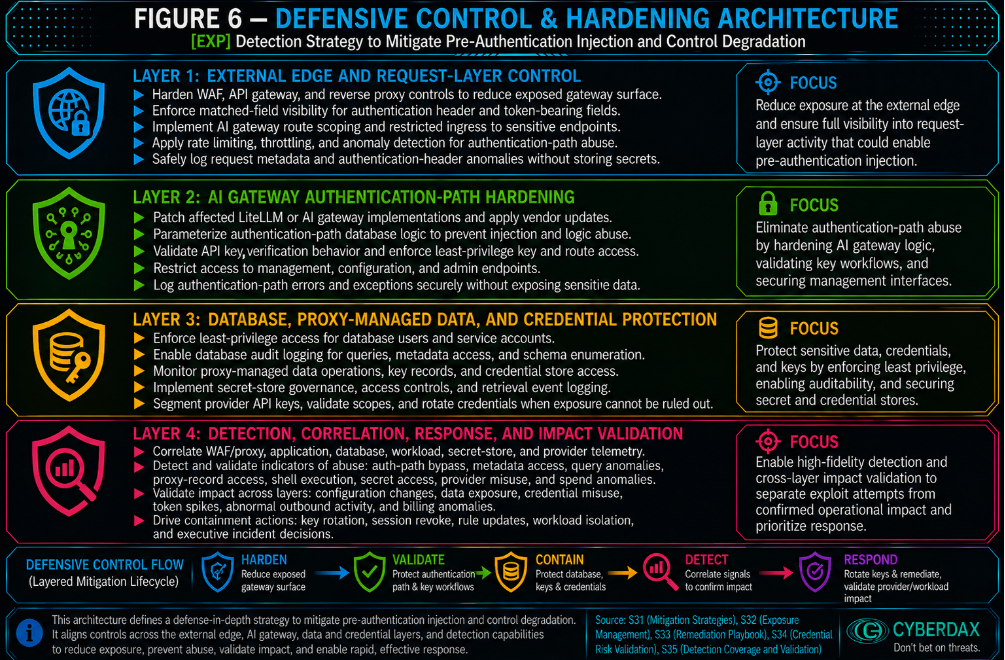
Figure 6
Architecture Objective
Defensive architecture should prevent malformed authentication material from reaching unsafe backend validation or database logic, reduce exposed AI gateway trust paths, limit credential blast radius, and preserve evidence across the full investigation chain.
External Access Layer
· API gateway, WAF, ingress control, rate limiting, source restrictions, and authenticated access controls.
· Inspection for malformed authentication material, SQL injection patterns, abnormal header structure, and unusual request behavior.
· Separation of public model invocation routes from administrative, provider-configuration, key-management, routing, and spend-management routes.
AI Gateway Application Layer
· Strict authentication-path validation before backend query logic.
· Parameterized query handling for key verification, routing, tenant lookup, and provider selection.
· Consistent error handling that does not expose database behavior or internal state.
· Logging that distinguishes malformed authentication input, ordinary invalid credentials, authentication failures, route behavior, and control-plane activity.
Database and Record Layer
· Least-privilege database service accounts.
· Separate runtime, administrative, migration, and reporting permissions.
· Audit logging for metadata access, schema enumeration, key records, credential records, provider records, tenant records, routing records, configuration records, and spend-management records.
· Detection for query behavior inconsistent with normal authentication-path validation.
Credential and Secret Layer
· Managed secret-store integration.
· Scoped provider keys and virtual keys.
· Segmented keys by tenant, application, environment, and provider.
· Rotation workflows for provider keys, virtual keys, master keys, database credentials, and cloud secrets.
· Secret access logging tied to gateway workload identity.
Provider Monitoring Layer
· Provider-side logs for key usage, model invocation, token volume, route behavior, tenant context, source infrastructure, and spend.
· Alerting for abnormal provider usage independent of gateway logs.
· Billing and quota controls to reduce financial impact from exposed keys.
Workload and Cloud Layer
· Runtime monitoring for gateway containers, hosts, and workloads.
· Egress controls for provider access, database access, secret-store access, and internal service access.
· Cloud identity least privilege and workload identity mapping.
· Monitoring for shell execution, cloud CLI use, Kubernetes interaction, metadata access, package retrieval, and abnormal outbound communication.
SOC and Incident Response Layer
· Correlation across request-layer, application, database, secret-store, workload, cloud, and provider telemetry.
· Playbooks that separate exploit attempt, backend database effect, credential exposure, provider misuse, and workload follow-on behavior.
· Escalation paths for credential rotation, provider review, workload isolation, legal review, customer assurance, and executive reporting.
Architecture Judgment
The defensive architecture should treat AI gateway authentication paths as high-value trust boundaries. Protection is strongest when exposed routes are minimized, authentication material is safely handled, backend database access is least-privileged and auditable, secrets are segmented, provider usage is independently monitored, and workload follow-on behavior can be validated quickly.
S35 Security Hardening Guidance
Exposure Hardening
· Remove unnecessary internet exposure from AI gateway and LLM proxy routes.
· Restrict public access to documented model invocation routes only.
· Place administrative, key-management, provider-configuration, team-management, routing, and spend-management functions behind separate authenticated access paths.
· Enforce source restrictions, API gateway policy, rate limits, WAF inspection, and request-size controls.
· Review non-production gateways for production-like credentials or public exposure.
Authentication-Path Hardening
· Validate Authorization headers, bearer tokens, API keys, token length, character set, encoding, and structure before backend interaction.
· Reject malformed authentication material before database lookup where feasible.
· Use parameterized queries for key verification, tenant lookup, provider selection, and routing policy.
· Normalize authentication error responses to prevent database or implementation detail leakage.
· Log malformed authentication attempts in a structured way that supports investigation without exposing sensitive secrets.
Database Hardening
· Apply least privilege to gateway database service accounts.
· Separate runtime read, runtime write, administrative, migration, and reporting privileges.
· Restrict access to key, credential, provider, tenant, routing, configuration, and spend-management records.
· Enable audit logging for metadata access, schema enumeration, abnormal query behavior, sensitive record access, and modification attempts.
· Review database permissions after gateway upgrades, migrations, provider integrations, and tenant onboarding.
Credential Hardening
· Store provider keys, virtual keys, database credentials, and cloud secrets in managed secret stores where feasible.
· Segment keys by environment, tenant, application, provider, and business purpose.
· Use short-lived or scoped credentials where provider and platform support allow.
· Remove stale, shared, overprivileged, or cross-environment credentials.
· Monitor key creation, export, update, deletion, unusual use, and abnormal provider access.
Provider Hardening
· Enable provider-side logging for key usage, model invocation, token consumption, source infrastructure, tenant context, route behavior, and spend.
· Apply provider-side quotas, billing limits, model restrictions, and key-level access controls.
· Separate provider accounts or keys for production, staging, development, and security testing.
· Alert on abnormal usage patterns, token spikes, unexpected models, unknown sources, and spend anomalies.
Workload Hardening
· Restrict gateway workload access to required databases, providers, secret stores, and internal services.
· Enforce egress controls and deny unnecessary outbound communication.
· Restrict shell access, cloud CLI availability, package managers, and administrative tooling in gateway runtime environments where feasible.
· Monitor access to environment variables, mounted secrets, credential files, metadata services, and secret-store APIs.
· Harden container, Kubernetes, and cloud workload identities with least privilege and clear ownership.
Operational Hardening
· Maintain current inventory of exposed AI gateways and LLM proxy services.
· Require security review for new externally reachable AI gateway routes.
· Document credential rotation procedures for provider keys, virtual keys, master keys, database credentials, and cloud secrets.
· Test incident response procedures for gateway compromise, database exposure, credential rotation, provider misuse, and workload follow-on behavior.
· Validate telemetry pipelines after gateway upgrades, provider integration changes, database migrations, and cloud architecture changes.
S36 Security Program Maturity Assessment
Current Maturity Assessment
Moderate by default for most organizations, with maturity moving lower or higher based on gateway inventory completeness, telemetry reliability, credential segmentation, provider visibility, and shared ownership across security, platform, cloud, application, and AI governance teams.
Maturity Basis
· Mature defense requires correlation across request-layer, application, database, secret-store, workload, cloud, and provider telemetry.
· Many organizations have partial visibility into gateway traffic but weaker visibility into malformed authentication material, backend database effects, provider-side usage, and workload follow-on behavior.
· AI gateway ownership is often distributed across multiple teams, which can delay remediation and impact determination.
· Credential concentration inside gateway environments can create risk faster than traditional application incident processes are prepared to resolve.
Low Maturity Indicators
· No authoritative inventory of AI gateway, LLM proxy, or OpenAI-compatible proxy services.
· Public exposure is not centrally reviewed.
· Authentication failures are logged generically without malformed-token context.
· Database service-account activity is not audited.
· Provider usage cannot be tied to key, tenant, route, model, source, or spend.
· Provider keys and virtual keys are shared across environments or applications.
· Secret-store and workload telemetry are incomplete.
· Incident response playbooks do not address AI gateway credential exposure or provider misuse.
Moderate Maturity Indicators
· Exposed gateway routes are inventoried and reviewed.
· Authentication-path logging distinguishes malformed input from ordinary invalid credentials.
· WAF or API gateway telemetry provides some matched-field visibility.
· Database audit logging exists for gateway service accounts and sensitive records.
· Provider usage and spend can be reviewed by key or route.
· Credential rotation procedures exist for major provider keys and virtual keys.
· Workload telemetry can identify obvious secret access, shell execution, package retrieval, or abnormal outbound communication.
· Incident response can separate exploit attempt from backend database effect and credential exposure.
High Maturity Indicators
· AI gateways are treated as critical trust-boundary infrastructure.
· Exposed routes, administrative endpoints, provider integrations, and tenant-routing paths are governed through formal review.
· Authentication-path input handling is standardized and tested.
· Database access is least-privileged, auditable, and correlated to gateway routes and service accounts.
· Provider usage is monitored independently from gateway logs.
· Provider keys and virtual keys are segmented, scoped, rotated, and monitored.
· Workload, cloud, secret-store, and provider telemetry are normalized for rapid incident determination.
· Playbooks define actions for exploit attempt, backend database effect, credential exposure, provider misuse, and workload follow-on behavior.
· Security, platform engineering, cloud operations, application engineering, and AI governance share ownership of AI gateway risk.
Maturity Improvement Priority
Organizations should prioritize moving from partial gateway visibility to evidence-based incident determination. The minimum defensible maturity target is the ability to prove whether suspicious authentication-path activity did or did not reach backend database records, expose credentials, trigger provider misuse, or produce workload follow-on behavior.
S37 Residual Risk and Forward Outlook

Figure 7
Residual Risk
Residual risk remains Moderate to High after patching or immediate mitigation because authentication-path injection is a behavior class, not a single-product issue. Fixing the confirmed anchor reduces one known path but does not eliminate similar weaknesses in adjacent AI gateway, LLM proxy, OpenAI-compatible proxy, orchestration, plugin, middleware, or gateway implementations. Residual risk is highest where gateways remain internet-exposed, credentials are concentrated, database audit coverage is incomplete, provider usage visibility is weak, or workload follow-on telemetry is unavailable.
Post-Remediation Risk Factors
· Unknown or unmanaged AI gateway deployments.
· Internet-exposed routes with unclear business ownership.
· Authentication-path input handling not validated across similar gateway implementations.
· Broad database privileges for gateway service accounts.
· Provider keys or virtual keys shared across tenants, applications, providers, or environments.
· Incomplete database audit logs for sensitive proxy-managed records.
· Limited provider-side usage and spend visibility.
· Incomplete workload, secret-store, cloud, container, or network telemetry.
· Inability to prove whether exposed credentials were accessed before patching.
Forward Outlook
Adversary interest in AI gateway infrastructure is expected to increase as enterprises centralize provider access, model routing, tenant controls, and AI spend governance through middleware layers. Authentication-path injection is especially valuable because it targets the point where external API traffic becomes trusted, authenticated, routed, and billed. Similar behavior is likely to recur across AI middleware, proxy, orchestration, plugin, and gateway ecosystems as adoption expands.
Expected Defensive Evolution
· Increased focus on AI gateway asset inventory and exposure management.
· More aggressive monitoring of authentication-path anomalies.
· Stronger database audit requirements for gateway service accounts.
· Greater segmentation of provider keys, virtual keys, tenants, and environments.
· Independent provider-side monitoring for unauthorized usage and spend anomalies.
· More mature incident playbooks for AI gateway compromise, credential exposure, and provider misuse.
· Expanded runtime monitoring for gateway workloads and secret access paths.
Residual Risk Judgment
Residual risk remains Moderate when exposure is reduced, affected implementations are patched, credentials are reviewed, provider usage is validated, and telemetry supports incident determination. Residual risk remains High when exposed gateways persist, credential exposure cannot be ruled out, provider logs are incomplete, database audit visibility is weak, or workload follow-on activity cannot be assessed.
Forward-Looking Executive Takeaway
AI gateway infrastructure should be treated as durable security control infrastructure, not a temporary integration layer. Organizations that centralize AI access through gateways must govern authentication-path security, backend database access, credential storage, provider usage, and workload runtime visibility as core enterprise security functions. The long-term defensive requirement is behavior-based detection and evidence-driven response for authentication-path injection across AI gateway and LLM proxy ecosystems.
S38 Attack Economics & Organizational Impact Model
The economic model reflects asymmetry between low attacker cost and increasing defender cost, driven by exposed AI gateway infrastructure, authentication-path reachability, backend database impact potential, credential concentration, provider-usage exposure, and detection timing as defined in S6 and S6A.
Adversary Economics
Low Cost of Execution
· Attackers can begin with exposed AI gateway, LLM proxy, or OpenAI-compatible proxy routes.
· Exploitation attempts can be delivered through normal API request paths.
· Malformed authentication material allows attacker activity to target trust-establishment logic before valid authentication is required.
· Active exploitation of the confirmed anchor increases the likelihood of payload reuse, scanning, and broader attacker adoption.
High Repeatability and Scale
· Standardized API routes and common gateway deployment patterns enable repeatable targeting across exposed environments.
· Internet-facing AI gateway services provide scalable discovery and probing opportunities.
· Similar authentication-path weaknesses may recur across AI middleware, proxy, orchestration, plugin, and gateway ecosystems.
· Attacker effort remains low when discovery, request delivery, and malformed authentication testing can be automated.
Credential and Provider-Access Value
· AI gateways may centralize provider keys, virtual keys, routing policy, tenant context, configuration data, and spend controls.
· Successful backend database access can create value beyond the initial vulnerable service.
· Exposed provider keys or virtual keys may retain value after the vulnerable path is patched.
· Unauthorized model usage, token consumption, or provider spend can create direct financial impact.
Defender Cost Dynamics
Cost Acceleration Drivers
· Detection delay increases investigation and containment scope.
· Incomplete database telemetry increases uncertainty around backend impact.
· Credential concentration increases rotation burden.
· Provider-side visibility gaps delay confirmation of unauthorized usage.
· Multi-tenant or multi-provider gateway use increases blast radius.
· Workload telemetry gaps make it harder to separate database impact from runtime compromise.
· Fragmented ownership across security, platform engineering, application engineering, cloud operations, and AI governance delays containment decisions.
Cost Containment Conditions
· Restricted gateway exposure reduces attacker reach.
· Safe authentication-path input handling removes the vulnerable trust path.
· Database least privilege limits record access and modification.
· Segmented provider keys and virtual keys reduce downstream blast radius.
· Strong provider-side monitoring identifies unauthorized model usage and spend anomalies.
· Workload and secret-store telemetry separate credential exposure from runtime compromise.
· Early correlation across request-layer, application, database, provider, and workload telemetry reduces investigation scope.
Economic Asymmetry
· Attacker cost remains low when exposed gateway routes can be discovered and tested remotely.
· Defender cost increases as exposed gateway scope expands.
· Defender cost increases when backend database impact cannot be quickly confirmed or ruled out.
· Defender cost increases when credential rotation affects providers, tenants, applications, environments, or automation workflows.
· Defender cost increases when provider-usage validation requires external logs, billing review, or key-level investigation.
· Defender cost increases when workload follow-on activity must be investigated across cloud, container, host, secret-store, and network telemetry.
· Defender cost increases when tenant, customer, contractual, regulatory, or compliance sensitivity expands response obligations.
· Active exploitation of the confirmed anchor increases attacker adoption pressure without requiring defenders to wait for KEV inclusion before prioritizing response.
S39 Economic Impact & Organizational Exposure
Figure 7
Impact Progression Model
Stage 1 Attempted Gateway Exploitation
· Malformed authentication material targets exposed AI gateway routes.
· Containment focuses on exposure validation, patching, WAF or API gateway review, and request-layer monitoring.
· Business impact is limited when telemetry confirms no backend database effect.
Stage 2 Backend Database Impact
· Authentication-path activity reaches backend validation or database logic.
· Investigation expands to database query behavior, metadata access, schema enumeration, and proxy-managed record access.
· Business impact increases because the organization must determine whether keys, credentials, configuration, tenant context, or spend controls were accessed or modified.
Stage 3 Credential and Provider Exposure
· Proxy-managed keys, provider credentials, virtual keys, database tokens, configuration records, or secret material may be exposed.
· Response expands into credential rotation, provider-usage review, spend validation, tenant-impact assessment, and customer assurance preparation.
· Financial exposure increases when provider keys can enable unauthorized model invocation or token consumption.
Stage 4 Conditional Workload or Cloud Follow-On
· Follow-on behavior may involve secret access, workload execution, cloud identity abuse, Kubernetes interaction, package retrieval, or abnormal outbound communication.
· This stage requires independent workload, cloud, endpoint, container, secret-store, or network evidence.
· Impact expands into broader infrastructure response only when telemetry supports runtime or cloud follow-on activity.
Organizational Exposure Drivers
· Internet-facing AI gateway, LLM proxy, or OpenAI-compatible proxy routes.
· Authentication material processed before backend validation or database interaction.
· Centralized provider keys, virtual keys, routing policy, tenant context, configuration data, and spend controls.
· Broad database privileges for gateway service accounts.
· Weak segmentation between gateway runtime, database, secret store, provider accounts, and internal services.
· Multi-provider or multi-tenant gateway architecture.
· Limited visibility into malformed authentication material and matched request fields.
· Incomplete database, provider, workload, secret-store, or cloud telemetry.
· Unclear ownership across platform, application, cloud, security operations, and AI governance teams.
Exposure Amplification Factors
· Active exploitation of the confirmed anchor increases attacker attention and payload reuse.
· AI gateway adoption increases the number of reachable middleware and orchestration targets.
· Standardized API routes enable repeatable scanning and exploitation attempts.
· Credential concentration increases downstream value from backend database access.
· Provider-side monitoring gaps delay confirmation of unauthorized model use or spend abuse.
· Telemetry gaps increase response scope because higher-impact outcomes may be difficult to disprove.
· Multi-tenant or multi-provider environments increase business and operational blast radius.
Exposure Reduction Factors
· Strict access control over AI gateway and LLM proxy routes.
· Separation of public model invocation paths from administrative and key-management functions.
· Safe authentication-path input handling and parameterized backend queries.
· Least-privilege database service accounts.
· Segmented provider keys, virtual keys, tenants, applications, and environments.
· Provider-side usage and spend monitoring independent of gateway logs.
· Workload, secret-store, cloud, and network visibility for follow-on validation.
· Tested incident playbooks for exploit attempt, database effect, credential exposure, provider misuse, and workload follow-on behavior.
Organizational Impact Judgment
The highest organizational exposure occurs when an internet-facing AI gateway combines authentication-path weakness, backend database access, credential concentration, weak provider monitoring, and incomplete workload telemetry. The most important economic transition is from request-layer exploit attempt to backend database effect. The most important business-impact transition is from backend database effect to credential-bearing record access or provider-key misuse. Workload compromise and remote code execution remain separate findings that require independent evidence.
S40 References
Vendor Advisory
· GitHub Security Advisory — SQL Injection in Proxy API Key Verification — GHSA-r75f-5x8p-qvmc
hxxps[:]//github[.]com/BerriAI/litellm/security/advisories/GHSA-r75f-5x8p-qvmc
Vulnerability Records
· GitHub Advisory Database — GHSA-r75f-5x8p-qvmc
hxxps[:]//github[.]com/advisories/GHSA-r75f-5x8p-qvmc
Known Exploited Vulnerabilities (KEV)
· CISA Known Exploited Vulnerabilities Catalog
hxxps[:]//www[.]cisa[.]gov/known-exploited-vulnerabilities-catalog
Security Vendor Analysis
· Sysdig — CVE-2026-42208: Targeted SQL Injection Against LiteLLM’s Authentication Path Discovered 36 Hours Following Vulnerability Disclosure
hxxps[:]//www[.]sysdig[.]com/blog/cve-2026-42208-targeted-sql-injection-against-litellms-authentication-path-discovered-36-hours-following-vulnerability-disclosure
· BleepingComputer — Hackers Are Exploiting a Critical LiteLLM Pre-Auth SQLi Flaw
hxxps[:]//www[.]bleepingcomputer[.]com/news/security/hackers-are-exploiting-a-critical-litellm-pre-auth-sqli-flaw/
ATT&CK Framework
· MITRE ATT&CK Enterprise Matrix / Technique Catalog
hxxps[:]//attack[.]mitre[.]org/
