
Report Type: EXP
Threat Category: Public-Facing Application Exploitation / Trusted-Site Delivery Abuse
Assessment Date: May 27, 2026
Latest Amendment Date: August 10, 2026
Primary Impact Domain: Trusted Publishing Infrastructure and User-Exposure Risk
Secondary Impact Domains:
Endpoint Security, Credential and Token Exposure, SaaS Access, Cloud Access, Developer-Platform Exposure, Customer Trust, and Operational Continuity
Affected Asset Class: Internet-Facing Ghost CMS Deployments, Ghost-Hosted Publishing Sites, Trusted Content Delivery Surfaces, User Endpoints, Identity and Cloud-Connected Accounts
Threat Objective Classification: Trusted-Site Delivery, ClickFix-Style User Execution, Credential and Token Access Enablement, and Downstream Account Abuse Risk
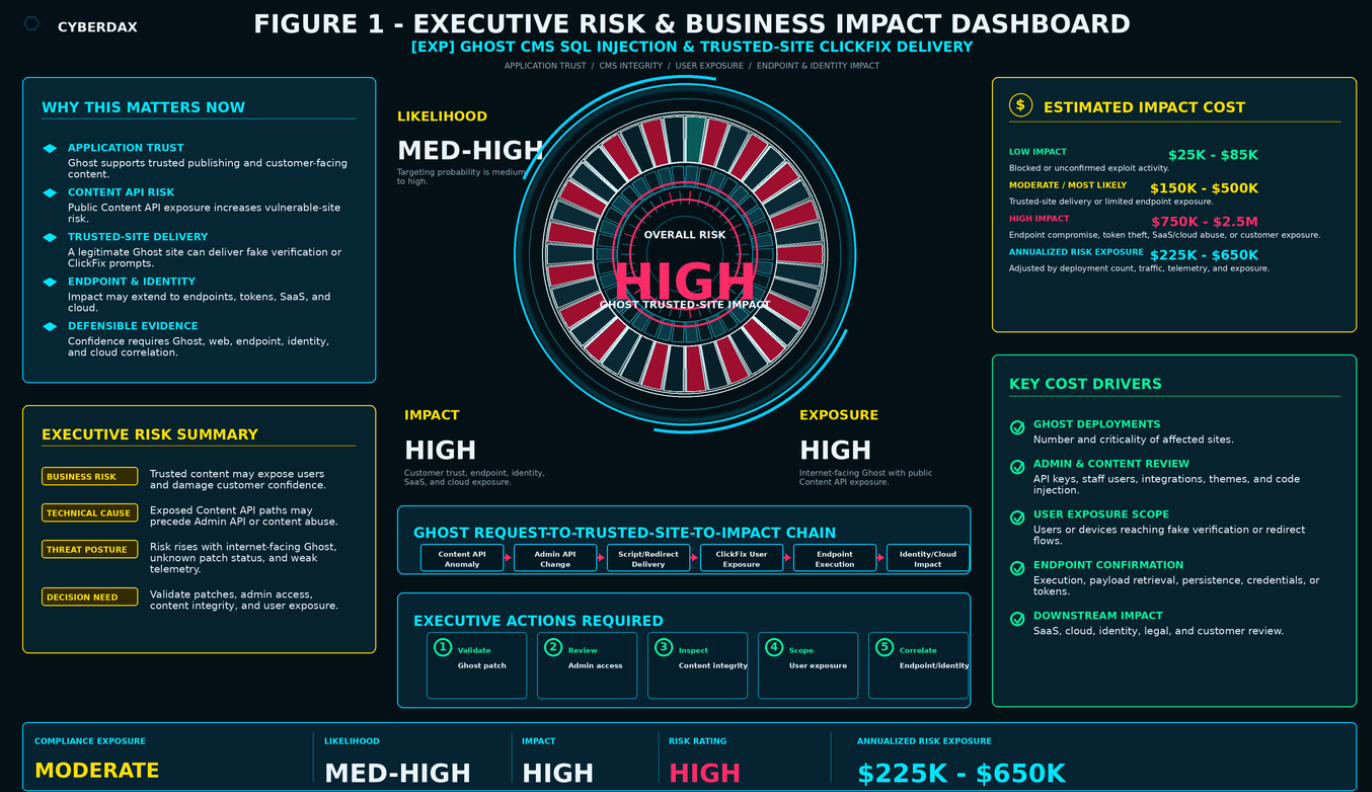
BLUF
Ghost CMS SQL Injection and Trusted-Site ClickFix Delivery creates business risk by turning trusted publishing infrastructure into a potential user-exposure and malware-delivery pathway. The material risk is not limited to exploitation of a vulnerable Ghost CMS deployment; it is the downstream conversion of a legitimate site into a delivery surface for fake verification, fake CAPTCHA, browser-check, or clipboard-instruction flows that may lead users toward endpoint execution, credential exposure, token exposure, or follow-on cloud and SaaS abuse.
Executive Risk Translation
This activity should be understood as an application-trust failure with downstream endpoint and identity consequences. If a Ghost-powered site is compromised or manipulated, users may interact with malicious delivery content because the site appears legitimate, previously trusted, and operationally normal. Executive decision-making should focus on patch posture, application integrity, administrative access control, trusted-site monitoring, endpoint visibility, and incident-response readiness rather than treating this as a narrow web-application vulnerability.
S3 — Why This Matters Now
· Ghost CMS is commonly used for trusted publishing, newsletters, blogs, marketing sites, documentation portals, and customer-facing content.
· Public Content API exposure can create an exploitable application path when vulnerable versions remain internet-facing or compensating controls are incomplete.
· A compromised trusted site can create higher user-exposure risk than a newly registered malicious domain because users, customers, employees, and partners may be more likely to trust the source.
· ClickFix-style delivery increases risk by pushing users toward manual command execution through fake verification, fake CAPTCHA, browser-check, or clipboard-instruction flows.
· Operational impact can extend beyond the Ghost deployment into endpoints, credentials, SaaS accounts, cloud environments, developer platforms, and customer trust.
· Detection requires staged correlation across web, application, proxy, DNS, browser, endpoint, identity, cloud, and SIEM telemetry.
· Organizations with weak Ghost inventory, incomplete Content API visibility, limited Admin API audit depth, or poor endpoint-to-identity correlation may struggle to reconstruct exposure timelines after suspicious activity.
S4 — Key Judgments
· Ghost CMS SQL injection-like activity should be treated as an exploit-attempt signal unless correlated with Admin API activity, content modification, trusted-site delivery, endpoint execution, or incident-response evidence.
· Risk increases when a vulnerable or unknown-version Ghost deployment is internet-facing, exposes public Content API routes, lacks strong WAF or reverse-proxy controls, or has incomplete application logging.
· Business impact increases when Ghost-hosted content is trusted by customers, employees, partners, subscribers, or external users.
· The highest operational risk occurs when suspicious Content API activity is followed by Admin API misuse, content modification, external script insertion, redirect-chain behavior, fake verification delivery, or endpoint-side execution.
· Endpoint compromise should not be assumed from a trusted-site visit or fake verification page alone.
· Confidence increases only when user exposure is linked to suspicious command execution, payload retrieval, persistence, credential access, token access, or command-and-control-like behavior.
· Cloud, SaaS, identity, and developer-platform anomalies should be treated as downstream investigative leads unless they are temporally and behaviorally linked to Ghost-hosted delivery, endpoint execution, credential theft, token theft, or incident-response evidence.
· The organization’s defensive priority should be to reduce trusted-site delivery risk, validate Ghost patch posture, preserve content-change evidence, and strengthen endpoint and identity correlation.
S5 — Executive Risk Summary
Business Risk
A compromised Ghost CMS deployment can undermine trust in public-facing content and expose users to malicious delivery flows from a legitimate site. This creates business risk across customer trust, brand integrity, endpoint security, credential exposure, SaaS access, cloud access, legal review, customer notification, and operational response.
Technical Cause
The technical risk centers on a vulnerable or exposed Ghost CMS Content API path that may enable SQL injection-like activity, followed by possible Admin API abuse, content modification, JavaScript insertion, redirect-chain activation, or trusted-site delivery of fake verification and ClickFix-style user-execution prompts.
Threat Posture
The threat posture is elevated for organizations that operate internet-facing Ghost deployments, rely on Ghost-hosted content for customer communication, have incomplete Ghost version tracking, lack strong WAF, CDN, or reverse-proxy telemetry, or cannot correlate Ghost-side activity with endpoint and identity behavior.
Executive Decision Requirement
Executives should prioritize Ghost patch validation, Ghost asset inventory, administrative access review, Admin API key rotation readiness, content-integrity monitoring, endpoint visibility, and user-exposure scoping. The decision requirement is whether to treat Ghost-hosted content as a monitored trust boundary rather than a passive publishing system.
S6 — Executive Cost Summary
Low Impact Scenario
Suspicious Content API activity or trusted-site delivery indicators are detected early, but no confirmed Ghost content tampering, endpoint execution, credential theft, token theft, or downstream cloud and SaaS abuse is validated.
Estimated Impact
$25,000 to $85,000.
Cost Drivers Include
· Ghost version validation and patch verification.
· WAF, CDN, reverse proxy, and web log review.
· Content-integrity review for articles, pages, themes, templates, and code-injection settings.
· Admin API key review and staff-user validation.
· Limited endpoint and proxy scoping for exposed users.
· Short-duration incident-response coordination.
· Internal communications and executive reporting.
Moderate Impact Scenario
Ghost content tampering or trusted-site delivery is validated, and one or more users or devices show suspicious exposure or endpoint execution, but credential theft, token theft, cloud compromise, SaaS compromise, or broad customer impact is not confirmed.
Estimated Impact
$150,000 to $500,000.
Cost Drivers Include
· Ghost content restoration and integrity validation.
· Admin API key rotation and staff-user review.
· Endpoint triage for exposed users or devices.
· Proxy, DNS, browser, and secure web gateway exposure reconstruction.
· Malware analysis or payload triage where recovered artifacts exist.
· Legal and communications review for possible customer, subscriber, or partner exposure.
· Additional monitoring for credential, token, SaaS, cloud, or developer-platform misuse.
· Temporary operational disruption to publishing, marketing, newsletter, documentation, or customer communication workflows.
High Impact Scenario
Ghost-hosted delivery leads to confirmed endpoint compromise, credential theft, token theft, downstream SaaS or cloud abuse, customer exposure, public trust impact, or recurring content reinfection after cleanup.
Estimated Impact
$750,000 to $2,500,000.
Cost Drivers Include
· Full incident-response investigation across Ghost, endpoint, identity, SaaS, cloud, and developer-platform telemetry.
· Endpoint containment, forensics, eradication, and recovery.
· Credential and token revocation across affected users, administrators, service accounts, and integrations.
· Ghost platform restoration, content integrity validation, and administrative hardening.
· Customer, subscriber, partner, or regulator communications where exposure thresholds are met.
· Legal review, outside counsel, digital forensics, and crisis communications support.
· Business interruption affecting publishing, customer communication, marketing, support, documentation, or subscription workflows.
· Residual monitoring for reinfection, token reuse, cloud abuse, SaaS abuse, or follow-on intrusion activity.
S6A — Key Cost Drivers
· Number and business criticality of affected Ghost deployments.
· Whether the Ghost deployment is self-hosted, managed, CDN-fronted, reverse-proxied, or externally maintained.
· Availability of Ghost Content API, Admin API, content-change, code-injection, staff-user, integration, and theme-change telemetry.
· Scope of trusted-site user exposure.
· Number of users or devices that interacted with fake verification, fake CAPTCHA, browser-check, redirect-chain, or payload-staging flows.
· Whether endpoint execution, payload retrieval, persistence, credential access, token access, or command-and-control-like behavior is confirmed.
· Whether compromised credentials or tokens are linked to SaaS, cloud, identity, or developer-platform activity.
· Ability to reconstruct the exposure timeline across Ghost, WAF, CDN, reverse proxy, proxy, DNS, browser, endpoint, identity, and cloud telemetry.
· Required customer, subscriber, partner, legal, regulatory, or executive communications.
· Duration of business disruption to publishing, marketing, support, documentation, newsletter, or customer communication workflows.
Most Likely Scenario Justification
The most likely scenario is moderate impact for organizations with internet-facing Ghost deployments and meaningful user traffic because the highest-cost investigation work begins when trusted-site delivery, suspicious redirects, or endpoint exposure must be scoped. Cost may remain low if activity is limited to blocked exploit attempts or unconfirmed suspicious Content API behavior. Cost moves higher if Ghost content tampering is confirmed, multiple users are exposed, endpoint execution is validated, credentials or tokens are accessed, or downstream SaaS, cloud, identity, or developer-platform activity requires investigation.
S6B — Compliance and Risk Context
Compliance Exposure Indicator
Moderate.
Compliance exposure depends on whether trusted-site delivery exposed customers, subscribers, employees, partners, or regulated user populations to malicious content, endpoint compromise, credential theft, token theft, or downstream account misuse. Exposure increases when user interaction, endpoint execution, data access, account compromise, or customer notification thresholds are validated.
Risk Register Entry
Risk Title
Ghost CMS Trusted-Site Delivery and Downstream User-Exposure Risk
Risk Description
A vulnerable or compromised Ghost CMS deployment may be converted into trusted delivery infrastructure through Content API exploitation, Admin API misuse, content modification, malicious script insertion, redirect-chain behavior, or fake verification delivery. This may expose users to ClickFix-style execution prompts and create downstream risk to endpoints, credentials, tokens, SaaS platforms, cloud environments, developer platforms, customer trust, and operational continuity.
Likelihood
Medium.
Impact
High.
Risk Rating
High.
Annualized Risk Exposure
Estimated annualized risk exposure is $225,000 to $650,000 for organizations with internet-facing Ghost deployments, meaningful user traffic, and moderate telemetry coverage. This estimate should be locally adjusted based on deployment count, user exposure, telemetry maturity, customer-facing use, regulatory context, and confirmed incident history.
S7 — Risk Drivers
· Internet-facing Ghost deployments with vulnerable or unknown patch posture.
· Public Content API availability without sufficient WAF, CDN, reverse proxy, or logging coverage.
· Weak Admin API key governance, incomplete staff-user review, or insufficient integration oversight.
· Limited visibility into Ghost article, page, theme, template, integration, staff-user, webhook, and code-injection changes.
· Use of Ghost-hosted content for customer, subscriber, partner, or employee communication.
· Frequent publishing, marketing, analytics, tag-management, newsletter, or site-customization workflows that may obscure malicious content changes.
· Incomplete proxy, DNS, browser, secure web gateway, or NDR visibility for trusted-site delivery and redirect-chain reconstruction.
· Incomplete endpoint telemetry for browser-adjacent execution, payload retrieval, persistence, credential access, token access, and outbound communication.
· Weak identity-to-endpoint correlation for downstream SaaS, cloud, identity, or developer-platform activity.
· Limited incident-response readiness for content integrity review, Admin API key rotation, staff-user validation, endpoint scoping, and customer-exposure assessment.
S8 — Bottom Line for Executives
Ghost CMS SQL Injection and Trusted-Site ClickFix Delivery should be managed as a trusted-content and user-exposure risk, not only as a CMS vulnerability. Business risk increases when a legitimate Ghost-powered site becomes a delivery point for fake verification or ClickFix-style user execution. Executive action should focus on patch validation, trusted-site integrity, administrative access control, endpoint visibility, and exposure scoping so the organization can determine whether activity remained an attempted exploit, became Ghost-side compromise, or progressed into endpoint and identity risk.
S9 — Board-Level Takeaway
A compromised trusted publishing platform can convert normal business content into an attack delivery channel. The board-level concern is whether the organization can prove that Ghost-hosted content remains trustworthy, that exposed users can be scoped quickly, and that endpoint, identity, SaaS, and cloud activity can be correlated if malicious delivery occurs. The recommended posture is to validate Ghost patch status, strengthen administrative controls, monitor content integrity, and preserve the telemetry needed to distinguish exposure from confirmed compromise.
S10 — Threat Overview

Figure 2
Ghost CMS SQL Injection and Trusted-Site ClickFix Delivery is a staged application-trust threat model in which an exposed or vulnerable Ghost CMS deployment may be abused to support trusted-site delivery of malicious user-execution lures. The risk begins with suspicious Content API activity against Ghost CMS infrastructure and increases when that activity is followed by Admin API access, content modification, JavaScript insertion, redirect-chain behavior, fake verification delivery, or endpoint-side ClickFix execution.
The threat should not be understood as a single web exploit or a single endpoint event. The operational concern is the conversion of a legitimate publishing site into a trusted delivery surface. Once users interact with compromised or manipulated Ghost-hosted content, malicious delivery flows may attempt to push them toward fake verification, fake CAPTCHA, browser-check, clipboard-instruction, or other ClickFix-style execution paths.
This activity creates risk across application trust, endpoint security, credential exposure, token exposure, SaaS access, cloud access, developer-platform access, and customer confidence. Confidence increases when suspicious Ghost-side activity is linked to trusted-site delivery behavior and endpoint-side execution evidence. A vulnerable Ghost version, WAF alert, trusted-site visit, fake verification page, endpoint command, or cloud anomaly should not be treated as confirmed compromise by itself.
S11 — Threat Classification and Type
Threat Type
Application exploitation and trusted-site delivery abuse.
Threat Sub-Type
CMS compromise pathway with downstream ClickFix-style user-execution risk.
Operational Classification
Staged application-to-endpoint compromise pathway involving suspicious Ghost Content API activity, potential Admin API misuse, content modification, trusted-site delivery, endpoint execution, and possible downstream credential, token, SaaS, cloud, or developer-platform exposure.
Primary Function
Convert trusted Ghost-hosted content into a delivery mechanism that can expose users to fake verification, fake CAPTCHA, browser-check, clipboard-instruction, redirect-chain, external loader, or payload-staging flows.
S12 — Campaign or Activity Overview
The activity model centers on suspicious interaction with Ghost CMS infrastructure followed by potential trusted-site delivery and endpoint-side execution. The initial stage may involve Content API SQL injection-like request behavior against vulnerable or unknown-version Ghost deployments. Risk increases when suspicious Content API behavior is followed by Admin API activity, content modification, code-injection changes, theme changes, staff-user activity, integration activity, webhook changes, or external script insertion.
The delivery stage may involve Ghost-hosted pages serving newly introduced JavaScript, suspicious redirect chains, fake verification pages, fake CAPTCHA pages, fake Cloudflare-themed pages, browser-check pages, clipboard-instruction pages, external loaders, or payload-staging destinations. Because the content is delivered from a previously trusted site, users may be more likely to interact with the lure.
The endpoint stage may involve browser-adjacent PowerShell, command-shell, script-host execution, archive retrieval, payload retrieval, DLL loading, loader execution, persistence, credential access, token access, or command-and-control-like behavior. Downstream SaaS, cloud, identity, and developer-platform activity should be treated as related only when it is temporally and behaviorally linked to Ghost-hosted delivery, endpoint execution, credential theft, token theft, or incident-response evidence.
This report does not require unsupported actor attribution. The detection and risk model is based on observable behavior, exposure conditions, trusted-site delivery patterns, and endpoint-side follow-on activity.
S13 — Targets and Exposure Surface
The primary exposure surface is internet-facing Ghost CMS infrastructure, especially self-hosted or externally maintained deployments with public Content API availability, vulnerable or unknown patch posture, incomplete WAF coverage, incomplete CDN or reverse-proxy visibility, or limited application logging.
Affected technology and workflow areas include Ghost CMS sites, Ghost Content API routes, Ghost Admin API routes, article and page publishing workflows, theme and template management, global code-injection settings, staff-user administration, integrations, webhooks, newsletter and subscription workflows, analytics scripts, tag-management workflows, and customer-facing publishing channels.
Affected user populations may include site administrators, content managers, marketing teams, customer-support teams, subscribers, customers, employees, partners, and external visitors who trust the Ghost-hosted content. Exposure risk increases when users interact with fake verification, fake CAPTCHA, browser-check, clipboard-instruction, redirect-chain, external loader, or payload-staging flows.
Steam discussion-forum ClickFix activity expands the exposure surface to users who trust public support threads, troubleshooting discussions, or community guidance hosted on a legitimate platform. The delivery path may impersonate technical support or remediation instructions and direct users to copy or execute PowerShell commands, including commands run with administrative privileges, that retrieve and install XMRig or related payloads. Exposure is highest where users can follow unverified support guidance, manually copy commands from browser content, launch elevated PowerShell, or execute retrieved content without application-control, browser-to-shell, command-line, or endpoint-behavior validation.
Downstream dependencies may include managed endpoints, browser telemetry, endpoint detection and response platforms, identity providers, SaaS applications, cloud environments, developer platforms, CI/CD systems, and credential or token stores. These downstream systems should not be treated as compromised by default, but they become relevant when endpoint execution or credential-access evidence is validated.
S14 — Sectors / Countries Affected
Sectors Affected
· Organizations operating Ghost-powered publishing sites, blogs, documentation portals, marketing sites, newsletter platforms, subscription content, or customer-facing communications.
· Media, technology, SaaS, fintech, education, nonprofit, professional services, security, and digital publishing organizations may face elevated exposure when Ghost-hosted content is trusted by users, customers, subscribers, partners, or employees.
· Organizations that consume trusted third-party Ghost-hosted content may also face user-exposure risk even if they do not directly operate the affected Ghost infrastructure.
Countries Affected
Global.
Ghost CMS is internet-facing and broadly deployable across regions. Geographic exposure should be treated as global unless incident-specific evidence restricts activity to a particular country, hosting region, customer base, or affected site population.
S15 — Adversary Capability Profiling
Capability Level
Moderate to high.
The activity requires the ability to identify exposed Ghost CMS infrastructure, interact with Content API attack surface, potentially abuse Admin API or content-modification paths, and convert trusted content into user-execution delivery infrastructure. Capability assessment increases when activity shows staged exploitation, delayed reuse, content modification, script insertion, redirect-chain management, and endpoint follow-on behavior.
Technical Sophistication
Moderate.
The technical model does not require highly novel malware to create business impact. Risk comes from chaining application exposure, trusted-site delivery, social engineering, and endpoint execution. Sophistication increases when the activity avoids static indicators, rotates delivery infrastructure, uses trusted domains, delays execution, or blends content changes into legitimate publishing and marketing workflows.
Infrastructure Maturity
Moderate.
Infrastructure maturity may include compromised trusted sites, redirect chains, fake verification pages, external loaders, payload-staging infrastructure, newly observed domains, cloud or hosting platforms, direct IP destinations, dynamic DNS, or infrastructure that blends with normal web-delivery patterns.
Operational Scale
Variable.
Operational scale may be limited to a single Ghost deployment, but it can expand quickly when a trusted Ghost-hosted site serves content to a large user population. Scale also increases when the same delivery flow reaches multiple users, multiple devices, subscribers, customers, employees, partners, or downstream organizations that trust the site.
Escalation Likelihood
Conditional.
Escalation likelihood increases when suspicious Content API activity is followed by Admin API access, content modification, external script insertion, trusted-site delivery, endpoint execution, credential access, token access, or downstream SaaS and cloud activity. Escalation likelihood remains lower when activity is limited to blocked requests, isolated scanning, or unconfirmed suspicious traffic without follow-on evidence.
S16 — Targeting Probability Assessment
Overall Targeting Probability
Medium to high for organizations operating internet-facing Ghost deployments with public Content API availability, vulnerable or unknown patch posture, incomplete logging, and meaningful user traffic.
Targeting Drivers
· Internet-facing Ghost CMS deployments.
· Ghost deployments earlier than version 6.19.1 or deployments with unknown patch posture.
· Public Content API exposure.
· Weak or incomplete WAF, CDN, reverse proxy, and web application logging.
· Incomplete Ghost Admin API, content-change, staff-user, integration, theme, webhook, and code-injection visibility.
· High-trust Ghost-hosted content viewed by customers, subscribers, employees, partners, or external users.
· Publishing, marketing, analytics, tag-management, or newsletter workflows that make external scripts and content changes harder to distinguish from malicious modification.
· Endpoint environments where browser-adjacent PowerShell, command-shell, script-host, archive retrieval, or payload retrieval activity may be difficult to baseline.
· Identity, SaaS, cloud, or developer-platform dependencies that could be affected if endpoint execution leads to credential or token access.
Most Likely Targets
· Self-hosted Ghost CMS deployments with internet-facing Content API routes.
· Ghost-powered publishing sites with meaningful user trust or recurring readership.
· Customer-facing marketing, newsletter, documentation, support, or subscription content portals.
· Organizations with limited Ghost asset inventory, limited version validation, or limited application telemetry.
· Environments where trusted-site delivery can expose employees, customers, subscribers, partners, or administrators to ClickFix-style execution prompts.
S17 — MITRE ATT&CK Chain Flow Mapping
Stage 1 — Public-Facing Ghost CMS Exposure
Suspicious activity may begin with discovery or interaction against internet-facing Ghost CMS infrastructure, especially deployments with public Content API availability and vulnerable or unknown patch posture.
· ATT&CK mapping: Gather Victim Host Information T1592.
· Confidence: Conditional. Exposure and discovery are inferred from interaction with public Ghost infrastructure and should not be treated as exploitation by themselves.
Stage 2 — Content API Exploitation Attempt
The activity may involve SQL injection-like Content API requests, abnormal query structures, malformed filters, encoded operators, response anomalies, WAF SQL injection context, or backend instability.
· ATT&CK mapping: Exploit Public-Facing Application T1190.
· Confidence: High when suspicious Content API behavior is observed against a vulnerable or unknown-version Ghost deployment; lower when only generic scanning or blocked traffic is present.
Stage 3 — Administrative Control or Content Modification
Risk increases when suspicious Content API activity is followed by Admin API access, administrative-route activity, staff-user changes, integration changes, webhook changes, theme changes, code-injection changes, or article and page modification.
· ATT&CK mapping: Account Manipulation T1098.
· Confidence: Conditional. Administrative activity should be treated as malicious only when source, timing, action, route, integration, content-change context, or baseline deviation supports escalation.
Stage 4 — Trusted-Site Script or Redirect Delivery
A manipulated Ghost-hosted page may introduce external scripts, redirect chains, fake verification pages, fake CAPTCHA pages, fake Cloudflare-themed pages, browser-check pages, clipboard-instruction content, or payload-staging destinations.
· ATT&CK mapping: Drive-by Compromise T1189.
· Confidence: High when trusted Ghost-hosted content is linked to suspicious redirect, script-loading, fake verification, or payload-staging behavior.
Stage 5 — User Execution Through ClickFix-Style Interaction
Endpoint-side activity may occur when a user follows fake verification or clipboard-instruction prompts and runs browser-adjacent PowerShell, command shell, script-host, archive retrieval, payload retrieval, or loader execution.
· ATT&CK mapping: User Execution T1204.
· Confidence: High when browser-adjacent execution is temporally linked to Ghost-hosted exposure, suspicious redirect-chain evidence, fake verification delivery, payload retrieval, or endpoint follow-on behavior.
Stage 6 — Payload Retrieval and Execution
The endpoint may retrieve scripts, archives, DLLs, executables, shortcut files, installers, or loader components from newly observed, suspicious, direct-IP, low-reputation, or payload-staging infrastructure.
· ATT&CK mapping: Ingress Tool Transfer T1105.
· Confidence: Conditional. Payload retrieval supports escalation when linked to Ghost-hosted delivery, suspicious execution, loader behavior, persistence, credential access, token access, or incident-response evidence.
Stage 7 — Persistence, Credential Access, or Token Access
Post-execution activity may include persistence creation, browser-data access, credential-store access, token access, suspicious credential harvesting, or follow-on access using legitimate credentials or sessions.
· ATT&CK mapping: Credentials from Password Stores T1555.
· Confidence: Conditional. Credential or token access should be validated with endpoint, identity, SaaS, cloud, or incident-response evidence before being attributed to the Ghost delivery chain.
Stage 8 — Downstream SaaS, Cloud, Identity, or Developer-Platform Activity
If credentials or tokens are exposed, downstream activity may appear in SaaS, cloud, identity, developer-platform, CI/CD, or control-plane telemetry.
· ATT&CK mapping: Valid Accounts T1078.
· Confidence: Conditional. Downstream anomalies should not be attributed to this activity unless upstream Ghost-hosted delivery and endpoint or credential-access linkage are validated.
S18 — Attack Path Narrative
Signal-Aligned Execution Flow
The Ghost CMS SQL Injection and Trusted-Site ClickFix Delivery attack path should be understood as a staged progression from exposed application surface to trusted-site delivery and potential endpoint execution. The risk does not come from a single suspicious request, a single WAF alert, a single fake verification page, or a single endpoint command. The risk increases when multiple stages align across Ghost application telemetry, edge telemetry, content-change records, user-exposure telemetry, and endpoint evidence.
The first stage begins with an exposed Ghost CMS deployment. Risk is highest when the deployment is internet-facing, exposes public Content API routes, has vulnerable or unknown patch posture, lacks complete WAF or reverse-proxy visibility, or does not preserve enough application telemetry to reconstruct suspicious Content API activity.
The second stage involves suspicious Ghost Content API behavior. This may include abnormal filter syntax, malformed slug handling, encoded operators, nested expressions, unusual ordering behavior, timing-oriented request behavior, backend errors, abnormal response sizes, WAF SQL injection context, or repeated request variation. This stage should be treated as exploit-attempt evidence unless it is paired with stronger Ghost-side or downstream evidence.
The third stage involves possible administrative control or content modification. Risk increases when suspicious Content API activity is followed by Ghost Admin API access, administrative-route activity, staff-user changes, integration changes, webhook changes, theme modification, code-injection changes, article updates, page updates, or compressed-window publishing behavior from unfamiliar infrastructure or abnormal source context.
The fourth stage involves trusted-site delivery. If a Ghost-hosted page is modified to introduce external JavaScript, suspicious redirect logic, fake verification content, fake CAPTCHA content, fake Cloudflare-themed content, browser-check content, clipboard-instruction text, or payload-staging links, the compromised site can become a delivery surface that users are likely to trust.
The fifth stage involves user exposure. Users may encounter fake verification, fake CAPTCHA, browser-check, clipboard-instruction, external loader, suspicious redirect, or payload-staging flows from a previously trusted Ghost-powered site. A visit to the page does not prove endpoint compromise. Exposure becomes more significant when multiple users or devices receive the same suspicious delivery chain or when browser, proxy, DNS, or secure web gateway telemetry links the user session to suspicious follow-on infrastructure.
The sixth stage involves endpoint-side execution. Risk increases when endpoint telemetry shows browser-adjacent PowerShell, command-shell, script-host activity, archive retrieval, payload retrieval, DLL loading, loader execution, or suspicious child processes after Ghost-hosted exposure. Endpoint compromise should not be confirmed unless execution, payload behavior, persistence, credential access, token access, command-and-control-like behavior, or incident-response evidence supports that conclusion.
The final stage involves downstream expansion. If endpoint execution leads to credential theft, token theft, SaaS access anomalies, cloud control-plane activity, developer-platform access, or identity abuse, those signals should be treated as downstream investigative leads until they are linked to upstream Ghost-hosted delivery and endpoint or credential-access evidence.
Execution Flow
· Exposed or vulnerable Ghost CMS deployment is reachable from the internet.
· Suspicious Content API activity targets the Ghost deployment.
· WAF, CDN, reverse proxy, web server, or application telemetry may show SQL injection-like behavior, abnormal request structure, backend instability, or response anomalies.
· Admin API access or administrative-route activity occurs after suspicious Content API behavior.
· Ghost content, theme, template, integration, webhook, staff-user, or code-injection settings are modified.
· Ghost-hosted content begins delivering suspicious scripts, redirects, fake verification content, fake CAPTCHA content, browser-check prompts, clipboard-instruction text, or payload-staging links.
· Users or devices interact with the trusted Ghost-hosted content.
· Endpoint telemetry shows browser-adjacent command execution, payload retrieval, loader execution, or other suspicious follow-on behavior.
· Credential, token, SaaS, cloud, identity, or developer-platform activity becomes relevant only when linked to endpoint execution or credential-access evidence.
Interpretation Guardrails
· Suspicious Content API activity alone does not prove successful exploitation.
· WAF SQL injection context alone does not prove database read, Admin API key exposure, or Ghost content tampering.
· Admin API activity alone does not prove malicious administration unless source, timing, route, action, content-change context, or baseline deviation supports escalation.
· Trusted Ghost-site delivery alone does not prove endpoint compromise.
· Fake verification delivery alone does not prove user execution.
· Endpoint PowerShell or command-shell execution alone does not prove Ghost-delivered compromise.
· Cloud, SaaS, identity, or developer-platform anomalies should not be attributed to this activity without upstream Ghost-hosted delivery and endpoint or credential-access linkage.
S19 — Attack Chain Risk Amplification Summary
Risk Amplification Overview
Risk amplifies because the attack path can cross multiple trust boundaries. A Ghost CMS deployment may begin as a web-application exposure, but the impact can expand into public content integrity, user trust, endpoint execution, credential exposure, token exposure, SaaS access, cloud access, developer-platform access, legal review, and customer communications.
The core amplification point is trust. A malicious domain may be easier for users, browsers, proxies, and security controls to distrust. A legitimate Ghost-hosted site may already be trusted by customers, employees, subscribers, partners, or public visitors. If that trusted content is modified, the attacker gains a delivery channel that can bypass user suspicion and complicate security triage.
Application Trust Amplification
· A vulnerable or manipulated Ghost deployment can convert normal publishing infrastructure into a malicious delivery pathway.
· Content manipulation can affect articles, pages, templates, themes, code-injection settings, integrations, webhooks, or shared site components.
· Malicious delivery may appear to come from a legitimate site, increasing the chance of user interaction.
· Integrity failures can undermine confidence in customer-facing content, documentation, newsletters, support pages, marketing pages, or subscription workflows.
User-Exposure Amplification
· A single compromised Ghost-hosted page may expose multiple users or devices.
· Exposure can include customers, employees, subscribers, partners, administrators, or external visitors.
· Fake verification, fake CAPTCHA, browser-check, and clipboard-instruction flows may create higher risk because they encourage user-driven execution rather than relying only on passive drive-by behavior.
· Multiple users receiving the same redirect chain or fake verification flow increases the urgency of exposure scoping.
Endpoint and Credential-Risk Amplification
· Browser-adjacent command execution can move the incident from web exposure into endpoint compromise.
· Payload retrieval, loader execution, persistence, credential access, token access, and command-and-control-like behavior increase the investigation scope.
· Credential or token exposure can extend impact beyond the original endpoint.
· Downstream access may involve SaaS applications, cloud environments, developer platforms, CI/CD systems, privileged workstations, or administrative accounts.
Operational Amplification
· Investigation requires coordination across application owners, web teams, infrastructure teams, endpoint security, identity teams, cloud teams, legal, communications, and incident response.
· Organizations may need to validate Ghost patch posture, Admin API key exposure, staff-user activity, integrations, webhooks, content changes, endpoint execution, and downstream account activity.
· Publishing, documentation, marketing, newsletter, support, or subscription workflows may be disrupted while content integrity is reviewed.
· The response burden increases when telemetry is incomplete, especially where Content API parameters, Admin API activity, content-change history, browser telemetry, or endpoint process lineage are missing.
Business Impact Amplification
· Customer trust may be affected if malicious content is delivered from a legitimate site.
· Brand impact may increase if public-facing content was modified or used for malicious delivery.
· Legal and compliance review may be required if customers, subscribers, employees, or regulated user populations were exposed.
· Customer notification, partner notification, or regulator engagement may become necessary if exposure thresholds are met.
· Residual risk remains until content integrity, administrative control, endpoint scoping, credential safety, and downstream access are validated.
Risk Amplification Bottom Line
The attack chain is high leverage because it can transform a web-application exposure into a trusted-content, user-exposure, endpoint, identity, and cloud-risk problem. The highest-risk scenario is not isolated Content API probing. The highest-risk scenario is confirmed Ghost content manipulation followed by trusted-site delivery and endpoint-side execution.
S20 — Tactics, Techniques, and Procedures
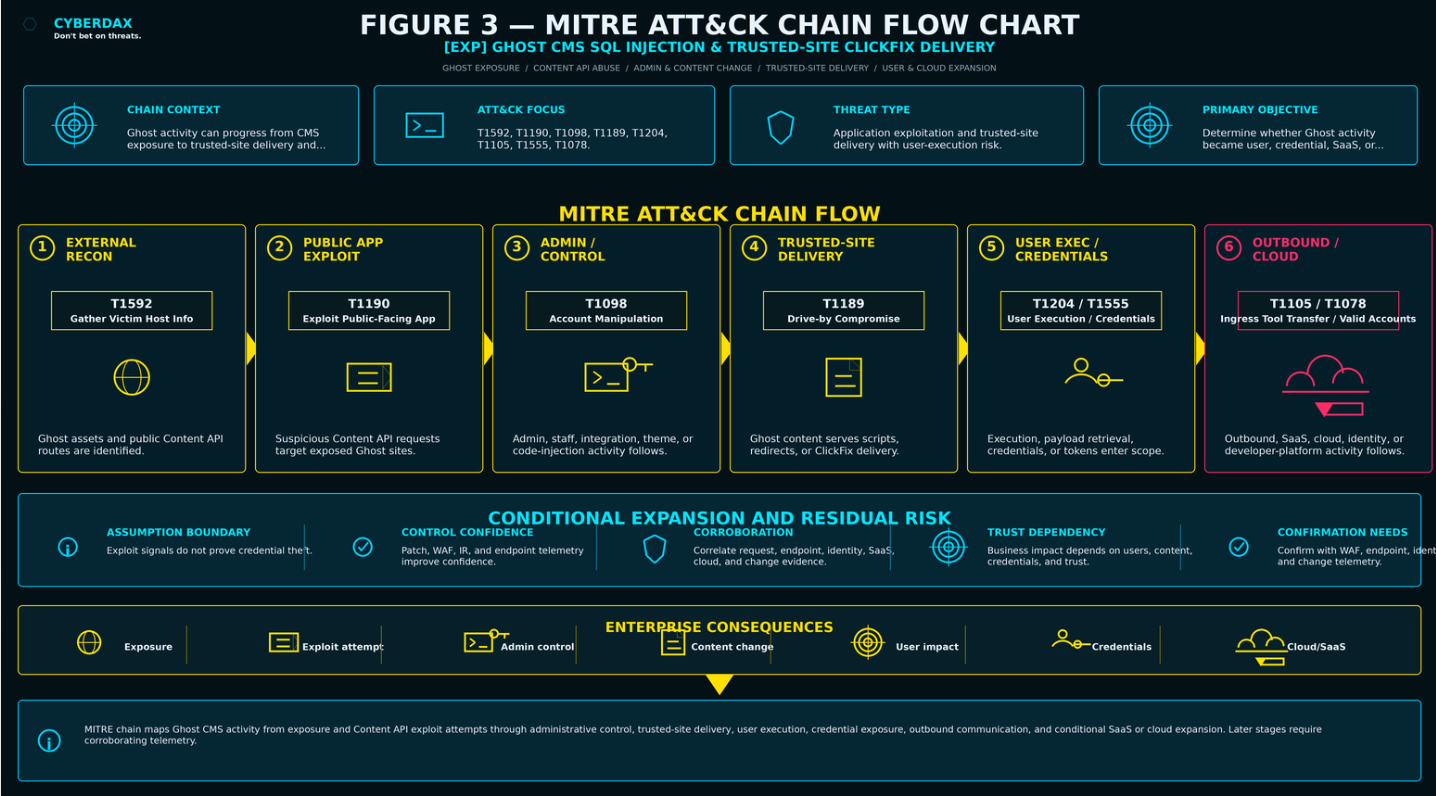
Figure 3
Initial Exposure and Application Targeting
· Activity may begin with interaction against internet-facing Ghost CMS deployments.
· Risk increases when the Ghost deployment has vulnerable or unknown patch posture, public Content API availability, incomplete WAF coverage, incomplete reverse-proxy logging, or limited application telemetry.
· Suspicious Content API requests may include abnormal filters, malformed slugs, encoded operators, nested expressions, unusual ordering behavior, timing-oriented requests, abnormal response behavior, or WAF SQL injection context.
· This stage should be treated as exploit-attempt evidence unless correlated with Admin API activity, content modification, trusted-site delivery, or incident-response evidence.
Administrative Access and Content Modification
· Risk increases when suspicious Content API activity is followed by Admin API access or administrative-route activity.
· Suspicious administrative activity may include unfamiliar source IPs, rare ASNs, unusual geographies, hosting-provider infrastructure, new user agents, unexpected automation context, or access outside expected publishing workflows.
· Content modification may involve article edits, page edits, theme changes, template changes, code-injection changes, staff-user changes, integration changes, webhook changes, or bulk publishing activity.
· Admin API activity should not be treated as malicious by itself unless source, timing, route, action, content-change context, or baseline deviation supports escalation.
Trusted-Site Delivery Abuse
· Modified Ghost content may introduce external script references, redirect logic, fake verification text, fake CAPTCHA content, fake Cloudflare-themed content, browser-check prompts, clipboard-instruction text, deceptive troubleshooting or utility-installation instructions, or payload-staging links.
· Delivery from a previously trusted Ghost-powered site may reduce user suspicion.
· Suspicious delivery is higher confidence when multiple users receive the same redirect chain, fake verification flow, external script, deceptive troubleshooting instruction, or payload-staging destination.
· Related macOS ClickFix activity covered with adaptation may use operating-system, browser, or environment context to selectively present deceptive instructions to likely macOS users while reducing exposure to non-target systems or automated analysis. This behavior should not be interpreted as evidence that Ghost-hosted delivery itself used platform-fingerprinting unless local or incident-specific evidence establishes that linkage.
· External script loading and redirect behavior should be validated against approved analytics, tag-management, advertising, newsletter, consent-management, marketing, subscription, and site-customization workflows.
ClickFix-Style User Execution
· The user-execution stage may involve browser-adjacent PowerShell, Windows command shell, macOS Terminal or shell execution, script-host execution, archive retrieval, payload retrieval, DLL loading, installer execution, application launch, or loader activity.
· Related macOS ClickFix activity may direct users to copy or enter commands into Terminal or another shell context, creating a user-driven execution path from deceptive content exposure to payload retrieval or infostealer execution.
· Confidence increases when endpoint execution occurs shortly after Ghost-hosted exposure or suspicious redirect-chain activity.
· Suspicious command content may include encoded execution, remote retrieval, chained commands, execution-policy or security-control bypass, hidden or background execution, user-writable path execution, direct IP retrieval, temporary-file execution, or shell-based retrieval and execution.
· Endpoint command execution should not be attributed to this activity without browser adjacency, upstream delivery context, suspicious execution behavior, payload retrieval, or incident-response evidence.
Payload Retrieval and Loader Behavior
· Payload-stage activity may include retrieval of scripts, archives, DLLs, executables, shortcut files, installers, disk images, application bundles, shell scripts, or loader components.
· Risk increases when retrieved content is unsigned, low reputation, newly observed, staged in user-writable or temporary paths, executed shortly after retrieval, or linked to the same browser-adjacent storyline.
· Loader behavior may involve PowerShell, rundll32, regsvr32, mshta, wscript, cscript, node, Python, msiexec, Windows command shell, macOS Terminal, sh, bash, zsh, installer utilities, application-launch mechanisms, archive utilities, or other interpreter and loader paths.
· Related macOS ClickFix activity may deliver infostealer payloads such as MacSync or Atomic Stealer. These malware-family names should be treated as supporting campaign context rather than required detection conditions; the durable behavior is deceptive user execution followed by payload retrieval, endpoint execution, credential access, sensitive-data access, or outbound activity.
· Payload retrieval should be treated as staging evidence until execution, loader behavior, persistence, command-and-control, credential access, token access, sensitive-data access, or incident-response evidence confirms compromise.
Persistence, Credential Access, and Downstream Activity
· Post-execution behavior may include scheduled tasks, startup-folder writes, registry run keys, service creation, browser extension changes, script persistence, autostart modification, or other platform-relevant persistence where supported by incident evidence.
· Credential or token risk may involve browser credential stores, token stores, password managers, developer tokens, cloud credentials, session artifacts, macOS Keychain material, iCloud-related data, cryptocurrency wallet material, or other sensitive credential and authentication data accessible from the endpoint.
· Infostealer activity may extend beyond traditional credentials to browser data, stored authentication material, wallet data, local documents, system information, and other user-accessible data targeted for collection or exfiltration.
· Downstream activity may appear in SaaS, cloud, identity, developer-platform, CI/CD, or control-plane telemetry.
· Downstream activity should remain an investigative lead unless linked to trusted-content exposure, endpoint execution, credential theft, token theft, sensitive-data theft, or incident-response evidence.
S20A — Adversary Tradecraft Summary
Tradecraft Overview
The tradecraft model is behavior-led and does not require a single actor identity, malware family, injected script, redirect domain, command string, operating system, or payload family. The defining pattern is the possible conversion of trusted content into a delivery surface for fake verification or ClickFix-style user execution that can progress into endpoint execution, credential access, sensitive-data theft, or downstream compromise. Ghost-hosted delivery represents the primary report path, while related non-Ghost platform activity may be covered with adaptation where it produces materially similar execution and post-execution behavior.
Observed Tradecraft Themes
· Targeting application trust rather than relying only on malicious domains.
· Using Ghost CMS exposure and Content API behavior as an entry point into a trusted publishing environment.
· Potentially abusing Admin API access, integrations, staff-user controls, themes, templates, webhooks, or code-injection settings to modify content.
· Introducing delivery logic into legitimate pages so users encounter malicious prompts from a site they may already trust.
· Using fake verification, fake CAPTCHA, fake Cloudflare-themed, browser-check, clipboard-instruction, troubleshooting, or utility-installation flows to encourage manual user execution.
· Adapting ClickFix-style user execution to the endpoint platform, including PowerShell or command-shell execution on Windows and Terminal or shell-based execution on macOS.
· Related macOS ClickFix activity may use environment-aware delivery, browser characteristics, or operating-system fingerprinting to restrict malicious content to likely targets and reduce exposure to non-target systems or automated analysis.
· Using platform-appropriate payloads and execution methods while rotating malware families, command syntax, staging infrastructure, lure content, and delivery techniques. MacSync and Atomic Stealer are examples of observed macOS infostealer payloads, not defining characteristics of the behavioral model.
· Relying on browser-adjacent execution paths that can blend with normal user, administrator, developer, or helpdesk activity unless correlated with upstream exposure.
· Rotating domains, scripts, redirect paths, payload-staging locations, lure text, command syntax, execution mechanisms, and malware stages to reduce static indicator durability.
· Using endpoint execution as the bridge from trusted-content exposure into browser credential theft, token theft, macOS Keychain access, sensitive-data theft, SaaS access, cloud access, identity compromise, or developer-platform risk.
Detection-Relevant Tradecraft Characteristics
· The most durable detection opportunity is the chain relationship between Ghost Content API activity, administrative follow-on, content modification, trusted-site delivery, user exposure, endpoint execution, and downstream identity or cloud behavior.
· Static indicators, malware-family names, filenames, hashes, and individual command strings should support enrichment and scoping, not define the detection model.
· Trusted-site delivery should be evaluated through content-change timing, external script novelty, redirect-chain behavior, user-exposure clustering, endpoint follow-on, and incident-response evidence. Environment-aware delivery or platform fingerprinting should be treated as additional adaptation context when supported by incident or source evidence.
· Endpoint detections should account for both Windows and macOS execution paths and require browser adjacency, suspicious PowerShell, command-shell, Terminal, or shell behavior, payload retrieval, loader behavior, persistence, credential access, token access, sensitive-data access, or command-and-control-like behavior before escalating to confirmed compromise.
· macOS investigations should correlate browser or trusted-content exposure with Terminal or shell execution, payload retrieval, application or installer activity, credential or sensitive-data access, and outbound communication where telemetry is available.
· Cloud, SaaS, identity, and developer-platform detections should require upstream linkage before being treated as campaign-aligned.
Tradecraft Bottom Line
This activity is most important because it can turn trusted CMS content or related trusted-platform content into a cross-platform user-execution delivery path. The defensive model should remain focused on staged behavioral correlation, not static IOCs, malware-family names, operating-system-specific indicators, or unsupported attribution. The most reliable detection posture is to connect Ghost-side activity where applicable, trusted-content delivery, user interaction, platform-native endpoint execution, credential or sensitive-data access, and downstream access evidence without assuming compromise from any single signal.
S21 — Detection Strategy Overview
Detection Philosophy
Detection for this report must treat the Ghost CMS SQL injection and trusted-site ClickFix delivery chain as a staged compromise model rather than a single web exploit. The core detection objective is to identify when a vulnerable or exposed Ghost CMS deployment is converted into trusted malware-delivery infrastructure through unauthorized database access, Admin API abuse, content modification, malicious JavaScript insertion, and downstream user-execution lures.
The strongest detection value comes from correlating Ghost-side compromise behavior with trusted-site delivery behavior and endpoint-side ClickFix execution behavior. A suspicious Content API request is not enough by itself to prove compromise. A trusted-site visit is not enough by itself to prove endpoint compromise. The model should escalate only when telemetry shows meaningful progression across the chain, such as exploit activity followed by Admin API misuse, content tampering, injected script delivery, fake verification interaction, or suspicious user-side command execution.
This detection strategy should remain behavior-led and variant-resilient. It should not depend on one injected script, one fake CAPTCHA phrase, one domain, one payload hash, or one command string because an attacker can rotate delivery pages, JavaScript loaders, redirect paths, and malware payloads without changing the underlying operational model.
Primary Detection Anchors
· Suspicious Ghost Content API requests targeting vulnerable or unknown-version Ghost instances.
· SQL injection-like Content API request patterns involving abnormal filter, slug, ordering, encoded, nested, or timing-oriented query behavior.
· Ghost versions earlier than 6.19.1 on internet-facing self-hosted deployments.
· Admin API activity from unusual source IPs, ASNs, geographies, hosting providers, automation contexts, or time windows.
· Admin API use shortly after suspicious Content API activity against the same Ghost deployment.
· Bulk modification of Ghost articles, pages, themes, code-injection settings, integrations, or shared templates.
· Newly inserted JavaScript, external script references, suspicious inline loaders, or footer-level code changes across multiple articles.
· Ghost-hosted pages redirecting users to fake verification, fake CAPTCHA, fake Cloudflare-themed, browser-check, or clipboard-instruction flows.
· Browser-adjacent execution of PowerShell, command shell, script hosts, DLL loaders, or suspicious payload retrieval after interaction with a Ghost-hosted page.
· Multiple users receiving the same suspicious script, redirect chain, or fake verification flow from a previously trusted Ghost-powered site.
Detection Prioritization Model
· Highest priority should be assigned to confirmed Ghost content manipulation involving unauthorized Admin API use, bulk article modification, code-injection changes, malicious JavaScript insertion, or suspicious staff-user and integration changes.
· High priority should be assigned to suspicious Content API SQL injection behavior against vulnerable or unknown-version Ghost instances when followed by Admin API activity, content modification, or external script insertion.
· High priority should be assigned to endpoint-side ClickFix execution when browser, proxy, DNS, or EDR telemetry links the user session to a Ghost-hosted page or related fake verification flow.
· Medium priority should be assigned to suspicious JavaScript injection or abnormal page modification without confirmed endpoint execution.
· Medium priority should be assigned to fake verification or fake CAPTCHA delivery from trusted Ghost-hosted infrastructure when downstream execution has not yet been observed.
· Lower priority should be assigned to isolated SQL injection-like requests that lack Ghost-version context, Admin API follow-on behavior, content manipulation, redirect behavior, or user-side execution evidence.
Correlation Strategy
Correlation must separate exposed infrastructure, suspected Ghost compromise, confirmed Ghost compromise, suspected user exposure, and confirmed endpoint execution.
Ghost-side compromise should require at least one strong CMS-side anchor. Acceptable anchors include suspicious Ghost Content API SQL injection behavior, vulnerable Ghost version exposure, Admin API use from unfamiliar infrastructure, abnormal content modification, malicious JavaScript insertion, staff-user changes, integration changes, or unauthorized code-injection activity.
Endpoint-side compromise should require at least one strong user-execution anchor. Acceptable anchors include browser-to-shell execution, PowerShell or command-shell activity after web interaction, clipboard-to-command behavior, suspicious script-host execution, payload retrieval, DLL loader execution, Electron-based malware execution, or post-execution command-and-control behavior.
A Ghost Content API request alone must not be treated as confirmed compromise. A vulnerable Ghost version alone must not be treated as active exploitation. A trusted-site visit alone must not be treated as endpoint compromise. A fake verification page alone must not be treated as malware execution unless followed by command execution, payload retrieval, script execution, loader behavior, or other endpoint control activity.
Confirmed campaign-aligned escalation should require evidence from at least two stages of the chain. Preferred escalation paths include exploit-to-Admin API correlation, Admin API-to-content modification correlation, content modification-to-script delivery correlation, or Ghost-hosted delivery-to-endpoint execution correlation.
Telemetry Prioritization
· Ghost web server access logs.
· Reverse proxy, CDN, and WAF logs covering Ghost Content API and Admin API routes.
· Ghost application logs and administrative activity records where available.
· Ghost staff-user, integration, Admin API key, theme, post, page, and code-injection change history where available.
· Content integrity monitoring for Ghost articles, shared templates, theme files, footer content, and global code-injection settings.
· DNS, proxy, secure web gateway, and browser telemetry showing visits to Ghost-hosted pages, fake verification pages, redirect chains, or payload-hosting locations.
· Endpoint telemetry showing browser child processes, PowerShell execution, command-shell activity, script-host execution, DLL loading, suspicious archive or script retrieval, and malware-stage execution.
· EDR network telemetry showing outbound connections after suspected ClickFix command execution.
· SIEM correlation across CMS, web, proxy, DNS, browser, and endpoint telemetry.
Detection Design Constraints
· Detection must not rely only on Ghost version metadata because many deployments may not expose reliable version information.
· Detection must not rely only on known compromised domains because the campaign abuses legitimate trusted sites.
· Detection must not rely only on one JavaScript string, fake CAPTCHA phrase, fake Cloudflare page title, or clipboard command.
· Detection must distinguish legitimate Ghost publishing, theme updates, analytics changes, and marketing-tag changes from unauthorized bulk modification and suspicious code injection.
· Detection must distinguish legitimate administrator API activity from Admin API use originating from unfamiliar hosting infrastructure, unusual geographies, abnormal time windows, or unexpected automation sources.
· Detection must distinguish benign PowerShell and command-shell activity from ClickFix execution by requiring browser adjacency, user-interaction context, suspicious command content, payload retrieval, or post-execution behavior.
· Detection must avoid attributing endpoint malware execution to this activity unless there is upstream evidence of Ghost-hosted delivery, fake verification interaction, or matching trusted-site delivery flow.
· Detection must account for self-hosted Ghost deployments where application logging, Admin API audit depth, and content revision history may be incomplete.
Public Implementation Considerations
· Maintain an inventory of Ghost deployments, including hosted or self-hosted status, exposed domains, version posture, administrative access paths, edge-control coverage, and logging availability.
· Establish normal patterns for Ghost Content API usage, Admin API usage, content modification, approved script usage, administrator activity, publishing workflows, and endpoint behavior after browser sessions.
· Validate that required telemetry sources can support correlation across Ghost web activity, edge telemetry, application activity, endpoint execution, DNS, proxy, browser, and network telemetry.
· Test detections in hunt mode before alert-mode deployment to identify legitimate publishing automation, analytics updates, marketing-tag changes, CMS maintenance, administrator workflows, and approved incident-response activity.
· Treat Admin API key rotation, staff-user review, content-integrity review, and endpoint scoping as local incident-response actions when compromise is suspected.
Variant Resilience Requirements
· Detection should generalize beyond one fake CAPTCHA page, one Cloudflare-themed lure, one payload family, one injected JavaScript loader, or one command string.
· Detection should identify the attacker behavior of converting trusted CMS content into delivery infrastructure even when domains, scripts, redirect chains, and payloads change.
· Detection should preserve coverage when attackers move from article-level injection to theme-level injection, global code-injection settings, staff-user abuse, or integration-token abuse.
· Detection should preserve coverage when endpoint payloads change from PowerShell-delivered malware to JavaScript droppers, DLL loaders, Electron-based malware, or other user-executed payload chains.
· Detection should preserve coverage when compromised Ghost sites include universities, media organizations, SaaS providers, fintech firms, security vendors, personal blogs, or other high-trust publishing environments.
· Detection should preserve coverage when attackers use script obfuscation, nested redirects, URL shorteners, benign-looking script names, trusted infrastructure, or staged payload delivery.
Operational Detection Model
· Identify Ghost CMS exposure, patch posture, and logging coverage.
· Detect suspicious Content API request behavior and SQL injection-like patterns.
· Detect Admin API use from unfamiliar infrastructure, unusual source context, or abnormal timing.
· Detect article, page, theme, integration, staff-user, or code-injection modification after suspicious Content API or Admin API activity.
· Detect malicious JavaScript insertion, unexpected external script references, footer-level loaders, or suspicious redirect behavior.
· Detect trusted-site delivery of fake verification, fake CAPTCHA, fake Cloudflare-themed, browser-check, or clipboard-instruction flows.
· Detect endpoint-side ClickFix execution after user interaction with a Ghost-hosted page or related redirect chain.
· Correlate CMS-side, web-delivery, and endpoint-side signals before escalating to confirmed campaign-aligned compromise.
· Separate exposed vulnerable infrastructure, suspected Ghost compromise, confirmed Ghost compromise, suspected user exposure, and confirmed endpoint execution into distinct SOC outcomes.
S22 — Primary Detection Signals
Primary Detection Signals
· Ghost Content API requests containing SQL injection-like query structures, abnormal filter syntax, encoded operators, nested expressions, unusual ordering behavior, malformed slug handling, or timing-oriented request behavior.
· Content API activity against internet-facing Ghost deployments running versions earlier than 6.19.1 or deployments where version posture cannot be confirmed.
· Repeated Content API requests from unfamiliar infrastructure, hosting providers, anonymity services, scanning nodes, unexpected geographies, or user agents inconsistent with normal readership, crawler, newsletter, analytics, and integration behavior.
· Content API activity followed by Admin API activity from a new source IP, ASN, geography, automation identity, integration context, user agent, or time window not associated with normal publishing operations.
· Admin API use that modifies multiple posts, articles, pages, themes, shared templates, integrations, staff-user settings, or code-injection settings in a compressed time window.
· Admin API activity that inserts new JavaScript, modifies article footers, changes shared templates, adds suspicious external script references, or alters global code-injection settings.
· Staff-user changes, integration changes, Admin API key activity, or privileged publishing activity occurring after suspicious Content API access.
· Ghost article, page, theme, or template changes that insert fake verification logic, fake CAPTCHA instructions, fake Cloudflare-branded content, clipboard-copy instructions, obfuscated JavaScript, suspicious external script references, or redirect logic.
· Trusted Ghost-hosted pages redirecting users to fake verification pages, fake CAPTCHA pages, fake Cloudflare-themed pages, suspicious intermediate domains, script-loading infrastructure, or payload-staging locations.
· Endpoint telemetry showing browser-adjacent PowerShell, command-shell, script-host, DLL-loader, suspicious archive retrieval, payload retrieval, or malware-stage execution after the user visits a Ghost-hosted page or related redirect chain.
Supporting Detection Signals
· Increased request volume to Ghost Content API endpoints from infrastructure that does not match normal readership, crawler, newsletter, analytics, search-engine, monitoring, or integration patterns.
· Content API requests that generate application errors, abnormal response timing, backend database error patterns, unusual response sizes, or WAF SQL injection detections.
· Ghost administrative activity occurring outside normal publishing windows, outside known administrator locations, or from infrastructure not previously associated with the site.
· Sudden changes in article body length, footer content, script density, external domain references, inline JavaScript volume, or redirect behavior across multiple posts.
· Theme-file modification, template modification, code-injection changes, integration changes, or staff-user changes without matching expected administrative activity.
· New or unusual staff accounts, staff invitations, integration records, Admin API key activity, or privileged publishing activity after suspicious Content API behavior.
· Proxy, DNS, browser, or secure web gateway telemetry showing fake verification, fake CAPTCHA, fake Cloudflare-themed pages, or unusual redirect chains from a site previously classified as trusted.
· Multiple users or devices receiving similar fake verification prompts, clipboard-instruction pages, or redirect chains after browsing the same Ghost-hosted domain.
· Endpoint command execution within a short window after browser interaction with a Ghost-hosted page, especially when command content includes encoded PowerShell, remote script retrieval, clipboard-delivered commands, suspicious archive retrieval, or execution from temporary paths.
· EDR network telemetry showing outbound connections to payload-hosting, command-and-control, paste, file-sharing, CDN-abuse, or newly registered infrastructure shortly after suspected ClickFix execution.
Exploit Attempt and Instability Signals
· SQL injection-like Content API requests containing abnormal filter operators, malformed slug filters, encoded database syntax, unexpected sorting parameters, nested expressions, comment-style syntax, time-delay patterns, or characters inconsistent with normal Ghost API usage.
· Ghost Content API requests that produce HTTP 500 errors, backend exception traces, elevated latency, abnormal response sizes, empty-but-successful responses, or WAF alerts associated with SQL injection behavior.
· Repeated probing across Ghost Content API routes, posts, pages, tags, authors, slugs, pagination parameters, ordering parameters, or filterable fields from the same source infrastructure.
· Requests to Ghost Content API endpoints using unusual combinations of filters, ordering, pagination, encoding, and special characters not observed in normal site usage.
· Short bursts of suspicious Content API activity followed by administrative requests, content update activity, article modification, or code-injection changes.
· Vulnerable Ghost version exposure combined with public-facing Content API availability, weak compensating controls, or missing WAF and reverse-proxy coverage.
· Content API activity from scanner-like infrastructure followed by a quiet period and later Admin API use, indicating possible key extraction and delayed reuse.
Outbound Communication Signals
· Ghost pages loading newly introduced external JavaScript from domains not previously associated with the site.
· Ghost pages redirecting users to fake verification, fake CAPTCHA, fake Cloudflare-themed, or browser-check pages inconsistent with the site’s normal hosting, CDN, security, analytics, and marketing architecture.
· Browser sessions contacting suspicious intermediate redirectors, shortened URLs, newly registered domains, compromised infrastructure, paste services, file-sharing locations, CDN-abuse locations, or payload-staging hosts after visiting Ghost-hosted content.
· Endpoint outbound connections initiated after browser-to-shell, browser-to-PowerShell, browser-to-script-host, or clipboard-to-command execution behavior.
· Outbound HTTP, HTTPS, DNS, or EDR network events to payload-hosting infrastructure after the user interacts with a fake verification or clipboard-instruction prompt.
· Repeated user or device traffic to the same suspicious redirect chain, external script source, or fake verification infrastructure from a trusted Ghost-hosted site.
· Unexpected client-side retrieval of JavaScript, archives, DLLs, scripts, executables, shortcut files, or Electron-based payloads following Ghost page interaction.
Persistence and Post-Exploitation Signals
· Unauthorized Ghost staff-user creation, staff invitation activity, staff-role modification, staff-session activity, or account access from unfamiliar infrastructure.
· New or modified Ghost integrations, Admin API keys, webhooks, code-injection settings, theme files, shared templates, automation records, or privileged publishing workflows.
· Recurrent article, page, template, theme, integration, or code-injection modification after remediation or content cleanup.
· Endpoint persistence behavior after ClickFix execution, including scheduled tasks, startup-folder writes, registry run-key changes, service creation, browser extension abuse, script persistence, or autostart modification.
· Endpoint file writes to temporary directories, user profile paths, browser cache paths, public directories, startup locations, or other commonly abused staging paths.
· Payload execution followed by credential-access tooling, browser-data access, token theft, remote-access tooling, command-and-control beaconing, or additional payload retrieval.
· Repeated endpoint execution attempts after browser interaction with the same compromised Ghost-hosted page, redirect chain, or fake verification page.
Downstream Expansion Signals
· Endpoint compromise may be followed by credential access, token access, abnormal cloud or SaaS activity, developer-platform access, internal discovery, or remote service activity.
· Suspicious downstream activity should be treated as related only when it is temporally and behaviorally linked to Ghost-hosted delivery, fake verification interaction, confirmed endpoint execution, credential theft, token theft, or incident-response evidence.
· Cloud, SaaS, identity, and developer-platform anomalies should remain downstream investigative leads unless the upstream Ghost-hosted delivery and endpoint execution relationship is validated.
Signal Usage Constraints
· A vulnerable Ghost version alone is an exposure signal, not proof of exploitation.
· A suspicious Content API request alone is an exploit-attempt signal, not proof of successful Ghost compromise.
· Admin API activity alone is not malicious unless the source, timing, action pattern, integration context, user agent, or content-change behavior deviates from the site’s normal publishing baseline.
· JavaScript injection should be validated against approved analytics, advertising, newsletter, subscription, tag-management, consent-management, and site-customization workflows.
· A trusted Ghost-hosted page visit alone is not endpoint compromise.
· A fake verification page alone is not endpoint compromise unless followed by suspicious command execution, payload retrieval, script execution, loader behavior, persistence, or command-and-control activity.
· Endpoint PowerShell or command-shell execution should not be attributed to this activity without browser adjacency, user-interaction context, suspicious command content, payload retrieval, or upstream Ghost-hosted delivery evidence.
· Downstream SaaS, cloud, identity, or developer-platform anomalies should not be attributed to this activity unless temporally and behaviorally linked to confirmed endpoint execution or Ghost-hosted delivery.
· Confirmed escalation should require evidence from more than one stage of the chain, such as Content API activity followed by Admin API misuse, Admin API misuse followed by content modification, content modification followed by malicious delivery, or Ghost-hosted delivery followed by endpoint execution.
S23 — Telemetry Requirements
Endpoint and Process Execution Telemetry
· Endpoint telemetry should capture browser-adjacent process creation, including browser-spawned PowerShell, command shell, script hosts, DLL loaders, archive utilities, installer processes, and suspicious child-process chains.
· Process telemetry should include command line, parent process, grandparent process, user context, working directory, process hash, process path, execution timestamp, integrity level, and network connection context where available.
· PowerShell telemetry should include command line, script block logging where available, encoded command usage, download cradle behavior, suspicious invocation flags, execution policy changes, and remote content retrieval.
· Windows command-shell telemetry should include chained commands, temporary-path execution, remote script retrieval, archive extraction, execution from user-writable paths, and command activity occurring shortly after browser interaction.
· Script-host telemetry should include suspicious use of wscript, cscript, mshta, node, rundll32, regsvr32, and other interpreter or loader behavior that follows browser activity.
· Browser telemetry should capture recent site visits, redirect chains, file downloads, suspicious prompt interaction where available, and child-process activity after user interaction with Ghost-hosted pages.
· Endpoint telemetry should preserve timing relationships between Ghost-hosted browsing activity and command execution so defenders can distinguish ClickFix execution from unrelated administrator, developer, or helpdesk activity.
Memory and Execution Telemetry
· Memory and execution telemetry should capture suspicious script execution, reflective loading, DLL execution, unmanaged code loading, and loader-like behavior after browser-adjacent command execution.
· EDR telemetry should include process injection, suspicious module loads, unsigned or low-reputation DLL loading, unusual child processes, suspicious process ancestry, and command-and-control staging behavior.
· Execution telemetry should identify Electron-based payload execution, JavaScript droppers, DLL loaders, suspicious archive-based payloads, and additional malware-stage execution after ClickFix-style commands.
· Execution telemetry should retain sufficient process lineage to determine whether suspicious activity originated from a browser session, fake verification prompt, clipboard-delivered instruction, or manually pasted command.
· Memory telemetry should be treated as supporting evidence unless paired with browser adjacency, payload retrieval, command execution, persistence, or outbound communication.
Crash and Fault Telemetry
· Ghost application telemetry should capture Content API errors, backend exceptions, abnormal response sizes, elevated latency, and HTTP 500 responses associated with suspicious query behavior.
· Reverse proxy, CDN, WAF, and web telemetry should capture SQL injection detections, malformed request patterns, blocked requests, request anomalies, response codes, response sizes, and backend error indicators.
· Database, application, and platform telemetry should capture exception patterns consistent with malformed filter, slug, ordering, pagination, encoded, or nested query behavior where available.
· Web telemetry should preserve request and response timing where available so defenders can identify timing-oriented SQL injection behavior or abnormal backend query delays.
· Crash and fault telemetry should be used as an exploit-attempt indicator, not as standalone proof of successful compromise.
File and Persistence Telemetry
· Ghost content telemetry should capture post updates, page updates, article revisions, theme modifications, template changes, code-injection setting changes, integration changes, staff-user changes, and Admin API key activity where available.
· Content integrity monitoring should capture newly inserted JavaScript, external script references, footer modifications, fake verification content, fake CAPTCHA logic, fake Cloudflare-themed content, clipboard-instruction text, and redirect logic.
· Endpoint file telemetry should capture downloads, archive extraction, script creation, DLL writes, executable writes, shortcut-file creation, and payload staging in user-writable or temporary paths.
· Endpoint persistence telemetry should capture scheduled tasks, startup-folder writes, registry run keys, service creation, browser extension changes, script persistence, autostart entries, and recurring execution after ClickFix delivery.
· CMS-side persistence telemetry should capture recurring code-injection changes, theme reinfection, unauthorized integration creation, staff-user abuse, webhook modification, and repeated article tampering after cleanup.
· File and persistence telemetry should distinguish normal Ghost publishing workflows, analytics updates, tag-management changes, and administrator maintenance from unauthorized modification and malicious reinfection.
Network and Outbound Communication Telemetry
· Network telemetry should capture Ghost Content API requests, Admin API requests, suspicious external script loads, redirect chains, fake verification infrastructure, payload staging, and endpoint outbound connections after suspected ClickFix execution.
· Reverse proxy, CDN, WAF, and web server logs should preserve source IP, user agent, request path, query parameters where available, response code, response size, referrer, host header, TLS context where available, and request timestamp.
· DNS, proxy, secure web gateway, and browser network telemetry should capture visits to compromised Ghost pages, fake verification pages, suspicious redirectors, newly introduced script sources, payload-hosting infrastructure, and command-and-control destinations.
· EDR network telemetry should capture outbound HTTP, HTTPS, DNS, and direct-IP connections initiated after browser-to-shell, browser-to-PowerShell, browser-to-script-host, or clipboard-to-command execution.
· Network telemetry should retain enough session context to correlate Ghost-hosted delivery with endpoint execution and avoid attributing unrelated outbound activity to this campaign.
· Outbound communication telemetry should prioritize behavior, timing, infrastructure novelty, and relationship to the Ghost-hosted delivery chain rather than relying only on known domains or static indicators.
Web and Application Telemetry
· Ghost application telemetry should capture Content API route access, Admin API route access, staff-user activity, integration activity, Admin API key use, article modification, page modification, theme modification, and code-injection changes where available.
· Ghost deployment telemetry should identify version posture, patch status, exposed domains, reverse proxy paths, CDN coverage, administrative access paths, and public Content API availability where available.
· Web server, CDN, reverse proxy, and WAF telemetry should capture suspicious requests to Ghost Content API endpoints and anomalous administrative activity against Ghost Admin API routes.
· CMS content-change telemetry should capture article body changes, footer changes, shared template changes, theme edits, injected JavaScript, external script additions, and suspicious redirect logic.
· Application telemetry should capture whether suspicious Content API activity preceded Admin API use, content modification, integration changes, staff-user changes, or code-injection changes.
· Where Ghost application audit logs are incomplete, defenders should compensate with available edge telemetry, content-integrity monitoring, administrative records, and incident-response review.
Telemetry Availability Requirements
· Confirm whether Ghost is self-hosted, managed, containerized, reverse-proxied, CDN-fronted, or externally maintained before assuming telemetry availability.
· Required CMS-side telemetry may include Ghost web access logs, Content API route visibility, Admin API route visibility, content-change history, code-injection change visibility, staff-user activity, integration activity, and API key activity where available.
· Required edge telemetry may include CDN, WAF, reverse proxy, web server, and load-balancer logs with enough request context to identify suspicious Content API and Admin API behavior.
· Required endpoint telemetry may include process creation, command line, process ancestry, script execution, file writes, persistence changes, network connections, and browser-adjacent execution context.
· Required network telemetry may include DNS, proxy, secure web gateway, browser network events, EDR network events, and outbound connection records.
· Required identity, SaaS, cloud, and developer-platform telemetry should be used for downstream investigation only when endpoint execution, credential access, token theft, or post-execution identity abuse has been observed.
· Required correlation data may include consistent timestamps, hostnames, user identities, source IPs, destination domains, request paths, user agents, process lineage, and content-change metadata.
Telemetry Limitations and Gaps
· Some Ghost deployments may not expose reliable version metadata, which can limit patch-posture validation.
· Self-hosted Ghost deployments may have inconsistent application logging, limited Admin API audit depth, incomplete content revision history, or short log-retention windows.
· CDN and reverse proxy configurations may strip, normalize, truncate, or fail to retain query parameters needed to detect suspicious Content API behavior.
· WAF alerts may show exploit attempts but may not confirm whether database reads, API key exposure, Admin API misuse, or content modification occurred.
· Content-change visibility may be weak when article edits, theme changes, or code-injection changes are not retained with sufficient user, timestamp, and source-context detail.
· Endpoint detections may miss ClickFix execution when users manually paste commands, browser telemetry is absent, or process lineage does not preserve the relationship between browsing and command execution.
· PowerShell and command-shell activity may be noisy in developer, administrator, and IT support environments, requiring baseline-driven correlation before alert-mode deployment.
· DNS and proxy telemetry may identify fake verification or payload infrastructure but may not prove user execution without endpoint process evidence.
· Cloud, SaaS, identity, and developer-platform anomalies should be treated as downstream investigative leads unless linked to endpoint execution, credential theft, token theft, or Ghost-hosted delivery.
· Static indicators, script fragments, command strings, domains, hashes, and fake verification text may rotate quickly and should not be treated as the primary telemetry foundation.
S24 — Detection Opportunities and Gaps
Detection Opportunities
· Detection can identify Ghost Content API exploitation attempts through abnormal query structures, suspicious filter usage, malformed slug handling, encoded operators, unusual ordering behavior, timing-oriented requests, backend errors, WAF SQL injection alerts, and request patterns inconsistent with normal Ghost API usage.
· Detection can identify exposed Ghost infrastructure by correlating internet-facing Ghost deployments, version posture, Content API availability, patch status, CDN coverage, reverse-proxy coverage, and Ghost versions earlier than 6.19.1.
· Detection can identify suspected Admin API key exposure or reuse by correlating suspicious Content API activity with later Admin API activity from unfamiliar IPs, ASNs, geographies, hosting providers, user agents, automation contexts, or time windows.
· Detection can identify Ghost-side compromise through abnormal Admin API behavior, compressed-window content modification, page modification, theme modification, code-injection changes, integration changes, staff-user changes, or privileged publishing activity outside expected workflows.
· Detection can identify malicious content manipulation by monitoring Ghost article bodies, footers, shared templates, theme files, global code-injection settings, and external JavaScript references for unexpected or unauthorized changes.
· Detection can identify trusted-site delivery when Ghost-hosted pages redirect users to fake verification pages, fake CAPTCHA pages, fake Cloudflare-themed pages, suspicious intermediate infrastructure, external loaders, or payload-staging locations.
· Detection can identify ClickFix execution when endpoint telemetry shows browser-adjacent PowerShell, Windows command-shell, script-host activity, DLL-loader activity, archive retrieval, payload retrieval, installer execution, or malware-stage execution after interaction with a Ghost-hosted page or related redirect chain.
· Related macOS ClickFix activity covered with adaptation may be detectable through Terminal or shell sessions that invoke remote-retrieval or decoding utilities shortly after browser activity, including suspicious combinations of curl, shell interpreters, encoded or compressed content, temporary-file creation, executable permission changes, application execution, or other platform-native execution behavior.
· Detection can identify credential and sensitive-data access after macOS ClickFix execution through suspicious access to Keychain material, browser credential stores, authentication data, SSH keys, cryptocurrency wallet data, or other sensitive files when endpoint telemetry provides sufficient process and file-access visibility.
· Detection can identify downstream expansion when confirmed endpoint execution is followed by credential theft, token theft, sensitive-data theft, SaaS access anomalies, cloud control-plane anomalies, developer-platform access, internal discovery, or remote service activity.
· Detection can improve confidence by correlating multiple stages of the chain, including Content API activity to Admin API misuse, Admin API misuse to content modification, content modification to malicious delivery, and trusted-content delivery to platform-native endpoint execution.
High-Value Detection Opportunities
· Ghost Content API SQL injection behavior against vulnerable or unknown-version Ghost deployments.
· Suspicious Content API activity followed by Admin API access from unfamiliar infrastructure.
· Admin API use that modifies multiple articles, pages, templates, themes, integrations, staff users, or code-injection settings in a compressed time window.
· Newly inserted JavaScript, fake verification content, fake CAPTCHA logic, fake Cloudflare-themed lures, clipboard-instruction text, or suspicious redirect logic on Ghost-hosted content.
· External script loads or redirect chains introduced shortly after Ghost content modification.
· Multiple users receiving similar fake verification prompts from the same previously trusted Ghost-hosted site.
· Browser-adjacent PowerShell, Windows command-shell, macOS Terminal or shell execution, script-host activity, DLL-loader activity, archive retrieval, payload retrieval, or application execution after interaction with trusted content.
· On macOS, browser activity followed by Terminal or shell execution involving remote retrieval, decoding, shell pipelines, temporary-file activity, permission changes, application execution, or suspicious outbound communication.
· Endpoint persistence, credential access, token theft, sensitive-data access, outbound command-and-control, data exfiltration, or additional payload execution after suspected ClickFix execution.
· Ghost content reinfection, recurring code-injection changes, unauthorized integration changes, repeated staff-user abuse, or repeated content tampering after cleanup.
Correlation Opportunities
· Correlate Ghost Content API requests with WAF SQL injection alerts, backend application errors, abnormal response sizes, elevated latency, suspicious query structures, or unusual response behavior.
· Correlate vulnerable Ghost version exposure with public Content API availability, administrative exposure, and lack of compensating CDN, WAF, or reverse-proxy controls.
· Correlate suspicious Content API activity with subsequent Admin API access from a new source IP, ASN, geography, user agent, integration identity, hosting provider, or automation context.
· Correlate Admin API activity with article edits, page edits, theme modifications, code-injection changes, integration changes, staff-user changes, or bulk publishing activity.
· Correlate content changes with newly observed JavaScript, external script references, fake verification text, fake CAPTCHA logic, fake Cloudflare-themed content, clipboard-instruction prompts, or redirect behavior.
· Correlate Ghost-hosted page visits with proxy, DNS, browser, and secure web gateway telemetry showing suspicious redirects, newly introduced script sources, fake verification pages, or payload-staging infrastructure.
· Correlate Ghost-hosted or related trusted-content delivery with endpoint browser-to-shell, browser-to-PowerShell, browser-to-Terminal, clipboard-to-command, archive retrieval, payload-retrieval, application-launch, or installer behavior.
· On macOS, correlate browser exposure with Terminal or shell activity, curl or other remote retrieval, decoding or decompression, temporary-file creation, executable-permission modification, application or script execution, Keychain or browser credential access, sensitive-data collection, and outbound communication.
· Correlate endpoint execution with outbound connections, persistence changes, credential-access behavior, token access, sensitive-data access, data staging or exfiltration, SaaS access anomalies, cloud control-plane activity, or developer-platform access.
· Correlate recurring Ghost content tampering with incomplete remediation, unrotated Admin API keys, persistent unauthorized integrations, staff-user abuse, or theme-level reinfection.
Detection Gaps
· Detection may miss exploitation when Ghost version metadata is unavailable, inaccurate, hidden behind a CDN, or not centrally inventoried.
· Detection may miss Content API SQL injection activity when CDN, reverse proxy, WAF, web server, or load-balancer telemetry does not retain query parameters.
· Detection may miss successful database reads when exploit attempts do not produce visible errors, abnormal latency, WAF alerts, backend instability, or other observable application-side effects.
· Detection may miss Admin API key theft when the only visible behavior is later legitimate-looking Admin API use with stolen credentials or exposed API keys.
· Detection may miss content manipulation when Ghost article revisions, theme changes, code-injection changes, integration changes, or staff-user changes are not retained with user, source IP, user agent, and timestamp metadata.
· Detection may miss malicious JavaScript insertion when attackers use subtle inline changes, trusted infrastructure, obfuscated loaders, approved-looking script names, or site-customization areas already used for legitimate analytics and marketing scripts.
· Detection may miss trusted-site delivery when users access compromised Ghost-hosted content from unmanaged devices, personal devices, mobile devices, or networks without proxy, DNS, browser, or EDR visibility.
· Detection may miss related macOS ClickFix delivery when server-side browser or environment fingerprinting presents malicious content only to qualifying macOS users while crawlers, sandboxes, scanners, or non-target browsers receive blank, benign, or decoy content.
· Detection may miss ClickFix execution when users manually paste commands, process lineage is incomplete, browser telemetry is unavailable, clipboard telemetry is unavailable, or endpoint logging does not preserve the relationship between browsing and command execution.
· Detection may miss macOS ClickFix execution when Terminal or shell telemetry is incomplete, command-line arguments are not retained, shell child-process relationships are unavailable, remote-retrieval activity is not attributed to the initiating process, or endpoint products lack sufficient macOS process and file visibility.
· Detection may miss credential or sensitive-data theft when access to Keychain material, browser credential stores, authentication files, SSH keys, cryptocurrency wallet data, or other sensitive files is not visible or cannot be attributed to the responsible process.
· Detection may miss data staging or exfiltration when collection occurs rapidly, temporary archives are deleted, outbound transfers are encrypted, destination infrastructure rotates, or process-to-network attribution is incomplete.
· Detection may miss downstream identity, SaaS, cloud, or developer-platform abuse when endpoint execution evidence is absent or when access appears to originate from legitimate credentials, tokens, or sessions.
· Detection may miss campaign attribution when payloads, injected JavaScript, fake verification pages, domains, redirect chains, hashes, command strings, lure text, fingerprinting logic, and malware families rotate quickly.
False Positive and Noise Considerations
· Legitimate Ghost publishing workflows may create bulk article edits, theme changes, template updates, or code-injection changes during site redesigns, migration work, SEO updates, content imports, analytics changes, or marketing campaigns.
· Legitimate Ghost integrations may generate Admin API activity from automation platforms, publishing workflows, newsletter tools, analytics services, or third-party content-management processes.
· Legitimate CDN, WAF, monitoring, search-engine, SEO, and analytics activity may generate unusual request volume against public Ghost routes.
· Security scanners and vulnerability management tools may generate SQL injection-like Content API requests without indicating real adversary exploitation.
· Legitimate analytics, advertising, consent-management, tag-management, subscription, newsletter, and site-customization scripts may resemble external script injection unless baselined and validated.
· Legitimate administrator, developer, helpdesk, and IT support activity may include PowerShell, Windows command-shell, macOS Terminal or shell use, script-host activity, archive extraction, temporary-path execution, remote script retrieval, installer activity, or application execution.
· Legitimate macOS administrative and developer workflows may use curl, sh, bash, zsh, osascript, archive utilities, command-line installers, executable-permission changes, or scripted application deployment and should be validated against user, parent-process, destination, timing, and change-management context.
· Browser or device fingerprinting should not be treated as malicious by itself because legitimate anti-bot, fraud-prevention, authentication, advertising, and application-security services may collect similar environment attributes.
· Endpoint detections should reduce noise by requiring browser adjacency, user-interaction context, suspicious command content, payload retrieval, credential or sensitive-data access, persistence, outbound communication, or upstream trusted-content delivery evidence.
· Cloud, SaaS, identity, and developer-platform alerts should not be promoted as campaign-linked findings unless temporally and behaviorally connected to trusted-content delivery, confirmed endpoint execution, credential theft, token theft, sensitive-data theft, or incident-response evidence.
Coverage Improvement Opportunities
· Improve Ghost deployment inventory, including hosted versus self-hosted status, version posture, public Content API availability, CDN coverage, WAF coverage, administrative access paths, and logging depth.
· Improve reverse proxy, CDN, WAF, and web server logging so suspicious Ghost Content API query parameters are retained and searchable where available.
· Improve Ghost administrative visibility by retaining Admin API activity, staff-user changes, integration changes, code-injection changes, theme modifications, article revisions, and content-change history where available.
· Improve content integrity monitoring for Ghost articles, pages, shared templates, theme files, footers, and global code-injection settings.
· Improve endpoint visibility into browser-adjacent process execution, PowerShell activity, Windows command-shell activity, macOS Terminal and shell execution, script-host activity, file writes, application execution, credential or sensitive-data access, persistence changes, and outbound connections.
· Improve macOS telemetry for Terminal and shell process ancestry, command-line arguments, curl and other remote-retrieval activity, decoding and decompression utilities, temporary-file creation, executable-permission changes, application launches, Keychain and browser credential access, sensitive-file access, process-to-network attribution, data staging, and exfiltration where available.
· Improve DNS, proxy, secure web gateway, and browser telemetry to retain redirect chains, referrer context, newly introduced script sources, suspicious fake verification pages, payload-staging locations, and evidence of environment-aware delivery where available.
· Ensure web-content inspection and threat-analysis workflows account for server-side cloaking in which automated scanners, sandboxes, or non-target environments may receive content different from that presented to qualifying users.
· Improve SIEM correlation between CMS-side compromise signals, trusted-site delivery signals, Windows or macOS endpoint execution signals, credential or sensitive-data access signals, and downstream identity, SaaS, cloud, or developer-platform signals.
· Improve baseline documentation for normal Ghost publishing workflows, approved administrative activity, approved integration activity, approved JavaScript usage, expected automation, marketing changes, analytics changes, content-management maintenance, and legitimate macOS administrative or developer shell activity.
Detection Confidence Model
· Low confidence should be assigned to isolated exposure signals, including vulnerable Ghost version posture, public Content API availability, one-off suspicious Content API requests without follow-on behavior, or isolated access to related ClickFix infrastructure without evidence of malicious content delivery or execution.
· Medium confidence should be assigned to suspicious Content API behavior paired with backend instability, WAF SQL injection alerts, abnormal request patterns, unusual response behavior, or vulnerable version exposure.
· Medium confidence should be assigned to related macOS delivery activity where browser or network telemetry indicates suspicious ClickFix-like infrastructure, environment-aware content delivery, or deceptive macOS delivery behavior but endpoint execution is not confirmed.
· High confidence should be assigned to suspicious Content API behavior followed by Admin API activity from unfamiliar infrastructure, abnormal content modification, code-injection changes, integration changes, staff-user changes, or privileged publishing activity.
· High confidence should be assigned to Ghost content modification followed by fake verification delivery, suspicious redirect behavior, newly introduced external script loading, repeated user exposure, or payload-staging activity from a trusted Ghost-hosted site.
· High confidence should be assigned to related macOS ClickFix activity when browser exposure is followed by suspicious Terminal or shell execution, remote payload retrieval, application or script execution, credential or sensitive-data access, or attributable outbound activity.
· Confirmed Ghost compromise confidence should require multiple linked stages, such as Content API exploitation followed by Admin API misuse or Admin API misuse followed by malicious content injection.
· Confirmed endpoint compromise confidence should require suspicious platform-native command execution, payload retrieval, script or application execution, loader behavior, persistence, credential access, sensitive-data access, command-and-control activity, exfiltration, or other post-execution behavior after trusted-content delivery.
· Confirmed campaign-aligned confidence should require linkage between the relevant upstream delivery path and endpoint-side execution or post-execution evidence. Ghost-side compromise should be required only when attributing the activity specifically to the Ghost-hosted branch of this report.
Operational Gaps Requiring Validation
· Confirm whether the organization directly operates Ghost CMS, relies on a managed Ghost provider, or consumes Ghost-hosted third-party content as a trusted external site.
· Confirm whether Ghost deployments are patched to the fixed version or later.
· Confirm whether Content API and Admin API requests are visible through available edge, application, and web telemetry.
· Confirm whether request parameters are retained for Content API routes.
· Confirm whether Ghost administrative activity, content changes, code-injection changes, integration changes, and staff-user changes are logged with enough context for investigation.
· Confirm whether endpoint telemetry can link browser activity to later suspicious PowerShell, Windows command-shell, macOS Terminal or shell execution, script execution, loader behavior, archive retrieval, payload retrieval, application execution, persistence, credential access, token access, sensitive-data access, or outbound communication.
· Confirm whether macOS endpoint telemetry retains process ancestry, shell command lines, remote-retrieval activity, file creation, executable-permission changes, application execution, sensitive credential-store access, process-to-network attribution, data staging, and outbound transfer activity with sufficient context for investigation.
· Confirm whether DNS, proxy, browser, and secure web gateway telemetry can reconstruct redirect chains from Ghost-hosted or related trusted content to fake verification, deceptive delivery, environment-aware delivery, or payload-staging infrastructure.
· Confirm whether web inspection, sandboxing, or automated analysis controls can identify or compensate for server-side browser fingerprinting and cloaking that may return benign or decoy content to non-target environments.
· Confirm whether identity, SaaS, cloud, and developer-platform logs are available for downstream investigation after endpoint execution, credential theft, token theft, or sensitive-data theft is confirmed.
S25 — Ultra-Tuned Detection Engineering Rules
NDR / Network Behavioral Analytics
Detection Viability Assessment
NDR / Network Behavioral Analytics has three rules for this EXP report.
· NDR / Network Behavioral Analytics is conditionally viable for detecting suspicious network behavior associated with Ghost CMS Content API exploitation attempts, abnormal Ghost API request structure, Admin API access anomalies, content-update route activity, trusted-site content delivery abuse, suspicious redirect behavior, external script loading, fake verification infrastructure, payload-staging activity, endpoint outbound follow-on behavior, and downstream expansion from exposed users or compromised Ghost-hosted infrastructure.
· NDR / Network Behavioral Analytics is strongest where network-flow telemetry, DNS telemetry, proxy telemetry, secure web gateway logs, WAF telemetry, CDN logs, reverse proxy logs, load balancer logs, Ghost web logs, Ghost application route context, destination enrichment, asset inventory, Ghost deployment inventory, approved administrator-source baselines, approved integration baselines, approved external-script inventories, approved publishing automation, vulnerability context, patch context, and SIEM correlation can be combined.
· NDR / Network Behavioral Analytics can identify suspicious sequencing between abnormal Ghost Content API activity, WAF SQL injection context, response anomalies, source novelty, Ghost Admin API route access, administrative-path access, compressed-window content-update behavior, newly introduced external script retrieval, fake verification delivery, redirect-chain anomalies, payload-staging infrastructure, user endpoint outbound follow-on behavior, and downstream identity, SaaS, cloud, or developer-platform access where correlated telemetry exists.
· NDR / Network Behavioral Analytics is not a standalone source for confirming successful Ghost SQL injection exploitation, database-read success, Admin API key theft, Ghost article tampering, Ghost code-injection modification, staff-user abuse, endpoint command execution, credential theft, token theft, malware execution, cloud compromise, or actor attribution because request success, database state, content-change details, Admin API action contents, endpoint process execution, and user-pasted ClickFix commands may not be fully visible in network telemetry.
· NDR / Network Behavioral Analytics rules must be correlated with WAF logs, CDN logs, reverse proxy logs, load balancer logs, Ghost web logs, Ghost application logs, Ghost Admin API records, content-change telemetry, code-injection change records, staff-user records, integration records, endpoint telemetry, browser telemetry, file telemetry, DNS logs, proxy logs, secure web gateway logs, identity logs, cloud logs, asset inventory, vulnerability context, change-control records, and SIEM enrichment before classifying activity as probable compromise.
· NDR / Network Behavioral Analytics detection content should be treated as high-value behavioral coverage for exploit-attempt detection, Admin API misuse scoping, trusted-site delivery identification, user-exposure scoping, external script and redirect-chain triage, payload-staging identification, endpoint outbound follow-on scoping, and post-exploitation triage, not direct CVE confirmation, endpoint compromise confirmation, or actor attribution by itself.
· NDR / Network Behavioral Analytics rules should not generate high-confidence alerting from network-only anomalies, suspicious Content API requests alone, vulnerable Ghost version posture alone, destination novelty alone, unusual DNS alone, inbound request volume alone, Admin API route access alone, external script loading alone, trusted Ghost-site visits alone, redirect activity alone, direct IP access alone, newly registered domains alone, cloud API access alone, or high byte volume alone.
Rule
Ghost Content API SQL Injection Behavior Followed by Admin API or Content-Modification Network Sequence
Rule Format
NDR behavioral API-to-administration correlation rule suitable for network-flow telemetry, DNS telemetry, proxy telemetry, secure web gateway logs, WAF telemetry, CDN logs, reverse proxy logs, load balancer logs, Ghost web log correlation, Ghost route inventory, Ghost Content API route validation, Ghost Admin API route validation, destination enrichment, source enrichment, Ghost deployment inventory, approved administrator-source baselines, approved integration baselines, approved publishing automation baselines, approved scanner baselines, vulnerability context, patch context, and SIEM correlation after Ghost asset validation, Content API route validation, Admin API route validation, request-parameter visibility validation, response-behavior validation, source-context validation, timing-window tuning, and environment-specific allowlisting.
Detection Purpose
· Detect suspicious Ghost Content API request behavior that may represent SQL injection probing or exploitation against internet-facing Ghost CMS deployments.
· Identify network-visible progression from abnormal Content API request behavior to Admin API access, administrative-path access, content-update activity, integration-related access, code-injection-related access, theme-related access, staff-user-related access, or publishing-control behavior.
· Prioritize activity involving internet-facing Ghost deployments, self-hosted Ghost deployments, unknown-version Ghost deployments, Ghost deployments earlier than version 6.19.1, public Content API exposure, administrative-adjacent workflows, and Ghost sites with limited compensating CDN, WAF, or reverse-proxy controls.
· Support early escalation when suspicious Content API behavior is followed by source-novel Admin API activity, compressed-window administrative access, content-update route access, suspicious external script loading, redirect-chain behavior, fake verification delivery, or endpoint exposure evidence.
· Preserve separation between exploit-attempt detection and confirmed Ghost compromise by requiring supporting Admin API, content-change, endpoint, file, identity, cloud, or incident-response evidence before classifying activity as probable compromise.
· This rule does not prove successful SQL injection exploitation, database-read success, Admin API key theft, Ghost content tampering, staff-user abuse, integration compromise, endpoint compromise, malware execution, credential theft, token theft, or actor attribution without supporting Ghost application, Admin API, content-change, endpoint, identity, cloud, file, change-control, or incident-response evidence.
Detection Logic
· Identify inbound HTTP or HTTPS activity against confirmed or suspected Ghost CMS deployments.
· Prioritize request activity involving Ghost Content API routes, including locally mapped equivalents of /ghost/api/content/, /ghost/api/v*/content/, /api/content/, content-route aliases, CDN-rewritten Content API paths, and reverse-proxy-mapped Ghost Content API endpoints.
· Prioritize abnormal Content API request behavior involving malformed filters, abnormal filter operators, nested expressions, unexpected ordering parameters, malformed slug filters, encoded characters, SQL-like metacharacters, comment-style syntax, boolean-style probes, time-delay-like patterns, unusually complex query strings, repeated request variation, sparse targeted probing, endpoint-specific request clusters, or parameter combinations inconsistent with normal Ghost Content API usage.
· Prioritize request behavior from newly observed sources, rare ASNs, hosting-provider sources, anonymization infrastructure, unusual geographies, uncommon user agents, scanner-like request cadence, low-reputation infrastructure, source clusters with limited history, or sources inconsistent with normal readership, crawler, administrator, integration, newsletter, monitoring, CDN, or analytics patterns.
· Correlate suspicious Content API activity to subsequent Ghost Admin API route access, administrative-path access, content-update endpoint access, integration-related access, staff-user-related access, theme-related access, code-injection-related access, or publishing-control activity involving the same Ghost deployment, same hostname, same backend asset, same CDN origin, same reverse-proxy path, or same application boundary.
· Increase confidence when suspicious Content API activity is followed by Admin API or administrative activity from a new source IP, new ASN, new geography, new hosting provider, new user agent, unfamiliar automation context, or source network not associated with normal Ghost administration.
· Increase confidence when suspicious Content API activity is followed by compressed-window access to multiple article, page, post, tag, theme, staff-user, integration, webhook, or code-injection route families.
· Increase confidence when response behavior shows repeated 400-series or 500-series responses followed by successful 200-series responses, response-size variation, response-time anomalies, backend timeout behavior, abnormal latency, WAF SQL injection detections, partial blocking, repeated retry after blocking, or error-to-success transitions against the same route family.
· Increase confidence when WAF, CDN, reverse proxy, load balancer, or web server telemetry shows suspicious allowed requests, request normalization anomalies, parameter anomalies, partial blocking, request-size anomalies, abnormal query-string handling, source clustering, endpoint-specific probing, or route-specific access inconsistent with normal Ghost operations.
· Increase confidence when Ghost application telemetry, content-change telemetry, endpoint telemetry, file telemetry, or SIEM enrichment shows Admin API key activity, content modification, code-injection change, staff-user change, integration change, external script addition, malicious redirect behavior, or other Ghost-side modification after the suspicious Content API activity.
· Reduce severity for authorized vulnerability scanning, approved penetration testing, WAF validation, uptime monitoring, CDN health checks, search indexing, newsletter integrations, analytics integrations, documented publishing automation, approved administrative activity, migration activity, content imports, marketing updates, incident response, and planned maintenance when behavior is consistent with source, route, application, destination, baseline, and time window.
· Do not classify suspicious Ghost Content API behavior as confirmed exploitation without downstream application, Admin API, content-change, endpoint, file, identity, cloud, network, or incident-response evidence.
· Do not treat vulnerable Ghost version posture, suspicious Content API requests, WAF SQL injection alerts, source novelty, Admin API route access, high request volume, abnormal latency, response-size variation, or destination novelty as compromise evidence by itself.
Required Telemetry
· Network-flow telemetry.
· DNS logs.
· Proxy logs.
· Secure web gateway logs where available.
· WAF logs where available.
· CDN logs where available.
· Reverse proxy logs where available.
· Load balancer logs where available.
· Web server access logs where available.
· Web server error logs where available.
· Ghost web access logs where available.
· Ghost application logs where available.
· NDR session metadata.
· Source IP, hostname, device identity, user agent, ASN, geolocation, network type, hosting provider, reputation, and first-seen timestamp where available.
· Destination IP, domain, hostname, port, category, ASN, geolocation, reputation, first-seen timestamp, and domain age where available.
· TLS SNI, HTTP host, URL path, URI stem, URI query, request method, request size, bytes received, bytes sent, response size, response code, response timing, protocol, directionality, timestamp, session duration, byte count, and connection count where available.
· Ghost deployment inventory.
· Ghost Content API route inventory.
· Ghost Admin API route inventory.
· Ghost administrative path inventory.
· Ghost content-update route inventory.
· Ghost theme route inventory.
· Ghost integration route inventory.
· Ghost staff-user route inventory.
· Ghost code-injection route inventory.
· Internet-facing exposure inventory.
· Ghost version and patch context.
· Ghost hosted versus self-hosted deployment context.
· CDN placement context.
· WAF placement context.
· Reverse proxy path context.
· Load balancer backend mapping.
· Ghost backend asset mapping.
· Approved Ghost administrator source inventory.
· Approved Ghost publishing automation inventory.
· Approved Ghost integration inventory.
· Approved Ghost newsletter and analytics integration inventory.
· Approved Ghost crawler, scanner, and monitoring inventory.
· Approved maintenance-window records.
· Approved content-import and migration records.
· Approved marketing-update records.
· WAF SQL injection detection context.
· Request-normalization context where available.
· Query-parameter retention validation.
· Admin API authentication context where available.
· Ghost Admin API audit logs where available.
· Ghost content-change telemetry where available.
· Ghost article revision history where available.
· Ghost theme-change telemetry where available.
· Ghost code-injection change telemetry where available.
· Ghost staff-user activity where available.
· Ghost integration activity where available.
· Endpoint telemetry where available.
· Browser telemetry where available.
· File telemetry where available.
· Identity logs where available.
· Cloud control-plane telemetry where available.
· Change-control records.
· Incident-response activity records.
· Managed hosting operation records where available.
Engineering Implementation Instructions
· Build Ghost-facing asset groups covering internet-facing Ghost deployments, self-hosted Ghost servers, managed Ghost deployments with available logs, CDN-fronted Ghost sites, reverse-proxied Ghost sites, load balancer backends, Ghost application hosts, Ghost container workloads, Ghost publishing domains, and Ghost administrative boundaries.
· Build Ghost Content API endpoint groups covering /ghost/api/content/, versioned Content API paths, reverse-proxy-mapped Content API paths, CDN-rewritten Content API paths, content-route aliases, public post routes, tag routes, author routes, slug-based routes, filterable fields, pagination parameters, ordering parameters, and locally observed Ghost Content API equivalents.
· Build Ghost Admin API and administrative route groups covering /ghost/api/admin/, admin interface paths, content-update routes, page-update routes, post-update routes, theme routes, staff-user routes, integration routes, webhook routes, code-injection routes, publishing-control routes, and locally mapped Ghost administrative equivalents.
· Build suspicious request-behavior groups for abnormal filter syntax, nested expressions, malformed slug filters, unusual ordering parameters, encoded operators, SQL-like metacharacters, comment-style syntax, boolean-style probes, time-delay-like patterns, unusually complex query strings, repeated request variation, endpoint-specific probing, sparse targeted requests, abnormal request cadence, abnormal response-size behavior, elevated latency, backend timeouts, WAF SQL injection alerts, and error-to-success transitions.
· Build suspicious source-context groups for newly observed sources, rare ASNs, unusual geographies, hosting-provider sources, anonymization infrastructure, scanner-like cadence, uncommon user agents, low-reputation infrastructure, source clusters with limited history, and sources inconsistent with known reader, crawler, integration, administrator, newsletter, analytics, monitoring, or CDN health-check patterns.
· Build administrative follow-on groups for new Admin API source access, new administrative route access, compressed-window route access, multiple content-update routes, theme-update routes, staff-user routes, integration routes, webhook routes, code-injection routes, article update bursts, page update bursts, and route patterns inconsistent with normal publishing operations.
· Validate whether NDR, DNS, proxy, secure web gateway, WAF, CDN, reverse proxy, load balancer, web server logs, Ghost application logs, Admin API records, content-change telemetry, endpoint telemetry, browser telemetry, file telemetry, identity logs, cloud logs, and SIEM telemetry can reliably join on asset, hostname, backend asset, CDN origin, source IP, destination IP, user agent, request path, URI query, timestamp, route family, session context, and Ghost deployment boundary.
· Use dynamic baselines by Ghost deployment, Content API route family, Admin API route family, source ASN, source geography, source reputation, user agent, request method, response code, response size, query complexity, request cadence, administrator source, publishing automation identity, integration identity, and time of day.
· Use shorter correlation windows when suspicious Content API activity is followed immediately by Admin API route access, administrative route access, WAF SQL injection alerts, backend errors, response-code shifts, or compressed-window content-update route access.
· Use moderate correlation windows when suspicious Content API activity is followed by delayed Admin API key reuse, article update bursts, theme-update access, integration access, code-injection route access, staff-user route access, or suspicious external script loading.
· Use longer correlation windows for delayed Admin API key reuse, low-and-slow administrative access, delayed content tampering, delayed trusted-site delivery, or delayed redirect-chain activation after suspected exploitation.
· Add severity weighting for internet-facing exposure, Ghost version earlier than 6.19.1, unknown patch posture, public Content API availability, missing WAF coverage, missing reverse-proxy controls, source novelty, WAF SQL injection context, backend instability, Admin API source deviation, compressed-window administrative access, suspicious content-update route access, and corroborating application or endpoint telemetry.
· Treat source novelty, WAF SQL injection alerts, abnormal query syntax, vulnerable version posture, Admin API route access, and response anomalies as confidence amplifiers, not standalone compromise criteria.
· Avoid broad suppression for cloud providers, CDNs, hosting providers, managed Ghost providers, developer platforms, analytics providers, newsletter providers, tag-management systems, monitoring systems, vulnerability scanners, and publishing automation without validation because legitimate workflows and attacker staging paths may overlap.
· Use change-management records, maintenance windows, approved scanner lists, penetration testing records, publishing records, migration records, content-import records, marketing-update records, managed hosting records, incident-response records, and approved integration inventories as triage evidence before classifying activity as suspicious.
· Validate all environment variables, Ghost asset groups, Content API route groups, Admin API route groups, suspicious request patterns, source-context groups, administrator baselines, integration baselines, timing windows, enrichment fields, exception logic, parser behavior, and local schema mappings before production deployment.
· Do not enable high-severity alerting until field availability, query-parameter retention, route visibility, correlation reliability, baseline quality, false-positive rate, query performance, SOC triage workflow, enrichment availability, exception handling, and incident-response evidence requirements are validated.
DRI Assessment
DRI
8.0 / 10
· The rule is behaviorally anchored to a durable Ghost Content API request-to-administrative-control sequence rather than static CVE strings, known exploit payloads, known source IPs, fixed URI patterns, specific SQL fragments, proof-of-concept syntax, user agents, or infrastructure indicators.
· The rule remains useful if an adversary changes query syntax, payload encoding, source infrastructure, source ASN, timing, request order, Admin API reuse timing, Ghost route representation, CDN path presentation, or content-modification sequence.
· The score is supported by the durability of suspicious Content API request behavior, source novelty, abnormal response behavior, WAF SQL injection context, Admin API route progression, administrative source deviation, and cross-layer enrichment with Ghost application or content-change telemetry.
· The score is constrained by TLS visibility limits, upstream traffic termination, CDN abstraction, reverse-proxy normalization, missing query-parameter retention, managed Ghost hosting opacity, incomplete Ghost application logs, incomplete Admin API audit depth, and missing content-change telemetry.
· The rule is durable as a supporting NDR correlation but should not be treated as standalone proof of SQL injection success, Admin API key theft, content tampering, endpoint compromise, actor attribution, or confirmed compromise.
TCR Assessment
Operational TCR
7.0 / 10
Full-Telemetry TCR
8.5 / 10
· Operational confidence depends on NDR visibility, DNS visibility, proxy visibility, WAF context, CDN context, reverse proxy logs, Ghost route mapping, query-parameter retention, source enrichment, asset inventory, Ghost version context, administrator baselines, integration baselines, and reliable source-to-asset correlation.
· Operational confidence is reduced where network telemetry cannot distinguish Ghost Content API route behavior, query-string content, request normalization, Admin API route access, administrative route context, or backend response behavior.
· Operational confidence is reduced where Ghost deployments have broad public API use, heavy integration activity, frequent publishing automation, managed hosting abstraction, incomplete administrator baselines, or high-volume legitimate scanning and monitoring activity.
· Full-telemetry confidence improves when NDR events are enriched with WAF logs, CDN logs, reverse proxy logs, load balancer logs, Ghost application logs, Admin API records, content-change telemetry, code-injection records, staff-user records, endpoint telemetry, browser telemetry, file telemetry, identity context, vulnerability context, and change-control records.
· Even under full telemetry conditions, this rule should support incident escalation and scoping rather than standalone confirmation of Ghost SQL injection exploitation or Admin API key theft.
Limitations
· This rule detects suspicious network behavior after Ghost Content API request anomalies, not confirmed exploitation by itself.
· NDR may not observe full query parameters, decoded payloads, normalized payloads, database-read results, Admin API key contents, Ghost application state changes, content modifications, or endpoint process execution.
· TLS encryption, upstream traffic termination, CDN abstraction, reverse-proxy normalization, load balancer routing, NAT, shared hosting, managed hosting, and hosting-provider abstraction may reduce fidelity.
· Legitimate vulnerability scanning, penetration testing, WAF validation, uptime monitoring, CDN health checks, search indexing, publishing automation, migration activity, content imports, analytics integrations, newsletter integrations, managed hosting operations, vendor support, incident response, and approved administrative activity can produce similar network patterns.
· Missing Ghost application logs, Admin API records, content-change telemetry, staff-user telemetry, integration telemetry, endpoint telemetry, or browser telemetry significantly reduces confidence that suspicious network behavior reflects exploitation rather than benign malformed traffic or routine operations.
· Missing Ghost deployment inventory, route mapping, administrator baselines, integration baselines, and approved scanner inventories increases false positives.
· The rule may miss exploitation that produces successful database reads but no visible WAF alert, backend instability, Admin API follow-on behavior, content modification, or network-visible delivery activity.
· The rule should not be used for actor attribution without incident-specific intelligence, validated behavioral correlation, or confirmed victim-environment evidence.
Detection Query Pattern
NDR Ghost Content API to Admin API correlation query pattern requiring platform syntax validation, Ghost asset validation, Content API route validation, Admin API route validation, WAF correlation validation, reverse proxy validation, CDN path validation, query-parameter retention validation, Ghost version validation, administrator baseline validation, integration baseline validation, timing-window tuning, and environment-specific allowlisting before production deployment.
NetworkEvent AS GhostContentApiActivity
WHERE GhostContentApiActivity.Direction IN ANY (
"INBOUND",
"EXTERNAL_TO_INTERNAL",
"CLIENT_TO_SERVER",
"WEB_REQUEST"
)
AND GhostContentApiActivity.DestinationAsset IN ASSET_GROUP (
"Ghost CMS Deployments",
"Internet Facing Ghost CMS Deployments",
"Self Hosted Ghost CMS Servers",
"CDN Fronted Ghost CMS Sites",
"Reverse Proxied Ghost CMS Sites",
"Ghost Application Hosts",
"Ghost Load Balancer Backends",
"Ghost Container Workloads",
"Ghost Publishing Domains",
"Ghost Administrative Boundaries"
)
AND (
GhostContentApiActivity.RequestPathCategory IN ANY (
"ghost_content_api",
"ghost_versioned_content_api",
"ghost_api_content_route",
"ghost_public_content_api",
"ghost_post_route",
"ghost_page_route",
"ghost_tag_route",
"ghost_author_route",
"ghost_slug_route",
"reverse_proxy_mapped_ghost_content_api",
"cdn_rewritten_ghost_content_api"
)
OR GhostContentApiActivity.RequestPath MATCHES ANY (
"/ghost/api/content/",
"/ghost/api/v*/content/",
"/api/content/"
)
)
AND (
GhostContentApiActivity.QueryPattern IN ANY (
"abnormal_filter_syntax",
"nested_filter_expression",
"malformed_slug_filter",
"unusual_order_parameter",
"encoded_operator_sequence",
"sql_like_metacharacter_use",
"comment_style_syntax",
"boolean_style_probe",
"time_delay_like_pattern",
"unusually_complex_query_string",
"unexpected_parameter_combination",
"repeated_query_variation",
"sparse_targeted_query_probing"
)
OR GhostContentApiActivity.RequestPattern IN ANY (
"abnormal_request_cadence",
"endpoint_specific_probing",
"scanner_like_sequence",
"low_frequency_targeted_access",
"repeated_malformed_requests",
"suspicious_allowed_api_activity"
)
OR GhostContentApiActivity.ResponsePattern IN ANY (
"repeated_400_series",
"repeated_500_series",
"error_then_success",
"response_size_variation",
"response_time_anomaly",
"backend_timeout",
"abnormal_latency",
"waf_sql_injection_context",
"request_normalization_anomaly"
)
OR GhostContentApiActivity.SourceContext IN ANY (
"newly_observed_source",
"rare_asn",
"unusual_geography",
"anonymization_infrastructure",
"suspicious_hosting",
"low_reputation_source",
"source_cluster_with_limited_history",
"source_not_expected_for_readership_or_integration"
)
)
AND OPTIONAL_CONFIDENCE_INCREASE WITHIN ENV_GHOST_WAF_CONTEXT_WINDOW (
WafEvent.EventType IN ANY (
"SQL Injection Detected",
"Suspicious Query Parameter",
"Request Normalization Anomaly",
"Malformed Request",
"Partially Blocked Request",
"Repeated Retry After Block",
"Allowed Suspicious Web Activity"
)
AND WafEvent.Asset IN SAME_GHOST_DEPLOYMENT(GhostContentApiActivity.DestinationAsset)
AND WafEvent.SourceIP IN SAME_SOURCE(GhostContentApiActivity.SourceIP)
)
AND EVENT_NEAR WITHIN ENV_GHOST_CONTENT_TO_ADMIN_WINDOW (
NetworkEvent AS GhostAdminOrContentActivity
WHERE GhostAdminOrContentActivity.DestinationAsset IN SAME_GHOST_DEPLOYMENT(GhostContentApiActivity.DestinationAsset)
AND GhostAdminOrContentActivity.Direction IN ANY (
"INBOUND",
"EXTERNAL_TO_INTERNAL",
"CLIENT_TO_SERVER",
"WEB_REQUEST"
)
AND (
GhostAdminOrContentActivity.RequestPathCategory IN ANY (
"ghost_admin_api",
"ghost_admin_interface",
"ghost_content_update_route",
"ghost_post_update_route",
"ghost_page_update_route",
"ghost_theme_route",
"ghost_staff_user_route",
"ghost_integration_route",
"ghost_webhook_route",
"ghost_code_injection_route",
"ghost_publishing_control_route",
"reverse_proxy_mapped_ghost_admin_route"
)
OR GhostAdminOrContentActivity.RequestPath MATCHES ANY (
"/ghost/api/admin/",
"/ghost/api/*/admin/"
)
)
AND (
GhostAdminOrContentActivity.SourceContext IN ANY (
"new_admin_source",
"new_admin_asn",
"new_admin_geography",
"new_admin_user_agent",
"hosting_provider_admin_source",
"automation_context_not_in_baseline",
"source_not_in_approved_administrator_inventory"
)
OR GhostAdminOrContentActivity.ActivityPattern IN ANY (
"compressed_window_admin_activity",
"multiple_content_update_routes",
"multiple_publishing_control_routes",
"theme_update_route_access",
"staff_user_route_access",
"integration_route_access",
"code_injection_route_access",
"bulk_article_update_pattern",
"bulk_page_update_pattern"
)
)
)
AND OPTIONAL_CONFIDENCE_INCREASE WITHIN ENV_GHOST_CONTENT_CHANGE_CONTEXT_WINDOW (
GhostApplicationEvent.EventType IN ANY (
"Admin API Key Used",
"Article Modified",
"Page Modified",
"Post Modified",
"Theme Modified",
"Code Injection Changed",
"External Script Reference Added",
"Staff User Changed",
"Integration Changed",
"Webhook Changed",
"Bulk Publishing Activity",
"Suspicious Redirect Added"
)
AND GhostApplicationEvent.Asset IN SAME_GHOST_DEPLOYMENT(GhostContentApiActivity.DestinationAsset)
)
AND GhostContentApiActivity.SourceIP NOT IN ASSET_GROUP (
"Approved Vulnerability Scanners",
"Approved Penetration Testing Infrastructure",
"Approved WAF Validation Sources",
"Approved Uptime Monitoring Sources",
"Approved CDN Health Check Sources",
"Approved Search Indexing Sources"
)
AND GhostAdminOrContentActivity.SourceIP NOT IN ASSET_GROUP (
"Approved Ghost Administrators",
"Approved Ghost Publishing Automation",
"Approved Ghost Integration Sources",
"Approved Managed Hosting Operators",
"Approved Incident Response Sources"
)
AND NOT ChangeContext IN ANY (
"approved_ghost_upgrade",
"approved_content_import",
"approved_content_migration",
"approved_theme_update",
"approved_marketing_update",
"approved_publishing_automation",
"approved_penetration_test",
"approved_vulnerability_scan",
"approved_vendor_support",
"approved_managed_hosting_operation",
"approved_incident_response_activity"
)
Rule
Ghost Admin API Content Modification Followed by Trusted-Site Script or Redirect Delivery Anomaly
Rule Format
NDR behavioral administration-to-delivery correlation rule suitable for network-flow telemetry, DNS telemetry, proxy telemetry, secure web gateway logs, WAF telemetry, CDN logs, reverse proxy logs, load balancer logs, Ghost web log correlation, Ghost Admin API route validation, Ghost content-update route validation, content-change context, external script-source baselines, redirect-chain baselines, approved analytics baselines, approved marketing baselines, approved newsletter baselines, approved tag-management baselines, approved consent-management baselines, Ghost deployment inventory, destination enrichment, user-exposure scoping, and SIEM correlation after Ghost administrative-source validation, content-modification validation, script-source validation, redirect-chain validation, user-exposure validation, timing-window tuning, and environment-specific allowlisting.
Detection Purpose
· Detect suspicious Ghost Admin API or administrative-route behavior followed by trusted-site delivery anomalies that may indicate malicious JavaScript insertion, code-injection abuse, theme tampering, article tampering, or redirect-chain activation.
· Identify the network-visible portion of a Ghost compromise-to-delivery sequence without relying on a single injected JavaScript string, fake CAPTCHA phrase, fake Cloudflare title, domain, URI path, payload hash, command string, or proof-of-concept pattern.
· Prioritize activity involving Ghost-hosted pages that recently received administrative updates, content updates, theme changes, code-injection changes, integration changes, or newly introduced external script references.
· Support early escalation when suspicious administrative activity is followed by external script loading, suspicious redirect chains, fake verification delivery, fake CAPTCHA delivery, fake Cloudflare-themed delivery, payload-staging infrastructure, or repeated user exposure from a previously trusted Ghost-hosted site.
· Preserve separation between suspected Ghost-side content tampering and confirmed endpoint compromise by requiring endpoint, browser, file, persistence, command-and-control, identity, cloud, or incident-response evidence before classifying exposed users as compromised.
· This rule does not prove Admin API key theft, unauthorized Ghost content tampering, endpoint compromise, ClickFix command execution, malware delivery success, credential theft, token theft, or actor attribution without supporting Ghost application, content-change, endpoint, browser, file, identity, cloud, change-control, or incident-response evidence.
Detection Logic
· Identify Ghost Admin API, administrative-path, publishing-control, content-update, theme-update, integration-update, staff-user, webhook, or code-injection route activity against confirmed or suspected Ghost CMS deployments.
· Prioritize administrative activity from unfamiliar source IPs, rare ASNs, unusual geographies, hosting-provider infrastructure, uncommon user agents, unfamiliar automation contexts, new administrator source networks, or source infrastructure not associated with normal Ghost administration.
· Prioritize administrative activity involving compressed-window modification of multiple posts, pages, articles, theme assets, shared templates, global code-injection settings, integrations, webhooks, or staff-user settings.
· Prioritize activity where administrative access follows suspicious Content API behavior, WAF SQL injection context, abnormal request behavior, backend instability, or vulnerable Ghost version exposure.
· Correlate administrative or content-update activity to newly observed external script loads, newly introduced domains, suspicious redirect chains, fake verification pages, fake CAPTCHA pages, fake Cloudflare-themed pages, clipboard-instruction pages, browser-check pages, external loader infrastructure, or payload-staging locations from the same Ghost-hosted domain or content path.
· Increase confidence when multiple users receive similar redirect behavior, external script references, fake verification prompts, or payload-staging contacts from the same Ghost-hosted site or same updated content family.
· Increase confidence when destination enrichment shows newly observed domains, newly registered domains, direct IP destinations, rare ASNs, dynamic DNS, suspicious hosting, low-reputation infrastructure, unusual TLS SNI, unusual HTTP host values, or destinations unrelated to approved Ghost operations.
· Increase confidence when Ghost application telemetry, content-change telemetry, code-injection records, theme-change records, staff-user records, integration records, or SIEM enrichment confirms that an article, page, theme, template, code-injection setting, or integration changed before delivery anomalies appeared.
· Increase confidence when endpoint telemetry, browser telemetry, DNS telemetry, proxy telemetry, or secure web gateway telemetry shows user exposure followed by suspicious download activity, browser-to-shell behavior, payload retrieval, command-and-control-like behavior, or post-exposure outbound communication.
· Reduce severity for approved analytics providers, advertising providers, tag-management systems, newsletter services, subscription services, consent-management tools, marketing redirects, A/B testing tools, managed hosting operations, approved publishing automation, approved theme updates, approved content migrations, approved incident response, and documented maintenance when behavior is consistent with source, destination, application, and time window.
· Do not classify external script loading or redirect behavior as malicious without administrative-source deviation, content-change evidence, destination novelty, suspicious delivery behavior, user-exposure clustering, endpoint corroboration, or incident-response evidence.
· Do not treat newly introduced external scripts, redirect chains, fake verification page hits, domain novelty, direct IP access, unusual DNS, high byte volume, or repeated user exposure as compromise evidence by itself.
Required Telemetry
· Network-flow telemetry.
· DNS logs.
· Proxy logs.
· Secure web gateway logs where available.
· Browser network telemetry where available.
· WAF logs where available.
· CDN logs where available.
· Reverse proxy logs where available.
· Load balancer logs where available.
· Web server access logs where available.
· Ghost web access logs where available.
· Ghost application logs where available.
· Ghost Admin API logs where available.
· NDR session metadata.
· Source IP, hostname, device identity, user agent, ASN, geolocation, network type, hosting provider, reputation, and first-seen timestamp where available.
· Destination IP, domain, hostname, port, category, ASN, geolocation, reputation, first-seen timestamp, domain age, registrar context, hosting provider, and infrastructure classification where available.
· TLS SNI, HTTP host, URL path, URI stem, URI query, request method, referrer, request size, bytes received, bytes sent, response size, response code, response timing, content type, protocol, directionality, timestamp, session duration, byte count, and connection count where available.
· Ghost deployment inventory.
· Ghost Admin API route inventory.
· Ghost content-update route inventory.
· Ghost article and page route inventory.
· Ghost theme route inventory.
· Ghost code-injection route inventory.
· Ghost staff-user route inventory.
· Ghost integration route inventory.
· Ghost webhook route inventory.
· Ghost public content path inventory.
· Ghost trusted-site domain inventory.
· Ghost version and patch context.
· Ghost hosted versus self-hosted deployment context.
· Internet-facing exposure inventory.
· CDN path context.
· Reverse proxy path context.
· Load balancer backend mapping.
· WAF placement context.
· Approved Ghost administrator source inventory.
· Approved Ghost publishing automation inventory.
· Approved Ghost integration inventory.
· Approved external script-source inventory.
· Approved analytics provider inventory.
· Approved advertising provider inventory.
· Approved tag-management provider inventory.
· Approved consent-management provider inventory.
· Approved newsletter provider inventory.
· Approved subscription provider inventory.
· Approved marketing redirect inventory.
· Approved destination inventory.
· External script-source first-seen telemetry.
· Redirect-chain telemetry.
· Referrer context.
· User-exposure telemetry.
· User endpoint DNS telemetry where available.
· User endpoint proxy telemetry where available.
· User endpoint secure web gateway telemetry where available.
· Browser download telemetry where available.
· EDR telemetry from user endpoints where available.
· Ghost content-change telemetry where available.
· Ghost article revision history where available.
· Ghost code-injection change records where available.
· Ghost theme-change telemetry where available.
· Ghost integration-change telemetry where available.
· Ghost staff-user activity where available.
· Destination reputation enrichment.
· Newly observed destination enrichment.
· Change-control records.
· Marketing-change records.
· Publishing records.
· Maintenance-window records.
· Managed hosting operation records where available.
· Incident-response records where available.
Engineering Implementation Instructions
· Build Ghost administrative asset groups covering Ghost Admin API routes, Ghost admin interface paths, publishing-control routes, article update routes, page update routes, theme update routes, code-injection routes, integration routes, webhook routes, staff-user routes, and locally mapped administrative equivalents.
· Build Ghost public delivery groups covering Ghost-hosted article paths, page paths, public post routes, tag pages, author pages, static asset paths, theme asset paths, newsletter landing pages, subscription pages, and trusted-site content paths exposed to users.
· Build suspicious administrative activity groups for new administrator source access, new Admin API source access, rare ASN administrator activity, unusual geography, unfamiliar automation context, hosting-provider administrator source, compressed-window publishing activity, multiple content-update routes, theme update activity, code-injection route access, integration route access, staff-user route access, and administrative activity following suspicious Content API behavior.
· Build suspicious delivery groups for newly introduced external script sources, external loader references, newly observed redirect chains, fake verification pages, fake CAPTCHA pages, fake Cloudflare-themed pages, clipboard-instruction pages, browser-check pages, suspicious intermediate redirectors, direct IP destinations, newly registered domains, dynamic DNS infrastructure, low-reputation infrastructure, rare SNI values, unusual HTTP host values, and payload-staging destinations.
· Build approved delivery baselines for analytics providers, advertising providers, tag managers, consent-management tools, newsletter services, subscription services, marketing redirects, approved A/B testing tools, approved CDN scripts, approved Ghost themes, approved site customizations, and approved external JavaScript dependencies.
· Build user-exposure groups covering users, devices, browsers, sessions, source networks, and endpoints that accessed Ghost-hosted content during the suspected exposure window.
· Validate whether NDR, DNS, proxy, secure web gateway, browser telemetry, WAF, CDN, reverse proxy, load balancer, web server logs, Ghost application logs, Admin API records, content-change telemetry, endpoint telemetry, file telemetry, identity logs, cloud logs, and SIEM telemetry can reliably join on Ghost deployment, hostname, URL path, content family, source IP, user agent, destination domain, referrer, timestamp, user, device, and session context.
· Use dynamic baselines by Ghost deployment, article path, page path, theme asset path, external script source, redirect destination, destination category, destination first-seen time, destination reputation, destination ASN, destination geography, administrator source, publishing automation source, integration identity, user population, and time of day.
· Use shorter correlation windows when suspicious Admin API activity is followed immediately by external script loading, redirect-chain changes, fake verification delivery, payload-staging contacts, or repeated user exposure.
· Use moderate correlation windows when suspicious administrative activity is followed by content-change records, theme updates, code-injection changes, integration changes, staff-user changes, or delayed external script activation.
· Use longer correlation windows for delayed malicious delivery, low-and-slow content modification, delayed redirect-chain activation, staged payload infrastructure, or delayed user exposure after suspected Admin API key reuse.
· Add severity weighting for suspicious Content API precursor activity, unknown or vulnerable Ghost version posture, new administrator source, compressed-window content modification, code-injection route access, external script novelty, redirect-chain novelty, fake verification delivery, repeated user exposure, destination risk, and endpoint follow-on behavior.
· Treat external script novelty, redirect-chain novelty, fake verification text, destination novelty, and user-exposure clustering as confidence amplifiers, not standalone compromise criteria.
· Avoid broad suppression for analytics providers, marketing providers, CDNs, tag managers, consent providers, newsletter services, advertising platforms, object storage, cloud platforms, developer platforms, file-sharing services, managed hosting providers, or security vendors without validation because legitimate workflows and attacker staging paths may overlap.
· Use change-management records, publishing records, marketing-change records, theme-update records, content-import records, migration records, approved integration inventories, managed hosting records, incident-response records, and maintenance windows as triage evidence before classifying activity as suspicious.
· Validate all environment variables, Ghost administrative groups, Ghost public delivery groups, external script-source groups, redirect-chain groups, approved delivery baselines, user-exposure groups, destination enrichment fields, timing windows, exception logic, parser behavior, and local schema mappings before production deployment.
· Do not enable high-severity alerting until content-change visibility, external script baselines, redirect-chain baselines, user-exposure validation, field availability, correlation reliability, false-positive rate, query performance, SOC triage workflow, enrichment availability, exception handling, and incident-response evidence requirements are validated.
DRI Assessment
DRI
8.0 / 10
· The rule is behaviorally anchored to a durable Ghost administrative-control-to-trusted-site-delivery sequence rather than static injected JavaScript, known domains, known lure text, fake CAPTCHA strings, fake Cloudflare titles, payload hashes, command strings, or source infrastructure alone.
· The rule remains useful if an adversary changes injected script content, redirect infrastructure, fake verification wording, payload host, CDN provider, domain registrar, script filename, theme location, content path, delivery timing, or user-exposure pattern.
· The score is supported by the durability of suspicious Admin API activity, compressed-window content modification, newly introduced script sources, redirect-chain changes, trusted-site delivery, user-exposure clustering, destination abnormality, and cross-layer enrichment with Ghost application and endpoint telemetry.
· The score is constrained by encrypted traffic, CDN abstraction, managed Ghost hosting opacity, incomplete content-change logs, missing Admin API records, incomplete external-script baselines, marketing-script churn, tag-management complexity, and missing browser or endpoint telemetry.
· The rule is durable as a trusted-site delivery detector but should not be treated as standalone proof of Admin API key theft, malicious content tampering, endpoint compromise, malware execution, or actor attribution.
TCR Assessment
Operational TCR
7.0 / 10
Full-Telemetry TCR
8.5 / 10
· Operational confidence depends on Admin API route visibility, content-update route visibility, external script-source visibility, redirect-chain telemetry, DNS visibility, proxy visibility, secure web gateway logs, destination enrichment, Ghost asset inventory, administrator baselines, approved script-source baselines, and reliable user-exposure correlation.
· Operational confidence is reduced where Ghost sites use frequent marketing changes, tag managers, third-party scripts, dynamic redirects, A/B testing, managed hosting controls, or frequent content updates without strong change-control records.
· Operational confidence is reduced where NDR cannot confirm whether a newly observed external script or redirect chain was added by unauthorized activity or by legitimate site customization.
· Full-telemetry confidence improves when delivery events are enriched with Ghost Admin API records, content-change telemetry, article revision history, theme-change logs, code-injection records, integration records, staff-user records, browser telemetry, endpoint telemetry, file telemetry, identity context, and change-control records.
· Even under full telemetry conditions, this rule should support escalation and scoping rather than standalone confirmation of malicious content tampering or endpoint compromise.
Limitations
· This rule detects suspicious trusted-site delivery behavior after Ghost administrative or content-change anomalies, not confirmed unauthorized modification by itself.
· NDR may not observe page content, script contents, injected JavaScript text, redirect logic, Admin API payload contents, or Ghost application state changes when TLS inspection, proxy visibility, or application telemetry is unavailable.
· Legitimate analytics changes, tag-management updates, advertising changes, newsletter integrations, consent-management updates, subscription workflows, marketing redirects, theme updates, content migrations, managed hosting operations, vendor support, and approved publishing automation can produce similar delivery patterns.
· Missing Ghost content-change telemetry, code-injection records, theme-change records, Admin API logs, browser telemetry, or endpoint telemetry reduces confidence that delivery behavior reflects malicious tampering rather than routine site operation.
· Dynamic marketing workflows, A/B testing platforms, content-delivery changes, and approved third-party scripts can increase false positives.
· The rule may miss malicious delivery that uses already-approved script infrastructure, compromised approved third-party providers, normal-looking redirects, or content changes that do not create visible network novelty.
· The rule may miss user exposure from unmanaged devices, mobile devices, personal devices, off-network browsing, or networks without DNS, proxy, secure web gateway, browser, or EDR visibility.
· The rule should not be used for actor attribution without incident-specific intelligence, validated behavioral correlation, or confirmed victim-environment evidence.
Detection Query Pattern
NDR Ghost Admin API content modification to trusted-site delivery correlation query pattern requiring platform syntax validation, Ghost administrative route validation, content-update validation, external script-source validation, redirect-chain validation, approved script-source baseline validation, user-exposure validation, endpoint-correlation validation, timing-window tuning, and environment-specific allowlisting before production deployment.
NetworkEvent AS GhostAdminActivity
WHERE GhostAdminActivity.Direction IN ANY (
"INBOUND",
"EXTERNAL_TO_INTERNAL",
"CLIENT_TO_SERVER",
"WEB_REQUEST"
)
AND GhostAdminActivity.DestinationAsset IN ASSET_GROUP (
"Ghost CMS Deployments",
"Internet Facing Ghost CMS Deployments",
"Self Hosted Ghost CMS Servers",
"CDN Fronted Ghost CMS Sites",
"Reverse Proxied Ghost CMS Sites",
"Ghost Application Hosts",
"Ghost Load Balancer Backends",
"Ghost Container Workloads",
"Ghost Publishing Domains",
"Ghost Administrative Boundaries"
)
AND (
GhostAdminActivity.RequestPathCategory IN ANY (
"ghost_admin_api",
"ghost_content_update_route",
"ghost_post_update_route",
"ghost_page_update_route",
"ghost_theme_route",
"ghost_code_injection_route",
"ghost_staff_user_route",
"ghost_integration_route",
"ghost_webhook_route",
"ghost_publishing_control_route",
"reverse_proxy_mapped_ghost_admin_route"
)
OR GhostAdminActivity.RequestPath MATCHES ANY (
"/ghost/api/admin/",
"/ghost/api/*/admin/"
)
)
AND (
GhostAdminActivity.SourceContext IN ANY (
"new_admin_source",
"new_admin_asn",
"new_admin_geography",
"new_admin_user_agent",
"hosting_provider_admin_source",
"automation_context_not_in_baseline",
"source_not_in_approved_administrator_inventory",
"source_not_in_approved_publishing_automation"
)
OR GhostAdminActivity.ActivityPattern IN ANY (
"compressed_window_admin_activity",
"multiple_article_update_routes",
"multiple_page_update_routes",
"multiple_content_update_routes",
"theme_update_route_access",
"code_injection_route_access",
"staff_user_route_access",
"integration_route_access",
"webhook_route_access",
"bulk_publishing_activity"
)
)
AND OPTIONAL_CONFIDENCE_INCREASE WITHIN ENV_GHOST_EXPLOIT_PRECURSOR_WINDOW (
NetworkEvent AS GhostExploitPrecursor
WHERE GhostExploitPrecursor.DestinationAsset IN SAME_GHOST_DEPLOYMENT(GhostAdminActivity.DestinationAsset)
AND (
GhostExploitPrecursor.RequestPathCategory IN ANY (
"ghost_content_api",
"ghost_versioned_content_api",
"ghost_public_content_api",
"reverse_proxy_mapped_ghost_content_api"
)
OR GhostExploitPrecursor.QueryPattern IN ANY (
"abnormal_filter_syntax",
"nested_filter_expression",
"malformed_slug_filter",
"unusual_order_parameter",
"encoded_operator_sequence",
"sql_like_metacharacter_use",
"boolean_style_probe",
"time_delay_like_pattern",
"unusually_complex_query_string"
)
OR GhostExploitPrecursor.ResponsePattern IN ANY (
"repeated_500_series",
"error_then_success",
"response_size_variation",
"response_time_anomaly",
"waf_sql_injection_context",
"backend_timeout"
)
)
)
AND OPTIONAL_CONFIDENCE_INCREASE WITHIN ENV_GHOST_CONTENT_CHANGE_CONTEXT_WINDOW (
GhostApplicationEvent.EventType IN ANY (
"Article Modified",
"Page Modified",
"Post Modified",
"Theme Modified",
"Code Injection Changed",
"External Script Reference Added",
"Redirect Logic Added",
"Staff User Changed",
"Integration Changed",
"Webhook Changed",
"Bulk Publishing Activity"
)
AND GhostApplicationEvent.Asset IN SAME_GHOST_DEPLOYMENT(GhostAdminActivity.DestinationAsset)
)
AND EVENT_NEAR WITHIN ENV_GHOST_ADMIN_TO_DELIVERY_WINDOW (
NetworkEvent AS GhostTrustedSiteDelivery
WHERE (
GhostTrustedSiteDelivery.ReferrerHost IN SAME_GHOST_DOMAIN(GhostAdminActivity.DestinationAsset)
OR GhostTrustedSiteDelivery.SourcePage IN SAME_GHOST_PUBLIC_CONTENT_FAMILY(GhostAdminActivity.DestinationAsset)
OR GhostTrustedSiteDelivery.DestinationAsset IN SAME_GHOST_DEPLOYMENT(GhostAdminActivity.DestinationAsset)
)
AND (
GhostTrustedSiteDelivery.DeliveryPattern IN ANY (
"new_external_script_load",
"new_external_loader_reference",
"suspicious_redirect_chain",
"fake_verification_page",
"fake_captcha_page",
"fake_cloudflare_themed_page",
"browser_check_page",
"clipboard_instruction_page",
"payload_staging_contact",
"external_script_from_unapproved_source",
"multiple_users_same_delivery_chain"
)
OR GhostTrustedSiteDelivery.DestinationContext IN ANY (
"newly_observed_destination",
"newly_registered_domain",
"rare_asn",
"suspicious_hosting",
"dynamic_dns_destination",
"direct_ip_destination",
"low_reputation_destination",
"rare_sni",
"unusual_http_host",
"destination_not_in_approved_ghost_script_inventory"
)
)
)
AND OPTIONAL_CONFIDENCE_INCREASE WITHIN ENV_USER_EXPOSURE_CONTEXT_WINDOW (
NetworkEvent AS UserExposureActivity
WHERE UserExposureActivity.ReferrerHost IN SAME_GHOST_DOMAIN(GhostAdminActivity.DestinationAsset)
AND UserExposureActivity.SourceAsset IN ASSET_GROUP (
"User Endpoints",
"Managed User Endpoints",
"Browsers Accessing Ghost Hosted Content",
"Users Exposed To Trusted Ghost Site Delivery"
)
AND UserExposureActivity.ActivityPattern IN ANY (
"multiple_users_exposed",
"same_redirect_chain_seen_by_multiple_users",
"same_external_script_seen_by_multiple_users",
"same_fake_verification_seen_by_multiple_users",
"same_payload_staging_destination_seen_by_multiple_users"
)
)
AND OPTIONAL_CONFIDENCE_INCREASE WITHIN ENV_ENDPOINT_CONTEXT_WINDOW (
EndpointEvent.EventType IN ANY (
"Browser Adjacent Command Execution",
"Suspicious Browser Child Process",
"Payload Retrieval",
"Suspicious Download Executed",
"PowerShell Execution After Browser Activity",
"Command Shell Execution After Browser Activity",
"Script Host Execution After Browser Activity",
"Persistence Attempt",
"Command And Control Like Behavior"
)
AND EndpointEvent.UserOrDevice IN USERS_OR_DEVICES_EXPOSED_BY(UserExposureActivity)
)
AND GhostAdminActivity.SourceIP NOT IN ASSET_GROUP (
"Approved Ghost Administrators",
"Approved Ghost Publishing Automation",
"Approved Ghost Integrations",
"Approved Managed Hosting Operators",
"Approved Vendor Support Sources",
"Approved Incident Response Sources"
)
AND GhostTrustedSiteDelivery.DestinationDomain NOT IN ASSET_GROUP (
"Approved Ghost External Script Sources",
"Approved Analytics Providers",
"Approved Advertising Providers",
"Approved Tag Management Providers",
"Approved Consent Management Providers",
"Approved Newsletter Providers",
"Approved Subscription Providers",
"Approved Marketing Redirect Destinations",
"Approved CDN Script Sources",
"Approved Site Customization Destinations"
)
AND NOT ChangeContext IN ANY (
"approved_ghost_upgrade",
"approved_content_import",
"approved_content_migration",
"approved_theme_update",
"approved_code_injection_change",
"approved_marketing_update",
"approved_tag_manager_update",
"approved_analytics_update",
"approved_newsletter_update",
"approved_vendor_support",
"approved_managed_hosting_operation",
"approved_incident_response_activity"
)
Rule
Trusted Ghost-Site ClickFix Delivery With Endpoint Outbound Follow-On Behavior
Rule Format
NDR behavioral trusted-site-to-user-delivery correlation rule suitable for network-flow telemetry, DNS telemetry, proxy telemetry, secure web gateway logs, browser network telemetry, EDR network telemetry, WAF telemetry, CDN logs, reverse proxy logs, Ghost web log correlation, referrer tracking, redirect-chain tracking, user-exposure tracking, destination enrichment, Ghost hosted-domain inventory, approved external-script baselines, approved marketing baselines, approved content-delivery baselines, endpoint correlation, identity correlation, cloud correlation, and SIEM correlation after trusted Ghost-site validation, user-exposure validation, redirect-chain validation, destination validation, endpoint follow-on validation, timing-window tuning, and environment-specific allowlisting.
Detection Purpose
· Detect trusted-site ClickFix delivery behavior where a Ghost-hosted page exposes users to fake verification, fake CAPTCHA, fake Cloudflare-themed, browser-check, clipboard-instruction, suspicious redirect, external loader, or payload-staging flows.
· Identify the network-visible portion of user exposure and post-exposure activity without relying on a single fake verification phrase, command string, payload filename, malware family, domain, hash, script fragment, or lure template.
· Prioritize activity where a previously trusted Ghost-hosted domain begins sending users to newly introduced external infrastructure, suspicious redirect chains, payload-staging destinations, or repeated fake verification flows.
· Support escalation when user exposure to Ghost-hosted delivery is followed by endpoint outbound communication, suspicious downloads, payload retrieval, newly observed DNS activity, beacon-like traffic, or endpoint detections consistent with browser-adjacent execution.
· Preserve separation between suspected user exposure and confirmed endpoint compromise by requiring endpoint process, browser, file, persistence, command-and-control, identity, cloud, or incident-response evidence before classifying a user or endpoint as compromised.
· This rule does not prove that a user pasted a ClickFix command, executed malware, installed a payload, lost credentials, lost tokens, or suffered endpoint compromise without supporting endpoint process, browser, file, persistence, command-and-control, identity, cloud, or incident-response evidence.
Detection Logic
· Identify user visits to Ghost-hosted pages, Ghost public content paths, Ghost article pages, Ghost page paths, Ghost tag pages, Ghost author pages, Ghost newsletter landing pages, or Ghost-hosted static assets.
· Identify Ghost-hosted page interactions followed by external script loading, suspicious redirect chains, fake verification pages, fake CAPTCHA pages, fake Cloudflare-themed pages, browser-check pages, clipboard-instruction pages, fake update prompts, external loader infrastructure, or payload-staging destinations.
· Prioritize delivery behavior involving newly observed domains, newly registered domains, direct IP destinations, dynamic DNS infrastructure, suspicious hosting providers, low-reputation infrastructure, rare ASNs, rare TLS SNI values, unusual HTTP host values, suspicious content types, unfamiliar CDN usage, or destinations outside approved Ghost site operations.
· Prioritize repeated exposure where multiple users, multiple devices, multiple browser sessions, or multiple source networks receive similar redirect chains, script references, fake verification prompts, or payload-staging contacts from the same Ghost-hosted site or same content family.
· Correlate trusted Ghost-site delivery to endpoint outbound communication from the exposed user or device shortly after the exposure window.
· Prioritize endpoint outbound follow-on involving suspicious downloads, payload-like retrieval, direct IP access, newly observed DNS lookups, rare destination reuse, command-and-control-like traffic, repeated beacon-like sessions, unusual TLS metadata, unexpected content types, or connections to destinations unrelated to normal browsing.
· Increase confidence when endpoint telemetry, browser telemetry, EDR network telemetry, or SIEM correlation shows browser-to-shell execution, browser-to-PowerShell execution, browser-to-script-host execution, clipboard-to-command behavior, archive retrieval, payload retrieval, suspicious download execution, persistence, credential access, or command-and-control behavior after Ghost-hosted exposure.
· Increase confidence when the same Ghost-hosted domain recently showed suspicious Content API behavior, Admin API source deviation, content-update activity, newly introduced external scripts, code-injection changes, theme modification, integration modification, or staff-user changes.
· Increase confidence when DNS, proxy, secure web gateway, browser, or NDR telemetry shows multiple users receiving the same fake verification or redirect chain and at least one user showing endpoint outbound follow-on behavior.
· Reduce severity for approved analytics, advertising, tag-management, consent-management, newsletter, subscription, marketing redirect, training content, software distribution, managed hosting, vendor support, helpdesk activity, incident response, and approved security-control workflows when behavior is consistent with source, destination, user population, and time window.
· Do not classify trusted Ghost-site visits as endpoint compromise without suspicious redirect behavior, external loader activity, fake verification behavior, payload-staging behavior, endpoint outbound follow-on, or endpoint process evidence.
· Do not classify endpoint outbound traffic as Ghost-delivered compromise without Ghost-hosted exposure evidence, redirect-chain evidence, user-exposure evidence, suspicious delivery infrastructure, or endpoint corroboration.
· Do not treat newly observed domains, redirect chains, fake verification page hits, direct IP access, suspicious downloads, unusual DNS, beacon-like traffic, or high byte volume as compromise evidence by itself.
Required Telemetry
· Network-flow telemetry.
· DNS logs.
· Proxy logs.
· Secure web gateway logs where available.
· Browser network telemetry where available.
· Browser download telemetry where available.
· EDR network telemetry where available.
· Firewall logs where available.
· Egress gateway logs where available.
· WAF logs where available.
· CDN logs where available.
· Reverse proxy logs where available.
· Load balancer logs where available.
· Ghost web server logs where available.
· Ghost application logs where available.
· NDR session metadata.
· Source IP, hostname, device identity, user identity, browser identity, user agent, ASN, geolocation, network type, and reputation where available.
· Destination IP, domain, hostname, port, category, ASN, geolocation, reputation, first-seen timestamp, domain age, registrar context, hosting provider, and infrastructure classification where available.
· TLS SNI, HTTP host, URL path, URI stem, URI query, referrer, request method, response code, response size, response timing, protocol, directionality, timestamp, session duration, byte count, connection count, content type, transfer pattern, and redirect-chain context where available.
· Ghost hosted-domain inventory.
· Ghost public content path inventory.
· Ghost trusted-site inventory.
· Ghost article path inventory.
· Ghost page path inventory.
· Ghost theme asset path inventory.
· Ghost external script-source baseline.
· Approved analytics provider inventory.
· Approved advertising provider inventory.
· Approved tag-management provider inventory.
· Approved consent-management provider inventory.
· Approved newsletter provider inventory.
· Approved subscription provider inventory.
· Approved marketing redirect inventory.
· Approved software distribution destination inventory.
· Approved training content destination inventory.
· Approved browser download destination inventory.
· Approved security-control destination inventory.
· Approved content-delivery destination inventory.
· Referrer context.
· Redirect-chain telemetry.
· External script-source telemetry.
· Destination reputation enrichment.
· Newly observed destination enrichment.
· Domain age enrichment.
· User-exposure telemetry.
· Affected-user and affected-device grouping.
· Endpoint process telemetry where available.
· Endpoint file telemetry where available.
· Endpoint persistence telemetry where available.
· Endpoint command-and-control telemetry where available.
· Identity logs where available.
· Cloud control-plane telemetry where available.
· SaaS telemetry where available.
· Developer-platform telemetry where available.
· Ghost Content API precursor telemetry where available.
· Ghost Admin API precursor telemetry where available.
· Ghost content-change telemetry where available.
· Ghost code-injection change telemetry where available.
· Change-control records.
· Marketing-change records.
· Helpdesk records.
· Maintenance-window records.
· Incident-response records where available.
Engineering Implementation Instructions
· Build Ghost trusted-site groups covering Ghost-hosted domains, public article paths, public page paths, tag pages, author pages, newsletter landing pages, subscription pages, Ghost-hosted static assets, theme asset paths, and externally consumed Ghost content paths.
· Build user-exposure groups covering users, devices, browsers, sessions, source networks, managed endpoints, unmanaged exposure candidates, and endpoints that accessed Ghost-hosted content during the suspected delivery window.
· Build suspicious delivery groups for fake verification pages, fake CAPTCHA pages, fake Cloudflare-themed pages, browser-check pages, clipboard-instruction pages, fake update prompts, external loader references, newly introduced external scripts, suspicious redirect chains, direct IP destinations, newly registered domains, dynamic DNS destinations, rare SNI values, unusual HTTP hosts, payload-staging destinations, and repeated exposure to the same delivery chain.
· Build endpoint outbound follow-on groups for suspicious downloads, payload-like retrieval, rare destination reuse, beacon-like traffic, direct IP access, newly observed DNS lookups, post-download callback behavior, suspicious archive retrieval, unusual content type, uncommon ports, abnormal session duration, repeated communication to rare infrastructure, and destination activity unrelated to normal browsing.
· Build optional endpoint corroboration groups for browser-adjacent command execution, browser-to-PowerShell execution, browser-to-command-shell execution, browser-to-script-host execution, clipboard-to-command behavior, suspicious download execution, archive extraction, payload execution, persistence, credential access, token access, and command-and-control behavior.
· Build Ghost-side precursor groups for suspicious Content API activity, WAF SQL injection context, Admin API source deviation, compressed-window content modification, code-injection changes, external script additions, theme modification, staff-user changes, integration changes, and webhook changes.
· Validate whether NDR, DNS, proxy, secure web gateway, browser telemetry, EDR network telemetry, firewall logs, egress logs, WAF, CDN, reverse proxy, load balancer, Ghost logs, endpoint telemetry, file telemetry, identity logs, cloud logs, SaaS logs, developer-platform logs, and SIEM telemetry can reliably join on user, device, browser, source IP, destination domain, referrer, URL path, timestamp, session context, Ghost domain, content family, and endpoint identity.
· Use dynamic baselines by Ghost domain, content path, referrer, script source, redirect destination, destination category, destination first-seen time, destination reputation, destination ASN, destination geography, destination content type, user population, browser family, endpoint group, source network, and time of day.
· Use shorter correlation windows when Ghost-hosted page access is followed immediately by suspicious redirect behavior, fake verification delivery, payload-staging contact, suspicious download, newly observed DNS lookup, direct IP access, or endpoint outbound follow-on.
· Use moderate correlation windows when Ghost-hosted exposure is followed by delayed endpoint outbound communication, suspicious browser download behavior, endpoint telemetry, persistence, credential access, or repeated rare destination contact.
· Use longer correlation windows for low-and-slow endpoint beaconing, delayed payload execution, delayed command-and-control behavior, delayed credential abuse, delayed token abuse, or repeated user exposure across multiple Ghost-hosted content visits.
· Add severity weighting for trusted Ghost-site reputation, repeated user exposure, same redirect chain across multiple users, newly introduced script sources, fake verification delivery, destination novelty, destination reputation, direct IP access, unusual DNS behavior, payload-like retrieval, endpoint outbound follow-on, browser-adjacent execution, persistence, credential access, and Ghost-side precursor evidence.
· Treat trusted-site visit, fake verification page hit, redirect-chain novelty, destination novelty, unusual DNS, suspicious download, and endpoint outbound communication as confidence amplifiers, not standalone compromise criteria.
· Avoid broad suppression for cloud providers, CDNs, developer platforms, file-transfer services, object storage, analytics services, newsletter platforms, tag managers, consent providers, advertising providers, security vendors, helpdesk tools, software distribution platforms, or training content platforms without validation because legitimate workflows and attacker staging paths may overlap.
· Use change-management records, marketing records, approved external script inventories, approved redirect inventories, approved content-delivery inventories, helpdesk records, software distribution records, training content records, managed hosting records, incident-response records, and maintenance windows as triage evidence before classifying activity as suspicious.
· Validate all environment variables, Ghost trusted-site groups, user-exposure groups, suspicious delivery groups, endpoint outbound follow-on groups, endpoint corroboration groups, destination groups, approved destination lists, referrer fields, redirect-chain fields, timing windows, baseline logic, exception logic, parser behavior, and local schema mappings before production deployment.
· Do not enable high-severity alerting until referrer visibility, redirect-chain visibility, user-exposure validation, endpoint correlation reliability, destination baselines, field availability, false-positive rate, query performance, SOC triage workflow, enrichment availability, exception handling, and incident-response evidence requirements are validated.
DRI Assessment
DRI
8.5 / 10
· The rule is behaviorally anchored to trusted-site delivery followed by endpoint outbound follow-on behavior rather than static domains, fake verification phrases, fake CAPTCHA text, fake Cloudflare titles, injected script strings, command strings, payload hashes, or malware family names.
· The rule remains useful if an adversary changes lure text, redirect infrastructure, script source, payload host, CDN provider, domain registrar, command format, endpoint payload, delivery timing, user agent, or post-exposure network behavior.
· The score is supported by the durability of trusted-site exposure, redirect-chain abnormality, destination novelty, repeated user exposure, payload-staging behavior, endpoint outbound follow-on, browser-adjacent execution context, and Ghost-side precursor enrichment.
· The score is constrained by encrypted traffic, missing referrer data, missing redirect-chain telemetry, unmanaged browsing, mobile browsing, personal devices, incomplete endpoint telemetry, proxy aggregation, NAT, and legitimate marketing or content-delivery workflows.
· The rule is durable as a trusted-site delivery and user-exposure detector but should not be treated as standalone proof that a user executed a ClickFix command or that endpoint compromise succeeded.
TCR Assessment
Operational TCR
7.5 / 10
Full-Telemetry TCR
9.0 / 10
· Operational confidence depends on DNS visibility, proxy visibility, secure web gateway visibility, browser telemetry, EDR network telemetry, referrer context, redirect-chain context, destination enrichment, Ghost hosted-domain inventory, approved script-source baselines, user-exposure tracking, and reliable endpoint correlation.
· Operational confidence is reduced where users browse from unmanaged devices, mobile devices, personal devices, off-network networks, privacy-focused browsers, or environments without referrer, proxy, DNS, or endpoint visibility.
· Operational confidence is reduced where Ghost-hosted sites have frequent third-party script changes, dynamic redirects, marketing campaigns, tag-management updates, newsletter integrations, or high-volume legitimate external content loading.
· Full-telemetry confidence improves when delivery events are enriched with Ghost-side precursor evidence, Admin API records, content-change telemetry, browser telemetry, endpoint process telemetry, file telemetry, persistence telemetry, identity logs, cloud logs, SaaS logs, developer-platform logs, and incident-response evidence.
· Even under full telemetry conditions, this rule should support escalation, exposure scoping, and endpoint triage rather than standalone confirmation of user compromise, credential theft, token theft, malware execution, or actor attribution.
Limitations
· This rule detects trusted-site delivery and endpoint outbound follow-on behavior, not confirmed user execution or endpoint compromise by itself.
· NDR may not observe page content, fake verification text, clipboard instructions, command strings, downloaded file contents, endpoint process execution, or browser prompt interaction.
· Missing DNS, proxy, secure web gateway, browser telemetry, EDR network telemetry, referrer context, or redirect-chain telemetry may reduce visibility into exposure and delivery.
· Missing endpoint process, file, persistence, or command-and-control telemetry may prevent confirmation that a user executed a ClickFix command or that payload execution occurred.
· Legitimate marketing redirects, analytics scripts, tag managers, consent-management tools, newsletter services, software distribution workflows, training content, helpdesk-guided downloads, security controls, and approved content-delivery workflows can produce similar network patterns.
· Personal devices, unmanaged browsers, mobile browsing, privacy protections, ad blockers, browser isolation, and off-network traffic can reduce or fragment visibility.
· The rule may miss delivery that uses approved third-party infrastructure, compromised legitimate script providers, normal-looking content paths, no visible redirect chain, or endpoint-only execution with limited network follow-on.
· The rule may miss compromise when payload execution occurs without observable outbound communication or when outbound activity blends into approved destinations.
· The rule should not be used for actor attribution without incident-specific intelligence, validated behavioral correlation, or confirmed victim-environment evidence.
Detection Query Pattern
NDR trusted Ghost-site ClickFix delivery and endpoint outbound follow-on query pattern requiring platform syntax validation, trusted Ghost-site validation, referrer validation, redirect-chain validation, user-exposure validation, destination-enrichment validation, endpoint-correlation validation, Ghost-side precursor validation, approved destination validation, timing-window tuning, and environment-specific allowlisting before production deployment.
NetworkEvent AS GhostTrustedSiteVisit
WHERE GhostTrustedSiteVisit.Direction IN ANY (
"CLIENT_TO_SERVER",
"WEB_REQUEST",
"DOWNLOAD",
"CLIENT_TO_EXTERNAL"
)
AND GhostTrustedSiteVisit.DestinationApplication IN ASSET_GROUP (
"Ghost Hosted Sites",
"Trusted Ghost Hosted Domains",
"Ghost Public Content",
"Ghost Article Pages",
"Ghost Page Paths",
"Ghost Newsletter Landing Pages",
"Ghost Subscription Pages",
"Ghost Static Assets",
"Ghost Theme Assets",
"Externally Consumed Ghost Content"
)
AND GhostTrustedSiteVisit.SourceAsset IN ASSET_GROUP (
"Managed User Endpoints",
"User Endpoints",
"Browsers",
"Corporate Source Networks",
"Users Accessing Ghost Hosted Content"
)
AND EVENT_NEAR WITHIN ENV_GHOST_VISIT_TO_DELIVERY_WINDOW (
NetworkEvent AS SuspiciousDelivery
WHERE SuspiciousDelivery.SourceAsset IN SAME_USER_OR_DEVICE(GhostTrustedSiteVisit.SourceAsset)
AND (
SuspiciousDelivery.ReferrerHost IN SAME_GHOST_DOMAIN(GhostTrustedSiteVisit.DestinationApplication)
OR SuspiciousDelivery.PreviousHop IN SAME_GHOST_DOMAIN(GhostTrustedSiteVisit.DestinationApplication)
OR SuspiciousDelivery.RedirectChain CONTAINS SAME_GHOST_DOMAIN(GhostTrustedSiteVisit.DestinationApplication)
)
AND (
SuspiciousDelivery.DeliveryPattern IN ANY (
"new_external_script_load",
"suspicious_redirect_chain",
"fake_verification_page",
"fake_captcha_page",
"fake_cloudflare_themed_page",
"browser_check_page",
"clipboard_instruction_page",
"fake_update_prompt",
"external_loader_reference",
"payload_staging_contact",
"same_delivery_chain_seen_by_multiple_users"
)
OR SuspiciousDelivery.DestinationContext IN ANY (
"newly_observed_destination",
"newly_registered_domain",
"rare_asn",
"suspicious_hosting",
"dynamic_dns_destination",
"direct_ip_destination",
"low_reputation_destination",
"rare_sni",
"unusual_http_host",
"destination_not_in_approved_ghost_script_inventory",
"destination_not_in_approved_marketing_inventory"
)
OR SuspiciousDelivery.TransferPattern IN ANY (
"suspicious_download",
"payload_like_retrieval",
"unexpected_content_type",
"external_script_reference",
"archive_retrieval",
"script_retrieval",
"executable_retrieval",
"post_redirect_payload_contact"
)
)
)
AND EVENT_NEAR WITHIN ENV_GHOST_DELIVERY_TO_ENDPOINT_FOLLOWON_WINDOW (
NetworkEvent AS EndpointOutboundFollowOn
WHERE EndpointOutboundFollowOn.SourceAsset IN SAME_USER_OR_DEVICE(GhostTrustedSiteVisit.SourceAsset)
AND EndpointOutboundFollowOn.Direction IN ANY (
"CLIENT_TO_EXTERNAL",
"OUTBOUND",
"DNS_QUERY",
"DOWNLOAD",
"EXTERNAL_TRANSFER",
"CLOUD_APPLICATION_TRANSFER"
)
AND (
EndpointOutboundFollowOn.DestinationFirstSeen WITHIN ENV_NEW_DESTINATION_WINDOW
OR EndpointOutboundFollowOn.DomainAge <= ENV_NEW_DOMAIN_AGE_WINDOW
OR EndpointOutboundFollowOn.DestinationReputation IN ANY (
"rare",
"newly_observed",
"unknown",
"suspicious",
"high_risk"
)
OR EndpointOutboundFollowOn.DestinationPattern IN ANY (
"direct_ip_destination",
"dynamic_dns_destination",
"rare_sni",
"unusual_http_host",
"uncommon_port",
"unusual_dns_lookup",
"rare_destination_reuse",
"destination_unrelated_to_normal_browsing",
"payload_staging_destination",
"command_and_control_like_destination"
)
OR EndpointOutboundFollowOn.TransferPattern IN ANY (
"suspicious_download",
"payload_like_retrieval",
"unexpected_content_type",
"beacon_like_user_endpoint_activity",
"post_download_callback",
"repeated_low_volume_connections",
"unusual_session_duration"
)
)
)
AND OPTIONAL_CONFIDENCE_INCREASE WITHIN ENV_ENDPOINT_PROCESS_CONTEXT_WINDOW (
EndpointEvent.EventType IN ANY (
"Browser Adjacent Command Execution",
"Suspicious Browser Child Process",
"PowerShell Execution After Browser Activity",
"Command Shell Execution After Browser Activity",
"Script Host Execution After Browser Activity",
"Clipboard To Command Behavior",
"Archive Retrieval",
"Payload Retrieval",
"Suspicious Download Executed",
"Persistence Attempt",
"Credential Access",
"Token Access",
"Command And Control Like Behavior"
)
AND EndpointEvent.Asset IN SAME_USER_OR_DEVICE(GhostTrustedSiteVisit.SourceAsset)
)
AND OPTIONAL_CONFIDENCE_INCREASE WITHIN ENV_GHOST_SIDE_PRECURSOR_WINDOW (
GhostApplicationEvent.EventType IN ANY (
"Suspicious Content API Activity",
"WAF SQL Injection Context",
"Admin API Source Deviation",
"Article Modified",
"Page Modified",
"Theme Modified",
"Code Injection Changed",
"External Script Reference Added",
"Redirect Logic Added",
"Integration Changed",
"Staff User Changed"
)
AND GhostApplicationEvent.Asset IN SAME_GHOST_DEPLOYMENT(GhostTrustedSiteVisit.DestinationApplication)
)
AND OPTIONAL_CONFIDENCE_INCREASE WITHIN ENV_MULTI_USER_EXPOSURE_WINDOW (
NetworkEvent AS AdditionalUserExposure
WHERE AdditionalUserExposure.SourceAsset NOT IN SAME_USER_OR_DEVICE(GhostTrustedSiteVisit.SourceAsset)
AND AdditionalUserExposure.ReferrerHost IN SAME_GHOST_DOMAIN(GhostTrustedSiteVisit.DestinationApplication)
AND AdditionalUserExposure.DeliveryPattern IN ANY (
"same_redirect_chain_seen_by_multiple_users",
"same_external_script_seen_by_multiple_users",
"same_fake_verification_seen_by_multiple_users",
"same_payload_staging_destination_seen_by_multiple_users",
"clustered_user_exposure_from_same_ghost_site"
)
)
AND SuspiciousDelivery.DestinationDomain NOT IN ASSET_GROUP (
"Approved Ghost External Script Sources",
"Approved Analytics Providers",
"Approved Advertising Providers",
"Approved Tag Management Providers",
"Approved Consent Management Providers",
"Approved Newsletter Providers",
"Approved Subscription Providers",
"Approved Marketing Redirect Destinations",
"Approved CDN Script Sources",
"Approved Site Customization Destinations",
"Approved Training Content Destinations",
"Approved Software Distribution Destinations",
"Approved Security Control Destinations"
)
AND EndpointOutboundFollowOn.DestinationDomain NOT IN ASSET_GROUP (
"Approved User Browsing Destinations",
"Approved Software Distribution Destinations",
"Approved Training Content Destinations",
"Approved Helpdesk Download Destinations",
"Approved Content Delivery Destinations",
"Approved Security Control Destinations",
"Approved Business Application Destinations"
)
AND NOT ChangeContext IN ANY (
"approved_marketing_campaign",
"approved_tag_manager_update",
"approved_analytics_update",
"approved_newsletter_update",
"approved_consent_management_update",
"approved_training_distribution",
"approved_software_distribution",
"approved_helpdesk_activity",
"approved_security_control_activity",
"approved_vendor_support",
"approved_incident_response_activity"
)
SentinelOne
Detection Viability Assessment
SentinelOne has three rules for this EXP report.
· SentinelOne is viable for detecting endpoint-side behavior associated with Ghost CMS SQL Injection and Trusted-Site ClickFix Delivery, including browser-adjacent command execution, suspicious interpreter use, payload retrieval, loader execution, file staging, persistence, credential access, token access, and command-and-control-like behavior after suspected trusted-site exposure.
· SentinelOne is strongest when endpoint process telemetry, command-line telemetry, parent-child process relationships, SentinelOne Storyline context, file telemetry, DLL-load telemetry, network telemetry, browser process context, PowerShell telemetry, script-host telemetry, persistence telemetry, behavioral indicators, DNS enrichment, proxy enrichment, browser-download context, and SIEM correlation can be combined.
· SentinelOne can identify ClickFix-consistent endpoint behavior even when the Ghost-side exploit path, Admin API misuse, content tampering, redirect-chain behavior, or malicious trusted-site delivery is observed by Ghost logs, WAF, CDN, reverse proxy, NDR, DNS, proxy, secure web gateway, browser telemetry, or SIEM correlation rather than directly inside SentinelOne.
· SentinelOne is not a standalone source for confirming Ghost Content API exploitation, database-read success, Admin API key theft, Ghost article modification, Ghost code-injection changes, staff-user abuse, Ghost integration abuse, malicious script injection, or exact user interaction with a fake verification page.
· SentinelOne detections must be correlated with Ghost web logs, WAF logs, CDN logs, reverse proxy logs, proxy logs, DNS logs, browser telemetry, secure web gateway logs, NDR telemetry, SIEM enrichment, content-change records, and incident-response evidence before classifying endpoint behavior as Ghost-delivered or campaign-aligned.
· SentinelOne should be treated as endpoint confirmation and endpoint triage coverage for suspected ClickFix delivery, not as standalone proof of the Ghost CMS exploit path.
· SentinelOne rules should not generate high-confidence campaign attribution from PowerShell execution alone, command-shell execution alone, browser activity alone, script-host use alone, archive extraction alone, download activity alone, persistence alone, credential-access indicators alone, outbound network traffic alone, or SentinelOne behavioral alerts alone without Ghost-hosted exposure context, suspicious delivery evidence, payload execution, or post-execution behavior.
Rule
Browser-Adjacent ClickFix Command Execution After Trusted Ghost-Site Exposure
Rule Format
SentinelOne endpoint behavioral correlation rule suitable for Deep Visibility telemetry, process telemetry, command-line telemetry, browser process ancestry, parent-child process relationships, PowerShell telemetry, command-shell telemetry, script-host telemetry, browser-download context, DNS enrichment, proxy enrichment, secure web gateway enrichment, Ghost-hosted exposure enrichment, SentinelOne Storyline context, and SIEM correlation after endpoint field validation, browser process mapping, command-line parsing validation, exposure-context validation, timing-window tuning, and environment-specific allowlisting.
Detection Purpose
· Detect endpoint command execution consistent with ClickFix-style delivery where a user interacts with a Ghost-hosted page or related redirect chain and then runs a browser-adjacent command through PowerShell, command shell, script host, Run-dialog-adjacent execution, clipboard-delivered instruction, or similar user-execution path.
· Identify endpoint-side behavior that may follow fake verification, fake CAPTCHA, fake Cloudflare-themed, browser-check, clipboard-instruction, or trusted-site delivery flows.
· Prioritize suspicious browser-adjacent PowerShell, command-shell, script-host, and interpreter execution that occurs shortly after user exposure to a Ghost-hosted page, suspicious Ghost-related redirect chain, fake verification infrastructure, or payload-staging destination.
· Support escalation when endpoint command execution includes encoded commands, remote content retrieval, suspicious execution flags, temporary-path usage, archive retrieval, script retrieval, executable retrieval, DLL retrieval, loader behavior, or outbound network follow-on.
· Preserve separation between suspected ClickFix interaction and confirmed endpoint compromise by requiring payload execution, persistence, credential access, token access, command-and-control behavior, SentinelOne threat behavior, or incident-response confirmation before classifying the endpoint as compromised.
· This rule does not prove Ghost CMS exploitation, Admin API key theft, Ghost content tampering, malicious JavaScript insertion, user clipboard interaction, user-pasted command execution, malware installation, credential theft, token theft, or actor attribution without supporting Ghost-side, web-delivery, endpoint, browser, file, network, or incident-response evidence.
Detection Logic
· Identify browser-adjacent process creation where common browsers, browser helper processes, WebView processes, or user shell context are followed by PowerShell, command shell, Windows script hosts, mshta, rundll32, regsvr32, node, Python, JavaScript engines, archive utilities, installer processes, or other interpreters.
· Prioritize process ancestry involving Chrome, Edge, Firefox, Brave, Opera, WebView2, browser helper processes, explorer.exe, StartMenuExperienceHost.exe, ShellExperienceHost.exe, or Run-dialog-adjacent execution followed by suspicious command interpreters.
· Prioritize PowerShell execution involving encoded commands, hidden windows, no-profile execution, execution-policy bypass, remote content retrieval, inline script execution, download cradle behavior, base64 content, compressed content, string concatenation, suspicious web requests, or execution from user-writable paths.
· Prioritize command-shell execution involving chained commands, curl, wget, certutil, bitsadmin, mshta, rundll32, regsvr32, PowerShell handoff, temporary-path execution, archive extraction, script retrieval, executable retrieval, DLL retrieval, or direct execution of recently downloaded content.
· Prioritize script-host execution involving wscript, cscript, mshta, node, jscript, vbscript, JavaScript droppers, script downloads, inline execution, suspicious file extensions, or execution from Downloads, Temp, AppData, ProgramData, Public, browser cache, or user profile paths.
· Correlate suspicious command execution to recent browser navigation, DNS lookup, proxy event, secure web gateway event, NDR event, or SIEM enrichment showing access to a Ghost-hosted page, suspicious Ghost-related redirect chain, fake verification infrastructure, payload-staging destination, or compromised trusted site.
· Increase confidence when the command line contains remote retrieval, encoded execution, suspicious command chaining, script execution from user-writable directories, unusual LOLBin use, archive retrieval, executable retrieval, DLL retrieval, direct IP access, or newly observed destination access.
· Increase confidence when the endpoint process subsequently creates suspicious files, executes downloaded content, loads suspicious DLLs, creates persistence, performs credential access, accesses browser credential stores, initiates outbound communication, or triggers SentinelOne behavioral detections.
· Increase confidence when multiple endpoints show similar browser-adjacent execution after exposure to the same Ghost-hosted domain, redirect chain, fake verification page, or payload-staging infrastructure.
· Reduce severity for approved administrator workflows, developer workflows, helpdesk sessions, software deployment, browser-based enterprise management tools, sanctioned remote support, approved training labs, security testing, incident response, and documented automation when behavior is consistent with user, device, path, process, command line, destination, and time window.
· Do not classify browser-adjacent command execution as Ghost-delivered compromise without Ghost-hosted exposure evidence, suspicious redirect-chain evidence, browser or proxy context, payload retrieval, post-execution behavior, or incident-response evidence.
· Do not treat PowerShell, command shell, browser activity, script-host execution, archive extraction, or outbound traffic as campaign-linked by itself.
Required Telemetry
· SentinelOne Deep Visibility process telemetry.
· Process creation events.
· Process termination events where available.
· Command-line telemetry.
· Parent process and grandparent process.
· Process path.
· Process hash.
· Process signer and certificate metadata.
· User identity.
· Device identity.
· Working directory.
· Integrity level.
· Process start time.
· Process ancestry.
· SentinelOne Storyline context.
· Browser process telemetry.
· Browser child-process telemetry.
· PowerShell telemetry.
· Command-shell telemetry.
· Script-host telemetry.
· LOLBin execution telemetry.
· File creation telemetry.
· File modification telemetry.
· File download telemetry where available.
· Archive extraction telemetry where available.
· DLL load telemetry where available.
· Network connection telemetry.
· DNS enrichment where available.
· Proxy enrichment where available.
· Secure web gateway enrichment where available.
· Browser history or browser telemetry where available.
· Clipboard-adjacent telemetry where available.
· SentinelOne behavioral indicators.
· SentinelOne threat indicators.
· SentinelOne agent detection metadata.
· Ghost-hosted domain enrichment.
· Trusted-site exposure enrichment.
· Suspicious redirect-chain enrichment.
· Fake verification infrastructure enrichment.
· Payload-staging destination enrichment.
· Approved administrator workflow baselines.
· Approved developer workflow baselines.
· Approved helpdesk workflow baselines.
· Approved software deployment baselines.
· Approved security testing baselines.
· Approved incident-response activity records.
· SIEM correlation context where available.
Engineering Implementation Instructions
· Build browser process groups covering Chrome, Edge, Firefox, Brave, Opera, WebView2, browser helper processes, enterprise browsers, and locally used browser variants.
· Build browser-adjacent execution groups covering direct browser child processes, browser-grandchild processes, explorer-mediated execution shortly after browser interaction, Run-dialog-adjacent execution, user shell handoff, downloaded-file execution, and command execution from user-writable paths.
· Build suspicious interpreter groups covering powershell.exe, pwsh.exe, cmd.exe, wscript.exe, cscript.exe, mshta.exe, rundll32.exe, regsvr32.exe, node.exe, python.exe, java.exe, msiexec.exe, certutil.exe, bitsadmin.exe, curl.exe, wget.exe, expand.exe, tar.exe, 7z.exe, rar.exe, and locally relevant archive or interpreter utilities.
· Build suspicious command-line groups for encoded execution, execution-policy bypass, hidden windows, no-profile execution, remote retrieval, chained commands, direct IP retrieval, suspicious user-agent strings, inline script execution, base64 content, archive retrieval, script retrieval, executable retrieval, DLL retrieval, temporary-path execution, AppData execution, ProgramData execution, Public directory execution, Downloads execution, and browser-cache execution.
· Build Ghost exposure enrichment groups using proxy, DNS, browser, secure web gateway, NDR, or SIEM context that identifies Ghost-hosted page access, suspicious redirect-chain access, fake verification access, fake CAPTCHA access, fake Cloudflare-themed delivery, payload-staging contact, or trusted-site delivery from a Ghost-powered domain.
· Build optional post-execution groups covering downloaded payload execution, suspicious file writes, DLL loads, persistence creation, registry run-key creation, scheduled task creation, startup-folder writes, service creation, browser credential-store access, token access, outbound command-and-control-like behavior, and SentinelOne behavioral detections.
· Use short correlation windows when browser activity is followed immediately by PowerShell, command shell, script host, archive retrieval, executable retrieval, or payload execution.
· Use moderate correlation windows when user exposure is followed by delayed payload execution, downloaded-file execution, persistence creation, credential access, or outbound callback behavior.
· Use longer correlation windows for delayed execution from Downloads, AppData, Temp, ProgramData, Public, browser cache, or other user-writable paths after Ghost-hosted exposure.
· Add severity weighting for Ghost-hosted delivery context, suspicious redirect-chain context, fake verification context, browser-adjacent process ancestry, encoded command content, remote retrieval, suspicious file staging, payload execution, persistence, credential access, and outbound follow-on.
· Treat browser adjacency, encoded commands, remote retrieval, and suspicious interpreter use as confidence amplifiers, not standalone confirmation of Ghost-delivered compromise.
· Validate SentinelOne field availability for process ancestry, command line, file path, user identity, device identity, Storyline ID, network connections, DNS enrichment, file writes, script execution, and behavioral indicators before enabling alert mode.
· Validate SIEM joins between SentinelOne telemetry, DNS logs, proxy logs, secure web gateway logs, NDR telemetry, browser telemetry, and Ghost-hosted exposure context.
· Build allowlists for approved administrator scripts, developer workflows, software deployment tools, remote support tools, enterprise management tools, helpdesk workflows, security testing, incident response, and known automation before enabling alert mode.
· Do not enable high-severity alerting until command-line parsing, browser process grouping, exposure enrichment, timing windows, exception logic, false-positive rate, query performance, SOC triage workflow, and endpoint-response playbooks are validated.
DRI Assessment
DRI
8.5 / 10
· The rule is behaviorally anchored to durable ClickFix endpoint execution behavior rather than static Ghost domains, fake verification text, fake CAPTCHA strings, fake Cloudflare titles, injected JavaScript, payload hashes, known malware families, or fixed command strings.
· The rule remains useful if an adversary changes lure text, redirect infrastructure, command syntax, script host, download location, payload filename, domain, staging provider, archive format, or post-execution sequence.
· The score is supported by the durability of browser-adjacent command execution, suspicious interpreter use, encoded execution, remote retrieval, payload staging, user-writable path execution, and post-execution endpoint behavior.
· The score is constrained by incomplete browser telemetry, lack of clipboard visibility, benign administrator or developer command activity, helpdesk-driven command execution, missing proxy or DNS enrichment, and environments where users commonly run scripts from browsers or user-writable paths.
· The rule is durable as endpoint confirmation coverage but should not be treated as standalone proof of Ghost CMS exploitation, Ghost content tampering, or campaign attribution.
TCR Assessment
Operational TCR
7.5 / 10
Full-Telemetry TCR
9.0 / 10
· Operational confidence depends on process ancestry, command-line visibility, browser process mapping, SentinelOne Storyline continuity, file telemetry, network telemetry, and enrichment from DNS, proxy, browser, secure web gateway, or SIEM sources.
· Operational confidence is reduced where browser telemetry is unavailable, process ancestry is incomplete, command lines are truncated, PowerShell logging is limited, or Ghost-hosted exposure context is unavailable.
· Operational confidence is reduced in developer, administrator, helpdesk, and IT support environments where browser-adjacent PowerShell or command-shell use may occur for legitimate reasons.
· Full-telemetry confidence improves when SentinelOne telemetry is enriched with Ghost-hosted exposure context, redirect-chain evidence, payload-staging context, browser telemetry, file telemetry, persistence telemetry, outbound network behavior, and SIEM correlation.
· Even under full telemetry conditions, this rule should support endpoint triage and escalation rather than standalone confirmation of Ghost exploit success or actor attribution.
Limitations
· SentinelOne cannot independently confirm Ghost Content API exploitation, Admin API key theft, Ghost content tampering, or malicious script insertion.
· SentinelOne may not observe clipboard interaction, exact fake verification page content, browser prompt interaction, or the user’s decision to paste a command.
· Browser-adjacent command execution can occur during legitimate administrator, developer, helpdesk, software installation, security testing, or incident-response workflows.
· Command-line truncation, privacy controls, missing process ancestry, missing browser telemetry, or missing proxy and DNS enrichment can reduce detection confidence.
· This rule may miss ClickFix execution that uses a benign-looking command, approved tooling, no remote retrieval, no suspicious child process, or delayed execution outside the correlation window.
· This rule should not be used for campaign attribution without upstream Ghost-hosted delivery evidence or incident-specific intelligence.
Detection Query Pattern
SentinelOne Deep Visibility query pattern requiring tenant syntax validation, endpoint field validation, browser process validation, command-line parsing validation, Ghost exposure enrichment validation, approved workflow allowlisting, timing-window validation, and environment-specific tuning before production deployment.
SentinelOneEndpointEvent AS BrowserAdjacentCommand
WHERE BrowserAdjacentCommand.EndpointOS = "windows"
AND BrowserAdjacentCommand.EventType IN ANY (
"Process Creation",
"Process Execution",
"Behavioral Indicator",
"Storyline Process Event"
)
AND BrowserAdjacentCommand.AgentComputerName IN ASSET_GROUP (
"Managed User Endpoints",
"Privileged Workstations",
"Developer Workstations",
"Administrative Workstations",
"High-Risk User Endpoints",
"Endpoints Exposed To Trusted Ghost-Site Delivery"
)
AND BrowserAdjacentCommand.SrcProcName IN ANY (
"chrome.exe",
"msedge.exe",
"firefox.exe",
"brave.exe",
"opera.exe",
"iexplore.exe",
"msedgewebview2.exe",
"browser_broker.exe",
"explorer.exe",
"StartMenuExperienceHost.exe",
"ShellExperienceHost.exe"
)
AND BrowserAdjacentCommand.TgtProcName IN ANY (
"powershell.exe",
"pwsh.exe",
"cmd.exe",
"wscript.exe",
"cscript.exe",
"mshta.exe",
"rundll32.exe",
"regsvr32.exe",
"node.exe",
"python.exe",
"msiexec.exe",
"certutil.exe",
"bitsadmin.exe",
"curl.exe",
"wget.exe"
)
AND (
BrowserAdjacentCommand.TgtProcCmdLine CONTAINS ANY (
"-enc",
"-encodedcommand",
"executionpolicy bypass",
"-nop",
"-noprofile",
"-w hidden",
"hidden",
"downloadstring",
"invoke-webrequest",
"iwr",
"invoke-expression",
"iex",
"frombase64string",
"certutil",
"bitsadmin",
"curl",
"wget",
"http://",
"https://",
"://",
"appdata",
"temp",
"downloads",
"users\public",
"programdata"
)
OR BrowserAdjacentCommand.TgtProcCmdLine CONTAINS ANY (
"archive",
".zip",
".rar",
".7z",
".js",
".vbs",
".ps1",
".bat",
".cmd",
".dll",
".exe"
)
OR BrowserAdjacentCommand.SrcProcCmdLine CONTAINS ANY (
"fake_verification",
"browser_check",
"captcha",
"cloudflare",
"verify",
"clipboard",
"download",
"run"
)
)
AND EVENT_NEAR WITHIN ENV_GHOST_EXPOSURE_WINDOW (
WebOrNetworkEvent AS GhostExposure
WHERE GhostExposure.EventType IN ANY (
"Ghost Hosted Page Visit",
"Trusted Ghost Site Visit",
"Suspicious Redirect From Ghost Site",
"Fake Verification Page Visit",
"Fake Captcha Page Visit",
"Fake Cloudflare Themed Page Visit",
"Payload Staging Contact",
"Suspicious External Script Loaded"
)
AND GhostExposure.UserOrDevice IN SAME_USER_OR_DEVICE (
BrowserAdjacentCommand.UserOrDevice
)
)
AND EVENT_NEAR WITHIN ENV_ENDPOINT_FOLLOWON_WINDOW (
SentinelOneEndpointEvent AS BrowserAdjacentFollowOn
WHERE BrowserAdjacentFollowOn.EventType IN ANY (
"File Created",
"File Executed",
"Network Connection",
"DLL Loaded",
"Registry Modified",
"Scheduled Task Created",
"Credential Store Access",
"Token Access",
"Behavioral Threat Indicator"
)
AND BrowserAdjacentFollowOn.StorylineId IN SAME_STORYLINE (
BrowserAdjacentCommand.StorylineId
)
)
AND NOT BrowserAdjacentCommand.AgentComputerName IN ASSET_GROUP (
"Approved Administrator Workstations",
"Approved Developer Workstations",
"Approved Helpdesk Workstations",
"Approved Security Testing Systems",
"Approved Incident Response Systems"
)
AND NOT BrowserAdjacentCommand.TgtProcCmdLine CONTAINS ANY (
"approved_admin_script",
"approved_developer_command",
"approved_helpdesk_procedure",
"approved_software_deployment",
"approved_remote_support",
"approved_security_testing"
)
Rule
Suspicious Payload Retrieval and Loader Execution After Ghost-Hosted Delivery
Rule Format
SentinelOne endpoint behavioral payload-retrieval and loader-execution correlation rule suitable for Deep Visibility telemetry, file telemetry, process telemetry, browser-download telemetry, process ancestry, command-line telemetry, DLL load telemetry, archive extraction telemetry, network telemetry, DNS enrichment, proxy enrichment, secure web gateway enrichment, Ghost-hosted delivery enrichment, suspicious destination enrichment, SentinelOne Storyline correlation, and SIEM correlation after endpoint field validation, download-path validation, execution-path validation, destination enrichment validation, timing-window tuning, and local exception tuning.
Detection Purpose
· Detect endpoint payload retrieval, archive retrieval, script retrieval, executable retrieval, DLL retrieval, and loader execution behavior that occurs after suspected Ghost-hosted ClickFix delivery.
· Identify user-executed or browser-adjacent payload staging where downloaded or retrieved content is written to user-writable locations and then executed, loaded, expanded, or used to launch additional payloads.
· Prioritize execution chains involving Downloads, Temp, AppData, ProgramData, Public, browser cache, archive extraction paths, suspicious script paths, unsigned binaries, low-reputation binaries, newly written DLLs, or unusual parent-child process relationships.
· Support escalation when payload retrieval is followed by script execution, DLL loading, process injection, persistence, credential access, token access, outbound command-and-control behavior, or SentinelOne behavioral detections.
· Preserve separation between suspected payload staging and confirmed compromise by requiring execution, loader behavior, persistence, credential access, command-and-control, SentinelOne threat detection, or incident-response evidence before classifying the endpoint as compromised.
· This rule does not prove Ghost CMS exploitation, Ghost Admin API key theft, malicious Ghost content modification, user-pasted ClickFix execution, or actor attribution without supporting Ghost-side, delivery-side, endpoint-side, and incident-response evidence.
Detection Logic
· Identify file retrieval, browser download, command-line download, script retrieval, archive retrieval, executable retrieval, DLL retrieval, or direct IP retrieval occurring after Ghost-hosted exposure or suspicious browser activity.
· Prioritize retrieval from newly observed domains, newly registered domains, direct IP destinations, suspicious hosting providers, rare ASNs, dynamic DNS, low-reputation infrastructure, payload-staging destinations, file-sharing services, paste services, CDN-abuse locations, object storage, or destinations unrelated to normal business browsing.
· Prioritize file writes to Downloads, Temp, AppData, ProgramData, Public, browser cache, startup-adjacent paths, user profile paths, script directories, or unusual execution directories.
· Identify execution of newly written files, extracted files, downloaded scripts, JavaScript droppers, PowerShell scripts, batch files, DLLs, EXEs, MSI installers, shortcut files, archive contents, or Electron-style payloads.
· Identify loader behavior involving rundll32, regsvr32, mshta, wscript, cscript, PowerShell, node, python, msiexec, install utilities, or unusual parent-child chains after retrieval.
· Increase confidence when retrieved content is unsigned, low reputation, first seen in the environment, has uncommon extension use, executes from a user-writable path, loads a newly written DLL, creates a suspicious child process, or initiates network communication.
· Increase confidence when retrieval and execution share the same SentinelOne Storyline as browser-adjacent command execution or suspicious user-exposure context.
· Increase confidence when the endpoint recently accessed a Ghost-hosted page, suspicious Ghost-related redirect chain, fake verification page, fake CAPTCHA page, fake Cloudflare-themed page, or payload-staging location.
· Increase confidence when execution is followed by persistence, credential access, token access, browser-data access, outbound command-and-control-like behavior, or SentinelOne behavioral threat indicators.
· Reduce severity for approved software distribution, helpdesk-guided downloads, developer tooling, package managers, browser updates, enterprise installers, training labs, security tools, incident response, and known business applications when behavior matches expected source, path, signer, hash, user, device, command line, and time window.
· Do not classify payload retrieval as endpoint compromise without execution, loader behavior, persistence, command-and-control, credential access, token access, SentinelOne threat detection, or incident-response confirmation.
· Do not attribute payload retrieval to Ghost-hosted delivery without Ghost exposure context, suspicious redirect-chain context, browser-adjacent execution, or corroborating SIEM enrichment.
Required Telemetry
· SentinelOne Deep Visibility telemetry.
· Process creation telemetry.
· File creation telemetry.
· File modification telemetry.
· File execution telemetry.
· File hash telemetry.
· File path telemetry.
· File signer and certificate metadata.
· File reputation telemetry where available.
· Browser download telemetry where available.
· Archive extraction telemetry where available.
· DLL load telemetry.
· Script execution telemetry.
· PowerShell telemetry.
· Command-shell telemetry.
· Process ancestry.
· SentinelOne Storyline ID.
· User identity.
· Device identity.
· Network connection telemetry.
· DNS enrichment where available.
· Proxy enrichment where available.
· Secure web gateway enrichment where available.
· Destination reputation enrichment.
· Domain age enrichment.
· First-seen file context.
· First-seen destination context.
· Ghost-hosted exposure enrichment.
· Suspicious redirect-chain enrichment.
· Payload-staging destination enrichment.
· Approved software distribution baselines.
· Approved helpdesk baselines.
· Approved developer tool baselines.
· Approved package-manager baselines.
· Approved enterprise installer baselines.
· Approved security tool baselines.
· Incident-response records where available.
Engineering Implementation Instructions
· Build file-staging groups covering Downloads, Temp, AppData, ProgramData, Public, browser cache, user profile paths, startup-adjacent paths, script directories, archive extraction paths, and locally observed staging locations.
· Build suspicious file-type groups covering scripts, archives, executables, DLLs, MSI installers, shortcut files, JavaScript files, batch files, PowerShell scripts, encoded content, and uncommon extension combinations.
· Build retrieval-process groups covering browsers, PowerShell, command shell, curl, wget, certutil, bitsadmin, mshta, rundll32, regsvr32, node, python, and locally relevant download utilities.
· Build loader-execution groups covering rundll32, regsvr32, mshta, wscript, cscript, PowerShell, node, python, msiexec, unsigned executables, low-reputation binaries, newly written DLLs, Electron-style payloads, and script droppers.
· Build suspicious destination groups covering newly observed domains, newly registered domains, direct IPs, suspicious hosting, dynamic DNS, rare ASNs, payload-staging destinations, file-sharing services, paste services, CDN-abuse locations, and object-storage destinations not approved for business use.
· Build Ghost delivery enrichment groups using DNS, proxy, secure web gateway, browser, NDR, or SIEM telemetry showing Ghost-hosted exposure, trusted Ghost-site delivery, fake verification interaction, suspicious redirect-chain access, or payload-staging contact.
· Correlate retrieval, file write, execution, DLL load, child process, persistence, credential access, and network follow-on using SentinelOne Storyline where possible.
· Use short correlation windows for download-to-execution and retrieval-to-loader activity.
· Use moderate correlation windows for archive extraction, delayed file execution, suspicious DLL loading, and post-execution network activity.
· Use longer correlation windows for delayed persistence, credential access, token access, or recurring command-and-control-like behavior after suspected payload retrieval.
· Add severity weighting for Ghost exposure context, newly observed file, unsigned file, low-reputation file, user-writable execution path, suspicious loader, suspicious child process, first-seen destination, outbound follow-on, persistence, credential access, and SentinelOne behavioral indicators.
· Treat suspicious payload retrieval as a staging signal until execution, loader behavior, persistence, or command-and-control behavior is observed.
· Build allowlists for approved enterprise software deployment, browser updates, package managers, developer tools, helpdesk-guided downloads, training labs, security testing, incident response, and known business applications.
· Do not enable alert mode until file path visibility, file hash visibility, signer visibility, download context, execution context, Storyline joins, destination enrichment, exception handling, and SOC triage workflows are validated.
DRI Assessment
DRI
8.0 / 10
· The rule is behaviorally anchored to durable payload retrieval and loader execution behavior rather than static payload hashes, domains, filenames, lure text, fake verification strings, or malware family names.
· The rule remains useful if an adversary changes payload host, payload filename, archive type, download command, loader utility, script language, execution path, or staging infrastructure.
· The score is supported by the durability of suspicious file staging, user-writable path execution, first-seen files, loader behavior, DLL loading, archive extraction, outbound follow-on, and SentinelOne Storyline correlation.
· The score is constrained by legitimate software installation activity, developer tooling, helpdesk downloads, missing browser-download telemetry, incomplete signer or reputation telemetry, and endpoint environments with frequent script or tool execution.
· The rule is durable as endpoint payload-stage coverage but should not be treated as standalone proof of Ghost-delivered compromise without upstream delivery or endpoint execution evidence.
TCR Assessment
Operational TCR
7.0 / 10
Full-Telemetry TCR
8.5 / 10
· Operational confidence depends on file telemetry, process telemetry, command-line telemetry, network telemetry, signer metadata, file reputation, Storyline continuity, destination enrichment, and Ghost exposure context.
· Operational confidence is reduced where file reputation is unavailable, browser downloads are not visible, process ancestry is incomplete, endpoint users commonly download and execute tools, or software distribution workflows are noisy.
· Operational confidence is reduced where payload retrieval occurs from approved infrastructure, where execution is delayed, or where user-writable path execution is common in the environment.
· Full-telemetry confidence improves when retrieval, file writes, execution, DLL loads, child processes, persistence, network communication, and Ghost-hosted exposure evidence are linked in the same SentinelOne Storyline or SIEM-correlated timeline.
· Even under full telemetry conditions, this rule should support endpoint triage and escalation rather than standalone campaign attribution.
Limitations
· SentinelOne cannot confirm the user viewed a fake verification page unless enriched with browser, proxy, secure web gateway, or SIEM context.
· Payload retrieval may be legitimate when driven by helpdesk activity, software deployment, developer workflows, package managers, browser updates, or training labs.
· This rule may miss fileless execution, living-off-the-land execution without file writes, payloads staged through approved infrastructure, or delayed execution outside the correlation window.
· Missing file hash, signer, reputation, browser download, network, or Storyline telemetry can reduce confidence.
· The rule should not be used to infer Ghost CMS compromise or actor attribution without upstream evidence.
Detection Query Pattern
SentinelOne Deep Visibility query pattern requiring tenant syntax validation, file telemetry validation, process telemetry validation, Storyline validation, destination enrichment validation, Ghost exposure enrichment validation, approved software workflow allowlisting, timing-window validation, and environment-specific tuning before production deployment.
SentinelOneEndpointEvent AS PayloadRetrieval
WHERE PayloadRetrieval.EndpointOS = "windows"
AND PayloadRetrieval.EventType IN ANY (
"File Creation",
"File Modification",
"File Execution",
"Process Creation",
"Network Connection",
"Script Execution",
"DLL Load",
"Storyline Process Event"
)
AND PayloadRetrieval.AgentComputerName IN ASSET_GROUP (
"Managed User Endpoints",
"Privileged Workstations",
"Developer Workstations",
"Administrative Workstations",
"High-Risk User Endpoints",
"Endpoints Exposed To Trusted Ghost-Site Delivery"
)
AND (
PayloadRetrieval.TgtFilePath CONTAINS ANY (
"\Downloads\",
"\AppData\",
"\Temp\",
"\ProgramData\",
"\Users\Public\",
"\AppData\Local\Temp\",
"\AppData\Local\Microsoft\Windows\INetCache\",
"\AppData\Local\Microsoft\Windows\Temporary Internet Files\"
)
OR PayloadRetrieval.TgtFilePath ENDSWITH ANY (
".ps1",
".js",
".vbs",
".bat",
".cmd",
".exe",
".dll",
".msi",
".zip",
".rar",
".7z",
".lnk"
)
OR PayloadRetrieval.TgtFileReputation IN ANY (
"unknown",
"low_reputation",
"suspicious",
"malicious",
"first_seen"
)
)
AND (
PayloadRetrieval.SrcProcName IN ANY (
"chrome.exe",
"msedge.exe",
"firefox.exe",
"brave.exe",
"opera.exe",
"powershell.exe",
"pwsh.exe",
"cmd.exe",
"wscript.exe",
"cscript.exe",
"mshta.exe",
"rundll32.exe",
"regsvr32.exe",
"node.exe",
"python.exe",
"certutil.exe",
"bitsadmin.exe",
"curl.exe",
"wget.exe"
)
OR PayloadRetrieval.SrcProcCmdLine CONTAINS ANY (
"http://",
"https://",
"downloadstring",
"invoke-webrequest",
"iwr",
"curl",
"wget",
"certutil",
"bitsadmin",
"archive",
"extract",
"expand",
"tar",
"7z"
)
)
AND EVENT_NEAR WITHIN ENV_RETRIEVAL_TO_EXECUTION_WINDOW (
SentinelOneEndpointEvent AS PayloadExecution
WHERE PayloadExecution.EventType IN ANY (
"Process Creation",
"File Execution",
"DLL Load",
"Script Execution",
"Behavioral Indicator"
)
AND PayloadExecution.StorylineId IN SAME_STORYLINE (
PayloadRetrieval.StorylineId
)
AND (
PayloadExecution.TgtProcName IN ANY (
"powershell.exe",
"pwsh.exe",
"cmd.exe",
"wscript.exe",
"cscript.exe",
"mshta.exe",
"rundll32.exe",
"regsvr32.exe",
"node.exe",
"python.exe",
"msiexec.exe"
)
OR PayloadExecution.TgtFilePath CONTAINS ANY (
"\Downloads\",
"\AppData\",
"\Temp\",
"\ProgramData\",
"\Users\Public\"
)
)
)
AND EVENT_NEAR WITHIN ENV_GHOST_EXPOSURE_WINDOW (
WebOrNetworkEvent AS PayloadGhostExposure
WHERE PayloadGhostExposure.EventType IN ANY (
"Ghost Hosted Page Visit",
"Trusted Ghost Site Visit",
"Suspicious Redirect From Ghost Site",
"Fake Verification Page Visit",
"Fake Captcha Page Visit",
"Fake Cloudflare Themed Page Visit",
"Payload Staging Contact"
)
AND PayloadGhostExposure.UserOrDevice IN SAME_USER_OR_DEVICE (
PayloadRetrieval.UserOrDevice
)
)
AND EVENT_NEAR WITHIN ENV_POST_EXECUTION_WINDOW (
SentinelOneEndpointEvent AS PayloadPostExecution
WHERE PayloadPostExecution.EventType IN ANY (
"Registry Modified",
"Scheduled Task Created",
"Service Created",
"Startup Folder Write",
"Credential Store Access",
"Token Access",
"Network Connection",
"Behavioral Threat Indicator"
)
AND PayloadPostExecution.StorylineId IN SAME_STORYLINE (
PayloadRetrieval.StorylineId
)
)
AND NOT PayloadRetrieval.AgentComputerName IN ASSET_GROUP (
"Approved Software Deployment Systems",
"Approved Developer Workstations",
"Approved Helpdesk Workstations",
"Approved Security Testing Systems",
"Approved Incident Response Systems"
)
AND NOT PayloadRetrieval.TgtFileHash IN BASELINE (
"Approved Enterprise Software",
"Approved Developer Tools",
"Approved Helpdesk Tools",
"Approved Security Tools",
"Approved Training Lab Tools"
)
Rule
Post-ClickFix Persistence, Credential Access, and Command-and-Control Behavior After Ghost-Site Exposure
Rule Format
SentinelOne endpoint behavioral post-execution correlation rule suitable for Deep Visibility telemetry, SentinelOne Storyline context, behavioral threat indicators, process telemetry, file telemetry, registry telemetry, scheduled task telemetry, service telemetry, browser credential-store access telemetry, token access telemetry, network telemetry, DNS enrichment, proxy enrichment, Ghost-hosted exposure enrichment, suspicious delivery enrichment, endpoint response context, and SIEM correlation after persistence-field validation, credential-access validation, network-enrichment validation, Storyline validation, exposure-context validation, and local exception tuning.
Detection Purpose
· Detect post-execution endpoint behavior consistent with successful ClickFix-driven compromise after suspected exposure to compromised Ghost-hosted content or related trusted-site delivery infrastructure.
· Identify persistence creation, credential access, token access, browser-data access, suspicious outbound communication, command-and-control-like behavior, and additional payload execution after browser-adjacent command execution or payload retrieval.
· Prioritize endpoint activity that follows Ghost-hosted exposure, fake verification interaction, suspicious redirect-chain activity, payload retrieval, browser-adjacent command execution, or suspicious loader execution.
· Support escalation from suspected exposure or suspected payload execution to probable endpoint compromise when persistence, credential access, token access, command-and-control, or SentinelOne behavioral threat indicators are present.
· Preserve separation between endpoint compromise and campaign attribution by requiring upstream Ghost-hosted delivery, suspicious redirect-chain evidence, or incident-response correlation before attributing the endpoint activity to this EXP report.
· This rule does not prove Ghost CMS exploitation, Admin API key theft, Ghost content tampering, malicious script insertion, or actor attribution without supporting upstream and incident-response evidence.
Detection Logic
· Identify persistence behavior including scheduled task creation, registry run-key modification, startup-folder writes, service creation, shortcut persistence, script persistence, WMI persistence, browser extension modification, or recurring execution from user-writable paths.
· Identify credential or token access behavior including browser credential-store access, credential vault access, LSASS-adjacent access, token file access, session cookie access, developer-secret access, SSH key access, cloud credential file access, or suspicious access to password-store locations.
· Identify command-and-control-like behavior including repeated low-volume outbound connections, rare destination contact, newly observed destination contact, direct IP communication, dynamic DNS, unusual TLS SNI, uncommon ports, beacon-like timing, post-execution callback, or outbound communication from suspicious process ancestry.
· Correlate post-execution behavior to earlier browser-adjacent command execution, payload retrieval, loader execution, suspicious script execution, or user-writable path execution in the same SentinelOne Storyline.
· Correlate post-execution behavior to Ghost-hosted exposure context, suspicious Ghost-related redirect-chain evidence, fake verification infrastructure, fake CAPTCHA delivery, fake Cloudflare-themed delivery, or payload-staging contact where available.
· Increase confidence when persistence, credential access, token access, command-and-control-like behavior, and suspicious file or process activity occur in the same Storyline or same user-device timeline.
· Increase confidence when SentinelOne behavioral indicators classify the activity as suspicious, malicious, persistence-related, credential-access-related, lateral-movement-related, or command-and-control-related.
· Increase confidence when the endpoint later shows SaaS, cloud, identity, VPN, email, developer-platform, repository, secret-store, or administrative access anomalies consistent with stolen credentials or tokens.
· Reduce severity for approved management agents, enterprise software updaters, EDR activity, backup tools, identity agents, password managers, developer tools, helpdesk tools, security testing, incident response, and known business applications when behavior matches expected signer, path, hash, process, user, device, destination, and time window.
· Do not classify persistence, credential access, or command-and-control behavior as Ghost-delivered without upstream Ghost-hosted delivery or suspicious user-exposure evidence.
· Do not use downstream identity, SaaS, cloud, or developer-platform activity as campaign-linked evidence unless temporally and behaviorally tied to endpoint execution, credential access, token theft, or Ghost-hosted delivery.
Required Telemetry
· SentinelOne Deep Visibility telemetry.
· SentinelOne Storyline context.
· Process creation telemetry.
· Command-line telemetry.
· File creation telemetry.
· File modification telemetry.
· Registry modification telemetry.
· Scheduled task telemetry.
· Service creation telemetry.
· Startup-folder write telemetry.
· Browser extension telemetry where available.
· Browser credential-store access telemetry where available.
· Credential access behavioral indicators.
· Token access behavioral indicators.
· LSASS-adjacent access telemetry where available.
· Developer-secret access telemetry where available.
· SSH key access telemetry where available.
· Cloud credential file access telemetry where available.
· Network connection telemetry.
· DNS enrichment where available.
· Proxy enrichment where available.
· Secure web gateway enrichment where available.
· Destination reputation enrichment.
· Domain age enrichment.
· SentinelOne behavioral indicators.
· SentinelOne threat indicators.
· File signer and certificate metadata.
· File hash telemetry.
· Process ancestry.
· User identity.
· Device identity.
· Ghost-hosted exposure enrichment.
· Suspicious redirect-chain enrichment.
· Payload-staging enrichment.
· Browser-adjacent execution context.
· Payload retrieval context.
· Loader execution context.
· Identity telemetry where available.
· SaaS telemetry where available.
· Cloud control-plane telemetry where available.
· Developer-platform telemetry where available.
· Approved management-agent baselines.
· Approved updater baselines.
· Approved password-manager baselines.
· Approved developer-tool baselines.
· Approved helpdesk-tool baselines.
· Approved security-tool baselines.
· Incident-response records where available.
Engineering Implementation Instructions
· Build persistence groups covering scheduled tasks, registry run keys, startup-folder writes, service creation, shortcut persistence, script persistence, recurring execution, WMI persistence, browser extension changes, and autostart modification.
· Build credential-access groups covering browser credential-store access, password-store access, token file access, cookie access, session artifact access, cloud credential files, developer secrets, SSH keys, credential vaults, and LSASS-adjacent behavior.
· Build command-and-control groups covering newly observed destinations, rare destinations, direct IP destinations, dynamic DNS, unusual SNI, uncommon ports, repeated low-volume sessions, beacon-like intervals, suspicious outbound from script hosts, suspicious outbound from recently downloaded payloads, and post-execution callback behavior.
· Build Storyline correlation groups linking browser-adjacent execution, payload retrieval, loader execution, suspicious file writes, persistence, credential access, token access, and outbound network communication.
· Build Ghost exposure groups using DNS, proxy, secure web gateway, browser, NDR, or SIEM evidence of Ghost-hosted page visits, suspicious Ghost-related redirect chains, fake verification pages, fake CAPTCHA pages, fake Cloudflare-themed pages, or payload-staging contact.
· Build downstream expansion groups for suspicious SaaS, cloud, identity, VPN, email, developer-platform, repository, secret-store, or administrative access after endpoint compromise indicators.
· Use short correlation windows for payload execution followed by persistence, credential access, token access, or outbound callback.
· Use moderate correlation windows for credential access followed by suspicious identity, SaaS, cloud, or developer-platform activity.
· Use longer correlation windows for delayed beaconing, recurring persistence, delayed token use, delayed credential use, or low-and-slow post-compromise activity.
· Add severity weighting for Ghost exposure context, suspicious browser-adjacent execution, payload retrieval, loader behavior, persistence, credential access, token access, command-and-control-like traffic, SentinelOne behavioral detections, and downstream identity or SaaS anomalies.
· Treat persistence, credential access, token access, and command-and-control-like behavior as high-confidence endpoint compromise indicators when linked to suspicious execution, but not as Ghost-attributed without upstream delivery evidence.
· Build allowlists for approved management agents, software updaters, backup tools, password managers, identity agents, developer tools, helpdesk tools, EDR components, security testing, and incident-response activity.
· Validate field availability for registry changes, scheduled tasks, service creation, startup writes, file writes, credential-store access, network connections, Storyline continuity, user identity, device identity, and enrichment joins before enabling alert mode.
· Do not enable high-severity campaign-linked alerting until endpoint behavior, Ghost delivery context, exception logic, false-positive rate, query performance, triage workflow, and response procedures are validated.
DRI Assessment
DRI
8.5 / 10
· The rule is behaviorally anchored to durable post-execution compromise behavior rather than static payloads, domains, lure text, command strings, or malware family names.
· The rule remains useful if an adversary changes initial payload, script host, staging infrastructure, persistence mechanism, credential target, token target, command-and-control destination, or timing.
· The score is supported by the durability of persistence, credential access, token access, command-and-control-like behavior, Storyline correlation, and SentinelOne behavioral indicators.
· The score is constrained by legitimate management tools, software updaters, password managers, developer tools, security tools, incomplete credential-access telemetry, missing identity or cloud enrichment, and environments with noisy administrative tooling.
· The rule is durable for endpoint compromise confirmation but should not be treated as standalone proof of Ghost-delivered origin or actor attribution.
TCR Assessment
Operational TCR
8.0 / 10
Full-Telemetry TCR
9.0 / 10
· Operational confidence depends on SentinelOne Storyline continuity, process telemetry, persistence telemetry, credential-access visibility, token-access visibility, network telemetry, destination enrichment, behavioral indicators, and Ghost exposure context.
· Operational confidence is reduced where management agents, updaters, developer tools, password managers, and helpdesk tools create similar persistence, credential access, or outbound behavior.
· Operational confidence is reduced when upstream Ghost delivery context is unavailable, even if endpoint compromise indicators are strong.
· Full-telemetry confidence improves when SentinelOne detections are enriched with Ghost-hosted delivery evidence, browser telemetry, DNS logs, proxy logs, identity logs, cloud logs, SaaS logs, developer-platform logs, and incident-response confirmation.
· Even under full telemetry conditions, this rule should distinguish endpoint compromise confidence from campaign-attribution confidence.
Limitations
· SentinelOne can detect endpoint compromise behavior, but it cannot independently prove the Ghost CMS exploit path.
· Persistence, credential access, token access, and outbound communication can be generated by legitimate tools, security products, software updaters, password managers, developer tools, and administrative workflows.
· Missing Storyline continuity, missing registry telemetry, missing credential-access telemetry, missing network enrichment, or missing Ghost exposure context can reduce confidence.
· This rule may miss compromise that avoids persistence, performs minimal outbound communication, uses approved infrastructure, or delays post-execution activity beyond the correlation window.
· Downstream SaaS, identity, cloud, and developer-platform anomalies should not be attributed to this campaign without endpoint execution and upstream delivery linkage.
· The rule should not be used for actor attribution without incident-specific intelligence or confirmed victim-environment evidence.
Detection Query Pattern
SentinelOne Deep Visibility query pattern requiring tenant syntax validation, Storyline validation, persistence telemetry validation, credential-access telemetry validation, token-access validation, network enrichment validation, Ghost exposure enrichment validation, approved management-tool allowlisting, timing-window validation, and environment-specific tuning before production deployment.
SentinelOneEndpointEvent AS PostClickFixBehavior
WHERE PostClickFixBehavior.EndpointOS = "windows"
AND PostClickFixBehavior.EventType IN ANY (
"Process Creation",
"File Creation",
"File Modification",
"Registry Modification",
"Scheduled Task Creation",
"Service Creation",
"Network Connection",
"Behavioral Indicator",
"Threat Indicator",
"Storyline Process Event"
)
AND PostClickFixBehavior.AgentComputerName IN ASSET_GROUP (
"Managed User Endpoints",
"Privileged Workstations",
"Developer Workstations",
"Administrative Workstations",
"High-Risk User Endpoints",
"Endpoints Exposed To Trusted Ghost-Site Delivery"
)
AND (
PostClickFixBehavior.TgtFilePath CONTAINS ANY (
"\Startup\",
"\AppData\Roaming\Microsoft\Windows\Start Menu\Programs\Startup\",
"\AppData\",
"\Temp\",
"\ProgramData\",
"\Users\Public\",
"\Microsoft\Credentials\",
"\Microsoft\Vault\",
"\Google\Chrome\User Data\",
"\Microsoft\Edge\User Data\",
"\Mozilla\Firefox\Profiles\",
"\.ssh\",
"\.aws\",
"\.azure\",
"\.config\"
)
OR PostClickFixBehavior.RegistryKeyPath CONTAINS ANY (
"\Run",
"\RunOnce",
"\Services\",
"\CurrentVersion\Run",
"\CurrentVersion\RunOnce"
)
OR PostClickFixBehavior.TgtProcCmdLine CONTAINS ANY (
"schtasks",
"sc.exe",
"reg add",
"startup",
"runkey",
"persistence",
"credentials",
"cookies",
"tokens",
"vault",
"keychain",
"browser",
"password",
"ssh",
"aws",
"azure",
"gcloud"
)
OR PostClickFixBehavior.SentinelOneIndicator IN ANY (
"suspicious_persistence",
"malicious_persistence",
"credential_theft_behavior",
"token_theft_behavior",
"suspicious_network_behavior",
"malware_behavior",
"lateral_movement_behavior"
)
)
AND EVENT_NEAR WITHIN ENV_PRIOR_EXECUTION_WINDOW (
SentinelOneEndpointEvent AS PriorExecution
WHERE PriorExecution.EventType IN ANY (
"Process Creation",
"File Execution",
"Script Execution",
"DLL Load",
"Behavioral Indicator"
)
AND PriorExecution.StorylineId IN SAME_STORYLINE (
PostClickFixBehavior.StorylineId
)
AND (
PriorExecution.TgtProcCmdLine CONTAINS ANY (
"encodedcommand",
"executionpolicy bypass",
"downloadstring",
"invoke-webrequest",
"curl",
"wget",
"certutil",
"bitsadmin"
)
OR PriorExecution.TgtFilePath CONTAINS ANY (
"\Downloads\",
"\AppData\",
"\Temp\",
"\ProgramData\",
"\Users\Public\"
)
)
)
AND EVENT_NEAR WITHIN ENV_GHOST_EXPOSURE_WINDOW (
WebOrNetworkEvent AS PostClickFixGhostExposure
WHERE PostClickFixGhostExposure.EventType IN ANY (
"Ghost Hosted Page Visit",
"Trusted Ghost Site Visit",
"Suspicious Redirect From Ghost Site",
"Fake Verification Page Visit",
"Fake Captcha Page Visit",
"Fake Cloudflare Themed Page Visit",
"Payload Staging Contact"
)
AND PostClickFixGhostExposure.UserOrDevice IN SAME_USER_OR_DEVICE (
PostClickFixBehavior.UserOrDevice
)
)
AND EVENT_NEAR WITHIN ENV_DOWNSTREAM_ABUSE_WINDOW (
IdentityOrCloudEvent AS DownstreamAbuse
WHERE DownstreamAbuse.EventType IN ANY (
"Suspicious SaaS Login",
"Suspicious Cloud Console Access",
"Suspicious Developer Platform Access",
"Token Reuse",
"Credential Reuse",
"Mailbox Access Anomaly",
"Repository Access Anomaly",
"Secret Access Anomaly",
"Privileged Operation From New Source"
)
AND DownstreamAbuse.UserOrDevice IN SAME_USER_OR_DEVICE (
PostClickFixBehavior.UserOrDevice
)
)
AND NOT PostClickFixBehavior.SrcProcSigner IN BASELINE (
"Approved Management Agent Signers",
"Approved Software Updater Signers",
"Approved Password Manager Signers",
"Approved Security Tool Signers",
"Approved Backup Tool Signers"
)
AND NOT PostClickFixBehavior.AgentComputerName IN ASSET_GROUP (
"Approved Administrator Workstations",
"Approved Developer Workstations",
"Approved Helpdesk Workstations",
"Approved Security Testing Systems",
"Approved Incident Response Systems"
)
AND NOT PostClickFixBehavior.ChangeContext IN ANY (
"approved_software_update",
"approved_management_agent_activity",
"approved_password_manager_activity",
"approved_helpdesk_activity",
"approved_developer_activity",
"approved_security_testing",
"approved_incident_response_activity"
)
Splunk
Detection Viability Assessment
Splunk has three rules for this EXP report.
· Splunk is viable for correlating Ghost CMS SQL injection exposure, Ghost Content API anomalies, Admin API or content-modification activity, trusted-site delivery behavior, suspicious redirect chains, fake verification delivery, payload-staging infrastructure, endpoint execution, persistence, credential access, token access, and downstream identity or cloud activity when the required telemetry is ingested, normalized, and reliably joined.
· Splunk is strongest where WAF logs, CDN logs, reverse proxy logs, load balancer logs, Ghost web logs, Ghost application logs, Ghost Admin API records, content-change telemetry, DNS logs, proxy logs, secure web gateway logs, NDR events, SentinelOne or other EDR telemetry, browser telemetry, identity logs, cloud logs, SaaS logs, destination enrichment, asset inventory, vulnerability context, and change-control records can be combined.
· Splunk provides high-value coverage for this EXP report because the governing detection model depends on cross-layer sequencing: suspicious Ghost Content API behavior, administrative control or content modification, trusted-site delivery, user exposure, endpoint execution, and post-execution behavior.
· Splunk is not a standalone proof source for successful SQL injection exploitation, database-read success, Admin API key theft, Ghost content tampering, malicious JavaScript insertion, user-pasted ClickFix command execution, endpoint compromise, credential theft, token theft, cloud compromise, or actor attribution unless the correlated events contain supporting evidence from the relevant telemetry layer.
· Splunk rules must avoid treating WAF SQL injection alerts, Ghost Content API anomalies, Admin API route access, external script loading, redirect behavior, endpoint PowerShell execution, suspicious downloads, persistence, credential access, token access, or identity anomalies as campaign-aligned by themselves.
· Splunk detections should be treated as correlation and escalation logic that combines web, application, delivery, endpoint, identity, and cloud evidence into a defensible triage path.
· Splunk detections should not generate high-confidence findings from a single telemetry source unless that source contains direct confirmation evidence and the finding is scoped only to that source’s visibility.
Rule
Ghost Content API SQL Injection Behavior Followed by Admin API or Content-Modification Activity
Rule Format
Splunk correlation rule suitable for WAF logs, CDN logs, reverse proxy logs, load balancer logs, Ghost web logs, Ghost application logs, Ghost Admin API logs, content-change telemetry, DNS logs, proxy logs, secure web gateway logs, NDR events, vulnerability context, asset inventory, source enrichment, administrator-source baselines, integration baselines, publishing-automation baselines, and change-control records after index validation, sourcetype validation, field normalization, Ghost asset validation, Content API route validation, Admin API route validation, query-string retention validation, timing-window tuning, and environment-specific allowlisting.
Detection Purpose
· Detect suspicious Ghost Content API behavior that may represent SQL injection probing or exploitation attempts against Ghost CMS deployments.
· Identify follow-on Ghost Admin API, administrative-path, content-update, theme-update, code-injection, staff-user, integration, webhook, or publishing-control activity after suspicious Content API activity.
· Prioritize activity involving internet-facing Ghost deployments, self-hosted Ghost deployments, unknown-version deployments, Ghost deployments earlier than version 6.19.1, public Content API exposure, missing WAF coverage, or limited reverse-proxy controls.
· Support escalation when suspicious Content API activity is followed by new administrator-source access, compressed-window administrative activity, content-change telemetry, code-injection modification, external script addition, redirect behavior, endpoint exposure, or endpoint execution evidence.
· Preserve separation between suspicious exploitation attempts and confirmed Ghost compromise by requiring application, Admin API, content-change, endpoint, file, identity, cloud, or incident-response evidence before classifying the activity as probable compromise.
· This rule does not prove successful SQL injection exploitation, database-read success, Admin API key theft, Ghost content tampering, malicious JavaScript insertion, endpoint compromise, credential theft, token theft, or actor attribution without supporting evidence from the affected telemetry layers.
Detection Logic
· Identify inbound web activity against confirmed or suspected Ghost CMS deployments.
· Prioritize Ghost Content API route access involving /ghost/api/content/, versioned Content API paths, /api/content/, locally mapped Content API paths, CDN-rewritten Content API paths, reverse-proxy-mapped Content API paths, or Ghost public Content API equivalents.
· Prioritize abnormal query behavior involving malformed filter syntax, nested filters, unusual ordering parameters, malformed slug filters, encoded operators, SQL-like metacharacters, comment-style syntax, boolean-style probes, time-delay-like patterns, unusually complex query strings, repeated request variation, or endpoint-specific probing.
· Prioritize activity from newly observed sources, rare ASNs, unusual geographies, hosting-provider infrastructure, anonymization infrastructure, low-reputation sources, uncommon user agents, scanner-like cadence, or sources inconsistent with normal readership, crawler, administrator, integration, newsletter, monitoring, CDN, or analytics behavior.
· Correlate suspicious Content API behavior to subsequent Ghost Admin API access, administrative-route access, content-update activity, theme-update activity, code-injection activity, integration activity, webhook activity, staff-user activity, or publishing-control activity against the same Ghost deployment, hostname, backend asset, CDN origin, reverse-proxy path, or application boundary.
· Increase confidence when WAF, CDN, reverse proxy, load balancer, or web server telemetry shows SQL injection context, request-normalization anomalies, parameter anomalies, partial blocking, repeated retry after blocking, backend errors, response-time anomalies, response-size variation, or error-to-success transitions.
· Increase confidence when Ghost application logs, Admin API logs, content-change records, article revision history, code-injection records, theme-change telemetry, staff-user records, or integration records show modification activity after suspicious Content API behavior.
· Increase confidence when suspicious Ghost activity is followed by external script additions, redirect-chain changes, fake verification delivery, payload-staging contact, endpoint exposure, or endpoint execution evidence.
· Reduce severity for approved vulnerability scanning, penetration testing, WAF validation, uptime monitoring, CDN health checks, search indexing, approved publishing automation, newsletter integrations, analytics integrations, managed hosting operations, incident response, content imports, migrations, marketing updates, and documented maintenance.
· Do not classify suspicious Ghost Content API activity as confirmed exploitation without downstream application, Admin API, content-change, endpoint, identity, cloud, file, network, or incident-response evidence.
· Do not treat vulnerable Ghost version posture, WAF SQL injection alerts, suspicious Content API requests, source novelty, Admin API route access, response-size variation, high request volume, or abnormal latency as compromise evidence by itself.
Required Telemetry
· Splunk index and sourcetype inventory.
· WAF logs.
· CDN logs where available.
· Reverse proxy logs where available.
· Load balancer logs where available.
· Web server access logs.
· Web server error logs.
· Ghost web access logs where available.
· Ghost application logs where available.
· Ghost Admin API logs where available.
· Ghost content-change telemetry where available.
· Ghost article revision history where available.
· Ghost code-injection change telemetry where available.
· Ghost theme-change telemetry where available.
· Ghost staff-user activity where available.
· Ghost integration activity where available.
· DNS logs.
· Proxy logs.
· Secure web gateway logs where available.
· NDR events where available.
· Endpoint telemetry where available.
· Browser telemetry where available.
· Identity logs where available.
· Cloud control-plane telemetry where available.
· Source IP, user agent, ASN, geolocation, reputation, first-seen timestamp, and hosting-provider context.
· Destination IP, domain, hostname, URL path, URI query, HTTP method, response code, response size, response time, request size, referrer, TLS SNI, and HTTP host.
· Ghost deployment inventory.
· Ghost Content API route inventory.
· Ghost Admin API route inventory.
· Ghost administrative path inventory.
· Ghost content-update route inventory.
· Ghost version and patch context.
· Internet-facing exposure inventory.
· CDN and reverse-proxy mapping context.
· Load balancer backend mapping.
· Approved Ghost administrator source inventory.
· Approved Ghost publishing automation inventory.
· Approved Ghost integration inventory.
· Approved scanner and monitoring inventories.
· Change-control records.
· Incident-response activity records.
Engineering Implementation Instructions
· Build Ghost asset groups in Splunk using hostnames, domains, backend server names, CDN origin mappings, reverse-proxy mappings, load balancer backend mappings, Ghost application hosts, Ghost container workloads, and Ghost publishing domains.
· Build Ghost Content API route macros covering /ghost/api/content/, /ghost/api/v*/content/, /api/content/, reverse-proxy-mapped paths, CDN-rewritten paths, public content API routes, slug routes, tag routes, author routes, pagination parameters, filterable fields, and locally observed Ghost equivalents.
· Build Ghost Admin API and administrative-route macros covering /ghost/api/admin/, admin interface paths, content-update routes, post-update routes, page-update routes, theme routes, code-injection routes, staff-user routes, integration routes, webhook routes, and publishing-control routes.
· Build suspicious query macros for abnormal filter syntax, nested expressions, encoded operators, SQL-like metacharacters, boolean-style probes, comment-style syntax, time-delay-like strings, unusual ordering parameters, malformed slug filters, repeated query variation, and endpoint-specific probing.
· Build suspicious source macros for newly observed sources, rare ASNs, unusual geographies, hosting-provider sources, anonymization infrastructure, low-reputation infrastructure, scanner-like request cadence, and uncommon user agents.
· Normalize web, WAF, CDN, reverse proxy, load balancer, Ghost, proxy, DNS, NDR, endpoint, identity, and cloud fields into consistent entities such as source IP, destination host, Ghost deployment, URL path, URI query, user agent, response code, response size, request time, referrer, user, device, session, and timestamp where available.
· Use short correlation windows when suspicious Content API activity is followed immediately by Admin API route access, WAF SQL injection context, backend errors, response-code shifts, content-update activity, or code-injection activity.
· Use moderate correlation windows for delayed Admin API activity, delayed content modification, theme changes, integration changes, staff-user changes, or external script additions.
· Use longer correlation windows for low-and-slow exploitation attempts, delayed trusted-site delivery, delayed redirect activation, or delayed endpoint exposure.
· Use severity weighting for internet-facing exposure, unknown or vulnerable Ghost version posture, public Content API exposure, missing WAF coverage, source novelty, WAF SQL injection context, response anomalies, Admin API source deviation, compressed-window administrative access, and content-change corroboration.
· Treat WAF SQL injection alerts, suspicious Content API syntax, source novelty, vulnerable version posture, and Admin API access as confidence amplifiers, not standalone compromise criteria.
· Validate all Splunk indexes, sourcetypes, field names, field extractions, macros, lookups, data model mappings, asset mappings, route mappings, enrichment joins, timing windows, suppression logic, and query performance before production deployment.
· Do not enable high-severity alerting until field availability, route visibility, query-parameter retention, enrichment reliability, false-positive baselines, query performance, SOC triage workflow, and exception handling are validated.
DRI Assessment
DRI
8.5 / 10
· The rule is behaviorally anchored to a durable web-to-application-control sequence rather than static CVE strings, known proof-of-concept syntax, known exploit payloads, fixed source IPs, single URI strings, or known infrastructure indicators.
· The rule remains useful if an adversary changes query syntax, encoding, source infrastructure, user agent, request ordering, exploitation timing, Admin API reuse timing, or content-modification sequence.
· The score is supported by the durability of abnormal Content API behavior, WAF SQL injection context, source novelty, response anomalies, Admin API route progression, content-modification telemetry, and cross-source Splunk correlation.
· The score is constrained by incomplete query-string retention, CDN abstraction, reverse-proxy normalization, managed hosting opacity, missing Ghost application logs, missing Admin API audit depth, missing content-change telemetry, and inconsistent field normalization.
· The rule is durable as Splunk correlation logic but should not be treated as standalone proof of SQL injection success, Admin API key theft, Ghost content tampering, endpoint compromise, or actor attribution.
TCR Assessment
Operational TCR
7.5 / 10
Full-Telemetry TCR
9.0 / 10
· Operational confidence depends on WAF visibility, CDN visibility, reverse proxy logs, load balancer logs, Ghost route visibility, query-string retention, Ghost application logs, Admin API records, content-change records, asset inventory, source enrichment, and reliable Splunk field normalization.
· Operational confidence is reduced where Splunk cannot distinguish Ghost Content API route behavior, URI query content, request normalization, Admin API route access, administrative source context, or content-change activity.
· Operational confidence is reduced where Ghost deployments have broad public API use, heavy integration activity, frequent publishing automation, managed hosting abstraction, incomplete administrator baselines, or high-volume legitimate scanning.
· Full-telemetry confidence improves when Splunk correlates WAF, CDN, reverse proxy, load balancer, Ghost application, Admin API, content-change, endpoint, DNS, proxy, identity, cloud, vulnerability, and change-control telemetry.
· Even under full telemetry conditions, this rule should support escalation and scoping rather than standalone confirmation of Ghost SQL injection exploitation or Admin API key theft.
Limitations
· This rule detects suspicious web and application-control sequencing, not confirmed exploitation by itself.
· Splunk may not contain full query parameters, decoded payloads, normalized payloads, database-read results, Admin API key contents, page content, JavaScript content, or endpoint process execution unless those telemetry sources are ingested and retained.
· CDN abstraction, reverse-proxy normalization, TLS termination, managed hosting, NAT, shared hosting, and inconsistent field extraction may reduce fidelity.
· Legitimate vulnerability scanning, penetration testing, WAF validation, uptime monitoring, CDN health checks, search indexing, publishing automation, content imports, migrations, analytics integrations, newsletter integrations, managed hosting operations, vendor support, incident response, and approved administrative activity can produce similar patterns.
· Missing Ghost application logs, Admin API records, content-change telemetry, route inventory, administrator baselines, integration baselines, or query-string retention materially reduces confidence.
· The rule may miss exploitation that produces successful database reads but no visible WAF context, backend instability, Admin API follow-on behavior, content modification, or delivery activity.
· The rule should not be used for actor attribution without incident-specific intelligence, validated behavioral correlation, or confirmed victim-environment evidence.
Detection Query Pattern
Splunk SPL correlation pattern requiring index validation, sourcetype validation, field extraction validation, Ghost asset validation, Ghost route validation, query-string retention validation, lookup validation, timing-window tuning, and environment-specific allowlisting before production deployment.
(
index=<web_or_waf_index> sourcetype IN (<waf_sourcetype>, <cdn_sourcetype>, <reverse_proxy_sourcetype>, <web_access_sourcetype>)
dest_host IN [ | inputlookup ghost_cms_assets.csv | fields dest_host ]
(
uri_path IN ("/ghost/api/content/", "/ghost/api//content/", "/api/content/")
OR uri_path IN [ | inputlookup ghost_content_api_routes.csv | fields uri_path ]
)
(
uri_query LIKE "%filter=%"
OR uri_query LIKE "%[%'%"
OR uri_query LIKE "%]%"
OR uri_query LIKE "%--%"
OR uri_query LIKE "%/%"
OR uri_query LIKE "%/%"
OR uri_query LIKE "%sleep%"
OR uri_query LIKE "%select%"
OR uri_query LIKE "%union%"
OR uri_query LIKE "%order=%"
OR uri_query LIKE "%slug:%"
OR signature IN ("SQL Injection", "SQLi", "Request Normalization Anomaly", "Malformed Query Parameter")
OR action IN ("blocked", "allowed", "partially_blocked")
)
| eval ghost_activity_type="suspicious_content_api_activity"
| eval ghost_asset=coalesce(dest_host, http_host, host)
| eval source_key=coalesce(src_ip, client_ip, c_ip)
| eval user_agent_key=coalesce(user_agent, http_user_agent)
| eval content_api_time=_time
| lookup approved_ghost_scanners.csv source_key OUTPUT source_key AS approved_scanner_source
| lookup approved_ghost_admin_sources.csv source_key OUTPUT source_key AS approved_admin_source
| eval approved_scanner_flag=if(isnotnull(approved_scanner_source), 1, 0)
| eval approved_admin_flag=if(isnotnull(approved_admin_source), 1, 0)
| table content_api_time ghost_asset source_key user_agent_key uri_path uri_query status response_code bytes_out signature action ghost_activity_type approved_scanner_flag approved_admin_flag
)
| append [
search index=<ghost_or_web_index> sourcetype IN (<ghost_app_sourcetype>, <ghost_admin_sourcetype>, <web_access_sourcetype>)
dest_host IN [ | inputlookup ghost_cms_assets.csv | fields dest_host ]
(
uri_path IN ("/ghost/api/admin/", "/ghost/api//admin/*")
OR uri_path IN [ | inputlookup ghost_admin_routes.csv | fields uri_path ]
OR event_type IN ("admin_api_access", "content_modified", "post_modified", "page_modified", "theme_modified", "code_injection_changed", "integration_changed", "staff_user_changed")
)
| eval ghost_activity_type="admin_or_content_modification"
| eval ghost_asset=coalesce(dest_host, http_host, host)
| eval source_key=coalesce(src_ip, client_ip, c_ip)
| eval admin_time=_time
| lookup approved_ghost_scanners.csv source_key OUTPUT source_key AS approved_scanner_source
| lookup approved_ghost_admin_sources.csv source_key OUTPUT source_key AS approved_admin_source
| eval approved_scanner_flag=if(isnotnull(approved_scanner_source), 1, 0)
| eval approved_admin_flag=if(isnotnull(approved_admin_source), 1, 0)
| table admin_time ghost_asset source_key user user_agent uri_path event_type action object_type object_id ghost_activity_type approved_scanner_flag approved_admin_flag
]
| stats
min(content_api_time) AS first_content_api_time
max(content_api_time) AS last_content_api_time
min(admin_time) AS first_admin_time
values(uri_path) AS observed_paths
values(uri_query) AS observed_queries
values(signature) AS waf_signatures
values(action) AS actions
values(event_type) AS ghost_events
values(object_type) AS modified_objects
values(user_agent_key) AS user_agents
values(source_key) AS sources
max(approved_scanner_flag) AS approved_scanner_seen
max(approved_admin_flag) AS approved_admin_seen
BY ghost_asset
| where isnotnull(first_content_api_time)
AND isnotnull(first_admin_time)
AND first_admin_time >= first_content_api_time
AND first_admin_time <= first_content_api_time + <ghost_content_to_admin_window_seconds>
| where approved_scanner_seen != 1
AND approved_admin_seen != 1
Rule
Trusted Ghost-Site Script or Redirect Delivery Followed by User Exposure Clustering
Rule Format
Splunk correlation rule suitable for proxy logs, DNS logs, secure web gateway logs, browser telemetry, CDN logs, reverse proxy logs, Ghost web logs, Ghost application logs, content-change telemetry, WAF logs, NDR events, endpoint network telemetry, destination enrichment, Ghost trusted-site inventory, approved external-script inventories, approved redirect inventories, user and device identity enrichment, and SIEM correlation after index validation, sourcetype validation, field normalization, referrer validation, redirect-chain validation, user-exposure validation, timing-window tuning, and environment-specific allowlisting.
Detection Purpose
· Detect trusted Ghost-site delivery behavior where users are exposed to newly introduced external scripts, suspicious redirect chains, fake verification pages, fake CAPTCHA pages, fake Cloudflare-themed pages, browser-check pages, clipboard-instruction pages, or payload-staging infrastructure.
· Identify user-exposure clustering from a Ghost-hosted domain or Ghost-hosted content family to suspicious delivery infrastructure.
· Prioritize delivery behavior that follows suspicious Ghost administrative activity, content-change activity, code-injection changes, theme changes, integration changes, or newly introduced external script references.
· Support scoping of affected users, devices, sessions, browsers, source networks, redirect chains, external script sources, and payload-staging destinations.
· Preserve separation between trusted-site exposure and endpoint compromise by requiring endpoint process, file, persistence, credential, token, command-and-control, or incident-response evidence before classifying exposed users as compromised.
· This rule does not prove Ghost CMS exploitation, Admin API key theft, malicious Ghost content modification, ClickFix command execution, malware installation, credential theft, token theft, or actor attribution without supporting Ghost-side, endpoint-side, and incident-response evidence.
Detection Logic
· Identify proxy, DNS, secure web gateway, browser, CDN, reverse proxy, or web telemetry showing user access to trusted Ghost-hosted content.
· Correlate Ghost-hosted page access to external script loading, redirect-chain activity, fake verification infrastructure, fake CAPTCHA infrastructure, fake Cloudflare-themed infrastructure, browser-check pages, clipboard-instruction pages, external loader infrastructure, or payload-staging destinations.
· Prioritize newly observed destinations, newly registered domains, direct IP destinations, dynamic DNS infrastructure, suspicious hosting providers, low-reputation infrastructure, rare ASNs, rare TLS SNI values, unusual HTTP host values, unfamiliar CDN usage, or destinations outside approved Ghost operations.
· Prioritize repeated exposure where multiple users, devices, browser sessions, or source networks receive similar redirect chains, script references, fake verification prompts, or payload-staging contacts from the same Ghost-hosted site or content family.
· Increase confidence when Ghost content-change telemetry, code-injection records, theme-change telemetry, Admin API logs, integration changes, or article revision history shows a relevant modification before delivery anomalies appear.
· Increase confidence when WAF, CDN, reverse proxy, Ghost web logs, NDR, or prior Splunk correlation shows suspicious Content API or Admin API activity before trusted-site delivery.
· Increase confidence when endpoint telemetry shows browser-adjacent command execution, payload retrieval, suspicious download execution, persistence, credential access, token access, or command-and-control-like behavior after user exposure.
· Reduce severity for approved analytics, advertising, tag-management, consent-management, newsletter, subscription, marketing redirect, A/B testing, training content, software distribution, managed hosting, vendor support, incident response, and approved security-control workflows.
· Do not classify Ghost-hosted exposure as compromise without suspicious delivery behavior, content-change evidence, endpoint follow-on behavior, or incident-response confirmation.
· Do not treat newly observed domains, redirect chains, fake verification page hits, direct IP access, suspicious downloads, unusual DNS, high byte volume, or repeated user exposure as compromise evidence by itself.
Required Telemetry
· Proxy logs.
· DNS logs.
· Secure web gateway logs where available.
· Browser telemetry where available.
· Browser download telemetry where available.
· CDN logs where available.
· Reverse proxy logs where available.
· Ghost web logs where available.
· Ghost application logs where available.
· Ghost Admin API logs where available.
· Ghost content-change telemetry where available.
· Ghost code-injection records where available.
· Ghost theme-change telemetry where available.
· WAF logs where available.
· NDR events where available.
· Endpoint network telemetry where available.
· Endpoint process telemetry where available.
· User identity.
· Device identity.
· Source IP.
· Destination domain.
· Destination IP.
· HTTP host.
· TLS SNI.
· URL path.
· Referrer.
· Redirect-chain context.
· HTTP method.
· Response code.
· Response size.
· Content type.
· Destination reputation.
· Domain age.
· Destination first-seen timestamp.
· Ghost trusted-site inventory.
· Ghost public content path inventory.
· Ghost external script-source baseline.
· Approved analytics provider inventory.
· Approved advertising provider inventory.
· Approved tag-management provider inventory.
· Approved consent-management provider inventory.
· Approved newsletter provider inventory.
· Approved subscription provider inventory.
· Approved marketing redirect inventory.
· Approved training and software distribution inventories.
· Change-control records.
· Marketing-change records.
· Incident-response records.
Engineering Implementation Instructions
· Build Ghost trusted-site lookup tables covering Ghost-hosted domains, public article paths, public page paths, tag pages, author pages, newsletter landing pages, subscription pages, Ghost static assets, theme asset paths, and externally consumed Ghost content paths.
· Build approved external script and redirect lookup tables covering analytics providers, advertising providers, tag managers, consent-management providers, newsletter providers, subscription providers, marketing redirect destinations, approved CDN scripts, approved site customizations, training destinations, software distribution destinations, and security-control destinations.
· Normalize proxy, DNS, secure web gateway, browser, CDN, reverse proxy, Ghost, endpoint, and NDR fields into consistent user, device, source IP, destination domain, destination IP, referrer, URL path, redirect chain, content type, session, and timestamp fields.
· Build suspicious delivery macros for newly observed external script sources, suspicious redirect chains, fake verification pages, fake CAPTCHA pages, fake Cloudflare-themed pages, browser-check pages, clipboard-instruction pages, direct IP destinations, newly registered domains, dynamic DNS destinations, low-reputation destinations, rare SNI values, unusual HTTP hosts, and payload-staging destinations.
· Build user-exposure aggregation by Ghost domain, content path, redirect destination, external script source, user, device, browser, source network, and time window.
· Use short correlation windows when Ghost-hosted page access is followed immediately by suspicious redirect behavior, fake verification delivery, payload-staging contact, suspicious download, newly observed DNS lookup, or endpoint outbound follow-on.
· Use moderate correlation windows when content-change telemetry is followed by delayed external script loading, redirect-chain activation, user exposure, endpoint download behavior, or endpoint execution.
· Use longer correlation windows for delayed trusted-site delivery, staged payload activation, recurring user exposure, delayed endpoint callback, or delayed identity abuse.
· Add severity weighting for Ghost-side precursor evidence, newly introduced script sources, redirect-chain novelty, fake verification delivery, repeated user exposure, destination risk, endpoint follow-on, and downstream identity or cloud anomalies.
· Treat trusted-site visit, destination novelty, redirect-chain novelty, fake verification delivery, and user-exposure clustering as confidence amplifiers, not standalone compromise criteria.
· Validate Splunk indexes, sourcetypes, field extractions, referrer availability, redirect-chain visibility, destination enrichment, first-seen logic, lookup quality, timing windows, and query performance before production deployment.
· Do not enable high-severity alerting until user-exposure baselines, external-script baselines, redirect baselines, destination enrichment, false-positive rates, query performance, SOC triage workflow, and exception handling are validated.
DRI Assessment
DRI
8.0 / 10
· The rule is behaviorally anchored to durable trusted-site delivery and user-exposure clustering rather than static domains, fake verification phrases, fake CAPTCHA text, fake Cloudflare titles, injected script strings, payload hashes, or malware family names.
· The rule remains useful if an adversary changes lure text, redirect infrastructure, external script source, payload host, CDN provider, domain registrar, content path, delivery timing, or user-exposure pattern.
· The score is supported by the durability of trusted-site exposure, redirect-chain abnormality, external script novelty, user clustering, destination abnormality, and cross-source Splunk correlation.
· The score is constrained by missing referrer data, missing redirect-chain visibility, privacy controls, encrypted traffic, dynamic marketing workflows, tag-management complexity, and incomplete browser or endpoint telemetry.
· The rule is durable as trusted-site delivery coverage but should not be treated as standalone proof of Ghost compromise, endpoint compromise, user execution, or actor attribution.
TCR Assessment
Operational TCR
7.5 / 10
Full-Telemetry TCR
9.0 / 10
· Operational confidence depends on proxy visibility, DNS visibility, secure web gateway logs, browser telemetry, referrer fields, redirect-chain context, destination enrichment, Ghost trusted-site inventory, approved external-script baselines, and user-to-device mapping.
· Operational confidence is reduced where users browse from unmanaged devices, mobile devices, personal devices, off-network networks, privacy-focused browsers, or telemetry sources that do not preserve referrer or redirect context.
· Operational confidence is reduced where Ghost-hosted sites frequently use tag managers, marketing redirects, analytics changes, newsletter integrations, dynamic third-party scripts, or A/B testing platforms.
· Full-telemetry confidence improves when Splunk enriches delivery events with Ghost content-change records, Admin API records, WAF events, NDR telemetry, endpoint telemetry, browser telemetry, identity logs, cloud logs, and incident-response evidence.
· Even under full telemetry conditions, this rule should support exposure scoping and endpoint triage rather than standalone confirmation of endpoint compromise.
Limitations
· This rule detects suspicious trusted-site delivery and user exposure, not confirmed endpoint compromise by itself.
· Splunk may not observe page content, injected JavaScript, clipboard instructions, fake verification text, command strings, or user interaction unless those data sources are ingested.
· Missing referrer data, missing redirect-chain telemetry, missing browser telemetry, missing endpoint telemetry, or missing destination enrichment may reduce visibility.
· Legitimate analytics changes, advertising updates, tag-management updates, newsletter integrations, consent-management updates, subscription workflows, marketing redirects, A/B testing, software distribution, training content, helpdesk workflows, and approved security controls can produce similar patterns.
· The rule may miss delivery that uses approved third-party infrastructure, compromised legitimate providers, normal-looking redirects, no visible redirect chain, or unmanaged user devices.
· The rule should not be used for actor attribution without incident-specific intelligence or confirmed victim-environment evidence.
Detection Query Pattern
Splunk SPL correlation pattern requiring proxy, DNS, browser, destination-enrichment, referrer, redirect-chain, Ghost-site lookup, approved-destination lookup, and user/device mapping validation before production deployment.
(
index=<proxy_or_swg_index> sourcetype IN (<proxy_sourcetype>, <swg_sourcetype>, <browser_sourcetype>, <dns_sourcetype>)
(
referrer_domain IN [ | inputlookup ghost_trusted_domains.csv | fields referrer_domain ]
OR src_page_domain IN [ | inputlookup ghost_trusted_domains.csv | fields src_page_domain ]
OR url_domain IN [ | inputlookup ghost_trusted_domains.csv | fields url_domain ]
)
(
dest_domain NOT IN [ | inputlookup approved_ghost_external_destinations.csv | fields dest_domain ]
OR dest_domain IN [ | inputlookup newly_observed_domains.csv | fields dest_domain ]
OR dest_category IN ("newly_registered_domain", "dynamic_dns", "suspicious_hosting", "unknown", "low_reputation")
OR url LIKE "%captcha%"
OR url LIKE "%verify%"
OR url LIKE "%cloudflare%"
OR url LIKE "%browser-check%"
OR url LIKE "%clipboard%"
OR content_type IN ("application/javascript", "application/octet-stream", "application/x-msdownload", "application/zip")
OR redirect_chain_length > <approved_redirect_chain_threshold>
)
| eval delivery_activity_type="trusted_ghost_site_delivery_anomaly"
| eval ghost_site=coalesce(referrer_domain, src_page_domain, url_domain)
| eval user_key=coalesce(user, src_user, username)
| eval device_key=coalesce(dest_device, src_host, host, device_name)
| eval destination_key=coalesce(dest_domain, query, dest_ip)
| eval delivery_time=_time
| table delivery_time ghost_site user_key device_key src_ip destination_key dest_domain dest_ip url referrer redirect_chain_length content_type dest_category delivery_activity_type
)
| append [
search index=<ghost_or_web_index> sourcetype IN (<ghost_app_sourcetype>, <ghost_admin_sourcetype>, <web_access_sourcetype>, <waf_sourcetype>)
dest_host IN [ | inputlookup ghost_cms_assets.csv | fields dest_host ]
(
event_type IN ("content_modified", "post_modified", "page_modified", "theme_modified", "code_injection_changed", "external_script_added", "redirect_logic_added", "integration_changed")
OR signature IN ("SQL Injection", "SQLi", "Request Normalization Anomaly")
OR uri_path IN ("/ghost/api/content/", "/ghost/api/admin/", "/ghost/api//admin/")
)
| eval precursor_activity_type="ghost_side_precursor"
| eval ghost_site=coalesce(dest_host, http_host, host)
| eval precursor_time=_time
| table precursor_time ghost_site event_type signature uri_path action object_type user precursor_activity_type
]
| stats
min(delivery_time) AS first_delivery_time
max(delivery_time) AS last_delivery_time
min(precursor_time) AS first_precursor_time
dc(user_key) AS exposed_user_count
dc(device_key) AS exposed_device_count
values(destination_key) AS suspicious_destinations
values(url) AS observed_urls
values(referrer) AS referrers
values(content_type) AS content_types
values(dest_category) AS destination_categories
values(event_type) AS ghost_events
values(signature) AS precursor_signatures
BY ghost_site
| where isnotnull(first_delivery_time)
AND exposed_user_count >= <user_exposure_threshold>
| where isnull(first_precursor_time)
OR first_delivery_time >= first_precursor_time
| lookup approved_marketing_changes.csv ghost_site OUTPUT ghost_site AS approved_marketing_site
| lookup approved_incident_response_activity.csv ghost_site OUTPUT ghost_site AS approved_ir_site
| where isnull(approved_marketing_site)
AND isnull(approved_ir_site)
Rule
Ghost-Site Delivery Followed by Endpoint Execution or Post-Execution Compromise Behavior
Rule Format
Splunk correlation rule suitable for proxy logs, DNS logs, secure web gateway logs, browser telemetry, SentinelOne or other EDR telemetry, Windows process logs, PowerShell logs, file telemetry, registry telemetry, scheduled task telemetry, service creation telemetry, endpoint network telemetry, identity logs, SaaS logs, cloud logs, Ghost-hosted exposure enrichment, suspicious delivery enrichment, endpoint compromise enrichment, user-to-device mapping, and SIEM correlation after index validation, sourcetype validation, endpoint field normalization, user/device correlation validation, timing-window tuning, and environment-specific allowlisting.
Detection Purpose
· Detect endpoint execution or post-execution compromise behavior after suspected Ghost-hosted trusted-site delivery.
· Correlate Ghost-hosted exposure, suspicious delivery, browser-adjacent command execution, payload retrieval, loader execution, persistence, credential access, token access, command-and-control behavior, and downstream identity or cloud anomalies.
· Prioritize endpoint activity involving PowerShell, command shell, script hosts, LOLBins, payload retrieval, user-writable path execution, suspicious downloads, DLL loading, persistence creation, credential access, token access, browser-data access, or outbound command-and-control-like behavior.
· Support escalation from exposure scoping to probable endpoint compromise when endpoint execution and post-execution behaviors are observed after Ghost-hosted delivery.
· Preserve separation between endpoint compromise and campaign attribution by requiring Ghost-hosted exposure, suspicious delivery evidence, endpoint execution, and incident-response or downstream corroboration before classifying activity as campaign-aligned.
· This rule does not prove Ghost CMS exploitation, Admin API key theft, Ghost content tampering, user-pasted ClickFix execution, credential theft, token theft, cloud compromise, or actor attribution without supporting evidence from the relevant telemetry layers.
Detection Logic
· Identify user or device exposure to Ghost-hosted content, suspicious Ghost-related redirect chains, fake verification pages, fake CAPTCHA pages, fake Cloudflare-themed pages, payload-staging destinations, or suspicious external script sources.
· Correlate exposure to endpoint process execution involving browsers, PowerShell, command shell, script hosts, mshta, rundll32, regsvr32, node, Python, certutil, bitsadmin, curl, wget, msiexec, archive utilities, or newly downloaded files.
· Prioritize command lines involving encoded commands, execution-policy bypass, hidden windows, no-profile execution, remote content retrieval, download cradle behavior, base64 content, chained commands, script retrieval, archive retrieval, executable retrieval, DLL retrieval, temporary-path execution, AppData execution, ProgramData execution, Public directory execution, Downloads execution, or browser-cache execution.
· Prioritize file activity involving newly written files, unsigned files, low-reputation files, script files, archives, executables, DLLs, MSI installers, shortcut files, or payload-like content in user-writable locations.
· Identify post-execution behavior including registry run-key creation, scheduled task creation, service creation, startup-folder writes, shortcut persistence, script persistence, browser credential-store access, token access, cloud credential file access, developer-secret access, SSH key access, suspicious outbound communication, rare destination contact, newly observed destination contact, or beacon-like behavior.
· Increase confidence when endpoint execution shares a user, device, source IP, session, or time window with Ghost-hosted exposure or suspicious delivery evidence.
· Increase confidence when endpoint execution is followed by downstream identity, SaaS, cloud, email, VPN, repository, secret-store, or developer-platform anomalies.
· Increase confidence when SentinelOne, Windows, EDR, proxy, DNS, and identity telemetry converge on the same user-device timeline.
· Reduce severity for approved administrator workflows, developer workflows, helpdesk workflows, software deployment, enterprise installers, training labs, security testing, incident response, management agents, password managers, backup tools, and known business applications.
· Do not classify endpoint behavior as Ghost-delivered without upstream Ghost-hosted exposure or suspicious delivery evidence.
· Do not use downstream identity, SaaS, cloud, or developer-platform activity as campaign-linked evidence unless temporally and behaviorally tied to endpoint execution, credential access, token theft, or Ghost-hosted delivery.
Required Telemetry
· Proxy logs.
· DNS logs.
· Secure web gateway logs where available.
· Browser telemetry where available.
· Browser download telemetry where available.
· SentinelOne or other EDR telemetry.
· Windows process creation logs where available.
· PowerShell logs where available.
· File creation telemetry.
· File execution telemetry.
· DLL load telemetry where available.
· Registry modification telemetry.
· Scheduled task telemetry.
· Service creation telemetry.
· Startup-folder write telemetry.
· Endpoint network telemetry.
· Endpoint behavioral detections.
· User identity.
· Device identity.
· Source IP.
· Destination domain.
· Destination IP.
· URL.
· Referrer.
· Redirect-chain context.
· Process name.
· Parent process.
· Command line.
· File path.
· File hash.
· File signer.
· File reputation.
· Storyline or process-chain identifier where available.
· Identity logs where available.
· SaaS logs where available.
· Cloud control-plane logs where available.
· Developer-platform logs where available.
· Ghost-hosted exposure enrichment.
· Suspicious delivery enrichment.
· Approved administrator workflow baselines.
· Approved developer workflow baselines.
· Approved helpdesk workflow baselines.
· Approved software deployment baselines.
· Approved management-agent baselines.
· Approved password-manager baselines.
· Approved security-tool baselines.
· Incident-response records where available.
Engineering Implementation Instructions
· Build user and device correlation logic joining proxy, DNS, browser, EDR, Windows, identity, SaaS, cloud, and developer-platform telemetry by user, device, source IP, session, hostname, endpoint ID, and time window.
· Build Ghost exposure macros using trusted Ghost domains, Ghost public content paths, suspicious redirect-chain evidence, fake verification delivery, fake CAPTCHA delivery, fake Cloudflare-themed delivery, and payload-staging contact.
· Build endpoint execution macros for browser-adjacent PowerShell, command shell, script hosts, mshta, rundll32, regsvr32, node, Python, certutil, bitsadmin, curl, wget, msiexec, archive utilities, downloaded-file execution, and user-writable path execution.
· Build payload macros for suspicious file writes, unsigned files, low-reputation files, new files, archives, scripts, executables, DLLs, MSI installers, shortcut files, and uncommon extensions in user-writable paths.
· Build post-execution macros for persistence, credential access, token access, browser credential-store access, cloud credential file access, developer-secret access, SSH key access, suspicious outbound communication, rare destination contact, newly observed destination contact, and beacon-like behavior.
· Build downstream abuse macros for suspicious SaaS login, suspicious cloud console access, developer-platform access anomaly, token reuse, credential reuse, mailbox access anomaly, repository access anomaly, secret access anomaly, and privileged operation from a new source.
· Use short correlation windows for Ghost exposure followed by browser-adjacent command execution, payload retrieval, suspicious file write, script execution, or outbound callback.
· Use moderate correlation windows for payload execution followed by persistence, credential access, token access, or downstream identity activity.
· Use longer correlation windows for delayed token use, delayed credential use, delayed beaconing, delayed SaaS activity, delayed cloud activity, or low-and-slow post-compromise behavior.
· Add severity weighting for Ghost exposure context, suspicious redirect-chain evidence, fake verification delivery, endpoint execution, payload retrieval, user-writable path execution, persistence, credential access, token access, command-and-control-like behavior, and downstream identity or cloud anomalies.
· Treat endpoint execution as endpoint evidence and Ghost-hosted exposure as delivery evidence; require both before classifying activity as Ghost-delivered.
· Validate all indexes, sourcetypes, field extractions, EDR data mappings, Windows event mappings, user/device joins, timing windows, lookups, suppression logic, false-positive baselines, and query performance before production deployment.
· Do not enable high-severity campaign-linked alerting until endpoint execution, Ghost exposure context, user/device correlation, exception logic, SOC triage workflow, and response procedures are validated.
DRI Assessment
DRI
8.5 / 10
· The rule is behaviorally anchored to durable exposure-to-endpoint-execution and post-execution compromise behavior rather than static payloads, domains, lure text, command strings, fake verification strings, or malware family names.
· The rule remains useful if an adversary changes lure text, redirect infrastructure, payload host, command syntax, script host, staging infrastructure, persistence mechanism, credential target, token target, or command-and-control destination.
· The score is supported by the durability of Ghost-hosted exposure, browser-adjacent execution, payload retrieval, user-writable path execution, persistence, credential access, token access, outbound communication, downstream abuse, and Splunk cross-source correlation.
· The score is constrained by incomplete endpoint telemetry, missing browser telemetry, missing referrer context, unmanaged devices, command-line truncation, noisy developer or administrator workflows, incomplete user/device correlation, and missing identity or cloud enrichment.
· The rule is durable for cross-layer compromise triage but should not be treated as standalone proof of Ghost CMS exploitation or actor attribution.
TCR Assessment
Operational TCR
8.0 / 10
Full-Telemetry TCR
9.0 / 10
· Operational confidence depends on Ghost exposure context, proxy and DNS visibility, endpoint telemetry, process command-line visibility, file telemetry, persistence telemetry, credential-access visibility, user/device mapping, destination enrichment, identity logs, and cloud or SaaS enrichment.
· Operational confidence is reduced where users browse from unmanaged devices, proxy data lacks referrer context, endpoint telemetry is incomplete, command lines are truncated, or user/device joins are unreliable.
· Operational confidence is reduced in developer, administrator, helpdesk, and IT support environments where script execution, software downloads, or credential-store access may occur legitimately.
· Full-telemetry confidence improves when Splunk correlates proxy, DNS, browser, EDR, Windows, SentinelOne, file, identity, cloud, SaaS, developer-platform, and incident-response telemetry in a single user-device timeline.
· Even under full telemetry conditions, this rule should distinguish endpoint compromise confidence from Ghost-delivered attribution confidence.
Limitations
· This rule requires reliable cross-source correlation and may underperform where Splunk does not ingest browser, proxy, DNS, endpoint, identity, or Ghost-side telemetry.
· Splunk cannot prove a user pasted a ClickFix command unless supporting endpoint, browser, or incident-response evidence exists.
· Endpoint execution, persistence, credential access, token access, and outbound communication can be generated by legitimate tools, security products, software updaters, password managers, developer tools, helpdesk activity, and administrative workflows.
· Missing command-line telemetry, missing process ancestry, missing file telemetry, missing referrer context, missing user/device mapping, or missing identity/cloud enrichment can reduce confidence.
· The rule may miss compromise that avoids persistence, uses approved infrastructure, delays execution beyond the correlation window, uses unmanaged devices, or produces minimal network activity.
· Downstream SaaS, identity, cloud, or developer-platform anomalies should not be attributed to this campaign without endpoint execution and upstream delivery linkage.
· The rule should not be used for actor attribution without incident-specific intelligence or confirmed victim-environment evidence.
Detection Query Pattern
Splunk SPL correlation pattern requiring proxy, DNS, browser, endpoint, SentinelOne or EDR, identity, cloud, user/device mapping, Ghost exposure, approved workflow lookup, and timing-window validation before production deployment.
(
index=<proxy_or_swg_index> sourcetype IN (<proxy_sourcetype>, <swg_sourcetype>, <browser_sourcetype>, <dns_sourcetype>)
(
referrer_domain IN [ | inputlookup ghost_trusted_domains.csv | fields referrer_domain ]
OR url_domain IN [ | inputlookup ghost_trusted_domains.csv | fields url_domain ]
OR dest_domain IN [ | inputlookup ghost_trusted_domains.csv | fields dest_domain ]
)
(
url LIKE "%verify%"
OR url LIKE "%captcha%"
OR url LIKE "%cloudflare%"
OR url LIKE "%browser-check%"
OR url LIKE "%clipboard%"
OR dest_domain IN [ | inputlookup suspicious_delivery_destinations.csv | fields dest_domain ]
OR dest_category IN ("newly_registered_domain", "dynamic_dns", "suspicious_hosting", "unknown", "low_reputation")
)
| eval activity_type="ghost_delivery_exposure"
| eval user_key=coalesce(user, src_user, username)
| eval device_key=coalesce(src_host, dest_device, device_name, host)
| eval exposure_time=_time
| table exposure_time user_key device_key src_ip dest_domain url referrer_domain dest_category activity_type
)
| append [
search index=<endpoint_or_edr_index> sourcetype IN (<sentinelone_sourcetype>, <edr_sourcetype>, <windows_process_sourcetype>, <powershell_sourcetype>)
(
process_name IN ("powershell.exe", "pwsh.exe", "cmd.exe", "wscript.exe", "cscript.exe", "mshta.exe", "rundll32.exe", "regsvr32.exe", "node.exe", "python.exe", "msiexec.exe", "certutil.exe", "bitsadmin.exe", "curl.exe", "wget.exe")
OR parent_process_name IN ("chrome.exe", "msedge.exe", "firefox.exe", "brave.exe", "opera.exe", "msedgewebview2.exe", "explorer.exe")
OR command_line LIKE "%encodedcommand%"
OR command_line LIKE "%executionpolicy bypass%"
OR command_line LIKE "%downloadstring%"
OR command_line LIKE "%invoke-webrequest%"
OR command_line LIKE "%curl%"
OR command_line LIKE "%wget%"
OR command_line LIKE "%certutil%"
OR command_line LIKE "%bitsadmin%"
OR file_path LIKE "%\Downloads\%"
OR file_path LIKE "%\AppData\%"
OR file_path LIKE "%\Temp\%"
OR file_path LIKE "%\ProgramData\%"
OR file_path LIKE "%\Users\Public\%"
)
| eval activity_type="endpoint_execution"
| eval user_key=coalesce(user, src_user, username)
| eval device_key=coalesce(dest_device, src_host, host, device_name, endpoint_name)
| eval endpoint_execution_time=_time
| table endpoint_execution_time user_key device_key process_name parent_process_name command_line file_path file_hash process_guid storyline_id activity_type
]
| append [
search index=<endpoint_or_identity_index> sourcetype IN (<sentinelone_sourcetype>, <edr_sourcetype>, <windows_security_sourcetype>, <identity_sourcetype>, <cloud_sourcetype>, <saas_sourcetype>)
(
event_type IN ("registry_modified", "scheduled_task_created", "service_created", "startup_folder_write", "credential_store_access", "token_access", "network_connection", "behavioral_threat_indicator")
OR registry_path LIKE "%\Run%"
OR command_line LIKE "%schtasks%"
OR command_line LIKE "%reg add%"
OR command_line LIKE "%credentials%"
OR command_line LIKE "%cookies%"
OR command_line LIKE "%tokens%"
OR file_path LIKE "%\Microsoft\Credentials\%"
OR file_path LIKE "%\Google\Chrome\User Data\%"
OR file_path LIKE "%\.aws\%"
OR file_path LIKE "%\.azure\%"
OR file_path LIKE "%\.ssh\%"
OR identity_event_type IN ("Suspicious SaaS Login", "Suspicious Cloud Console Access", "Token Reuse", "Credential Reuse", "Privileged Operation From New Source")
)
| eval activity_type="post_execution_or_downstream_abuse"
| eval user_key=coalesce(user, src_user, username)
| eval device_key=coalesce(dest_device, src_host, host, device_name, endpoint_name)
| eval post_execution_time=_time
| table post_execution_time user_key device_key event_type identity_event_type process_name command_line registry_path file_path dest_domain dest_ip activity_type
]
| stats
min(exposure_time) AS first_exposure_time
max(exposure_time) AS last_exposure_time
min(endpoint_execution_time) AS first_endpoint_execution_time
min(post_execution_time) AS first_post_execution_time
values(dest_domain) AS destinations
values(url) AS urls
values(process_name) AS processes
values(parent_process_name) AS parent_processes
values(command_line) AS command_lines
values(file_path) AS file_paths
values(event_type) AS endpoint_events
values(identity_event_type) AS identity_events
BY user_key device_key
| where isnotnull(first_exposure_time)
AND isnotnull(first_endpoint_execution_time)
AND first_endpoint_execution_time >= first_exposure_time
AND first_endpoint_execution_time <= first_exposure_time + <ghost_exposure_to_endpoint_execution_window_seconds>
| eval post_execution_present=if(isnotnull(first_post_execution_time) AND first_post_execution_time>=first_endpoint_execution_time, 1, 0)
| lookup approved_endpoint_workflows.csv user_key device_key OUTPUT user_key AS approved_user device_key AS approved_device
| where isnull(approved_user)
AND isnull(approved_device)
Elastic
Detection Viability Assessment
Elastic has three rules for this EXP report.
· Elastic is viable for correlating Ghost CMS SQL injection exposure, Ghost Content API anomalies, Admin API or content-modification activity, trusted-site delivery behavior, suspicious redirect chains, fake verification delivery, endpoint execution, payload retrieval, persistence, credential access, token access, and downstream identity or cloud activity when the required telemetry is indexed, mapped, and correlated through validated ECS-aligned fields.
· Elastic is strongest where Elastic Defend, endpoint events, Windows process telemetry, PowerShell telemetry, file telemetry, registry telemetry, DNS logs, proxy logs, secure web gateway logs, web server logs, WAF logs, CDN logs, reverse proxy logs, Ghost application logs, Ghost Admin API records, content-change telemetry, cloud logs, identity logs, destination enrichment, asset inventory, vulnerability context, and change-control records can be searched through consistent ECS-aligned fields and validated custom mappings.
· Elastic can provide high-value coverage for this EXP report because the governing detection model depends on cross-layer sequencing between suspicious Ghost Content API behavior, administrative modification, trusted-site delivery, user exposure, endpoint execution, and post-execution behavior.
· Elastic is not a standalone proof source for successful SQL injection exploitation, database-read success, Admin API key theft, Ghost content tampering, malicious JavaScript insertion, user-pasted ClickFix command execution, endpoint compromise, credential theft, token theft, cloud compromise, or actor attribution unless the correlated events contain supporting evidence from the appropriate telemetry layer.
· Elastic detections must avoid treating WAF SQL injection alerts, Ghost Content API route access, Admin API route access, external script loading, redirect behavior, browser-adjacent PowerShell execution, suspicious downloads, persistence, credential access, token access, or identity anomalies as campaign-aligned by themselves.
· Elastic detections should be treated as behavior-led correlation and escalation logic that combines web, application, delivery, endpoint, identity, and cloud evidence into a defensible triage path.
· Elastic detections should not generate high-confidence findings from a single telemetry source unless that source contains direct confirmation evidence and the finding is scoped only to that source’s visibility.
Rule
Ghost Content API SQL Injection Behavior Followed by Admin API or Content-Modification Activity
Rule Format
Elastic EQL / KQL correlation rule suitable for WAF logs, CDN logs, reverse proxy logs, load balancer logs, web server logs, Ghost web logs, Ghost application logs, Ghost Admin API records, content-change telemetry, DNS logs, proxy logs, Elastic Defend endpoint telemetry, vulnerability context, asset inventory, source enrichment, administrator-source baselines, integration baselines, publishing-automation baselines, and change-control records after index validation, ECS field validation, custom field mapping validation, Ghost asset validation, Content API route validation, Admin API route validation, query-string retention validation, timing-window tuning, exception tuning, and environment-specific allowlisting.
Detection Purpose
· Detect suspicious Ghost Content API behavior that may represent SQL injection probing or exploitation attempts against Ghost CMS deployments.
· Identify follow-on Ghost Admin API, administrative-path, content-update, theme-update, code-injection, staff-user, integration, webhook, or publishing-control activity after suspicious Content API activity.
· Prioritize activity involving internet-facing Ghost deployments, self-hosted Ghost deployments, unknown-version deployments, Ghost deployments earlier than version 6.19.1, public Content API exposure, missing WAF coverage, or limited reverse-proxy controls.
· Support escalation when suspicious Content API activity is followed by new administrator-source access, compressed-window administrative activity, content-change telemetry, code-injection modification, external script addition, redirect behavior, endpoint exposure, or endpoint execution evidence.
· Preserve separation between suspicious exploitation attempts and confirmed Ghost compromise by requiring application, Admin API, content-change, endpoint, file, identity, cloud, or incident-response evidence before classifying the activity as probable compromise.
· This rule does not prove successful SQL injection exploitation, database-read success, Admin API key theft, Ghost content tampering, malicious JavaScript insertion, endpoint compromise, credential theft, token theft, or actor attribution without supporting evidence from the affected telemetry layers.
Detection Logic
· Identify inbound web activity against confirmed or suspected Ghost CMS deployments.
· Prioritize Ghost Content API route access involving /ghost/api/content/, versioned Content API paths, /api/content/, locally mapped Content API paths, CDN-rewritten Content API paths, reverse-proxy-mapped Content API paths, or Ghost public Content API equivalents.
· Prioritize abnormal query behavior involving malformed filter syntax, nested filters, unusual ordering parameters, malformed slug filters, encoded operators, SQL-like metacharacters, comment-style syntax, boolean-style probes, time-delay-like patterns, unusually complex query strings, repeated request variation, or endpoint-specific probing.
· Prioritize activity from newly observed sources, rare ASNs, unusual geographies, hosting-provider infrastructure, anonymization infrastructure, low-reputation sources, uncommon user agents, scanner-like cadence, or sources inconsistent with normal readership, crawler, administrator, integration, newsletter, monitoring, CDN, or analytics behavior.
· Correlate suspicious Content API behavior to subsequent Ghost Admin API access, administrative-route access, content-update activity, theme-update activity, code-injection activity, integration activity, webhook activity, staff-user activity, or publishing-control activity against the same Ghost deployment, hostname, backend asset, CDN origin, reverse-proxy path, or application boundary.
· Increase confidence when WAF, CDN, reverse proxy, load balancer, or web server telemetry shows SQL injection context, request-normalization anomalies, parameter anomalies, partial blocking, repeated retry after blocking, backend errors, response-time anomalies, response-size variation, or error-to-success transitions.
· Increase confidence when Ghost application logs, Admin API logs, content-change records, article revision history, code-injection records, theme-change telemetry, staff-user records, or integration records show modification activity after suspicious Content API behavior.
· Increase confidence when suspicious Ghost activity is followed by external script additions, redirect-chain changes, fake verification delivery, payload-staging contact, endpoint exposure, or endpoint execution evidence.
· Reduce severity for approved vulnerability scanning, penetration testing, WAF validation, uptime monitoring, CDN health checks, search indexing, approved publishing automation, newsletter integrations, analytics integrations, managed hosting operations, incident response, content imports, migrations, marketing updates, and documented maintenance.
· Do not classify suspicious Ghost Content API activity as confirmed exploitation without downstream application, Admin API, content-change, endpoint, identity, cloud, file, network, or incident-response evidence.
· Do not treat vulnerable Ghost version posture, WAF SQL injection alerts, suspicious Content API requests, source novelty, Admin API route access, response-size variation, high request volume, or abnormal latency as compromise evidence by itself.
Required Telemetry
· Elastic index inventory.
· ECS field mapping inventory.
· WAF logs.
· CDN logs where available.
· Reverse proxy logs where available.
· Load balancer logs where available.
· Web server access logs.
· Web server error logs.
· Ghost web access logs where available.
· Ghost application logs where available.
· Ghost Admin API logs where available.
· Ghost content-change telemetry where available.
· Ghost article revision history where available.
· Ghost code-injection change telemetry where available.
· Ghost theme-change telemetry where available.
· Ghost staff-user activity where available.
· Ghost integration activity where available.
· DNS logs.
· Proxy logs.
· Secure web gateway logs where available.
· Elastic Defend endpoint telemetry where available.
· Browser telemetry where available.
· Identity logs where available.
· Cloud control-plane telemetry where available.
· Source IP, user agent, ASN, geolocation, reputation, first-seen timestamp, and hosting-provider context.
· Destination IP, domain, hostname, URL path, URL query, HTTP method, response code, response size, response time, request size, referrer, TLS SNI, and HTTP host.
· Ghost deployment inventory.
· Ghost Content API route inventory.
· Ghost Admin API route inventory.
· Ghost administrative path inventory.
· Ghost content-update route inventory.
· Ghost version and patch context.
· Internet-facing exposure inventory.
· CDN and reverse-proxy mapping context.
· Load balancer backend mapping.
· Approved Ghost administrator source inventory.
· Approved Ghost publishing automation inventory.
· Approved Ghost integration inventory.
· Approved scanner and monitoring inventories.
· Change-control records.
· Incident-response activity records.
Engineering Implementation Instructions
· Build Ghost asset lists in Elastic using hostnames, domains, backend server names, CDN origin mappings, reverse-proxy mappings, load balancer backend mappings, Ghost application hosts, Ghost container workloads, and Ghost publishing domains.
· Build Ghost Content API route value lists covering /ghost/api/content/, /ghost/api/v*/content/, /api/content/, reverse-proxy-mapped paths, CDN-rewritten paths, public Content API routes, slug routes, tag routes, author routes, pagination parameters, filterable fields, and locally observed Ghost equivalents.
· Build Ghost Admin API and administrative-route value lists covering /ghost/api/admin/, admin interface paths, content-update routes, post-update routes, page-update routes, theme routes, code-injection routes, staff-user routes, integration routes, webhook routes, and publishing-control routes.
· Build suspicious query logic for abnormal filter syntax, nested expressions, encoded operators, SQL-like metacharacters, boolean-style probes, comment-style syntax, time-delay-like strings, unusual ordering parameters, malformed slug filters, repeated query variation, and endpoint-specific probing.
· Build suspicious source enrichment for newly observed sources, rare ASNs, unusual geographies, hosting-provider sources, anonymization infrastructure, low-reputation infrastructure, scanner-like request cadence, and uncommon user agents.
· Normalize WAF, CDN, reverse proxy, load balancer, Ghost, proxy, DNS, endpoint, identity, and cloud fields into ECS-aligned entities such as source.ip, destination.ip, destination.domain, url.path, url.query, http.request.method, http.response.status_code, http.response.bytes, user_agent.original, user.name, host.name, event.action, and event.category.
· Use short correlation windows when suspicious Content API activity is followed immediately by Admin API route access, WAF SQL injection context, backend errors, response-code shifts, content-update activity, or code-injection activity.
· Use moderate correlation windows for delayed Admin API activity, delayed content modification, theme changes, integration changes, staff-user changes, or external script additions.
· Use longer correlation windows for low-and-slow exploitation attempts, delayed trusted-site delivery, delayed redirect activation, or delayed endpoint exposure.
· Use severity weighting for internet-facing exposure, unknown or vulnerable Ghost version posture, public Content API exposure, missing WAF coverage, source novelty, WAF SQL injection context, response anomalies, Admin API source deviation, compressed-window administrative access, and content-change corroboration.
· Treat WAF SQL injection alerts, suspicious Content API syntax, source novelty, vulnerable version posture, and Admin API access as confidence amplifiers, not standalone compromise criteria.
· Validate all Elastic indices, ECS fields, custom field mappings, ingest pipelines, route lists, asset lists, exception lists, enrich policies, timing windows, suppression logic, and query performance before production deployment.
· Do not enable high-severity alerting until field availability, route visibility, query-parameter retention, enrichment reliability, false-positive baselines, query performance, SOC triage workflow, and exception handling are validated.
DRI Assessment
DRI
8.5 / 10
· The rule is behaviorally anchored to a durable web-to-application-control sequence rather than static CVE strings, known proof-of-concept syntax, known exploit payloads, fixed source IPs, single URI strings, or known infrastructure indicators.
· The rule remains useful if an adversary changes query syntax, encoding, source infrastructure, user agent, request ordering, exploitation timing, Admin API reuse timing, or content-modification sequence.
· The score is supported by the durability of abnormal Content API behavior, WAF SQL injection context, source novelty, response anomalies, Admin API route progression, content-modification telemetry, and cross-source Elastic correlation.
· The score is constrained by incomplete query-string retention, CDN abstraction, reverse-proxy normalization, managed hosting opacity, missing Ghost application logs, missing Admin API audit depth, missing content-change telemetry, and inconsistent field mapping.
· The rule is durable as Elastic correlation logic but should not be treated as standalone proof of SQL injection success, Admin API key theft, Ghost content tampering, endpoint compromise, or actor attribution.
TCR Assessment
Operational TCR
7.5 / 10
Full-Telemetry TCR
9.0 / 10
· Operational confidence depends on WAF visibility, CDN visibility, reverse proxy logs, load balancer logs, Ghost route visibility, query-string retention, Ghost application logs, Admin API records, content-change records, asset inventory, source enrichment, and reliable Elastic field mapping.
· Operational confidence is reduced where Elastic cannot distinguish Ghost Content API route behavior, URL query content, request normalization, Admin API route access, administrative source context, or content-change activity.
· Operational confidence is reduced where Ghost deployments have broad public API use, heavy integration activity, frequent publishing automation, managed hosting abstraction, incomplete administrator baselines, or high-volume legitimate scanning.
· Full-telemetry confidence improves when Elastic correlates WAF, CDN, reverse proxy, load balancer, Ghost application, Admin API, content-change, endpoint, DNS, proxy, identity, cloud, vulnerability, and change-control telemetry.
· Even under full telemetry conditions, this rule should support escalation and scoping rather than standalone confirmation of Ghost SQL injection exploitation or Admin API key theft.
Limitations
· This rule detects suspicious web and application-control sequencing, not confirmed exploitation by itself.
· Elastic may not contain full query parameters, decoded payloads, normalized payloads, database-read results, Admin API key contents, page content, JavaScript content, or endpoint process execution unless those telemetry sources are ingested and retained.
· CDN abstraction, reverse-proxy normalization, TLS termination, managed hosting, NAT, shared hosting, and inconsistent field mapping may reduce fidelity.
· Legitimate vulnerability scanning, penetration testing, WAF validation, uptime monitoring, CDN health checks, search indexing, publishing automation, content imports, migrations, analytics integrations, newsletter integrations, managed hosting operations, vendor support, incident response, and approved administrative activity can produce similar patterns.
· Missing Ghost application logs, Admin API records, content-change telemetry, route inventory, administrator baselines, integration baselines, or query-string retention materially reduces confidence.
· The rule may miss exploitation that produces successful database reads but no visible WAF context, backend instability, Admin API follow-on behavior, content modification, or delivery activity.
· The rule should not be used for actor attribution without incident-specific intelligence, validated behavioral correlation, or confirmed victim-environment evidence.
Detection Query Pattern
Elastic EQL / KQL correlation pattern requiring index validation, ECS field validation, custom field mapping validation, Ghost asset validation, Ghost route validation, query-string retention validation, exception validation, timing-window tuning, and environment-specific allowlisting before production deployment.
sequence by destination.domain with maxspan=<ghost_content_to_admin_window>
[any where event.dataset in ("waf", "cdn", "nginx.access", "apache.access", "proxy", "ghost.web")
and destination.domain in $ghost_cms_assets
and (
url.path like "/ghost/api/content/" or
url.path like "/ghost/api//content/" or
url.path like "/api/content/" or
url.path in $ghost_content_api_routes
)
and (
url.query like "filter=" or
url.query like "[%" or
url.query like "]" or
url.query like "--" or
url.query like "%2d%2d" or
url.query like "%27" or
url.query like "%22" or
url.query like "%2f%2a" or
url.query like "%2a%2f" or
url.query like "sleep" or
url.query like "select" or
url.query like "union" or
url.query like "order=" or
url.query like "slug:" or
rule.name in ("SQL Injection", "SQLi", "Request Normalization Anomaly", "Malformed Query Parameter") or
event.action in ("blocked", "allowed", "partially_blocked")
)
and not source.ip in $approved_ghost_scanners
and not source.ip in $approved_ghost_admin_sources]
[any where event.dataset in ("ghost.application", "ghost.admin", "nginx.access", "apache.access", "proxy")
and destination.domain in $ghost_cms_assets
and (
url.path like "/ghost/api/admin/" or
url.path like "/ghost/api//admin/*" or
url.path in $ghost_admin_routes or
event.action in ("admin_api_access", "content_modified", "post_modified", "page_modified", "theme_modified", "code_injection_changed", "integration_changed", "staff_user_changed")
)
and not source.ip in $approved_ghost_admin_sources
and not source.ip in $approved_managed_hosting_sources]
Rule
Trusted Ghost-Site Script or Redirect Delivery Followed by User Exposure Clustering
Rule Format
Elastic EQL / KQL correlation rule suitable for proxy logs, DNS logs, secure web gateway logs, browser telemetry, CDN logs, reverse proxy logs, Ghost web logs, Ghost application logs, content-change telemetry, WAF logs, Elastic Defend endpoint telemetry, destination enrichment, Ghost trusted-site inventory, approved external-script inventories, approved redirect inventories, user and device identity enrichment, and SIEM correlation after index validation, ECS field validation, field normalization, referrer validation, redirect-chain validation, user-exposure validation, threshold validation, timing-window tuning, and environment-specific exception tuning.
Detection Purpose
· Detect trusted Ghost-site delivery behavior where users are exposed to newly introduced external scripts, suspicious redirect chains, fake verification pages, fake CAPTCHA pages, fake Cloudflare-themed pages, browser-check pages, clipboard-instruction pages, or payload-staging infrastructure.
· Identify user-exposure clustering from a Ghost-hosted domain or Ghost-hosted content family to suspicious delivery infrastructure.
· Prioritize delivery behavior that follows suspicious Ghost administrative activity, content-change activity, code-injection changes, theme changes, integration changes, or newly introduced external script references.
· Support scoping of affected users, devices, sessions, browsers, source networks, redirect chains, external script sources, and payload-staging destinations.
· Preserve separation between trusted-site exposure and endpoint compromise by requiring endpoint process, file, persistence, credential, token, command-and-control, or incident-response evidence before classifying exposed users as compromised.
· This rule does not prove Ghost CMS exploitation, Admin API key theft, malicious Ghost content modification, ClickFix command execution, malware installation, credential theft, token theft, or actor attribution without supporting Ghost-side, endpoint-side, and incident-response evidence.
Detection Logic
· Identify proxy, DNS, secure web gateway, browser, CDN, reverse proxy, or web telemetry showing user access to trusted Ghost-hosted content.
· Correlate Ghost-hosted page access to external script loading, redirect-chain activity, fake verification infrastructure, fake CAPTCHA infrastructure, fake Cloudflare-themed infrastructure, browser-check pages, clipboard-instruction pages, external loader infrastructure, or payload-staging destinations.
· Prioritize newly observed destinations, newly registered domains, direct IP destinations, dynamic DNS infrastructure, suspicious hosting providers, low-reputation infrastructure, rare ASNs, rare TLS SNI values, unusual HTTP host values, unfamiliar CDN usage, or destinations outside approved Ghost operations.
· Prioritize repeated exposure where multiple users, devices, browser sessions, or source networks receive similar redirect chains, script references, fake verification prompts, or payload-staging contacts from the same Ghost-hosted site or content family.
· Increase confidence when Ghost content-change telemetry, code-injection records, theme-change telemetry, Admin API logs, integration changes, or article revision history shows a relevant modification before delivery anomalies appear.
· Increase confidence when WAF, CDN, reverse proxy, Ghost web logs, Elastic, or prior correlation shows suspicious Content API or Admin API activity before trusted-site delivery.
· Increase confidence when endpoint telemetry shows browser-adjacent command execution, payload retrieval, suspicious download execution, persistence, credential access, token access, or command-and-control-like behavior after user exposure.
· Reduce severity for approved analytics, advertising, tag-management, consent-management, newsletter, subscription, marketing redirect, A/B testing, training content, software distribution, managed hosting, vendor support, incident response, and approved security-control workflows.
· Do not classify Ghost-hosted exposure as compromise without suspicious delivery behavior, content-change evidence, endpoint follow-on behavior, or incident-response confirmation.
· Do not treat newly observed domains, redirect chains, fake verification page hits, direct IP access, suspicious downloads, unusual DNS, high byte volume, or repeated user exposure as compromise evidence by itself.
Required Telemetry
· Proxy logs.
· DNS logs.
· Secure web gateway logs where available.
· Browser telemetry where available.
· Browser download telemetry where available.
· CDN logs where available.
· Reverse proxy logs where available.
· Ghost web logs where available.
· Ghost application logs where available.
· Ghost Admin API logs where available.
· Ghost content-change telemetry where available.
· Ghost code-injection records where available.
· Ghost theme-change telemetry where available.
· WAF logs where available.
· Elastic Defend endpoint telemetry where available.
· User identity.
· Device identity.
· Source IP.
· Destination domain.
· Destination IP.
· HTTP host.
· TLS SNI.
· URL path.
· Referrer.
· Redirect-chain context.
· HTTP method.
· Response code.
· Response size.
· Content type.
· Destination reputation.
· Domain age.
· Destination first-seen timestamp.
· Ghost trusted-site inventory.
· Ghost public content path inventory.
· Ghost external script-source baseline.
· Approved analytics provider inventory.
· Approved advertising provider inventory.
· Approved tag-management provider inventory.
· Approved consent-management provider inventory.
· Approved newsletter provider inventory.
· Approved subscription provider inventory.
· Approved marketing redirect inventory.
· Approved training and software distribution inventories.
· Change-control records.
· Marketing-change records.
· Incident-response records.
Engineering Implementation Instructions
· Build Ghost trusted-site value lists covering Ghost-hosted domains, public article paths, public page paths, tag pages, author pages, newsletter landing pages, subscription pages, Ghost static assets, theme asset paths, and externally consumed Ghost content paths.
· Build approved external script and redirect value lists covering analytics providers, advertising providers, tag managers, consent-management providers, newsletter providers, subscription providers, marketing redirect destinations, approved CDN scripts, approved site customizations, training destinations, software distribution destinations, and security-control destinations.
· Normalize proxy, DNS, secure web gateway, browser, CDN, reverse proxy, Ghost, endpoint, and identity fields into consistent ECS-aligned user, device, source IP, destination domain, destination IP, referrer, URL path, redirect chain, content type, session, and timestamp fields.
· Build suspicious delivery logic for newly observed external script sources, suspicious redirect chains, fake verification pages, fake CAPTCHA pages, fake Cloudflare-themed pages, browser-check pages, clipboard-instruction pages, direct IP destinations, newly registered domains, dynamic DNS destinations, low-reputation destinations, rare SNI values, unusual HTTP hosts, and payload-staging destinations.
· Build user-exposure aggregation by Ghost domain, content path, redirect destination, external script source, user, device, browser, source network, and time window.
· Use short correlation windows when Ghost-hosted page access is followed immediately by suspicious redirect behavior, fake verification delivery, payload-staging contact, suspicious download, newly observed DNS lookup, or endpoint outbound follow-on.
· Use moderate correlation windows when content-change telemetry is followed by delayed external script loading, redirect-chain activation, user exposure, endpoint download behavior, or endpoint execution.
· Use longer correlation windows for delayed trusted-site delivery, staged payload activation, recurring user exposure, delayed endpoint callback, or delayed identity abuse.
· Add severity weighting for Ghost-side precursor evidence, newly introduced script sources, redirect-chain novelty, fake verification delivery, repeated user exposure, destination risk, endpoint follow-on, and downstream identity or cloud anomalies.
· Treat trusted-site visit, destination novelty, redirect-chain novelty, fake verification delivery, and user-exposure clustering as confidence amplifiers, not standalone compromise criteria.
· Validate Elastic indices, ECS mappings, field extractions, referrer availability, redirect-chain visibility, destination enrichment, first-seen logic, exception quality, threshold logic, timing windows, and query performance before production deployment.
· Do not enable high-severity alerting until user-exposure baselines, external-script baselines, redirect baselines, destination enrichment, false-positive rates, query performance, SOC triage workflow, and exception handling are validated.
DRI Assessment
DRI
8.0 / 10
· The rule is behaviorally anchored to durable trusted-site delivery and user-exposure clustering rather than static domains, fake verification phrases, fake CAPTCHA text, fake Cloudflare titles, injected script strings, payload hashes, or malware family names.
· The rule remains useful if an adversary changes lure text, redirect infrastructure, external script source, payload host, CDN provider, domain registrar, content path, delivery timing, or user-exposure pattern.
· The score is supported by the durability of trusted-site exposure, redirect-chain abnormality, external script novelty, user clustering, destination abnormality, and cross-source Elastic correlation.
· The score is constrained by missing referrer data, missing redirect-chain visibility, privacy controls, encrypted traffic, dynamic marketing workflows, tag-management complexity, and incomplete browser or endpoint telemetry.
· The rule is durable as trusted-site delivery coverage but should not be treated as standalone proof of Ghost compromise, endpoint compromise, user execution, or actor attribution.
TCR Assessment
Operational TCR
7.5 / 10
Full-Telemetry TCR
9.0 / 10
· Operational confidence depends on proxy visibility, DNS visibility, secure web gateway logs, browser telemetry, referrer fields, redirect-chain context, destination enrichment, Ghost trusted-site inventory, approved external-script baselines, and user-to-device mapping.
· Operational confidence is reduced where users browse from unmanaged devices, mobile devices, personal devices, off-network networks, privacy-focused browsers, or telemetry sources that do not preserve referrer or redirect context.
· Operational confidence is reduced where Ghost-hosted sites frequently use tag managers, marketing redirects, analytics changes, newsletter integrations, dynamic third-party scripts, or A/B testing platforms.
· Full-telemetry confidence improves when Elastic enriches delivery events with Ghost content-change records, Admin API records, WAF events, endpoint telemetry, browser telemetry, identity logs, cloud logs, and incident-response evidence.
· Even under full telemetry conditions, this rule should support exposure scoping and endpoint triage rather than standalone confirmation of endpoint compromise.
Limitations
· This rule detects suspicious trusted-site delivery and user exposure, not confirmed endpoint compromise by itself.
· Elastic may not observe page content, injected JavaScript, clipboard instructions, fake verification text, command strings, or user interaction unless those data sources are ingested.
· Missing referrer data, missing redirect-chain telemetry, missing browser telemetry, missing endpoint telemetry, or missing destination enrichment may reduce visibility.
· Legitimate analytics changes, advertising updates, tag-management updates, newsletter integrations, consent-management updates, subscription workflows, marketing redirects, A/B testing, software distribution, training content, helpdesk workflows, and approved security controls can produce similar patterns.
· The rule may miss delivery that uses approved third-party infrastructure, compromised legitimate providers, normal-looking redirects, no visible redirect chain, or unmanaged user devices.
· The rule should not be used for actor attribution without incident-specific intelligence or confirmed victim-environment evidence.
Detection Query Pattern
Elastic KQL threshold pattern requiring proxy, DNS, browser, destination-enrichment, referrer, redirect-chain, Ghost-site value list, approved-destination value list, user/device mapping validation, threshold validation, and exposure-window tuning before production deployment.
event.dataset : ("proxy" or "secure_web_gateway" or "browser" or "dns" or "cdn" or "nginx.access" or "apache.access")
and (
http.request.referrer.domain : $ghost_trusted_domains or
url.domain : $ghost_trusted_domains or
destination.domain : $ghost_trusted_domains
)
and (
destination.domain : $suspicious_delivery_destinations or
destination.domain : $newly_observed_domains or
destination.ip : $suspicious_delivery_ips or
dns.question.name : $suspicious_delivery_destinations or
url.full : (captcha or verify or cloudflare or browser-check or clipboard) or
http.response.mime_type : ("application/javascript" or "application/octet-stream" or "application/x-msdownload" or "application/zip")
)
and not destination.domain : $approved_analytics_destinations
and not destination.domain : $approved_marketing_redirect_destinations
and not destination.domain : $approved_training_or_software_distribution_destinations
and not destination.domain : $approved_ghost_external_destinations
Threshold condition:
· Group by url.domain, http.request.referrer.domain, destination.domain, and event.dataset.
· Count distinct user.name, host.name, source.ip, or validated endpoint identifier.
· Alert only when the distinct exposed-user, exposed-host, source-IP, or endpoint count exceeds the locally validated Ghost-site exposure threshold inside the configured delivery window.
· Suppress when the grouped destination and referrer combination maps to approved analytics, marketing, tag-management, consent-management, newsletter, subscription, training, software distribution, managed hosting, security testing, or incident-response activity.
Rule
Ghost-Site Delivery Followed by Endpoint Execution or Post-Execution Compromise Behavior
Rule Format
Elastic EQL / KQL correlation rule suitable for proxy logs, DNS logs, secure web gateway logs, browser telemetry, Elastic Defend telemetry, SentinelOne or other EDR telemetry, Windows process logs, PowerShell logs, file telemetry, registry telemetry, scheduled task telemetry, service creation telemetry, endpoint network telemetry, identity logs, SaaS logs, cloud logs, Ghost-hosted exposure enrichment, suspicious delivery enrichment, endpoint compromise enrichment, user-to-device mapping, and SIEM correlation after index validation, ECS field validation, endpoint field normalization, user/device correlation validation, entity-correlation mapping, timing-window tuning, and environment-specific exception tuning.
Detection Purpose
· Detect endpoint execution or post-execution compromise behavior after suspected Ghost-hosted trusted-site delivery.
· Correlate Ghost-hosted exposure, suspicious delivery, browser-adjacent command execution, payload retrieval, loader execution, persistence, credential access, token access, command-and-control behavior, and downstream identity or cloud anomalies.
· Prioritize endpoint activity involving PowerShell, command shell, script hosts, LOLBins, payload retrieval, user-writable path execution, suspicious downloads, DLL loading, persistence creation, credential access, token access, browser-data access, or outbound command-and-control-like behavior.
· Support escalation from exposure scoping to probable endpoint compromise when endpoint execution and post-execution behaviors are observed after Ghost-hosted delivery.
· Preserve separation between endpoint compromise and campaign attribution by requiring Ghost-hosted exposure, suspicious delivery evidence, endpoint execution, and incident-response or downstream corroboration before classifying activity as campaign-aligned.
· This rule does not prove Ghost CMS exploitation, Admin API key theft, Ghost content tampering, user-pasted ClickFix execution, credential theft, token theft, cloud compromise, or actor attribution without supporting evidence from the relevant telemetry layers.
Detection Logic
· Identify user or device exposure to Ghost-hosted content, suspicious Ghost-related redirect chains, fake verification pages, fake CAPTCHA pages, fake Cloudflare-themed pages, payload-staging destinations, or suspicious external script sources.
· Correlate exposure to endpoint process execution involving browsers, PowerShell, command shell, script hosts, mshta, rundll32, regsvr32, node, Python, certutil, bitsadmin, curl, wget, msiexec, archive utilities, or newly downloaded files.
· Prioritize command lines involving encoded commands, execution-policy bypass, hidden windows, no-profile execution, remote content retrieval, download cradle behavior, base64 content, chained commands, script retrieval, archive retrieval, executable retrieval, DLL retrieval, temporary-path execution, AppData execution, ProgramData execution, Public directory execution, Downloads execution, or browser-cache execution.
· Prioritize file activity involving newly written files, unsigned files, low-reputation files, script files, archives, executables, DLLs, MSI installers, shortcut files, or payload-like content in user-writable locations.
· Identify post-execution behavior including registry run-key creation, scheduled task creation, service creation, startup-folder writes, shortcut persistence, script persistence, browser credential-store access, token access, cloud credential file access, developer-secret access, SSH key access, suspicious outbound communication, rare destination contact, newly observed destination contact, or beacon-like behavior.
· Increase confidence when endpoint execution shares a validated entity correlation key, user, device, source IP, session, or time window with Ghost-hosted exposure or suspicious delivery evidence.
· Increase confidence when endpoint execution is followed by downstream identity, SaaS, cloud, email, VPN, repository, secret-store, or developer-platform anomalies.
· Increase confidence when Elastic Defend, Windows, EDR, proxy, DNS, and identity telemetry converge on the same validated user-device or entity-correlation timeline.
· Reduce severity for approved administrator workflows, developer workflows, helpdesk workflows, software deployment, enterprise installers, training labs, security testing, incident response, management agents, password managers, backup tools, and known business applications.
· Do not classify endpoint behavior as Ghost-delivered without upstream Ghost-hosted exposure or suspicious delivery evidence.
· Do not use downstream identity, SaaS, cloud, or developer-platform activity as campaign-linked evidence unless temporally and behaviorally tied to endpoint execution, credential access, token theft, or Ghost-hosted delivery.
Required Telemetry
· Proxy logs.
· DNS logs.
· Secure web gateway logs where available.
· Browser telemetry where available.
· Browser download telemetry where available.
· Elastic Defend telemetry.
· SentinelOne or other EDR telemetry where available.
· Windows process creation logs where available.
· PowerShell logs where available.
· File creation telemetry.
· File execution telemetry.
· DLL load telemetry where available.
· Registry modification telemetry.
· Scheduled task telemetry.
· Service creation telemetry.
· Startup-folder write telemetry.
· Endpoint network telemetry.
· Endpoint behavioral detections.
· User identity.
· Device identity.
· Source IP.
· Destination domain.
· Destination IP.
· URL.
· Referrer.
· Redirect-chain context.
· Process name.
· Parent process.
· Command line.
· File path.
· File hash.
· File signer.
· File reputation.
· Process entity ID or process-chain identifier where available.
· Agent ID where available.
· Host ID where available.
· Device ID where available.
· Validated entity correlation ID where available.
· Identity logs where available.
· SaaS logs where available.
· Cloud control-plane logs where available.
· Developer-platform logs where available.
· Ghost-hosted exposure enrichment.
· Suspicious delivery enrichment.
· Approved administrator workflow baselines.
· Approved developer workflow baselines.
· Approved helpdesk workflow baselines.
· Approved software deployment baselines.
· Approved management-agent baselines.
· Approved password-manager baselines.
· Approved security-tool baselines.
· Incident-response records where available.
Engineering Implementation Instructions
· Build user and device correlation logic joining proxy, DNS, browser, Elastic Defend, Windows, EDR, identity, SaaS, cloud, and developer-platform telemetry by validated local mappings across user, device, source IP, session, hostname, endpoint ID, agent ID, host ID, device ID, or another reliable endpoint identifier.
· Build or enrich a normalized entity.correlation_id field where native fields are inconsistent across proxy, DNS, browser, endpoint, identity, cloud, and SaaS telemetry.
· Build Ghost exposure logic using trusted Ghost domains, Ghost public content paths, suspicious redirect-chain evidence, fake verification delivery, fake CAPTCHA delivery, fake Cloudflare-themed delivery, and payload-staging contact.
· Build endpoint execution logic for browser-adjacent PowerShell, command shell, script hosts, mshta, rundll32, regsvr32, node, Python, certutil, bitsadmin, curl, wget, msiexec, archive utilities, downloaded-file execution, and user-writable path execution.
· Build payload logic for suspicious file writes, unsigned files, low-reputation files, new files, archives, scripts, executables, DLLs, MSI installers, shortcut files, and uncommon extensions in user-writable paths.
· Build post-execution logic for persistence, credential access, token access, browser credential-store access, cloud credential file access, developer-secret access, SSH key access, suspicious outbound communication, rare destination contact, newly observed destination contact, and beacon-like behavior.
· Build downstream abuse logic for suspicious SaaS login, suspicious cloud console access, developer-platform access anomaly, token reuse, credential reuse, mailbox access anomaly, repository access anomaly, secret access anomaly, and privileged operation from a new source.
· Use short correlation windows for Ghost exposure followed by browser-adjacent command execution, payload retrieval, suspicious file write, script execution, or outbound callback.
· Use moderate correlation windows for payload execution followed by persistence, credential access, token access, or downstream identity activity.
· Use longer correlation windows for delayed token use, delayed credential use, delayed beaconing, delayed SaaS activity, delayed cloud activity, or low-and-slow post-compromise behavior.
· Add severity weighting for Ghost exposure context, suspicious redirect-chain evidence, fake verification delivery, endpoint execution, payload retrieval, user-writable path execution, persistence, credential access, token access, command-and-control-like behavior, and downstream identity or cloud anomalies.
· Treat endpoint execution as endpoint evidence and Ghost-hosted exposure as delivery evidence; require both before classifying activity as Ghost-delivered.
· Validate all Elastic indices, ECS fields, custom fields, endpoint data mappings, Windows event mappings, user/device/entity joins, timing windows, value lists, exception lists, false-positive baselines, and query performance before production deployment.
· Do not enable high-severity campaign-linked alerting until endpoint execution, Ghost exposure context, user/device/entity correlation, exception logic, SOC triage workflow, and response procedures are validated.
DRI Assessment
DRI
8.5 / 10
· The rule is behaviorally anchored to durable exposure-to-endpoint-execution and post-execution compromise behavior rather than static payloads, domains, lure text, command strings, fake verification strings, or malware family names.
· The rule remains useful if an adversary changes lure text, redirect infrastructure, payload host, command syntax, script host, staging infrastructure, persistence mechanism, credential target, token target, or command-and-control destination.
· The score is supported by the durability of Ghost-hosted exposure, browser-adjacent execution, payload retrieval, user-writable path execution, persistence, credential access, token access, outbound communication, downstream abuse, and Elastic cross-source correlation.
· The score is constrained by incomplete endpoint telemetry, missing browser telemetry, missing referrer context, unmanaged devices, command-line truncation, noisy developer or administrator workflows, incomplete user/device/entity correlation, and missing identity or cloud enrichment.
· The rule is durable for cross-layer compromise triage but should not be treated as standalone proof of Ghost CMS exploitation or actor attribution.
TCR Assessment
Operational TCR
8.0 / 10
Full-Telemetry TCR
9.0 / 10
· Operational confidence depends on Ghost exposure context, proxy and DNS visibility, endpoint telemetry, process command-line visibility, file telemetry, persistence telemetry, credential-access visibility, user/device/entity mapping, destination enrichment, identity logs, and cloud or SaaS enrichment.
· Operational confidence is reduced where users browse from unmanaged devices, proxy data lacks referrer context, endpoint telemetry is incomplete, command lines are truncated, or user/device/entity joins are unreliable.
· Operational confidence is reduced in developer, administrator, helpdesk, and IT support environments where script execution, software downloads, or credential-store access may occur legitimately.
· Full-telemetry confidence improves when Elastic correlates proxy, DNS, browser, Elastic Defend, Windows, file, identity, cloud, SaaS, developer-platform, and incident-response telemetry in a single validated entity timeline.
· Even under full telemetry conditions, this rule should distinguish endpoint compromise confidence from Ghost-delivered attribution confidence.
Limitations
· This rule requires reliable cross-source correlation and may underperform where Elastic does not ingest browser, proxy, DNS, endpoint, identity, or Ghost-side telemetry.
· Elastic cannot prove a user pasted a ClickFix command unless supporting endpoint, browser, or incident-response evidence exists.
· Endpoint execution, persistence, credential access, token access, and outbound communication can be generated by legitimate tools, security products, software updaters, password managers, developer tools, helpdesk activity, and administrative workflows.
· Missing command-line telemetry, missing process ancestry, missing file telemetry, missing referrer context, missing user/device/entity mapping, or missing identity/cloud enrichment can reduce confidence.
· The rule may miss compromise that avoids persistence, uses approved infrastructure, delays execution beyond the correlation window, uses unmanaged devices, or produces minimal network activity.
· Downstream SaaS, identity, cloud, or developer-platform anomalies should not be attributed to this campaign without endpoint execution and upstream delivery linkage.
· The rule should not be used for actor attribution without incident-specific intelligence or confirmed victim-environment evidence.
Detection Query Pattern
Elastic EQL / KQL correlation pattern requiring proxy, DNS, browser, endpoint, Elastic Defend, identity, cloud, validated entity correlation mapping, Ghost exposure, approved workflow exception validation, and timing-window validation before production deployment. The entity.correlation_id field must be locally derived from validated mappings such as user.name, host.name, source.ip, agent.id, host.id, device.id, endpoint ID, session ID, or another reliable environment-specific identifier.
sequence by entity.correlation_id with maxspan=<ghost_exposure_to_endpoint_execution_window>
[any where event.dataset in ("proxy", "secure_web_gateway", "browser", "dns")
and entity.correlation_id != null
and (
http.request.referrer.domain in $ghost_trusted_domains or
url.domain in $ghost_trusted_domains or
destination.domain in $ghost_trusted_domains
)
and (
url.full like "verify" or
url.full like "captcha" or
url.full like "cloudflare" or
url.full like "browser-check" or
url.full like "clipboard" or
destination.domain in $suspicious_delivery_destinations or
destination.domain in $newly_observed_domains
)
and not destination.domain in $approved_training_or_software_distribution_destinations
and not destination.domain in $approved_marketing_redirect_destinations]
[process where event.type in ("start", "process_started")
and entity.correlation_id != null
and (
process.name in ("powershell.exe", "pwsh.exe", "cmd.exe", "wscript.exe", "cscript.exe", "mshta.exe", "rundll32.exe", "regsvr32.exe", "node.exe", "python.exe", "msiexec.exe", "certutil.exe", "bitsadmin.exe", "curl.exe", "wget.exe") or
process.parent.name in ("chrome.exe", "msedge.exe", "firefox.exe", "brave.exe", "opera.exe", "msedgewebview2.exe", "explorer.exe") or
process.command_line like "encodedcommand" or
process.command_line like "executionpolicy bypass" or
process.command_line like "downloadstring" or
process.command_line like "invoke-webrequest" or
process.command_line like "curl" or
process.command_line like "wget" or
process.command_line like "certutil" or
process.command_line like "bitsadmin" or
file.path like "\Downloads\" or
file.path like "\AppData\" or
file.path like "\Temp\" or
file.path like "\ProgramData\" or
file.path like "\Users\Public\"
)
and not host.name in $approved_administrator_workstations
and not host.name in $approved_developer_workstations
and not process.command_line in $approved_endpoint_workflows]
[any where event.dataset in ("elastic_defend", "windows", "endpoint", "identity", "cloud", "saas")
and entity.correlation_id != null
and (
event.action in ("registry_modified", "scheduled_task_created", "service_created", "startup_folder_write", "credential_store_access", "token_access", "network_connection", "behavioral_threat_indicator") or
registry.path like "\Run" or
process.command_line like "schtasks" or
process.command_line like "reg add" or
process.command_line like "credentials" or
process.command_line like "cookies" or
process.command_line like "tokens" or
file.path like "\Microsoft\Credentials\" or
file.path like "\Google\Chrome\User Data\" or
file.path like "\.aws\" or
file.path like "\.azure\" or
file.path like "\.ssh\" or
event.action in ("suspicious_saas_login", "suspicious_cloud_console_access", "token_reuse", "credential_reuse", "privileged_operation_from_new_source")
)
and not process.code_signature.subject_name in $approved_management_agent_signers
and not process.code_signature.subject_name in $approved_security_tool_signers]
QRadar
Detection Viability Assessment
QRadar has three rules for this EXP report.
· QRadar is viable for correlating Ghost CMS SQL injection exposure, Ghost Content API anomalies, Admin API or content-modification activity, trusted-site delivery behavior, suspicious redirect chains, fake verification delivery, endpoint execution, persistence, credential access, token access, and downstream identity or cloud activity when the required events are parsed through validated DSM mappings, custom properties, reference data, building blocks, and CRE correlation rules.
· QRadar is strongest where WAF logs, CDN logs, reverse proxy logs, load balancer logs, web server logs, Ghost application logs, Ghost Admin API records, Ghost content-change telemetry, DNS logs, proxy logs, secure web gateway logs, endpoint telemetry, Windows process events, PowerShell events, identity logs, cloud logs, SaaS logs, destination enrichment, asset inventory, vulnerability context, and change-control records are available.
· QRadar is not a standalone proof source for successful SQL injection exploitation, database-read success, Admin API key theft, Ghost content tampering, malicious JavaScript insertion, user-pasted ClickFix command execution, endpoint compromise, credential theft, token theft, cloud compromise, or actor attribution unless correlated events contain supporting evidence from the relevant telemetry layer.
· QRadar detections should be treated as correlation and offense-generation logic that combines web, application, delivery, endpoint, identity, and cloud evidence into a defensible triage path.
· QRadar rules must not generate high-confidence campaign attribution from WAF SQL injection alerts, Ghost Content API requests, Admin API route access, redirect behavior, external script loading, endpoint PowerShell execution, suspicious downloads, persistence, credential access, token access, or identity anomalies by themselves.
Rule
Ghost Content API SQL Injection Behavior Followed by Admin API or Content-Modification Activity
Rule Format
QRadar CRE correlation rule supported by AQL validation searches, custom properties, reference data, building blocks, and time-window offense logic after DSM validation, custom property validation, Ghost asset reference data validation, Content API route validation, Admin API route validation, decoded-query validation, offense-index validation, response-limiter validation, and environment-specific allowlisting.
Detection Purpose
· Detect suspicious Ghost Content API behavior that may represent SQL injection probing or exploitation attempts against Ghost CMS deployments.
· Identify follow-on Ghost Admin API, administrative-path, content-update, theme-update, code-injection, staff-user, integration, webhook, or publishing-control activity after suspicious Content API activity.
· Prioritize activity involving internet-facing Ghost deployments, self-hosted Ghost deployments, unknown-version deployments, Ghost deployments earlier than version 6.19.1, public Content API exposure, missing WAF coverage, or limited reverse-proxy controls.
· Support escalation when suspicious Content API activity is followed by new administrator-source access, compressed-window administrative activity, content-change telemetry, code-injection modification, external script addition, redirect behavior, endpoint exposure, or endpoint execution evidence.
· Preserve separation between suspicious exploitation attempts and confirmed Ghost compromise by requiring application, Admin API, content-change, endpoint, identity, cloud, or incident-response evidence before classifying the activity as probable compromise.
· This rule does not prove successful SQL injection exploitation, database-read success, Admin API key theft, Ghost content tampering, malicious JavaScript insertion, endpoint compromise, credential theft, token theft, or actor attribution without supporting evidence.
Detection Logic
· Identify inbound web, reverse proxy, CDN, Ghost, or WAF activity against confirmed Ghost CMS assets.
· Prioritize Ghost Content API route access involving /ghost/api/content/, versioned Content API paths, /api/content/, CDN-rewritten Content API paths, reverse-proxy-mapped Content API paths, or local Ghost public Content API equivalents.
· Prioritize abnormal query behavior involving malformed filter syntax, nested filters, unusual ordering parameters, malformed slug filters, encoded operators, SQL-like metacharacters, comment-style syntax, boolean-style probes, time-delay-like patterns, unusually complex query strings, repeated request variation, or endpoint-specific probing.
· Correlate suspicious Content API behavior to subsequent Ghost Admin API access, administrative-route access, content-update activity, theme-update activity, code-injection activity, integration activity, webhook activity, staff-user activity, or publishing-control activity against the same Ghost deployment or normalized Ghost asset.
· Increase confidence when WAF, CDN, reverse proxy, load balancer, or web server telemetry shows SQL injection context, request-normalization anomalies, parameter anomalies, partial blocking, repeated retry after blocking, backend errors, response-time anomalies, response-size variation, or error-to-success transitions.
· Increase confidence when Ghost application logs, Admin API logs, content-change records, article revision history, code-injection records, theme-change telemetry, staff-user records, or integration records show modification activity after suspicious Content API behavior.
· Reduce severity for approved vulnerability scanning, penetration testing, WAF validation, uptime monitoring, CDN health checks, search indexing, publishing automation, newsletter integrations, analytics integrations, managed hosting operations, incident response, content imports, migrations, marketing updates, and documented maintenance.
· Do not classify suspicious Ghost Content API activity as confirmed exploitation without downstream application, Admin API, content-change, endpoint, identity, cloud, file, network, or incident-response evidence.
Required Telemetry
· QRadar log source inventory.
· QRadar DSM mapping inventory.
· QRadar custom property inventory.
· QRadar reference data inventory.
· QRadar building block inventory.
· WAF events.
· CDN events where available.
· Reverse proxy events where available.
· Load balancer events where available.
· Web server access events.
· Web server error events.
· Ghost web access events where available.
· Ghost application events where available.
· Ghost Admin API events where available.
· Ghost content-change events where available.
· Ghost article revision history where available.
· Ghost code-injection change events where available.
· Ghost theme-change events where available.
· Ghost staff-user activity where available.
· Ghost integration activity where available.
· DNS events.
· Proxy events.
· Endpoint events where available.
· Identity events where available.
· Cloud control-plane events where available.
· Source IP, user agent, ASN, geolocation, reputation, first-seen timestamp, and hosting-provider context.
· Destination IP, destination hostname, normalized Ghost asset, URL path, URL query, decoded URL query, HTTP method, response code, response size, response time, request size, referrer, TLS SNI, and HTTP host.
· Ghost deployment inventory.
· Ghost Content API route inventory.
· Ghost Admin API route inventory.
· Approved Ghost administrator source inventory.
· Approved Ghost scanner inventory.
· Approved managed-hosting source inventory.
· Change-control records.
· Incident-response activity records.
Engineering Implementation Instructions
· Build QRadar reference data for Ghost CMS assets, Ghost Content API routes, Ghost Admin API routes, approved Ghost scanners, approved Ghost administrator sources, approved managed-hosting sources, approved integrations, and approved publishing automation.
· Build custom properties for <cp_ghost_asset>, <cp_url_path>, <cp_url_query>, <cp_decoded_url_query>, <cp_http_method>, <cp_http_status>, <cp_response_size>, <cp_response_time>, <cp_user_agent>, <cp_referrer>, <cp_http_host>, <cp_tls_sni>, <cp_ghost_event_type>, <cp_ghost_route_family>, <cp_source_reputation>, <cp_source_first_seen>, and <cp_admin_event_type>.
· Build building blocks for suspicious Content API query behavior, suspicious source behavior, Ghost Admin API access, Ghost content modification, Ghost code-injection modification, Ghost integration changes, and Ghost staff-user activity.
· Use short correlation windows when suspicious Content API activity is followed by Admin API route access, WAF SQL injection context, backend errors, response-code shifts, content-update activity, or code-injection activity.
· Use moderate correlation windows for delayed Admin API activity, delayed content modification, theme changes, integration changes, staff-user changes, or external script additions.
· Treat WAF SQL injection alerts, suspicious Content API syntax, source novelty, vulnerable version posture, and Admin API access as confidence amplifiers, not standalone compromise criteria.
· Validate QRadar log sources, DSM parsing, custom properties, reference data, building blocks, rule tests, time windows, response limiter settings, offense naming, offense indexing, suppressions, and rule performance before production deployment.
· Do not enable high-severity offense generation until field availability, route visibility, query-parameter retention, decoded-query extraction, enrichment reliability, false-positive baselines, rule performance, SOC triage workflow, and exception handling are validated.
DRI Assessment
DRI
8.0 / 10
· The rule is behaviorally anchored to a durable web-to-application-control sequence rather than static CVE strings, known proof-of-concept syntax, known exploit payloads, fixed source IPs, single URI strings, or known infrastructure indicators.
· The rule remains useful if an adversary changes query syntax, encoding, source infrastructure, user agent, request ordering, exploitation timing, Admin API reuse timing, or content-modification sequence.
· The score is supported by the durability of abnormal Content API behavior, WAF SQL injection context, source novelty, response anomalies, Admin API route progression, content-modification telemetry, and QRadar cross-source correlation.
· The score is constrained by incomplete query-string retention, CDN abstraction, reverse-proxy normalization, managed hosting opacity, missing Ghost application logs, missing Admin API audit depth, missing content-change telemetry, custom property gaps, and DSM parsing inconsistency.
TCR Assessment
Operational TCR
7.0 / 10
Full-Telemetry TCR
8.5 / 10
· Operational confidence depends on WAF visibility, CDN visibility, reverse proxy events, load balancer events, Ghost route visibility, query-string retention, decoded-query extraction, Ghost application events, Admin API records, content-change records, asset inventory, source enrichment, and reliable QRadar custom property mapping.
· Operational confidence is reduced where QRadar cannot distinguish Ghost Content API route behavior, URL query content, request normalization, Admin API route access, administrative source context, or content-change activity.
· Full-telemetry confidence improves when QRadar correlates WAF, CDN, reverse proxy, load balancer, Ghost application, Admin API, content-change, endpoint, DNS, proxy, identity, cloud, vulnerability, and change-control telemetry.
Limitations
· This rule detects suspicious web and application-control sequencing, not confirmed exploitation by itself.
· QRadar may not contain full query parameters, decoded payloads, normalized payloads, database-read results, Admin API key contents, page content, JavaScript content, or endpoint process execution unless those telemetry sources are ingested and parsed.
· CDN abstraction, reverse-proxy normalization, TLS termination, managed hosting, NAT, shared hosting, and inconsistent DSM parsing may reduce fidelity.
· Missing Ghost application logs, Admin API records, content-change telemetry, route inventory, administrator baselines, integration baselines, query-string retention, decoded query-string extraction, or custom property extraction materially reduces confidence.
· The rule should not be used for actor attribution without incident-specific intelligence, validated behavioral correlation, or confirmed victim-environment evidence.
Detection Query Pattern
QRadar implementation pattern requiring local validation. The AQL blocks below are validation searches, not standalone production rules. CRE logic must be implemented through QRadar building blocks, rule tests, reference data, offense indexing, response limiters, and local custom-property mappings.
QRadar CRE Rule
Ghost Content API SQL Injection Behavior Followed by Admin API or Content Modification
Required Reference Data Placeholders
- <REF_GHOST_CMS_ASSETS>
- <REF_GHOST_CONTENT_API_ROUTES>
- <REF_GHOST_ADMIN_API_ROUTES>
- <REF_APPROVED_GHOST_SCANNERS>
- <REF_APPROVED_GHOST_ADMIN_SOURCES>
- <REF_APPROVED_MANAGED_HOSTING_SOURCES>
- <REF_APPROVED_INCIDENT_RESPONSE_SOURCES>
- <REF_APPROVED_MAINTENANCE_SOURCES>
Required Custom Property Placeholders
- <cp_ghost_asset>
- <cp_url_path>
- <cp_url_query>
- <cp_decoded_url_query>
- <cp_http_host>
- <cp_http_method>
- <cp_http_status>
- <cp_response_size>
- <cp_response_time>
- <cp_user_agent>
- <cp_referrer>
- <cp_ghost_event_type>
- <cp_admin_event_type>
AQL Validation Search
Stage 1 — Suspicious Ghost Content API Activity
SELECT
DATEFORMAT(starttime, 'yyyy-MM-dd HH:mm:ss') AS event_time,
sourceip,
destinationip,
UTF8(payload) AS raw_event,
<cp_ghost_asset> AS ghost_asset,
<cp_url_path> AS url_path,
<cp_url_query> AS url_query,
<cp_decoded_url_query> AS decoded_url_query,
<cp_http_status> AS http_status,
<cp_response_size> AS response_size,
<cp_response_time> AS response_time,
<cp_user_agent> AS user_agent
FROM events
WHERE
(
LOGSOURCENAME(logsourceid) ILIKE '%waf%'
OR LOGSOURCENAME(logsourceid) ILIKE '%cdn%'
OR LOGSOURCENAME(logsourceid) ILIKE '%reverse%proxy%'
OR LOGSOURCENAME(logsourceid) ILIKE '%nginx%'
OR LOGSOURCENAME(logsourceid) ILIKE '%apache%'
OR LOGSOURCENAME(logsourceid) ILIKE '%ghost%'
)
AND (
<cp_ghost_asset> matches locally mapped Ghost CMS asset reference data
OR <cp_http_host> matches locally mapped Ghost CMS asset reference data
OR destinationip matches locally mapped Ghost CMS asset reference data
)
AND (
<cp_url_path> matches locally mapped Ghost Content API route reference data
OR <cp_url_path> ILIKE '/ghost/api/content/%'
OR <cp_url_path> ILIKE '/ghost/api/%/content/%'
OR <cp_url_path> ILIKE '/api/content/%'
)
AND (
<cp_url_query> ILIKE '%filter=%'
OR <cp_decoded_url_query> ILIKE '%filter=%'
OR <cp_url_query> ILIKE '%--%'
OR <cp_decoded_url_query> ILIKE '%--%'
OR <cp_url_query> ILIKE '%/*%'
OR <cp_decoded_url_query> ILIKE '%/*%'
OR <cp_url_query> ILIKE '%*/%'
OR <cp_decoded_url_query> ILIKE '%*/%'
OR <cp_url_query> ILIKE '%sleep%'
OR <cp_decoded_url_query> ILIKE '%sleep%'
OR <cp_url_query> ILIKE '%select%'
OR <cp_decoded_url_query> ILIKE '%select%'
OR <cp_url_query> ILIKE '%union%'
OR <cp_decoded_url_query> ILIKE '%union%'
OR <cp_url_query> ILIKE '%order=%'
OR <cp_decoded_url_query> ILIKE '%order=%'
OR <cp_url_query> ILIKE '%slug:%'
OR <cp_decoded_url_query> ILIKE '%slug:%'
OR QIDNAME(qid) ILIKE '%SQL Injection%'
OR QIDNAME(qid) ILIKE '%SQLi%'
OR QIDNAME(qid) ILIKE '%Request Normalization%'
OR QIDNAME(qid) ILIKE '%Malformed Query%'
)
AND sourceip does not match locally mapped approved Ghost scanner reference data
AND sourceip does not match locally mapped approved Ghost administrator-source reference data
LAST <content_api_observation_window>
AQL Validation Search
Stage 2 — Ghost Admin API or Content Modification Follow-On
SELECT
DATEFORMAT(starttime, 'yyyy-MM-dd HH:mm:ss') AS event_time,
sourceip,
destinationip,
UTF8(payload) AS raw_event,
<cp_ghost_asset> AS ghost_asset,
<cp_url_path> AS url_path,
<cp_ghost_event_type> AS ghost_event_type,
<cp_admin_event_type> AS admin_event_type,
<cp_user_agent> AS user_agent
FROM events
WHERE
(
LOGSOURCENAME(logsourceid) ILIKE '%ghost%'
OR LOGSOURCENAME(logsourceid) ILIKE '%nginx%'
OR LOGSOURCENAME(logsourceid) ILIKE '%apache%'
OR LOGSOURCENAME(logsourceid) ILIKE '%reverse%proxy%'
)
AND (
<cp_ghost_asset> matches locally mapped Ghost CMS asset reference data
OR <cp_http_host> matches locally mapped Ghost CMS asset reference data
OR destinationip matches locally mapped Ghost CMS asset reference data
)
AND (
<cp_url_path> matches locally mapped Ghost Admin API route reference data
OR <cp_url_path> ILIKE '/ghost/api/admin/%'
OR <cp_url_path> ILIKE '/ghost/api/%/admin/%'
OR <cp_ghost_event_type> in local Ghost admin-or-content-modification event values
OR <cp_admin_event_type> in local Ghost admin-or-content-modification event values
)
AND sourceip does not match locally mapped approved Ghost administrator-source reference data
AND sourceip does not match locally mapped approved managed-hosting source reference data
LAST <ghost_content_to_admin_window>
CRE Rule Logic Inside Detection Query Pattern
- Create building block <BB_GHOST_CONTENT_API_SQLI_SUSPICIOUS> from Stage 1.
- Create building block <BB_GHOST_ADMIN_OR_CONTENT_MODIFICATION> from Stage 2.
- Generate an offense when <BB_GHOST_ADMIN_OR_CONTENT_MODIFICATION> occurs within <ghost_content_to_admin_window> after <BB_GHOST_CONTENT_API_SQLI_SUSPICIOUS>.
- Require shared or locally normalized Ghost asset context across both stages, such as <cp_ghost_asset>, <cp_http_host>, destinationip, destination hostname, or reverse-proxy backend mapping.
- Increase magnitude only when source IP, user agent, Ghost asset, route family, or session context aligns across both stages.
- Suppress when source IP, Ghost asset, route family, change window, or user context maps to approved scanner, approved administrator, approved managed-hosting, approved incident-response, or approved maintenance reference data.
- Index offense by <cp_ghost_asset>, destinationip, sourceip, <cp_http_host>, and route family where available.
Rule
Trusted Ghost-Site Script or Redirect Delivery Followed by User Exposure Clustering
Rule Format
QRadar threshold correlation rule supported by AQL validation searches, reference data, custom properties, exposure-threshold logic, and CRE offense generation after proxy, DNS, browser, destination-enrichment, referrer, redirect-chain, user/device mapping, response-limiter, and exposure-window validation.
Detection Purpose
· Detect trusted Ghost-site delivery behavior where users are exposed to newly introduced external scripts, suspicious redirect chains, fake verification pages, fake CAPTCHA pages, fake Cloudflare-themed pages, browser-check pages, clipboard-instruction pages, or payload-staging infrastructure.
· Identify user-exposure clustering from a Ghost-hosted domain or Ghost-hosted content family to suspicious delivery infrastructure.
· Prioritize delivery behavior that follows suspicious Ghost administrative activity, content-change activity, code-injection changes, theme changes, integration changes, or newly introduced external script references.
· Support scoping of affected users, devices, sessions, browsers, source networks, redirect chains, external script sources, and payload-staging destinations.
· Preserve separation between trusted-site exposure and endpoint compromise by requiring endpoint process, file, persistence, credential, token, command-and-control, or incident-response evidence before classifying exposed users as compromised.
· This rule does not prove Ghost CMS exploitation, Admin API key theft, malicious Ghost content modification, ClickFix command execution, malware installation, credential theft, token theft, or actor attribution without supporting Ghost-side, endpoint-side, and incident-response evidence.
Detection Logic
· Identify proxy, DNS, secure web gateway, browser, CDN, reverse proxy, or web telemetry showing user access to trusted Ghost-hosted content.
· Correlate Ghost-hosted page access to external script loading, redirect-chain activity, fake verification infrastructure, fake CAPTCHA infrastructure, fake Cloudflare-themed infrastructure, browser-check pages, clipboard-instruction pages, external loader infrastructure, or payload-staging destinations.
· Prioritize newly observed destinations, newly registered domains, direct IP destinations, dynamic DNS infrastructure, suspicious hosting providers, low-reputation infrastructure, rare ASNs, rare TLS SNI values, unusual HTTP host values, unfamiliar CDN usage, or destinations outside approved Ghost operations.
· Prioritize repeated exposure where multiple users, devices, browser sessions, or source networks receive similar redirect chains, script references, fake verification prompts, or payload-staging contacts from the same Ghost-hosted site or content family.
· Increase confidence when Ghost content-change telemetry, code-injection records, theme-change telemetry, Admin API logs, integration changes, or article revision history shows a relevant modification before delivery anomalies appear.
· Increase confidence when endpoint telemetry shows browser-adjacent command execution, payload retrieval, suspicious download execution, persistence, credential access, token access, or command-and-control-like behavior after user exposure.
· Reduce severity for approved analytics, advertising, tag-management, consent-management, newsletter, subscription, marketing redirect, A/B testing, training content, software distribution, managed hosting, vendor support, incident response, and approved security-control workflows.
· Do not classify Ghost-hosted exposure as compromise without suspicious delivery behavior, content-change evidence, endpoint follow-on behavior, or incident-response confirmation.
Required Telemetry
· Proxy events.
· DNS events.
· Secure web gateway events where available.
· Browser events where available.
· Browser download events where available.
· CDN events where available.
· Reverse proxy events where available.
· Ghost web events where available.
· Ghost application events where available.
· Ghost Admin API events where available.
· Ghost content-change events where available.
· WAF events where available.
· Endpoint events where available.
· User identity.
· Device identity.
· Source IP.
· Destination domain.
· Destination IP.
· HTTP host.
· TLS SNI.
· URL path.
· Full URL.
· Referrer.
· Redirect-chain context.
· Redirect-chain length.
· HTTP method.
· Response code.
· Response size.
· Content type.
· Destination reputation.
· Destination category.
· Domain age.
· Destination first-seen timestamp.
· Ghost trusted-site inventory.
· Approved analytics provider inventory.
· Approved marketing redirect inventory.
· Approved training and software distribution inventory.
· Approved managed-hosting inventory.
· Approved security-testing inventory.
· Change-control records.
· Marketing-change records.
· Incident-response records.
Engineering Implementation Instructions
· Build Ghost trusted-site reference data covering Ghost-hosted domains, public article paths, public page paths, tag pages, author pages, newsletter landing pages, subscription pages, Ghost static assets, theme asset paths, and externally consumed Ghost content paths.
· Build approved destination reference data for analytics, advertising, tag managers, consent-management providers, newsletter providers, subscription providers, marketing redirect destinations, approved CDN scripts, approved site customizations, training destinations, software distribution destinations, managed hosting destinations, security-testing destinations, and incident-response destinations.
· Build suspicious delivery reference data for suspicious delivery destinations, newly observed domains, suspicious delivery IPs, suspicious DNS names, newly registered domains, suspicious hosting providers, low-reputation destinations, and payload-staging infrastructure.
· Build custom properties for <cp_referrer_domain>, <cp_source_page_domain>, <cp_destination_domain>, <cp_destination_ip>, <cp_dns_question_name>, <cp_url_path>, <cp_full_url>, <cp_redirect_chain_length>, <cp_content_type>, <cp_user_name>, <cp_device_name>, <cp_source_ip>, <cp_destination_category>, <cp_destination_first_seen>, and <cp_ghost_site>.
· Build threshold logic that requires distinct exposed users, devices, source IPs, or validated endpoint identifiers to exceed the locally validated exposure threshold inside the configured delivery window.
· Validate QRadar log sources, DSM parsing, custom properties, reference data, first-seen logic, threshold logic, response limiter settings, offense naming, offense indexing, false-positive rates, rule performance, SOC triage workflow, and exception handling before production deployment.
DRI Assessment
DRI
8.0 / 10
· The rule is behaviorally anchored to durable trusted-site delivery and user-exposure clustering rather than static domains, fake verification phrases, fake CAPTCHA text, fake Cloudflare titles, injected script strings, payload hashes, or malware family names.
· The rule remains useful if an adversary changes lure text, redirect infrastructure, external script source, payload host, CDN provider, domain registrar, content path, delivery timing, or user-exposure pattern.
· The score is supported by the durability of trusted-site exposure, redirect-chain abnormality, external script novelty, user clustering, destination abnormality, and QRadar cross-source correlation.
· The score is constrained by missing referrer data, missing redirect-chain visibility, privacy controls, encrypted traffic, dynamic marketing workflows, tag-management complexity, incomplete browser or endpoint telemetry, and custom property gaps.
TCR Assessment
Operational TCR
7.0 / 10
Full-Telemetry TCR
8.5 / 10
· Operational confidence depends on proxy visibility, DNS visibility, secure web gateway events, browser events, referrer fields, redirect-chain context, destination enrichment, Ghost trusted-site inventory, approved external-script baselines, and user-to-device mapping.
· Operational confidence is reduced where telemetry sources do not preserve referrer, redirect-chain, destination-category, destination-age, or user/device mapping context.
· Full-telemetry confidence improves when QRadar enriches delivery events with Ghost content-change records, Admin API records, WAF events, endpoint telemetry, browser telemetry, identity logs, cloud logs, and incident-response evidence.
Limitations
· This rule detects suspicious trusted-site delivery and user exposure, not confirmed endpoint compromise by itself.
· QRadar may not observe page content, injected JavaScript, clipboard instructions, fake verification text, command strings, or user interaction unless those data sources are ingested and parsed.
· Legitimate analytics changes, advertising updates, tag-management updates, newsletter integrations, consent-management updates, subscription workflows, marketing redirects, A/B testing, software distribution, training content, helpdesk workflows, and approved security controls can produce similar patterns.
· The rule may miss delivery that uses approved third-party infrastructure, compromised legitimate providers, normal-looking redirects, no visible redirect chain, or unmanaged user devices.
Detection Query Pattern
QRadar implementation pattern requiring local validation. The AQL block below is a validation search, not a standalone production rule. CRE logic must be implemented through QRadar building blocks, rule tests, reference data, offense indexing, response limiters, and local custom-property mappings.
QRadar CRE Rule
Trusted Ghost-Site Script or Redirect Delivery Followed by User Exposure Clustering
Required Reference Data Placeholders
- <REF_GHOST_TRUSTED_SITES>
- <REF_SUSPICIOUS_DELIVERY_DESTINATIONS>
- <REF_NEWLY_OBSERVED_DOMAINS>
- <REF_SUSPICIOUS_DELIVERY_IPS>
- <REF_APPROVED_ANALYTICS_DESTINATIONS>
- <REF_APPROVED_MARKETING_REDIRECTS>
- <REF_APPROVED_TRAINING_DESTINATIONS>
- <REF_APPROVED_SOFTWARE_DISTRIBUTION_DESTINATIONS>
- <REF_APPROVED_GHOST_EXTERNAL_DESTINATIONS>
- <REF_APPROVED_MANAGED_HOSTING_DESTINATIONS>
- <REF_APPROVED_SECURITY_TESTING_DESTINATIONS>
- <REF_APPROVED_INCIDENT_RESPONSE_DESTINATIONS>
Required Custom Property Placeholders
- <cp_referrer_domain>
- <cp_source_page_domain>
- <cp_destination_domain>
- <cp_destination_ip>
- <cp_dns_question_name>
- <cp_full_url>
- <cp_url_path>
- <cp_redirect_chain_length>
- <cp_content_type>
- <cp_user_name>
- <cp_device_name>
- <cp_source_ip>
- <cp_destination_category>
- <cp_ghost_site>
AQL Validation Search
Trusted Ghost-Site Delivery Exposure Clustering
SELECT
<cp_ghost_site> AS ghost_site,
<cp_destination_domain> AS destination_domain,
<cp_destination_ip> AS destination_ip,
<cp_full_url> AS full_url,
<cp_referrer_domain> AS referrer_domain,
<cp_content_type> AS content_type,
COUNT(DISTINCT <cp_user_name>) AS distinct_users,
COUNT(DISTINCT <cp_device_name>) AS distinct_devices,
COUNT(DISTINCT sourceip) AS distinct_source_ips,
MIN(starttime) AS first_seen,
MAX(starttime) AS last_seen
FROM events
WHERE
(
LOGSOURCENAME(logsourceid) ILIKE '%proxy%'
OR LOGSOURCENAME(logsourceid) ILIKE '%secure%web%gateway%'
OR LOGSOURCENAME(logsourceid) ILIKE '%browser%'
OR LOGSOURCENAME(logsourceid) ILIKE '%dns%'
OR LOGSOURCENAME(logsourceid) ILIKE '%cdn%'
OR LOGSOURCENAME(logsourceid) ILIKE '%reverse%proxy%'
OR LOGSOURCENAME(logsourceid) ILIKE '%nginx%'
OR LOGSOURCENAME(logsourceid) ILIKE '%apache%'
)
AND (
<cp_referrer_domain> matches locally mapped Ghost trusted-site reference data
OR <cp_source_page_domain> matches locally mapped Ghost trusted-site reference data
OR <cp_destination_domain> matches locally mapped Ghost trusted-site reference data
OR <cp_dns_question_name> matches locally mapped Ghost trusted-site reference data
)
AND (
<cp_destination_domain> matches locally mapped suspicious delivery destination reference data
OR <cp_destination_domain> matches locally mapped newly observed domain reference data
OR <cp_destination_ip> matches locally mapped suspicious delivery IP reference data
OR <cp_dns_question_name> matches locally mapped suspicious delivery destination reference data
OR <cp_full_url> ILIKE '%captcha%'
OR <cp_full_url> ILIKE '%verify%'
OR <cp_full_url> ILIKE '%cloudflare%'
OR <cp_full_url> ILIKE '%browser-check%'
OR <cp_full_url> ILIKE '%clipboard%'
OR <cp_content_type> IN ('application/javascript', 'application/octet-stream', 'application/x-msdownload', 'application/zip')
OR <cp_redirect_chain_length> > <approved_redirect_chain_threshold>
)
AND <cp_destination_domain> does not match locally mapped approved analytics reference data
AND <cp_destination_domain> does not match locally mapped approved marketing redirect reference data
AND <cp_destination_domain> does not match locally mapped approved training destination reference data
AND <cp_destination_domain> does not match locally mapped approved software distribution reference data
AND <cp_destination_domain> does not match locally mapped approved Ghost external destination reference data
AND <cp_destination_domain> does not match locally mapped approved managed-hosting reference data
AND <cp_destination_domain> does not match locally mapped approved security-testing reference data
AND <cp_destination_domain> does not match locally mapped approved incident-response reference data
GROUP BY
<cp_ghost_site>,
<cp_destination_domain>,
<cp_destination_ip>,
<cp_full_url>,
<cp_referrer_domain>,
<cp_content_type>
HAVING
COUNT(DISTINCT <cp_user_name>) >= <ghost_delivery_exposed_user_threshold>
OR COUNT(DISTINCT <cp_device_name>) >= <ghost_delivery_exposed_device_threshold>
OR COUNT(DISTINCT sourceip) >= <ghost_delivery_source_ip_threshold>
LAST <ghost_delivery_exposure_window>
CRE Rule Logic Inside Detection Query Pattern
- Create building block <BB_GHOST_TRUSTED_SITE_DELIVERY_EXPOSURE> from the AQL validation conditions above.
- Generate an offense when exposure thresholds are exceeded inside <ghost_delivery_exposure_window>.
- Require grouping by local Ghost site, destination domain, destination IP, referrer domain, and content type where available.
- Index the offense by <cp_ghost_site>, <cp_destination_domain>, <cp_referrer_domain>, and <cp_source_ip>.
- Suppress when destination, referrer, user, device, source IP, content-change window, or change-control context maps to approved marketing, analytics, managed-hosting, training, software distribution, security testing, incident-response, or maintenance reference data.
Rule
Ghost-Site Delivery Followed by Endpoint Execution or Post-Execution Compromise Behavior
Rule Format
QRadar multi-stage CRE correlation rule supported by AQL validation searches, endpoint custom properties, entity-correlation custom properties, reference data, building blocks, and offense logic after endpoint DSM validation, proxy/DNS/browser correlation validation, entity-correlation validation, timing-window validation, response-limiter validation, and exception tuning.
Detection Purpose
· Detect endpoint execution or post-execution compromise behavior after suspected Ghost-hosted trusted-site delivery.
· Correlate Ghost-hosted exposure, suspicious delivery, browser-adjacent command execution, payload retrieval, loader execution, persistence, credential access, token access, command-and-control behavior, and downstream identity or cloud anomalies.
· Prioritize endpoint activity involving PowerShell, command shell, script hosts, LOLBins, payload retrieval, user-writable path execution, suspicious downloads, DLL loading, persistence creation, credential access, token access, browser-data access, or outbound command-and-control-like behavior.
· Support escalation from exposure scoping to probable endpoint compromise when endpoint execution and post-execution behaviors are observed after Ghost-hosted delivery.
· Preserve separation between endpoint compromise and campaign attribution by requiring Ghost-hosted exposure, suspicious delivery evidence, endpoint execution, and incident-response or downstream corroboration before classifying activity as campaign-aligned.
· This rule does not prove Ghost CMS exploitation, Admin API key theft, Ghost content tampering, user-pasted ClickFix execution, credential theft, token theft, cloud compromise, or actor attribution without supporting evidence from the relevant telemetry layers.
Detection Logic
· Identify user or device exposure to Ghost-hosted content, suspicious Ghost-related redirect chains, fake verification pages, fake CAPTCHA pages, fake Cloudflare-themed pages, payload-staging destinations, or suspicious external script sources.
· Correlate exposure to endpoint process execution involving browsers, PowerShell, command shell, script hosts, mshta, rundll32, regsvr32, node, Python, certutil, bitsadmin, curl, wget, msiexec, archive utilities, or newly downloaded files.
· Prioritize command lines involving encoded commands, execution-policy bypass, hidden windows, no-profile execution, remote content retrieval, download cradle behavior, base64 content, chained commands, script retrieval, archive retrieval, executable retrieval, DLL retrieval, temporary-path execution, AppData execution, ProgramData execution, Public directory execution, Downloads execution, or browser-cache execution.
· Identify post-execution behavior including registry run-key creation, scheduled task creation, service creation, startup-folder writes, shortcut persistence, script persistence, browser credential-store access, token access, cloud credential file access, developer-secret access, SSH key access, suspicious outbound communication, rare destination contact, newly observed destination contact, or beacon-like behavior.
· Increase confidence when endpoint execution shares a validated entity correlation key, user, device, source IP, session, or time window with Ghost-hosted exposure or suspicious delivery evidence.
· Reduce severity for approved administrator workflows, developer workflows, helpdesk workflows, software deployment, enterprise installers, training labs, security testing, incident response, management agents, password managers, backup tools, and known business applications.
· Do not classify endpoint behavior as Ghost-delivered without upstream Ghost-hosted exposure or suspicious delivery evidence.
Required Telemetry
· Proxy events.
· DNS events.
· Secure web gateway events where available.
· Browser events where available.
· Endpoint telemetry.
· Windows process creation events where available.
· PowerShell events where available.
· File creation events.
· File execution events.
· DLL load events where available.
· Registry modification events.
· Scheduled task events.
· Service creation events.
· Startup-folder write events.
· Endpoint network events.
· Endpoint behavioral detections.
· User identity.
· Device identity.
· Source IP.
· Destination domain.
· Destination IP.
· URL.
· Referrer.
· Redirect-chain context.
· Process name.
· Parent process.
· Command line.
· File path.
· File hash.
· File signer.
· File reputation.
· Validated entity correlation ID.
· Identity events where available.
· SaaS events where available.
· Cloud control-plane events where available.
· Developer-platform events where available.
· Approved administrator workflow baselines.
· Approved developer workflow baselines.
· Approved helpdesk workflow baselines.
· Approved software deployment baselines.
· Approved management-agent baselines.
· Approved password-manager baselines.
· Approved security-tool baselines.
· Incident-response records where available.
Engineering Implementation Instructions
· Build user and device correlation logic joining proxy, DNS, browser, endpoint, Windows, EDR, identity, SaaS, cloud, and developer-platform telemetry by validated local mappings across user, device, source IP, session, hostname, endpoint ID, agent ID, host ID, device ID, or another reliable endpoint identifier.
· Build or enrich a normalized entity-correlation custom property where native fields are inconsistent across proxy, DNS, browser, endpoint, identity, cloud, and SaaS telemetry.
· Build Ghost exposure logic using trusted Ghost domains, Ghost public content paths, suspicious redirect-chain evidence, fake verification delivery, fake CAPTCHA delivery, fake Cloudflare-themed delivery, and payload-staging contact.
· Build endpoint execution logic for browser-adjacent PowerShell, command shell, script hosts, mshta, rundll32, regsvr32, node, Python, certutil, bitsadmin, curl, wget, msiexec, archive utilities, downloaded-file execution, and user-writable path execution.
· Build post-execution logic for persistence, credential access, token access, browser credential-store access, cloud credential file access, developer-secret access, SSH key access, suspicious outbound communication, rare destination contact, newly observed destination contact, and beacon-like behavior.
· Validate QRadar log sources, DSM parsing, custom properties, endpoint data mappings, Windows event mappings, user/device/entity joins, timing windows, reference data, exception lists, false-positive baselines, response limiter settings, offense indexing, rule performance, and SOC triage workflow before production deployment.
DRI Assessment
DRI
8.0 / 10
· The rule is behaviorally anchored to durable exposure-to-endpoint-execution and post-execution compromise behavior rather than static payloads, domains, lure text, command strings, fake verification strings, or malware family names.
· The rule remains useful if an adversary changes lure text, redirect infrastructure, payload host, command syntax, script host, staging infrastructure, persistence mechanism, credential target, token target, or command-and-control destination.
· The score is constrained by incomplete endpoint telemetry, missing browser telemetry, missing referrer context, unmanaged devices, command-line truncation, noisy developer or administrator workflows, incomplete user/device/entity correlation, missing identity or cloud enrichment, custom property gaps, and DSM parsing variability.
TCR Assessment
Operational TCR
7.5 / 10
Full-Telemetry TCR
8.5 / 10
· Operational confidence depends on Ghost exposure context, proxy and DNS visibility, endpoint telemetry, process command-line visibility, file telemetry, persistence telemetry, credential-access visibility, user/device/entity mapping, destination enrichment, identity logs, and cloud or SaaS enrichment.
· Operational confidence is reduced where users browse from unmanaged devices, proxy data lacks referrer context, endpoint telemetry is incomplete, command lines are truncated, custom properties are missing, or user/device/entity joins are unreliable.
· Full-telemetry confidence improves when QRadar correlates proxy, DNS, browser, endpoint, Windows, file, identity, cloud, SaaS, developer-platform, and incident-response telemetry in a single validated entity timeline.
Limitations
· This rule requires reliable cross-source correlation and may underperform where QRadar does not ingest browser, proxy, DNS, endpoint, identity, or Ghost-side telemetry.
· QRadar cannot prove a user pasted a ClickFix command unless supporting endpoint, browser, or incident-response evidence exists.
· Endpoint execution, persistence, credential access, token access, and outbound communication can be generated by legitimate tools, security products, software updaters, password managers, developer tools, helpdesk activity, and administrative workflows.
· Missing command-line telemetry, missing process ancestry, missing file telemetry, missing referrer context, missing user/device/entity mapping, or missing identity/cloud enrichment can reduce confidence.
Detection Query Pattern
QRadar implementation pattern requiring local validation. The AQL blocks below are validation searches, not standalone production rules. CRE logic must be implemented through QRadar building blocks, rule tests, reference data, offense indexing, response limiters, and local custom-property mappings.
QRadar CRE Rule
Ghost-Site Delivery Followed by Endpoint Execution or Post-Execution Compromise Behavior
Required Reference Data Placeholders
- <REF_GHOST_TRUSTED_SITES>
- <REF_SUSPICIOUS_DELIVERY_DESTINATIONS>
- <REF_NEWLY_OBSERVED_DOMAINS>
- <REF_APPROVED_TRAINING_DESTINATIONS>
- <REF_APPROVED_SOFTWARE_DISTRIBUTION_DESTINATIONS>
- <REF_APPROVED_MARKETING_REDIRECTS>
- <REF_APPROVED_ADMINISTRATOR_WORKSTATIONS>
- <REF_APPROVED_DEVELOPER_WORKSTATIONS>
- <REF_APPROVED_HELPDESK_WORKSTATIONS>
- <REF_APPROVED_ENDPOINT_WORKFLOWS>
- <REF_APPROVED_MANAGEMENT_AGENT_SIGNERS>
- <REF_APPROVED_SECURITY_TOOL_SIGNERS>
- <REF_APPROVED_INCIDENT_RESPONSE_SYSTEMS>
Required Custom Property Placeholders
- <cp_entity_correlation_id>
- <cp_referrer_domain>
- <cp_destination_domain>
- <cp_dns_question_name>
- <cp_full_url>
- <cp_user_name>
- <cp_device_name>
- <cp_process_name>
- <cp_parent_process_name>
- <cp_command_line>
- <cp_file_path>
- <cp_file_hash>
- <cp_file_signer>
- <cp_registry_path>
- <cp_event_type>
- <cp_identity_event_type>
- <cp_cloud_event_type>
AQL Validation Search
Stage 1 — Ghost Delivery Exposure
SELECT
DATEFORMAT(starttime, 'yyyy-MM-dd HH:mm:ss') AS exposure_time,
<cp_entity_correlation_id> AS entity_correlation_id,
sourceip,
<cp_user_name> AS user_name,
<cp_device_name> AS device_name,
<cp_destination_domain> AS destination_domain,
<cp_full_url> AS full_url,
<cp_referrer_domain> AS referrer_domain
FROM events
WHERE
<cp_entity_correlation_id> IS NOT NULL
AND (
LOGSOURCENAME(logsourceid) ILIKE '%proxy%'
OR LOGSOURCENAME(logsourceid) ILIKE '%secure%web%gateway%'
OR LOGSOURCENAME(logsourceid) ILIKE '%browser%'
OR LOGSOURCENAME(logsourceid) ILIKE '%dns%'
)
AND (
<cp_referrer_domain> matches locally mapped Ghost trusted-site reference data
OR <cp_destination_domain> matches locally mapped Ghost trusted-site reference data
OR <cp_dns_question_name> matches locally mapped Ghost trusted-site reference data
)
AND (
<cp_full_url> ILIKE '%verify%'
OR <cp_full_url> ILIKE '%captcha%'
OR <cp_full_url> ILIKE '%cloudflare%'
OR <cp_full_url> ILIKE '%browser-check%'
OR <cp_full_url> ILIKE '%clipboard%'
OR <cp_destination_domain> matches locally mapped suspicious delivery destination reference data
OR <cp_destination_domain> matches locally mapped newly observed domain reference data
)
AND <cp_destination_domain> does not match locally mapped approved training destination reference data
AND <cp_destination_domain> does not match locally mapped approved software distribution reference data
AND <cp_destination_domain> does not match locally mapped approved marketing redirect reference data
LAST <ghost_exposure_window>
AQL Validation Search
Stage 2 — Endpoint Execution
SELECT
DATEFORMAT(starttime, 'yyyy-MM-dd HH:mm:ss') AS endpoint_time,
<cp_entity_correlation_id> AS entity_correlation_id,
sourceip,
<cp_user_name> AS user_name,
<cp_device_name> AS device_name,
<cp_process_name> AS process_name,
<cp_parent_process_name> AS parent_process_name,
<cp_command_line> AS command_line,
<cp_file_path> AS file_path,
<cp_file_hash> AS file_hash
FROM events
WHERE
<cp_entity_correlation_id> IS NOT NULL
AND (
LOGSOURCENAME(logsourceid) ILIKE '%endpoint%'
OR LOGSOURCENAME(logsourceid) ILIKE '%windows%'
OR LOGSOURCENAME(logsourceid) ILIKE '%powershell%'
OR LOGSOURCENAME(logsourceid) ILIKE '%edr%'
)
AND (
<cp_process_name> IN ('powershell.exe', 'pwsh.exe', 'cmd.exe', 'wscript.exe', 'cscript.exe', 'mshta.exe', 'rundll32.exe', 'regsvr32.exe', 'node.exe', 'python.exe', 'msiexec.exe', 'certutil.exe', 'bitsadmin.exe', 'curl.exe', 'wget.exe')
OR <cp_parent_process_name> IN ('chrome.exe', 'msedge.exe', 'firefox.exe', 'brave.exe', 'opera.exe', 'msedgewebview2.exe', 'explorer.exe')
OR <cp_command_line> ILIKE '%encodedcommand%'
OR <cp_command_line> ILIKE '%executionpolicy bypass%'
OR <cp_command_line> ILIKE '%downloadstring%'
OR <cp_command_line> ILIKE '%invoke-webrequest%'
OR <cp_command_line> ILIKE '%curl%'
OR <cp_command_line> ILIKE '%wget%'
OR <cp_command_line> ILIKE '%certutil%'
OR <cp_command_line> ILIKE '%bitsadmin%'
OR <cp_file_path> ILIKE '%\\Downloads\\%'
OR <cp_file_path> ILIKE '%\\AppData\\%'
OR <cp_file_path> ILIKE '%\\Temp\\%'
OR <cp_file_path> ILIKE '%\\ProgramData\\%'
OR <cp_file_path> ILIKE '%\\Users\\Public\\%'
)
AND <cp_device_name> does not match locally mapped approved administrator workstation reference data
AND <cp_device_name> does not match locally mapped approved developer workstation reference data
AND <cp_device_name> does not match locally mapped approved helpdesk workstation reference data
AND <cp_command_line> does not match locally mapped approved endpoint workflow reference data
LAST <ghost_exposure_to_endpoint_execution_window>
AQL Validation Search
Stage 3 — Post-Execution or Downstream Behavior
SELECT
DATEFORMAT(starttime, 'yyyy-MM-dd HH:mm:ss') AS post_execution_time,
<cp_entity_correlation_id> AS entity_correlation_id,
<cp_event_type> AS event_type,
<cp_identity_event_type> AS identity_event_type,
<cp_cloud_event_type> AS cloud_event_type,
<cp_process_name> AS process_name,
<cp_command_line> AS command_line,
<cp_file_path> AS file_path,
<cp_registry_path> AS registry_path,
<cp_file_signer> AS file_signer
FROM events
WHERE
<cp_entity_correlation_id> IS NOT NULL
AND (
LOGSOURCENAME(logsourceid) ILIKE '%endpoint%'
OR LOGSOURCENAME(logsourceid) ILIKE '%windows%'
OR LOGSOURCENAME(logsourceid) ILIKE '%identity%'
OR LOGSOURCENAME(logsourceid) ILIKE '%cloud%'
OR LOGSOURCENAME(logsourceid) ILIKE '%saas%'
)
AND (
<cp_event_type> IN ('registry_modified', 'scheduled_task_created', 'service_created', 'startup_folder_write', 'credential_store_access', 'token_access', 'network_connection', 'behavioral_threat_indicator')
OR <cp_registry_path> ILIKE '%\\Run%'
OR <cp_command_line> ILIKE '%schtasks%'
OR <cp_command_line> ILIKE '%reg add%'
OR <cp_command_line> ILIKE '%credentials%'
OR <cp_command_line> ILIKE '%cookies%'
OR <cp_command_line> ILIKE '%tokens%'
OR <cp_file_path> ILIKE '%\\Microsoft\\Credentials\\%'
OR <cp_file_path> ILIKE '%\\Google\\Chrome\\User Data\\%'
OR <cp_file_path> ILIKE '%\\.aws\\%'
OR <cp_file_path> ILIKE '%\\.azure\\%'
OR <cp_file_path> ILIKE '%\\.ssh\\%'
OR <cp_identity_event_type> IN ('suspicious_saas_login', 'token_reuse', 'credential_reuse', 'privileged_operation_from_new_source')
OR <cp_cloud_event_type> IN ('suspicious_cloud_console_access', 'privileged_operation_from_new_source')
)
AND <cp_file_signer> does not match locally mapped approved management-agent signer reference data
AND <cp_file_signer> does not match locally mapped approved security-tool signer reference data
LAST <post_execution_window>
CRE Rule Logic Inside Detection Query Pattern
- Create building block <BB_GHOST_DELIVERY_EXPOSURE> from Stage 1.
- Create building block <BB_ENDPOINT_CLICKFIX_EXECUTION> from Stage 2.
- Create building block <BB_POST_EXECUTION_OR_DOWNSTREAM_ABUSE> from Stage 3.
- Generate an offense when Stage 2 occurs within <ghost_exposure_to_endpoint_execution_window> after Stage 1 using matching <cp_entity_correlation_id>.
- Increase offense magnitude when Stage 3 occurs within <post_execution_window> after Stage 2 using matching <cp_entity_correlation_id>.
- Index offense by <cp_entity_correlation_id>, <cp_user_name>, <cp_device_name>, sourceip, and <cp_destination_domain>.
- Suppress when entity, host, user, command line, file hash, file signer, destination, maintenance window, or incident-response context maps to approved administrator, developer, helpdesk, software deployment, training, security testing, incident-response, management-agent, password-manager, backup-tool, or security-tool reference data.
SIGMA
Detection Viability Assessment
SIGMA has three rules for this EXP report.
· SIGMA is viable for portable behavior-led detection coverage across SIEM platforms when Ghost CMS web telemetry, reverse proxy logs, WAF events, proxy logs, DNS events, endpoint telemetry, and identity or cloud activity can be normalized into consistent fields.
· SIGMA is strongest for expressing cross-platform detection patterns that can be translated into Splunk, Elastic, QRadar, Microsoft Sentinel, Chronicle, or other SIEM backends after field mapping, log-source validation, enrichment validation, and local tuning.
· SIGMA is appropriate for this EXP report because the detection model depends on reusable behavioral patterns: suspicious Ghost Content API access, administrative or content-modification follow-on, trusted-site delivery exposure, browser-adjacent execution, and post-execution compromise behavior.
· SIGMA is not a standalone proof source for successful SQL injection exploitation, database-read success, Admin API key theft, Ghost content tampering, malicious JavaScript insertion, user-pasted ClickFix command execution, endpoint compromise, credential theft, token theft, cloud compromise, or actor attribution.
· SIGMA rules must be translated and validated against local log sources, field names, index names, event categories, source types, endpoint schemas, proxy schemas, enrichment sources, exception lists, and SIEM-specific query behavior before operational use.
· SIGMA should be treated as portable detection engineering logic, not final deployable SIEM code without backend-specific mapping and validation.
Rule
Ghost Content API SQL Injection Behavior Followed by Admin API or Content-Modification Activity
Rule Format
SIGMA correlation-style detection pattern suitable for WAF logs, CDN logs, reverse proxy logs, load balancer logs, web server logs, Ghost application logs, Ghost Admin API records, content-change telemetry, proxy logs, endpoint telemetry, source enrichment, Ghost asset inventory, approved scanner baselines, approved administrator-source baselines, approved managed-hosting baselines, change-control records, and SIEM translation after field mapping, backend validation, correlation-key validation, timing-window tuning, and environment-specific exception handling.
Detection Purpose
· Detect suspicious Ghost Content API behavior that may represent SQL injection probing or exploitation attempts against Ghost CMS deployments.
· Identify follow-on Ghost Admin API access, administrative-route access, content-update activity, theme modification, code-injection modification, integration changes, webhook activity, staff-user changes, or publishing-control activity.
· Prioritize activity involving internet-facing Ghost deployments, self-hosted Ghost deployments, unknown-version deployments, Ghost deployments earlier than version 6.19.1, public Content API exposure, missing WAF coverage, or limited reverse-proxy controls.
· Support escalation when suspicious Content API behavior is followed by administrative or content-modification activity against the same Ghost deployment.
· Preserve separation between suspicious exploitation attempts and confirmed compromise by requiring supporting application, Admin API, content-change, endpoint, identity, cloud, file, network, or incident-response evidence before classifying the activity as probable compromise.
· This rule does not prove successful SQL injection exploitation, database-read success, Admin API key theft, Ghost content tampering, malicious JavaScript insertion, endpoint compromise, credential theft, token theft, or actor attribution without supporting evidence.
Detection Logic
· Identify inbound web, reverse proxy, CDN, Ghost, or WAF activity against confirmed Ghost CMS assets.
· Prioritize Ghost Content API route access involving /ghost/api/content/, versioned Content API paths, /api/content/, CDN-rewritten Content API paths, reverse-proxy-mapped Content API paths, or local Ghost public Content API equivalents.
· Prioritize abnormal query behavior involving malformed filter syntax, nested filters, unusual ordering parameters, malformed slug filters, encoded operators, SQL-like metacharacters, SQL comment syntax, block-comment syntax, boolean-style probes, time-delay-like patterns, repeated request variation, or endpoint-specific probing.
· Correlate suspicious Content API behavior to subsequent Ghost Admin API access, administrative-route access, content-update activity, theme-update activity, code-injection activity, integration activity, webhook activity, staff-user activity, or publishing-control activity against the same Ghost asset, hostname, backend asset, or normalized application boundary.
· Increase confidence when WAF, CDN, reverse proxy, load balancer, or web server telemetry shows SQL injection context, request-normalization anomalies, parameter anomalies, partial blocking, repeated retry after blocking, backend errors, response-time anomalies, response-size variation, or error-to-success transitions.
· Reduce severity for approved vulnerability scanning, penetration testing, WAF validation, uptime monitoring, CDN health checks, search indexing, publishing automation, newsletter integrations, analytics integrations, managed hosting operations, incident response, content imports, migrations, marketing updates, and documented maintenance.
· Do not classify suspicious Ghost Content API activity as confirmed exploitation without downstream application, Admin API, content-change, endpoint, identity, cloud, file, network, or incident-response evidence.
Required Telemetry
· WAF logs.
· CDN logs where available.
· Reverse proxy logs where available.
· Load balancer logs where available.
· Web server access logs.
· Web server error logs.
· Ghost web access logs where available.
· Ghost application logs where available.
· Ghost Admin API logs where available.
· Ghost content-change telemetry where available.
· Ghost article revision history where available.
· Ghost code-injection change telemetry where available.
· Ghost theme-change telemetry where available.
· Ghost staff-user activity where available.
· Ghost integration activity where available.
· Proxy logs where available.
· Endpoint telemetry where available.
· Source IP, user agent, ASN, geolocation, reputation, first-seen timestamp, and hosting-provider context.
· Destination IP, destination hostname, HTTP host, normalized Ghost asset, URL path, URL query, decoded URL query, HTTP method, response code, response size, response time, request size, referrer, and TLS SNI.
· Ghost deployment inventory.
· Ghost Content API route inventory.
· Ghost Admin API route inventory.
· Approved Ghost scanner inventory.
· Approved Ghost administrator source inventory.
· Approved managed-hosting source inventory.
· Change-control records.
· Incident-response activity records.
Engineering Implementation Instructions
· Translate SIGMA fields to the target SIEM’s local web, WAF, reverse proxy, CDN, Ghost, proxy, and endpoint schema before deployment.
· Build normalized field mappings for url.path, url.query, source.ip, destination.ip, destination.domain, http.request.method, http.response.status_code, http.response.bytes, user_agent.original, event.action, rule.name, host.name, http.request.referrer, and local Ghost asset identifiers.
· Build lookup or enrichment logic for Ghost CMS assets, Ghost Content API routes, Ghost Admin API routes, approved scanner sources, approved administrator sources, managed-hosting sources, maintenance windows, change-control records, and incident-response activity.
· Implement correlation in the target SIEM so suspicious Content API activity is followed by Admin API or content-modification activity against the same Ghost asset or normalized application boundary inside the configured correlation window.
· Treat WAF SQL injection context and suspicious Content API syntax as confidence amplifiers, not standalone proof of exploitation.
· Validate field availability, query-string retention, decoded-query extraction, event normalization, correlation keys, timing windows, enrichment reliability, false-positive baselines, query performance, and SOC triage workflow before operational use.
DRI Assessment
DRI
8.0 / 10
· The rule is behaviorally anchored to a durable web-to-application-control sequence rather than static CVE strings, fixed payload strings, fixed source IPs, single URI strings, or known infrastructure indicators.
· The rule remains useful if an adversary changes query syntax, encoding, source infrastructure, user agent, request ordering, exploitation timing, Admin API reuse timing, or content-modification sequence.
· The score is supported by abnormal Content API behavior, WAF SQL injection context, source novelty, response anomalies, Admin API route progression, content-modification telemetry, and cross-platform portability.
· The score is constrained by incomplete query-string retention, CDN abstraction, reverse-proxy normalization, managed hosting opacity, missing Ghost application logs, missing Admin API audit depth, missing content-change telemetry, and backend-specific field mapping differences.
TCR Assessment
Operational TCR
7.0 / 10
Full-Telemetry TCR
8.5 / 10
· Operational confidence depends on WAF visibility, CDN visibility, reverse proxy logs, Ghost route visibility, query-string retention, Ghost application logs, Admin API records, content-change records, asset inventory, source enrichment, and reliable SIEM translation.
· Operational confidence is reduced where the backend SIEM cannot distinguish Ghost Content API route behavior, URL query content, request normalization, Admin API route access, administrative source context, or content-change activity.
· Full-telemetry confidence improves when translated SIGMA logic correlates WAF, CDN, reverse proxy, Ghost application, Admin API, content-change, endpoint, DNS, proxy, identity, cloud, vulnerability, and change-control telemetry.
Limitations
· This rule expresses portable detection logic and must be translated before deployment.
· Backend translations may differ across Splunk, Elastic, QRadar, Microsoft Sentinel, Chronicle, and other SIEM platforms.
· SIGMA may not express all backend-specific correlation, lookup, enrichment, suppression, risk scoring, or offense-generation behavior without local adaptation.
· The rule detects suspicious web and application-control sequencing, not confirmed exploitation by itself.
· Missing Ghost application logs, Admin API records, content-change telemetry, route inventory, administrator baselines, integration baselines, query-string retention, decoded query extraction, or field mapping materially reduces confidence.
· The rule should not be used for actor attribution without incident-specific intelligence, validated behavioral correlation, or confirmed victim-environment evidence.
Detection Query Pattern
title: Ghost Content API SQL Injection Behavior Followed By Admin API Or Content Modification
id: 9e7b39c4-1f51-4f93-9f94-0a8c7d6e5b41
status: experimental
description: Detects suspicious Ghost CMS Content API query behavior that should be correlated to Ghost Admin API access or content-modification activity against the same Ghost deployment.
author: CyberDax
date: 2026/05/27
references:
- EXP Ghost CMS SQL Injection and Trusted-Site ClickFix Delivery
logsource:
category: webserver
detection:
selection_content_api_route:
url.path|contains:
- '/ghost/api/content/'
- '/api/content/'
selection_content_api_versioned_route:
url.path|re: '/ghost/api/.*/content/'
selection_sqli_query:
url.query|contains:
- 'filter='
- '--'
- '/*'
- '*/'
- 'sleep'
- 'select'
- 'union'
- 'order='
- 'slug:'
selection_encoded_sqli_query:
url.query|contains:
- '%2d%2d'
- '%27'
- '%22'
- '%2f%2a'
- '%2a%2f'
selection_waf_sqli_context:
rule.name|contains:
- 'SQL Injection'
- 'SQLi'
- 'Request Normalization'
- 'Malformed Query'
selection_waf_sql_action_context:
rule.name|contains:
- 'SQL Injection'
- 'SQLi'
- 'Request Normalization'
- 'Malformed Query'
event.action:
- blocked
- allowed
- partially_blocked
filter_approved_sources:
source.ip:
- '<approved_ghost_scanner_source>'
- '<approved_ghost_admin_source>'
- '<approved_managed_hosting_source>'
- '<approved_incident_response_source>'
condition: >
(
(
selection_content_api_route
or selection_content_api_versioned_route
)
and
(
selection_sqli_query
or selection_encoded_sqli_query
or selection_waf_sqli_context
or selection_waf_sql_action_context
)
)
and not filter_approved_sources
fields:
- source.ip
- destination.ip
- destination.domain
- host.name
- http.request.method
- http.response.status_code
- http.response.bytes
- url.path
- url.query
- user_agent.original
- rule.name
- event.action
falsepositives:
- Approved vulnerability scanning
- WAF validation
- CDN health checks
- Search indexing
- Approved Ghost publishing automation
- Managed hosting operations
- Incident response
level: medium
tags:
- attack.initial_access
- attack.t1190
- cyberdax.exp
- ghost.cms
- sql_injection
- trusted_site_delivery
correlation:
type: temporal
description: Correlate suspicious Content API activity to subsequent Ghost Admin API or content-modification activity against the same Ghost asset, hostname, HTTP host, backend server, or normalized application boundary.
stage_1: suspicious_content_api_activity
stage_2: admin_or_content_modification
follow_on_indicators:
url.path:
- '/ghost/api/admin/'
- '/ghost/api/*/admin/'
event.action:
- admin_api_access
- content_modified
- post_modified
- page_modified
- theme_modified
- code_injection_changed
- integration_changed
- staff_user_changed
join_keys:
- destination.domain
- http.host
- host.name
- destination.ip
- '<normalized_ghost_asset>'
maxspan: '<ghost_content_to_admin_window>'
deployment_notes:
- Translate fields to local backend schema before use.
- Implement the follow-on Admin API or content-modification stage with SIEM-native temporal correlation.
- Implement approved-source exceptions with SIEM-native lookup or suppression logic.
- Treat WAF SQL injection context and suspicious query behavior as confidence amplifiers, not proof of exploitation.
Rule
Trusted Ghost-Site Script or Redirect Delivery Followed by User Exposure Clustering
Rule Format
SIGMA threshold-style detection pattern suitable for proxy logs, DNS logs, secure web gateway logs, browser telemetry, CDN logs, reverse proxy logs, Ghost web logs, Ghost application logs, content-change telemetry, WAF logs, endpoint telemetry, destination enrichment, Ghost trusted-site inventory, approved external-script inventory, approved redirect inventory, user and device identity enrichment, and SIEM translation after field mapping, threshold tuning, destination-enrichment validation, and environment-specific exception handling.
Detection Purpose
· Detect trusted Ghost-site delivery behavior where users are exposed to newly introduced external scripts, suspicious redirect chains, fake verification pages, fake CAPTCHA pages, fake Cloudflare-themed pages, browser-check pages, clipboard-instruction pages, or payload-staging infrastructure.
· Identify user-exposure clustering from a Ghost-hosted domain or Ghost-hosted content family to suspicious delivery infrastructure.
· Prioritize delivery behavior that follows suspicious Ghost administrative activity, content-change activity, code-injection changes, theme changes, integration changes, or newly introduced external script references.
· Support scoping of affected users, devices, sessions, browsers, source networks, redirect chains, external script sources, and payload-staging destinations.
· Preserve separation between trusted-site exposure and endpoint compromise by requiring endpoint process, file, persistence, credential, token, command-and-control, or incident-response evidence before classifying exposed users as compromised.
· This rule does not prove Ghost CMS exploitation, Admin API key theft, malicious Ghost content modification, ClickFix command execution, malware installation, credential theft, token theft, or actor attribution without supporting Ghost-side, endpoint-side, and incident-response evidence.
Detection Logic
· Identify proxy, DNS, secure web gateway, browser, CDN, reverse proxy, or web telemetry showing user access to trusted Ghost-hosted content.
· Correlate Ghost-hosted page access to external script loading, redirect-chain activity, fake verification infrastructure, fake CAPTCHA infrastructure, fake Cloudflare-themed infrastructure, browser-check pages, clipboard-instruction pages, external loader infrastructure, or payload-staging destinations.
· Prioritize newly observed destinations, newly registered domains, direct IP destinations, dynamic DNS infrastructure, suspicious hosting providers, low-reputation infrastructure, rare ASNs, rare TLS SNI values, unusual HTTP host values, unfamiliar CDN usage, or destinations outside approved Ghost operations.
· Prioritize repeated exposure where multiple users, devices, browser sessions, or source networks receive similar redirect chains, script references, fake verification prompts, or payload-staging contacts from the same Ghost-hosted site or content family.
· Increase confidence when Ghost content-change telemetry, code-injection records, theme-change telemetry, Admin API logs, integration changes, or article revision history shows a relevant modification before delivery anomalies appear.
· Increase confidence when endpoint telemetry shows browser-adjacent command execution, payload retrieval, suspicious download execution, persistence, credential access, token access, or command-and-control-like behavior after user exposure.
· Reduce severity for approved analytics, advertising, tag-management, consent-management, newsletter, subscription, marketing redirect, A/B testing, training content, software distribution, managed hosting, vendor support, incident response, and approved security-control workflows.
· Do not classify Ghost-hosted exposure as compromise without suspicious delivery behavior, content-change evidence, endpoint follow-on behavior, or incident-response confirmation.
Required Telemetry
· Proxy logs.
· DNS logs.
· Secure web gateway logs where available.
· Browser telemetry where available.
· Browser download telemetry where available.
· CDN logs where available.
· Reverse proxy logs where available.
· Ghost web logs where available.
· Ghost application logs where available.
· Ghost Admin API logs where available.
· Ghost content-change telemetry where available.
· WAF logs where available.
· Endpoint telemetry where available.
· User identity.
· Device identity.
· Source IP.
· Destination domain.
· Destination IP.
· HTTP host.
· TLS SNI.
· URL path.
· Full URL.
· Referrer.
· Redirect-chain context.
· Redirect-chain length.
· Content type.
· Destination reputation.
· Destination category.
· Domain age.
· Destination first-seen timestamp.
· Ghost trusted-site inventory.
· Approved analytics provider inventory.
· Approved marketing redirect inventory.
· Approved training and software distribution inventory.
· Approved managed-hosting inventory.
· Approved security-testing inventory.
· Change-control records.
· Marketing-change records.
· Incident-response records.
Engineering Implementation Instructions
· Translate SIGMA fields to the target SIEM’s local proxy, DNS, secure web gateway, browser, CDN, reverse proxy, Ghost, and endpoint schema before deployment.
· Build normalized field mappings for http.request.referrer, url.domain, destination.domain, destination.ip, dns.question.name, url.full, url.path, http.response.mime_type, source.ip, user.name, host.name, and locally derived destination-risk fields.
· Build approved-destination exceptions for analytics, advertising, tag management, consent management, newsletter providers, subscription providers, marketing redirects, approved CDN scripts, approved site customizations, training destinations, software distribution destinations, managed hosting, security testing, incident response, and maintenance activity.
· Implement exposure clustering in the target SIEM using distinct user, device, source IP, or endpoint counts inside a locally validated delivery window.
· Treat destination novelty, redirect-chain novelty, fake verification delivery, and user-exposure clustering as confidence amplifiers, not standalone compromise criteria.
· Validate referrer availability, redirect-chain visibility, destination enrichment, threshold logic, false-positive baselines, query performance, and SOC triage workflow before operational use.
DRI Assessment
DRI
8.0 / 10
· The rule is behaviorally anchored to durable trusted-site delivery and user-exposure clustering rather than static domains, fake verification phrases, fake CAPTCHA text, fake Cloudflare titles, injected script strings, payload hashes, or malware family names.
· The rule remains useful if an adversary changes lure text, redirect infrastructure, external script source, payload host, CDN provider, domain registrar, content path, delivery timing, or user-exposure pattern.
· The score is supported by the durability of trusted-site exposure, redirect-chain abnormality, external script novelty, user clustering, destination abnormality, and cross-platform portability.
· The score is constrained by missing referrer data, missing redirect-chain visibility, privacy controls, encrypted traffic, dynamic marketing workflows, tag-management complexity, incomplete browser or endpoint telemetry, and backend-specific field mapping differences.
TCR Assessment
Operational TCR
7.0 / 10
Full-Telemetry TCR
8.5 / 10
· Operational confidence depends on proxy visibility, DNS visibility, secure web gateway logs, browser telemetry, referrer fields, redirect-chain context, destination enrichment, Ghost trusted-site inventory, approved external-script baselines, and user-to-device mapping.
· Operational confidence is reduced where telemetry sources do not preserve referrer, redirect-chain, destination-category, destination-age, or user/device mapping context.
· Full-telemetry confidence improves when translated SIGMA logic is enriched with Ghost content-change records, Admin API records, WAF events, endpoint telemetry, browser telemetry, identity logs, cloud logs, and incident-response evidence.
Limitations
· This rule expresses portable threshold-style detection logic and must be translated before deployment.
· SIGMA does not consistently express backend-specific threshold grouping, unique-count aggregation, enrichment joins, or suppression logic without target SIEM adaptation.
· The rule detects suspicious trusted-site delivery and user exposure, not confirmed endpoint compromise by itself.
· QRadar, Splunk, Elastic, Sentinel, Chronicle, and other backends may require different threshold syntax and correlation handling.
· The rule may miss delivery that uses approved third-party infrastructure, compromised legitimate providers, normal-looking redirects, no visible redirect chain, or unmanaged user devices.
Detection Query Pattern
title: Trusted Ghost Site Script Or Redirect Delivery Followed By User Exposure Clustering
id: 6f43a271-18cb-4ef2-9d41-7c95e0a6d2b3
status: experimental
description: Detects clustered user exposure from trusted Ghost-hosted content to suspicious redirect, fake verification, script, or payload-staging destinations.
author: CyberDax
date: 2026/05/27
references:
- EXP Ghost CMS SQL Injection and Trusted-Site ClickFix Delivery
logsource:
category: proxy
detection:
selection_ghost_referrer:
http.request.referrer|contains:
- '<ghost_trusted_domain>'
- '<ghost_public_content_path>'
selection_ghost_url_domain:
url.domain:
- '<ghost_trusted_domain>'
selection_ghost_destination_domain:
destination.domain:
- '<ghost_trusted_domain>'
selection_suspicious_destination_domain:
destination.domain:
- '<suspicious_delivery_destination>'
- '<newly_observed_domain>'
selection_suspicious_destination_ip:
destination.ip:
- '<suspicious_delivery_ip>'
selection_suspicious_dns_question:
dns.question.name:
- '<suspicious_delivery_destination>'
selection_fake_verification:
url.full|contains:
- 'captcha'
- 'verify'
- 'cloudflare'
- 'browser-check'
- 'clipboard'
selection_payload_content:
http.response.mime_type:
- 'application/javascript'
- 'application/octet-stream'
- 'application/x-msdownload'
- 'application/zip'
filter_approved_destination_domain:
destination.domain:
- '<approved_analytics_destination>'
- '<approved_marketing_redirect>'
- '<approved_training_destination>'
- '<approved_software_distribution_destination>'
- '<approved_ghost_external_destination>'
- '<approved_managed_hosting_destination>'
- '<approved_security_testing_destination>'
- '<approved_incident_response_destination>'
condition: >
(
1 of selection_ghost_*
and
(
1 of selection_suspicious_*
or selection_fake_verification
or selection_payload_content
)
)
and not filter_approved_destination_domain
fields:
- source.ip
- user.name
- host.name
- destination.domain
- destination.ip
- dns.question.name
- http.request.referrer
- url.domain
- url.full
- http.response.mime_type
falsepositives:
- Approved analytics
- Approved advertising
- Tag management
- Consent management
- Newsletter and subscription workflows
- Marketing redirects
- Training content
- Software distribution
- Security testing
- Incident response
level: medium
tags:
- attack.initial_access
- attack.t1189
- attack.t1204
- cyberdax.exp
- ghost.cms
- trusted_site_delivery
- clickfix
correlation:
type: threshold
description: Alert when distinct exposed users, hosts, source IPs, or validated endpoint identifiers exceed locally validated Ghost-site exposure thresholds inside the configured delivery window.
group_by:
- url.domain
- http.request.referrer
- destination.domain
- destination.ip
distinct_count_fields:
- user.name
- host.name
- source.ip
- '<validated_endpoint_identifier>'
threshold:
users: '<ghost_delivery_exposed_user_threshold>'
hosts: '<ghost_delivery_exposed_host_threshold>'
source_ips: '<ghost_delivery_source_ip_threshold>'
timeframe: '<ghost_delivery_exposure_window>'
deployment_notes:
- Implement unique-count thresholding in the target SIEM backend.
- Suppress approved marketing, analytics, managed-hosting, training, security-testing, incident-response, and maintenance activity.
- Treat exposure clustering as exposure evidence, not endpoint compromise evidence.
Rule
Ghost-Site Delivery Followed by Endpoint Execution or Post-Execution Compromise Behavior
Rule Format
SIGMA correlation-style detection pattern suitable for proxy logs, DNS logs, secure web gateway logs, browser telemetry, endpoint telemetry, Windows process events, PowerShell events, file events, registry events, scheduled task events, service creation events, endpoint network telemetry, identity logs, SaaS logs, cloud logs, Ghost-hosted exposure enrichment, suspicious delivery enrichment, endpoint compromise enrichment, user-to-device mapping, and SIEM translation after field mapping, entity-correlation validation, timing-window tuning, and environment-specific exception handling.
Detection Purpose
· Detect endpoint execution or post-execution compromise behavior after suspected Ghost-hosted trusted-site delivery.
· Correlate Ghost-hosted exposure, suspicious delivery, browser-adjacent command execution, payload retrieval, loader execution, persistence, credential access, token access, command-and-control behavior, and downstream identity or cloud anomalies.
· Prioritize endpoint activity involving PowerShell, command shell, script hosts, LOLBins, payload retrieval, user-writable path execution, suspicious downloads, DLL loading, persistence creation, credential access, token access, browser-data access, or outbound command-and-control-like behavior.
· Support escalation from exposure scoping to probable endpoint compromise when endpoint execution and post-execution behaviors are observed after Ghost-hosted delivery.
· Preserve separation between endpoint compromise and campaign attribution by requiring Ghost-hosted exposure, suspicious delivery evidence, endpoint execution, and incident-response or downstream corroboration before classifying activity as campaign-aligned.
· This rule does not prove Ghost CMS exploitation, Admin API key theft, Ghost content tampering, user-pasted ClickFix execution, credential theft, token theft, cloud compromise, or actor attribution without supporting evidence from the relevant telemetry layers.
Detection Logic
· Identify user or device exposure to Ghost-hosted content, suspicious Ghost-related redirect chains, fake verification pages, fake CAPTCHA pages, fake Cloudflare-themed pages, payload-staging destinations, or suspicious external script sources.
· Correlate exposure to endpoint process execution involving browsers, PowerShell, command shell, script hosts, mshta, rundll32, regsvr32, node, Python, certutil, bitsadmin, curl, wget, msiexec, archive utilities, or newly downloaded files.
· Prioritize command lines involving encoded commands, execution-policy bypass, hidden windows, no-profile execution, remote content retrieval, download cradle behavior, base64 content, chained commands, script retrieval, archive retrieval, executable retrieval, DLL retrieval, temporary-path execution, AppData execution, ProgramData execution, Public directory execution, Downloads execution, or browser-cache execution.
· Identify post-execution behavior including registry run-key creation, scheduled task creation, service creation, startup-folder writes, shortcut persistence, script persistence, browser credential-store access, token access, cloud credential file access, developer-secret access, SSH key access, suspicious outbound communication, rare destination contact, newly observed destination contact, or beacon-like behavior.
· Increase confidence when endpoint execution shares a validated entity correlation key, user, device, source IP, session, or time window with Ghost-hosted exposure or suspicious delivery evidence.
· Reduce severity for approved administrator workflows, developer workflows, helpdesk workflows, software deployment, enterprise installers, training labs, security testing, incident response, management agents, password managers, backup tools, and known business applications.
· Do not classify endpoint behavior as Ghost-delivered without upstream Ghost-hosted exposure or suspicious delivery evidence.
Required Telemetry
· Proxy logs.
· DNS logs.
· Secure web gateway logs where available.
· Browser telemetry where available.
· Endpoint telemetry.
· Windows process creation events where available.
· PowerShell events where available.
· File creation events.
· File execution events.
· DLL load events where available.
· Registry modification events.
· Scheduled task events.
· Service creation events.
· Startup-folder write events.
· Endpoint network telemetry.
· Endpoint behavioral detections.
· User identity.
· Device identity.
· Source IP.
· Destination domain.
· Destination IP.
· URL.
· Referrer.
· Redirect-chain context.
· Process name.
· Parent process.
· Command line.
· File path.
· File hash.
· File signer.
· File reputation.
· Validated entity correlation ID.
· Identity events where available.
· SaaS events where available.
· Cloud control-plane events where available.
· Developer-platform events where available.
· Approved administrator workflow baselines.
· Approved developer workflow baselines.
· Approved helpdesk workflow baselines.
· Approved software deployment baselines.
· Approved management-agent baselines.
· Approved password-manager baselines.
· Approved security-tool baselines.
· Incident-response records where available.
Engineering Implementation Instructions
· Translate SIGMA fields to the target SIEM’s proxy, DNS, browser, endpoint, Windows, identity, cloud, and SaaS schema before deployment.
· Build a validated entity-correlation key using user, device, source IP, session, hostname, endpoint ID, agent ID, host ID, device ID, or another reliable endpoint identifier.
· Build Ghost exposure logic using trusted Ghost domains, Ghost public content paths, suspicious redirect-chain evidence, fake verification delivery, fake CAPTCHA delivery, fake Cloudflare-themed delivery, and payload-staging contact.
· Build endpoint execution logic for browser-adjacent PowerShell, command shell, script hosts, mshta, rundll32, regsvr32, node, Python, certutil, bitsadmin, curl, wget, msiexec, archive utilities, downloaded-file execution, and user-writable path execution.
· Build post-execution logic for persistence, credential access, token access, browser credential-store access, cloud credential file access, developer-secret access, SSH key access, suspicious outbound communication, rare destination contact, newly observed destination contact, and beacon-like behavior.
· Validate backend field mappings, user/device/entity joins, timing windows, approved-workflow exceptions, false-positive baselines, query performance, and SOC triage workflow before operational use.
DRI Assessment
DRI
8.0 / 10
· The rule is behaviorally anchored to durable exposure-to-endpoint-execution and post-execution compromise behavior rather than static payloads, domains, lure text, command strings, fake verification strings, or malware family names.
· The rule remains useful if an adversary changes lure text, redirect infrastructure, payload host, command syntax, script host, staging infrastructure, persistence mechanism, credential target, token target, or command-and-control destination.
· The score is constrained by incomplete endpoint telemetry, missing browser telemetry, missing referrer context, unmanaged devices, command-line truncation, noisy developer or administrator workflows, incomplete user/device/entity correlation, missing identity or cloud enrichment, and backend-specific field mapping differences.
TCR Assessment
Operational TCR
7.5 / 10
Full-Telemetry TCR
8.5 / 10
· Operational confidence depends on Ghost exposure context, proxy and DNS visibility, endpoint telemetry, process command-line visibility, file telemetry, persistence telemetry, credential-access visibility, user/device/entity mapping, destination enrichment, identity logs, and cloud or SaaS enrichment.
· Operational confidence is reduced where users browse from unmanaged devices, proxy data lacks referrer context, endpoint telemetry is incomplete, command lines are truncated, or user/device/entity joins are unreliable.
· Full-telemetry confidence improves when translated SIGMA logic correlates proxy, DNS, browser, endpoint, Windows, file, identity, cloud, SaaS, developer-platform, and incident-response telemetry in a single validated entity timeline.
Limitations
· This rule expresses portable multi-stage detection logic and must be translated before deployment.
· SIGMA does not consistently express backend-specific entity-correlation joins, temporal joins, exception lookups, or offense-generation logic without local adaptation.
· SIGMA cannot prove a user pasted a ClickFix command unless supporting endpoint, browser, or incident-response evidence exists.
· Endpoint execution, persistence, credential access, token access, and outbound communication can be generated by legitimate tools, security products, software updaters, password managers, developer tools, helpdesk activity, and administrative workflows.
· Missing command-line telemetry, missing process ancestry, missing file telemetry, missing referrer context, missing user/device/entity mapping, or missing identity/cloud enrichment can reduce confidence.
Detection Query Pattern
title: Ghost Site Delivery Followed By Endpoint Execution Or Post Execution Compromise Behavior
id: 4c6d8e10-59d9-4d71-a7ac-2f35b8e9410c
status: experimental
description: Detects endpoint execution or post-execution compromise behavior after suspected Ghost-hosted trusted-site delivery or suspicious redirect exposure.
author: CyberDax
date: 2026/05/27
references:
- EXP Ghost CMS SQL Injection and Trusted-Site ClickFix Delivery
logsource:
category: process_creation
product: windows
detection:
selection_browser_parent:
ParentImage|endswith:
- '\chrome.exe'
- '\msedge.exe'
- '\firefox.exe'
- '\brave.exe'
- '\opera.exe'
- '\msedgewebview2.exe'
- '\explorer.exe'
selection_suspicious_process:
Image|endswith:
- '\powershell.exe'
- '\pwsh.exe'
- '\cmd.exe'
- '\wscript.exe'
- '\cscript.exe'
- '\mshta.exe'
- '\rundll32.exe'
- '\regsvr32.exe'
- '\node.exe'
- '\python.exe'
- '\msiexec.exe'
- '\certutil.exe'
- '\bitsadmin.exe'
- '\curl.exe'
- '\wget.exe'
selection_suspicious_command:
CommandLine|contains:
- 'encodedcommand'
- 'executionpolicy bypass'
- 'downloadstring'
- 'invoke-webrequest'
- 'curl'
- 'wget'
- 'certutil'
- 'bitsadmin'
- 'schtasks'
- 'reg add'
- 'credentials'
- 'cookies'
- 'tokens'
selection_user_writable_image_path:
Image|contains:
- '\Downloads\'
- '\AppData\'
- '\Temp\'
- '\ProgramData\'
- '\Users\Public\'
selection_user_writable_command_path:
CommandLine|contains:
- '\Downloads\'
- '\AppData\'
- '\Temp\'
- '\ProgramData\'
- '\Users\Public\'
selection_post_execution_file_paths:
CommandLine|contains:
- '\Microsoft\Credentials\'
- '\Google\Chrome\User Data\'
- '\.aws\'
- '\.azure\'
- '\.ssh\'
filter_approved_command_workflow:
CommandLine:
- '<approved_endpoint_workflow>'
filter_approved_image_workflow:
Image:
- '<approved_management_agent>'
- '<approved_security_tool>'
condition: >
(
selection_browser_parent
and
(
selection_suspicious_process
or selection_suspicious_command
or selection_user_writable_image_path
or selection_user_writable_command_path
or selection_post_execution_file_paths
)
)
and not 1 of filter_approved_*_workflow
fields:
- User
- Computer
- Image
- ParentImage
- CommandLine
- CurrentDirectory
- ProcessGuid
- ProcessId
- ParentProcessGuid
- ParentProcessId
- Hashes
falsepositives:
- Approved administrator activity
- Developer workflows
- Helpdesk workflows
- Software deployment
- Training labs
- Security testing
- Incident response
- Management agents
- Password managers
- Backup tools
- Security tools
level: high
tags:
- attack.execution
- attack.t1059
- attack.t1204
- attack.persistence
- attack.credential_access
- cyberdax.exp
- ghost.cms
- clickfix
correlation:
type: temporal
description: Correlate endpoint execution to prior Ghost-hosted exposure or suspicious Ghost-site redirect activity using a validated entity correlation key.
upstream_stage: ghost_delivery_exposure
endpoint_stage: suspicious_endpoint_execution
downstream_stage: post_execution_or_downstream_abuse
join_keys:
- user.name
- host.name
- source.ip
- agent.id
- host.id
- '<validated_entity_correlation_id>'
maxspan_upstream_to_endpoint: '<ghost_exposure_to_endpoint_execution_window>'
maxspan_endpoint_to_postexecution: '<post_execution_window>'
deployment_notes:
- Implement upstream Ghost delivery exposure correlation in the target SIEM backend.
- Implement post-execution follow-on correlation using endpoint, identity, SaaS, cloud, and file telemetry where available.
- Treat endpoint execution as endpoint evidence and Ghost-hosted exposure as delivery evidence; require both before classifying activity as Ghost-delivered.
YARA
Detection Viability Assessment
YARA has zero primary rules for this EXP report.
· YARA is not recommended for primary S25 detection because the governing detection model is behavior-led, not artifact-led.
· The report’s strongest detection coverage comes from Ghost Content API request behavior, SQL injection-like query structure, WAF or reverse-proxy context, Ghost Admin API or content-modification follow-on, trusted-site redirect or script delivery, user-exposure clustering, endpoint execution, persistence, credential access, token access, downstream identity activity, and cloud or SaaS correlation where applicable.
· YARA does not observe Ghost Content API request sequencing, URL query behavior, WAF rule context, reverse-proxy normalization, Ghost Admin API route access, Ghost content-change timing, code-injection modification, trusted-site redirect chains, fake verification delivery, browser telemetry, endpoint process ancestry, command-line execution, credential-store access timing, token access timing, SaaS activity, cloud activity, or user-to-device correlation.
· YARA can support optional investigative hunting if responders recover a stable artifact during incident response, such as a web shell, injected JavaScript file, suspicious theme file, modified Ghost template artifact, payload file, loader, dropper, script, shortcut, archive, memory artifact, or reusable file-content pattern.
· Including a primary YARA rule would create unnecessary artifact dependency and would be weaker than the accepted behavior-led rule sets for NDR / Network Behavioral Analytics, SentinelOne, Splunk, Elastic, QRadar, and SIGMA.
· YARA should remain a conditional investigative control rather than a primary detection system unless stable artifact evidence becomes available from the affected environment.
· YARA should not be used to infer successful Ghost CMS SQL injection, Admin API key theft, Ghost content tampering, malicious JavaScript insertion, trusted-site ClickFix delivery, endpoint compromise, credential theft, token theft, cloud compromise, or actor attribution without supporting web, application, endpoint, identity, cloud, network, file, memory, or incident-response evidence.
Final Disposition
No primary YARA rule is included.
AWS
Detection Viability Assessment
AWS has three rules for this EXP report.
· AWS is viable when Ghost CMS is hosted behind AWS-native infrastructure such as CloudFront, AWS WAF, Application Load Balancer, API Gateway, ECS, EKS, EC2, Lightsail, Route 53, S3-hosted static assets, or CloudWatch-observed workloads.
· AWS is strongest for detecting cloud-edge exposure, AWS WAF SQL injection context, CloudFront or ALB request anomalies, Ghost administrative access through AWS-hosted paths, suspicious trusted-site delivery through AWS-hosted domains, and downstream AWS identity or control-plane activity after endpoint or credential exposure.
· AWS is not a standalone proof source for successful Ghost CMS SQL injection, database-read success, Admin API key theft, Ghost content tampering, malicious JavaScript insertion, user-pasted ClickFix command execution, endpoint compromise, credential theft, token theft, SaaS compromise, cloud compromise, or actor attribution.
· AWS detections must avoid treating WAF SQL injection alerts, CloudFront request anomalies, ALB request anomalies, Route 53 DNS events, IAM anomalies, STS token use, CloudTrail API calls, GuardDuty findings, or cloud control-plane activity as Ghost-campaign aligned by themselves.
· AWS rules should be treated as cloud-edge and cloud-control-plane correlation logic that supports scoping, escalation, and environment-specific investigation when AWS telemetry can be tied to the Ghost-hosted application, trusted-site delivery path, endpoint execution, or credential-use timeline.
· AWS detection coverage is strongest when cloud-edge telemetry is correlated with Ghost application logs, endpoint telemetry, proxy logs, identity logs, CI/CD logs, credential-store telemetry, and incident-response evidence.
Rule
AWS WAF or CloudFront Ghost Content API SQL Injection Behavior Followed by Admin or Content-Modification Activity
Rule Format
AWS CloudWatch Logs Insights / CloudTrail Lake / SIEM correlation pattern suitable for AWS WAF logs, CloudFront logs, ALB logs, Route 53 logs, VPC Flow Logs, ECS or EKS workload logs, EC2 web server logs, Ghost application logs, CloudWatch application logs, CloudTrail events, AWS Config context, Security Hub context, GuardDuty context, asset inventory, approved scanner lists, approved administrator-source lists, managed-hosting baselines, and change-control records after log source validation, field mapping, Ghost asset mapping, route mapping, timing-window tuning, and exception validation.
Detection Purpose
· Detect suspicious Ghost Content API activity visible through AWS WAF, CloudFront, ALB, or AWS-hosted application logs.
· Identify follow-on Ghost Admin API access, administrative-route access, content-update activity, theme-update activity, code-injection activity, integration activity, webhook activity, staff-user activity, or publishing-control activity against the same AWS-hosted Ghost deployment.
· Prioritize activity involving internet-facing Ghost deployments, self-hosted Ghost deployments on AWS, unknown-version Ghost deployments, Ghost deployments earlier than version 6.19.1, public Content API exposure, missing WAF coverage, weak CloudFront controls, or limited ALB visibility.
· Support escalation when suspicious Content API behavior is followed by Ghost administrative or content-modification activity, external script insertion, trusted-site redirect behavior, fake verification delivery, endpoint exposure, or downstream identity activity.
· Preserve separation between suspicious exploitation attempts and confirmed compromise by requiring supporting Ghost application, Admin API, content-change, endpoint, identity, cloud, file, network, or incident-response evidence before classifying the activity as probable compromise.
· This rule does not prove successful Ghost SQL injection exploitation, database-read success, Admin API key theft, Ghost content tampering, malicious JavaScript insertion, endpoint compromise, credential theft, token theft, AWS compromise, or actor attribution without supporting evidence.
Detection Logic
· Identify inbound request activity against AWS-hosted Ghost CMS assets.
· Prioritize requests to Ghost Content API routes involving /ghost/api/content/, versioned Content API paths, /api/content/, CloudFront-rewritten paths, ALB-routed paths, reverse-proxy-mapped paths, or local Ghost public Content API equivalents.
· Prioritize abnormal query behavior involving malformed filter syntax, nested filters, unusual ordering parameters, malformed slug filters, encoded operators, SQL-like metacharacters, comment-style syntax, boolean-style probes, time-delay-like strings, unusually complex query strings, repeated request variation, or endpoint-specific probing.
· Correlate suspicious Content API behavior to subsequent Ghost Admin API access, administrative-route access, content-update activity, theme-update activity, code-injection activity, staff-user activity, integration activity, webhook activity, or publishing-control activity against the same AWS-hosted Ghost asset, CloudFront distribution, ALB target, ECS service, EKS workload, EC2 host, Route 53 name, or normalized application boundary.
· Increase confidence when AWS WAF shows SQL injection context, request-normalization anomalies, parameter anomalies, partial blocking, repeated retry after blocking, backend errors, response-time anomalies, response-size variation, or error-to-success transitions.
· Increase confidence when CloudWatch application logs, Ghost application logs, Admin API logs, content-change records, article revision history, code-injection records, theme-change telemetry, staff-user records, or integration records show modification activity after suspicious Content API behavior.
· Reduce severity for approved vulnerability scanning, penetration testing, WAF validation, uptime monitoring, CDN health checks, search indexing, approved publishing automation, newsletter integrations, analytics integrations, managed hosting operations, incident response, content imports, migrations, marketing updates, and documented maintenance.
· Do not classify suspicious AWS WAF, CloudFront, ALB, or Ghost Content API activity as confirmed exploitation without downstream application, Admin API, content-change, endpoint, identity, cloud, file, network, or incident-response evidence.
Required Telemetry
· AWS WAF logs.
· CloudFront standard logs or real-time logs.
· ALB access logs.
· Route 53 resolver logs where available.
· VPC Flow Logs where available.
· CloudWatch application logs.
· ECS workload logs where applicable.
· EKS workload logs where applicable.
· EC2 web server logs where applicable.
· Lightsail web logs where applicable.
· Ghost application logs where available.
· Ghost Admin API logs where available.
· Ghost content-change telemetry where available.
· Ghost code-injection records where available.
· Ghost theme-change telemetry where available.
· Ghost staff-user activity where available.
· Ghost integration activity where available.
· CloudTrail events where applicable.
· AWS Config context where applicable.
· Security Hub context where applicable.
· GuardDuty context where applicable.
· Source IP, user agent, ASN, geolocation, reputation, first-seen timestamp, and hosting-provider context.
· CloudFront distribution ID, ALB name, target group, target IP, host header, URI path, URI query, HTTP method, response code, response bytes, request bytes, referrer, TLS SNI, and normalized Ghost asset.
· Ghost deployment inventory.
· AWS-hosted Ghost asset inventory.
· Ghost Content API route inventory.
· Ghost Admin API route inventory.
· Approved Ghost scanner inventory.
· Approved Ghost administrator source inventory.
· Approved managed-hosting source inventory.
· Change-control records.
· Incident-response activity records.
Engineering Implementation Instructions
· Build AWS-hosted Ghost asset mappings using CloudFront distribution IDs, ALB names, target groups, EC2 instance IDs, ECS services, EKS workloads, Route 53 names, application hostnames, public domains, backend targets, and Ghost publishing domains.
· Build Ghost Content API route mappings covering /ghost/api/content/, /ghost/api/v*/content/, /api/content/, CloudFront-rewritten paths, ALB-routed paths, reverse-proxy-mapped paths, public Content API routes, slug routes, tag routes, author routes, pagination parameters, filterable fields, and locally observed Ghost equivalents.
· Build Ghost Admin API and administrative-route mappings covering /ghost/api/admin/, admin interface paths, content-update routes, post-update routes, page-update routes, theme routes, code-injection routes, staff-user routes, integration routes, webhook routes, and publishing-control routes.
· Normalize AWS WAF, CloudFront, ALB, Route 53, CloudWatch, ECS, EKS, EC2, Ghost, CloudTrail, endpoint, and identity fields into consistent source, destination, URL, route, host, workload, account, region, and timestamp fields.
· Use short correlation windows when suspicious Content API activity is followed immediately by Admin API route access, WAF SQL injection context, backend errors, response-code shifts, content-update activity, or code-injection activity.
· Use moderate correlation windows for delayed Admin API activity, delayed content modification, theme changes, integration changes, staff-user changes, or external script additions.
· Treat AWS WAF SQL injection context, suspicious Content API syntax, source novelty, vulnerable version posture, and Admin API access as confidence amplifiers, not standalone compromise criteria.
· Validate AWS log delivery, CloudWatch log groups, S3 log buckets, field extraction, partitioning, time synchronization, asset mapping, route mapping, source enrichment, exception lists, false-positive baselines, query performance, and SOC triage workflow before production deployment.
· Do not enable high-severity alerting until route visibility, query-string retention, AWS WAF logging, CloudFront logging, ALB logging, Ghost log availability, content-change visibility, enrichment reliability, and exception handling are validated.
DRI Assessment
DRI
8.0 / 10
· The rule is behaviorally anchored to durable cloud-edge-to-application-control sequencing rather than fixed CVE strings, known exploit payloads, static IP indicators, single URI strings, or known infrastructure indicators.
· The rule remains useful if an adversary changes query syntax, encoding, source infrastructure, user agent, request order, exploitation timing, CloudFront pathing, ALB routing, Admin API reuse timing, or content-modification sequence.
· The score is supported by the durability of abnormal Content API behavior, AWS WAF SQL injection context, CloudFront or ALB request context, source novelty, response anomalies, Admin API route progression, content-modification telemetry, and AWS-hosted asset correlation.
· The score is constrained by incomplete query-string retention, CloudFront abstraction, ALB logging gaps, reverse-proxy normalization, managed hosting opacity, missing Ghost application logs, missing Admin API audit depth, missing content-change telemetry, and inconsistent asset mapping.
TCR Assessment
Operational TCR
7.0 / 10
Full-Telemetry TCR
8.5 / 10
· Operational confidence depends on AWS WAF visibility, CloudFront logs, ALB logs, Ghost route visibility, query-string retention, CloudWatch application logs, Admin API records, content-change records, AWS asset inventory, source enrichment, and reliable Ghost-to-AWS asset mapping.
· Operational confidence is reduced where AWS telemetry cannot distinguish Ghost Content API route behavior, URL query content, request normalization, Admin API route access, administrative source context, or content-change activity.
· Full-telemetry confidence improves when AWS edge telemetry is correlated with Ghost application logs, Admin API records, content-change telemetry, endpoint telemetry, DNS, proxy, identity, cloud, vulnerability, and change-control evidence.
Limitations
· This rule detects suspicious AWS-hosted web and application-control sequencing, not confirmed exploitation by itself.
· AWS WAF, CloudFront, ALB, and CloudWatch may not contain full query parameters, decoded payloads, normalized payloads, database-read results, Admin API key contents, page content, JavaScript content, or endpoint process execution unless those telemetry sources are ingested and retained.
· CloudFront abstraction, ALB logging gaps, reverse-proxy normalization, TLS termination, managed hosting, NAT, shared hosting, and inconsistent field mapping may reduce fidelity.
· Legitimate vulnerability scanning, penetration testing, WAF validation, uptime monitoring, CDN health checks, search indexing, publishing automation, content imports, migrations, analytics integrations, newsletter integrations, managed hosting operations, vendor support, incident response, and approved administrative activity can produce similar patterns.
· Missing Ghost application logs, Admin API records, content-change telemetry, route inventory, administrator baselines, integration baselines, query-string retention, or AWS asset mapping materially reduces confidence.
· The rule should not be used for actor attribution without incident-specific intelligence, validated behavioral correlation, or confirmed victim-environment evidence.
Detection Query Pattern
AWS CloudWatch Logs Insights / CloudTrail Lake / SIEM correlation pattern requiring local validation. The query blocks below are implementation patterns and must be adapted to local AWS log groups, Athena tables, CloudTrail Lake event data stores, S3 partitions, field names, and Ghost asset mappings before production deployment.
-- AWS CloudWatch Logs Insights Validation Pattern
-- Stage 1
-- Suspicious Ghost Content API Activity Through AWS WAF, CloudFront, ALB, or Application Logs
fields @timestamp, sourceIp, clientIp, httpRequest.clientIp, httpRequest.uri, httpRequest.args, uri, cs_uri_stem, cs_uri_query, request_url, host, httpHost, userAgent, action, terminatingRuleId, labels
| filter host in <aws_hosted_ghost_assets>
or httpHost in <aws_hosted_ghost_assets>
or @logStream like /<ghost_asset_identifier>/
| filter httpRequest.uri like /\/ghost\/api\/content\//
or httpRequest.uri like /\/ghost\/api\/.*\/content\//
or httpRequest.uri like /\/api\/content\//
or uri like /\/ghost\/api\/content\//
or cs_uri_stem like /\/ghost\/api\/content\//
or request_url like /\/ghost\/api\/content\//
| filter httpRequest.args like /filter=/
or cs_uri_query like /filter=/
or request_url like /filter=/
or httpRequest.args like /--/
or cs_uri_query like /--/
or request_url like /--/
or httpRequest.args like /\/\*/
or cs_uri_query like /\/\*/
or request_url like /\/\*/
or httpRequest.args like /sleep|select|union|order=|slug:/
or cs_uri_query like /sleep|select|union|order=|slug:/
or request_url like /sleep|select|union|order=|slug:/
or terminatingRuleId like /SQL|SQLi|Injection|Normalization|Malformed/
or labels like /SQL|SQLi|Injection|Normalization|Malformed/
| filter sourceIp not in <approved_ghost_scanner_sources>
and clientIp not in <approved_ghost_scanner_sources>
and httpRequest.clientIp not in <approved_ghost_scanner_sources>
and sourceIp not in <approved_ghost_admin_sources>
and clientIp not in <approved_ghost_admin_sources>
and httpRequest.clientIp not in <approved_ghost_admin_sources>
| stats count(*) as suspicious_content_api_events,
min(@timestamp) as first_seen,
max(@timestamp) as last_seen
by host, httpHost, @logStream, sourceIp, clientIp, httpRequest.clientIp, userAgent
| filter suspicious_content_api_events >= <ghost_content_api_suspicious_event_threshold>
-- AWS CloudWatch Logs Insights Validation Pattern
-- Stage 2
-- Ghost Admin API or Content Modification Follow-On
fields @timestamp, sourceIp, clientIp, httpRequest.clientIp, httpRequest.uri, uri, cs_uri_stem, request_url, host, httpHost, userAgent, eventName, eventSource, eventType, message
| filter host in <aws_hosted_ghost_assets>
or httpHost in <aws_hosted_ghost_assets>
or @logStream like /<ghost_asset_identifier>/
| filter httpRequest.uri like /\/ghost\/api\/admin\//
or httpRequest.uri like /\/ghost\/api\/.*\/admin\//
or uri like /\/ghost\/api\/admin\//
or cs_uri_stem like /\/ghost\/api\/admin\//
or request_url like /\/ghost\/api\/admin\//
or message like /admin_api_access|content_modified|post_modified|page_modified|theme_modified|code_injection_changed|integration_changed|staff_user_changed/
| filter sourceIp not in <approved_ghost_admin_sources>
and clientIp not in <approved_ghost_admin_sources>
and httpRequest.clientIp not in <approved_ghost_admin_sources>
and sourceIp not in <approved_managed_hosting_sources>
and clientIp not in <approved_managed_hosting_sources>
and httpRequest.clientIp not in <approved_managed_hosting_sources>
| stats count(*) as admin_or_content_events,
min(@timestamp) as first_seen,
max(@timestamp) as last_seen
by host, httpHost, @logStream, sourceIp, clientIp, httpRequest.clientIp, userAgent
-- Correlation Requirement
-- Correlate Stage 2 to Stage 1 where the normalized Ghost asset matches and Stage 2 occurs within <ghost_content_to_admin_window> after Stage 1.
-- Increase severity only when source IP, user agent, route family, AWS account, CloudFront distribution, ALB target group, or normalized Ghost asset aligns across both stages.
-- Suppress approved scanners, approved administrator sources, approved managed-hosting sources, approved maintenance windows, and incident-response activity.
Rule
AWS-Hosted Trusted Ghost-Site Delivery Followed by User Exposure Clustering
Rule Format
AWS CloudWatch Logs Insights / Athena / SIEM threshold pattern suitable for CloudFront logs, AWS WAF logs, ALB logs, Route 53 resolver logs, VPC Flow Logs, CloudWatch application logs, proxy logs forwarded to AWS, browser telemetry forwarded to AWS, destination enrichment, Ghost trusted-site inventory, approved external-destination inventory, approved redirect inventory, user and device identity enrichment, and SIEM translation after field mapping, threshold tuning, destination-enrichment validation, and exception handling.
Detection Purpose
· Detect trusted Ghost-site delivery behavior from AWS-hosted Ghost domains where users are exposed to newly introduced external scripts, suspicious redirect chains, fake verification pages, fake CAPTCHA pages, fake Cloudflare-themed pages, browser-check pages, clipboard-instruction pages, or payload-staging infrastructure.
· Identify user-exposure clustering from an AWS-hosted Ghost domain, CloudFront distribution, ALB, Route 53 name, or Ghost-hosted content family to suspicious delivery infrastructure.
· Prioritize delivery behavior that follows suspicious Ghost administrative activity, content-change activity, code-injection changes, theme changes, integration changes, or newly introduced external script references.
· Support scoping of affected users, devices, sessions, source networks, redirect chains, external script sources, and payload-staging destinations when telemetry is available.
· Preserve separation between trusted-site exposure and endpoint compromise by requiring endpoint process, file, persistence, credential, token, command-and-control, or incident-response evidence before classifying exposed users as compromised.
· This rule does not prove Ghost CMS exploitation, Admin API key theft, malicious Ghost content modification, ClickFix command execution, malware installation, credential theft, token theft, AWS compromise, or actor attribution without supporting Ghost-side, endpoint-side, and incident-response evidence.
Detection Logic
· Identify CloudFront, ALB, AWS WAF, Route 53, proxy, browser, or CloudWatch telemetry showing user access to AWS-hosted Ghost content.
· Correlate Ghost-hosted page access to external script loading, redirect-chain activity, fake verification infrastructure, fake CAPTCHA infrastructure, fake Cloudflare-themed infrastructure, browser-check pages, clipboard-instruction pages, external loader infrastructure, or payload-staging destinations.
· Prioritize newly observed destinations, newly registered domains, direct IP destinations, dynamic DNS infrastructure, suspicious hosting providers, low-reputation infrastructure, rare ASNs, rare TLS SNI values, unusual HTTP host values, unfamiliar CDN usage, or destinations outside approved Ghost operations.
· Prioritize repeated exposure where multiple users, devices, browser sessions, source IPs, or source networks receive similar redirect chains, script references, fake verification prompts, or payload-staging contacts from the same AWS-hosted Ghost site or content family.
· Increase confidence when Ghost content-change telemetry, code-injection records, theme-change telemetry, Admin API logs, integration changes, article revision history, or CloudWatch application logs show a relevant modification before delivery anomalies appear.
· Increase confidence when endpoint telemetry shows browser-adjacent command execution, payload retrieval, suspicious download execution, persistence, credential access, token access, or command-and-control-like behavior after user exposure.
· Reduce severity for approved analytics, advertising, tag-management, consent-management, newsletter, subscription, marketing redirect, A/B testing, training content, software distribution, managed hosting, vendor support, incident response, and approved security-control workflows.
· Do not classify AWS-hosted Ghost exposure as compromise without suspicious delivery behavior, content-change evidence, endpoint follow-on behavior, or incident-response confirmation.
Required Telemetry
· CloudFront standard logs or real-time logs.
· AWS WAF logs where available.
· ALB access logs where available.
· Route 53 resolver logs where available.
· VPC Flow Logs where available.
· CloudWatch application logs.
· Ghost web logs where available.
· Ghost application logs where available.
· Ghost Admin API logs where available.
· Ghost content-change telemetry where available.
· Proxy logs forwarded to AWS where available.
· Browser telemetry forwarded to AWS where available.
· Endpoint telemetry forwarded to AWS where available.
· User identity.
· Device identity.
· Source IP.
· Destination domain.
· Destination IP.
· HTTP host.
· TLS SNI.
· URL path.
· Full URL.
· Referrer.
· Redirect-chain context.
· Content type.
· Destination reputation.
· Destination category.
· Domain age.
· Destination first-seen timestamp.
· CloudFront distribution ID.
· ALB name.
· Route 53 hosted zone or query context.
· AWS account ID.
· AWS region.
· Ghost trusted-site inventory.
· Approved analytics provider inventory.
· Approved marketing redirect inventory.
· Approved training and software distribution inventory.
· Approved managed-hosting inventory.
· Approved security-testing inventory.
· Change-control records.
· Marketing-change records.
· Incident-response records.
Engineering Implementation Instructions
· Build AWS-hosted Ghost trusted-site mappings using CloudFront distribution IDs, alternate domain names, Route 53 records, ALB names, target groups, ECS services, EKS workloads, EC2 instances, S3-hosted assets, Lightsail instances, and Ghost publishing domains.
· Build approved destination mappings for analytics, advertising, tag management, consent management, newsletter providers, subscription providers, marketing redirects, approved CDN scripts, approved site customizations, training destinations, software distribution destinations, managed hosting destinations, security-testing destinations, and incident-response destinations.
· Build suspicious delivery mappings for suspicious delivery destinations, newly observed domains, suspicious delivery IPs, suspicious DNS names, newly registered domains, suspicious hosting providers, low-reputation destinations, and payload-staging infrastructure.
· Normalize CloudFront, AWS WAF, ALB, Route 53, CloudWatch, proxy, browser, Ghost, endpoint, and identity fields into consistent user, device, source IP, destination, referrer, URL path, content type, AWS account, region, and timestamp fields.
· Implement exposure clustering using distinct user, host, source IP, device, or validated endpoint identifier counts inside a locally validated delivery window.
· Treat destination novelty, redirect-chain novelty, fake verification delivery, and user-exposure clustering as confidence amplifiers, not standalone compromise criteria.
· Validate AWS log delivery, S3 log partitions, CloudWatch log groups, Athena table mappings, destination enrichment, threshold logic, false-positive baselines, query performance, and SOC triage workflow before operational use.
DRI Assessment
DRI
8.0 / 10
· The rule is behaviorally anchored to durable trusted-site delivery and user-exposure clustering rather than static domains, fake verification phrases, fake CAPTCHA text, fake Cloudflare titles, injected script strings, payload hashes, or malware family names.
· The rule remains useful if an adversary changes lure text, redirect infrastructure, external script source, payload host, CDN provider, domain registrar, content path, CloudFront routing, ALB routing, delivery timing, or user-exposure pattern.
· The score is supported by trusted-site exposure, redirect-chain abnormality, external script novelty, user clustering, destination abnormality, AWS-hosted asset mapping, and cloud-edge telemetry.
· The score is constrained by missing referrer data, missing redirect-chain visibility, privacy controls, encrypted traffic, dynamic marketing workflows, tag-management complexity, incomplete browser or endpoint telemetry, incomplete CloudFront logs, and backend-specific field mapping differences.
TCR Assessment
Operational TCR
7.0 / 10
Full-Telemetry TCR
8.5 / 10
· Operational confidence depends on CloudFront visibility, AWS WAF visibility, ALB logs, Route 53 context, proxy visibility, browser telemetry, referrer fields, redirect-chain context, destination enrichment, Ghost trusted-site inventory, approved external-script baselines, and user-to-device mapping.
· Operational confidence is reduced where telemetry sources do not preserve referrer, redirect-chain, destination-category, destination-age, or user/device mapping context.
· Full-telemetry confidence improves when AWS-hosted delivery telemetry is enriched with Ghost content-change records, Admin API records, WAF events, endpoint telemetry, browser telemetry, identity logs, cloud logs, and incident-response evidence.
Limitations
· This rule detects suspicious trusted-site delivery and user exposure through AWS-hosted infrastructure, not confirmed endpoint compromise by itself.
· AWS telemetry may not observe page content, injected JavaScript, clipboard instructions, fake verification text, command strings, user interaction, or endpoint process execution unless those sources are ingested.
· Legitimate analytics changes, advertising updates, tag-management updates, newsletter integrations, consent-management updates, subscription workflows, marketing redirects, A/B testing, software distribution, training content, helpdesk workflows, and approved security controls can produce similar patterns.
· The rule may miss delivery that uses approved third-party infrastructure, compromised legitimate providers, normal-looking redirects, missing referrer context, unmanaged devices, or non-AWS telemetry paths.
· The rule should not be used for actor attribution without incident-specific intelligence or confirmed victim-environment evidence.
Detection Query Pattern
AWS CloudWatch Logs Insights / Athena / SIEM threshold pattern requiring local validation. The query block below is an implementation pattern and must be adapted to local AWS log groups, Athena tables, field names, Ghost trusted-site mappings, destination-enrichment sources, and user/device mappings before production deployment.
-- AWS CloudWatch Logs Insights Validation Pattern
-- Trusted Ghost-Site Delivery Followed by User Exposure Clustering
fields @timestamp, sourceIp, clientIp, httpRequest.clientIp, host, httpHost, cs_host, cs_uri_stem, cs_uri_query, request_url, referrer, cs_referrer, uri, userAgent, contentType, destinationDomain, destinationIp
| filter host in <aws_hosted_ghost_trusted_sites>
or httpHost in <aws_hosted_ghost_trusted_sites>
or cs_host in <aws_hosted_ghost_trusted_sites>
or referrer like /<ghost_trusted_domain>/
or cs_referrer like /<ghost_trusted_domain>/
| filter destinationDomain in <suspicious_delivery_destinations>
or destinationDomain in <newly_observed_domains>
or destinationIp in <suspicious_delivery_ips>
or request_url like /captcha|verify|cloudflare|browser-check|clipboard/
or cs_uri_query like /captcha|verify|cloudflare|browser-check|clipboard/
or contentType in ['application/javascript', 'application/octet-stream', 'application/x-msdownload', 'application/zip']
| filter destinationDomain not in <approved_analytics_destinations>
and destinationDomain not in <approved_marketing_redirects>
and destinationDomain not in <approved_training_destinations>
and destinationDomain not in <approved_software_distribution_destinations>
and destinationDomain not in <approved_managed_hosting_destinations>
and destinationDomain not in <approved_security_testing_destinations>
and destinationDomain not in <approved_incident_response_destinations>
| stats count(*) as exposure_events,
count_distinct(sourceIp) as distinct_source_ips,
count_distinct(clientIp) as distinct_client_ips,
count_distinct(httpRequest.clientIp) as distinct_waf_client_ips,
count_distinct(userAgent) as distinct_user_agents,
min(@timestamp) as first_seen,
max(@timestamp) as last_seen
by host, httpHost, cs_host, destinationDomain, destinationIp, referrer, cs_referrer
| filter distinct_source_ips >= <ghost_delivery_source_ip_threshold>
or distinct_client_ips >= <ghost_delivery_source_ip_threshold>
or distinct_waf_client_ips >= <ghost_delivery_source_ip_threshold>
or exposure_events >= <ghost_delivery_event_threshold>
-- Correlation Requirement
-- Correlate exposure clustering to Ghost content-change telemetry when available.
-- Escalate only when exposure clustering follows suspicious Ghost administrative activity, content modification, code-injection change, theme change, or confirmed incident-response evidence.
-- Suppress approved analytics, marketing, tag-management, managed-hosting, training, software distribution, security-testing, incident-response, and maintenance activity.
Rule
AWS Credential or Control-Plane Activity Following Ghost-Site Delivery and Endpoint Execution
Rule Format
AWS CloudTrail Lake / CloudWatch Logs Insights / SIEM correlation pattern suitable for CloudTrail management events, CloudTrail data events where enabled, IAM Access Analyzer context, GuardDuty findings, Security Hub findings, VPC Flow Logs, endpoint telemetry forwarded to AWS or SIEM, identity telemetry, proxy logs, Ghost trusted-site exposure enrichment, suspicious delivery enrichment, and entity-correlation mapping after account validation, region validation, identity mapping, access-key mapping, role-session mapping, timing-window tuning, and environment-specific exception handling.
Detection Purpose
· Detect suspicious AWS credential use or AWS control-plane activity after Ghost-hosted trusted-site delivery and endpoint execution evidence.
· Correlate Ghost-hosted exposure, suspicious delivery, browser-adjacent command execution, credential or token access, AWS API activity, role assumption, access-key use, unusual region access, privileged API calls, cloud storage access, or suspicious infrastructure changes.
· Prioritize AWS events involving new source IPs, unusual geographies, unusual user agents, unusual role sessions, newly observed access keys, rare regions, suspicious STS activity, IAM policy changes, access-key creation, Secrets Manager access, SSM activity, Lambda changes, EC2 changes, S3 enumeration, CloudTrail tampering, GuardDuty evasion, or security-control modification.
· Support escalation from endpoint execution to possible AWS credential exposure only when AWS control-plane activity is temporally and behaviorally tied to endpoint execution, credential access, token access, or incident-response evidence.
· Preserve separation between cloud activity and Ghost-delivered compromise by requiring upstream Ghost-hosted exposure and endpoint or credential evidence before classifying AWS activity as campaign-aligned.
· This rule does not prove Ghost CMS exploitation, Admin API key theft, Ghost content tampering, user-pasted ClickFix execution, credential theft, token theft, AWS compromise, or actor attribution without supporting evidence from the relevant telemetry layers.
Detection Logic
· Identify AWS CloudTrail or Security Hub activity involving unusual access-key use, role assumption, IAM changes, privileged API calls, suspicious cloud storage access, secrets access, SSM use, Lambda changes, EC2 changes, CloudTrail changes, GuardDuty changes, or security-control modification.
· Correlate AWS activity to prior Ghost-hosted trusted-site exposure and endpoint execution or credential-access evidence involving the same user, device, source IP, access key, role session, identity, or validated entity correlation key.
· Prioritize AWS API calls from new source IPs, rare ASNs, unusual geographies, unknown user agents, unusual AWS regions, new access keys, unusual role sessions, newly observed session names, or access patterns inconsistent with the user’s baseline.
· Increase confidence when endpoint telemetry shows browser-adjacent execution, credential-store access, token access, cloud credential file access, developer-secret access, .aws directory access, SSO token access, or outbound command-and-control-like behavior before AWS API activity.
· Increase confidence when GuardDuty, Security Hub, IAM Access Analyzer, CloudTrail Lake, or CloudWatch detects anomalous API use, impossible travel, credential exfiltration indicators, root-account use, suspicious policy changes, or security-control impairment.
· Reduce severity for approved administrator activity, developer workflows, CI/CD automation, SSO workflows, break-glass activity, infrastructure-as-code deployment, patching activity, security testing, incident response, and documented maintenance.
· Do not attribute AWS activity to Ghost-site delivery unless upstream Ghost-hosted exposure and endpoint or credential evidence are present.
· Do not treat cloud-only anomalies as proof of Ghost compromise, ClickFix execution, endpoint compromise, credential theft, token theft, or actor attribution.
Required Telemetry
· CloudTrail management events.
· CloudTrail data events where enabled.
· CloudTrail Lake event data stores where available.
· IAM Access Analyzer context where available.
· GuardDuty findings where available.
· Security Hub findings where available.
· AWS Config changes where available.
· CloudWatch logs where available.
· VPC Flow Logs where available.
· SSO or IAM Identity Center logs where available.
· AWS access-key inventory.
· IAM user inventory.
· IAM role inventory.
· Role session context.
· AWS Organizations account inventory.
· AWS account ID.
· AWS region.
· Source IP.
· User agent.
· Event source.
· Event name.
· Event category.
· Request parameters.
· Response elements.
· Error code.
· Recipient account ID.
· Access key ID.
· Principal ARN.
· Assumed role ARN.
· Session issuer ARN.
· Session name.
· MFA context.
· Endpoint telemetry.
· Credential-store access telemetry.
· Browser telemetry where available.
· Proxy logs where available.
· Ghost-hosted exposure enrichment.
· Suspicious delivery enrichment.
· Validated entity correlation ID where available.
· Approved administrator baselines.
· Approved developer baselines.
· Approved CI/CD baselines.
· Approved SSO baselines.
· Approved incident-response records.
· Change-control records.
Engineering Implementation Instructions
· Build AWS identity baselines for IAM users, roles, access keys, assumed-role sessions, expected source IPs, expected geographies, expected user agents, expected regions, expected API families, CI/CD roles, SSO roles, break-glass roles, and infrastructure-as-code automation.
· Build entity-correlation logic joining Ghost exposure telemetry, endpoint execution telemetry, credential-access telemetry, access-key telemetry, role-session telemetry, CloudTrail events, GuardDuty findings, and Security Hub findings by user, device, source IP, access key ID, session issuer, role ARN, principal ARN, account ID, and time window.
· Build suspicious AWS API logic for unusual AssumeRole, GetCallerIdentity, ListAccessKeys, CreateAccessKey, AttachUserPolicy, PutUserPolicy, CreateLoginProfile, UpdateAssumeRolePolicy, GetSecretValue, ssm:SendCommand, Lambda updates, EC2 instance changes, S3 enumeration, CloudTrail changes, GuardDuty changes, Security Hub changes, and IAM policy changes.
· Use short correlation windows for endpoint credential access followed by AWS API use from a new source, new user agent, unusual region, or unusual role session.
· Use moderate correlation windows for delayed credential reuse, delayed role assumption, delayed S3 access, delayed Secrets Manager access, delayed SSM use, or delayed IAM changes.
· Use longer correlation windows for low-and-slow cloud reconnaissance or delayed privileged cloud action after suspected endpoint credential exposure.
· Treat AWS control-plane anomalies as cloud evidence and Ghost-hosted exposure as delivery evidence; require endpoint or credential-access linkage before classifying cloud activity as Ghost-delivered.
· Validate CloudTrail coverage, data-event coverage, GuardDuty integration, Security Hub integration, identity baselines, source enrichment, access-key mapping, role-session mapping, exception logic, false-positive baselines, query performance, and SOC triage workflow before production deployment.
DRI Assessment
DRI
8.0 / 10
· The rule is behaviorally anchored to durable cloud credential-use and control-plane activity after delivery and endpoint evidence rather than static indicators, known payloads, fixed domains, single AWS API calls, or known actor infrastructure.
· The rule remains useful if an adversary changes payload host, lure text, endpoint command syntax, access key, role session name, source IP, AWS region, user agent, or API ordering.
· The score is supported by the durability of Ghost-hosted exposure, endpoint execution, credential access, token access, AWS API novelty, role-session novelty, privileged API behavior, and cloud-control-plane telemetry.
· The score is constrained by incomplete endpoint telemetry, missing browser telemetry, missing CloudTrail data events, incomplete IAM Identity Center logs, weak identity baselines, noisy administrator workflows, CI/CD activity, and unreliable entity correlation.
TCR Assessment
Operational TCR
7.5 / 10
Full-Telemetry TCR
9.0 / 10
· Operational confidence depends on CloudTrail coverage, identity baselines, access-key mapping, role-session mapping, endpoint telemetry, credential-access visibility, proxy or browser telemetry, Ghost exposure context, and reliable entity correlation.
· Operational confidence is reduced where CloudTrail data events are disabled, IAM Identity Center logs are incomplete, endpoint telemetry is missing, access keys are shared, roles are heavily reused, CI/CD activity is noisy, or source IPs are NATed.
· Full-telemetry confidence improves when AWS control-plane activity is correlated with Ghost-hosted delivery, endpoint execution, credential-access evidence, GuardDuty findings, Security Hub findings, identity logs, and incident-response evidence.
Limitations
· This rule detects suspicious AWS credential or control-plane behavior after delivery and endpoint evidence, not Ghost exploitation by itself.
· CloudTrail events, GuardDuty findings, Security Hub findings, IAM anomalies, STS activity, or unusual AWS API calls do not prove Ghost-site delivery, endpoint compromise, credential theft, token theft, or actor attribution without upstream and endpoint evidence.
· Legitimate administrator activity, developer workflows, CI/CD automation, SSO workflows, break-glass activity, infrastructure-as-code deployment, patching activity, security testing, and incident response can produce similar patterns.
· Missing endpoint telemetry, missing credential-access telemetry, missing CloudTrail data events, incomplete identity baselines, shared access keys, shared roles, unmanaged devices, and NATed source IPs can reduce confidence.
· The rule should not be used for actor attribution without incident-specific intelligence or confirmed victim-environment evidence.
Detection Query Pattern
AWS CloudTrail Lake / CloudWatch Logs Insights / SIEM correlation pattern requiring local validation. The query block below is an implementation pattern and must be adapted to local CloudTrail Lake event data stores, CloudWatch log groups, field names, account mappings, identity baselines, access-key mappings, and entity-correlation logic before production deployment.
-- AWS CloudTrail Lake Validation Pattern
-- Suspicious AWS Credential or Control-Plane Activity After Ghost-Site Delivery and Endpoint Execution Evidence
SELECT
eventTime,
recipientAccountId,
awsRegion,
sourceIPAddress,
userAgent,
eventSource,
eventName,
userIdentity.type,
userIdentity.arn,
userIdentity.principalId,
userIdentity.accessKeyId,
userIdentity.sessionContext.sessionIssuer.arn,
userIdentity.sessionContext.sessionIssuer.userName,
requestParameters,
responseElements,
errorCode
FROM <cloudtrail_lake_event_data_store>
WHERE
eventSource IN (
'sts.amazonaws.com',
'iam.amazonaws.com',
'secretsmanager.amazonaws.com',
'ssm.amazonaws.com',
'lambda.amazonaws.com',
'ec2.amazonaws.com',
's3.amazonaws.com',
'cloudtrail.amazonaws.com',
'guardduty.amazonaws.com',
'securityhub.amazonaws.com',
'kms.amazonaws.com'
)
AND eventName IN (
'AssumeRole',
'GetCallerIdentity',
'GetSessionToken',
'ListAccessKeys',
'CreateAccessKey',
'UpdateAccessKey',
'AttachUserPolicy',
'PutUserPolicy',
'CreateLoginProfile',
'UpdateAssumeRolePolicy',
'GetSecretValue',
'DescribeSecret',
'SendCommand',
'UpdateFunctionCode',
'UpdateFunctionConfiguration',
'RunInstances',
'ModifyInstanceAttribute',
'ListBuckets',
'GetObject',
'PutObject',
'StopLogging',
'DeleteTrail',
'UpdateTrail',
'DeleteDetector',
'UpdateDetector',
'BatchUpdateFindings',
'ScheduleKeyDeletion',
'DisableKey'
)
AND sourceIPAddress NOT IN (<approved_admin_source_ips>)
AND userAgent NOT IN (<approved_automation_user_agents>)
AND userIdentity.arn NOT IN (<approved_ci_cd_roles>)
AND userIdentity.arn NOT IN (<approved_break_glass_roles>)
AND awsRegion NOT IN (<expected_regions_for_principal>)
AND eventTime BETWEEN <endpoint_execution_time> AND <endpoint_execution_time_plus_cloud_window>
-- Correlation Requirement
-- Correlate AWS activity to prior Ghost-hosted delivery and endpoint execution or credential-access evidence using validated entity correlation.
-- Required Correlation Inputs
-- User identity.
-- Source IP.
-- Endpoint hostname.
-- Access key ID.
-- Assumed-role ARN.
-- Session issuer ARN.
-- Principal ARN.
-- Validated entity correlation ID.
-- Escalation Requirement
-- Escalate only when AWS activity follows endpoint execution, credential-store access, token access, .aws directory access, SSO token access, or incident-response confirmation.
-- Suppression Requirement
-- Suppress approved administrator, developer, CI/CD, SSO, infrastructure-as-code, security-testing, incident-response, and maintenance activity.
-- Attribution Guardrail
-- Do not attribute cloud-only anomalies to Ghost-site delivery without upstream Ghost exposure and endpoint or credential-access linkage.
Azure
Detection Viability Assessment
Azure has three rules for this EXP report.
· Azure is viable when Ghost CMS is hosted behind Azure-native infrastructure such as Azure Front Door, Azure Application Gateway, Azure Web Application Firewall, Azure App Service, Azure Container Apps, Azure Kubernetes Service, Azure Virtual Machines, Azure Load Balancer, Azure DNS, Azure Monitor, Microsoft Defender for Cloud, or Microsoft Sentinel-connected workloads.
· Azure is strongest for detecting cloud-edge exposure, Azure WAF SQL injection context, Front Door or Application Gateway request anomalies, Ghost administrative access through Azure-hosted paths, suspicious trusted-site delivery through Azure-hosted domains, and downstream Entra ID, Azure subscription, or Azure control-plane activity after endpoint or credential exposure.
· Azure is not a standalone proof source for successful Ghost CMS SQL injection, database-read success, Admin API key theft, Ghost content tampering, malicious JavaScript insertion, user-pasted ClickFix command execution, endpoint compromise, credential theft, token theft, SaaS compromise, cloud compromise, or actor attribution.
· Azure detections must avoid treating WAF SQL injection alerts, Front Door request anomalies, Application Gateway request anomalies, Azure DNS events, Entra ID anomalies, Azure Activity operations, Defender for Cloud alerts, Sentinel incidents, or control-plane activity as Ghost-campaign aligned by themselves.
· Azure rules should be treated as cloud-edge, identity, and control-plane correlation logic that supports scoping, escalation, and environment-specific investigation when Azure telemetry can be tied to the Ghost-hosted application, trusted-site delivery path, endpoint execution, or credential-use timeline.
· Azure detection coverage is strongest when cloud-edge telemetry is correlated with Ghost application logs, endpoint telemetry, proxy logs, Entra ID logs, CI/CD logs, credential-store telemetry, and incident-response evidence.
Rule
Azure WAF or Front Door Ghost Content API SQL Injection Behavior Followed by Admin or Content-Modification Activity
Rule Format
Microsoft Sentinel / KQL correlation pattern suitable for Azure Front Door WAF logs, Application Gateway WAF logs, Azure Monitor logs, App Service logs, Container Apps logs, AKS ingress logs, VM web server logs, Azure Firewall logs, Ghost application logs, Ghost Admin API records, content-change telemetry, Defender for Cloud context, Azure Activity logs, asset inventory, approved scanner lists, approved administrator-source lists, managed-hosting baselines, and change-control records after log source validation, field mapping, Ghost asset mapping, route mapping, timing-window tuning, and exception validation.
Detection Purpose
· Detect suspicious Ghost Content API activity visible through Azure WAF, Azure Front Door, Application Gateway, Azure-hosted reverse proxy, or Azure-hosted application logs.
· Identify follow-on Ghost Admin API access, administrative-route access, content-update activity, theme-update activity, code-injection activity, integration activity, webhook activity, staff-user activity, or publishing-control activity against the same Azure-hosted Ghost deployment.
· Prioritize activity involving internet-facing Ghost deployments, self-hosted Ghost deployments on Azure, unknown-version Ghost deployments, Ghost deployments earlier than version 6.19.1, public Content API exposure, missing WAF coverage, weak Front Door controls, or limited Application Gateway visibility.
· Support escalation when suspicious Content API behavior is followed by Ghost administrative or content-modification activity, external script insertion, trusted-site redirect behavior, fake verification delivery, endpoint exposure, or downstream identity activity.
· Preserve separation between suspicious exploitation attempts and confirmed compromise by requiring supporting Ghost application, Admin API, content-change, endpoint, identity, cloud, file, network, or incident-response evidence before classifying the activity as probable compromise.
· This rule does not prove successful Ghost SQL injection exploitation, database-read success, Admin API key theft, Ghost content tampering, malicious JavaScript insertion, endpoint compromise, credential theft, token theft, Azure compromise, or actor attribution without supporting evidence.
Detection Logic
· Identify inbound request activity against Azure-hosted Ghost CMS assets.
· Prioritize requests to Ghost Content API routes involving /ghost/api/content/, versioned Content API paths, /api/content/, Front Door-rewritten paths, Application Gateway-routed paths, reverse-proxy-mapped paths, or local Ghost public Content API equivalents.
· Prioritize abnormal query behavior involving malformed filter syntax, nested filters, unusual ordering parameters, malformed slug filters, encoded operators, SQL-like metacharacters, comment-style syntax, boolean-style probes, time-delay-like strings, unusually complex query strings, repeated request variation, or endpoint-specific probing.
· Correlate suspicious Content API behavior to subsequent Ghost Admin API access, administrative-route access, content-update activity, theme-update activity, code-injection activity, staff-user activity, integration activity, webhook activity, or publishing-control activity against the same Azure-hosted Ghost asset, Front Door endpoint, Application Gateway listener, App Service, Container App, AKS ingress, VM host, Azure DNS name, or normalized application boundary.
· Increase confidence when Azure WAF shows SQL injection context, request-normalization anomalies, parameter anomalies, partial blocking, repeated retry after blocking, backend errors, response-time anomalies, response-size variation, or error-to-success transitions.
· Increase confidence when Azure Monitor application logs, Ghost application logs, Admin API logs, content-change records, article revision history, code-injection records, theme-change telemetry, staff-user records, or integration records show modification activity after suspicious Content API behavior.
· Reduce severity for approved vulnerability scanning, penetration testing, WAF validation, uptime monitoring, CDN health checks, search indexing, approved publishing automation, newsletter integrations, analytics integrations, managed hosting operations, incident response, content imports, migrations, marketing updates, and documented maintenance.
· Do not classify suspicious Azure WAF, Front Door, Application Gateway, or Ghost Content API activity as confirmed exploitation without downstream application, Admin API, content-change, endpoint, identity, cloud, file, network, or incident-response evidence.
Required Telemetry
· Azure Front Door WAF logs.
· Application Gateway WAF logs.
· Azure Front Door access logs where available.
· Application Gateway access logs where available.
· Azure Monitor logs.
· App Service HTTP logs where applicable.
· Container Apps logs where applicable.
· AKS ingress logs where applicable.
· VM web server logs where applicable.
· Azure Firewall logs where applicable.
· Azure DNS logs where available.
· Network Security Group flow logs where available.
· Ghost application logs where available.
· Ghost Admin API logs where available.
· Ghost content-change telemetry where available.
· Ghost code-injection records where available.
· Ghost theme-change telemetry where available.
· Ghost staff-user activity where available.
· Ghost integration activity where available.
· Azure Activity logs where applicable.
· Defender for Cloud context where applicable.
· Microsoft Sentinel incidents or analytics context where applicable.
· Source IP, user agent, ASN, geolocation, reputation, first-seen timestamp, and hosting-provider context.
· Front Door endpoint, Application Gateway name, listener, backend pool, backend IP, host header, URI path, URI query, HTTP method, response code, response bytes, request bytes, referrer, TLS SNI, and normalized Ghost asset.
· Ghost deployment inventory.
· Azure-hosted Ghost asset inventory.
· Ghost Content API route inventory.
· Ghost Admin API route inventory.
· Approved Ghost scanner inventory.
· Approved Ghost administrator source inventory.
· Approved managed-hosting source inventory.
· Change-control records.
· Incident-response activity records.
Engineering Implementation Instructions
· Build Azure-hosted Ghost asset mappings using Front Door endpoints, custom domains, Application Gateway listeners, backend pools, App Service names, Container Apps, AKS workloads, VM resource IDs, Azure DNS records, public domains, backend targets, and Ghost publishing domains.
· Build Ghost Content API route mappings covering /ghost/api/content/, /ghost/api/v*/content/, /api/content/, Front Door-rewritten paths, Application Gateway-routed paths, reverse-proxy-mapped paths, public Content API routes, slug routes, tag routes, author routes, pagination parameters, filterable fields, and locally observed Ghost equivalents.
· Build Ghost Admin API and administrative-route mappings covering /ghost/api/admin/, admin interface paths, content-update routes, post-update routes, page-update routes, theme routes, code-injection routes, staff-user routes, integration routes, webhook routes, and publishing-control routes.
· Normalize Azure Front Door, Application Gateway, WAF, Azure Monitor, App Service, Container Apps, AKS, VM web logs, Ghost, Azure Activity, endpoint, and identity fields into consistent source, destination, URL, route, host, workload, tenant, subscription, resource group, region, and timestamp fields.
· Use short correlation windows when suspicious Content API activity is followed immediately by Admin API route access, WAF SQL injection context, backend errors, response-code shifts, content-update activity, or code-injection activity.
· Use moderate correlation windows for delayed Admin API activity, delayed content modification, theme changes, integration changes, staff-user changes, or external script additions.
· Treat Azure WAF SQL injection context, suspicious Content API syntax, source novelty, vulnerable version posture, and Admin API access as confidence amplifiers, not standalone compromise criteria.
· Validate Azure log delivery, Log Analytics workspaces, diagnostic settings, storage accounts, table schemas, field extraction, partitioning, time synchronization, asset mapping, route mapping, source enrichment, exception lists, false-positive baselines, query performance, and SOC triage workflow before production deployment.
· Do not enable high-severity alerting until route visibility, query-string retention, Azure WAF logging, Front Door logging, Application Gateway logging, Ghost log availability, content-change visibility, enrichment reliability, and exception handling are validated.
DRI Assessment
DRI
8.0 / 10
· The rule is behaviorally anchored to durable cloud-edge-to-application-control sequencing rather than fixed CVE strings, known exploit payloads, static IP indicators, single URI strings, or known infrastructure indicators.
· The rule remains useful if an adversary changes query syntax, encoding, source infrastructure, user agent, request order, exploitation timing, Front Door pathing, Application Gateway routing, Admin API reuse timing, or content-modification sequence.
· The score is supported by the durability of abnormal Content API behavior, Azure WAF SQL injection context, Front Door or Application Gateway request context, source novelty, response anomalies, Admin API route progression, content-modification telemetry, and Azure-hosted asset correlation.
· The score is constrained by incomplete query-string retention, Front Door abstraction, Application Gateway logging gaps, reverse-proxy normalization, managed hosting opacity, missing Ghost application logs, missing Admin API audit depth, missing content-change telemetry, and inconsistent asset mapping.
TCR Assessment
Operational TCR
7.0 / 10
Full-Telemetry TCR
8.5 / 10
· Operational confidence depends on Azure WAF visibility, Front Door logs, Application Gateway logs, Ghost route visibility, query-string retention, Azure Monitor application logs, Admin API records, content-change records, Azure asset inventory, source enrichment, and reliable Ghost-to-Azure asset mapping.
· Operational confidence is reduced where Azure telemetry cannot distinguish Ghost Content API route behavior, URL query content, request normalization, Admin API route access, administrative source context, or content-change activity.
· Full-telemetry confidence improves when Azure edge telemetry is correlated with Ghost application logs, Admin API records, content-change telemetry, endpoint telemetry, DNS, proxy, identity, cloud, vulnerability, and change-control evidence.
Limitations
· This rule detects suspicious Azure-hosted web and application-control sequencing, not confirmed exploitation by itself.
· Azure WAF, Front Door, Application Gateway, and Azure Monitor may not contain full query parameters, decoded payloads, normalized payloads, database-read results, Admin API key contents, page content, JavaScript content, or endpoint process execution unless those telemetry sources are ingested and retained.
· Front Door abstraction, Application Gateway logging gaps, reverse-proxy normalization, TLS termination, managed hosting, NAT, shared hosting, and inconsistent field mapping may reduce fidelity.
· Legitimate vulnerability scanning, penetration testing, WAF validation, uptime monitoring, CDN health checks, search indexing, publishing automation, content imports, migrations, analytics integrations, newsletter integrations, managed hosting operations, vendor support, incident response, and approved administrative activity can produce similar patterns.
· Missing Ghost application logs, Admin API records, content-change telemetry, route inventory, administrator baselines, integration baselines, query-string retention, or Azure asset mapping materially reduces confidence.
· The rule should not be used for actor attribution without incident-specific intelligence, validated behavioral correlation, or confirmed victim-environment evidence.
Detection Query Pattern
Microsoft Sentinel / KQL correlation pattern requiring local validation. The query blocks below are implementation patterns and must be adapted to local Log Analytics workspaces, diagnostic settings, table names, field names, and Ghost asset mappings before production deployment.
// Microsoft Sentinel KQL Validation Pattern
// Stage 1
// Suspicious Ghost Content API Activity Through Azure WAF, Front Door, Application Gateway, or Application Logs
let GhostAssets = dynamic(["<azure_hosted_ghost_asset>"]);
let ApprovedScannerSources = dynamic(["<approved_ghost_scanner_source>"]);
let ApprovedAdminSources = dynamic(["<approved_ghost_admin_source>"]);
let ContentApiSuspicious =
AzureDiagnostics
| where TimeGenerated >= ago(<content_api_observation_window>)
| where tostring(host_s) in (GhostAssets)
or tostring(requestUri_s) has "<ghost_asset_identifier>"
or tostring(Resource) has "<ghost_asset_identifier>"
| where tostring(requestUri_s) has "/ghost/api/content/"
or tostring(requestUri_s) matches regex @"/ghost/api/.*/content/"
or tostring(requestUri_s) has "/api/content/"
or tostring(uri_s) has "/ghost/api/content/"
or tostring(requestQuery_s) has "/ghost/api/content/"
| where tostring(requestQuery_s) has "filter="
or tostring(requestUri_s) has "filter="
or tostring(requestQuery_s) has "--"
or tostring(requestUri_s) has "--"
or tostring(requestQuery_s) has "/*"
or tostring(requestUri_s) has "/*"
or tostring(requestQuery_s) matches regex @"(?i)sleep|select|union|order=|slug:"
or tostring(requestUri_s) matches regex @"(?i)sleep|select|union|order=|slug:"
or tostring(ruleName_s) matches regex @"(?i)SQL|SQLi|Injection|Normalization|Malformed"
or tostring(details_message_s) matches regex @"(?i)SQL|SQLi|Injection|Normalization|Malformed"
| where not(ip_s in (ApprovedScannerSources))
and not(clientIP_s in (ApprovedScannerSources))
and not(ip_s in (ApprovedAdminSources))
and not(clientIP_s in (ApprovedAdminSources))
| summarize
suspicious_content_api_events = count(),
first_seen = min(TimeGenerated),
last_seen = max(TimeGenerated)
by
ghost_asset = coalesce(tostring(host_s), tostring(Resource), tostring(resourceId_s)),
source_ip = coalesce(tostring(ip_s), tostring(clientIP_s)),
user_agent = tostring(userAgent_s)
| where suspicious_content_api_events >= <ghost_content_api_suspicious_event_threshold>;
ContentApiSuspicious
// Microsoft Sentinel KQL Validation Pattern
// Stage 2
// Ghost Admin API or Content Modification Follow-On
let ApprovedManagedHostingSources = dynamic(["<approved_managed_hosting_source>"]);
let AdminOrContentFollowOn =
AzureDiagnostics
| where TimeGenerated >= ago(<ghost_content_to_admin_window>)
| where tostring(host_s) in (GhostAssets)
or tostring(requestUri_s) has "<ghost_asset_identifier>"
or tostring(Resource) has "<ghost_asset_identifier>"
| where tostring(requestUri_s) has "/ghost/api/admin/"
or tostring(requestUri_s) matches regex @"/ghost/api/.*/admin/"
or tostring(uri_s) has "/ghost/api/admin/"
or tostring(message_s) matches regex @"(?i)admin_api_access|content_modified|post_modified|page_modified|theme_modified|code_injection_changed|integration_changed|staff_user_changed"
| where not(ip_s in (ApprovedAdminSources))
and not(clientIP_s in (ApprovedAdminSources))
and not(ip_s in (ApprovedManagedHostingSources))
and not(clientIP_s in (ApprovedManagedHostingSources))
| summarize
admin_or_content_events = count(),
first_seen = min(TimeGenerated),
last_seen = max(TimeGenerated)
by
ghost_asset = coalesce(tostring(host_s), tostring(Resource), tostring(resourceId_s)),
source_ip = coalesce(tostring(ip_s), tostring(clientIP_s)),
user_agent = tostring(userAgent_s);
AdminOrContentFollowOn
// Correlation Requirement
// Correlate Stage 2 to Stage 1 where the normalized Ghost asset matches and Stage 2 occurs within <ghost_content_to_admin_window> after Stage 1.
// Increase severity only when source IP, user agent, route family, Azure tenant, subscription, Front Door endpoint, Application Gateway backend pool, or normalized Ghost asset aligns across both stages.
// Suppress approved scanners, approved administrator sources, approved managed-hosting sources, approved maintenance windows, and incident-response activity.
Rule
Azure-Hosted Trusted Ghost-Site Delivery Followed by User Exposure Clustering
Rule Format
Microsoft Sentinel / KQL threshold pattern suitable for Azure Front Door logs, Azure WAF logs, Application Gateway logs, Azure DNS logs, Network Security Group flow logs, Azure Monitor application logs, proxy logs forwarded to Sentinel, browser telemetry forwarded to Sentinel, destination enrichment, Ghost trusted-site inventory, approved external-destination inventory, approved redirect inventory, user and device identity enrichment, and Sentinel implementation after field mapping, threshold tuning, destination-enrichment validation, and exception handling.
Detection Purpose
· Detect trusted Ghost-site delivery behavior from Azure-hosted Ghost domains where users are exposed to newly introduced external scripts, suspicious redirect chains, fake verification pages, fake CAPTCHA pages, fake Cloudflare-themed pages, browser-check pages, clipboard-instruction pages, or payload-staging infrastructure.
· Identify user-exposure clustering from an Azure-hosted Ghost domain, Front Door endpoint, Application Gateway listener, Azure DNS name, or Ghost-hosted content family to suspicious delivery infrastructure.
· Prioritize delivery behavior that follows suspicious Ghost administrative activity, content-change activity, code-injection changes, theme changes, integration changes, or newly introduced external script references.
· Support scoping of affected users, devices, sessions, source networks, redirect chains, external script sources, and payload-staging destinations when telemetry is available.
· Preserve separation between trusted-site exposure and endpoint compromise by requiring endpoint process, file, persistence, credential, token, command-and-control, or incident-response evidence before classifying exposed users as compromised.
· This rule does not prove Ghost CMS exploitation, Admin API key theft, malicious Ghost content modification, ClickFix command execution, malware installation, credential theft, token theft, Azure compromise, or actor attribution without supporting Ghost-side, endpoint-side, and incident-response evidence.
Detection Logic
· Identify Front Door, Application Gateway, Azure WAF, Azure DNS, proxy, browser, or Azure Monitor telemetry showing user access to Azure-hosted Ghost content.
· Correlate Ghost-hosted page access to external script loading, redirect-chain activity, fake verification infrastructure, fake CAPTCHA infrastructure, fake Cloudflare-themed infrastructure, browser-check pages, clipboard-instruction pages, external loader infrastructure, or payload-staging destinations.
· Prioritize newly observed destinations, newly registered domains, direct IP destinations, dynamic DNS infrastructure, suspicious hosting providers, low-reputation infrastructure, rare ASNs, rare TLS SNI values, unusual HTTP host values, unfamiliar CDN usage, or destinations outside approved Ghost operations.
· Prioritize repeated exposure where multiple users, devices, browser sessions, source IPs, or source networks receive similar redirect chains, script references, fake verification prompts, or payload-staging contacts from the same Azure-hosted Ghost site or content family.
· Increase confidence when Ghost content-change telemetry, code-injection records, theme-change telemetry, Admin API logs, integration changes, article revision history, or Azure Monitor application logs show a relevant modification before delivery anomalies appear.
· Increase confidence when endpoint telemetry shows browser-adjacent command execution, payload retrieval, suspicious download execution, persistence, credential access, token access, or command-and-control-like behavior after user exposure.
· Reduce severity for approved analytics, advertising, tag-management, consent-management, newsletter, subscription, marketing redirect, A/B testing, training content, software distribution, managed hosting, vendor support, incident response, and approved security-control workflows.
· Do not classify Azure-hosted Ghost exposure as compromise without suspicious delivery behavior, content-change evidence, endpoint follow-on behavior, or incident-response confirmation.
Required Telemetry
· Azure Front Door access logs.
· Azure Front Door WAF logs where available.
· Application Gateway access logs where available.
· Application Gateway WAF logs where available.
· Azure DNS logs where available.
· Network Security Group flow logs where available.
· Azure Monitor application logs.
· Ghost web logs where available.
· Ghost application logs where available.
· Ghost Admin API logs where available.
· Ghost content-change telemetry where available.
· Proxy logs forwarded to Sentinel where available.
· Browser telemetry forwarded to Sentinel where available.
· Endpoint telemetry forwarded to Sentinel where available.
· User identity.
· Device identity.
· Source IP.
· Destination domain.
· Destination IP.
· HTTP host.
· TLS SNI.
· URL path.
· Full URL.
· Referrer.
· Redirect-chain context.
· Content type.
· Destination reputation.
· Destination category.
· Domain age.
· Destination first-seen timestamp.
· Front Door endpoint.
· Application Gateway name.
· Azure DNS zone or query context.
· Azure tenant ID.
· Azure subscription ID.
· Azure region.
· Ghost trusted-site inventory.
· Approved analytics provider inventory.
· Approved marketing redirect inventory.
· Approved training and software distribution inventory.
· Approved managed-hosting inventory.
· Approved security-testing inventory.
· Change-control records.
· Marketing-change records.
· Incident-response records.
Engineering Implementation Instructions
· Build Azure-hosted Ghost trusted-site mappings using Front Door endpoints, custom domains, Azure DNS records, Application Gateway listeners, backend pools, App Service names, Container Apps, AKS workloads, VM resource IDs, storage-backed static assets, and Ghost publishing domains.
· Build approved destination mappings for analytics, advertising, tag management, consent management, newsletter providers, subscription providers, marketing redirects, approved CDN scripts, approved site customizations, training destinations, software distribution destinations, managed hosting destinations, security-testing destinations, and incident-response destinations.
· Build suspicious delivery mappings for suspicious delivery destinations, newly observed domains, suspicious delivery IPs, suspicious DNS names, newly registered domains, suspicious hosting providers, low-reputation destinations, and payload-staging infrastructure.
· Normalize Front Door, Azure WAF, Application Gateway, Azure DNS, Azure Monitor, proxy, browser, Ghost, endpoint, and identity fields into consistent user, device, source IP, destination, referrer, URL path, content type, tenant, subscription, region, and timestamp fields.
· Implement exposure clustering using distinct user, host, source IP, device, or validated endpoint identifier counts inside a locally validated delivery window.
· Treat destination novelty, redirect-chain novelty, fake verification delivery, and user-exposure clustering as confidence amplifiers, not standalone compromise criteria.
· Validate Azure log delivery, diagnostic settings, Log Analytics workspace tables, storage partitions, Sentinel data connectors, destination enrichment, threshold logic, false-positive baselines, query performance, and SOC triage workflow before operational use.
DRI Assessment
DRI
8.0 / 10
· The rule is behaviorally anchored to durable trusted-site delivery and user-exposure clustering rather than static domains, fake verification phrases, fake CAPTCHA text, fake Cloudflare titles, injected script strings, payload hashes, or malware family names.
· The rule remains useful if an adversary changes lure text, redirect infrastructure, external script source, payload host, CDN provider, domain registrar, content path, Front Door routing, Application Gateway routing, delivery timing, or user-exposure pattern.
· The score is supported by trusted-site exposure, redirect-chain abnormality, external script novelty, user clustering, destination abnormality, Azure-hosted asset mapping, and cloud-edge telemetry.
· The score is constrained by missing referrer data, missing redirect-chain visibility, privacy controls, encrypted traffic, dynamic marketing workflows, tag-management complexity, incomplete browser or endpoint telemetry, incomplete Front Door logs, and backend-specific field mapping differences.
TCR Assessment
Operational TCR
7.0 / 10
Full-Telemetry TCR
8.5 / 10
· Operational confidence depends on Front Door visibility, Azure WAF visibility, Application Gateway logs, Azure DNS context, proxy visibility, browser telemetry, referrer fields, redirect-chain context, destination enrichment, Ghost trusted-site inventory, approved external-script baselines, and user-to-device mapping.
· Operational confidence is reduced where telemetry sources do not preserve referrer, redirect-chain, destination-category, destination-age, or user/device mapping context.
· Full-telemetry confidence improves when Azure-hosted delivery telemetry is enriched with Ghost content-change records, Admin API records, WAF events, endpoint telemetry, browser telemetry, identity logs, cloud logs, and incident-response evidence.
Limitations
· This rule detects suspicious trusted-site delivery and user exposure through Azure-hosted infrastructure, not confirmed endpoint compromise by itself.
· Azure telemetry may not observe page content, injected JavaScript, clipboard instructions, fake verification text, command strings, user interaction, or endpoint process execution unless those sources are ingested.
· Legitimate analytics changes, advertising updates, tag-management updates, newsletter integrations, consent-management updates, subscription workflows, marketing redirects, A/B testing, software distribution, training content, helpdesk workflows, and approved security controls can produce similar patterns.
· The rule may miss delivery that uses approved third-party infrastructure, compromised legitimate providers, normal-looking redirects, missing referrer context, unmanaged devices, or non-Azure telemetry paths.
· The rule should not be used for actor attribution without incident-specific intelligence or confirmed victim-environment evidence.
Detection Query Pattern
Microsoft Sentinel / KQL threshold pattern requiring local validation. The query block below is an implementation pattern and must be adapted to local Log Analytics workspaces, table names, field names, Ghost trusted-site mappings, destination-enrichment sources, and user/device mappings before production deployment.
// Microsoft Sentinel KQL Validation Pattern
// Trusted Ghost-Site Delivery Followed by User Exposure Clustering
let GhostTrustedSites = dynamic(["<azure_hosted_ghost_trusted_site>"]);
let SuspiciousDeliveryDestinations = dynamic(["<suspicious_delivery_destination>"]);
let NewlyObservedDomains = dynamic(["<newly_observed_domain>"]);
let SuspiciousDeliveryIps = dynamic(["<suspicious_delivery_ip>"]);
let ApprovedDestinations = dynamic([
"<approved_analytics_destination>",
"<approved_marketing_redirect>",
"<approved_training_destination>",
"<approved_software_distribution_destination>",
"<approved_managed_hosting_destination>",
"<approved_security_testing_destination>",
"<approved_incident_response_destination>"
]);
AzureDiagnostics
| where TimeGenerated >= ago(<ghost_delivery_exposure_window>)
| where tostring(host_s) in (GhostTrustedSites)
or tostring(requestUri_s) has "<ghost_trusted_domain>"
or tostring(referrer_s) has "<ghost_trusted_domain>"
or tostring(referer_s) has "<ghost_trusted_domain>"
| where tostring(destinationHost_s) in (SuspiciousDeliveryDestinations)
or tostring(destinationHost_s) in (NewlyObservedDomains)
or tostring(destinationIp_s) in (SuspiciousDeliveryIps)
or tostring(requestUri_s) matches regex @"(?i)captcha|verify|cloudflare|browser-check|clipboard"
or tostring(requestQuery_s) matches regex @"(?i)captcha|verify|cloudflare|browser-check|clipboard"
or tostring(contentType_s) in ("application/javascript", "application/octet-stream", "application/x-msdownload", "application/zip")
| where not(tostring(destinationHost_s) in (ApprovedDestinations))
| summarize
exposure_events = count(),
distinct_source_ips = dcount(coalesce(tostring(clientIP_s), tostring(ip_s))),
distinct_user_agents = dcount(tostring(userAgent_s)),
first_seen = min(TimeGenerated),
last_seen = max(TimeGenerated)
by
ghost_site = coalesce(tostring(host_s), tostring(Resource), tostring(resourceId_s)),
destination_domain = tostring(destinationHost_s),
destination_ip = tostring(destinationIp_s),
referrer_value = coalesce(tostring(referrer_s), tostring(referer_s))
| where distinct_source_ips >= <ghost_delivery_source_ip_threshold>
or exposure_events >= <ghost_delivery_event_threshold>
// Correlation Requirement
// Correlate exposure clustering to Ghost content-change telemetry when available.
// Escalate only when exposure clustering follows suspicious Ghost administrative activity, content modification, code-injection change, theme change, or confirmed incident-response evidence.
// Suppress approved analytics, marketing, tag-management, managed-hosting, training, software distribution, security-testing, incident-response, and maintenance activity.
Rule
Azure Credential or Control-Plane Activity Following Ghost-Site Delivery and Endpoint Execution
Rule Format
Microsoft Sentinel / KQL correlation pattern suitable for Entra ID sign-in logs, Entra ID audit logs, Azure Activity logs, Defender for Cloud alerts, Defender for Endpoint telemetry, CloudAppEvents where available, Key Vault logs, Storage logs, Automation logs, Azure Resource Manager operations, endpoint telemetry, identity telemetry, proxy logs, Ghost trusted-site exposure enrichment, suspicious delivery enrichment, and entity-correlation mapping after tenant validation, subscription validation, identity mapping, token/session mapping, service principal mapping, timing-window tuning, and environment-specific exception handling.
Detection Purpose
· Detect suspicious Azure credential use, Entra ID activity, or Azure control-plane activity after Ghost-hosted trusted-site delivery and endpoint execution evidence.
· Correlate Ghost-hosted exposure, suspicious delivery, browser-adjacent command execution, credential or token access, Entra ID sign-in activity, Azure Activity operations, privileged role use, service principal activity, Key Vault access, storage access, or suspicious infrastructure changes.
· Prioritize Azure events involving new source IPs, unusual geographies, unfamiliar user agents, unusual service principal use, newly observed app IDs, rare regions, suspicious role assignments, credential additions, Key Vault access, automation runbook changes, VM command execution, storage enumeration, diagnostic-setting changes, Defender impairment, or security-control modification.
· Support escalation from endpoint execution to possible Azure credential exposure only when Azure control-plane activity is temporally and behaviorally tied to endpoint execution, credential access, token access, or incident-response evidence.
· Preserve separation between cloud activity and Ghost-delivered compromise by requiring upstream Ghost-hosted exposure and endpoint or credential evidence before classifying Azure activity as campaign-aligned.
· This rule does not prove Ghost CMS exploitation, Admin API key theft, Ghost content tampering, user-pasted ClickFix execution, credential theft, token theft, Azure compromise, or actor attribution without supporting evidence from the relevant telemetry layers.
Detection Logic
· Identify Entra ID, Azure Activity, Defender for Cloud, Defender for Endpoint, Key Vault, Storage, or ARM activity involving unusual sign-ins, privileged operations, service principal changes, credential changes, Key Vault access, VM command execution, automation changes, storage access, diagnostic-setting changes, Defender changes, or security-control modification.
· Correlate Azure activity to prior Ghost-hosted trusted-site exposure and endpoint execution or credential-access evidence involving the same user, device, source IP, session, service principal, app ID, tenant, subscription, identity, or validated entity correlation key.
· Prioritize Azure activity from new source IPs, rare ASNs, unusual geographies, unknown user agents, unusual regions, new service principals, unusual app IDs, newly observed session names, or access patterns inconsistent with the user’s baseline.
· Increase confidence when endpoint telemetry shows browser-adjacent execution, credential-store access, token access, Azure credential file access, developer-secret access, .azure directory access, browser token access, SSO token access, or outbound command-and-control-like behavior before Azure activity.
· Increase confidence when Defender for Cloud, Defender for Endpoint, Entra ID, Azure Activity, or Microsoft Sentinel detects anomalous sign-in behavior, impossible travel, credential exfiltration indicators, privileged role activation, suspicious policy changes, or security-control impairment.
· Reduce severity for approved administrator activity, developer workflows, CI/CD automation, SSO workflows, break-glass activity, infrastructure-as-code deployment, patching activity, security testing, incident response, and documented maintenance.
· Do not attribute Azure activity to Ghost-site delivery unless upstream Ghost-hosted exposure and endpoint or credential evidence are present.
· Do not treat cloud-only anomalies as proof of Ghost compromise, ClickFix execution, endpoint compromise, credential theft, token theft, or actor attribution.
Required Telemetry
· Entra ID sign-in logs.
· Entra ID audit logs.
· Azure Activity logs.
· Defender for Cloud alerts where available.
· Defender for Endpoint telemetry where available.
· Microsoft Sentinel incidents or analytics context where available.
· CloudAppEvents where available.
· Key Vault diagnostic logs where available.
· Storage diagnostic logs where available.
· Azure Resource Manager operation logs.
· Azure Automation logs where available.
· Azure Policy change logs where available.
· Azure RBAC role assignment logs.
· Conditional Access context.
· User inventory.
· Service principal inventory.
· Managed identity inventory.
· App registration inventory.
· Azure tenant ID.
· Azure subscription ID.
· Resource group.
· Azure region.
· Source IP.
· User agent.
· Operation name.
· Resource provider.
· Resource ID.
· Caller.
· User principal name.
· App ID.
· Service principal ID.
· Session ID.
· Risk state.
· MFA context.
· Endpoint telemetry.
· Credential-store access telemetry.
· Browser telemetry where available.
· Proxy logs where available.
· Ghost-hosted exposure enrichment.
· Suspicious delivery enrichment.
· Validated entity correlation ID where available.
· Approved administrator baselines.
· Approved developer baselines.
· Approved CI/CD baselines.
· Approved SSO baselines.
· Approved incident-response records.
· Change-control records.
Engineering Implementation Instructions
· Build Azure identity baselines for users, service principals, managed identities, app registrations, expected source IPs, expected geographies, expected user agents, expected tenants, expected subscriptions, expected API families, CI/CD identities, SSO workflows, break-glass accounts, and infrastructure-as-code automation.
· Build entity-correlation logic joining Ghost exposure telemetry, endpoint execution telemetry, credential-access telemetry, Entra ID sign-in logs, Entra ID audit logs, Azure Activity operations, Defender alerts, Key Vault events, Storage events, and Sentinel incidents by user, device, source IP, session ID, app ID, service principal ID, caller, tenant ID, subscription ID, and time window.
· Build suspicious Azure operation logic for unusual role assignments, credential additions, service principal changes, app registration changes, Key Vault secret access, Storage enumeration, VM Run Command activity, Automation account changes, diagnostic-setting changes, Defender plan changes, policy changes, network rule changes, and RBAC changes.
· Use short correlation windows for endpoint credential access followed by Azure activity from a new source, new user agent, unusual tenant, unusual subscription, or unusual service principal.
· Use moderate correlation windows for delayed credential reuse, delayed privileged role activity, delayed storage access, delayed Key Vault access, delayed VM command execution, or delayed RBAC changes.
· Use longer correlation windows for low-and-slow cloud reconnaissance or delayed privileged cloud action after suspected endpoint credential exposure.
· Treat Azure control-plane anomalies as cloud evidence and Ghost-hosted exposure as delivery evidence; require endpoint or credential-access linkage before classifying cloud activity as Ghost-delivered.
· Validate Entra ID log coverage, Azure Activity coverage, Key Vault diagnostic logging, Storage diagnostic logging, Defender integrations, Sentinel data connectors, identity baselines, source enrichment, service principal mapping, exception logic, false-positive baselines, query performance, and SOC triage workflow before production deployment.
DRI Assessment
DRI
8.0 / 10
· The rule is behaviorally anchored to durable Azure credential-use, Entra ID activity, and control-plane activity after delivery and endpoint evidence rather than static indicators, known payloads, fixed domains, single Azure operations, or known actor infrastructure.
· The rule remains useful if an adversary changes payload host, lure text, endpoint command syntax, source IP, Azure region, user agent, app ID, service principal, session behavior, or operation ordering.
· The score is supported by the durability of Ghost-hosted exposure, endpoint execution, credential access, token access, Entra ID novelty, service principal novelty, privileged operation behavior, and Azure control-plane telemetry.
· The score is constrained by incomplete endpoint telemetry, missing browser telemetry, incomplete diagnostic logging, incomplete Entra ID retention, weak identity baselines, noisy administrator workflows, CI/CD activity, and unreliable entity correlation.
TCR Assessment
Operational TCR
7.5 / 10
Full-Telemetry TCR
9.0 / 10
· Operational confidence depends on Entra ID sign-in logs, Entra ID audit logs, Azure Activity coverage, identity baselines, service principal mapping, endpoint telemetry, credential-access visibility, proxy or browser telemetry, Ghost exposure context, and reliable entity correlation.
· Operational confidence is reduced where diagnostic logging is disabled, Entra ID retention is incomplete, endpoint telemetry is missing, shared accounts are used, service principals are heavily reused, CI/CD activity is noisy, or source IPs are NATed.
· Full-telemetry confidence improves when Azure control-plane activity is correlated with Ghost-hosted delivery, endpoint execution, credential-access evidence, Defender findings, Sentinel incidents, identity logs, and incident-response evidence.
Limitations
· This rule detects suspicious Azure credential, Entra ID, or control-plane behavior after delivery and endpoint evidence, not Ghost exploitation by itself.
· Entra ID events, Azure Activity operations, Defender findings, Sentinel incidents, service principal anomalies, or unusual Azure operations do not prove Ghost-site delivery, endpoint compromise, credential theft, token theft, or actor attribution without upstream and endpoint evidence.
· Legitimate administrator activity, developer workflows, CI/CD automation, SSO workflows, break-glass activity, infrastructure-as-code deployment, patching activity, security testing, and incident response can produce similar patterns.
· Missing endpoint telemetry, missing credential-access telemetry, missing diagnostic logs, incomplete identity baselines, shared accounts, shared service principals, unmanaged devices, and NATed source IPs can reduce confidence.
· The rule should not be used for actor attribution without incident-specific intelligence or confirmed victim-environment evidence.
Detection Query Pattern
Microsoft Sentinel / KQL correlation pattern requiring local validation. The query block below is an implementation pattern and must be adapted to local Log Analytics workspaces, table names, tenant mappings, subscription mappings, identity baselines, service principal mappings, and entity-correlation logic before production deployment.
// Microsoft Sentinel KQL Validation Pattern
// Suspicious Azure Credential or Control-Plane Activity After Ghost-Site Delivery and Endpoint Execution Evidence
let ApprovedAdminSourceIps = dynamic(["<approved_admin_source_ip>"]);
let ApprovedAutomationUserAgents = dynamic(["<approved_automation_user_agent>"]);
let ApprovedCiCdIdentities = dynamic(["<approved_ci_cd_identity>"]);
let ApprovedBreakGlassIdentities = dynamic(["<approved_break_glass_identity>"]);
let ExpectedRegionsForPrincipal = dynamic(["<expected_region_for_principal>"]);
let EndpointExecutionTime = datetime(<endpoint_execution_time>);
let CloudWindowEnd = datetime(<endpoint_execution_time_plus_cloud_window>);
AzureActivity
| where TimeGenerated between (EndpointExecutionTime .. CloudWindowEnd)
| where OperationNameValue in~ (
"Microsoft.Authorization/roleAssignments/write",
"Microsoft.Authorization/roleDefinitions/write",
"Microsoft.KeyVault/vaults/secrets/read",
"Microsoft.KeyVault/vaults/secrets/write",
"Microsoft.Compute/virtualMachines/runCommand/action",
"Microsoft.Automation/automationAccounts/runbooks/write",
"Microsoft.Storage/storageAccounts/listKeys/action",
"Microsoft.Storage/storageAccounts/blobServices/containers/read",
"Microsoft.Insights/diagnosticSettings/write",
"Microsoft.Security/pricings/write",
"Microsoft.Network/networkSecurityGroups/securityRules/write"
)
| where not(CallerIpAddress in (ApprovedAdminSourceIps))
| where not(UserAgent in (ApprovedAutomationUserAgents))
| where not(Caller in (ApprovedCiCdIdentities))
| where not(Caller in (ApprovedBreakGlassIdentities))
| where not(Location in (ExpectedRegionsForPrincipal))
| project
TimeGenerated,
TenantId,
SubscriptionId,
ResourceGroup,
ResourceProviderValue,
OperationNameValue,
ActivityStatusValue,
Caller,
CallerIpAddress,
UserAgent,
CorrelationId,
ResourceId,
Properties
// Correlation Requirement
// Correlate Azure activity to prior Ghost-hosted delivery and endpoint execution or credential-access evidence using validated entity correlation.
// Required Correlation Inputs
// User identity.
// Source IP.
// Endpoint hostname.
// Service principal ID.
// App ID.
// Session ID.
// Tenant ID.
// Subscription ID.
// Validated entity correlation ID.
// Escalation Requirement
// Escalate only when Azure activity follows endpoint execution, credential-store access, token access, .azure directory access, browser token access, SSO token access, or incident-response confirmation.
// Suppression Requirement
// Suppress approved administrator, developer, CI/CD, SSO, infrastructure-as-code, security-testing, incident-response, and maintenance activity.
// Attribution Guardrail
// Do not attribute cloud-only anomalies to Ghost-site delivery without upstream Ghost exposure and endpoint or credential-access linkage.
GCP
Detection Viability Assessment
GCP has three rules for this EXP report.
· GCP is viable when Ghost CMS is hosted behind Google Cloud infrastructure such as Cloud Load Balancing, Cloud Armor, Cloud CDN, Google Kubernetes Engine, Compute Engine, Cloud Run, App Engine, Cloud DNS, Cloud Logging, Security Command Center, Chronicle, or a SIEM ingesting GCP telemetry.
· GCP is strongest for detecting cloud-edge exposure, Cloud Armor SQL injection context, load-balancer request anomalies, Ghost administrative access through GCP-hosted paths, suspicious trusted-site delivery through GCP-hosted domains, and downstream Google Cloud IAM or control-plane activity after endpoint or credential exposure.
· GCP is not a standalone proof source for successful Ghost CMS SQL injection, database-read success, Admin API key theft, Ghost content tampering, malicious JavaScript insertion, user-pasted ClickFix command execution, endpoint compromise, credential theft, token theft, SaaS compromise, cloud compromise, or actor attribution.
· GCP detections must avoid treating Cloud Armor SQL injection findings, load-balancer request anomalies, Cloud DNS events, IAM anomalies, service-account activity, audit-log events, Security Command Center findings, or GCP control-plane activity as Ghost-campaign aligned by themselves.
· GCP rules should be treated as cloud-edge, identity, and control-plane correlation logic that supports scoping, escalation, and environment-specific investigation when GCP telemetry can be tied to the Ghost-hosted application, trusted-site delivery path, endpoint execution, or credential-use timeline.
· GCP detection coverage is strongest when cloud-edge telemetry is correlated with Ghost application logs, endpoint telemetry, proxy logs, Google Cloud audit logs, CI/CD logs, credential-store telemetry, and incident-response evidence.
Rule
GCP Cloud Armor or Load Balancer Ghost Content API SQL Injection Behavior Followed by Admin or Content-Modification Activity
Rule Format
GCP Cloud Logging / BigQuery / Chronicle / SIEM correlation pattern suitable for Cloud Armor logs, external Application Load Balancer logs, Cloud CDN logs, Cloud Run logs, App Engine logs, GKE ingress logs, Compute Engine web server logs, Cloud DNS logs, VPC Flow Logs, Ghost application logs, Ghost Admin API records, content-change telemetry, Security Command Center context, Cloud Audit Logs, asset inventory, approved scanner lists, approved administrator-source lists, managed-hosting baselines, and change-control records after log source validation, field mapping, Ghost asset mapping, route mapping, timing-window tuning, and exception validation.
Detection Purpose
· Detect suspicious Ghost Content API activity visible through Cloud Armor, GCP load balancing, Cloud CDN, GCP-hosted reverse proxy, or GCP-hosted application logs.
· Identify follow-on Ghost Admin API access, administrative-route access, content-update activity, theme-update activity, code-injection activity, integration activity, webhook activity, staff-user activity, or publishing-control activity against the same GCP-hosted Ghost deployment.
· Prioritize activity involving internet-facing Ghost deployments, self-hosted Ghost deployments on GCP, unknown-version Ghost deployments, Ghost deployments earlier than version 6.19.1, public Content API exposure, missing Cloud Armor coverage, weak load-balancer controls, or limited backend visibility.
· Support escalation when suspicious Content API behavior is followed by Ghost administrative or content-modification activity, external script insertion, trusted-site redirect behavior, fake verification delivery, endpoint exposure, or downstream identity activity.
· Preserve separation between suspicious exploitation attempts and confirmed compromise by requiring supporting Ghost application, Admin API, content-change, endpoint, identity, cloud, file, network, or incident-response evidence before classifying the activity as probable compromise.
· This rule does not prove successful Ghost SQL injection exploitation, database-read success, Admin API key theft, Ghost content tampering, malicious JavaScript insertion, endpoint compromise, credential theft, token theft, GCP compromise, or actor attribution without supporting evidence.
Detection Logic
· Identify inbound request activity against GCP-hosted Ghost CMS assets.
· Prioritize requests to Ghost Content API routes involving /ghost/api/content/, versioned Content API paths, /api/content/, load-balancer-rewritten paths, Cloud CDN-routed paths, reverse-proxy-mapped paths, or local Ghost public Content API equivalents.
· Prioritize abnormal query behavior involving malformed filter syntax, nested filters, unusual ordering parameters, malformed slug filters, encoded operators, SQL-like metacharacters, comment-style syntax, boolean-style probes, time-delay-like strings, unusually complex query strings, repeated request variation, or endpoint-specific probing.
· Correlate suspicious Content API behavior to subsequent Ghost Admin API access, administrative-route access, content-update activity, theme-update activity, code-injection activity, staff-user activity, integration activity, webhook activity, or publishing-control activity against the same GCP-hosted Ghost asset, load balancer, backend service, GKE ingress, Cloud Run service, App Engine service, Compute Engine host, Cloud DNS name, or normalized application boundary.
· Increase confidence when Cloud Armor shows SQL injection context, request-normalization anomalies, parameter anomalies, partial blocking, repeated retry after blocking, backend errors, response-time anomalies, response-size variation, or error-to-success transitions.
· Increase confidence when Cloud Logging application logs, Ghost application logs, Admin API logs, content-change records, article revision history, code-injection records, theme-change telemetry, staff-user records, or integration records show modification activity after suspicious Content API behavior.
· Reduce severity for approved vulnerability scanning, penetration testing, WAF validation, uptime monitoring, CDN health checks, search indexing, approved publishing automation, newsletter integrations, analytics integrations, managed hosting operations, incident response, content imports, migrations, marketing updates, and documented maintenance.
· Do not classify suspicious Cloud Armor, load balancer, Cloud CDN, or Ghost Content API activity as confirmed exploitation without downstream application, Admin API, content-change, endpoint, identity, cloud, file, network, or incident-response evidence.
Required Telemetry
· Cloud Armor logs.
· External Application Load Balancer logs.
· Cloud CDN logs where available.
· Cloud Logging application logs.
· Cloud Run logs where applicable.
· App Engine logs where applicable.
· GKE ingress logs where applicable.
· Compute Engine web server logs where applicable.
· Cloud DNS logs where available.
· VPC Flow Logs where available.
· Ghost application logs where available.
· Ghost Admin API logs where available.
· Ghost content-change telemetry where available.
· Ghost code-injection records where available.
· Ghost theme-change telemetry where available.
· Ghost staff-user activity where available.
· Ghost integration activity where available.
· Cloud Audit Logs where applicable.
· Security Command Center context where applicable.
· Chronicle detections or SIEM context where applicable.
· Source IP, user agent, ASN, geolocation, reputation, first-seen timestamp, and hosting-provider context.
· Load balancer name, forwarding rule, backend service, backend IP, host header, URI path, URI query, HTTP method, response code, response bytes, request bytes, referrer, TLS SNI, and normalized Ghost asset.
· Ghost deployment inventory.
· GCP-hosted Ghost asset inventory.
· Ghost Content API route inventory.
· Ghost Admin API route inventory.
· Approved Ghost scanner inventory.
· Approved Ghost administrator source inventory.
· Approved managed-hosting source inventory.
· Change-control records.
· Incident-response activity records.
Engineering Implementation Instructions
· Build GCP-hosted Ghost asset mappings using load balancer names, forwarding rules, backend services, GKE ingress objects, Cloud Run services, App Engine services, Compute Engine instance IDs, Cloud DNS records, public domains, backend targets, and Ghost publishing domains.
· Build Ghost Content API route mappings covering /ghost/api/content/, /ghost/api/v*/content/, /api/content/, load-balancer-rewritten paths, Cloud CDN-routed paths, reverse-proxy-mapped paths, public Content API routes, slug routes, tag routes, author routes, pagination parameters, filterable fields, and locally observed Ghost equivalents.
· Build Ghost Admin API and administrative-route mappings covering /ghost/api/admin/, admin interface paths, content-update routes, post-update routes, page-update routes, theme routes, code-injection routes, staff-user routes, integration routes, webhook routes, and publishing-control routes.
· Normalize Cloud Armor, Cloud Load Balancing, Cloud CDN, Cloud Logging, Cloud Run, App Engine, GKE, Compute Engine, Ghost, Cloud Audit Logs, endpoint, and identity fields into consistent source, destination, URL, route, host, workload, project, folder, organization, region, and timestamp fields.
· Use short correlation windows when suspicious Content API activity is followed immediately by Admin API route access, Cloud Armor SQL injection context, backend errors, response-code shifts, content-update activity, or code-injection activity.
· Use moderate correlation windows for delayed Admin API activity, delayed content modification, theme changes, integration changes, staff-user changes, or external script additions.
· Treat Cloud Armor SQL injection context, suspicious Content API syntax, source novelty, vulnerable version posture, and Admin API access as confidence amplifiers, not standalone compromise criteria.
· Validate GCP log delivery, log sinks, BigQuery datasets, Cloud Logging views, field extraction, partitioning, time synchronization, asset mapping, route mapping, source enrichment, exception lists, false-positive baselines, query performance, and SOC triage workflow before production deployment.
· Do not enable high-severity alerting until route visibility, query-string retention, Cloud Armor logging, load-balancer logging, Cloud CDN logging, Ghost log availability, content-change visibility, enrichment reliability, and exception handling are validated.
DRI Assessment
DRI
8.0 / 10
· The rule is behaviorally anchored to durable cloud-edge-to-application-control sequencing rather than fixed CVE strings, known exploit payloads, static IP indicators, single URI strings, or known infrastructure indicators.
· The rule remains useful if an adversary changes query syntax, encoding, source infrastructure, user agent, request order, exploitation timing, load-balancer pathing, Cloud CDN routing, Admin API reuse timing, or content-modification sequence.
· The score is supported by the durability of abnormal Content API behavior, Cloud Armor SQL injection context, load-balancer request context, source novelty, response anomalies, Admin API route progression, content-modification telemetry, and GCP-hosted asset correlation.
· The score is constrained by incomplete query-string retention, load-balancer abstraction, backend logging gaps, reverse-proxy normalization, managed hosting opacity, missing Ghost application logs, missing Admin API audit depth, missing content-change telemetry, and inconsistent asset mapping.
TCR Assessment
Operational TCR
7.0 / 10
Full-Telemetry TCR
8.5 / 10
· Operational confidence depends on Cloud Armor visibility, load-balancer logs, Cloud CDN logs, Ghost route visibility, query-string retention, Cloud Logging application logs, Admin API records, content-change records, GCP asset inventory, source enrichment, and reliable Ghost-to-GCP asset mapping.
· Operational confidence is reduced where GCP telemetry cannot distinguish Ghost Content API route behavior, URL query content, request normalization, Admin API route access, administrative source context, or content-change activity.
· Full-telemetry confidence improves when GCP edge telemetry is correlated with Ghost application logs, Admin API records, content-change telemetry, endpoint telemetry, DNS, proxy, identity, cloud, vulnerability, and change-control evidence.
Limitations
· This rule detects suspicious GCP-hosted web and application-control sequencing, not confirmed exploitation by itself.
· Cloud Armor, load-balancer, Cloud CDN, and Cloud Logging telemetry may not contain full query parameters, decoded payloads, normalized payloads, database-read results, Admin API key contents, page content, JavaScript content, or endpoint process execution unless those telemetry sources are ingested and retained.
· Load-balancer abstraction, backend logging gaps, reverse-proxy normalization, TLS termination, managed hosting, NAT, shared hosting, and inconsistent field mapping may reduce fidelity.
· Legitimate vulnerability scanning, penetration testing, WAF validation, uptime monitoring, CDN health checks, search indexing, publishing automation, content imports, migrations, analytics integrations, newsletter integrations, managed hosting operations, vendor support, incident response, and approved administrative activity can produce similar patterns.
· Missing Ghost application logs, Admin API records, content-change telemetry, route inventory, administrator baselines, integration baselines, query-string retention, or GCP asset mapping materially reduces confidence.
· The rule should not be used for actor attribution without incident-specific intelligence, validated behavioral correlation, or confirmed victim-environment evidence.
Detection Query Pattern
GCP Cloud Logging / BigQuery / Chronicle / SIEM correlation pattern requiring local validation. The query blocks below are implementation patterns and must be adapted to local log sinks, BigQuery datasets, table names, field names, and Ghost asset mappings before production deployment.
-- GCP BigQuery Validation Pattern
-- Shared Declarations
DECLARE ghost_assets ARRAY<STRING> DEFAULT ["<gcp_hosted_ghost_asset>"];
DECLARE approved_scanner_sources ARRAY<STRING> DEFAULT ["<approved_ghost_scanner_source>"];
DECLARE approved_admin_sources ARRAY<STRING> DEFAULT ["<approved_ghost_admin_source>"];
DECLARE approved_managed_hosting_sources ARRAY<STRING> DEFAULT ["<approved_managed_hosting_source>"];
-- Stage 1
-- Suspicious Ghost Content API Activity Through Cloud Armor, Load Balancer, Cloud CDN, or Application Logs
WITH content_api_suspicious AS (
SELECT
timestamp,
COALESCE(httpRequest.remoteIp, jsonPayload.remoteIp, jsonPayload.clientIp) AS source_ip,
COALESCE(httpRequest.requestUrl, jsonPayload.requestUrl, jsonPayload.uri, jsonPayload.path) AS request_url,
COALESCE(jsonPayload.host, httpRequest.serverIp, resource.labels.backend_service_name, resource.labels.url_map_name) AS ghost_asset,
COALESCE(httpRequest.userAgent, jsonPayload.userAgent) AS user_agent,
jsonPayload.enforcedSecurityPolicy.name AS security_policy,
jsonPayload.enforcedSecurityPolicy.outcome AS security_policy_outcome,
jsonPayload.enforcedSecurityPolicy.configuredAction AS security_policy_action,
jsonPayload.statusDetails AS status_details
FROM `<gcp_log_project>.<gcp_log_dataset>.<gcp_edge_or_application_log_table>`
WHERE timestamp >= TIMESTAMP_SUB(CURRENT_TIMESTAMP(), INTERVAL <content_api_observation_window_minutes> MINUTE)
AND (
COALESCE(jsonPayload.host, resource.labels.backend_service_name, resource.labels.url_map_name) IN UNNEST(ghost_assets)
OR COALESCE(httpRequest.requestUrl, jsonPayload.requestUrl, jsonPayload.uri, jsonPayload.path) LIKE '%<ghost_asset_identifier>%'
)
AND (
COALESCE(httpRequest.requestUrl, jsonPayload.requestUrl, jsonPayload.uri, jsonPayload.path) LIKE '%/ghost/api/content/%'
OR REGEXP_CONTAINS(COALESCE(httpRequest.requestUrl, jsonPayload.requestUrl, jsonPayload.uri, jsonPayload.path), r'/ghost/api/.*/content/')
OR COALESCE(httpRequest.requestUrl, jsonPayload.requestUrl, jsonPayload.uri, jsonPayload.path) LIKE '%/api/content/%'
)
AND (
COALESCE(httpRequest.requestUrl, jsonPayload.requestUrl, jsonPayload.uri, jsonPayload.path) LIKE '%filter=%'
OR COALESCE(httpRequest.requestUrl, jsonPayload.requestUrl, jsonPayload.uri, jsonPayload.path) LIKE '%--%'
OR COALESCE(httpRequest.requestUrl, jsonPayload.requestUrl, jsonPayload.uri, jsonPayload.path) LIKE '%/*%'
OR REGEXP_CONTAINS(COALESCE(httpRequest.requestUrl, jsonPayload.requestUrl, jsonPayload.uri, jsonPayload.path), r'(?i)sleep|select|union|order=|slug:')
OR REGEXP_CONTAINS(COALESCE(jsonPayload.enforcedSecurityPolicy.name, jsonPayload.statusDetails, ''), r'(?i)SQL|SQLi|Injection|Normalization|Malformed')
)
AND COALESCE(httpRequest.remoteIp, jsonPayload.remoteIp, jsonPayload.clientIp) NOT IN UNNEST(approved_scanner_sources)
AND COALESCE(httpRequest.remoteIp, jsonPayload.remoteIp, jsonPayload.clientIp) NOT IN UNNEST(approved_admin_sources)
)
SELECT
ghost_asset,
source_ip,
user_agent,
COUNT(*) AS suspicious_content_api_events,
MIN(timestamp) AS first_seen,
MAX(timestamp) AS last_seen
FROM content_api_suspicious
GROUP BY ghost_asset, source_ip, user_agent
HAVING suspicious_content_api_events >= <ghost_content_api_suspicious_event_threshold>;
-- GCP BigQuery Validation Pattern
-- Stage 2
-- Ghost Admin API or Content Modification Follow-On
WITH admin_or_content_follow_on AS (
SELECT
timestamp,
COALESCE(httpRequest.remoteIp, jsonPayload.remoteIp, jsonPayload.clientIp) AS source_ip,
COALESCE(httpRequest.requestUrl, jsonPayload.requestUrl, jsonPayload.uri, jsonPayload.path) AS request_url,
COALESCE(jsonPayload.host, httpRequest.serverIp, resource.labels.backend_service_name, resource.labels.url_map_name) AS ghost_asset,
COALESCE(httpRequest.userAgent, jsonPayload.userAgent) AS user_agent,
COALESCE(jsonPayload.message, jsonPayload.eventName, jsonPayload.action) AS event_context
FROM `<gcp_log_project>.<gcp_log_dataset>.<gcp_edge_or_application_log_table>`
WHERE timestamp >= TIMESTAMP_SUB(CURRENT_TIMESTAMP(), INTERVAL <ghost_content_to_admin_window_minutes> MINUTE)
AND (
COALESCE(jsonPayload.host, resource.labels.backend_service_name, resource.labels.url_map_name) IN UNNEST(ghost_assets)
OR COALESCE(httpRequest.requestUrl, jsonPayload.requestUrl, jsonPayload.uri, jsonPayload.path) LIKE '%<ghost_asset_identifier>%'
)
AND (
COALESCE(httpRequest.requestUrl, jsonPayload.requestUrl, jsonPayload.uri, jsonPayload.path) LIKE '%/ghost/api/admin/%'
OR REGEXP_CONTAINS(COALESCE(httpRequest.requestUrl, jsonPayload.requestUrl, jsonPayload.uri, jsonPayload.path), r'/ghost/api/.*/admin/')
OR REGEXP_CONTAINS(COALESCE(jsonPayload.message, jsonPayload.eventName, jsonPayload.action, ''), r'(?i)admin_api_access|content_modified|post_modified|page_modified|theme_modified|code_injection_changed|integration_changed|staff_user_changed')
)
AND COALESCE(httpRequest.remoteIp, jsonPayload.remoteIp, jsonPayload.clientIp) NOT IN UNNEST(approved_admin_sources)
AND COALESCE(httpRequest.remoteIp, jsonPayload.remoteIp, jsonPayload.clientIp) NOT IN UNNEST(approved_managed_hosting_sources)
)
SELECT
ghost_asset,
source_ip,
user_agent,
COUNT(*) AS admin_or_content_events,
MIN(timestamp) AS first_seen,
MAX(timestamp) AS last_seen
FROM admin_or_content_follow_on
GROUP BY ghost_asset, source_ip, user_agent;
-- Correlation Requirement
-- Correlate Stage 2 to Stage 1 where the normalized Ghost asset matches and Stage 2 occurs within <ghost_content_to_admin_window> after Stage 1.
-- Increase severity only when source IP, user agent, route family, GCP organization, folder, project, load balancer, backend service, or normalized Ghost asset aligns across both stages.
-- Suppress approved scanners, approved administrator sources, approved managed-hosting sources, approved maintenance windows, and incident-response activity.
Rule
GCP-Hosted Trusted Ghost-Site Delivery Followed by User Exposure Clustering
Rule Format
GCP Cloud Logging / BigQuery / Chronicle / SIEM threshold pattern suitable for Cloud Load Balancing logs, Cloud Armor logs, Cloud CDN logs, Cloud DNS logs, VPC Flow Logs, Cloud Logging application logs, proxy logs forwarded to a SIEM, browser telemetry forwarded to a SIEM, destination enrichment, Ghost trusted-site inventory, approved external-destination inventory, approved redirect inventory, user and device identity enrichment, and SIEM implementation after field mapping, threshold tuning, destination-enrichment validation, and exception handling.
Detection Purpose
· Detect trusted Ghost-site delivery behavior from GCP-hosted Ghost domains where users are exposed to newly introduced external scripts, suspicious redirect chains, fake verification pages, fake CAPTCHA pages, fake Cloudflare-themed pages, browser-check pages, clipboard-instruction pages, or payload-staging infrastructure.
· Identify user-exposure clustering from a GCP-hosted Ghost domain, load balancer, backend service, Cloud DNS name, or Ghost-hosted content family to suspicious delivery infrastructure.
· Prioritize delivery behavior that follows suspicious Ghost administrative activity, content-change activity, code-injection changes, theme changes, integration changes, or newly introduced external script references.
· Support scoping of affected users, devices, sessions, source networks, redirect chains, external script sources, and payload-staging destinations when telemetry is available.
· Preserve separation between trusted-site exposure and endpoint compromise by requiring endpoint process, file, persistence, credential, token, command-and-control, or incident-response evidence before classifying exposed users as compromised.
· This rule does not prove Ghost CMS exploitation, Admin API key theft, malicious Ghost content modification, ClickFix command execution, malware installation, credential theft, token theft, GCP compromise, or actor attribution without supporting Ghost-side, endpoint-side, and incident-response evidence.
Detection Logic
· Identify load-balancer, Cloud Armor, Cloud CDN, Cloud DNS, proxy, browser, or Cloud Logging telemetry showing user access to GCP-hosted Ghost content.
· Correlate Ghost-hosted page access to external script loading, redirect-chain activity, fake verification infrastructure, fake CAPTCHA infrastructure, fake Cloudflare-themed infrastructure, browser-check pages, clipboard-instruction pages, external loader infrastructure, or payload-staging destinations.
· Prioritize newly observed destinations, newly registered domains, direct IP destinations, dynamic DNS infrastructure, suspicious hosting providers, low-reputation infrastructure, rare ASNs, rare TLS SNI values, unusual HTTP host values, unfamiliar CDN usage, or destinations outside approved Ghost operations.
· Prioritize repeated exposure where multiple users, devices, browser sessions, source IPs, or source networks receive similar redirect chains, script references, fake verification prompts, or payload-staging contacts from the same GCP-hosted Ghost site or content family.
· Increase confidence when Ghost content-change telemetry, code-injection records, theme-change telemetry, Admin API logs, integration changes, article revision history, or Cloud Logging application logs show a relevant modification before delivery anomalies appear.
· Increase confidence when endpoint telemetry shows browser-adjacent command execution, payload retrieval, suspicious download execution, persistence, credential access, token access, or command-and-control-like behavior after user exposure.
· Reduce severity for approved analytics, advertising, tag-management, consent-management, newsletter, subscription, marketing redirect, A/B testing, training content, software distribution, managed hosting, vendor support, incident response, and approved security-control workflows.
· Do not classify GCP-hosted Ghost exposure as compromise without suspicious delivery behavior, content-change evidence, endpoint follow-on behavior, or incident-response confirmation.
Required Telemetry
· Cloud Load Balancing logs.
· Cloud Armor logs where available.
· Cloud CDN logs where available.
· Cloud DNS logs where available.
· VPC Flow Logs where available.
· Cloud Logging application logs.
· Ghost web logs where available.
· Ghost application logs where available.
· Ghost Admin API logs where available.
· Ghost content-change telemetry where available.
· Proxy logs forwarded to SIEM where available.
· Browser telemetry forwarded to SIEM where available.
· Endpoint telemetry forwarded to SIEM where available.
· User identity.
· Device identity.
· Source IP.
· Destination domain.
· Destination IP.
· HTTP host.
· TLS SNI.
· URL path.
· Full URL.
· Referrer.
· Redirect-chain context.
· Content type.
· Destination reputation.
· Destination category.
· Domain age.
· Destination first-seen timestamp.
· Load balancer name.
· Backend service.
· Cloud DNS zone or query context.
· GCP organization ID.
· GCP folder ID.
· GCP project ID.
· GCP region.
· Ghost trusted-site inventory.
· Approved analytics provider inventory.
· Approved marketing redirect inventory.
· Approved training and software distribution inventory.
· Approved managed-hosting inventory.
· Approved security-testing inventory.
· Change-control records.
· Marketing-change records.
· Incident-response records.
Engineering Implementation Instructions
· Build GCP-hosted Ghost trusted-site mappings using load balancer names, forwarding rules, backend services, URL maps, Cloud DNS records, GKE ingress objects, Cloud Run services, App Engine services, Compute Engine instance IDs, storage-backed static assets, and Ghost publishing domains.
· Build approved destination mappings for analytics, advertising, tag management, consent management, newsletter providers, subscription providers, marketing redirects, approved CDN scripts, approved site customizations, training destinations, software distribution destinations, managed hosting destinations, security-testing destinations, and incident-response destinations.
· Build suspicious delivery mappings for suspicious delivery destinations, newly observed domains, suspicious delivery IPs, suspicious DNS names, newly registered domains, suspicious hosting providers, low-reputation destinations, and payload-staging infrastructure.
· Normalize load-balancer, Cloud Armor, Cloud CDN, Cloud DNS, Cloud Logging, proxy, browser, Ghost, endpoint, and identity fields into consistent user, device, source IP, destination, referrer, URL path, content type, organization, folder, project, region, and timestamp fields.
· Implement exposure clustering using distinct user, host, source IP, device, or validated endpoint identifier counts inside a locally validated delivery window.
· Treat destination novelty, redirect-chain novelty, fake verification delivery, and user-exposure clustering as confidence amplifiers, not standalone compromise criteria.
· Validate GCP log delivery, log sinks, BigQuery datasets, table mappings, Chronicle or SIEM ingestion, destination enrichment, threshold logic, false-positive baselines, query performance, and SOC triage workflow before operational use.
DRI Assessment
DRI
8.0 / 10
· The rule is behaviorally anchored to durable trusted-site delivery and user-exposure clustering rather than static domains, fake verification phrases, fake CAPTCHA text, fake Cloudflare titles, injected script strings, payload hashes, or malware family names.
· The rule remains useful if an adversary changes lure text, redirect infrastructure, external script source, payload host, CDN provider, domain registrar, content path, load-balancer routing, Cloud CDN routing, delivery timing, or user-exposure pattern.
· The score is supported by trusted-site exposure, redirect-chain abnormality, external script novelty, user clustering, destination abnormality, GCP-hosted asset mapping, and cloud-edge telemetry.
· The score is constrained by missing referrer data, missing redirect-chain visibility, privacy controls, encrypted traffic, dynamic marketing workflows, tag-management complexity, incomplete browser or endpoint telemetry, incomplete load-balancer logs, and backend-specific field mapping differences.
TCR Assessment
Operational TCR
7.0 / 10
Full-Telemetry TCR
8.5 / 10
· Operational confidence depends on load-balancer visibility, Cloud Armor visibility, Cloud CDN logs, Cloud DNS context, proxy visibility, browser telemetry, referrer fields, redirect-chain context, destination enrichment, Ghost trusted-site inventory, approved external-script baselines, and user-to-device mapping.
· Operational confidence is reduced where telemetry sources do not preserve referrer, redirect-chain, destination-category, destination-age, or user/device mapping context.
· Full-telemetry confidence improves when GCP-hosted delivery telemetry is enriched with Ghost content-change records, Admin API records, Cloud Armor events, endpoint telemetry, browser telemetry, identity logs, cloud logs, and incident-response evidence.
Limitations
· This rule detects suspicious trusted-site delivery and user exposure through GCP-hosted infrastructure, not confirmed endpoint compromise by itself.
· GCP telemetry may not observe page content, injected JavaScript, clipboard instructions, fake verification text, command strings, user interaction, or endpoint process execution unless those sources are ingested.
· Legitimate analytics changes, advertising updates, tag-management updates, newsletter integrations, consent-management updates, subscription workflows, marketing redirects, A/B testing, software distribution, training content, helpdesk workflows, and approved security controls can produce similar patterns.
· The rule may miss delivery that uses approved third-party infrastructure, compromised legitimate providers, normal-looking redirects, missing referrer context, unmanaged devices, or non-GCP telemetry paths.
· The rule should not be used for actor attribution without incident-specific intelligence or confirmed victim-environment evidence.
Detection Query Pattern
GCP Cloud Logging / BigQuery / Chronicle / SIEM threshold pattern requiring local validation. The query block below is an implementation pattern and must be adapted to local log sinks, BigQuery datasets, table names, Ghost trusted-site mappings, destination-enrichment sources, and user/device mappings before production deployment.
-- GCP BigQuery Validation Pattern
-- Trusted Ghost-Site Delivery Followed by User Exposure Clustering
DECLARE ghost_trusted_sites ARRAY<STRING> DEFAULT ["<gcp_hosted_ghost_trusted_site>"];
DECLARE suspicious_delivery_destinations ARRAY<STRING> DEFAULT ["<suspicious_delivery_destination>"];
DECLARE newly_observed_domains ARRAY<STRING> DEFAULT ["<newly_observed_domain>"];
DECLARE suspicious_delivery_ips ARRAY<STRING> DEFAULT ["<suspicious_delivery_ip>"];
DECLARE approved_destinations ARRAY<STRING> DEFAULT [
"<approved_analytics_destination>",
"<approved_marketing_redirect>",
"<approved_training_destination>",
"<approved_software_distribution_destination>",
"<approved_managed_hosting_destination>",
"<approved_security_testing_destination>",
"<approved_incident_response_destination>"
];
SELECT
COALESCE(jsonPayload.host, resource.labels.backend_service_name, resource.labels.url_map_name) AS ghost_site,
COALESCE(jsonPayload.destinationHost, jsonPayload.dest_host, jsonPayload.host) AS destination_domain,
COALESCE(jsonPayload.destinationIp, jsonPayload.dest_ip) AS destination_ip,
COALESCE(jsonPayload.referrer, httpRequest.referer) AS referrer_value,
COUNT(*) AS exposure_events,
COUNT(DISTINCT COALESCE(httpRequest.remoteIp, jsonPayload.remoteIp, jsonPayload.clientIp)) AS distinct_source_ips,
COUNT(DISTINCT COALESCE(httpRequest.userAgent, jsonPayload.userAgent)) AS distinct_user_agents,
MIN(timestamp) AS first_seen,
MAX(timestamp) AS last_seen
FROM `<gcp_log_project>.<gcp_log_dataset>.<gcp_edge_or_proxy_log_table>`
WHERE timestamp >= TIMESTAMP_SUB(CURRENT_TIMESTAMP(), INTERVAL <ghost_delivery_exposure_window_minutes> MINUTE)
AND (
COALESCE(jsonPayload.host, resource.labels.backend_service_name, resource.labels.url_map_name) IN UNNEST(ghost_trusted_sites)
OR COALESCE(jsonPayload.referrer, httpRequest.referer, httpRequest.requestUrl) LIKE '%<ghost_trusted_domain>%'
)
AND (
COALESCE(jsonPayload.destinationHost, jsonPayload.dest_host, jsonPayload.host) IN UNNEST(suspicious_delivery_destinations)
OR COALESCE(jsonPayload.destinationHost, jsonPayload.dest_host, jsonPayload.host) IN UNNEST(newly_observed_domains)
OR COALESCE(jsonPayload.destinationIp, jsonPayload.dest_ip) IN UNNEST(suspicious_delivery_ips)
OR REGEXP_CONTAINS(COALESCE(httpRequest.requestUrl, jsonPayload.requestUrl, jsonPayload.uri, jsonPayload.path), r'(?i)captcha|verify|cloudflare|browser-check|clipboard')
OR COALESCE(jsonPayload.contentType, jsonPayload.mimeType) IN (
'application/javascript',
'application/octet-stream',
'application/x-msdownload',
'application/zip'
)
)
AND COALESCE(jsonPayload.destinationHost, jsonPayload.dest_host, jsonPayload.host) NOT IN UNNEST(approved_destinations)
GROUP BY ghost_site, destination_domain, destination_ip, referrer_value
HAVING distinct_source_ips >= <ghost_delivery_source_ip_threshold>
OR exposure_events >= <ghost_delivery_event_threshold>;
-- Correlation Requirement
-- Correlate exposure clustering to Ghost content-change telemetry when available.
-- Escalate only when exposure clustering follows suspicious Ghost administrative activity, content modification, code-injection change, theme change, or confirmed incident-response evidence.
-- Suppress approved analytics, marketing, tag-management, managed-hosting, training, software distribution, security-testing, incident-response, and maintenance activity.
Rule
GCP Credential or Control-Plane Activity Following Ghost-Site Delivery and Endpoint Execution
Rule Format
GCP Cloud Audit Logs / BigQuery / Chronicle / SIEM correlation pattern suitable for Admin Activity audit logs, Data Access audit logs where enabled, IAM audit logs, service-account audit logs, Security Command Center findings, Cloud Asset Inventory context, Cloud Storage logs, Secret Manager logs, Cloud Run logs, Cloud Functions logs, Compute Engine operations, GKE operations, endpoint telemetry, identity telemetry, proxy logs, Ghost trusted-site exposure enrichment, suspicious delivery enrichment, and entity-correlation mapping after organization validation, folder validation, project validation, identity mapping, token/session mapping, service-account mapping, timing-window tuning, and environment-specific exception handling.
Detection Purpose
· Detect suspicious GCP credential use, IAM activity, service-account activity, or GCP control-plane activity after Ghost-hosted trusted-site delivery and endpoint execution evidence.
· Correlate Ghost-hosted exposure, suspicious delivery, browser-adjacent command execution, credential or token access, Google Cloud audit activity, privileged role use, service-account activity, Secret Manager access, Cloud Storage access, or suspicious infrastructure changes.
· Prioritize GCP events involving new source IPs, unusual geographies, unfamiliar user agents, unusual service-account use, newly observed principals, rare regions, suspicious IAM policy changes, service-account key creation, Secret Manager access, Cloud Storage enumeration, Compute Engine changes, Cloud Run changes, Cloud Functions changes, GKE changes, logging sink changes, Security Command Center impairment, or security-control modification.
· Support escalation from endpoint execution to possible GCP credential exposure only when GCP control-plane activity is temporally and behaviorally tied to endpoint execution, credential access, token access, or incident-response evidence.
· Preserve separation between cloud activity and Ghost-delivered compromise by requiring upstream Ghost-hosted exposure and endpoint or credential evidence before classifying GCP activity as campaign-aligned.
· This rule does not prove Ghost CMS exploitation, Admin API key theft, Ghost content tampering, user-pasted ClickFix execution, credential theft, token theft, GCP compromise, or actor attribution without supporting evidence from the relevant telemetry layers.
Detection Logic
· Identify Cloud Audit Logs, Security Command Center, Cloud Asset Inventory, Secret Manager, Cloud Storage, Compute Engine, Cloud Run, Cloud Functions, GKE, IAM, or logging activity involving unusual sign-ins, privileged operations, service-account changes, key creation, secret access, storage access, workload changes, logging changes, Security Command Center changes, or security-control modification.
· Correlate GCP activity to prior Ghost-hosted trusted-site exposure and endpoint execution or credential-access evidence involving the same user, device, source IP, session, service account, principal, project, organization, identity, or validated entity correlation key.
· Prioritize GCP activity from new source IPs, rare ASNs, unusual geographies, unknown user agents, unusual regions, new service accounts, unusual principals, newly observed session patterns, or access patterns inconsistent with the user’s baseline.
· Increase confidence when endpoint telemetry shows browser-adjacent execution, credential-store access, token access, GCP credential file access, developer-secret access, .config/gcloud access, browser token access, SSO token access, service-account key access, or outbound command-and-control-like behavior before GCP activity.
· Increase confidence when Security Command Center, Cloud Audit Logs, IAM logs, or a SIEM detects anomalous access behavior, impossible travel, credential exfiltration indicators, privileged role changes, suspicious policy changes, or security-control impairment.
· Reduce severity for approved administrator activity, developer workflows, CI/CD automation, SSO workflows, break-glass activity, infrastructure-as-code deployment, patching activity, security testing, incident response, and documented maintenance.
· Do not attribute GCP activity to Ghost-site delivery unless upstream Ghost-hosted exposure and endpoint or credential evidence are present.
· Do not treat cloud-only anomalies as proof of Ghost compromise, ClickFix execution, endpoint compromise, credential theft, token theft, or actor attribution.
Required Telemetry
· Cloud Audit Logs Admin Activity.
· Cloud Audit Logs Data Access where enabled.
· IAM audit logs.
· Service-account audit logs.
· Security Command Center findings where available.
· Cloud Asset Inventory context where available.
· Cloud Storage audit logs where available.
· Secret Manager audit logs where available.
· Cloud Run audit logs where available.
· Cloud Functions audit logs where available.
· Compute Engine audit logs where available.
· GKE audit logs where available.
· Cloud Logging sink change logs.
· Organization policy change logs.
· IAM policy change logs.
· User inventory.
· Service-account inventory.
· Workload identity inventory.
· OAuth application context where available.
· GCP organization ID.
· GCP folder ID.
· GCP project ID.
· GCP region.
· Source IP.
· User agent.
· Method name.
· Service name.
· Resource name.
· Principal email.
· Service-account email.
· Authentication info.
· Request metadata.
· Authorization info.
· Endpoint telemetry.
· Credential-store access telemetry.
· Browser telemetry where available.
· Proxy logs where available.
· Ghost-hosted exposure enrichment.
· Suspicious delivery enrichment.
· Validated entity correlation ID where available.
· Approved administrator baselines.
· Approved developer baselines.
· Approved CI/CD baselines.
· Approved SSO baselines.
· Approved incident-response records.
· Change-control records.
Engineering Implementation Instructions
· Build GCP identity baselines for users, service accounts, workload identities, expected source IPs, expected geographies, expected user agents, expected organizations, expected folders, expected projects, expected API families, CI/CD identities, SSO workflows, break-glass accounts, and infrastructure-as-code automation.
· Build entity-correlation logic joining Ghost exposure telemetry, endpoint execution telemetry, credential-access telemetry, Cloud Audit Logs, IAM audit logs, service-account activity, Security Command Center findings, Secret Manager access, Cloud Storage access, and SIEM incidents by user, device, source IP, principal email, service-account email, project ID, organization ID, folder ID, method name, resource name, and time window.
· Build suspicious GCP operation logic for unusual IAM policy changes, service-account key creation, service-account impersonation, Secret Manager access, Cloud Storage enumeration, Compute Engine changes, Cloud Run changes, Cloud Functions changes, GKE changes, Cloud Logging sink changes, Security Command Center changes, organization policy changes, and project-level permission changes.
· Use short correlation windows for endpoint credential access followed by GCP activity from a new source, new user agent, unusual project, unusual organization, or unusual service account.
· Use moderate correlation windows for delayed credential reuse, delayed privileged role activity, delayed storage access, delayed Secret Manager access, delayed workload changes, or delayed IAM changes.
· Use longer correlation windows for low-and-slow cloud reconnaissance or delayed privileged cloud action after suspected endpoint credential exposure.
· Treat GCP control-plane anomalies as cloud evidence and Ghost-hosted exposure as delivery evidence; require endpoint or credential-access linkage before classifying cloud activity as Ghost-delivered.
· Validate Cloud Audit Logs coverage, Data Access logging coverage, Secret Manager logging, Cloud Storage audit logging, Security Command Center integration, Chronicle or SIEM ingestion, identity baselines, source enrichment, service-account mapping, exception logic, false-positive baselines, query performance, and SOC triage workflow before production deployment.
DRI Assessment
DRI
8.0 / 10
· The rule is behaviorally anchored to durable GCP credential-use, IAM activity, service-account activity, and control-plane activity after delivery and endpoint evidence rather than static indicators, known payloads, fixed domains, single GCP operations, or known actor infrastructure.
· The rule remains useful if an adversary changes payload host, lure text, endpoint command syntax, source IP, GCP region, user agent, service account, principal, session behavior, or operation ordering.
· The score is supported by the durability of Ghost-hosted exposure, endpoint execution, credential access, token access, IAM novelty, service-account novelty, privileged operation behavior, and GCP control-plane telemetry.
· The score is constrained by incomplete endpoint telemetry, missing browser telemetry, incomplete Data Access logging, incomplete audit-log retention, weak identity baselines, noisy administrator workflows, CI/CD activity, and unreliable entity correlation.
TCR Assessment
Operational TCR
7.5 / 10
Full-Telemetry TCR
9.0 / 10
· Operational confidence depends on Cloud Audit Logs, IAM audit logs, Data Access logging, identity baselines, service-account mapping, endpoint telemetry, credential-access visibility, proxy or browser telemetry, Ghost exposure context, and reliable entity correlation.
· Operational confidence is reduced where Data Access logging is disabled, audit-log retention is incomplete, endpoint telemetry is missing, shared accounts are used, service accounts are heavily reused, CI/CD activity is noisy, or source IPs are NATed.
· Full-telemetry confidence improves when GCP control-plane activity is correlated with Ghost-hosted delivery, endpoint execution, credential-access evidence, Security Command Center findings, identity logs, and incident-response evidence.
Limitations
· This rule detects suspicious GCP credential, IAM, service-account, or control-plane behavior after delivery and endpoint evidence, not Ghost exploitation by itself.
· Cloud Audit Logs, IAM events, Security Command Center findings, service-account anomalies, or unusual GCP operations do not prove Ghost-site delivery, endpoint compromise, credential theft, token theft, or actor attribution without upstream and endpoint evidence.
· Legitimate administrator activity, developer workflows, CI/CD automation, SSO workflows, break-glass activity, infrastructure-as-code deployment, patching activity, security testing, and incident response can produce similar patterns.
· Missing endpoint telemetry, missing credential-access telemetry, missing Data Access logs, incomplete identity baselines, shared accounts, shared service accounts, unmanaged devices, and NATed source IPs can reduce confidence.
· The rule should not be used for actor attribution without incident-specific intelligence or confirmed victim-environment evidence.
Detection Query Pattern
GCP Cloud Audit Logs / BigQuery / Chronicle / SIEM correlation pattern requiring local validation. The query block below is an implementation pattern and must be adapted to local log sinks, BigQuery datasets, table names, organization mappings, project mappings, identity baselines, service-account mappings, and entity-correlation logic before production deployment.
-- GCP BigQuery Validation Pattern
-- Suspicious GCP Credential or Control-Plane Activity After Ghost-Site Delivery and Endpoint Execution Evidence
DECLARE approved_admin_source_ips ARRAY<STRING> DEFAULT ["<approved_admin_source_ip>"];
DECLARE approved_automation_user_agents ARRAY<STRING> DEFAULT ["<approved_automation_user_agent>"];
DECLARE approved_ci_cd_identities ARRAY<STRING> DEFAULT ["<approved_ci_cd_identity>"];
DECLARE approved_break_glass_identities ARRAY<STRING> DEFAULT ["<approved_break_glass_identity>"];
DECLARE expected_projects_for_principal ARRAY<STRING> DEFAULT ["<expected_project_for_principal>"];
SELECT
timestamp,
resource.labels.project_id AS project_id,
resource.labels.organization_id AS organization_id,
resource.labels.folder_id AS folder_id,
protoPayload.authenticationInfo.principalEmail AS principal_email,
protoPayload.requestMetadata.callerIp AS source_ip,
protoPayload.requestMetadata.callerSuppliedUserAgent AS user_agent,
protoPayload.serviceName AS service_name,
protoPayload.methodName AS method_name,
protoPayload.resourceName AS resource_name,
protoPayload.authorizationInfo AS authorization_info,
protoPayload.status.message AS status_message
FROM `<gcp_log_project>.<gcp_log_dataset>.<gcp_audit_log_table>`
WHERE timestamp BETWEEN TIMESTAMP("<endpoint_execution_time>")
AND TIMESTAMP("<endpoint_execution_time_plus_cloud_window>")
AND protoPayload.serviceName IN (
"iam.googleapis.com",
"cloudresourcemanager.googleapis.com",
"secretmanager.googleapis.com",
"storage.googleapis.com",
"compute.googleapis.com",
"run.googleapis.com",
"cloudfunctions.googleapis.com",
"container.googleapis.com",
"logging.googleapis.com",
"securitycenter.googleapis.com"
)
AND protoPayload.methodName IN (
"google.iam.admin.v1.CreateServiceAccountKey",
"google.iam.admin.v1.SetIamPolicy",
"google.iam.credentials.v1.GenerateAccessToken",
"google.cloud.secretmanager.v1.SecretManagerService.AccessSecretVersion",
"storage.objects.list",
"storage.objects.get",
"v1.compute.instances.insert",
"v1.compute.instances.setMetadata",
"google.cloud.run.v2.Services.UpdateService",
"google.cloud.functions.v2.FunctionService.UpdateFunction",
"google.container.v1.ClusterManager.SetIamPolicy",
"google.logging.v2.ConfigServiceV2.CreateSink",
"google.logging.v2.ConfigServiceV2.UpdateSink",
"google.cloud.securitycenter.v1.SecurityCenter.UpdateFinding"
)
AND protoPayload.requestMetadata.callerIp NOT IN UNNEST(approved_admin_source_ips)
AND protoPayload.requestMetadata.callerSuppliedUserAgent NOT IN UNNEST(approved_automation_user_agents)
AND protoPayload.authenticationInfo.principalEmail NOT IN UNNEST(approved_ci_cd_identities)
AND protoPayload.authenticationInfo.principalEmail NOT IN UNNEST(approved_break_glass_identities)
AND resource.labels.project_id NOT IN UNNEST(expected_projects_for_principal);
-- Correlation Requirement
-- Correlate GCP activity to prior Ghost-hosted delivery and endpoint execution or credential-access evidence using validated entity correlation.
-- Required Correlation Inputs
-- User identity.
-- Source IP.
-- Endpoint hostname.
-- Service-account email.
-- Principal email.
-- Project ID.
-- Organization ID.
-- Folder ID.
-- Validated entity correlation ID.
-- Escalation Requirement
-- Escalate only when GCP activity follows endpoint execution, credential-store access, token access, .config/gcloud access, browser token access, SSO token access, service-account key access, or incident-response confirmation.
-- Suppression Requirement
-- Suppress approved administrator, developer, CI/CD, SSO, infrastructure-as-code, security-testing, incident-response, and maintenance activity.
-- Attribution Guardrail
-- Do not attribute cloud-only anomalies to Ghost-site delivery without upstream Ghost exposure and endpoint or credential-access linkage.
S26 — Threat-to-Rule Traceability Matrix
Traceability Purpose
This section maps the Ghost CMS SQL Injection and Trusted-Site ClickFix Delivery threat model to the S25 detection rule set. The purpose is to show how each rule family supports the staged detection model without treating any single telemetry source, rule, or platform as standalone proof of compromise.
The traceability model follows the same staged chain used throughout Block 4:
· Ghost CMS exposure and suspicious Content API activity.
· Ghost Content API SQL injection-like behavior, WAF SQL injection context, abnormal request structure, response anomalies, or vulnerable-version exposure.
· Ghost Admin API access, administrative-route access, or content-modification follow-on.
· Ghost article, page, theme, integration, staff-user, webhook, or code-injection modification.
· Trusted-site script loading, redirect-chain behavior, fake verification delivery, fake CAPTCHA delivery, fake Cloudflare-themed delivery, browser-check delivery, clipboard-instruction delivery, or payload-staging contact.
· User or device exposure clustering from a trusted Ghost-hosted site.
· Endpoint-side ClickFix execution, browser-adjacent command execution, payload retrieval, loader execution, persistence, credential access, token access, or command-and-control-like behavior.
· Downstream identity, SaaS, cloud, developer-platform, or control-plane activity only when linked to upstream Ghost-hosted delivery and endpoint, credential-access, token-access, or incident-response evidence.
Traceability Constraints
· No single rule is intended to prove the full intrusion chain by itself.
· Ghost version exposure alone is treated as exposure context, not evidence of active exploitation.
· Suspicious Content API activity alone is treated as exploit-attempt or exposure evidence, not confirmed Ghost compromise.
· WAF SQL injection context alone is treated as supporting exploit-attempt evidence, not proof of successful database read, Admin API key exposure, or content tampering.
· Admin API activity alone is treated as administrative-control evidence, not malicious use unless source, timing, route, action, content-change context, or integration context deviates from the local baseline.
· Trusted Ghost-site visits alone are treated as exposure evidence, not endpoint compromise.
· Fake verification delivery alone is treated as suspicious delivery evidence, not proof of user execution or malware execution.
· Endpoint execution alone is treated as endpoint evidence, not Ghost-campaign attribution unless upstream Ghost-hosted exposure, suspicious delivery, or related enrichment is present.
· Cloud, SaaS, identity, and developer-platform anomalies are treated as downstream investigative leads unless linked to Ghost-hosted delivery, endpoint execution, credential access, token theft, or incident-response confirmation.
· YARA remains non-primary unless stable artifacts are recovered during incident response.
Rule Coverage Summary
NDR / Network Behavioral Analytics
Coverage Role
Network-led detection of Ghost Content API anomalies, Admin API follow-on, trusted-site delivery behavior, user-exposure clustering, endpoint outbound follow-on behavior, and downstream network-visible expansion.
Primary Traceability
· Ghost Content API SQL injection-like behavior.
· WAF SQL injection context and abnormal response behavior.
· Admin API or content-modification follow-on.
· Trusted-site external script or redirect delivery.
· Multi-user or multi-device exposure clustering.
· Endpoint outbound follow-on behavior after trusted Ghost-site delivery.
Rule Alignment
· Ghost Content API SQL Injection Behavior Followed by Admin API or Content-Modification Network Sequence.
· Ghost Admin API Content Modification Followed by Trusted-Site Script or Redirect Delivery Anomaly.
· Trusted Ghost-Site ClickFix Delivery With Endpoint Outbound Follow-On Behavior.
Traceability Limit
NDR does not confirm database-read success, Admin API key theft, Ghost content tampering, endpoint command execution, credential theft, token theft, cloud compromise, or actor attribution without supporting telemetry from Ghost, endpoint, identity, cloud, file, browser, proxy, DNS, SIEM, or incident-response sources.
SentinelOne
Coverage Role
Endpoint confirmation and endpoint triage for ClickFix-style execution, suspicious payload retrieval, loader execution, persistence, credential access, token access, and command-and-control-like behavior.
Primary Traceability
· Browser-adjacent execution after trusted Ghost-site exposure.
· Suspicious interpreter use after fake verification or redirect-chain exposure.
· Payload retrieval and loader execution after Ghost-hosted delivery.
· Persistence, credential access, token access, outbound activity, or command-and-control-like behavior after suspected ClickFix execution.
Rule Alignment
· Browser-Adjacent ClickFix Command Execution After Trusted Ghost-Site Exposure.
· Suspicious Payload Retrieval and Loader Execution After Ghost-Hosted Delivery.
· Post-ClickFix Persistence, Credential Access, Token Access, or Command-and-Control Behavior.
Traceability Limit
SentinelOne does not independently confirm Ghost Content API exploitation, database-read success, Admin API key theft, Ghost content tampering, malicious JavaScript insertion, or exact user interaction with a fake verification page.
Splunk
Coverage Role
SIEM correlation across web, application, delivery, endpoint, identity, SaaS, cloud, and enrichment telemetry.
Primary Traceability
· Ghost Content API SQL injection-like behavior followed by Admin API or content-modification activity.
· Trusted Ghost-site script or redirect delivery followed by user or device exposure clustering.
· Ghost-hosted delivery followed by endpoint execution, persistence, credential access, token access, or downstream activity.
Rule Alignment
· Ghost Content API SQL Injection Behavior Followed by Admin API or Content-Modification Activity.
· Trusted Ghost-Site Script or Redirect Delivery Followed by User Exposure Clustering.
· Ghost-Site Delivery Followed by Endpoint Execution or Post-Execution Abuse.
Traceability Limit
Splunk detections depend on local index, sourcetype, field, lookup, enrichment, identity, endpoint, cloud, timing-window, exception, and correlation-key validation before operational deployment.
Elastic
Coverage Role
ECS-aligned web, endpoint, identity, and cloud correlation where Ghost, WAF, proxy, endpoint, and enrichment telemetry can be normalized.
Primary Traceability
· Ghost Content API SQL injection-like behavior followed by Admin API or content-modification activity.
· Trusted Ghost-site delivery followed by user or device exposure clustering.
· Browser-adjacent endpoint execution or post-execution abuse after Ghost-hosted delivery.
Rule Alignment
· Ghost Content API SQL Injection Behavior Followed by Admin API or Content-Modification Activity.
· Trusted Ghost-Site Script or Redirect Delivery Followed by User Exposure Clustering.
· Ghost-Site Delivery Followed by Endpoint Execution or Post-Execution Abuse.
Traceability Limit
Elastic detections require ECS mapping, custom field validation, index validation, endpoint event validation, entity-correlation validation, exception tuning, query performance validation, and timing-window validation.
QRadar
Coverage Role
AQL validation and CRE correlation for Ghost exposure, Admin API or content-modification follow-on, trusted-site delivery, user exposure, endpoint execution, and post-execution abuse.
Primary Traceability
· Ghost Content API SQL injection-like behavior followed by Admin API or content-modification follow-on.
· Trusted Ghost-site script or redirect delivery followed by user or device exposure clustering.
· Ghost-hosted delivery followed by endpoint ClickFix execution or post-execution abuse.
Rule Alignment
· Ghost Content API SQL Injection Behavior Followed by Admin API or Content-Modification Follow-On.
· Trusted Ghost-Site Script or Redirect Delivery Followed by User Exposure Clustering.
· Ghost-Site Delivery Followed by Endpoint ClickFix Execution or Post-Execution Abuse.
Traceability Limit
QRadar coverage depends on validated DSM parsing, custom properties, reference data, building blocks, CRE rule logic, offense indexing, timing windows, entity-correlation keys, and local suppression logic.
SIGMA
Coverage Role
Portable cross-platform detection logic for translation into SIEM backends after field mapping, backend support validation, and local tuning.
Primary Traceability
· Suspicious Ghost Content API access.
· Admin API or content-modification follow-on.
· Trusted-site delivery exposure.
· Browser-adjacent execution.
· Post-execution or downstream compromise behavior.
Rule Alignment
· Ghost Content API SQL Injection Behavior Followed By Admin API Or Content Modification.
· Trusted Ghost-Site Script or Redirect Delivery Followed by User Exposure Clustering.
· Ghost-Site Delivery Followed by Endpoint Execution or Post-Execution Abuse.
Traceability Limit
SIGMA rules are portable detection logic, not direct production deployment content. They require backend translation, field mapping, temporal-correlation support, threshold support, exception mapping, and enrichment validation.
YARA
Coverage Role
No primary S25 rule coverage.
Primary Traceability
Optional investigative artifact hunting only if incident response produces a stable artifact.
Rule Alignment
No primary YARA rule is included.
Traceability Limit
YARA does not observe Ghost Content API request sequencing, Admin API route access, content-change timing, redirect-chain delivery, endpoint process ancestry, credential-store access timing, token access timing, SaaS activity, cloud activity, or user-to-device correlation.
AWS
Coverage Role
AWS-hosted Ghost coverage across AWS WAF, CloudFront, ALB, Route 53, CloudWatch, CloudTrail, GuardDuty, Security Hub, AWS identity telemetry, and AWS control-plane telemetry where applicable.
Primary Traceability
· AWS-hosted Ghost Content API SQL injection-like behavior followed by Admin API or content-modification activity.
· AWS-hosted trusted Ghost-site delivery followed by user or device exposure clustering.
· AWS suspicious identity or control-plane activity after Ghost-site delivery and endpoint, credential-access, token-access, or incident-response evidence.
Rule Alignment
· AWS-Hosted Ghost Content API SQL Injection Behavior Followed by Admin API or Content-Modification Activity.
· AWS-Hosted Trusted Ghost-Site Delivery Followed by User Exposure Clustering.
· Suspicious AWS Credential or Control-Plane Activity After Ghost-Site Delivery and Endpoint Execution Evidence.
Traceability Limit
AWS telemetry must not be treated as Ghost-campaign aligned by itself. Cloud-only anomalies require upstream Ghost-hosted delivery and endpoint, credential-access, token-access, or incident-response linkage.
Azure
Coverage Role
Azure-hosted Ghost coverage across Azure Front Door, Application Gateway, WAF, Azure Monitor, Azure Activity, Entra ID, Microsoft Sentinel, Defender telemetry, and Azure control-plane activity where applicable.
Primary Traceability
· Azure-hosted Ghost Content API SQL injection-like behavior followed by Admin API or content-modification activity.
· Azure-hosted trusted Ghost-site delivery followed by user or device exposure clustering.
· Azure credential, Entra ID, or control-plane activity after Ghost-site delivery and endpoint, credential-access, token-access, or incident-response evidence.
Rule Alignment
· Azure-Hosted Ghost Content API SQL Injection Behavior Followed by Admin API or Content-Modification Activity.
· Azure-Hosted Trusted Ghost-Site Delivery Followed by User Exposure Clustering.
· Suspicious Azure Credential or Control-Plane Activity After Ghost-Site Delivery and Endpoint Execution Evidence.
Traceability Limit
Azure control-plane or Entra ID anomalies must not be attributed to Ghost-site delivery unless upstream Ghost exposure and endpoint, credential-access, token-access, or incident-response linkage are validated.
GCP
Coverage Role
GCP-hosted Ghost coverage across Cloud Armor, Cloud Load Balancing, Cloud CDN, Cloud Logging, Cloud Audit Logs, Security Command Center, Chronicle, GCP IAM, and GCP control-plane telemetry where applicable.
Primary Traceability
· GCP-hosted Ghost Content API SQL injection-like behavior followed by Admin API or content-modification activity.
· GCP-hosted trusted Ghost-site delivery followed by user or device exposure clustering.
· GCP IAM, service-account, or control-plane activity after Ghost-site delivery and endpoint, credential-access, token-access, or incident-response evidence.
Rule Alignment
· GCP-Hosted Ghost Content API SQL Injection Behavior Followed by Admin API or Content-Modification Activity.
· GCP-Hosted Trusted Ghost-Site Delivery Followed by User Exposure Clustering.
· Suspicious GCP IAM or Control-Plane Activity After Ghost-Site Delivery and Endpoint Execution Evidence.
Traceability Limit
GCP control-plane anomalies require upstream Ghost-hosted delivery plus endpoint execution, credential access, token access, or incident-response evidence before being treated as campaign-aligned.
Threat Behavior Traceability
Ghost CMS Exposure and Content API SQL Injection-Like Activity
Mapped Rules
· NDR Rule 1.
· Splunk Rule 1.
· Elastic Rule 1.
· QRadar Rule 1.
· SIGMA Rule 1.
· AWS Rule 1.
· Azure Rule 1.
· GCP Rule 1.
Detection Outcome
Identifies suspicious Content API behavior, WAF SQL injection context, abnormal query structures, source novelty, response anomalies, vulnerable or unknown-version Ghost deployments, and exploit-attempt signals.
Escalation Requirement
Escalate only when Content API behavior is paired with Admin API activity, content modification, WAF context, backend instability, application telemetry, endpoint telemetry, or incident-response evidence.
Admin API Access and Content-Modification Follow-On
Mapped Rules
· NDR Rule 1.
· NDR Rule 2.
· Splunk Rule 1.
· Elastic Rule 1.
· QRadar Rule 1.
· SIGMA Rule 1.
· AWS Rule 1.
· Azure Rule 1.
· GCP Rule 1.
Detection Outcome
Identifies suspicious administrative-source deviation, Admin API access, administrative-route access, post or page modification, theme modification, code-injection changes, staff-user activity, integration activity, webhook changes, or compressed-window publishing behavior.
Escalation Requirement
Escalate only when administrative activity deviates from local baselines or links to suspicious Content API activity, content-change telemetry, trusted-site delivery, endpoint exposure, or incident-response confirmation.
Trusted-Site Script or Redirect Delivery
Mapped Rules
· NDR Rule 2.
· NDR Rule 3.
· Splunk Rule 2.
· Elastic Rule 2.
· QRadar Rule 2.
· SIGMA Rule 2.
· AWS Rule 2.
· Azure Rule 2.
· GCP Rule 2.
Detection Outcome
Identifies newly introduced external script sources, suspicious redirect chains, fake verification pages, fake CAPTCHA pages, fake Cloudflare-themed pages, browser-check flows, clipboard-instruction pages, external loader infrastructure, or payload-staging destinations from trusted Ghost-hosted content.
Escalation Requirement
Escalate only when delivery behavior is linked to suspicious Ghost-side activity, content-change evidence, user-exposure clustering, destination novelty, endpoint corroboration, or incident-response evidence.
User or Device Exposure Clustering
Mapped Rules
· NDR Rule 3.
· Splunk Rule 2.
· Elastic Rule 2.
· QRadar Rule 2.
· SIGMA Rule 2.
· AWS Rule 2.
· Azure Rule 2.
· GCP Rule 2.
Detection Outcome
Identifies repeated user or device exposure to the same redirect chain, external script source, fake verification flow, payload-staging destination, or suspicious Ghost-hosted content family.
Escalation Requirement
Escalate only when exposure is paired with suspicious delivery infrastructure, endpoint outbound follow-on, endpoint execution, Ghost-side precursor activity, or incident-response confirmation.
Endpoint ClickFix Execution
Mapped Rules
· SentinelOne Rule 1.
· Splunk Rule 3.
· Elastic Rule 3.
· QRadar Rule 3.
· SIGMA Rule 3.
· NDR Rule 3 where endpoint outbound follow-on is visible.
Detection Outcome
Identifies browser-adjacent PowerShell, command shell, script-host execution, clipboard-to-command behavior, browser-to-shell execution, suspicious download execution, archive retrieval, payload retrieval, or interpreter execution after Ghost-hosted exposure.
Escalation Requirement
Escalate only when endpoint execution is linked to Ghost-hosted exposure, suspicious redirect-chain evidence, browser or proxy context, payload retrieval, post-execution behavior, or incident-response evidence.
Payload Retrieval and Loader Execution
Mapped Rules
· SentinelOne Rule 2.
· Splunk Rule 3.
· Elastic Rule 3.
· QRadar Rule 3.
· SIGMA Rule 3.
· NDR Rule 3 where network follow-on is visible.
Detection Outcome
Identifies retrieval of scripts, archives, executables, DLLs, installers, shortcut files, or loader-like behavior after trusted-site delivery or ClickFix-style execution.
Escalation Requirement
Escalate only when retrieval is followed by execution, loader behavior, persistence, command-and-control activity, credential access, token access, SentinelOne threat behavior, SIEM correlation, or incident-response confirmation.
Persistence, Credential Access, Token Access, and Command-and-Control Behavior
Mapped Rules
· SentinelOne Rule 3.
· Splunk Rule 3.
· Elastic Rule 3.
· QRadar Rule 3.
· SIGMA Rule 3.
· AWS Rule 3 where AWS identity or control-plane activity follows endpoint or credential evidence.
· Azure Rule 3 where Entra ID or Azure control-plane activity follows endpoint or credential evidence.
· GCP Rule 3 where GCP IAM or control-plane activity follows endpoint or credential evidence.
Detection Outcome
Identifies post-execution behavior including persistence creation, credential-store access, browser-data access, token access, command-and-control-like outbound behavior, suspicious cloud access, SaaS access anomalies, or developer-platform access.
Escalation Requirement
Escalate only when post-execution activity is temporally and behaviorally linked to Ghost-hosted delivery, endpoint execution, credential theft, token theft, or incident-response evidence.
Cloud, SaaS, Identity, and Developer-Platform Downstream Activity
Mapped Rules
· AWS Rule 3.
· Azure Rule 3.
· GCP Rule 3.
· Splunk Rule 3.
· Elastic Rule 3.
· QRadar Rule 3.
· SIGMA Rule 3.
Detection Outcome
Identifies suspicious identity, SaaS, cloud, developer-platform, IAM, credential, token, or control-plane activity that occurs after endpoint execution or credential-access evidence.
Escalation Requirement
Do not attribute downstream cloud, SaaS, identity, or developer-platform activity to the Ghost CMS delivery chain unless upstream Ghost-hosted delivery and endpoint, credential-access, token-access, or incident-response linkage are validated.
Coverage Gaps and Non-Coverage Conditions
YARA Non-Coverage
· YARA has no primary rules because the report’s detection model is behavior-led rather than artifact-led.
· YARA may become useful only if incident response produces a stable artifact such as a web shell, injected JavaScript file, suspicious theme file, modified Ghost template, loader, dropper, script, shortcut, archive, memory artifact, or reusable file-content pattern.
Single-Stage Non-Coverage
· Isolated Ghost version exposure does not equal exploitation.
· Isolated Content API activity does not equal successful SQL injection.
· Isolated WAF SQL injection context does not equal successful database read or Admin API key theft.
· Isolated Admin API access does not equal malicious administration.
· Isolated external script loading does not equal malicious injection.
· Isolated fake verification page access does not equal endpoint compromise.
· Isolated PowerShell or command-shell execution does not equal Ghost-delivered compromise.
· Isolated cloud, SaaS, identity, or developer-platform anomalies do not equal campaign-aligned downstream activity.
Required Local Validation Before Deployment
· Exact SIEM, EDR, NDR, cloud, and application schemas.
· Index names, sourcetypes, table names, datasets, log groups, workspaces, and event categories.
· Ghost Content API and Admin API route mappings.
· Ghost asset inventory and normalized Ghost deployment identifiers.
· User, host, source IP, endpoint ID, session, and entity-correlation keys.
· WAF, CDN, reverse proxy, load balancer, web server, Ghost application, endpoint, DNS, proxy, browser, identity, SaaS, cloud, and developer-platform telemetry availability.
· Approved administrator sources, scanner sources, publishing automation, integration identities, managed-hosting sources, marketing changes, tag-management activity, analytics workflows, helpdesk workflows, software distribution, security testing, incident response, and maintenance context.
· Timing windows, enrichment sources, exception logic, false-positive baselines, query performance, SOC triage workflow, and hunt-to-alert promotion criteria.
Bottom Line
The S25 rule set provides behavior-led coverage across the Ghost CMS SQL injection and trusted-site ClickFix delivery chain. The strongest coverage comes from multi-stage correlation across Ghost Content API behavior, Admin API or content-modification follow-on, trusted-site script or redirect delivery, user or device exposure clustering, endpoint execution, post-execution activity, and downstream cloud or identity behavior.
The rule set should be interpreted as implementation-ready detection engineering guidance that becomes operational only after local telemetry mapping, field validation, timing-window tuning, exception validation, baseline testing, query-performance testing, SOC triage validation, and customer-environment deployment review.

Figure 4
S27 — Behavior & Log Artifacts
Purpose
This section identifies the behavior and log artifacts most likely to support detection, triage, scoping, and validation of Ghost CMS SQL Injection and Trusted-Site ClickFix Delivery activity. These artifacts should be interpreted through the staged detection model used throughout Block 4 and should not be treated as standalone proof of compromise without supporting context.
Ghost CMS and Web Application Artifacts
· Ghost Content API requests involving abnormal filter syntax, malformed slug filters, nested expressions, unusual ordering parameters, encoded operators, SQL-like metacharacters, comment-style syntax, timing-oriented request behavior, repeated query variation, or unusually complex query strings.
· Content API requests against Ghost deployments running versions earlier than 6.19.1 or deployments where version posture cannot be validated.
· Content API requests associated with repeated 400-series responses, repeated 500-series responses, backend timeouts, abnormal latency, unusual response sizes, empty-but-successful responses, error-to-success transitions, or other abnormal response behavior.
· Admin API requests from unfamiliar source IPs, ASNs, geographies, hosting providers, user agents, automation contexts, or time windows.
· Admin API activity that follows suspicious Content API activity against the same normalized Ghost deployment.
· Administrative-path access involving post, page, article, theme, integration, webhook, staff-user, code-injection, or publishing-control route families.
· Compressed-window changes to multiple articles, pages, posts, templates, theme assets, staff users, integrations, webhooks, or code-injection settings.
· New or modified external script references in article bodies, page bodies, shared templates, theme files, footer content, or global code-injection settings.
· Ghost content changes involving fake verification language, fake CAPTCHA content, fake Cloudflare-themed content, browser-check wording, clipboard-instruction text, redirect logic, suspicious inline JavaScript, or unexpected loader behavior.
· Staff-user creation, staff invitation, staff-role modification, integration creation, webhook modification, Admin API key activity, or privileged publishing activity after suspicious Content API behavior.
WAF, CDN, Reverse Proxy, and Load Balancer Artifacts
· WAF SQL injection detections associated with Ghost Content API routes.
· WAF request-normalization anomalies involving Content API query parameters, malformed filters, encoded operators, or suspicious request structure.
· CDN, reverse proxy, load balancer, or web server logs showing suspicious allowed requests that were not fully blocked.
· Repeated retry behavior after WAF blocking or partial blocking.
· Backend error responses or abnormal latency following suspicious Content API requests.
· Source clustering across multiple Ghost Content API routes, public post routes, tag routes, author routes, slug routes, pagination parameters, ordering parameters, or filterable fields.
· Admin API route access from source infrastructure not normally associated with Ghost administration.
· Newly observed external script loads, suspicious redirect chains, or payload-staging contacts from Ghost-hosted pages.
· Referrer relationships showing movement from Ghost-hosted content to fake verification, fake CAPTCHA, browser-check, clipboard-instruction, suspicious redirect, or payload-staging infrastructure.
DNS, Proxy, Secure Web Gateway, and Browser Artifacts
· DNS queries for newly observed domains, newly registered domains, dynamic DNS destinations, suspicious hosting infrastructure, payload-staging destinations, or low-reputation infrastructure after Ghost-hosted page visits.
· Proxy or secure web gateway events showing Ghost-hosted pages redirecting users to fake verification pages, fake CAPTCHA pages, fake Cloudflare-themed pages, browser-check pages, clipboard-instruction pages, external loaders, or payload-staging infrastructure.
· Browser network telemetry showing external script loads or redirect chains introduced after Ghost content changes.
· Multiple users or devices reaching the same suspicious redirect chain, external script source, fake verification page, or payload-staging destination from the same Ghost-hosted domain.
· Referrer context linking Ghost-hosted content to suspicious delivery infrastructure.
· Browser download telemetry showing scripts, archives, executables, DLLs, shortcut files, or installer content retrieved after Ghost-hosted exposure.
· Secure web gateway events showing unusual content types, suspicious downloads, payload-like retrieval, direct IP access, rare SNI values, unusual HTTP host values, or destinations outside approved Ghost site operations.
Endpoint and EDR Artifacts
· Browser-adjacent process creation involving PowerShell, command shell, Windows script hosts, mshta, rundll32, regsvr32, node, Python, archive utilities, installers, or other interpreters.
· Process ancestry showing browser, WebView, shell, or Run-dialog-adjacent execution leading to script, command, interpreter, loader, or payload activity.
· PowerShell execution involving encoded commands, hidden windows, no-profile execution, execution-policy bypass, remote content retrieval, download cradle behavior, inline script execution, suspicious string handling, or execution from user-writable paths.
· Command-shell execution involving chained commands, remote retrieval, archive extraction, direct IP retrieval, script execution, DLL retrieval, executable retrieval, or temporary-path execution.
· Script-host execution involving wscript, cscript, mshta, JavaScript, VBScript, node, or other interpreter behavior after browser activity.
· File writes to Downloads, Temp, AppData, ProgramData, Public, browser cache, startup-adjacent locations, user profile paths, archive extraction paths, or unusual execution directories.
· Execution of newly written files, extracted files, downloaded scripts, JavaScript droppers, PowerShell scripts, batch files, DLLs, EXEs, MSI installers, shortcut files, archive contents, or Electron-style payloads.
· Loader behavior involving rundll32, regsvr32, mshta, wscript, cscript, PowerShell, node, Python, msiexec, unsigned binaries, low-reputation binaries, newly written DLLs, or suspicious child processes.
· Persistence activity involving scheduled tasks, startup-folder writes, registry run keys, service creation, browser extension changes, script persistence, autostart entries, or recurring execution after suspected ClickFix delivery.
· Credential-access or token-access behavior involving browser credential stores, token stores, password managers, session artifacts, developer tokens, cloud credentials, or suspicious credential harvesting activity.
· Outbound command-and-control-like activity after browser-adjacent execution, payload retrieval, loader behavior, persistence, credential access, or token access.
Identity, SaaS, Cloud, and Developer-Platform Artifacts
· Sign-ins, token use, access-key use, service-principal activity, role assumption, or service-account activity following endpoint execution or credential-access evidence.
· Cloud control-plane activity involving IAM changes, key creation, policy modification, role changes, suspicious region use, unusual API calls, or activity from unfamiliar source infrastructure.
· SaaS activity involving suspicious mailbox access, file access, administrative changes, session anomalies, impossible travel, mass download, unusual sharing, or token reuse after endpoint compromise evidence.
· Developer-platform activity involving repository access, token use, package publishing, secrets access, workflow modification, CI/CD activity, or unusual source context after endpoint execution or credential-access evidence.
· Activity involving legitimate credentials, tokens, service accounts, or sessions that becomes suspicious only when temporally and behaviorally linked to Ghost-hosted delivery, endpoint execution, credential theft, token theft, or incident-response confirmation.
Correlation Artifacts
· Matching normalized Ghost deployment identifiers across Content API activity, Admin API activity, content changes, trusted-site delivery, and user-exposure telemetry.
· Matching source IP, hostname, user identity, endpoint ID, browser session, referrer chain, destination domain, redirect chain, or session context across Ghost-hosted delivery and endpoint activity.
· Timing relationships between suspicious Content API activity, Admin API access, content modification, external script loading, redirect-chain delivery, user exposure, endpoint execution, payload retrieval, and post-execution behavior.
· Enrichment linking Ghost-hosted exposure to suspicious redirect infrastructure, newly observed destinations, fake verification delivery, endpoint outbound follow-on, or cloud and identity downstream activity.
· Incident-response evidence confirming content tampering, unauthorized Admin API use, endpoint execution, credential access, token access, persistence, or malicious payload execution.
Artifact Interpretation Constraints
· A vulnerable Ghost version alone is an exposure artifact, not proof of exploitation.
· A suspicious Content API request alone is an exploit-attempt artifact, not proof of successful SQL injection.
· WAF SQL injection context alone is supporting exploit-attempt evidence, not proof of database read, Admin API key exposure, or content tampering.
· Admin API activity alone is not malicious unless source, timing, route, action, content-change context, integration context, or baseline deviation supports escalation.
· External script loading alone is not malicious unless content-change context, destination novelty, redirect behavior, user exposure, endpoint corroboration, or incident-response evidence supports escalation.
· A fake verification page alone is suspicious delivery evidence, not endpoint compromise.
· Endpoint PowerShell or command-shell activity alone is endpoint evidence, not Ghost-delivered compromise without upstream delivery context or suspicious execution behavior.
· Cloud, SaaS, identity, and developer-platform anomalies should not be attributed to this activity unless linked to Ghost-hosted delivery, endpoint execution, credential access, token theft, or incident-response confirmation.
S28 — Detection Strategy and SOC Implementation Guidance
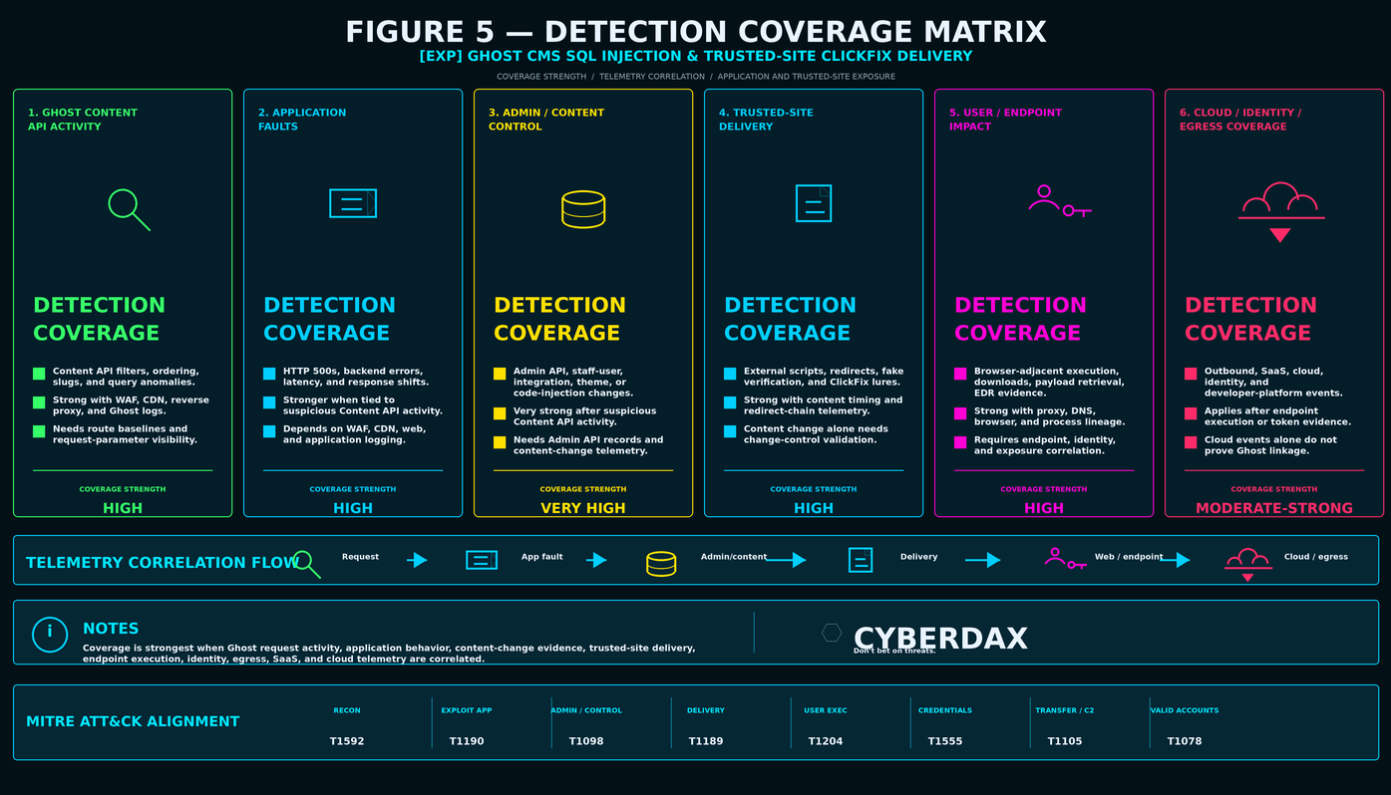
Figure 5
Purpose
This section provides SOC implementation guidance for operationalizing the S25 detection rules and S26 traceability model. The guidance is intended to help defenders deploy the rule set as staged detection coverage while avoiding over-attribution from single-source telemetry.
Implementation Approach
· Deploy the rules in hunt mode before enabling alert mode.
· Validate Ghost asset inventory, Ghost hosted-domain inventory, public Content API availability, Admin API route mappings, administrative path mappings, CDN coverage, WAF coverage, reverse proxy paths, load balancer backend mappings, and Ghost version posture.
· Validate whether Ghost deployments are self-hosted, managed, containerized, reverse-proxied, CDN-fronted, externally maintained, or consumed as trusted third-party content.
· Validate that Content API requests, Admin API requests, query parameters, response codes, response sizes, response timing, user agents, source context, referrer context, and route families are retained and searchable.
· Validate endpoint visibility for process creation, command line, parent process, grandparent process, process path, file writes, DLL loads, script execution, persistence, network connections, and behavioral detections.
· Validate DNS, proxy, secure web gateway, browser, and NDR telemetry for redirect chains, referrer relationships, newly introduced script sources, fake verification pages, and payload-staging infrastructure.
· Validate cloud, SaaS, identity, and developer-platform telemetry as downstream investigative sources, not primary attribution sources.
SOC Triage Model
· Treat isolated Ghost version exposure as low-confidence exposure context.
· Treat suspicious Content API activity as exploit-attempt evidence unless it is paired with WAF context, backend instability, Admin API follow-on, content modification, endpoint exposure, or incident-response evidence.
· Treat Admin API or administrative-route access as suspicious only when it deviates from normal source, timing, user agent, route, integration, action, content-change, or automation baselines.
· Treat content modification as high priority when it involves external scripts, redirect logic, code-injection settings, theme changes, staff-user changes, integration changes, or compressed-window article and page updates.
· Treat trusted-site fake verification delivery as suspicious delivery evidence, not endpoint compromise.
· Treat endpoint browser-adjacent PowerShell, command-shell, script-host, payload retrieval, loader execution, persistence, credential access, token access, or command-and-control-like activity as endpoint-confirmation evidence when linked to Ghost-hosted exposure.
· Treat cloud, SaaS, identity, and developer-platform anomalies as downstream leads unless upstream Ghost delivery and endpoint or credential-access linkage are validated.
Recommended SOC Workflow
· Confirm whether the affected domain, host, or application is a Ghost deployment.
· Determine Ghost hosted versus self-hosted status.
· Confirm Ghost version posture and patch status where available.
· Review Content API activity for abnormal filter syntax, malformed slug filters, nested expressions, unusual ordering parameters, encoded operators, SQL-like metacharacters, timing-oriented behavior, source novelty, and response anomalies.
· Review WAF, CDN, reverse proxy, load balancer, and web server logs for SQL injection context, request-normalization anomalies, partial blocking, repeated retries, backend errors, and suspicious allowed requests.
· Review Admin API and administrative-route activity for unfamiliar sources, compressed-window changes, route family expansion, staff-user activity, integration changes, webhook changes, theme changes, and code-injection changes.
· Review content-change telemetry for injected JavaScript, external script references, redirect logic, fake verification content, fake CAPTCHA content, fake Cloudflare-themed content, clipboard-instruction text, and suspicious inline loaders.
· Review DNS, proxy, secure web gateway, browser, and NDR telemetry for user exposure to suspicious redirect chains, fake verification pages, external loaders, and payload-staging destinations.
· Review endpoint telemetry for browser-adjacent execution, payload retrieval, archive extraction, script execution, DLL loading, persistence, credential access, token access, and command-and-control-like behavior.
· Review identity, SaaS, cloud, and developer-platform telemetry only after endpoint execution, credential theft, token theft, or incident-response evidence is present.
Alert Prioritization
· Highest priority should be assigned to suspicious Content API activity followed by Admin API misuse, content modification, malicious script insertion, or trusted-site delivery.
· Highest priority should be assigned to trusted Ghost-site delivery followed by endpoint execution, payload retrieval, persistence, credential access, token access, or command-and-control-like behavior.
· High priority should be assigned to Admin API source deviation followed by content changes, external script references, redirect logic, or user-exposure clustering.
· High priority should be assigned to multiple users or devices exposed to the same suspicious redirect chain, fake verification page, or payload-staging destination from a trusted Ghost-hosted site.
· Medium priority should be assigned to suspicious Content API activity with WAF SQL injection context, backend instability, response anomalies, or vulnerable-version exposure but without confirmed follow-on activity.
· Medium priority should be assigned to suspicious trusted-site delivery without confirmed endpoint execution.
· Low priority should be assigned to isolated Ghost version exposure, isolated Content API anomalies, isolated destination novelty, isolated WAF alerts, or isolated endpoint interpreter use without correlation.
Hunt-to-Alert Promotion Criteria
· Promote Content API detections when local baselines show manageable expected noise and suspicious request behavior reliably correlates with WAF context, response anomalies, Admin API follow-on, content modification, or source deviation.
· Promote Admin API follow-on detections when administrator-source baselines, integration baselines, route mappings, and content-change visibility are validated.
· Promote trusted-site delivery detections when redirect-chain visibility, external script-source baselines, destination enrichment, user-exposure tracking, and referrer context are reliable.
· Promote endpoint execution detections when process ancestry, command-line visibility, file telemetry, network telemetry, and Ghost-hosted exposure enrichment are reliable.
· Promote downstream cloud, SaaS, identity, or developer-platform detections only when upstream Ghost-hosted delivery and endpoint or credential-access linkage can be validated.
· Do not promote any rule to high-severity alerting until exception handling, false-positive baselines, query performance, triage workflow, and escalation criteria are validated.
Suppression and Exception Guidance
· Suppress or downgrade only when validated local context explains the behavior.
· Approved scanner, penetration testing, WAF validation, uptime monitoring, CDN health-check, search indexing, newsletter, analytics, publishing automation, managed hosting, vendor support, incident-response, and maintenance activity should be validated before suppression.
· Approved analytics, advertising, tag-management, consent-management, newsletter, subscription, marketing redirect, CDN script, site customization, and A/B testing workflows should be validated before suppressing external script or redirect-chain behavior.
· Approved administrator, developer, helpdesk, software distribution, remote support, training lab, security testing, and incident-response workflows should be validated before suppressing endpoint execution behavior.
· Approved cloud, SaaS, identity, developer-platform, CI/CD, break-glass, and automation activity should be validated before suppressing downstream control-plane or credential-use anomalies.
· Broad suppression by cloud provider, hosting provider, CDN, analytics provider, software-distribution platform, or destination category should be avoided because legitimate infrastructure and attacker staging infrastructure can overlap.
Escalation Guidance
· Escalate when suspicious Content API activity is followed by Admin API activity, content modification, code-injection changes, external script insertion, redirect delivery, or user exposure.
· Escalate when Ghost content changes introduce suspicious JavaScript, redirect logic, fake verification content, fake CAPTCHA content, fake Cloudflare-themed content, or payload-staging behavior.
· Escalate when multiple users or devices are exposed to the same suspicious delivery chain from a trusted Ghost-hosted site.
· Escalate when endpoint telemetry shows browser-adjacent command execution, payload retrieval, loader execution, persistence, credential access, token access, or command-and-control-like behavior after Ghost-hosted exposure.
· Escalate when cloud, SaaS, identity, or developer-platform anomalies follow confirmed endpoint execution, credential theft, token theft, or incident-response evidence.
· Do not escalate to confirmed compromise from a single stage unless incident-response evidence independently confirms compromise.
SOC Outcome Classification
· Exposed Ghost deployment.
· Suspected Ghost Content API exploitation attempt.
· Suspected Ghost administrative-control misuse.
· Suspected Ghost content modification.
· Confirmed Ghost content tampering.
· Suspected trusted-site delivery.
· Confirmed user or device exposure.
· Suspected ClickFix execution.
· Confirmed endpoint compromise.
· Suspected credential or token theft.
· Suspected downstream cloud, SaaS, identity, or developer-platform abuse.
· Confirmed campaign-aligned compromise only when multiple stages are validated.
Implementation Guardrails
· Do not attribute activity to this threat from Ghost version exposure alone.
· Do not attribute activity to this threat from WAF SQL injection context alone.
· Do not attribute activity to this threat from Admin API access alone.
· Do not attribute activity to this threat from fake verification page access alone.
· Do not attribute activity to this threat from endpoint PowerShell or command-shell execution alone.
· Do not attribute activity to this threat from cloud, SaaS, identity, or developer-platform anomalies alone.
· Maintain clear separation between exposure, exploit attempt, suspected Ghost compromise, confirmed Ghost compromise, suspected user exposure, confirmed endpoint execution, credential theft, token theft, and downstream compromise.
S29 — Detection Coverage Summary
Coverage Summary
The detection model provides strong behavior-led coverage across the Ghost CMS SQL Injection and Trusted-Site ClickFix Delivery chain when Ghost telemetry, edge telemetry, network telemetry, endpoint telemetry, identity telemetry, cloud telemetry, and SIEM correlation are available.
The strongest coverage comes from multi-stage correlation rather than single-signal detection. Coverage is highest when suspicious Content API behavior can be linked to Admin API activity, content modification, trusted-site delivery, user exposure, endpoint execution, and downstream identity or cloud behavior.
Strong Coverage Areas
· Ghost Content API SQL injection-like request behavior against vulnerable or unknown-version Ghost deployments.
· WAF SQL injection context involving Ghost Content API routes.
· Abnormal request structure, query complexity, encoded operators, malformed filters, malformed slug handling, timing-oriented behavior, or response anomalies.
· Admin API access from unfamiliar source infrastructure, unusual user agents, unusual geographies, or unexpected automation contexts.
· Admin API or administrative-route activity following suspicious Content API behavior.
· Article, page, post, template, theme, integration, webhook, staff-user, or code-injection modification after suspicious Content API or Admin API activity.
· Newly introduced JavaScript, external script references, redirect logic, fake verification content, fake CAPTCHA content, fake Cloudflare-themed content, browser-check content, or clipboard-instruction text.
· Trusted Ghost-site delivery of suspicious redirects, fake verification pages, payload-staging contacts, external loaders, or suspicious script sources.
· Multi-user or multi-device exposure clustering from the same trusted Ghost-hosted site.
· Browser-adjacent PowerShell, command-shell, script-host execution, payload retrieval, loader execution, archive extraction, DLL loading, persistence, credential access, token access, or command-and-control-like behavior after Ghost-hosted exposure.
· Downstream cloud, SaaS, identity, or developer-platform activity when linked to endpoint execution, credential access, token theft, or incident-response evidence.
Moderate Coverage Areas
· Suspicious Content API activity without Admin API follow-on or content-change visibility.
· Ghost version exposure where version metadata is incomplete, hidden, or not centrally inventoried.
· WAF SQL injection detections without application telemetry or backend response context.
· Admin API activity without full administrator-source baselines or content-change records.
· External script or redirect changes in environments with frequent marketing, analytics, tag-management, consent-management, A/B testing, or newsletter changes.
· Fake verification or fake CAPTCHA delivery without confirmed endpoint execution.
· Endpoint interpreter execution in environments with frequent administrator, developer, helpdesk, or software deployment activity.
· Cloud, SaaS, identity, or developer-platform anomalies where endpoint or credential-access linkage is incomplete.
Weak Coverage Areas
· Successful database reads that produce no visible WAF alert, backend instability, response anomaly, Admin API follow-on, or application-side telemetry.
· Admin API key theft where later use resembles legitimate administrative behavior.
· Managed Ghost environments where application logs, Admin API records, content-change telemetry, or backend context are unavailable.
· Ghost content tampering where revisions, code-injection changes, theme changes, integration changes, or staff-user changes are not retained.
· User exposure from unmanaged devices, mobile devices, personal devices, off-network browsing, or networks without proxy, DNS, browser, secure web gateway, or EDR visibility.
· ClickFix execution when users manually paste commands and process lineage, browser telemetry, clipboard context, or endpoint logging is incomplete.
· Payload execution with minimal network follow-on, approved infrastructure use, delayed execution, or living-off-the-land behavior.
· Downstream identity, SaaS, cloud, or developer-platform abuse using legitimate credentials, tokens, sessions, or service accounts without clear upstream linkage.
No Primary Coverage Areas
· YARA-based primary detection.
· Artifact-only confirmation where no stable artifact has been recovered.
· Actor attribution without incident-specific intelligence.
· Confirmation of successful SQL injection without database, application, Admin API, content-change, or incident-response evidence.
· Confirmation of endpoint compromise from trusted-site visit, fake verification page access, or PowerShell execution alone.
Platform Coverage Summary
NDR / Network Behavioral Analytics
· Strong for Ghost Content API anomalies, WAF context, Admin API follow-on, trusted-site delivery, user-exposure clustering, endpoint outbound follow-on, and network-visible downstream behavior.
· Limited for database-read confirmation, content-change contents, endpoint process execution, credential theft, token theft, and actor attribution.
SentinelOne
· Strong for endpoint ClickFix execution, payload retrieval, loader execution, persistence, credential access, token access, and command-and-control-like behavior.
· Limited for Ghost-side exploitation, Admin API key theft, content tampering, injected JavaScript, and exact fake verification interaction unless enriched by web, proxy, DNS, browser, or SIEM context.
Splunk
· Strong for multi-source correlation when indexes, sourcetypes, fields, lookups, entity keys, timing windows, and enrichment are validated.
· Limited where data onboarding, field extraction, lookup maintenance, or entity correlation is incomplete.
Elastic
· Strong for ECS-aligned web, endpoint, identity, and cloud correlation.
· Limited where ECS mappings, custom fields, index patterns, endpoint telemetry, or entity-correlation keys are incomplete.
QRadar
· Strong for AQL validation, CRE correlation, reference data, and offense workflows after DSM and custom property validation.
· Limited where DSM parsing, custom properties, building blocks, reference sets, or entity correlation are incomplete.
SIGMA
· Strong for portable detection logic and backend translation.
· Limited by backend support for temporal correlation, threshold grouping, enrichment joins, and suppression logic.
YARA
· Not primary for this report.
· Useful only for optional investigative hunting if stable artifacts are recovered.
AWS
· Strong where AWS-hosted Ghost telemetry, WAF, CloudFront, ALB, CloudTrail, GuardDuty, Security Hub, and identity context are available.
· Limited where cloud-only anomalies lack upstream Ghost delivery and endpoint or credential-access linkage.
Azure
· Strong where Azure-hosted Ghost telemetry, Front Door, Application Gateway, WAF, Azure Monitor, Entra ID, Defender, Sentinel, and Azure Activity telemetry are available.
· Limited where Entra ID or Azure control-plane anomalies lack upstream Ghost delivery and endpoint or credential-access linkage.
GCP
· Strong where GCP-hosted Ghost telemetry, Cloud Armor, Cloud Load Balancing, Cloud CDN, Cloud Logging, Cloud Audit Logs, Security Command Center, Chronicle, IAM, and control-plane telemetry are available.
· Limited where GCP IAM or control-plane anomalies lack upstream Ghost delivery and endpoint or credential-access linkage.
Coverage Confidence
High Confidence
High confidence applies when at least two stages of the chain are linked by reliable telemetry. Examples include suspicious Content API activity followed by Admin API misuse, Admin API activity followed by content modification, content modification followed by trusted-site delivery, or Ghost-hosted delivery followed by endpoint execution.
Medium Confidence
Medium confidence applies when one strong stage is present with supporting context but lacks full downstream confirmation. Examples include suspicious Content API behavior with WAF context, suspicious Admin API access with source deviation, or fake verification delivery from a trusted Ghost-hosted site without endpoint execution.
Low Confidence
Low confidence applies to isolated exposure signals, isolated suspicious requests, isolated WAF alerts, isolated trusted-site visits, isolated fake verification pages, isolated endpoint interpreter execution, or isolated cloud and identity anomalies without correlation.
Coverage Bottom Line
The detection model provides broad, behavior-led coverage when deployed as a correlated detection package. The coverage is strongest across Ghost Content API behavior, Admin API follow-on, content modification, trusted-site delivery, user exposure, endpoint execution, and downstream cloud or identity activity. Coverage is weakest where telemetry does not preserve route context, query parameters, content-change history, endpoint process ancestry, redirect chains, or identity-to-endpoint linkage.
S30 — Intelligence Maturity Assessment
Assessment Purpose
This section assesses the intelligence maturity of the Ghost CMS SQL Injection and Trusted-Site ClickFix Delivery detection model. The assessment focuses on how well the report converts threat behavior into durable detection logic, validated telemetry requirements, rule traceability, and operational SOC guidance.
Overall Intelligence Maturity
High.
The report provides a mature behavior-led detection model because it does not depend on one payload, one domain, one injected script, one fake verification page, one command string, or one malware family. It instead tracks the durable operational sequence of Ghost Content API exploitation behavior, Admin API or content-modification follow-on, trusted-site delivery abuse, user exposure, endpoint execution, and downstream identity or cloud activity.
Maturity Strengths
· The model separates exposure, exploit attempt, suspected Ghost compromise, confirmed Ghost compromise, suspected user exposure, confirmed endpoint execution, credential theft, token theft, and downstream compromise.
· The model avoids over-attribution from single-stage telemetry.
· The model prioritizes staged correlation over indicator-only detection.
· The model maps threat behavior to specific rule families across NDR, SentinelOne, Splunk, Elastic, QRadar, SIGMA, AWS, Azure, and GCP.
· The model correctly excludes YARA as a primary detection system because the report is behavior-led rather than artifact-led.
· The model identifies required telemetry, telemetry gaps, false-positive conditions, implementation constraints, and hunt-to-alert promotion requirements.
· The model preserves cloud-correlation guardrails and does not attribute AWS, Azure, or GCP anomalies to the Ghost delivery chain without upstream and endpoint or credential-access linkage.
Maturity Constraints
· Confidence depends heavily on Content API route visibility, query-parameter retention, WAF context, reverse proxy telemetry, CDN telemetry, and Ghost application logging.
· Confidence depends on Ghost administrative telemetry, content-change records, code-injection records, staff-user records, integration records, webhook records, and theme-change visibility.
· Endpoint confirmation depends on process ancestry, command-line telemetry, file telemetry, browser context, DNS context, proxy context, EDR network telemetry, and persistence or credential-access visibility.
· Trusted-site delivery confirmation depends on referrer context, redirect-chain telemetry, external script-source visibility, user-exposure clustering, and destination enrichment.
· Downstream cloud, SaaS, identity, and developer-platform analysis depends on reliable identity-to-endpoint linkage, credential-use context, token-use context, and validated upstream delivery evidence.
· Managed Ghost environments may limit application-level evidence and require stronger reliance on edge, network, content-integrity, and endpoint telemetry.
Intelligence Durability
High.
The detection model should remain durable if attackers change domains, infrastructure, payloads, redirect paths, injected JavaScript, fake verification wording, fake CAPTCHA branding, fake Cloudflare-themed content, script filenames, command strings, or malware families. The model remains focused on the behavior of converting trusted Ghost-hosted content into delivery infrastructure and driving user-side execution.
Detection Engineering Maturity
High.
The S25 rules provide implementation-ready detection engineering guidance across multiple platforms. The rule set includes detection purpose, detection logic, telemetry requirements, engineering instructions, DRI, TCR, limitations, and query patterns or platform-specific rule logic. The rules preserve local-validation requirements and do not present unmapped patterns as universally deployable.
SOC Operational Maturity
High.
The report provides practical SOC guidance by defining triage stages, escalation requirements, suppression guidance, coverage limits, and outcome classifications. The SOC model is mature because it prevents analysts from treating isolated WAF alerts, trusted-site visits, fake verification pages, endpoint PowerShell, or cloud anomalies as confirmed compromise without staged evidence.
Threat Intelligence Maturity
High.
The report translates threat intelligence into operational detection logic without relying on static IOCs. It identifies durable tradecraft, expected telemetry, platform-specific detection paths, non-coverage conditions, and rule-to-threat traceability. The intelligence model is suitable for portfolio use, customer-facing detection engineering guidance, and future report updates.
Adversary Adaptation Resistance
High.
The report remains resilient against common adversary changes, including:
· Rotating domains.
· Changing redirect chains.
· Changing fake verification wording.
· Changing fake CAPTCHA or browser-check branding.
· Changing JavaScript loaders.
· Moving from article-level injection to theme-level or global code-injection abuse.
· Delaying Admin API reuse.
· Delaying payload execution.
· Changing payload families.
· Changing command syntax.
· Using trusted infrastructure.
· Using legitimate credentials, tokens, or sessions after endpoint compromise.
Operational Readiness
Moderate to High.
The report is implementation-ready as detection engineering guidance, but operational readiness depends on customer-specific mapping and validation. The rules require local telemetry validation, field mapping, schema mapping, timing-window tuning, exception handling, false-positive baselining, query-performance testing, and SOC workflow validation before production alert deployment.
Maturity Gaps
· Ghost version metadata may be incomplete or unavailable.
· Content API query parameters may be stripped, normalized, truncated, or unavailable.
· Managed Ghost providers may limit access to application logs and Admin API telemetry.
· Content-change telemetry may not retain enough source, user, timestamp, and revision context.
· Browser telemetry and referrer context may be incomplete.
· Endpoint process ancestry and command-line telemetry may be limited or truncated.
· Cloud, SaaS, identity, and developer-platform telemetry may not reliably link activity back to endpoint execution or token theft.
· Static artifacts may not be available, limiting YARA usefulness.
Improvement Priorities
· Improve Ghost deployment inventory and version tracking.
· Improve Content API and Admin API route visibility.
· Improve WAF, CDN, reverse proxy, load balancer, and web server logging.
· Improve Ghost administrative logging, staff-user activity logging, integration activity logging, code-injection change tracking, and content revision history.
· Improve content-integrity monitoring for articles, pages, themes, templates, and global code-injection settings.
· Improve DNS, proxy, browser, secure web gateway, and redirect-chain telemetry.
· Improve endpoint process ancestry, command-line telemetry, file telemetry, DLL-load telemetry, persistence telemetry, and EDR network telemetry.
· Improve identity, SaaS, cloud, and developer-platform linkage to endpoint and credential-access evidence.
· Improve false-positive baselines for publishing workflows, marketing changes, analytics updates, tag-management changes, software distribution, helpdesk workflows, developer workflows, managed hosting operations, and incident-response activity.
Final Intelligence Maturity Judgment
The Ghost CMS SQL Injection and Trusted-Site ClickFix Delivery report demonstrates high intelligence maturity because it converts threat behavior into durable, staged, platform-aware detection engineering coverage. The model is strongest when used as a correlated detection package across Ghost telemetry, edge telemetry, network telemetry, endpoint telemetry, identity telemetry, cloud telemetry, and SIEM enrichment.
The report should not be treated as a single-rule or single-signal detection model. Its value comes from preserving the full chain relationship between Ghost Content API behavior, Admin API or content-modification follow-on, trusted-site delivery, endpoint execution, and downstream identity or cloud behavior.
S31 — Telemetry Dependencies
Ghost CMS SQL Injection and Trusted-Site ClickFix Delivery detection and response depends on the organization’s ability to reconstruct a single exposure timeline across public Ghost CMS request activity, Content API behavior, Admin API activity, content modification, trusted-site delivery, user exposure, endpoint execution, credential or token access, and downstream SaaS, cloud, identity, or developer-platform activity. The primary dependency is not one specific tool, but the ability to prove which Ghost deployment was exposed, whether suspicious Content API behavior reached vulnerable or exposed functionality, whether Admin API or content-modification activity followed, whether Ghost-hosted content was altered, whether users were exposed to suspicious delivery flows, and whether endpoint or downstream activity occurred after that exposure.
Ghost CMS and Application Telemetry
· Ghost web access logs showing Content API requests, public route access, Admin API route access, administrative-path activity, source IP, user agent, request method, URI path, URI query where available, response code, response size, response timing, referrer, and request sequencing.
· Ghost application logs showing Content API errors, Admin API activity, authentication-adjacent activity, publishing activity, staff-user activity, integration activity, webhook activity, theme activity, code-injection changes, and application-specific errors.
· Ghost content-change telemetry showing article edits, page edits, post edits, theme changes, template changes, global code-injection changes, external script additions, redirect logic additions, integration changes, webhook changes, and staff-user changes.
· Ghost version and patch telemetry showing whether the deployment was running a vulnerable version, a remediated version, or an unknown version posture during the suspected exposure window.
· Ghost hosted versus self-hosted context showing whether the organization controls application logs, Admin API telemetry, content-change records, WAF placement, CDN configuration, reverse-proxy routing, and incident-response access.
· Change-control and publishing records showing approved content updates, marketing changes, theme updates, analytics changes, newsletter changes, integration changes, emergency fixes, vendor-support activity, and maintenance windows.
Web, WAF, CDN, and Request Telemetry
· WAF, CDN, reverse proxy, load balancer, web server, and application gateway telemetry showing URI path, URI query where available, request method, source IP, user agent, referrer, response code, bytes received, bytes sent, response size, request timing, upstream routing, request disposition, and blocked or allowed request status.
· Request visibility for Ghost Content API activity, abnormal filter syntax, malformed slug filters, nested expressions, unusual ordering parameters, encoded operators, SQL-like metacharacters, unusually complex query strings, sparse targeted probing, repeated request variation, endpoint-specific probing, and request cadence anomalies.
· WAF normalization and inspection output showing SQL injection context, suspicious query parameters, request-normalization anomalies, malformed request handling, partial blocking, allowed suspicious traffic, repeated retry behavior after blocking, and response-code shifts.
· Response behavior telemetry showing repeated 400-series or 500-series responses, response-size variation, response-time changes, backend timeouts, application instability, abnormal latency, and error-to-success transitions.
· CDN and reverse-proxy telemetry showing whether suspicious request paths, Admin API routes, public Ghost pages, external script references, redirect chains, and trusted-site delivery behavior were visible at the edge.
Trusted-Site Delivery and User-Exposure Telemetry
· DNS, proxy, secure web gateway, browser, and NDR telemetry showing user access to Ghost-hosted pages, referrer relationships, redirect-chain behavior, external script loading, fake verification pages, fake CAPTCHA pages, fake Cloudflare-themed pages, browser-check pages, clipboard-instruction pages, external loaders, and payload-staging destinations.
· User access telemetry identifying which users, devices, browsers, source networks, sessions, customers, subscribers, partners, employees, or external visitors interacted with the affected Ghost-hosted content during the suspected exposure window.
· Browser download, proxy, DNS, secure web gateway, and endpoint timeline telemetry showing suspicious downloads, script retrieval, archive retrieval, payload retrieval, direct IP access, rare SNI values, unusual HTTP hosts, newly observed domains, and low-reputation destinations after Ghost-hosted exposure.
· Referrer and redirect-chain telemetry linking Ghost-hosted content to suspicious delivery infrastructure, payload-staging destinations, external script sources, or fake verification flows.
· User-population context showing whether exposed users were employees, customers, subscribers, partners, administrators, unmanaged-device users, or managed endpoints with sufficient telemetry for exposure scoping.
Endpoint and Execution Telemetry
· Endpoint process telemetry showing process creation, parent-child process lineage, command-line arguments, process start and stop times, user context, integrity context, signer context, hash context, and process reputation where available.
· Parent-child process relationships involving browsers, WebView processes, PowerShell, command shell, wscript, cscript, mshta, rundll32, regsvr32, msiexec, node, Python, archive utilities, file-transfer utilities, and other interpreter or loader paths.
· File telemetry showing creation, modification, deletion, rename, overwrite, permission changes, timestamp changes, archive extraction, script creation, DLL writes, executable writes, shortcut-file creation, and execution from Downloads, Temp, AppData, ProgramData, Public, browser cache, or other user-writable paths.
· Endpoint network telemetry showing outbound callbacks, newly observed domains, direct IP egress, uncommon ports, rare destinations, unusual TLS metadata, payload retrieval, beacon-like activity, and abnormal transfer behavior after browser-adjacent execution.
· Persistence and credential-access telemetry showing scheduled tasks, startup-folder writes, registry run keys, service creation, browser extension changes, browser credential-store access, token-store access, password-manager access, developer token access, cloud credential access, or other credential-adjacent behavior.
Credential, Identity, SaaS, Cloud, and Developer-Platform Telemetry
· Identity telemetry showing suspicious sign-ins, token use, service-account activity, MFA changes, conditional access failures, impossible travel, unfamiliar administrative source context, suspicious session reuse, or failed-to-successful access patterns after endpoint execution or credential-access evidence.
· SaaS telemetry showing mailbox access, file access, sharing changes, administrative changes, suspicious downloads, token reuse, or abnormal user activity after endpoint compromise evidence.
· Cloud telemetry showing access-key creation, role assumption, policy changes, IAM changes, service-account use, unusual region activity, object storage access, metadata access, secrets retrieval, managed database access, and control-plane activity after endpoint or credential-access evidence.
· Developer-platform telemetry showing repository access, secrets access, token use, workflow modification, package activity, CI/CD changes, or unusual source context after endpoint execution or credential-access evidence.
· Downstream telemetry should be treated as conditional unless mapped to upstream Ghost-hosted delivery, endpoint execution, credential theft, token theft, or incident-response evidence.
Telemetry Dependency Summary
· Ghost CMS and application telemetry establishes whether suspicious Content API activity, Admin API activity, content modification, staff-user activity, integration activity, webhook activity, or code-injection changes occurred.
· Web, WAF, CDN, reverse proxy, load balancer, and web server telemetry establishes whether suspicious request activity reached Ghost-facing functionality and whether response behavior changed.
· Trusted-site delivery telemetry establishes whether Ghost-hosted content exposed users to suspicious scripts, redirects, fake verification flows, external loaders, or payload-staging infrastructure.
· Endpoint telemetry establishes whether exposed users or devices showed browser-adjacent execution, payload retrieval, loader behavior, persistence, credential access, token access, or outbound follow-on behavior.
· Identity, SaaS, cloud, and developer-platform telemetry establishes whether activity expanded into downstream credential use, token use, account misuse, control-plane activity, or developer-platform access.
· Change-control, asset, vulnerability, publishing, vendor-support, incident-response, and maintenance records establish whether observed behavior was authorized, expected, or suspicious.
S32 — Detection Limitations
Ghost CMS SQL Injection and Trusted-Site ClickFix Delivery detection is limited by the fact that activity can begin as ordinary internet noise, malformed Content API traffic, WAF-blocked probes, legitimate publishing activity, approved marketing changes, or normal endpoint administration. A suspicious Content API request, WAF SQL injection alert, Admin API event, content change, fake verification page, endpoint command, or cloud event is not inherently proof of successful exploitation. Risk emerges from the relationship between suspicious Ghost-facing activity, administrative or content-change behavior, trusted-site delivery, endpoint execution, credential or token access, and downstream identity or cloud evidence.
Ghost CMS and Application Limitations
· Ghost version posture may be unavailable, hidden, inaccurate, or obscured by CDN, reverse-proxy, managed-hosting, or deployment practices.
· Public Content API availability does not prove exploitation.
· Suspicious Content API requests do not prove successful SQL injection, database read, Admin API key exposure, or content tampering.
· WAF SQL injection alerts may indicate exploit attempts but may not confirm whether requests reached the application or succeeded.
· Ghost application logs may not retain enough detail to reconstruct Content API activity, Admin API behavior, staff-user activity, integration changes, webhook changes, theme changes, code-injection changes, or content updates.
· Managed Ghost environments may limit access to application logs, Admin API audit detail, content-change records, backend telemetry, and incident-response artifacts.
Content Integrity Limitations
· Content modification may be difficult to validate if article revisions, page revisions, theme changes, template changes, integration changes, webhook changes, staff-user changes, or code-injection settings are not retained.
· Legitimate publishing, marketing, analytics, tag-management, newsletter, subscription, consent-management, A/B testing, site-customization, content-import, migration, and incident-response workflows may resemble suspicious content changes.
· External scripts and redirects may be legitimate when tied to approved business workflows.
· Subtle malicious changes may blend into existing theme files, shared templates, footer content, global code-injection settings, article bodies, or page bodies.
· Content cleanup does not prove that prior user exposure did not occur.
Network and Delivery Limitations
· CDN, reverse proxy, WAF, load balancer, and web server telemetry may strip, normalize, truncate, or fail to retain query parameters needed to identify suspicious Content API behavior.
· TLS inspection gaps may prevent visibility into page content, injected scripts, redirect logic, fake verification content, or payload-staging behavior.
· Referrer context may be missing, limiting the ability to prove that suspicious delivery came from Ghost-hosted content.
· Redirect-chain reconstruction may be incomplete when users browse from unmanaged devices, mobile devices, personal devices, privacy-focused browsers, browser isolation tools, off-network locations, or external networks.
· Newly observed domains, direct IP destinations, rare SNI values, unusual HTTP host values, suspicious redirects, and fake verification pages are risk indicators, not proof of endpoint compromise.
Endpoint and User-Execution Limitations
· Endpoint telemetry may not preserve the relationship between Ghost-hosted exposure and later PowerShell, command-shell, script-host, archive retrieval, payload retrieval, loader execution, or outbound behavior.
· Users may manually paste commands from fake verification or clipboard-instruction pages, making clipboard, browser-interaction, and user-action visibility incomplete.
· Process command lines may be truncated, hidden, unavailable, or normalized in a way that reduces detection fidelity.
· Developer, administrator, helpdesk, software distribution, remote support, security testing, and incident-response workflows may legitimately use PowerShell, command shell, script hosts, archive utilities, installers, and remote retrieval.
· Payload execution may be delayed, fileless, staged through approved infrastructure, or blended into legitimate tools.
· Endpoint compromise should not be confirmed from browser-adjacent execution alone without payload behavior, persistence, credential access, token access, command-and-control-like activity, EDR threat behavior, or incident-response evidence.
Identity, SaaS, Cloud, and Developer-Platform Limitations
· Cloud, SaaS, identity, and developer-platform anomalies may be unrelated to Ghost-hosted delivery unless linked to endpoint execution, credential theft, token theft, or incident-response evidence.
· Valid credentials, tokens, service accounts, or sessions may make downstream activity appear legitimate.
· Identity-to-endpoint linkage may be incomplete when users use multiple devices, shared accounts, unmanaged devices, personal browsers, remote access workflows, or privacy tools.
· Cloud control-plane activity may reflect normal automation, CI/CD activity, break-glass access, managed service behavior, vendor support, or administrative maintenance.
· Developer-platform access may be legitimate when tied to normal repository maintenance, CI/CD pipelines, package management, secrets rotation, or engineering workflows.
Attribution and Classification Limitations
· The report should not classify activity as confirmed Ghost CMS exploitation based on a single suspicious request, WAF alert, Content API event, Admin API event, content change, fake verification page, endpoint alert, or cloud event.
· Activity should be described as aligned with the Ghost CMS SQL Injection and Trusted-Site ClickFix Delivery path only when the behavior chain matches suspicious Content API activity followed by Admin API activity, content modification, trusted-site delivery, user exposure, endpoint execution, credential access, token access, or downstream expansion evidence.
· Confirmed compromise, confirmed credential access, confirmed token theft, confirmed user-side delivery, confirmed persistence, confirmed exfiltration, and confirmed cloud expansion require incident-specific validation.
· Actor attribution should remain out of scope unless supported by separate incident intelligence, validated infrastructure overlap, intrusion evidence, or external reporting.
S33 — Defensive Control & Hardening Improvements
Ghost CMS SQL Injection and Trusted-Site ClickFix Delivery risk reduction depends on strengthening Ghost CMS exposure management, patch validation, administrative governance, content integrity, WAF and edge visibility, endpoint execution controls, credential protection, trusted-site delivery monitoring, user-exposure scoping, cloud and SaaS containment, and response readiness. The most effective improvements reduce the likelihood that malicious Content API activity reaches vulnerable functionality, limit the blast radius of Ghost administrative misuse, and improve the organization’s ability to prove what content, users, endpoints, credentials, tokens, and downstream resources were affected.
Ghost CMS Exposure and Patch Hardening
· Maintain a current inventory of internet-facing Ghost deployments, hosted versus self-hosted status, public Content API exposure, Admin API exposure, Ghost version posture, WAF placement, CDN paths, reverse-proxy paths, load balancer paths, application owners, vendor owners, and business criticality.
· Prioritize patch validation for internet-facing Ghost deployments, customer-facing publishing sites, newsletter platforms, documentation portals, subscription content, and externally maintained Ghost instances.
· Validate Ghost deployments earlier than version 6.19.1 or deployments where version posture cannot be confirmed.
· Remove or restrict unnecessary public exposure of Ghost routes, administrative-adjacent paths, legacy publishing paths, unused integrations, unused webhooks, and unneeded automation workflows.
· Require documented change-control evidence for Ghost upgrades, content updates, theme changes, code-injection changes, integration changes, webhook changes, vendor support, emergency fixes, and maintenance windows.
Admin API and Publishing Governance
· Review Ghost Admin API access, Admin API keys, staff users, roles, invitations, integrations, webhooks, automation identities, and privileged publishing workflows.
· Rotate Admin API keys when compromise is suspected or when exposure history cannot be confidently reconstructed.
· Restrict administrative access to approved identities, approved administrator sources, approved automation, and documented publishing workflows where operationally feasible.
· Review staff-user changes, integration creation, webhook changes, code-injection changes, and privileged publishing activity after suspicious Content API behavior.
· Monitor Admin API activity from unfamiliar IPs, rare ASNs, unusual geographies, hosting-provider infrastructure, new user agents, unexpected automation contexts, or abnormal time windows.
WAF, Web, and Application Hardening
· Tune WAF, CDN, reverse proxy, application gateway, and load balancer controls for suspicious Ghost Content API activity, abnormal filters, malformed slugs, nested expressions, unusual ordering parameters, encoded operators, SQL-like metacharacters, repeated request variation, sparse targeted probing, and error-to-success transitions.
· Preserve URI path, URI query where available, source context, response code, response size, response timing, referrer, host header, user agent, request disposition, and upstream routing data.
· Apply route-aware protections for Ghost Content API routes, Ghost Admin API routes, public Ghost pages, code-injection routes, theme routes, integration routes, staff-user routes, webhook routes, and publishing-control routes.
· Monitor suspicious allowed traffic, partial blocking, request-normalization anomalies, backend instability, abnormal response behavior, and response-code shifts.
· Separate public content delivery paths from administrative functions, integration workflows, webhook workflows, and high-risk publishing controls where operationally feasible.
Content Integrity and Trusted-Site Delivery Hardening
· Maintain known-good baselines for articles, pages, templates, themes, footer content, global code-injection settings, external script references, redirect behavior, newsletter flows, and user-facing prompts.
· Monitor for unauthorized JavaScript changes, external script additions, redirect logic, fake verification text, fake CAPTCHA content, fake Cloudflare-themed content, browser-check wording, clipboard-instruction text, and payload-staging links.
· Apply change review for theme changes, template changes, global code-injection changes, integration changes, webhook changes, and high-impact publishing automation.
· Document approved analytics, advertising, tag-management, consent-management, newsletter, subscription, marketing redirect, A/B testing, and site-customization scripts.
· Validate content cleanup after suspected compromise and monitor for reinfection, recurring code-injection changes, unauthorized integrations, or repeated content tampering.
Endpoint, Credential, and Token Hardening
· Improve endpoint visibility into browser-adjacent PowerShell, command-shell, script-host execution, archive retrieval, payload retrieval, DLL loading, installer execution, loader behavior, persistence, credential access, token access, and outbound communication.
· Reduce unnecessary browser-to-command execution and user-writable path execution where operationally feasible.
· Monitor for encoded PowerShell, execution-policy bypass, hidden windows, remote retrieval, chained commands, direct IP retrieval, suspicious interpreter behavior, and execution from Downloads, Temp, AppData, ProgramData, Public, or browser cache paths.
· Store sensitive tokens, API keys, developer secrets, cloud credentials, service-account material, and automation credentials in managed secrets systems where feasible.
· Prepare credential and token revocation workflows for exposed users, administrators, service accounts, integrations, publishing automation, and developer accounts.
User-Exposure and Response Readiness
· Retain proxy, DNS, secure web gateway, browser download, EDR, NDR, and endpoint timeline telemetry for users who access Ghost-hosted content during suspected exposure windows.
· Predefine exposure-scoping workflows for employees, customers, subscribers, partners, external users, administrators, managed endpoints, unmanaged devices, and off-network browsing scenarios.
· Prepare response workflows for Ghost patch validation, Admin API key rotation, staff-user review, integration review, webhook review, content integrity review, content restoration, endpoint triage, credential revocation, and downstream cloud or SaaS scoping.
· Preserve evidence before content cleanup where possible so responders can determine whether exposure occurred before remediation.
· Ensure customer, subscriber, partner, legal, communications, and executive assurance workflows can be activated when trusted-site delivery or endpoint exposure cannot be confidently ruled out.
S34 — Defensive Control & Hardening Architecture

Figure 6
The defensive architecture for Ghost CMS SQL Injection and Trusted-Site ClickFix Delivery should be built around a layered application-to-content-to-user-exposure model. The architecture must assume that public Ghost CMS activity can become business-impacting exposure when suspicious Content API behavior reaches vulnerable functionality, administrative control is abused, Ghost content is modified, users are exposed to trusted-site delivery, endpoints execute suspicious commands, or credentials and tokens are used downstream.
Exposure Management Layer
· Maintain authoritative inventory of internet-facing Ghost deployments, hosted versus self-hosted status, public Content API exposure, Admin API exposure, Ghost version posture, WAF placement, CDN path, reverse proxy path, load balancer path, application ownership, vendor ownership, and business criticality.
· Prioritize configuration and patch validation for public Ghost publishing sites, customer-facing content portals, newsletter platforms, documentation portals, subscription content, marketing sites, and externally maintained Ghost instances.
· Track Content API routes, Admin API routes, code-injection settings, theme paths, integration paths, webhook paths, staff-user controls, article paths, page paths, tag paths, author paths, and high-risk public content.
· Link vulnerability management, asset ownership, Ghost patch posture, vendor-support records, publishing records, change-control records, and business criticality to detection and response prioritization.
Request Control and Application Protection Layer
· Enforce WAF, CDN, reverse proxy, application gateway, and load balancer protections for suspicious Content API behavior, abnormal filters, malformed slug filters, unusual ordering parameters, encoded operators, SQL-like metacharacters, repeated request variation, sparse targeted probing, and suspicious allowed traffic.
· Apply route-aware protections for Ghost Content API routes, Ghost Admin API routes, public Ghost pages, code-injection routes, theme routes, staff-user routes, integration routes, webhook routes, and publishing-control workflows.
· Restrict administrative paths and high-risk publishing functions using strong authentication, approved source controls, step-up controls, administrative session monitoring, and documented publishing workflows where operationally feasible.
· Monitor blocked and allowed suspicious request activity, request-normalization anomalies, response-code shifts, response-time changes, backend timeouts, abnormal latency, and error-to-success transitions.
Administrative and Content Integrity Layer
· Monitor Admin API activity, staff-user activity, integration activity, webhook changes, theme changes, code-injection changes, article updates, page updates, publishing automation, and privileged content-management workflows.
· Monitor Ghost content for unauthorized JavaScript, external script references, redirect logic, fake verification wording, fake CAPTCHA content, fake Cloudflare-themed content, browser-check prompts, clipboard-instruction text, and payload-staging links.
· Apply known-good baselines to articles, pages, themes, templates, footer content, global code-injection settings, external script references, and shared publishing components.
· Correlate Ghost application events to WAF, CDN, reverse proxy, web server, source context, administrator identity, publishing workflow, asset inventory, and change-control evidence.
Trusted-Site Delivery and User-Exposure Layer
· Correlate Ghost-hosted content access with DNS, proxy, secure web gateway, browser, NDR, endpoint, and SIEM telemetry.
· Track redirect chains from Ghost-hosted pages to fake verification pages, fake CAPTCHA pages, fake Cloudflare-themed pages, browser-check pages, clipboard-instruction pages, external loaders, suspicious script sources, and payload-staging destinations.
· Identify multiple users or devices receiving the same suspicious delivery chain from a trusted Ghost-powered site.
· Preserve evidence required for user-exposure scoping, customer assurance, subscriber notification analysis, partner notification analysis, legal review, cyber insurance coordination, regulatory analysis, and executive reporting.
Endpoint Execution and Containment Layer
· Monitor browser-adjacent PowerShell, command-shell, script-host execution, archive retrieval, payload retrieval, DLL loading, installer execution, loader behavior, suspicious child processes, persistence, credential access, token access, and outbound command-and-control-like behavior.
· Correlate endpoint execution with Ghost-hosted exposure, suspicious redirect-chain activity, fake verification delivery, payload-staging infrastructure, browser telemetry, and proxy evidence.
· Contain affected endpoints when suspicious execution is validated.
· Preserve endpoint evidence required for process ancestry, command line, file writes, network connections, credential access, token access, persistence, and incident-response validation.
Identity, SaaS, Cloud, and Developer-Platform Containment Layer
· Monitor identity, SaaS, cloud, and developer-platform activity after endpoint execution, credential access, token access, or incident-response evidence is validated.
· Review sign-ins, token use, access-key creation, role assumption, policy changes, repository access, secrets access, workflow changes, package activity, service-account use, and control-plane activity.
· Revoke exposed credentials and tokens where evidence supports exposure.
· Avoid attributing cloud-only, SaaS-only, identity-only, or developer-platform-only anomalies to Ghost-hosted delivery without upstream linkage.
Incident Governance Layer
· Maintain decision workflows for Ghost containment, patch validation, Admin API key rotation, staff-user review, integration review, webhook review, content restoration, endpoint triage, credential rotation, user-exposure scoping, downstream cloud or SaaS review, legal escalation, customer assurance, vendor escalation, and executive reporting.
· Define escalation thresholds for suspicious Content API activity, Admin API source deviation, content modification, trusted-site delivery, endpoint execution, credential access, token access, outbound communication, downstream identity activity, and incomplete telemetry.
· Require cross-functional participation from security, application owners, publishing teams, marketing teams, infrastructure teams, endpoint teams, identity teams, cloud teams, vendor-management teams, legal, privacy, communications, customer assurance, and executive leadership.
· Track evidence quality, confidence level, containment status, exposure scope, patch status, Admin API key status, content restoration status, endpoint scope, credential and token rotation status, vendor dependency, and residual risk.
S35 — Defensive Control Mapping Matrix
Application Exposure Controls
Strengthen
· Ghost asset inventory, internet exposure tracking, public Content API review, Admin API exposure review, hosted versus self-hosted ownership, version validation, WAF placement validation, CDN and reverse-proxy documentation, vendor-managed site tracking, and patch governance.
Applies to
· Internet-facing Ghost CMS deployments, public Content API routes, Ghost Admin API routes, customer-facing publishing sites, documentation portals, newsletter platforms, marketing sites, subscription content, and incomplete asset ownership.
Reduces
· Unknown exposure, delayed patching, incomplete asset ownership, untracked public Content API access, and inability to confirm whether vulnerable Ghost deployments remain internet-facing.
Ghost Administrative and API Governance Controls
Strengthen
· Admin API key governance, staff-user review, role review, invitation review, integration review, webhook review, publishing automation baselines, approved administrator source baselines, and privileged content-management workflows.
Applies to
· Ghost administrators, content managers, publishing automation, integrations, webhooks, staff users, managed support, vendor maintenance, and privileged publishing actions.
Reduces
· Unauthorized administrative access, delayed discovery of Admin API misuse, unreviewed staff-user changes, persistent unauthorized integrations, and abuse of legitimate publishing workflows.
WAF and Web Protection Controls
Strengthen
· WAF rules, request normalization, Content API route protections, Admin API route protections, response anomaly monitoring, partial-block review, rate controls, source clustering analysis, query-parameter retention, and allowed suspicious traffic review.
Applies to
· Suspicious Content API activity, abnormal filter syntax, malformed slug filters, nested expressions, encoded operators, SQL-like metacharacters, unusual ordering parameters, request-size anomalies, backend instability, and error-to-success transitions.
Reduces
· Missed exploit attempts, missed Content API anomalies, missed source clustering, missed WAF bypass-like behavior, and missed suspicious allowed traffic.
Content Integrity Controls
Strengthen
· Article revision tracking, page revision tracking, theme monitoring, template monitoring, global code-injection monitoring, external script-source baselines, redirect monitoring, fake verification content review, and publishing change-control validation.
Applies to
· Articles, pages, posts, themes, templates, footer content, global code-injection settings, integrations, webhooks, shared publishing components, and customer-facing Ghost-hosted content.
Reduces
· Malicious JavaScript insertion, fake verification delivery, fake CAPTCHA delivery, suspicious redirect logic, unauthorized content tampering, reinfection after cleanup, and loss of confidence in public-facing content.
Trusted-Site Delivery and User-Exposure Controls
Strengthen
· DNS monitoring, proxy visibility, secure web gateway coverage, browser telemetry, redirect-chain reconstruction, referrer preservation, external script tracking, user-exposure grouping, and customer or subscriber exposure workflows.
Applies to
· Employees, customers, subscribers, partners, administrators, external visitors, managed endpoints, unmanaged devices, and users who access Ghost-hosted content.
Reduces
· Missed user exposure, missed fake verification delivery, missed payload-staging contact, missed redirect-chain behavior, and inability to identify affected users or devices.
Endpoint Execution Controls
Strengthen
· Browser-adjacent process detection, PowerShell monitoring, command-shell telemetry, script-host monitoring, file write and file execution telemetry, DLL-load visibility, persistence monitoring, credential-access monitoring, token-access monitoring, and endpoint network telemetry.
Applies to
· Managed endpoints, privileged workstations, developer workstations, administrator workstations, high-risk user endpoints, and devices exposed to suspicious Ghost-hosted delivery.
Reduces
· Missed ClickFix execution, missed payload retrieval, missed loader behavior, missed persistence, missed credential access, missed token access, and missed endpoint outbound follow-on behavior.
Credential, Identity, SaaS, Cloud, and Developer-Platform Controls
Strengthen
· MFA, conditional access, token monitoring, credential revocation workflows, SaaS audit logging, cloud control-plane monitoring, developer-platform access review, service-account governance, IAM review, and CI/CD access monitoring.
Applies to
· Identity providers, SaaS applications, cloud environments, developer platforms, CI/CD systems, repositories, service accounts, automation identities, and administrator accounts.
Reduces
· Downstream credential abuse, token misuse, SaaS account misuse, cloud control-plane abuse, developer-platform exposure, and over-attribution from cloud-only anomalies.
Audit and Evidence Controls
Strengthen
· Retention, normalization, field mapping, asset correlation, source-to-application linkage, user-to-device mapping, identity-to-endpoint mapping, Ghost deployment mapping, change-control records, vendor-support records, publishing records, and incident evidence preservation.
Applies to
· Exposure scoping, user-impact determination, legal defensibility, customer assurance, notification analysis, cyber insurance coordination, vendor escalation, and incident reconstruction.
Reduces
· Uncertainty when determining whether activity remained attempted, became Ghost-side compromise, exposed users, caused endpoint execution, or expanded into downstream compromise.
Response and Governance Controls
Strengthen
· Ghost containment playbooks, patch validation procedures, Admin API key rotation workflows, staff-user review workflows, integration review workflows, webhook review workflows, content restoration procedures, endpoint triage, credential and token revocation, user-exposure scoping, legal escalation, customer assurance, vendor escalation, and executive reporting.
Applies to
· Suspected exploitation, confirmed content tampering, trusted-site delivery, endpoint execution, credential exposure, token exposure, downstream SaaS or cloud activity, incomplete telemetry, customer-facing service risk, and regulatory exposure.
Reduces
· Response delay, incomplete exposure scoping, inconsistent customer-impact assessment, loss of evidence during cleanup, and recurring compromise due to incomplete remediation.
S36 — CyberDax Intelligence Maturity Assessment
Current Maturity Assessment
Moderate to high.
Ghost CMS SQL Injection and Trusted-Site ClickFix Delivery defense requires more than WAF alerting, generic CMS patching, or endpoint alerts. Organizations with basic web logs, WAF events, and endpoint telemetry may identify suspicious activity, but they may struggle to prove whether Content API activity led to Admin API misuse, whether Ghost-hosted content changed, whether users were exposed to fake verification delivery, whether endpoint execution occurred, whether credentials or tokens were accessed, or whether the incident expanded into SaaS, cloud, identity, or developer-platform resources. Mature defense requires integrated visibility across Ghost application behavior, edge telemetry, content-change records, user-exposure telemetry, endpoint evidence, downstream identity and cloud telemetry, change-control records, vendor-support records, and incident governance.
Maturity Strengths
· Organizations with centralized Ghost, WAF, CDN, reverse proxy, load balancer, web server, endpoint, DNS, proxy, NDR, browser, identity, SaaS, cloud, asset, vulnerability, vendor-support, publishing, and change-control telemetry have a stronger foundation for detecting suspicious Ghost request-to-impact behavior.
· Organizations with mature Ghost asset inventory, patch validation, WAF tuning, Admin API monitoring, content-integrity monitoring, endpoint telemetry, token governance, user-exposure scoping, and downstream identity or cloud monitoring can reduce both likelihood and blast radius.
· Organizations with established application-security, publishing, infrastructure, endpoint, identity, cloud, legal, privacy, customer assurance, vendor-management, and executive-governance workflows can make faster decisions when exploitation success or user exposure cannot be ruled out.
Maturity Gaps
· Many organizations do not maintain complete inventories of internet-facing Ghost deployments, public Content API exposure, Admin API exposure, Ghost version posture, hosted versus self-hosted status, WAF placement, vendor ownership, application ownership, or business criticality.
· WAF, CDN, proxy, reverse proxy, and web server logs may not retain enough request structure, query context, request normalization, response behavior, referrer context, or upstream routing to distinguish exploit attempts from benign malformed traffic.
· Ghost application and Admin API logs may not capture enough staff-user activity, integration activity, webhook activity, content-change detail, code-injection changes, theme changes, or publishing workflow context to prove whether the site remained trustworthy.
· Content-integrity monitoring may not provide enough prior-state, source, user, timestamp, revision, external script, redirect, or known-good baseline context to prove whether Ghost content changed maliciously.
· Managed Ghost, vendor-hosted, externally maintained, CDN-fronted, or reverse-proxied environments may limit application, content-change, Admin API, source, and backend visibility.
· Endpoint telemetry may not reliably link browser activity to later command execution, payload retrieval, loader behavior, persistence, credential access, token access, or outbound communication.
· Cloud, SaaS, identity, and developer-platform telemetry may not be correlated to the affected user, endpoint, token, credential, or Ghost exposure boundary.
· Incident-response teams may not have pre-built workflows for trusted-site delivery where malware may be absent but content trust, user exposure, endpoint execution, credentials, tokens, and downstream account activity are material.
Maturity Improvement Priorities
· Improve correlation between Ghost, WAF, CDN, reverse proxy, load balancer, web server, endpoint, DNS, proxy, browser, NDR, identity, SaaS, cloud, asset, vulnerability, publishing, vendor-support, and change-control telemetry.
· Expand Ghost visibility for Content API activity, Admin API access, staff-user changes, integration changes, webhook changes, theme changes, code-injection changes, content updates, and publishing workflow anomalies.
· Strengthen Ghost patch validation, public Content API review, Admin API key governance, staff-user governance, integration governance, webhook governance, and emergency remediation workflows.
· Strengthen content-integrity monitoring, known-good baselines, external script-source tracking, redirect-chain monitoring, user-facing content review, and publishing change-control validation.
· Strengthen endpoint visibility, browser-adjacent execution detection, credential-access monitoring, token-access monitoring, endpoint network telemetry, and downstream identity or cloud linkage.
· Establish executive-ready exposure-scoping workflows for suspected Ghost exploitation, content tampering, trusted-site delivery, endpoint execution, credential access, token access, downstream SaaS or cloud activity, and customer-facing service risk.
Target Maturity State
Advanced.
The target maturity state is the ability to detect suspicious Ghost-facing request activity, validate whether the activity affected Admin API or content-control paths, determine whether Ghost-hosted content changed, identify trusted-site delivery behavior, confirm whether users or devices were exposed, confirm whether endpoint execution occurred, assess whether credentials or tokens were accessed, assess whether identity or cloud expansion occurred, and support legal, customer, regulatory, vendor-management, and executive decision-making from a single defensible evidence timeline. Mature organizations should be able to contain the Ghost request-to-content-to-user-exposure chain before it expands into credential misuse, token exposure, SaaS abuse, cloud-resource exposure, endpoint compromise, customer-facing disruption, or broader business exposure.
S37 — Strategic Defensive Improvements
Ghost CMS SQL Injection and Trusted-Site ClickFix Delivery risk should be addressed as a strategic internet-facing application, trusted-content, credential, user-exposure, and cloud-governance issue rather than a narrow Ghost CMS alert. The organization should prioritize controls that reduce Ghost exposure, strengthen Admin API governance, protect content integrity, limit trusted-site delivery risk, improve endpoint and credential visibility, support user-exposure scoping, improve downstream containment, and support executive decision-making when exploitation success cannot be ruled out.
Strategic Application Exposure Improvements
· Maintain authoritative inventory of internet-facing Ghost deployments, public Content API exposure, Admin API exposure, Ghost version posture, hosted versus self-hosted status, WAF placement, CDN paths, reverse-proxy paths, application ownership, vendor ownership, business criticality, and patch status.
· Reduce unnecessary public exposure of administrative-adjacent paths, unused Content API routes, legacy publishing workflows, unused integrations, unused webhooks, and high-risk content-management functions.
· Require rapid Ghost version validation, patch validation, configuration review, Admin API key review, staff-user review, integration review, webhook review, and compensating-control review for customer-facing Ghost deployments.
· Link vulnerability management, application ownership, Ghost patch posture, WAF coverage, vendor-support records, publishing records, change-control records, and business criticality to executive risk tracking.
Strategic Detection and Telemetry Improvements
· Expand Ghost, WAF, CDN, reverse proxy, load balancer, web server, endpoint, DNS, proxy, browser, NDR, identity, SaaS, cloud, asset, vulnerability, vendor-support, publishing, and change-control visibility for Ghost-hosted environments.
· Normalize fields across request activity, Admin API activity, content changes, publishing workflows, process behavior, file activity, user identity, device identity, source, destination, redirect chain, referrer context, endpoint activity, and cloud activity.
· Improve correlation between suspicious Content API activity and downstream Admin API access, content modification, trusted-site delivery, user exposure, endpoint execution, credential access, token access, and cloud-resource access.
· Establish baselines for Ghost Content API behavior, Admin API behavior, administrator sources, integration activity, publishing automation, content changes, external script additions, redirect behavior, user exposure, endpoint execution, and downstream cloud or SaaS activity.
Strategic Application and Content Hardening Improvements
· Enforce Ghost configuration governance, Admin API key governance, staff-user governance, integration governance, webhook governance, theme-change review, code-injection review, publishing automation controls, and administrative audit logging.
· Harden Ghost administrative workflows through source restrictions where feasible, MFA, privileged access review, documented publishing workflows, approved automation, integration review, and vendor-support oversight.
· Reduce content-tampering risk by monitoring articles, pages, templates, themes, footer content, global code-injection settings, shared publishing components, external script references, redirect logic, and user-facing prompts.
· Require change-control validation for content updates, theme updates, JavaScript changes, code-injection changes, external script additions, marketing updates, analytics updates, tag-management updates, newsletter changes, integration changes, webhook changes, vendor support, and emergency administrative activity.
Strategic Endpoint, Credential, and Cloud Containment Improvements
· Improve controls for browser-adjacent execution, user-writable path execution, suspicious archive retrieval, payload retrieval, DLL loading, persistence, credential access, token access, and endpoint outbound follow-on behavior.
· Enforce credential rotation and exposure review after suspected Ghost content tampering, trusted-site delivery, endpoint execution, credential-adjacent behavior, token access, or unexplained downstream activity.
· Restrict unnecessary access from user endpoints and administrator accounts to SaaS platforms, cloud environments, developer platforms, CI/CD systems, service accounts, secrets stores, repositories, and control-plane resources.
· Improve identity governance, token governance, service-account governance, IAM review, conditional access, SaaS audit logging, developer-platform monitoring, and cloud control-plane monitoring.
· Build user-delivery scoping workflows for modified Ghost content, suspicious redirects, fake verification prompts, external script loading, browser execution chains, endpoint detections, exposed users, and customer or subscriber populations.
Strategic Response and Governance Improvements
· Build response workflows for Ghost exploitation where malware may be absent but application trust, content integrity, user exposure, endpoint execution, credentials, tokens, vendor dependencies, or cloud resources may be affected.
· Predefine escalation thresholds for suspicious Content API activity, Admin API source deviation, content modification, code-injection changes, external script insertion, trusted-site delivery, endpoint execution, credential access, token access, downstream cloud activity, customer-facing service risk, and incomplete telemetry.
· Ensure security, application owners, publishing teams, marketing teams, infrastructure teams, endpoint teams, cloud teams, identity teams, vendor-management teams, legal, privacy, communications, customer assurance, cyber insurance, and executive leadership can operate from a shared evidence timeline.
· Establish board-ready reporting for Ghost exposure, patch posture, Admin API governance, exploitation confidence, content integrity, trusted-site delivery, user-exposure scope, endpoint execution, credential containment, token containment, downstream cloud or SaaS scope, vendor dependency, customer assurance, notification analysis, and residual risk.
· Conduct tabletop exercises focused on public-facing Ghost exploitation, Admin API misuse, content tampering, trusted-site delivery, fake verification exposure, endpoint execution, credential exposure, token exposure, cloud or SaaS expansion, incomplete audit evidence, and customer-facing service disruption.
S38 — Attack Economics & Organizational Impact Model
Adversary Cost Advantage
Ghost CMS SQL Injection and Trusted-Site ClickFix Delivery creates adversary cost advantage because the attack path may allow malicious delivery through already trusted publishing infrastructure. If a vulnerable Ghost deployment is manipulated, the adversary may not need to build user trust from a new domain or lure site. The attacker can instead attempt to use legitimate Ghost-hosted content to expose users to fake verification, fake CAPTCHA, browser-check, clipboard-instruction, redirect-chain, external loader, or payload-staging flows.
The cost advantage increases when Ghost deployments remain internet-facing, version posture is unknown, Content API activity is poorly monitored, Admin API activity is not baselined, content-change history is incomplete, and user-exposure telemetry is fragmented.
Defender Cost Disadvantage
Defender cost disadvantage comes from the need to prove what happened across multiple trust boundaries. The organization may need to validate Ghost patch posture, review Content API activity, inspect Admin API use, identify content changes, reconstruct trusted-site delivery, scope exposed users, triage endpoints, revoke credentials or tokens, and review downstream SaaS, cloud, identity, or developer-platform activity.
The defender’s cost increases when logs are incomplete, content revisions are not retained, referrer context is missing, endpoint telemetry is limited, users accessed content from unmanaged devices, or cloud and identity activity cannot be linked back to endpoint or credential-access evidence.
Operational Leverage for Attackers
· A single compromised Ghost-hosted page may expose many users or devices.
· A trusted site can reduce user suspicion compared with a newly registered malicious domain.
· Fake verification and ClickFix-style delivery can shift execution burden to the user.
· Malicious content may blend with legitimate publishing, marketing, analytics, tag-management, newsletter, or site-customization workflows.
· Endpoint execution can create downstream access opportunities through credentials, tokens, SaaS sessions, cloud accounts, developer platforms, or service accounts.
· Delayed execution, rotating redirect infrastructure, changing lure text, and use of legitimate infrastructure can increase defender investigation time.
Organizational Impact Model
The organizational impact model depends on whether activity remains limited to suspicious request behavior, progresses into Ghost content tampering and user exposure, or results in endpoint execution and downstream account activity. Impact should be assessed through staged evidence rather than a single alert.
Low Impact Scenario
Suspicious Content API activity or trusted-site delivery indicators are detected early, but no confirmed Ghost content tampering, endpoint execution, credential theft, token theft, or downstream cloud and SaaS abuse is validated.
Estimated Impact
$25,000 to $85,000.
Moderate Impact Scenario
Ghost content tampering or trusted-site delivery is validated, and one or more users or devices show suspicious exposure or endpoint execution, but credential theft, token theft, cloud compromise, SaaS compromise, or broad customer impact is not confirmed.
Estimated Impact
$150,000 to $500,000.
High Impact Scenario
Ghost-hosted delivery leads to confirmed endpoint compromise, credential theft, token theft, downstream SaaS or cloud abuse, customer exposure, public trust impact, or recurring content reinfection after cleanup.
Estimated Impact
$750,000 to $2,500,000.
Economic Pressure Points
· Ghost deployment count and business criticality.
· Public Content API exposure and Ghost version posture.
· Completeness of Admin API, staff-user, integration, webhook, theme, and code-injection telemetry.
· Ability to validate whether Ghost-hosted content was modified.
· Number of customers, subscribers, employees, partners, administrators, or external visitors exposed to suspicious delivery.
· Number of endpoints requiring triage after trusted-site exposure.
· Evidence of payload retrieval, endpoint execution, persistence, credential access, token access, or command-and-control-like activity.
· Scope of downstream SaaS, cloud, identity, developer-platform, or CI/CD review.
· Need for credential and token revocation.
· Need for legal, customer, subscriber, partner, regulator, cyber insurance, or executive communications.
· Duration of disruption to publishing, marketing, documentation, newsletter, support, subscription, or customer communication workflows.
S39 — Economic Impact & Organizational Exposure
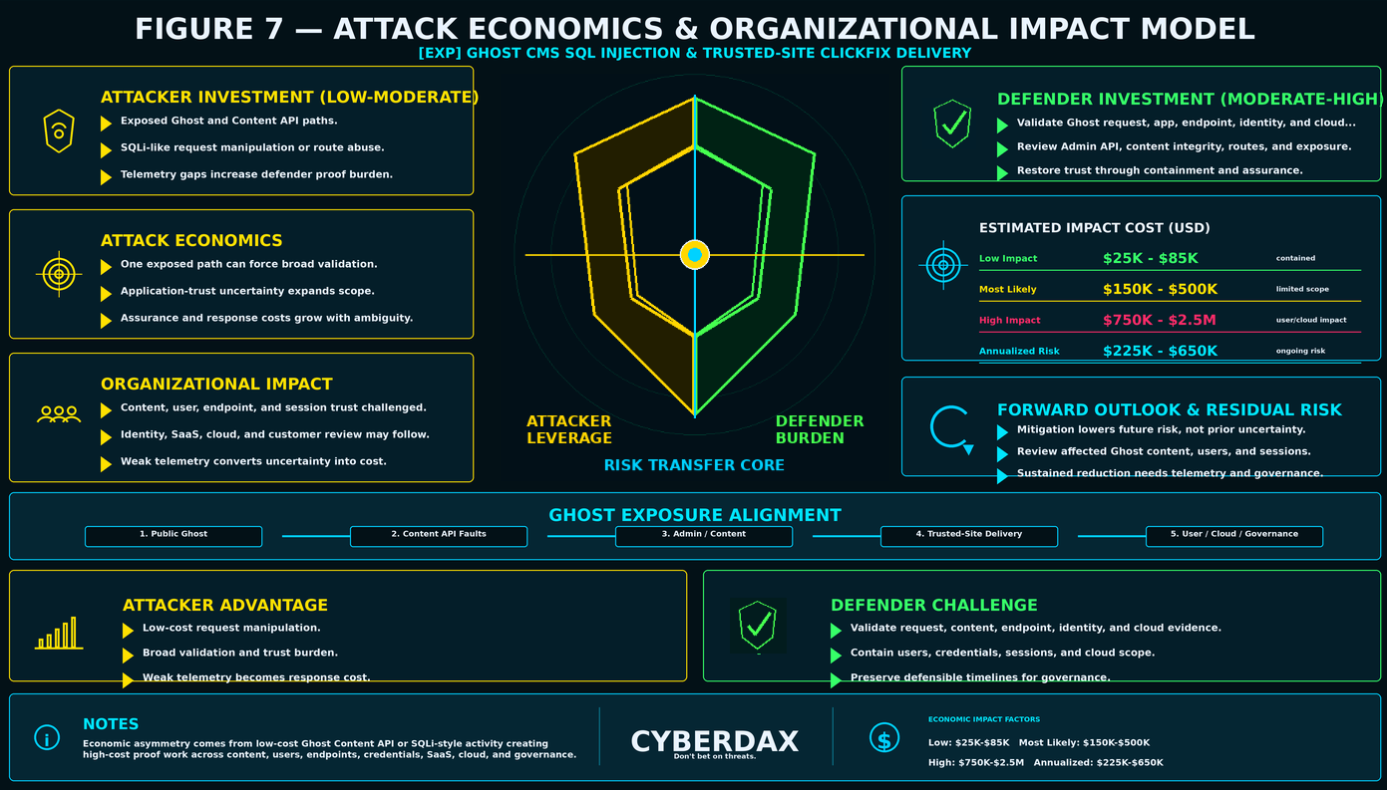
Figure 7
Ghost CMS SQL injection and trusted-site ClickFix activity expands organizational exposure by creating uncertainty over whether public Ghost application surfaces were exploited; whether Content API, administrative, authentication, member, theme, federation, upload, cache, or content-management behavior crossed an expected trust boundary; whether trusted Ghost-hosted content was converted into deceptive delivery infrastructure; whether users executed attacker-supplied commands; and whether endpoint compromise, credential or token exposure, cryptomining, sensitive-data theft, exfiltration, downstream account activity, ransomware progression, or broader organizational impact followed.
The governing risk is not limited to one CVE, Ghost version, Content API route, Admin API route, authentication flow, member workflow, theme operation, publishing workflow, SQL-injection pattern, fake verification page, support thread, PowerShell command, Terminal command, payload, malware family, domain, source address, campaign, or actor. The material question is whether a Ghost application boundary or trusted-content interaction was converted into unauthorized data access, administrative control, content manipulation, deceptive user execution, payload retrieval, endpoint compromise, resource abuse, credential or sensitive-data access, exfiltration, or attributable downstream identity, SaaS, cloud, developer-platform, or internal-system activity.
The retained vulnerability population demonstrates that Ghost exposure extends substantially beyond CVE-2026-26980. Materially relevant public Ghost vulnerabilities include Content API filter weaknesses capable of exposing private fields, arbitrary database reads, arbitrary SQL through authenticated Admin API routes, administrative-authentication and session-boundary weaknesses, authentication rate-limit bypass behavior, Ghost Admin access through malicious user interaction, stored and reflected browser-execution paths, malicious-theme server-side code execution, theme path traversal and arbitrary file write, cache poisoning, SSRF paths, arbitrary file-read conditions, dangerous upload-content handling, federation-content JavaScript injection, member authentication weaknesses, and account-enumeration behavior.
Economic exposure increases when affected Ghost environments support customer-facing publishing, documentation, marketing, newsletters, subscriptions, support, authenticated member services, federated content, regulated communications, or trusted user interactions. Exposure also increases when related trusted-platform ClickFix activity causes users to execute attacker-supplied PowerShell, Windows Terminal, command-shell, macOS Terminal, or other shell instructions and defenders cannot reconstruct the relationship between trusted-content exposure, user interaction, process execution, payload retrieval, credential or sensitive-data access, network communication, and downstream activity.
Related ClickFix activity broadens the trusted-content and endpoint side of the exposure model through compromised legitimate websites, community forums, fake CAPTCHA and verification workflows, fake browser or operating-system errors, fake support and troubleshooting content, Windows Terminal execution, macOS Terminal execution, signed or native utility abuse, alternate retrieval protocols, RAT delivery, cryptomining, infostealer delivery, ransomware access, credential theft, sensitive-data collection, persistence, staging, exfiltration, and environment-aware delivery.
Estimated Economic Exposure
Estimated exposure should be treated as scenario-based rather than fixed. The most defensible enterprise estimate depends on whether activity remains limited to blocked requests, failed exploitation, isolated vulnerable-version exposure, prevented content modification, unsuccessful command execution, or focused investigation; progresses into unauthorized Ghost administration, data access, trusted-site delivery, shell execution, payload retrieval, RAT or infostealer execution, persistence, cryptomining, credential, token, or sensitive-data exposure, or constrained downstream activity; or results in persistent endpoint compromise, significant resource abuse, broad credential misuse, material data theft, SaaS or cloud access, ransomware activity, customer exposure, public trust damage, recurring reinfection, or prolonged operational disruption.
Economic exposure grows when the organization cannot determine whether Ghost data was accessed, whether authentication or authorization boundaries were bypassed, whether administrative control was obtained, whether themes or trusted content were modified, which users were exposed, whether attacker-controlled instructions were executed, whether malware was retrieved or executed, whether credentials, tokens, or sensitive data were accessed, whether persistence or security-control changes occurred, whether data was staged or exfiltrated, and whether application, endpoint, identity, SaaS, cloud, network, and downstream trust can be restored.
Low Impact Scenario
Estimated $25K–$85K
This scenario applies when suspicious Ghost activity, vulnerable-version exposure, trusted-site delivery, related ClickFix activity, or deceptive execution instructions are detected early, but no confirmed unauthorized Ghost data access, consequential administrative or content change, endpoint execution, payload retrieval, malware installation, credential theft, token theft, sensitive-data theft, cryptomining, persistence, exfiltration, or downstream account misuse is validated.
Available evidence supports a failed, prevented, contained, approved, or non-impacting event. Response remains limited to Ghost request, authentication, administrative, member, version, theme, upload, and content validation; trusted-platform exposure review; endpoint scoping; PowerShell or shell-history review where available; selective credential, token, or sensitive-data validation; focused network investigation; short-term monitoring; and executive assurance that application, endpoint, account, data, and downstream integrity were not materially affected.
Moderate Impact Scenario
Estimated $150K–$500K
This scenario applies when unauthorized Ghost administrative activity, data access, content or theme manipulation, trusted-site ClickFix delivery, or a related trusted-platform ClickFix chain is validated and one or more systems show suspicious browser-to-shell execution, PowerShell, Windows Terminal, macOS Terminal or shell execution, payload retrieval, RAT or infostealer execution, cryptomining, persistence, credential or sensitive-data access, data staging, or resource abuse, but broad credential theft, material data exfiltration, SaaS compromise, cloud compromise, customer impact, ransomware deployment, or enterprise-wide disruption is not confirmed.
Evidence may include suspicious Content API or Admin API activity, abnormal Content API filters, private-field access, unauthorized staff or session use, anomalous authentication-rate behavior, theme or content changes, code-injection changes, malicious JavaScript, fake verification or clipboard instructions, trusted-platform support-thread impersonation, copied PowerShell or Terminal commands, remote payload retrieval, cryptominer activity, RAT or infostealer execution, browser or Keychain credential access, sensitive-file collection, persistence, security-control changes, abnormal outbound communication, archive or data staging, or sustained CPU and system-resource consumption.
Response may require Ghost administrative, authentication, member, theme, upload, federation, cache, and content review; endpoint isolation; PowerShell or shell process-lineage reconstruction; payload analysis; persistence removal; malware eradication; credential and token review; sensitive-data exposure assessment; network hunting; resource-impact assessment; user notification; legal or privacy review where applicable; executive reporting; and extended post-remediation monitoring.
High Impact Scenario
Estimated $750K–$2.5M
This scenario applies when Ghost exploitation or related trusted-platform delivery leads to confirmed administrative takeover, malicious trusted-content modification, persistent endpoint compromise, privileged or platform-native execution, broad malware deployment, significant cryptomining or endpoint-resource abuse, credential or token theft, significant sensitive-data exfiltration, downstream SaaS or cloud misuse, ransomware preparation or deployment, customer exposure, public trust impact, recurring content reinfection, or prolonged operational disruption.
The organization may need to treat affected Ghost sites, databases, authentication state, administrative identities, publishing workflows, themes, uploads, federated content, cached responses, content changes, trusted support or troubleshooting channels, Windows and macOS endpoints, command histories, credentials, tokens, sensitive user data, SaaS accounts, cloud accounts, developer platforms, and connected business resources as exposed or unreliable until evidence proves otherwise.
Response may require emergency content suspension, Ghost administrative lockdown, endpoint containment, enterprise-wide hunting, payload eradication, persistence removal, credential and token rotation, sensitive-data exposure assessment, Ghost administrative and integration review, SaaS and cloud audit validation, endpoint rebuilding, resource-consumption assessment, customer or workforce notification analysis, legal and regulatory escalation, communications planning, executive or board reporting, and formal restoration of application, endpoint, identity, data, and downstream trust.
Annualized Risk Exposure
Estimated annualized risk exposure is $225K–$650K for organizations with internet-facing Ghost deployments, meaningful user traffic, trusted publishing or support workflows, permissive browser-to-shell behavior, and moderate telemetry coverage.
Exposure may reach $750K–$2.5M when Ghost compromise or trusted-platform delivery results in administrative takeover, persistent endpoint compromise, elevated shell execution, broad malware deployment, sustained cryptomining, significant resource abuse, credential or token misuse, sensitive-data theft, downstream SaaS or cloud access, ransomware impact, customer exposure, recurring reinfection, incomplete containment, communications response, or executive intervention.
The retained Ghost vulnerability and related ClickFix populations increase the number of application, authentication, administrative, trusted-content, user-execution, and endpoint pathways capable of producing these outcomes without changing the existing annualized range.
Operational Dependency
Operational dependency is concentrated in Ghost-hosted publishing, documentation, marketing, newsletter, support, subscription, member, federation, customer-communication, and public-content workflows.
One affected Ghost site, Content API route, Admin API workflow, authentication flow, theme-management workflow, upload path, federated-content workflow, publishing workflow, support page, community thread, deceptive troubleshooting page, privileged endpoint, administrative identity, or trusted communication channel can create broad investigation and recovery requirements when multiple users, customers, business units, or dependent services rely on that relationship.
Dependency increases when affected content, endpoints, support workflows, administrative identities, sensitive data, member services, or customer-facing services cannot be suspended, isolated, rebuilt, restricted, or validated without disrupting essential communications or business operations.
Control Trust
Control trust is reduced when the organization cannot prove that Ghost patch posture, Content API behavior, Admin API activity, authentication controls, authentication rate limiting, trusted-proxy handling, Staff Token use, member activity, theme operations, upload behavior, federation activity, integrations, content integrity, trusted support content, endpoint protections, PowerShell or shell execution controls, credentials, tokens, sensitive-data stores, logging, and downstream actions remained reliable during the exposure window.
Trust is further reduced when unauthorized activity occurs through an expected Ghost site, valid staff or Admin API identity, valid session or Staff Token, legitimate community or content platform, trusted-looking support or troubleshooting guidance, approved browser, authorized user, administrator-context PowerShell session, Windows Terminal session, macOS Terminal session, permitted network route, or recognizable troubleshooting or maintenance workflow.
Patching, content restoration, authentication correction, malicious-content removal, endpoint isolation, malware removal, process termination, credential rotation, token invalidation, persistence removal, or network blocking reduces future exposure but does not independently prove that pre-remediation data access, administrative misuse, endpoint execution, cryptomining, credential access, sensitive-data collection, persistence, resource abuse, exfiltration, or downstream activity did not occur.
Visibility Confidence
Visibility confidence is highest when Ghost application telemetry, Content API logs, Admin API logs, authentication and session records, rate-limit decisions, trusted-proxy and forwarding-header context, Staff Token use, member events, theme operations, upload records, federation events, filesystem and content-change records, WAF logs, CDN logs, reverse-proxy logs, trusted-content and referrer context, browser history, clipboard or user-interaction evidence, PowerShell logs, Windows Terminal and macOS shell telemetry, process lineage, command-line arguments, file activity, persistence events, credential-store access, sensitive-file access, endpoint-resource telemetry, DNS, proxy, network, identity, SaaS, cloud, incident-response, and remediation evidence can be correlated through stable site, user, endpoint, process, file, destination, account, session, resource, and timestamp mappings.
Visibility confidence is reduced when Content API parameters are missing, Admin API activity is not retained, authentication or token state is unavailable, rate-limit decisions or client-source normalization are unavailable, member activity is not attributable, theme or content revisions are incomplete, upload metadata or content types are unavailable, server-side outbound requests cannot be attributed, federated-content provenance is missing, support-thread or referrer context is unavailable, shell command lines are unavailable, process lineage is truncated, payload retrieval lacks endpoint attribution, credential-store access cannot be attributed to a process, sensitive-data staging or outbound transfer cannot be reconstructed, endpoint-resource history is unavailable, environment-aware delivery hides malicious content from automated inspection, or downstream activity cannot be linked to the affected endpoint or user.
S25 provides behavior-led coverage for suspicious Ghost Content API activity, Ghost administrative or content-modification behavior, trusted Ghost-site delivery, fake verification and clipboard-instruction delivery, browser-adjacent command execution, payload retrieval, endpoint process activity, persistence, credential or token access, and correlated downstream identity or cloud behavior.
The current traceability model specifically identifies suspicious Content API filter and query behavior; administrative-source deviation; Admin API or administrative-route access; post or page modification; theme modification; code-injection changes; staff-user, integration, and webhook activity; trusted Ghost-site external-script or redirect delivery; user exposure; browser-to-shell execution; payload retrieval; and post-execution compromise. These are the governing conditions used for the Direct Coverage classifications below.
Change-Control Confidence
Change-control confidence is high when Ghost publishing, authentication, trusted-proxy configuration, Staff Token, Admin API, integration, webhook, theme, upload, federation, code-injection, member, content, vendor-support, emergency-maintenance, endpoint-administration, developer-shell activity, and incident-response actions are recorded with validated actors, systems, approvals, timestamps, expected objects, and post-change verification.
Confidence is reduced when Ghost content changes, theme uploads, authentication events, forwarding-header behavior, file uploads, content-type changes, external-script additions, redirects, staff-user changes, integration changes, federation content, support or troubleshooting content, shell execution, endpoint exclusions, persistence changes, downloaded executables, or sensitive-data access cannot be tied to approved owners, legitimate troubleshooting, documented maintenance, developer activity, or incident-response activity.
Downstream Dependency
Downstream dependency includes managed endpoints, identity providers, SaaS applications, cloud platforms, developer platforms, CI/CD systems, repositories, service accounts, token stores, password managers, browser credential stores, macOS Keychain material, cryptocurrency-wallet data, customer communication channels, financial systems, and legal or communications workflows.
The organization must distinguish suspicious Ghost administrative behavior, authentication or token activity, shell execution, payload retrieval, RAT, cryptominer, ransomware, or infostealer execution, persistence, endpoint-resource consumption, credential access, sensitive-data collection, SaaS access, cloud access, or internal-system activity from confirmed downstream compromise.
Such activity becomes materially relevant when evidence ties it to an affected Ghost site, CVE, trusted-content source, browser session, endpoint, process, credential, token, account, source, destination, or bounded investigation window.
Customer, Workforce, Partner, and Regulatory Exposure
Customer, workforce, partner, and regulatory exposure increases when Ghost exploitation or malicious trusted-platform activity affects customers, subscribers, members, employees, partners, administrators, regulated user populations, managed endpoints, credentials, tokens, sensitive data, customer communications, SaaS platforms, cloud resources, or business-critical services.
Exposure also increases when telemetry gaps prevent timely confirmation of whether Ghost database or member data was exposed, private Content API fields were recovered, authentication controls or rate limits were bypassed, administrative access was abused, trusted content was manipulated, users executed attacker-supplied commands, privileged execution occurred, malware was installed, cryptomining occurred, endpoint resources were materially consumed, credentials, tokens, browser authentication data, Keychain material, cryptocurrency-wallet material, or other sensitive data were accessed, whether data was exfiltrated, or whether containment was complete.
Notification and reporting decisions must be based on validated local evidence and applicable obligations rather than Ghost presence, vulnerable-version presence, CVE presence, ClickFix branding, malware-family identification, source addresses, domains, filenames, hashes, support or troubleshooting content, or static indicators alone.
Residual Economic Risk
Residual economic risk remains after Ghost patching, authentication correction, content restoration, malicious trusted-content removal, endpoint isolation, shell termination, payload removal, malware eradication, persistence removal, credential rotation, token invalidation, network blocking, or incident-response closure when the pre-remediation activity window cannot be reconstructed.
Removing one malware process, deleting one executable or script, restoring Ghost content, removing one theme, correcting one authentication weakness, or deleting one malicious forum or troubleshooting post does not prove that earlier database or file access, private-field disclosure, authentication-rate bypass, administrative misuse, privileged execution, payload retrieval, cryptomining, credential access, sensitive-data collection, persistence, security-control modification, resource abuse, exfiltration, or downstream activity did not occur.
Residual risk should remain elevated until historical Ghost application, authentication, Admin API, Content API, theme, member, upload, federation, browser, PowerShell, shell, endpoint, file, process, persistence, credential-access, sensitive-data-access, resource-utilization, network, identity, SaaS, cloud, downstream-system, incident-response, and remediation evidence has been assessed and the organization can demonstrate that application, endpoint, identity, credential, token, data, network, and downstream trust have been restored.
CVE / KEV Behavioral Coverage Assessment
The scoped OSINT-to-S25 assessment retains twenty-eight materially relevant Ghost CMS CVEs and ten named public trusted-content or ClickFix behavioral cases for individual coverage disposition.
The register is intentionally behavior-driven and scoped to threats that materially intersect the current S25 detection model. It is not intended to function as an exhaustive historical inventory of every Ghost vulnerability ever assigned a CVE.
Direct Coverage applies when the documented vulnerability or behavioral case produces a material observable condition already represented by current S25 detection logic without substantive changes to the governing rule behavior. Exact CVE identification is not required; the observable threat behavior must itself match an existing rule family.
Coverage With Adaptation applies when S25 provides meaningful coverage of resulting behavior but reliable identification of the initiating vulnerability, route, authentication condition, rate-limit bypass, server-side request, file-access behavior, upload condition, cache behavior, federation behavior, delivery source, execution method, platform, protocol, or malware-specific activity requires additional telemetry, field mapping, source context, or correlation.
Non-Coverage applies when the documented behavior is not materially represented by current S25 and requires a new detection objective rather than an implementation adaptation of existing rule logic.
Known exploitation, proof-of-concept availability, campaign reporting, malware-family identification, and vendor mitigation remain urgency, governance, investigation, and remediation signals. They do not independently establish Direct Coverage or confirmed local exploitation.
Detection Engineering Coverage Interpretation
The S25 detection content provides Direct Coverage when documented activity produces one or more of these implemented outcomes:
· Suspicious Ghost Content API activity against vulnerable or unknown-version Ghost deployments
· Abnormal Content API filter, slug, ordering, encoded, nested, or timing-oriented query behavior
· WAF or reverse-proxy SQL-injection context associated with Ghost Content API activity
· Suspicious Ghost Admin API or administrative-route activity
· Administrative-source deviation
· Post or page modification
· Theme modification
· Code-injection changes
· Staff-user, integration, or webhook changes
· Compressed-window publishing behavior
· Newly introduced external JavaScript or script sources
· Trusted Ghost-site redirect, fake-verification, fake-CAPTCHA, browser-check, clipboard-instruction, loader, or payload-staging delivery
· User or device exposure clustering from trusted Ghost-hosted content
· Browser-adjacent PowerShell, command-shell, or related interpreter execution after trusted-site exposure
· Payload retrieval, loader execution, persistence, credential access, token access, or command-and-control-like behavior
· Correlated downstream identity, SaaS, cloud, developer-platform, CI/CD, or internal-system activity
The S25 rules intentionally avoid dependence on one CVE, Ghost version, exact command string, source address, domain, filename, hash, payload, malware family, campaign, or actor. CVE identifiers, affected routes, authentication conditions, delivery mechanisms, malware families, and public attack paths improve asset identification, investigation, and prioritization but do not replace the governing behavioral logic.
Direct Coverage
Direct Coverage applies where the documented activity itself produces a material condition represented by existing S25 rule logic without substantive changes.
· CVE-2026-53949 — public API filter-validation bypass capable of exposing private fields and password-hash material through repeated filter queries. This directly aligns with S25’s Content API filter and abnormal-query detection family because the initiating behavior itself uses public API filter manipulation.
· CVE-2026-26980 — unauthenticated Ghost Content API SQL injection permitting arbitrary database reads. This directly aligns with S25’s explicit Ghost Content API SQL-injection-like request detection and Content API-to-administrative or downstream correlation.
· CVE-2023-31133 — insufficient validation of filters on public Ghost API endpoints allowing brute-force disclosure of private fields. This directly aligns with S25’s Content API filter/query detection model, including suspicious filter parameters and abnormal query variation.
· CVE-2022-47197 — stored JavaScript injection through post footer code injection allowing privilege escalation to administrator. This directly aligns with S25’s post/page modification and code-injection-change detections because the malicious behavior itself is an unauthorized code-injection modification in Ghost content.
· CVE-2022-47196 — stored JavaScript injection through post header code injection allowing privilege escalation to administrator. This directly aligns with S25’s post/page modification and code-injection-change detections because the malicious behavior itself is an unauthorized code-injection modification in Ghost content.
· Ghost CMS CVE-2026-26980 trusted-site ClickFix campaign — public exploitation of vulnerable Ghost infrastructure followed by malicious Ghost-hosted content and ClickFix delivery. This directly instantiates the report’s complete S25 chain of Content API exploitation, Ghost-side modification, trusted-site delivery, user exposure, browser-adjacent execution, payload retrieval, and post-execution behavior.
These entries remain Direct Coverage because their documented initiating or operational behavior is already represented by current Content API, Ghost content/code-injection, or trusted-site delivery detections.
Coverage With Adaptation
Coverage With Adaptation applies where current S25 provides meaningful detection of consequential activity but reliable identification of the documented vulnerability or campaign requires additional telemetry or correlation.
· CVE-2026-70593 — custom-theme upload path traversal allowing a staff user to write files outside the expected upload directory and alter installation behavior. Requires archive/path-containment, storage-handler, filesystem-destination, and Ghost-server write telemetry.
· CVE-2026-53950 — JavaScript injection through maliciously customized ActivityPub content. Requires ActivityPub source provenance, federation-object visibility, rendering context, injected-content analysis, and federation-to-Ghost-user correlation.
· CVE-2026-53948 — attacker-controlled Content-Type on Admin API uploads, potentially enabling stored XSS when files are served from the same origin. Requires upload endpoint, supplied-versus-derived content-type, storage-backend, object-serving, browser-execution, and user-session correlation.
· CVE-2026-53946 — Ghost outbound requests to attacker-controlled image-card URLs during post rendering. Requires image-card provenance, render-trigger context, Ghost-server outbound-request attribution, internal or cloud-metadata destination classification, and staff-to-request correlation.
· CVE-2026-53945 — bypass of Ghost private-IP protections through DNS rebinding, enabling Ghost to reach internal-network hosts through outbound-fetch features. Requires DNS-resolution history, re-resolution behavior, Ghost-server outbound requests, internal-address classification, and request-to-fetch correlation.
· CVE-2026-53943 — preview-response cache poisoning through x-ghost-preview in affected shared-cache configurations. Requires preview-header visibility, cache-key context, shared-cache telemetry, response provenance, cache-hit history, and rendered-content comparison.
· CVE-2026-29784 — session-verification CSRF weakness allowing one-time codes to be used across different login sessions. Requires OTC issuance/use telemetry, session binding, authentication-flow visibility, phishing context, and resulting-session correlation.
· CVE-2026-29053 — malicious Ghost theme capable of arbitrary server-side code execution. Requires theme provenance, upload/activation records, Ghost server-process ancestry, filesystem behavior, child-process execution, and server-to-network telemetry.
· CVE-2026-24778 — malicious Ghost Portal link executing JavaScript with the victim’s permissions and potentially enabling account takeover. Requires Portal URL context, browser/session attribution, DOM or script execution telemetry, victim identity, and browser-to-Ghost-action correlation.
· CVE-2026-22597 — Admin API media-inliner SSRF capable of exfiltrating internal-system data. Requires media-inliner parameter visibility, server-side outbound-request attribution, internal-resource classification, and request-to-exfiltration correlation.
· CVE-2026-22596 — arbitrary SQL through the authenticated /ghost/api/admin/members/events endpoint. Current S25 sees Admin API and resulting administrative behavior, but reliable detection of this vulnerability requires members/events route visibility, submitted parameters, SQL-related request context, authenticated Admin identity, and database-result correlation.
· CVE-2026-22595 — Staff Token authorization weakness allowing access to endpoints intended for Staff Session authentication. Requires authentication-method identification, token-versus-session context, endpoint authorization requirements, token owner/role mapping, and resulting-action correlation.
· CVE-2026-22594 — Ghost staff email-2FA bypass. Requires expected-versus-observed 2FA state, session issuance, authentication-method context, staff identity, source context, and resulting privileged-action correlation.
· CVE-2025-9862 — Ghost SSRF allowing access to internal resources. Requires vulnerable-route context, Ghost-server request attribution, destination classification, and application-to-network correlation.
· CVE-2024-43409 — improper authentication on member endpoints allowing unauthorized member actions and member-information access. Requires member-endpoint authentication context, member identity, request/result correlation, and member-data visibility.
· CVE-2024-34451 — Ghost authentication rate-limit bypass through attacker-controlled source-address context, including X-Forwarded-For handling under affected or improperly trusted reverse-proxy conditions. Current S25 may identify resulting anomalous Ghost administrative or authentication activity, but reliable detection of the bypass itself requires authentication-attempt telemetry, rate-limit decision visibility, trusted-proxy configuration, forwarded-header normalization, effective client-source attribution, repeated-attempt correlation, and comparison between apparent and validated source identities. Vendor-dispute context around expected reverse-proxy configuration should remain visible during triage and does not independently establish exploitation.
· CVE-2024-23724 — stored SVG-profile-image XSS with privilege-escalation/account-takeover potential. Requires profile-image provenance, SVG/script rendering visibility, browser-session attribution, local API interaction, and XSS-to-privileged-action correlation. The CVE record also carries a disputed-status history that should remain visible during triage.
· CVE-2023-40028 — authenticated symlink upload enabling arbitrary host-file reads. Requires upload telemetry, symlink identification, resolved filesystem path, target-file context, Ghost-process attribution, and access-result correlation.
· CVE-2023-32235 — unauthenticated path traversal allowing arbitrary reads from the active theme directory. Requires affected-route visibility, traversal normalization, requested-file path context, theme-directory mapping, response characteristics, and request-to-file-access correlation.
· CVE-2021-29484 — malicious-link interaction allowing an untrusted user to gain access to Ghost Admin. Current S25 can detect consequential anomalous Ghost administration, but reliable detection of the initiating vulnerability requires /ghost/preview context, malicious-link interaction, victim-session attribution, resulting Admin access, and source-to-session correlation.
· CVE-2020-8134 — Ghost SSRF allowing interaction with internal or external network resources. Requires SSRF-specific request context, Ghost-server request attribution, destination mapping, and initiating application-to-network correlation.
· Steam discussion-forum ClickFix/XMRig — requires Steam/forum-source context, PowerShell detail, XMRig process/configuration visibility, mining-pool communication, persistence telemetry, and endpoint-resource baselining.
· DriveSurge compromised-site ClickFix/FakeUpdates — requires non-Ghost compromised-site identification, injected-script or traffic-distribution context, visitor profiling, redirect provenance, and source-to-endpoint correlation.
· macOS ClickFix / MacSync / Atomic Stealer — requires macOS browser, Terminal/shell, native-utility, Keychain/browser credential, sensitive-file, persistence, staging, exfiltration, process-to-network, and fingerprinting/cloaking telemetry.
· Windows Terminal ClickFix / Lumma Stealer — requires Windows Terminal ancestry, lure-source context, command-line telemetry, Lumma execution, credential-store access, and exfiltration visibility.
· CrashFix browser-disruption / Python RAT — requires malicious-extension or browser-disruption context, fake repair workflow attribution, Python process lineage, payload execution, and RAT follow-on telemetry.
· App-V ClickFix / Amatera — requires App-V script provenance, signed-script lineage, PowerShell context, Amatera behavior, credential-store access, and exfiltration telemetry.
· PHALT#BLYX hospitality ClickFix / fake BSOD / DCRat — requires hospitality-lure and phishing context, fake-BSOD attribution, PowerShell/MSBuild lineage, DCRat behavior, and source-to-endpoint correlation.
· Finger-protocol ClickFix — requires finger.exe visibility, Finger-protocol network telemetry, remote-command retrieval, source-lure attribution, and process-chain correlation.
· Interlock ClickFix / fake IT tools / ransomware progression — requires non-Ghost source mapping, campaign-specific activity, lateral progression, data-theft evidence, and ransomware-stage correlation.
These entries remain Coverage With Adaptation because the current S25 rules detect substantial resulting behavior but do not directly identify each vulnerability-specific application primitive, rate-limit-bypass condition, non-Ghost delivery source, alternate protocol, operating-system-specific execution path, or campaign-specific implementation.
Non-Coverage Conditions
Non-Coverage applies where the documented behavior is not materially represented by current S25 and requires a new detection objective rather than adaptation of existing rule logic.
· CVE-2026-53947 — unauthenticated registered-member email enumeration through response discrepancies on Ghost member sign-in endpoints. Current S25 does not implement member-enumeration or response-differential detection.
· CVE-2022-41697 — Ghost login user enumeration through specially crafted requests and observable response differences. Current S25 does not implement login enumeration or authentication-response-differential detection.
Additional non-coverage conditions apply when activity remains limited to:
· Vulnerable-version or CVE presence without aligned behavioral evidence
· Generic scanning without Ghost application context
· Isolated WAF SQL-injection alerts without relevant Ghost route or follow-on evidence
· Approved administrative, publishing, integration, member, federation, or support activity
· Fake verification or troubleshooting content without user execution or payload activity
· Shell activity without suspicious command content, trusted-content adjacency, payload retrieval, or consequential follow-on
· Malware-family identification without evidence tying the artifact to unauthorized execution and a bounded investigation window
· Cloud, SaaS, identity, developer-platform, or CI/CD anomalies without upstream or endpoint linkage
· Artifact presence without execution, persistence, credential access, network activity, or another consequential behavior
Current Coverage Count
Direct Coverage Entries
6
Coverage With Adaptation Entries
30
Current Assessment Register Count
38
CVE Entries
28
Named Behavioral Entries
10
The current assessment register contains twenty-eight materially relevant Ghost CMS CVEs and ten named public trusted-content or ClickFix behavioral cases.
Five CVEs are Direct Coverage:
· CVE-2026-53949
· CVE-2026-26980
· CVE-2023-31133
· CVE-2022-47197
· CVE-2022-47196
Twenty-one CVEs are Coverage With Adaptation:
· CVE-2026-70593
· CVE-2026-53950
· CVE-2026-53948
· CVE-2026-53946
· CVE-2026-53945
· CVE-2026-53943
· CVE-2026-29784
· CVE-2026-29053
· CVE-2026-24778
· CVE-2026-22597
· CVE-2026-22596
· CVE-2026-22595
· CVE-2026-22594
· CVE-2025-9862
· CVE-2024-43409
· CVE-2024-34451
· CVE-2024-23724
· CVE-2023-40028
· CVE-2023-32235
· CVE-2021-29484
· CVE-2020-8134
Two CVEs are Not Covered:
· CVE-2026-53947
· CVE-2022-41697
One named behavioral entry is Direct Coverage:
· Ghost CMS CVE-2026-26980 trusted-site ClickFix campaign
Nine named behavioral entries are Coverage With Adaptation:
· Steam discussion-forum ClickFix/XMRig
· DriveSurge compromised-site ClickFix/FakeUpdates
· macOS ClickFix / MacSync / Atomic Stealer
· Windows Terminal ClickFix / Lumma Stealer
· CrashFix browser-disruption / Python RAT
· App-V ClickFix / Amatera
· PHALT#BLYX hospitality ClickFix / fake BSOD / DCRat
· Finger-protocol ClickFix
· Interlock ClickFix / fake IT tools / ransomware progression
The arithmetic reconciles as follows:
· 5 Direct Coverage CVEs + 1 Direct named behavioral entry = 6 Direct Coverage entries
· 21 Coverage With Adaptation CVEs + 9 Coverage With Adaptation named behavioral entries = 30 Coverage With Adaptation entries
· 2 Not Covered CVEs = 2 Not Covered entries
· 6 Direct + 30 Coverage With Adaptation + 2 Not Covered = 38 total assessed entries
· 28 CVEs + 10 named behavioral entries = 38 total assessed entries
The register represents the materially relevant vulnerability and named behavioral population assessed against the current S25 rules. It is intentionally scoped to the report’s behavior model and should not be interpreted as an exhaustive catalog of every historical Ghost vulnerability.
Current KEV Count
0
None of the twenty-eight Ghost CVEs retained in the current assessment register are represented in this report as CISA Known Exploited Vulnerabilities.
Public exploitation reporting for CVE-2026-26980 and operational reporting for multiple ClickFix campaigns remain urgency and remediation signals but do not independently alter the KEV count or prove local exploitation.
Coverage Qualification
Coverage is strongest where suspicious Ghost behavior or trusted-content exposure can be joined with Content API filter manipulation, SQL-injection-like request behavior, administrative or content modification, code injection, user interaction, browser-adjacent execution, payload retrieval, process creation, persistence, credential or token activity, sensitive-data access, network communication, endpoint-resource consumption, exfiltration, or downstream access.
For Direct Coverage CVEs, the critical question is whether the vulnerability’s documented behavior itself satisfies a current S25 detection family. CVE-2026-53949 and CVE-2023-31133 directly exercise public API filter manipulation; CVE-2026-26980 directly exercises the Content API SQL-injection/read path; CVE-2022-47196 and CVE-2022-47197 directly produce Ghost post code-injection modifications.
Direct Coverage does not mean S25 independently identifies a CVE number. Vulnerability attribution still requires version, route, request, content, authentication, timing, and incident evidence.
For Coverage With Adaptation CVEs, reliable identification requires vulnerability-specific route, authentication, rate-limit, trusted-proxy, member, upload, federation, theme, filesystem, cache, SSRF, server-process, or authorization telemetry sufficient to connect the initiating condition to consequential behavior already visible to S25.
For related ClickFix activity, reliable coverage requires delivery-source attribution and the platform-, browser-, shell-, protocol-, payload-, credential-, persistence-, network-, or exfiltration-specific context needed to map the initiating behavior into the current trusted-content → execution → payload → post-execution sequence.
Coverage is weaker for exploit or delivery evidence without consequential follow-on; administrative activity inside approved workflows; manually copied commands without user-interaction visibility; shell execution without command-line or process-lineage visibility; renamed or embedded malware; malware-family identification without behavioral linkage; encrypted mining or exfiltration traffic; sensitive-data access without process attribution; deleted staging artifacts; short-lived execution; fingerprinting or cloaking that hides malicious content from inspection; incomplete source-to-endpoint lineage; and short telemetry retention.
The report does not claim universal Ghost vulnerability detection, universal CMS exploitation detection, universal authentication-abuse detection, universal ClickFix detection, universal shell-abuse detection, universal RAT, cryptominer, ransomware, or infostealer detection, universal credential or sensitive-data-theft detection, universal exfiltration detection, universal cloud or SaaS detection, or standalone CVE, malware, actor, campaign, or impact attribution.
Detection confidence depends on telemetry completeness, Ghost and endpoint inventories, asset and version validation, route and request visibility, Content API parameter retention, authentication and rate-limit telemetry, trusted-proxy and forwarding-header visibility, Staff Token telemetry, member visibility, theme and upload records, content-change and code-injection records, federation provenance, trusted-content and referrer context, browser telemetry, PowerShell and shell logging, process lineage, command-line visibility, file history, persistence telemetry, endpoint-resource baselines, credential-store and sensitive-file visibility, process-to-network attribution, identity and token linkage, SaaS and cloud auditing, approved-workflow mapping, timestamp alignment, retention, query validation, performance testing, false-positive testing, and SOC triage readiness.
Executive Exposure Statement
The organization’s economic exposure is highest when Ghost or related trusted-platform activity creates uncertainty over whether application data, authentication boundaries, administrative control, content integrity, user interactions, endpoint execution, administrator privileges, credentials, tokens, sensitive data, endpoint resources, identity services, SaaS resources, cloud resources, and dependent business operations remained intact.
The retained Ghost CVE population reinforces the application-side risk because multiple distinct weaknesses can affect public API filters, database access, authentication, rate limiting, authorization, administrative APIs, themes, uploads, federation, frontend content, server-side network requests, host files, or server behavior. Five Ghost CVEs directly instantiate existing S25 Content API or content/code-injection behaviors, while the remaining covered CVEs require vulnerability-specific adaptation.
The broader ClickFix population reinforces trusted-content and endpoint risk because deceptive instructions can move across Ghost sites, community forums, compromised websites, fake support workflows, Windows Terminal, macOS Terminal, signed Microsoft utilities, legacy protocols, browser extensions, and multiple malware families while preserving the same higher-order sequence of trusted interaction, user-driven execution, payload retrieval, post-execution activity, credential or data access, and downstream impact.
The strategic risk is not only that one Ghost vulnerability, ClickFix page, support reply, shell command, RAT, cryptominer, ransomware payload, or infostealer exists. The material risk is that an adversary may convert one application or trusted-content interaction into unauthorized data access, administrative change, malicious content modification, platform-native command execution, payload retrieval, persistent endpoint compromise, cryptomining, resource abuse, credential, token, or sensitive-data exposure, exfiltration, downstream account misuse, customer impact, operational disruption, or broader organizational compromise before containment.
S40 — References
The following references support the vulnerability descriptions, coverage classifications, KEV assessment, named behavioral cases, and detection-engineering interpretation retained in this report.
Vulnerability Records
NVD — CVE-2026-53949
hxxps://nvd[.]nist[.]gov/vuln/detail/CVE-2026-53949
NVD — CVE-2026-26980
hxxps://nvd[.]nist[.]gov/vuln/detail/CVE-2026-26980
NVD — CVE-2023-31133
hxxps://nvd[.]nist[.]gov/vuln/detail/CVE-2023-31133
NVD — CVE-2022-47197
hxxps://nvd[.]nist[.]gov/vuln/detail/CVE-2022-47197
NVD — CVE-2022-47196
hxxps://nvd[.]nist[.]gov/vuln/detail/CVE-2022-47196
NVD — CVE-2026-70593
hxxps://nvd[.]nist[.]gov/vuln/detail/CVE-2026-70593
NVD — CVE-2026-53950
hxxps://nvd[.]nist[.]gov/vuln/detail/CVE-2026-53950
NVD — CVE-2026-53948
hxxps://nvd[.]nist[.]gov/vuln/detail/CVE-2026-53948
NVD — CVE-2026-53946
hxxps://nvd[.]nist[.]gov/vuln/detail/CVE-2026-53946
NVD — CVE-2026-53945
hxxps://nvd[.]nist[.]gov/vuln/detail/CVE-2026-53945
NVD — CVE-2026-53943
hxxps://nvd[.]nist[.]gov/vuln/detail/CVE-2026-53943
NVD — CVE-2026-29784
hxxps://nvd[.]nist[.]gov/vuln/detail/CVE-2026-29784
NVD — CVE-2026-29053
hxxps://nvd[.]nist[.]gov/vuln/detail/CVE-2026-29053
NVD — CVE-2026-24778
hxxps://nvd[.]nist[.]gov/vuln/detail/CVE-2026-24778
NVD — CVE-2026-22597
hxxps://nvd[.]nist[.]gov/vuln/detail/CVE-2026-22597
NVD — CVE-2026-22596
hxxps://nvd[.]nist[.]gov/vuln/detail/CVE-2026-22596
NVD — CVE-2026-22595
hxxps://nvd[.]nist[.]gov/vuln/detail/CVE-2026-22595
NVD — CVE-2026-22594
hxxps://nvd[.]nist[.]gov/vuln/detail/CVE-2026-22594
NVD — CVE-2025-9862
hxxps://nvd[.]nist[.]gov/vuln/detail/CVE-2025-9862
NVD — CVE-2024-43409
hxxps://nvd[.]nist[.]gov/vuln/detail/CVE-2024-43409
NVD — CVE-2024-34451
hxxps://nvd[.]nist[.]gov/vuln/detail/CVE-2024-34451
NVD — CVE-2024-23724
hxxps://nvd[.]nist[.]gov/vuln/detail/CVE-2024-23724
NVD — CVE-2023-40028
hxxps://nvd[.]nist[.]gov/vuln/detail/CVE-2023-40028
NVD — CVE-2023-32235
hxxps://nvd[.]nist[.]gov/vuln/detail/CVE-2023-32235
NVD — CVE-2021-29484
hxxps://nvd[.]nist[.]gov/vuln/detail/CVE-2021-29484
NVD — CVE-2020-8134
hxxps://nvd[.]nist[.]gov/vuln/detail/CVE-2020-8134
Known Exploited Vulnerabilities
CISA — Known Exploited Vulnerabilities Catalog
hxxps://www[.]cisa[.]gov/known-exploited-vulnerabilities-catalog
Security Vendor Analysis
BleepingComputer — Ghost CMS SQL Injection Flaw Exploited in Large-Scale ClickFix Campaign
hxxps://www[.]bleepingcomputer[.]com/news/security/ghost-cms-sql-injection-flaw-exploited-in-large-scale-clickfix-campaign/
BleepingComputer — Steam Forum ClickFix Attacks Infect Gamers With XMRig Cryptominers
hxxps://www[.]bleepingcomputer[.]com/news/security/steam-forum-clickfix-attacks-infect-gamers-with-xmrig-cryptominers/
Silent Push — Meet DriveSurge: A New Threat Actor Using ClickFix and Fake Update Drive-By Attacks in Thousands of Compromised Sites
hxxps://www[.]silentpush[.]com/blog/drivesurge/
Microsoft Security — ClickFix Campaign Uses Fake macOS Utilities Lures to Deliver Infostealers
hxxps://www[.]microsoft[.]com/en-us/security/blog/2026/05/06/clickfix-campaign-uses-fake-macos-utilities-lures-deliver-infostealers/
Microsoft Security — From Open Lures to Cloaked Gates: How a macOS ClickFix Campaign Learned to Hide
hxxps://www[.]microsoft[.]com/en-us/security/blog/2026/08/05/macos-clickfix-campaign-learned-hide/
The Hacker News — Microsoft Reveals ClickFix Campaign Using Windows Terminal to Deploy Lumma Stealer
hxxps://thehackernews[.]com/2026/03/microsoft-reveals-clickfix-campaign.html
Microsoft Security — New ClickFix Variant CrashFix Deploying Python Remote Access Trojan
hxxps://www[.]microsoft[.]com/en-us/security/blog/2026/02/05/clickfix-variant-crashfix-deploying-python-rat-trojan/
BleepingComputer — New ClickFix Attacks Abuse Windows App-V Scripts to Push Malware
hxxps://www[.]bleepingcomputer[.]com/news/security/new-clickfix-attacks-abuse-windows-app-v-scripts-to-push-malware/
The Hacker News — Fake Booking Emails Redirect Hotel Staff to Fake BSoD Pages Delivering DCRat
hxxps://thehackernews[.]com/2026/01/fake-booking-emails-redirect-hotel.html
BleepingComputer — Decades-Old Finger Protocol Abused in ClickFix Malware Attacks
hxxps://www[.]bleepingcomputer[.]com/news/security/decades-old-finger-protocol-abused-in-clickfix-malware-attacks/
BleepingComputer — Interlock Ransomware Gang Pushes Fake IT Tools in ClickFix Attacks
hxxps://www[.]bleepingcomputer[.]com/news/security/interlock-ransomware-gang-pushes-fake-it-tools-in-clickfix-attacks/
Threat Tradecraft and Intrusion Patterns
MITRE ATT&CK Framework — Enterprise Matrix
hxxps://attack[.]mitre[.]org/
