CVE-2026-2256 MS-Agent Prompt Injection Command Execution Exposure


BLUF
CVE-2026-2256 exposes a command execution pathway in the ModelScope MS-Agent automation framework by allowing attacker-controlled prompt content to be interpreted as operating system commands by the agent’s Shell tool. This creates a trust-boundary failure between untrusted prompt input and privileged automation execution, enabling manipulated prompts to trigger arbitrary commands within automation runtimes.
For organizations using AI-driven DevOps or infrastructure automation platforms, the primary enterprise risk is automation pipeline integrity compromise rather than direct system exploitation. Successful exploitation could allow adversaries to manipulate build pipelines, extract embedded credentials, or introduce malicious changes into software delivery workflows using trusted automation identities, effectively converting automation infrastructure into an attacker-controlled deployment channel.
Organizations operating MS-Agent deployments should prioritize exposure assessment, monitor automation runtimes for abnormal shell invocation, and verify the integrity of recent automation pipeline activity.
Section 2- Key Judgments
CVE-2026-2256 represents an automation trust-boundary failure that allows attacker-controlled prompt content to trigger operating system commands within the MS-Agent automation runtime.
· The primary enterprise risk is automation pipeline integrity compromise, where manipulated prompts may influence CI/CD workflows, infrastructure orchestration tasks, or other privileged automation operations.
· Environments where automation agents possess elevated privileges or access to deployment credentials present the highest operational exposure.
· At the time of this report, exploitation activity appears limited to security research and proof-of-concept demonstrations, with no confirmed evidence of large-scale enterprise attacks.
· The vulnerability highlights a broader emerging risk category affecting AI-driven automation frameworks, where prompt manipulation can translate into unintended privileged system actions.
Section 3- Risk Drivers
The operational impact of CVE-2026-2256 depends primarily on how automation agents are deployed and what privileges they possess within enterprise environments.
Key risk drivers include:
· Privilege scope of automation agents
Automation runtimes operating with infrastructure or deployment privileges significantly increase the potential impact of command execution.
· Integration with CI/CD pipelines or infrastructure orchestration systems
Agents controlling build pipelines or deployment workflows create the possibility of large-scale software supply chain manipulation.
· Credential exposure within automation environments
Automation platforms that store long-lived credentials or infrastructure tokens increase the likelihood of credential theft and lateral movement.
· Automation input trust boundaries
Workflows that ingest external data sources, documentation, or user-generated prompts without validation increase the probability of prompt injection exploitation.
· Logging and telemetry maturity
Organizations lacking automation runtime logging may have reduced visibility into prompt ingestion and command execution activity.
Section 4- Executive Risk Summary
The vulnerability primarily threatens automation pipeline integrity rather than direct infrastructure compromise, introducing the risk that trusted automation identities could be abused to manipulate software delivery workflows or infrastructure operations.
Threat Classification
Automation Pipeline Integrity Risk
Section 5- Executive Cost Summary

This cost analysis was developed by the CyberDax team using expert judgment and assisted analytical tools to support clarity and consistency.
For organizations affected by CVE-2026-2256 exploitation within AI-driven automation or DevOps pipeline environments, the primary financial exposure stems from incident response, pipeline validation, and operational disruption during automation security remediation.
· Low-end total cost: $200,000 – $450,000
(limited automation exposure with rapid containment and minimal pipeline disruption)
· Typical expected range: $500,000 – $1,200,000
(automation infrastructure investigation, credential rotation, and pipeline validation required)
· Upper-bound realistic scenarios: $1,200,000 – $2,500,000
(extended pipeline shutdown, credential compromise, and broader infrastructure remediation)
Key Cost Drivers
· Scope of automation infrastructure requiring forensic review
· Number of credentials or service accounts requiring rotation
· Duration of CI/CD pipeline suspension during validation
· Engineering labor required to audit recent automation outputs
· Presence of regulated workloads or sensitive data in automation environments
Section 6- Bottom Line for Executives (Public Company Context)
For most public companies, CVE-2026-2256 will not become financially significant unless automation pipelines, infrastructure orchestration tasks, or privileged automation credentials were manipulated during exploitation. The vulnerability affects the ModelScope MS-Agent automation framework and allows attacker-controlled prompts to be interpreted as operating system commands by the agent’s Shell tool, potentially enabling unauthorized command execution within automation runtimes.
If investigation confirms that production systems, software delivery pipelines, and regulated datasets were not altered, the event will likely remain below traditional materiality thresholds. The most realistic financial exposure arises from automation integrity validation, credential rotation, and verification of recent pipeline outputs, rather than infrastructure rebuild or prolonged operational outages.
Management’s priority should be to rapidly confirm whether the integrity of automation workflows and software delivery processes has been affected.
Management’s focus should be on:
· Confirming the scope of automation environments running MS-Agent or similar agent frameworks
· Verifying the integrity of recent CI/CD pipeline outputs and infrastructure automation tasks
· Determining whether automation credentials could access regulated, financial reporting, or investor-relevant systems
· Documenting response timelines, remediation actions, and monitoring controls implemented after detection
In most realistic scenarios, rapid containment and verification of automation integrity will limit both financial exposure and disclosure sensitivity. The speed and quality of investigative documentation directly influence both cost containment and governance posture.
Section 7- Board-Level Takeaway (Materiality & Disclosure Framing)
CVE-2026-2256 should be viewed primarily as an automation governance and operational integrity risk, not automatically a material cybersecurity event. The vulnerability becomes disclosure-sensitive only if exploitation results in confirmed manipulation of production infrastructure, compromise of privileged automation credentials, or access to regulated or investor-relevant data.
Under realistic scenarios:
· Limited automation host impact without data exposure is unlikely to meet SEC cybersecurity materiality thresholds.
· Temporary suspension of DevOps or infrastructure automation pipelines during investigation is typically operational rather than investor-material if core business services remain unaffected.
· Confirmed manipulation of software delivery pipelines, access to infrastructure credentials, or compromise of regulated datasets could elevate the event into potential Form 8-K disclosure territory depending on scale and duration.
Board oversight should concentrate on:
· Whether automation infrastructure interacts with systems tied to financial reporting, regulated data, or investor communications
· Whether the integrity of software delivery pipelines or infrastructure orchestration was affected
· Whether management’s remediation actions demonstrate effective governance over AI-driven automation platforms
In practical terms, the vulnerability itself is not inherently material. Materiality arises only if exploitation produces measurable operational disruption, compromise of financially relevant systems, or exposure of material nonpublic information.
Priority Level and Response Window
Priority Level
· High Automation Runtime Command Execution Risk
Executive Risk Category
· AI Automation Infrastructure Compromise
SOC Action Level
· Immediate monitoring and containment
Response Window
· Exposure assessment within 24 hours
· Automation runtime privilege validation within 48 hours
· Detection engineering deployment within 72 hours
· Automation architecture hardening within 7 days
Why This Matters Now
· AI-driven automation platforms are increasingly embedded in production DevOps pipelines
· Agent frameworks frequently execute privileged infrastructure commands
· Prompt injection allows attackers to bypass traditional exploit delivery models
· Automation systems often maintain long-lived credentials or tokens
· Compromise of automation pipelines may allow silent manipulation of software builds or infrastructure
What we don’t yet know
· Confirmed real-world exploitation activity against enterprise MS-Agent deployments
· Whether weaponized exploit kits have emerged in the threat ecosystem
· Full scope of automation environments currently running vulnerable versions
· Whether attackers are targeting CI/CD or research automation workflows
· Vendor patch timeline or coordinated remediation release schedule
Exploit Conditions Snapshot
Component
· ModelScope MS-Agent Shell Tool
Vulnerability Class
· Command Injection
CWE
· CWE-78 Improper Neutralization of Special Elements used in OS Command
Security Boundary Impact
· Arbitrary OS command execution under automation runtime privileges
Primary Risk Outcomes
· Host command execution
· Automation pipeline manipulation
· Credential extraction
· Lateral movement via automation identities
Today’s Hunt Focus (3 signals)
Signal 1 Automation Runtime Shell Invocation
· Signal: Python automation runtimes spawning shell interpreters such as bash or sh
· Telemetry: EDR process creation logs, container runtime logs
· Why it matters: Indicates potential prompt-to-command execution through automation agents.
Signal 2 Prompt-to-Execution Correlation
· Signal: Prompt ingestion events followed by shell execution within the same workflow execution cycle
· Telemetry: Automation workflow logs, agent runtime logs
· Why it matters: This sequence represents the most direct indicator of prompt injection exploitation.
Signal 3 Post-Execution Network Activity
· Signal: Outbound network connections initiated shortly after automation shell execution
· Telemetry: EDR network telemetry, firewall egress logs, DNS logs
· Why it matters: Indicates potential command-and-control communication or data exfiltration.
Sectors
· Technology
· Cloud Service Providers
· Financial Services (DevOps-heavy environments)
· Research and AI development organizations
Countries
· Global
First Activity
· March 2026 Vulnerability publicly disclosed during security research.
Last Activity
· March 2026 Ongoing public research and proof-of-concept analysis.
CVE
· CVE-2026-2256
Vendor
· ModelScope
Affected Platform
· MS-Agent automation framework
Vulnerability Type
· Command injection through shell execution interface
Impact Scope
· Arbitrary command execution within automation runtime environment
CVSS and CWE and KEV and Nessus and EPSS
CVSS v3.1
· Base Score: 6.5
· Vector: /AV:N/AC:L/PR:N/UI:N/S:U/C:L/I:L/A:N
Score reflects limited direct host impact from the vulnerability itself; however, automation runtimes frequently operate with elevated infrastructure privileges, which can significantly amplify operational and security risk if exploited within enterprise DevOps environments.
CWE
· CWE-78 Improper Neutralization of Special Elements used in OS Command
CISA KEV
· Not listed in the CISA Known Exploited Vulnerabilities catalog at this time
Nessus Plugin Coverage
· Plugin coverage not observed at this time
EPSS
· EPSS score not yet available at this time
Exploit Status
Public exploit code
· Proof-of-concept available
Weaponization maturity
· Early-stage research
Exploit chaining
· Not known at this time
Confidence & Assessment Statement
Analytic Confidence Level
· Moderate confidence in the exploitability of the vulnerability and the associated enterprise automation risk.
Technical Validation
· Public proof-of-concept code demonstrates that attacker-controlled prompt content can be interpreted as operating system commands through the MS-Agent Shell tool interface.
· Review of the MS-Agent automation design indicates that prompt input may be passed to tool execution pathways without strict command validation or execution boundaries.
· This design pattern creates a trust boundary failure in which untrusted data can influence privileged automation actions.
Operational Assessment
· The vulnerability mechanism is technically confirmed and reproducible in controlled testing environments.
· Exploitation does not rely on memory corruption or complex exploit chains; instead, it abuses automation logic and tool execution pathways.
· Environments where automation agents execute infrastructure commands, interact with CI/CD pipelines, or manage privileged credentials present the highest operational risk.
Current Threat Landscape
· At the time of this report, there is no confirmed evidence of widespread threat-actor exploitation targeting enterprise MS-Agent deployments.
· Observed activity remains primarily within security research and proof-of-concept demonstration contexts.
· However, the vulnerability class aligns with a growing category of prompt-to-execution weaknesses in AI automation frameworks, which are receiving increased attention from both researchers and adversaries.
Assessment Constraints
· Public telemetry regarding enterprise MS-Agent adoption remains limited.
· The maturity of exploit tooling beyond proof-of-concept demonstrations is not yet fully understood.
· Real-world impact will depend heavily on how organizations deploy automation agents and the privilege scope assigned to automation service accounts.
Confidence Interpretation
· While the current threat landscape suggests limited active exploitation, the vulnerability represents a structural automation security weakness rather than a traditional software flaw.
· Organizations using agent-driven automation frameworks should treat the issue as an automation trust-boundary risk, where manipulated input may translate into privileged infrastructure actions.
Operational Implication
· Enterprises operating automation platforms with privileged infrastructure access should assume that prompt-to-execution vulnerabilities may emerge across similar agent frameworks and should implement prompt validation, command allow-listing, and runtime monitoring controls to reduce exposure.
MITRE ATT&CK Chain Flow Mapping

Initial Access
· T1204 – User Execution
Execution
· T1059 – Command and Scripting Interpreter
Credential Access (Potential)
· T1552 – Unsecured Credentials
Stage-Based TTPs

T1204 – User Execution
· Adversaries may introduce malicious prompt content into automation workflows or external data sources that are processed by the MS-Agent Shell tool, causing attacker-controlled input to be interpreted as operating system commands.
Operational Objective
· Convert untrusted automation input into privileged command execution.
Artifacts
· Prompt strings containing shell syntax
· Automation workflow logs showing prompt ingestion followed by tool execution
· Agent runtime input logs containing command fragments
Detection Relevance
· Monitor automation pipeline inputs for shell syntax or command injection patterns.
· Correlate prompt ingestion events with subsequent subprocess execution.
T1059 – Command and Scripting Interpreter
Injected prompts may cause the MS-Agent runtime to invoke shell interpreters through subprocess calls, enabling arbitrary command execution within the automation host.
Operational Objective
· Execute attacker-controlled commands within the automation runtime environment.
Artifacts
· python → bash or python → sh process lineage
· subprocess invocation originating from automation runtime processes
· command execution within agent execution logs
Detection Relevance
· Monitor automation runtimes spawning shell interpreters.
· Detect command execution patterns triggered by automation processes.
T1552 – Unsecured Credentials
Automation workflows may store credentials in configuration files, environment variables, or secrets directories that can be accessed through command execution.
Operational Objective
· Retrieve credentials that enable access to additional infrastructure systems.
Artifacts
· Access to configuration directories such as .config or .secrets
· Environment variable enumeration commands
· Credential file reads following shell execution events
Detection Relevance
· Monitor automation runtime processes accessing credential storage paths.
· Correlate credential access events with automation shell execution.
Malware and SHA256
Associated malware family
· Not known at this time
Exploit payload SHA256
· Not known at this time
Behavior and Log Artifacts
· Python automation runtime spawning shell interpreters such as bash or sh.
· Subprocess execution triggered immediately after prompt ingestion events within automation workflows.
· Temporary directories such as /tmp or /var/tmp used for command staging or script execution.
· Outbound network connections initiated by automation processes immediately following shell execution.
· Command-line arguments containing shell control characters such as “;”, “&&”, or “|” within automation runtime execution logs.
· Automation runtime processes invoking network utilities such as curl, wget, or nc shortly after shell interpreter execution.
IOC Confidence and Hunt Prioritization (numeric scores)

Scoring Model
Signal Fidelity (0–40)
Exploit Correlation (0–40)
Operational Impact (0–20)
Maximum Score: 100
Scores above 90 indicate strong exploit-chain alignment and should trigger immediate investigation.
Immediate Priority
· Automation runtime spawning shell interpreter — 96
· Python subprocess launching network utilities (curl, wget, nc) — 95
· Prompt ingestion followed by command execution — 94
High Priority
· Outbound network session initiated by automation runtime — 87
· Credential file access from automation process — 83
· Encoded command payload execution — 80
Elevated Monitoring
· Unexpected subprocess invocation by automation runtime — 74
· Abnormal DNS queries from automation host — 71
· Suspicious command arguments in automation logs — 69
· Scheduled task creation by automation runtime following command execution — 66
Detection Signals Layer
Primary Signals
· Automation runtime spawning shell interpreters such as bash or sh
· Prompt ingestion events immediately followed by command execution within the same workflow
· Shell execution from automation runtimes followed by outbound network connections
Secondary Signals
· Encoded command payloads executed by automation runtime processes
· Credential or secrets directory access initiated by automation agents
· Persistence artifacts such as scheduled task creation following shell execution
Detection Coverage Matrix

Endpoint Telemetry
· Detect python → bash or python → sh process lineage originating from automation runtimes.
Network IDS
· Detect outbound command-and-control style traffic following shell execution events.
SIEM Correlation
· Detect prompt ingestion events immediately followed by command execution.
Application Logs
· Detect shell tool execution originating from automation workflows after prompt ingestion.
Coverage Interpretation
· Detection coverage is strongest for post-execution behaviors such as shell invocation and outbound network activity. The initial prompt injection stage may evade traditional perimeter or network detection because exploitation occurs within application logic rather than through an externally delivered exploit payload.
Residual Detection Risk
· Organizations lacking automation runtime telemetry or agent workflow logging may have limited visibility into the initial exploitation stage.
SOC Priority
1. Monitor subprocess execution from automation runtimes.
2. Detect outbound network sessions initiated after shell execution.
3. Correlate automation workflow events with shell interpreter invocation.
Detection Engineering Matrix (Operational Rule Layer)

Execution Detection
· Detect python automation runtimes spawning shell interpreters such as bash or sh.
· Detect agent shell tool invocation followed by operating system command execution.
Potential Persistence Detection
· Detect creation of scheduled tasks or cron entries originating from automation service accounts following command execution.
· Detect automation runtime processes modifying system startup scripts after shell execution events.
Credential Access Detection
· Detect automation runtime processes accessing credential storage directories such as .config, .secrets, or environment variable stores.
· Detect automation agents reading secrets management files following shell execution activity.
Command and Control Detection
· Detect outbound network sessions initiated by automation runtime processes immediately after shell execution.
· Detect DNS requests to recently registered domains originating from automation hosts following command execution.
Correlation Layer
· Prompt ingestion event followed by shell execution within a five-minute window.
· Shell execution followed by outbound network session within ten minutes.
· Credential file access following shell execution events.
Cross-Domain Correlation Logic (High-Confidence Exploit Signals)
Immediate incident response should be triggered when the following signal combinations occur.
Primary Exploit Pivot
• Prompt ingestion anomaly followed by shell command execution within the same automation workflow execution cycle.
High-Confidence Correlation Signals
· Automation runtime shell invocation followed by outbound network connection within ten minutes.
· Credential file access by automation runtime combined with abnormal authentication activity in identity logs.
· Automation process spawning network utilities such as curl, wget, or netcat followed by DNS queries to previously unseen domains.
· Automation workflow command execution followed by creation of persistence artifacts such as scheduled tasks or cron entries.
These signal combinations represent exploit-chain alignment indicators and should trigger immediate investigation by the security operations team.
Detection Rules
Suricata
Rule Name
CyberDax Automation Host Post-Execution Suspicious Egress (HTTP)
Detection Intent
Detect suspicious outbound HTTP activity from automation hosts that is strongly associated with post-execution command-and-control and staged data movement.
Purpose
Provide network confirmation signals after suspected prompt-to-shell execution events, optimized for automation infrastructure segments.
Tuning Explanation
· Deploy only on automation subnets and CI runner egress points.
· This rule assumes automation hosts should not make interactive shell-style HTTP callbacks.
· Reduce noise by excluding internal artifact repositories and known package mirrors via HOME_NET and pass rules.
· Tune threshold to your baseline; start at five hits per five minutes per source host.
alert http $HOME_NET any -> $EXTERNAL_NET any (
msg:"CYBERDAX Automation Host Suspicious HTTP Egress After Shell Execution";
flow:established,to_server;
http.method;
content:"POST"; nocase;
http.user_agent;
pcre:"/(curl\/|Wget\/|python-requests\/|Go-http-client\/|libwww-perl\/)/i";
threshold:type both, track by_src, count 5, seconds 300;
classtype:trojan-activity;
sid:2262256101;
rev:2;
)
Rule Name
CyberDax Automation Host Suspicious DNS Rare-TLD Burst
Detection Intent
Detect automation hosts making repeated DNS queries to domains with uncommon top-level domains, indicative of opportunistic command-and-control infrastructure.
Purpose
Provide a low-cost early warning network signal that becomes high-confidence when correlated with endpoint shell execution telemetry.
Tuning Explanation
· Apply only to automation hosts; do not deploy broadly across enterprise DNS.
· Increase threshold in noisy environments, decrease for executive or Tier-Zero automation.
· Treat as Elevated Monitoring unless paired with endpoint execution signals.
alert dns $HOME_NET any -> $EXTERNAL_NET any (
msg:"CYBERDAX Automation Host suspicious DNS rare-TLD burst";
dns.query;
pcre:"/\.(top|xyz|click|online|site|icu|cam)$/i";
threshold:type both, track by_src, count 5, seconds 60;
classtype:trojan-activity;
sid:2262256102;
rev:2;
)
SentinelOne
Rule Name
Automation Runtime Shell Interpreter Spawn (High Fidelity)
Detection Intent
Detect python-based automation runtimes spawning shell interpreters and high-risk utilities in a manner consistent with prompt-to-command execution.
Purpose
Identify the execution pivot of CVE-2026-2256: untrusted input resulting in privileged tool execution.
Tuning Explanation
· Scope to automation hosts or automation policy group.
· Prefer service-account scoped deployments to reduce noise.
· Exclude known administrative automation scripts only after validation.
EventType = "Process Creation"
AND ParentProcessName CONTAINS "python"
AND ProcessName IN ("bash","sh","dash","zsh","ksh","curl","wget","nc","ncat","socat")
AND (
ParentProcessPath CONTAINS "ms-agent"
OR ParentProcessPath CONTAINS "/automation/"
OR ParentProcessCmdLine CONTAINS "ms-agent"
)
AND ParentProcessName NOT IN ("ansible","salt-minion")
Rule Name
Automation Runtime Secrets Access Following Shell Execution (Corrected Logic)
Detection Intent
Detect automation runtime file access to credential-bearing directories that occurs after shell execution behavior.
Purpose
Detect credential retrieval attempts following prompt injection exploitation.
Tuning Explanation
· The parent process scope is constrained to automation runtimes.
· The directory list should be customized to your environment.
· This rule is designed to be paired with the shell spawn rule for high-confidence escalation.
EventType = "File Access"
AND ProcessName CONTAINS "python"
AND (
ProcessPath CONTAINS "ms-agent"
OR ProcessPath CONTAINS "/automation/"
OR ProcessCmdLine CONTAINS "ms-agent"
)
AND (
FilePath CONTAINS "/.config/"
OR FilePath CONTAINS "/secrets/"
OR FilePath CONTAINS "/etc/ssh/"
OR FilePath CONTAINS "/root/.ssh/"
OR FilePath CONTAINS "/home/"
OR FilePath CONTAINS "/var/lib/"
)
Rule Name
Automation Runtime Persistence Artifact Creation (Cron and Startup Modifications)
Detection Intent
Detect creation of scheduled tasks or modification of startup scripts by automation runtimes following suspected execution.
Purpose
Identify potential post-exploitation persistence steps originating from automation identities.
Tuning Explanation
· Restrict it to automation service accounts and automation hosts.
· Exclude known configuration management runs only after baseline review.
EventType = "Process Creation"
AND ProcessName IN ("crontab","at","systemctl","update-rc.d","chkconfig")
AND ParentProcessName CONTAINS "python"
AND (
ParentProcessPath CONTAINS "ms-agent"
OR ParentProcessPath CONTAINS "/automation/"
OR ParentProcessCmdLine CONTAINS "ms-agent"
)
Elastic
Rule Name
Automation Prompt-to-Shell Execution Followed by Egress (Sequence)
Detection Intent
Detect the exploit-chain sequence: python automation runtime spawns a shell interpreter and then initiates outbound network activity.
Purpose
Identify post-execution activity consistent with prompt injection exploitation.
Tuning Explanation
· Use a longer window to accommodate automation pipeline execution timing.
· Apply to automation hosts only.
sequence by host.id with maxspan=10m
[process where process.parent.name == "python"
and process.name in ("bash","sh","dash","zsh","ksh")]
[network where network.direction == "egress"]
Rule Name
Automation Secrets Access Followed by Egress (Potential Exfiltration)
Detection Intent
Detect credential or secrets directory access followed by outbound network communication.
Purpose
Identify likely credential harvesting and exfiltration patterns.
Tuning Explanation
· Expand secret paths to your environment.
· Consider adding allow-lists for known secrets rotation services.
sequence by host.id with maxspan=15m
[file where file.path like "/secrets/*"
or file.path like "/.config/*"
or file.path like "/etc/ssh/*"
or file.path like "/root/.ssh/*"]
[network where network.direction == "egress"]
Sigma
Rule Name
Automation Runtime Shell Interpreter Invocation With Suspicious Command Patterns
Detection Intent
Detect python automation runtimes launching shell interpreters with command-line patterns consistent with command injection and post-exploitation tooling.
Purpose
Detect likely prompt-to-command execution behavior with reduced false positives.
Tuning Explanation
· Ensure your telemetry includes CommandLine fields.
· Add environment-specific parent path constraints for ms-agent deployments.
title: Automation Runtime Shell Invocation With Suspicious Command Patterns
logsource:
product: linux
category: process_creation
detection:
selection_parent:
ParentImage|contains: "python"
selection_child:
Image|endswith:
- "/bash"
- "/sh"
- "/dash"
- "/zsh"
selection_cmd:
CommandLine|contains:
- " -c "
- "bash -i"
- "python -c"
- "curl "
- "wget "
- "nc "
- "ncat "
- "socat "
condition: selection_parent and selection_child and selection_cmd
level: high
tags:
- attack.t1059
Rule Name
Automation Runtime Scheduled Task Creation After Shell Activity
Detection Intent
Detect automation runtimes creating scheduled tasks, a common persistence method after command execution.
Purpose
Identify post-exploitation persistence behavior.
Tuning Explanation
· Deploy only on automation hosts.
· Consider raising severity only when correlated with shell invocation alerts.
title: Automation Runtime Scheduled Task Creation After Shell Activity
logsource:
product: linux
category: process_creation
detection:
selection:
ParentImage|contains: "python"
Image|endswith:
- "/crontab"
- "/at"
- "/systemctl"
condition: selection
level: medium
tags:
- attack.t1053
YARA
Rule Name
CyberDax MS-Agent Prompt-to-Execution Artifact Heuristic (Reduced Noise)
Detection Intent
Detect code or artifacts consistent with agent shell tool execution and subprocess invocation patterns used in prompt-to-command exploitation.
Purpose
Support forensic hunts across repositories, staging directories, and deployed agent environments with improved specificity versus generic keyword scans.
Tuning Explanation
· This is a heuristic rule and should be used for retrospective hunting, not primary blocking.
· Add environment-specific file path scoping where possible (agent plugins, tool definitions).
· Replace or extend strings once confirmed exploit artifacts are identified.
rule CYBERDAX_MSAgent_PromptToExecution_Artifacts
{
meta:
description = "MS-Agent prompt-to-shell execution artifact heuristic"
author = "CyberDax LLC"
version = "2"
strings:
$agent1 = "ms-agent" ascii nocase
$tool1 = "Shell" ascii nocase
$tool2 = "ShellTool" ascii nocase
$sub1 = "subprocess.run" ascii nocase
$sub2 = "subprocess.Popen" ascii nocase
$cmd1 = "bash -c" ascii nocase
$cmd2 = "sh -c" ascii nocase
condition:
(1 of ($agent*) and 1 of ($tool*) and 1 of ($sub*)) or
(1 of ($cmd*) and 1 of ($sub*))
}
SOC Deployment Notes (applies to all five platforms)
Treat alerts as High severity when the sequence is observed:
· Python automation runtime spawns shell interpreter
· followed by outbound egress within ten minutes
o Treat standalone DNS rare-TLD bursts as Elevated Monitoring unless paired with endpoint execution telemetry.
o Validate allow-lists for CI/CD job runners, secrets rotation services, and approved automation utilities before promoting to protect-mode policies.
Operational Engineering Notes
Noise Reduction Controls
· Exclude CI/CD testing environments.
· Exclude development automation sandboxes.
· Exclude approved automation shell tools.
Telemetry Requirements
· Endpoint process telemetry.
· Automation workflow execution logs.
· DNS and outbound network logs.
Correlation Window
· 5 to 15 minutes for execution-to-network correlations.
· Extended investigative correlation window: 24 to 48 hours for multi-stage activity analysis.
Network-only anomalies should not trigger high severity without host-based confirmation.
Delivery Methods
· Prompt injection delivered through automation workflow inputs, API requests, or user-provided task prompts.
· Malicious instructions embedded in data sources processed by automation agents, including documentation, repositories, or external content feeds.
· Compromised or manipulated external data sources ingested by automation pipelines that are treated as trusted inputs by the agent runtime.
7-Day Response Plan
Day 1
· Identify all MS-Agent deployments across enterprise infrastructure.
· Conduct rapid exposure assessment and review automation runtime telemetry for abnormal shell execution.
Day 2
· Deploy detection rules across EDR, SIEM, and network monitoring platforms.
Day 3
· Restrict shell execution privileges for automation agents and review automation runtime permissions.
Day 4
· Audit automation workflow input sources and validate trusted data ingestion paths.
Day 5
· Rotate credentials used by automation pipelines and service accounts associated with agent runtimes.
Day 6
· Apply network segmentation and egress monitoring controls for automation infrastructure.
Day 7
· Conduct automation security architecture review and implement long-term controls for prompt validation and tool execution restrictions.
Defensive Control and Hardening Architecture
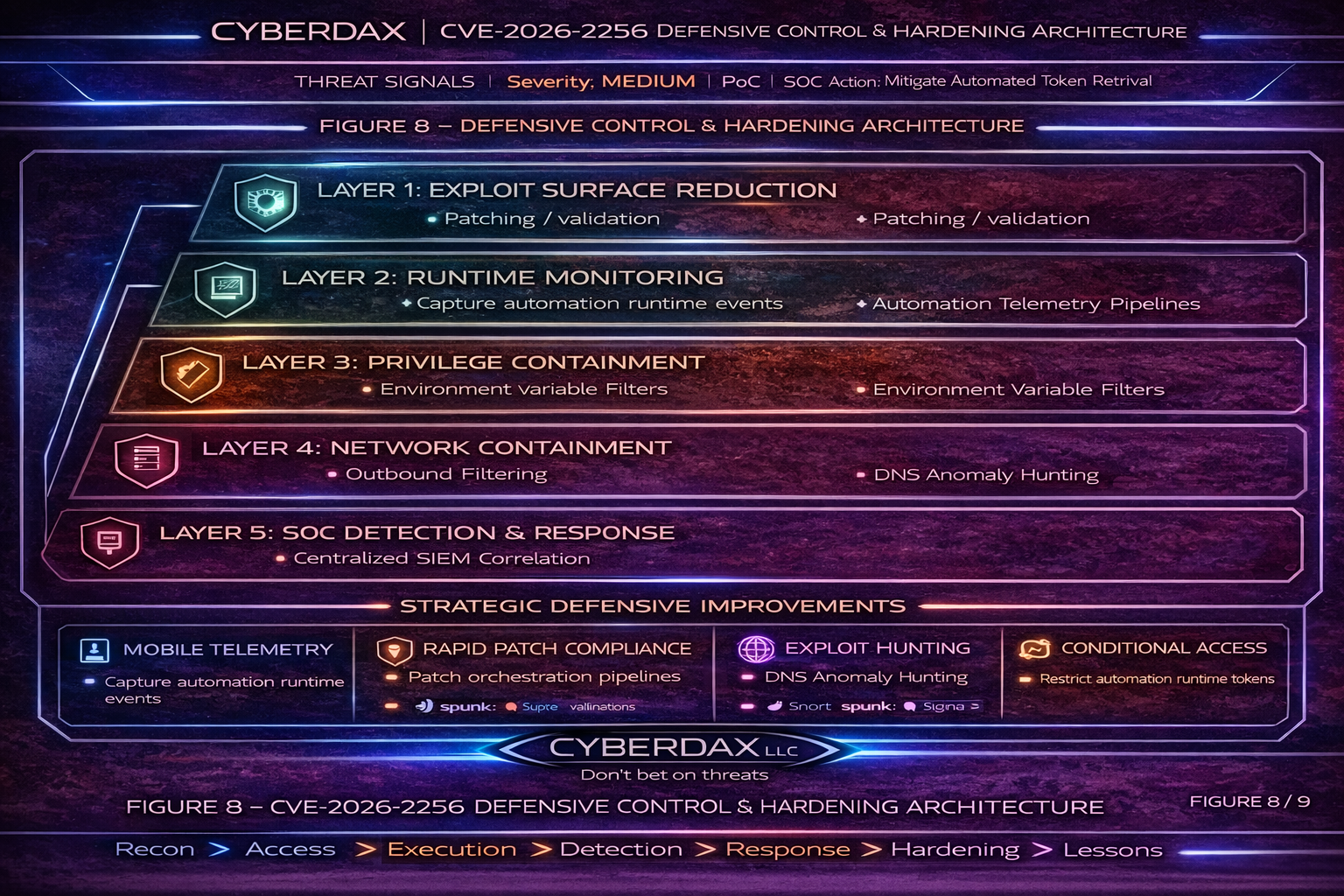
Layer 1 Prompt Input Validation
· Implement strict validation and allow-listing for automation inputs, enforcing a trust boundary between untrusted prompts and tool execution.
Layer 2 Command Allow-Listing
· Restrict commands executable by automation agents to a defined allow-list of approved operations.
Layer 3 Runtime Sandboxing
· Execute automation workflows within isolated, non-root containers with restricted system capabilities and ephemeral runtime environments.
Layer 4 Network Egress Controls
· Restrict outbound connections from automation hosts and enforce monitored egress paths.
Layer 5 Credential Isolation
· Store credentials in dedicated secrets management systems and use short-lived tokens for automation authentication.
Layer 6 Identity Monitoring
· Monitor automation service accounts and agent identities for abnormal authentication or privilege escalation activity.
Layer 7 Runtime Behavioral Detection
· Detect abnormal automation behavior such as unexpected shell execution or unusual tool invocation patterns.
Layer 8 Continuous Automation Security Review
· Regularly audit automation workflows, privilege boundaries, and tool execution policies.
Estimated Probability of Recurrence (12-month horizon)
Estimated Probability
· Approximately 65 percent likelihood of recurrence within the next 12 months
Drivers
· Rapid adoption of AI-driven automation and agent frameworks within DevOps pipelines, infrastructure orchestration, and enterprise research workflows.
· Limited maturity of security controls governing prompt validation, tool execution boundaries, and automation runtime permissions.
· High attacker incentive to target automation agents that operate with privileged access to infrastructure, credentials, and deployment pipelines.
· Growing awareness within the security research community of prompt-to-execution vulnerabilities in agent frameworks.
Post-incident insights and recommendations

Automation frameworks introduce a new enterprise risk model in which adversaries manipulate automation logic rather than exploiting traditional software vulnerabilities. Prompt-to-execution weaknesses such as CVE-2026-2256 demonstrate how untrusted inputs processed by automation agents can trigger privileged system actions when trust boundaries between input ingestion and tool execution are not enforced.
Organizations should treat automation agents as privileged infrastructure components and apply security controls comparable to those used for production systems and CI/CD platforms.
Key defensive lessons include:
· Enforce strict validation of automation inputs before they are passed to agent tools or execution environments.
· Restrict command execution capabilities within automation runtimes through allow-listing and sandboxed execution.
· Isolate credentials used by automation pipelines through dedicated secrets management systems and short-lived tokens.
· Monitor automation service accounts and agent runtimes for abnormal shell execution or unexpected workflow behavior.
· Conduct regular security reviews of automation workflows to identify trust boundary violations between prompt ingestion and tool execution.
References
Primary Sources
· MITRE CVE Program — hxxps://cve.mitre[.]org/cgi-bin/cvename.cgi?name=CVE-2026-2256
· National Vulnerability Database (NVD) — hxxps://nvd.nist[.]gov/vuln/detail/CVE-2026-2256
· ModelScope MS-Agent Project Repository — hxxps://github[.]com/modelscope/ms-agent
Security Research
· Itamar Yochpaz Security Research (Proof-of-Concept Repository) — hxxps://github[.]com/Itamar-Yochpaz/CVE-2026-2256-PoC
Government Reference
· CISA Known Exploited Vulnerabilities (KEV) Catalog — hxxps://www[.]cisa[.]gov/known-exploited-vulnerabilities-catalog?field_cve=CVE-2026-21385
