
Report Type: Exploitation Risk Assessment
Threat Category: WordPress Application Exploitation and Post-Exploitation
Assessment Date: July 20, 2026
Last Amendment Date : October 18, 2026
Primary Impact Domain: Application and Database Compromise
Secondary Impact Domains: Server-Side Execution, Credential Exposure, Persistence, Downstream Access, Data Exposure, Operational Disruption
Affected Asset Class: Internet-Facing WordPress Sites, Databases, PHP and Web-Server Workloads, Hosting Platforms, Cloud Resources, and Connected Enterprise Systems
Threat Objective Classification: Initial Access, Database Manipulation, Remote Code Execution, Persistent Access, Credential Access, Defense Impairment, and Enterprise Expansion
Published by: CyberDax LLC
Author: Edward “Tony” Dolley
Role: Founder / Principal Threat Researcher, CyberDax LLC
Publication Date: July 20, 2026
Publication Type: Cybersecurity Research Report / White Paper
S2 BLUF
WordPress Core REST API batch-route confusion and SQL-injection-to-remote-code-execution activity create material enterprise risk because a remote adversary may manipulate how embedded REST requests are interpreted, pass attacker-controlled input into vulnerable WordPress query behavior, alter database operations, and progress into server-side execution, unauthorized application changes, executable-file modification, command execution, credential access, persistence, outbound communication, or downstream compromise. The technical risk arises when inconsistent interpretation between a REST batch wrapper and an embedded request enables security-relevant query parameters to reach unsafe database behavior, after which unauthorized database reads, writes, or stored application-state changes may influence later WordPress processing and create a path to code execution. Successful compromise may allow an adversary to operate through the WordPress application, PHP runtime, web-server process, database account, container, workload, or hosting environment while accessing sensitive configuration, modifying executable content, establishing persistent access, retrieving payloads, reaching connected services, or exposing customer and business data. Immediate executive action is required to identify exposed WordPress environments, validate remediation and protective controls, preserve web, application, PHP, database, file, process, container, hosting, and network evidence, investigate suspicious REST and database behavior, isolate confirmed compromises, rotate exposed credentials, rebuild affected environments when integrity cannot be established, and confirm that application, database, workload, and downstream trust have been restored.
Executive Risk Translation
This activity shifts the business risk from one exposed website or suspicious REST request to uncertainty over whether an internet-facing application, its database, its hosting environment, and the identities or systems connected to it can continue to be trusted. When available evidence cannot reliably distinguish legitimate REST batch processing from route-confusion abuse, expected WordPress query behavior from successful SQL injection, authorized database changes from attacker-controlled application-state manipulation, or normal PHP activity from server-side execution, leadership may need to treat the affected environment and its downstream relationships as potentially compromised until proven otherwise. That response may require site isolation, emergency remediation, request and database reconstruction, PHP-process analysis, file and container collection, credential rotation, application rebuilding, enterprise-wide hunting, customer and partner impact assessment, legal and compliance review, cyber-insurance coordination, executive reporting, and formal confirmation that the application, database, hosting platform, connected services, and affected business operations can safely return to trusted use.
S3 — Why This Matters Now
· The activity includes a facilitated SQL-injection condition and a separate REST API batch-route confusion condition that may combine to enable remote code execution when the required technical conditions align.
· REST API batch functionality processes embedded requests within an outer request, making consistent routing, validation, authorization, and parameter interpretation critical across the complete request chain.
· Exploitation of the combined chain may be initiated remotely without an existing authenticated WordPress session when the required route, query-processing, and application conditions are present.
· Attacker-controlled values may reach security-relevant WordPress query parameters and influence the structure or behavior of a database query.
· Successful SQL injection may enable unauthorized database reads, writes, record changes, object access, or application-state transitions without immediately producing a malicious process or file.
· Database-backed content, options, metadata, configuration, or other stored values may influence later WordPress rendering, inclusion, loading, or execution behavior.
· Server-side execution may remain within an existing PHP or web-server worker and may not create a separate child process.
· Exploitation may lead to unauthorized changes involving WordPress users, roles, application passwords, options, scheduled actions, content, metadata, plugins, themes, must-use plugins, drop-ins, rewrite behavior, or configuration.
· A newly created or modified server-side file may be remotely accessed to execute commands, retrieve payloads, expose credentials, establish persistence, or initiate outbound communication.
· WordPress workloads may retain database credentials, hosting tokens, API keys, cloud credentials, deployment secrets, service-account tokens, webhook secrets, mail credentials, and access to connected services.
· Compromised WordPress workloads may be capable of reaching databases, cloud metadata services, orchestration APIs, source repositories, CI/CD platforms, administrative interfaces, identity services, or other internal systems.
· Managed, shared, containerized, autoscaled, or ephemeral hosting may limit access to the process, file, memory, database, and network evidence required to establish the full scope of compromise.
· Remediation and protective controls reduce current exposure but do not prove that every relevant WordPress environment was successfully addressed or that exploitation did not occur beforehand.
· Remediation exclusions, filesystem restrictions, hosting limitations, failed automated actions, or customized deployment workflows may leave relevant environments exposed.
· Remediating the initiating application weakness does not determine whether an adversary previously manipulated the database, executed code, created persistence, accessed credentials, reached downstream systems, or removed evidence.
· Deleting one suspicious PHP file does not establish that database-backed persistence, additional files, unauthorized users, modified options, scheduled actions, stolen credentials, or downstream access have been removed.
· Container replacement, site restoration, service restart, or hosting migration may destroy short-lived request, process, memory, file, and database evidence before investigators can reconstruct the attack chain.
· REST integrations, mobile applications, content automation, block-editor operations, search, filtering, plugins, themes, backups, migrations, and security testing may generate superficially similar request or database behavior.
· Detection based only on one URI, request body, SQL fragment, query parameter, PHP filename, payload hash, command, user agent, source address, or callback destination cannot provide durable assurance.
· Business exposure increases when the affected site supports ecommerce, customer portals, authentication, regulated data, payment-related workflows, business-critical publishing, partner integrations, managed hosting, software delivery, or connectivity to internal and cloud services.
S4 — Key Judgments
· WordPress Core REST API batch-route confusion and SQL-injection-to-RCE activity should be treated as an application-compromise, database-integrity, server-side-execution, credential-exposure, downstream-access, and business-resilience risk, not only as an application-remediation or web-security issue.
· The primary enterprise risk is the adversary’s ability to convert abnormal REST request interpretation into attacker-influenced database behavior and then use the application, stored data, PHP runtime, filesystem, or connected workload to obtain code execution or persistent access.
· An unusual request to the WordPress REST batch endpoint does not prove route-confusion exploitation.
· SQL keywords, encoded characters, quotation marks, comments, nested values, list parameters, database errors, or response delays do not independently prove successful SQL injection.
· Suspicious REST batch activity followed by WordPress-attributed database queries that materially differ from the expected operation provides stronger evidence of successful manipulation than either web or database telemetry alone.
· Successful database manipulation does not automatically establish remote code execution.
· Unauthorized database writes, stored executable content, application-state changes, or configuration modifications followed by abnormal PHP evaluation, inclusion, loading, file creation, process activity, or outbound communication provide materially stronger evidence of escalation.
· PHP or web-server child-process creation is a high-value execution signal but is not required when malicious activity remains within an existing application worker.
· A PHP file located within a WordPress directory does not prove that the file is malicious, remotely accessible, or executed.
· A newly created or modified server-side artifact followed by remote access, command execution, payload retrieval, sensitive-file access, or outbound communication should be treated as probable server-side compromise.
· A WAF prevention event may establish attempted exploitation but does not prove that attacker-controlled input reached WordPress or altered a database query.
· Network-only evidence cannot prove route confusion, SQL injection, database manipulation, PHP execution, file creation, credential access, or persistence.
· Database-only evidence may identify abnormal queries or unauthorized writes but may not reveal the application behavior that enabled later server-side execution.
· Endpoint-only evidence may detect suspicious files, child processes, or outbound communication without identifying the initiating REST request or application-layer entry path.
· A functioning website, completed remediation action, clean security assessment, or absence of a current webshell does not prove that application, database, credential, hosting, or downstream integrity was preserved.
· Credential rotation and site restoration may be necessary but may not be sufficient when an adversary could have modified database-backed settings, created unauthorized users, established scheduled execution, deployed secondary payloads, accessed hosting credentials, or reached connected systems.
· Recurrence of suspicious files, database objects, users, scheduled actions, command execution, or outbound communication after restart, restoration, container replacement, or remediation materially increases confidence in persistence.
· Missing request bodies, database queries, PHP-process telemetry, file events, container history, or network attribution cannot be treated as proof that exploitation did not occur.
· Direct exploitation of the WordPress Core REST and query-processing chain must remain distinct from facilitated SQL injection in which a plugin, theme, custom endpoint, or application workflow passes attacker-controlled input into vulnerable query behavior.
· WordPress Core compromise does not establish compromise of the WordPress build process, update infrastructure, hosting provider, plugin vendor, theme vendor, or software supply chain without direct supporting evidence.
· The most damaging outcome occurs when an internet-facing WordPress compromise enables persistent server-side access, privileged credential theft, sensitive-data exposure, customer-facing manipulation, internal expansion, cloud compromise, security-control impairment, or coordinated compromise across shared hosting, management, deployment, or credential infrastructure.
S5 — Executive Risk Summary
Business Risk
WordPress Core REST API batch-route confusion and SQL-injection-to-RCE activity can undermine the organization’s ability to trust an affected public-facing application, its database, its PHP and web-server runtime, its hosting environment, and the identities or services connected to it. Risk increases when the affected site supports ecommerce, customer portals, authentication, regulated information, payment-related workflows, business-critical communications, partner integrations, managed services, marketing operations, software delivery, or access to internal or cloud systems. The business impact is not limited to the original request or website; it can expand into uncertainty over whether customer or employee data was exposed, database records were modified, credentials were accessed, executable content was introduced, commands were run, security controls were impaired, downstream systems were reached, persistence remains, or evidence was removed.
Technical Cause
The risk is driven by inconsistent interpretation of embedded REST batch requests combined with unsafe handling of attacker-controlled query input within WordPress query behavior. Exposure becomes material when an unauthenticated or otherwise untrusted request reaches a security-relevant WordPress query parameter, alters a database query, causes unauthorized reads or writes, changes stored application state, or influences later server-side processing. Technical impact may include modification of users, roles, application passwords, options, scheduled actions, content, metadata, plugins, themes, must-use plugins, drop-ins, rewrite behavior, or configuration; creation or modification of PHP or executable content; execution within an existing PHP worker; child-process creation; command execution; access to sensitive configuration; outbound communication; persistence; credential use; and downstream expansion. Exposure increases when request bodies, embedded routes, database queries, query attribution, PHP activity, file changes, process ancestry, container history, socket ownership, workload identity, and administrative change records are incomplete.
Threat Posture
The threat posture is elevated for internet-facing WordPress environments where REST batch processing, attacker-influenced query behavior, exposed application functionality, or insufficient preventive controls create a viable path from remote request manipulation to unauthorized database activity and server-side execution. The posture remains elevated where plugins, themes, custom endpoints, or application workflows can pass attacker-controlled input into vulnerable query behavior. Risk becomes critical when a WordPress workload has writable executable paths, broad database privileges, access to sensitive configuration, unrestricted outbound connectivity, cloud or orchestration identity, shared hosting relationships, reusable credentials, administrative integrations, or connectivity to internal systems. The threat may remain active after remediation, restoration, rebuilding, or deletion of an identified file if database-backed persistence, unauthorized users, modified options, scheduled actions, secondary payloads, stolen credentials, hosting access, or downstream compromise remain.
Executive Decision Requirement
Executives must require measurable assurance that all WordPress instances, hosting models, domains, owners, plugins, themes, integrations, internet exposures, database relationships, administrative paths, and downstream dependencies are inventoried and assessed. Leadership should require confirmation that remediation and protective controls were successfully implemented, excluded or operationally constrained systems were separately addressed, suspicious REST and WAF activity was reviewed, database behavior was examined, WordPress users and configuration were validated, executable paths were checked, PHP and web-server behavior was investigated, sensitive credentials were assessed, and internal or cloud access was scoped. When compromise cannot be ruled out, executives must be prepared to authorize site isolation, emergency traffic controls, request preservation, database review, container or workload snapshotting, credential and session invalidation, application rebuilding, enterprise-wide hunting, downstream-system investigation, customer and partner impact analysis, legal and compliance escalation, cyber-insurance coordination, communications planning, and formal restoration of application and data integrity. Leadership should also require evidence that security operations, incident response, web engineering, application owners, database administrators, hosting teams, cloud security, identity, legal, privacy, communications, cyber insurance, customer support, and business owners can support a coordinated response.
S6 — Executive Cost Summary
WordPress Core REST API batch-route confusion and SQL-injection-to-RCE activity create financial exposure because the organization must determine whether an exposed site was targeted, whether attacker-controlled input altered database behavior, whether unauthorized reads or writes occurred, whether stored application state enabled server-side execution, whether executable content was created, whether credentials or sensitive data were exposed, and whether connected systems were reached. The cost profile is different from routine website remediation, malware removal, or content restoration because an affected application may have continued serving customers and business processes while its database, files, runtime, credentials, and downstream relationships were no longer trustworthy. A single confirmed compromise can therefore require investigation across web infrastructure, database platforms, hosting environments, containers, cloud services, identity systems, customer records, payment-related workflows, administrative accounts, CI/CD systems, source repositories, security platforms, partner connections, and additional WordPress instances.
Response cost is driven by the work required to preserve requests and logs, reconstruct embedded REST activity, validate database-query behavior, identify unauthorized reads or writes, review users and configuration, examine PHP execution, collect files and containers, identify persistence artifacts, reconstruct outbound and internal communication, rotate credentials, restore content and application state, assess data exposure, investigate connected systems, rebuild affected workloads, validate trusted WordPress packages, and prove that the application, database, filesystem, hosting environment, and downstream access have returned to a known-good state.
Cost increases materially when request bodies are unavailable, embedded batch operations cannot be reconstructed, database-query logging is disabled, shared database accounts weaken attribution, WordPress audit logging is incomplete, PHP execution remains inside an existing worker, short-lived files are deleted before collection, containers or pods are replaced, hosting providers limit forensic access, local logs are overwritten, outbound connections lack process attribution, credentials are shared, or site ownership and dependencies are poorly documented. The highest-cost cases occur when affected sites support ecommerce, payment-related operations, authentication, regulated data, customer portals, high-volume publishing, managed hosting, shared administration, cloud connectivity, sensitive integrations, or business-critical services.
Low Impact Scenario
Rapid investigation confirms an exposed, targeted, or misconfigured WordPress environment without evidence that attacker-controlled input successfully altered a database query, caused an unauthorized read or write, changed application state, enabled server-side execution, created malicious executable content, exposed credentials, established persistence, initiated unauthorized communication, or reached downstream systems. Suspicious REST requests, WAF events, database errors, query anomalies, file operations, or PHP activity were blocked, unsuccessful, legitimate, or unsupported by correlated application, database, file, process, network, workload, or forensic evidence. WordPress, web-server, WAF, database, hosting, deployment, change-management, and security records support a failed, contained, approved, or non-impacting event. Response is limited to emergency remediation, control validation, targeted log review, request preservation, focused database and file validation, configuration correction, short-term enhanced monitoring, credential review, limited hunting, and executive assurance that application and database integrity were not materially affected. Estimated impact $500K–$3M.
Moderate Impact Scenario
Confirmed or strongly suspected exploitation affects one or more WordPress sites, databases, PHP workers, containers, workloads, hosting environments, customer-facing services, or connected systems. Evidence may include suspicious REST batch activity followed by altered database queries, unauthorized database reads or writes, user or option changes, application-state manipulation, PHP or executable-file creation, remote access to a new server-side artifact, command execution, sensitive-configuration access, abnormal outbound communication, persistence, security-control impairment, or cleanup. The organization cannot immediately determine which data, credentials, database records, customer interactions, commands, payloads, integrations, or downstream systems were affected. Response requires enterprise-focused web and database investigation, file and PHP analysis, credential rotation, site rebuilding, customer-data review, internal scoping, cloud and hosting review, persistence removal, enhanced monitoring, legal and compliance assessment, cyber-insurance coordination, executive reporting, and formal confirmation that application and data integrity have been restored. Estimated impact $5M–$35M.
High Impact Scenario
WordPress REST API and SQL-injection-to-RCE compromise becomes an enterprise-impact event when confirmed or suspected exploitation results in broad sensitive-data exposure, customer-facing or payment-related manipulation, privileged credential theft, persistent server-side access, cloud or hosting compromise, internal expansion, compromise of shared management or deployment infrastructure, security-control impairment, ransomware enablement, destructive activity, or coordinated compromise across multiple sites or tenants. The organization may need to assume that affected applications, databases, customer records, administrative identities, hosting environments, integrations, downstream systems, and public communications were exposed or unreliable until evidence proves otherwise. Response may require emergency isolation of site populations, suspension of customer-facing services, broad credential and key rotation, enterprise-wide web and endpoint hunting, database reconstruction, application rebuilding, payment and customer-impact analysis, partner coordination, privacy and regulatory escalation, cyber-insurance engagement, communications response, customer-notification analysis, executive and board reporting, and formal validation that application, data, hosting, and business operations can safely resume. Estimated impact $40M–$200M+.
S6A — Key Cost Drivers
· Number and business criticality of affected WordPress sites, domains, databases, PHP workers, containers, pods, workloads, hosts, customer portals, ecommerce services, payment-related workflows, publishing platforms, and downstream systems.
· Number of exposed WordPress instances requiring emergency remediation validation, manual intervention, hosting-provider coordination, protective-control deployment, or replacement.
· Scope of internet-facing REST API exposure and legitimate applications, integrations, mobile clients, plugins, themes, automation systems, and management platforms using REST functionality.
· Number of suspicious requests, embedded routes, request variants, source addresses, user agents, sessions, response anomalies, WAF events, and application errors requiring investigation.
· Availability and retention of complete HTTP methods, routes, parameters, request bodies, headers, responses, request identifiers, source attribution, timestamps, and WAF normalization data.
· Ability to reconstruct individual embedded operations contained within REST batch requests.
· Availability of WordPress audit telemetry covering users, roles, application passwords, options, scheduled actions, plugins, themes, content, metadata, and configuration.
· Availability of database query, audit, error, slow-query, object-access, transaction, read, write, administrative, account, session, and affected-row telemetry.
· Ability to associate an abnormal database query with the responsible WordPress site, request, PHP worker, application account, container, workload, or tenant.
· Use of shared database accounts, connection pools, proxies, hosting layers, or multi-tenant infrastructure that weakens attribution.
· Number and sensitivity of database tables, records, users, options, credentials, customer records, payment-related data, content, metadata, and configuration objects accessed or modified.
· Extent of unauthorized WordPress user, administrator-role, application-password, option, scheduled-action, plugin, theme, drop-in, must-use plugin, rewrite, or content changes.
· Availability of PHP, PHP-FPM, web-server, FastCGI, process, file, memory, module-load, runtime-evaluation, child-process, and network telemetry.
· Ability to determine whether server-side execution occurred inside an existing PHP worker or created a separate process.
· Number of PHP, script, executable, configuration, archive, temporary, cache, upload, plugin, theme, language, backup, and web-root files requiring validation.
· Availability of trusted WordPress release packages, approved plugin and theme packages, component manifests, hashes, file histories, and deployment records.
· Number of newly created, modified, hidden, renamed, obfuscated, or inventory-inconsistent server-side artifacts requiring content analysis and access-history review.
· Ability to preserve terminated containers, replaced pods, ephemeral filesystems, short-lived processes, local logs, runtime memory, and network history.
· Number and privilege level of database credentials, hosting tokens, API keys, cloud credentials, SSH material, deployment secrets, webhook secrets, mail credentials, service-account tokens, and administrative identities accessible from affected workloads.
· Complexity of rotating database passwords, application secrets, API keys, cloud credentials, certificates, administrative accounts, customer sessions, and integration tokens without disrupting operations.
· Number of internal systems, databases, cloud services, metadata services, orchestration APIs, source repositories, CI/CD systems, administrative interfaces, partner platforms, and customer environments reachable through affected workloads.
· Extent of outbound payload retrieval, command-and-control-like communication, direct-IP traffic, tunneling, proxying, data transfer, internal-service access, or downstream authentication requiring reconstruction.
· Scope of security-control impairment, WAF modification, logging interruption, endpoint-protection degradation, container-policy changes, file-integrity disruption, or telemetry suppression.
· Extent of log truncation, application-log deletion, database cleanup, PHP-file removal, temporary-payload deletion, command-history removal, timestomping, or evidence loss.
· Number of additional WordPress sites requiring enterprise-wide hunting because they share hosting infrastructure, management platforms, credentials, plugins, themes, databases, deployment tooling, or administrative relationships.
· Business disruption caused by emergency remediation, site isolation, ecommerce suspension, payment interruption, content rollback, customer-portal unavailability, credential rotation, database restoration, hosting migration, application rebuilding, or temporary distrust of public-facing systems.
· Dependence on hosting providers, managed WordPress providers, CDN providers, WAF vendors, database providers, cloud providers, plugin vendors, theme vendors, payment processors, partners, customers, and third-party system owners to preserve evidence or restore services.
· Legal, privacy, regulatory, contractual, payment-card, cyber-insurance, customer, partner, communications, executive, or board obligations triggered by unauthorized access, data exposure, content manipulation, credential compromise, downstream compromise, operational interruption, or inability to prove application and data integrity.
S6B — Compliance and Risk Context

Figure 1
WordPress Core REST API and SQL-injection-to-RCE executive risk model showing how abnormal REST batch-route interpretation can progress into attacker-controlled query construction, unauthorized database activity, application-state manipulation, PHP or server-side execution, executable-file modification, persistent access, credential exposure, outbound communication, internal expansion, customer-data exposure, operational disruption, and enterprise-level financial and regulatory impact.
Compliance Exposure Indicator
High
Risk Register Entry
Risk Title
WordPress Core REST API and SQL-Injection-to-RCE Post-Exploitation Risk
Risk Description
Adversaries may exploit inconsistent interpretation of embedded requests within WordPress REST API batch functionality and combine that behavior with unsafe handling of attacker-controlled WordPress query parameters to alter database operations. Successful exploitation may permit unauthorized database reads, writes, user changes, role changes, application-password changes, option changes, scheduled-action changes, content or metadata modification, configuration changes, or stored application-state manipulation. Resulting database or application behavior may enable PHP execution, server-side loading of attacker-controlled content, creation or modification of executable files, persistent server-side access, command execution, payload retrieval, credential theft, security-control impairment, evidence removal, outbound communication, or access to internal and cloud-connected systems. This may increase customer and employee data exposure, payment-related risk, website and service disruption, credential compromise, downstream-system compromise, legal and compliance review, customer or partner notification analysis, cyber-insurance scrutiny, communications response, and board-level concern. Compliance exposure should be driven by local evidence of successful request manipulation, unauthorized database activity, application-state changes, server-side execution, file modification, credential access, persistence, security-control impairment, downstream access, data exposure, or operational impact, not by WordPress presence, exposure status, unusual REST requests, WAF alerts, SQL keywords, database errors, PHP files, or public reporting alone.
Likelihood
High
Impact
Severe
Risk Rating
Critical
Annualized Risk Exposure
Estimated annualized exposure of $6M–$45M+ for materially exposed enterprise environments where WordPress sites are internet-facing, support customer or business-critical services, process sensitive or regulated information, operate ecommerce or payment-related workflows, use privileged database accounts, retain reusable credentials, connect to cloud or internal systems, or depend on shared hosting, management, deployment, and integration infrastructure. Exposure increases when remediation completion cannot be verified, operationally constrained environments remain exposed, request bodies are unavailable, database auditing is incomplete, WordPress change logging is weak, PHP and file telemetry are limited, containers are ephemeral, hosting providers restrict forensic access, outbound connectivity is broad, credentials are shared, or dependencies are undocumented. A realized severe event may exceed $40M–$200M+ when exploitation results in persistent server-side access, broad sensitive-data exposure, customer-facing or payment-related manipulation, privileged credential compromise, compromise of shared management or hosting infrastructure, internal or cloud expansion, widespread website compromise, security-control degradation, ransomware or destructive activity, prolonged customer-facing disruption, regulatory reporting, customer notification, litigation, cyber-insurance review, communications response, or board-level intervention.
S7 — Risk Drivers
· WordPress sites may expose REST API functionality directly to untrusted internet sources.
· REST batch functionality may process multiple embedded requests through one outer request.
· Differences between outer-request and embedded-request interpretation may create route, method, validation, authorization, or parameter-handling inconsistencies.
· A remote attacker may be able to reach security-relevant query behavior when the required route, request-processing, query-handling, and application conditions are present.
· Attacker-controlled list values, nested structures, duplicated parameters, conflicting values, encoded input, or altered route arrangements may influence request interpretation.
· Unsafe handling of attacker-controlled query parameters may allow modification of the resulting database query.
· SQL injection may support unauthorized data reads, writes, record changes, object access, or application-state transitions.
· Abnormal database behavior may occur under the legitimate WordPress application account and appear consistent with expected application connectivity.
· Shared database accounts, connection pools, proxies, or hosting platforms may obscure which request, site, or tenant caused an abnormal query.
· Database changes may affect WordPress users, administrator roles, application passwords, options, scheduled actions, content, metadata, plugins, themes, rewrite behavior, or configuration.
· Stored attacker-controlled content or configuration may influence later rendering, inclusion, loading, or execution behavior.
· Server-side execution may occur within an existing PHP or web-server process without creating an obvious new executable.
· PHP or web-server workers may legitimately read configuration, write files, access databases, and communicate externally, complicating behavioral classification.
· WordPress administration, plugins, themes, backups, migrations, page builders, caching, optimization, and security functions may generate legitimate file or database changes.
· Writable upload, cache, temporary, language, backup, plugin, theme, must-use plugin, drop-in, or web-root paths may provide locations for executable content.
· A newly created or modified server-side artifact may use a legitimate-looking name, hidden filename, double extension, misleading content type, short loader, encoded content, or obfuscated execution.
· Persistent server-side access may use different request methods, parameters, authentication mechanisms, filenames, extensions, or activation patterns.
· Malicious execution may create shells, script interpreters, downloaders, archive utilities, network tools, package managers, service utilities, or administrative processes.
· Attackers may avoid child-process creation by executing commands, network activity, or malicious application logic within an existing PHP worker.
· WordPress workloads may contain database credentials, API keys, cloud credentials, hosting tokens, SSH material, webhook secrets, deployment credentials, and service-account tokens.
· Compromised workloads may access cloud metadata, orchestration APIs, databases, identity services, administrative interfaces, source repositories, CI/CD systems, or management platforms.
· Outbound WordPress communication may be common because of webhooks, APIs, mail, media retrieval, monitoring, security products, and integrations.
· Attackers may use approved cloud services, repositories, APIs, direct-IP connections, encrypted sessions, common ports, or familiar hosting infrastructure.
· Managed or shared hosting may not expose endpoint, process, file, socket, memory, container, or database telemetry.
· Container restart, pod replacement, workload replacement, restoration, or migration may destroy local evidence.
· Local application, web-server, PHP, database, container, and security logs may be altered, deleted, truncated, overwritten, or excluded from collection.
· Successful exploitation may produce minimal errors, limited request volume, no persistent file, and no separate child process.
· A blocked or unstable exploit may produce multiple errors and alerts without successful database manipulation or execution.
· The original REST request may remain unknown even when server-side execution or post-exploitation is confirmed.
· Application remediation may create false closure when unauthorized users, altered options, scheduled actions, executable content, stolen credentials, hosting access, or downstream compromise remain.
· Site restoration may reintroduce compromised database content, plugins, themes, configuration, credentials, or backups.
· Shared hosting, shared databases, shared credentials, centralized management, plugin-management systems, deployment tooling, and backup platforms may expand the response scope beyond one website.
· Business exposure increases when affected sites support ecommerce, customer portals, authentication, regulated data, payment-related workflows, publishing, customer services, partner access, or internal integrations.
· Application uncertainty, database-integrity loss, credential exposure, sensitive-data compromise, customer-facing manipulation, evidence loss, service interruption, downstream expansion, and incomplete containment can transform a website incident into legal, regulatory, communications, cyber-insurance, customer, partner, executive, and board-level exposure.
S8 — Bottom Line for Executives
WordPress Core REST API batch-route confusion and SQL-injection-to-RCE activity should be treated as a high-priority application-compromise, database-integrity, server-side-execution, credential-exposure, and business-resilience risk because a remote adversary may convert abnormal request interpretation into unauthorized database behavior and then use the application, PHP runtime, filesystem, credentials, or connected workload to maintain access and expand. The executive question is not only whether remediation was completed, whether a WAF blocked suspicious traffic, whether a database error occurred, whether an unfamiliar PHP file was found, or whether the website appears operational; it is whether the organization can prove that attacker-controlled input did not alter database behavior, application state remained intact, server-side code was not executed, executable content was not introduced, credentials were not exposed, persistence was not established, sensitive data was not modified or accessed, and suspicious activity did not lead to internal, cloud, hosting, customer, or partner compromise. Response must focus on validating remediation completion, preserving application and database evidence, reconstructing suspicious requests, reviewing database and WordPress changes, examining PHP and file activity, rotating exposed credentials, scoping downstream systems, removing persistence, rebuilding from trusted sources when integrity cannot be established, and confirming that application, data, hosting, and connected operations have been restored before leadership relies on the affected environment.
S9 — Board-Level Takeaway
WordPress Core REST API and SQL-injection-to-RCE activity becomes a board-level issue when an adversary can convert access to a public-facing application into unauthorized control over database behavior, server-side execution, credentials, sensitive information, customer-facing content, or downstream systems. The risk is not simply that a WordPress site was exposed to the behavior, an unusual REST request was observed, a WAF signature fired, a database error occurred, or a PHP file appeared in the web root; it is the possibility that adversaries manipulated application logic, altered database state, executed through trusted PHP or web-server processes, established persistent access, stole credentials, modified customer-facing content or payment-related workflows, weakened security controls, removed evidence, exposed sensitive data, or expanded through hosting, cloud, administrative, and partner relationships while the website continued to function. Leadership should require evidence that WordPress inventory and ownership, remediation governance, REST and WAF visibility, database auditing, application-change logging, file integrity, PHP and process telemetry, container preservation, credential management, outbound controls, network segmentation, remote logging, incident-response readiness, legal readiness, customer-notification planning, communications procedures, and business-continuity capabilities can support rapid and defensible decisions when application or database integrity cannot be confirmed.
S10 — Threat Overview
WordPress Core REST API batch-route confusion and SQL-injection-to-RCE activity describes adversary behavior in which a remote actor manipulates embedded REST operations so that request routing, validation, authorization, parameter handling, or callback processing is interpreted inconsistently across the request chain. Attacker-controlled values may then reach unsafe WordPress query behavior, alter database operations, and produce unauthorized reads, writes, user changes, option changes, content or metadata modification, configuration changes, or other application-state manipulation. Resulting database or application behavior may influence later PHP, plugin, theme, template, rendering, inclusion, file, or execution activity and create a path to server-side code execution, command activity, credential access, persistent access, outbound communication, security-control impairment, evidence removal, or downstream compromise. Multiple request structures, embedded routes, parameters, database operations, stored values, execution mechanisms, file paths, PHP artifacts, commands, payloads, destinations, hosting models, and persistence methods may produce this behavior, but the durable enterprise risk is broader than any single request body, scanner signature, exploit implementation, file, payload, campaign, actor, or infrastructure indicator.
· This is not only a malformed-request, WAF-alert, SQL-keyword, database-error, PHP-file, webshell, unusual-process, payload-hash, or suspicious-destination model.
· The core threat behavior is inconsistent REST batch-request interpretation followed by attacker-influenced query construction, unauthorized database activity, conditional server-side execution, and possible persistence or downstream expansion.
· Internet-facing WordPress REST functionality, embedded request processing, security-relevant query parameters, application callbacks, database accounts, and database-backed application state represent the primary exploitation surface.
· PHP workers, web-server processes, containers, pods, workloads, managed-hosting instances, and writable application paths represent the primary server-side execution surface.
· Customer-facing services, databases, administrative platforms, cloud resources, identity services, repositories, deployment systems, orchestration platforms, partner connections, and internal networks represent the primary downstream exposure surface.
· An unusual REST batch request does not prove route-confusion exploitation.
· SQL-like input, encoded characters, comments, quotation marks, nested values, duplicated parameters, list structures, response differences, or database errors do not independently prove successful SQL injection.
· Successful alteration of a database query does not prove that server-side code execution occurred.
· Unauthorized database reads or writes may occur through the expected WordPress database account and appear consistent with normal application connectivity.
· Server-side execution may remain entirely within an existing PHP or web-server worker and may not create a separate process or persistent file.
· A newly created or modified PHP file does not prove remote access, command execution, persistence, or malicious intent without supporting request, content, process, network, or forensic evidence.
· WordPress administration, plugins, themes, deployment, backup, migration, optimization, caching, security, content-management, and integration activity may produce superficially similar request, database, file, process, or network behavior.
· Managed, shared, containerized, autoscaled, or ephemeral hosting may conceal the responsible request, process, database session, file operation, socket, workload, or tenant.
· A functioning site, completed remediation action, successful restoration, clean security assessment, or absence of a current webshell does not prove that application, database, credential, hosting, or downstream integrity was preserved.
· Compromise may remain limited to one request, database operation, site, worker, file, workload, account, or session without producing broad instability.
· The exact database-to-execution mechanism may remain unknown even when unauthorized database activity, server-side execution, or post-exploitation is confirmed.
· Compromise of one WordPress environment does not establish compromise of the WordPress project, software-distribution infrastructure, hosting provider, plugin vendor, theme vendor, or broader software supply chain.
· Application remediation, PHP-file deletion, credential rotation, container replacement, site restoration, or workload rebuilding may not fully contain compromise when database-backed persistence, unauthorized users, secondary payloads, stolen credentials, hosting access, or downstream compromise remain active.
· Public reporting, exploit analysis, scanner detections, proof-of-concept releases, file indicators, infrastructure indicators, or exploitation tracking should increase investigative urgency without narrowing the assessment into an indicator-only or weakness-specific model.
S11 — Threat Classification and Type
Threat Type
WordPress Core REST API batch-route confusion and SQL-injection-to-RCE post-exploitation risk.
Threat Sub-Type
REST batch-request interpretation inconsistency, embedded-route confusion, routing or validation divergence, authorization inconsistency, attacker-controlled query-parameter abuse, unsafe database-query construction, SQL injection, unauthorized database reads or writes, stored-data manipulation, application-state modification, PHP or web-server execution, executable-file creation or modification, command execution, credential access, webshell persistence, outbound communication, internal service access, security-control impairment, evidence removal, and downstream system expansion.
Operational Classification
Remote application-layer exploitation, database-integrity compromise, stored-data manipulation, server-side execution, credential exposure, application persistence, workload compromise, downstream-access pathway, and business-resilience risk.
Primary Function
Obtain unauthorized influence over WordPress request interpretation and database-query behavior, convert that influence into unauthorized database activity or stored application-state change, use the resulting application, PHP, web-server, filesystem, database, container, or workload context to execute additional activity, and sustain or expand access while creating uncertainty around application integrity, database trust, credential exposure, hosting integrity, containment completeness, customer impact, and downstream enterprise exposure.
S12 — Campaign or Activity Overview

Figure 2
WordPress Core REST API and SQL-injection-to-RCE activity model showing abnormal REST batch-request interpretation, attacker-controlled query construction, unauthorized database activity, stored application-state manipulation, PHP or server-side execution, executable-file modification, persistent access, credential exposure, outbound communication, cleanup, and possible downstream system expansion.
This report assesses WordPress Core REST API batch-route confusion and SQL-injection-to-RCE activity as a durable behavior class rather than a single request body, exploit script, scanner result, database error, PHP file, payload, campaign, actor cluster, proof-of-concept implementation, command, destination, or infrastructure indicator. The core activity pattern begins when an adversary manipulates an outer REST batch request or embedded operation so that routing, validation, authorization, parameter handling, or callback behavior is interpreted inconsistently. Activity may progress when attacker-controlled values reach unsafe query-processing behavior and materially alter database operations, producing unauthorized reads, writes, user changes, configuration changes, content or metadata modification, or other stored application-state manipulation. Resulting application or database behavior may then enable PHP execution, executable-file creation or modification, persistent server-side access, command execution, credential theft, outbound communication, security-control impairment, evidence removal, or downstream access. Successful compromise may enable one or more conditional outcomes, including additional payload deployment, internal reconnaissance, cloud or orchestration access, remote authentication, lateral expansion, sensitive-data exposure, customer-facing manipulation, ransomware enablement, destructive activity, or continued access after the initiating application weakness is remediated.
· The activity is best understood as an application-compromise, database-integrity, stored-data-manipulation, server-side-execution, credential-exposure, persistence, downstream-access, and business-resilience threat rather than a routine website-remediation or WAF-blocking issue.
· The exact request arrangement, query parameter, embedded route, database operation, stored value, or execution mechanism may vary and is not required to be fully established for the behavior model to remain valid.
· Activity may begin through unauthenticated internet-originated REST requests, malicious automation, scripted probing, scanner-assisted exploitation, or another remote application interaction.
· Adversaries may vary embedded routes, methods, list values, duplicated parameters, nested structures, encodings, quotation, comments, operators, functions, or request ordering to alter interpretation or identify unsafe query behavior.
· Activity may remain limited to malformed requests, blocked WAF events, validation failures, database errors, timing changes, failed writes, application faults, worker restarts, or incomplete execution.
· Probable REST batch-route abuse is indicated when a request contains material inconsistencies between the outer batch context and embedded operations and produces behavior inconsistent with normal REST usage.
· Probable SQL injection is indicated when attacker-controlled input materially changes the resulting query or produces an unauthorized read, write, object access, record change, or application-state transition.
· Database activity may occur under the expected WordPress application account, database connection, PHP worker, container, workload, or hosting identity.
· Unauthorized database changes may involve WordPress users, roles, application passwords, options, scheduled actions, content, metadata, plugins, themes, must-use plugins, drop-ins, rewrite behavior, or configuration.
· Stored attacker-controlled content or configuration may influence later rendering, inclusion, loading, evaluation, callback processing, or another server-side execution path.
· Server-side execution may occur within an existing PHP or web-server process, through child-process creation, through executable-file placement, or through another application-runtime mechanism.
· Executable or server-side content may be placed within plugin, theme, upload, cache, temporary, language, backup, must-use plugin, drop-in, configuration, or web-root paths.
· Persistent server-side access may use a webshell, loader, modified application component, altered database-backed configuration, scheduled action, unauthorized administrator, application password, secondary payload, or stolen credential.
· Command activity may involve shell interpreters, script hosts, downloaders, archive utilities, package managers, network tools, service utilities, administrative tools, or execution entirely within the existing application process.
· Outbound activity may involve payload retrieval, callback traffic, direct-IP communication, tunneling, proxying, data transfer, cloud-service access, or internal service access.
· Credential access may involve database credentials, hosting tokens, API keys, cloud credentials, SSH material, deployment secrets, webhook secrets, mail credentials, service-account tokens, or environment-provided identity.
· Evidence removal may involve PHP-file deletion, temporary-payload cleanup, database-value restoration, command-history removal, application-log deletion, database-log deletion, audit disabling, container replacement, or workload destruction.
· Downstream activity may involve databases, cloud metadata, orchestration APIs, identity services, administrative systems, repositories, CI/CD platforms, security systems, partner environments, customer systems, or internal networks.
· Actor names, malware names, proof-of-concept releases, request patterns, filenames, hashes, destinations, commands, payloads, and individual execution methods should enrich the assessment rather than replace local behavior-led evidence.
S13 — Targets and Exposure Surface
The exposure surface includes internet-facing WordPress environments where REST API functionality, embedded batch operations, query-processing behavior, authenticated media-upload or image-processing workflows, plugin authentication functionality, database connectivity, application callbacks, or writable server-side paths can be influenced by untrusted input. It also includes every database object, PHP worker, web-server process, container, workload, credential, internal system, cloud service, administrative platform, customer-facing workflow, and downstream relationship that may be reached or affected through the compromised application.
· Internet-facing WordPress sites, multisite environments, customer portals, ecommerce platforms, publishing systems, authentication portals, marketing sites, business applications, managed WordPress services, and hosted customer environments.
· WordPress REST API endpoints, batch-processing functionality, custom endpoints, plugin routes, theme routes, application callbacks, query filters, search functions, list-based parameters, content workflows, media-upload and attachment-processing workflows, authentication workflows, account-management functionality, and automation interfaces.
· WordPress environments using the User Profile Builder plugin where unauthenticated authentication-bypass behavior can result in unauthorized access to privileged WordPress account state, including administrator-level access.
· WordPress environments where authenticated Author-or-higher users can submit attacker-controlled files for server-side media processing.
· WordPress installations using Imagick and Ghostscript where attacker-controlled uploaded content can enter image or attachment-processing workflows capable of producing server-side code execution.
· Reverse proxies, CDNs, load balancers, WAFs, API gateways, web servers, FastCGI services, PHP-FPM pools, PHP workers, application workers, containers, pods, serverless functions, virtual machines, and managed-hosting instances.
· WordPress database accounts, database servers, schemas, tables, records, query processors, stored values, connection pools, database proxies, audit systems, and shared database infrastructure.
· WordPress users, administrator roles, authentication state, application passwords, options, scheduled actions, content, metadata, plugins, themes, must-use plugins, drop-ins, rewrite rules, configuration objects, and database-backed application state.
· WordPress core, plugin, theme, upload, cache, temporary, language, backup, configuration, must-use plugin, drop-in, and web-root paths.
· Writable directories capable of storing PHP, script, executable, archive, configuration, or application-controlled content.
· PHP, web-server, FastCGI, application-worker, shell, script-interpreter, downloader, archive, package-manager, service-control, network-tool, and administrative-process execution contexts.
· WordPress configuration, environment files, database credentials, API keys, hosting tokens, cloud credentials, SSH material, deployment secrets, webhook secrets, mail credentials, service-account tokens, and other sensitive configuration.
· Hosting-control panels, managed WordPress platforms, plugin-management systems, deployment pipelines, source repositories, CI/CD systems, backup platforms, staging environments, restoration workflows, and administrative automation.
· Cloud metadata services, managed identities, workload identities, secret stores, orchestration APIs, container-management systems, virtualization platforms, and infrastructure-management services accessible from the workload.
· Internal databases, administrative interfaces, identity systems, file services, management systems, security platforms, repositories, business applications, customer environments, partner connections, and segmented networks reachable from the affected workload.
· DNS, proxy, firewall, NDR, endpoint-network, flow, packet, cloud-networking, service-mesh, load-balancing, hosting, monitoring, and management infrastructure that may observe or permit application communication.
· Environments with broad database privileges, writable executable paths, unrestricted outbound communication, shared credentials, weak application auditing, limited authentication logging, limited database logging, incomplete PHP telemetry, short retention, ephemeral workloads, or weak process-to-network attribution.
· Shared, managed, or multi-tenant hosting where site-level attribution, authentication-event attribution, database-session attribution, file evidence, process evidence, socket ownership, memory evidence, or terminated-workload preservation is limited.
· Systems where legitimate WordPress administration, authentication, plugins, themes, webhooks, APIs, content processing, media retrieval, backup, monitoring, and security activity cannot be reliably separated from attacker-driven behavior.
· Sites that remain operational after suspicious authentication, request, or database activity because continued application availability may conceal administrator takeover, selective database manipulation, server-side execution, persistent access, or downstream communication.
· Internet-facing vBulletin 5.x and 6.x environments where unauthenticated requests to ajax/render/[template], including pagenav template processing and attacker-controlled template parameters, can reach dynamic or in-process PHP evaluation.
· vBulletin workloads where exploitation can produce PHP or web-server execution, suspicious child processes, file activity, outbound communication, credential or configuration access, persistence, or downstream expansion without requiring executable-file upload or webshell placement.
· Environments where the vBulletin request route, template name, submitted parameters, PHP worker or web-server context, child-process activity, file operations, network activity, or downstream effects cannot be reliably observed and correlated from request to runtime.
S14 — Sectors / Countries Affected
Sectors Affected
· Technology, SaaS, software, telecommunications, hosting, cloud-service, managed-service, cybersecurity, and digital-platform organizations operating customer-facing WordPress environments, managed hosting, shared infrastructure, or cloud-connected application workloads.
· Retail, ecommerce, hospitality, travel, media, marketing, publishing, entertainment, and customer-service organizations using WordPress for payment-related workflows, customer portals, content delivery, lead generation, account interaction, or public communications.
· Financial services, insurance, banking, payment-adjacent, legal, consulting, and professional-services organizations where WordPress environments connect to regulated information, customer records, authentication services, business applications, or administrative workflows.
· Healthcare, life sciences, public-sector, defense, education, research, nonprofit, and regulated-service organizations using WordPress for public services, workforce communication, research dissemination, sensitive portals, or protected-data workflows.
· Manufacturing, industrial, energy, utilities, aerospace, engineering, transportation, logistics, and supplier-dependent organizations using WordPress for corporate communications, partner access, support portals, documentation, customer services, or connected business processes.
· Managed WordPress providers, hosting providers, web-development firms, digital agencies, marketing platforms, plugin-management providers, incident-response firms, and organizations whose administrative systems connect to multiple customer environments.
· Organizations using shared hosting, centralized WordPress management, common plugins or themes, shared credentials, automated deployment, reusable application packages, or broadly connected hosting environments.
· Large enterprises, distributed organizations, government contractors, multinational businesses, hybrid-cloud operators, and regulated environments with extensive public-facing application estates and complex downstream dependencies.
Countries Affected
· Global.
· Exposure is not limited to a single country or region because WordPress, managed hosting, REST API functionality, PHP, cloud infrastructure, ecommerce platforms, publishing systems, and customer-facing web services are deployed globally.
· Countries with large digital-service, ecommerce, hosting, software-development, managed-service, government, education, healthcare, financial, media, or critical-infrastructure ecosystems may face elevated operational exposure.
· Cross-border hosting, centralized administration, multinational identity platforms, global customer portals, shared deployment systems, international managed-service relationships, and distributed customer environments can expand investigation and containment scope.
· Country-specific impact should be assessed by application exposure, business criticality, database privilege, data sensitivity, customer reach, hosting model, credential access, downstream connectivity, telemetry maturity, regulatory obligations, and incident-response capability rather than geography alone.
S15 — Adversary Capability Profiling
Capability Level
Moderate to High
Technical Sophistication
Adversaries require sufficient capability to identify exposed WordPress REST behavior, construct or modify embedded batch operations, influence security-relevant query parameters, recognize response or database effects, and convert successful database manipulation into stored application-state change or server-side execution. Lower-complexity activity may use public research, automated scanners, copied request structures, common SQL-injection techniques, standard webshells, commodity command shells, readily available payloads, or known writable paths. Higher-capability activity may involve custom request mutation, route and callback analysis, database-specific query manipulation, stored application-state abuse, in-process PHP execution, memory-resident payloads, short-lived files, custom loaders, credential theft, cloud or orchestration access, low-volume communication, selective persistence, cross-site expansion, and cleanup designed to obscure the initiating request or execution path.
Infrastructure Maturity
Moderate
Infrastructure maturity varies by activity pattern. Lower-maturity activity may rely on one scanning host, commodity cloud infrastructure, raw-IP requests, known payload-hosting services, standard webshells, common shells, direct downloads, and obvious persistence. Higher-maturity activity may use rotating infrastructure, compromised websites, residential proxies, cloud services, staged delivery, encrypted channels, dynamic request mutation, separate scanning and command infrastructure, low-volume callbacks, trusted hosting providers, compromised administrative accounts, reverse proxies, tunnels, or communication designed to resemble legitimate WordPress integrations, webhooks, APIs, media retrieval, monitoring, or management traffic.
Operational Scale
Single-site exploitation to multi-site, hosting, cloud, or enterprise compromise
Operational scale ranges from malformed or blocked requests against one WordPress site to broader compromise when successful query manipulation produces server-side execution, persistent access, credential exposure, internal connectivity, cloud or orchestration access, or compromise of shared management and hosting relationships. Within one organization, scale can expand from unauthorized database activity or a single PHP artifact into command execution, secondary payload deployment, credential theft, additional site compromise, remote authentication, internal reconnaissance, lateral expansion, customer-data exposure, cloud compromise, security-control impairment, ransomware enablement, destructive activity, or widespread operational disruption. Shared credentials, centralized management, common deployment tooling, hosting platforms, shared databases, backup systems, and multi-tenant infrastructure may increase the scale beyond the originating site.
Escalation Likelihood
High
Escalation likelihood is high when suspicious REST batch activity is followed by attacker-influenced query construction or unauthorized database reads, writes, or application-state changes. Escalation likelihood increases further when database manipulation is followed by abnormal PHP evaluation, executable-file creation, remote access to a new server-side artifact, child-process creation, command execution, payload retrieval, credential access, outbound communication, persistence, security-control impairment, or cleanup. Escalation likelihood is highest when the affected workload has broad database privileges, writable executable paths, sensitive credentials, unrestricted outbound access, cloud or orchestration identity, internal connectivity, shared hosting relationships, incomplete application and database logging, ephemeral infrastructure, or evidence that suspicious behavior recurred after restart, restoration, or remediation.
S16 — Targeting Probability Assessment
Overall Targeting Probability
High
Targeting Drivers
· WordPress sites are frequently internet-facing and may expose REST API functionality directly to untrusted sources.
· REST batch processing may provide a complex application path where outer and embedded requests must be interpreted consistently.
· Public research, application documentation, source-code availability, request-analysis tools, and automated scanners may reduce the effort required to identify useful route or query behavior.
· Remote request manipulation may permit exploitation without an existing authenticated WordPress session when the required application conditions align.
· Plugins, themes, custom endpoints, integrations, search functions, filtering logic, and content workflows may introduce additional paths for attacker-controlled input to reach query behavior.
· SQL injection may provide unauthorized access to data or application state through the legitimate WordPress database account.
· Database-backed users, options, scheduled actions, content, metadata, plugins, themes, and configuration may provide persistence or influence later application processing.
· PHP and web-server workers routinely interact with databases, files, external services, and application content, complicating behavioral identification.
· Writable plugin, theme, upload, cache, temporary, language, backup, and web-root paths may provide locations for executable or server-side content.
· Managed, shared, containerized, and autoscaled hosting may reduce process, memory, file, database, and network visibility.
· WordPress workloads may retain database, hosting, cloud, deployment, API, webhook, mail, SSH, and service-account credentials.
· Broad outbound access and legitimate webhooks, APIs, mail, media retrieval, monitoring, and integrations may help malicious communication blend with expected activity.
· Shared hosting, shared databases, centralized management, reusable credentials, common plugins or themes, and deployment tooling may increase the value of one successful compromise.
· Adversaries benefit from environments where request bodies, embedded routes, database queries, WordPress changes, PHP execution, file operations, container history, process attribution, and remote logging are incomplete.
· Restoration, container replacement, service restart, or application rebuilding may destroy evidence before the full chain is reconstructed.
· Targeting probability should be assessed through REST exposure, route and query behavior, database privilege, writable-path access, application criticality, credential availability, hosting model, downstream reachability, telemetry maturity, and local evidence of request-to-database-to-execution behavior rather than weakness count, version count, or actor association alone.
Most Likely Targets
· Internet-facing WordPress sites exposing REST API functionality, embedded batch processing, custom endpoints, plugin routes, theme routes, search, filtering, or automation interfaces.
· Customer portals, ecommerce sites, payment-adjacent workflows, publishing systems, authentication portals, business applications, managed WordPress environments, and high-value public-facing sites.
· Sites using plugins, themes, custom code, integrations, or application workflows that pass untrusted input into database-query behavior.
· WordPress environments using database accounts with broad read, write, administrative, object-management, or file-related privileges.
· Workloads with writable plugin, theme, upload, cache, temporary, language, backup, configuration, must-use plugin, drop-in, or web-root paths.
· Sites where PHP or web-server processes can create child processes, execute interpreters, access sensitive configuration, or communicate broadly to external and internal destinations.
· WordPress workloads containing database credentials, API keys, cloud credentials, hosting tokens, SSH material, deployment secrets, webhook secrets, mail credentials, or service-account tokens.
· Workloads capable of reaching cloud metadata, orchestration APIs, identity platforms, repositories, CI/CD systems, administrative services, databases, customer systems, or internal networks.
· Shared-hosting, managed-hosting, multi-tenant, containerized, autoscaled, or ephemeral environments with limited forensic access or weak site-level attribution.
· Environments where WAF, web-server, WordPress, PHP, database, file, process, container, network, and identity telemetry are incomplete or poorly correlated.
· Organizations using centralized WordPress management, shared credentials, common deployment workflows, shared databases, reusable application packages, plugin-management platforms, or shared backup infrastructure.
· Environments with short telemetry retention, local-only logging, shared administrative accounts, weak change governance, broad egress, permissive internal routing, or delayed incident-response access.
S17 — MITRE ATT&CK Chain Flow Mapping
Stage 1 — Public-Facing Application Exploitation
The adversary manipulates externally reachable WordPress REST batch and query-processing behavior to obtain unauthorized access to the application, database, or underlying workload.
· T1190 — Exploit Public-Facing Application
Stage 2 — Conditional Command or Script Execution
The adversary may use the compromised WordPress or PHP execution context to invoke shell commands, scripts, interpreters, or supporting system utilities.
· T1059 — Command and Scripting Interpreter
Stage 3 — Conditional Persistent Server-Side Access
The adversary may deploy or modify a remotely accessible server-side script to maintain execution and command capability through the affected WordPress environment.
· T1505.003 — Server Software Component: Web Shell
Stage 4 — Conditional Credential Access
The adversary may search workload-accessible configuration, environment, deployment, backup, or application files for credentials and secrets.
· T1552.001 — Unsecured Credentials: Credentials In Files
Stage 5 — Conditional Valid-Account Expansion
The adversary may use stolen, exposed, or attacker-created credentials to authenticate to additional WordPress, hosting, cloud, administrative, customer, partner, or internal systems.
· T1078 — Valid Accounts
S18 — Attack Path Narrative (Signal-Aligned Execution Flow)
WordPress Core REST API batch-route confusion and SQL-injection-to-RCE activity begins when an adversary sends a crafted request that causes an outer REST batch operation and one or more embedded requests to be interpreted inconsistently across routing, validation, authorization, parameter handling, or callback processing. The core attack path is progression from abnormal REST request interpretation into attacker-influenced database-query behavior, unauthorized database activity, application-state manipulation, server-side execution, and possible persistence or downstream expansion. Credential theft, broad internal compromise, cloud access, ransomware enablement, destructive activity, and sensitive-data exposure remain conditional outcomes unless supporting telemetry confirms them.
Stage 1: Suspicious REST Batch Request and Embedded-Route Manipulation
The adversary submits an outer REST batch request containing one or more embedded operations designed to create inconsistent interpretation of the route, method, parameters, validation context, authorization state, or callback behavior. Observable evidence may include unusual batch-request structure, unexpected embedded routes, duplicated or conflicting parameters, nested list values, abnormal encodings, altered methods, route and body disagreement, repeated request mutation, request-body anomalies, or REST activity inconsistent with the site’s normal applications and integrations. This stage does not establish exploitation because legitimate block-editor activity, mobile applications, content automation, integrations, security testing, plugins, themes, backups, and administrative tools may use REST functionality. It becomes material when the request cannot be reconciled with expected site behavior, contains security-relevant parameter combinations, or is followed by corresponding database, application, file, process, or network anomalies.
Stage 2: Attacker-Influenced Query Construction and Database Interaction
Attacker-controlled values reach WordPress query-processing behavior and influence the structure, logic, scope, or result of a database operation. Observable evidence may include abnormal SQL fragments, query structure inconsistent with the initiating route, unexpected operators or functions, unusual list expansion, manipulated conditions, altered ordering or filtering, unauthorized object access, abnormal row counts, database errors, timing anomalies, or database activity attributed to WordPress that materially differs from the expected application operation. SQL-like text, quotation marks, comments, encoded characters, response delays, or database errors alone do not establish successful SQL injection. This stage becomes probable when the initiating request can be associated with a materially altered query or unauthorized database effect through request identifiers, timestamps, application logs, database auditing, transaction records, session attribution, or bounded temporal correlation.
Stage 3: Unauthorized Database Read, Write, or Application-State Manipulation
The adversary uses the altered query behavior to access or modify WordPress database content, users, roles, application passwords, options, scheduled actions, content, metadata, plugin or theme state, rewrite behavior, configuration, or another database-backed application object. Observable evidence may include unexpected reads of sensitive tables, unauthorized account or role changes, application-password creation, option modification, scheduled-action changes, content manipulation, metadata changes, configuration updates, transaction anomalies, unusual affected-row counts, or changes performed outside an approved administrative workflow. This stage does not establish server-side execution because unauthorized reads or writes may remain limited to data access or application-state modification. It becomes materially significant when the database activity is unauthorized, cannot be reconciled with expected WordPress or administrator behavior, and creates a plausible path to later rendering, inclusion, loading, callback processing, file modification, or execution.
Stage 4: PHP or Server-Side Execution
The adversary converts database or application-state influence into execution within the WordPress application, PHP runtime, web-server worker, plugin or theme code path, callback mechanism, or another server-side processing context. Observable evidence may include abnormal PHP evaluation, suspicious inclusion or loading behavior, unexpected callback execution, runtime-generated code, child-process creation, command or script invocation, module loading, sensitive-file access, unusual PHP errors, worker instability, process ancestry anomalies, private or short-lived execution artifacts, or network activity from the responsible application process. Server-side execution may remain within an existing PHP or web-server worker and may not create a separate process. This stage becomes probable when unauthorized database or application-state changes are followed by execution behavior that cannot be reconciled with normal WordPress, plugin, theme, scheduled, deployment, backup, or maintenance activity.
Stage 5: Executable-File Modification, Command Activity, or Persistent Access
The adversary uses the compromised application context to create or modify PHP, script, configuration, plugin, theme, must-use plugin, drop-in, upload, cache, temporary, backup, language, or web-root content; execute commands; retrieve payloads; or establish persistent server-side access. Observable evidence may include new or modified PHP files, unexpected executable content, short loaders, obfuscated code, remote access to a newly created artifact, shell or script-interpreter execution, payload retrieval, scheduled actions, unauthorized administrators, application-password creation, modified options, persistent callbacks, recurring file changes, or execution after restart or restoration. File presence alone does not establish malicious execution because legitimate administration, updates, plugins, themes, backups, migrations, optimization, and caching may modify similar paths. This stage becomes high priority when the artifact or application change is remotely accessible, executed, recurrent, linked to the initiating chain, or followed by command, credential, network, or cleanup activity.
Stage 6: Credential Access, Cleanup, and Downstream Expansion
The adversary accesses sensitive configuration or credentials, removes evidence, or uses the compromised WordPress environment to reach additional systems. Observable evidence may include access to WordPress configuration, environment files, hosting tokens, database credentials, API keys, SSH material, cloud credentials, deployment secrets, webhook secrets, mail credentials, service-account tokens, or workload identity; followed by remote authentication, cloud or orchestration access, repository access, CI/CD activity, internal service access, payload transfer, proxying, tunneling, additional site compromise, or similar behavior from related identities or infrastructure. Cleanup may include PHP-file deletion, database-value restoration, application-log deletion, database-log deletion, audit suppression, temporary-payload cleanup, command-history removal, container replacement, workload destruction, or restoration intended to obscure evidence. This stage becomes critical when credential use, cleanup, or downstream activity is temporally and behaviorally linked to the established request, database, execution, or persistence sequence.
S19 — Attack Chain Risk Amplification Summary
WordPress Core REST API batch-route confusion and SQL-injection-to-RCE activity amplifies risk because it can convert one externally reachable application request into unauthorized influence over database behavior and then potentially into server-side execution through trusted WordPress, PHP, web-server, database, hosting, container, or workload contexts. The chain becomes materially more dangerous when abnormal request interpretation is followed by confirmed query manipulation, unauthorized database activity, application-state modification, executable-file creation, command execution, persistent access, credential exposure, security-control impairment, evidence removal, or downstream expansion.
· REST batch processing increases ambiguity because one outer request may contain multiple embedded operations with different routes, methods, parameters, validation paths, and authorization contexts.
· Inconsistent interpretation across the outer and embedded request layers increases exploitation risk because security checks may not apply uniformly across the complete request chain.
· Attacker-controlled query parameters increase database-integrity risk because a legitimate WordPress process and application account may perform the resulting database operation.
· Expected database connectivity weakens simplistic trust models because the application identity may be legitimate while the query behavior is not.
· Shared database accounts, connection pools, proxies, or managed hosting increase attribution difficulty because defenders may not be able to associate a query with one request, site, tenant, worker, or workload.
· Unauthorized database reads increase confidentiality risk because customer, employee, credential, configuration, or operational data may be accessed without creating an obvious file or process artifact.
· Unauthorized database writes increase integrity risk because stored application state may influence future rendering, routing, authentication, scheduling, plugin behavior, or execution.
· Database-backed user, role, application-password, option, metadata, or scheduled-action changes increase persistence risk because access may survive file deletion or application restart.
· Execution inside an existing PHP or web-server worker increases concealment because no separate malicious process may be created.
· Missing PHP runtime, callback, inclusion, module-load, or memory telemetry increases uncertainty because defenders may observe the request and database change without seeing the execution transition.
· Writable plugin, theme, upload, cache, temporary, backup, language, must-use plugin, drop-in, configuration, or web-root paths increase execution opportunity because server-side content may be introduced into locations later processed by the application.
· Remote access to a newly created or modified server-side artifact increases confidence in successful execution when it is linked to the initiating request and database activity.
· Command execution increases impact because the adversary can move beyond application manipulation into discovery, payload deployment, configuration changes, credential access, security-control impairment, or additional tooling.
· Credential exposure increases blast radius because database, hosting, cloud, deployment, API, SSH, webhook, mail, or service-account credentials may support continued or downstream access.
· Broad workload identity or cloud permissions increase consequence because one compromised WordPress environment may reach orchestration, secrets, storage, repositories, deployment platforms, or additional services.
· Shared hosting, centralized WordPress management, shared databases, common deployment tooling, reusable credentials, and shared backup systems increase scale because one compromise may affect multiple sites or tenants.
· Outbound payload retrieval, tunneling, proxying, or direct-IP communication increases containment complexity because attacker activity may extend beyond the original application channel.
· Security-control changes increase containment risk because WAF rules, logging, endpoint protection, container controls, file integrity, or monitoring may be weakened after execution.
· Cleanup activity increases response cost because deleted files, reverted database values, terminated containers, overwritten logs, or removed command history may prevent reliable reconstruction.
· Restoration or workload replacement may create false closure because database-backed persistence, unauthorized users, altered options, stolen credentials, or downstream access may survive the original application rebuild.
· Continued website availability increases dwell risk because selective database manipulation or server-side execution may occur while the site remains functional.
· Incomplete request bodies, query logs, PHP telemetry, file history, container evidence, socket ownership, or identity attribution increase false-positive and scoping burden.
· Delayed discovery increases investigation difficulty because volatile request data, short-lived PHP activity, temporary files, container state, database-session evidence, and network attribution may no longer be available.
· Response burden increases because teams may need to preserve requests, reconstruct embedded operations, validate database activity, examine PHP execution, review files and containers, rotate credentials, investigate downstream systems, rebuild applications, and prove that application and data integrity have been restored.
S20 — Tactics, Techniques, and Procedures

Figure 3
REST Batch Endpoint Discovery and Request Profiling
Adversaries may identify internet-facing WordPress REST functionality, batch-processing behavior, custom routes, plugin endpoints, theme routes, search functions, filters, or automation interfaces. They may compare normal and abnormal responses, enumerate accepted methods and parameters, or determine how outer and embedded requests are processed. This behavior becomes risk-relevant when reconnaissance or repeated request mutation is followed by anomalous batch activity, database effects, or server-side execution.
Outer and Embedded Request Interpretation Abuse
Adversaries may craft an outer REST batch request whose embedded operations use routes, methods, parameters, authorization context, or validation behavior that are interpreted inconsistently. They may rely on route normalization differences, conflicting fields, nested values, duplicated parameters, reordered operations, or mismatched request metadata. This behavior becomes materially significant when the embedded operation reaches logic that would not be accessible or processed in the same way through a normal standalone request.
Attacker-Controlled Parameter Injection
Adversaries may supply malicious values through list parameters, nested objects, query arguments, duplicated fields, encoded content, or other application-controlled input. They may use quotation, comments, operators, functions, conditional logic, or database-specific syntax to influence query construction. This behavior becomes high priority when the resulting database query materially differs from the expected operation or produces an unauthorized effect.
Query-Behavior Validation and Error Testing
Adversaries may test for database influence through response differences, database errors, timing variation, content changes, row-count differences, object access, or repeated input mutation. They may use low-volume requests or alter one value at a time to reduce detection. This behavior becomes materially significant when request variants produce repeatable database or application effects that cannot be reconciled with legitimate use.
Unauthorized Database Read Activity
Adversaries may use attacker-influenced query behavior to retrieve WordPress users, options, metadata, content, configuration, credentials, or other sensitive records. Reads may occur through the legitimate WordPress database account and may not produce a separate endpoint artifact. This behavior becomes high priority when accessed objects, returned values, query scope, or affected tables are inconsistent with the initiating application route or business function.
Unauthorized Database Write and Application-State Manipulation
Adversaries may modify users, roles, application passwords, options, scheduled actions, content, metadata, plugins, themes, rewrite behavior, or configuration to change application behavior, establish access, or prepare server-side execution. This behavior becomes materially significant when the change is not attributable to an approved administrator, plugin, deployment process, or application workflow.
Stored Content and Configuration Abuse
Adversaries may place attacker-controlled code, markup, configuration, callback values, or executable content into database-backed fields that are later rendered, included, evaluated, loaded, or processed by WordPress, PHP, a plugin, a theme, or another application component. This behavior becomes high priority when the stored value directly precedes abnormal application execution, file creation, callback invocation, or network activity.
PHP Runtime and Application-Worker Execution
Adversaries may execute malicious logic within an existing PHP-FPM, web-server, FastCGI, or application-worker process. Execution may remain in-process, invoke dynamic evaluation or inclusion, load attacker-controlled content, call application functions, or transition into child-process activity. This behavior becomes materially significant when PHP runtime evidence aligns with the initiating request and unauthorized database change.
Executable-File Creation or Modification
Adversaries may create, replace, append to, or modify PHP, script, configuration, plugin, theme, must-use plugin, drop-in, upload, cache, temporary, backup, language, or web-root files. Artifacts may use legitimate-looking names, hidden filenames, double extensions, short loaders, encoded content, obfuscation, or misleading content types. This behavior becomes high priority when the file is remotely accessible, executed, recurrent, or linked to suspicious request and database activity.
Remote Access Through Server-Side Scripts
Adversaries may deploy a webshell, loader, command endpoint, modified plugin component, or another remotely accessible server-side script. Access may use standard or unusual methods, query parameters, headers, cookies, authentication values, or encrypted payloads. This behavior becomes materially significant when remote requests to the artifact are followed by command execution, payload retrieval, file operations, credential access, or outbound communication.
Command and Script Execution
Adversaries may invoke shell commands, PHP code, script interpreters, downloaders, archive tools, package managers, service utilities, network tools, or administrative commands through the compromised application context. Commands may be interactive, encoded, short-lived, fileless, or executed entirely within the application worker. This behavior becomes high priority when command activity follows confirmed request manipulation, database abuse, or server-side execution within a defensible timeline.
Payload Retrieval and Modular Expansion
Adversaries may download, extract, stage, load, or execute additional payloads after obtaining server-side execution. Follow-on components may provide credential access, discovery, persistence, remote administration, tunneling, proxying, data collection, ransomware, or destructive capability. This behavior remains conditional until file, process, memory, container, or network evidence confirms it.
Credential and Secret Access
Adversaries may access WordPress configuration, environment files, database credentials, hosting tokens, API keys, cloud credentials, SSH material, deployment secrets, webhook secrets, mail credentials, service-account tokens, backup files, or application artifacts containing sensitive values. This behavior becomes materially significant when the accessed credential is later used or appears in related authentication, cloud, hosting, repository, or internal-service activity.
Persistent WordPress and Application Access
Adversaries may create unauthorized administrators, application passwords, scheduled actions, modified options, persistent callbacks, plugins, must-use plugins, drop-ins, webshells, loaders, cron entries, or secondary payloads. Persistence may rely on database-backed state rather than an obvious filesystem artifact. This behavior becomes high priority when the access or execution recurs after restart, restoration, file deletion, credential rotation, or application remediation.
Outbound Communication, Tunneling, and Proxying
Adversaries may initiate callbacks, retrieve payloads, communicate with direct IP addresses, use approved cloud services, establish tunnels, proxy traffic, or access internal and external services from the compromised workload. Communication may be encrypted, low-volume, intermittent, or blended with legitimate WordPress webhooks, APIs, mail, monitoring, media retrieval, or integration traffic. This behavior becomes materially significant when process, socket, workload, identity, and timing evidence associate it with the established compromise chain.
Cloud, Hosting, and Orchestration Access
Adversaries may use workload identity, metadata services, hosting-control panels, cloud APIs, orchestration platforms, container-management interfaces, secret stores, or deployment systems accessible from the compromised WordPress environment. This behavior becomes critical when access exceeds expected workload function or uses credentials and identities exposed through the application.
Security-Control Impairment
Adversaries may modify WAF rules, application logging, database auditing, endpoint protection, container controls, file-integrity monitoring, security plugins, host-firewall rules, or telemetry settings to reduce visibility or prevent disruption. Activity may use application changes, database modifications, shell commands, administrative interfaces, or direct configuration changes. This behavior becomes high priority when security-control changes follow request manipulation, execution, credential access, or command activity.
Artifact and Evidence Removal
Adversaries may delete PHP files, staged payloads, scripts, archives, temporary content, application logs, database logs, command history, container artifacts, or security records after execution. They may revert database values, disable auditing, replace workloads, destroy pods, truncate logs, or alter timestamps. This behavior becomes materially significant when cleanup follows suspicious request, database, file, process, or network activity and cannot be reconciled with approved maintenance or incident response.
Downstream Access and Expansion
Adversaries may use the compromised application, exposed credentials, hosting access, workload identity, tunnel, proxy path, remote service, or administrative interface to reach additional systems. Activity may include remote authentication, repository access, CI/CD interaction, cloud access, orchestration activity, internal service access, payload transfer, additional WordPress compromise, or similar behavior in customer or partner environments. This behavior becomes critical when downstream events are linked to the originating compromise through identity, source, destination, process, session, infrastructure, or bounded time.
Operational Blending With WordPress Administration and Hosting Activity
Adversaries may blend malicious activity into content management, plugin or theme administration, backup, restoration, migration, optimization, caching, security testing, managed hosting, deployment, monitoring, or incident-response workflows. This blending is effective because those activities may legitimately generate REST requests, database changes, PHP execution, file modification, container replacement, credential access, or outbound communication. Detection and response require correlation across request, application, database, PHP, file, process, container, identity, network, change-control, hosting, and administrative evidence.
S20A — Adversary Tradecraft Summary
WordPress Core REST API batch-route confusion and SQL-injection-to-RCE activity exploits the trust relationships among internet-facing REST functionality, embedded request handling, WordPress query behavior, legitimate database accounts, stored application state, PHP and web-server execution, writable application paths, hosting platforms, workload identities, and connected enterprise services. The adversary objective is to convert inconsistent request interpretation into unauthorized database influence and server-side execution while blending malicious behavior into normal application, database, content-management, hosting, deployment, and integration activity.
· The core tradecraft pattern is abnormal REST batch-request interpretation followed by attacker-influenced query behavior, unauthorized database activity, conditional server-side execution, and possible persistent or downstream access.
· The behavior is not dependent on one request body, route, parameter, SQL fragment, database operation, file, webshell, command, payload, destination, hosting model, campaign, actor, or vulnerability identifier.
· Adversaries may use nested values, duplicated parameters, route and body disagreement, altered methods, unusual encoding, request mutation, database-specific syntax, stored values, callback behavior, dynamic inclusion, or executable-file placement.
· An unusual REST request does not establish exploitation without evidence that attacker-controlled input reached or altered application or database behavior.
· SQL-like input or database errors do not establish successful injection without evidence of a materially altered query or unauthorized database effect.
· Database manipulation does not establish server-side execution without supporting PHP, file, process, runtime, callback, or network evidence.
· Legitimate WordPress database-account identity does not establish query integrity because malicious activity may occur through the expected application connection.
· A functioning website does not establish trust because selective database manipulation or server-side execution may occur while expected application behavior continues.
· PHP or web-server child-process creation is a high-value execution signal but is not required when activity remains within an existing worker.
· A newly created PHP file does not establish malicious execution unless its content, access, execution, recurrence, or related behavior supports that conclusion.
· Persistent access may rely on database-backed users, options, scheduled actions, callbacks, application passwords, or configuration rather than one obvious filesystem artifact.
· Outbound communication may be encrypted, intermittent, low-volume, direct, proxied, tunneled, or blended with legitimate webhooks, APIs, mail, media retrieval, monitoring, or hosting activity.
· Credential access may expose database, hosting, cloud, deployment, API, SSH, webhook, mail, or service-account identities capable of extending the compromise beyond the website.
· Cleanup may remove the initiating request evidence, database values, PHP artifacts, temporary files, container state, or local logs while persistence, credentials, hosting access, or downstream compromise remains.
· Detection requires correlation across REST requests, embedded operations, database queries, WordPress changes, PHP execution, file activity, child processes, containers, sockets, workload identity, network sessions, persistence, credentials, and cleanup.
· Response requires treating confirmed activity as an application, database, workload, credential, hosting, and downstream trust incident rather than only as a suspicious request, SQL-injection alert, PHP file, or website-remediation issue.
· The tradecraft remains durable because the adversary objective is to abuse application and database trust to obtain execution and continued access regardless of the specific request structure, query primitive, file path, execution method, credential, communication channel, or downstream target used.
S21 — Detection Strategy Overview
Detection Philosophy
Detection for WordPress Core REST API and SQL-Injection-to-RCE Post-Exploitation Risk must treat the activity as a staged application-to-host compromise chain rather than an isolated REST request, SQL-injection signature, database error, PHP process anomaly, or unusual outbound connection.
The primary detection objective is to identify progression from abnormal interaction with the WordPress REST API batch endpoint through route-interpretation confusion, attacker-controlled query construction, SQL-injection behavior, unauthorized database activity, server-side code execution, file or configuration modification, command execution, persistence, credential or secret access, outbound communication, and downstream expansion.
The strongest detection value comes from correlating reverse-proxy, CDN, WAF, web-server, WordPress, REST API, PHP, database, file, process, network, identity, container, workload, and hosting telemetry. No single signal should confirm compromise. REST API batch requests may be legitimate. Query parameters may contain lists or nested structures during normal application use. Database errors can result from plugin defects, theme defects, malformed requests, compatibility problems, or operational failures. PHP workers routinely access databases, write cache or temporary content, communicate with external services, and perform approved application functions.
Confidence should increase only when multiple stages align and cannot be explained by approved WordPress functionality, plugin or theme behavior, authenticated administration, content operations, deployment, maintenance, backup, restoration, migration, vulnerability scanning, penetration testing, hosting-provider activity, or incident response.
The detection model must remain behavior-driven and variant-resilient. It must not depend on one CVE, proof-of-concept script, request body, batch-route arrangement, parameter name, SQL fragment, encoding method, database response, file path, PHP filename, command string, callback destination, user agent, source address, exploit tool, or post-exploitation payload.
Detection must preserve the distinction between direct exploitation of the WordPress-core REST and query-processing chain, facilitated SQL injection requiring another component to pass attacker-controlled input into vulnerable query behavior, unrelated plugin or theme vulnerabilities, ordinary REST API use, and generic web exploitation.
Primary Detection Anchors
· Internet-originated requests to the WordPress REST API batch endpoint containing unusual, nested, conflicting, duplicated, malformed, or security-relevant route and query structures.
· Batch requests in which route interpretation, validation, authorization, or parameter handling appears inconsistent between the outer batch request and an embedded request.
· Requests containing attacker-controlled values that reach security-relevant WordPress query parameters or produce SQL syntax, database errors, abnormal query structure, delay patterns, or response differences consistent with injection testing.
· Repeated variation of embedded routes, query parameters, list values, encodings, delimiters, quotation, comments, operators, or payload structure from the same source or campaign cluster.
· A suspicious REST request followed by abnormal database queries attributed to the affected WordPress site, PHP worker, application account, workload, or database session.
· Database activity inconsistent with the expected WordPress operation, including abnormal reads, writes, object manipulation, option changes, user changes, content changes, metadata changes, or stored values capable of influencing later application processing.
· A suspicious REST or database sequence followed by PHP, web-server, FastCGI, or application-worker behavior inconsistent with the requested WordPress operation.
· PHP or web-server worker creation of command shells, script interpreters, downloaders, archive utilities, permission-changing utilities, service-management tools, network utilities, or other operating-system processes.
· Creation, modification, rename, extraction, permission change, or deletion of PHP or executable content within WordPress core, plugin, theme, upload, cache, temporary, language, must-use plugin, drop-in, configuration, or web-root paths outside an approved workflow.
· Requests to a newly created, newly modified, hidden, renamed, or inventory-inconsistent PHP file following suspected exploitation.
· Unauthorized changes to WordPress users, roles, application passwords, options, scheduled actions, content, metadata, plugins, themes, drop-ins, rewrite behavior, or configuration.
· Access to wp-config.php, environment files, database credentials, API keys, cloud credentials, hosting tokens, deployment secrets, session material, or other sensitive configuration after suspicious REST or PHP activity.
· Outbound DNS, HTTP, HTTPS, socket, or direct-IP communication from the affected PHP worker, web-server process, container, pod, workload, or host following suspected exploitation.
· Payload retrieval, reconnaissance, command execution, persistence, credential use, defense impairment, log alteration, artifact deletion, lateral movement, staging, or impact following the application-layer sequence.
· Recurrence of suspicious webshell, PHP execution, file, process, or network behavior after application restart, container restart, workload replacement, host reboot, restoration, or attempted remediation.
Detection Prioritization Model
· Critical priority should be assigned when a suspicious REST batch request is followed by abnormal WordPress-attributed database activity and confirmed PHP or operating-system command execution.
· Critical priority should be assigned when suspected exploitation is followed by unauthorized PHP file placement, webshell access, credential or secret theft, persistence, security-control impairment, destructive activity, or downstream compromise.
· Critical priority should be assigned when a newly created or modified PHP artifact is accessed remotely and produces command execution, payload retrieval, outbound communication, or additional filesystem changes.
· Critical priority should be assigned when suspicious database or application activity is followed by repeated access from a new external source and confirmed attacker-directed server behavior.
· High priority should be assigned when a suspicious batch-route request produces database behavior materially inconsistent with the expected WordPress operation.
· High priority should be assigned when a PHP or web-server worker creates an unexpected child process, writes executable server-side content, accesses sensitive configuration, or initiates baseline-inconsistent outbound communication after suspicious REST activity.
· High priority should be assigned when database-backed content, options, metadata, users, roles, application passwords, scheduled actions, or configuration are altered without a corresponding authenticated administrative or deployment workflow.
· High priority should be assigned when a new PHP file, modified executable file, or hidden application artifact is followed by remote requests or execution behavior.
· Medium priority should be assigned to repeated or structured REST batch-endpoint probing that contains SQL-injection characteristics but lacks confirmed database, file, process, or network follow-on.
· Medium priority should be assigned to abnormal database errors, response differences, or time-delay patterns when they align with suspicious REST activity but successful injection has not been established.
· Medium priority should be assigned to anomalous PHP-worker file, process, or network behavior when the initiating request cannot be recovered but the activity remains inconsistent with the site baseline.
· Lower priority should be assigned to isolated REST batch requests, database errors, PHP file changes, worker child processes, or outbound connections that align with approved application, administrative, deployment, integration, backup, migration, security-testing, or maintenance activity.
Correlation Strategy (Strict Enforcement)
Correlation must distinguish potential targeting, suspected REST batch-route abuse, suspected SQL injection, probable successful database manipulation, suspected server-side execution, confirmed remote code execution, persistence, and confirmed post-exploitation.
Potential targeting may be established through malformed or unusual REST batch requests, but it must not be promoted to successful exploitation without material application, database, response, file, process, network, or forensic evidence.
Suspected REST batch-route abuse should require an affected WordPress context and one or more material request anomalies. Relevant anomalies include:
· Security-relevant embedded routes.
· Route or method inconsistency between the batch wrapper and embedded request.
· Duplicated, conflicting, nested, or malformed route definitions.
· Unexpected authorization or validation behavior.
· Repeated route mutation.
· Unusual batch size or request sequencing.
· Encoding or structural variation intended to alter route interpretation.
· Response behavior inconsistent with the apparent embedded request.
· Requests outside the site’s established REST API usage baseline.
Suspected SQL injection should require more than the presence of SQL keywords or punctuation. Strong anchors include:
· Attacker-controlled values reaching a security-relevant WordPress query parameter.
· Query fragments or database telemetry showing abnormal quotation, operators, comments, functions, subqueries, unions, delay functions, or boolean conditions.
· Database errors temporally linked to the suspicious request.
· Repeatable response-content, response-size, status, timing, or data differences associated with controlled input changes.
· Database queries inconsistent with the WordPress route and requested operation.
· Unexpected access to tables, columns, objects, or records outside the normal request scope.
· Database reads or writes attributed to the affected WordPress application account immediately after structured exploit testing.
Probable successful database manipulation should require evidence that attacker-controlled input changed the resulting query or caused an unauthorized read, write, object change, stored value, or application-state transition.
Server-side execution escalation should require evidence beyond a suspicious request or database anomaly. Strong anchors include:
· PHP or web-server child-process creation.
· Command-shell or script-interpreter execution.
· Executable server-side file creation followed by remote access.
· Unexpected evaluation, inclusion, loading, rendering, or execution of attacker-influenced content.
· Unauthorized changes to WordPress files or executable configuration.
· Payload retrieval followed by process, file, memory, persistence, or network activity.
· Outbound communication from the implicated PHP worker, web-server process, container, pod, workload, or host.
· Direct incident-response evidence confirming code execution within the affected application context.
Confirmed chain-aligned escalation should require evidence from at least two material stages unless direct forensic evidence establishes successful execution. Preferred correlation paths include:
· Suspicious REST batch activity followed by abnormal database-query construction.
· Route-confusion indicators followed by attacker-influenced WordPress query behavior.
· SQL-injection indicators followed by unauthorized database reads or writes.
· Database manipulation followed by abnormal server-side rendering, inclusion, evaluation, or execution behavior.
· Suspicious REST or database activity followed by PHP-worker child-process creation.
· Suspicious application activity followed by unauthorized PHP file placement.
· New or modified PHP content followed by remote access and command execution.
· PHP or web-server execution followed by payload retrieval or outbound callback behavior.
· Sensitive-configuration access followed by credential use or downstream authentication.
· Command execution followed by discovery, persistence, security-control impairment, staging, lateral movement, or impact.
· Application, container, workload, or host restart followed by recurrence of webshell access, command execution, file modification, or outbound communication.
Correlation must preserve the site, virtual host, workload, container, pod, host, source address, request identifier, trace identifier, PHP process, database account, database session, database thread, file, process, and network-session relationships needed to support attribution across layers.
Telemetry Prioritization
· Reverse-proxy, CDN, load-balancer, and WAF request telemetry.
· Complete HTTP method, host, URI, route, query string, request body, headers, content type, content length, response status, response size, latency, source address, forwarded address, user agent, request identifier, and timestamp.
· WordPress REST API request, route, validation, authorization, callback, error, and response telemetry where available.
· Web-server and FastCGI telemetry identifying the virtual host, site, worker, upstream process, request identifier, response, and execution duration.
· PHP process, error, warning, fatal-error, module, include, evaluation, child-process, and execution telemetry.
· Database query, audit, error, slow-query, session, connection, transaction, object-access, read, write, and administrative telemetry.
· Database account, source application, source host, source process, database name, table, query digest, query text, affected rows, response code, execution time, and timestamp.
· WordPress audit telemetry covering users, roles, application passwords, options, content, metadata, plugins, themes, scheduled actions, configuration, and administrative changes.
· Process creation and termination telemetry with complete ancestry, command line, working directory, user, session, container, hash, signer, path, and process identifier.
· File creation, write, rename, copy, extraction, permission change, ownership change, deletion, and metadata-change telemetry.
· File-integrity baselines for WordPress core, plugins, themes, must-use plugins, drop-ins, uploads, cache, temporary paths, language directories, configuration files, and the web root.
· Endpoint, workload, container, Kubernetes, hosting-platform, and orchestration telemetry.
· DNS, proxy, firewall, socket, flow, EDR-network, NDR, and packet telemetry mapped to the responsible process or workload where available.
· Authentication, identity-provider, hosting-control-panel, cloud, secret-store, database, VPN, remote-access, and downstream-service telemetry.
· Application deployment, WordPress update, plugin and theme update, backup, restore, migration, maintenance, vulnerability-scanning, penetration-testing, and change-control records.
· Log truncation, log deletion, audit disabling, telemetry interruption, file cleanup, temporary-file deletion, and anti-forensic telemetry.
Detection Design Constraints
· Detection must not rely on one CVE, exploit script, scanner template, user agent, source address, route string, request body, or proof-of-concept structure.
· Detection must not assume that every REST batch request is malicious.
· Detection must not classify SQL injection solely from SQL keywords, quotation marks, comments, encoded characters, list parameters, or database errors.
· Detection must distinguish direct exploitation of the REST batch-route chain from facilitated SQL injection that requires a plugin or theme to pass untrusted data into vulnerable query behavior.
· Detection must distinguish WordPress-core behavior from unrelated plugin, theme, custom-code, web-server, PHP, or database vulnerabilities.
· Detection must account for legitimate REST integrations, block-editor activity, mobile applications, automation, content workflows, search, filtering, reporting, security products, and management platforms.
· Detection must account for legitimate database administration, migration, backup, restoration, optimization, indexing, reporting, and maintenance.
· Detection must not infer successful SQL injection from a WAF alert or suspicious request without application, database, response, or forensic support.
· Detection must not infer remote code execution from database access alone.
· Detection must not assume that database manipulation always produces a file on disk or a child process.
· Detection must account for execution that occurs within an existing PHP worker, web-server process, application runtime, container, or database-backed processing path.
· Detection must not classify every PHP-worker child process, file write, or outbound connection as malicious.
· Detection must validate whether files, processes, destinations, database objects, users, roles, options, scheduled actions, and configuration changes are approved for the affected site.
· Detection must preserve the distinction between attempted exploitation, successful injection, database manipulation, server-side execution, persistence, and post-exploitation.
· Detection must retain coverage when attackers change request structure, encoding, parameter placement, SQL syntax, database function, execution primitive, file path, PHP code, command interpreter, callback infrastructure, payload, persistence method, or cleanup procedure.
· Detection must not treat forced automatic updating, patching activity, emergency hosting-provider controls, or security testing as malicious without contradictory evidence.
Baseline and Deployment Requirements
· Maintain an authoritative inventory of WordPress sites, versions, branches, hosting models, virtual hosts, domains, internet exposure, owners, business criticality, and patch status.
· Identify which sites expose the REST API and which applications, integrations, plugins, themes, mobile clients, automation systems, or management platforms legitimately use batch requests.
· Record normal REST routes, request methods, batch sizes, request structures, authentication states, user agents, source networks, response patterns, and request volumes for each site.
· Maintain mappings between each domain, virtual host, WordPress instance, PHP pool, web-server worker, container, pod, workload, host, database, and database account.
· Maintain approved WordPress core, plugin, theme, must-use plugin, drop-in, upload, cache, temporary, and configuration-file inventories.
· Maintain approved users, roles, application passwords, scheduled actions, integrations, webhooks, database objects, administrative workflows, and deployment identities.
· Record expected PHP-worker child processes, file-write locations, network destinations, update services, media services, webhook targets, mail services, and external integrations.
· Preserve consistent request identifiers, trace identifiers, site identifiers, workload identifiers, process identifiers, database-session identifiers, timestamps, and correlation keys across application, database, endpoint, network, and SIEM telemetry.
· Retain request bodies or security-relevant normalized request fields where legally and operationally permissible, with appropriate protection for credentials, personal data, tokens, and submitted content.
· Configure database auditing at a level sufficient to associate abnormal queries and object access with the affected WordPress account or workload without creating unsustainable performance or storage impact.
· Forward WordPress, web-server, PHP, database, endpoint, container, firewall, proxy, and hosting-platform logs to protected remote storage.
· Test detection logic in hunt or audit mode before alert-mode deployment.
· Validate expected behavior during WordPress updates, plugin and theme updates, deployments, backups, restoration, migration, cache rebuilds, indexing, content imports, security scans, penetration tests, and incident response.
· Create exception handling for approved scanners, hosting-provider mitigations, emergency patching, application testing, database administration, deployment automation, and documented integrations.
· Retain sufficient history to establish first-seen routes, request structures, source patterns, database queries, PHP files, processes, destinations, users, options, and scheduled actions.
· Confirm time synchronization across CDN, reverse proxy, WAF, web server, PHP, database, endpoint, container, cloud, hosting, identity, and SIEM systems.
Variant Resilience Requirements
· Detection should remain effective when an attacker changes the REST batch request structure, number of embedded requests, ordering, method, route, content type, header set, or encoding.
· Detection should remain effective when route-confusion behavior is attempted through a different security-relevant embedded route or request arrangement.
· Detection should remain effective when attacker-controlled query input reaches another plugin, theme, custom endpoint, or application workflow using the same vulnerable query behavior.
· Detection should remain effective when SQL syntax, comments, operators, functions, timing mechanisms, boolean conditions, encoding, capitalization, spacing, or database-specific features change.
· Detection should remain effective when exploitation produces data access, object modification, stored content, configuration changes, code execution, or another application-state transition.
· Detection should remain effective when execution occurs through PHP evaluation, inclusion, rendering, file creation, existing-process execution, command-shell creation, script execution, or another server-side primitive.
· Detection should remain effective when the attacker writes to a plugin, theme, upload, cache, temporary, language, must-use plugin, drop-in, core, configuration, or web-root path.
· Detection should remain effective when a webshell or backdoor uses a different filename, extension, parameter, request method, authentication mechanism, obfuscation method, or activation pattern.
· Detection should remain effective when post-exploitation occurs in a container, pod, managed hosting environment, virtual machine, shared host, or traditional server.
· Detection should remain effective when payload delivery, command execution, discovery, credential access, persistence, lateral movement, staging, impact, or cleanup methods change.
· Detection should remain effective when destinations, domains, addresses, ports, protocols, certificates, user agents, payload hashes, and command strings rotate.
· Detection should remain effective when the attacker removes the original exploit request, database artifact, PHP file, command history, temporary payload, application log, or local security evidence.
Operational Detection Model
· Identify affected and internet-exposed WordPress instances and map each site to its application, PHP, database, workload, host, and network telemetry.
· Monitor REST batch-endpoint use for route, method, structure, validation, authorization, parameter, encoding, sequencing, response, and source anomalies.
· Detect attacker-controlled input reaching security-relevant WordPress query parameters.
· Detect SQL-injection testing through correlated request, response, application-error, database-error, query, timing, and object-access behavior.
· Determine whether suspicious input materially changed a database query or caused unauthorized data access, modification, or application-state change.
· Detect abnormal database activity attributed to the affected WordPress site, PHP pool, workload, or application account.
· Detect PHP or web-server process behavior inconsistent with the initiating WordPress request.
· Detect unexpected child processes, command execution, script execution, payload retrieval, file writes, permission changes, sensitive-file access, and outbound communication.
· Detect unauthorized PHP or executable content within WordPress-controlled or web-accessible paths.
· Detect remote access to newly created, newly modified, hidden, or inventory-inconsistent server-side files.
· Detect unauthorized changes to WordPress users, roles, application passwords, options, scheduled actions, content, metadata, plugins, themes, drop-ins, and configuration.
· Detect access to database credentials, API keys, cloud credentials, hosting tokens, deployment secrets, and other sensitive configuration.
· Detect reconnaissance, persistence, credential use, defense impairment, staging, lateral movement, destructive activity, and cleanup following the application-layer sequence.
· Correlate multiple stages before assigning probable or confirmed compromise.
· Preserve separate SOC outcomes for exploit probing, suspected route confusion, suspected SQL injection, probable database manipulation, suspected server-side execution, confirmed remote code execution, persistence, and confirmed post-exploitation.
Explicit Non-Deployment Guardrails
· Do not deploy a generic alert for all requests to the WordPress REST batch endpoint.
· Do not deploy a generic SQL-keyword or punctuation match against all WordPress request bodies.
· Do not treat a WAF SQL-injection signature as proof of successful exploitation.
· Do not treat an HTTP error, PHP warning, database error, response delay, or server fault as proof of successful injection.
· Do not alert on every use of WordPress query filtering, list-based author filtering, REST filtering, search, pagination, or batch processing.
· Do not infer remote code execution solely from suspicious database access.
· Do not alert on every PHP-worker child process, file write, configuration read, or outbound connection without local baseline and request context.
· Do not treat an unauthorized file as a confirmed webshell unless execution, access, content, or forensic evidence supports that conclusion.
· Do not classify approved WordPress updates, forced automatic updates, plugin or theme changes, deployment activity, cache generation, backup, restoration, migration, or hosting-provider mitigation as post-exploitation.
· Do not attribute activity to a named exploit, actor, campaign, malware family, or vulnerability solely from generic REST, SQL-injection, PHP, file, process, or network behavior.
· Do not claim direct visibility into database-to-code-execution behavior when database auditing, PHP execution telemetry, file telemetry, or workload telemetry is absent.
· Do not claim endpoint coverage for managed or shared hosting where host, container, PHP-process, file, and network telemetry are unavailable.
· Do not claim successful-exploitation coverage from network-only telemetry.
· Do not promote a zero-event result to evidence of non-exploitation when request bodies, database queries, PHP activity, file operations, or relevant logs were unavailable, sampled, filtered, delayed, overwritten, or deleted.
S22 — Primary Detection Signals

Figure 4
Primary Detection Signals
· An internet-originated request targets the WordPress REST API batch endpoint with abnormal embedded-route, method, validation, authorization, or parameter structure.
· A batch request contains duplicated, conflicting, nested, malformed, or security-relevant route definitions inconsistent with the site’s normal REST behavior.
· A suspicious request carries attacker-controlled input into a security-relevant WordPress query parameter.
· Controlled variations in request values produce repeatable database errors, response-content changes, response-size changes, timing differences, status changes, or other injection-consistent behavior.
· Database auditing shows a query attributed to the affected WordPress application account that materially differs from the expected query for the requested REST operation.
· A suspicious request is followed by unexpected access to WordPress database tables, records, options, users, roles, metadata, content, or configuration-related objects.
· A suspicious request is followed by unauthorized database writes or application-state changes.
· A PHP or web-server worker creates a command shell, script interpreter, downloader, archive utility, permission-changing utility, or network tool after the suspicious application sequence.
· A PHP or executable file is created or modified in a WordPress-controlled or web-accessible path outside an approved deployment or administrative workflow.
· A newly created or modified PHP file is accessed remotely shortly after suspicious REST, database, or PHP activity.
· The newly accessed file produces command execution, payload retrieval, outbound communication, sensitive-file access, or additional filesystem modification.
· A PHP worker, web-server process, container, pod, or host initiates baseline-inconsistent outbound communication after suspected exploitation.
· WordPress users, roles, application passwords, options, scheduled actions, plugins, themes, drop-ins, content, metadata, or configuration are changed without an attributable approved action.
· Sensitive WordPress, database, hosting, cloud, or deployment credentials are accessed following suspicious REST or server-side execution activity.
· The same webshell, PHP execution, file, process, or communication behavior recurs after restart, replacement, restoration, or attempted remediation.
Supporting Detection Signals
· Repeated probing of the REST batch endpoint from a new, rare, low-reputation, hosting-provider, anonymization, or scanner-associated source.
· Rapid mutation of embedded routes, request methods, list values, parameter placement, encodings, quotation, comments, operators, or payload structure.
· Requests containing nested arrays, conflicting values, duplicated keys, encoded separators, database functions, SQL operators, comments, or delay-oriented syntax inconsistent with expected use.
· Abnormal request volume, batch size, request sequencing, response size, response latency, or error rate for the affected WordPress site.
· A suspicious unauthenticated request reaches a route or operation normally associated with authenticated or restricted application behavior.
· WAF or application-security detections associated with SQL injection, route confusion, request smuggling between application layers, or malformed REST input.
· WordPress, PHP, web-server, or database errors occurring immediately after structured REST requests.
· Query digests, query length, selected columns, joined tables, predicates, functions, or execution time differing materially from the site baseline.
· Database access to tables or records unrelated to the apparent REST request.
· Changes to WordPress options, users, roles, application passwords, scheduled actions, content, or metadata without a matching audit event.
· File creation or modification by a PHP or web-server identity in plugin, theme, upload, cache, temporary, language, must-use plugin, drop-in, core, or web-root directories.
· File extensions, content types, magic bytes, or script content inconsistent with the destination directory.
· Double extensions, misleading image extensions, hidden filenames, randomized names, short PHP loaders, obfuscated code, encoded strings, dynamic evaluation, or command-execution functions.
· A PHP or web-server process accessing shell history, SSH material, environment files, cloud credentials, deployment tokens, container service-account tokens, or database configuration.
· Outbound communication to a first-seen, rare, direct-IP, low-reputation, dynamic-DNS, paste, file-sharing, tunneling, or payload-hosting destination.
· Unexpected PHP-worker or web-server access to internal management services, databases, metadata services, orchestration APIs, or administrative interfaces.
· Application, web-server, PHP, database, security, or audit logs being truncated, deleted, disabled, or no longer forwarded after suspicious activity.
Exploit Attempt and Instability Signals
· Repeated HTTP 400, 401, 403, 404, 409, 422, 500, 502, 503, or application-specific errors following mutated REST batch requests.
· WordPress REST validation, authorization, routing, callback, or parameter-processing errors associated with unusual batch structures.
· PHP warnings, notices, exceptions, fatal errors, type errors, memory errors, timeout events, or worker termination following suspicious requests.
· Database syntax errors, truncation errors, type-conversion errors, invalid-value errors, unexpected row-count changes, aborted queries, or long-running query termination.
· Repeated request-value changes that alternate between normal and abnormal response timing or content.
· Web-server, PHP-FPM, FastCGI, container, pod, or application-worker restart following suspicious REST or database activity.
· Repeated failed attempts to create, modify, access, include, or execute a server-side file.
· Application-control, malware-prevention, EDR, webshell, or file-integrity blocks involving the WordPress directory shortly after suspicious requests.
· Permission-denied, read-only filesystem, container-security, or policy-enforcement events preventing unauthorized file creation or process execution.
· Failed command-shell, script-interpreter, downloader, DNS, socket, or outbound connection attempts from the PHP or web-server context.
· Database connection exhaustion, lock contention, query cancellation, or service degradation following structured exploitation attempts.
· Rapid retries against the same site after route, query, file, command, or network failures.
These signals support identification of attempted, partial, blocked, or unstable exploitation but do not establish successful SQL injection or remote code execution without supporting application, database, file, process, network, or forensic evidence.
Outbound Communication Signals
· A PHP worker, web-server process, container, pod, workload, or host initiates communication to a destination not required by the affected site’s approved integrations.
· First-seen or rare-destination communication begins shortly after suspicious REST, database, file, or process activity.
· Direct-IP communication occurs without a documented application, update, webhook, monitoring, or hosting dependency.
· The affected workload performs DNS lookups for newly observed, algorithmic, low-reputation, dynamic-DNS, payload-hosting, paste, tunneling, or command-and-control-associated domains.
· PHP or web-server communication uses uncommon destination ports, nonstandard protocols, unusual TLS characteristics, or protocol behavior inconsistent with the port.
· Outbound requests contain host, user, database, credential, configuration, or command-output data following suspected exploitation.
· Payload-hosting communication is followed by a new process, file, module, scheduled action, service, cron entry, configuration change, or persistence artifact.
· Short periodic callbacks or long-lived interactive sessions begin after suspicious server-side execution.
· Destination rotation occurs while the affected process, workload, timing, request pattern, or data-transfer behavior remains consistent.
· A WordPress workload communicates with internal administrative, identity, database, orchestration, cloud-metadata, or management services not normally accessed by the site.
· Outbound traffic continues after the original request, source address, exploit path, or suspected PHP artifact changes.
· Communication recurs after container restart, pod replacement, service restart, application restart, or host reboot.
Persistence and Post-Exploitation Signals (Conditional)
· A newly created or modified PHP file remains remotely accessible after the initiating exploitation activity.
· A backdoor, webshell, loader, or modified WordPress component reappears after deletion or restoration.
· A must-use plugin, drop-in, plugin, theme file, scheduled action, cron entry, startup item, service, systemd unit, container configuration, or orchestration object is created or modified to preserve execution.
· WordPress users, administrator roles, application passwords, authentication material, or session-related settings are created or modified without an approved action.
· WordPress options, rewrite behavior, active plugins, active theme, auto-loading values, content, metadata, or database-backed configuration are changed to support continued access or execution.
· Command-shell, PHP command execution, script-host, package-manager, downloader, archive, compiler, or network-tool activity originates from the web-server or PHP context.
· System, account, network, process, service, filesystem, database, container, cloud, or security-product discovery follows suspected exploitation.
· Additional payloads, scripts, modules, archives, binaries, or tools are retrieved, extracted, written, or executed.
· Credentials, tokens, API keys, database secrets, SSH material, cloud credentials, hosting credentials, deployment secrets, or service-account tokens are accessed or staged.
· Security controls, logging, file integrity, WAF rules, endpoint protection, container controls, access policies, or forwarding configurations are disabled or impaired.
· Application, PHP, web-server, database, operating-system, container, or security logs are altered, deleted, truncated, or excluded from collection.
· Temporary payloads, exploit artifacts, command output, database values, shell history, archives, or webshell files are removed after execution.
· Content, payment pages, forms, redirects, scripts, user records, or customer-facing data are modified following server-side compromise.
· The affected workload is used for cryptocurrency mining, spam, phishing, malware delivery, traffic redirection, credential theft, data collection, proxying, or destructive activity.
Lateral Movement and Expansion Signals (Conditional)
· The compromised WordPress workload connects to internal systems, databases, administrative interfaces, file shares, management platforms, or services outside its normal dependencies.
· Credentials or tokens obtained from the WordPress host are used to authenticate to another system, cloud service, SaaS platform, source repository, deployment system, or hosting platform.
· Remote administration, SSH, RDP, WinRM, WMI, SMB, database-client, container-management, or orchestration activity follows the application compromise.
· Cloud metadata, instance identity, managed identity, workload identity, service-account, or container-orchestration credentials are accessed from the compromised workload.
· The affected workload queries Kubernetes, container, cloud, virtualization, secret-management, or infrastructure-management APIs.
· New processes, scheduled tasks, services, cron entries, containers, pods, functions, or workloads appear on related systems.
· Payloads are transferred from the compromised WordPress environment to internal or downstream systems.
· Similar REST probing, SQL-injection behavior, PHP file placement, webshell access, or command execution appears on additional WordPress sites.
· Shared database, hosting, management, deployment, backup, plugin-management, or credential infrastructure is accessed following the initial compromise.
· Customer, tenant, partner, or managed-hosting environments are accessed using credentials, connectors, tokens, or administrative relationships exposed through the affected site.
· The original WordPress site continues functioning as a staging point, redirector, proxy, malware host, credential-harvesting location, or long-term access node.
· Identity, cloud, SaaS, VPN, hosting-control-panel, source-control, CI/CD, or remote-access anomalies are linked to credentials or systems exposed through the WordPress compromise.
Downstream activity should remain an investigative lead unless it is temporally and behaviorally linked to the REST, SQL-injection, database-manipulation, server-side-execution, credential-access, persistence, or post-exploitation sequence.
Signal Usage Constraints
· An unusual REST batch request does not prove route confusion or successful exploitation.
· SQL keywords, punctuation, encoded values, comments, list parameters, or malformed input do not prove SQL injection.
· A WAF alert does not prove that attacker-controlled data reached the database.
· A database error does not prove that a query was successfully manipulated.
· Response timing or content differences may result from caching, network conditions, application load, database load, or normal query variation.
· Abnormal database access does not prove remote code execution.
· A PHP or web-server child process may be legitimate when produced by approved application functionality, maintenance, backup, media processing, security tooling, or administration.
· A PHP file in a WordPress directory does not prove that the file is malicious or remotely accessible.
· A newly created file does not prove execution.
· A remote request to a PHP file does not prove successful command execution.
· Outbound communication may result from updates, webhooks, APIs, media retrieval, mail delivery, monitoring, security products, or approved integrations.
· WordPress user, role, option, content, plugin, theme, or scheduled-action changes may be legitimate when attributable to an approved administrator or automation process.
· Command execution or discovery must not be attributed to the chain without upstream application or forensic linkage.
· Log deletion may occur during legitimate rotation, maintenance, troubleshooting, privacy operations, restoration, or incident response.
· Similar behavior on another site must not be attributed to the same campaign without supporting evidence.
· Confirmed escalation should require multiple aligned stages or direct incident-response evidence.
S23 — Telemetry Requirements
Endpoint and Process Execution Telemetry
· Process start and termination events from WordPress hosts, virtual machines, containers, pods, managed workloads, or supporting systems where available.
· Full process path, command line, parent and grandparent process, working directory, user, session, effective identity, container, workload, hash, signer, process identifier, and timestamp.
· PHP, PHP-FPM, web-server, FastCGI, CGI, application-worker, container-runtime, shell, script-interpreter, downloader, archive, package-manager, compiler, and network-tool execution.
· Child-process creation from PHP, Apache, Nginx, IIS, LiteSpeed, FastCGI, container entrypoint, application worker, or associated service processes.
· Command-shell, Bash, sh, PowerShell, Python, Perl, Ruby, Node.js, curl, wget, certutil, bitsadmin, package-manager, service-control, cron, scheduled-task, remote-execution, and administrative-tool telemetry as applicable to the hosting platform.
· Process ancestry preserved sufficiently to associate execution with the affected WordPress site, virtual host, PHP pool, container, pod, workload, or request.
· Process execution associated with file creation, sensitive-file access, outbound connections, credential use, persistence, or cleanup.
· Application-control, reputation, malware-prevention, quarantine, EDR, container-security, and workload-protection events.
· Execution telemetry retained across application restart, PHP-worker recycle, container restart, pod replacement, workload replacement, and host reboot where supported.
Memory and Execution Telemetry
· PHP module loading, dynamic extension loading, runtime configuration changes, and unexpected executable-module activity.
· In-memory script execution, dynamically evaluated content, decoded payload execution, runtime-created functions, or equivalent application-runtime behavior where observable.
· Process memory containing webshell, command-execution, downloader, credential-access, or payload-loading content where memory scanning is available.
· Executable memory, shellcode, reflective loading, manual mapping, injected modules, or memory-resident payloads within PHP, web-server, application-worker, or related processes.
· Cross-process memory access, remote-memory allocation, memory writing, section mapping, thread creation, or process injection when post-exploitation expands beyond the application runtime.
· Suspicious call stacks, module loads, hooks, or runtime behavior associated with command execution, credential access, network communication, or defense impairment.
· Memory telemetry sufficient to distinguish malicious runtime execution from legitimate PHP opcode caches, JIT behavior, application performance monitoring, security agents, profiling, debugging, and runtime instrumentation.
· Correlation between the affected request, PHP worker, runtime execution, child process, file activity, and network communication.
Crash and Fault Telemetry
· WordPress, REST API, PHP, PHP-FPM, web-server, FastCGI, database, container, workload, and hosting-platform error events.
· REST route-resolution, validation, authorization, callback, parameter-processing, and serialization errors.
· PHP warnings, notices, exceptions, fatal errors, type errors, memory-limit events, timeout events, segmentation faults, and worker termination.
· Database syntax, type-conversion, truncation, collation, invalid-value, permission, connection, transaction, lock, timeout, resource, and query-cancellation errors.
· Web-server 4xx and 5xx events associated with abnormal REST batch requests.
· Application-worker, container, pod, or service restarts occurring shortly after suspicious requests.
· Failed file creation, permission change, execution, include, evaluation, command, DNS, socket, or outbound connection activity.
· WAF, application-control, EDR, container-security, file-integrity, malware-prevention, or policy blocks associated with the affected request or workload.
· Sufficient timestamps, request identifiers, process identifiers, database-session identifiers, and workload identifiers to correlate failed activity with later successful execution.
Crash and fault telemetry should support detection of unsuccessful, partial, blocked, or unstable exploitation but should not be treated as standalone proof of compromise.
File and Persistence Telemetry
· File creation, modification, replacement, rename, copy, extraction, deletion, permission change, ownership change, and metadata change.
· Full source and destination paths, initiating process, user, effective identity, container, workload, hash, signer, size, content type, extension, creation time, modification time, and first-seen time.
· File operations within WordPress core, plugin, theme, must-use plugin, drop-in, upload, cache, temporary, language, configuration, backup, and web-root paths.
· File-integrity baselines for approved WordPress core versions, plugins, themes, must-use plugins, drop-ins, configuration files, and deployment artifacts.
· Detection of PHP or executable content within paths normally expected to contain media, cache, temporary, language, backup, or non-executable content.
· Web-server and PHP access to newly created or modified files.
· Creation or modification of cron jobs, scheduled tasks, services, startup items, container entrypoints, initialization scripts, orchestration manifests, deployment configurations, or persistent workload objects.
· WordPress database and audit events associated with users, roles, application passwords, options, scheduled actions, active plugins, active themes, content, metadata, rewrite behavior, or executable configuration.
· Access to wp-config.php, environment files, credentials, API keys, SSH material, cloud configuration, container service-account tokens, hosting credentials, deployment secrets, and database configuration.
· Creation or modification of tunneling, proxying, remote-access, credential-access, loader, command-execution, or cleanup tools.
· Deletion or alteration of WordPress, PHP, web-server, database, operating-system, container, hosting, security, command-history, payload, archive, and temporary-file evidence.
· Recurrence of files, database objects, users, scheduled actions, configuration changes, or persistence artifacts after remediation.
· Deployment, backup, restoration, migration, plugin update, theme update, WordPress update, hosting-provider, and change-control context required to distinguish legitimate changes.
Network and Outbound Communication Telemetry
· Reverse-proxy, CDN, load-balancer, WAF, web-server, API gateway, and application request telemetry.
· Endpoint, workload, container, pod, socket, DNS, proxy, firewall, flow, EDR-network, NDR, and packet telemetry.
· Source and destination IP, source and destination port, protocol, direction, bytes, packets, duration, connection state, certificate, domain, SNI, timestamp, and request identifier where available.
· Network events mapped to the responsible PHP worker, web-server process, container, pod, workload, host, or application identity.
· First-seen and prevalence context for source addresses, destinations, domains, certificates, ports, protocols, user agents, and request structures.
· Inbound request telemetry sufficient to retain the REST batch endpoint, embedded routes, methods, parameters, request body, content type, headers, response status, response size, and latency.
· Outbound communication from PHP, web-server, application-worker, container, pod, or host processes.
· DNS resolution, payload retrieval, command-and-control, tunneling, proxying, data transfer, credential use, and downstream-service access.
· Internal traffic from the affected WordPress workload to databases, administrative systems, identity services, cloud metadata, orchestration APIs, source repositories, CI/CD systems, or management platforms.
· Session recurrence and timing across PHP-worker recycle, application restart, container restart, pod replacement, workload replacement, restoration, or host reboot.
· Network-flow visibility across internet, perimeter, internal, cloud, hosting-provider, container, orchestration, and segmented environments.
· Packet or application-layer visibility sufficient to distinguish legitimate WordPress integrations from exploit delivery, command execution, payload transfer, or data staging where legally and operationally permitted.
Web and Application Telemetry (Conditional Availability)
· WordPress REST API request, route-resolution, endpoint, method, authentication, authorization, validation, callback, parameter, response, and error telemetry.
· Complete REST batch-request structure, including embedded routes, methods, headers, parameters, body content, and per-request responses where available.
· WordPress audit events for user creation, role changes, application passwords, option changes, scheduled actions, plugin activity, theme activity, content changes, metadata changes, and configuration changes.
· Web-server access, error, rewrite, virtual-host, upstream, FastCGI, worker, request-body, and response telemetry.
· PHP access, error, warning, fatal-error, configuration, module, execution, child-process, and pool telemetry.
· Database general-query, audit, error, slow-query, object-access, authentication, connection, session, transaction, read, write, and administrative telemetry.
· Database query text or normalized query representation, query digest, application account, source workload, database, table, selected objects, affected rows, result status, and execution duration.
· WAF and application-security events with normalized signatures, matched fields, request context, enforcement action, and correlation identifiers.
· Hosting-control-panel, managed WordPress, deployment, backup, restoration, staging, migration, update, plugin-management, and administrative records.
· Plugin, theme, integration, automation, block-editor, mobile-client, webhook, search, filtering, and content-workflow telemetry needed to explain legitimate REST behavior.
· Container, Kubernetes, serverless, platform-as-a-service, or managed-hosting telemetry connecting requests to workloads, identities, files, processes, network sessions, and replacement events.
· Security-product events showing SQL-injection prevention, webshell detection, malicious PHP prevention, command execution, credential access, or workload compromise.
Telemetry Availability Requirements
· Confirm whether full requests to the REST batch endpoint are retained or whether only URI and status metadata are available.
· Confirm whether embedded routes, parameters, headers, request bodies, and per-request batch responses can be reconstructed.
· Confirm whether WAF normalization preserves the original and decoded request values needed for investigation.
· Confirm whether WordPress-native or plugin-provided audit logging records REST, user, role, option, scheduled-action, plugin, theme, content, and metadata changes.
· Confirm whether web-server and PHP telemetry can associate a request with the responsible PHP worker or application process.
· Confirm whether database auditing captures query text or normalized query structure, account, source workload, affected objects, execution status, and timing.
· Confirm whether database-session identifiers can be correlated with the initiating WordPress request or PHP worker.
· Confirm whether process telemetry is available for PHP, web-server, container, pod, workload, or host execution.
· Confirm whether child-process, file, sensitive-file, and outbound-network activity is visible.
· Confirm whether WordPress-controlled directories are covered by file-integrity or endpoint-file telemetry.
· Confirm whether file telemetry includes content type, hash, creating process, path, ownership, permissions, and first-seen context.
· Confirm whether endpoint or workload network events retain process, container, pod, workload, and direction context.
· Confirm whether container or pod replacement preserves access to terminated workload logs, filesystems, process evidence, and network history.
· Confirm whether managed or shared hosting provides sufficient application, PHP, database, file, process, and network evidence before claiming coverage.
· Confirm whether logs are forwarded to protected remote storage before an attacker can delete or alter them.
· Confirm whether retention is sufficient to compare activity before and after restart, replacement, restoration, or remediation.
· Confirm whether CDN, reverse-proxy, WAF, web-server, WordPress, PHP, database, endpoint, container, cloud, identity, and SIEM timestamps are synchronized.
· Confirm whether approved WordPress updates, plugin and theme changes, deployments, backups, restoration, migration, hosting-provider activity, scanners, penetration tests, and incident-response workflows are documented for suppression and validation.
Telemetry Limitations and Gaps
· Some CDN, reverse-proxy, WAF, and web-server configurations do not retain request bodies.
· Request bodies may be truncated, sampled, redacted, encrypted, normalized, or unavailable because of privacy, performance, or storage constraints.
· WAF logs may preserve only a signature category and not the exact matched input.
· Batch requests may contain multiple embedded operations that are difficult to reconstruct from standard access logs.
· Standard WordPress logging may not record REST route resolution, parameter handling, database-query construction, or internal callback behavior.
· Many WordPress deployments lack authoritative audit logs for users, roles, options, scheduled actions, plugins, themes, content, and metadata.
· Database query logging may be disabled because of performance, storage, privacy, or operational concerns.
· Normalized query digests may omit the attacker-controlled values required to establish successful manipulation.
· Database auditing may not reliably associate a query with the initiating request, PHP worker, virtual host, site, container, or tenant.
· Shared database accounts may weaken site-level attribution.
· WAF or request telemetry can identify suspicious input but cannot prove that the database executed an altered query.
· Database telemetry can identify abnormal queries but may not expose the later application behavior that enabled server-side execution.
· Process-creation telemetry may not detect execution occurring entirely within an existing PHP or web-server process.
· Managed or shared hosting may not provide endpoint, process, memory, file, or socket telemetry.
· Container or pod replacement may destroy local files, process evidence, memory evidence, and short-lived logs.
· File telemetry may miss changes made before sensor deployment, outside monitored paths, through database-backed storage, or within ephemeral filesystems.
· Legitimate plugins, themes, page builders, optimization tools, backup tools, security tools, and hosting platforms may write PHP or configuration files.
· Outbound network activity from PHP may be common because of updates, webhooks, APIs, media retrieval, mail delivery, monitoring, and integrations.
· Encryption may conceal payload retrieval, commands, data staging, credential use, and command-and-control content.
· Network telemetry may show communication without proving which WordPress request, PHP worker, database action, or file caused it.
· Log deletion or workload replacement may remove evidence before collection.
· A blocked or failed exploit may produce many signals without successful database manipulation or execution.
· Successful exploitation may produce minimal application errors and may not leave a persistent file.
· The original access request may remain unknown even when server-side execution and post-exploitation are confirmed.
· A zero-event result does not prove absence of compromise when relevant telemetry was disabled, incomplete, sampled, overwritten, delayed, or collected after the activity.
S24 — Detection Opportunities and Gaps
Detection Opportunities
· Detect abnormal use of the WordPress REST API batch endpoint.
· Detect conflicting, nested, duplicated, malformed, or security-relevant embedded-route structures.
· Detect differences between outer batch-request context and embedded request routing, methods, authorization, validation, or parameters.
· Detect attacker-controlled values reaching security-relevant WordPress query parameters.
· Detect structured SQL-injection testing through request mutation, response variation, database errors, timing differences, and query anomalies.
· Detect abnormal database queries attributed to an affected WordPress application account, PHP pool, site, container, pod, workload, or host.
· Detect unauthorized database access, writes, object changes, user changes, role changes, option changes, content changes, metadata changes, or scheduled-action changes.
· Detect suspicious REST or database activity followed by PHP-worker or web-server child-process creation.
· Detect command-shell, script-interpreter, downloader, archive, permission-changing, service-management, or network-tool execution from the application context.
· Detect unauthorized PHP or executable file creation within WordPress-controlled or web-accessible paths.
· Detect PHP content placed in upload, cache, temporary, language, backup, or other paths not expected to contain executable code.
· Detect remote access to newly created, modified, hidden, or inventory-inconsistent PHP files.
· Detect webshell-like request behavior followed by command execution, payload retrieval, sensitive-file access, or outbound communication.
· Detect unauthorized WordPress users, roles, application passwords, options, scheduled actions, plugins, themes, drop-ins, content, metadata, or configuration changes.
· Detect access to WordPress, database, hosting, cloud, deployment, SSH, or container credentials following suspected exploitation.
· Detect first-seen or baseline-inconsistent outbound communication from PHP, web-server, container, pod, workload, or host processes.
· Detect internal expansion from the affected workload to databases, metadata services, orchestration APIs, administrative systems, identity services, source repositories, CI/CD systems, or management platforms.
· Detect payload retrieval, command execution, reconnaissance, persistence, credential use, defense impairment, staging, data collection, lateral movement, and destructive activity.
· Detect log truncation, audit disabling, evidence deletion, temporary-file cleanup, database cleanup, command-history removal, or workload replacement following suspicious activity.
· Improve confidence through correlation of request, route, response, application, database, file, process, network, identity, container, workload, and hosting stages.
· Generalize coverage across request structures, query parameters, SQL syntax, execution primitives, file paths, webshells, payloads, infrastructure, and post-exploitation methods.
Detection Gaps
· Detection may miss the initiating request when request bodies are not retained, are truncated, are encrypted, or are removed by an upstream service.
· Detection may miss route-confusion behavior when only the outer REST batch endpoint is logged and embedded requests are unavailable.
· Detection may miss successful SQL injection when database auditing is disabled or normalized query data removes attacker-controlled values.
· Detection may fail to associate an abnormal database query with the responsible WordPress request, site, PHP worker, or tenant.
· Detection may miss database manipulation that produces no error, timing change, visible response difference, or persistent database artifact.
· Detection may miss server-side execution that remains entirely inside an existing PHP or web-server process.
· Detection may miss short-lived PHP files that are created, accessed, and deleted between file-integrity scans.
· Detection may miss executable content stored in unexpected formats, database fields, cache objects, temporary storage, or ephemeral container layers.
· Detection may misclassify legitimate file writes by WordPress updates, plugins, themes, page builders, backup tools, security tools, deployment systems, or hosting platforms.
· Detection may miss unauthorized WordPress changes when application audit logging is incomplete.
· Detection may miss credential access when secrets are read in memory, inherited through environment variables, obtained through workload identity, or accessed through local metadata services.
· Detection may miss outbound communication when egress is proxied through approved infrastructure, encrypted, short-lived, or blended with normal WordPress integrations.
· Detection may miss internal lateral movement when east-west traffic, container networking, cloud metadata access, or orchestration API activity is not monitored.
· Detection may lose process, file, memory, and network evidence when a container or pod is replaced.
· Detection may be materially limited in managed or shared hosting where endpoint, PHP-process, database, file, and socket telemetry is unavailable.
· Detection may miss cleanup when logs remain local and are deleted before forwarding.
· Detection may not determine the exact database-to-execution primitive when application-internal telemetry is unavailable.
· Detection may not distinguish direct WordPress-core exploitation from another plugin, theme, or custom-code flaw when the initiating request is missing.
· Detection may identify generic webshell or post-exploitation activity without determining the original vulnerability.
· Detection may not support actor, campaign, malware, or tool attribution when request patterns, payloads, infrastructure, filenames, commands, and persistence methods change.
· Detection cannot prove successful exploitation from WAF, network, or scanner telemetry alone.
· Detection cannot prove absence of compromise when telemetry was incomplete, delayed, sampled, overwritten, deleted, or enabled after the relevant period.
Compensating Controls
· Apply supported WordPress security updates promptly and verify that affected sites are running remediated versions.
· Confirm that forced automatic updates completed successfully across all eligible WordPress instances.
· Identify sites excluded from automatic updates because of configuration, hosting limitations, unsupported branches, filesystem permissions, custom update workflows, or administrative policy.
· Restrict public access to unnecessary REST routes and endpoints where business operations permit.
· Apply WAF and reverse-proxy controls for abnormal REST batch structures, route confusion, SQL-injection patterns, malformed parameters, excessive batch sizes, and repeated request mutation.
· Rate-limit repeated REST batch probing while preserving legitimate integrations and management workflows.
· Maintain authoritative WordPress core, plugin, theme, must-use plugin, drop-in, user, role, application-password, option, scheduled-action, and configuration inventories.
· Enforce least privilege for WordPress database accounts and prevent unnecessary administrative, filesystem, external-file, or operating-system capabilities.
· Restrict database connectivity to approved WordPress workloads and management systems.
· Disable database features or privileges capable of writing files, loading external content, or performing administrative operations when they are not required.
· Restrict web-server and PHP identities from writing to WordPress core, plugin, theme, configuration, and other executable paths except during approved deployment operations.
· Separate writable media, cache, upload, and temporary paths from executable application paths.
· Prevent PHP or other server-side execution from upload, cache, backup, temporary, and media directories where operationally viable.
· Enforce application control, workload protection, container security, and command-execution restrictions for PHP and web-server processes.
· Restrict unexpected child processes from PHP, web-server, FastCGI, and application-worker contexts.
· Apply outbound network controls limiting WordPress workloads to approved update services, APIs, webhooks, mail services, databases, and business integrations.
· Block or restrict direct-IP egress, unauthorized tunneling, metadata-service access, orchestration API access, and unnecessary internal administrative connectivity.
· Protect wp-config.php, environment files, deployment secrets, cloud credentials, hosting credentials, database credentials, SSH material, and service-account tokens.
· Use short-lived, workload-scoped, least-privilege credentials where supported.
· Forward CDN, WAF, web-server, WordPress, PHP, database, endpoint, container, firewall, identity, and hosting logs to protected remote storage.
· Protect logging and audit configurations from alteration by the WordPress application identity.
· Monitor high-value WordPress paths with real-time file-integrity or endpoint-file telemetry.
· Validate WordPress files against trusted release packages and approved plugin or theme sources.
· Maintain tested response procedures for request preservation, database-query review, PHP-process analysis, file collection, container snapshotting, credential rotation, site isolation, restoration, and enterprise-wide hunting.
· Hunt across all WordPress instances for related REST probing, database anomalies, unauthorized PHP files, webshell access, command execution, credential access, outbound callbacks, persistence, and cleanup rather than limiting response to known indicators.
· Rebuild from trusted sources when application, database, filesystem, credential, or hosting integrity cannot be established.
Non-Coverage Conditions
· No primary exploitation coverage exists where REST request details and database behavior are both unavailable.
· WAF-only or network-only telemetry cannot prove successful SQL injection, database manipulation, or remote code execution.
· URI-only web logs cannot reliably identify embedded batch routes, attacker-controlled parameters, or normalized payload structure.
· Database-error-only telemetry cannot prove that attacker-controlled input altered a query.
· Database telemetry without site, workload, account, or request attribution may not support reliable WordPress-specific coverage.
· Process-creation-only telemetry cannot detect execution that remains within an existing PHP or web-server process.
· File-only telemetry cannot prove the initiating REST or SQL-injection path.
· Network-only telemetry cannot prove database manipulation, PHP execution, file creation, credential access, persistence, or cleanup.
· Cloud control-plane telemetry cannot directly detect REST route confusion, database-query manipulation, PHP execution, or local file activity within a workload.
· Managed or shared hosting coverage is materially weakened when PHP-process, database, filesystem, container, socket, and host telemetry are unavailable.
· SQL-injection coverage is materially weakened when request bodies, decoded parameters, database queries, query digests, execution timing, and affected objects are unavailable.
· Remote-code-execution coverage is materially weakened when PHP runtime, process, file, memory, workload, or forensic telemetry is unavailable.
· Webshell coverage is materially weakened when file creation, content, remote access, process execution, and request correlation are unavailable.
· Credential-access coverage is materially weakened when sensitive-file, environment-variable, metadata-service, secret-store, and identity telemetry is unavailable.
· Lateral-movement coverage is materially weakened when east-west network, identity, cloud, container, orchestration, and downstream-service telemetry is unavailable.
· Cleanup coverage is materially weakened when application, database, endpoint, container, and hosting logs remain local and can be deleted before collection.
· A prevention or blocking event may establish attempted behavior but not successful database manipulation, code execution, persistence, or post-exploitation.
· Generic PHP execution, webshell, SQL-injection, file-write, or outbound-communication behavior does not establish exploitation of this WordPress-core chain without sufficient application linkage.
· Actor, campaign, malware, exploit-tool, and vulnerability attribution are outside direct coverage when only generic behavior is observed.
· A zero-event result does not prove absence of compromise when telemetry was disabled, incomplete, sampled, filtered, delayed, overwritten, deleted, or collected after the relevant activity.
S25 — Ultra-Tuned Detection Engineering Rules
NDR / Network Behavioral Analytics
Detection Viability Assessment
NDR and Network Behavioral Analytics platforms can provide viable supporting coverage for this report when they can identify monitored WordPress sites, inspect HTTP request metadata, recognize the WordPress REST batch route, group repeated activity by source and destination, baseline WordPress workload communication, and apply approved-client and approved-destination exceptions.
NDR can identify suspicious REST exploitation activity and abnormal communication from a WordPress workload. It cannot directly confirm that a database query was manipulated, that SQL injection succeeded, that PHP code executed, or that a webshell or persistence mechanism was created. Those conclusions require application, database, endpoint, file, workload, or incident-response evidence.
Two rules survive validation:
· Suspicious WordPress REST batch exploitation activity.
· Abnormal network activity from a WordPress workload.
Each rule is independently deployable and does not require another CyberDax rule to fire first.
Rule
Suspicious WordPress REST Batch Exploitation Activity
Rule Format
NDR or Network Behavioral Analytics HTTP behavioral-detection pattern using WordPress asset identification, REST batch-route matching, repeated request mutation, SQL-injection-like request characteristics, response anomalies, and approved-source exceptions.
Detection Purpose
Detect repeated or materially abnormal requests to WordPress REST batch functionality that may represent route-confusion testing or SQL-injection activity. The rule identifies suspicious exploitation behavior without claiming successful database manipulation or remote code execution.
Detection Logic
· Limit detection to known internet-facing WordPress sites.
· Identify inbound requests to the locally validated WordPress REST batch route.
· Detect repeated requests from the same source that vary embedded routes, parameters, values, encodings, or request bodies.
· Detect malformed, conflicting, duplicated, nested, or unusual batch-request structures where the platform exposes those fields.
· Detect SQL-injection-like request characteristics when combined with repeated request mutation.
· Detect repeated request mutation followed by abnormal response behavior, even when a parsed SQL-injection indicator is unavailable.
· Increase confidence when the activity produces changing response codes, meaningful latency variation, upstream errors, server resets, or WAF matches.
· Exclude approved scanners, penetration tests, WordPress management services, hosting-provider security systems, administrative automation, and known integrations.
· Do not treat one REST request, one SQL keyword, one unusual parameter, or one WAF match as sufficient evidence.
Required Telemetry
· NDR, WAF, reverse-proxy, CDN, load-balancer, or web-request telemetry.
· Destination host, domain, virtual host, or WordPress site identifier.
· Source IP and forwarded source IP where available.
· HTTP method, URI, route, query string, request body or request hash, response code, response size, response latency, and timestamp.
· Parsed embedded-route or parameter fields where supported.
· WAF match category and action where available.
· Approved-source and testing-window lookups.
Engineering Implementation Instructions
· Build an authoritative list of internet-facing WordPress sites and their REST batch-route representations.
· Confirm whether request bodies and embedded batch requests are available before using body-dependent logic.
· Where request bodies are unavailable, use route, source, frequency, request-hash variation, response behavior, and WAF context.
· Group related requests by source IP, forwarded source IP, session, or another validated source identifier.
· Establish normal batch-request volume and approved client behavior for each WordPress site.
· Maintain exceptions for scanners, penetration tests, managed hosting, administrative automation, security services, and documented integrations.
· Require repeated request mutation plus suspicious request evidence or abnormal response behavior before promoting the detection from hunting to alerting.
· Retain request or transaction identifiers for application and database investigation.
· Validate query cost, parsing behavior, thresholds, and false positives in hunt mode before alert deployment.
· Describe the result as suspicious WordPress REST exploitation activity, not confirmed SQL injection or RCE.
DRI Assessment
The rule remains effective when attackers change source infrastructure, request ordering, embedded routes, parameter values, encoding, SQL syntax, user agents, or proof-of-concept implementations. Variant resistance decreases when only one low-noise request is sent or when request-body visibility is unavailable.
DRI
8.5
TCR Assessment
Operational confidence depends on accurate WordPress asset identification, REST route mapping, request visibility, source grouping, approved-client exceptions, and locally tested thresholds. Full-telemetry confidence improves when WAF, WordPress, PHP, database, endpoint, and file telemetry are available for investigation.
Operational TCR
8.2
Full-Telemetry TCR
8.9
Limitations
· TLS encryption may prevent request inspection when telemetry is collected before decryption.
· CDN, reverse-proxy, and managed-hosting layers may obscure the original source or request body.
· Some logging platforms truncate, redact, normalize, sample, or omit request bodies.
· Legitimate scanners, management tools, mobile clients, plugins, and integrations may use unusual REST requests.
· SQL-like text and encoded characters can occur in legitimate application content.
· Response latency can change because of caching, server load, database load, or network conditions.
· A WAF match may represent blocked activity that never reached WordPress.
· A single carefully constructed request may not produce enough behavior for this rule.
· The rule cannot confirm successful SQL injection, database manipulation, PHP execution, or persistence.
Detection Query Pattern
Use this pattern as an implementation guide for platforms that support WordPress asset grouping, HTTP request metadata, REST batch-route identification, request mutation tracking, response analysis, WAF enrichment, approved-source exceptions, aggregation, and source-to-destination correlation.
LET monitored_wordpress_requests =
http_or_waf_events
WHERE destination_asset IN ENV_WORDPRESS_ASSETS
AND request_direction = "inbound"
AND request_route MATCHES ENV_WORDPRESS_REST_BATCH_ROUTES
AND source NOT IN ENV_APPROVED_WORDPRESS_TEST_AND_INTEGRATION_SOURCES
LET suspicious_request_activity =
monitored_wordpress_requests
WHERE (
request_structure IN (
"malformed",
"conflicting",
"duplicated",
"nested",
"rare"
)
OR sql_injection_indicator = true
OR waf_match_category = "sql_injection"
)
LET repeated_mutation =
monitored_wordpress_requests
AGGREGATE BY destination_asset, source
WITHIN ENV_WORDPRESS_REQUEST_WINDOW
CALCULATE
request_count,
unique_request_hashes,
unique_parameter_sets,
unique_response_codes
WHERE request_count >= ENV_REQUEST_THRESHOLD
AND (
unique_request_hashes >= ENV_MUTATION_THRESHOLD
OR unique_parameter_sets >= ENV_PARAMETER_MUTATION_THRESHOLD
)
LET abnormal_response_activity =
monitored_wordpress_requests
WHERE (
response_latency_change >= ENV_RESPONSE_LATENCY_THRESHOLD
OR response_status IN ENV_SUSPICIOUS_RESPONSE_CODES
OR connection_result IN (
"server_reset",
"upstream_error"
)
)
ALERT WHEN
(
JOIN suspicious_request_activity
WITH repeated_mutation
WHERE same_destination_asset = true
AND same_source = true
WITHIN ENV_WORDPRESS_REQUEST_WINDOW
)
OR
(
JOIN repeated_mutation
WITH abnormal_response_activity
WHERE same_destination_asset = true
AND same_source = true
WITHIN ENV_WORDPRESS_REQUEST_WINDOW
)
OUTPUT
destination_asset,
virtual_host,
source,
http_method,
request_route,
request_count,
unique_request_hashes,
unique_parameter_sets,
unique_response_codes,
request_structure,
sql_injection_indicator,
waf_match_category,
waf_action,
response_status,
response_latency,
connection_result,
first_seen,
last_seen
Rule
Abnormal Network Activity From a WordPress Workload
Rule Format
NDR or Network Behavioral Analytics anomaly-detection pattern using WordPress workload identification, expected external and internal communication baselines, destination rarity, connection behavior, approved-dependency exceptions, and optional upstream security context.
Detection Purpose
Detect unusual outbound communication or internal service access originating from a WordPress workload that may indicate payload retrieval, callback activity, command-and-control-like behavior, or downstream expansion. The rule does not claim that NDR directly observed SQL injection, PHP execution, webshell activity, credential theft, or lateral movement.
Detection Logic
· Limit detection to known WordPress servers, containers, pods, workloads, or managed-hosting instances with reliable network identity.
· Identify outbound communication to a new, rare, suspicious, direct-IP, or role-inconsistent destination.
· Identify callback-like, payload-retrieval-like, tunneling-like, long-lived, periodic, or unusually interactive sessions.
· Identify access to internal systems or service categories not included in the WordPress workload’s expected dependency map.
· Increase confidence when multiple new destinations, ports, or internal systems are contacted within a bounded period.
· Increase confidence when the activity follows a suspicious inbound request, WAF event, webshell-like request, or workload-security alert where that context is available.
· Exclude approved update, plugin, theme, webhook, API, mail, media, monitoring, backup, security, hosting, repository, and deployment destinations.
· Do not classify rare egress as command and control or unexpected internal access as lateral movement without corroborating evidence.
Required Telemetry
· NDR, DNS, proxy, firewall, flow, or endpoint-network telemetry.
· WordPress workload, server, container, pod, host, or managed-instance mapping.
· Source and destination IP, destination domain, destination port, protocol, direction, duration, bytes, connection count, and timestamp.
· Destination reputation, first-seen status, prevalence, ASN, geography, and service category.
· Internal asset role and expected WordPress dependency mapping.
· Approved external-domain, external-IP, and internal-dependency lookups.
· WAF, application, endpoint, or workload-security context where available.
Engineering Implementation Instructions
· Build a reliable inventory of WordPress workloads and their stable network identifiers.
· Establish expected external destinations and internal dependencies for each workload role or site group.
· Maintain separate approved-domain and approved-IP lists for updates, webhooks, APIs, mail, media, monitoring, backups, security products, hosting services, repositories, and deployment systems.
· Require destination rarity, role deviation, unusual session behavior, or internal dependency deviation rather than alerting on outbound traffic alone.
· Tune shared-hosting, autoscaled, and multi-tenant environments separately.
· Preserve source attribution through NAT, container networking, Kubernetes services, proxies, and shared egress where possible.
· Use upstream WAF or application context only as enrichment; the rule must remain capable of detecting abnormal network behavior independently.
· Test callback, destination-count, port-count, and internal-peer thresholds in hunt mode.
· Route activity involving cloud metadata, secret stores, orchestration systems, identity services, source repositories, deployment systems, or administrative infrastructure at higher priority.
· Describe the result as abnormal WordPress workload network activity, not confirmed RCE, command and control, credential compromise, or lateral movement.
DRI Assessment
The rule remains effective when attackers change the original vulnerability, webshell, payload, command, destination, port, protocol, callback interval, or internal target. Variant resistance is reduced when attackers use approved destinations, existing sessions, expected internal dependencies, or local-only activity.
DRI
8.6
TCR Assessment
Operational confidence depends on reliable WordPress workload identification, expected-egress baselines, internal dependency mapping, destination enrichment, and approved-service exceptions. Full-telemetry confidence improves when network behavior can be correlated with WAF, application, endpoint, file, container, workload-identity, or incident-response evidence.
Operational TCR
8.3
Full-Telemetry TCR
9.0
Limitations
· WordPress workloads commonly communicate externally for legitimate business and operational purposes.
· NAT, shared egress, service meshes, proxies, container overlays, and managed hosting may obscure the source workload.
· NDR may not identify the initiating request, process, user, file, or database action.
· Attackers may use approved cloud services, APIs, repositories, webhooks, or existing connections.
· Local-only activity and same-host communication may not be visible.
· Short encrypted sessions may resemble legitimate API or webhook traffic.
· Incomplete dependency maps may cause legitimate internal communication to appear suspicious.
· Autoscaling, deployment, backup, restoration, migration, and maintenance can change network behavior.
· The rule cannot prove SQL injection, PHP execution, webshell access, command and control, credential compromise, or lateral movement.
Detection Query Pattern
Use this pattern as an implementation guide for platforms that support WordPress workload grouping, destination-domain and destination-IP enrichment, expected-egress baselines, internal dependency mapping, connection-behavior analysis, and approved-service exceptions.
LET wordPress_network_activity =
dns_proxy_firewall_ndr_or_flow_events
WHERE source_asset IN ENV_WORDPRESS_WORKLOADS
AND event_time NOT IN ENV_APPROVED_WORDPRESS_OPERATIONAL_WINDOWS
LET suspicious_external_activity =
wordPress_network_activity
WHERE connection_direction = "outbound"
AND (
destination_domain IS NULL
OR destination_domain NOT IN ENV_APPROVED_WORDPRESS_EXTERNAL_DOMAINS
)
AND (
destination_ip IS NULL
OR destination_ip NOT IN ENV_APPROVED_WORDPRESS_EXTERNAL_IPS
)
AND (
destination_first_seen IN (
"new",
"rare"
)
OR destination_reputation IN (
"suspicious",
"malicious"
)
OR direct_ip_connection = true
OR network_behavior IN (
"callback_like",
"payload_retrieval_like",
"tunneling_like",
"periodic",
"long_lived_low_volume",
"interactive"
)
)
LET suspicious_internal_activity =
wordPress_network_activity
WHERE connection_direction = "internal"
AND destination_asset NOT IN ENV_APPROVED_WORDPRESS_INTERNAL_DEPENDENCIES
AND (
destination_first_seen IN (
"new",
"rare"
)
OR destination_role IN ENV_SENSITIVE_INTERNAL_SERVICE_ROLES
OR unique_destination_count >= ENV_INTERNAL_DESTINATION_THRESHOLD
OR unique_destination_port_count >= ENV_INTERNAL_PORT_THRESHOLD
)
ALERT WHEN
suspicious_external_activity
OR suspicious_internal_activity
OUTPUT
source_asset,
wordPress_site_id,
source_ip,
destination_asset,
destination_domain,
destination_ip,
destination_port,
destination_role,
connection_direction,
destination_first_seen,
destination_reputation,
network_behavior,
session_duration,
bytes_sent,
bytes_received,
unique_destination_count,
unique_destination_port_count,
first_seen,
last_seen
SentinelOne
Detection Viability Assessment
SentinelOne can provide strong post-exploitation coverage when the WordPress server or underlying workload has an active agent with process, file, and network telemetry. SentinelOne can detect abnormal child-process execution, suspicious file creation or modification, and process-attributed outbound communication.
SentinelOne cannot directly observe WordPress REST route confusion or prove that SQL injection occurred. Its role begins when the exploitation chain produces host-visible execution, file, or network behavior.
Three rules survive validation:
· Suspicious child-process execution from a WordPress web-server or PHP process.
· Suspicious PHP or executable-file creation in WordPress paths.
· Suspicious WordPress process execution followed by outbound communication.
Rule
Suspicious Child Process From WordPress Web Server or PHP
Rule Format
SentinelOne Deep Visibility PowerQuery process-creation detection pattern.
Detection Purpose
Detect shells, interpreters, downloaders, administrative utilities, or reconnaissance tools launched by a WordPress web-server or PHP process. This behavior may indicate server-side command execution following application exploitation.
Detection Logic
· Limit detection to endpoints hosting WordPress.
· Identify child processes launched by PHP, Apache, Nginx, PHP-FPM, IIS, or locally mapped WordPress application processes.
· Alert when the child process is a shell, script interpreter, downloader, network utility, discovery tool, permission utility, or another process not normally launched by the parent.
· Increase confidence when the command line contains download, execution, file-write, decoding, credential-access, or system-discovery behavior.
· Exclude approved administration, deployment, backup, security scanning, monitoring, and maintenance activity.
· Do not treat every PHP or web-server child process as malicious.
Required Telemetry
· SentinelOne process-creation telemetry.
· Parent-process name, path, command line, user, and process identifier.
· Child-process name, path, command line, hash, signer, and process identifier.
· Endpoint, server-role, and WordPress asset tagging.
· Approved process, command, user, and maintenance-window exceptions.
Engineering Implementation Instructions
· Tag or group all SentinelOne-managed WordPress servers.
· Map the legitimate PHP and web-server parent processes used in the environment.
· Build a locally validated list of shells, interpreters, downloaders, network utilities, discovery tools, and administrative binaries.
· Baseline legitimate child processes created by backup, deployment, monitoring, security, image-processing, and maintenance tools.
· Require a suspicious child process or command-line behavior rather than the parent process alone.
· Validate the query in hunt mode before promotion to alerting.
· Describe the result as suspicious server-side process execution, not confirmed exploitation or RCE.
DRI Assessment
The rule remains useful when attackers change the REST request, SQL syntax, exploit code, payload name, or command. Variant resistance is high because it detects the host execution boundary rather than the original exploit.
DRI
8.9
TCR Assessment
Operational confidence depends on accurate WordPress asset grouping, complete process telemetry, locally mapped parent processes, and tuned administrative exceptions. Full-telemetry confidence improves when process activity is correlated with WAF, application, database, file, and network evidence.
Operational TCR
8.6
Full-Telemetry TCR
9.3
Limitations
· Some WordPress plugins and administrative tools legitimately launch external processes.
· Backup, deployment, monitoring, image-processing, security, and maintenance activity may resemble malicious execution.
· In-process PHP execution may not create a child process.
· The rule cannot identify the originating REST request or prove SQL injection.
· Unmanaged or unsupported WordPress workloads are not covered.
Detection Query Pattern
Use this PowerQuery-style pattern after mapping local WordPress asset groups, parent processes, suspicious child processes, command-line patterns, and approved exceptions.
FROM ProcessCreation
WHERE endpoint_group IN ENV_WORDPRESS_ENDPOINTS
AND parent_process_name IN ENV_WORDPRESS_WEB_AND_PHP_PROCESSES
AND (
process_name IN ENV_SHELL_INTERPRETER_DOWNLOADER_AND_ADMIN_TOOLS
OR command_line MATCHES ENV_SUSPICIOUS_EXECUTION_COMMAND_REGEX
)
AND event_time NOT IN ENV_APPROVED_WORDPRESS_MAINTENANCE_WINDOWS
AND process_path NOT IN ENV_APPROVED_WORDPRESS_CHILD_PROCESS_PATHS
GROUP BY
endpoint_name,
parent_process_name,
process_name,
process_path,
command_line,
user
WINDOW 15m
EMIT suspicious_wordpress_child_process
Rule
Suspicious PHP or Executable File Creation in WordPress Paths
Rule Format
SentinelOne Deep Visibility PowerQuery file-event detection pattern.
Detection Purpose
Detect creation, modification, or rename activity involving PHP, script, executable, or web-accessible files in WordPress directories where that activity is rare, unauthorized, or inconsistent with approved administration. The behavior may indicate webshell placement, loader creation, persistence, or post-exploitation modification.
Detection Logic
· Limit detection to WordPress endpoints and locally mapped WordPress directories.
· Identify creation, modification, or rename activity involving PHP, script, or executable file types.
· Prioritize files created in upload, cache, temporary, theme, plugin, or other web-accessible writable directories.
· Prioritize rare filenames, hidden files, double extensions, newly observed hashes, or files written by PHP or web-server processes.
· Exclude approved WordPress updates, plugin or theme installation, deployment, backup restoration, administrative changes, and security tooling.
· Do not treat every PHP file change as malicious.
Required Telemetry
· SentinelOne file-creation, modification, and rename telemetry.
· File path, filename, extension, hash, signer, and event type.
· Initiating process name, path, command line, user, and process identifier.
· WordPress installation-path and writable-path mappings.
· Approved update, deployment, backup, and maintenance exceptions.
Engineering Implementation Instructions
· Map WordPress core, plugin, theme, upload, cache, temporary, and custom application paths.
· Identify directories where PHP or executable content should never normally be created.
· Maintain approved update, plugin, theme, deployment, backup, and restoration windows.
· Use initiating-process context when available.
· Prioritize PHP or executable files written by web-server, PHP, shell, downloader, or unknown processes.
· Baseline legitimate file-management and security-plugin activity before alert deployment.
· Confirm the locally supported SentinelOne file-event dataset and event-type names before implementation.
· Describe the result as suspicious WordPress file activity, not confirmed webshell persistence.
DRI Assessment
The rule is behavior-driven and remains useful when attackers change filenames, hashes, payload content, or exploit implementation. Variant resistance is reduced when malicious code is injected into an existing legitimate file or executed only in memory.
DRI
8.7
TCR Assessment
Operational confidence depends on accurate WordPress path mapping, complete file telemetry, initiating-process visibility, and reliable maintenance exceptions. Full-telemetry confidence improves when suspicious file activity is followed by remote access, process execution, or outbound communication.
Operational TCR
8.4
Full-Telemetry TCR
9.2
Limitations
· WordPress updates, plugin installation, theme changes, backups, restoration, and deployment may produce similar file events.
· Custom applications may legitimately create PHP files in nonstandard paths.
· Fileless or in-memory execution is not covered.
· Modification of an existing file may be harder to distinguish from legitimate maintenance.
· The rule cannot prove that a suspicious file was remotely executed.
Detection Query Pattern
Use this PowerQuery-style pattern after mapping WordPress paths, locally supported file-event names, prohibited executable-write paths, approved maintenance activity, and legitimate file-management processes.
FROM FileEvent
WHERE event_type IN (
"create",
"modify",
"rename"
)
AND endpoint_group IN ENV_WORDPRESS_ENDPOINTS
AND file_path STARTS_WITH_ANY ENV_WORDPRESS_PATHS
AND file_extension IN ENV_PHP_SCRIPT_AND_EXECUTABLE_EXTENSIONS
AND (
file_path STARTS_WITH_ANY ENV_WORDPRESS_WRITABLE_OR_WEB_ACCESSIBLE_PATHS
OR initiating_process_name IN ENV_WORDPRESS_WEB_PHP_SHELL_OR_DOWNLOADER_PROCESSES
)
AND event_time NOT IN ENV_APPROVED_WORDPRESS_MAINTENANCE_WINDOWS
AND initiating_process_path NOT IN ENV_APPROVED_WORDPRESS_FILE_MANAGEMENT_PROCESSES
GROUP BY
endpoint_name,
file_path,
file_name,
file_hash,
initiating_process_name,
initiating_process_path,
user,
event_type
WINDOW 30m
EMIT suspicious_wordpress_file_creation_or_modification
Rule
Suspicious WordPress Process Followed by Outbound Communication
Rule Format
SentinelOne Deep Visibility STAR or sequence-detection pattern using process creation followed by network connection telemetry.
Detection Purpose
Detect suspicious process execution associated with a WordPress web-server or PHP process followed by outbound communication to an unapproved, rare, suspicious, or direct-IP destination.
Detection Logic
· Identify suspicious child-process execution from a WordPress web-server or PHP parent.
· Correlate the process with an outbound network connection from the same endpoint and process context.
· Prioritize new, rare, suspicious, malicious, direct-IP, or unusual-port destinations.
· Exclude approved updates, APIs, webhooks, mail, monitoring, backup, security, hosting, and deployment destinations.
· Require both suspicious process behavior and outbound communication.
· Do not classify the connection as command and control without additional evidence.
Required Telemetry
· SentinelOne process-creation telemetry.
· SentinelOne network-connection telemetry.
· Parent and child process identifiers.
· Source endpoint and WordPress asset grouping.
· Destination domain, IP, port, protocol, reputation, and rarity.
· Approved WordPress egress destinations and maintenance exceptions.
Engineering Implementation Instructions
· Confirm that process and network events share a reliable process identifier or storyline identifier.
· Map WordPress web-server and PHP parent processes.
· Maintain approved domain and IP destinations for updates, APIs, webhooks, mail, monitoring, backups, security products, hosting services, and deployments.
· Require suspicious process execution before evaluating the outbound connection.
· Tune direct-IP, destination-rarity, reputation, and unusual-port conditions locally.
· Validate process-to-network correlation in hunt mode before alert deployment.
· Describe the result as suspicious process-attributed outbound communication, not confirmed command and control.
DRI Assessment
The rule remains effective when attackers change payload names, destination infrastructure, ports, protocols, or callback timing. Variant resistance is reduced when the attacker uses an approved destination, an existing process, or in-process network communication.
DRI
8.8
TCR Assessment
Operational confidence depends on reliable process-to-network attribution, destination enrichment, approved-egress mapping, and accurate WordPress endpoint grouping. Full-telemetry confidence improves when the sequence is supported by WAF, application, database, file, or identity evidence.
Operational TCR
8.5
Full-Telemetry TCR
9.3
Limitations
· Legitimate WordPress tools may launch processes that communicate externally.
· Approved cloud services, APIs, repositories, and webhooks may be abused.
· Some network events may not retain reliable process attribution.
· In-process PHP communication may not create a separate child process.
· The rule cannot prove command and control, data theft, or successful exploitation.
Detection Query Pattern
Use this STAR-style sequence after mapping WordPress endpoints, web-server and PHP parents, suspicious child processes, approved destinations, and process-to-network identifiers.
SEQUENCE BY endpoint_name, process_id
ProcessCreation
WHERE endpoint_group IN ENV_WORDPRESS_ENDPOINTS
AND parent_process_name IN ENV_WORDPRESS_WEB_AND_PHP_PROCESSES
AND (
process_name IN ENV_SHELL_INTERPRETER_DOWNLOADER_AND_ADMIN_TOOLS
OR command_line MATCHES ENV_SUSPICIOUS_EXECUTION_COMMAND_REGEX
)
FOLLOWED BY NetworkConnection
WHERE connection_direction = "outbound"
AND (
destination_reputation IN (
"suspicious",
"malicious"
)
OR destination_first_seen IN (
"new",
"rare"
)
OR direct_ip_connection = true
OR destination_port IN ENV_UNUSUAL_WORDPRESS_EGRESS_PORTS
)
AND (
destination_domain IS NULL
OR destination_domain NOT IN ENV_APPROVED_WORDPRESS_EXTERNAL_DOMAINS
)
AND (
destination_ip IS NULL
OR destination_ip NOT IN ENV_APPROVED_WORDPRESS_EXTERNAL_IPS
)
WITHIN 15m
EMIT suspicious_wordpress_process_to_network_sequence
Splunk
Detection Viability Assessment
Splunk can provide strong behavioral coverage when WordPress web, WAF, database, endpoint, file, and network telemetry are available and mapped to consistent site, host, source, request, process, and time fields.
Three rules survive validation:
· Suspicious WordPress REST batch exploitation activity.
· Abnormal database activity associated with a WordPress site.
· WordPress host post-exploitation behavior.
The rules remain independently deployable. Splunk should not claim successful SQL injection or remote code execution from a single web, WAF, database, process, file, or network event.
Rule
Suspicious WordPress REST Batch Exploitation Activity
Rule Format
Splunk SPL behavioral aggregation rule using web, reverse-proxy, CDN, load-balancer, or WAF telemetry.
Detection Purpose
Detect repeated or materially abnormal requests to WordPress REST batch functionality that may indicate route-confusion testing or SQL-injection activity.
Detection Logic
· Limit detection to known internet-facing WordPress sites.
· Identify requests to the locally validated WordPress REST batch route.
· Group requests by destination site and source.
· Detect repeated request-body, parameter, route, or encoding variation.
· Require suspicious request characteristics, WAF SQL-injection context, or abnormal response behavior.
· Exclude approved scanners, penetration tests, management platforms, security services, and integrations.
· Do not alert on one request or one WAF match alone.
Required Telemetry
· Web, WAF, reverse-proxy, CDN, load-balancer, or API telemetry.
· Destination site, virtual host, source IP, forwarded source IP, method, URI, route, request hash, parameters, response status, response time, and timestamp.
· WAF category and action where available.
· WordPress asset and approved-source lookups.
Engineering Implementation Instructions
· Map local indexes, sourcetypes, and fields to the normalized placeholders used in the query.
· Build wordpress_assets.csv with monitored hosts, domains, and site identifiers.
· Build approved_wordpress_sources.csv with scanners, integrations, management services, and authorized testing sources.
· Normalize source IP using the validated forwarded-address field only when proxy trust is established.
· Generate a stable request hash from the request body or normalized parameters where available.
· Set request-count, mutation-count, and response-time thresholds from historical baselines.
· Confirm that environment list placeholders expand to valid SPL values before deployment.
· Run in hunt mode before alert promotion.
· Describe the result as suspicious WordPress REST exploitation activity, not confirmed SQL injection.
DRI Assessment
The rule remains effective when attackers change source infrastructure, parameter values, encoding, request order, SQL syntax, or proof-of-concept implementation.
DRI
8.7
TCR Assessment
Operational confidence depends on reliable WordPress asset mapping, source attribution, request visibility, approved-source exceptions, and locally tested thresholds. Full-telemetry confidence improves with database, endpoint, file, and application evidence.
Operational TCR
8.5
Full-Telemetry TCR
9.2
Limitations
· Request bodies may be encrypted, truncated, sampled, redacted, or unavailable.
· Legitimate integrations and scanners may generate unusual REST activity.
· Response latency may change because of ordinary server or database load.
· A blocked WAF event does not prove the request reached WordPress.
· A single low-noise request may evade aggregation.
· The rule cannot prove successful SQL injection or RCE.
Detection Query Pattern
Use this SPL pattern after mapping local indexes, sourcetypes, WordPress assets, REST batch routes, approved sources, request hashes, WAF fields, and thresholds.
index=ENV_WEB_WAF_INDEX sourcetype IN (ENV_WEB_WAF_SOURCETYPES)
| eval site=coalesce(site_id, virtual_host, host)
| lookup wordpress_assets.csv site OUTPUT site_id AS wordpress_site
| where isnotnull(wordpress_site)
| eval src=coalesce(validated_forwarded_ip, src_ip)
| lookup approved_wordpress_sources.csv src OUTPUT approved
| where isnull(approved)
| where match(uri, ENV_WORDPRESS_REST_BATCH_ROUTE_REGEX)
| eval request_signature=coalesce(
request_hash,
md5(coalesce(request_body, normalized_parameters, uri))
)
| eval suspicious_request=if(
in(request_structure,"malformed","conflicting","duplicated","nested","rare")
OR sql_injection_indicator="true"
OR waf_category="sql_injection",
1,
0
)
| eval abnormal_response=if(
in(response_status,ENV_SUSPICIOUS_RESPONSE_CODES)
OR response_time>=ENV_RESPONSE_TIME_THRESHOLD
OR in(connection_result,"server_reset","upstream_error"),
1,
0
)
| stats
count AS request_count
dc(request_signature) AS unique_requests
max(suspicious_request) AS suspicious_request
max(abnormal_response) AS abnormal_response
values(waf_category) AS waf_categories
values(waf_action) AS waf_actions
values(response_status) AS response_statuses
min(_time) AS first_seen
max(_time) AS last_seen
BY wordpress_site, site, src
| where request_count>=ENV_REQUEST_THRESHOLD
AND unique_requests>=ENV_MUTATION_THRESHOLD
AND (suspicious_request=1 OR abnormal_response=1)
Rule
Abnormal Database Activity Associated With a WordPress Site
Rule Format
Splunk SPL database behavioral rule using database audit, query, error, or activity telemetry.
Detection Purpose
Detect unusual database activity performed by a WordPress application account or originating from a WordPress workload that may indicate unauthorized query manipulation or post-exploitation database access.
Detection Logic
· Limit detection to mapped WordPress database accounts, hosts, schemas, and source workloads.
· Detect unusual query types, sensitive-table access, unexpected write activity, database errors, or query-volume changes.
· Prioritize activity involving WordPress users, options, configuration, sessions, credentials, or other sensitive records.
· Compare the activity with the account’s normal query and write profile.
· Exclude approved updates, migrations, backups, restorations, maintenance, and administrative activity.
· Do not treat one database error or one unusual query as proof of SQL injection.
Required Telemetry
· Database audit, query, error, or activity logs.
· Database account, source host, source IP, schema, table, operation, query category, error, row count, and timestamp.
· WordPress database-account, schema, host, and sensitive-table mappings.
· Approved maintenance and administrative exceptions.
Engineering Implementation Instructions
· Map local database indexes, sourcetypes, operations, query categories, schemas, accounts, and errors.
· Build wordpress_database_assets.csv containing WordPress database accounts, schemas, source hosts, and sensitive tables.
· Baseline normal read, write, schema-change, and error activity by account and site.
· Maintain exceptions for updates, migrations, backup, restore, maintenance, and approved database administration.
· Prefer normalized query categories rather than storing or alerting on complete sensitive query text.
· Confirm that local operation, query-category, table-category, and error-category lists expand to valid SPL values.
· Validate thresholds and sensitive-table mappings in hunt mode.
· Describe the result as abnormal WordPress-associated database activity, not confirmed SQL injection.
DRI Assessment
The rule remains useful when attackers alter the request, injection string, encoding, SQL syntax, or exploit implementation because it detects resulting database behavior.
DRI
8.6
TCR Assessment
Operational confidence depends on database logging, reliable WordPress account and workload mapping, sensitive-table identification, and normal activity baselines. Full-telemetry confidence improves with request, process, file, and network correlation.
Operational TCR
8.2
Full-Telemetry TCR
9.1
Limitations
· Many environments do not retain full database audit or query telemetry.
· Database proxies, connection pools, and shared accounts may obscure the originating request or site.
· WordPress updates, plugins, maintenance, and administrative tools may perform unusual writes.
· Query logging may expose sensitive data and must follow local retention and privacy requirements.
· The rule cannot prove which web request caused the database activity.
· One database anomaly does not establish successful exploitation.
Detection Query Pattern
Use this SPL pattern after mapping local database telemetry, WordPress accounts, schemas, source workloads, sensitive tables, approved operations, and thresholds.
index=ENV_DATABASE_INDEX sourcetype IN (ENV_DATABASE_SOURCETYPES)
| lookup wordpress_database_assets.csv
db_account
db_schema
src_host
OUTPUT wordpress_site, sensitive_table
| where isnotnull(wordpress_site)
| eval unusual_operation=if(
in(operation,"UPDATE","INSERT","DELETE","ALTER","CREATE","DROP")
OR in(query_category,ENV_UNUSUAL_WORDPRESS_QUERY_CATEGORIES),
1,
0
)
| eval sensitive_access=if(
table_name=sensitive_table
OR in(table_category,ENV_SENSITIVE_WORDPRESS_TABLE_CATEGORIES),
1,
0
)
| eval database_error=if(
in(error_category,ENV_SUSPICIOUS_DATABASE_ERROR_CATEGORIES),
1,
0
)
| lookup approved_wordpress_database_activity.csv
wordpress_site
db_account
operation
OUTPUT approved
| where isnull(approved)
| stats
count AS event_count
sum(unusual_operation) AS unusual_operations
sum(sensitive_access) AS sensitive_events
sum(database_error) AS database_errors
dc(table_name) AS unique_tables
values(operation) AS operations
values(table_name) AS tables
min(_time) AS first_seen
max(_time) AS last_seen
BY wordpress_site, db_account, db_schema, src_host
| where unusual_operations>=ENV_UNUSUAL_OPERATION_THRESHOLD
OR sensitive_events>=ENV_SENSITIVE_TABLE_THRESHOLD
OR database_errors>=ENV_DATABASE_ERROR_THRESHOLD
Rule
WordPress Host Post-Exploitation Behavior
Rule Format
Splunk SPL correlation rule using endpoint process, file, and network telemetry.
Detection Purpose
Detect suspicious process execution, WordPress-path file activity, or suspicious outbound communication correlated on the same WordPress host.
Detection Logic
· Limit detection to known WordPress servers and workloads.
· Detect shells, interpreters, downloaders, administrative utilities, or discovery tools launched by PHP or web-server processes.
· Detect PHP, script, or executable-file creation, modification, or rename activity beneath WordPress paths.
· Detect suspicious outbound communication from the affected WordPress host.
· Alert on suspicious process or file behavior, or on outbound communication correlated with suspicious process behavior on the same host.
· Exclude approved administration, updates, deployment, backup, monitoring, security, and maintenance activity.
· Do not label the activity as confirmed RCE, webshell persistence, or command and control without investigation.
Required Telemetry
· Endpoint process, file, and network events.
· Parent and child process names, paths, command lines, hashes, users, and process identifiers where available.
· File path, extension, operation, hash, and initiating process.
· Destination domain, IP, port, reputation, and first-seen status.
· WordPress host, path, process, and approved-egress lookups.
· Approved maintenance and administrative exceptions.
Engineering Implementation Instructions
· Map endpoint indexes and sourcetypes to the Splunk Common Information Model where practical.
· Build WordPress host, web-server parent-process, path, suspicious-tool, approved-process, approved-destination, and maintenance lookups.
· Normalize endpoint identity across process, file, and network data.
· Use process identifiers for additional enrichment when they are consistently available, but retain host-level correlation as the minimum implementation.
· Build ENV_WORDPRESS_PATH_REGEX from escaped WordPress root, plugin, theme, upload, cache, temporary, and custom application paths.
· Confirm that environment process, extension, reputation, destination, and port lists expand to valid SPL values.
· Validate each event type separately before enabling combined correlation.
· Run in hunt mode and test alert volume, field completeness, and query performance.
· Describe the result as suspicious post-exploitation behavior on a WordPress host.
DRI Assessment
The rule remains effective when attackers change the vulnerability, command, payload, filename, hash, destination, or callback timing.
DRI
8.9
TCR Assessment
Operational confidence depends on complete endpoint telemetry, accurate WordPress host and path mapping, approved exceptions, and destination enrichment. Full-telemetry confidence improves with reliable process attribution and supporting WAF, web, application, and database evidence.
Operational TCR
8.7
Full-Telemetry TCR
9.4
Limitations
· Legitimate WordPress administration, updates, plugins, backups, deployments, and security products may produce similar events.
· In-process or memory-only execution may not create a child process or file.
· Host-level timing correlation does not prove that a specific process initiated a network connection.
· Attackers may use approved destinations or modify existing files.
· Unmanaged WordPress workloads are not covered.
· The rule cannot independently establish successful SQL injection or the originating request.
Detection Query Pattern
Use this SPL pattern after mapping local endpoint indexes, WordPress hosts, parent processes, path regexes, suspicious tools, approved processes, approved destinations, and maintenance windows.
index=ENV_ENDPOINT_INDEX sourcetype IN (ENV_ENDPOINT_SOURCETYPES)
| lookup wordpress_hosts.csv endpoint OUTPUT wordpress_site
| where isnotnull(wordpress_site)
| eval process_behavior=if(
event_type="process"
AND in(parent_process_name,ENV_WORDPRESS_WEB_AND_PHP_PROCESSES)
AND (
in(process_name,ENV_SUSPICIOUS_CHILD_PROCESSES)
OR match(command_line,ENV_SUSPICIOUS_COMMAND_REGEX)
),
1,
0
)
| eval file_behavior=if(
event_type="file"
AND match(file_path,ENV_WORDPRESS_PATH_REGEX)
AND in(file_extension,ENV_PHP_SCRIPT_AND_EXECUTABLE_EXTENSIONS)
AND in(file_action,"create","modify","rename"),
1,
0
)
| eval network_behavior=if(
event_type="network"
AND connection_direction="outbound"
AND (
in(destination_reputation,"suspicious","malicious")
OR in(destination_first_seen,"new","rare")
OR direct_ip_connection="true"
OR in(destination_port,ENV_UNUSUAL_WORDPRESS_EGRESS_PORTS)
),
1,
0
)
| where process_behavior=1 OR file_behavior=1 OR network_behavior=1
| lookup approved_wordpress_endpoint_activity.csv
endpoint
process_name
file_path
destination_domain
OUTPUT approved
| where isnull(approved)
| bin _time span=15m
| stats
max(process_behavior) AS process_behavior
max(file_behavior) AS file_behavior
max(network_behavior) AS network_behavior
values(parent_process_name) AS parent_processes
values(process_name) AS processes
values(command_line) AS command_lines
values(file_path) AS files
values(destination_domain) AS destination_domains
values(destination_ip) AS destination_ips
min(_time) AS first_seen
max(_time) AS last_seen
BY wordpress_site, endpoint, _time
| where process_behavior=1
OR file_behavior=1
OR (network_behavior=1 AND process_behavior=1)
Elastic
Detection Viability Assessment
Elastic can provide strong behavioral coverage when WordPress web, WAF, database, endpoint, file, and network telemetry are mapped to consistent Elastic Common Schema fields.
Three rules survive validation:
· Suspicious WordPress REST batch exploitation activity.
· Abnormal database activity associated with a WordPress site.
· WordPress host post-exploitation sequence.
Elastic should not claim successful SQL injection or remote code execution from a single web, database, process, file, or network event.
Rule
Suspicious WordPress REST Batch Exploitation Activity
Rule Format
Elastic Security threshold rule using KQL-filtered web, reverse-proxy, CDN, load-balancer, or WAF events.
Detection Purpose
Detect repeated or materially abnormal requests to WordPress REST batch functionality that may indicate route-confusion testing or SQL-injection activity.
Detection Logic
· Limit detection to known internet-facing WordPress sites.
· Identify requests to the locally validated WordPress REST batch route.
· Group activity by WordPress site and source address.
· Require repeated requests with varying request hashes, parameters, routes, or encodings.
· Require suspicious request characteristics, a WAF SQL-injection classification, or abnormal response behavior.
· Exclude approved scanners, penetration tests, management services, security platforms, and integrations.
· Do not alert on one request or one WAF match alone.
Required Telemetry
· Web, WAF, reverse-proxy, CDN, load-balancer, or API events.
· WordPress site identifier, destination domain, source address, HTTP method, URL path, request hash, response status, response time, and timestamp.
· WAF category and action where available.
· Approved-source and WordPress-asset mappings.
Engineering Implementation Instructions
· Map local data streams and fields to Elastic Common Schema where practical.
· Tag monitored WordPress sites with labels.wordpress_site or an equivalent field.
· Map the validated REST batch route to url.path.
· Populate a stable request hash or normalized parameter signature where available.
· Maintain approved-source exceptions for scanners, integrations, management platforms, and authorized testing.
· Configure the threshold by WordPress site and source address.
· Set request and unique-request thresholds from historical baselines.
· Run in investigation mode before alert promotion.
· Describe the result as suspicious WordPress REST exploitation activity, not confirmed SQL injection.
DRI Assessment
The rule remains effective when attackers change source infrastructure, request order, parameter values, encoding, SQL syntax, or proof-of-concept implementation.
DRI
8.7
TCR Assessment
Operational confidence depends on reliable WordPress asset tagging, source attribution, request visibility, approved-source exceptions, and locally tested thresholds. Full-telemetry confidence improves with application, database, endpoint, and file evidence.
Operational TCR
8.5
Full-Telemetry TCR
9.2
Limitations
· Request bodies may be unavailable, encrypted, truncated, sampled, or redacted.
· Legitimate scanners and integrations may generate unusual REST traffic.
· Response time may change because of normal server or database load.
· A blocked WAF event does not prove the request reached WordPress.
· A single low-noise request may evade threshold logic.
· The rule cannot prove successful SQL injection or RCE.
Detection Query Pattern
Use this KQL filter with an Elastic threshold rule grouped by labels.wordpress_site and source.ip. Configure minimum event count and cardinality on http.request.body.content_hash or the locally mapped request-signature field.
event.category:web
and labels.wordpress_site:*
and url.path:ENV_WORDPRESS_REST_BATCH_ROUTE
and not source.ip:ENV_APPROVED_WORDPRESS_SOURCES
and (
wordpress.request_structure:(
"malformed" or
"conflicting" or
"duplicated" or
"nested" or
"rare"
)
or rule.category:"sql_injection"
or wordpress.sql_injection_indicator:true
or http.response.status_code:ENV_SUSPICIOUS_RESPONSE_CODES
or event.outcome:"failure"
)
Rule
Abnormal Database Activity Associated With a WordPress Site
Rule Format
Elastic Security threshold rule using KQL-filtered database audit, query, error, or activity events.
Detection Purpose
Detect unusual database activity performed by a WordPress application account or originating from a WordPress workload that may indicate unauthorized query manipulation or post-exploitation database access.
Detection Logic
· Limit detection to mapped WordPress database accounts, schemas, source hosts, and workloads.
· Detect unusual write, schema-change, or administrative operations.
· Detect access to sensitive WordPress tables or record categories.
· Detect repeated database errors or material changes in query behavior.
· Exclude approved updates, migrations, backups, restorations, maintenance, and administration.
· Do not treat one database error or unusual operation as proof of SQL injection.
Required Telemetry
· Database audit, query, error, or activity telemetry.
· Database account, source host, source address, schema, table, operation, query category, error category, and timestamp.
· WordPress database-account, schema, host, and sensitive-table mappings.
· Approved database-maintenance exceptions.
Engineering Implementation Instructions
· Map database telemetry to ECS or consistent custom fields.
· Tag WordPress database accounts and schemas with labels.wordpress_site.
· Build locally maintained lists for sensitive tables, unusual query categories, approved operations, and maintenance windows.
· Baseline normal read, write, schema-change, and error activity by site and database account.
· Prefer normalized query categories over storing full sensitive query text.
· Configure threshold grouping by WordPress site, database account, schema, and source host.
· Validate thresholds in investigation mode.
· Describe the result as abnormal WordPress-associated database activity, not confirmed SQL injection.
DRI Assessment
The rule remains useful when attackers change the request, injection string, encoding, SQL syntax, or exploit implementation because it detects resulting database behavior.
DRI
8.6
TCR Assessment
Operational confidence depends on database logging, reliable WordPress account and workload mapping, sensitive-table identification, and normal activity baselines. Full-telemetry confidence improves with request, process, file, and network correlation.
Operational TCR
8.2
Full-Telemetry TCR
9.1
Limitations
· Many environments do not retain complete database audit or query telemetry.
· Shared accounts, connection pools, and database proxies may obscure the originating request.
· WordPress updates, plugins, maintenance, and administrative tools may generate unusual writes.
· Query logging may expose sensitive information.
· The rule cannot prove which web request caused the database activity.
· One database anomaly does not establish successful exploitation.
Detection Query Pattern
Use this KQL filter with an Elastic threshold rule grouped by labels.wordpress_site, user.name, database.name, and source.address.
event.category:database
and labels.wordpress_site:*
and not wordpress.database_activity_approved:true
and (
database.operation:(
"UPDATE" or
"INSERT" or
"DELETE" or
"ALTER" or
"CREATE" or
"DROP"
)
or database.query_category:ENV_UNUSUAL_WORDPRESS_QUERY_CATEGORIES
or database.table:ENV_SENSITIVE_WORDPRESS_TABLES
or error.code:ENV_SUSPICIOUS_DATABASE_ERROR_CODES
)
Rule
WordPress Host Post-Exploitation Sequence
Rule Format
Elastic Security EQL sequence rule using process, file, and network events from WordPress hosts.
Detection Purpose
Detect suspicious WordPress web-server or PHP child-process execution followed by WordPress-path file activity or suspicious outbound communication on the same host.
Detection Logic
· Limit detection to known WordPress servers and workloads.
· Identify shells, interpreters, downloaders, administrative utilities, or discovery tools launched by PHP or web-server processes.
· Correlate the suspicious process with PHP, script, or executable-file creation, modification, or rename activity beneath WordPress paths.
· Correlate the suspicious process with suspicious outbound communication from the same WordPress host.
· Alert when suspicious process execution is followed by suspicious file or outbound network activity on the same WordPress host.
· Exclude approved updates, administration, deployment, backup, monitoring, security, and maintenance activity.
· Do not classify the sequence as confirmed RCE, persistence, or command and control without investigation.
Required Telemetry
· Elastic Defend or equivalent process, file, and network telemetry.
· Parent and child process names, paths, command lines, hashes, users, and process identifiers where available.
· File path, extension, action, hash, and initiating process.
· Destination domain, address, port, reputation, and first-seen status.
· WordPress host, path, process, and approved-destination mappings.
Engineering Implementation Instructions
· Tag all monitored WordPress hosts with labels.wordpress_host.
· Map local PHP and web-server parent processes.
· Build lists for suspicious child processes, command-line patterns, WordPress paths, executable extensions, and approved destinations.
· Use host-level sequence correlation as the minimum implementation.
· Use process identifiers for additional enrichment when consistently available.
· Validate process, file, and network conditions separately before enabling the sequence.
· Run in investigation mode and tune approved administration and maintenance activity.
· Describe the result as suspicious post-exploitation activity on a WordPress host.
DRI Assessment
The rule remains effective when attackers change the vulnerability, command, payload, filename, hash, destination, port, or callback timing.
DRI
8.9
TCR Assessment
Operational confidence depends on complete endpoint telemetry, accurate WordPress host and path mapping, approved exceptions, and destination enrichment. Full-telemetry confidence improves with reliable process attribution and supporting web, application, and database evidence.
Operational TCR
8.7
Full-Telemetry TCR
9.4
Limitations
· Legitimate updates, plugins, backups, deployments, administration, and security tools may produce similar sequences.
· In-process or memory-only execution may not create a child process or file.
· Host-level sequence correlation does not prove that a specific process initiated a network connection.
· Attackers may use approved destinations or modify existing files.
· Unmanaged WordPress workloads are not covered.
· Suspicious process or file activity that occurs without the required second sequence event will not alert through this rule.
· The rule cannot independently establish successful SQL injection.
Detection Query Pattern
Use this EQL pattern after mapping WordPress host tags, parent processes, suspicious child processes, WordPress paths, executable extensions, and approved destinations.
sequence by host.id with maxspan=15m
[process
where labels.wordpress_host == true
and process.parent.name in ENV_WORDPRESS_WEB_AND_PHP_PROCESSES
and (
process.name in ENV_SUSPICIOUS_CHILD_PROCESSES
or process.command_line like~ ENV_SUSPICIOUS_COMMAND_PATTERNS
)
and not wordpress.activity_approved == true
]
[any
where labels.wordpress_host == true
and (
(
event.category == "file"
and file.path like~ ENV_WORDPRESS_PATH_PATTERNS
and file.extension in ENV_PHP_SCRIPT_AND_EXECUTABLE_EXTENSIONS
and event.action in ("creation", "change", "rename")
)
or
(
event.category == "network"
and network.direction == "egress"
and (
threat.indicator.confidence in ("Medium", "High")
or destination.address in ENV_RARE_OR_NEW_DESTINATIONS
or destination.port in ENV_UNUSUAL_WORDPRESS_EGRESS_PORTS
)
and not destination.address in ENV_APPROVED_WORDPRESS_DESTINATIONS
)
)
]
QRadar
Detection Viability Assessment
QRadar can provide strong behavioral coverage when WordPress web, WAF, database, endpoint, file, and network events are normalized into reliable properties and associated with known WordPress assets.
Three rules survive validation:
· Suspicious WordPress REST batch exploitation activity.
· Abnormal database activity associated with a WordPress site.
· WordPress host post-exploitation behavior.
QRadar should not claim successful SQL injection or remote code execution from a single web, database, process, file, or network event.
Rule
Suspicious WordPress REST Batch Exploitation Activity
Rule Format
QRadar Custom Rule Engine behavioral rule using normalized web, reverse-proxy, CDN, load-balancer, or WAF events.
Detection Purpose
Detect repeated or materially abnormal requests to WordPress REST batch functionality that may indicate route-confusion testing or SQL-injection activity.
Detection Logic
· Limit detection to known internet-facing WordPress sites.
· Identify requests to the locally validated WordPress REST batch route.
· Group activity by WordPress site and source address.
· Detect repeated requests with changing request hashes, parameters, routes, or encodings.
· Require suspicious request characteristics, a WAF SQL-injection classification, or abnormal response behavior.
· Exclude approved scanners, penetration tests, management services, security platforms, and integrations.
· Do not alert on one request or one WAF match alone.
Required Telemetry
· Web, WAF, reverse-proxy, CDN, load-balancer, or API events.
· WordPress site identifier, destination host, source address, method, URI, route, request signature, response status, response time, and timestamp.
· WAF category and action where available.
· WordPress asset and approved-source reference sets.
Engineering Implementation Instructions
· Create or validate custom properties for WordPress site, request route, request signature, WAF category, response status, and response time.
· Populate a reference set containing monitored WordPress assets.
· Populate a reference set containing approved scanners, integrations, management platforms, and authorized testing sources.
· Use the trusted forwarded source field only where proxy trust is validated.
· Establish request-count, unique-request, and response-time thresholds from historical baselines.
· Test the rule in report-only mode before enabling offense generation.
· Describe the offense as suspicious WordPress REST exploitation activity, not confirmed SQL injection.
DRI Assessment
The rule remains effective when attackers change source infrastructure, request order, parameters, encoding, SQL syntax, or proof-of-concept implementation.
DRI
8.7
TCR Assessment
Operational confidence depends on accurate WordPress asset mapping, reliable source attribution, request-signature visibility, approved-source exclusions, and locally tested thresholds. Full-telemetry confidence improves with database, endpoint, file, and application evidence.
Operational TCR
8.4
Full-Telemetry TCR
9.2
Limitations
· Request bodies may be encrypted, truncated, sampled, redacted, or unavailable.
· Legitimate scanners and integrations may generate unusual REST traffic.
· Response time may vary because of normal server or database load.
· A blocked WAF event does not prove that the request reached WordPress.
· A single low-noise request may evade threshold logic.
· The rule cannot prove successful SQL injection or RCE.
Detection Query Pattern
Implement as a QRadar CRE rule after mapping the local event properties and reference sets.
APPLY Suspicious WordPress REST Batch Exploitation Activity
ON events
WHEN
Destination Asset is contained in
ENV_WORDPRESS_ASSET_REFERENCE_SET
AND Request Route matches
ENV_WORDPRESS_REST_BATCH_ROUTE_REGEX
AND Source IP is not contained in
ENV_APPROVED_WORDPRESS_SOURCE_REFERENCE_SET
AND at least ENV_REQUEST_THRESHOLD events are seen
with the same Source IP and WordPress Site
within ENV_REQUEST_WINDOW
AND at least ENV_MUTATION_THRESHOLD distinct Request Signatures
are seen with the same Source IP and WordPress Site
within ENV_REQUEST_WINDOW
AND (
Request Structure is one of
malformed, conflicting, duplicated, nested, rare
OR WAF Category equals sql_injection
OR SQL Injection Indicator equals true
OR Response Status is contained in
ENV_SUSPICIOUS_RESPONSE_STATUS_REFERENCE_SET
OR Response Time is greater than
ENV_RESPONSE_TIME_THRESHOLD
)
CREATE an offense named
Suspicious WordPress REST Batch Exploitation Activity
Rule
Abnormal Database Activity Associated With a WordPress Site
Rule Format
QRadar Custom Rule Engine behavioral rule using database audit, query, error, or activity events.
Detection Purpose
Detect unusual database activity performed by a WordPress application account or originating from a WordPress workload that may indicate unauthorized query manipulation or post-exploitation database access.
Detection Logic
· Limit detection to mapped WordPress database accounts, schemas, source hosts, and workloads.
· Detect unusual write, schema-change, or administrative operations.
· Detect access to sensitive WordPress tables or record categories.
· Detect repeated database errors or material changes in query behavior.
· Exclude approved updates, migrations, backups, restorations, maintenance, and administration.
· Do not treat one database error or unusual operation as proof of SQL injection.
Required Telemetry
· Database audit, query, error, or activity events.
· Database account, source host, source address, schema, table, operation, query category, error category, and timestamp.
· WordPress database-account, schema, host, and sensitive-table mappings.
· Approved database-maintenance reference sets.
Engineering Implementation Instructions
· Create or validate custom properties for database account, schema, table, operation, query category, and error category.
· Maintain reference sets for WordPress database accounts, schemas, source hosts, sensitive tables, and approved activity.
· Baseline normal read, write, schema-change, and error activity by WordPress site and database account.
· Prefer normalized query categories rather than retaining complete sensitive query text.
· Set operation, sensitive-table, and error thresholds from local database behavior.
· Test the rule in report-only mode before enabling offense generation.
· Describe the offense as abnormal WordPress-associated database activity, not confirmed SQL injection.
DRI Assessment
The rule remains useful when attackers change the request, injection string, encoding, SQL syntax, or exploit implementation because it detects resulting database behavior.
DRI
8.6
TCR Assessment
Operational confidence depends on database logging, reliable WordPress account and workload mapping, sensitive-table identification, and normal activity baselines. Full-telemetry confidence improves with request, process, file, and network correlation.
Operational TCR
8.2
Full-Telemetry TCR
9.1
Limitations
· Many environments do not retain complete database audit or query telemetry.
· Shared accounts, connection pools, and database proxies may obscure the originating request.
· WordPress updates, plugins, maintenance, and administrative tools may generate unusual writes.
· Query logging may expose sensitive information.
· The rule cannot prove which web request caused the database activity.
· One database anomaly does not establish successful exploitation.
Detection Query Pattern
Implement as a QRadar CRE rule after mapping local database properties, WordPress database assets, sensitive tables, approved activity, and thresholds.
APPLY Abnormal Database Activity Associated With a WordPress Site
ON events
WHEN
(
Database Account is contained in
ENV_WORDPRESS_DATABASE_ACCOUNT_REFERENCE_SET
OR Database Schema is contained in
ENV_WORDPRESS_DATABASE_SCHEMA_REFERENCE_SET
OR Source Host is contained in
ENV_WORDPRESS_DATABASE_SOURCE_REFERENCE_SET
)
AND Database Activity is not contained in
ENV_APPROVED_WORDPRESS_DATABASE_ACTIVITY_REFERENCE_SET
AND (
Database Operation is one of
UPDATE, INSERT, DELETE, ALTER, CREATE, DROP
OR Query Category is contained in
ENV_UNUSUAL_WORDPRESS_QUERY_CATEGORY_REFERENCE_SET
OR Database Table is contained in
ENV_SENSITIVE_WORDPRESS_TABLE_REFERENCE_SET
OR Database Error Category is contained in
ENV_SUSPICIOUS_DATABASE_ERROR_REFERENCE_SET
)
AND at least ENV_DATABASE_EVENT_THRESHOLD events are seen
with the same WordPress Site and Database Account
within ENV_DATABASE_ACTIVITY_WINDOW
CREATE an offense named
Abnormal Database Activity Associated With a WordPress Site
Rule
WordPress Host Post-Exploitation Behavior
Rule Format
QRadar Custom Rule Engine correlation rule using endpoint process, file, and network events.
Detection Purpose
Detect suspicious process execution or WordPress-path file activity, and detect suspicious outbound communication when it occurs near suspicious process behavior on the same WordPress host.
Detection Logic
· Limit detection to known WordPress servers and workloads.
· Detect shells, interpreters, downloaders, administrative utilities, or discovery tools launched by PHP or web-server processes.
· Detect PHP, script, or executable-file creation, modification, or rename activity beneath WordPress paths.
· Detect suspicious outbound communication from a WordPress host.
· Alert on suspicious process or file behavior.
· Alert on suspicious outbound communication only when suspicious process behavior occurred on the same host within the correlation window.
· Exclude approved updates, administration, deployment, backup, monitoring, security, and maintenance activity.
· Do not classify the offense as confirmed RCE, persistence, or command and control without investigation.
Required Telemetry
· Endpoint process, file, and network events.
· Parent and child process names, paths, command lines, hashes, users, and process identifiers where available.
· File path, extension, action, hash, and initiating process.
· Destination domain, address, port, reputation, and first-seen status.
· WordPress host, path, process, approved-destination, and maintenance reference sets.
Engineering Implementation Instructions
· Populate a reference set containing monitored WordPress hosts.
· Map local PHP and web-server parent processes.
· Maintain reference sets for suspicious child processes, WordPress paths, executable extensions, approved processes, and approved destinations.
· Create building blocks for suspicious WordPress process behavior, suspicious WordPress file behavior, and suspicious WordPress outbound communication.
· Correlate network behavior with recent suspicious process behavior on the same host.
· Validate each building block independently before enabling the final correlation rule.
· Test the rules in report-only mode and tune approved administration and maintenance activity.
· Describe the offense as suspicious post-exploitation behavior on a WordPress host.
DRI Assessment
The rule remains effective when attackers change the vulnerability, command, payload, filename, hash, destination, port, or callback timing.
DRI
8.9
TCR Assessment
Operational confidence depends on complete endpoint telemetry, accurate WordPress host and path mapping, approved exceptions, and destination enrichment. Full-telemetry confidence improves with reliable process attribution and supporting web, application, and database evidence.
Operational TCR
8.6
Full-Telemetry TCR
9.3
Limitations
· Legitimate updates, plugins, backups, deployments, administration, and security tools may produce similar behavior.
· In-process or memory-only execution may not create a child process or file.
· Host-level timing correlation does not prove that a specific process initiated a network connection.
· Attackers may use approved destinations or modify existing files.
· Unmanaged WordPress workloads are not covered.
· The rule cannot independently establish successful SQL injection.
Detection Query Pattern
Implement the following CRE building blocks and correlation rule after mapping WordPress hosts, processes, paths, file types, approved activity, destinations, and correlation windows.
BUILDING BLOCK
Suspicious WordPress Process Behavior
WHEN
Source Asset is contained in
ENV_WORDPRESS_HOST_REFERENCE_SET
AND Parent Process is contained in
ENV_WORDPRESS_WEB_AND_PHP_PROCESS_REFERENCE_SET
AND (
Process Name is contained in
ENV_SUSPICIOUS_CHILD_PROCESS_REFERENCE_SET
OR Command Line matches
ENV_SUSPICIOUS_COMMAND_REGEX
)
AND Activity is not contained in
ENV_APPROVED_WORDPRESS_ACTIVITY_REFERENCE_SET
BUILDING BLOCK
Suspicious WordPress File Behavior
WHEN
Source Asset is contained in
ENV_WORDPRESS_HOST_REFERENCE_SET
AND File Path matches
ENV_WORDPRESS_PATH_REGEX
AND File Extension is contained in
ENV_PHP_SCRIPT_AND_EXECUTABLE_EXTENSION_REFERENCE_SET
AND File Action is one of
create, modify, rename
AND Activity is not contained in
ENV_APPROVED_WORDPRESS_ACTIVITY_REFERENCE_SET
BUILDING BLOCK
Suspicious WordPress Outbound Communication
WHEN
Source Asset is contained in
ENV_WORDPRESS_HOST_REFERENCE_SET
AND Network Direction equals outbound
AND (
Destination Reputation is one of
suspicious, malicious
OR Destination First Seen is one of
new, rare
OR Direct IP Connection equals true
OR Destination Port is contained in
ENV_UNUSUAL_WORDPRESS_EGRESS_PORT_REFERENCE_SET
)
AND Destination is not contained in
ENV_APPROVED_WORDPRESS_DESTINATION_REFERENCE_SET
APPLY WordPress Host Post-Exploitation Behavior
ON events
WHEN
an event matches
Suspicious WordPress Process Behavior
OR an event matches
Suspicious WordPress File Behavior
OR (
an event matches
Suspicious WordPress Outbound Communication
AND an event matching
Suspicious WordPress Process Behavior
was seen on the same Source Asset
within ENV_WORDPRESS_CORRELATION_WINDOW
)
CREATE an offense named
WordPress Host Post-Exploitation Behavior
SIGMA
Detection Viability Assessment
SIGMA can provide portable behavioral coverage for suspicious WordPress REST requests, abnormal WordPress-associated database activity, and suspicious child-process execution from WordPress web-server or PHP processes.
Three rules survive validation:
· Suspicious WordPress REST batch exploitation request.
· Abnormal WordPress database modification activity.
· Suspicious child process from a WordPress web server or PHP process.
SIGMA should not claim successful SQL injection or remote code execution from a single web, database, or process event.
Rule
Suspicious WordPress REST Batch Exploitation Request
Rule Format
Portable SIGMA YAML rule using normalized web-server, reverse-proxy, CDN, load-balancer, or WAF events.
Detection Purpose
Detect requests to WordPress REST batch functionality that contain indicators of route-confusion testing, SQL-injection activity, or abnormal response behavior.
Detection Logic
· Limit detection to the locally validated WordPress REST batch route.
· Require at least one suspicious request-structure, SQL-injection, or abnormal-response indicator.
· Require the WordPress REST route in addition to the suspicious indicator.
· Exclude approved scanners, penetration tests, integrations, management platforms, and security services.
· Do not treat a generic WAF match outside the WordPress REST route as relevant.
· Do not describe the result as confirmed SQL injection or RCE.
Required Telemetry
· Web-server, WAF, reverse-proxy, CDN, load-balancer, or API events.
· URL path, source address, request method, request classification, WAF category, response status, and destination host.
· Approved-source and WordPress-asset mappings.
Engineering Implementation Instructions
· Map local web fields to the SIGMA field names or backend equivalents.
· Replace the REST route placeholder with the locally validated WordPress REST batch path.
· Add approved scanners, integrations, testing sources, and management platforms to the filter.
· Map local WAF SQL-injection classifications and suspicious request-structure values.
· Tune abnormal response-status values for the environment.
· Use backend aggregation where repeated-request thresholds are required.
· Describe the result as suspicious WordPress REST exploitation activity.
DRI Assessment
The rule remains useful when attackers change source infrastructure, parameter values, encoding, request order, SQL syntax, or proof-of-concept implementation.
DRI
8.5
TCR Assessment
Operational confidence depends on REST-route visibility, reliable field mapping, WAF or request classification, and approved-source exclusions. Full-telemetry confidence improves with database and endpoint evidence.
Operational TCR
8.2
Full-Telemetry TCR
9.0
Limitations
· Request bodies may be encrypted, redacted, truncated, sampled, or unavailable.
· Some web products do not normalize WAF or request-structure fields.
· Legitimate testing and integrations may generate similar requests.
· The rule may require backend aggregation to detect low-signal repeated activity.
· A blocked request does not prove that WordPress processed it.
· The rule cannot prove successful SQL injection or RCE.
Detection Query Pattern
title: Suspicious WordPress REST Batch Exploitation Request
id: 4c3a730f-90b4-4ea4-90f7-3890b831f97c
status: experimental
description: Detects suspicious requests to WordPress REST batch functionality with route-confusion, SQL-injection, or abnormal-response indicators.
logsource:
category: webserver
detection:
selection_route:
url.path|re: 'ENV_WORDPRESS_REST_BATCH_ROUTE_REGEX'
selection_suspicious_structure:
request.structure:
- malformed
- conflicting
- duplicated
- nested
- rare
selection_suspicious_waf:
waf.category:
- sql_injection
selection_suspicious_indicator:
threat.indicator:
- sql_injection
selection_suspicious_response:
http.response.status_code:
- ENV_SUSPICIOUS_RESPONSE_STATUS
filter_approved:
source.ip:
- ENV_APPROVED_WORDPRESS_SOURCE
condition: selection_route and 1 of selection_suspicious_* and not filter_approved
falsepositives:
- Authorized security testing
- Approved scanners
- WordPress management or integration activity
level: high
tags:
- attack.initial-access
- attack.t1190
Rule
Abnormal WordPress Database Modification Activity
Rule Format
Portable SIGMA YAML rule using normalized database audit or activity events.
Detection Purpose
Detect unusual modification or schema-change activity performed by a WordPress database account, originating from a WordPress workload, or affecting sensitive WordPress tables.
Detection Logic
· Require at least one mapped WordPress database account, schema, source workload, or sensitive table indicator.
· Detect write, delete, schema-change, or database-object creation activity.
· Prioritize WordPress user, option, configuration, session, credential, and other sensitive tables.
· Exclude approved updates, migrations, backups, restorations, maintenance, and administration.
· Do not treat one database event as proof of SQL injection.
Required Telemetry
· Database audit, query, or activity events.
· Database account, source host, schema, table, operation, and timestamp.
· WordPress database-account, schema, source-host, and sensitive-table mappings.
· Approved maintenance and administrative exceptions.
Engineering Implementation Instructions
· Map local database fields to the SIGMA field names or backend equivalents.
· Populate WordPress database accounts, schemas, source hosts, and sensitive tables.
· Replace operation placeholders with normalized local operation values.
· Add approved updates, migrations, backup, restore, and maintenance activity to the filter.
· Prefer normalized operation and table fields instead of complete query text.
· Use backend thresholding where repeated database activity is required.
· Describe the result as abnormal WordPress-associated database activity.
DRI Assessment
The rule remains effective when attackers alter the web request, injection string, encoding, SQL syntax, or exploit implementation because it detects resulting database operations.
DRI
8.4
TCR Assessment
Operational confidence depends on database audit coverage, reliable WordPress account and table mapping, and approved maintenance exclusions. Full-telemetry confidence improves with web and endpoint correlation.
Operational TCR
8.0
Full-Telemetry TCR
8.9
Limitations
· Many environments do not retain complete database audit telemetry.
· Shared accounts and connection pools may obscure the originating request.
· WordPress updates and plugins may perform similar database writes.
· Database field names vary significantly between products.
· The rule cannot identify which web request caused the activity.
· One database event does not establish successful exploitation.
Detection Query Pattern
title: Abnormal WordPress Database Modification Activity
id: b9eacbb7-d80f-47b3-946d-30d857a79149
status: experimental
description: Detects unusual database modifications or schema changes associated with WordPress accounts, schemas, workloads, or sensitive tables.
logsource:
category: database
detection:
selection_scope_account:
- ENV_WORDPRESS_DATABASE_ACCOUNT
selection_scope_schema:
- ENV_WORDPRESS_DATABASE_SCHEMA
selection_scope_source:
source.hostname:
- ENV_WORDPRESS_DATABASE_SOURCE
selection_scope_table:
database.table:
- ENV_SENSITIVE_WORDPRESS_TABLE
selection_operation:
database.operation:
- UPDATE
- INSERT
- DELETE
- ALTER
- CREATE
- DROP
filter_approved:
event.action:
- ENV_APPROVED_WORDPRESS_DATABASE_ACTIVITY
condition: 1 of selection_scope_* and selection_operation and not filter_approved
falsepositives:
- WordPress updates
- Plugin installation or removal
- Database migration
- Backup or restoration activity
- Approved administration
level: high
tags:
- attack.execution
- attack.t1059
Rule
Suspicious Child Process From a WordPress Web Server or PHP Process
Rule Format
Portable SIGMA YAML process-creation rule.
Detection Purpose
Detect shells, interpreters, downloaders, administrative utilities, or discovery tools launched by WordPress web-server or PHP processes.
Detection Logic
· Limit detection to child processes launched by PHP or recognized web-server processes.
· Detect shells, scripting engines, downloaders, network utilities, discovery tools, and administrative commands.
· Include suspicious command-line patterns where process names alone are insufficient.
· Exclude approved administration, deployment, backup, monitoring, security, and maintenance activity.
· Do not classify the event as confirmed RCE without supporting evidence.
Required Telemetry
· Endpoint process-creation events.
· Parent and child process names, paths, command lines, users, hashes, host identifiers, and timestamps.
· WordPress host, web-server process, PHP process, approved-process, and maintenance mappings.
Engineering Implementation Instructions
· Map Linux and Windows web-server and PHP process names used by the environment.
· Populate suspicious shell, interpreter, downloader, discovery, and administrative process names.
· Add locally relevant suspicious command-line patterns.
· Add approved deployment, backup, maintenance, monitoring, and security processes to the filter.
· Restrict deployment to known WordPress hosts where the backend supports asset filtering.
· Describe the result as suspicious process execution from a WordPress workload.
DRI Assessment
The rule remains effective when attackers change the vulnerability, command, payload, filename, hash, destination, or callback infrastructure.
DRI
8.9
TCR Assessment
Operational confidence depends on complete process telemetry, accurate parent-process mapping, WordPress asset identification, and approved administrative exclusions. Full-telemetry confidence improves with file, network, web, and database evidence.
Operational TCR
8.7
Full-Telemetry TCR
9.3
Limitations
· Legitimate administration, updates, backup, deployment, and security tools may create similar processes.
· In-process or memory-only execution may not create a child process.
· Parent-process fields may be incomplete or altered.
· Attackers may execute through approved interpreters or utilities.
· The rule does not independently prove SQL injection or RCE.
· Unmanaged WordPress workloads are not covered.
Detection Query Pattern
title: Suspicious Child Process From a WordPress Web Server or PHP Process
id: 37cfd751-dfca-459b-99d7-96c102264290
status: experimental
description: Detects suspicious child processes launched by PHP or web-server processes on WordPress workloads.
logsource:
category: process_creation
detection:
selection_parent:
ParentImage|endswith:
- '/php'
- '/php-fpm'
- '/apache2'
- '/httpd'
- '/nginx'
- '\php.exe'
- '\httpd.exe'
- '\nginx.exe'
- '\w3wp.exe'
selection_child:
Image|endswith:
- '/sh'
- '/bash'
- '/dash'
- '/zsh'
- '/curl'
- '/wget'
- '/nc'
- '/ncat'
- '/python'
- '/python3'
- '/perl'
- '/whoami'
- '/id'
- '/uname'
- '\cmd.exe'
- '\powershell.exe'
- '\pwsh.exe'
- '\certutil.exe'
- '\curl.exe'
- '\whoami.exe'
- '\systeminfo.exe'
selection_command:
CommandLine|contains:
- 'base64'
- '/dev/tcp/'
- 'curl '
- 'wget '
- 'Invoke-WebRequest'
- 'DownloadString'
- 'EncodedCommand'
filter_approved:
CommandLine|contains:
- ENV_APPROVED_WORDPRESS_PROCESS_ACTIVITY
condition: selection_parent and (selection_child or selection_command) and not filter_approved
falsepositives:
- Approved WordPress administration
- Deployment or maintenance automation
- Backup and monitoring tools
- Authorized security testing
level: high
tags:
- attack.execution
- attack.t1059
YARA
YARA Coverage Disposition
YARA has zero deployable rules for this EXP report.
YARA is not viable as a primary S25 detection system because the report’s detection model is behavioral, request-driven, database-activity based, process-execution based, file-activity based, network-correlation based, and SIEM-correlation based rather than dependent on a stable malicious file or reusable malware signature.
YARA may provide limited supporting value only if a confirmed malicious PHP file, webshell, script, loader, encoded payload, configuration structure, persistence component, archive, memory artifact, or reusable malware family is recovered and independently validated.
Final YARA Outcome
No YARA rules survive.
AWS
Detection Viability Assessment
AWS provides supporting detection coverage through AWS WAF, Amazon GuardDuty Runtime Monitoring, GuardDuty RDS Protection, and Amazon EventBridge.
Three deployable rules survive validation:
· Repeated requests to the WordPress REST batch route.
· GuardDuty post-exploitation findings affecting a WordPress EC2 workload.
· GuardDuty anomalous database-access findings affecting a WordPress RDS instance.
AWS should not independently claim successful SQL injection or remote code execution from one WAF or GuardDuty event.
Rule
Repeated Requests to the WordPress REST Batch Route
Rule Format
AWS WAFv2 rate-based rule using a scope-down statement and Count action.
Detection Purpose
Detect repeated requests from one source address to the WordPress REST batch route.
Detection Logic
· Limit counting to the validated WordPress REST batch route.
· Aggregate matching requests by source IP address.
· Generate counted matches after the configured request threshold is exceeded.
· Keep the rule in Count mode so it detects without automatically blocking traffic.
· Exclude approved scanners or management services through a higher-priority allow rule or an additional scope-down exception.
· Do not describe the result as confirmed SQL injection.
Required Telemetry
· AWS WAF request inspection.
· AWS WAF logging for investigation.
· Source IP address, URI path, host, action, rule name, and timestamp.
· Approved-source mappings where required.
Engineering Implementation Instructions
· Replace the REST route placeholder with the exact normalized WordPress REST batch path.
· Use the unencoded route value when deploying through AWS CLI or an AWS SDK because those interfaces handle SearchString encoding.
· Manually Base64-encode SearchString only when constructing a raw AWS WAF API request.
· Set the request threshold from normal application traffic.
· Deploy the rule in the Web ACL associated with the WordPress workload.
· Place approved-source exceptions before this rule or add them to the scope-down statement.
· Enable AWS WAF logging and rule metrics.
· Validate in Count mode before considering any blocking action.
DRI Assessment
The rule remains useful when attackers change parameters, request bodies, encoding, SQL syntax, or exploit implementation because it counts access to the affected route.
DRI
8.1
TCR Assessment
Operational confidence depends on accurate route matching, reliable source attribution, and a locally tested request threshold. Full-telemetry confidence improves with application, database, and endpoint evidence.
Operational TCR
7.9
Full-Telemetry TCR
8.8
Limitations
· One low-volume exploitation request may not exceed the threshold.
· Shared proxies or NAT gateways may combine unrelated clients.
· Legitimate integrations may repeatedly access the route.
· The rule does not inspect database consequences.
· A counted request does not prove successful SQL injection or RCE.
Detection Query Pattern
Deploy as an AWS WAFv2 Web ACL rule. Replace the priority, request limit, route value, and metric name with environment-specific values.
{
"Name": "Detect-Repeated-WordPress-REST-Batch-Requests",
"Priority": 40,
"Statement": {
"RateBasedStatement": {
"Limit": 100,
"EvaluationWindowSec": 300,
"AggregateKeyType": "IP",
"ScopeDownStatement": {
"ByteMatchStatement": {
"SearchString": "ENV_WORDPRESS_REST_BATCH_ROUTE",
"FieldToMatch": {
"UriPath": {}
},
"TextTransformations": [
{
"Priority": 0,
"Type": "URL_DECODE"
},
{
"Priority": 1,
"Type": "LOWERCASE"
}
],
"PositionalConstraint": "STARTS_WITH"
}
}
}
},
"Action": {
"Count": {}
},
"VisibilityConfig": {
"SampledRequestsEnabled": true,
"CloudWatchMetricsEnabled": true,
"MetricName": "RepeatedWordPressRestBatchRequests"
}
}
Rule
GuardDuty Post-Exploitation Finding on a WordPress EC2 Workload
Rule Format
Amazon EventBridge event rule matching GuardDuty Runtime Monitoring findings.
Detection Purpose
Detect high-value GuardDuty runtime findings affecting a known WordPress EC2 instance.
Detection Logic
· Limit detection to identified WordPress EC2 instance IDs.
· Match GuardDuty findings associated with suspicious command execution, persistence, command-and-control activity, or suspicious generated domains.
· Route matching findings to an approved response target.
· Do not treat the finding as proof that the WordPress REST vulnerability was the initial access method.
Required Telemetry
· Amazon GuardDuty Runtime Monitoring.
· GuardDuty findings delivered to EventBridge.
· EC2 instance ID, finding type, severity, process context, network context, and timestamp.
· Current inventory of WordPress EC2 instance IDs.
Engineering Implementation Instructions
· Enable GuardDuty Runtime Monitoring for the applicable EC2 workloads.
· Replace the EC2 instance placeholders with the actual WordPress instance IDs.
· Deploy the EventBridge rule in each applicable Region.
· Attach an SNS topic, Lambda function, SQS queue, incident workflow, or SIEM-ingestion target.
· Grant EventBridge permission to invoke the selected target.
· Generate and validate an applicable GuardDuty sample finding before production activation.
· Describe the result as suspicious post-exploitation activity affecting a WordPress workload.
DRI Assessment
The rule remains effective when attackers change the vulnerability, command arguments, payload filename, hash, or callback infrastructure because GuardDuty evaluates runtime behavior and threat context.
DRI
8.8
TCR Assessment
Operational confidence depends on GuardDuty Runtime Monitoring coverage, accurate EC2 inventory, supported findings, and reliable EventBridge delivery. Full-telemetry confidence improves with WAF, application, database, and endpoint evidence.
Operational TCR
8.6
Full-Telemetry TCR
9.3
Limitations
· Runtime Monitoring must be enabled and healthy.
· The rule only covers listed WordPress EC2 instances.
· GuardDuty may detect post-exploitation behavior without identifying the initial exploit.
· In-process or low-noise activity may not generate a listed finding.
· A GuardDuty finding does not independently establish successful SQL injection.
Detection Query Pattern
Deploy as an Amazon EventBridge event pattern. Replace the instance IDs with the actual WordPress EC2 instance IDs.
{
"source": [
"aws.guardduty"
],
"detail-type": [
"GuardDuty Finding"
],
"detail": {
"type": [
"Execution:Runtime/SuspiciousCommand",
"Persistence:Runtime/SuspiciousCommand",
"Backdoor:Runtime/C&CActivity.B!DNS",
"Trojan:Runtime/DGADomainRequest.C!DNS"
],
"resource": {
"resourceType": [
"Instance"
],
"instanceDetails": {
"instanceId": [
"ENV_WORDPRESS_EC2_INSTANCE_ID_1",
"ENV_WORDPRESS_EC2_INSTANCE_ID_2"
]
}
},
"severity": [
{
"numeric": [
">=",
4
]
}
]
}
}
Rule
GuardDuty Anomalous Database Access Affecting a WordPress RDS Instance
Rule Format
Amazon EventBridge event rule matching GuardDuty RDS Protection findings.
Detection Purpose
Detect anomalous or malicious database login activity affecting an RDS instance used by a WordPress deployment.
Detection Logic
· Limit detection to identified WordPress RDS database instances.
· Match anomalous successful logins, successful brute-force activity, or successful logins from known malicious or Tor infrastructure.
· Route matching findings to an approved response target.
· Treat the finding as supporting database-access evidence rather than proof of SQL injection.
Required Telemetry
· GuardDuty RDS Protection.
· GuardDuty findings delivered to EventBridge.
· RDS instance identifier, database user, source context, finding type, severity, and timestamp.
· Current inventory of WordPress RDS instance identifiers.
Engineering Implementation Instructions
· Enable GuardDuty RDS Protection for supported WordPress databases.
· Replace the database placeholders with the actual RDS instance identifiers.
· Deploy the EventBridge rule in each applicable Region.
· Attach an SNS topic, Lambda function, SQS queue, incident workflow, or SIEM-ingestion target.
· Grant EventBridge permission to invoke the selected target.
· Validate the final event pattern against an actual or sample GuardDuty finding.
· Describe the result as anomalous database access affecting a WordPress database.
DRI Assessment
The rule remains useful when attackers change source infrastructure, database credentials, tooling, or login sequence because GuardDuty profiles database login behavior and known malicious sources.
DRI
8.3
TCR Assessment
Operational confidence depends on supported RDS engines, enabled RDS Protection, accurate instance identifiers, and established login baselines. Full-telemetry confidence improves with WAF, application, database-audit, and endpoint evidence.
Operational TCR
8.1
Full-Telemetry TCR
8.9
Limitations
· RDS Protection monitors supported database login activity, not SQL statements or database modifications.
· Normal application access through an existing WordPress database account may not appear anomalous.
· Newly enabled databases require time to establish normal login behavior.
· The rule does not identify which web request preceded the login activity.
· The finding does not independently establish successful SQL injection.
Detection Query Pattern
Deploy as an Amazon EventBridge event pattern. Replace the database identifiers with the actual WordPress RDS instance identifiers.
{
"source": [
"aws.guardduty"
],
"detail-type": [
"GuardDuty Finding"
],
"detail": {
"type": [
"CredentialAccess:RDS/AnomalousBehavior.SuccessfulLogin",
"CredentialAccess:RDS/AnomalousBehavior.SuccessfulBruteForce",
"CredentialAccess:RDS/MaliciousIPCaller.SuccessfulLogin",
"CredentialAccess:RDS/TorIPCaller.SuccessfulLogin"
],
"resource": {
"resourceType": [
"RDSDBInstance"
],
"rdsDbInstanceDetails": {
"dbInstanceIdentifier": [
"ENV_WORDPRESS_RDS_INSTANCE_ID_1",
"ENV_WORDPRESS_RDS_INSTANCE_ID_2"
]
}
}
}
}
Azure
Detection Viability Assessment
Azure provides supporting detection coverage through Azure Web Application Firewall, Microsoft Defender for Cloud, Microsoft Sentinel, and Azure Monitor.
Three deployable rules survive validation:
· Repeated suspicious requests to the WordPress REST batch route.
· Defender for Cloud post-exploitation alert affecting a WordPress workload.
· Defender for Cloud database alert affecting a WordPress database.
Microsoft Sentinel scheduled analytics rules use deployable KQL queries and require the query to return TimeGenerated. Defender for Cloud alerts connected to Sentinel are stored in the SecurityAlert table.
Rule
Repeated Suspicious Requests to the WordPress REST Batch Route
Rule Format
Microsoft Sentinel scheduled analytics rule using Azure Front Door WAF logs.
Detection Purpose
Detect repeated suspicious requests from one source address to the WordPress REST batch route.
Detection Logic
· Limit detection to Azure Front Door WAF events.
· Identify requests to the validated WordPress REST batch route.
· Group requests by source address and destination host.
· Require repeated requests and at least one WAF match, block, or SQL-injection-related rule.
· Exclude approved scanners, integrations, management services, and authorized testing.
· Do not describe the result as confirmed SQL injection.
Required Telemetry
· Azure Front Door WAF diagnostic logs.
· Client address, request URI, destination host, WAF action, rule name, and timestamp.
· Approved-source mappings.
Engineering Implementation Instructions
· Enable Azure Front Door WAF diagnostic logging to the Sentinel Log Analytics workspace.
· Replace the WordPress route, approved-source, and threshold placeholders.
· Configure the Sentinel analytics rule to run every 15 minutes with a 15-minute lookback.
· Map ClientIP as an IP entity and Host as a host entity.
· Validate the threshold against normal WordPress traffic before production activation.
Azure Front Door WAF events are available through the FrontDoorWebApplicationFirewallLog category in AzureDiagnostics.
DRI Assessment
The rule remains useful when attackers change request parameters, encoding, SQL syntax, request order, or exploit implementation.
DRI
8.5
TCR Assessment
Operational confidence depends on complete WAF logging, accurate route matching, reliable client attribution, and locally tested thresholds.
Operational TCR
8.3
Full-Telemetry TCR
9.0
Limitations
· A low-volume request may not exceed the threshold.
· A blocked request does not prove that WordPress processed it.
· Shared proxies may combine unrelated clients.
· Legitimate integrations may repeatedly access the route.
· The rule cannot prove successful SQL injection or RCE.
Detection Query Pattern
AzureDiagnostics
| where Category in (
"FrontDoorWebApplicationFirewallLog",
"FrontdoorWebApplicationFirewallLog"
)
| extend
ClientIP = tostring(column_ifexists("clientIP_s", "")),
RequestUri = tostring(column_ifexists("requestUri_s", "")),
Host = tostring(column_ifexists("host_s", "")),
Action = tostring(column_ifexists("action_s", "")),
RuleName = tostring(column_ifexists("ruleName_s", ""))
| where RequestUri contains "ENV_WORDPRESS_REST_BATCH_ROUTE"
| where ClientIP !in (ENV_APPROVED_WORDPRESS_SOURCE_IPS)
| summarize
RequestCount = count(),
SuspiciousMatches = countif(
Action in~ ("Block", "Log", "AnomalyScoring", "logandscore")
or RuleName contains "SQLI"
),
FirstSeen = min(TimeGenerated),
LastSeen = max(TimeGenerated)
by ClientIP, Host, bin(TimeGenerated, 15m)
| where RequestCount >= ENV_REQUEST_THRESHOLD
and SuspiciousMatches >= 1
| project
TimeGenerated = LastSeen,
ClientIP,
Host,
RequestCount,
SuspiciousMatches,
FirstSeen,
LastSeen
Rule
Defender for Cloud Post-Exploitation Alert Affecting a WordPress Workload
Rule Format
Microsoft Sentinel scheduled analytics rule using Microsoft Defender for Cloud alerts.
Detection Purpose
Detect high-value Defender for Cloud alerts affecting a known WordPress virtual machine, container, or application workload.
Detection Logic
· Limit detection to Defender for Cloud alerts.
· Limit affected entities to known WordPress workloads.
· Match locally approved post-exploitation alert names.
· Require medium- or high-severity alerts.
· Do not assume that the WordPress REST vulnerability was the initial-access method.
Required Telemetry
· Microsoft Defender for Cloud alerts connected to Microsoft Sentinel.
· Alert name, severity, compromised entity, resource identifiers, and timestamp.
· Current WordPress Azure-resource inventory.
Engineering Implementation Instructions
· Connect Microsoft Defender for Cloud alerts to Microsoft Sentinel.
· Replace the WordPress-resource and approved-alert-name placeholders.
· Populate the alert-name list with validated Defender for Cloud alerts covering suspicious command execution, malware, webshell activity, persistence, or suspicious outbound behavior.
· Configure the rule to alert once for each returned event.
· Map CompromisedEntity as the affected host or cloud resource.
Defender for Cloud alerts are ingested into Sentinel’s SecurityAlert table with ProductName set to Azure Security Center.
DRI Assessment
The rule remains effective when attackers change commands, payload names, hashes, destinations, or callback infrastructure because it relies on Defender for Cloud alert behavior.
DRI
8.7
TCR Assessment
Operational confidence depends on enabled Defender for Cloud protections, accurate WordPress resource inventory, and validated alert-name mappings.
Operational TCR
8.5
Full-Telemetry TCR
9.2
Limitations
· Defender for Cloud coverage varies by workload and enabled protection plan.
· The rule only covers identified WordPress resources.
· Alert names must be validated against alerts available in the environment.
· A Defender for Cloud alert may not identify the original exploitation method.
· The rule cannot independently prove successful SQL injection.
Detection Query Pattern
SecurityAlert
| where ProductName == "Azure Security Center"
| where CompromisedEntity in~ (ENV_WORDPRESS_AZURE_RESOURCES)
| where AlertSeverity in~ ("Medium", "High")
| where AlertName in~ (
ENV_DEFENDER_FOR_CLOUD_POST_EXPLOITATION_ALERT_NAMES
)
| project
TimeGenerated,
SystemAlertId,
AlertName,
AlertSeverity,
CompromisedEntity,
Description,
AlertLink
Rule
Defender for Cloud Database Alert Affecting a WordPress Database
Rule Format
Microsoft Sentinel scheduled analytics rule using Microsoft Defender for Cloud alerts.
Detection Purpose
Detect high-value Defender for Cloud database alerts affecting a database used by a WordPress deployment.
Detection Logic
· Limit detection to Defender for Cloud alerts.
· Limit affected entities to known WordPress database resources.
· Match locally validated anomalous-access, credential-abuse, or database-threat alert names.
· Require medium- or high-severity alerts.
· Treat the alert as supporting database evidence rather than proof of SQL injection.
Required Telemetry
· Microsoft Defender for Cloud database alerts connected to Microsoft Sentinel.
· Alert name, severity, compromised entity, database resource identifier, and timestamp.
· Current inventory of WordPress database resources.
Engineering Implementation Instructions
· Enable the applicable Defender for Cloud database protection plan.
· Replace the WordPress database-resource and approved-alert-name placeholders.
· Populate the alert-name list from validated alerts available for the deployed Azure database service.
· Configure the rule to alert once for each returned event.
· Map CompromisedEntity as the affected cloud resource.
DRI Assessment
The rule remains useful when attackers change source infrastructure, credentials, tooling, or access sequence because it relies on Defender for Cloud database alerts.
DRI
8.3
TCR Assessment
Operational confidence depends on supported database services, enabled Defender for Cloud protections, accurate database inventory, and validated alert mappings.
Operational TCR
8.1
Full-Telemetry TCR
8.9
Limitations
· Database protection capabilities vary by Azure database service.
· Alert availability depends on the enabled Defender for Cloud plan.
· Normal application activity using an existing database account may not appear anomalous.
· The rule does not identify the originating web request.
· The alert does not independently establish successful SQL injection.
Detection Query Pattern
SecurityAlert
| where ProductName == "Azure Security Center"
| where CompromisedEntity in~ (ENV_WORDPRESS_AZURE_DATABASE_RESOURCES)
| where AlertSeverity in~ ("Medium", "High")
| where AlertName in~ (
ENV_DEFENDER_FOR_CLOUD_DATABASE_ALERT_NAMES
)
| project
TimeGenerated,
SystemAlertId,
AlertName,
AlertSeverity,
CompromisedEntity,
Description,
AlertLink
GCP
Detection Viability Assessment
GCP provides limited supporting detection coverage through Google Cloud Armor.
One deployable rule survives validation:
· Repeated requests to the WordPress REST batch route.
The rule detects repeated access to the affected route from the same source address. It provides rate-dependent supporting coverage and should not be treated as direct detection of successful SQL injection, remote code execution, database manipulation, or host post-exploitation.
Rule
Repeated Requests to the WordPress REST Batch Route
Rule Format
Google Cloud Armor rate-limiting rule using a CEL path expression, per-IP aggregation, and preview mode.
Detection Purpose
Detect repeated requests from one source address to the WordPress REST batch route that may indicate automated probing or repeated exploitation attempts.
Detection Logic
· Limit detection to the validated WordPress REST batch route.
· Normalize capitalization and URL encoding before matching the path.
· Count matching requests separately for each source IP address.
· Identify clients exceeding the configured request threshold.
· Keep the rule in preview mode during initial validation.
· Exclude approved scanners, management services, integrations, and authorized testing through higher-priority allow rules.
· Do not describe a match as confirmed SQL injection or RCE.
Required Telemetry
· Google Cloud Armor request inspection.
· External Application Load Balancer request logging.
· Source IP address, request path, matched rule, action, and timestamp.
· Approved-source mappings where required.
Engineering Implementation Instructions
· Replace the security-policy, priority, route, and request-threshold placeholders.
· Enter the exact normalized WordPress REST batch route in lowercase.
· Attach the Cloud Armor security policy to the WordPress backend service.
· Place approved-source allow rules at a higher priority than this rule.
· Enable request logging on the protected backend service.
· Deploy the rule in preview mode.
· Tune the threshold using normal WordPress traffic before considering enforcement.
· Treat the result as repeated suspicious route activity, not direct proof of exploitation.
DRI Assessment
The rule remains useful when attackers change request parameters, request bodies, URL encoding, capitalization, SQL syntax, or exploit tooling because it detects repeated access to the affected route.
DRI
8.2
TCR Assessment
Operational confidence depends on accurate route matching, reliable source attribution, enabled request logging, approved-source exclusions, and a locally tested threshold.
Operational TCR
8.0
Full-Telemetry TCR
8.8
Limitations
· A successful single-request exploit may not exceed the threshold.
· Slow exploitation below the threshold may evade detection.
· Distributed activity across multiple source addresses may evade the per-IP threshold.
· Shared proxies or NAT services may combine unrelated clients.
· Legitimate integrations may repeatedly access the route.
· Preview mode records the rule result but does not enforce the denial action.
· The rule does not detect resulting database manipulation, PHP execution, file changes, persistence, or outbound activity.
· The rule cannot independently prove successful SQL injection or RCE.
Detection Query Pattern
gcloud compute security-policies rules create ENV_RULE_PRIORITY \
--security-policy=ENV_WORDPRESS_CLOUD_ARMOR_POLICY \
--expression="request.path.lower().urlDecode().startsWith('ENV_WORDPRESS_REST_BATCH_ROUTE')" \
--action=throttle \
--rate-limit-threshold-count=ENV_REQUEST_THRESHOLD \
--rate-limit-threshold-interval-sec=300 \
--conform-action=allow \
--exceed-action=deny-429 \
--enforce-on-key=IP \
--preview \
--description="Detect repeated requests to the WordPress REST batch route"
S26 — Threat-to-Rule Traceability Matrix
Traceability Purpose
This section maps the primary behavioral threat conditions in this report to the S25 detection coverage developed across NDR / Network Behavioral Analytics, SentinelOne, Splunk, Elastic, QRadar, SIGMA, YARA, AWS, Azure, and GCP.
The traceability model is behavior-led. It does not rely on one CVE, proof-of-concept script, WordPress version, REST request body, embedded route, parameter name, SQL fragment, database function, response code, PHP filename, file path, process name, command string, destination, source address, user agent, payload, webshell, malware family, campaign, actor, or static indicator as the basis for coverage.
Coverage Scope
The S25 rule set provides coverage for observable behavior associated with repeated or materially abnormal access to the WordPress REST API batch endpoint, route and request-structure anomalies, SQL-injection-like request activity, abnormal response behavior, unusual WordPress-associated database operations, unauthorized database modifications, suspicious child-process execution from PHP or web-server processes, PHP or executable-file activity within WordPress paths, process-attributed outbound communication, abnormal WordPress workload network behavior, cloud workload and database security findings, and rate-dependent request activity at cloud application-protection layers.
Coverage is strongest where web, WAF, reverse-proxy, CDN, load-balancer, WordPress, PHP, database, process, file, endpoint-network, workload, container, DNS, proxy, firewall, NDR, cloud-security, asset-inventory, approved-source, approved-destination, maintenance-window, deployment, change-control, and incident-response telemetry can be joined into bounded behavioral sequences.
Primary Coverage Areas
· Repeated requests to the validated WordPress REST API batch route
· Malformed, conflicting, duplicated, nested, rare, or rapidly changing batch-request structures
· Repeated variation of embedded routes, parameters, request bodies, encodings, or request signatures
· SQL-injection-like request classifications and WAF matches associated with the affected route
· Abnormal response codes, response latency, upstream errors, or connection resets following repeated request mutation
· Unusual database operations performed by mapped WordPress accounts, schemas, source workloads, or hosts
· Access to or modification of sensitive WordPress tables, users, roles, options, sessions, credentials, content, metadata, or configuration
· Database writes, deletes, schema changes, object creation, errors, or query-pattern deviations inconsistent with normal WordPress activity
· Shells, interpreters, downloaders, network tools, discovery utilities, and administrative processes launched by PHP or web-server processes
· PHP, script, or executable-file creation, modification, or rename activity within WordPress-controlled or web-accessible paths
· Suspicious process execution followed by outbound communication to rare, new, direct-IP, suspicious, malicious, or unusual-port destinations
· Abnormal outbound or internal communication originating from a mapped WordPress workload
· GuardDuty Runtime Monitoring findings associated with WordPress EC2 workloads
· GuardDuty RDS Protection findings associated with WordPress database resources
· Defender for Cloud post-exploitation alerts associated with WordPress workloads
· Defender for Cloud database alerts associated with WordPress database resources
· Repeated WordPress REST batch-route access observed through AWS WAF, Azure Front Door WAF, or Google Cloud Armor
Traceability Mapping
Repeated or Materially Abnormal WordPress REST Batch Activity
This behavior is covered where web, WAF, reverse-proxy, CDN, load-balancer, NDR, or cloud application-protection telemetry identifies repeated access to the validated WordPress REST API batch route and the activity contains request mutation, unusual structure, suspicious classification, abnormal response behavior, or locally significant rate conditions.
Mapped Coverage
· NDR / Network Behavioral Analytics provides primary behavioral coverage through repeated route access, request mutation, suspicious request characteristics, abnormal responses, and approved-source exceptions
· Splunk provides primary aggregation across WordPress site, source, route, request signature, WAF classification, response status, and response timing
· Elastic provides primary threshold coverage grouped by WordPress site and source address with request-signature cardinality
· QRadar provides primary CRE correlation using WordPress asset reference data, route matching, source grouping, request thresholds, mutation thresholds, and suspicious request or response properties
· SIGMA provides portable event-level coverage for REST batch requests containing suspicious request-structure, SQL-injection, or abnormal-response indicators
· AWS provides rate-dependent supporting coverage through an AWS WAFv2 rate-based rule scoped to the validated REST batch route
· Azure provides rate-dependent supporting coverage through Azure Front Door WAF telemetry and a Sentinel scheduled analytics rule
· GCP provides rate-dependent supporting coverage through a Google Cloud Armor per-IP rate-limiting rule scoped to the validated REST batch route
· SentinelOne does not directly observe the initiating REST request unless related telemetry is separately ingested
· YARA provides no request-level coverage
Coverage Qualification
· One request to the REST batch endpoint is not sufficient
· One unusual parameter is not sufficient
· One SQL keyword, quotation mark, comment, operator, or encoded value is not sufficient
· One WAF SQL-injection match is not sufficient
· One abnormal HTTP response or latency increase is not sufficient
· Cloud rate-limit rules may identify repeated route access without identifying suspicious request content
· Coverage requires the validated route plus repeated activity, request mutation, suspicious structure, WAF or request classification, abnormal response behavior, or a locally tested rate threshold
· Approved scanners, penetration tests, management services, hosting-provider systems, integrations, and administrative automation require explicit evaluation
· Low-volume or single-request exploitation may evade threshold and aggregation rules
Route-Interpretation, Embedded-Route, and Batch-Structure Anomalies
This behavior is covered where request telemetry exposes malformed, conflicting, duplicated, nested, rare, or rapidly changing embedded-route and parameter structures associated with the WordPress REST batch endpoint.
Mapped Coverage
· NDR provides primary behavioral coverage where request bodies, embedded routes, parameter structures, request hashes, or equivalent normalized fields are visible
· Splunk, Elastic, and QRadar provide primary correlation where request structure, route, parameter, request-signature, source, destination, and response fields are retained
· SIGMA provides portable event-level coverage where normalized request-structure fields exist
· AWS, Azure, and GCP provide only limited route-rate or WAF supporting coverage and may not preserve the complete embedded batch structure
· SentinelOne does not directly detect route interpretation or batch-request construction
· YARA provides no coverage
Coverage Qualification
· The outer REST batch route alone does not expose the behavior of embedded requests
· A malformed request does not prove intentional route confusion
· Duplicated or nested values may occur during legitimate application or integration activity
· WAF normalization may alter, decode, truncate, or omit the original request structure
· Coverage requires retained embedded-route, parameter, request-body, request-hash, normalization, sequencing, or response context
· Detection weakens materially when only the outer URI and response status are logged
SQL-Injection-Like Request Activity
This behavior is covered where requests to the validated WordPress REST batch route contain SQL-injection classifications, suspicious request structures, repeated input mutation, database-oriented syntax, or abnormal responses that are inconsistent with normal WordPress use.
Mapped Coverage
· NDR provides primary supporting request-behavior coverage where decrypted HTTP metadata or WAF context is available
· Splunk provides primary aggregation across request signatures, WAF categories, response behavior, site, and source
· Elastic provides primary threshold coverage through suspicious request, WAF, response, and request-cardinality fields
· QRadar provides primary CRE coverage using parsed request, WAF, response, source, route, and mutation properties
· SIGMA provides portable event-level coverage for route-scoped SQL-injection or suspicious request classifications
· AWS, Azure, and GCP provide supporting route-rate or WAF evidence but do not directly prove that attacker-controlled input altered a database query
· SentinelOne does not directly detect SQL injection at the web-request layer
· YARA provides no SQL-injection request coverage
Coverage Qualification
· SQL keywords or punctuation alone are not sufficient
· A WAF classification alone is not sufficient
· A blocked request does not prove that WordPress processed the request
· A response delay may result from server, database, cache, or network conditions
· A database error may result from ordinary application defects or malformed input
· Coverage establishes suspicious or probable injection testing, not successful query manipulation
· Confirmation requires database, application, response, or forensic evidence showing that attacker-controlled input changed query behavior or caused unauthorized access
Abnormal Database Activity Associated With a WordPress Site
This behavior is covered where database telemetry identifies unusual operations, sensitive-table access, database errors, query-pattern changes, or activity performed by a mapped WordPress database account, schema, workload, source host, or application context.
Mapped Coverage
· Splunk provides primary behavioral aggregation across database accounts, schemas, source hosts, tables, operations, query categories, error categories, and WordPress site mappings
· Elastic provides primary threshold coverage using mapped WordPress database accounts, schemas, workloads, sensitive tables, operations, and error behavior
· QRadar provides primary CRE coverage through database DSM properties, reference sets, sensitive-table mappings, operation categories, and approved-activity exclusions
· SIGMA provides portable database-event coverage for abnormal WordPress database modification activity
· AWS provides supporting database-threat evidence through GuardDuty RDS Protection findings affecting mapped WordPress RDS resources
· Azure provides supporting database-threat evidence through Defender for Cloud database alerts affecting mapped WordPress database resources
· NDR may provide supporting connection or workload context but cannot directly establish query manipulation
· SentinelOne may identify host-visible consequences but does not directly observe database queries
· GCP has no surviving native database detection rule in S25
· YARA provides no database-behavior coverage
Coverage Qualification
· One database error is not sufficient
· One unusual query or write is not sufficient
· One administrative operation is not sufficient
· WordPress updates, plugins, themes, migrations, backups, restorations, maintenance, and administration may produce similar activity
· Shared accounts, connection pools, proxies, and managed database services may weaken request or site attribution
· Database logging may omit query values, normalize query structure, or expose sensitive information
· Coverage requires mapped WordPress accounts, schemas, workloads, hosts, tables, operations, query categories, errors, baselines, or approved-activity context
· Database anomalies do not independently establish that SQL injection occurred
Unauthorized WordPress Database Modification
This behavior is covered where database telemetry identifies unauthorized writes, deletes, schema changes, object creation, or modification of sensitive WordPress records involving users, roles, application passwords, sessions, options, configuration, content, metadata, scheduled actions, plugins, themes, or related application state.
Mapped Coverage
· Splunk, Elastic, and QRadar provide primary database-event aggregation and correlation where sensitive tables, operations, accounts, source workloads, and approved activities are mapped
· SIGMA provides portable database modification coverage using normalized database operation and table fields
· AWS and Azure provide supporting evidence when native database security services generate mapped anomalous-access, credential-abuse, or database-threat findings
· SentinelOne may provide follow-on process, file, or network evidence when database manipulation results in host-visible behavior
· NDR may provide follow-on network evidence but cannot directly establish the database change
· GCP provides no direct S25 database modification rule
· YARA provides no database-state coverage
Coverage Qualification
· A database write does not prove unauthorized manipulation
· An option, user, role, content, or metadata change may be legitimate
· Database activity must be evaluated against the affected site, account, operation, table, administrator, application workflow, deployment, update, and maintenance context
· Database manipulation may occur without a file write or child process
· The exact database-to-execution primitive may remain unknown when WordPress and PHP internal telemetry are unavailable
Suspicious Child Process From a WordPress Web Server or PHP Process
This behavior is covered where endpoint telemetry identifies a shell, interpreter, downloader, network utility, discovery tool, permission utility, administrative program, or suspicious command line launched by PHP, PHP-FPM, Apache, Nginx, IIS, LiteSpeed, FastCGI, or another mapped WordPress application process.
Mapped Coverage
· SentinelOne provides primary endpoint coverage through Deep Visibility process creation, parent-child context, command lines, endpoint grouping, and approved exceptions
· Splunk provides primary correlation where process events are mapped to WordPress hosts and approved process activity
· Elastic provides primary EQL process-sequence or endpoint-event coverage
· QRadar provides primary CRE coverage where endpoint DSMs expose parent process, child process, command line, host, user, and asset context
· SIGMA provides portable process-creation coverage for suspicious children of PHP or web-server processes
· NDR provides supporting evidence when the execution produces payload retrieval, callbacks, unusual egress, or internal expansion
· AWS and Azure provide supporting evidence where GuardDuty Runtime Monitoring or Defender for Cloud generates a relevant post-exploitation alert
· GCP has no direct host-execution rule in S25
· YARA provides no process-behavior coverage
Coverage Qualification
· A PHP or web-server child process alone is not sufficient
· Shell, PowerShell, Python, Perl, curl, wget, certutil, or another utility alone is not sufficient
· Backup, deployment, monitoring, security, image-processing, maintenance, and administrative tools may create similar processes
· In-process PHP execution may not create a child process
· Coverage requires WordPress host attribution, mapped parent processes, suspicious child or command behavior, ancestry, user, timing, approved-workflow evaluation, or supporting file or network evidence
· The event does not independently identify the initiating request or prove SQL injection
Suspicious PHP or Executable-File Activity in WordPress Paths
This behavior is covered where endpoint or file telemetry identifies PHP, script, executable, or web-accessible file creation, modification, or rename activity within WordPress core, plugin, theme, upload, cache, temporary, language, must-use plugin, drop-in, configuration, backup, or web-root paths.
Mapped Coverage
· SentinelOne provides primary file-event coverage through WordPress path mappings, file operations, initiating-process context, hashes, filenames, and approved maintenance exceptions
· Splunk provides primary correlation where file events, WordPress paths, file extensions, initiating processes, endpoint identity, and approved workflows are available
· Elastic provides primary file-event or EQL sequence coverage
· QRadar provides primary CRE coverage where file, path, process, host, and operation properties are normalized
· SIGMA does not contain a dedicated WordPress file-event rule in this S25 set but may receive supporting coverage through backend correlation with process and database detections
· NDR provides no direct local file coverage
· AWS, Azure, and GCP do not directly detect local WordPress file activity through the surviving cloud rules
· YARA has no deployable rule because no stable malicious file content is established
Coverage Qualification
· A PHP file in a WordPress directory is not sufficient
· A recently created, rare, unsigned, hidden, or randomly named file is not sufficient
· A file write does not prove that the file was remotely accessible or executed
· WordPress updates, plugin installation, theme changes, deployments, backups, restoration, cache generation, security products, and hosting platforms may perform similar writes
· Coverage requires WordPress path attribution, event type, extension or content context, initiating process, hash, first-seen status, approved-workflow evaluation, remote access, execution, or network follow-on
· Fileless and memory-only execution are outside this detection path
Remote Access to Newly Created or Modified PHP Content
This behavior receives investigative and supporting coverage where a new or modified PHP or executable artifact can be associated with later web access, process execution, payload retrieval, additional file activity, or outbound communication. No surviving S25 rule directly implements the complete file-creation-to-remote-access sequence.
Mapped Coverage
· SentinelOne provides primary file-event evidence for suspicious PHP or executable-file creation and separate process evidence when execution produces a child process
· Splunk, Elastic, and QRadar provide supporting investigation and correlation where file, web-request, process, host, path, and timestamp telemetry is available, but the surviving S25 rules do not directly implement remote-request-to-file correlation
· NDR may provide supporting inbound-request or follow-on network context but cannot directly establish that a request accessed or executed the newly created file
· SIGMA provides portable file-adjacent process coverage but has no surviving rule that directly correlates file creation with subsequent remote access
· AWS, Azure, and GCP may provide supporting WAF or cloud-security evidence but do not establish that a local PHP artifact was remotely accessed or executed
· YARA may become useful only after a malicious PHP file or reusable webshell artifact is independently recovered and validated
Coverage Qualification
· File creation does not prove remote access
· Remote access to a PHP file does not prove server-side execution
· A successful HTTP response does not prove attacker-directed command execution
· No surviving S25 rule directly detects the complete file-creation-to-remote-access sequence
· Confirmation requires additional web-request, path, PHP-runtime, process, file, network, application, or forensic correlation
· Short-lived files may be deleted before endpoint or file-integrity telemetry records them
Suspicious Process Execution Followed by Outbound Communication
This behavior is covered where a suspicious child process associated with a WordPress PHP or web-server parent initiates communication to an unapproved, new, rare, direct-IP, suspicious, malicious, or unusual-port destination.
Mapped Coverage
· SentinelOne provides primary sequence coverage through process creation followed by a network connection using endpoint and process identifiers
· Splunk provides primary host-level correlation across process and network telemetry, with process identifiers used for stronger enrichment when consistently available
· Elastic provides primary EQL sequence coverage where process and network events share endpoint and process context
· QRadar provides primary CRE correlation where process, network, asset, destination, and temporal properties are available
· NDR provides primary or supporting network-behavior coverage for rare destinations, callbacks, payload retrieval, tunneling-like behavior, and unusual internal access
· AWS and Azure may provide supporting post-exploitation alerts through GuardDuty Runtime Monitoring or Defender for Cloud
· SIGMA provides process-level coverage but requires backend network correlation for the complete sequence
· GCP has no direct process-attributed network rule in S25
· YARA provides no behavioral sequence coverage
Coverage Qualification
· Outbound communication alone is not sufficient
· A rare, new, direct-IP, suspicious, or unusual-port destination alone is not sufficient
· A suspicious child process alone does not establish command and control
· Legitimate WordPress integrations, updates, repositories, webhooks, APIs, mail services, monitoring, backup, security, deployment, and hosting services may produce similar activity
· Coverage requires process-to-network attribution or bounded host-level correlation, approved-egress evaluation, destination context, WordPress workload attribution, and suspicious process evidence
· In-process PHP communication may not create a separate child process
Abnormal Network Activity From a WordPress Workload
This behavior is covered where a mapped WordPress host, container, pod, workload, or managed instance communicates with an unapproved external destination or unexpected internal service and the activity is new, rare, reputation-significant, role-inconsistent, direct-IP, periodic, interactive, long-lived, tunneling-like, payload-retrieval-like, or inconsistent with its dependency map.
Mapped Coverage
· NDR / Network Behavioral Analytics provides primary network coverage using WordPress workload mappings, destination baselines, destination rarity, reputation, connection behavior, internal dependency maps, and approved-service exceptions
· SentinelOne provides primary or supporting endpoint network coverage when communication can be attributed to a suspicious process
· Splunk, Elastic, and QRadar provide primary or supporting SIEM correlation across WordPress workload identity, process, destination, port, reputation, first-seen status, and approved-egress data
· AWS and Azure provide supporting post-exploitation or workload-security evidence where native protection services generate relevant findings
· SIGMA requires compatible network telemetry and backend correlation
· GCP provides no surviving general workload-egress rule in this report
· YARA provides no network-behavior coverage
Coverage Qualification
· WordPress workloads commonly communicate externally for legitimate purposes
· A new or rare destination alone is not sufficient
· Direct-IP communication alone is not sufficient
· Long duration, recurrence, byte volume, or unusual ports alone are not sufficient
· NAT, proxies, service meshes, shared egress, container overlays, load balancers, and managed hosting may weaken workload attribution
· Coverage requires reliable WordPress workload identification, approved-destination and dependency mapping, destination or session anomalies, process attribution where available, or another corroborating signal
· Local-only activity and same-host communication may not be visible to NDR
Payload Retrieval, Callback, or Command-and-Control-Like Activity
This behavior is covered where suspicious WordPress process or workload activity is followed by payload retrieval, recurring callbacks, tunneling-like connections, long-lived sessions, unusual data transfer, or communication with unapproved infrastructure.
Mapped Coverage
· NDR provides primary network-behavior detection for payload-retrieval-like, callback-like, tunneling-like, periodic, long-lived, or interactive communication
· SentinelOne provides primary endpoint process-to-network correlation
· Splunk, Elastic, and QRadar provide primary or supporting correlation where endpoint, network, process, destination, and prior compromise context are joined
· AWS and Azure may provide supporting GuardDuty or Defender for Cloud findings
· SIGMA provides supporting process coverage but depends on backend network and temporal correlation
· GCP provides no direct post-exploitation callback rule in S25
· YARA provides no network-session coverage
Coverage Qualification
· A connection to a suspicious destination does not independently establish command and control
· Payload retrieval may use approved cloud services, repositories, APIs, or content-delivery infrastructure
· Short encrypted sessions may resemble ordinary application traffic
· Attackers may use existing processes, expected ports, approved destinations, or existing sessions
· Coverage requires suspicious process or workload attribution, destination evaluation, session behavior, timing, prior request or database evidence, or another post-exploitation signal
Cloud WAF and Application-Protection Route Activity
This behavior is covered where AWS WAF, Azure Front Door WAF, or Google Cloud Armor observes repeated requests to the validated WordPress REST batch route from the same source address.
Mapped Coverage
· AWS provides one route-rate rule using AWS WAFv2 with a scope-down statement and Count action
· Azure provides one Sentinel analytics rule using Azure Front Door WAF diagnostic events and locally tested request and suspicious-match thresholds
· GCP provides one Google Cloud Armor per-IP rate-limiting rule using normalized path matching and preview mode
· NDR, Splunk, Elastic, QRadar, and SIGMA provide richer request-behavior coverage where request structure, WAF, response, and mutation fields are available
· SentinelOne and YARA provide no direct cloud WAF route coverage
Coverage Qualification
· These cloud rules are rate-dependent
· A single exploitation request may not exceed the threshold
· Slow activity may remain below the threshold
· Distributed activity may remain below per-source thresholds
· Shared proxies or NAT services may combine unrelated clients
· Legitimate integrations may repeatedly access the route
· The cloud rule match does not prove that WordPress processed the request
· The cloud rule match does not prove successful SQL injection, database manipulation, or RCE
Cloud Workload Post-Exploitation Findings
This behavior is covered where a native cloud workload-protection service generates a validated medium- or high-confidence alert affecting a known WordPress workload and the alert represents suspicious command execution, malware, webshell activity, persistence, suspicious communication, or related post-exploitation behavior.
Mapped Coverage
· AWS provides supporting coverage through GuardDuty Runtime Monitoring findings affecting mapped WordPress EC2 workloads
· Azure provides supporting coverage through Defender for Cloud alerts affecting mapped WordPress virtual machines, containers, or application workloads
· Splunk, Elastic, and QRadar may ingest and correlate these findings with web, database, endpoint, file, network, and identity evidence
· NDR may contribute supporting network context
· SentinelOne provides stronger direct endpoint coverage where an agent is deployed on the workload
· SIGMA provides portable endpoint or process coverage where compatible telemetry exists
· GCP has no surviving native workload post-exploitation rule in S25
· YARA provides no general workload-behavior coverage
Coverage Qualification
· Cloud protection capabilities vary by workload type, protection plan, service, operating system, deployment model, and enabled sensors
· An alert may not identify the original exploitation method
· An alert affecting a WordPress workload does not prove that the REST API chain was the initial-access vector
· Alert names, finding types, affected-resource fields, and severity mappings require local validation
· Coverage requires an accurate WordPress cloud-resource inventory and validated alert mappings
Cloud Database Threat Findings
This behavior is covered where GuardDuty RDS Protection or Defender for Cloud generates a validated anomalous-access, credential-abuse, malicious-source, or database-threat finding affecting a database used by a WordPress deployment.
Mapped Coverage
· AWS provides supporting coverage through GuardDuty RDS Protection findings affecting mapped WordPress RDS instances
· Azure provides supporting coverage through Defender for Cloud database alerts affecting mapped WordPress database resources
· Splunk, Elastic, and QRadar provide stronger database-event correlation where direct audit, operation, table, account, source, and schema telemetry is available
· SIGMA provides portable database modification coverage
· NDR may provide connection context but cannot directly establish database manipulation
· SentinelOne may provide follow-on endpoint evidence
· GCP has no surviving native database rule in S25
· YARA provides no database-threat coverage
Coverage Qualification
· Cloud database alerts do not independently establish SQL injection
· Normal application activity using a valid database account may not appear anomalous
· Database-protection capabilities vary by service and enabled plan
· The originating REST request may remain unknown
· Reliable coverage requires WordPress database inventory, affected-resource mapping, validated finding or alert names, and supporting database or application evidence
Persistence, Credential Access, and Downstream Expansion
This behavior is partially covered where suspicious process, file, database, network, or cloud-security activity indicates persistent PHP content, unauthorized WordPress accounts or application passwords, sensitive configuration access, recurring execution, credential use, or communication with internal or downstream services.
Mapped Coverage
· SentinelOne provides endpoint process, file, Storyline, and network investigation support
· Splunk, Elastic, and QRadar provide correlation across process, file, database, network, identity, cloud, and approved-workflow telemetry
· NDR provides supporting evidence for internal expansion, unusual dependencies, callbacks, or recurrence
· SIGMA provides portable database and process event coverage but depends on backend correlation for persistence and downstream sequencing
· AWS and Azure provide supporting native security findings where enabled services detect post-exploitation or database threats
· GCP provides only the route-rate rule and does not directly cover persistence, credential access, or downstream expansion
· YARA remains non-deployable unless a stable malicious persistence artifact or reusable payload is recovered
Coverage Qualification
· A new WordPress user, role, application password, scheduled action, option, file, service, task, or connection alone is not sufficient
· Legitimate administrators, deployments, plugins, themes, hosting platforms, updates, and automation may make similar changes
· Coverage requires temporal and behavioral linkage to suspicious request, database, process, file, network, identity, or forensic evidence
· Credential access may occur through memory, environment variables, workload identity, metadata services, or secret stores without a traditional file read
· Downstream activity remains an investigative lead unless it can be linked to the WordPress compromise sequence
NDR / Network Behavioral Analytics Coverage Disposition
NDR / Network Behavioral Analytics provides two independently deployable rule families:
· Suspicious WordPress REST batch exploitation activity
· Abnormal network activity from a WordPress workload
NDR provides primary coverage for repeated and materially abnormal REST batch activity, request mutation, suspicious request characteristics, abnormal response behavior, rare or unapproved destinations, callback-like communication, payload-retrieval-like behavior, tunneling-like sessions, and unexpected internal service access.
NDR cannot independently confirm successful SQL injection, unauthorized database manipulation, PHP execution, local file creation, webshell placement, persistence, credential theft, or the original exploitation method without application, database, endpoint, file, workload, or incident-response evidence.
SentinelOne Coverage Disposition
SentinelOne provides three primary endpoint rule families:
· Suspicious child process from a WordPress web server or PHP process
· Suspicious PHP or executable-file creation in WordPress paths
· Suspicious WordPress process followed by outbound communication
Coverage depends on active agent deployment, WordPress endpoint grouping, mapped PHP and web-server processes, WordPress path inventories, process and file telemetry, reliable process-to-network identifiers, approved process and maintenance exceptions, and approved destination mappings.
SentinelOne does not directly observe REST route confusion or prove that SQL injection occurred. Its primary role begins when the activity produces host-visible process, file, or network behavior.
Splunk Coverage Disposition
Splunk provides three primary behavioral and correlation rules:
· Suspicious WordPress REST batch exploitation activity
· Abnormal database activity associated with a WordPress site
· WordPress host post-exploitation behavior
Coverage depends on validated indexes, sourcetypes, normalized fields, WordPress asset inventories, REST route mappings, approved-source lookups, request signatures, database-account and sensitive-table mappings, WordPress host and path mappings, approved process and destination data, maintenance exceptions, and locally tested thresholds.
The host post-exploitation rule retains host-level correlation as its minimum implementation. Process identifiers provide stronger enrichment when they are consistently available, but the rule does not claim that host-level timing alone proves that one process initiated a specific network connection.
Elastic Coverage Disposition
Elastic provides three primary behavioral rules:
· Suspicious WordPress REST batch exploitation activity
· Abnormal database activity associated with a WordPress site
· WordPress host post-exploitation sequence
Coverage depends on reliable ECS or locally consistent mappings for WordPress site, source address, URL path, request signature, database account, schema, table, operation, process, file, endpoint, destination, and approved exceptions.
The REST and database rules use threshold behavior. The post-exploitation rule uses endpoint process, file, and network sequencing or correlation. Elastic must not promote one web, database, process, file, or network event to confirmed SQL injection or RCE.
QRadar Coverage Disposition
QRadar provides three primary CRE rule families:
· Suspicious WordPress REST batch exploitation activity
· Abnormal database activity associated with a WordPress site
· WordPress host post-exploitation behavior
Coverage depends on validated DSM parsing, custom properties, WordPress asset building blocks, route and source reference sets, request-signature properties, database-account and sensitive-table reference data, endpoint process and file properties, approved destination and maintenance reference data, offense indexing, response limiters, and bounded temporal correlation.
QRadar cannot produce reliable coverage where the required web, database, process, file, or network properties are absent or inconsistently normalized.
SIGMA Coverage Disposition
SIGMA provides three portable rule families:
· Suspicious WordPress REST batch exploitation request
· Abnormal WordPress database modification activity
· Suspicious child process from a WordPress web server or PHP process
SIGMA provides portable event-level coverage across web-request, database-operation, and process-creation behavior.
Coverage remains dependent on the target backend for field translation, WordPress asset scoping, local event-source compatibility, approved-source and approved-activity exceptions, thresholding, cardinality, temporal ordering, and cross-rule correlation. SIGMA does not independently provide the complete request-to-database-to-host sequence.
YARA Coverage Disposition
YARA has zero deployable rules for this EXP report.
YARA is not viable as a primary S25 detection system because the governing detection model is behavioral, request-driven, database-activity based, process-execution based, file-activity based, network-correlation based, and SIEM-correlation based rather than dependent on a stable malicious file or reusable malware signature.
YARA may provide limited supporting value only if responders recover a confirmed malicious PHP file, webshell, script, loader, encoded payload, configuration structure, persistence component, archive, memory artifact, or reusable malware family independently linked to the incident.
Final YARA Outcome
No YARA rules survive.
AWS Coverage Disposition
AWS provides three supporting native rules:
· Repeated requests to the WordPress REST batch route
· GuardDuty post-exploitation findings affecting a WordPress EC2 workload
· GuardDuty anomalous database-access findings affecting a WordPress RDS instance
AWS WAF provides rate-dependent route coverage. GuardDuty Runtime Monitoring provides supporting workload post-exploitation findings. GuardDuty RDS Protection provides supporting anomalous database-access findings.
AWS does not independently prove successful SQL injection or RCE from one WAF or GuardDuty event. Coverage depends on accurate route matching, locally tested thresholds, enabled WAF logging, enabled GuardDuty protection plans, reliable EC2 and RDS inventory, and validated finding-type mappings.
Azure Coverage Disposition
Azure provides three supporting Sentinel analytics rules:
· Repeated suspicious requests to the WordPress REST batch route
· Defender for Cloud post-exploitation alert affecting a WordPress workload
· Defender for Cloud database alert affecting a WordPress database
Azure Front Door WAF provides rate-dependent request and WAF context. Defender for Cloud provides supporting workload and database security findings.
Azure does not independently prove successful SQL injection, database manipulation, or RCE from one WAF or Defender for Cloud alert. Coverage depends on enabled diagnostic logging, Sentinel ingestion, supported Defender for Cloud plans, accurate WordPress workload and database inventories, validated alert-name mappings, and locally tested thresholds.
GCP Coverage Disposition
GCP provides one supporting native rule:
· Repeated requests to the WordPress REST batch route
Google Cloud Armor provides rate-dependent detection of repeated access to the validated WordPress REST batch route from the same source address.
GCP does not directly detect successful SQL injection, database manipulation, PHP execution, file creation, persistence, credential access, or host post-exploitation through this rule. Coverage depends on correct Cloud Armor policy attachment, normalized route matching, per-IP attribution, request logging, approved-source exceptions, preview-mode validation, and a locally tested request threshold.
Coverage Gaps and Non-Coverage Conditions
The S25 rule set does not independently prove that route confusion succeeded, that attacker-controlled input altered a database query, that a database operation resulted from SQL injection, that manipulated database state caused PHP execution, that a suspicious child process resulted from the WordPress REST request, that a PHP file was remotely accessed or executed, that outbound communication represented command and control, or that downstream activity resulted from this specific WordPress-core chain.
Coverage Weakens Under the Following Conditions
· REST request bodies, embedded routes, parameters, headers, or per-request batch responses are unavailable
· WAF or reverse-proxy normalization removes the original request representation
· Only the outer REST batch URI is retained
· Request signatures or normalized parameter representations cannot be generated
· Source attribution is weakened by proxies, NAT, shared services, CDNs, load balancers, or managed hosting
· WordPress sites, domains, virtual hosts, workloads, endpoints, containers, pods, databases, and database accounts are not authoritatively inventoried
· Database auditing is disabled, incomplete, delayed, sampled, or limited to normalized digests
· Database events cannot be attributed to the affected WordPress site, account, workload, source host, session, or request
· Shared database accounts, connection pools, or proxies obscure attribution
· Sensitive WordPress tables, operations, users, options, sessions, credentials, and configuration objects are not mapped
· PHP and web-server parent processes are not mapped
· Process-creation telemetry is unavailable or execution remains inside an existing PHP or web-server process
· Process ancestry, command lines, users, hashes, or process identifiers are incomplete
· WordPress paths and writable or web-accessible directories are not mapped
· File creation, modification, rename, initiating-process, hash, or first-seen telemetry is unavailable
· Web-request paths cannot be reliably correlated with local WordPress file paths
· Short-lived files are deleted before collection
· Fileless or memory-only execution occurs
· Process and network events do not share reliable endpoint, process, or Storyline identifiers
· Host-level timing correlation is incorrectly treated as proof of process ownership
· Approved external destinations, internal dependencies, update services, APIs, webhooks, mail services, repositories, monitoring systems, backups, security services, and deployment systems are not modeled
· NAT, service meshes, proxies, shared egress, container networking, or managed hosting obscure the responsible workload
· Local-only or same-host activity is outside network visibility
· Cloud WAF rules are treated as direct proof of SQL injection or RCE
· Cloud workload or database alerts are treated as proof that the WordPress REST chain was the initial-access method
· GuardDuty or Defender for Cloud protection plans are not enabled or do not support the affected workload or database service
· Cloud alert names, finding types, severities, and resource identifiers are not validated locally
· GCP Cloud Armor preview results are treated as enforcement events
· Legitimate WordPress integrations, scanners, management platforms, updates, plugins, themes, deployments, backups, restorations, migrations, security testing, hosting-provider activity, or incident-response actions are not accurately modeled
· A blocked request, database error, process event, file write, remote file request, rare destination, cloud finding, or other isolated signal is treated as proof of compromise
· Logs are stored only locally and can be altered, deleted, truncated, overwritten, or lost during container or workload replacement
· Telemetry was enabled only after the relevant activity
· A zero-event result is treated as proof that exploitation did not occur
Traceability Conclusion
The S25 detection set provides broad behavior-led coverage across repeated WordPress REST batch-route activity, request mutation, route and request-structure anomalies, SQL-injection-like request behavior, abnormal response activity, unusual WordPress-associated database operations, unauthorized database modification, suspicious PHP or web-server child processes, suspicious PHP or executable-file activity, process-attributed outbound communication, abnormal WordPress workload network behavior, cloud WAF route activity, cloud workload post-exploitation findings, and cloud database-threat findings.
The surviving rules provide investigative and supporting evidence for remote access to newly created or modified PHP content, but no surviving S25 rule directly implements the complete file-creation-to-remote-access sequence. Confirmation of that behavior requires additional web-request, path, PHP-runtime, process, file, network, application, or forensic correlation.
Coverage is strongest where complete request, route, response, WordPress, PHP, database, process, file, network, workload, cloud-security, asset-inventory, approved-source, approved-destination, maintenance, deployment, change-control, and incident-response evidence is available.
The rule set intentionally avoids treating one REST request, unusual parameter, SQL keyword, WAF match, database error, database write, child process, PHP file, remote file request, outbound connection, rare destination, cloud WAF threshold, GuardDuty finding, Defender for Cloud alert, or any other isolated signal as proof of successful exploitation.
Detection confidence depends on correlating suspicious request activity, database behavior, server-side process or file consequences, workload communication, cloud-security findings, persistence, credential access, and downstream activity while preserving the distinction between potential targeting, suspected REST batch-route abuse, suspected SQL injection, probable successful database manipulation, suspected server-side execution, confirmed remote code execution, persistence, and confirmed post-exploitation.
S27 — Behavior & Log Artifacts
Purpose
This section identifies the primary behavior and log artifacts that support detection, investigation, triage, and validation for WordPress REST API batch-route abuse, route-interpretation anomalies, SQL-injection-like request activity, unauthorized database access or modification, server-side PHP execution, suspicious file activity, command execution, outbound communication, persistence, credential access, cleanup, recurrence, and downstream expansion.
The artifacts below are behavior-led. They should not be treated as proof of successful SQL injection, database manipulation, remote code execution, webshell deployment, persistence, credential theft, downstream compromise, actor attribution, campaign attribution, or exploitation of a specific vulnerability unless they are correlated into a coherent sequence.
Primary Artifact Categories
· WordPress asset, site, version, hosting, and exposure artifacts
· REST API batch-route and embedded-request artifacts
· HTTP request, response, WAF, proxy, CDN, and load-balancer artifacts
· WordPress route-resolution, validation, authorization, callback, and application artifacts
· Database query, session, account, table, operation, error, and transaction artifacts
· PHP, PHP-FPM, web-server, FastCGI, and application-worker process artifacts
· Child-process, command-line, script-interpreter, downloader, and discovery artifacts
· WordPress core, plugin, theme, upload, cache, temporary, language, configuration, and web-root file artifacts
· Webshell, remote-access, request-to-file, and execution artifacts
· DNS, proxy, firewall, NDR, flow, socket, and endpoint-network artifacts
· WordPress user, role, application-password, option, scheduled-action, content, metadata, and configuration artifacts
· Credential, secret, environment, metadata-service, cloud-identity, and hosting-token artifacts
· Persistence, scheduled execution, service, cron, startup, plugin, theme, must-use plugin, and drop-in artifacts
· Log truncation, deletion, audit disabling, temporary-file removal, and cleanup artifacts
· Restart, replacement, restoration, remediation, and recurrence artifacts
· Approved administration, deployment, update, backup, restoration, migration, hosting-provider, testing, and incident-response artifacts
· AWS WAF, GuardDuty Runtime Monitoring, GuardDuty RDS Protection, and EventBridge artifacts
· Azure Front Door WAF, Microsoft Sentinel, Defender for Cloud workload, and database-alert artifacts
· Google Cloud Armor and External Application Load Balancer artifacts
· Site, host, workload, request, process, database-session, file, network-session, identity, resource, and timestamp correlation artifacts
WordPress Asset, Site, Version, Hosting, and Exposure Artifacts
Relevant Artifacts
WordPress site identifier, domain, virtual host, URL, IP address, business owner, business function, business criticality, WordPress version, branch, patch status, automatic-update status, REST API exposure, REST batch-route exposure, hosting provider, hosting model, managed-hosting status, shared-hosting status, web-server type, PHP version, PHP pool, container, pod, workload, host, database platform, database account, database name, cloud account, subscription, project, resource identifier, endpoint identity, and event timestamp.
Useful Log Sources
· Asset inventories
· Configuration-management databases
· Vulnerability-management platforms
· WordPress management platforms
· Hosting-provider portals
· CDN and reverse-proxy inventories
· Cloud-resource inventories
· Container and orchestration inventories
· Endpoint-management systems
· SIEM-normalized asset data
Detection Use
These artifacts define which WordPress sites are internet exposed, which REST routes are expected, which workloads and databases support each site, and which systems should be included in detection scope.
They are essential for distinguishing activity affecting a monitored WordPress deployment from generic web, database, endpoint, or cloud activity.
Investigation Use
Investigators should determine the affected site, WordPress version, patch status, hosting model, REST exposure, PHP pool, workload, database, cloud resource, owner, and criticality before interpreting request, database, process, file, or network evidence.
Non-Coverage Conditions
A WordPress installation alone is not sufficient.
Internet exposure alone is not sufficient.
An unpatched version alone is not sufficient.
Stale or incomplete site-to-host, site-to-database, or site-to-workload mappings materially weaken attribution.
REST API Batch-Route and Embedded-Request Artifacts
Relevant Artifacts
HTTP method, outer request route, embedded route, embedded method, batch size, embedded-request count, request order, route parameter, route duplication, route conflict, nested route structure, malformed route structure, authorization context, authentication state, validation result, callback result, parameter structure, list values, arrays, nested objects, content type, request body, normalized request body, decoded request body, request hash, parameter hash, route hash, request identifier, trace identifier, session identifier, source address, forwarded source address, user agent, response status, response body size, response latency, per-request batch response, error result, and event timestamp.
Useful Log Sources
· WordPress REST API instrumentation
· WordPress application logs
· Web-server access and error logs
· WAF logs
· Reverse-proxy logs
· CDN logs
· Load-balancer logs
· API gateway logs
· NDR application-layer telemetry
· SIEM-normalized web telemetry
Detection Use
These artifacts support detection when requests to the WordPress REST batch endpoint contain malformed, conflicting, duplicated, nested, unusual, or rapidly changing embedded routes, methods, parameters, or request structures.
Investigation Use
Investigators should reconstruct the outer batch request and each embedded request. They should compare routes, methods, validation, authorization, parameters, and responses with expected WordPress and integration behavior.
Non-Coverage Conditions
The outer batch route alone is not sufficient.
A large batch alone is not sufficient.
Nested parameters alone are not sufficient.
Many standard web logs do not retain embedded-request structure.
Request normalization may remove the original representation.
HTTP Request, Response, WAF, Proxy, CDN, and Load-Balancer Artifacts
Relevant Artifacts
Source IP, forwarded source IP, destination IP, host, domain, virtual host, method, scheme, URI, route, query string, request body, content type, content length, headers, cookies, authentication state, user agent, request signature, WAF rule, WAF category, WAF matched field, WAF action, proxy action, CDN action, load-balancer action, response status, response size, response content type, response latency, connection result, upstream error, server reset, request count, unique request count, mutation count, first-seen time, last-seen time, and event timestamp.
Useful Log Sources
· WAF platforms
· CDN platforms
· Reverse proxies
· Load balancers
· Web servers
· API gateways
· NDR
· Packet capture
· SIEM web-data models
Detection Use
These artifacts support detection of repeated route access, request mutation, WAF SQL-injection classifications, abnormal responses, server errors, latency changes, and structured exploitation attempts.
Investigation Use
Investigators should determine whether the request was blocked, counted, logged, allowed, forwarded, normalized, decoded, modified, or sampled and whether it reached the WordPress application.
Non-Coverage Conditions
A WAF match does not prove that WordPress processed the request.
A blocked request does not prove successful exploitation.
Response latency alone is not sufficient.
Shared proxies and NAT may obscure the original source.
WordPress Application and Route-Processing Artifacts
Relevant Artifacts
REST route resolution, route registration, callback selection, method validation, parameter validation, authorization decision, permission callback, authentication result, current user, request context, filter execution, hook execution, query-construction call, application error, PHP warning, exception, fatal error, callback result, object access, option access, user access, content access, metadata access, scheduled-action access, and event timestamp.
Useful Log Sources
· WordPress application logging
· WordPress audit plugins
· Custom REST instrumentation
· PHP application logs
· Application performance monitoring
· Debug logs
· Hosting-provider application telemetry
· SIEM-normalized application telemetry
Detection Use
These artifacts support detection when route interpretation, authorization, validation, or callback behavior differs from the apparent outer batch request or expected embedded request.
Investigation Use
Investigators should identify which route and callback processed the request, which parameters reached query construction, which user or application context was active, and whether expected authorization and validation controls were applied.
Non-Coverage Conditions
Standard WordPress logging may not record route resolution or callback behavior.
Application debug logs may be disabled in production.
A PHP warning or WordPress error alone is not sufficient.
Database Query, Session, Account, and Transaction Artifacts
Relevant Artifacts
Database account, source host, source IP, source application, PHP pool, workload, database name, schema, table, column, object, operation, query category, query digest, normalized query, query text, selected fields, predicates, joins, functions, comments, subqueries, unions, delay functions, transaction identifier, session identifier, connection identifier, thread identifier, rows examined, rows returned, rows affected, execution time, error code, error category, result status, lock activity, transaction state, authentication result, administrative action, and event timestamp.
Useful Log Sources
· Database audit logs
· General-query logs
· Slow-query logs
· Database error logs
· Database activity monitoring
· Database proxy logs
· Managed database security services
· GuardDuty RDS Protection
· Defender for Cloud database alerts
· SIEM-normalized database telemetry
Detection Use
These artifacts support detection of abnormal queries, unexpected operations, sensitive-table access, unauthorized writes, query-shape changes, repeated errors, or activity inconsistent with the apparent WordPress request.
Investigation Use
Investigators should compare the query, account, source workload, affected tables, operation, rows, execution time, and result with the expected WordPress route and normal application behavior.
Non-Coverage Conditions
One query error is not sufficient.
One unusual query is not sufficient.
Shared accounts and connection pools may weaken attribution.
Normalized digests may remove attacker-controlled values.
Complete query logging may expose sensitive data.
WordPress Database-State and Application-Change Artifacts
Relevant Artifacts
WordPress users, administrator roles, capabilities, application passwords, authentication keys, sessions, options, active plugins, active theme, scheduled actions, cron state, rewrite rules, content, posts, pages, forms, scripts, metadata, autoloaded values, configuration values, plugin settings, theme settings, drop-ins, must-use plugins, and event timestamp.
Useful Log Sources
· WordPress audit logs
· Database audit logs
· WordPress management platforms
· Hosting-provider change logs
· Plugin and theme management logs
· Application configuration monitoring
· SIEM-normalized WordPress audit data
Detection Use
These artifacts support detection when sensitive WordPress records or application state change without an attributable administrator, deployment, update, integration, or automation workflow.
Investigation Use
Investigators should determine who or what changed the value, whether the change was performed through WordPress, directly through the database, through a management platform, or through a deployment process, and whether the change enabled access or execution.
Non-Coverage Conditions
A WordPress user or option change alone is not sufficient.
Plugins and themes may legitimately modify database state.
Many environments lack authoritative WordPress audit logging.
PHP, Web-Server, FastCGI, and Application-Worker Artifacts
Relevant Artifacts
Process name, process path, parent process, grandparent process, command line, process ID, process entity ID, user, effective user, group, session, working directory, PHP pool, virtual host, container, pod, workload, loaded modules, configuration file, environment variables, execution duration, child process, process termination, process restart, fatal error, memory limit, timeout, request identifier, trace identifier, network connection, file operation, and event timestamp.
Useful Log Sources
· EDR process telemetry
· PHP-FPM logs
· Apache logs
· Nginx logs
· IIS logs
· LiteSpeed logs
· FastCGI telemetry
· Container-runtime telemetry
· Workload-protection platforms
· SIEM-normalized process telemetry
Detection Use
These artifacts support detection when PHP or web-server processes perform operations inconsistent with the initiating WordPress request or expected application role.
Investigation Use
Investigators should identify the PHP pool, virtual host, request, user, child process, file activity, network activity, and database activity associated with the worker.
Non-Coverage Conditions
A long-running PHP worker alone is not sufficient.
A PHP warning or restart alone is not sufficient.
Shared PHP pools may weaken site-level attribution.
Child-Process, Command-Line, Script, and Utility Artifacts
Relevant Artifacts
Parent process, parent path, child process, child path, command line, shell, interpreter, downloader, network utility, discovery utility, archive utility, permission utility, package manager, compiler, service-control utility, task scheduler, cron utility, script path, encoded command, download URL, output path, user, working directory, process hash, signer, endpoint identity, container identity, and event timestamp.
Useful Log Sources
· SentinelOne Deep Visibility
· EDR process telemetry
· Linux audit telemetry
· Windows process creation
· Sysmon
· PowerShell logs
· Shell history where available
· Container-runtime telemetry
· SIEM-normalized process telemetry
Detection Use
These artifacts support detection when PHP or web-server processes launch shells, interpreters, downloaders, administrative utilities, discovery tools, or other unexpected child processes.
Investigation Use
Investigators should determine whether the child process is expected for the WordPress site, plugin, backup, media-processing, deployment, security, or maintenance workflow and whether it produced file or network follow-on.
Non-Coverage Conditions
A shell or interpreter alone is not sufficient.
Approved plugins and administration tools may launch external processes.
In-process execution may not create a child process.
WordPress File and Directory Artifacts
Relevant Artifacts
File name, extension, full path, source path, destination path, operation, creation time, modification time, rename time, deletion time, first-seen time, hash, signer, owner, group, permissions, size, content type, magic bytes, web accessibility, executable state, initiating process, initiating user, remote source, archive source, deployment source, baseline status, trusted-package status, and event timestamp.
Useful Log Sources
· EDR file telemetry
· File-integrity monitoring
· Operating-system audit logs
· Container filesystem telemetry
· Hosting-provider file monitoring
· WordPress integrity scanners
· Malware-prevention platforms
· SIEM-normalized file telemetry
Detection Use
These artifacts support detection of PHP, script, executable, or configuration changes in WordPress core, plugin, theme, upload, cache, temporary, language, must-use plugin, drop-in, configuration, backup, or web-root paths.
Investigation Use
Investigators should determine who or what wrote the file, whether the path should permit server-side execution, whether the file matches a trusted package, whether it was remotely requested, and whether execution or network activity followed.
Non-Coverage Conditions
A PHP file alone is not sufficient.
A newly created file alone is not sufficient.
A rare file alone is not sufficient.
Updates, plugins, themes, backup, restore, cache, and security tooling may create similar artifacts.
Remote Access, Webshell, and File-Execution Artifacts
Relevant Artifacts
Request URI, requested file, file path, file creation time, file modification time, first access, source IP, user agent, method, query string, body parameters, authentication state, response status, response size, execution time, child process, command output, additional file writes, payload retrieval, outbound communication, session recurrence, and event timestamp.
Useful Log Sources
· Web-server access logs
· WAF logs
· Reverse-proxy logs
· EDR process and file telemetry
· NDR
· PHP logs
· Webshell detection platforms
· SIEM correlation
Detection Use
These artifacts support detection when a newly created or modified PHP or executable file is accessed remotely and produces process, file, network, or sensitive-access behavior.
Investigation Use
Investigators should establish whether the requested path maps to the changed file, whether PHP executed it, whether the request produced command or network activity, and whether the file remained accessible after remediation.
Non-Coverage Conditions
Remote access to a PHP file does not prove command execution.
A successful HTTP response does not prove webshell functionality.
File creation and web access may be separated by long periods.
Network, DNS, Proxy, Firewall, NDR, and Flow Artifacts
Relevant Artifacts
Source IP, destination IP, source port, destination port, domain, DNS query, DNS response, protocol, TLS metadata, certificate, SNI, connection direction, connection state, duration, bytes, packets, start time, end time, first-seen destination, prevalence, ASN, geography, reputation, direct-IP communication, unusual protocol, recurring connection, callback timing, long-duration session, interactive behavior, payload-retrieval behavior, tunneling behavior, internal service role, workload identity, process identity, and event timestamp.
Useful Log Sources
· NDR / Network Behavioral Analytics
· SentinelOne network telemetry
· DNS logs
· Proxy logs
· Firewall logs
· Flow logs
· Packet capture
· Cloud workload telemetry
· SIEM-normalized network telemetry
Detection Use
These artifacts support detection when a WordPress workload communicates with a new, rare, unapproved, suspicious, direct-IP, role-inconsistent, internal-management, metadata, orchestration, identity, or administrative destination.
Investigation Use
Investigators should determine whether the communication belongs to an approved update, API, webhook, mail, monitoring, backup, security, repository, hosting, or deployment dependency and whether suspicious process or request activity preceded it.
Non-Coverage Conditions
Outbound communication alone is not sufficient.
A rare destination alone is not sufficient.
Direct-IP communication alone is not sufficient.
Encrypted traffic may conceal payload or command content.
Credential, Secret, Environment, Metadata, and Identity Artifacts
Relevant Artifacts
wp-config.php access, environment-file access, environment-variable access, database credentials, API keys, hosting tokens, deployment tokens, SSH material, cloud credentials, workload identity, managed identity, service-account token, metadata-service request, secret-store request, identity-provider event, authentication event, source workload, source process, destination service, result, and event timestamp.
Useful Log Sources
· EDR file-access telemetry
· Process telemetry
· Cloud metadata logs where available
· Secret-management audit logs
· Identity-provider logs
· Cloud identity logs
· Hosting-control-panel logs
· SIEM-normalized identity and secret telemetry
Detection Use
These artifacts support detection when sensitive configuration, credentials, or cloud identity material is accessed after suspicious WordPress request, database, process, or file activity.
Investigation Use
Investigators should determine what secret was accessed, which process or workload accessed it, whether the access was expected, and whether the material was subsequently used.
Non-Coverage Conditions
Configuration-file access alone is not sufficient.
Environment variables may be inherited without a visible file read.
Metadata access may be legitimate for managed workloads.
Persistence and Recurring-Execution Artifacts
Relevant Artifacts
WordPress user creation, role change, application password, option change, active plugin, active theme, must-use plugin, drop-in, scheduled action, cron entry, system cron, scheduled task, service, systemd unit, startup script, container entrypoint, initialization script, orchestration manifest, deployment configuration, webshell persistence, file reappearance, database value recurrence, initiating process, initiating user, and event timestamp.
Useful Log Sources
· WordPress audit logs
· Database audit logs
· EDR file and process telemetry
· Cron logs
· Task Scheduler logs
· Service Control Manager logs
· systemd logs
· Container and orchestration audit logs
· SIEM-normalized persistence telemetry
Detection Use
These artifacts support detection when unauthorized recurring execution or access appears after suspicious REST, database, process, or file activity.
Investigation Use
Investigators should determine whether the persistence mechanism is attributable to an approved administrator, plugin, theme, deployment, hosting platform, update, or automation process.
Non-Coverage Conditions
A scheduled action alone is not sufficient.
A new plugin or user alone is not sufficient.
A service or cron change alone is not sufficient.
Cleanup and Anti-Forensic Artifacts
Relevant Artifacts
Application-log deletion, PHP-log deletion, web-server-log deletion, database-log deletion, audit disabling, forwarding interruption, file deletion, file rename, file truncation, temporary-file removal, archive deletion, payload deletion, script deletion, webshell deletion, shell-history deletion, database-value removal, command output deletion, container replacement, pod replacement, workload replacement, initiating process, user, command line, and event timestamp.
Useful Log Sources
· EDR file telemetry
· Application logs
· Database audit logs
· Operating-system audit logs
· Container and orchestration logs
· Log-forwarding platforms
· SIEM health monitoring
· Incident-response records
Detection Use
These artifacts support detection when logs, files, database values, payloads, or workload evidence are removed after suspicious activity.
Investigation Use
Investigators should determine whether cleanup was part of log rotation, deployment, restoration, privacy processing, hosting operations, maintenance, or incident response and whether remote copies of the evidence remain.
Non-Coverage Conditions
File deletion alone is not sufficient.
Log rotation alone is not sufficient.
Container replacement may remove evidence without malicious intent.
Cleanup may occur before telemetry is forwarded.
Restart, Replacement, Restoration, and Recurrence Artifacts
Relevant Artifacts
Application restart, PHP-FPM restart, web-server restart, database restart, container restart, pod replacement, workload replacement, host reboot, site restoration, backup restoration, file restoration, remediation time, file reappearance, repeated request pattern, repeated database activity, repeated process execution, repeated outbound destination, repeated persistence artifact, repeated user or option change, and event timestamp.
Useful Log Sources
· System logs
· Web-server and PHP logs
· Container and orchestration telemetry
· Hosting-provider logs
· Backup and restoration logs
· EDR timelines
· SIEM correlation
· NDR recurrence analytics
· Incident-response records
Detection Use
These artifacts support detection when suspicious request, database, process, file, network, or persistence behavior recurs after restart, replacement, restoration, or attempted remediation.
Investigation Use
Investigators should reconstruct continuity using site, host, path, hash, user, option, task, destination, workload, account, or database identifiers when process and session identifiers change.
Non-Coverage Conditions
A restart alone is not sufficient.
A repeated request alone is not sufficient.
Workload replacement may break process and local-file continuity.
Approved-Workflow and Administrative Artifacts
Relevant Artifacts
Administrator identity, administrative workstation, jump host, VPN session, privileged-access session, WordPress management platform, deployment pipeline, software-distribution system, plugin-management platform, hosting-provider action, backup job, restoration job, migration job, scanner, penetration test, security test, incident-response case, maintenance window, change ticket, script execution, file transfer, database administration, and event timestamp.
Useful Log Sources
· Change-management systems
· CI/CD platforms
· WordPress management platforms
· Privileged-access systems
· VPN logs
· Hosting-provider logs
· Backup platforms
· Security-testing platforms
· Incident-response systems
Detection Use
These artifacts support false-positive reduction and distinguish approved administration, deployment, update, restoration, migration, security testing, hosting activity, and incident response from malicious behavior.
Non-Coverage Conditions
Administrator activity alone is not sufficient.
A trusted management platform alone is not sufficient.
Broad suppression based on user, source, tool, signer, or platform is not appropriate.
AWS WAF and Cloud-Security Artifacts
Relevant Artifacts
AWS account, Region, Web ACL, rule name, rule priority, action, URI path, host, source IP, forwarded IP, request count, threshold, Count result, EC2 instance ID, network-interface ID, GuardDuty finding type, finding ID, severity, resource type, resource ID, runtime process context, RDS instance, database user, source address, finding time, EventBridge event, and event timestamp.
Detection Use
These artifacts support detection of repeated WordPress REST batch-route access, GuardDuty Runtime Monitoring post-exploitation findings, and GuardDuty RDS anomalous-access findings affecting mapped WordPress resources.
Non-Coverage Conditions
AWS WAF rate activity does not prove SQL injection.
GuardDuty findings do not prove the WordPress REST chain was the initial-access method.
Coverage depends on enabled protection plans and accurate EC2 and RDS inventory.
Azure WAF, Sentinel, and Defender for Cloud Artifacts
Relevant Artifacts
Subscription ID, resource group, resource ID, Front Door profile, WAF policy, client IP, host, request URI, action, rule name, request count, alert name, alert severity, compromised entity, system alert ID, Defender for Cloud product name, database resource, alert link, Sentinel workspace, analytics-rule result, and event timestamp.
Detection Use
These artifacts support detection of repeated suspicious requests to the WordPress REST batch route, Defender for Cloud post-exploitation alerts affecting WordPress workloads, and database alerts affecting WordPress database resources.
Non-Coverage Conditions
Front Door WAF activity does not prove that WordPress processed the request.
Defender for Cloud alerts may not identify the original exploitation method.
Coverage depends on diagnostic logging, Sentinel ingestion, supported plans, and accurate resource inventories.
Google Cloud Armor Artifacts
Relevant Artifacts
Project ID, security policy, rule priority, backend service, load balancer, request path, normalized request path, source IP, matched rule, preview status, throttle result, threshold, interval, conform action, exceed action, response status, request count, approved-source rule, and event timestamp.
Detection Use
These artifacts support rate-dependent detection of repeated access to the validated WordPress REST batch route from the same source address.
Non-Coverage Conditions
Cloud Armor does not directly detect SQL injection, database manipulation, PHP execution, file creation, persistence, credential access, or host post-exploitation.
Preview results are detections, not enforcement actions.
A single or distributed exploitation attempt may evade the threshold.
YARA Artifact Disposition
YARA has no deployable primary-rule artifact set for this EXP report.
YARA is not viable as a primary artifact model because the report’s detection surface is behavioral, request-driven, database-activity based, process-execution based, file-activity based, network-correlation based, cloud-security based, and SIEM-correlation based rather than stable malicious file content.
YARA may become useful only if a confirmed malicious PHP file, webshell, script, loader, encoded payload, configuration structure, persistence component, archive, memory artifact, or reusable malware family is recovered and independently linked to the incident.
Final YARA Outcome
No YARA rules survive.
S28 — Detection Strategy and SOC Implementation Guidance

Figure 5
Purpose
This section provides implementation guidance for operationalizing the S25 rule set and S26 traceability model across NDR / Network Behavioral Analytics, SentinelOne, Splunk, Elastic, QRadar, SIGMA, YARA, AWS, Azure, GCP, endpoint, application, database, network, SIEM, SOAR, cloud, hosting, WordPress management, and incident-response environments.
The detection strategy is sequence-based. It prioritizes correlated behavior over single-event alerting and avoids treating one WordPress REST request, route anomaly, SQL keyword, WAF match, database error, database operation, PHP process, child process, file change, outbound connection, cloud alert, source address, destination, actor name, campaign name, malware family, or static indicator as proof of compromise.
Implementation Strategy
Deploy the detection model in layered stages:
· WordPress site, version, patch, business owner, criticality, hosting model, internet exposure, REST exposure, workload, host, PHP pool, database, and cloud-resource inventory first
· Normal WordPress REST route, method, batch size, request structure, authentication state, source, integration, and response baselines second
· Reverse-proxy, CDN, load-balancer, WAF, and web-server request telemetry third
· WordPress route-resolution, validation, authorization, callback, audit, and application telemetry fourth
· Database account, schema, table, operation, query category, error, session, and source-workload telemetry fifth
· PHP, web-server, FastCGI, application-worker, process ancestry, command line, and user context sixth
· WordPress file path, operation, hash, initiating process, web accessibility, and package-baseline context seventh
· DNS, proxy, firewall, NDR, socket, flow, destination novelty, reputation, session, and internal-dependency context eighth
· WordPress user, role, application-password, option, scheduled-action, plugin, theme, content, metadata, and configuration context ninth
· Credential, secret, environment, metadata-service, identity, cloud, hosting, and deployment-token context tenth
· Persistence, scheduled execution, service, cron, startup, plugin, must-use plugin, drop-in, container, and orchestration context eleventh
· Log deletion, audit disabling, file removal, database cleanup, workload replacement, and anti-forensic context twelfth
· Restart, replacement, restoration, remediation, and recurrence context thirteenth
· Approved administration, deployment, update, plugin or theme management, backup, restore, migration, hosting-provider, scanning, penetration-testing, and incident-response context fourteenth
· AWS WAF, GuardDuty Runtime Monitoring, GuardDuty RDS Protection, Azure Front Door WAF, Defender for Cloud, Sentinel, and Google Cloud Armor context fifteenth
· Alert promotion only after telemetry validation, false-positive baselining, suppression governance, query testing, triage-playbook alignment, and ownership assignment
Telemetry Normalization Requirements
Implementation requires normalized entity and time correlation across WordPress asset, request, route, response, WAF, application, PHP, database, process, file, network, identity, cloud, hosting, change-management, SOAR, incident-response, and SIEM telemetry.
Minimum Normalization Requirements
· WordPress site ID
· Domain
· Virtual host
· WordPress version
· Patch status
· REST API exposure
· Hosting model
· Business owner
· Business criticality
· Web-server type
· PHP version
· PHP pool
· Workload ID
· Container ID
· Pod ID
· Hostname
· Endpoint ID
· Cloud account, subscription, or project
· Cloud resource ID
· Database platform
· Database name
· Database schema
· Database account
· Database source host
· Request ID
· Trace ID
· Session ID
· HTTP method
· Request host
· Request URI
· Request route
· Embedded route
· Embedded method
· Batch size
· Request body or normalized representation
· Request hash
· Parameter signature
· Request structure
· Authentication state
· Authorization result
· Validation result
· WAF category
· WAF rule
· WAF action
· Source IP
· Validated forwarded source IP
· User agent
· Response status
· Response size
· Response latency
· Connection result
· WordPress user
· WordPress role
· Application password
· Option name
· Scheduled action
· Plugin
· Theme
· Content object
· Metadata object
· PHP process
· Web-server process
· Parent process
· Child process
· Process path
· Command line
· Process ID
· Process entity ID
· User
· Working directory
· File name
· File path
· File extension
· File hash
· File operation
· File owner
· File permissions
· File creation time
· File modification time
· File first-seen time
· Initiating process
· Web-accessible state
· Database operation
· Database query category
· Query digest
· Table
· Column or object
· Rows affected
· Database error category
· Database session ID
· Database transaction ID
· Destination IP
· Destination domain
· Destination port
· Protocol
· Connection direction
· Connection duration
· Bytes sent
· Bytes received
· Destination first-seen state
· Destination prevalence
· Destination reputation
· Internal service role
· Approved-destination state
· Approved-source state
· Approved-dependency state
· Credential or secret type
· Metadata-service access
· Identity event
· Persistence type
· Cleanup target
· Restart or replacement type
· Approved-workflow context
· Change ticket
· Maintenance window
· Hosting-provider action
· Incident-response case ID
· AWS Web ACL and rule
· AWS EC2 and RDS resource IDs
· GuardDuty finding type and ID
· Azure WAF policy and rule
· Defender for Cloud alert name and system alert ID
· Azure resource ID
· Google Cloud Armor policy and rule priority
· Event timestamp
· Telemetry source
Correlation Requirements
Rules should use bounded correlation windows that reflect the relationship between REST activity, request mutation, database behavior, server-side execution, file activity, outbound communication, persistence, cleanup, and recurrence.
Recommended Starting Windows
· Repeated requests to the same WordPress REST batch route grouped over 5 to 15 minutes
· Request mutation and abnormal response behavior within 15 minutes
· Suspicious REST activity to database errors or abnormal queries within 5 minutes
· Suspicious REST activity to unauthorized database reads or writes within 15 minutes
· Database manipulation to PHP or web-server process anomalies within 30 minutes
· Suspicious REST or database activity to child-process execution within 30 minutes
· Suspicious REST or database activity to WordPress-path file creation or modification within 60 minutes
· New or modified PHP file to remote access within 24 hours
· Suspicious process execution to outbound communication within 15 minutes
· Suspicious application activity to sensitive configuration or credential access within 60 minutes
· Suspicious execution to persistence within 4 hours
· Suspicious execution to cleanup or log impairment within 60 minutes
· Suspicious activity recurring after application restart, PHP restart, container replacement, restoration, or remediation within 24 hours
· Cloud WAF route activity aggregated within the configured 5- to 15-minute threshold window
· GuardDuty or Defender for Cloud alerts correlated with web, database, or endpoint evidence within 24 hours
· Similar REST, database, file, process, or network behavior across multiple WordPress sites within 8 hours
· Continued activity after containment, file removal, account disabling, secret rotation, workload replacement, or restoration within 24 hours
These windows should be tightened in high-volume environments and extended only when site, request, trace, database-session, process, file, workload, destination, user, cloud-resource, SOAR, or incident-response continuity supports the extension.
Alert Promotion Guidance
Do not promote a hunt or correlation search into alert mode until:
· WordPress sites and owners are inventoried
· Internet exposure and REST exposure are validated
· WordPress versions and patch status are reliable
· Domains, virtual hosts, PHP pools, workloads, hosts, databases, and cloud resources are mapped
· Normal REST batch-route activity is baselined
· Legitimate integrations, management platforms, mobile clients, block editors, plugins, themes, and automation are documented
· Request-body, embedded-route, parameter, request-hash, response, and WAF fields are validated
· Trusted proxy and forwarded-source handling is validated
· WordPress route-resolution and audit logging availability is understood
· Database accounts, schemas, source hosts, sensitive tables, operations, and error categories are mapped
· Database auditing and query-retention requirements are approved
· PHP and web-server parent processes are mapped
· Process, file, and network event fields are validated
· WordPress core, plugin, theme, upload, cache, temporary, language, must-use plugin, drop-in, configuration, backup, and web-root paths are mapped
· Approved deployment, update, backup, restoration, migration, security, hosting, and maintenance workflows are documented
· Approved external destinations and internal dependencies are mapped
· Process-to-network or host-level correlation behavior is validated
· WordPress user, role, application-password, option, scheduled-action, plugin, theme, content, and metadata audit coverage is understood
· Sensitive-file, environment, secret-store, metadata-service, and identity telemetry is validated
· Restart, replacement, restoration, and recurrence events can be reconstructed
· AWS WAF, GuardDuty, EventBridge, Azure WAF, Sentinel, Defender for Cloud, and Cloud Armor logging is enabled where applicable
· Cloud workload and database inventories are accurate
· Alert names and finding types are validated locally
· Query performance, alert volume, severity, routing, enrichment, ownership, and triage guidance are tested
False-Positive Control
False-positive control should use site-specific REST baselines, approved-source lists, route inventories, integration inventories, WAF context, database-operation baselines, sensitive-table maps, WordPress audit records, path baselines, approved processes, destination inventories, maintenance windows, deployment records, hosting-provider records, security-testing windows, cloud-resource inventories, and incident-response cases.
Common False-Positive Sources
· Legitimate REST API integrations
· Block editor activity
· Mobile WordPress clients
· Search and filtering functions
· Pagination and batch processing
· WordPress management platforms
· Vulnerability scanners
· Penetration testing
· WAF testing
· Security plugins
· Hosting-provider security controls
· Automatic WordPress updates
· Plugin installation or removal
· Theme installation or modification
· Backup and restoration
· Site migration
· Content import or export
· Database optimization
· Database administration
· Database reporting
· Page builders
· Media processing
· Cache generation
· Deployment automation
· CI/CD activity
· File-integrity scans
· Malware scans
· Monitoring and health checks
· Webhooks
· Mail delivery
· API integrations
· Repository access
· Cloud agents
· Secret retrieval by approved workloads
· Metadata-service access by approved cloud services
· Incident response
· Emergency patching or hosting-provider mitigation
Triage Guidance
Initial triage should determine whether suspicious activity forms a coherent application-to-database-to-host sequence rather than a single-event anomaly.
Triage Questions
· Which WordPress site, domain, virtual host, workload, host, and database were involved
· Was the site internet exposed
· Was the affected REST batch route enabled
· Was the site patched at the time
· Was the request authenticated
· Which outer and embedded routes were used
· Were methods, routes, authorization, validation, or parameters inconsistent
· Were routes or parameters duplicated, conflicting, nested, malformed, or rapidly changed
· Was the source approved
· Did a scanner, integration, mobile client, management platform, or security test explain the activity
· Was the request blocked, counted, logged, or allowed by the WAF
· Did the request reach WordPress
· Did response status, response size, latency, or error behavior change across input variations
· Did WordPress record route-resolution, validation, authorization, callback, or application errors
· Did attacker-controlled input reach a security-relevant query parameter
· Did database errors occur
· Did query structure, operations, tables, rows, execution time, or result behavior change
· Did the WordPress database account access unexpected tables or records
· Were WordPress users, roles, application passwords, options, scheduled actions, content, metadata, plugins, themes, or configuration modified
· Did a PHP or web-server process launch a child process
· What child process and command line executed
· Did the process write or modify PHP, script, executable, or configuration content
· Was the file inside a WordPress-controlled or web-accessible path
· Did the file match a trusted package or deployment
· Was the new or modified file remotely accessed
· Did access produce command execution, payload retrieval, file changes, or outbound communication
· Did PHP or the web-server access wp-config.php, environment files, credentials, metadata services, secret stores, hosting tokens, or cloud identities
· Did the workload communicate with a new, rare, direct-IP, suspicious, internal-management, metadata, orchestration, identity, or administrative destination
· Was the destination approved for the affected site
· Did communication follow suspicious process execution
· Did persistence appear through users, roles, application passwords, scheduled actions, plugins, themes, must-use plugins, drop-ins, cron, services, tasks, or orchestration changes
· Were logs, files, database values, temporary artifacts, shell history, or workloads removed or replaced
· Did suspicious behavior recur after restart, replacement, restoration, or remediation
· Did GuardDuty or Defender for Cloud generate related findings
· Did Cloud Armor, AWS WAF, or Azure Front Door WAF record repeated route activity
· Can the sequence be linked by site, request, trace, database session, process, file, workload, destination, identity, cloud resource, SOAR case, or incident case
· Is the behavior explained by approved administration, deployment, update, backup, restoration, migration, hosting activity, testing, or incident response
Escalation Guidance
Escalate when multiple behavior classes align in sequence, especially when suspicious REST batch activity is followed by abnormal database behavior, unauthorized database modification, PHP or web-server execution, suspicious file activity, outbound communication, persistence, credential access, cleanup, or recurrence.
Higher-Priority Escalation Conditions
· Repeated request mutation targets the validated WordPress REST batch route
· Embedded routes, methods, validation, authorization, or parameters are inconsistent
· Suspicious request behavior produces repeatable response or timing changes
· Database errors or query anomalies align with controlled request variation
· A WordPress database account performs unexpected reads, writes, schema changes, or sensitive-table access
· WordPress users, roles, application passwords, options, scheduled actions, content, metadata, plugins, themes, or configuration change without an approved workflow
· A PHP or web-server process launches a shell, interpreter, downloader, network utility, discovery utility, or administrative tool
· A PHP, script, or executable file appears in a WordPress-controlled or web-accessible path outside an approved workflow
· A newly created or modified PHP file is remotely accessed
· File access is followed by command execution, payload retrieval, outbound communication, or additional file changes
· PHP or the web-server accesses sensitive credentials or configuration
· Suspicious process execution is followed by outbound communication
· The workload contacts a rare, suspicious, direct-IP, internal-management, metadata, orchestration, identity, or administrative destination
· Persistence appears after suspicious request, database, process, or file activity
· Logs or artifacts are removed after execution
· Suspicious behavior returns after restart, replacement, restoration, or remediation
· Similar activity appears across multiple WordPress sites
· Multiple systems independently show aligned behavior
· GuardDuty or Defender for Cloud provides supporting workload or database findings
Deployment Guardrails
Do not deploy these detections as fully automated blocking, isolation, account disabling, file deletion, database rollback, or workload destruction logic without local validation.
Do not treat one REST request, unusual parameter, SQL keyword, WAF match, database error, database write, PHP child process, file change, outbound connection, rare destination, cloud WAF threshold, GuardDuty finding, Defender for Cloud alert, or static indicator as proof of compromise.
Do not attribute request-only, database-only, process-only, file-only, network-only, cloud-only, or single-event anomalies to successful SQL injection, confirmed RCE, webshell persistence, credential theft, downstream compromise, actor activity, or campaign activity without reliable lineage.
Do not enable high-confidence alerting until platform-specific schemas, fields, asset mappings, route mappings, request representations, database mappings, process mappings, WordPress paths, cloud inventories, enrichment sources, exception lists, false-positive baselines, query performance, triage readiness, and escalation criteria have been validated.
S29 — Detection Coverage Summary
Coverage Summary
The S25 detection set provides broad behavior-led coverage for repeated or materially abnormal WordPress REST API batch-route activity, route and request-structure anomalies, SQL-injection-like request behavior, abnormal response activity, unusual WordPress-associated database operations, unauthorized database modification, suspicious PHP or web-server child processes, suspicious PHP or executable-file activity, process-attributed outbound communication, abnormal WordPress workload network behavior, cloud WAF route activity, cloud workload post-exploitation findings, and cloud database-threat findings.
Coverage is strongest when WordPress asset inventories, REST route baselines, complete request telemetry, WordPress application telemetry, database auditing, PHP and web-server process telemetry, WordPress path monitoring, endpoint network telemetry, NDR, identity telemetry, cloud-security telemetry, approved workflows, and SIEM correlation are normalized into bounded sequences.
The detection model intentionally avoids route-only matching, SQL-keyword-only conclusions, WAF-only conclusions, database-error-only conclusions, process-name-only matching, PHP-file-only conclusions, rare-destination-only matching, cloud-alert-only conclusions, actor names, campaign names, malware-family names, and other single-event conclusions.
Strong Coverage Areas
· Repeated and materially abnormal requests to the validated WordPress REST batch route
· Repeated request mutation from the same source to the same WordPress site
· Malformed, conflicting, duplicated, nested, or rare request structures where retained
· WAF SQL-injection context associated with the affected route
· Abnormal response codes, response timing, upstream errors, and server resets following request mutation
· Unusual database operations performed by mapped WordPress accounts, schemas, hosts, or workloads
· Sensitive WordPress table access and modification
· Suspicious child-process execution from PHP or web-server processes
· PHP, script, or executable-file activity in WordPress-controlled paths
· Suspicious process execution followed by outbound communication
· Abnormal egress or internal service access from a mapped WordPress workload
· GuardDuty Runtime Monitoring findings affecting WordPress EC2 workloads
· GuardDuty RDS findings affecting WordPress database resources
· Defender for Cloud workload findings affecting WordPress resources
· Defender for Cloud database findings affecting WordPress databases
· Rate-dependent route coverage through AWS WAF, Azure Front Door WAF, and Google Cloud Armor
Moderate Coverage Areas
· Route-interpretation anomalies where embedded request data is incomplete
· SQL-injection testing where only request and response behavior is available
· Database anomalies where query values or session attribution are incomplete
· WordPress database modification where application audit logging is incomplete
· Host execution where only process creation is available
· Suspicious file activity where initiating-process or remote-access context is unavailable
· Process-to-network behavior where only host-level timing correlation is available
· Webshell access where file, request, and process evidence cannot be fully joined
· Credential access where secrets are obtained through environment variables, metadata, or workload identity
· Persistence where WordPress audit, database, file, task, service, cron, or orchestration telemetry is partial
· Cleanup where the initiating process or command is unavailable
· Restart recurrence where workload or process continuity is lost
· SIGMA portability across backend products
· Cloud security findings where alert-name or resource mappings are incomplete
· GCP route-rate detection where threshold tuning is immature
Limited Coverage Areas
· Single-request exploitation
· Slow exploitation below rate or aggregation thresholds
· Distributed exploitation across many source addresses
· Route confusion where only the outer batch URI is logged
· Successful SQL injection without errors, timing changes, response changes, or retained query data
· Database manipulation through shared accounts or connection pools without request attribution
· Server-side execution that remains entirely inside an existing PHP or web-server process
· Fileless or memory-only execution
· Short-lived PHP files created and deleted between collection events
· Executable content stored in database values, cache objects, or ephemeral layers
· Webshells using legitimate-looking filenames or modified existing files
· Outbound activity through approved destinations or existing sessions
· Local, loopback, same-host, same-segment, or unsensed communication
· Credential access through memory, inherited environment variables, workload identity, or secret services without visible file access
· Persistence through mechanisms outside available WordPress, database, file, cron, service, task, or orchestration telemetry
· Cleanup completed before forwarding
· Activity delayed beyond retention or correlation windows
· Managed or shared hosting without endpoint, process, file, database, or socket visibility
· Cloud-hosted activity that produces no native workload or database finding
· GCP database or host post-exploitation behavior without additional telemetry
Non-Covered Areas
The S25 rule set does not directly prove:
· Successful route confusion
· Successful SQL injection
· That attacker-controlled input altered a specific query
· The exact SQL statement executed
· The exact database-to-execution primitive
· That a database change caused PHP execution
· That a suspicious child process resulted from the initiating REST request
· That a PHP file was a functional webshell
· That a remotely accessed file successfully executed commands
· The exact payload executed
· Confirmed command-and-control operation
· Successful credential theft
· Successful lateral movement
· Data theft
· Destructive impact
· Actor attribution
· Campaign attribution
· Malware-family attribution
· Exploit-tool attribution
· Exploitation of a specific vulnerability when only generic behavior is observed
These outcomes require investigation, corroborating telemetry, forensic evidence, and incident-specific validation.
System Coverage Summary
NDR / Network Behavioral Analytics
NDR provides two primary behavioral rules for suspicious WordPress REST batch exploitation activity and abnormal network activity from a WordPress workload.
NDR supplies strong evidence for repeated request mutation, suspicious request characteristics, abnormal responses, rare or unapproved destinations, callbacks, payload retrieval, tunneling-like activity, and unexpected internal service access.
NDR does not independently confirm successful SQL injection, unauthorized database manipulation, PHP execution, file creation, persistence, credential access, or the original exploitation method.
SentinelOne
SentinelOne provides three primary endpoint rules for suspicious child-process execution, suspicious PHP or executable-file creation, and suspicious process-attributed outbound communication.
Coverage includes Deep Visibility process, file, endpoint, network, parent-child, command-line, hash, path, and process-identifier context.
SentinelOne does not directly observe REST route confusion or prove SQL injection. In-process PHP execution may remain outside child-process detection.
Splunk
Splunk provides three primary behavioral and correlation rules for REST batch exploitation activity, abnormal WordPress-associated database activity, and WordPress host post-exploitation behavior.
Coverage depends on reliable indexes, sourcetypes, normalized fields, WordPress assets, route mappings, approved-source lookups, request signatures, database mappings, host and path inventories, destination enrichment, and bounded timing windows.
Elastic
Elastic provides three primary rules for REST batch exploitation activity, abnormal WordPress-associated database activity, and host post-exploitation sequencing.
Coverage depends on ECS-compatible or locally consistent mappings, threshold configuration, cardinality fields, endpoint process and file telemetry, network attribution, and approved exceptions.
QRadar
QRadar provides three primary CRE rules for REST batch exploitation activity, abnormal WordPress-associated database activity, and WordPress host post-exploitation behavior.
Coverage depends on DSM parsing, custom properties, asset building blocks, reference sets, request-signature fields, database mappings, endpoint fields, offense indexing, response limiters, and temporal correlation.
SIGMA
SIGMA provides three portable rule families for suspicious REST batch exploitation requests, abnormal WordPress database modification, and suspicious child processes from PHP or web-server processes.
Production value depends on backend translation, local field mapping, compatible web, database, and process event sources, thresholding, temporal correlation, asset scoping, exceptions, and approved-workflow handling.
YARA
YARA has zero deployable rules because no stable malicious PHP file, webshell, loader, script, encoded payload, configuration structure, persistence artifact, archive, memory artifact, or reusable malware family is established.
AWS
AWS provides three supporting native rules for repeated REST batch-route requests, GuardDuty Runtime Monitoring post-exploitation findings, and GuardDuty RDS anomalous database-access findings.
AWS does not independently establish successful SQL injection or RCE from one WAF or GuardDuty event.
Azure
Azure provides three supporting Sentinel analytics rules for repeated suspicious REST batch-route requests, Defender for Cloud post-exploitation alerts, and Defender for Cloud database alerts.
Azure does not independently establish successful SQL injection, database manipulation, or RCE from one WAF or Defender for Cloud event.
GCP
GCP provides one supporting Google Cloud Armor rule for repeated requests to the WordPress REST batch route.
GCP does not directly detect database manipulation, PHP execution, file creation, persistence, credential access, or host post-exploitation through this rule.
Coverage Conclusion
The detection set provides strong practical coverage for observable enterprise behavior associated with WordPress REST batch-route abuse, SQL-injection testing, database anomalies, unauthorized database modification, PHP or web-server execution, suspicious WordPress file activity, process-attributed outbound communication, abnormal workload network activity, and supporting cloud-security findings.
It is strongest when multiple telemetry classes align in sequence and weakest where successful SQL injection, database manipulation, in-process execution, fileless execution, credential access, persistence, or cleanup occurs without observable request, application, database, process, file, network, identity, cloud, or SIEM evidence.
S30 — Intelligence Maturity Assessment
Maturity Assessment Summary
The intelligence maturity level for this report is high for behavior-led detection strategy and moderate for direct compromise confirmation.
The detection model is mature because it focuses on durable behavioral relationships: abnormal WordPress REST batch activity, route and request-structure anomalies, SQL-injection-like input, abnormal database behavior, unauthorized WordPress database changes, PHP or web-server execution, suspicious file activity, outbound communication, persistence, credential access, cleanup, recurrence, and supporting cloud-security findings.
Direct compromise confirmation remains limited because enterprise telemetry may not expose complete embedded requests, exact query construction, the exact database-to-execution primitive, in-process PHP execution, transient files, memory-only activity, secret access, or the initial access path directly.
Behavioral Intelligence Maturity
Behavioral maturity is high.
The report identifies repeatable behavior that can be detected across web, WAF, reverse-proxy, CDN, load-balancer, WordPress, PHP, database, endpoint, EDR, file, process, network, NDR, identity, cloud, SIEM, SOAR, and incident-response telemetry.
The behaviors are durable across WordPress versions, routes, request layouts, parameter names, SQL syntax, database functions, encodings, PHP filenames, file paths, payloads, command interpreters, destinations, ports, protocols, source addresses, exploit tools, campaign names, actor names, and cloud-provider variation.
Strong Behavioral Anchors
· Repeated abnormal use of the WordPress REST batch route
· Malformed, conflicting, duplicated, nested, or rapidly changing request structures
· Repeated request mutation associated with suspicious responses
· Attacker-controlled values reaching security-relevant query parameters
· Abnormal database operations attributed to a WordPress account or workload
· Unauthorized access to or modification of sensitive WordPress records
· Suspicious child processes from PHP or web-server processes
· PHP or executable-file changes in WordPress-controlled paths
· Remote access to newly created or modified PHP content
· Suspicious process execution followed by outbound communication
· Rare, new, unapproved, direct-IP, or role-inconsistent workload communication
· Sensitive configuration or credential access
· Persistence through WordPress, file, task, cron, service, container, or orchestration mechanisms
· Cleanup, log impairment, or evidence removal
· Recurrence after restart, replacement, restoration, or remediation
· Supporting AWS, Azure, and GCP route or cloud-security activity
Telemetry Maturity
Telemetry maturity is moderate to high.
Web, WAF, database, endpoint, file, process, network, cloud-security, and SIEM telemetry provide strong coverage where site, request, source, route, database account, database session, process, file, workload, destination, user, resource, and timestamp fields are available and normalized.
Telemetry maturity decreases when request bodies are unavailable, embedded requests cannot be reconstructed, query values are removed, database attribution is weak, in-process execution is invisible, short-lived files are missed, process-to-network attribution is unavailable, or managed hosting limits host visibility.
Web and Request-Telemetry Maturity
Web and request maturity is moderate to high.
WAF, reverse-proxy, CDN, load-balancer, web-server, and application telemetry can identify repeated route use, request mutation, suspicious structure, WAF classifications, abnormal responses, and source behavior.
Maturity decreases when request bodies are encrypted, truncated, redacted, sampled, normalized, or unavailable or when only the outer REST URI is retained.
WordPress Application-Telemetry Maturity
WordPress application maturity is moderate.
Maturity increases when REST route resolution, validation, authorization, callback, audit, user, role, option, scheduled-action, content, metadata, plugin, theme, and configuration events are recorded.
Maturity decreases because many standard WordPress deployments lack authoritative application and audit telemetry.
Database Intelligence Maturity
Database maturity is moderate to strong.
Database audit, query, operation, table, account, session, error, row, and timing telemetry can identify abnormal WordPress-associated database behavior and unauthorized changes.
Maturity decreases when query logging is disabled, sensitive values are removed, shared accounts obscure site attribution, connection pools obscure requests, or application-to-database correlation is unavailable.
Process and Execution Maturity
Process and execution maturity is moderate to high.
Endpoint platforms can identify suspicious child processes, command lines, process ancestry, users, paths, hashes, and process-to-network relationships involving PHP and web-server processes.
Maturity decreases when execution remains inside an existing PHP or web-server process, process telemetry is absent, parent fields are incomplete, or attackers use approved interpreters and utilities.
File and Webshell Maturity
File maturity is moderate to high.
File telemetry can identify creation, modification, rename, and deletion of PHP, script, executable, or configuration content in WordPress-controlled paths.
Maturity decreases when legitimate WordPress activity produces similar changes, existing files are modified, short-lived files are deleted before collection, files are stored in ephemeral layers, or execution is fileless.
Network Maturity
Network maturity is high for abnormal workload communication and moderate for compromise confirmation.
NDR, DNS, proxy, firewall, flow, endpoint-network, and packet telemetry provide durable evidence for new, rare, direct-IP, unapproved, suspicious, long-lived, interactive, tunneling-like, payload-retrieval-like, or role-inconsistent communication.
Network telemetry does not independently prove SQL injection, database manipulation, PHP execution, file creation, credential access, or persistence.
Credential and Identity Maturity
Credential and identity maturity is moderate.
Sensitive-file access, environment access, metadata-service access, secret-store audit events, identity-provider events, and downstream authentication can support detection of credential access and use.
Maturity decreases when secrets are inherited through environment variables, obtained from memory, accessed through workload identity, or used through approved systems without anomalous identity behavior.
Persistence Maturity
Persistence maturity is moderate.
WordPress audit, database, file, cron, scheduled-task, service, startup, plugin, must-use plugin, drop-in, container, and orchestration telemetry can identify recurring execution and access.
Maturity decreases when persistence uses unmonitored application values, database-backed logic, obscure plugins, managed-hosting mechanisms, memory-resident techniques, or delayed activation.
Cleanup and Anti-Forensic Maturity
Cleanup maturity is moderate.
File deletion, log truncation, audit disabling, database cleanup, temporary-file removal, shell-history deletion, and workload replacement can be detected when telemetry is forwarded before evidence is lost.
Maturity decreases when logs remain local, forwarding is delayed, container replacement destroys evidence, or legitimate maintenance is not baselined.
Restart and Recurrence Maturity
Restart and recurrence maturity is moderate to strong.
Repeated request, database, file, process, network, persistence, or identity behavior after restart, replacement, restoration, or remediation provides durable evidence of continued compromise.
Maturity decreases when process, workload, file, session, or Storyline continuity is lost and the SIEM cannot reconstruct the sequence through durable identifiers.
Cloud Maturity
Cloud maturity is moderate.
AWS provides useful supporting route, workload, and database findings through AWS WAF, GuardDuty Runtime Monitoring, GuardDuty RDS Protection, and EventBridge.
Azure provides useful supporting route, workload, and database findings through Azure Front Door WAF, Microsoft Sentinel, and Defender for Cloud.
GCP provides limited route-rate visibility through Google Cloud Armor.
Cloud platforms do not independently prove successful SQL injection, database manipulation, PHP execution, file creation, persistence, credential theft, or the original exploitation method from one cloud event.
Adversary-Resilience Maturity
Adversary-resilience maturity is high for behavior-led detection and moderate for high-confidence compromise confirmation.
The detection model is resilient because it avoids brittle indicators and focuses on relationships an adversary may create when converting abnormal REST activity into database manipulation, server-side execution, file activity, outbound communication, persistence, credential access, cleanup, or downstream expansion.
The model is less resilient when adversaries use one low-noise request, distributed sources, expected query behavior, in-process execution, modified legitimate files, approved destinations, existing sessions, workload identities, memory-only activity, delayed persistence, or telemetry-suppressed techniques.
Operationalization Maturity
Operationalization maturity is moderate.
The S25 rules are implementation-ready detection patterns, but production deployment requires local validation of schemas, indexes, sourcetypes, DSM fields, custom properties, ECS mappings, SentinelOne fields, WordPress assets, REST route mappings, request signatures, database accounts, sensitive tables, PHP and web-server processes, WordPress paths, network baselines, cloud resources, alert names, exception lists, false-positive baselines, query performance, triage logic, and alert routing.
Operational maturity increases when detection owners validate telemetry quality, maintain authoritative WordPress inventories, preserve request and database evidence, map PHP and web-server processes, monitor WordPress paths, baseline approved destinations and integrations, document approved workflows, and test realistic benign and suspicious sequences.
Attribution Maturity
Attribution maturity is low to moderate.
The rule set supports detection of behavior consistent with WordPress REST abuse, SQL-injection testing, database manipulation, server-side execution, suspicious file activity, outbound communication, persistence, credential access, and cleanup.
It should not be used by itself to attribute activity to a specific adversary, campaign, exploit developer, infrastructure provider, malware family, hosting provider, or named threat group without external evidence and incident-specific validation.
Attribution requires corroborating evidence such as request reconstruction, query analysis, file analysis, PHP analysis, process history, memory analysis, command history, persistence artifacts, credential use, network content, victimology, tradecraft, infrastructure, and external intelligence reporting.
Maturity Limitations
Primary Maturity Limitations
· Limited retention of complete REST batch requests
· Limited visibility into embedded routes and per-request responses
· Variable WAF normalization and request-body retention
· Limited WordPress-native route and callback telemetry
· Variable WordPress audit coverage
· Variable database query, session, and object-access telemetry
· Shared database accounts and connection pools
· Limited attribution between requests and database sessions
· Limited visibility into the exact database-to-execution primitive
· Limited visibility into in-process PHP execution
· Variable PHP and web-server process telemetry
· Variable WordPress path and file telemetry
· Short-lived or ephemeral file activity
· Limited web-request-to-file-to-process correlation
· Variable endpoint network process attribution
· Variable NDR visibility
· Limited visibility into local, loopback, same-host, and encrypted communication
· Variable sensitive-file, environment, metadata-service, and secret-store visibility
· Variable WordPress persistence and scheduled-action telemetry
· Variable cleanup and log-forwarding retention
· Workload continuity loss across container or pod replacement
· Variable GuardDuty and Defender for Cloud coverage
· Limited GCP database and host post-exploitation coverage
· Variable cloud-resource mappings
· Variable approved-workflow baselines
· High false-positive potential when detections are deployed without local tuning
· Limited direct evidence for actor, campaign, malware, or exploit attribution
Maturity Improvement Priorities
Priority Improvements
· Maintain authoritative WordPress site and owner inventories
· Record WordPress versions, branches, patch status, and automatic-update status
· Map domains, virtual hosts, PHP pools, workloads, hosts, databases, and cloud resources
· Inventory exposed REST routes and legitimate batch-route users
· Preserve complete request bodies and embedded-request structures where permissible
· Preserve original and normalized request representations
· Generate stable request hashes or normalized parameter signatures
· Improve WordPress route-resolution, validation, authorization, callback, and audit logging
· Enable database audit telemetry
· Preserve database account, source, schema, table, operation, query category, error, session, and timing fields
· Map sensitive WordPress tables and objects
· Improve request-to-database correlation
· Map PHP and web-server processes
· Enable complete process ancestry and command-line telemetry
· Monitor WordPress core, plugin, theme, upload, cache, temporary, language, must-use plugin, drop-in, configuration, backup, and web-root paths
· Preserve file creation, modification, rename, deletion, hash, initiating-process, and first-seen fields
· Improve remote-file-access and process correlation
· Improve endpoint process-to-network attribution
· Improve NDR, DNS, proxy, firewall, flow, and packet normalization
· Build approved external-destination and internal-dependency inventories
· Improve WordPress user, role, application-password, option, scheduled-action, plugin, theme, content, metadata, and configuration auditing
· Improve sensitive-file, environment, metadata-service, secret-store, hosting-token, and cloud-identity visibility
· Improve persistence, cron, task, service, container, and orchestration telemetry
· Forward application, PHP, web-server, database, endpoint, firewall, cloud, and security logs to protected remote storage
· Preserve restart, replacement, restoration, and remediation events
· Improve AWS WAF, GuardDuty, EventBridge, EC2, and RDS mappings
· Improve Azure Front Door WAF, Sentinel, Defender for Cloud, workload, and database mappings
· Improve Google Cloud Armor policy, backend, source, route, and threshold mappings
· Build approved-workflow baselines for administration, updates, plugins, themes, deployment, backup, restoration, migration, hosting, security testing, and incident response
· Test detections against realistic benign and suspicious sequences before alert promotion
Final Intelligence Maturity Assessment
The report’s intelligence maturity is strong for behavior-led detection engineering, strong for executive risk framing, moderate to strong for telemetry-driven operational detection, moderate to strong for web, WAF, database, endpoint, file, process, network, identity, and SIEM correlation, moderate for AWS and Azure supporting security findings, limited to moderate for GCP route-rate support, and low to moderate for direct SQL-injection, database-to-execution, in-process PHP, credential-theft, downstream-compromise, or attribution confirmation.
The S25 through S30 detection model is best used as an implementation-ready threat-to-detection framework that identifies suspicious REST batch activity, probable SQL-injection testing, abnormal database behavior, unauthorized WordPress state changes, suspicious PHP or web-server execution, suspicious file activity, outbound communication, persistence, cleanup, recurrence, and supporting cloud-security behavior.
It should not be used as a standalone proof model for successful SQL injection, confirmed remote code execution, functional webshell operation, credential theft, downstream compromise, data theft, destructive impact, or adversary attribution without corroborating telemetry, forensic evidence, and incident-specific validation.
S31 — Telemetry Dependencies
WordPress Core REST API batch-route confusion and SQL-injection-to-RCE activity requires telemetry capable of determining whether suspicious REST and database behavior remained limited to legitimate application use, approved administration, blocked exploitation, malformed requests, compatibility failures, or unsuccessful testing, or progressed into attacker-influenced query construction, unauthorized database activity, application-state manipulation, server-side execution, executable-file modification, command activity, persistence, credential access, cleanup, outbound communication, or downstream expansion. The central dependency is the ability to correlate WordPress inventory, REST request activity, application behavior, database queries, PHP execution, file changes, process activity, container and workload state, sockets, network sessions, credentials, identities, hosting context, downstream access, change-control evidence, incident-response actions, and business impact into one request-to-database-to-enterprise-impact investigation model.
Asset, Application, and Exposure Context
· Asset telemetry must identify WordPress sites, multisite environments, customer portals, ecommerce platforms, publishing systems, authentication portals, managed-hosting instances, virtual machines, containers, pods, serverless workloads, databases, reverse proxies, load balancers, CDNs, WAFs, and supporting infrastructure in scope.
· Application telemetry must identify WordPress instances, domains, virtual hosts, REST API exposure, batch functionality, plugins, themes, must-use plugins, drop-ins, custom endpoints, integrations, automation workflows, hosting models, PHP pools, database relationships, deployment systems, administrative platforms, business owners, and technical owners.
· Exposure telemetry must identify internet-facing routes, authentication requirements, permitted request methods, REST consumers, trusted source networks, API gateways, WAF protections, rate limits, administrative restrictions, network zones, and downstream connectivity.
· Required fields include canonical site identifier, domain, virtual host, application identifier, WordPress instance identifier, hosting provider, workload identifier, container or pod identifier, host identifier, database name, database account, PHP pool, owner, business criticality, regulated-data exposure, customer dependency, ecommerce or payment-related function, internet-exposure status, REST API status, management platform, cloud context, and remediation state where available.
· This telemetry is required to determine which WordPress environment received the suspicious request and whether the affected site presents broader customer, credential, administrative, cloud, or downstream risk.
· Current application state must not replace historical state because plugins, themes, routes, users, options, files, credentials, containers, hosts, database accounts, ownership, and protective controls may have changed after suspicious activity.
Reverse-Proxy, CDN, WAF, and HTTP Request Telemetry
· Request telemetry must capture complete HTTP method, host, URI, normalized route, raw query string, request body or security-relevant normalized fields, headers, cookies, content type, content length, response status, response size, response time, source address, forwarded address, user agent, session context, request identifier, trace identifier, and timestamp.
· REST batch telemetry should identify the outer request, each embedded operation, route, method, parameters, order, validation result, authorization result, callback, response status, and relationship to the parent request.
· WAF and application-security telemetry should capture matched rule, normalized input, request location, transformation, action, enforcement result, confidence, signature category, policy, source, and associated request identifier.
· CDN, load-balancer, proxy, API-gateway, and web-server telemetry must preserve the chain of source, forwarded source, proxy hop, virtual host, backend, application instance, and workload responsible for processing the request.
· Required visibility includes duplicated parameters, conflicting values, nested arrays, list expansion, route and body disagreement, unusual encodings, altered methods, repeated request mutation, abnormal batch size, and security-relevant parameter combinations.
· This telemetry is required to establish whether a suspicious request reached the intended WordPress instance and whether outer and embedded requests were interpreted consistently.
· A WAF event, malformed request, error response, or suspicious parameter alone must not be used to prove successful exploitation.
WordPress Application and REST Telemetry
· WordPress telemetry should capture REST route registration, route resolution, callback selection, validation, authorization, parameter handling, authentication state, user context, error handling, response generation, and application exceptions where available.
· Audit telemetry must capture changes to users, roles, application passwords, options, scheduled actions, content, metadata, plugins, themes, must-use plugins, drop-ins, rewrite behavior, configuration, and administrative settings.
· Required fields include site identifier, domain, route, callback, plugin or component owner, authenticated identity, session, source, request identifier, action, object type, object identifier, old value, new value, result, timestamp, and approved workflow context.
· Application telemetry should identify whether activity originated from the block editor, mobile client, content automation, plugin, theme, administrative interface, integration, webhook, backup tool, migration tool, security product, deployment workflow, or custom code.
· Historical route, plugin, theme, user, option, and scheduled-action state should be retained where operationally viable.
· This telemetry is required to distinguish attacker-driven request handling and application-state changes from legitimate WordPress activity.
· Application audit events alone may not prove that the underlying database query or server-side execution was malicious.
Database Query, Audit, and Transaction Telemetry
· Database telemetry must capture query text or protected normalized form, query digest, account, source host, source application, connection identifier, session identifier, transaction identifier, database, schema, table, object, operation type, selected columns, predicates, affected rows, returned rows, execution time, result, error, and timestamp.
· Database audit telemetry should capture reads, writes, inserts, updates, deletes, object access, account use, administrative operations, option changes, user changes, transaction behavior, and sensitive-table access.
· Required context includes the relationship among the initiating REST request, WordPress site, PHP worker, database account, connection pool, database session, query, object, and resulting application state.
· Query telemetry should support comparison between the expected database operation for the REST route and the operation that actually occurred.
· Shared database accounts, connection pools, proxies, managed databases, and multi-tenant services must preserve sufficient site, workload, or session context for attribution.
· This telemetry is required to determine whether attacker-controlled input materially changed database behavior or produced unauthorized reads, writes, object access, or application-state transitions.
· SQL syntax, errors, timing changes, or query anomalies alone must not be used to prove successful injection without request and database-effect correlation.
PHP, Web-Server, and Application-Worker Telemetry
· PHP and web-server telemetry must capture worker identifier, pool, virtual host, site, request identifier, process identifier, parent process, user, execution duration, error, include or load activity, module activity, callback activity, child-process activity, file operations, network operations, and timestamp where available.
· PHP telemetry should capture warnings, notices, fatal errors, exceptions, type errors, dynamic evaluation, inclusion, autoloading, unexpected callbacks, module loading, runtime-generated code, and application-worker instability where supported.
· Required context includes the relationship among the initiating request, database operation, application-state change, PHP worker, file, child process, socket, and outbound session.
· Process telemetry must capture process creation, termination, ancestry, command line, executable path, working directory, user, session, container, workload, hash, signer, process identifier, process entity identifier, process GUID, and timestamp.
· PHP or web-server child-process creation should be associated with the responsible site, request, worker, and database sequence where possible.
· This telemetry is required to establish whether database or application-state manipulation progressed into server-side execution or command activity.
· Absence of a child process must not be treated as proof that execution did not occur because malicious logic may remain inside an existing application worker.
File, Directory, and Application-Component Telemetry
· File telemetry must capture creation, write, append, replacement, rename, copy, extraction, permission change, ownership change, metadata change, deletion, restoration, and access involving WordPress-controlled or web-accessible content.
· Directory telemetry must identify WordPress core, plugin, theme, must-use plugin, drop-in, upload, cache, temporary, language, backup, configuration, web-root, deployment, staging, and hosting-managed paths.
· Required fields include source path, destination path, filename, extension, content type, magic bytes, size, hash, signer where applicable, creation time, modification time, first-seen time, initiating process, process path, user, session, site, virtual host, container, workload, package source, deployment source, and approved change identifier.
· File-integrity telemetry should compare artifacts against trusted WordPress, plugin, theme, and deployment packages.
· Content-analysis telemetry should identify executable PHP, short loaders, obfuscation, encoded content, command functions, dynamic evaluation, hidden files, double extensions, misleading extensions, and inventory-inconsistent files.
· Remote-access telemetry should identify whether a newly created or modified server-side artifact was requested after creation.
· This telemetry is required to determine whether suspicious application behavior progressed into executable-file modification, webshell access, loader execution, or persistent server-side access.
· File presence alone must not be used to prove execution or malicious intent.
Container, Workload, Hosting, and Orchestration Telemetry
· Container and workload telemetry must capture image, image digest, container identifier, pod identifier, namespace, workload, node, service account, runtime, start time, stop time, restart count, replacement history, mounted volumes, filesystem state, network identity, and deployment revision.
· Orchestration telemetry should capture pod creation, deletion, replacement, scaling, exec activity, secret access, service-account use, admission decisions, policy violations, workload changes, network-policy changes, and deployment modifications.
· Managed-hosting telemetry should capture site-level activity, control-panel actions, file operations, database operations, backup and restoration actions, administrative access, mitigation activity, and provider-performed remediation.
· Required context includes the mapping among domain, virtual host, WordPress site, PHP pool, container, pod, workload, host, database, service account, and network identity.
· Historical workload and hosting state must be retained because container replacement, pod restart, restoration, scaling, or migration may destroy local evidence.
· This telemetry is required to establish which workload processed the activity and whether compromise survived or spread through shared, managed, or ephemeral infrastructure.
· Current healthy workload state must not be treated as proof that a prior workload was not compromised.
Socket, DNS, Proxy, Firewall, and NDR Telemetry
· Endpoint and workload socket telemetry must capture bind, listen, accept, connect, close, source address, source port, destination address, destination port, protocol, process identifier, process name, container, pod, workload, user, and timestamp where available.
· Network telemetry must capture source and destination address, port, protocol, direction, bytes, packets, duration, session state, recurrence, first-seen status, domain, certificate, proxy chain, NAT context, firewall action, network segment, and workload identity.
· DNS, proxy, firewall, NDR, flow, packet, cloud-network, service-mesh, and hosting telemetry should identify payload retrieval, direct-IP communication, callbacks, tunneling, proxying, unexpected internal access, cloud-service access, destination rotation, and low-volume recurring traffic.
· Required context includes the responsible WordPress site, PHP worker, web-server process, container, pod, workload, host, identity, and initiating request sequence.
· Network telemetry must support separation of legitimate webhooks, APIs, mail, monitoring, media retrieval, updates, security tools, hosting management, and integrations from attacker-controlled communication.
· This telemetry is required to determine whether server-side execution progressed into payload retrieval, command-and-control-like activity, proxying, tunneling, data transfer, or downstream access.
· Network activity alone must not be used to prove SQL injection or server-side execution.
Command, Script, and Post-Execution Telemetry
· Process and command telemetry must capture shell interpreters, PHP command execution, script hosts, download tools, archive utilities, package managers, permission-changing tools, service utilities, network tools, discovery commands, remote-execution mechanisms, and administrative commands.
· Required fields include process name, process path, command line, parent process, grandparent process, user, session, privilege, working directory, signer, hash, process lineage identifier, process entity identifier, process GUID, site, workload, container, host, and timestamp.
· Script telemetry should capture shell history, PowerShell where present, script-block logging where enabled, PHP command execution, interpreter arguments, encoded commands, downloaded scripts, and execution results.
· Command activity should be linked to the implicated PHP worker, web-server process, request, file, workload, session, or bounded post-exploitation window.
· This telemetry is required to determine whether server-side access was used for discovery, payload retrieval, service manipulation, security-control impairment, credential access, or further compromise.
· Isolated administrative commands must not be attributed to the chain without upstream application or workload linkage.
WordPress Persistence, Configuration, and Security-Control Telemetry
· Persistence telemetry must capture unauthorized administrators, role changes, application-password creation, scheduled actions, cron changes, option changes, persistent callbacks, plugin installation, theme modification, must-use plugin changes, drop-ins, webshells, loaders, startup actions, container changes, and secondary payload deployment.
· Security-control telemetry must capture WAF policy changes, security-plugin changes, logging changes, database-audit changes, file-integrity state, endpoint-protection state, host-firewall changes, container-policy changes, cloud-control changes, exclusions, sensor health, prevention events, and telemetry interruption.
· Required fields include object, old value, new value, actor, source process, user, session, site, workload, change method, approval context, timestamp, recovery state, and recurrence.
· Restart, restoration, container replacement, workload replacement, and rebuild telemetry must identify whether suspicious users, files, callbacks, commands, or network activity returned.
· This telemetry is required to determine whether the adversary preserved access or weakened defensive visibility.
· Persistence and control changes must be interpreted against approved WordPress administration, deployment, hosting-provider, testing, maintenance, and incident-response activity.
Credential, Identity, and Administrative-Access Telemetry
· Identity telemetry must capture WordPress, hosting, database, cloud, service-account, deployment, repository, administrative, remote-access, and internal-service authentication involving affected sites or exposed credentials.
· Required fields include identity, source site, source workload, source endpoint, source address, device, authentication method, session identifier, target system, target service, result, privilege, token or key identifier, timestamp, and approved workflow context.
· Credential-access telemetry should capture access to WordPress configuration, environment files, database credentials, hosting tokens, API keys, cloud credentials, SSH material, deployment secrets, webhook secrets, mail credentials, backup files, service-account tokens, and secret stores where available.
· Administrative telemetry should capture hosting-control-panel actions, WordPress administration, database administration, repository access, CI/CD actions, cloud-console use, orchestration access, and privileged changes.
· This telemetry is required to determine whether compromise progressed from application execution into credential-enabled persistence or downstream access.
· Authentication or administrative activity alone must not be attributed to the chain without site, workload, source, process, session, identity, or timing linkage.
Downstream System and Expansion Telemetry
· Downstream telemetry must capture remote authentication, repository access, CI/CD activity, cloud API use, orchestration activity, secret access, database access, file transfer, software deployment, internal service access, management-plane activity, security-platform changes, and additional WordPress compromise associated with the affected environment.
· Required fields include originating site, workload, source identity, source address, target system, target service, operation, process, resource, result, session, timestamp, and approved workflow context.
· Cloud telemetry should capture identity use, API activity, role changes, secret access, storage access, resource modification, security-control changes, logging changes, network changes, and workload-identity activity.
· Hosting telemetry should capture control-panel access, administrative changes, site cloning, backup restoration, credential changes, file-manager activity, database access, and cross-site management actions.
· Security-platform telemetry should capture policy changes, exclusions, allowlists, alert suppression, agent changes, integration changes, logging changes, and administrative actions.
· This telemetry is required to establish whether the affected WordPress environment was used as a pivot or whether exposed credentials were used elsewhere.
· Downstream activity must be linked through identity, site, workload, source, process, session, destination, infrastructure, or bounded time before attribution.
Cleanup, Evidence, and Incident-Response Telemetry
· Cleanup telemetry must capture PHP-file deletion, file rename, self-deletion, database-value restoration, content rollback, application-log deletion, database-log deletion, audit suppression, command-history removal, temporary-file deletion, archive deletion, container replacement, workload destruction, restoration, and timestamp alteration.
· Incident-response records must capture evidence acquisition, request preservation, database review, file collection, memory acquisition where applicable, site isolation, traffic restriction, container snapshotting, process termination, credential rotation, site rebuild, workload replacement, downstream review, and closure rationale.
· Required fields include affected site, domain, request, database session, query, PHP worker, file, process, workload, credential, network session, downstream system, containment action, action owner, timestamp, evidence source, validation state, and residual risk.
· Response activity must be distinguishable from attacker-driven cleanup, application changes, or security-control impairment.
· This telemetry is required to determine whether evidence was intentionally removed and whether remediation eliminated every known persistence and access path.
Change-Control, Hosting, Maintenance, and Business Context
· Change-control telemetry must capture WordPress administration, plugin or theme installation, deployment, content changes, migrations, backups, restorations, cache rebuilds, database maintenance, hosting-provider actions, security testing, vulnerability scanning, incident-response actions, emergency controls, and application rebuilding.
· Business context must identify site owner, application owner, hosting owner, database owner, identity owner, data owner, regulated-data status, business criticality, outage tolerance, recovery priority, customer dependency, payment-related function, partner relationships, and downstream trust.
· Approved workflows should identify expected users, source systems, routes, processes, files, database operations, destinations, time windows, deployment packages, and change identifiers.
· This telemetry is required to distinguish attacker behavior from legitimate application and hosting activity.
· Remediation must not be considered complete until request exposure, database integrity, application state, PHP execution, file integrity, credential state, security-control state, hosting integrity, network behavior, downstream access, and post-remediation recurrence have been explicitly validated.
S32 — Detection Limitations
Detection of WordPress Core REST API batch-route confusion and SQL-injection-to-RCE activity is limited by whether the organization can reconstruct the relationship among abnormal REST requests, embedded-route interpretation, attacker-controlled query input, database activity, application-state changes, PHP or web-server execution, executable-file modification, command activity, persistence, credential access, outbound communication, cleanup, and downstream expansion. Environments that rely only on WAF alerts, suspicious parameters, SQL keywords, database errors, PHP filenames, child processes, destination reputation, or isolated administrative events will not have enough evidence for high-confidence exploitation or impact determination.
Primary Limitations
· Missing WordPress inventory may prevent identification of affected sites, domains, virtual hosts, hosting models, PHP pools, databases, owners, plugins, themes, integrations, and business dependencies.
· Missing historical application state may prevent validation of which users, roles, application passwords, options, scheduled actions, plugins, themes, files, routes, configurations, or integrations were expected at the time of suspicious activity.
· Reverse proxies, CDNs, WAFs, load balancers, API gateways, or hosting platforms may normalize, truncate, sample, redact, or omit request bodies and security-relevant fields.
· Privacy, regulatory, storage, or performance constraints may prevent retention of full request bodies.
· Outer and embedded REST operations may not share a consistent request identifier.
· Web-server or application logs may not record the complete route, parameters, authentication state, callback, or response for each embedded operation.
· A suspicious REST batch request does not prove route-confusion exploitation.
· SQL-like input, quotation, comments, encoded characters, nested values, database errors, or timing changes do not prove successful SQL injection.
· Database-query logging may be disabled, sampled, truncated, normalized, or limited to slow or failed queries.
· Managed databases may not expose complete query text, session context, or source-process attribution.
· Shared database accounts, connection pools, proxies, and multi-tenant systems may prevent association of a query with one site, request, worker, or tenant.
· A database query anomaly does not independently prove that attacker-controlled input caused it.
· Unauthorized database reads or writes may occur without producing a file, process, or endpoint alert.
· WordPress audit logging may not capture every user, role, option, scheduled-action, plugin, theme, content, metadata, or configuration change.
· Database-backed persistence may be missed when monitoring focuses only on filesystem artifacts.
· PHP runtime telemetry may not expose dynamic evaluation, inclusion, callback behavior, runtime-generated code, or execution that remains inside an existing worker.
· PHP or web-server command execution may occur without a visible child process.
· Child-process telemetry may omit the responsible site, request, virtual host, PHP pool, or database sequence.
· File telemetry may miss short-lived PHP files, writes within containers, managed-hosting file operations, memory-backed filesystems, or artifacts deleted before collection.
· Legitimate WordPress administration, plugins, themes, backups, migrations, caching, optimization, security tooling, and deployments may create or modify PHP and configuration files.
· A new, hidden, rare, obfuscated, or first-seen PHP file is not automatically malicious.
· File access logs may not establish whether a server-side artifact executed or merely returned static content.
· Managed hosting may not expose process, file, socket, memory, container, or database telemetry.
· Container restart, pod replacement, scaling, restoration, or workload replacement may destroy local evidence.
· Current clean container state may conceal compromise of a terminated workload.
· Network sensors may not observe same-host, loopback, encrypted, cloud-native, service-mesh, or asymmetrically routed traffic.
· NAT, proxies, CDNs, load balancers, hosting infrastructure, and shared egress may obscure the originating workload.
· Encrypted communication may conceal commands, payloads, tunneled traffic, or transferred data.
· Direct-IP, rare-destination, cloud-service, long-duration, or low-volume communication may be legitimate.
· WordPress webhooks, APIs, mail, media retrieval, monitoring, security tools, and integrations may resemble attacker-controlled outbound activity.
· Command execution may occur through PHP functions or application callbacks without invoking a recognizable shell.
· Shell, script, PHP, audit, command-line, or interpreter telemetry may be disabled or incomplete.
· Credential access may occur through configuration files, environment variables, process memory, backups, hosting panels, tokens, metadata services, or secret stores that are not fully logged.
· Unauthorized administrators, application passwords, scheduled actions, callbacks, or options may persist without creating a separate operating-system artifact.
· Cleanup may remove the original request evidence, database values, PHP files, commands, logs, containers, or temporary payloads before collection.
· Restoration may overwrite evidence while reintroducing compromised database content, plugins, themes, files, credentials, or backups.
· Downstream systems may not retain the originating site, workload, source identity, session, token, or process context.
· Shared administrative, hosting, database, cloud, or service accounts may prevent reliable actor attribution.
· Short retention may prevent reconstruction when request probing, database manipulation, execution, persistence, and credential use are separated by hours, days, or weeks.
· Poor timestamp synchronization may break correlation among CDN, WAF, proxy, web-server, WordPress, PHP, database, endpoint, container, cloud, hosting, identity, and incident-response records.
· Missing change-control, deployment, hosting-provider, backup, restoration, security-testing, maintenance, and incident-response records may prevent reliable false-positive control.
Detection Boundary
· Internet-facing WordPress REST functionality is not proof of compromise.
· A public report, exploit publication, scanner detection, request pattern, source address, filename, hash, destination, tool, or proof-of-concept release is not proof of compromise by itself.
· An unusual REST batch request is not proof that outer and embedded operations were interpreted inconsistently.
· A WAF SQL-injection alert is not proof that attacker-controlled input reached the WordPress query layer.
· SQL keywords, quotation marks, comments, encoded values, nested lists, duplicated parameters, response delays, or database errors are not proof of successful injection.
· A database query anomaly is not proof that the query was attacker-controlled.
· An unauthorized database read or write does not automatically establish server-side execution.
· A WordPress user, role, option, content, metadata, scheduled-action, plugin, theme, or configuration change may be legitimate.
· A PHP or web-server child process is not automatically malicious.
· A PHP worker accessing configuration, writing files, or communicating externally may be performing an approved application function.
· A PHP file in a WordPress path is not proof that it is malicious, remotely accessible, or executed.
· A webshell alert without content, access, execution, or forensic context may be insufficient for complete chain attribution.
· A first-seen, hidden, obfuscated, short, or unusual PHP file is not proof of compromise.
· A new outbound connection is not proof of command and control.
· Direct-IP, encrypted, rare, recurring, low-volume, or cloud-hosted communication may be authorized.
· Credential access, authentication, cloud activity, repository access, or administrative changes must not be attributed to the chain without upstream linkage.
· Cleanup, file deletion, database restoration, workload replacement, or log removal may occur during maintenance, restoration, privacy operations, hosting-provider remediation, or incident response.
· Compromise of one WordPress site does not prove compromise of WordPress distribution infrastructure, a hosting provider, plugin vendor, theme vendor, or software supply chain.
· Prevention events may establish attempted behavior without proving successful query manipulation, database compromise, or execution.
· A zero-event result does not prove absence of compromise when telemetry was disabled, sampled, redacted, delayed, filtered, overwritten, deleted, or collected after the activity.
· Detection logic must not depend on another CyberDax alert, DRI score, TCR score, or analyst conclusion as an input.
· High-confidence conclusions should require validated multi-signal correlation across request activity, database behavior, application-state change, execution evidence, file activity, command activity, persistence, credentials, network behavior, and approved workflow context where applicable.
Operational Impact of Limitations
Detection coverage should be reduced, converted to hunt-only logic, or withheld when authoritative WordPress inventory, complete request context, embedded-operation visibility, database-query attribution, WordPress audit logging, PHP execution telemetry, file history, workload preservation, socket ownership, network direction, credential activity, downstream logging, approved workflows, or bounded sequence correlation are unavailable or unreliable. Suspicious activity may remain analytically important but unsuitable for high-confidence SQL-injection, server-side-execution, webshell, persistence, credential-theft, or downstream-compromise determination when the organization cannot validate the complete request-to-database-to-execution sequence.
S33 — Defensive Control & Hardening Improvements
Defensive improvement should focus on making WordPress REST behavior, database integrity, application-state changes, PHP execution, file integrity, workload identity, credential use, network activity, downstream access, and trust restoration measurable, governed, and recoverable. The objective is not only to block one request or remove one PHP file, but to prevent untrusted input from reaching unsafe query behavior, constrain database and workload privilege, identify when application processing becomes malicious, preserve evidence, limit downstream reach, and prove that affected environments can return safely to operation.
Asset, Application, and Exposure Governance
· Maintain complete inventory of WordPress sites, domains, virtual hosts, hosting models, REST exposure, plugins, themes, must-use plugins, drop-ins, custom endpoints, integrations, PHP pools, databases, deployment systems, management platforms, owners, and business dependencies.
· Classify sites by internet exposure, authentication function, ecommerce or payment-related use, regulated-data access, customer dependency, database privilege, workload identity, internal reach, and recovery complexity.
· Identify which applications, mobile clients, plugins, themes, integrations, automation systems, and management platforms legitimately use REST batch functionality.
· Maintain ownership, periodic review, exception approval, remediation closure, and emergency-change documentation.
REST API and Request-Processing Hardening
· Restrict unnecessary REST routes and batch functionality where business operations permit.
· Enforce consistent route, method, authorization, validation, parameter, and callback interpretation between outer and embedded requests.
· Reject duplicated, conflicting, malformed, unexpected, or type-inconsistent security-relevant parameters.
· Apply strict input validation, canonicalization, allowlisting, length controls, type enforcement, and parameter-structure validation before query construction.
· Require authentication and authorization for routes and operations that do not require anonymous access.
· Use rate limiting, behavioral request controls, source restrictions, and abuse prevention for sensitive routes.
· Test REST behavior through nested, conflicting, duplicated, encoded, reordered, and malformed input cases.
· Preserve request identifiers across proxies, WAFs, web servers, WordPress, PHP, and database layers.
Database Query and Privilege Hardening
· Use safe parameterized query construction and avoid unsafe concatenation of untrusted input.
· Restrict WordPress database accounts to the minimum required schemas, tables, objects, operations, and administrative functions.
· Remove unnecessary database privileges capable of file access, account administration, object creation, broad metadata access, or cross-database operations.
· Use separate database accounts for sites or tenants where operationally viable.
· Enable database audit logging for sensitive reads, writes, user changes, option changes, administrative activity, and abnormal query behavior.
· Protect database logs and forward them to remote storage.
· Baseline expected query patterns, tables, operations, row counts, and execution times by site and route where feasible.
· Review database-account privilege after migrations, hosting changes, plugin deployments, and application updates.
WordPress Application-State Governance
· Maintain approved inventories of users, roles, application passwords, options, scheduled actions, plugins, themes, must-use plugins, drop-ins, integrations, callbacks, webhooks, and administrative identities.
· Require strong authentication, MFA where supported, named administrative accounts, least privilege, and periodic review of WordPress administrators.
· Disable or remove unused application passwords, users, plugins, themes, scheduled actions, routes, and integrations.
· Monitor unauthorized role changes, administrator creation, application-password creation, option changes, scheduled actions, persistent callbacks, and configuration changes.
· Protect sensitive options and configuration values from unauthorized application modification where feasible.
· Validate application state after restoration, migration, deployment, and incident response.
PHP, Web-Server, and Runtime Hardening
· Run PHP and web-server processes under dedicated least-privileged identities.
· Separate sites, tenants, PHP pools, containers, workloads, and database accounts where feasible.
· Disable unnecessary PHP functions, modules, wrappers, protocol handlers, and execution capabilities where operationally viable.
· Restrict PHP and web-server child-process creation unless explicitly required.
· Apply operating-system, container, and workload controls that limit shell execution, package installation, service modification, and administrative utilities.
· Use read-only application filesystems and immutable deployment models where practical.
· Restrict access from PHP workers to sensitive operating-system files, environment secrets, cloud metadata, container sockets, orchestration APIs, and internal administrative services.
· Validate PHP and application configuration after deployment, migration, restoration, and hosting changes.
File, Directory, and Component Hardening
· Restrict write access to WordPress core, plugin, theme, must-use plugin, drop-in, configuration, and web-root paths to approved deployment and administrative identities.
· Separate writable upload, cache, temporary, backup, and media paths from executable paths.
· Prevent script execution in upload, cache, temporary, backup, and other content-storage directories where operationally viable.
· Enforce extension, content-type, magic-byte, ownership, permission, and execution-policy controls.
· Maintain approved WordPress, plugin, theme, and deployment-package manifests containing paths, hashes, versions, and package relationships.
· Monitor high-value WordPress paths with file-integrity and endpoint-file controls.
· Protect backups, staging areas, deployment packages, plugin repositories, theme repositories, and restoration artifacts from unauthorized modification.
· Validate file integrity after deployment, plugin or theme changes, migration, restoration, and incident response.
Container, Hosting, and Workload Hardening
· Use minimal, immutable, signed, and approved container images where applicable.
· Run workloads as non-root and apply least privilege, seccomp, capability restrictions, admission controls, and read-only filesystems where compatible.
· Restrict workload service accounts, metadata access, secret access, orchestration permissions, container runtime access, and control-plane access.
· Separate tenants, customers, sites, workloads, networks, storage, credentials, and administrative paths.
· Preserve container, pod, workload, image, deployment, and replacement history.
· Require managed-hosting providers to support request, database, file, administrative, backup, restoration, and incident-response evidence.
· Validate that hosting-provider mitigation does not destroy evidence or create false closure.
Network and Egress Hardening
· Restrict WordPress workloads to required databases, APIs, webhooks, mail services, monitoring systems, media sources, update services, and external destinations.
· Block unnecessary direct-IP communication, tunneling, proxying, remote forwarding, and administrative protocols.
· Restrict access from public-facing WordPress environments to internal management systems, identity platforms, repositories, CI/CD systems, security tools, orchestration APIs, and cloud control planes.
· Segment public-facing application tiers from administrative, development, security, customer, and regulated environments.
· Use host, container, cloud, and network firewall policy to limit east-west and outbound reach.
· Monitor workload-owned sockets, unexpected listeners, first-seen destinations, internal service access, and post-exploitation communication.
Credential and Identity Hardening
· Protect WordPress configuration, environment files, database credentials, hosting tokens, API keys, cloud credentials, SSH material, deployment secrets, webhook secrets, mail credentials, service-account tokens, and backup secrets.
· Avoid embedding long-lived secrets in application files, images, repositories, backups, or environment variables where stronger secret-management methods are available.
· Use dedicated credentials for each site, workload, database, deployment process, integration, and environment where feasible.
· Avoid credential reuse across production, staging, development, customer, hosting, cloud, and administrative environments.
· Use short-lived credentials, managed identities, workload identities, secret stores, MFA, time-bounded access, and rapid revocation where supported.
· Monitor affected workloads for credential access and associated identities for unusual downstream use.
· Maintain tested procedures for rapid password, key, token, certificate, session, application-password, and service-account rotation.
Logging and Evidence Hardening
· Enable and validate reverse-proxy, CDN, WAF, web-server, WordPress, REST, PHP, database, file, process, container, hosting, identity, cloud, DNS, firewall, proxy, and NDR telemetry where supported.
· Preserve complete request identifiers, trace identifiers, site identifiers, workload identifiers, database-session identifiers, process identifiers, timestamps, and correlation keys.
· Forward relevant logs to protected remote storage.
· Retain sufficient history to evaluate first-seen routes, request structures, database queries, users, options, scheduled actions, PHP files, processes, credentials, and destinations.
· Protect logging configuration, audit policy, database auditing, WAF policy, security-plugin settings, sensor health, and log forwarding from unauthorized change.
· Preserve request bodies or normalized security fields where legally and operationally permissible.
· Preserve containers, pods, filesystems, database state, and volatile evidence before restart, replacement, restoration, or rebuilding where operationally safe.
Downstream Access and Segmentation Hardening
· Limit the internal systems, cloud resources, secret stores, repositories, CI/CD systems, databases, administrative interfaces, customer environments, and security platforms reachable from WordPress workloads.
· Restrict hosting-control panels, management APIs, orchestration systems, deployment platforms, remote services, and privileged authentication to approved sources.
· Separate production, staging, development, customer, partner, administrative, and security environments where feasible.
· Monitor remote authentication, repository access, cloud API activity, secret access, deployment actions, database access, and management-plane activity originating from affected workloads.
· Require independent validation before application or hosting identities can perform broad or high-impact changes.
· Maintain emergency site-isolation, workload-isolation, egress-restriction, and network-segmentation procedures.
Incident Response and Trust Restoration
· Create response procedures for suspicious REST batch activity, suspected query manipulation, unauthorized database reads or writes, application-state changes, PHP execution, executable-file modification, webshell access, credential exposure, cleanup, and downstream access.
· Require responders to validate the site, domain, request, embedded route, parameter, database account, query, database session, application change, PHP worker, file, process, workload, container, socket, credential, downstream system, and remediation state.
· Prepare decision paths for request preservation, database review, site isolation, WAF controls, workload snapshotting, container preservation, credential rotation, application rebuilding, enterprise hunting, downstream review, legal assessment, compliance escalation, cyber-insurance coordination, customer or partner review, communications planning, and executive reporting.
· Treat confirmed SQL-injection-to-RCE activity as an application, database, workload, credential, hosting, and downstream trust incident, not only as a web-application or malicious-file event.
· Require post-remediation validation that unauthorized users, application passwords, options, scheduled actions, PHP files, webshells, credentials, security-control changes, outbound activity, and downstream access did not continue.
S34 — Defensive Control & Hardening Architecture

Figure 6
The defensive architecture should treat WordPress sites, REST APIs, embedded requests, query-processing behavior, database accounts, stored application state, PHP workers, web-server processes, application files, containers, workloads, hosting platforms, credentials, network paths, downstream systems, and business dependencies as one governed application-trust system rather than isolated web events. The architecture must connect inventory, exposure governance, request visibility, database integrity, application-state monitoring, runtime protection, file control, workload security, egress restriction, identity protection, downstream monitoring, incident containment, and executive trust restoration into one request-to-enterprise-impact assurance model.
Architecture Layer One — WordPress Asset, Application, and Exposure Governance
WordPress asset, application, and exposure governance establishes which sites, domains, virtual hosts, hosting models, REST routes, plugins, themes, custom endpoints, integrations, PHP pools, databases, workloads, management systems, owners, and business dependencies exist. This layer captures internet exposure, authentication function, customer dependency, regulated-data exposure, database privilege, hosting context, business criticality, recovery priority, and remediation state.
Architecture Layer Two — REST API and Request-Control Governance
REST API and request-control governance determines which routes, methods, embedded operations, parameters, applications, identities, and source networks are authorized. This layer captures outer and embedded request structure, route resolution, method, validation, authorization, parameter handling, callback processing, request identifiers, WAF policy, and expected usage.
Architecture Layer Three — WordPress Application-State Integrity
WordPress application-state integrity determines whether users, roles, application passwords, options, scheduled actions, content, metadata, plugins, themes, must-use plugins, drop-ins, callbacks, webhooks, rewrite behavior, and configuration match approved state and change history. This layer captures actor, object, old value, new value, administrative context, deployment context, and timestamp.
Architecture Layer Four — Database Query and Data Integrity
Database query and data integrity determine whether attacker-controlled input altered query construction, expanded object access, caused unauthorized reads or writes, or changed stored application state. This layer captures query text or digest, account, session, transaction, database, object, operation, predicates, affected rows, result, source application, workload, and request linkage.
Architecture Layer Five — PHP and Server-Side Execution Visibility
PHP and server-side execution visibility determine whether application or database influence progressed into dynamic evaluation, inclusion, callback execution, runtime-generated code, child-process creation, command execution, module loading, sensitive-file access, or outbound communication. This layer captures site, request, PHP pool, worker, process lineage, runtime events, command lines, modules, errors, files, sockets, and timestamp.
Architecture Layer Six — File, Directory, and Component Integrity
File, directory, and component integrity determine whether WordPress core, plugin, theme, must-use plugin, drop-in, configuration, upload, cache, temporary, backup, language, and web-root content match approved packages, manifests, permissions, and deployment history. This layer captures file operation, initiating process, identity, path, hash, content, package source, access history, remote request history, and approved change.
Architecture Layer Seven — Container, Hosting, and Workload Integrity
Container, hosting, and workload integrity determine which container, pod, workload, host, image, service account, managed-hosting instance, or server processed the activity and whether replacement, scaling, migration, restoration, or shared infrastructure affected evidence and containment. This layer captures image digest, deployment revision, workload identity, filesystem, mounted storage, network identity, restart history, provider actions, and tenant context.
Architecture Layer Eight — Credential, Secret, and Identity Protection
Credential, secret, and identity protection determine whether WordPress, database, hosting, cloud, deployment, API, SSH, webhook, mail, service-account, administrative, or customer credentials were exposed or used after compromise. This layer captures secret access, identity, source, device, session, authentication method, privilege, target, token or key use, result, and downstream activity.
Architecture Layer Nine — Network, Egress, and Downstream Attribution
Network, egress, and downstream attribution determine whether communication represents legitimate WordPress behavior, payload retrieval, callback traffic, direct-IP communication, tunneling, proxying, cloud access, internal-service access, or downstream expansion. This layer captures process or workload ownership, direction, duration, recurrence, destination context, DNS, proxy, NAT, firewall, NDR, service mesh, and cloud-network evidence.
Architecture Layer Ten — Persistence and Security-Control Monitoring
Persistence and security-control monitoring determine whether the adversary created unauthorized accounts, application passwords, scheduled actions, options, callbacks, plugins, files, webshells, loaders, container changes, or secondary payloads, or impaired WAF, logging, database auditing, file integrity, endpoint protection, container controls, cloud controls, or monitoring. This layer captures object state, old and new values, actor, source, recurrence, approval, and recovery.
Architecture Layer Eleven — SOC Correlation and False-Positive Control
SOC correlation joins site, request, REST, WAF, WordPress, database, PHP, file, process, container, hosting, identity, network, persistence, downstream-system, change-control, and incident-response context. This layer distinguishes attacker-driven activity from content management, block-editor use, mobile applications, integrations, administration, plugin or theme changes, deployments, backups, restorations, migrations, caching, monitoring, security testing, hosting-provider actions, and incident response.
Architecture Layer Twelve — Incident Response and Executive Trust Workflow
Incident response and executive trust workflow connects technical evidence to containment and business decisions. This layer captures incident severity, affected sites, databases, files, workloads, credentials, network paths, downstream systems, containment actions, rebuild decisions, credential rotation, enterprise hunting, legal review, privacy and compliance review, customer or partner impact, communications planning, executive reporting, and confirmation that trusted operation can be restored.
Architecture Outcome
The architecture should enable the organization to answer seven questions during a WordPress REST API and SQL-injection-to-RCE incident:
· Which site, domain, route, embedded request, parameter, database account, query, database object, WordPress change, PHP worker, file, process, workload, credential, network session, downstream system, business owner, or remediation action was affected?
· Did the activity align with approved WordPress use, administration, integration, content management, deployment, plugin or theme activity, backup, restoration, migration, hosting-provider action, security testing, or incident response?
· Did attacker-controlled request input reach and materially alter WordPress query behavior?
· Did database activity result in unauthorized reads, writes, application-state changes, or server-side execution?
· Did server-side execution produce executable content, command activity, persistent access, credential exposure, outbound communication, security-control impairment, cleanup, or downstream expansion?
· Can the organization preserve evidence, isolate sites and workloads, rotate credentials, restrict network access, rebuild affected environments, investigate downstream systems, remove persistence, and prevent recurrence without false closure?
· Can leadership make defensible decisions about application integrity, database integrity, credential exposure, customer or regulated-data risk, internal or cloud expansion, operational disruption, legal obligations, and return-to-service approval?
S35 — Defensive Control Mapping Matrix
Preventive Controls
· Maintain complete inventory of WordPress sites, domains, hosting models, REST routes, plugins, themes, custom endpoints, integrations, databases, PHP pools, workloads, management systems, identities, owners, criticality, and downstream dependencies.
· Restrict unnecessary REST routes, batch functionality, anonymous operations, and administrative interfaces.
· Enforce consistent routing, method, validation, authorization, parameter, and callback handling across outer and embedded requests.
· Apply strict input validation, canonicalization, type enforcement, allowlisting, and length and structure controls.
· Use safe query construction and parameterized database operations.
· Apply least privilege to WordPress database accounts, hosting identities, service accounts, cloud roles, deployment identities, and administrative users.
· Separate sites, tenants, PHP pools, containers, workloads, databases, credentials, and hosting relationships where feasible.
· Restrict write access to WordPress core, plugin, theme, must-use plugin, drop-in, configuration, and web-root paths.
· Separate writable content paths from executable paths and prevent script execution in upload, cache, temporary, backup, and media directories where viable.
· Use immutable or read-only application deployments where practical.
· Restrict PHP and web-server child-process creation, shell execution, metadata access, secret access, container-runtime access, orchestration access, and unnecessary internal connectivity.
· Use application, container, cloud, host, and network controls to restrict unauthorized tools, tunnels, proxying, direct-IP communication, and administrative access.
· Protect credentials through dedicated identities, secret stores, short-lived access, MFA, workload identity, limited scope, and rapid revocation.
· Forward relevant request, database, application, endpoint, workload, identity, and network logs to protected remote storage.
· Maintain tested emergency WAF controls, site isolation, workload isolation, credential rotation, network restriction, rebuilding, and enterprise-hunting procedures.
Detective Controls
· Monitor REST batch-endpoint activity for unusual routes, methods, nested values, duplicated parameters, conflicting values, encodings, request sequencing, and validation or authorization inconsistencies.
· Correlate outer and embedded REST operations through shared request and trace identifiers.
· Monitor attacker-controlled values reaching security-relevant WordPress query parameters.
· Detect abnormal query structure, unexpected object access, unauthorized reads or writes, unusual affected-row counts, and database behavior inconsistent with the initiating route.
· Monitor unauthorized changes to WordPress users, roles, application passwords, options, scheduled actions, content, metadata, plugins, themes, drop-ins, callbacks, and configuration.
· Monitor PHP and web-server workers for unexpected child processes, dynamic execution, sensitive-file access, command activity, payload retrieval, and abnormal outbound communication.
· Monitor creation, replacement, rename, extraction, modification, and deletion of PHP or executable content within WordPress-controlled paths.
· Compare files against approved WordPress, plugin, theme, and deployment manifests.
· Monitor remote access to newly created, modified, hidden, obfuscated, or inventory-inconsistent server-side files.
· Monitor credential and secret access from WordPress, PHP, web-server, container, workload, or hosting contexts.
· Monitor direct-IP communication, first-seen destinations, tunneling, proxying, payload-hosting services, internal management access, and cloud or orchestration access.
· Monitor unauthorized administrators, application passwords, scheduled actions, callbacks, plugins, webshells, loaders, and recurring execution.
· Monitor WAF, logging, database-audit, security-plugin, endpoint-protection, container-policy, cloud-control, firewall, file-integrity, and sensor-health changes.
· Monitor application-log deletion, database-log deletion, audit suppression, PHP-file deletion, database-value restoration, container replacement, workload destruction, and timestamp alteration.
· Monitor remote authentication, repository access, CI/CD activity, cloud API use, secret access, deployment activity, and management-plane changes associated with affected identities or workloads.
· Require multi-signal correlation before high-confidence SQL-injection, server-side-execution, webshell, persistence, credential-theft, or downstream-compromise determination.
Responsive Controls
· Preserve request, WAF, WordPress, database, PHP, file, process, container, hosting, identity, network, and downstream-system evidence before remediation.
· Isolate affected sites, workloads, containers, databases, or hosts when compromise cannot be ruled out.
· Apply emergency traffic restrictions without destroying evidence.
· Preserve containers, pods, workloads, database state, filesystems, and volatile evidence before replacement, restart, restoration, or rebuilding where operationally safe.
· Remove or suspend affected WordPress routes, plugins, themes, integrations, administrative accounts, application passwords, files, credentials, or hosting workflows according to validated scope.
· Rotate exposed or potentially exposed database, hosting, cloud, deployment, API, SSH, webhook, mail, service-account, administrative, and customer-session credentials.
· Restrict network access and segment affected workloads from unnecessary internal and external destinations.
· Hunt for related request patterns, database activity, users, options, scheduled actions, files, PHP execution, commands, credentials, communication, persistence, cleanup, and downstream activity across the environment.
· Rebuild affected WordPress environments when application, database, file, workload, or hosting integrity cannot be restored with confidence.
· Investigate cloud resources, repositories, CI/CD systems, identity platforms, hosting-control panels, databases, customer environments, partner systems, and internal services for downstream activity.
· Perform legal, privacy, compliance, cyber-insurance, communications, customer, partner, executive, and board review when credential exposure, data access, broad expansion, destructive activity, payment-related manipulation, or incomplete containment is suspected.
· Confirm that application state, database integrity, file integrity, workload state, credential state, security-control state, network behavior, downstream systems, and post-remediation monitoring support closure.
Governance Controls
· Maintain approved inventories for sites, routes, plugins, themes, integrations, databases, workloads, hosting platforms, deployment identities, service accounts, administrators, network paths, downstream systems, owners, and control owners.
· Maintain approved workflows for WordPress administration, REST use, content management, plugins, themes, deployment, backup, restoration, migration, hosting support, testing, emergency changes, and incident response.
· Require change control for REST exposure, route registration, database privilege, application configuration, file permissions, execution policy, workload identity, egress, logging, security controls, remote access, and network segmentation.
· Require periodic validation of WordPress inventory, REST-route exposure, database privilege, users, application passwords, scheduled actions, component manifests, file-execution controls, workload permissions, destination baselines, and credential scope.
· Maintain escalation criteria for suspected route confusion, query manipulation, unauthorized database activity, application-state change, server-side execution, executable-file creation, webshell access, credential exposure, persistence, security-control impairment, cleanup, and downstream expansion.
· Track unresolved inventory, request-visibility, database-attribution, PHP-telemetry, file-integrity, workload-preservation, network-attribution, identity, segmentation, retention, response, and recovery gaps in the enterprise risk register.
Control Mapping Summary
The strongest control posture combines prevention of unsafe request and query handling, detection of request-to-database-to-execution sequences, restriction of application and workload privilege, and response workflows that restore application integrity, database integrity, credential security, hosting trust, network trust, downstream assurance, and business continuity. Controls should be prioritized for WordPress environments with internet exposure, customer portals, ecommerce or payment-related functions, authentication responsibilities, regulated data, broad database privilege, writable executable paths, privileged workload identities, shared hosting, centralized management, sensitive integrations, or access to internal and cloud systems.
S36 — CyberDax Intelligence Maturity Assessment
Current Intelligence Maturity
Moderate to High
Maturity Rationale
WordPress Core REST API batch-route confusion and SQL-injection-to-RCE activity forms a mature behavior-led intelligence model because the assessment is not dependent on one request body, vulnerability identifier, affected version, campaign, actor, scanner signature, SQL fragment, database error, PHP filename, payload, command, destination, hosting model, or static indicator. Organization-specific maturity varies because reliable implementation depends on complete REST request context, embedded-operation visibility, database-query attribution, WordPress audit logging, PHP runtime telemetry, file history, workload preservation, socket ownership, network direction, identity attribution, and downstream-system logging. Environments with those capabilities can support high-confidence sequence analysis, while environments without them may remain limited to lower-confidence hunting and incident scoping.
Strengths
· The governing behavior remains durable across changing request structures, routes, parameters, SQL syntax, database functions, plugins, themes, execution primitives, PHP files, payloads, credentials, destinations, hosting models, and campaign branding.
· The core sequence is analytically clear: abnormal REST request interpretation, attacker-influenced query behavior, unauthorized database activity, conditional server-side execution, and possible persistence or downstream expansion.
· Detection opportunities are strong where request, WordPress, database, PHP, file, process, container, hosting, network, identity, persistence, and downstream telemetry can be correlated.
· S25 provides behavior-led coverage across NDR, SentinelOne, Splunk, Elastic, QRadar, SIGMA, YARA, AWS, Azure, and GCP according to platform-native implementation viability.
· Defensive controls map directly to REST governance, safe query handling, database least privilege, application-state integrity, PHP hardening, file control, workload protection, egress restriction, credential protection, segmentation, and trust restoration.
· Blocks 1 through 5 remain aligned to the EXP behavior model without reverting to a single-request, WAF-only, SQL-keyword-only, PHP-file-only, destination-only, or indicator-only assessment.
Maturity Gaps
· WordPress inventories may not identify every site, domain, hosting model, REST route, plugin, theme, custom endpoint, integration, PHP pool, database, workload, owner, or business dependency.
· Historical route, plugin, theme, user, option, scheduled-action, file, credential, and configuration state may be incomplete.
· Request bodies may be redacted, sampled, truncated, unavailable, or separated from embedded operations.
· Outer and embedded requests may not retain consistent request identifiers.
· WAF normalization may obscure the original attacker-controlled input.
· Database queries may be unavailable, normalized, sampled, or missing source-site and request attribution.
· Shared database accounts and connection pools may weaken site-level attribution.
· WordPress audit logging may omit critical users, roles, application passwords, options, scheduled actions, content, metadata, plugins, themes, or configuration changes.
· PHP runtime, callback, inclusion, evaluation, module, or memory telemetry may be unavailable.
· Command activity may remain inside an existing PHP or web-server worker.
· File operations may occur inside short-lived containers, managed hosting, shared infrastructure, or unmonitored paths.
· Legitimate WordPress activity may create PHP files, modify application state, access credentials, or communicate externally.
· Container, pod, and workload replacement may destroy local evidence.
· Managed-hosting providers may restrict access to process, file, database, socket, network, or administrative telemetry.
· Endpoint socket ownership and process-to-network attribution may be unavailable.
· Network direction, destination context, session recurrence, byte flow, and workload identity may be incomplete.
· Encrypted traffic may conceal commands, payloads, tunneling, proxying, or data transfer.
· Credential access may occur through files, environment variables, metadata services, backups, tokens, hosting panels, or secret stores that are not fully logged.
· Persistence may rely entirely on database-backed users, options, scheduled actions, callbacks, application passwords, or configuration.
· Cleanup may remove request evidence, database changes, PHP files, logs, commands, containers, or temporary payloads before collection.
· Shared credentials and hosting identities may prevent reliable attribution.
· Downstream systems may not retain the originating site, workload, identity, token, source, or session context.
· Restoration and migration may break request, database, file, workload, and process continuity.
· Short retention may prevent reconstruction of delayed execution or downstream use.
· Change-control and approved-workflow baselines may be insufficient to distinguish malicious activity from WordPress administration, plugin or theme changes, content processing, deployment, backup, restoration, hosting support, testing, or incident response.
· Organizations may over-rely on WAF alerts, SQL keywords, database errors, PHP filenames, child processes, file rarity, direct-IP communication, destination reputation, or public reporting.
Maturity Improvement Priorities
· Maintain authoritative site, domain, hosting, REST-route, plugin, theme, integration, database, PHP-pool, workload, owner, criticality, and dependency inventories.
· Preserve historical WordPress users, roles, application passwords, options, scheduled actions, routes, files, packages, credentials, permissions, and configuration state.
· Improve complete request-body, embedded-operation, route, method, parameter, authorization, validation, callback, response, and request-identifier visibility.
· Improve database-query text or digest, account, session, transaction, object, affected-row, source-workload, and request attribution.
· Improve WordPress audit coverage for users, roles, options, application passwords, scheduled actions, plugins, themes, content, metadata, callbacks, and configuration.
· Improve PHP worker, runtime evaluation, inclusion, callback, module, child-process, file, and network telemetry.
· Improve file-operation, content-analysis, remote-access, and trusted-component-baseline visibility.
· Preserve container, pod, workload, hosting-provider, image, filesystem, deployment, restart, and replacement history.
· Improve endpoint and workload socket ownership, network direction, session recurrence, destination context, and process-to-network attribution.
· Improve credential, identity, hosting-control-panel, cloud, repository, CI/CD, secret-store, and downstream-system attribution.
· Improve WAF, application, database, PHP, file, workload, cloud, endpoint, DNS, proxy, firewall, and NDR correlation.
· Preserve restoration, migration, deployment, container-replacement, application-restart, and database-maintenance history.
· Build approved-workflow baselines for WordPress administration, block-editor use, mobile applications, integrations, content automation, plugins, themes, deployment, backup, restoration, migration, hosting support, security testing, and incident response.
· Test detection and response logic against representative benign and malicious sequences before alert promotion or automated containment.
Maturity Outlook
Maturity can improve quickly when the organization prioritizes complete request context, embedded-operation visibility, database-query attribution, WordPress audit logging, PHP runtime telemetry, file history, workload preservation, socket ownership, network direction, identity correlation, and post-remediation validation. The highest-value improvements are those that prove whether attacker-controlled input altered query behavior, whether database activity became unauthorized, whether application-state manipulation progressed into server-side execution, and whether the organization can restore application, database, workload, credential, network, and downstream trust without relying on WAF blocking, file deletion, patching, restoration, or container replacement alone.
S37 — Strategic Defensive Improvements
Strategic improvement should focus on reducing the probability that untrusted REST input can influence unsafe WordPress query behavior and reducing the amount of enterprise access exposed if application, database, PHP, workload, or credential integrity is lost. The organization should treat this threat as a cross-functional resilience problem spanning application security, web engineering, database administration, hosting, cloud security, identity, network security, security operations, incident response, vulnerability management, privacy, legal, compliance, cyber insurance, communications, customer management, business continuity, and executive governance.
Priority One — Establish WordPress Risk-Tier Governance
· Classify WordPress environments by internet exposure, authentication role, ecommerce or payment-related function, regulated-data access, customer dependency, database privilege, hosting model, workload identity, internal connectivity, administrative access, and recovery complexity.
· Apply stronger request controls, database restrictions, file protections, workload controls, telemetry, segmentation, credential, and recovery requirements to elevated-risk sites.
· Treat customer portals, payment-adjacent sites, authentication services, managed-hosting systems, centralized management platforms, regulated workloads, and broadly connected environments as elevated trust tiers.
· Require explicit ownership and trust-restoration criteria for every elevated-risk WordPress environment.
Priority Two — Make REST Route and Request Governance Authoritative
· Maintain approved inventories of REST routes, methods, callbacks, parameters, authentication requirements, integrations, applications, and source networks.
· Preserve outer and embedded request relationships.
· Validate route, method, authorization, validation, parameter, and callback consistency.
· Require exceptions for anonymous, sensitive, custom, or batch-enabled routes to be documented and periodically reviewed.
Priority Three — Eliminate Unsafe Query Construction
· Require safe parameterized database operations for attacker-influenced input.
· Remove unsafe query concatenation, type ambiguity, implicit list expansion, inconsistent canonicalization, and unvalidated parameter transformation.
· Test database-query behavior using nested, duplicated, conflicting, malformed, encoded, and database-specific input.
· Treat untrusted input reaching security-relevant query behavior as a high-risk design condition.
Priority Four — Reduce Database Privilege and Shared Attribution
· Use dedicated least-privileged database accounts by site, tenant, environment, or application tier where feasible.
· Remove unnecessary file, administrative, cross-database, object-creation, and broad metadata privileges.
· Preserve query, session, account, workload, and site attribution.
· Require rapid suspension and rotation of affected database credentials.
Priority Five — Build Request-to-Database-to-Execution Detection
· Detect the durable sequence rather than isolated artifacts: abnormal REST batch activity, attacker-influenced query behavior, unauthorized database effects, PHP or server-side execution, and post-exploitation.
· Preserve site, request, embedded operation, parameter, database account, query, object, application change, PHP worker, file, process, workload, identity, network, and timing context.
· Route detections according to application risk tier without weakening evidence requirements.
· Require investigation playbooks to distinguish targeting, suspected route confusion, suspected SQL injection, probable database manipulation, suspected server-side execution, confirmed remote code execution, persistence, credential exposure, and downstream compromise.
Priority Six — Make WordPress Application State Explainable
· Maintain current and historical users, roles, application passwords, options, scheduled actions, plugins, themes, must-use plugins, drop-ins, callbacks, webhooks, content, metadata, rewrite behavior, and configuration.
· Baseline expected administrative and automated changes.
· Alert when high-risk application-state changes lack a matching identity, workflow, deployment, or change record.
· Validate application state after restoration, migration, rebuilding, and incident response.
Priority Seven — Separate Writable Content From Executable Content
· Prevent script execution from upload, cache, temporary, backup, media, and other content-storage locations where possible.
· Restrict write access to core, plugin, theme, must-use plugin, drop-in, configuration, and web-root paths.
· Use immutable deployment, read-only filesystems, approved packages, and integrity validation for high-value environments.
· Treat write-and-execute access within public-facing application paths as a high-risk entitlement.
Priority Eight — Reduce PHP and Workload Privilege
· Run PHP, web-server, container, and workload processes under dedicated least-privileged identities.
· Restrict child-process creation, shell execution, package installation, administrative utilities, sensitive-file access, metadata access, secret access, container-runtime access, and orchestration permissions.
· Separate sites, tenants, PHP pools, workloads, networks, databases, credentials, and hosting relationships.
· Require documented exceptions for privileged runtime capabilities.
Priority Nine — Constrain Egress and Downstream Reach
· Restrict WordPress workloads to required databases, APIs, mail services, webhooks, media sources, monitoring systems, and external destinations.
· Block unnecessary direct-IP communication, tunneling, proxying, remote forwarding, and administrative protocols.
· Segment public-facing WordPress workloads from management systems, identity platforms, repositories, CI/CD systems, security tools, orchestration APIs, and regulated networks.
· Preserve connection direction, destination context, workload ownership, session recurrence, and identity attribution.
Priority Ten — Reduce Credential and Administrative Blast Radius
· Remove shared administrators and broadly reused database, hosting, deployment, cloud, API, SSH, webhook, mail, and service-account credentials.
· Use named identities, MFA, short-lived access, workload identity, secret stores, time-bounded elevation, and privileged-access approval where supported.
· Use dedicated credentials for each site, environment, integration, workload, deployment process, and hosting relationship.
· Maintain rapid suspension and rotation capability for passwords, keys, tokens, certificates, sessions, application passwords, and service accounts.
Priority Eleven — Make Ephemeral Evidence Readiness Routine
· Define when request-body preservation, database snapshots, container preservation, workload snapshots, volatile evidence, and hosting-provider evidence are required.
· Ensure responders can preserve evidence before container replacement, pod restart, site restoration, database rollback, workload rebuilding, or hosting migration.
· Maintain procedures for reviewing request chains, database sessions, application changes, PHP execution, files, workloads, sockets, credentials, and outbound activity.
· Track visibility gaps that could prevent exploitation or execution confirmation.
Priority Twelve — Make Rebuild and Trust Restoration Routine
· Predefine when a WordPress site, database, workload, container, hosting environment, credential set, or management workflow must be isolated, rebuilt, restored, replaced, or suspended because integrity cannot be proven.
· Maintain tested procedures for evidence preservation, site isolation, database review, application rebuilding, file validation, credential rotation, network restriction, enterprise hunting, downstream-system investigation, and return to service.
· Do not treat WAF blocking, patching, PHP-file deletion, plugin removal, container replacement, site restoration, database rollback, or service restart as sufficient trust restoration.
· Require explicit validation of application state, database integrity, file state, PHP behavior, workload state, credential state, security-control health, network activity, downstream systems, and recurrence after remediation.
Priority Thirteen — Reduce Shared Hosting and Management Trust Concentration
· Limit the number of sites, tenants, customer environments, credentials, databases, workloads, and administrative systems controlled through one management platform or hosting identity.
· Reduce the ability of one deployment identity, hosting account, management platform, shared credential, database account, or backup system to modify broad site populations.
· Separate customer, tenant, environment, network-zone, credential, and administrative relationships where feasible.
· Require downstream and cross-site trust review whenever shared hosting or centralized management compromise cannot be ruled out.
Priority Fourteen — Integrate Executive and Business Decisioning
· Define escalation thresholds for suspected compromise involving customer portals, ecommerce or payment-related systems, authentication services, regulated data, hosting platforms, shared management, cloud resources, broad internal connectivity, or critical business operations.
· Maintain decision paths for WAF controls, application suspension, site isolation, workload isolation, credential rotation, network segmentation, enterprise hunting, rebuilding, customer impact, partner impact, legal review, privacy review, compliance review, cyber-insurance coordination, communications planning, and board reporting.
· Track unresolved request-visibility, database-integrity, application-state, PHP-telemetry, file-integrity, hosting, workload, network-attribution, credential, segmentation, retention, response, and recovery gaps in the enterprise risk register.
· Require leadership assurance that application integrity, database trust, credential security, hosting integrity, workload state, network trust, and downstream systems have been restored before normal operation resumes.
Strategic Outcome
The target state is an environment in which unsafe REST and query behavior is less likely to occur, exposed routes are governed, database privilege is constrained, unauthorized application-state changes are visible, PHP and server-side execution is explainable, writable content is separated from executable content, workload and hosting integrity can be validated, credentials expose less downstream privilege, outbound and internal access are restricted, affected environments can be isolated or rebuilt rapidly, and leadership can make defensible decisions about application integrity, database trust, customer or regulated-data exposure, internal or cloud expansion, operational disruption, legal obligations, and return to trusted operation.
S38 — Attack Economics & Organizational Impact Model
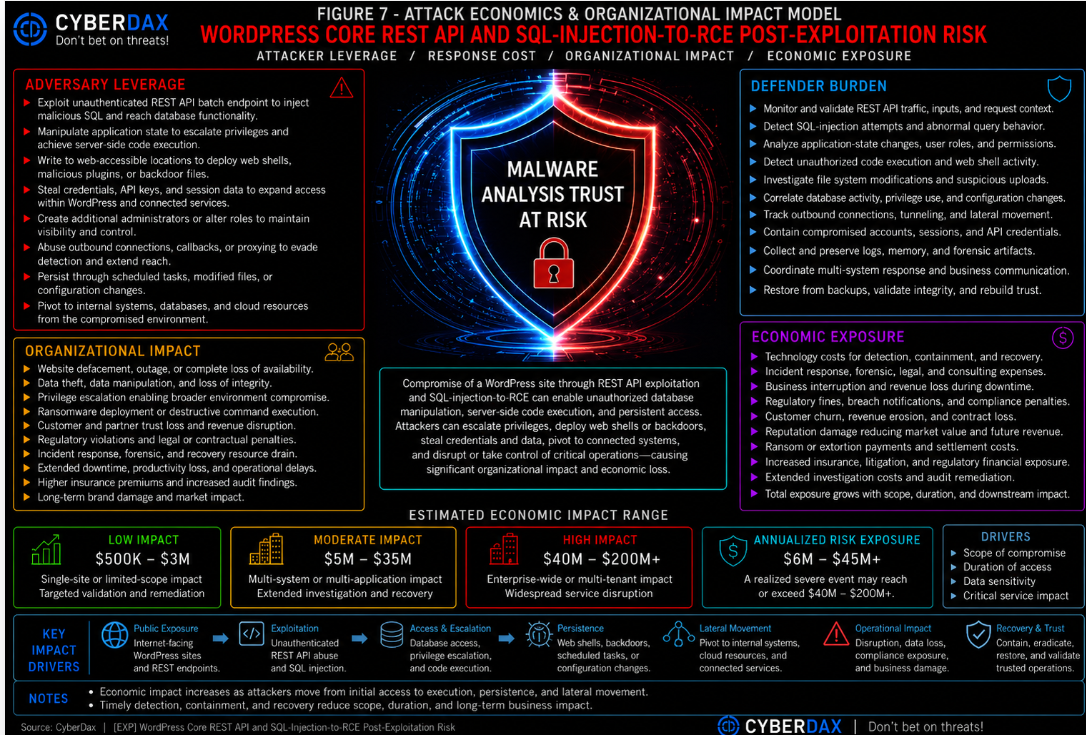
Figure 7
WordPress Core REST API batch-route confusion and SQL-injection-to-RCE activity changes intrusion economics by allowing an adversary to convert one externally reachable application interaction into unauthorized influence over database behavior, stored application state, PHP or server-side execution, persistent access, credential exposure, outbound communication, and possible downstream compromise. The attacker may gain disproportionate value from one compromised WordPress environment because the public-facing application, legitimate database account, PHP runtime, hosting platform, workload identity, stored credentials, approved network paths, administrative integrations, customer relationships, and downstream connectivity already exist and may be treated as legitimate by users, administrators, security tools, hosting controls, and connected systems.
When abnormal REST batch requests, attacker-influenced query behavior, unauthorized database reads or writes, application-state changes, PHP execution, executable-file modification, webshell access, command activity, credential access, persistence, cleanup, outbound communication, or downstream activity align within one investigation window, the organization’s cost expands beyond the initiating request or affected website. Responders must determine whether attacker-controlled input altered query behavior, which database objects and application settings were affected, whether server-side execution occurred, which files or accounts were created or modified, what commands were executed, which credentials or systems were exposed, whether security controls were impaired, whether evidence was removed, and whether application, database, hosting, workload, identity, network, and downstream trust can be restored safely.
Adversary Economic Advantage
· One externally reachable WordPress environment may provide a path from anonymous or untrusted request activity into application and database operations without requiring initial endpoint access.
· REST batch processing may reduce attacker effort by allowing multiple embedded operations, parameter structures, or route variations to be tested through one outer request mechanism.
· Differences in routing, validation, authorization, parameter interpretation, or callback handling may allow attacker-controlled values to reach application behavior that would otherwise be restricted or processed differently.
· The legitimate WordPress application and database account may perform the resulting query, reducing the attacker’s need to obtain separate database credentials before influencing stored data.
· Unauthorized database reads may expose users, configuration, credentials, customer information, application state, or operational data without requiring creation of an obvious malicious process or file.
· Unauthorized database writes may alter users, roles, application passwords, options, scheduled actions, content, metadata, callbacks, configuration, or other stored state that later influences application behavior.
· Database-backed persistence may reduce attacker cost because access can survive deletion of one file, application restart, container replacement, or incomplete restoration.
· Server-side execution within an existing PHP or web-server worker may reduce visibility because the adversary may not need to launch a separate executable.
· PHP and web-server processes already possess legitimate access to databases, configuration files, writable directories, external services, and application content.
· Writable plugin, theme, upload, cache, temporary, backup, language, must-use plugin, drop-in, configuration, and web-root paths may provide multiple locations for executable or remotely accessible content.
· A short loader, modified plugin component, webshell, altered callback, or database-backed execution path may provide continued access without requiring a large or distinctive payload.
· Existing WordPress, database, hosting, cloud, deployment, API, SSH, webhook, mail, service-account, or administrative credentials may provide reusable access beyond the originating website.
· Workload identities, cloud metadata access, orchestration permissions, hosting-control panels, deployment platforms, repositories, and CI/CD relationships may increase the value of one compromised application.
· Shared hosting, centralized WordPress management, shared database accounts, common deployment tooling, reusable credentials, and shared backup systems may create repeated opportunities across multiple sites or tenants.
· Broad outbound connectivity may allow payload retrieval, callback communication, tunneling, proxying, data transfer, or access to cloud and internal services without requiring a separately exposed listener.
· Legitimate webhooks, APIs, mail, media retrieval, monitoring, updates, and integrations may help malicious outbound communication blend into normal application activity.
· Direct-IP communication, common ports, encryption, cloud infrastructure, low-volume sessions, and intermittent callbacks may reduce the attacker’s cost of avoiding simple network filtering.
· Unauthorized administrators, application passwords, scheduled actions, options, plugins, webshells, loaders, or workload changes may provide multiple persistence alternatives.
· Security-control changes involving WAF policy, logging, database auditing, security plugins, endpoint protection, container controls, cloud controls, file integrity, or firewall rules may extend dwell time.
· Cleanup of request evidence, database values, PHP files, logs, commands, containers, or temporary payloads may increase defender uncertainty while credentials, persistence, or downstream access remain active.
· Site restoration, database rollback, container replacement, or migration may create false confidence if compromised application state, backups, credentials, or shared infrastructure are reintroduced.
· Continued website availability may reduce defender suspicion because customer-facing content and expected business functions may remain operational during selective database manipulation or server-side execution.
· One compromised WordPress environment may provide data access, persistent application control, credential exposure, hosting access, cloud access, and downstream reach without requiring separate exploitation of every connected system.
· The adversary benefits when defenders cannot rapidly distinguish malicious activity from legitimate REST use, content management, plugin or theme activity, deployment, backup, restoration, migration, hosting-provider actions, security testing, or incident response.
Defender Cost Expansion
· The organization must investigate both the suspicious request and the reliability of the REST, WordPress, database, PHP, file, process, container, hosting, identity, network, persistence, security-control, cleanup, and downstream evidence needed to establish impact.
· Response teams may need to reconstruct the outer batch request, every embedded operation, route interpretation, parameter handling, validation result, authorization state, callback, response, and associated database activity.
· Investigators may need to determine whether attacker-controlled input materially changed query construction or merely produced malformed, blocked, failed, or non-impacting behavior.
· Database analysis may require review of query text or digests, sessions, transactions, objects, predicates, returned rows, affected rows, account use, errors, execution time, and application attribution.
· The organization may need to identify every unauthorized read, write, user change, role change, application-password creation, option change, scheduled action, content modification, metadata change, plugin or theme change, callback change, or configuration change.
· PHP and runtime analysis may be required to determine whether application-state manipulation progressed into dynamic evaluation, inclusion, callback execution, runtime-generated code, child-process creation, command execution, module loading, or network activity.
· File analysis may require validation of WordPress core, plugins, themes, must-use plugins, drop-ins, uploads, cache, temporary paths, backups, language directories, configuration, and web-root content.
· Investigators may need to determine whether suspicious files were created, modified, accessed remotely, executed, deleted, restored, or reintroduced through backups or deployment workflows.
· Container and workload analysis may require reconstruction of images, image digests, deployment revisions, mounted volumes, service accounts, restart history, pod replacement, workload replacement, and ephemeral filesystem state.
· Managed-hosting response may require provider coordination to obtain request, database, file, process, network, backup, administrative, and historical evidence that the organization cannot collect directly.
· Network analysis may require reconstruction of payload retrieval, callbacks, direct-IP sessions, cloud-service access, internal connections, tunnels, proxying, DNS activity, NAT context, workload ownership, and session recurrence.
· Command and post-execution review may require analysis of shell commands, PHP execution, script interpreters, downloaders, archive tools, package managers, permission changes, service activity, discovery, payload staging, and security-control changes.
· Internal exposure scoping may be required across every WordPress site, database, workload, host, hosting account, management platform, cloud identity, repository, deployment system, secret store, administrative interface, customer environment, partner system, and internal service associated with the affected environment.
· Response cost increases when request bodies, embedded-operation identifiers, database queries, WordPress audit records, PHP runtime events, file history, container evidence, socket ownership, workload identity, or downstream attribution are incomplete.
· Investigation scope expands when the affected site supports authentication, ecommerce, payment-related workflows, regulated data, customer portals, business-critical publishing, managed hosting, software delivery, or sensitive integrations.
· Credential rotation may be required across WordPress accounts, application passwords, database accounts, hosting accounts, cloud identities, deployment credentials, API keys, SSH keys, webhook secrets, mail credentials, certificates, tokens, service accounts, and customer sessions.
· Operational disruption increases when sites must be isolated, traffic restricted, REST functionality disabled, plugins or themes suspended, databases reviewed, credentials invalidated, workloads replaced, or applications rebuilt.
· Enterprise hunting may be required to identify related request patterns, database queries, users, options, scheduled actions, PHP files, webshells, commands, credentials, outbound sessions, persistence, cleanup, and downstream access across the environment.
· Application rebuilding may be necessary when database integrity, WordPress state, file integrity, PHP runtime behavior, hosting integrity, workload state, credential security, or persistence cannot be validated with confidence.
· Database restoration may be complex because restoring an earlier copy can remove legitimate business changes while reintroducing attacker-controlled users, options, content, plugins, configuration, or credentials.
· Downstream review may require validation of hosting-control panels, cloud platforms, orchestration systems, repositories, CI/CD environments, identity systems, databases, security tools, customer systems, partner connections, and internal services.
· Security teams may need to reassess prior application, database, identity, network, cloud, or endpoint alerts if the affected WordPress workload functioned as a trusted application source or administrative identity.
· Business interruption may extend beyond the originating website when customer services, authentication, payments, publishing, marketing, support, software delivery, partner integrations, or regulated workflows depend on the affected environment.
· Evidence-preservation requirements may delay containment because site restoration, database rollback, container replacement, pod restart, workload rebuilding, process termination, or file deletion can destroy critical evidence.
· Legal, privacy, compliance, payment-card, cyber-insurance, communications, customer, partner, executive, and board-level costs increase when sensitive-data exposure, credential compromise, customer-facing manipulation, broad expansion, destructive activity, or incomplete containment cannot be ruled out.
· Customer-notification and regulatory analysis may be required even when data exposure is uncertain because incomplete database and application telemetry may prevent a definitive conclusion.
· Trust-restoration cost may continue after remediation because exposed credentials, active sessions, database-backed persistence, secondary payloads, hosting access, downstream changes, and attacker-controlled infrastructure may remain.
· Post-remediation monitoring may need to continue across multiple application, database, workload, identity, hosting, and network lifecycles to confirm that suspicious request, execution, persistence, or access behavior does not recur.
Organizational Impact Model
WordPress Application and REST Exposure Impact
The organization must determine which WordPress sites, domains, virtual hosts, REST routes, batch functions, custom endpoints, plugins, themes, integrations, mobile applications, automation systems, source networks, authentication contexts, WAF policies, hosting environments, owners, and business functions were exposed, targeted, modified, or included in remediation.
Request Interpretation and Query-Construction Impact
The organization must determine whether suspicious activity remained limited to malformed requests, blocked probing, validation failures, application errors, or legitimate REST use, or progressed into inconsistent interpretation of outer and embedded requests and attacker-influenced database-query construction.
Database Confidentiality and Integrity Impact
The organization must determine which databases, schemas, tables, records, users, roles, application passwords, options, scheduled actions, content, metadata, plugins, themes, callbacks, configuration objects, credentials, or other stored values were accessed, modified, deleted, restored, exposed, or rendered unreliable.
WordPress Application-State Impact
The organization must determine whether unauthorized users, administrators, application passwords, options, scheduled actions, plugins, themes, must-use plugins, drop-ins, callbacks, webhooks, content, metadata, rewrite behavior, or configuration created persistent access or changed application behavior.
PHP and Server-Side Execution Impact
The organization must determine whether database or application-state manipulation progressed into PHP evaluation, inclusion, loading, callback execution, runtime-generated code, application-worker execution, child-process creation, command execution, module loading, file access, or outbound communication.
File and Webshell Impact
The organization must determine which WordPress core, plugin, theme, must-use plugin, drop-in, upload, cache, temporary, backup, language, configuration, or web-root files were created, modified, replaced, remotely accessed, executed, deleted, restored, or included in trusted rebuild validation.
Container, Hosting, and Workload Impact
The organization must determine which containers, pods, workloads, images, nodes, virtual machines, managed-hosting instances, mounted volumes, deployment revisions, service accounts, provider actions, tenant relationships, and workload-replacement events were affected or rendered unreliable.
Credential and Identity Impact
The organization must determine whether WordPress, database, hosting, cloud, deployment, API, SSH, webhook, mail, service-account, administrative, certificate, token, key, workload-identity, or session material was accessed, copied, exported, used, rotated, revoked, or remains exposed.
Network and Downstream Access Impact
The organization must determine whether the compromised site or workload retrieved payloads, initiated callbacks, communicated through direct IP addresses, established tunnels or proxy paths, accessed internal services, reached cloud resources, contacted management systems, or enabled downstream authentication.
Persistence and Security-Control Impact
The organization must determine whether unauthorized accounts, application passwords, scheduled actions, options, callbacks, plugins, files, webshells, loaders, container changes, secondary payloads, WAF changes, logging changes, database-audit changes, security-plugin modifications, endpoint-control changes, cloud-policy changes, or firewall changes preserved access or reduced visibility.
Cleanup and Evidence-Reliability Impact
The organization must determine whether request records, WordPress logs, database logs, PHP events, files, database values, commands, containers, workloads, timestamps, security alerts, network sessions, or incident-response evidence were missing, altered, deleted, delayed, overwritten, restored, sampled, redacted, or rendered unreliable.
Shared Hosting and Centralized Management Impact
The organization must determine whether shared hosting, centralized WordPress management, plugin-management platforms, common deployment tooling, shared databases, hosting identities, reusable credentials, backup systems, or administrative workflows exposed additional sites or tenants.
Cloud, Repository, and Deployment Impact
The organization must determine whether cloud resources, metadata services, orchestration platforms, secret stores, repositories, CI/CD systems, deployment tools, infrastructure-management platforms, or workload identities experienced unauthorized access or modification.
Operational Availability and Business-Continuity Impact
The organization must determine whether site isolation, REST restrictions, WAF changes, credential rotation, database review, application rebuilding, workload replacement, hosting migration, enterprise hunting, downstream investigation, or prolonged monitoring disrupted customer portals, ecommerce, payments, authentication, publishing, marketing, support, partner services, or regulated operations.
Customer, Partner, and External-Service Impact
The organization must determine whether customer data, customer sessions, partner integrations, managed-service relationships, hosted customer environments, payment processors, external APIs, support systems, or contractual security functions were accessed, modified, interrupted, or rendered unreliable.
Legal, Privacy, Compliance, and Insurance Impact
The organization must determine whether unauthorized access, sensitive-data exposure, payment-related manipulation, credential compromise, customer impact, partner impact, incomplete evidence, prolonged disruption, or downstream expansion triggered legal review, privacy assessment, regulatory reporting, contractual notification, cyber-insurance coordination, litigation risk, or board escalation.
Containment and Trust-Restoration Impact
The organization must restore application integrity, database integrity, WordPress state, file integrity, PHP runtime trust, workload and hosting integrity, credential security, security-control health, network trust, downstream-system assurance, and business continuity through evidence preservation, traffic restriction, site isolation, database analysis, workload preservation, credential rotation, application rebuilding, persistence removal, enterprise hunting, downstream investigation, legal assessment, compliance review, cyber-insurance coordination, customer and partner analysis, executive reporting, and post-remediation monitoring.
Governance Impact
Leadership may need to treat confirmed or strongly suspected WordPress REST API and SQL-injection-to-RCE activity as an executive-level application, database, credential, hosting, and downstream trust incident because one affected environment may support customer services, payment-related operations, authentication, regulated data, shared hosting, centralized management, privileged workloads, sensitive integrations, or access to internal and cloud systems.
Economic Impact Summary
WordPress Core REST API batch-route confusion and SQL-injection-to-RCE activity creates economic advantage for adversaries because one public-facing application interaction may provide unauthorized database influence, server-side execution, persistent access, credential exposure, hosting or cloud access, and downstream reach without requiring separate compromise of every connected system. The organization’s financial exposure grows when it cannot quickly determine whether attacker-controlled input altered query behavior, whether unauthorized database activity occurred, whether server-side execution succeeded, which files or accounts were modified, which credentials or systems were exposed, whether security controls remained trustworthy, whether evidence was removed, and whether application, database, workload, hosting, identity, network, and downstream trust can be restored without continued operational uncertainty.
S39 — Economic Impact & Organizational Exposure
WordPress Core REST API and SQL-injection-to-RCE activity expands organizational exposure by creating uncertainty over whether attacker-controlled REST, plugin, theme, AJAX, form, upload, import, callback, archive, authentication, SSO, API, payment, account-management, or application input reached unsafe database, identity, session, filesystem, external-service, or server-side behavior; whether unauthorized reads, writes, account changes, role changes, privileged-session establishment, plugin changes, option changes, file operations, or application-state manipulation occurred; whether dangerous PHP or executable content was created, uploaded, renamed, included, deserialized, invoked, deleted, or exposed; and whether command execution, persistent access, credential exposure, security-control impairment, evidence removal, external-service abuse, or downstream compromise followed.
The governing risk is not limited to one CVE, WordPress release, REST route, plugin, theme, parameter, database object, upload handler, authentication flow, SSO integration, PHP filename, proof of concept, malware family, campaign, or actor. The material question is whether public-facing or otherwise reachable WordPress functionality was converted into unauthorized database influence, unauthorized authenticated or administrator access, sensitive-file access, executable-file placement, server-side execution, persistent application control, credential access, outbound communication, abuse of trusted integrations, or broader enterprise compromise before containment.
Economic exposure increases when affected WordPress environments support customer portals, ecommerce, payment-related functions, authentication, SSO, regulated information, shared hosting, centralized administration, cloud-connected workloads, privileged database accounts, reusable credentials, remote-management integrations, email-delivery services, payment processors, or broadly connected internal systems. Exposure is highest when defenders cannot join the initiating activity to the resulting database query, authentication decision, WordPress session, role or user-state change, option modification, PHP worker, file operation, API request, process behavior, identity use, network session, hosting action, or downstream event.
Estimated Economic Exposure
Estimated exposure should be treated as scenario-based rather than fixed. The most defensible enterprise estimate depends on whether activity remains limited to blocked requests, unsuccessful query manipulation, failed authentication-bypass attempts, prevented file execution, blocked SSRF, denied privilege escalation, or focused investigation; progresses into unauthorized database activity, unauthorized privileged-session establishment, dangerous file placement, PHP execution, sensitive-file disclosure, persistence, credential access, or constrained downstream reach; or results in broad sensitive-data exposure, durable remote access, administrator takeover, shared-hosting compromise, internal or cloud expansion, payment impact, ransomware enablement, destructive activity, customer impact, regulatory exposure, or prolonged operational disruption.
Economic exposure grows when the organization cannot determine whether attacker-controlled input materially changed database behavior, authentication state, session state, user or role state, WordPress options, plugin state, which records or application objects were accessed or modified, whether dangerous content was remotely reachable or executed, whether PHP or another server-side process performed malicious activity, whether external services or APIs were abused, whether credentials or sessions were exposed, and whether application, database, workload, hosting, identity, network, and downstream trust can be restored.
Low Impact Scenario
Estimated $500K–$3M
This scenario applies when rapid investigation confirms blocked or malformed requests, unsuccessful SQL injection, unsuccessful authentication bypass, privilege escalation, SSO abuse, SSRF, local-file access, PHP object injection, or code-execution attempts, a prevented dangerous-file upload or execution attempt, a narrowly contained database event, or another limited condition without evidence of unauthorized privileged access, persistent server-side access, material credential exposure, security-control impairment, customer impact, or downstream compromise.
Available evidence supports a failed, prevented, contained, approved, or non-impacting event. Response remains limited to request, authentication, session, database, file, integration, and application-state validation, WordPress or component remediation, focused file and process hunting, evidence preservation, credential review, logging improvement, short-term monitoring, and executive assurance that broader application, data, workload, identity, and downstream integrity were not materially affected.
Moderate Impact Scenario
Estimated $5M–$35M
This scenario applies when confirmed or strongly suspected exploitation affects one or more WordPress sites, plugins, themes, databases, PHP workers, workloads, hosting environments, administrative identities, SSO integrations, APIs, payment integrations, external services, or connected systems and produces unauthorized database reads or writes, account or role changes, administrator-session establishment, plugin installation or deactivation, option modification, application-password creation, sensitive-file access, executable-file placement, PHP execution, command activity, persistence, recurring communication, credential access, security-control changes, cleanup, or constrained downstream access.
Evidence may include abnormal REST, AJAX, form, upload, import, plugin, theme, callback, archive, authentication, API, payment, or SSO activity followed by abnormal database operations, privileged-session establishment, suspicious WordPress state changes, suspicious PHP-file creation, arbitrary file access or deletion, remote access to a newly created file, webshell behavior, PHP object deserialization, child-process execution, payload retrieval, outbound communication, credential use, or recurrence after restart, restoration, replacement, or remediation.
Response may require site isolation, authentication and session review, database review, application-state reconstruction, workload preservation, PHP and file analysis, credential rotation, external-service and API-key rotation, enterprise hunting, network reconstruction, persistence removal, application rebuilding, hosting-provider coordination, downstream-system review, legal or compliance assessment, cyber-insurance coordination, executive reporting, and extended post-remediation monitoring.
High Impact Scenario
Estimated $40M–$200M+
This scenario applies when confirmed or strongly suspected WordPress exploitation becomes an enterprise-impact event involving broad sensitive-data access, unauthorized administrator takeover, durable server-side control, privileged credential exposure, shared-hosting or centralized-management compromise, payment manipulation, internal pivoting, cloud or orchestration access, security-control impairment, customer-facing manipulation, ransomware enablement, destructive activity, regulatory exposure, or widespread operational disruption.
The organization may need to treat affected WordPress sites, plugins, themes, databases, stored application state, administrator sessions, PHP workers, files, workloads, containers, hosting platforms, credentials, sessions, backups, network paths, cloud identities, repositories, deployment systems, payment integrations, external-service configurations, customer environments, partner integrations, and dependent business processes as exposed or unreliable until evidence proves otherwise.
Response may require emergency site suspension, traffic restrictions, authentication or SSO restrictions, database and application freezes, workload isolation, credential and session invalidation, API-key rotation, enterprise-wide hunting, network segmentation, application and database rebuilding, backup validation, hosting migration, downstream containment, customer or partner notification analysis, privacy and regulatory escalation, cyber-insurance engagement, communications planning, executive and board reporting, and formal restoration of application, database, workload, identity, hosting, integration, and network trust.
Annualized Risk Exposure
Estimated annualized exposure of $6M–$45M+ for materially exposed enterprise environments where WordPress supports customer-facing services, ecommerce or payment-related functions, authentication, SSO, regulated data, centralized management, shared hosting, privileged database access, cloud-connected workloads, sensitive integrations, or broadly connected internal systems.
Exposure may exceed $40M–$200M+ when WordPress compromise results in administrator takeover, durable remote access, widespread credential misuse, broad customer-data exposure, payment manipulation, shared-hosting compromise, internal or cloud expansion, security-control degradation, ransomware or destructive activity, prolonged operational disruption, incomplete containment, regulatory reporting, litigation, communications response, or board-level intervention.
Operational Dependency
Operational dependency is high where WordPress supports customer portals, ecommerce, payment-related workflows, authentication, SSO, publishing, marketing, support, managed hosting, regulated services, partner integrations, remote-management functionality, or other business-critical operations.
One affected site, plugin, theme, database account, PHP pool, privileged WordPress session, workload, hosting identity, management platform, deployment process, shared backup, payment integration, external-service integration, or trusted API can create broad investigation and recovery requirements when multiple customers, tenants, users, business units, or dependent services rely on the affected environment.
Dependency increases when the environment cannot be suspended, isolated, rebuilt, migrated, or disconnected from databases, payment systems, cloud services, identity platforms, SSO providers, repositories, deployment systems, customer environments, external APIs, or internal networks without disrupting essential business functions.
Control Trust
Control trust is reduced when the organization cannot prove that request handling, authentication decisions, SSO validation, session establishment, database queries, WordPress users and options, plugin and theme state, PHP execution, application files, file-access controls, containers, hosting actions, workload identities, credentials, external-service integrations, network sessions, security controls, backups, and downstream-system activity remained reliable during the exposure window.
Trust is further reduced when malicious activity occurs through an expected WordPress process, database account, PHP worker, administrator session, plugin or theme directory, upload path, API integration, workload identity, hosting platform, or approved network route, or when unexplained activity cannot be reconciled with authorized authentication, content management, component changes, deployment, backup, restoration, migration, provider support, security testing, or incident response.
WAF blocking, automatic updating, authentication restrictions, session invalidation, PHP-file deletion, plugin removal, credential rotation, API-key rotation, database rollback, container replacement, site restoration, or application rebuilding reduces future exposure but does not independently prove that pre-remediation authentication bypass, privilege escalation, database access, file access, SSRF, server-side execution, persistence, credential exposure, cleanup, or downstream activity did not occur.
Visibility Confidence
Visibility confidence is highest when complete HTTP and REST request context, AJAX and authentication context, WAF and web-server evidence, WordPress audit events, login and session events, SSO-validation evidence, user and role history, option-change history, database queries and sessions, PHP worker activity, file operations, process lineage, workload history, socket ownership, external-service API logs, payment integration logs, identity events, hosting actions, cloud activity, change control, incident-response actions, and remediation evidence can be correlated through stable site, request, database, process, workload, identity, session, destination, resource, and timestamp mappings.
Visibility confidence is reduced when request bodies are unavailable, plugin or theme actions lack identifiers, authentication or SSO parameters are not retained, session establishment cannot be tied to initiating requests, database queries are sampled or normalized, application accounts are shared, PHP execution remains inside an existing worker, file activity occurs in terminated workloads, external-service logs are unavailable, hosting providers withhold evidence, socket ownership is unknown, network activity lacks workload attribution, credentials are accessed through unlogged sources, logs are overwritten, or downstream systems do not preserve originating identity or session context.
S25 provides independent request, database, application-state, file, process, and network detections. Splunk, Elastic, and QRadar provide REST-request, WordPress-associated database, and host post-exploitation rule families. SentinelOne provides child-process, WordPress-path file, and process-attributed network detections. SIGMA provides portable request, database-modification, and child-process coverage. YARA has no surviving primary rule because no stable malicious artifact is established.
Change-Control Confidence
Change-control confidence is high when WordPress updates, plugin and theme activity, authentication and SSO configuration, route registration, database changes, application-password creation, user and role changes, option changes, file deployment, container images, hosting actions, backups, restorations, migrations, emergency controls, and incident-response actions are recorded with validated actors, systems, approvals, timestamps, expected objects, and post-change verification.
Confidence is reduced when shared administrators, undocumented integrations, uncontrolled plugins or themes, weak deployment governance, emergency changes, provider-performed actions, untracked automation, missing authentication or session history, missing database history, incomplete component inventories, or weak application-state attribution prevent defenders from distinguishing authorized activity from attacker-driven authentication bypass, privilege escalation, query manipulation, file placement, external-service abuse, execution, persistence, or cleanup.
Downstream Dependency
Downstream dependency is high when affected WordPress environments have approved access to cloud metadata, orchestration platforms, secret stores, databases, repositories, CI/CD systems, identity services, hosting-control panels, customer environments, partner networks, payment systems, security platforms, administrative services, email-delivery or routing services, SSO or centralized-management services, remote-management APIs, or segmented internal networks.
The organization must distinguish suspicious authentication, privileged-session establishment, cloud access, repository activity, deployment actions, external-service API activity, payment activity, email-routing changes, password-reset activity, payload retrieval, internal connections, proxying, tunneling, file transfer, policy changes, or credential use from confirmed downstream compromise. Such activity becomes materially relevant when evidence ties it to an affected WordPress site, workload, process, identity, session, credential, integration, source, destination, or bounded investigation window.
Customer and Regulatory Exposure
Customer, partner, workforce, and regulatory exposure increases when WordPress compromise affects customer records, customer sessions, payment-related workflows, administrator accounts, credentials, password-reset communications, employee information, partner integrations, hosted customer environments, intellectual property, regulated data, internal systems, cloud resources, or services subject to notification, contractual, privacy, audit, litigation, payment-card, or sector-specific obligations.
Exposure also increases when telemetry gaps prevent timely confirmation of whether sensitive records were accessed, application state was manipulated, administrator sessions were established without authorization, executable files were placed, credentials were exposed, customer sessions were compromised, password-reset communications were redirected or intercepted, commands were executed, downstream systems were reached, security controls were impaired, or containment was complete.
Notification and reporting decisions must be based on validated local evidence and applicable obligations rather than WordPress presence, vulnerable-component presence, public exploitation or targeting reporting, proof-of-concept availability, WAF alerts, source addresses, actor speculation, or static indicators alone.
Residual Economic Risk
Residual economic risk remains after patching, WAF changes, authentication or SSO restrictions, route restrictions, PHP-file deletion, plugin or theme removal, database restoration, site rebuilding, container replacement, credential rotation, session invalidation, external-service API-key rotation, email-route restoration, network blocking, persistence cleanup, or incident-response closure when the pre-remediation activity window cannot be reconstructed.
Removing a suspicious file or restoring the site does not prove that unauthorized authentication, privilege escalation, privileged-session establishment, database access, application-state manipulation, arbitrary file access, external-service API abuse, password-reset interception, server-side execution, credential exposure, persistent access, cleanup, hosting compromise, or downstream activity did not occur before remediation. Replacing a workload does not prove that stolen credentials, active sessions, altered database objects, compromised external-service configurations, compromised backups, shared-hosting access, cloud changes, or downstream persistence were removed.
For CVE-2026-111862, Rank Math SEO PRO version 3.0.123 was affected by a confirmed software-distribution supply-chain compromise involving malicious plugin packages distributed between October 15, 2026, at 20:02 UTC and October 16, 2026, at 07:12 UTC. The incident differs from conventional WordPress Core REST API exploitation because the initiating compromise occurred through a trusted plugin distribution and update mechanism rather than exploitation of a vulnerable WordPress request handler. Malicious packages could establish persistent unauthorized access, introduce PHP backdoors, create unauthorized administrator accounts, modify WordPress application state, expose credentials and API keys, and communicate with attacker-controlled infrastructure. Rank Math released clean version 3.0.124, but replacing the compromised plugin does not independently remove malicious files, accounts, scheduled actions, database modifications, stolen credentials, or downstream persistence established before remediation. Organizations that downloaded or updated Rank Math SEO PRO 3.0.123 during the confirmed distribution window should determine whether the affected package was installed and activated, preserve available update and deployment evidence, compare plugin files against trusted vendor distributions, investigate unexpected administrator accounts and WordPress options, inspect PHP files and scheduled execution, review outbound communication and credential activity, and validate downstream integrity. Sites confirmed to have activated an affected malicious package should be treated as compromised until investigation and remediation establish otherwise. Version identification alone does not prove that a particular installation received or activated a malicious package.
For the October 2026 UpdraftCentral Cloud centralized-management signing-key compromise, organizations should not treat management-key revocation, forced disconnection, plugin updating, or reconnection as evidence that affected WordPress installations were not previously compromised. Patchstack reported active exploitation beginning October 18, 2026, involving stolen legitimate UpdraftCentral Cloud signing keys used to authorize plugin.upload_plugin commands that installed and activated malicious WordPress plugins. The incident differs from exploitation of a WordPress Core vulnerability because the initiating trust failure involved compromised centralized-management authorization. Organizations should identify WordPress installations connected to the affected cloud-management service, preserve remote-command and plugin deployment history where available, inspect unauthorized plugin installation and activation, review administrator accounts and application-state changes, examine suspicious PHP files and persistence, rotate exposed credentials, and validate downstream integrity. TeamUpdraft confirmed containment measures involving connection-key revocation, forced sign-outs, updated plugin releases, and customer remediation. Self-hosted UpdraftCentral deployments were not identified as affected by this incident. Successful containment requires validating both the restored management relationship and the integrity of previously connected WordPress installations. The campaign is a non-CVE Coverage With Adaptation object and does not change the existing CVE or CISA KEV counts.
For CVE-2026-85097, Bricksforge Pro Forms installations running affected versions through 3.1.8.9 should not treat upgrading alone as evidence that pre-remediation compromise did not occur. Patchstack reports active exploitation beginning October 7, 2026, at 21:47 UTC, involving unauthenticated nonce acquisition, GIF/PHP polyglot uploads, and manipulation of attacker-controlled temporaryFileUploads metadata. Exploitation primarily targets POST /wp-json/bricksforge/v1/form_submit, with additional activity involving /wp-admin/admin-ajax.php. Successful exploitation can place executable PHP content, establish webshell access, and support persistence, credential access, unauthorized application-state changes, outbound communication, and downstream compromise. Patchstack identifies version 3.1.8.10 as the corrected 3.x release, while the Bricksforge vendor changelog identifies version 4.0.1 as the corrected 4.x release. Organizations that operated affected installations during the exploitation window should review relevant form submissions, nonce acquisition, temporary-upload metadata, uploaded filenames and content, file-creation lineage, subsequent web access, PHP or web-server execution, process activity, persistence, credentials, network communication, and downstream effects where retained. Remediation does not independently establish that earlier exploitation was unsuccessful. No CISA KEV designation is represented for CVE-2026-85097.
For CVE-2026-93836 and CVE-2026-94504, organizations that operated affected WPC Product Bundles for WooCommerce or Ninja Forms versions during the documented exploitation window should not treat plugin remediation alone as evidence that compromise did not occur. Retrospective assessment should include affected-plugin inventory and version state, relevant unauthenticated input and stored application content, administrative submission or order rendering, JavaScript execution in the WordPress administrative origin, WordPress user and role history, administrator-account creation, privileged-session activity, application-state modification, persistence, credential activity, file or process behavior, outbound communication, and downstream effects where retained. Particular attention should be given to unexpected administrator accounts or privileged state created during or shortly after administrative rendering of attacker-controlled content because the observed campaign used shared second-stage JavaScript to establish persistent administrator access.
For CVE-2026-76581, WPMU DEV Dashboard installations through version 5.0.1 are affected and version 5.0.2 is the corrected release. Remediation should include updating affected installations and validating that sites connected to WPMU DEV with Hub SSO enabled, especially where the mapped WordPress account is an administrator, did not experience unauthorized SSO session establishment during the pre-remediation window.
For CVE-2026-14894, Super Forms – Drag & Drop Form Builder installations through version 6.3.313 are affected and version 6.3.314 is the corrected release. Public exploitation reporting establishes exploitation beginning July 14, 2026. Organizations that operated an affected version during the exposure period should not treat upgrading alone as evidence that compromise did not occur. Historical form-submission, file-creation, PHP-runtime, web-server, process, credential, network, persistence, and remediation evidence should be reviewed where available.
For CVE-2026-27540, WooCommerce Wholesale Lead Capture installations through version 2.0.3.1 are affected and version 2.0.3.2 is the corrected release. Public exploitation reporting establishes active exploitation and more than 100,000 blocked exploit attempts, with documented attack activity using the unauthenticated wwlc_file_upload_handler AJAX action and attacker-controlled file_settings values to permit PHP-file upload. Organizations that operated an affected version during the exposure period should not treat upgrading alone as evidence that compromise did not occur. Historical /wp-admin/admin-ajax.php requests invoking wwlc_file_upload_handler, upload-directory activity, unexpected or newly created PHP files, remote access to those files, PHP or web-server runtime behavior, process activity, administrator-account creation, persistence, credential activity, outbound communication, and other downstream evidence should be reviewed where available.
For CVE-2026-71362, Adobe Commerce, Adobe Commerce B2B, and Magento Open Source deployments affected by the August 2026 Adobe Commerce security update should not treat patching alone as evidence that pre-remediation exploitation did not occur. Adobe documents CVE-2026-71362 as a Critical incorrect-authorization vulnerability requiring no authentication and no administrator privileges, with successful exploitation resulting in privilege escalation. Open-source reporting cited by the Canadian Centre for Cyber Security confirms exploitation in the wild, and CISA added CVE-2026-71362 to the Known Exploited Vulnerabilities Catalog on September 24, 2026. Organizations that operated affected releases during the exposure window should review historical authentication and authorization activity, account and role state, privileged sessions, sensitive-resource access, application-state changes, credential use, and downstream activity where retained.
For CVE-2026-75650, Adobe Commerce and Magento Open Source deployments affected by StyleSmuggler should not treat application of Adobe's hotfix as evidence that pre-remediation compromise did not occur. CISA added CVE-2026-75650 to the Known Exploited Vulnerabilities Catalog on September 8, 2026 based on evidence of active exploitation. Organizations that operated an affected version during the exposure window should review historical GraphQL styles activity, report or template changes, failed-payment rendering, PHP execution, cron activity, payload retrieval, suspicious processes, credential activity, outbound communication, and other available post-exploitation evidence.
For CVE-2026-78006, The Events Calendar installations through version 6.17.4 are affected and version 6.17.4.1 is the corrected release. Organizations that operated an affected version during the exposure window should not treat upgrading alone as evidence that exploitation did not occur. Where relevant telemetry is available, retrospective assessment should include event-comment activity, copied or legacy widget-instance content, PHP deserialization and runtime activity, resulting file or process behavior, persistence, credentials, outbound communication, and other consequential post-exploitation evidence.
For CVE-2026-78159, The Events Calendar installations through version 6.17.3 are affected and version 6.17.3.1 is the corrected release. Organizations that operated an affected version during the exposure window should review relevant event-comment, legacy-widget rendering, PHP-runtime, callable-invocation, file, process, persistence, credential, and network evidence where retained rather than treating the upgrade itself as proof that pre-remediation compromise did not occur.
For CVE-2026-82845, Masteriyo LMS installations before version 3.4.1 are affected and version 3.4.1 is the corrected release. Organizations that operated an affected version during the exposure window should not treat upgrading alone as proof that exploitation did not occur. Where relevant telemetry is retained, retrospective assessment should include affected account and privilege state, request and metadata activity, serialized-object and deserialization behavior, file creation or modification, PHP or web-server execution, persistence, credentials, outbound communication, and downstream effects.
For CVE-2026-81402, DS Ad Rotator installations through version 0.8 are affected and no corrected release is represented in the cited public sources. Organizations operating the affected plugin should review upload-handler activity, authentication and capability context, file uploads and resulting filesystem changes, web access to newly created files, PHP or web-server execution, persistence, credential activity, outbound communication, and downstream effects. Removal or restriction of the vulnerable component does not independently establish that pre-remediation compromise did not occur.
For CVE-2026-62104, organizations operating Migratico Lite versions affected by the vulnerability should not treat remediation alone as proof that exploitation did not occur. Where relevant telemetry is retained, retrospective assessment should include Migratico Lite inventory and affected-version state, relevant unauthenticated request activity, the plugin-specific execution path, PHP or web-server runtime behavior, resulting file or process activity, persistence, credential activity, network communication, and downstream effects. No confirmed in-the-wild exploitation or CISA KEV designation is represented for CVE-2026-62104.
For CVE-2026-84434, Gravity Forms installations through version 3.1.0.4 are affected and version 3.1.1 is the corrected release. The documented condition requires a publicly accessible form containing a File Upload field whose visibility is set to Hidden. Organizations that operated an affected version during the exposure window should review relevant form-submission and upload-state activity, unexpected PHP or executable-file creation, remote access to newly created files, PHP or web-server runtime behavior, process activity, persistence, credential activity, outbound communication, and downstream effects. Patchstack currently applies its own “Known to be exploited! (KEV)” label to this vulnerability. That source-specific designation is not treated as a CISA Known Exploited Vulnerabilities Catalog designation in this report and does not change the report’s CISA KEV count.
For CVE-2026-92229, Forminator Forms installations through version 1.57.2 are affected and version 1.57.3 is the corrected release. Organizations that operated an affected version during the exposure window should review relevant Forminator request activity, current_url values, shortcode-processing and PHP-runtime behavior, resulting file or process activity, persistence, credential activity, network communication, and downstream effects where retained. The material risk is not shortcode input alone; it is whether unauthenticated attacker-controlled input reached the vulnerable shortcode execution path and produced unauthorized server-side behavior. No CISA KEV designation or confirmed in-the-wild exploitation is represented in this report for CVE-2026-92229.
For CVE-2026-87902, WordPress Core versions 7.1.0 through 7.1.1 are affected, with WordPress 7.1.2 containing the correction for the current 7.1 branch. The vulnerability allows an unauthenticated attacker, under documented conditions, to influence page-template resolution so that a chosen readable local PHP file outside the active theme directories is included. If the required server-environment and active-theme preconditions are present, the include path can lead to remote code execution. Organizations that operated an affected WordPress Core version during the exposure window should review page-template requests and resolution behavior, active child and parent theme state, relevant top-level page-* theme directories, access to readable local PHP targets, PHP runtime behavior, resulting file or process activity, persistence, credential activity, outbound communication, and downstream effects where retained. Updating to WordPress 7.1.2 or an applicable backport removes the vulnerable condition but does not independently establish that pre-remediation exploitation did not occur. Current public reporting supports active exploitation attempts against CVE-2026-87902, materially increasing remediation and retrospective-compromise-assessment urgency. CISA added CVE-2026-87902 to the Known Exploited Vulnerabilities Catalog on September 25, 2026 based on evidence of active exploitation. The KEV designation increases remediation and retrospective-compromise-assessment urgency but does not independently establish successful local compromise.
Residual risk should remain elevated until historical request, authentication, SSO, session, database, WordPress, PHP, file, process, workload, hosting, identity, external-service, payment, mail-routing, network, cloud, downstream-system, change-control, incident-response, and remediation evidence has been assessed and the organization can demonstrate that application, database, workload, credential, integration, hosting, identity, network, and downstream trust have been restored.
Proof-of-Concept Behavioral Coverage Assessment
Direct coverage applies where documented vulnerability behavior produces material database, application-state, dangerous-file, PHP, process, persistence, or network activity already detected by current S25 rules without substantive changes to rule logic.
Coverage With Adaptation applies where S25 detects material downstream consequences but reliable detection of the initiating path requires additional component inventory, authentication context, session attribution, API context, SSO or HMAC validation, PHP-runtime visibility, deserialization visibility, callback attribution, include-path resolution, local-file access context, external-service correlation, payment-service correlation, password-reset lineage, object-authorization state, protected-content scope, or platform-specific telemetry.
Known exploitation, targeting telemetry, severity, public proof of concept, and CISA KEV status remain urgency and remediation signals. They do not independently establish detection coverage or successful local compromise.
Detection Engineering Coverage Interpretation
The S25 detection content provides direct behavioral coverage when activity produces one or more of these implemented outcomes:
· Repeated or materially abnormal activity against WordPress REST, AJAX, authentication, SSO, API, upload, form-submission, or web functionality.
· Suspicious request mutation, nested or duplicated values, route inconsistency, abnormal encodings, or SQL-injection classifications.
· Abnormal database activity performed by a mapped WordPress application account, workload, schema, or database session.
· Unexpected database-object access, reads, writes, errors, affected-row counts, query-pattern changes, or administrative operations.
· Unauthorized users, roles, application passwords, options, scheduled actions, plugins, themes, content, metadata, configuration changes, or privileged sessions.
· Creation, modification, upload, extraction, replacement, rename, permission change, deletion, read, or remote access involving PHP, scripts, executables, sensitive files, or web-accessible content in WordPress-controlled paths.
· Suspicious PHP or web-server child-process execution.
· Suspicious process-attributed outbound communication from a WordPress, PHP, web-server, container, or workload context.
· Persistence, credential access, security-control impairment, cleanup, or recurrence after restart, restoration, replacement, or remediation.
· Conditional cloud or downstream activity where site, workload, identity, source, session, account, resource, integration, or incident lineage ties the event to the affected WordPress environment.
The S25 rules intentionally avoid dependence on one CVE, request body, parameter, SQL fragment, authentication value, HMAC, SSO field, file path, PHP filename, command string, source address, exploit tool, or payload. Plugin names, theme names, affected functions, parameters, versions, external-service integrations, API endpoints, SSO endpoints, and known paths may improve investigation and prioritization without changing the governing detection behavior.
CVE-2026-111862 does not require a new generic S25 detection rule. Existing S25 rules already provide relevant behavioral coverage for unauthorized WordPress administrator-account creation, unexpected user and role changes, WordPress option and application-state modification, malicious PHP-file placement or modification, suspicious PHP or web-server execution, persistence, credential access, process-attributed outbound communication, and downstream enterprise compromise. However, the initiating Rank Math SEO PRO compromise involved malicious code distributed through a trusted plugin update channel rather than a conventional remotely exploitable WordPress request path. Reliable incident-specific identification therefore requires Rank Math SEO PRO asset and affected-version inventory, installation or update timestamps, confirmation that the package originated from the compromised distribution window, trusted-package integrity comparison, plugin deployment and activation history, resulting filesystem modifications, unexpected administrator and option changes, PHP-runtime and scheduled-execution activity, process and network evidence, and correlation between the affected package and consequential behavior. Existing S25 detections may identify malicious downstream activity but do not independently prove that a legitimate-looking plugin update contained malicious code or that every compromised-package execution will generate a detectable anomaly. These attribution and telemetry limitations justify Coverage With Adaptation without substantive modification of the governing S25 behavioral rules. Confirmed malicious package distribution increases remediation and retrospective-compromise-assessment urgency but does not establish successful compromise of every installation running version 3.0.123.
CVE-2026-110031 and CVE-2026-110032 do not require new generic S25 rules. Existing S25 detections already cover consequential unauthorized WordPress user and role changes, privilege escalation, administrator-account manipulation, application-state modification, privileged-session activity, persistence, credential activity, and downstream enterprise effects. CVE-2026-110031 permits an authenticated Salon Booking System salon-staff user to manipulate account capabilities through customer editing, potentially escalating another account to administrator. CVE-2026-110032 permits authenticated Salon Staff or Salon Worker users to modify unauthorized account information, including demoting administrator accounts and potentially disrupting legitimate administrative access. Reliable vulnerability-specific identification requires Salon Booking System asset and affected-version context, initiating authenticated user identity, salon-staff or salon-worker authorization state, customer-management request activity, affected account identifiers, pre-event and post-event capabilities and roles, WordPress user metadata, resulting privileged-session activity, and request-to-identity-to-action correlation. These requirements strengthen attribution without substantively changing the governing S25 behavioral rules, so both vulnerabilities qualify as Coverage With Adaptation. No confirmed in-the-wild exploitation or CISA KEV designation is represented for either identifier.
CVE-2026-85097 does not require a new generic S25 rule. Existing S25 rules already cover resulting unauthorized PHP or executable-file creation in WordPress-controlled paths, suspicious PHP or web-server execution, child-process activity, application-state changes, persistence, credential activity, process-attributed outbound communication, and downstream enterprise effects. Reliable vulnerability-specific identification requires Bricksforge Pro Forms asset and affected-version context, nonce acquisition and form-submission activity, POST /wp-json/bricksforge/v1/form_submit and relevant /wp-admin/admin-ajax.php request context, temporaryFileUploads metadata, GIF/PHP polyglot content, resulting filename and filesystem location, PHP or web-server runtime evidence, subsequent file access, and request-to-upload-to-file-to-runtime correlation. These requirements strengthen attribution without substantively changing the governing S25 behavioral rules, so CVE-2026-85097 is Coverage With Adaptation. Confirmed active exploitation increases remediation and retrospective-compromise-assessment urgency but does not establish successful compromise of every targeted site.
CVE-2026-93836 and CVE-2026-94504 do not require new generic S25 rules. Existing S25 rules already cover resulting unauthorized user or role changes, administrator-account creation, privileged-session establishment, application-state modification, persistence, credential activity, file or process behavior, abnormal network activity, and downstream enterprise effects. Reliable vulnerability-specific identification requires the applicable WPC Product Bundles for WooCommerce or Ninja Forms asset and affected-version context, initiating unauthenticated input, stored application content, administrative-rendering lineage, JavaScript execution in the WordPress administrative origin, resulting administrator-account creation, subsequent privileged activity, and request-to-render-to-identity correlation. These requirements strengthen attribution without substantively changing the governing S25 behavioral rules, so CVE-2026-93836 and CVE-2026-94504 remain Coverage With Adaptation. Confirmed active exploitation increases remediation and retrospective-assessment urgency without requiring a new generic S25 rule or coverage reclassification.
CVE-2026-62104 does not require a new generic S25 rule. Existing S25 rules already cover resulting suspicious request activity, PHP or web-server execution, dangerous-file activity, process behavior, persistence, credential activity, process-attributed network communication, and downstream enterprise effects. Reliable vulnerability-specific identification requires Migratico Lite asset and affected-version context together with the relevant unauthenticated request, plugin execution path, PHP-runtime behavior, resulting file or process activity, persistence where present, network activity, and incident-response evidence. These requirements strengthen attribution without substantively changing the governing S25 behavioral rules, so CVE-2026-62104 remains Coverage With Adaptation.
CVE-2026-27540 does not require a new generic S25 rule. Existing S25 rules already cover unauthorized PHP or executable-file creation in WordPress-controlled paths, remote access to newly created files, PHP or web-server execution, child-process activity, application-state changes, persistence, credential activity, process-attributed network communication, and downstream enterprise effects. Reliable vulnerability-specific attribution can be strengthened through WooCommerce Wholesale Lead Capture asset and affected-version context, wwlc_file_upload_handler AJAX request visibility, file_settings parameter context, uploaded filename and content, resulting file path and creation lineage, subsequent web access, PHP or web-server runtime evidence, and request-to-file-to-runtime correlation. Those attribution fields improve investigation but do not require substantive modification of the governing S25 behavioral rules, so CVE-2026-27540 is Direct Coverage.
CVE-2026-80099 does not require a new generic S25 rule. Existing S25 rules already cover resulting unauthorized administrator-session establishment, creation of new administrator accounts, role or user-state changes, arbitrary REST API operations, application-state modification, credential or sensitive-resource access, plugin or option changes, file activity, PHP or process execution, persistence, abnormal network activity, and downstream enterprise effects. Reliable vulnerability-specific identification requires Newfold plugin and wp-module-data inventory, affected-version state, confirmation that the site lacked a stored Hiive connection token, REST request attribution, Authorization Bearer-token and X-Timestamp context where retained, HTTP method, request URL and body correlation, authentication-filter behavior, resulting wp_set_current_user activity or equivalent administrator-session state, subsequent REST API actions, user or role changes, and downstream application, file, process, credential, or network activity. This remains Newfold-specific Coverage With Adaptation and does not require substantive modification of the governing S25 behavioral rules.
CVE-2026-78006 and CVE-2026-78159 do not require new generic S25 rules. Existing S25 rules already cover resulting suspicious PHP activity, file or process execution, persistence, credential activity, abnormal network communication, and downstream enterprise effects. Reliable vulnerability-specific identification requires The Events Calendar asset and affected-version context together with the relevant event-comment, widget-rendering, deserialization or callable-invocation, and request-to-runtime lineage. These remain component-specific Coverage With Adaptation entries and do not require substantive modification of the governing S25 behavioral rules.
CVE-2026-82845 and CVE-2026-81402 do not require new generic S25 rules. Existing S25 rules already cover resulting suspicious request activity, unsafe-deserialization consequences, unauthorized file creation or upload, PHP or web-server execution, process activity, persistence, credential activity, abnormal network communication, and downstream enterprise effects. Reliable vulnerability-specific identification requires the applicable plugin and affected-version context together with initiating request and authentication state, metadata or upload-handler context, resulting file activity, PHP or web-server runtime evidence, and request-to-file-to-runtime lineage. These remain component-specific Coverage With Adaptation entries and do not require substantive modification of the governing S25 behavioral rules.
CVE-2026-84434 does not require a new generic S25 rule. Existing S25 rules already cover unauthorized PHP or executable-file creation in WordPress-controlled paths, remote access to newly created files, PHP or web-server execution, child-process activity, application-state changes, persistence, credential activity, process-attributed network communication, and downstream enterprise effects. Reliable vulnerability-specific attribution can be strengthened through Gravity Forms asset and affected-version context, confirmation that a publicly reachable form contained a File Upload field with Hidden visibility, initiating request and form-submission context, retained upload-state lineage, resulting filename and path, subsequent web access, PHP or web-server runtime evidence, and request-to-file-to-runtime correlation. Those attribution fields improve investigation but do not require substantive modification of the governing S25 behavioral rules, so CVE-2026-84434 is Direct Coverage.
CVE-2026-92229 does not require a new generic S25 rule. Existing S25 rules already cover resulting suspicious request activity, PHP or web-server runtime behavior, child-process execution, file activity, persistence, credential activity, process-attributed network communication, and downstream enterprise effects. Reliable vulnerability-specific identification requires Forminator asset and affected-version context, the affected request path, current_url and shortcode lineage, PHP-runtime visibility, resulting application, file, process, credential, or network behavior, and request-to-runtime correlation. These requirements strengthen attribution without substantively changing the governing S25 behavioral rules, so CVE-2026-92229 remains Coverage With Adaptation.
CVE-2026-87902 does not require a new generic S25 rule. Existing S25 rules already cover resulting suspicious request activity, local PHP-file access consequences, PHP or web-server runtime behavior, child-process execution, file activity, persistence, credential activity, process-attributed network communication, and downstream enterprise effects. Reliable vulnerability-specific identification requires WordPress Core asset and affected-version state, page-template resolution context, active child and parent theme context, the documented affected-theme preconditions, the chosen readable local PHP target, PHP-runtime visibility, and request-to-include-to-runtime correlation. These requirements strengthen attribution without substantively changing the governing S25 behavioral rules, so CVE-2026-87902 is Coverage With Adaptation. Current public reporting supports active exploitation attempts; this increases remediation and retrospective-assessment urgency but does not require a new generic S25 rule or a coverage reclassification.
CVE-2026-71362 does not require a new generic S25 rule. Existing S25 rules already cover resulting unauthorized privileged-session establishment, user or role changes, application-state modification, credential or sensitive-resource access, file or PHP activity, process execution, persistence, abnormal network activity, and downstream enterprise effects. Reliable vulnerability-specific identification requires Adobe Commerce, Adobe Commerce B2B, or Magento Open Source asset and affected-version context, the initiating request or interaction, authentication and authorization state, target account or resource, pre-event and post-event privilege state, resulting session or access, and request-to-identity-to-action lineage. These requirements strengthen attribution without substantively changing the governing S25 behavioral rules, so CVE-2026-71362 is Coverage With Adaptation. Confirmed exploitation and CISA KEV status increase remediation and retrospective-assessment urgency without changing the coverage classification.
Direct Coverage
Direct coverage applies where documented vulnerability behavior produces material database, application-state, file, PHP, process, persistence, or network activity already detected by the current S25 rules without substantive changes to rule logic.
· CVE-2026-84434 — Gravity Forms through version 3.1.0.4 unauthenticated arbitrary-file upload through a File Upload field whose visibility is set to Hidden. A mismatch between form-field validation and file-persistence processing can allow a rejected file’s retained upload state to reach upload_file without equivalent extension revalidation. Successful exploitation can place files that may be executable and create a remote-code-execution path under affected server conditions. The vulnerability is reachable on publicly accessible forms meeting the required field condition. Version 3.1.1 is the corrected release. Existing S25 file, PHP, process, persistence, credential, network, and downstream detections directly cover the material consequential behavior.
· CVE-2026-27540 — WooCommerce Wholesale Lead Capture through version 2.0.3.1 unauthenticated arbitrary-file upload through the wwlc_file_upload_handler AJAX action. The affected handler evaluates file extensions against an allowlist derived from attacker-controlled file_settings request data, allowing an unauthenticated actor to authorize PHP as an accepted file type and upload executable PHP content. Successful exploitation can place a PHP webshell on the affected site and enable remote code execution and broader site compromise. Version 2.0.3.2 is the corrected release. Existing S25 file, PHP, process, persistence, credential, network, and downstream detections directly cover the material consequential behavior.
· CVE-2026-14894 — Super Forms – Drag & Drop Form Builder through version 6.3.313 unauthenticated arbitrary-file upload through the submit_form nopriv AJAX handler. Missing file-type validation and the absence of a capability check allow an unauthenticated attacker to obtain the required sf_nonce and session cookie through the separate super_create_nonce nopriv action and then submit attacker-controlled file content. Files may be executable, including PHP content, creating a remote-code-execution path. Version 6.3.314 is the corrected release.
· CVE-2026-14494 — SigmaForms Pro through version 1.4.5 unauthenticated arbitrary-file upload capable of placing attacker-controlled executable content into the WordPress environment and enabling remote code execution under affected server conditions.
· CVE-2026-32479 — Visitor Traffic Real Time Statistics Pro through version 11.17 unauthenticated SQL injection permitting attacker-controlled SQL behavior and sensitive database access.
· CVE-2026-78260 — Epayco through version 8.4.6 unauthenticated SQL injection permitting attacker-controlled SQL behavior capable of exposing sensitive database information.
· CVE-2026-78274 — Fluent Boards Pro through version 2.0.11 authenticated Editor-level arbitrary-file upload; dangerous-file placement and resulting execution behavior directly map to existing file, PHP, process, and network detections.
· CVE-2026-78288 — Beautiful Taxonomy Filters through version 2.4.6 unauthenticated SQL injection permitting attacker-controlled SQL behavior and sensitive database access.
· CVE-2026-16061 — Rest Routes through version 5.5.5 unauthenticated SQL injection through attacker-controlled input reaching a public REST-route SQL query.
· CVE-2026-78568 — Total Donations through version 2.0.5 unauthenticated SQL injection permitting additional SQL behavior and sensitive database extraction.
· CVE-2026-78576 — Readabler before version 2.0.18 unauthenticated SQL injection permitting sensitive database extraction.
· CVE-2026-19949 — All-in-One WP Migration and Backup through version 7.109 second-order SQL injection through archive-restore behavior; the database behavior is directly covered, while the documented ability to recover ai1wm_secret_key and progress to remote execution increases consequence severity.
· CVE-2026-77018 — Workeera before version 1.0.6 Subscriber-or-higher arbitrary-file upload through candidate-profile mass assignment, permitting attacker-controlled files to be written into a publicly reachable directory and enabling remote code execution.
· CVE-2026-16601 — CM Map Locations through version 2.1.8 Subscriber-or-higher limited arbitrary-file upload permitting files that may be executable and capable of remote code execution.
· CVE-2026-5097 — wpForo Forum through version 2.4.17 SQL injection; resulting query deviation and sensitive-database activity directly align with current S25 database coverage.
· CVE-2026-18080 — ERP: Complete HR, Accounting & CRM Suite Built for WooCommerce unauthenticated dangerous-file upload and path-normalization weakness through the CRM Email Connect inbound IMAP attachment workflow, permitting attacker-controlled PHP or other executable content to be written into the WordPress environment and potentially enabling server-side PHP execution.
· CVE-2026-18884 — WooCommerce Lottery unauthenticated time-based SQL injection through orderby and order parameters permitting attacker-controlled SQL behavior capable of extracting sensitive database information.
· CVE-2026-18431 — Avada with Fusion Builder through version 3.16 unauthenticated arbitrary-file-write vulnerability permitting attacker-controlled file placement and executable PHP creation or placement for remote code execution.
· CVE-2026-15023 — Events Manager authenticated Contributor-or-higher second-order SQL injection through stored meta_key input used by event or location duplication functionality.
· CVE-2026-78470 — WP Project Manager Pro authenticated Subscriber-or-higher SQL injection permitting attacker-controlled SQL behavior capable of exposing database information.
· CVE-2026-32475 — Elementor Pro through version 4.2.1 unauthenticated unrestricted file upload through affected Forms widget file-upload handling when a published Elementor Pro Form widget contains at least one non-required File Upload field. The vulnerable handling can permit attacker-controlled PHP-file placement in the public wp-content/uploads/elementor/forms/ path and possible server-side code execution. Version 4.2.2 is the corrected release.
· CVE-2026-15748 — Forminator Forms unauthenticated arbitrary file upload through forged upload-field configuration, permitting executable PHP-file placement and possible remote code execution.
· CVE-2026-63030 — WordPress Core REST batch-endpoint route confusion that can combine with CVE-2026-60137 to permit SQL injection and remote code execution.
· CVE-2026-60137 — WordPress Core improper sanitization of the author__not_in WP_Query parameter, permitting SQL injection when another component passes untrusted input to it.
· CVE-2026-15445 — SEO Booster authenticated time-based SQL injection through an inadequately protected ORDER BY value.
· CVE-2026-2354 — Swiss Toolkit for WP file-type-validation weakness permitting authenticated PHP-file upload and possible code execution.
· CVE-2026-9700 — Eventer unauthenticated time-based SQL injection capable of extracting database information.
· CVE-2026-5524 — Divi Form Builder unrestricted executable-file upload permitting server-side PHP execution.
· CVE-2026-9050 — Slider Revolution authorization weakness permitting authenticated Contributor-level or higher users to deactivate active plugins.
· CVE-2026-9010 — Boost unauthenticated time-based SQL injection capable of extracting database information.
· CVE-2026-6555 — ProSolution WP Client unrestricted PHP-file upload capable of enabling code execution.
· CVE-2026-6271 — Career Section unrestricted executable-file upload capable of enabling code execution.
· CVE-2026-5100 — AWP Classifieds unauthenticated SQL injection capable of extracting database information.
· CVE-2026-4882 — User Registration Advanced Fields unrestricted file upload that may permit code execution when the affected field is enabled.
· CVE-2026-4352 — JetEngine SQL injection through a publicly exposed Custom Content Type REST search endpoint when the affected module configuration is present.
· CVE-2026-3459 — Drag and Drop Multiple File Upload for Contact Form 7 unrestricted file upload that may permit code execution when the affected form configuration is present.
· CVE-2026-1487 — LatePoint authenticated SQL injection affecting database confidentiality and potentially database integrity.
· CVE-2026-2001 — WowRevenue authorization weakness permitting arbitrary plugin installation and activation.
· CVE-2026-1306 — midi-Synth unrestricted file upload through exposed frontend functionality.
· CVE-2026-1756 — WP FOFT Loader unrestricted file upload that may permit code execution.
· CVE-2026-1400 — AI Engine file-renaming weakness capable of converting uploaded content into executable PHP content.
· CVE-2024-11613 — WordPress File Upload vulnerability permitting unauthenticated server-side execution and related file operations under affected configurations.
· CVE-2020-25213 — WordPress File Manager vulnerability permitting unauthenticated malicious-file upload and PHP execution.
CVE-2026-27540 Exploitation-State Qualification
· Wordfence reports active exploitation of CVE-2026-27540 against WooCommerce Wholesale Lead Capture deployments and more than 100,000 exploit attempts blocked by the Wordfence Firewall.
· Exploitation activity has been observed across multiple waves, including activity during June, July, and August 2026.
· WooCommerce Wholesale Lead Capture versions through 2.0.3.1 are affected. Version 2.0.3.2 contains the correction.
· The initiating vulnerability is an unauthenticated arbitrary-file-upload condition in the wwlc_file_upload_handler AJAX action.
· The vulnerable handler evaluates the uploaded file extension against a list supplied through the attacker-controlled file_settings request parameter. An attacker can include PHP in the supplied allowed-file list and cause the application to accept executable PHP content.
· Successful exploitation can create a PHP webshell that supports host reconnaissance, additional malicious-file placement, remote code execution, administrator-account creation, data access, persistence, and broader site compromise.
· Current exploitation reporting materially increases remediation and retrospective-compromise-assessment urgency, but blocked exploit-attempt volume does not establish successful compromise of every targeted site.
· Confidence in successful exploitation is strongest when affected wwlc_file_upload_handler requests can be joined with unexpected PHP or executable-file creation, subsequent remote access to the uploaded content, PHP or web-server execution, process activity, administrator-account creation, persistence, credential activity, outbound communication, security-control impairment, cleanup, or downstream behavior.
· Plugin presence, affected-version presence, a suspicious request, or an uploaded filename alone should not independently be treated as proof of successful exploitation without request-to-file lineage, remote access, execution, or other consequential evidence.
· CVE-2026-27540 is classified once as Direct Coverage because its consequential arbitrary-file-upload, executable-file-placement, PHP execution, process, persistence, network, credential, and downstream behavior already falls directly within the existing S25 detection model.
· CVE-2026-27540 adds one Direct Coverage entry. Its active exploitation evidence increases remediation and retrospective-assessment urgency but does not add a CISA KEV entry.
CVE-2026-14894 Exploitation-State Qualification
· Wordfence-originated exploitation reporting states that attackers began exploiting CVE-2026-14894 on July 14, 2026, five days after public disclosure of the vulnerability.
· Wordfence reported more than 250,000 exploit attempts blocked by the Wordfence Firewall against CVE-2026-14894.
· Super Forms – Drag & Drop Form Builder versions through 6.3.313 are affected. Version 6.3.314 contains the correction.
· The initiating vulnerability is an unauthenticated arbitrary-file-upload condition in the submit_form nopriv AJAX handler. Missing file-type validation and the absence of a capability check allow files that may be executable to be uploaded.
· The nonce does not create an effective authenticated boundary. An unauthenticated actor can first invoke the separate super_create_nonce nopriv AJAX action to obtain a valid sf_nonce and session cookie and can then issue the vulnerable form-submission request. The documented exploit path therefore requires two unauthenticated HTTP requests rather than an authenticated WordPress session.
· Current exploitation reporting identifies HTTP POST activity against /wp-admin/admin-ajax.php using the super_submit_form action and attacker-controlled file content, including Base64-encoded PHP payloads and attacker-selected filenames.
· Successful exploitation can place attacker-controlled executable content, including PHP backdoors, into the WordPress environment and create a remote-code-execution path.
· Current exploitation reporting materially increases remediation and retrospective-compromise-assessment urgency, but the number of blocked requests does not establish successful compromise of every targeted site.
· Confidence in successful exploitation is strongest when an affected Super Forms request sequence can be joined with unexpected PHP or executable-file creation, subsequent remote access to that content, PHP or web-server execution, process activity, persistence, credential activity, outbound communication, security-control impairment, cleanup, or downstream behavior.
· File presence, plugin presence, affected-version presence, or a blocked exploit request alone should not independently be treated as proof of successful exploitation without creation lineage, request correlation, remote access, execution, or other consequential evidence.
· CVE-2026-14894 is classified once as Direct Coverage because its consequential arbitrary-file-upload, executable-file-placement, PHP execution, process, persistence, network, credential, and downstream behavior already falls directly within the existing S25 detection model.
· CVE-2026-14894 remains one Direct Coverage entry. Its exploitation evidence increases remediation and retrospective-compromise-assessment urgency but does not add a CISA KEV entry.
CVE-2026-32475 Exploitation-State Qualification
· Wordfence reported on September 2, 2026 that attackers began targeting CVE-2026-32475 on August 19, 2026 and that the Wordfence firewall had blocked more than 190,000 exploit attempts.
· Observed targeting included requests to /wp-admin/admin-ajax.php using the elementor_pro_forms_send_form action.
· Blocked exploit attempts establish active targeting and materially increase remediation urgency, but they do not independently prove that every targeted site was successfully compromised.
· Unexpected PHP or other executable content created in wp-content/uploads/elementor/forms/ during the affected exposure window is a strong compromise indicator when correlated with the affected request pattern, subsequent remote file access, PHP execution, process activity, persistence, credential activity, outbound communication, or other consequential behavior.
· File presence alone, without creation lineage, exploitation-window correlation, remote access, execution, or other consequential evidence, should not independently be treated as proof of successful exploitation.
· CVE-2026-32475 remains Direct Coverage, is counted once, and does not change the current coverage or CISA KEV counts.
The SQL-injection entries directly align with S25 abnormal WordPress database-activity rules evaluating mapped application accounts, schemas, workloads, sensitive tables, operations, query categories, error behavior, query-pattern deviation, and unauthorized database modification.
The file-upload, arbitrary-file-write, and executable-placement entries directly align with S25 rules covering PHP or executable content created, modified, uploaded, renamed, extracted, permission-changed, or deleted in WordPress-controlled paths, together with suspicious PHP or web-server child processes and process-attributed network communication.
The application-state entries directly align with S25 visibility into users, roles, application passwords, options, active plugins, active themes, scheduled actions, configuration values, plugin settings, and related WordPress state.
CVE-2026-75650 Exploitation-State Qualification
· Adobe APSB26-146, published September 7, 2026, assigns CVE-2026-75650 to the StyleSmuggler vulnerability and confirms exploitation in the wild.
· Adobe identifies affected Adobe Commerce 2.4.4 through 2.4.9 August 2026 release lines and earlier, applicable Adobe Commerce B2B 1.3.3 through 1.5.3 lines and earlier, and Magento Open Source 2.4.6 through 2.4.9 lines and earlier, and provides a dedicated hotfix.
· The documented exploitation chain remains the same StyleSmuggler behavior previously represented as a named non-CVE object: attacker-controlled GraphQL styles input poisons Magento report or template content with PHP, failed-payment rendering causes execution of the poisoned content, and successful exploitation can progress to persistent backdoor execution, cron persistence, payload retrieval, process masquerading, and command-and-control communication.
· Adobe’s CVE assignment converts the existing StyleSmuggler object into one CVE-based Coverage With Adaptation entry. It does not create a second campaign or vulnerability count.
· Confirmed exploitation materially increases remediation and retrospective-compromise-assessment urgency. Affected deployments should receive Adobe’s CVE-2026-75650 hotfix and historical GraphQL styles activity, report or template changes, failed-payment rendering, PHP execution, cron changes, payload retrieval, suspicious processes, credential activity, and outbound connections should be reviewed where available.
· CISA added CVE-2026-75650 to the Known Exploited Vulnerabilities Catalog on September 8, 2026 based on evidence of active exploitation. The KEV addition provides authoritative identifier-level confirmation of known exploitation, increases remediation, investigation, and retrospective-compromise-assessment priority, and increases this report's CISA KEV count by one. KEV status does not independently establish successful exploitation of any local Adobe Commerce or Magento Open Source deployment.
Coverage With Adaptation
Coverage With Adaptation applies where S25 contains relevant downstream coverage but reliable detection of the initiating or execution behavior requires substantive expansion of authentication, SSO, HMAC-validation, telemetry, runtime visibility, object scope, extraction logic, include-path monitoring, local-file access visibility, filesystem-path attribution, external-service visibility, payment-service visibility, platform-specific visibility, or correlation.
· UpdraftCentral Cloud Centralized-Management Signing-Key Compromise — October 2026 non-CVE campaign involving stolen legitimate cloud-management signing keys used to authorize malicious plugin.upload_plugin remote commands against connected WordPress installations. Patchstack reported confirmed malicious activity beginning October 18, 2026, at 15:32 UTC. The compromised signing relationship permitted unauthorized plugin installation and activation through a trusted management channel, creating potential persistence, credential exposure, application-state manipulation, and downstream compromise. Existing S25 rules provide relevant behavioral coverage for unauthorized plugin changes, WordPress user and role modifications, PHP and executable-file activity, suspicious process execution, persistence, credential activity, outbound communication, and downstream effects. Reliable campaign-specific attribution requires UpdraftCentral-connected site inventory, affected management-key identification, signed remote-command history, cloud-service source context, command-to-site attribution, plugin installation and activation timestamps, resulting filesystem and application-state changes, and correlation with subsequent malicious behavior. Legitimately signed commands must not automatically be treated as authorized administrative activity when the signing credentials were compromised. This is one non-CVE Coverage With Adaptation campaign object. It does not require a new generic S25 rule and does not alter the 43 Direct Coverage CVEs, 91 Coverage With Adaptation CVEs, 134 total CVEs, or four CISA KEV entries.
· CVE-2026-111862 — Rank Math SEO PRO WordPress Plugin version 3.0.123 critical embedded malicious-code vulnerability associated with a confirmed software-distribution supply-chain compromise. Malicious plugin packages were distributed to a subset of customers between October 15, 2026, at 20:02 UTC and October 16, 2026, at 07:12 UTC. The compromised packages could establish persistent unauthorized server-side access, create hidden backdoors or unauthorized administrator accounts, modify WordPress files and application state, expose credentials or API keys, and communicate with attacker-controlled infrastructure. Rank Math released clean version 3.0.124. Existing S25 application-state, file, PHP-runtime, process, persistence, credential, network, identity, and downstream detections provide relevant consequence coverage, but reliable incident-specific identification requires affected-package provenance, Rank Math installation and update history, distribution-window correlation, trusted-file integrity comparison, plugin activation evidence, resulting filesystem and WordPress state changes, PHP execution, scheduled activity, administrator-account history, credential activity, outbound communication, and package-to-execution-to-persistence correlation. The trusted distribution mechanism must not be conflated with exploitation of WordPress Core REST API or SQL injection. Updating alone does not remove previously established malicious persistence, and version 3.0.123 presence alone does not prove receipt or execution of an affected package. This is Coverage With Adaptation and does not require a new generic S25 rule. CVE-2026-111862 adds one Coverage With Adaptation entry, does not change Direct Coverage, and does not add a CISA KEV entry.
· CVE-2026-110031 - Salon Booking System WordPress Plugin versions 10.17 through 10.31.10 authenticated Salon Staff privilege escalation through improper account-capability authorization during customer editing. An authenticated user holding the custom salon-staff role can manipulate account capabilities through the affected customer-management functionality, potentially granting administrator privileges to another account and enabling unauthorized site administration. Version 10.31.11 contains the correction. Existing S25 authentication, session, user and role, application-state, persistence, credential, network, and downstream detections cover material consequences, but reliable identification requires Salon Booking System asset and affected-version context, initiating salon-staff identity and permissions, customer-edit request activity, affected account identifiers, capability and user-meta changes, original and resulting privilege state, subsequent privileged-session activity, and request-to-identity-to-action correlation. Coverage With Adaptation
· CVE-2026-110032 - Salon Booking System WordPress Plugin versions before 10.31.11 authenticated unauthorized account modification and administrator-role demotion through insufficient authorization in the customer-management interface. An authenticated user holding Salon Staff or Salon Worker privileges can modify user accounts outside the intended authorization boundary, including changing administrator account roles to customer and overwriting profile information, potentially disrupting legitimate administrative access and compromising application-state integrity. Version 10.31.11 contains the correction. Existing S25 authentication, session, user and role, application-state, persistence, credential, network, and downstream detections cover material consequences, but reliable identification requires Salon Booking System asset and affected-version context, initiating authenticated identity and assigned role, customer-editor request activity, targeted administrator or other affected account, original and resulting role and profile state, unauthorized user-meta modifications, resulting administrative-access disruption, and request-to-identity-to-action correlation. Coverage With Adaptation
· CVE-2026-110372 — Brainstorm Force OttoKit WordPress Plugin through version 1.1.40 improper privilege assignment permitting unauthorized privilege escalation. Existing S25 authentication, user and role, application-state, persistence, credential, network, and downstream detections cover material consequences, but reliable identification requires OttoKit asset and version context, initiating authorization and account-state evidence, resulting privilege changes, privileged-session attribution, and request-to-identity-to-action correlation. Coverage With Adaptation
· CVE-2026-110886 — QuantumCloud Conversational Forms for ChatBot WordPress Plugin through version 1.5.1 PHP object injection through deserialization of untrusted data. Existing S25 PHP-runtime, file, process, persistence, credential, network, and downstream detections cover material execution consequences where a usable object chain exists, but reliable identification requires affected-plugin inventory, serialized-input visibility, deserialization and object-instantiation evidence, PHP-runtime attribution, and request-to-runtime correlation. Coverage With Adaptation
· CVE-2026-109894 — Arraytics Booktics WordPress Plugin through version 1.0.29 SQL injection capable of causing unauthorized database-query behavior. Existing S25 request and database detections cover material query deviation and consequential database activity, but reliable vulnerability-specific identification requires Booktics asset and version context, initiating request and parameter attribution, database-session mapping, affected query and object scope, and request-to-query correlation. Coverage With Adaptation
· CVE-2026-107436 — WP Chill Strong Testimonials WordPress Plugin through version 3.3.12 PHP object injection through deserialization of untrusted data. Existing S25 PHP-runtime, file, process, persistence, credential, network, and downstream detections cover material consequences where an exploitable object chain is available, but reliable identification requires plugin and version context, serialized-input and deserialization visibility, object-instantiation or gadget-chain evidence, PHP-runtime attribution, and request-to-runtime correlation. Coverage With Adaptation
· CVE-2026-110895 — DevItems Support Genix WordPress Plugin through version 1.4.54 SQL injection capable of unauthorized database-query manipulation. Existing S25 request and WordPress-associated database detections cover material query and data-access consequences, but reliable identification requires Support Genix asset and version context, initiating request and parameter evidence, affected database account and query, object scope, and request-to-database correlation. Coverage With Adaptation
· CVE-2026-110373 — Login with Phone Number WordPress Plugin improper privilege assignment permitting unauthorized privilege escalation. Existing S25 authentication, session, user and role, application-state, persistence, credential, and downstream detections cover consequential unauthorized privilege changes, but reliable identification requires affected-plugin and version context, initiating authentication or registration activity, original and resulting privilege state, session attribution, and request-to-identity correlation. Coverage With Adaptation
· CVE-2026-110383 — WP E-Signature Electronic Signature Add-on for Fluent Forms authorization bypass involving attacker-controlled key material. Existing S25 request, authentication, application-state, sensitive-resource, credential, and downstream detections provide relevant consequence coverage, but reliable identification requires affected-component inventory, key-validation and authorization context, target document or resource scope, resulting unauthorized access or state change, and request-to-resource correlation. Coverage With Adaptation
· CVE-2026-110653 — LatePoint Appointment Booking WordPress Plugin authentication bypass involving an OTP race condition and improper enforcement of authentication state. Existing S25 authentication, session, user and role, application-state, credential, persistence, and downstream detections cover material unauthorized-access consequences, but reliable identification requires LatePoint asset and affected-version context, OTP issuance and verification lineage, concurrent request timing, authentication-state transitions, resulting session establishment, and request-to-identity-to-action correlation. Coverage With Adaptation
· CVE-2026-96534 — Modern Events Calendar Lite and Pro WordPress Plugins before version 7.37.0 Subscriber-level SQL injection capable of unauthorized database-query manipulation. Existing S25 request and WordPress-associated database detections cover material query deviation and consequential database activity, but reliable identification requires affected-plugin inventory, subscriber authentication context, initiating request and parameter attribution, mapped database-session evidence, affected query and data scope, and request-to-database correlation. Coverage With Adaptation
· CVE-2026-85097 — Bricksforge Pro Forms through version 3.1.8.9 unauthenticated arbitrary-file upload capable of placing executable PHP content and enabling remote code execution. Patchstack reports active exploitation beginning October 7, 2026, at 21:47 UTC. The documented exploitation chain involves unauthenticated nonce acquisition, upload of a GIF/PHP polyglot, and manipulation of attacker-controlled temporaryFileUploads metadata to influence the resulting file placement. Exploitation primarily targets POST /wp-json/bricksforge/v1/form_submit, with additional activity through /wp-admin/admin-ajax.php. Successful exploitation can create PHP webshell access and support subsequent persistence, credential activity, process execution, outbound communication, and downstream compromise. Patchstack identifies version 3.1.8.10 as the corrected 3.x release, and the Bricksforge vendor changelog identifies version 4.0.1 as the corrected 4.x release. Existing S25 request, file, PHP-runtime, process, persistence, credential, network, application-state, and downstream detections provide relevant consequence coverage, but reliable vulnerability-specific identification requires Bricksforge Pro Forms asset and affected-version context, relevant form-submission and nonce activity, temporaryFileUploads metadata, uploaded filename and content, resulting filesystem location, subsequent web access, PHP-runtime behavior, and request-to-upload-to-file-to-runtime correlation. This is Coverage With Adaptation and does not require a new generic S25 rule. Confirmed active exploitation increases remediation and retrospective-compromise-assessment urgency without changing the Direct Coverage or CISA KEV counts.
· CVE-2026-94504 — Ninja Forms through version 3.15.3 unauthenticated stored cross-site scripting through submitted non-rich-text textarea content that can later execute when rendered in the legacy WordPress administrative submission editor. Patchstack observed active exploitation beginning October 5, 2026 using the same second-stage JavaScript infrastructure identified in exploitation of CVE-2026-93836. The JavaScript executes in the WordPress administrative origin and creates a hidden administrator account, producing a demonstrated identity, application-state, and persistence consequence rather than browser-only XSS. Existing S25 request, authentication, session, application-state, user and role, persistence, credential, file, process, network, and downstream detections provide relevant consequence coverage, but reliable detection and attribution of the initiating path requires Ninja Forms asset and affected-version context, form-submission and field context, administrative-view rendering lineage, JavaScript execution context, resulting user and role state, administrator-account creation, and request-to-render-to-identity correlation. Version 3.15.4 contains the correction. Active exploitation increases remediation and retrospective-compromise-assessment urgency but does not require a new generic S25 rule. No CISA KEV designation is represented for CVE-2026-94504.
· CVE-2026-93836 — WPC Product Bundles for WooCommerce through version 8.6.6 unauthenticated stored cross-site scripting through attacker-controlled product-bundle quantity data that can retain additional markup after numeric validation and later execute when rendered in the WordPress administrative origin. Patchstack observed active exploitation beginning October 4, 2026 and identified the same second-stage JavaScript infrastructure later used against CVE-2026-94504. The JavaScript creates a hidden administrator account, producing a demonstrated identity, application-state, and persistence consequence rather than browser-only XSS. Existing S25 request, authentication, session, application-state, user and role, persistence, credential, file, process, network, and downstream detections provide relevant consequence coverage, but reliable detection and attribution of the initiating path requires WPC Product Bundles asset and affected-version context, WooCommerce order and quantity-field context, stored-value and administrative-rendering lineage, JavaScript execution context, resulting user and role state, administrator-account creation, and request-to-storage-to-render-to-identity correlation. Active exploitation increases remediation and retrospective-compromise-assessment urgency but does not require a new generic S25 rule. No CISA KEV designation is represented for CVE-2026-93836
· CVE-2026-71362 — Adobe Commerce, Adobe Commerce B2B, and Magento Open Source Critical incorrect-authorization vulnerability that can be exploited without authentication or administrator privileges and can result in privilege escalation. Adobe APSB26-92 identifies affected Adobe Commerce 2.4.9-2026-jul and earlier 2.4.x July release lines, affected Adobe Commerce B2B 1.5.3-2026-jul and earlier listed release lines, and affected Magento Open Source 2.4.9-2026-jul and earlier listed release lines; Adobe's August 2026 security releases contain the corrections. Existing S25 authentication, session, identity, application-state, credential, file, process, network, persistence, and downstream behavior provides relevant consequence coverage, but reliable detection and attribution of the initiating incorrect-authorization path requires Adobe Commerce or Magento asset and affected-version context, initiating request or interaction context, authentication and authorization state, target account or resource, pre-event and post-event privilege state, resulting privileged session or sensitive-resource access, and request-to-identity-to-action correlation. Open-source reporting cited by the Canadian Centre for Cyber Security confirms exploitation in the wild. CISA added CVE-2026-71362 to the Known Exploited Vulnerabilities Catalog on September 24, 2026. This is Coverage With Adaptation and does not require a new generic S25 rule.
· CVE-2026-87902 — WordPress Core unauthenticated path traversal in page-template resolution leading to local PHP file inclusion and conditional remote code execution. Affected WordPress Core versions include 7.1.0 through 7.1.1, with WordPress 7.1.2 containing the correction for the current 7.1 branch and security backports released for supported older branches. An unauthenticated attacker can, under documented conditions, cause get_page_template() page-template resolution to include a chosen readable local .php file outside the active theme directories. Successful progression to remote code execution depends on server-environment and active-theme preconditions, including an affected theme layout and the presence of a suitable readable local PHP target. Existing S25 request, file, PHP-runtime, process, persistence, credential, network, and downstream detections provide relevant consequence coverage, but reliable identification of the initiating path requires WordPress Core asset and affected-version state, page-template resolution context, active child or parent theme context, affected-theme preconditions, chosen local PHP target context, PHP-runtime visibility, and request-to-include-to-runtime correlation. Current public reporting supports active exploitation attempts against CVE-2026-87902. CISA added CVE-2026-87902 to the Known Exploited Vulnerabilities Catalog on September 25, 2026 based on evidence of active exploitation. The KEV designation increases remediation and retrospective-compromise-assessment urgency but does not change the Coverage With Adaptation classification or require a new generic S25 rule.
· CVE-2026-92229 — Forminator Forms through version 1.57.2 unauthenticated arbitrary shortcode execution caused by inadequate validation before attacker-controlled input reaches server-side do_shortcode processing. Existing S25 request, PHP-runtime, file, process, persistence, credential, network, and downstream detections provide relevant consequence coverage, but reliable identification of the initiating path requires Forminator asset and affected-version context, the affected request path, current_url and shortcode lineage, PHP-runtime visibility, resulting application or host behavior, and request-to-runtime correlation. Version 1.57.3 is the corrected release. No confirmed in-the-wild exploitation or CISA KEV designation is represented. This is Coverage With Adaptation and does not require a new generic S25 rule.
· WordPress 7.1.3 Maintenance and Security Release — Non-CVE Coverage With Adaptation release-context entry. WordPress.org states that the October 6, 2026 release contains seven security fixes involving already-governed WordPress behavior, including stored cross-site scripting on the Comments administration page through pending comments, denial of service involving WP_Http::make_absolute_url(), second-order SQL injection in WordPress WXR export, an authorization weakness allowing Author-role users to make posts sticky, unauthenticated disclosure of comments on private and unpublished posts, cross-site scripting through Imgur embeds, and forgeable parameters passed to the {status}_{type} hook that can cause action-name collision. Existing S25 request, authentication, authorization, application-state, database, content-modification, PHP-runtime, file, process, network, and downstream detections provide relevant consequence coverage, while reliable issue-specific attribution requires the applicable WordPress Core version, request path, authentication or authorization context, affected function or workflow, resulting application-state or database behavior, and incident-response evidence. No CVE identifiers are manufactured from the release announcement. This release-context entry does not independently change the CVE register. The current register contains 43 Direct Coverage CVEs, 91 Coverage With Adaptation CVEs, 134 total represented CVEs, and four CISA KEV entries.
· WordPress 7.1.1 Maintenance and Security Release — Non-CVE Coverage With Adaptation release-context entry. WordPress.org states that the September 17, 2026 release contains 11 security fixes involving already-governed WordPress behavior, including stored cross-site scripting, authorization failures, authenticated path traversal in the WP REST Templates Controller, XML-RPC authorization bypass, unauthorized content modification, information disclosure, and related application-state or permission-control failures. Existing S25 request, authentication, session, application-state, content-modification, file, PHP-runtime, process, network, and downstream detections provide relevant consequence coverage, while reliable issue-specific attribution requires the applicable WordPress Core version, request path, authentication or authorization context, affected function or controller, resulting application-state change, and incident-response evidence. No CVE identifiers are manufactured from the release announcement. This release-context entry does not independently change the CVE register. With CVE-2026-71362, CVE-2026-87902, CVE-2026-93836, CVE-2026-94504, and CVE-2026-85097 represented alongside the October 17–18, 2026 nine-CVE WordPress coverage cohort, together with CVE-2026-110031, CVE-2026-110032, and CVE-2026-111862, the current register contains 43 Direct Coverage CVEs, 91 Coverage With Adaptation CVEs, 134 total represented CVEs, and four CISA KEV entries.
· CVE-2026-62104 — Migratico Lite unauthenticated remote-code-execution vulnerability. Existing S25 request, file, PHP-runtime, process, persistence, credential, network, and downstream behavior provides relevant consequence coverage, but reliable identification of the initiating path requires Migratico Lite asset and affected-version context, relevant unauthenticated request activity, the plugin-specific execution path, PHP or web-server runtime behavior, resulting file or process activity, persistence where present, network activity, and incident-response correlation. No confirmed in-the-wild exploitation or CISA KEV designation is represented. This is Coverage With Adaptation and does not require a new generic S25 rule.
· Admin Menu Editor Pro Trusted-Update Supply-Chain Compromise — On September 14, 2026, attackers compromised adminmenueditor.com and the plugin update infrastructure, causing malicious Admin Menu Editor Pro versions 2.35 and 2.36 to be delivered through the legitimate update channel. The malicious packages included includes/wp-user-consent.php, which provided webshell access and supported creation of a hidden WordPress administrator account. Reported compromise indicators also include /wp-content/object-cache/, WordPress users with names beginning wp_, and wp_options entries with names beginning wp_ocache. Existing S25 application-state, file, PHP, process, persistence, credential, network, and downstream detections provide relevant consequence coverage, but reliable campaign-specific identification requires Admin Menu Editor Pro asset and version context, update and deployment lineage, package or file-integrity comparison, campaign-artifact correlation, and linkage to resulting PHP, administrator-state, persistence, credential, network, or downstream behavior. This is a non-CVE Coverage With Adaptation entry and does not change any CVE or CISA KEV count.
· CVE-2026-82845 — Masteriyo LMS before version 3.4.1 authenticated low-privilege PHP object injection through unsafe deserialization of user-controlled metadata when the metadata is read back. A usable class bundled with the plugin can permit arbitrary server-side code execution, while a weaker unauthenticated path permits arbitrary file write. Existing S25 request, authentication, deserialization, file, PHP-runtime, process, persistence, credential, network, and downstream detections provide relevant consequence coverage, but reliable identification of the initiating path requires Masteriyo LMS asset and affected-version context, account and privilege state, request and metadata lineage, serialized-object and class-instantiation visibility, file-write history, PHP or web-server runtime evidence, and correlation to resulting execution or downstream activity. Version 3.4.1 is the corrected release. Public proof-of-concept publication is deferred until October 10, 2026. No confirmed in-the-wild exploitation or CISA KEV designation is represented.
· CVE-2026-81402 — DS Ad Rotator through version 0.8 unauthenticated arbitrary-file upload caused by missing capability checking, nonce verification, and file-type validation in the affected image-upload handler. Successful exploitation can place attacker-controlled PHP in a web-accessible directory and permit server-side execution. Existing S25 request, upload, file, PHP-runtime, process, persistence, credential, network, and downstream detections provide relevant consequence coverage, but reliable identification of the initiating path requires DS Ad Rotator asset and affected-version context, upload-handler request data, authentication state, capability and nonce context, filename and content-type evidence, file-creation lineage, web access to the uploaded object, PHP or web-server runtime evidence, and correlation to resulting execution or downstream activity. No corrected release, confirmed in-the-wild exploitation, or CISA KEV designation is represented.
· CVE-2026-78006 — The Events Calendar through version 6.17.4 unauthenticated PHP object injection / insecure deserialization capable of remote code execution through insufficient validation of copied widget-instance data. The vulnerable behavior can allow attacker-controlled serialized content to reach unsafe PHP deserialization during affected event rendering conditions. Version 6.17.4.1 is the corrected release and strengthens validation of copied widget instances. Existing S25 request, PHP-runtime, file, process, persistence, credential, network, and downstream detections provide relevant consequence coverage, but reliable identification of the initiating path requires The Events Calendar asset and affected-version context, relevant event and comment or rendered-content lineage, copied-widget-instance data, PHP deserialization and runtime visibility, and correlation to resulting execution or downstream activity. This is Coverage With Adaptation.
· CVE-2026-78159 — The Events Calendar through version 6.17.3 unauthenticated code injection capable of remote code execution through insufficient validation of copied legacy widget-instance data. The vulnerable processing path can permit attacker-controlled widget data to reach server-side callable execution during affected rendering conditions. Version 6.17.3.1 is the corrected release and hardens validation of copied widget-instance data. Existing S25 request, PHP-runtime, file, process, persistence, credential, network, and downstream detections provide relevant consequence coverage, but reliable identification of the initiating path requires The Events Calendar asset and affected-version context, relevant rendered-content and legacy-widget-instance lineage, callable-invocation or equivalent PHP-runtime visibility, and correlation to resulting execution or downstream activity. This is Coverage With Adaptation.
· CVE-2026-80099 — Newfold wp-module-data authentication bypass affecting multiple bundled Newfold WordPress plugins. When the site has no stored Hiive connection token, the wp-module-data authenticate() path can evaluate an attacker-computable Bearer token derived from attacker-controlled request values and an effectively empty secret, causing WordPress to set the current user to the first administrator returned by the application. Successful exploitation can grant administrator-level access, permit arbitrary REST API operations, enable creation of additional administrator accounts, and support complete site takeover. Affected plugin families include WP Plugin Web, WP Plugin Crazy Domains, WP Module Data, WP Plugin Hostgator, and WP Plugin Bluehost. Corrected plugin releases include WP Plugin Web 2.3.6, WP Plugin Crazy Domains 2.5.3, WP Plugin Hostgator 3.2.1, and WP Plugin Bluehost 4.19.1; the wp-module-data corrective commit is 9d913fd8fa12796c4d9c09081e4aeccfa5cb1301. Existing S25 rules cover resulting administrator-session establishment, user or role changes, arbitrary REST operations, application-state changes, file or PHP activity, credential access, persistence, network behavior, and downstream effects, but reliable detection of the initiating authentication-control failure requires Newfold product and version context, Hiive-token state, REST request and Bearer-token context, X-Timestamp and request-component correlation, authentication-filter behavior, resulting administrator identity or session state, and request-to-identity-to-action lineage. This remains Coverage With Adaptation.
· CVE-2026-75650 — Adobe Commerce and Magento Open Source StyleSmuggler actively exploited unauthenticated template-engine remote-code-execution vulnerability. CISA added CVE-2026-75650 to the Known Exploited Vulnerabilities Catalog on September 8, 2026 based on evidence of active exploitation. Adobe APSB26-146 identifies affected Adobe Commerce 2.4.4 through 2.4.9 August 2026 release lines and earlier, applicable Adobe Commerce B2B 1.3.3 through 1.5.3 lines and earlier, and Magento Open Source 2.4.6 through 2.4.9 lines and earlier, and provides a dedicated hotfix. Sansec reported exploitation beginning September 4, 2026 and reproduced the chain on clean Magento Open Source 2.4.7, 2.4.8, and 2.4.9 installations; an observed victim was running 2.4.6-p15 with July and August 2026 security updates applied. The documented chain abuses attacker-controlled GraphQL styles input to poison Magento report or template content with PHP and then causes Magento to execute the poisoned content during failed-payment-email rendering. Successful exploitation can progress to persistent backdoor execution, cron-based persistence, payload retrieval, process masquerading, and command-and-control communication. Existing S25 file, PHP, process, persistence, credential, and process-attributed network behaviors provide relevant downstream coverage, but reliable detection and attribution of the complete initiating chain requires Magento Open Source or Adobe Commerce asset and version context, applicable Adobe Commerce B2B component context, GraphQL request and styles parameter visibility, report or template state, failed-payment rendering lineage, Magento/PHP workload attribution, cron and process correlation, and associated network evidence. CVE-2026-75650 replaces the previously represented StyleSmuggler Coverage With Adaptation object and is counted once as Coverage With Adaptation.
· CVE-2026-19632 — TranslatePress through version 3.3.1 unauthenticated exposure of an administrator password-reset URL through the translation dictionary under documented language and automatic-string-saving conditions, enabling password reset and administrator takeover; reliable detection requires affected-plugin and version identification, AJAX request and response visibility, target-administrator locale context, password-reset lineage, resulting-session attribution, and request-to-reset-to-identity correlation.
· CVE-2026-19598 — Pods versions 3.3 through 3.3.9 unauthenticated privilege escalation capable of administrator takeover; reliable detection requires Pods and version identification, initiating request and authorization context, resulting user or role state, privileged-session attribution, and request-to-identity correlation.
· CVE-2026-78570 — Total Donations through version 2.0.5 unauthenticated privilege escalation to administrator; reliable detection requires plugin identification, initiating request context, resulting role and privileged-session state, and request-to-identity correlation.
· CVE-2026-4703 — WS Form LITE through version 1.10.80 unauthenticated PHP object injection through deserialization of form-submission metadata; no known POP chain is present in the vulnerable plugin itself, so material execution impact depends on a usable chain supplied by another installed component.
· CVE-2026-13598 — RestrictMate before version 1.3.0 unauthenticated registration-role manipulation permitting creation of a new administrator account and administrator session.
· CVE-2026-78562 — Verdure Core through version 1.2 unauthenticated local file inclusion capable of including and executing arbitrary server-side PHP files under affected conditions.
· CVE-2026-78572 — Kalles Addons through version 1.0.6 unauthenticated PHP object injection; no known POP chain is present in the vulnerable plugin itself and material downstream impact depends on another installed component providing a usable gadget chain.
· CVE-2026-75971 — ShopEngine through version 4.9.4 Shop Manager-or-higher privilege escalation through unrestricted WordPress-option values imported through the WordPress importer, including users_can_register and default_role changes capable of enabling administrator self-registration.
· CVE-2026-74851 — Pods before version 3.3.9.1 Author-or-higher remote code execution through improper display-callback blocking under affected restricted-display-callback configurations; reliable detection requires Pods mode and version identification, callback-selection context, PHP-runtime visibility, and request-to-runtime correlation.
· CVE-2026-74928 — Project Manager before version 4.0.7 unauthenticated account creation through import routes lacking authorization checks, permitting creation of WordPress accounts with attacker-selected passwords.
· CVE-2026-77693 — Order Tip for WooCommerce before version 1.6.0 Shop Manager-or-higher arbitrary server-file deletion through insufficient capability and path validation.
· CVE-2026-13415 — CMP before version 4.1.18 arbitrary WordPress-option modification where an Editor has been granted affected CMP controls, including option changes capable of privilege escalation to administrator.
· CVE-2026-77017 — Workeera before version 1.0.6 Subscriber-or-higher arbitrary-file read through insufficient restriction of candidate-profile file locations, including exposure of configuration and authentication secrets.
· CVE-2026-77016 — Workeera before version 1.0.6 Subscriber-or-higher arbitrary-file deletion through insufficient restriction of stored candidate-profile file paths.
· CVE-2026-14558 — User Frontend before version 4.3.10 Editor-or-higher PHP object injection through unsafe deserialization of user-controlled post metadata, with code execution possible where a suitable POP chain is present.
· CVE-2026-19092 — Tutor LMS before version 4.0.6 unauthenticated arbitrary zero-argument PHP-function invocation through template-variable shadowing; reliable detection requires Tutor LMS identification, affected request and template context, PHP-runtime visibility, function-invocation evidence, and request-to-runtime correlation.
· CVE-2026-16149 — Security Hardener through version 2.4.4 Subscriber-or-higher privilege escalation caused by replacement of WordPress Core REST-user permission callbacks, allowing creation of administrator accounts or reset of an existing administrator password.
· CVE-2026-19718 — BlogVault Backup & Staging, MalCare WordPress Security, and WP Remote affected versions unauthenticated site takeover through recovery of weakly generated remote-management connection secrets.
· CVE-2026-75977 — Mang Board WP through version 2.3.7 Subscriber-or-higher authentication-cookie forgery permitting administrator-cookie creation, administrator-password change, and site takeover.
· CVE-2026-19715 — WP OAuth Server before version 6.3.1 unauthenticated disclosure of OAuth tokens, authorization codes, and user records including password hashes through a publicly reachable debug log when debug logging is enabled.
· CVE-2026-19423 — Ultimate Member before version 2.13.0 unauthenticated registration-role manipulation under affected form-resolution behavior, enabling arbitrary capabilities and administrator-equivalent access.
· CVE-2026-78566 — Shuffle theme through version 1.8 unauthenticated local file inclusion capable of including and executing arbitrary PHP files under affected conditions.
· CVE-2026-79996 — User Registration & Membership before version 5.2.6 privilege escalation where a non-administrator with affected plugin-management capability can change arbitrary site options and escalate to administrator.
· CVE-2026-0551 — PPWP Password Protect Pages through version 1.9.18 Contributor-or-higher PHP object injection through deserialization of post_protection_roles input; no known POP chain exists in the vulnerable plugin itself.
· CVE-2026-16567 — Document Embedder before version 2.3.1 unauthenticated download-token issuance and private or draft document disclosure by identifier enumeration.
· CVE-2026-19892 — InfusedWoo Pro through version 5.1.17 Subscriber-or-higher password-reset-link disclosure through the affected email-preview functionality, permitting takeover of arbitrary WordPress accounts including administrators.
· CVE-2026-19223 — Smush versions 3.22.1 through before 4.3.2 multisite network-wide code execution where a site-level administrator can access a network-wide setting that should be restricted to network administrators.
· CVE-2026-19084 — Shared Files Pro before version 1.7.70 unauthenticated arbitrary-file read through insufficient validation of a server-file path and republication of file content at a public URL.
· CVE-2026-78292 — Hash Form through version 1.4.1 unauthenticated PHP object injection; reliable detection requires affected-plugin identification, deserialization and object-instantiation context, PHP-runtime evidence, and request-to-runtime correlation.
· CVE-2026-32566 — ACPT Pro through version 2.0.63 unauthenticated privilege escalation; reliable detection requires affected-plugin identification, initiating request and application-state context, resulting privileged account or session state, and request-to-identity correlation.
· CVE-2026-78286 — Geo Controller through version 8.9.8 unauthenticated PHP object injection; reliable detection requires affected-plugin identification, deserialization and object-instantiation context, PHP-runtime evidence, and request-to-runtime correlation.
· CVE-2026-10522 — MemberHero through version 6.9 unauthenticated privilege escalation through unrestricted frontend registration fields permitting arbitrary role selection including administrator; the published 6.9 mitigation is incomplete and no fully corrected version is established in the cited public sources.
· CVE-2026-16259 — Uix UserCenter through version 1.0.3 unauthenticated account takeover through an unauthenticated profile-update action combined with a hardcoded cross-install signing key, permitting forged authorization for administrator email and password changes.
· CVE-2026-16600 — SmartAIPress through version 1.2.0 Subscriber-or-higher full-read server-side request forgery through an insufficiently authorized AJAX action and attacker-controlled URL, permitting access to arbitrary internal or external resources and response content.
· CVE-2026-16947 — Total Processing Card Payments for WooCommerce through version 7.3 unauthenticated SSRF through an attacker-controlled verification path combined with insufficient response authentication, permitting payment-gateway credential disclosure and forged success responses that mark arbitrary WooCommerce orders as paid.
· CVE-2026-17520 — Newsletters before version 4.17 predictable API-key generation from publicly known material, permitting unauthenticated computation of the key and privileged API actions when the optional API is enabled, including subscriber modification and email transmission.
· CVE-2026-76581 — WPMU DEV Dashboard through version 5.0.1 unauthenticated authentication bypass to administrator through SSO HMAC canonicalization confusion.
· CVE-2026-82222 — GiveWP through version 4.16.7.1 unauthenticated PHP object injection and remote code execution through registration, serialized profile data, donation-session storage, unsafe deserialization, and a usable gadget chain.
· CVE-2026-15985 — Classified Listing - Mobile Number Verification unauthenticated authentication bypass through missing server-side Firebase OTP validation.
· CVE-2026-15990 — Formidable Charts unauthenticated directory traversal and arbitrary local-file read through frm_graph.
· CVE-2026-75797 — AI Engine arbitrary local-file read through caller-supplied URL-to-filesystem-path processing with resulting content forwarded to an external service.
· CVE-2026-3235 — WP Data Access unauthenticated insecure direct object reference permitting protected application-container data access.
· CVE-2026-13172 — Eventin missing authorization permitting unauthenticated retrieval of draft, pending, private, and password-protected content.
· CVE-2026-19094 — Tutor LMS unauthenticated SQL-query manipulation permitting unauthorized access to non-public course or question content without establishing arbitrary database extraction.
· CVE-2026-19912 — Kaltura HTML5 Player Library unauthenticated remote code execution through unsafe PHP deserialization and unsanitized filesystem-path construction.
· CVE-2026-19913 — Kaltura HTML5 Player Library unauthenticated arbitrary local-file disclosure.
· CVE-2026-56705 — Adminer before version 5.4.3 unauthenticated remote code execution through MSSQL PDO DSN manipulation and ODBC tracing.
· CVE-2026-14280 — Events Manager authenticated Administrator-or-higher local file inclusion through stored update-option array keys.
· CVE-2026-10627 — Events Manager missing authorization permitting unauthenticated disclosure of non-public event or location information.
· CVE-2026-78477 — Jawn WordPress theme unauthenticated privilege escalation capable of administrator-level WordPress access.
· CVE-2026-78478 — Måne WordPress theme unauthenticated local file inclusion capable of executing included server-side PHP.
· CVE-2026-61979 — miniOrange SAML SP Single Sign On unauthenticated privilege escalation through signature-algorithm confusion.
· CVE-2026-15981 — miniOrange SAML SP Single Sign On unauthenticated authentication bypass through improper handling of openssl_verify() return state.
· CVE-2026-78003 — Mailgun for WordPress unauthenticated SSRF through addresses-array path traversal enabling authenticated Mailgun API abuse, password-reset interception, and administrator takeover.
· CVE-2026-15826 — User Profile Builder unauthenticated authentication bypass capable of privileged WordPress administrator access.
· CVE-2026-65640 — WordPress Core authenticated Author-or-higher remote code execution through malicious file upload on installations using Imagick and Ghostscript.
· CVE-2026-61511 — vBulletin unauthenticated template-runtime eval injection permitting arbitrary PHP and operating-system command execution.
· CVE-2026-12583 — Newsletters unauthenticated PHP object injection using a bundled gadget chain capable of arbitrary file write and server-side code execution.
· CVE-2026-15338 — LA-Studio Element Kit authenticated local file inclusion capable of including and executing an existing PHP file.
· CVE-2026-14158 — Widget Logic Visual authenticated server-side code execution through stored input subsequently evaluated by PHP.
· CVE-2026-6101 — AMP for WP unsafe archive extraction capable of writing files outside the intended extraction location.
· CVE-2026-9200 — Query Shortcode authenticated local file inclusion capable of executing an existing PHP file.
· CVE-2026-7637 — Boost PHP object injection whose impact depends on the presence of an applicable POP chain.
· CVE-2026-1929 — Advanced Woo Labels execution of attacker-selected PHP functions or operating-system commands.
· CVE-2026-0726 — Nexter Extension PHP object injection whose impact depends on the presence of an applicable POP chain.
· CVE-2024-5932 — GiveWP PHP object injection capable of code execution when a suitable POP chain is present.
These entries remain under adaptation because their governing exploit behaviors can occur through privileged authentication-state abuse, registration-role manipulation, forged authentication, password-reset disclosure, weak API or remote-management secrets, SSRF, external-service abuse, payment-service abuse, local-file access, unsafe deserialization, PHP object injection, callback selection, dynamic evaluation, file inclusion, archive extraction, account-state manipulation, or additional request-to-runtime or request-to-identity correlation. Existing S25 rules may detect resulting application-state changes, privileged administrator activity, file writes, PHP execution, child processes, network connections, persistence, credential activity, database effects, unauthorized content access, or cleanup, but they do not directly detect every complete initiating behavior without additional telemetry or rule logic.
Duplicate and Conflation Suppression
· CVE-2026-16759 is not separately counted in the current coverage register because its public description materially overlaps the same Tutor LMS through version 4.0.5 template-variable-shadowing and zero-argument PHP-function invocation behavior represented by CVE-2026-19092.
· CVE-2026-16759 should remain a source-correlation object until CNA or vendor evidence establishes that it represents a materially distinct exploit path rather than a duplicate assignment for the same underlying Tutor LMS condition.
· The presence of multiple CVE assignments, vulnerability-database entries, or scanner records for materially identical underlying behavior does not justify double-counting coverage.
· The former StyleSmuggler object is not separately retained in the counted register after assignment of CVE-2026-75650. The StyleSmuggler campaign name remains relevant for source and intrusion correlation, but CVE-2026-75650 is the single counted Coverage With Adaptation entry for the underlying vulnerability.
· Browser-only XSS, isolated CSRF, low-impact enumeration, ordinary business-logic defects, or object modifications without a material server-side, identity, credential, application-state, payment-integrity, or enterprise downstream consequence remain outside the direct/adapted coverage count unless stronger evidence changes their disposition.
Non-Coverage Conditions
Non-coverage applies where activity does not produce observable suspicious request behavior, abnormal authentication or session behavior, abnormal database activity, WordPress state changes, dangerous file placement, sensitive-file access, PHP execution, process behavior, network deviation, external-service abuse, persistence, credential activity, cloud linkage, cleanup, downstream activity, or post-remediation recurrence.
Non-coverage applies when activity remains limited to:
· CVE-2026-111862 inferred solely from Rank Math SEO PRO plugin presence, version 3.0.123 inventory, public supply-chain compromise reporting, vulnerability-scanner identification, or a plugin installation or update event without evidence that the particular installation received an affected malicious package or experienced unauthorized server-side activity. The incident cannot be reliably attributed to a specific site solely because the affected plugin version was installed. Successful compromise assessment requires relevant package provenance, distribution-window and activation evidence, unexpected plugin-file changes, malicious PHP content, unauthorized administrator accounts, suspicious WordPress option or scheduled-action changes, persistence, credential exposure, abnormal network communication, or another material consequence. A clean version 3.0.124 installation does not independently establish that previously introduced malicious persistence was removed. Conversely, version 3.0.123 presence without malicious-package or consequential behavioral evidence does not independently establish successful local compromise.
· CVE-2026-110031 or CVE-2026-110032 inferred solely from Salon Booking System plugin presence, affected-version status, possession of a Salon Staff or Salon Worker account, public vulnerability reporting, vulnerability-scanner identification, or potentially relevant customer-management activity without evidence of unauthorized account-capability changes, administrator privilege escalation, administrator-role demotion, unauthorized profile modification, resulting privileged-session activity, administrative-access disruption, application-state manipulation, or another consequential downstream effect. Successful exploitation should not be inferred solely from plugin inventory, authenticated access, attempted customer editing, or advisory reporting without relevant request-to-account-to-identity correlation and material unauthorized consequences.
· CVE-2026-85097 inferred solely from Bricksforge Pro Forms presence, affected-version status, public exploitation reporting, vulnerability-scanner identification, nonce acquisition, suspicious form submissions, temporaryFileUploads metadata, GIF/PHP content, or potentially relevant upload activity without evidence of unauthorized executable-file placement, subsequent access to uploaded content, PHP or web-server execution, process activity, persistence, credential activity, abnormal network communication, application-state modification, or another consequential downstream effect. Successful exploitation should not be inferred solely from the existence of a vulnerable component, a blocked request, an uploaded filename, or public campaign reporting without relevant request-to-file-to-runtime evidence or other material consequences.
· CVE-2026-93836 or CVE-2026-94504 inferred solely from WPC Product Bundles for WooCommerce or Ninja Forms presence, affected-version status, stored-XSS reporting, public exploitation reporting, vulnerability-scanner identification, suspicious submitted content, or potentially relevant administrative rendering without evidence that attacker-controlled content executed in the WordPress administrative origin, created or altered a privileged WordPress identity, established a privileged session, modified application state, created persistence, produced credential activity, or resulted in another consequential downstream effect.
· CVE-2026-71362 inferred solely from Adobe Commerce, Adobe Commerce B2B, or Magento Open Source presence, affected-version status, Adobe APSB26-92, public exploitation reporting, CISA KEV status, vulnerability-scanner identification, or an isolated authorization anomaly without evidence of successful privilege escalation, unauthorized privileged-session establishment, user or role change, sensitive-resource access, application-state modification, credential activity, file or process behavior, abnormal network activity, or another consequential downstream effect.
· CVE-2026-84434 inferred solely from Gravity Forms presence, affected-version status, the required Hidden File Upload field configuration, public vulnerability reporting, vulnerability-scanner identification, or suspicious form/upload requests without evidence of unauthorized PHP or executable-file creation, remote access to an uploaded object, PHP or web-server execution, process activity, persistence, credential activity, abnormal network behavior, or another consequential downstream effect.
· CVE-2026-87902 inferred solely from WordPress Core presence, affected-version status, WordPress 7.1.2 release reporting, vulnerability-scanner identification, theme presence, page-template requests, public exploitation reporting, CISA KEV status, or a potentially readable local PHP target without evidence that attacker-controlled input reached the vulnerable page-template resolution path, caused inclusion of a chosen local PHP file outside the active theme directories, produced PHP-runtime effects, or resulted in file, process, persistence, credential, network, or downstream behavior.
· CVE-2026-92229 inferred solely from Forminator Forms presence, affected-version status, advisory reporting, vulnerability-scanner identification, current_url values, or shortcode-like input without evidence that attacker-controlled input reached the vulnerable shortcode-processing path and produced PHP-runtime effects, unauthorized application behavior, file or process activity, persistence, credential activity, abnormal network behavior, or another consequential downstream effect.
· CVE-2026-62104 inferred solely from Migratico Lite presence, affected-version status, vulnerability reporting, vulnerability-scanner identification, or suspicious unauthenticated request activity without evidence of the relevant plugin execution path, PHP or web-server runtime effects, resulting file or process activity, persistence, credential activity, abnormal network behavior, or another consequential downstream effect.
· CVE-2026-27540 inferred solely from WooCommerce Wholesale Lead Capture presence, an affected version, public exploitation reporting, scanner identification, blocked requests, or wwlc_file_upload_handler access without evidence of unauthorized PHP or executable-file creation, remote access to an uploaded object, PHP or web-server execution, process activity, administrator-account creation, persistence, credential activity, abnormal network behavior, or another consequential downstream effect.
· CVE-2026-82845 inferred solely from Masteriyo LMS presence, an affected version, low-privilege account access, serialized metadata, advisory reporting, or scanner identification without evidence of unsafe deserialization, arbitrary file write, PHP or server-side execution, persistence, credential activity, abnormal network behavior, or another consequential downstream effect.
· CVE-2026-81402 inferred solely from DS Ad Rotator presence, an affected version, access to the upload handler, advisory reporting, or scanner identification without evidence of unauthorized PHP or executable-file upload, web-accessible file placement, server-side execution, persistence, credential activity, abnormal network behavior, or another consequential downstream effect.
· CVE-2026-80099 inferred solely from Newfold plugin or wp-module-data presence, an affected version, absence of a stored Hiive connection token, public advisory reporting, scanner identification, or an attacker-computable Bearer-token condition without evidence of successful authentication bypass, administrator-session establishment, new administrator creation, unauthorized REST API action, application-state change, credential or sensitive-resource access, file or PHP activity, persistence, abnormal network behavior, or another consequential downstream effect.
· CVE-2026-78006 or CVE-2026-78159 inferred solely from The Events Calendar presence, an affected plugin version, advisory reporting, vulnerability-scanner identification, copied or legacy widget-instance content, or potentially relevant event-comment or rendered-content state without evidence of unsafe PHP deserialization, callable execution, PHP-runtime effects, file or process activity, persistence, credential activity, network behavior, or another consequential downstream effect.
· WordPress, plugin, theme, route, upload-handler, authentication endpoint, vulnerable-version, or proof-of-concept presence without local behavioral evidence.
· CVE names, exploit branding, campaign names, actor attribution, filenames, hashes, ports, source addresses, domains, user agents, request strings, SQL fragments, HMAC values, SSO parameter names, or static indicators without aligned local behavior.
· Suspicious requests that were blocked, malformed, or unsuccessful and cannot be tied to authentication, session, database, file, application-state, identity, external-service, mail-routing, payment, or execution effects.
· SQL-like input, database errors, timing changes, or WAF classifications without evidence that attacker-controlled input altered query behavior.
· Authentication, SSO, registration, password-reset, API, or session anomalies without evidence that the activity created or materially altered an unauthorized WordPress identity or privileged session.
· Database anomalies that cannot be tied to a WordPress site, application account, session, transaction, request, workload, or bounded investigation window.
· File creation, upload, read, deletion, or file presence without evidence of unauthorized scope, dangerous type, remote accessibility, execution, malicious content, recurrence, or relationship to an exploitation sequence.
· PHP or web-server activity that cannot be distinguished from approved content management, component operation, deployment, backup, restoration, migration, provider support, testing, or incident response.
· Network activity that cannot be tied to an affected site, process, workload, identity, session, destination, external-service integration, or bounded investigation window.
· Cloud anomalies that cannot be tied to the affected WordPress workload, identity, source, account, organization, resource, or incident.
· Credential theft, lateral movement, data exposure, ransomware, destructive activity, actor attribution, campaign attribution, or malware attribution inferred solely from behavior covered by S25.
· Browser-only reflected or stored XSS without a demonstrated server-side, identity, credential, application-state, or enterprise downstream consequence.
· CSRF or business-logic conditions without a demonstrated material server-side compromise path that falls inside the implemented S25 model.
· Environments where required site inventory, request context, authentication or SSO context, database-query attribution, WordPress auditing, PHP telemetry, file history, workload preservation, process-to-socket attribution, identity lineage, external-service audit evidence, timestamp alignment, retention, or approved-workflow context is unavailable.
Current Coverage Count
Directly Covered CVEs
43
CVEs Covered With Adaptation
91
Current CVE Coverage Count
134
The current CVE coverage count includes 43 directly covered CVEs and 91 CVEs covered with adaptation, for 134 total represented CVEs. The CVE count includes only individually assessed vulnerability identifiers whose documented behavior falls within the report's direct or adaptable detection model. Separately, the UpdraftCentral Cloud centralized-management signing-key compromise is represented as one non-CVE Coverage With Adaptation campaign. This additional campaign does not increase the Direct Coverage CVE count, Coverage With Adaptation CVE count, total represented CVE count, or CISA KEV count. It increases the existing non-CVE coverage-object population by one. The aggregate coverage-object total must include the previously represented non-CVE campaigns and release-context entries without double-counting those objects.
The October 17–18, 2026 WordPress vulnerability cohort adds nine individually assessed CVEs under Coverage With Adaptation: CVE-2026-110372, CVE-2026-110886, CVE-2026-109894, CVE-2026-107436, CVE-2026-110895, CVE-2026-110373, CVE-2026-110383, CVE-2026-110653, and CVE-2026-96534. These additions increased Coverage With Adaptation from 79 to 88 CVEs and total represented coverage from 122 to 131 CVEs. The subsequent addition of CVE-2026-110031 and CVE-2026-110032 increases Coverage With Adaptation to 90 CVEs and total represented coverage to 133 CVEs. Direct Coverage remains 43 CVEs and CISA KEV remains four. Existing S25 behavioral detections provide relevant coverage for qualifying database, authentication, authorization, identity, application-state, PHP-runtime, credential, and downstream consequences without requiring new generic rules. CVE-2026-109701, CVE-2026-108485, CVE-2026-109895, CVE-2026-110382, and CVE-2026-110897 are excluded from the counted register because available evidence establishes cross-site scripting vulnerabilities without demonstrating the material server-side, identity, credential, application-state, payment-integrity, or downstream consequences required by the existing coverage standard. These five identifiers remain referenced in S40 for vulnerability awareness and source correlation but do not increase the S39 coverage count. No confirmed in-the-wild exploitation or new CISA KEV designation is represented for this cohort.
CVE-2026-110031 and CVE-2026-110032 are each represented once as Coverage With Adaptation. Both affect the Salon Booking System WordPress Plugin and involve unauthorized account or privilege-state manipulation through authenticated customer-management functionality. CVE-2026-110031 permits Salon Staff privilege escalation to administrator through unauthorized capability assignment, while CVE-2026-110032 permits unauthorized account modification and administrator-role demotion by Salon Staff or Salon Worker users. Version 10.31.11 corrects both vulnerabilities. Existing S25 authentication, session, user and role, application-state, persistence, credential, network, and downstream detection capabilities provide relevant behavioral coverage, while reliable attribution requires plugin-specific authorization, customer-editing, account-state, and identity-lineage evidence. These two additions increase Coverage With Adaptation from 88 to 90 CVEs and total represented coverage from 131 to 133 CVEs. Direct Coverage remains 43 CVEs and CISA KEV remains four. No confirmed in-the-wild exploitation or new generic S25 rule requirement is represented for either vulnerability.
CVE-2026-85097 is represented once as Coverage With Adaptation. Its addition increases the Coverage With Adaptation count from 78 to 79 and the total represented CVE count from 121 to 122. Direct Coverage remains 43 CVEs. Patchstack reports confirmed active exploitation involving unauthenticated Bricksforge Pro Forms file-upload manipulation and potential PHP execution. Existing S25 detections cover material file, execution, persistence, credential, network, application-state, and downstream consequences, while reliable identification of the initiating vulnerability requires Bricksforge-specific request, upload-metadata, filesystem, and PHP-runtime correlation. CVE-2026-85097 adds no CISA KEV entry, leaving the current CISA KEV count at four.
WordPress 7.1.3 Maintenance and Security Release and WordPress 7.1.1 Maintenance and Security Release are each represented once as non-CVE Coverage With Adaptation release-context entries. Because the WordPress.org release announcements do not assign CVE identifiers to the seven security fixes in WordPress 7.1.3 or the 11 security fixes in WordPress 7.1.1, no new CVE objects are created from either release. These release-context entries do not independently change the CVE register. The current register contains 43 Direct Coverage CVEs, 91 Coverage With Adaptation CVEs, 134 total represented CVEs, and four CISA KEV entries.
CVE-2026-93836 and CVE-2026-94504 are each represented once as Coverage With Adaptation. Together they increase the Coverage With Adaptation count by two and the total represented CVE count by two. Patchstack reports active exploitation of both vulnerabilities using shared second-stage JavaScript that executes in the WordPress administrative origin and creates a hidden administrator account. Neither vulnerability changes the Direct Coverage count or the CISA KEV count.
CVE-2026-62104 is represented once as Coverage With Adaptation. Its addition increases the Coverage With Adaptation count by one and the total represented CVE count by one. No confirmed in-the-wild exploitation or CISA KEV designation is represented, so it does not change the Direct Coverage or CISA KEV counts.
CVE-2026-27540 is represented once as Direct Coverage. Its addition increases the Direct Coverage count by one and the total represented CVE count by one. Its active exploitation evidence does not change the Coverage With Adaptation count or the CISA KEV count.
CVE-2026-71362 is represented once as Coverage With Adaptation. Its addition increases the Coverage With Adaptation count by one and the total represented CVE count by one. CISA added the vulnerability to the Known Exploited Vulnerabilities Catalog on September 24, 2026, increasing this report's CISA KEV count by one.
CVE-2026-75650 represents the StyleSmuggler vulnerability as one Coverage With Adaptation entry. The underlying campaign and exploit chain remain represented once and are not double-counted.
CVE-2026-80099 is represented once as Coverage With Adaptation.
CVE-2026-78006 and CVE-2026-78159 are each represented once as Coverage With Adaptation. Together they add two adapted CVE entries and do not alter the Direct Coverage count.
CVE-2026-82845 and CVE-2026-81402 are each represented once as Coverage With Adaptation. Together they add two adapted CVE entries and do not alter the Direct Coverage or CISA KEV counts.
CVE-2026-84434 is represented once as Direct Coverage. Its addition increases the Direct Coverage count by one and the total represented CVE count by one. Patchstack’s source-specific exploitation label does not change the CISA KEV count.
CVE-2026-92229 is represented once as Coverage With Adaptation. Its addition increases the Coverage With Adaptation count by one and the total represented CVE count by one. No confirmed in-the-wild exploitation or CISA KEV designation is represented, so it does not change the Direct Coverage or CISA KEV counts.
CVE-2026-87902 is represented once as Coverage With Adaptation. The identifier is already present in the register and is not added again by this exploitation-state reconciliation. WordPress 7.1.2 and the WordPress security advisory establish the corrected current release and the documented conditional local-PHP-inclusion-to-RCE path. Current public reporting supports active exploitation attempts against the vulnerability. CISA added CVE-2026-87902 to the Known Exploited Vulnerabilities Catalog on September 25, 2026 based on evidence of active exploitation. The KEV addition does not alter the Direct Coverage count, Coverage With Adaptation count, or total represented CVE count, but it increases the CISA KEV count by one.
CVE-2026-111862 is represented once as Coverage With Adaptation following the confirmed Rank Math SEO PRO 3.0.123 malicious software-distribution incident. Its addition increases Coverage With Adaptation from 90 to 91 CVEs and total represented coverage from 133 to 134 CVEs. Direct Coverage remains 43 CVEs and CISA KEV remains four. Existing S25 detections provide relevant coverage for unauthorized WordPress administrator and application-state changes, malicious PHP-file activity, server-side execution, persistence, credential access, process-attributed outbound communication, and downstream effects, while incident-specific attribution requires affected-package provenance, distribution-window correlation, plugin activation and filesystem evidence, trusted-package integrity comparison, and package-to-execution-to-persistence linkage. The incident remains distinct from WordPress Core REST API exploitation and is not counted as a second vulnerability or separate non-CVE campaign object. No new generic S25 rule is required.
The current register contains 43 directly covered CVEs and 91 CVEs covered with adaptation, for 134 total represented CVEs. The CISA KEV count is four.
Current CISA KEV Count
4
· CVE-2026-71362
· CVE-2026-75650
· CVE-2020-25213
· CVE-2026-87902
CVE-2026-71362, CVE-2026-75650, CVE-2020-25213, and CVE-2026-87902 are the four CISA Known Exploited Vulnerabilities represented in the current register. CVE-2026-27540 and CVE-2026-14894 have confirmed exploitation evidence, and CVE-2026-32475 has active targeting evidence, but those three are not represented as CISA KEV entries.
CISA's September 24, 2026 KEV addition for CVE-2026-71362 provides authoritative identifier-level confirmation that CVE-2026-71362 is known to be exploited and increases this report's CISA KEV count by one.
CISA's September 8, 2026 KEV addition provides authoritative identifier-level confirmation that CVE-2026-75650 is known to be exploited. CISA's September 25, 2026 KEV addition provides authoritative identifier-level confirmation that CVE-2026-87902 is known to be exploited. CVE-2026-27540, CVE-2026-14894, and CVE-2026-32475 are not represented as CISA KEV entries.
CVE-2026-93836 and CVE-2026-94504 add zero CISA KEV entries. Patchstack reports active exploitation of both vulnerabilities, but no CISA Known Exploited Vulnerabilities Catalog designation is represented for either identifier. Their exploitation status increases remediation and retrospective-compromise-assessment urgency without changing the report’s CISA KEV count.
CVE-2026-62104 adds zero CISA KEV entries. No CISA Known Exploited Vulnerabilities Catalog designation or confirmed in-the-wild exploitation is represented for CVE-2026-62104.
CVE-2026-27540 adds zero CISA KEV entries. Active exploitation materially increases remediation and retrospective-assessment urgency but does not change the CISA KEV count.
CVE-2026-80099, CVE-2026-78006, and CVE-2026-78159 add zero CISA KEV entries. No CISA Known Exploited Vulnerabilities Catalog designation or confirmed in-the-wild exploitation is represented for those three CVEs.
CVE-2026-82845 and CVE-2026-81402 add zero CISA KEV entries. No CISA Known Exploited Vulnerabilities Catalog designation or confirmed in-the-wild exploitation is represented for either CVE.
CVE-2026-84434 adds zero CISA KEV entries. Patchstack currently labels the vulnerability “Known to be exploited! (KEV)” on its vulnerability record, but that Patchstack classification is not treated as a CISA Known Exploited Vulnerabilities Catalog designation and therefore does not change this report’s CISA KEV count.
CVE-2026-92229 adds zero CISA KEV entries. No CISA Known Exploited Vulnerabilities Catalog designation or confirmed in-the-wild exploitation is represented.
CVE-2026-87902 adds one CISA KEV entry. WordPress.org and GHSA-7hp8-65ch-5whp establish the vulnerability and corrected releases, current public reporting supports active exploitation attempts against affected deployments, and CISA added CVE-2026-87902 to the Known Exploited Vulnerabilities Catalog on September 25, 2026 based on evidence of active exploitation.
The count represents the CVEs individually assessed against the current S25 rules together with specifically adapted non-WordPress PHP application vulnerabilities whose behavior maps to the report’s established detection model. It is a validated behavior-class review population and is not an assertion that only 134 historical or future WordPress vulnerabilities, or adapted vulnerabilities on another PHP platform, can produce behavior detectable through S25.
Coverage Qualification
Coverage is strongest where suspicious request activity can be joined with abnormal authentication or session behavior, abnormal database behavior, unauthorized WordPress state changes, dangerous file placement, sensitive-file access, PHP execution, process behavior, outbound communication, external-service activity, persistence, credential activity, cleanup, or downstream access.
For SQL-injection entries, coverage is strongest where the affected plugin or WordPress component, initiating request, parameter, mapped application or database account, abnormal SQL query, sensitive object, errors, result or timing deviation, and resulting database or application-state effect can be joined within a bounded investigation window.
For authentication-bypass and privilege-escalation entries, coverage is strongest where affected component and version, initiating request, authentication or registration context, target account, pre-event and post-event role or user state, resulting session, privileged activity, and subsequent WordPress behavior can be correlated.
For arbitrary-file-upload, arbitrary-file-write, local-file-inclusion, file-read, and file-deletion entries, coverage is strongest where the affected component, request, attacker-controlled path or file input, resolved filesystem location, resulting operation, PHP or web-server runtime evidence, and any subsequent execution, credential, network, persistence, or cleanup behavior can be joined.
For PHP object-injection and deserialization entries, coverage is strongest where the initiating request, serialized object, deserialization event, instantiated class or gadget chain where applicable, PHP worker, file or process effects, network behavior, and downstream consequences can be correlated.
For SSRF and external-service abuse entries, coverage is strongest where the affected WordPress component, caller, attacker-controlled destination or path, application-generated outbound request, destination, credentials or API key used, response, external-service state change, and any resulting identity, payment, credential, or downstream behavior can be joined.
For authorization and protected-content entries, coverage is strongest where affected component and version, caller identity, target object, ownership or publication state, authorization decision, resulting access or change, response evidence, and any later sensitive-data use can be correlated.
For the UpdraftCentral Cloud centralized-management signing-key compromise, coverage is strongest where connected WordPress asset inventory, affected management-key identity, signed plugin.upload_plugin command history, originating cloud-service context, command timestamps, target site identifiers, plugin installation and activation records, resulting filesystem changes, WordPress administrator and option history, PHP-runtime behavior, persistence, credential activity, outbound communication, and downstream effects can be correlated within the confirmed investigation window. Existing S25 application-state, file, process, persistence, credential, network, and downstream detections cover material consequences, but successful campaign-specific attribution requires proof that the unauthorized operation originated through the compromised centralized-management signing relationship rather than ordinary approved administration. A legitimately signed command, a connected UpdraftCentral installation, or a plugin change alone does not independently establish malicious activity or successful local compromise. Conversely, key revocation, reconnection, plugin updating, or restoration does not independently establish that unauthorized plugins, persistence, credentials, or downstream access were removed. This campaign remains Coverage With Adaptation without requiring substantive changes to existing S25 rules.
For CVE-2026-85097, coverage is strongest where Bricksforge Pro Forms asset and affected-version state, the initiating unauthenticated request, nonce acquisition, form-submission activity, temporaryFileUploads metadata, attacker-controlled filename and content, resulting filesystem location, PHP or executable-file creation, subsequent remote access, PHP or web-server runtime behavior, process activity, persistence, credential activity, network communication, and downstream effects can be correlated within a bounded investigation window. Particular attention should be given to POST /wp-json/bricksforge/v1/form_submit and related /wp-admin/admin-ajax.php activity, GIF/PHP polyglot uploads, unexpected PHP files, and request-to-upload-to-file-to-runtime lineage. Existing S25 request, file, PHP, process, persistence, credential, network, application-state, and downstream behavior families provide relevant consequence coverage, but reliable identification of the initiating vulnerability requires Bricksforge-specific form, nonce, upload-metadata, file-placement, and runtime context. Confirmed active exploitation increases remediation and retrospective-review priority without changing the Coverage With Adaptation determination or requiring a new generic S25 rule.
For CVE-2026-93836 and CVE-2026-94504, coverage is strongest where affected WPC Product Bundles for WooCommerce or Ninja Forms asset and version state, initiating unauthenticated input, stored application content, administrative rendering, JavaScript execution in the WordPress administrative origin, resulting administrator-account creation, user and role state, privileged-session activity, persistence, credential activity, application-state modification, and downstream effects can be correlated within a bounded investigation window. Existing S25 request, authentication, session, user and role, application-state, persistence, credential, file, process, network, and downstream behavior families provide relevant consequence coverage, but reliable identification of the initiating vulnerabilities requires plugin-specific input, storage, administrative-rendering, execution, and request-to-render-to-identity lineage. Confirmed active exploitation increases remediation and retrospective-review priority without changing the Coverage With Adaptation determination.
For CVE-2026-71362, coverage is strongest where Adobe Commerce, Adobe Commerce B2B, or Magento Open Source asset and affected-version state, the initiating request or interaction, authentication and authorization context, target account or resource, pre-event and post-event privilege state, resulting privileged session or sensitive-resource access, subsequent application-state or credential activity, and downstream effects can be correlated within a bounded investigation window. Existing S25 authentication, session, identity, application-state, credential, file, process, network, persistence, and downstream behavior families cover material consequences, but reliable identification of the initiating vulnerability requires Adobe Commerce or Magento-specific version, authorization, target-object, privilege-state, and request-to-identity-to-action context. Confirmed exploitation and CISA KEV status increase remediation and retrospective-review priority without changing the Coverage With Adaptation determination.
For CVE-2026-84434, coverage is strongest where Gravity Forms asset and affected-version state, the relevant publicly reachable form and Hidden File Upload field configuration, initiating request and form-submission context, retained upload-state lineage, uploaded filename and content, resulting file creation, web accessibility of the created object, subsequent remote access, PHP or web-server execution, process activity, persistence, credential activity, network behavior, and downstream effects can be correlated within a bounded investigation window. The consequential file, PHP, process, persistence, credential, network, and downstream behaviors are directly covered by existing S25 rules; component and request context strengthen vulnerability attribution rather than requiring a new detection model.
For CVE-2026-87902, coverage is strongest where WordPress Core asset and affected-version state, the initiating unauthenticated request, page-template resolution context, active child and parent theme state, the documented affected-theme preconditions, the chosen readable local PHP target, resolved include path, PHP or web-server runtime behavior, and resulting file, process, persistence, credential, network, or downstream effects can be correlated within a bounded investigation window. Existing S25 behavior families cover consequential local-file-access, PHP execution, process, persistence, credential, network, and downstream behavior, but reliable identification of the initiating vulnerability requires WordPress Core-specific version, theme, template-resolution, local-target, include-path, and runtime context. Current public reporting and CISA KEV status increase remediation and retrospective-review priority without changing the Coverage With Adaptation determination.
For CVE-2026-92229, coverage is strongest where Forminator Forms asset and affected-version state, the initiating unauthenticated request, affected request path, current_url value, shortcode-processing lineage, PHP-runtime behavior, and resulting application-state, file, process, persistence, credential, network, or downstream effects can be correlated within a bounded investigation window. Existing S25 behavior families cover consequential server-side execution and post-exploitation behavior, but reliable identification of the initiating vulnerability requires Forminator-specific request, shortcode, and runtime context.
For CVE-2026-62104, coverage is strongest where Migratico Lite asset and affected-version state, the relevant unauthenticated initiating request, plugin execution path, PHP or web-server runtime behavior, resulting file or process activity, persistence, credential activity, network behavior, and downstream effects can be correlated within a bounded investigation window. Existing S25 behavior families cover consequential remote-code-execution and post-exploitation behavior, but reliable identification of the initiating vulnerability requires Migratico Lite-specific plugin, affected-version, request, and runtime context.
For CVE-2026-27540, coverage is strongest where WooCommerce Wholesale Lead Capture asset and affected-version state, an initiating request to wwlc_file_upload_handler, attacker-controlled file_settings values, uploaded filename and content, resulting file creation, web-accessibility of the created object, subsequent remote access, PHP or web-server execution, process activity, administrator-account creation, persistence, credential activity, network behavior, and downstream effects can be correlated within a bounded investigation window. The consequential file, PHP, process, persistence, credential, network, and downstream behaviors are directly covered by existing S25 rules; plugin and request context strengthen vulnerability attribution rather than requiring a new detection model.
For CVE-2026-82845, coverage is strongest where Masteriyo LMS asset and affected-version state, the initiating low-privilege account or unauthenticated request path, user-controlled metadata, serialized-object content, deserialization and class-instantiation behavior, resulting file write or PHP execution, process activity, persistence, credential activity, network behavior, and downstream effects can be correlated within a bounded investigation window. Existing S25 behavior families cover consequential execution and post-exploitation behavior, but reliable identification of the initiating vulnerability requires Masteriyo-specific account, metadata, deserialization, and runtime context.
For CVE-2026-81402, coverage is strongest where DS Ad Rotator asset and affected-version state, the initiating upload request, capability and nonce state, file-type validation failure, uploaded filename and content, resulting file creation in a web-accessible path, subsequent remote access, PHP or web-server execution, process activity, persistence, credential activity, network behavior, and downstream effects can be correlated within a bounded investigation window. Existing S25 behavior families cover consequential file, execution, and post-exploitation behavior, but reliable identification of the initiating vulnerability requires DS Ad Rotator-specific upload-handler and validation context.
For CVE-2026-78006, coverage is strongest where The Events Calendar asset and affected-version state, relevant event and rendered-content context, copied-widget-instance data, PHP deserialization activity, PHP worker behavior, and resulting file, process, persistence, credential, network, or downstream effects can be correlated within a bounded investigation window. Existing S25 behavior families cover consequential execution and post-exploitation behavior, but reliable identification of the initiating vulnerability requires The Events Calendar-specific rendering and deserialization context.
For CVE-2026-78159, coverage is strongest where The Events Calendar asset and affected-version state, relevant rendered-content context, copied or legacy widget-instance data, callable-invocation or equivalent PHP-runtime behavior, and resulting file, process, persistence, credential, network, or downstream effects can be correlated within a bounded investigation window. Existing S25 behavior families cover consequential execution and post-exploitation behavior, but reliable identification of the initiating vulnerability requires The Events Calendar-specific widget-rendering and runtime context.
For CVE-2026-80099, coverage is strongest where Newfold plugin and wp-module-data asset and affected-version state, Hiive connection-token state, initiating REST request, Authorization Bearer-token context, X-Timestamp, HTTP method, request URL and raw body where retained, authentication-filter processing, resulting administrator identity and WordPress session, subsequent REST API actions, user or role changes, application-state modifications, file or PHP activity, credential or sensitive-resource access, network behavior, persistence, and downstream effects can be correlated within a bounded investigation window. The critical correlation is whether an unauthenticated request reached the wp-module-data authentication path while the stored Hiive connection token was absent, supplied a token that passed the degenerate comparison, caused WordPress to establish administrator context, and was followed by unauthorized privileged activity. Existing S25 authentication, session, identity, application-state, file, execution, credential, network, and downstream behavior families remain the governing detections; reliable identification of the initiating flaw requires the Newfold-specific product, token-state, request, authentication, and identity lineage described above.
For CVE-2026-75650 / StyleSmuggler, coverage is strongest where Magento Open Source or Adobe Commerce asset and affected-version context, applicable Adobe Commerce B2B component context, suspicious GraphQL styles input, resulting report or template poisoning, failed-payment rendering, PHP-runtime execution, process lineage, cron persistence, file artifacts, outbound communication, and downstream effects can be correlated within a bounded investigation window. Existing S25 behavior families can detect material downstream execution, persistence, file, process, credential, and network consequences, but they do not independently establish the Magento-specific initiating chain without the required platform context and correlation. CISA KEV status increases remediation, investigation, and retrospective-assessment priority but does not independently establish successful local exploitation.
Coverage is weaker where blocked requests, isolated vulnerable-version presence, generic PHP activity, uncorrelated authentication success, ordinary administrator activity, file presence without operation lineage, SQL-like input without query attribution, external-service activity without WordPress request attribution, or downstream anomalies cannot be joined to the documented behavior within a bounded investigation window.
For CVE-2026-27540, current exploitation reporting establishes active exploitation and more than 100,000 blocked exploit attempts, materially increasing remediation and retrospective-assessment priority without independently proving successful local compromise. Confidence in successful exploitation is strongest where the documented unauthenticated wwlc_file_upload_handler path can be joined to unauthorized PHP or executable-file creation, subsequent remote access, PHP execution, administrator-account creation, persistence, credential activity, outbound communication, or another consequential post-exploitation behavior.
For CVE-2026-14894, current exploitation reporting establishes exploitation beginning July 14 and more than 250,000 blocked exploit attempts, materially increasing remediation and retrospective-assessment priority without independently proving successful local compromise. Confidence in successful exploitation is strongest where the documented unauthenticated Super Forms request path can be joined to unauthorized PHP or executable-file creation, subsequent remote access, PHP execution, persistence, credential activity, outbound communication, or another consequential post-exploitation behavior.
For CVE-2026-32475, Wordfence’s reported exploit-attempt volume establishes active targeting and increases remediation priority but does not by itself establish successful local compromise. Confidence in successful exploitation is strongest where an affected Elementor Pro request can be joined to unauthorized PHP or executable-file creation in wp-content/uploads/elementor/forms/, subsequent remote access to the created file, PHP execution, persistence, credential activity, outbound communication, or another consequential post-exploitation behavior.
Executive Exposure Statement
The organization’s economic exposure is highest when WordPress activity creates uncertainty over whether request handling, authentication or SSO validation, administrator sessions, database queries, stored application state, PHP execution, application files, plugin and theme directories, upload paths, protected files, external-service integrations, payment integrations, email-routing state, hosting environments, workload identities, credentials, security controls, customer systems, cloud resources, internal services, and business-critical workflows remained intact.
CVE-2026-93836 and CVE-2026-94504 reinforce this exposure because unauthenticated stored-XSS conditions in WPC Product Bundles for WooCommerce and Ninja Forms can convert attacker-controlled application input into JavaScript execution within the WordPress administrative origin and subsequent creation of a hidden administrator account. The material risk is not plugin presence, affected-version presence, or stored-XSS behavior alone; it is whether attacker-controlled content reached an administrative rendering path, executed with administrative-origin trust, created or altered a privileged WordPress identity, established persistent unauthorized access, and enabled subsequent application-state modification, credential activity, file or process behavior, network activity, or downstream compromise. Observed active exploitation of both vulnerabilities materially increases remediation and retrospective-compromise-assessment urgency.
CVE-2026-71362 reinforces this exposure because an unauthenticated incorrect-authorization condition in Adobe Commerce or Magento Open Source can cross an application authorization boundary and result in privilege escalation. The material risk is not vulnerable-version presence or CISA KEV status alone; it is whether attacker-controlled activity reached the affected authorization path, produced unauthorized privileged access or sensitive-resource access, and was followed by account or role changes, application-state modification, credential activity, file or process behavior, network activity, persistence, or downstream compromise. Confirmed in-the-wild exploitation and the September 24, 2026 CISA KEV addition materially increase remediation and retrospective-compromise-assessment urgency.
CVE-2026-84434 reinforces this exposure because a publicly reachable Gravity Forms workflow containing the required Hidden File Upload field can convert unauthenticated attacker-controlled form input into executable-file placement and possible server-side execution. The material risk is not plugin presence, affected-version presence, public exploitation classification, or suspicious upload traffic alone; it is whether attacker-controlled content reached the vulnerable upload path, produced unauthorized PHP or executable-file creation, and was followed by remote access, PHP execution, persistence, credential activity, outbound communication, or downstream compromise.
CVE-2026-87902 reinforces this exposure because WordPress Core page-template resolution can, under documented conditions, convert an unauthenticated request into inclusion of a chosen readable local PHP file outside the active theme directories and, when the required server and theme preconditions are present, remote code execution. The material risk is not WordPress Core version presence, theme presence, or a potentially readable local PHP file alone; it is whether attacker-controlled activity reached the vulnerable page-template resolution path, caused unauthorized local PHP inclusion, produced PHP-runtime execution, and was followed by file, process, persistence, credential, outbound communication, or downstream compromise. Current public reporting supports active exploitation attempts against CVE-2026-87902, and CISA added the vulnerability to the Known Exploited Vulnerabilities Catalog on September 25, 2026. The confirmed KEV state increases remediation and retrospective-compromise-assessment urgency without changing the existing Coverage With Adaptation classification.
CVE-2026-92229 reinforces this exposure because a vulnerable Forminator request path can convert unauthenticated attacker-controlled current_url input into arbitrary server-side shortcode execution. The material risk is not shortcode-like input alone; it is whether the request reached the vulnerable shortcode-processing path, produced unauthorized PHP or application behavior, and was followed by file, process, persistence, credential, network, or downstream compromise.
CVE-2026-62104 reinforces this exposure because a vulnerable Migratico Lite deployment can convert unauthenticated external interaction into server-side code execution. The material risk is not plugin or affected-version presence alone; it is whether attacker-controlled activity reached the vulnerable plugin path, produced PHP or other server-side execution, and was followed by file, process, persistence, credential, network, or downstream compromise. No confirmed in-the-wild exploitation or CISA KEV designation is represented for CVE-2026-62104.
CVE-2026-27540 reinforces this exposure because an unauthenticated WordPress plugin upload path can convert attacker-controlled request data directly into executable PHP placement and remote server-side control. Active exploitation demonstrates that the condition is operational rather than theoretical. The material risk is not plugin presence, affected-version presence, or blocked exploit traffic alone; it is whether a malicious wwlc_file_upload_handler request resulted in executable-file creation, subsequent web access, PHP execution, persistence, administrator-account creation, credential activity, outbound communication, or downstream compromise.
CVE-2026-82845 and CVE-2026-81402 reinforce this exposure because vulnerable WordPress plugin workflows can convert low-privilege metadata handling or unauthenticated upload activity into arbitrary file write, PHP execution, and broader server compromise. The material risk is not plugin presence or affected-version presence alone; it is whether attacker-controlled metadata or upload content reached the vulnerable processing path, produced an unauthorized file or runtime effect, and was followed by persistence, credential activity, outbound communication, or downstream compromise.
CVE-2026-78006 and CVE-2026-78159 reinforce this exposure because vulnerable The Events Calendar widget-processing paths can convert unauthenticated attacker-controlled content into unsafe PHP deserialization or code-execution conditions under affected configurations. The material risk is not plugin presence or an affected version alone; it is whether attacker-controlled content reached the vulnerable processing path, produced PHP runtime execution, and was followed by file, process, persistence, credential, network, or downstream compromise.
CVE-2026-80099 reinforces this exposure at the WordPress REST authentication boundary because a bundled Newfold module can convert an unauthenticated request into administrator context when the expected Hiive connection secret is absent and the Bearer-token comparison collapses to attacker-computable inputs. The material risk is not merely plugin presence; it is whether an external request crossed the authentication boundary, caused WordPress to assume an administrator identity, and was then used for unauthorized REST API operations, new administrator creation, application-state modification, credential access, file or PHP activity, persistence, or downstream compromise. No CISA KEV designation or confirmed in-the-wild exploitation is represented for CVE-2026-80099.
CVE-2026-75650 / StyleSmuggler reinforces this exposure because an unauthenticated Adobe Commerce or Magento Open Source template-engine vulnerability can convert attacker-controlled GraphQL input into server-side PHP execution and persistent post-exploitation activity. CISA's September 8, 2026 KEV addition provides authoritative confirmation that the vulnerability is known to be exploited and increases remediation and retrospective-compromise-assessment urgency. KEV status does not independently establish compromise of a specific deployment; the material question remains whether the initiating GraphQL and template-poisoning behavior can be correlated to PHP execution, persistence, credential activity, outbound communication, or downstream compromise.
The strategic risk is not only that one WordPress Core, plugin, or theme vulnerability exists. The material risk is that an adversary may convert one public-facing or trusted application interaction into unauthorized database access, unauthorized privileged application access, administrator-session establishment, protected-file access, abuse of a trusted external-service integration, password-reset interception, executable-file placement, concealed server-side execution, persistent application control, credential exposure, security-control impairment, evidence suppression, downstream compromise, ransomware enablement, destructive activity, customer impact, operational disruption, or broader enterprise compromise before containment.
S40 — References
The following authoritative references support the vulnerability assessments, exploitation determinations, remediation guidance, detection coverage, and CISA Known Exploited Vulnerabilities classifications documented throughout this report. References are organized by source function, with duplicate source URLs consolidated and relevant technical evidence retained.
Active Exploitation and Threat Intelligence
· Patchstack — Stolen UpdraftCentral Keys Are Backdooring WordPress Sites — October 19, 2026 — Confirmed active campaign involving compromised legitimate UpdraftCentral Cloud management signing keys used to authorize plugin.upload_plugin remote commands against connected WordPress installations. Malicious commands enabled unauthorized plugin installation and activation, creating a pathway to persistent application compromise and potential downstream credential exposure. Initial malicious activity was observed October 18, 2026, at 15:32 UTC. The campaign represents compromise of a trusted centralized-management authorization relationship rather than exploitation of a WordPress Core vulnerability. Detection requires correlation of remote-management command lineage, plugin installation and activation, administrative changes, file integrity, persistence, and downstream activity. Non-CVE campaign; Coverage With Adaptation for management-key attribution and signed-command provenance — hxxps[:]//patchstack[.]com/articles/updraftcentral-key-compromise-wordpress-backdoors/
· Wordfence — PSA: Malware Found in Some Rank Math SEO PRO 3.0.123 Downloads — October 16, 2026 — CVE-2026-111862 — Critical CVSS 9.8 supply-chain compromise affecting a subset of Rank Math SEO PRO 3.0.123 packages downloaded or updated between October 15, 2026, at 20:02 UTC and October 16, 2026, at 07:12 UTC; malicious plugin code could establish persistent backdoor access, create unauthorized administrator accounts, modify WordPress application state, expose credentials and secrets, and communicate with attacker-controlled infrastructure; clean replacement version 3.0.124 does not independently remove persistence established by an activated malicious package — hxxps[:]//www[.]wordfence[.]com/blog/2026/10/rank-math-seo-pro-3-0-123-malware/
· Patchstack — Critical Unauthenticated Arbitrary File Upload Vulnerability Exploited in Bricksforge Plugin — October 8, 2026 — CVE-2026-85097 — Active exploitation first observed October 7, 2026, at 21:47 UTC; unauthenticated attackers can obtain a nonce, upload a GIF/PHP polyglot, manipulate temporaryFileUploads metadata, and cause executable PHP content to be placed on the server; exploitation primarily targets POST /wp-json/bricksforge/v1/form_submit, with additional activity through /wp-admin/admin-ajax.php; versions through 3.1.8.9 affected; corrected 3.x release 3.1.8.10 — hxxps[:]//patchstack[.]com/articles/critical-unauthenticated-arbitrary-file-upload-vulnerability-exploited-in-bricksforge-plugin/
· Patchstack — Four ways back in: the WordPress XSS campaign that hides its own admin account — October 6, 2026 — CVE-2026-93836 and CVE-2026-94504 — Active exploitation first observed October 4 and October 5, respectively; both vulnerabilities deliver a shared second-stage JavaScript payload that executes within the WordPress administrative origin and creates a hidden administrator account for persistence — hxxps[:]//patchstack[.]com/articles/four-ways-back-in-the-wordpress-xss-campaign-that-hides-its-own-admin-account/
· Cyber Security Agency of Singapore — Active Exploitation of High-Severity Vulnerability in WordPress — September 24, 2026 — CVE-2026-87902 — Government reporting of active exploitation affecting vulnerable WordPress deployments — hxxps[:]//www[.]csa[.]gov[.]sg/alerts-and-advisories/alerts/al-2026-128/
· BleepingComputer — Malicious Admin Menu Editor Pro plugin backdoors 1,500 WordPress sites — September 15, 2026 — Compromised distribution infrastructure delivered malicious plugin versions 2.35 and 2.36; reported activity included web-shell deployment, hidden administrator-account creation, and persistent WordPress artifacts — hxxps[:]//www[.]bleepingcomputer[.]com/news/security/malcious-admin-menu-editor-pro-plugin-backdoors-1-500-wordpress-sites/
· Wordfence — Attackers Actively Exploiting Critical Vulnerability in WooCommerce Wholesale Lead Capture Plugin — September 2026 — CVE-2026-27540 — Active exploitation involving unauthenticated arbitrary-file upload and PHP execution — hxxps[:]//www[.]wordfence[.]com/blog/2026/09/attackers-actively-exploiting-critical-vulnerability-in-woocommerce-wholesale-lead-capture-plugin/
· BleepingComputer — Hackers Target WordPress Sites via Third-Party WooCommerce Plugin — September 15, 2026 — CVE-2026-27540 — Reported exploitation activity, PHP web-shell deployment, and substantial blocked attack volume — hxxps[:]//www[.]bleepingcomputer[.]com/news/security/hackers-target-wordpress-sites-via-third-party-woocommerce-plugin/
· Canadian Centre for Cyber Security — Adobe Security Advisory (AV26-808) – Update 1 — September 10, 2026 — CVE-2026-71362 — Government reporting identifying open-source evidence of exploitation in the wild — hxxps[:]//www[.]cyber[.]gc[.]ca/en/alerts-advisories/adobe-security-advisory-av26-808
· Sansec Forensics Team — StyleSmuggler: Magento and Adobe Commerce 0-day RCE under active attack — September 5, 2026 — Active exploitation affecting Magento and Adobe Commerce environments — hxxps[:]//sansec[.]io/research/stylesmuggler
· The Hacker News — Over 440,000 Exploit Attempts Target Super Forms and Elementor Pro RCE Flaws — September 4, 2026 — Reported exploitation activity targeting WordPress plugin vulnerabilities — hxxps[:]//thehackernews[.]com/2026/09/over-440000-exploit-attempts-target[.]html
· Wordfence — Attackers Actively Exploiting Critical Vulnerability in Elementor Pro Plugin — September 2, 2026 — CVE-2026-32475 — Active exploitation of an unauthenticated arbitrary-file-upload vulnerability permitting PHP execution — hxxps[:]//www[.]wordfence[.]com/blog/2026/09/attackers-actively-exploiting-critical-vulnerability-in-elementor-pro-plugin/
· Patchstack — Critical Unauthenticated File Upload to RCE in Elementor Pro Plugin — CVE-2026-32475 — Technical analysis of the arbitrary-file-upload-to-remote-code-execution path — hxxps[:]//patchstack[.]com/articles/critical-unauthenticated-file-upload-to-rce-in-elementor-pro-plugin/
· BleepingComputer — GiveWP WordPress Donation Plugin Flaw Lets Hackers Execute Server Commands — August 28, 2026 — CVE-2026-82222 — Reporting concerning unauthenticated PHP object injection and potential server-side command execution — hxxps[:]//www[.]bleepingcomputer[.]com/news/security/givewp-wordpress-donation-plugin-flaw-lets-hackers-execute-server-commands/
Vulnerability Records and Technical Advisories
· CVE Program — CVE-2026-111862 — October 17, 2026 — Rank Math SEO PRO WordPress Plugin — Supply-chain compromise involving embedded malicious code in a subset of version 3.0.123 packages distributed between October 15, 2026, at 20:02 UTC and October 16, 2026, at 07:12 UTC; potential consequences include persistent unauthorized server-side access, backdoor execution, credential exposure, administrator-account creation, and downstream compromise; version 3.0.123 alone does not establish compromise without evidence that an affected package was obtained or activated; corrected distribution version 3.0.124 — hxxps[:]//www[.]cve[.]org/CVERecord?id=CVE-2026-111862
· Patchstack — Rank Math SEO PRO 3.0.123 — Unauthenticated Embedded Malicious Code / Backdoor — CVE-2026-111862 — October 17, 2026 — Critical CVSS 9.8 supply-chain compromise involving malicious code embedded in selected Rank Math SEO PRO plugin packages; affected version 3.0.123, corrected version 3.0.124; malicious code may establish persistent unauthorized access and expose WordPress application, credential, and downstream trust; Patchstack states that conventional vulnerability-specific mitigation rules cannot address the compromised software-distribution mechanism — hxxps[:]//patchstack[.]com/database/wordpress/plugin/seo-by-rank-math-pro/vulnerability/wordpress-rank-math-seo-pro-plugin-3-0-123-unauthenticated-embedded-malicious-code-vulnerability
· CVE Program / WPScan CNA - CVE-2026-110031 - October 18, 2026 - Salon Booking System WordPress Plugin - Versions 10.17 through 10.31.10 permit authenticated users holding the custom salon-staff role to assign arbitrary capabilities to other accounts through customer editing, potentially escalating an account to administrator and enabling site takeover; corrected in version 10.31.11 - hxxps[:]//www[.]cve[.]org/CVERecord?id=CVE-2026-110031
· WPScan - Salon Booking System 10.17 through 10.31.10 - Salon Staff+ Privilege Escalation to Administrator via Case-Insensitive User Meta Key - CVE-2026-110031 - Authenticated salon-staff privilege abuse permits unauthorized capability assignment to other accounts and potential administrator takeover; corrected in version 10.31.11 - hxxps[:]//wpscan[.]com/vulnerability/8d24ad5b-2d50-467b-9c40-45e86e53dafb/
· CVE Program / WPScan CNA - CVE-2026-110032 - October 18, 2026 - Salon Booking System WordPress Plugin - Versions before 10.31.11 permit authenticated users holding Salon Staff or Salon Worker roles to modify unauthorized user accounts through the customer-management interface, including demoting administrators to customers and overwriting profile fields, potentially causing administrative lockout; corrected in version 10.31.11 - hxxps[:]//www[.]cve[.]org/CVERecord?id=CVE-2026-110032
· WPScan - Salon Booking System before 10.31.11 - Salon Staff+ Administrator Role Demotion via Customer Editor - CVE-2026-110032 - Improper account-level authorization permits salon staff to modify other users' profile fields and demote administrator accounts to customer status, creating administrative-access and application-integrity consequences; corrected in version 10.31.11 - hxxps[:]//wpscan[.]com/vulnerability/07310082-5ccc-4703-9344-2bd6e823b245/
· CVE Program — CVE-2026-110372 — October 18, 2026 — Brainstorm Force OttoKit WordPress Plugin — Improper privilege assignment permitting privilege escalation in affected versions through 1.1.40 — hxxps[:]//www[.]cve[.]org/CVERecord?id=CVE-2026-110372
· CVE Program — CVE-2026-110886 — October 18, 2026 — QuantumCloud Conversational Forms for ChatBot WordPress Plugin — Deserialization of untrusted data permitting PHP object injection in affected versions through 1.5.1 — hxxps[:]//www[.]cve[.]org/CVERecord?id=CVE-2026-110886
· CVE Program — CVE-2026-109894 — October 18, 2026 — Arraytics Booktics WordPress Plugin — SQL injection vulnerability affecting versions through 1.0.29 — hxxps[:]//www[.]cve[.]org/CVERecord?id=CVE-2026-109894
· CVE Program — CVE-2026-107436 — October 18, 2026 — WP Chill Strong Testimonials WordPress Plugin — Deserialization of untrusted data permitting PHP object injection in affected versions through 3.3.12 — hxxps[:]//www[.]cve[.]org/CVERecord?id=CVE-2026-107436
· CVE Program — CVE-2026-110895 — October 18, 2026 — DevItems Support Genix WordPress Plugin — SQL injection vulnerability affecting versions through 1.4.54 — hxxps[:]//www[.]cve[.]org/CVERecord?id=CVE-2026-110895
· CVE Program — CVE-2026-110373 — October 18, 2026 — Login with Phone Number WordPress Plugin — Improper privilege assignment permitting privilege escalation — hxxps[:]//www[.]cve[.]org/CVERecord?id=CVE-2026-110373
· CVE Program — CVE-2026-110383 — October 18, 2026 — WP E-Signature Electronic Signature Add-on for Fluent Forms — Authorization bypass through attacker-controlled key material — hxxps[:]//www[.]cve[.]org/CVERecord?id=CVE-2026-110383
· CVE Program — CVE-2026-109701 — October 17, 2026 — PAYCOMET for WooCommerce WordPress Plugin — Reflected cross-site scripting affecting versions through 5.45 — hxxps[:]//www[.]cve[.]org/CVERecord?id=CVE-2026-109701
· CVE Program — CVE-2026-108485 — October 18, 2026 — ThemeGrill eStore WordPress Theme — Reflected cross-site scripting vulnerability affecting versions through 1.6.13 — hxxps[:]//www[.]cve[.]org/CVERecord?id=CVE-2026-108485
· CVE Program — CVE-2026-109895 — October 18, 2026 — Arraytics Booktics WordPress Plugin — DOM-based cross-site scripting vulnerability affecting versions through 1.0.29 — hxxps[:]//www[.]cve[.]org/CVERecord?id=CVE-2026-109895
· CVE Program — CVE-2026-110382 — October 18, 2026 — NSquared Simply Schedule Appointments WordPress Plugin — Cross-site scripting vulnerability involving insufficient input sanitization — hxxps[:]//www[.]cve[.]org/CVERecord?id=CVE-2026-110382
· CVE Program — CVE-2026-110897 — October 18, 2026 — IdeaBox Creations PowerPack Lite for Beaver Builder WordPress Plugin — Stored cross-site scripting vulnerability — hxxps[:]//www[.]cve[.]org/CVERecord?id=CVE-2026-110897
· CVE Program — CVE-2026-110653 — October 17, 2026 — LatePoint Appointment Booking WordPress Plugin — Authentication bypass involving an OTP race condition and improper authentication-state enforcement — hxxps[:]//www[.]cve[.]org/CVERecord?id=CVE-2026-110653
· CVE Program — CVE-2026-96534 — October 18, 2026 — Modern Events Calendar Lite and Pro WordPress Plugins — Subscriber-level SQL injection affecting versions before 7.37.0 — hxxps[:]//www[.]cve[.]org/CVERecord?id=CVE-2026-96534
· CVE Program / Wordfence CNA — CVE-2026-94504 — Ninja Forms through version 3.15.3 — Unauthenticated stored cross-site scripting involving unsafe rendering of attacker-controlled submission content within the administrative interface — hxxps[:]//www[.]cve[.]org/CVERecord?id=CVE-2026-94504
· CVE Program / Wordfence CNA — CVE-2026-93836 — WPC Product Bundles for WooCommerce through version 8.6.6 — Unauthenticated stored cross-site scripting involving attacker-controlled quantity metadata — hxxps[:]//www[.]cve[.]org/CVERecord?id=CVE-2026-93836
· CVE Program / Wordfence CNA — CVE-2026-84434 — Gravity Forms through version 3.1.0.4 — Unauthenticated arbitrary-file upload through Hidden File Upload fields; potentially executable uploads may reach persistent storage without equivalent extension revalidation — hxxps[:]//www[.]cve[.]org/CVERecord?id=CVE-2026-84434
· Wordfence Threat Intelligence — Gravity Forms — Unauthenticated Arbitrary File Upload via Hidden File Upload Field — CVE-2026-84434 — hxxps[:]//www[.]wordfence[.]com/threat-intel/vulnerabilities/id/787e22a9-329b-4e71-bc2a-4f5524fc9356
· Patchstack — Gravity Forms <= 3.1.0.4 — Unauthenticated Arbitrary File Upload via Hidden File Upload Field — CVE-2026-84434 — Corrected in version 3.1.1; Patchstack exploitation labeling is distinguished from formal CISA KEV designation — hxxps[:]//patchstack[.]com/database/wordpress/plugin/gravityforms/vulnerability/wordpress-gravity-forms-plugin-3-1-0-4-unauthenticated-arbitrary-file-upload-via-hidden-file-upload-field-vulnerability
· CVE Program / Wordfence CNA — CVE-2026-92229 — Forminator Forms through version 1.57.2 — Unauthenticated arbitrary shortcode execution through insufficient validation of the current_url parameter before processing by do_shortcode — hxxps[:]//www[.]cve[.]org/CVERecord?id=CVE-2026-92229
· Wordfence Threat Intelligence — Forminator Forms — Unauthenticated Arbitrary Shortcode Execution via current_url Parameter — CVE-2026-92229 — hxxps[:]//www[.]wordfence[.]com/threat-intel/vulnerabilities/id/7c28869c-c880-4322-9f17-09495a08576e
· Patchstack — Forminator <= 1.57.2 — Unauthenticated Arbitrary Shortcode Execution via current_url Parameter — CVE-2026-92229 — Corrected in version 1.57.3 — hxxps[:]//patchstack[.]com/database/wordpress/plugin/forminator/vulnerability/wordpress-forminator-forms-plugin-1-57-2-unauthenticated-arbitrary-shortcode-execution-via-current-url-parameter-vulnerability
· Patchstack — Migratico Lite — CVE-2026-62104 — Unauthenticated remote-code-execution vulnerability affecting versions through 2.6.8 — hxxps[:]//patchstack[.]com/database/wordpress/plugin/migratico-lite/vulnerability/wordpress-migratico-lite-plugin-2-6-8-remote-code-execution-rce-vulnerability
· Wordfence Threat Intelligence — WooCommerce Wholesale Lead Capture <= 2.0.3.1 — Unauthenticated Arbitrary File Upload — CVE-2026-27540 — hxxps[:]//www[.]wordfence[.]com/threat-intel/vulnerabilities/wordpress-plugins/woocommerce-wholesale-lead-capture/woocommerce-wholesale-lead-capture-1178-unauthenticated-arbitrary-file-upload
· WPScan — WooCommerce Wholesale Lead Capture < 2.0.3.2 — Unauthenticated Arbitrary File Upload — CVE-2026-27540 — hxxps[:]//wpscan[.]com/vulnerability/a3cc250e-abec-4c6f-bbbd-4e5cb2b468df/
· CVE Program — CVE-2026-27540 — WooCommerce Wholesale Lead Capture — hxxps[:]//www[.]cve[.]org/CVERecord?id=CVE-2026-27540
· WPScan — Masteriyo LMS < 3.4.1 — Authenticated Low-Privilege PHP Object Injection / Arbitrary File Write / Remote Code Execution — CVE-2026-82845 — hxxps[:]//wpscan[.]com/vulnerability/5ced30ea-8b78-495f-b10c-42b3f10adcb3/
· CVE Program — CVE-2026-82845 — Masteriyo LMS — hxxps[:]//www[.]cve[.]org/CVERecord?id=CVE-2026-82845
· WPScan — DS Ad Rotator <= 0.8 — Unauthenticated Arbitrary File Upload to PHP Execution — CVE-2026-81402 — No corrected release identified in the source — hxxps[:]//wpscan[.]com/vulnerability/60e82611-ddf1-4275-8c68-14694d863fca/
· CVE Program — CVE-2026-81402 — DS Ad Rotator — hxxps[:]//www[.]cve[.]org/CVERecord?id=CVE-2026-81402
· Patchstack — The Events Calendar <= 6.17.4 — Unauthenticated PHP Object Injection / Deserialization of Untrusted Data to Remote Code Execution — CVE-2026-78006 — Corrected in version 6.17.4.1 — hxxps[:]//patchstack[.]com/database/wordpress/plugin/the-events-calendar/vulnerability/wordpress-the-events-calendar-plugin-6-17-4-unauthenticated-php-object-injection-to-remote-code-execution-vulnerability
· Patchstack — The Events Calendar <= 6.17.3 — Unauthenticated Code Injection to Remote Code Execution — CVE-2026-78159 — Corrected in version 6.17.3.1 — hxxps[:]//patchstack[.]com/database/wordpress/plugin/the-events-calendar/vulnerability/wordpress-the-events-calendar-plugin-6-17-3-unauthenticated-code-injection-to-remote-code-execution-vulnerability
· CVE Program / Wordfence CNA — CVE-2026-80099 — Newfold wp-module-data and associated WordPress plugins — Authentication bypass involving bearer-token validation with an empty secret — hxxps[:]//www[.]cve[.]org/CVERecord?id=CVE-2026-80099
· Wordfence Threat Intelligence — Various Newfold Plugins — Unauthenticated Authentication Bypass via Bearer Token Validation with Empty Secret — CVE-2026-80099 — hxxps[:]//www[.]wordfence[.]com/threat-intel/vulnerabilities/id/3ee369c0-0d7c-4142-b3ba-a518288647ba
· Wordfence Threat Intelligence — Super Forms – Drag & Drop Form Builder <= 6.3.313 — Unauthenticated Arbitrary File Upload via submit_form — CVE-2026-14894 — hxxps[:]//www[.]wordfence[.]com/threat-intel/vulnerabilities/id/e9c7fb16-efbb-41e9-be13-98e96c1e9100
· NVD — CVE-2026-14894 — Super Forms arbitrary-file-upload vulnerability — hxxps[:]//nvd[.]nist[.]gov/vuln/detail/CVE-2026-14894
· WPScan — Super Forms < 6.3.314 — Unauthenticated Arbitrary File Upload via data Parameter — CVE-2026-14894 — hxxps[:]//wpscan[.]com/vulnerability/986b554f-b5b3-47d8-8a7c-4cd5a30bb6f3/
· Patchstack — Pods 3.3–3.3.9 Unauthenticated Privilege Escalation — CVE-2026-19598 — hxxps[:]//patchstack[.]com/database/wordpress/plugin/pods/vulnerability/wordpress-pods-plugin-3-3-9-unauthenticated-privilege-escalation-vulnerability
· NVD — CVE-2026-14494 — hxxps[:]//nvd[.]nist[.]gov/vuln/detail/CVE-2026-14494
· Patchstack — Visitor Traffic Real Time Statistics Pro <= 11.17 SQL Injection — CVE-2026-32479 — hxxps[:]//patchstack[.]com/database/wordpress/plugin/visitors-traffic-real-time-statistics-pro/vulnerability/wordpress-visitor-traffic-real-time-statistics-pro-plugin-11-17-sql-injection-vulnerability
· Patchstack — Epayco <= 8.4.6 SQL Injection — CVE-2026-78260 — hxxps[:]//patchstack[.]com/database/wordpress/plugin/epayco-gateway/vulnerability/wordpress-epayco-plugin-8-4-6-sql-injection-vulnerability
· Patchstack — Fluent Boards Pro <= 2.0.11 Arbitrary File Upload — CVE-2026-78274 — hxxps[:]//patchstack[.]com/database/wordpress/plugin/fluent-boards-pro/vulnerability/wordpress-fluent-boards-pro-plugin-2-0-11-arbitrary-file-upload-vulnerability
· Patchstack — Beautiful Taxonomy Filters <= 2.4.6 SQL Injection — CVE-2026-78288 — hxxps[:]//patchstack[.]com/database/wordpress/plugin/beautiful-taxonomy-filters/vulnerability/wordpress-beautiful-taxonomy-filters-plugin-2-4-6-sql-injection-vulnerability
· WPScan — Rest Routes <= 5.5.5 Unauthenticated SQL Injection — CVE-2026-16061 — hxxps[:]//wpscan[.]com/vulnerability/a5114034-797c-44cd-ba9b-6ab3655fd3e8/
· Wordfence — Total Donations <= 2.0.5 Unauthenticated SQL Injection — CVE-2026-78568 — hxxps[:]//www[.]wordfence[.]com/threat-intel/vulnerabilities/id/0c3ecf70-544f-49c1-a943-86df89685b58
· Wordfence — Readabler < 2.0.18 Unauthenticated SQL Injection — CVE-2026-78576 — hxxps[:]//www[.]wordfence[.]com/threat-intel/vulnerabilities/id/baaa9688-dfdc-4ab2-b033-fe2b13a42e77
· Wordfence — All-in-One WP Migration and Backup <= 7.109 Second-Order SQL Injection / Secret-Key Exposure / RCE Path — CVE-2026-19949 — hxxps[:]//www[.]wordfence[.]com/threat-intel/vulnerabilities/id/22e273d9-a268-4dc5-b1f6-3bc5c29232c5
· WPScan — Workeera < 1.0.6 Subscriber+ Arbitrary File Upload — CVE-2026-77018 — hxxps[:]//wpscan[.]com/vulnerability/2d13eaeb-d2ac-4f21-9acf-32152f03bdb8/
· Wordfence — CM Map Locations <= 2.1.8 Subscriber+ Arbitrary File Upload — CVE-2026-16601 — hxxps[:]//www[.]wordfence[.]com/threat-intel/vulnerabilities/id/41308ae8-1b3d-4658-808d-630d6e673f3f
· NVD — CVE-2026-5097 — hxxps[:]//nvd[.]nist[.]gov/vuln/detail/CVE-2026-5097
· NVD — CVE-2026-78570 — hxxps[:]//nvd[.]nist[.]gov/vuln/detail/CVE-2026-78570
· Wordfence — WS Form LITE <= 1.10.80 PHP Object Injection — CVE-2026-4703 — hxxps[:]//www[.]wordfence[.]com/threat-intel/vulnerabilities/id/df36eae9-6f2b-432c-a765-57450939b344
· WPScan — RestrictMate < 1.3.0 Unauthenticated Privilege Escalation to Administrator — CVE-2026-13598 — hxxps[:]//wpscan[.]com/vulnerability/05fd8e45-92fa-4ed4-ae59-9a7b7743ea34/
· Wordfence — Verdure Core <= 1.2 Local File Inclusion — CVE-2026-78562 — hxxps[:]//www[.]wordfence[.]com/threat-intel/vulnerabilities/id/92abc078-4fdd-4afe-aa46-cdd3a18161f4
· Wordfence — Kalles Addons <= 1.0.6 PHP Object Injection — CVE-2026-78572 — hxxps[:]//www[.]wordfence[.]com/threat-intel/vulnerabilities/id/46474bf6-0906-4b94-8032-270991c5128d
· Wordfence — ShopEngine <= 4.9.4 Privilege Escalation through WordPress Option Import — CVE-2026-75971 — hxxps[:]//www[.]wordfence[.]com/threat-intel/vulnerabilities/id/4045d49f-fd12-4906-9e60-97fdb082fe84
· WPScan — Pods < 3.3.9.1 — Author+ RCE via Shortcode Display Callback — CVE-2026-74851 — hxxps[:]//wpscan[.]com/plugin/pods/
· WPScan — Project Manager < 4.0.7 Unauthenticated Account Creation through Import Routes — CVE-2026-74928 — hxxps[:]//wpscan[.]com/vulnerability/667093bc-e030-45ff-83e0-0d5a4f3abc16/
· WPScan — Order Tip for WooCommerce < 1.6.0 Arbitrary File Deletion — CVE-2026-77693 — hxxps[:]//wpscan[.]com/vulnerability/630de65a-d3ca-4690-a21a-985616ebfad1/
· WPScan — CMP < 4.1.18 Arbitrary WordPress Option Modification — CVE-2026-13415 — hxxps[:]//wpscan[.]com/vulnerability/f0380d89-6e49-462a-b158-9d2cc3f049ca/
· WPScan — Workeera < 1.0.6 Subscriber+ Arbitrary File Read — CVE-2026-77017 — hxxps[:]//wpscan[.]com/vulnerability/8764a981-09a8-4949-a5d1-599987fb73f6/
· WPScan — Workeera < 1.0.6 Subscriber+ Arbitrary File Deletion — CVE-2026-77016 — hxxps[:]//wpscan[.]com/vulnerability/f920ca4f-7058-4caf-bc5c-e1465b589e82/
· WPScan — User Frontend < 4.3.10 Editor+ PHP Object Injection — CVE-2026-14558 — hxxps[:]//wpscan[.]com/vulnerability/f6f3d943-c0b7-4160-8c44-65045831dcec/
· WPScan — Tutor LMS < 4.0.6 Arbitrary Zero-Argument Function Invocation — CVE-2026-19092 — hxxps[:]//wpscan[.]com/vulnerability/da7fb4c7-6d07-4c96-bde2-95bca1797d56/
· CVE Program / Wordfence CNA — Tutor LMS <= 4.0.5 Remote Code Execution through template and data POST Parameters — CVE-2026-16759 — This identifier remains outside the counted vulnerability register pending authoritative clarification of its substantial behavioral overlap with CVE-2026-19092 — hxxps[:]//www[.]cve[.]org/CVERecord?id=CVE-2026-16759
· WPScan — Security Hardener <= 2.4.4 Subscriber+ Privilege Escalation — CVE-2026-16149 — hxxps[:]//wpscan[.]com/vulnerability/4903fafb-e729-486e-8bdc-ec015fc2f27f/
· WPScan — BlogVault / MalCare / WP Remote Unauthenticated Site Takeover — CVE-2026-19718 — hxxps[:]//wpscan[.]com/vulnerability/360c0fda-d77a-4fe8-a060-34593c21ddc6/
· NVD — CVE-2026-75977 — hxxps[:]//nvd[.]nist[.]gov/vuln/detail/CVE-2026-75977
· WPScan — WP OAuth Server < 6.3.1 OAuth Token and User Data Disclosure — CVE-2026-19715 — hxxps[:]//wpscan[.]com/vulnerability/94987bd9-7ac2-44fd-93df-52892c2a4622/
· WPScan — Ultimate Member < 2.13.0 Registration-Role Privilege Escalation — CVE-2026-19423 — hxxps[:]//wpscan[.]com/vulnerability/3cdc8700-165a-4787-a3d0-b0914865b07b/
· Wordfence — Shuffle <= 1.8 Unauthenticated Local File Inclusion — CVE-2026-78566 — hxxps[:]//www[.]wordfence[.]com/threat-intel/vulnerabilities/id/e154cb8e-db3c-4d08-a3ad-c72e7733cfce
· WPScan — User Registration & Membership < 5.2.6 Privilege Escalation — CVE-2026-79996 — hxxps[:]//wpscan[.]com/vulnerability/609bbb7c-c19a-4c72-8cef-95598a2cfc0d/
· Wordfence — PPWP Password Protect Pages <= 1.9.18 PHP Object Injection — CVE-2026-0551 — hxxps[:]//www[.]wordfence[.]com/threat-intel/vulnerabilities/id/b8f53282-740e-4ac3-a2e1-7a97893e3355
· WPScan — Document Embedder < 2.3.1 Private Document Download — CVE-2026-16567 — hxxps[:]//wpscan[.]com/vulnerability/abf97927-cee2-44f4-a495-c7571d43be95/
· Wordfence — InfusedWoo Pro <= 5.1.17 Password Reset Link Disclosure / Account Takeover — CVE-2026-19892 — hxxps[:]//www[.]wordfence[.]com/threat-intel/vulnerabilities/id/207fc33b-ccf6-4c39-976d-41e6a89ad1ec
· WPScan — Smush < 4.3.2 Multisite Network-Wide RCE — CVE-2026-19223 — hxxps[:]//wpscan[.]com/vulnerability/77187a44-9850-4b7e-a6c2-84de660f46a3/
· NVD — CVE-2026-19084 — hxxps[:]//nvd[.]nist[.]gov/vuln/detail/CVE-2026-19084
· Patchstack — Hash Form <= 1.4.1 PHP Object Injection — CVE-2026-78292 — hxxps[:]//patchstack[.]com/database/wordpress/plugin/hash-form/vulnerability/wordpress-hash-form-plugin-1-4-1-php-object-injection-vulnerability
· NVD — CVE-2026-32566 — hxxps[:]//nvd[.]nist[.]gov/vuln/detail/CVE-2026-32566
· Patchstack — Geo Controller <= 8.9.8 PHP Object Injection — CVE-2026-78286 — hxxps[:]//patchstack[.]com/database/wordpress/plugin/cf-geoplugin/vulnerability/wordpress-geo-controller-plugin-8-9-8-php-object-injection-vulnerability
· WPScan — MemberHero <= 6.9 Unauthenticated Privilege Escalation to Administrator — CVE-2026-10522 — hxxps[:]//wpscan[.]com/vulnerability/8d531f22-1e8b-4e35-adec-c9304f4f7a07/
· WPScan — Uix UserCenter <= 1.0.3 Unauthenticated Privilege Escalation / Account Takeover — CVE-2026-16259 — hxxps[:]//wpscan[.]com/vulnerability/e551128c-c9b1-4e6a-a2aa-92830b7a4887/
· WPScan — SmartAIPress <= 1.2.0 Subscriber+ Full-Read SSRF — CVE-2026-16600 — hxxps[:]//wpscan[.]com/vulnerability/66d2dc2d-fe77-4d34-bfca-d47b086a9c96/
· WPScan — Total Processing Card Payments for WooCommerce <= 7.3 SSRF / Gateway Credential Disclosure / Payment Forgery — CVE-2026-16947 — hxxps[:]//wpscan[.]com/vulnerability/53fe46b3-e8c4-448e-aa80-b7fb02fffa51/
· WPScan — Newsletters < 4.17 Predictable API Key / Privileged API Access — CVE-2026-17520 — hxxps[:]//wpscan[.]com/vulnerability/5a719e6b-22e1-4950-bf17-cd92e2ea6685/
· Wordfence Threat Intelligence — WPMU DEV Dashboard <= 5.0.1 — Authentication Bypass to Administrator via SSO HMAC Canonicalization Confusion — CVE-2026-76581 — hxxps[:]//www[.]wordfence[.]com/threat-intel/vulnerabilities/id/3d4321c8-15a4-46f5-9b0e-2098a7fcfb5b
· CVE Program — CVE-2026-76581 — WPMU DEV Dashboard — hxxps[:]//www[.]cve[.]org/CVERecord?id=CVE-2026-76581
· NVD — CVE-2026-76581 — hxxps[:]//nvd[.]nist[.]gov/vuln/detail/CVE-2026-76581
· NVD — CVE-2026-82222 — GiveWP — hxxps[:]//nvd[.]nist[.]gov/vuln/detail/CVE-2026-82222
· Patchstack — GiveWP <= 4.16.7.1 — Unauthenticated Remote Code Execution — CVE-2026-82222 — hxxps[:]//patchstack[.]com/database/wordpress/plugin/give/vulnerability/wordpress-givewp-plugin-4-16-7-1-remote-code-execution-rce-vulnerability
· NVD — CVE-2026-18080 — hxxps[:]//nvd[.]nist[.]gov/vuln/detail/CVE-2026-18080
· NVD — CVE-2026-18884 — hxxps[:]//nvd[.]nist[.]gov/vuln/detail/CVE-2026-18884
· NVD — CVE-2026-15985 — hxxps[:]//nvd[.]nist[.]gov/vuln/detail/CVE-2026-15985
· NVD — CVE-2026-15990 — hxxps[:]//nvd[.]nist[.]gov/vuln/detail/CVE-2026-15990
· NVD — CVE-2026-75797 — hxxps[:]//nvd[.]nist[.]gov/vuln/detail/CVE-2026-75797
· NVD — CVE-2026-3235 — hxxps[:]//nvd[.]nist[.]gov/vuln/detail/CVE-2026-3235
· NVD — CVE-2026-13172 — hxxps[:]//nvd[.]nist[.]gov/vuln/detail/CVE-2026-13172
· NVD — CVE-2026-19094 — hxxps[:]//nvd[.]nist[.]gov/vuln/detail/CVE-2026-19094
· NVD — CVE-2026-19912 — hxxps[:]//nvd[.]nist[.]gov/vuln/detail/CVE-2026-19912
· NVD — CVE-2026-19913 — hxxps[:]//nvd[.]nist[.]gov/vuln/detail/CVE-2026-19913
· NVD — CVE-2026-18431 — hxxps[:]//nvd[.]nist[.]gov/vuln/detail/CVE-2026-18431
· NVD — CVE-2026-15023 — hxxps[:]//nvd[.]nist[.]gov/vuln/detail/CVE-2026-15023
· NVD — CVE-2026-14280 — hxxps[:]//nvd[.]nist[.]gov/vuln/detail/CVE-2026-14280
· NVD — CVE-2026-10627 — hxxps[:]//nvd[.]nist[.]gov/vuln/detail/CVE-2026-10627
· NVD — CVE-2026-56705 — hxxps[:]//nvd[.]nist[.]gov/vuln/detail/CVE-2026-56705
· NVD — CVE-2026-78477 — hxxps[:]//nvd[.]nist[.]gov/vuln/detail/CVE-2026-78477
· NVD — CVE-2026-78478 — hxxps[:]//nvd[.]nist[.]gov/vuln/detail/CVE-2026-78478
· NVD — CVE-2026-78470 — hxxps[:]//nvd[.]nist[.]gov/vuln/detail/CVE-2026-78470
· NVD — CVE-2026-32475 — Elementor Pro — hxxps[:]//nvd[.]nist[.]gov/vuln/detail/CVE-2026-32475
· NVD — CVE-2026-15748 — hxxps[:]//nvd[.]nist[.]gov/vuln/detail/CVE-2026-15748
· NVD — CVE-2026-63030 — hxxps[:]//nvd[.]nist[.]gov/vuln/detail/CVE-2026-63030
· NVD — CVE-2026-60137 — hxxps[:]//nvd[.]nist[.]gov/vuln/detail/CVE-2026-60137
· NVD — CVE-2026-15445 — hxxps[:]//nvd[.]nist[.]gov/vuln/detail/CVE-2026-15445
· NVD — CVE-2026-2354 — hxxps[:]//nvd[.]nist[.]gov/vuln/detail/CVE-2026-2354
· NVD — CVE-2026-9700 — hxxps[:]//nvd[.]nist[.]gov/vuln/detail/CVE-2026-9700
· NVD — CVE-2026-5524 — hxxps[:]//nvd[.]nist[.]gov/vuln/detail/CVE-2026-5524
· NVD — CVE-2026-9050 — hxxps[:]//nvd[.]nist[.]gov/vuln/detail/CVE-2026-9050
· NVD — CVE-2026-9010 — hxxps[:]//nvd[.]nist[.]gov/vuln/detail/CVE-2026-9010
· NVD — CVE-2026-6555 — hxxps[:]//nvd[.]nist[.]gov/vuln/detail/CVE-2026-6555
· NVD — CVE-2026-6271 — hxxps[:]//nvd[.]nist[.]gov/vuln/detail/CVE-2026-6271
· NVD — CVE-2026-5100 — hxxps[:]//nvd[.]nist[.]gov/vuln/detail/CVE-2026-5100
· NVD — CVE-2026-4882 — hxxps[:]//nvd[.]nist[.]gov/vuln/detail/CVE-2026-4882
· NVD — CVE-2026-4352 — hxxps[:]//nvd[.]nist[.]gov/vuln/detail/CVE-2026-4352
· NVD — CVE-2026-3459 — hxxps[:]//nvd[.]nist[.]gov/vuln/detail/CVE-2026-3459
· NVD — CVE-2026-1487 — hxxps[:]//nvd[.]nist[.]gov/vuln/detail/CVE-2026-1487
· NVD — CVE-2026-2001 — hxxps[:]//nvd[.]nist[.]gov/vuln/detail/CVE-2026-2001
· NVD — CVE-2026-1306 — hxxps[:]//nvd[.]nist[.]gov/vuln/detail/CVE-2026-1306
· NVD — CVE-2026-1756 — hxxps[:]//nvd[.]nist[.]gov/vuln/detail/CVE-2026-1756
· NVD — CVE-2026-1400 — hxxps[:]//nvd[.]nist[.]gov/vuln/detail/CVE-2026-1400
· NVD — CVE-2024-11613 — hxxps[:]//nvd[.]nist[.]gov/vuln/detail/CVE-2024-11613
· NVD — CVE-2020-25213 — hxxps[:]//nvd[.]nist[.]gov/vuln/detail/CVE-2020-25213
· NVD — CVE-2026-61979 — hxxps[:]//nvd[.]nist[.]gov/vuln/detail/CVE-2026-61979
· NVD — CVE-2026-15981 — hxxps[:]//nvd[.]nist[.]gov/vuln/detail/CVE-2026-15981
· NVD — CVE-2026-78003 — hxxps[:]//nvd[.]nist[.]gov/vuln/detail/CVE-2026-78003
· NVD — CVE-2026-15826 — hxxps[:]//nvd[.]nist[.]gov/vuln/detail/CVE-2026-15826
· NVD — CVE-2026-65640 — hxxps[:]//nvd[.]nist[.]gov/vuln/detail/CVE-2026-65640
· NVD — CVE-2026-61511 — hxxps[:]//nvd[.]nist[.]gov/vuln/detail/CVE-2026-61511
· NVD — CVE-2026-12583 — hxxps[:]//nvd[.]nist[.]gov/vuln/detail/CVE-2026-12583
· NVD — CVE-2026-15338 — hxxps[:]//nvd[.]nist[.]gov/vuln/detail/CVE-2026-15338
· NVD — CVE-2026-14158 — hxxps[:]//nvd[.]nist[.]gov/vuln/detail/CVE-2026-14158
· NVD — CVE-2026-6101 — hxxps[:]//nvd[.]nist[.]gov/vuln/detail/CVE-2026-6101
· NVD — CVE-2026-9200 — hxxps[:]//nvd[.]nist[.]gov/vuln/detail/CVE-2026-9200
· NVD — CVE-2026-7637 — hxxps[:]//nvd[.]nist[.]gov/vuln/detail/CVE-2026-7637
· NVD — CVE-2026-1929 — hxxps[:]//nvd[.]nist[.]gov/vuln/detail/CVE-2026-1929
· NVD — CVE-2026-0726 — hxxps[:]//nvd[.]nist[.]gov/vuln/detail/CVE-2026-0726
· NVD — CVE-2024-5932 — hxxps[:]//nvd[.]nist[.]gov/vuln/detail/CVE-2024-5932
Vendor Security Advisories and Remediation
· TeamUpdraft — Security Incident: What Customers Need to Know — October 19, 2026; updated October 20, 2026 — Vendor-confirmed unauthorized access to TeamUpdraft infrastructure and exposure of UpdraftCentral Cloud connection keys, enabling abuse of trusted remote-management authorization against connected WordPress installations. Vendor containment included revocation of affected connection credentials, forced account sign-outs, updated UpdraftPlus releases, and additional protective measures. Customer remediation includes updating affected installations, reestablishing trusted UpdraftCentral connections, reviewing administrator accounts and installed plugins, investigating unauthorized changes, replacing exposed credentials, and validating site integrity. The vendor distinguishes cloud-connected UpdraftCentral environments from self-hosted UpdraftCentral deployments and states that remote backups were not accessed through this incident. Installing an updated plugin or reconnecting management services does not independently establish that an installation was free of previously introduced malicious persistence — hxxps[:]//teamupdraft[.]com/blog/security-incident-october-2026/
· Rank Math — Rank Math PRO 3.0.123 Security Incident: How to Secure Your Website — October 16, 2026 — CVE-2026-111862 — Vendor-confirmed supply-chain compromise affecting selected Rank Math PRO 3.0.123 packages downloaded or updated between October 15, 2026, at 20:02 UTC and October 16, 2026, at 07:12 UTC; malicious code could establish persistent unauthorized access, recreate hidden backdoors, introduce unauthorized administrator accounts, modify WordPress files and database options, establish scheduled execution, communicate with rank1cdn[.]com, and expose credentials or API keys; vendor released clean version 3.0.124 and recommends treating sites that activated an affected package as compromised, restoring from a trusted pre-incident backup when available, removing malicious persistence, rotating exposed credentials and secrets, validating application integrity, and monitoring for recurrence; installing the clean plugin alone does not establish complete containment — hxxps[:]//rankmath[.]com/kb/pro-3-0-123-security-incident/
· Bricksforge — Version Changelog — October 8, 2026 — CVE-2026-85097 — Version 4.0.1 corrects the Pro Forms file-upload vulnerability; all installations with Pro Forms active were affected, including sites whose forms did not expose file-upload fields; Patchstack separately identifies version 3.1.8.10 as the corrected 3.x release — hxxps[:]//bricksforge[.]io/version-changelog/
· WordPress.org — WordPress 7.1.3 Maintenance and Security Release — October 6, 2026 — Seven security fixes and four bug fixes affecting stored cross-site scripting, denial of service, second-order SQL injection, authorization, information disclosure, and application-state handling — hxxps[:]//wordpress[.]org/news/2026/10/wordpress-7-1-3-maintenance-and-security-release/
· WordPress.org — WordPress 7.1.2 Release — September 22, 2026 — CVE-2026-87902 — Corrected unauthenticated page-template path traversal and conditional PHP file inclusion capable of leading to remote code execution when documented preconditions are met — hxxps[:]//wordpress[.]org/news/2026/09/wordpress-7-1-2-release/
· WordPress / GitHub Security Advisory — GHSA-7hp8-65ch-5whp — CVE-2026-87902 — Unauthenticated Path Traversal in Page-Template Resolution Leading to Conditional Remote Code Execution — Corrected in WordPress 7.1.2 and corresponding security backports — hxxps[:]//github[.]com/WordPress/wordpress-develop/security/advisories/GHSA-7hp8-65ch-5whp
· WordPress.org — WordPress 7.1.1 Maintenance and Security Release — September 17, 2026 — Eleven security fixes involving cross-site scripting, authorization weaknesses, authenticated path traversal, XML-RPC authorization bypass, unauthorized content modification, and information disclosure — hxxps[:]//wordpress[.]org/news/2026/09/wordpress-7-1-1-maintenance-and-security-release/
· WordPress.org Trac — Ninja Forms corrective changeset 3705719 — CVE-2026-94504 — Version 3.15.4 remediation lineage strengthening output escaping in the affected administrative submission-rendering path — hxxps[:]//plugins[.]trac[.]wordpress[.]org/changeset?reponame=&new=3705719%40ninja-forms%2Ftags%2F3.15.4&old=3685242%40ninja-forms%2Ftags%2F3.15.3
· WordPress.org Trac — WPC Product Bundles for WooCommerce corrective changeset 3702892 — CVE-2026-93836 — Corrective implementation associated with stored cross-site scripting through quantity metadata — hxxps[:]//plugins[.]trac[.]wordpress[.]org/changeset?reponame=&old=3702892%40woo-product-bundle&new=3702892%40woo-product-bundle
· WordPress.org Trac — Forminator corrective changeset 3700724 — CVE-2026-92229 — Remediation lineage for the affected shortcode-processing path — hxxps[:]//plugins[.]trac[.]wordpress[.]org/changeset?reponame=&old=3700724%40forminator&new=3700724%40forminator
· WordPress.org — The Events Calendar Changelog — Version 6.17.4.1 — September 10, 2026 — Security changes strengthening validation of copied widget instances; related remediation context for CVE-2026-78006 and CVE-2026-78159 — hxxps[:]//wordpress[.]org/plugins/the-events-calendar/
· The Events Calendar / GitHub — Plugin Readme and Changelog — Stable version 6.17.4.1 — Supporting vendor-maintained remediation history — hxxps[:]//github[.]com/the-events-calendar/the-events-calendar/blob/main/readme[.]txt
· Newfold Labs — wp-module-data corrective commit 9d913fd8fa12796c4d9c09081e4aeccfa5cb1301 — CVE-2026-80099 — Corrective implementation preventing authentication processing when no stored Hiive connection token is present — hxxps[:]//github[.]com/newfold-labs/wp-module-data/commit/9d913fd8fa12796c4d9c09081e4aeccfa5cb1301
· Newfold Labs — WP Plugin Web 2.3.5 to 2.3.6 Correction Comparison — CVE-2026-80099 — hxxps[:]//github[.]com/newfold-labs/wp-plugin-web/compare/2.3.5...2.3.6
· Newfold Labs — WP Plugin Crazy Domains 2.5.2 to 2.5.3 Correction Comparison — CVE-2026-80099 — hxxps[:]//github[.]com/newfold-labs/wp-plugin-crazy-domains/compare/2.5.2...2.5.3
· Newfold Labs — WP Plugin Hostgator 3.2.0 to 3.2.1 Correction Comparison — CVE-2026-80099 — hxxps[:]//github[.]com/newfold-labs/wp-plugin-hostgator/compare/3.2.0...3.2.1
· Newfold Labs — WP Plugin Bluehost 4.19.0 to 4.19.1 Correction Comparison — CVE-2026-80099 — hxxps[:]//github[.]com/newfold-labs/wp-plugin-bluehost/compare/4.19.0...4.19.1
· Adobe — Security Update Available for Adobe Commerce | APSB26-92 — August 11, 2026 — CVE-2026-71362 — Critical incorrect authorization resulting in privilege escalation affecting Adobe Commerce and Magento Open Source product lines — hxxps[:]//helpx[.]adobe[.]com/security/products/magento/apsb26-92[.]html
· Adobe — APSB26-146: Security Update Available for Adobe Commerce and Magento Open Source — September 7, 2026 — CVE-2026-75650 — Vendor security advisory and corrected-release guidance — hxxps[:]//helpx[.]adobe[.]com/security/products/magento/apsb26-146[.]html
· WPMU DEV — WPMU DEV Dashboard Plugin — Vendor product documentation supporting affected-plugin identification and deployment context — hxxps[:]//wpmudev[.]com/project/wpmu-dev-dashboard/
· Avada — Version 7.16.1 Security Update — August 25, 2026 — Vendor security-release documentation — hxxps[:]//avada[.]com/blog/version-7-16-1-security-update/
· Avada — Avada Changelog — Vendor-maintained version and remediation history — hxxps[:]//avada[.]com/documentation/avada-changelog/
· WordPress.org — WordPress 7.0.4 Release — August 2026 — Platform security and maintenance-release context — hxxps[:]//wordpress[.]org/news/2026/08/wordpress-7-0-4-release/
· WordPress.org — WordPress 7.0.2 Release — July 2026 — Platform security and maintenance-release context — hxxps[:]//wordpress[.]org/news/2026/07/wordpress-7-0-2-release/
CISA Known Exploited Vulnerabilities
· CISA — Known Exploited Vulnerabilities Catalog — Authoritative source for formal CISA KEV designation and exploitation-based catalog inclusion; the report retains four CISA KEV identifiers; independently reported exploitation of CVE-2026-85097 does not establish formal CISA KEV designation — hxxps[:]//www[.]cisa[.]gov/known-exploited-vulnerabilities-catalog
· CISA — CISA Adds One Known Exploited Vulnerability to Catalog — September 25, 2026 — CVE-2026-87902 — WordPress Core Remote File Inclusion Vulnerability — Catalog inclusion based on evidence of active exploitation — hxxps[:]//www[.]cisa[.]gov/news-events/alerts/2026/09/25/cisa-adds-one-known-exploited-vulnerability-catalog
· CISA — CISA Adds Four Known Exploited Vulnerabilities to Catalog — September 8, 2026 — CVE-2026-75650 — Adobe Commerce and Magento Open Source vulnerability included among the newly cataloged exploited vulnerabilities — hxxps[:]//www[.]cisa[.]gov/news-events/alerts/2026/09/08/cisa-adds-four-known-exploited-vulnerabilities-catalog
Threat Tradecraft and Supporting Technical References
· Wordfence — TranslatePress <= 3.3.1 Unauthenticated Account Takeover via Password Reset Link Disclosure — CVE-2026-19632 — Supporting technical analysis of account takeover through exposed password-reset material — hxxps[:]//www[.]wordfence[.]com/blog/2026/08/400000-wordpress-sites-affected-by-account-takeover-vulnerability-in-translatepress-wordpress-plugin/
· Patchstack — Unauthenticated PHP Object Injection to Remote Code Execution on GiveWP — CVE-2026-82222 — Technical analysis of PHP object injection, unsafe deserialization, and remote-code-execution conditions — hxxps[:]//patchstack[.]com/articles/unauthenticated-php-object-injection-to-remote-code-execution-on-givewp
· CERT/CC — Vulnerability Note VU#308749 — Remote Code Execution and Arbitrary File Read Vulnerabilities in Kaltura Servers — Supporting technical reference for server-side execution and file-access exposure — hxxps[:]//kb[.]cert[.]org/vuls/id/308749
· GitHub Security Advisory — Adminer before 5.4.3 Remote Code Execution via MSSQL PDO DSN Injection — GHSA-r4x9-5m63-3vxw — Supporting technical reference for database-connection manipulation and execution behavior — hxxps[:]//github[.]com/vrana/adminer/security/advisories/GHSA-r4x9-5m63-3vxw
· MITRE ATT&CK — Enterprise Matrix — Authoritative reference for adversary tactics, techniques, and procedures associated with exploitation, execution, persistence, privilege escalation, credential access, command and control, and post-compromise activity — hxxps[:]//attack[.]mitre[.]org/
